Table of Contents
Introduction: Innovation Strategy as the Foundation for Sustainable Growth
Growth rarely happens by accident. Behind every company that keeps growing through changing markets and shifting customer habits, there is a deliberate effort to innovate with purpose. That effort has a name: innovation strategy. It is not a buzzword. It is the structured approach that connects a company’s vision to the ideas it chooses to pursue, and the ideas it chooses to pursue to the results it actually achieves.
An innovation strategy tells a business where to look for new opportunities, how to create ideas that matter, and how to bring those ideas to life in a way that sustains growth over time. Without it, even well-resourced companies drift. They react to competitors instead of leading markets. They invest in projects that feel exciting but never connect to long-term goals. They generate ideas but fail to execute them. The result is wasted effort, lost time, and slow decline.
The most important business essential of our time may well be a coherent innovation strategy. According to McKinsey, 84 percent of executives believe that innovation is important to their growth strategy, but fewer than 10 percent say they are satisfied with their innovation performance. That gap between intention and outcome is exactly what a well-designed innovation strategy is built to close.
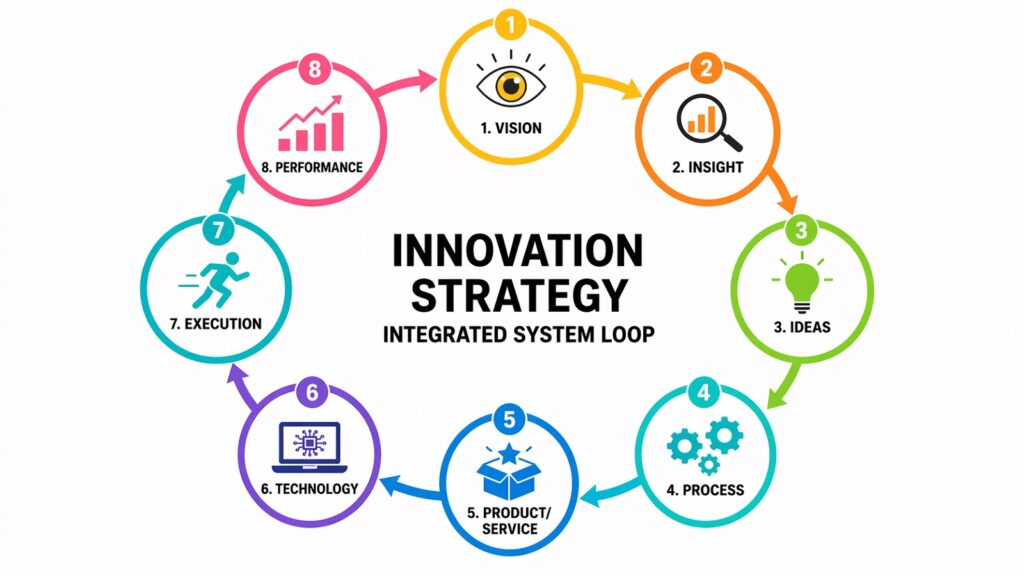
This article explores eight connected aspects of innovation strategy. Together they form a complete system that moves from thinking to structure to execution to measurement. Each aspect matters on its own, but the real power comes from how they work together. The eight aspects are shown in the table below.
Innovation Strategy: 8 Core Aspects at a Glance
| Innovation Strategy Aspect | What It Covers |
| Innovation Vision and Strategic Alignment | Connecting innovation goals directly to overall business direction and long-term purpose |
| Market Insight and Opportunity Discovery | Reading market signals, understanding customer needs, and spotting emerging gaps |
| Idea Generation and Innovation Culture | Building an environment where creative thinking and experimentation are genuinely encouraged |
| Innovation Process and Framework Design | Creating repeatable stages to move ideas from concept to working solution |
| Product and Service Innovation Strategy | Turning ideas into real offerings that solve problems and deliver measurable value |
| Technology and Digital Innovation Integration | Using digital tools, automation, and data to move faster and make smarter decisions |
| Innovation Execution and Scaling Models | Taking validated ideas through testing, iteration, and expansion across the organization |
| Innovation Performance and Governance Systems | Measuring outcomes, maintaining accountability, and learning from both success and failure |
1. Innovation Strategy Through Vision and Strategic Alignment
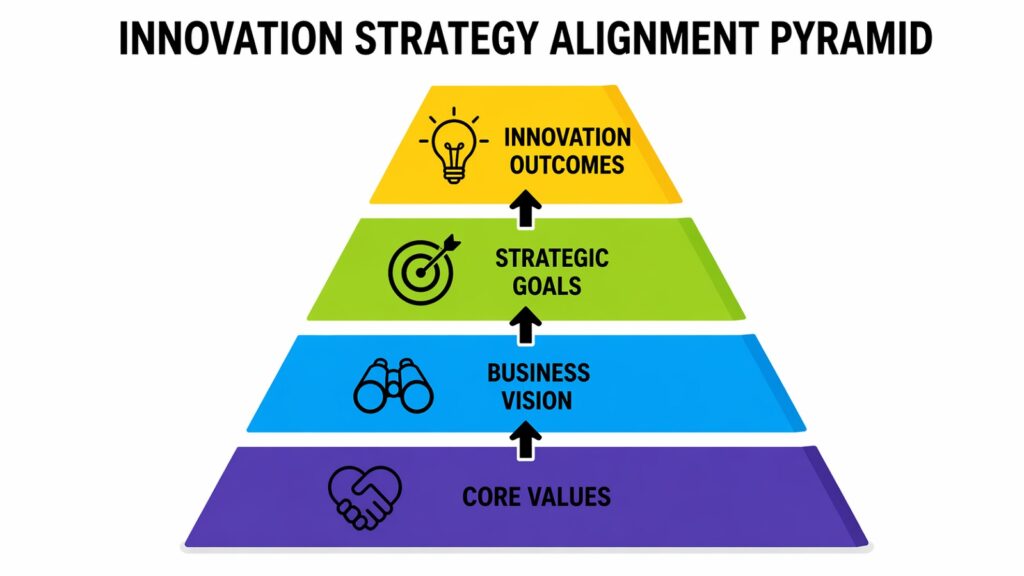
Every meaningful innovation begins with a question: what are we trying to become? That question is not philosophical. It is practical. Without a clear answer, innovation decisions scatter. Teams pursue ideas and visions that interest them personally but do not serve the business. Resources go toward projects that sound impressive but do not move the company closer to where it wants to go.
Innovation strategy starts with clarity of purpose. Innovation vision tells the business which problems are worth solving. Strategic alignment ensures that innovation efforts stay connected to that vision at every level, from the executive team down to the product manager deciding which feature to build next.
When Amazon declared its intention to be the most customer-centric company on earth, it was not just a motto. It became the lens through which every innovation decision was filtered. Should we build one-click purchasing? Does it serve the customer better? Should we create a cloud platform that others can use? If it removes friction and delivers value, yes. That kind of alignment transforms innovation from a collection of interesting experiments into a directed force that compounds over time.
Misalignment is expensive. A study by Bain and Company found that companies where frontline teams understand and believe in the strategy grow up to 40 percent faster than those where strategy is unclear or unevenly communicated. Innovation without alignment burns the same resources twice, once building something and again abandoning it when leadership discovers it does not fit.
The table below captures how different elements of strategic vision shape and guide a practical innovation strategy.
Innovation Strategy: Vision and Alignment Factors
| Vision Element | How It Drives Innovation Strategy |
| Mission Clarity | Companies like Patagonia tie innovation directly to their environmental mission, guiding every product decision |
| Strategic Intent | Amazon’s early statement of being the most customer-centric company shaped decades of service innovation |
| Long-Term Horizon | Toyota’s 100-year thinking model keeps R&D investments aligned even when short-term returns are uncertain |
| Leadership Commitment | Research by McKinsey shows companies where CEOs champion innovation grow revenue 2.4 times faster than peers |
| Shared Language | Aligning teams on what innovation means inside the organization reduces duplication and speeds decision-making |
| Innovation Scope | Apple defines its scope as user experience, not just hardware, which narrows focus and sharpens results |
| Portfolio Balance | BCG’s research shows that top innovators allocate 70% of effort to core, 20% to adjacent, and 10% to new markets |
| Governance Alignment | Without board-level backing, even well-funded innovation programs stall within two to three years of launch |
2. Innovation Strategy Through Market Insight and Innovation Opportunities
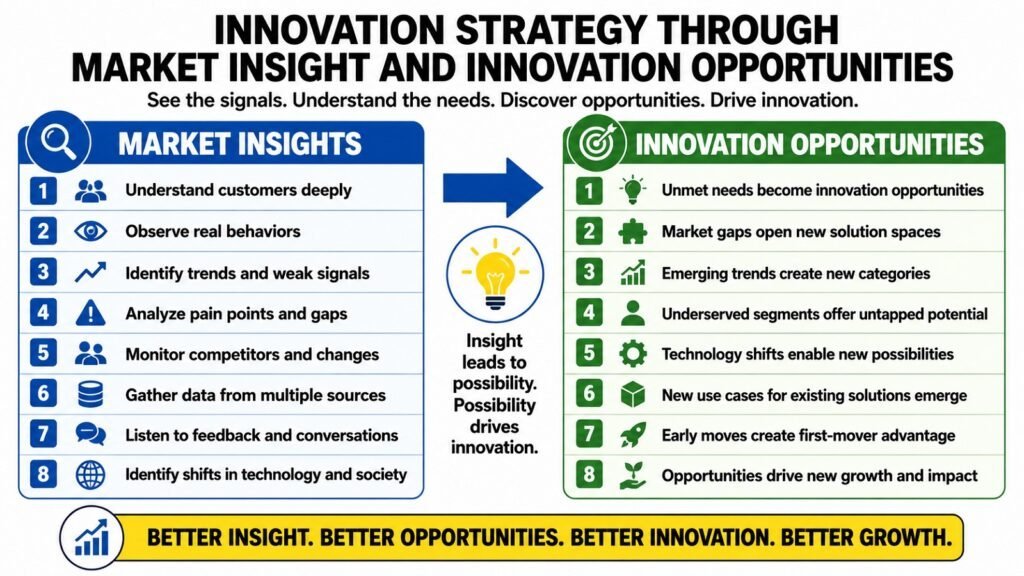
Innovation that is not grounded in the real world can impress at demos but disappoint in the market. A strong Innovation Strategy treats market insight not as research homework but as the foundation for identifying meaningful innovation opportunities. The best innovations rarely come from inventing something from nothing. They emerge from paying attention to what people struggle with, what they tolerate, and what they would change if they could.
This kind of insight requires more than surveys and focus groups. Businesses must observe how people actually behave, not simply what they say they want. They must also recognize signals that indicate changing needs, expectations, technologies, and market conditions before those shifts become obvious. Companies that embed market insight into their Innovation Strategy can understand problems more deeply and identify opportunities earlier than competitors relying mainly on surface-level data.
Airbnb offers a useful example. Its founders noticed people renting out air mattresses in San Francisco apartments because hotels were full during a conference. Rather than treating this as an isolated event, they recognized an innovation opportunity: unused residential space could become an alternative form of accommodation. That observation helped inspire a new category of business.
Innovation opportunities are rarely discovered by luck alone. They emerge when companies systematically gather, interpret, and connect market signals with customer problems and emerging needs. When this capability becomes part of Innovation Strategy, businesses can move beyond reacting to established trends and begin identifying opportunities early enough to shape new products, services, experiences, and business models.
Innovation Strategy: From Market Insight to Innovation Opportunities
| Innovation Strategy | Market Insight & Innovation Opportunities |
|---|---|
| Strategic Alignment | Market insight helps align innovation priorities with changing customer needs, market conditions, and long-term business objectives. |
| Opportunity Identification | Market signals reveal unmet needs, market gaps, emerging demands, and potential areas where innovation can create meaningful value. |
| Customer-Centric Innovation | Customer behavior, frustrations, expectations, and workarounds uncover opportunities for developing more relevant and valuable solutions. |
| Trend Anticipation | Emerging trends, behavioral shifts, and weak signals help businesses identify innovation opportunities before they become widely recognized. |
| Competitive Differentiation | Competitor gaps and changing customer expectations reveal opportunities to create distinctive value and strengthen competitive positioning. |
| Resource Prioritization | Market evidence helps businesses evaluate, compare, and prioritize innovation opportunities according to potential value, feasibility, and strategic fit. |
| Innovation Portfolio Development | Multiple market opportunities can shape a balanced portfolio of incremental, adjacent, and potentially transformative innovation initiatives. |
| Growth Strategy | Innovation opportunities identified through market insight can support new products, services, markets, customer segments, and businesses |
3. Innovation Strategy Through Idea Generation and Innovation Culture
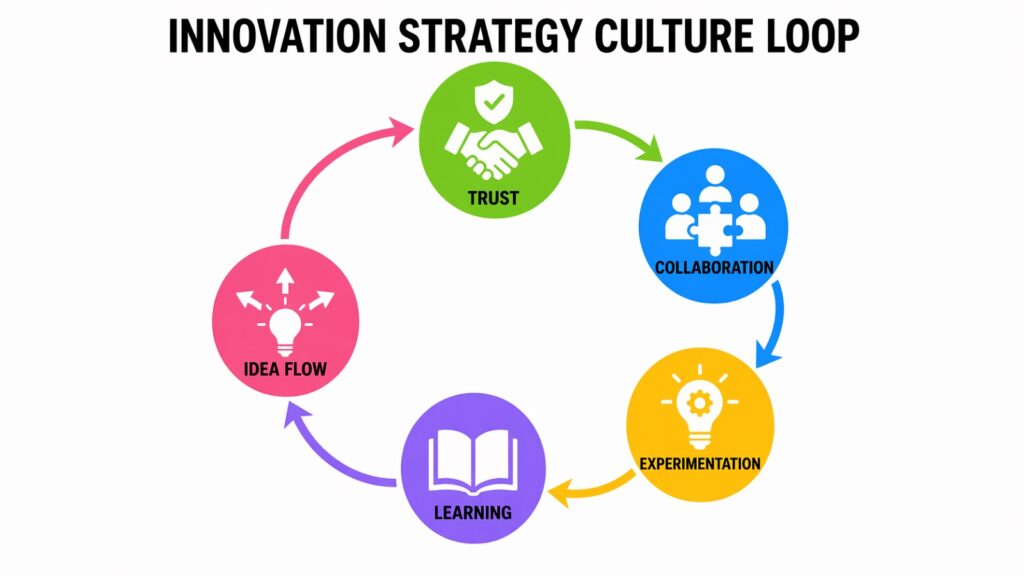
There is a painful irony that runs through many organizations. They declare innovation a top priority, hang motivational posters in conference rooms, and set up suggestion boxes that no one uses. Then they wonder why fresh ideas never come. The answer is usually cultural, not structural. Ideas need a specific kind of environment to appear and survive, and most workplaces are not designed to provide it.
Innovation strategy depends on culture because culture is the medium through which ideas either grow or die. A company where employees fear ridicule for suggesting something unconventional will never produce an abundance of useful ideas. A company where middle managers quietly kill anything that threatens their department’s budget will never sustain meaningful innovation. No process or framework can overcome a culture that does not genuinely value new thinking.
Building an innovation culture means investing in psychological safety. Amy Edmondson of Harvard Business School defines psychological safety as the belief that one will not be punished or humiliated for speaking up with ideas, questions, concerns, or mistakes. In organizations where that belief is strong, employees contribute more, experiment more, and recover from failure faster. These are exactly the conditions that an innovation strategy needs to function.
Culture also requires active leadership. When leaders model curiosity, openly discuss what they do not know, and respond to new ideas with questions rather than judgments, they signal that the organization is genuinely open. That signal travels fast. Microsoft’s cultural transformation under Satya Nadella, from a culture of internal competition to one of collaborative learning, helped the company recover its position as one of the most innovative large companies in the world.
Innovation Strategy: Culture Elements and Their Impact
| Culture Element | Its Role in Sustaining Innovation Strategy |
| Psychological Safety | Google’s Project Aristotle found that teams where members feel safe to speak up produce more innovative outcomes |
| Tolerance for Failure | 3M’s famous 15% free time policy allowed employees to experiment, leading to Post-it Notes among other products |
| Cross-Functional Collaboration | Pixar’s physical office design was intentionally built to force random encounters between different teams |
| Intrinsic Motivation | Daniel Pink’s research shows autonomy, mastery, and purpose drive creativity more effectively than financial reward |
| Recognition of Ideas | Tata Group’s InnoVerse platform collected over 100,000 ideas in two years by making contribution visible and valued |
| Continuous Learning Culture | Microsoft’s shift from a know-it-all to a learn-it-all culture under Satya Nadella reversed years of stagnation |
| Diversity of Thought | Boston Consulting Group found that companies with above-average diversity generate 19% more innovation revenue |
| Leadership Modeling | When leaders visibly participate in ideation and openly admit failures, teams follow with greater creative risk-taking |
4. Innovation Strategy Through Process and Framework Design
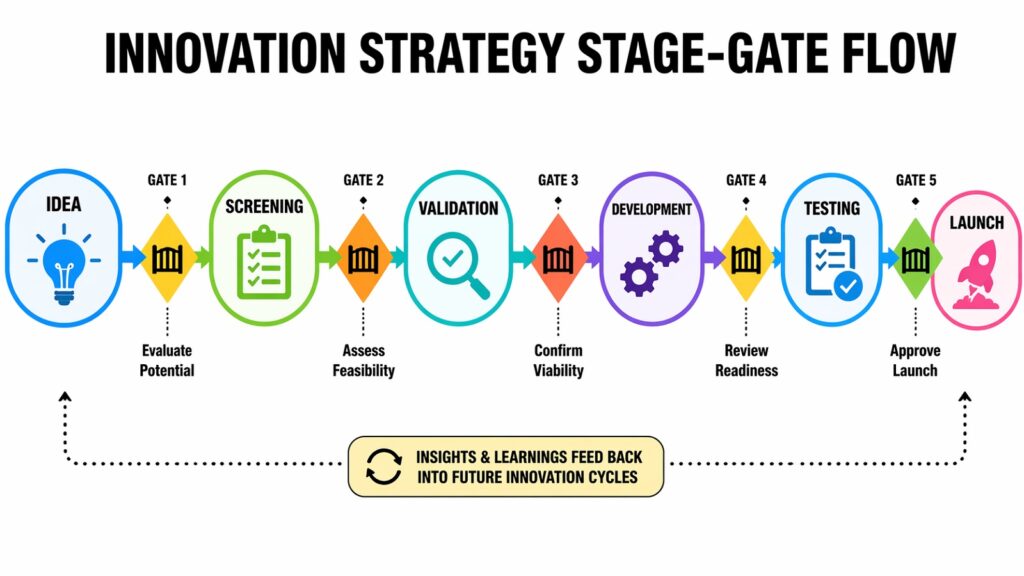
Great ideas without a reliable path to market are just intentions. One of the most common reasons innovation fails inside large organizations is not a shortage of ideas but a shortage of structure to move those ideas forward. Innovation strategy needs process because without it, momentum stalls, ownership blurs, and promising concepts quietly disappear.
A well-designed innovation framework does not bureaucratize creativity. It channels it. By creating clear stages through which ideas move, organizations reduce the chaos that often surrounds early-stage innovation while keeping enough flexibility to let good ideas evolve as they are tested. The goal is consistency, not rigidity.
Robert Cooper’s Stage-Gate process, developed in the 1980s and still widely used today, introduced the idea of structured review points where innovation projects are evaluated before moving to the next phase. The beauty of the model is not its specificity but its logic: innovation should be a series of informed decisions, not a leap of faith followed by years of expensive development. Each gate asks a simple question: do we know enough to justify the next investment?
Design Thinking, developed and popularized by IDEO and later integrated into the curriculum at Stanford’s d.school, offers a complementary framework that keeps human understanding at the center of every stage. By cycling through empathy, definition, ideation, prototyping, and testing, teams stay connected to the real problems they are solving even as the work becomes more technical.
What matters most is that organizations choose a framework and apply it consistently. An imperfect process applied consistently produces better outcomes than a perfect process applied occasionally.
Innovation Strategy: Process Framework Stages and Their Functions
| Framework Stage | Function Within Innovation Strategy |
| Opportunity Framing | Defines the problem worth solving before ideas are generated, preventing wasted effort on wrong questions |
| Ideation Phase | Structured brainstorming sessions with diverse participants produce more varied and higher-quality starting concepts |
| Concept Validation | Stage-gate reviews, as popularized by Robert Cooper, filter ideas by feasibility before significant investment |
| Prototype Development | Low-fidelity prototypes allow teams to test assumptions quickly without committing full engineering resources |
| Pilot Testing | Running controlled pilots in limited markets gives real data without the risk of a full-scale rollout failure |
| Scaling Decision | Evidence from pilots informs the investment case, reducing executive guesswork about what to fund next |
| Learning Loops | After each stage, teams document what was learned to improve the process for the next innovation cycle |
| Portfolio Review | Regular reviews of the entire innovation portfolio ensure the pipeline stays balanced and strategically relevant |
5. Innovation Strategy in Product and Service Development
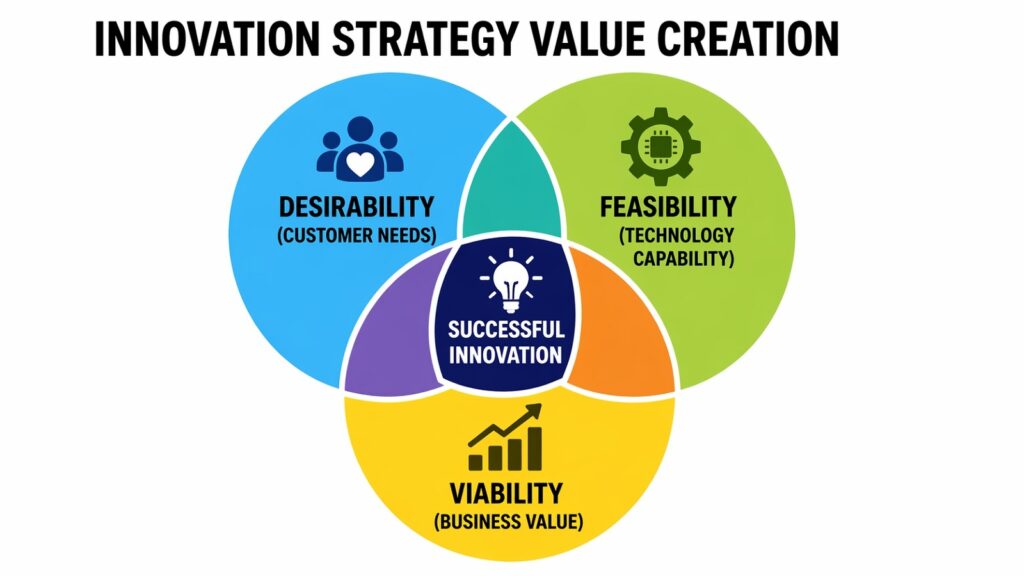
Innovation eventually has to become something tangible. It has to become a product someone buys, a service someone uses, an experience someone remembers. The distance between a good idea and a good product is not just technical. It is filled with decisions about what matters most to the customer, what the company can actually deliver, and how the offering will stand apart in a market full of alternatives.
The product and service innovation strategy is where the thinking of earlier stages gets tested against reality. This is where companies discover whether their market insight was accurate, whether their process was sound, and whether their cultural commitment to innovation translates into something customers actually want.
The most successful product innovations are not necessarily the most technically sophisticated. They are the ones that solve a real problem better than anything else available. Dyson did not invent vacuum cleaners. It reinvented the experience of using one by eliminating the bag, improving suction, and making the machine easier to maneuver. The technology behind Dyson products is impressive, but the driving force was always user frustration with existing solutions.
Service innovation follows similar logic. When Charles Schwab introduced 24-hour customer service and transparent fee structures in the brokerage industry, it was not inventing new financial instruments. It was rethinking what customers deserved from their financial services provider. That focus on customer experience became the foundation for years of competitive advantage.
Innovation strategy in product and service development works best when teams stay close to the customer throughout the process, not just at the beginning and end. Continuous feedback loops allow adjustments before problems become expensive.
Innovation Strategy: Product and Service Innovation Examples
| Innovation Output | Value Created Through Innovation Strategy |
| Minimum Viable Product | Amazon’s approach of launching early and improving quickly allowed AWS to dominate cloud before rivals caught on |
| Platform Products | Apple’s iOS ecosystem created a product platform that generates more revenue from services than hardware annually |
| Service Redesign | Starbucks reinvented the coffee shop experience by treating the store as a third place, not just a retail outlet |
| User Experience Innovation | Dyson’s product innovation was not new technology but dramatically better interaction with existing technology |
| Subscription Models | Adobe’s shift from boxed software to Creative Cloud subscriptions increased annual revenue by over 300% in a decade |
| Modular Innovation | LEGO’s modular design philosophy lets customers co-create products, reducing development cost while expanding range |
| Problem-Centered Design | IDEO’s human-centered design method focuses on deeply understanding user struggle before designing any solution |
| Competitive Differentiation | In markets with similar features, companies that innovate on reliability or support gain durable loyalty advantages |
6. Innovation Strategy Through Technology and Digital Integration
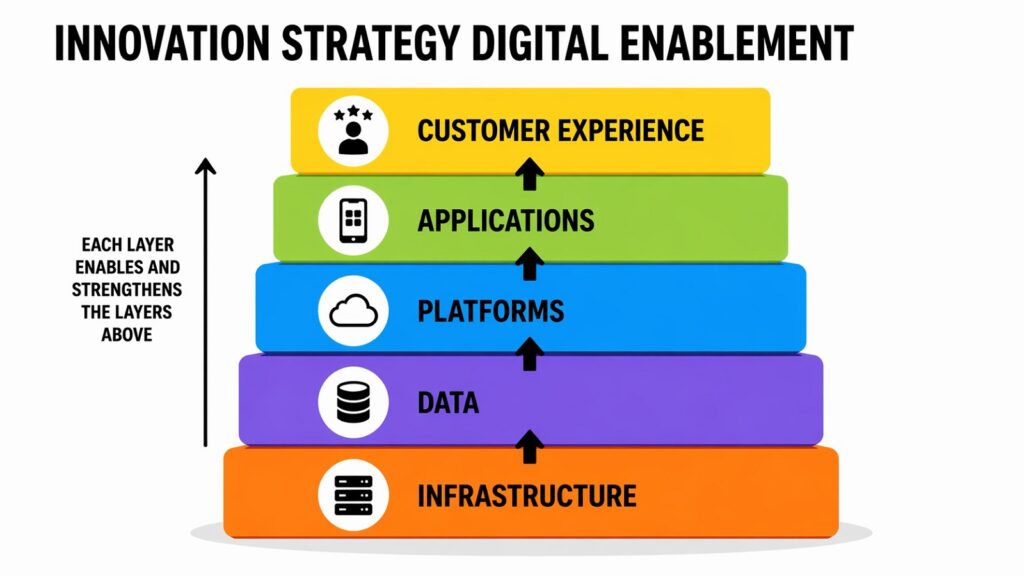
Technology does not replace innovation strategy. It amplifies it. When digital tools, data systems, and automation are woven into how a company innovates, the speed and quality of that innovation improves significantly. But technology for its own sake rarely produces useful results. The companies that extract the most value from digital investment are those that use it to solve specific problems within their existing innovation strategy.
Digital integration changes the pace of learning. Traditional product development cycles could take years. Digital tools compress that timeline. A company can now run a controlled experiment on a new service feature in days and get statistically meaningful data before committing engineering resources to a full build. That kind of speed changes the risk profile of innovation entirely.
Data is the most underused asset in most companies. Organizations collect enormous amounts of information about customer behavior, operational performance, and market signals, but relatively few use that data systematically to guide innovation decisions. Companies that build data literacy into their innovation strategy develop a compound advantage: every experiment they run makes them smarter about what to do next.
Automation, meanwhile, frees human talent from repetitive work and directs it toward creative problem-solving. This is not about replacing people. It is about changing what they spend their time on. When routine tasks are handled by automated systems, innovation teams can focus on the work that genuinely requires human judgment, empathy, and imagination.
Technology Enablers and Their Business Impact
| Technology Enabler | Impact on Innovation Strategy |
| Cloud Computing | AWS and Azure let startups build at scale without infrastructure investment, lowering the barrier to innovation |
| Artificial Intelligence | McKinsey estimates AI could add $13 trillion to global economic output by 2030 through process and product innovation |
| Advanced Analytics | Real-time data analysis lets companies test and learn from customer behavior faster than quarterly surveys allow |
| Internet of Things | Connected devices create new data streams that reveal product usage patterns previously invisible to designers |
| Digital Twins | Manufacturing companies use digital twins to simulate product changes before physical production, cutting trial costs |
| Automation Tools | Robotic process automation frees human teams from repetitive work, allowing more time for creative problem-solving |
| API Ecosystems | Open APIs allow companies to build on each other’s capabilities, accelerating innovation without building everything internally |
| No-Code Platforms | Tools like Airtable and Webflow allow non-technical teams to test product ideas without requiring developer time |
7. Innovation Strategy in Execution and Scaling Models
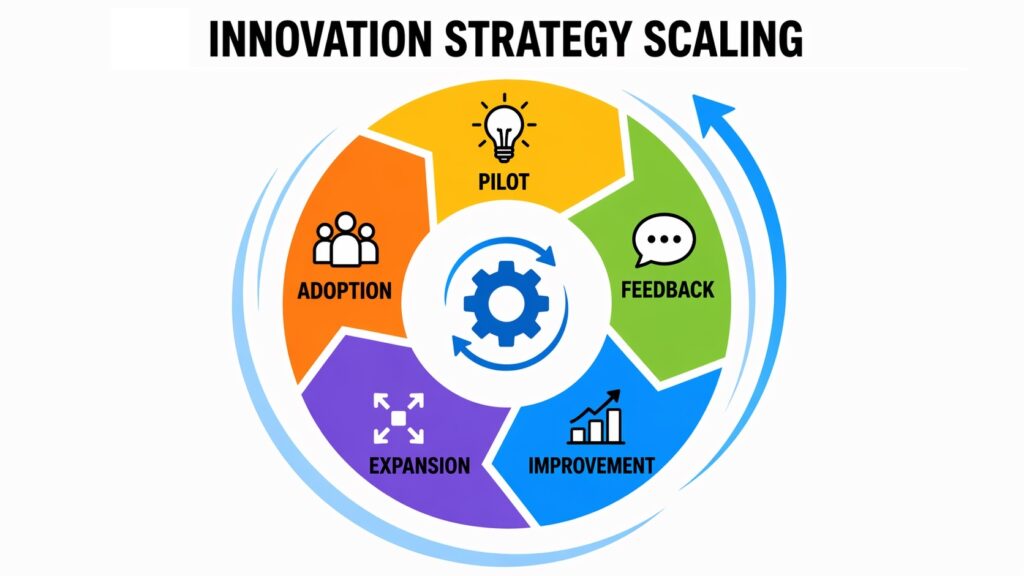
There is a graveyard of brilliant innovation strategies that died not in the planning room but on the way to the market. Execution is where most innovation efforts lose their way. Ideas that survived rigorous testing and gained leadership approval still fail because the organization could not carry them from small pilots to full-scale programs. Innovation strategy that stops at ideation and process design is only half a strategy.
Execution requires a different set of skills than innovation. The creative energy that generates ideas is not always the same as the disciplined focus needed to deliver results at scale. Successful companies recognize this and build execution capacity alongside creative capacity. They staff innovation teams with people who understand both how to explore and how to deliver.
Scaling is its own discipline. What works in a controlled pilot does not automatically work when it encounters the full complexity of the business environment. Customer support systems, supply chains, compliance processes, and internal tools all need to be ready. When companies rush from pilot to scale without stress-testing these dependencies, they create painful customer experiences that can set back even the best innovations.
The most effective scaling models combine agility with structure. They move quickly enough to maintain momentum but deliberately enough to ensure quality. Jeff Bezos described Amazon’s approach as being stubborn on vision and flexible on detail. That distinction matters enormously in execution. The destination stays fixed; the path adjusts as new information arrives.
Execution also demands honest conversations about what is not working. Many innovation programs fail because no one is willing to call a failing initiative what it is. Governance systems that reward candor and create clear criteria for stopping, pivoting, or continuing give execution teams the clarity they need to make good decisions fast.
Innovation Strategy: Execution and Scaling Factors
| Execution Factor | Its Importance in Innovation Strategy |
| Pilot-to-Scale Roadmap | Companies that plan the path from test to rollout before launching pilots waste significantly less time transitioning |
| Agile Methodology | Spotify’s squad model breaks large organizations into small autonomous teams that can execute and adapt quickly |
| Resource Allocation | Innovation budgets must be protected even in downturns; PwC research shows consistent innovators outperform in recoveries |
| Change Management | Kotter’s 8-step change model shows that innovation fails more often from human resistance than technical problems |
| Cross-Boundary Execution | GE’s FastWorks program trained 6,000 leaders to run lean startup principles inside a large industrial company |
| Fail-Fast Discipline | Setting clear failure criteria in advance allows teams to kill weak ideas early and redeploy resources to stronger ones |
| Scaling Infrastructure | Operations, supply chain, and support systems must be stress-tested before a new product is taken to full scale |
| Ecosystem Partnerships | Apple and Google scale innovation faster by letting third-party developers extend their platforms globally |
8. Innovation Strategy Through Performance and Governance Systems
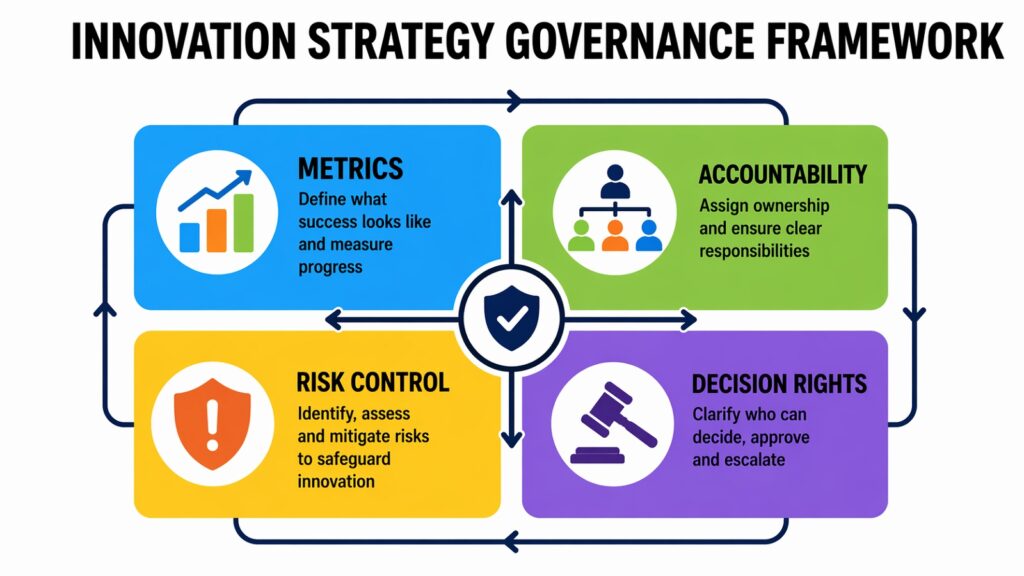
What gets measured gets managed. That principle is older than modern business, but it applies with particular force to innovation strategy. Organizations that do not measure their innovation performance have no reliable way to know whether they are getting better or worse, which investments are working, or where the system is breaking down. Measurement is not bureaucracy. It is the feedback loop that allows continuous improvement.
The challenge with measuring innovation is that the most important outcomes often take time to appear. A technology investment made today may not produce revenue for three years. A cultural change begun this quarter may not show up in productivity data until next year. This does not mean those investments are wrong. It means organizations need a layered approach to measurement, tracking both leading indicators of innovation health and lagging indicators of business impact.
Governance brings accountability to the innovation process. It ensures that investment decisions are made thoughtfully, that failing initiatives are addressed before they consume disproportionate resources, and that the lessons of each innovation cycle are captured and applied to the next. Without governance, innovation programs tend to drift toward the comfortable and familiar rather than the strategically important.
Good governance does not mean excessive control. The goal is to create enough structure to maintain direction and accountability without stifling the creative energy that makes innovation possible in the first place. Companies like Intel have used portfolio-level innovation reviews to maintain strategic coherence while still allowing individual teams the autonomy to explore. That balance is difficult to achieve but worth pursuing.
The most mature innovation strategies close the loop between performance data and strategic decisions. When teams can see what is working, they invest more confidently. When they can see what is not working, they course-correct earlier. Over time, that discipline compounds into a measurable and sustainable competitive advantage.
Innovation Strategy: Governance and Performance Elements
| Governance Element | Role in Innovation Strategy |
| Innovation KPIs | Metrics like idea conversion rate, time-to-market, and revenue from new products give leadership objective insight |
| Stage-Gate Reviews | Formal review points ensure accountability and allow resource reallocation before investments become irreversible |
| Innovation Accounting | Eric Ries proposed metrics like validated learning and activation rate to measure early-stage progress meaningfully |
| Portfolio Dashboards | Visualization of the full innovation pipeline by stage helps senior teams spot bottlenecks and imbalances early |
| Return on Innovation | Tying innovation outcomes to business returns keeps the program commercially grounded rather than idea-driven |
| Learning Reviews | Post-mortem analysis of failed innovations surfaces systemic issues that process changes can prevent in future cycles |
| Ethics and Risk Oversight | As innovations touch data, AI, and customer experience, governance must include responsible innovation guidelines |
| Board-Level Reporting | Companies that report innovation metrics to boards demonstrate that innovation is treated as a strategic asset, not a project |
Conclusion: Innovation Strategy as a Continuous Growth Engine
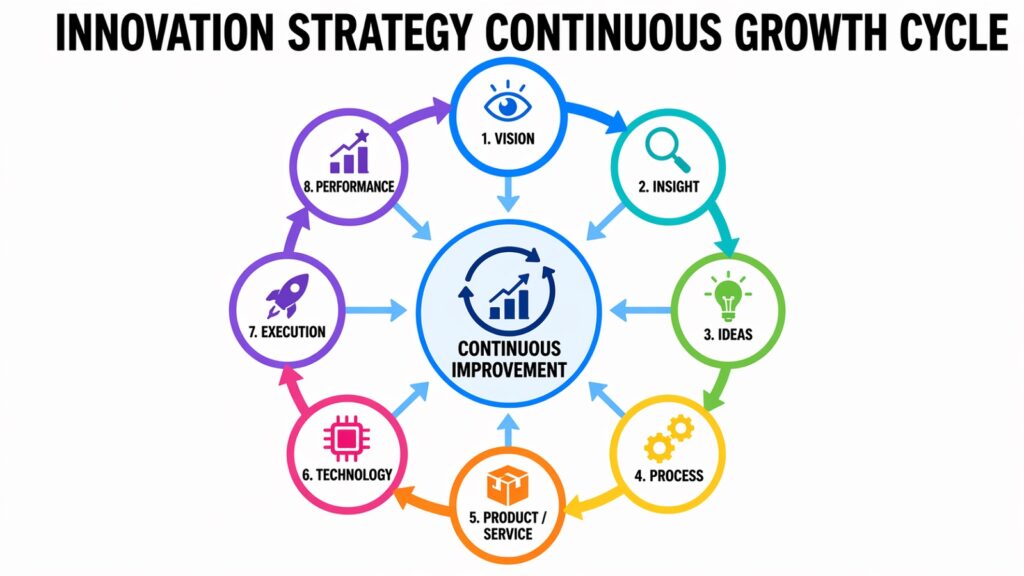
There is something quietly humbling about looking at the full arc of what innovation strategy requires. It is not one big idea or one brilliant product launch. It is a system, patiently built and carefully maintained, that turns vision into action and action into results. The eight aspects explored in this article are not separate projects. They are interconnected parts of a single, ongoing effort to grow with purpose.
Companies that treat innovation as an event tend to peak once. They find a breakthrough, ride it for a few years, and gradually lose ground as the market moves on without them. Companies that treat innovation as a system build something more durable. They develop the capacity to see new opportunities, generate responses, execute those responses well, and learn from every cycle. That capacity does not expire. It compounds.
The numbers support this view. Boston Consulting Group’s annual innovation report consistently shows that companies that maintain investment in innovation through market downturns outperform their peers by a significant margin in the years that follow. The advantage is not just in individual products or services. It is in the organizational capability that sustained innovation builds over time.
There exists a particular sense of nostalgia when observing companies that once dominated their sectors cease to innovate and gradually diminish. Kodak developed the digital camera in 1975 yet opted not to follow through with it. Blockbuster had the opportunity to purchase Netflix in 2000 for $50 million but chose to pass. These narratives do not depict malevolent individuals making thoughtless choices. Rather, they illustrate organizations that have disconnected from the innovation strategies that previously contributed to their success.
The lesson is not dramatic. It is quiet and steady: build the system, maintain it honestly, measure what matters, and never mistake a successful product for a permanent advantage. Innovation strategy is not a destination. It is the road. The table below summarizes how each of the eight aspects contributes to long-term growth when treated as part of a connected and continuous system.
Innovation Strategy: Contribution of Each Aspect to Long-Term Growth
| Innovation Strategy Aspect | Long-Term Growth Contribution |
| Innovation Vision and Strategic Alignment | Keeps every team pointed at the same horizon so effort compounds rather than cancels out |
| Market Insight and Opportunity Discovery | Ensures the business stays relevant by responding to real shifts in customer needs and markets |
| Idea Generation and Innovation Culture | Creates a constant pipeline of possibilities so growth is never held back by a shortage of ideas |
| Innovation Process and Framework Design | Brings predictability to innovation so organizations can improve output without burning resources |
| Product and Service Innovation Strategy | Delivers the tangible results customers experience, which is ultimately what drives revenue and loyalty |
| Technology and Digital Innovation Integration | Accelerates every other aspect of innovation by making information available faster and execution more precise |
| Innovation Execution and Scaling Models | Converts good ideas into real impact by ensuring that what works in small pilots grows into full programs |
| Innovation Performance and Governance Systems | Closes the learning loop so each cycle of innovation builds on the last rather than repeating old mistakes |