Table of Contents
Introduction: Why Startup Strategy Drives Fast Growth and Early Success
Most startups that fail do not fail because their idea was bad. They fail because nobody stopped long enough to think about direction. The product might be interesting. The founders might be passionate. But without a clear startup strategy, that energy tends to scatter. It goes in too many directions at once, and nothing meaningful gets built.
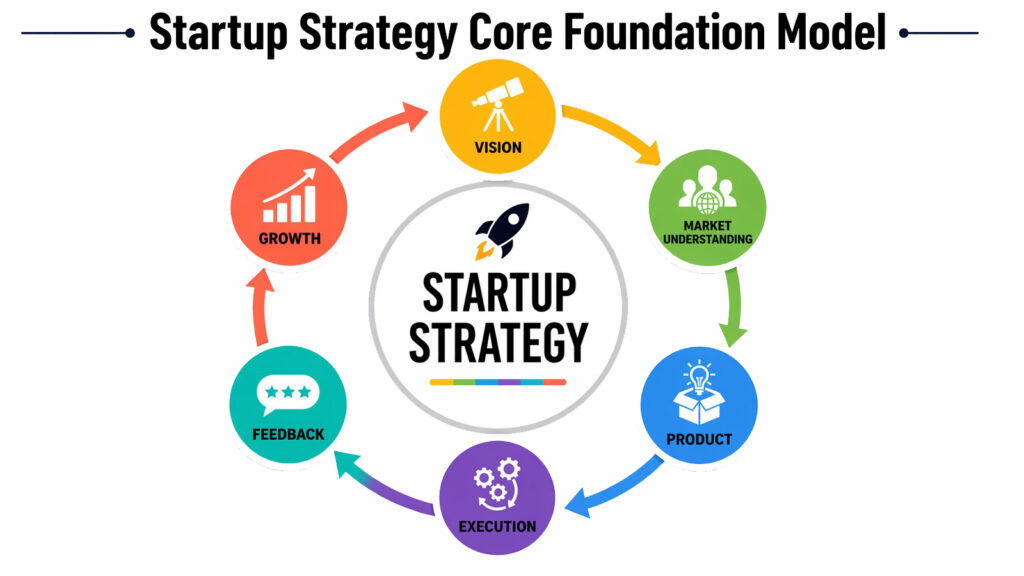
Startup strategy is not a formal document that sits in a drawer. It is one of the most important business essentials. Startup strategy is the way a founding team thinks about every decision, from who to serve to how to spend the first hundred dollars. It shapes priorities. It keeps the team from chasing things that look exciting but lead nowhere. When you have a strategy, the noise gets quieter. The path feels more real.
A lot of early-stage teams skip this part. They want to move fast, which is a good instinct. But moving fast without direction is just spinning. The startups that grow quickly are usually the ones that knew, early on, what they were doing and why. Strategy gave them that clarity.
This article walks through eight steps that build on each other. They cover everything from early clarity to avoiding the mistakes that quietly kill most young companies. Each step connects back to one central idea: startup strategy is not a one-time exercise but something that evolves with every lesson learned.
Startup Strategy: Overview of 8 Key Areas Covered in This Article
| Startup Strategy Areas | What It Means for Startup Strategy |
| Early Startup Strategy | Defines the problem, audience, and value proposition before any resources are committed |
| Startup Launch Checklist | Translates strategy into structured action steps covering business model, product, and operations |
| Product Market Fit | Tests whether the product genuinely solves a problem the market is willing to pay for |
| MVP Development | Builds the smallest functional version of a product to gather real user feedback quickly |
| Startup Funding Options | Evaluates financing sources based on goals, control preferences, and growth timeline |
| Customer Acquisition Strategies | Identifies the most cost-effective channels to reach and convert the target audience |
| Startup Growth Strategies | Creates systems for steady, sustainable expansion without losing operational stability |
| Startup Mistakes to Avoid | Recognizes common errors in judgment that slow progress or drain early-stage resources |
1. Startup Strategy for Early Stage Clarity and Direction
The beginning of a startup is a strange place to be. There are so many startup ideas, so many possible paths, and nobody around to tell you which one is right. Most founders feel this. The confusion is not a sign of weakness. It is just what the early stage looks like before the startup strategy steps in and starts doing its job.
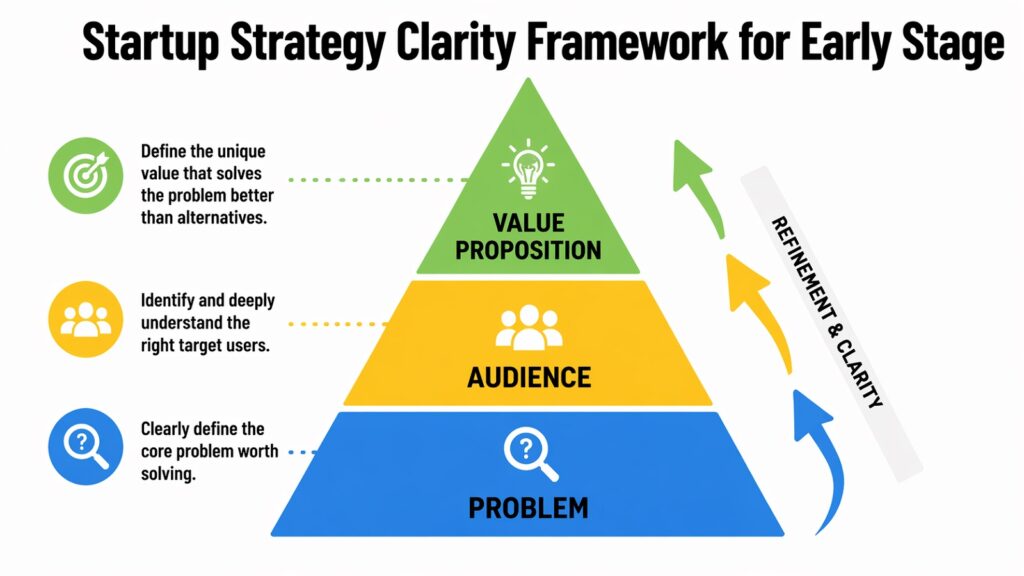
Clarity does not come from having more options. It comes from narrowing down. A strong startup strategy at this stage asks a few honest questions. What problem are you actually solving? Who has this problem badly enough to care? Why would your solution be better than whatever they are using now? These questions sound simple, but most teams skip them because they feel impatient to build.
Early decisions carry more weight than they seem. Choosing the wrong audience in month one can mean months of wasted work before the error becomes visible. Startup strategy helps founders make those early calls with more intention and less guesswork. It is not about being certain. It is about being deliberate.
When everything is filtered through a clear purpose, the team stops debating things that do not matter. The noise drops. Priorities emerge. And the work starts to feel less like wandering and more like progress.
Startup Strategy: Early Stage Clarity Factors and Their Strategic Importance
| Clarity Factor | Why It Matters for Early Startup Strategy |
| Problem definition | Prevents teams from building solutions to problems that do not meaningfully affect the target user |
| Audience specificity | Narrows focus so marketing and product decisions serve a real group rather than an abstract one |
| Value proposition | Articulates why the solution is better, faster, or cheaper than existing alternatives |
| Founder alignment | Ensures all co-founders share the same vision before resources and time are committed |
| Market size awareness | Confirms the opportunity is large enough to justify the effort and eventual fundraising |
| Resource mapping | Identifies what the team has versus what it needs to reach its first meaningful milestone |
| Competitive awareness | Acknowledges who else is working on the same problem and what differentiates this approach |
| Decision filters | Creates simple rules that help the team say no to ideas that fall outside the core purpose |
2. Startup Strategy Through a Practical Startup Launch
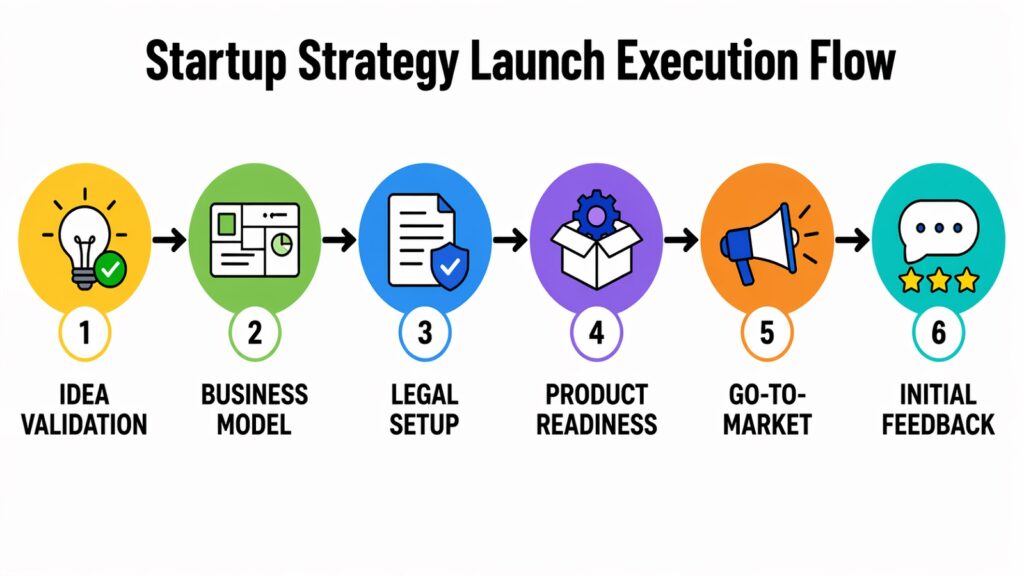
Having a direction is one thing. Turning that direction into a working business and taking it to market is another. This is where many founders stall. The thinking feels good, the conversations feel productive, but nothing concrete gets done. A startup launch brings the Startup Strategy into action mode, turning plans into decisions, activities, and measurable progress toward entering the market.
A launch is not simply about making the product available. It is about making sure the important parts of the business are ready to work together. What is the business model? Who are the first customers? How will the product reach them? Are the basic operations, sales, support, and communication systems ready? These are the questions that turn a Startup Strategy into a practical launch process.
A Startup Launch Framework can support this process by making key requirements visible. It does not need to cover every possible detail. Instead, it should capture the most important tasks and decisions that need to be completed before and during launch. Crafting the framework can also reveal gaps that founders may have overlooked, giving the team time to address them before they become costly problems.
The goal is not to create a perfect framework or a flawless launch. The goal is to turn strategy into coordinated action and give the team a clear path into the market. A practical launch creates momentum, while a focused framework helps keep that momentum from turning into chaos.
Startup Strategy: Startup Launch Components and Their Purpose
| Components | Role in Startup Strategy Execution |
| Business model definition | Confirms how the startup will generate revenue and what the unit economics look like at small scale |
| Legal entity setup | Establishes the right legal structure to protect founders and prepare for future fundraising |
| Product readiness check | Ensures the product is functional enough to deliver value to the first real users |
| Pricing decision | Sets a price that reflects value without deterring early adoption or undervaluing the product |
| Basic operations setup | Puts in place the tools and processes needed to deliver, support, and track the product |
| Initial marketing plan | Identifies how the first users will learn about the product and where they will come from |
| Customer support readiness | Prepares a simple way to hear from and respond to users during the early launch window |
| Success metrics definition | Defines what a good early result looks like so the team knows whether the launch worked |
3. Startup Strategy for Achieving Product Market Fit
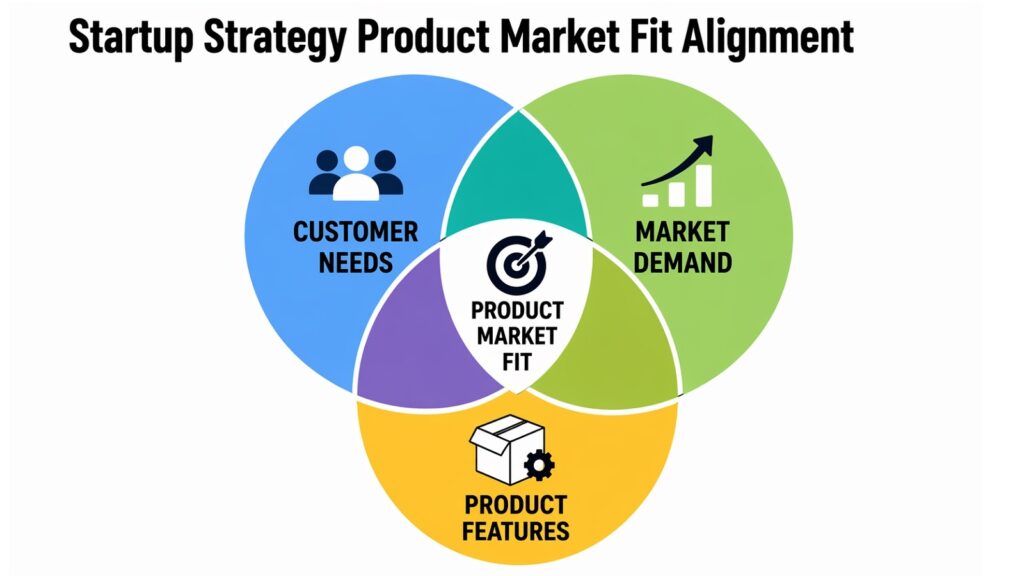
Product market fit is one of those phrases that gets used a lot without much explanation. What it really means is simple: enough people want what you are building, and they want it enough to stick around and tell others. When that happens, the business starts to feel like it has momentum. When it does not happen, everything feels like pushing a boulder uphill.
Startup strategy plays a major role in reaching this point. It is not something you stumble into. It requires listening to users carefully, testing small changes, and being honest about what the data is telling you. Most teams hear what they want to hear. Strategy means building a habit of hearing what is actually true.
The loop looks something like this: talk to users, build something small, watch how they use it, adjust, and repeat. Each cycle brings you closer to something that genuinely fits. There is no shortcut. But teams with a clear startup strategy move through these cycles faster because they know what they are testing and why.
Many early-stage companies have confused user interest with product-market fit. People saying something sounds interesting is not the same as people using it consistently, paying for it, or being genuinely upset if it went away. Strategy helps you tell the difference.
Startup Strategy: Product Market Fit Indicators and Measurement Approaches
| Fit Indicator | How It Informs Startup Strategy Decisions |
| Retention rate | Measures whether users return after their first experience, indicating real ongoing value |
| Net Promoter Score | Gauges how likely users are to recommend the product, reflecting genuine satisfaction |
| Organic referral rate | Shows whether users are spreading the word without paid incentives or advertising effort |
| Customer interviews | Provides qualitative insight into what users value most and where they feel friction |
| Churn analysis | Identifies which user segments leave and why, pointing to product or positioning gaps |
| Willingness to pay | Tests whether users see enough value to exchange money for the product or service |
| Usage frequency | Tracks how often users engage, separating casual interest from habitual reliance |
| Sean Ellis test | Asks users how disappointed they would be if the product disappeared; 40 percent threshold signals fit |
4. Startup Strategy for Efficient MVP Development
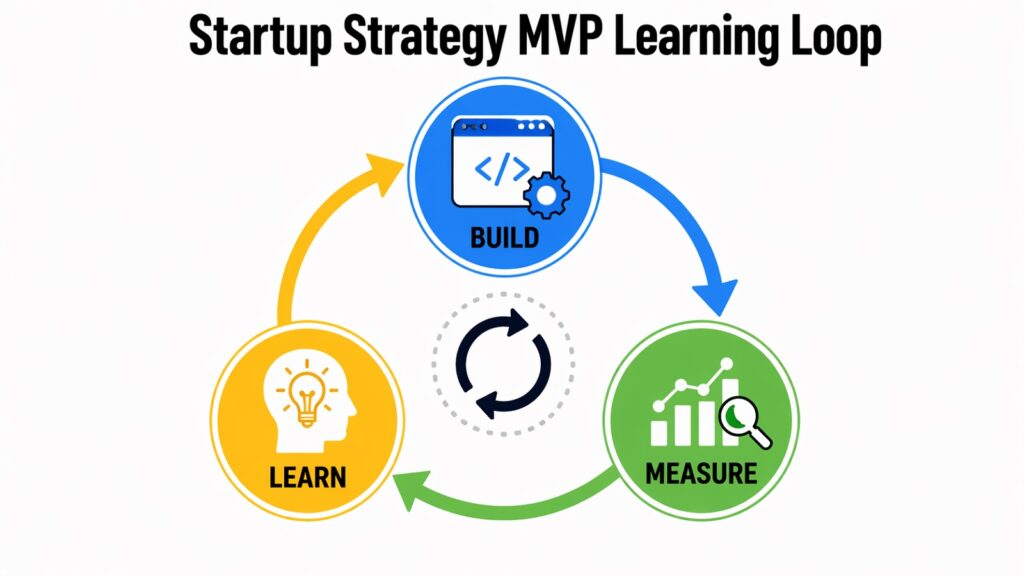
The idea of a minimum viable product has been around since Eric Ries and Steve Blank started writing about lean startups in the early 2000s. Since then, the concept has been stretched and misunderstood in many directions. Some teams build MVPs that are too polished and take too long. Others build something so bare that nobody can figure out what it does. Neither approach helps.
The strategic purpose of an MVP is learning. You are not trying to launch a finished product. You are trying to find out if your assumption about user needs is correct. That distinction changes everything about what you build and how long you spend building it.
Startup strategy guides this process by helping the team decide what to include and what to leave out. Every feature that does not directly test a core assumption is a distraction. The goal is to spend the least amount of time and money to get answers that matter. When teams understand that, the MVP becomes a tool rather than a compromise.
There is also a mindset component. Founders who are attached to their ideas tend to overbuild. Strategy creates a healthy distance between the idea and the person, making it easier to cut things that feel good but do not serve the learning goal.
Startup Strategy: MVP Development Principles and Their Practical Impact
| MVP Principle | Connection to Startup Strategy Goals |
| Core assumption testing | Focuses the build on validating the one belief that, if wrong, would change everything |
| Feature minimization | Eliminates anything that does not directly help answer the central strategic question |
| Speed to feedback | Prioritizes getting a working version in front of real users as quickly as reasonably possible |
| User testing protocol | Establishes a structured approach to collecting feedback so insights are consistent and usable |
| Iteration planning | Builds in regular review points to evaluate what the MVP revealed and what to change next |
| Scope control | Sets boundaries on what the MVP will and will not do before development begins |
| Cost discipline | Keeps spending low during validation so resources remain available for the build phase |
| Honest evaluation | Requires the team to assess results objectively rather than confirming pre-existing beliefs |
5. Startup Strategy for Choosing the Right Funding Options
Funding is one of the most emotionally charged topics in the startup world. Founders want it, investors evaluate it, and the media celebrates it as though raising money is the goal itself. It is not. Funding is a tool. Like any tool, its value depends entirely on whether it is the right one for the job.
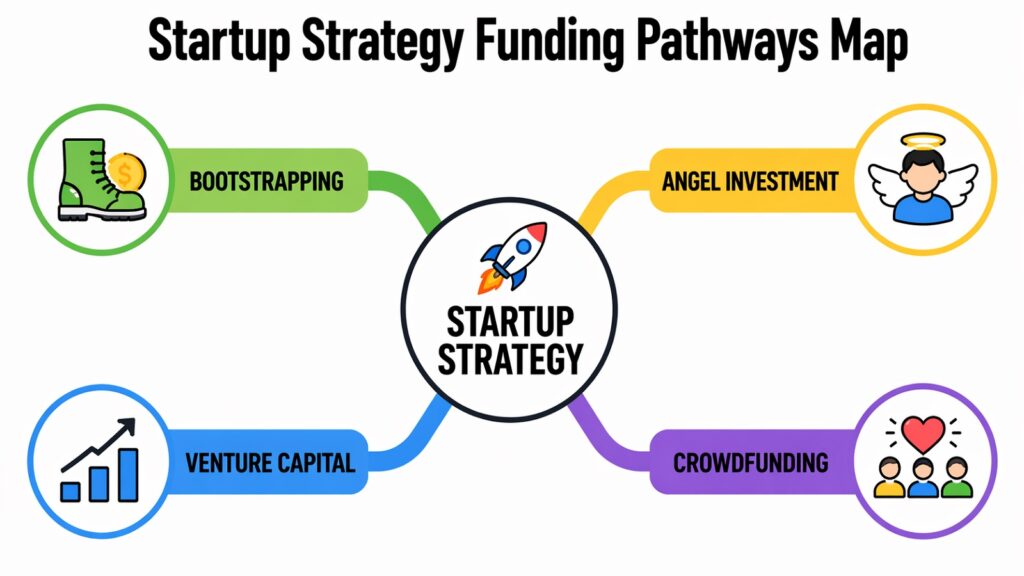
A startup strategy should guide funding decisions before any pitch deck is opened. The first question is not how much you can raise. It is whether you need to raise at all, and if so, from whom. Bootstrapping keeps control intact and forces financial discipline. Angel investment can bring not just money but useful connections. Venture capital accelerates growth but comes with expectations around pace and scale that not every business can or should meet.
According to the Kauffman Foundation, more than half of Inc. 500 companies were bootstrapped at founding. This suggests that external funding is not a universal requirement, even for high-growth businesses. Strategy means being honest about what kind of business you are building and what kind of fuel it actually needs.
Choosing the wrong funding source at the wrong time creates pressure that can distort the startup strategy. Founders who raise venture capital too early often find themselves optimizing for metrics that impress investors rather than building something that genuinely serves users. That tension rarely ends well.
Startup Strategy: Funding Options and Their Strategic Trade-offs
| Funding Option | Strategic Considerations for Early-Stage Startups |
| Bootstrapping | Preserves full ownership and forces lean operations, but limits speed of growth |
| Friends and family | Accessible early capital with flexible terms, but risks personal relationships if things go wrong |
| Angel investors | Provides seed capital and mentorship, typically in exchange for equity in the early stage |
| Accelerators | Offer structured programs, seed funding, and networks like Y Combinator and Techstars |
| Venture capital | Enables rapid scaling but requires high-growth trajectory and significant equity dilution |
| Revenue-based financing | Ties repayment to revenue, preserving equity while providing growth capital for scalable businesses |
| Small business loans | Offers non-dilutive capital but requires collateral and steady revenue for repayment |
| Crowdfunding | Validates demand publicly while raising capital, useful for consumer products with broad appeal |
6. Startup Strategy for Smart Customer Acquisition
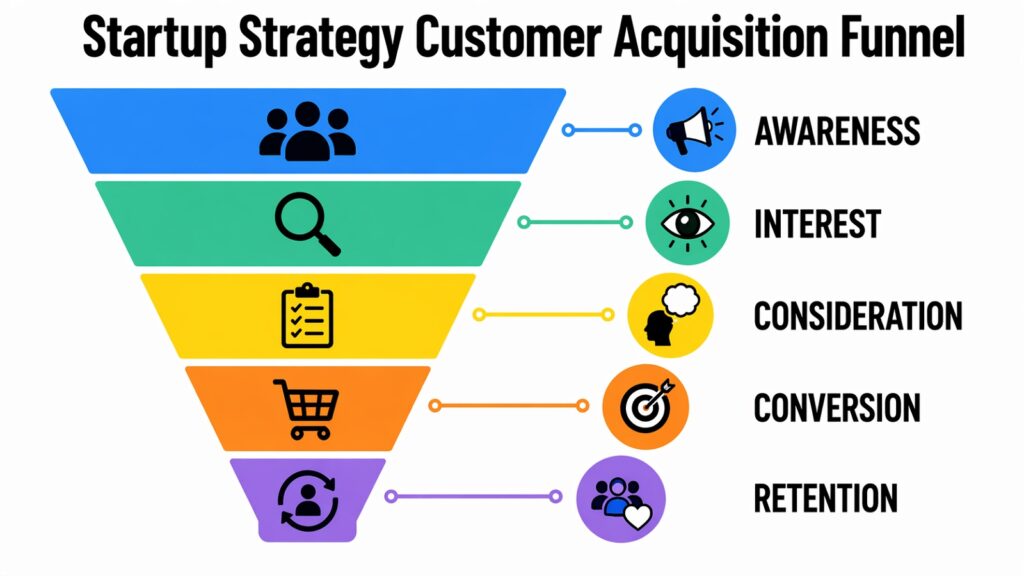
Getting customers is the part of startup life that feels both urgent and mysterious. Founders often approach it with a spray-and-pray mentality, trying every channel at once and hoping something sticks. That approach burns money and time without producing much clarity. A strategic approach works differently.
Smart customer acquisition starts with understanding where the target user already spends time, what influences their decisions, and what problem they are aware enough of to search for solutions. These insights come from research and from early conversations, not from assumptions. Startup strategy grounds acquisition in reality rather than wishful thinking.
The next step is testing channels deliberately. That might mean a small paid campaign, a content strategy, direct outreach, or partnerships. Each test generates data. The data tells you which channels reach the right people at a cost that makes sense. Then you double down on what works and let go of what does not. This is not a new idea, but most early teams do not do it with enough consistency.
Andrew Chen, a general partner at Andreessen Horowitz, has written extensively about how the most effective acquisition strategies are often the ones that feel unsexy at first. Cold emails, community participation, direct sales, and referral programs often outperform expensive paid campaigns in the early stage. Strategy means being willing to do the unglamorous work.
Startup Strategy: Customer Acquisition Channels and Their Strategic Fit
| Acquisition Channel | When It Fits Within a Startup Strategy Framework |
| Content marketing | Works well when users search for solutions, building organic traffic over a longer timeline |
| Direct sales outreach | Effective in B2B settings where relationships and trust drive purchasing decisions |
| Paid social advertising | Useful for quick testing but requires clear targeting and a well-defined conversion path |
| Referral programs | Leverages existing user satisfaction to bring in new users at a lower acquisition cost |
| SEO and organic search | Builds long-term visibility but requires consistent effort and a minimum viable content base |
| Community engagement | Creates trust and awareness in spaces where the target audience already gathers online |
| Partnerships | Expands reach through complementary businesses that serve the same audience without competing |
| Product-led growth | Lets the product itself drive discovery and adoption through free tiers or viral mechanics |
7. Startup Strategy for Sustainable Growth
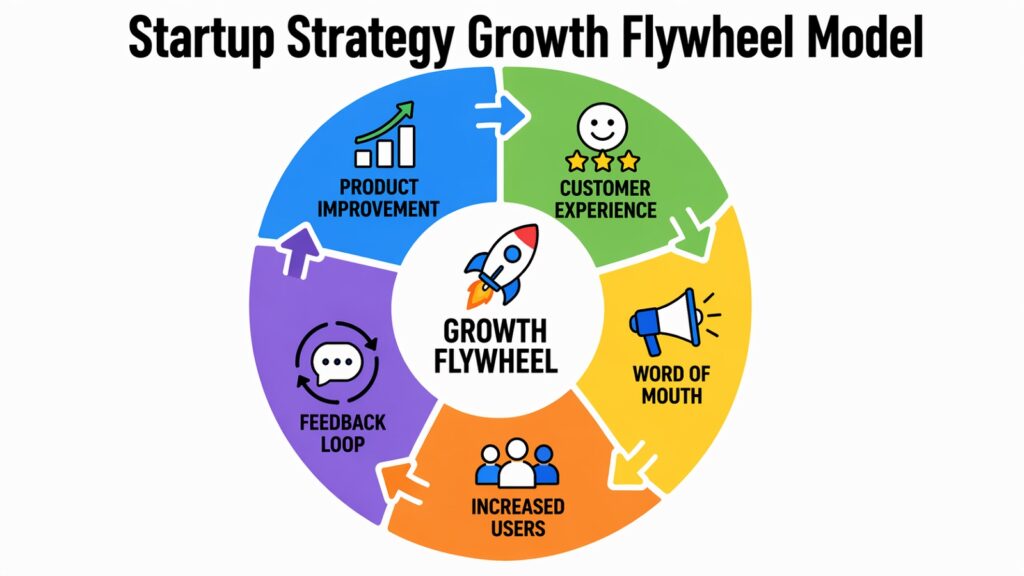
Early traction feels good. A spike in sign-ups, a round of positive press, a week where everything seems to be clicking. But traction is not growth. Growth is what happens when traction becomes repeatable, when the systems behind the early success are strong enough to carry more weight without breaking.
Sustainable growth is a chapter of startup strategy that many founders skip because it feels less urgent than the immediate problems in front of them. That is understandable. But the startups that scale well are usually the ones that built operating systems early, before they needed them. When growth arrives suddenly without any infrastructure in place, the experience is often chaotic and damaging.
Consistency matters more than spikes. A startup that grows at ten percent month over month for two years builds more real value than one that grows wildly for three months and then stagnates. Strategy supports the former by keeping the team focused on building things that compound rather than things that impress.
It is also worth noting that growth creates pressure on culture. Teams expand, communication gets harder, and the informal ways that worked when there were five people stop working when there are fifty. Startup strategy must account for this. Companies that grow sustainably are usually the ones that invested in clarity of values and processes early, not just product and revenue.
Startup Strategy: Growth Levers and Their Long-Term Sustainability Factors
| Growth Lever | Sustainability Consideration in Startup Strategy |
| Customer retention | Retaining users is cheaper than acquiring new ones and signals that the core product is working |
| Operational processes | Documented workflows allow teams to scale without quality declining as headcount grows |
| Unit economics discipline | Ensures each new customer adds more value than it costs to acquire and serve them |
| Team capacity planning | Aligns hiring pace with actual demand so the company is not perpetually understaffed or bloated |
| Brand consistency | Maintains a recognizable identity that builds trust with users as the company grows into new markets |
| Feedback loops | Preserves the habit of listening to users even as scale makes direct contact harder to maintain |
| Technology infrastructure | Builds systems that can handle growth in usage without requiring constant expensive rebuilds |
| Revenue diversification | Reduces dependence on a single customer or channel that could change or disappear without warning |
8. Startup Strategy to Avoid Common Mistakes
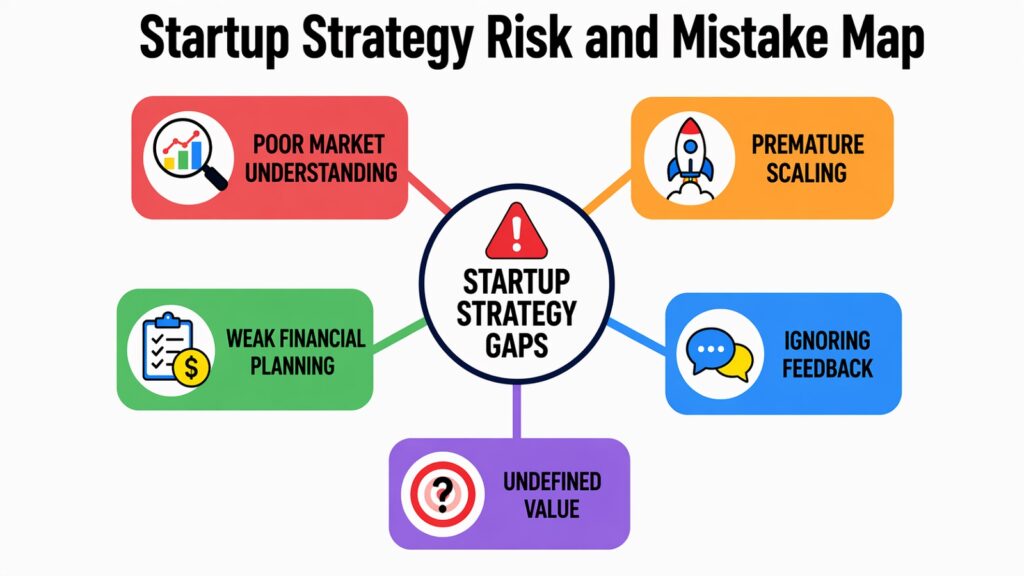
There is something quietly sobering about startup failure rates. According to research from the Harvard Business School, roughly 75 percent of venture-backed startups fail to return their investors’ capital. That number is not meant to discourage anyone. It is meant to make the case that knowing what not to do is just as valuable as knowing what to do.
Most startup mistakes do not feel like mistakes in the moment. They feel like bold decisions or reasonable trade-offs. Hiring too fast feels like confidence. Ignoring critical user feedback feels like staying focused. Expanding into new markets before the core business is stable feels like ambition. Startup strategy is what helps a team see these patterns for what they are before the consequences arrive.
One of the most common mistakes is premature scaling. Startups spend money on growth before they have confirmed that the product actually works for users. The result is a bigger operation built on a cracked foundation. Another common error is founder disagreement that goes unaddressed. When co-founders have different visions, and nobody has a process for resolving that tension, the company drifts and eventually fractures.
The antidote to most of these mistakes is not intelligence. It is discipline. A clear startup strategy, reviewed regularly and applied honestly, catches most of these errors before they become fatal. The founders who survive the early years are usually the ones who stayed curious, stayed humble, and stayed close to the truth about what was actually happening in their business.
Startup Strategy: Common Mistakes and Their Root Causes
| Common Mistake | How Startup Strategy Helps Prevent It |
| Premature scaling | Strategy sets milestones that must be met before expanding operations or increasing spending |
| Ignoring user feedback | A feedback loop built into strategy ensures user insights are collected and acted upon regularly |
| Co-founder misalignment | Early strategy sessions surface vision differences before they create damaging operational conflict |
| Running out of cash | Financial planning as part of strategy creates runway visibility and early warning signals |
| Copying competitors blindly | Strategy rooted in user research keeps decisions tied to real needs rather than reactive moves |
| Hiring too fast | Headcount decisions tied to strategy milestones prevent overstaffing before product-market fit |
| Neglecting culture | Values and ways of working embedded in strategy early remain intact as the team scales |
| Skipping legal basics | Checklists within the startup strategy catch structural and compliance gaps before they compound |
Conclusion: How Startup Strategy Turns Ideas Into Lasting Success
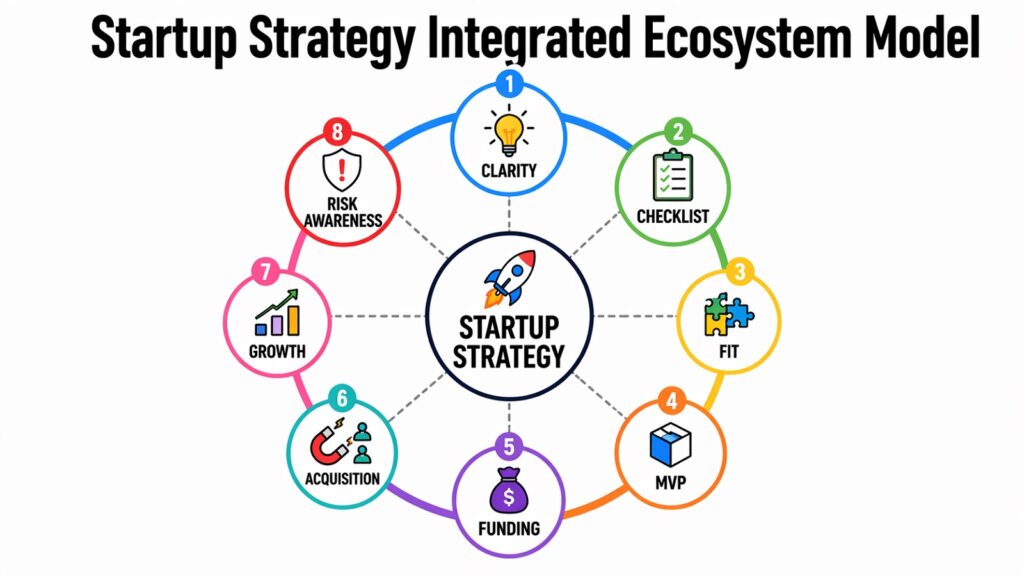
Looking back at these eight steps, what stands out is how much they depend on each other. Clarity about direction makes the launch checklist more meaningful. The launch checklist makes the MVP more focused. A focused MVP generates better data about product-market fit. Better product-market fit guides funding decisions. And so on through customer acquisition, sustainable growth, and the steady work of avoiding mistakes. Startup strategy is the thread that runs through all of it.
It is worth sitting with that idea for a moment. Strategy is often treated as something that happens before the real work begins. But that framing misses something important. Strategy is part of the real work. It is the part that makes all the other parts add up to something. Without it, the effort is real, but the direction is missing.
Building a startup is genuinely hard. There are weeks when nothing makes sense, when the numbers are going the wrong way, and the team is tired, and the path forward is unclear. In those moments, the thing that keeps good founders going is not optimism alone. It is the clarity that comes from a strategy they have thought through carefully and believe in deeply.
The steps in this article are not a guarantee of success. Nothing is. But they are a structure for thinking and deciding in a way that increases the odds. Start with clarity. Move with discipline. Listen constantly. Adjust without panic. And trust that a strong startup strategy, applied with patience and honesty, can turn a rough beginning into something that lasts.
Startup Strategy: Summary of All 8 Steps and Their Core Outcomes
| Startup Strategy Steps | Core Outcome for the Startup |
| Early Startup Strategy | Establishes the foundational clarity that every subsequent decision depends on for coherence |
| Startup Launch Checklist | Converts strategic intent into organized pre-launch actions that prevent costly oversights |
| Product Market Fit | Confirms that the product genuinely solves a problem users care about and will return for |
| MVP Development | Generates honest learning at the lowest possible cost before committing to full development |
| Startup Funding Options | Aligns capital sources with the company’s growth ambitions and operational style |
| Customer Acquisition Strategies | Identifies and refines the most effective channels for reaching and converting the right users |
| Startup Growth Strategies | Builds the systems and habits needed for expansion that does not compromise quality or culture |
| Startup Mistakes to Avoid | Reduces the likelihood of common strategic errors that quietly drain momentum and resources |