Table of Contents
Introduction: Camera Fundamentals in Modern Personal Technology
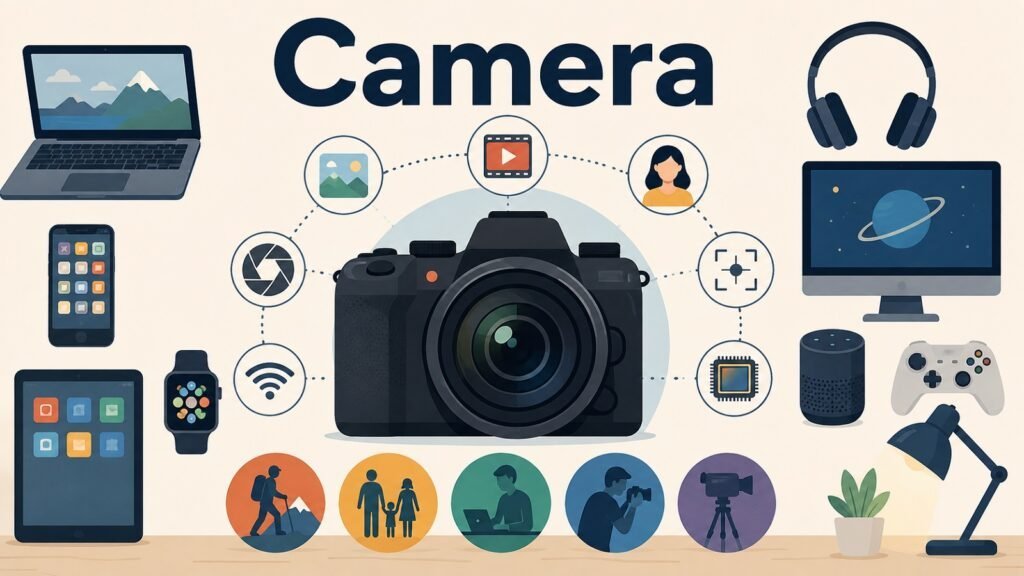
Few devices have shaped human experience as profoundly as the camera. At its core, a camera is an optical instrument that captures light reflected from a scene and converts it into a permanent visual record. What began as a room-sized apparatus requiring lengthy chemical processes has evolved into a compact, intelligent device that records sharp images and high-resolution video in a fraction of a second. Each generation of camera technology emerged in response to specific limitations, practical needs, and creative ambitions that earlier systems could not fully address.
The transition from film to digital imaging revolutionized the field. Film cameras necessitated physical development, which was expensive, time-intensive, and irreversible. In contrast, digital sensors replaced chemical film with electronic grids composed of light-sensitive pixels, allowing for immediate image capture and limitless reproduction. This transformation reduced barriers for casual users while providing professionals with unparalleled control. Even with the proliferation of smartphones, dedicated cameras continue to be vital in scenarios where optical versatility, sensor performance, and video capabilities are crucial — such as in wildlife photography, medical imaging, and cinematic production.
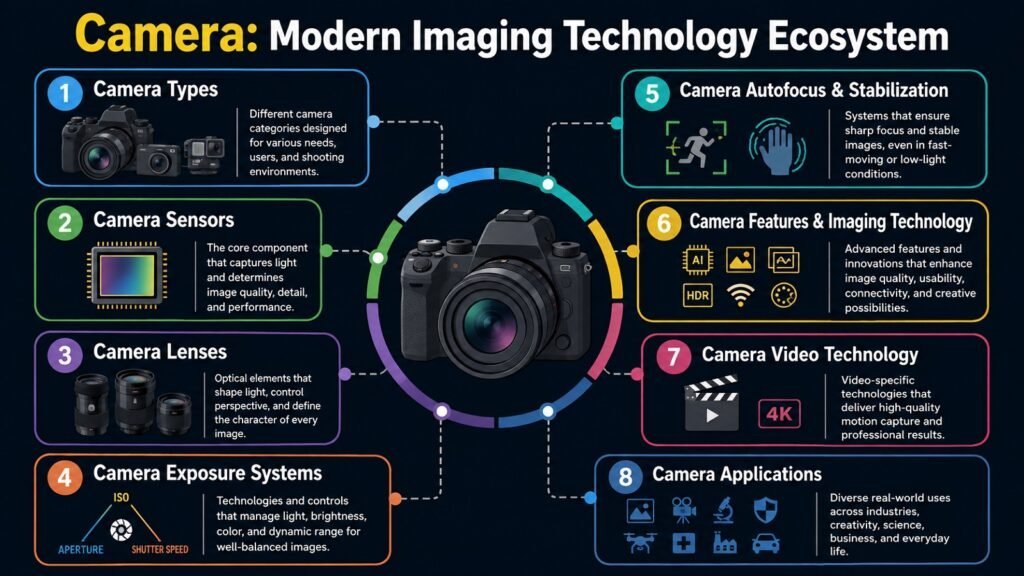
Modern cameras integrate precision optics, advanced image sensors, powerful processors, sophisticated software, and artificial intelligence into a tightly coordinated system. Each component shapes the others, and understanding how they interact explains why the camera remains one of the most important Personal Tech Devices today. The eight sections that follow examine this technology in depth, from the categories available to the real-world applications they support, building a comprehensive understanding of camera technology as a whole.
Table 1: Camera Technology Overview — Eight Major Aspects
| Aspect | What It Covers |
| Types | DSLR, mirrorless, compact, bridge, action, instant, medium-format, cinema |
| Sensors | CMOS, CCD, pixel size, megapixels, dynamic range, low-light performance |
| Lenses | Focal length, aperture, prime, zoom, macro, telephoto, wide-angle optics |
| Exposure Systems | Aperture, shutter speed, ISO, metering, white balance, shooting modes |
| Autofocus & Stabilization | Phase detection, contrast detection, OIS, IBIS, subject tracking |
| Features & Imaging | RAW capture, HDR, burst shooting, AI, computational photography |
| Video Technology | Resolution, frame rates, slow motion, log profiles, live streaming |
| Applications | Healthcare, journalism, science, manufacturing, security, education |
1. Camera Types: Understanding the Different Categories
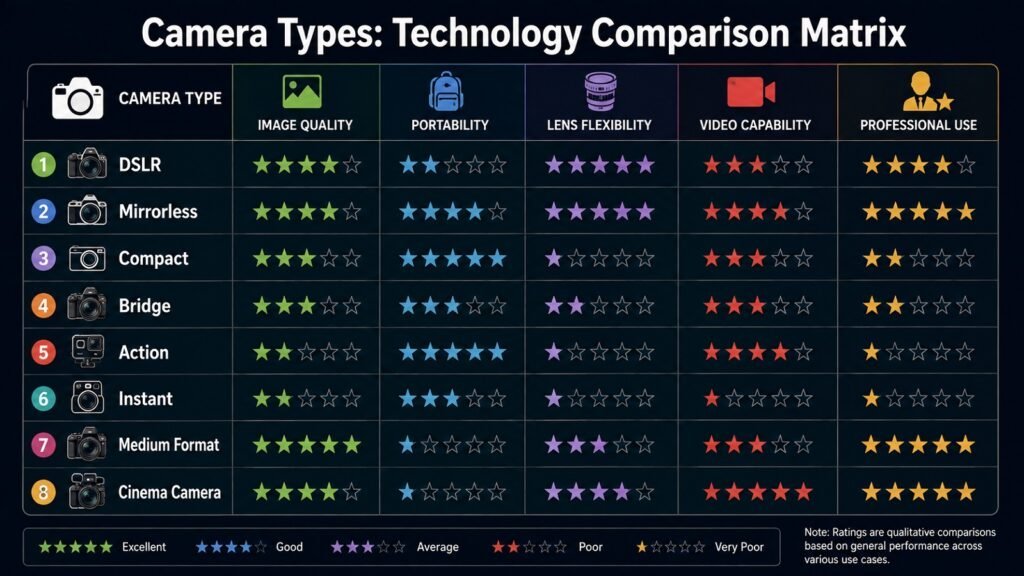
The camera market today is more diverse than ever, shaped by a wide range of imaging needs. Rather than converging on a single dominant format, modern photography is served by specialized systems, each designed to perform best under specific conditions. Understanding why different camera types exist requires examining the practical problems each was engineered to solve rather than simply comparing their specifications.
DSLR cameras — digital single-lens reflex — use a mirror to direct light from the lens into an optical viewfinder, giving photographers a direct, lag-free view of the scene. DSLRs benefit from decades of lens and accessory development, making them deeply capable systems for professionals and enthusiasts. Their mechanical complexity, however, makes them larger and heavier than newer alternatives. Mirrorless cameras removed the mirror assembly, allowing continuous sensor exposure and an electronic viewfinder that shows a live preview of the current exposure. This structural simplification reduced body size, enabled faster electronic shutters, and significantly improved video performance. Since the 2010s, mirrorless systems have steadily replaced DSLRs in professional markets and now represent the primary direction of camera development.
Compact cameras prioritize convenience with fixed lenses and automated exposure, making them accessible to casual users who want simplicity over control. Bridge cameras offer superzoom lenses and manual controls without interchangeable-lens complexity. Action cameras feature rugged, waterproof housings and wide-angle lenses built for physical activity and unconventional mounting. Instant cameras produce physical prints immediately after capture — a tangible, social function that no digital format replicates. Medium-format cameras use sensors larger than full frame, delivering exceptional detail for commercial and fine-art imaging. Cinema cameras are engineered specifically for motion picture production, offering high bit-depth recording, cinema lens mounts, robust monitoring outputs, and the dynamic range that professional filmmaking demands.
Table 2: Types and Their Primary Strengths
| Type | Primary Strength |
| DSLR | Optical viewfinder, extensive lens ecosystem, long battery life |
| Mirrorless | Compact size, fast autofocus, superior video, electronic viewfinder |
| Compact | Small size, automated operation, affordable and easy to use |
| Bridge | Superzoom range, manual controls, no lens-changing needed |
| Action | Rugged, waterproof, wide-angle capture for extreme activities |
| Instant | Immediate physical prints, creative social sharing experience |
| Medium-Format | Exceptional detail and dynamic range for commercial imaging |
| Cinema | High bit-depth video, cinema lens compatibility, broadcast output |
2. Camera Sensors: The Core Technology
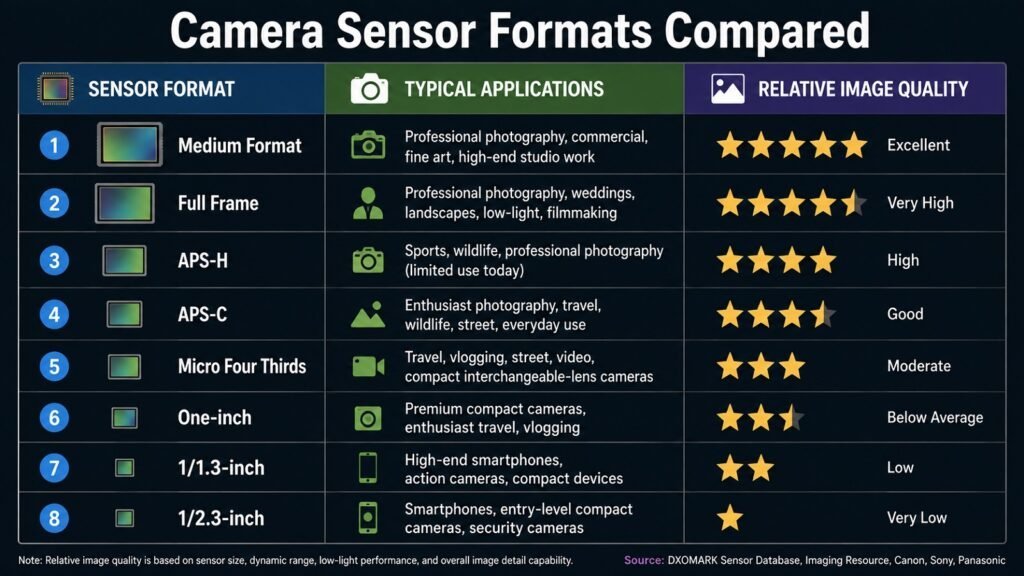
The image sensor transforms a camera from a mechanical housing into a functioning imaging system. It converts incoming light into a digital signal that can be processed, stored, and displayed, performing the role that film once served in analog photography. Understanding sensor technology explains why some cameras produce cleaner, more detailed, and more versatile images than others under identical lighting conditions.
Currently, two technologies dominate the landscape of modern digital cameras: CMOS (complementary metal-oxide-semiconductor) and CCD (charge-coupled device). CCD sensors were the initial standard, recognized for their ability to produce clean images with minimal noise. However, CMOS sensors have become the preferred choice due to their significantly lower power consumption, faster data reading capabilities, and much lower manufacturing costs at scale. Contemporary CMOS sensors have completely bridged the image quality gap while introducing features — such as on-chip processing and high-speed video readout — that CCD designs struggle to replicate. Consequently, CMOS technology now underpins nearly every consumer and professional camera manufactured today.
The size of the sensor is one of the most critical factors influencing performance. Larger sensors can capture more light per pixel, resulting in improved dynamic range, reduced noise in low-light conditions, and a shallower depth of field that effectively separates subjects from their backgrounds.
The hierarchy of sensor sizes ranges from smartphone sensors to compact sensors, Micro Four Thirds, APS-C, full-frame (approximately 36mm x 24mm), and medium-format. While megapixel count is a determinant of resolution, pixel size is equally significant — a 24-megapixel sensor with larger pixels often outperforms a 45-megapixel sensor with smaller pixels in low-light scenarios. Additionally, dynamic range, which refers to the sensor’s capacity to capture detail in both bright highlights and deep shadows simultaneously, is crucial for achieving high-quality images in practical applications.
Back-side illuminated (BSI) sensors position light-gathering components closer to incoming light, improving sensitivity without enlarging pixels. Stacked sensors place processing circuitry directly behind the imaging layer, enabling faster readout speeds for high-frame-rate video and rapid burst photography. These advances continually raise the quality ceiling, though they also reinforce a fundamental point — even the most advanced sensor depends on quality optics to deliver the light it needs to perform at its best.
Table 3: Sensor Technologies and Key Characteristics
| Sensor Characteristic | Practical Impact |
| CMOS Technology | Low power, fast readout, on-chip processing, industry standard |
| CCD Technology | Very low noise, high uniformity, used in specialized scientific imaging |
| Full-Frame Sensor | Largest mainstream size, superior low-light and dynamic range performance |
| APS-C Sensor | Compact body compatibility, good balance of performance and cost |
| Micro Four Thirds | Smaller sensor, lighter system, significant speed and versatility |
| Megapixel Count | Determines resolution ceiling for prints and cropping flexibility |
| BSI Architecture | More light captured per pixel, improved sensitivity and low-light detail |
| Stacked Sensor | Faster readout, high-speed video, reduced rolling shutter distortion |
3. Camera Lenses: How Optics Shape Every Image
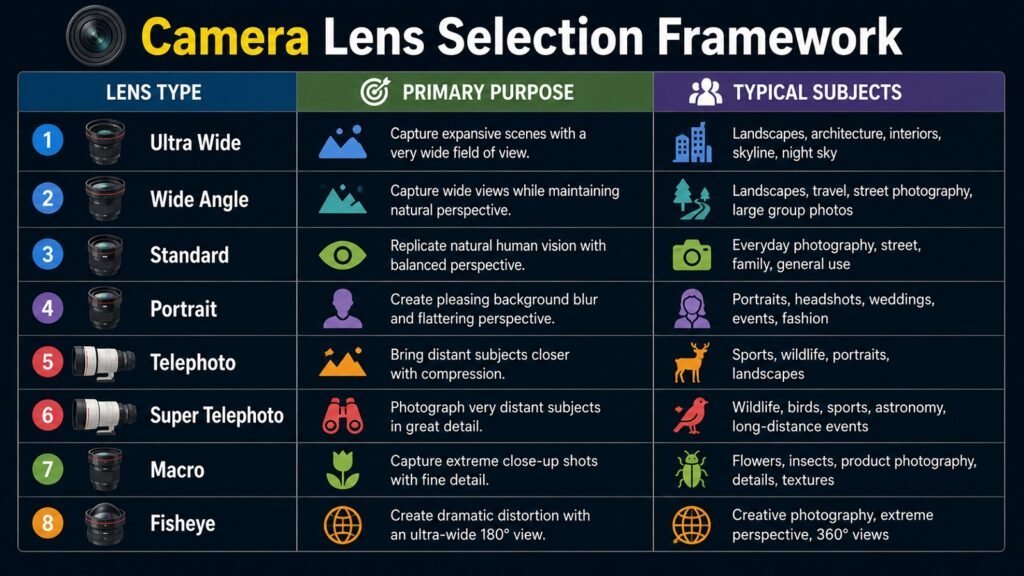
A camera sensor can only record what its lens allows it to see. Lenses determine not just sharpness but perspective, depth of field, subject isolation, and how a finished image feels to a viewer. The same scene photographed with different lenses produces fundamentally different visual results, which is why lens choice is central to photographic creativity.
Focal length, measured in millimeters, defines the angle of view a lens provides. Wide-angle lenses below 35mm (in full-frame terms) capture expansive scenes and suit landscape, architecture, and environmental portraiture. Standard focal lengths near 50mm approximate human vision and produce natural, undistorted perspective. Telephoto lenses above 85mm magnify distant subjects and compress apparent depth, making them essential for wildlife, sports, and events where physical proximity to subjects is impractical. Aperture describes the size of the light opening, expressed as an f-number. Lower values such as f/1.4 admit more light and produce shallow depth of field with soft backgrounds. Higher values such as f/8 keep more of the scene in focus simultaneously, which landscape and architectural photographers frequently prefer.
Prime lenses offer a single fixed focal length, enabling larger maximum apertures at lower cost and weight than zooms of equivalent reach. Zoom lenses cover a range of focal lengths in one barrel, trading some optical performance for versatility that travel and event photographers value highly. Macro lenses achieve reproduction ratios of 1:1 or greater for detailed close-up work with insects, products, and scientific subjects. Optical image stabilization (OIS) uses gyroscopic sensors and floating lens elements to counteract movement, enabling sharper handheld shots at slower shutter speeds. Modern autofocus lens systems use linear or piezoelectric motors fast enough to track athletes and birds in flight with reliable precision.
Tilt-shift lenses allow photographers to correct perspective distortion in architectural work and create selective focus effects unique to the format. Cinema lenses add precise focus distance markings and stepless aperture control for smooth video operation. Together, focal length, aperture, and stabilization define each lens’s creative range — and establish the optical conditions that the exposure system must then control to produce a properly rendered image.
Table 4: Lens Categories and Their Primary Applications
| Lens Type | Primary Application |
| Wide-Angle | Landscapes, architecture, interiors, environmental storytelling |
| Standard (50mm) | Street photography, documentary, natural perspective imaging |
| Telephoto | Wildlife, sports, events, compressing background distance |
| Prime Lens | Portraits, low light, maximum sharpness at specific focal length |
| Zoom Lens | Travel, events, versatile coverage across multiple focal lengths |
| Macro Lens | Insects, products, flowers, extreme close-up scientific imaging |
| Tilt-Shift Lens | Architecture correction, selective focus, miniature effect |
| Cine Lens | Filmmaking, precise focus marks, smooth iris and focus control |
4. Camera Exposure Systems: Controlling Light for Better Images
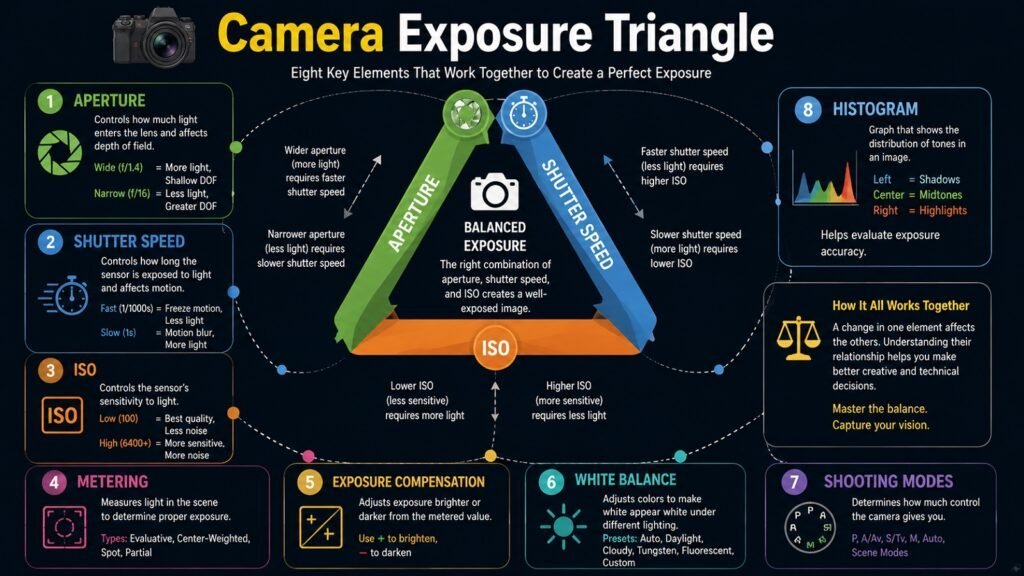
Exposure controls how much light reaches the sensor during a photograph. Three interlocking settings — aperture, shutter speed, and ISO — form the exposure triangle, and adjusting any one requires compensating with the others to maintain consistent brightness while achieving different creative or technical outcomes. Photographers who understand this relationship make deliberate decisions rather than relying entirely on automatic modes.
Aperture controls the light opening size and depth of field. Shutter speed controls the duration of exposure — a fast shutter speed such as 1/2000 second freezes motion and is essential for sports and wildlife, while a slow shutter introduces motion blur that can serve as either a problem or a creative effect. ISO adjusts the sensor’s light sensitivity. A low ISO produces clean images with minimal noise, while high ISO settings allow photography in very dark environments at the cost of increased grain and reduced shadow detail. Modern sensors handle high ISO values far better than earlier designs, but noise remains a physical trade-off as sensitivity increases.
Metering systems measure scene brightness to recommend exposure settings. Evaluative or matrix metering analyzes the entire frame and balances brightness across multiple zones. Spot metering reads a small defined area, giving precise control over a specific subject. Center-weighted metering prioritizes the middle of the frame while accounting for surrounding areas. White balance corrects color casts from different light sources — daylight, tungsten, and fluorescent each emit light at different color temperatures that cameras must compensate for to render neutral tones accurately. Exposure compensation allows intentional overrides, particularly useful for bright-toned scenes such as snow that cause automatic metering to underexpose.
Shooting modes — aperture priority, shutter priority, program, and full manual — define how much control photographers retain versus delegate to the camera, allowing them to match the interface to their experience level and the demands of each situation. Together, these controls establish photography as both a technical and creative discipline, and form the foundation that autofocus and stabilization technologies build upon to help photographers consistently achieve sharp, well-exposed results.
Table 5: Exposure Controls and Their Primary Purpose
| Exposure Control | Primary Purpose |
| Aperture | Controls light volume and depth of field in each frame |
| Shutter Speed | Controls motion capture — freeze action or introduce blur |
| ISO | Adjusts sensor sensitivity for low-light or bright conditions |
| Evaluative Metering | Balances exposure across the entire frame automatically |
| Spot Metering | Exposes for one precise area regardless of overall scene brightness |
| White Balance | Corrects color cast from different artificial or natural light sources |
| Exposure Compensation | Manual override to brighten or darken the metered exposure |
| Shooting Modes | Balances manual and automated control to match photographer preference |
5. Camera Autofocus and Stabilization: Improving Precision
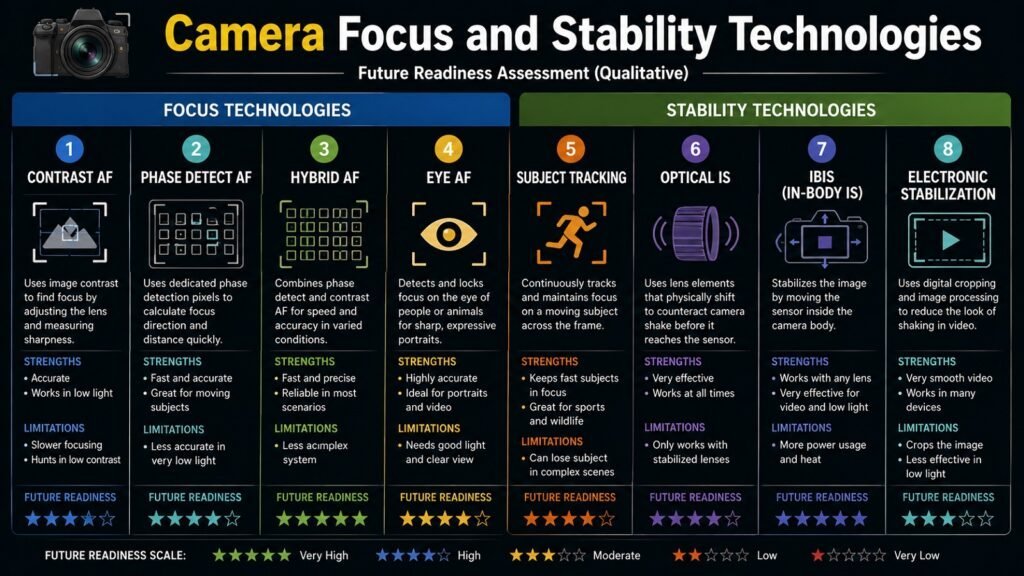
A camera equipped with a high-quality sensor and top-tier lens can still yield unsatisfactory outcomes if it lacks dependable focusing and stable image capture. Autofocus and stabilization technologies effectively tackle these issues, enabling photographers and videographers to focus on composition and timing instead of mechanical accuracy.
Phase detection autofocus (PDAF) analyzes pairs of image samples that are slightly offset, using the phase difference to calculate both the direction and distance the lens must travel to achieve sharp focus. This makes phase detection inherently fast and predictive, even on moving subjects. Modern mirrorless cameras embed phase detection pixels directly across the entire sensor surface, extending autofocus coverage to the frame edges.
Contrast detection autofocus evaluates edge sharpness and adjusts focus until contrast is maximized. It is slower because the lens must scan through a focus range to find the peak, but achieves high precision for static subjects. Most contemporary cameras use hybrid autofocus, combining phase detection for initial acquisition speed with contrast detection for final confirmation accuracy.
Subject recognition has transformed autofocus into an intelligent tracking tool. Modern cameras identify and lock focus on eyes, faces, animals, vehicles, and athletes, maintaining tracking even when subjects are partially obscured. This is especially valuable in wildlife photography, where birds in flight move unpredictably, and in sports, where subjects move at speeds that leave no margin for focusing errors.
Optical image stabilization (OIS) uses gyroscopic sensors to detect movement and shifts a floating lens element to compensate. In-body image stabilization (IBIS) moves the sensor itself, extending stabilization benefit to any attached lens. Many professional systems combine both approaches, achieving compensation equivalent to five or six stops of shutter speed reduction — enabling sharp handheld photography in conditions that would previously have required a tripod. Electronic stabilization applies software-based frame smoothing, providing additional benefit primarily for video recording.
Table 6: Autofocus and Stabilization Technologies
| Technology | Primary Benefit |
| Phase Detection AF | Fast, direction-aware focus acquisition on moving subjects |
| Contrast Detection AF | High accuracy for static subjects in precise close-up work |
| Hybrid Autofocus | Combines speed of phase with accuracy of contrast detection |
| Eye Detection AF | Keeps portraits sharp by locking focus on the subject’s eye |
| Subject Tracking | Maintains focus on athletes, animals, and vehicles in motion |
| Optical Image Stabilization | Compensates shaking within the lens mechanism |
| In-Body Image Stabilization | Sensor-shift stabilization effective with any attached lens |
| Electronic Stabilization | Software-based smoothing optimized for video recording |
6. Camera Features and Imaging Technology: Advancing Modern Performance
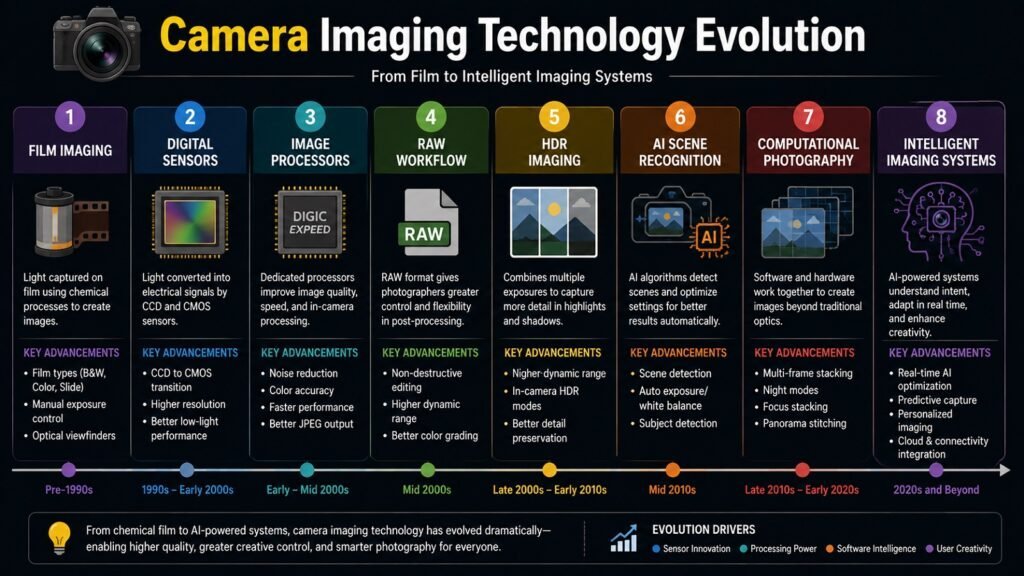
Beyond core hardware, modern cameras incorporate software-driven and computational features that significantly extend imaging capability. These represent a fundamental shift in how cameras generate and refine images, turning the body itself into an evolving platform where software and hardware advance together.
RAW image capture stores unprocessed sensor data without compression, preserving maximum tonal and color information for post-processing. Photographers retain complete control over exposure, white balance, sharpness, and noise reduction after the fact. JPEG capture applies automatic processing and compression, producing smaller, immediately usable files with less correction flexibility. Professionals generally prefer RAW in demanding conditions, while high-volume event photographers may choose JPEG for workflow efficiency. HDR imaging combines multiple exposures at different brightness levels into a single image that retains detail in both highlights and shadows simultaneously. Burst shooting captures extended sequences at high speed — professional sports cameras can exceed 30 frames per second — ensuring no critical moment in fast-moving events is missed.
Dedicated image processors such as Canon’s DIGIC, Nikon’s EXPEED, and Sony’s BIONZ manage the computational workload of converting sensor data into finished images at speed, handling noise reduction, color science, autofocus calculations, and video encoding simultaneously. Advances in processor performance have directly enabled features that would have been impossible just a few years ago. Artificial intelligence drives intelligent scene recognition that adjusts tone and color for landscape, portrait, food, sport, and night scenes without manual input.
Computational photography techniques such as pixel-shift high-resolution capture produce images that exceed the sensor’s native megapixel count by combining multiple micro-shifted exposures. Wireless connectivity via Wi-Fi and Bluetooth enables instant transfer to smartphones and cloud platforms, supporting efficient workflows that once required physical connections. These features collectively extend image quality beyond what the underlying hardware suggests is possible, and they set the stage for the increasingly capable video production systems that modern cameras have become.
Table 7: Imaging Features and Their Benefits
| Feature | Primary Benefit |
| RAW Capture | Preserves all sensor data for maximum post-processing flexibility |
| HDR Imaging | Retains highlight and shadow detail across high-contrast scenes |
| Burst Shooting | Sequences of rapid frames to capture peak moments precisely |
| Image Processor | Real-time handling of noise, color, autofocus, and encoding |
| AI Scene Recognition | Automatic adjustments matched to subject type and conditions |
| Computational Photography | Software-enhanced resolution and dynamic range beyond hardware limits |
| Pixel-Shift High Resolution | Multiple micro-shift exposures combined for ultra-high detail |
| Wireless Connectivity | Instant transfer to mobile devices and cloud platforms |
7. Camera Video Technology: Expanding the Role of Camera Beyond Photography
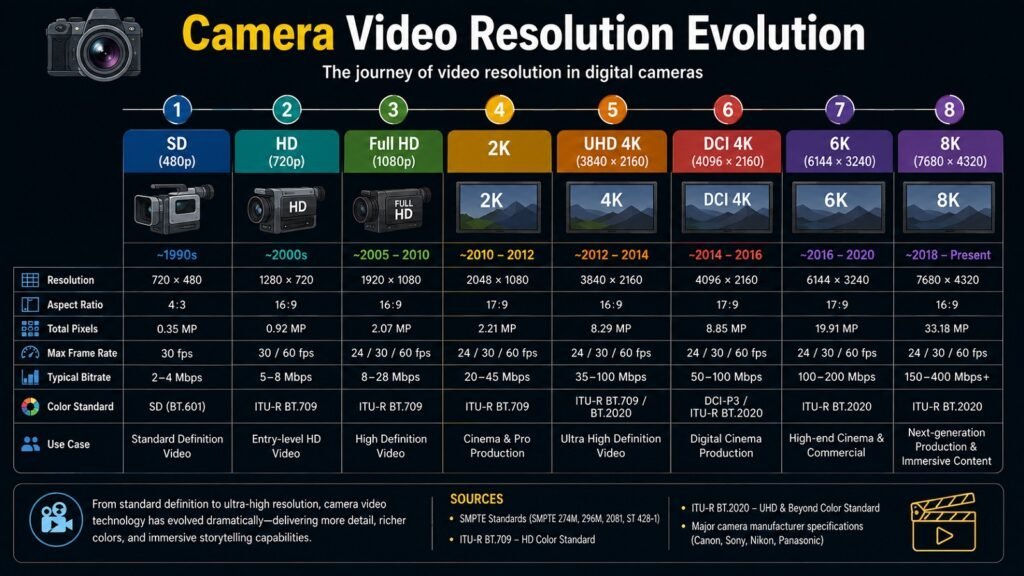
Modern cameras have evolved into hybrid devices capable of producing both still photographs and professional-quality video. This convergence has reshaped entire industries, giving individual creators access to production capabilities that once required dedicated film crews and specialized equipment. The boundary between a camera and a video production tool has effectively disappeared in many professional contexts.
Video resolution defines the pixel count in each recorded frame. Full HD (1920×1080) became the mainstream standard for broadcast and online delivery, but 4K (3840×2160) is now the professional default, with many cameras offering 6K and 8K recording for extraordinary cropping and reframing flexibility in post-production. Higher resolutions generate larger files and demand greater processing power and storage capacity. Frame rate determines how many frames are captured per second. Standard cinema runs at 24 frames per second, producing the motion character audiences associate with feature films. Television uses 25 or 30 frames per second depending on broadcast standard. High-speed recording at 120 frames per second or above enables slow-motion playback essential for sports analysis, wildlife documentation, and scientific visualization.
Logarithmic recording profiles deliberately flatten the tonal curve to preserve highlight and shadow detail in high-contrast scenes, producing footage with maximum flexibility for color grading. High dynamic range video standards such as HDR10 and Dolby Vision extend color volume and contrast range for compatible displays. External recording allows cameras to output minimally compressed video over HDMI to dedicated recording devices, bypassing in-camera compression for maximum quality. Live streaming capabilities have become increasingly important as cameras are deployed for broadcast, education, and corporate communications through internet platforms. These video technologies have transformed cameras from photography instruments into versatile visual production systems serving filmmakers, educators, journalists, and content creators across every distribution channel.
Table 8: Video Capabilities and Their Primary Use
| Video Capability | Primary Use |
| 4K Resolution | Professional production, post-production cropping flexibility |
| High Frame Rate | Smooth slow-motion capture for sports and scientific analysis |
| Log Profile Recording | Maximum dynamic range preservation for color grading workflows |
| HDR Video | Extended contrast and color for compatible display delivery |
| External Recording | Uncompressed output for maximum video quality and flexibility |
| Live Streaming | Real-time broadcast for education, events, and content creation |
| Hybrid Photo-Video | Single camera serves both still and motion production needs |
| In-Body Stabilization | Smooth handheld video without mechanical gimbals or rigs |
8. Camera Applications: How Camera Technology Supports Everyday Life and Industries
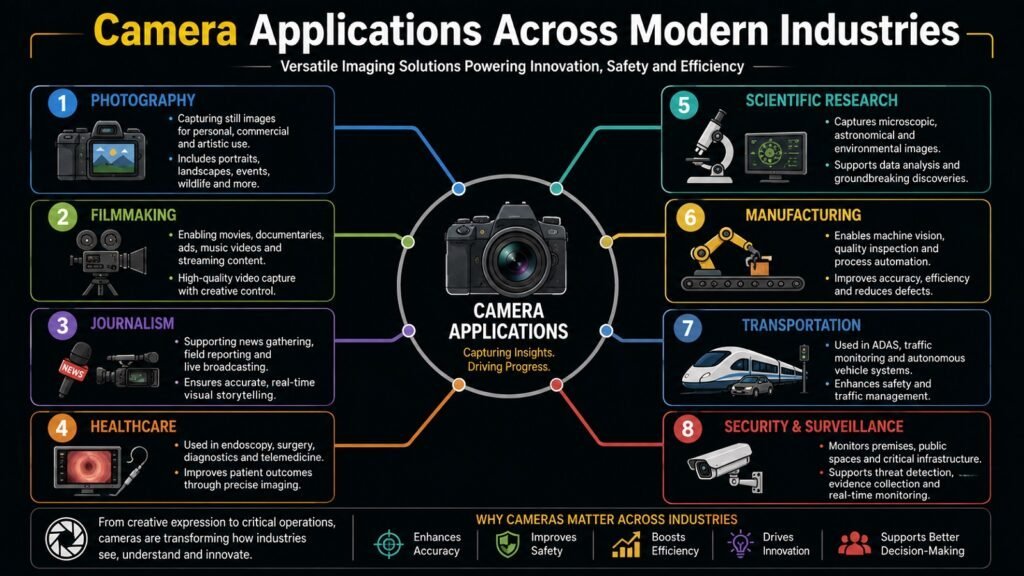
Camera technology does not exist in isolation — its value is measured by the problems it solves across personal, commercial, industrial, scientific, and public-service environments. In professional photography and filmmaking, cameras are the central creative instrument. Advertising, editorial, and fine-art photographers depend on image quality and optical versatility to produce commercial work at scale. Cinematographers combine camera capabilities with lighting design, sound, and post-production to create storytelling experiences that reach global audiences.
Journalism has been fundamentally transformed by camera technology. Photojournalists working in conflict zones and natural disasters rely on cameras that operate reliably under extreme conditions while producing images quickly enough for immediate publication. Video journalists now produce broadcast-quality reports using compact camera systems that would have been unrecognizable in television news just fifteen years ago.
In healthcare, cameras serve diagnostic, surgical, and research purposes with direct impact on patient outcomes. Endoscopic cameras enable minimally invasive procedures through tiny incisions, significantly reducing recovery times. Ophthalmic cameras capture detailed retinal images to screen for conditions including glaucoma and macular degeneration. Pathology laboratories use high-resolution microscopy cameras to analyze tissue samples at cellular resolution, supporting diagnoses that require precision beyond unaided human vision.
Scientific research depends on cameras across nearly every physical and biological discipline. Astronomers use camera sensors in long exposures to capture faint light from distant galaxies. Environmental scientists deploy camera traps to monitor wildlife without human disturbance. In manufacturing, machine-vision cameras inspect products at speeds exceeding human visual capability, detecting defects and dimensional errors in real time.
Transportation infrastructure relies on camera networks for traffic monitoring, license plate recognition, and the computer vision systems underpinning autonomous vehicle navigation. Security and public-safety applications use cameras to monitor critical infrastructure, support law enforcement investigations, and assist emergency response coordination. Each of these applications draws on the foundational camera technologies examined throughout this article, demonstrating how deeply camera capability is embedded within every layer of modern society.
Table 9: Camera Applications Across Key Industries
| Application Area | Primary Purpose or Benefit |
| Photography & Film | Creative production, commercial imaging, cinematic storytelling |
| Journalism | Real-time visual reporting of events under demanding conditions |
| Healthcare | Endoscopy, diagnostics, surgical guidance, pathology analysis |
| Scientific Research | Astronomy, biology, environmental monitoring, laboratory imaging |
| Manufacturing | Automated quality inspection, defect detection, precision measurement |
| Transportation | Traffic monitoring, license plate recognition, autonomous navigation |
| Security | Surveillance, perimeter monitoring, law enforcement support |
| Education | Remote learning, lecture recording, laboratory documentation |
Conclusion: The Future of Camera Innovation and Personal Technology
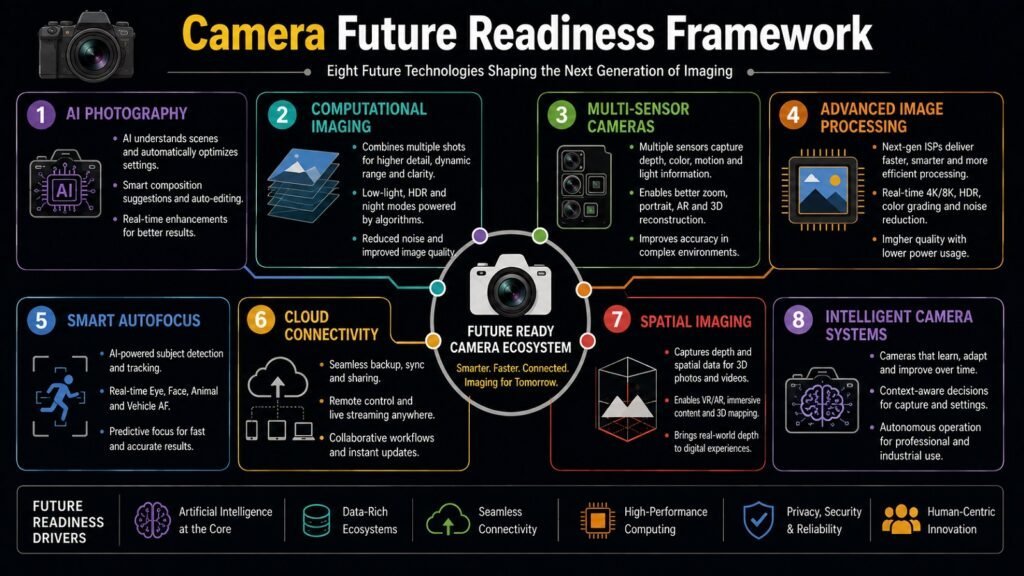
Eight major dimensions of camera technology have been examined in this article. Camera types define the contexts in which imaging takes place. Sensors set the quality ceiling. Lenses shape what the sensor receives. Exposure systems determine how light is measured and controlled. Autofocus and stabilization make precision imaging achievable in real-world conditions. Advanced imaging features extend what hardware alone could accomplish. Video capabilities have broadened the camera’s role beyond still photography. And real-world applications confirm that camera technology is a practical necessity embedded across medicine, science, industry, and public life — reinforcing why cameras remain among the most important Personal Tech Devices available today.
In the future, computational imaging powered by machine learning is expected to derive more information from sensor data than what traditional processing can accomplish. Artificial intelligence will increasingly integrate into the entire imaging pipeline, influencing everything from real-time exposure decisions to post-capture enhancements and intelligent subject recognition.
Advancements in sensor engineering will aim for improved dynamic range, reduced noise at high sensitivities, and quicker readout speeds. Furthermore, optical design will gain from innovative materials and precise manufacturing techniques that allow for smaller sizes without compromising performance. New methodologies, such as light-field sensors and multi-camera array systems, indicate that the design and functionality of cameras will continue to evolve significantly.
What will remain constant is the underlying purpose — capturing and communicating visual information with accuracy, clarity, and intent. Camera technology will continue to serve creativity, advance science, support industry, and document human experience in ways that no other device can replicate. For anyone seeking to understand modern personal technology in depth, the camera remains one of the most instructive and rewarding subjects to explore.
Table 10: Camera Technology — Key Takeaways from Each Major Aspect
| Aspect | Key Takeaway |
| Types | Each type solves specific use-case problems — no single camera fits all needs |
| Sensors | Sensor size and technology define the quality ceiling of any camera system |
| Lenses | Optics shape perspective, depth of field, and creative possibilities as much as the sensor |
| Exposure Systems | Aperture, shutter speed, and ISO work as an integrated system, not independent settings |
| Autofocus & Stabilization | Intelligent tracking and stabilization have made precision imaging widely accessible |
| Features & Imaging | AI and computational photography extend image quality beyond hardware limitations |
| Video Technology | Cameras are now complete hybrid production systems for photo and motion content |
| Applications | Camera technology is embedded in healthcare, science, industry, and public infrastructure |