Table of Contents
Introduction — 5G: The Foundation of Modern Connectivity
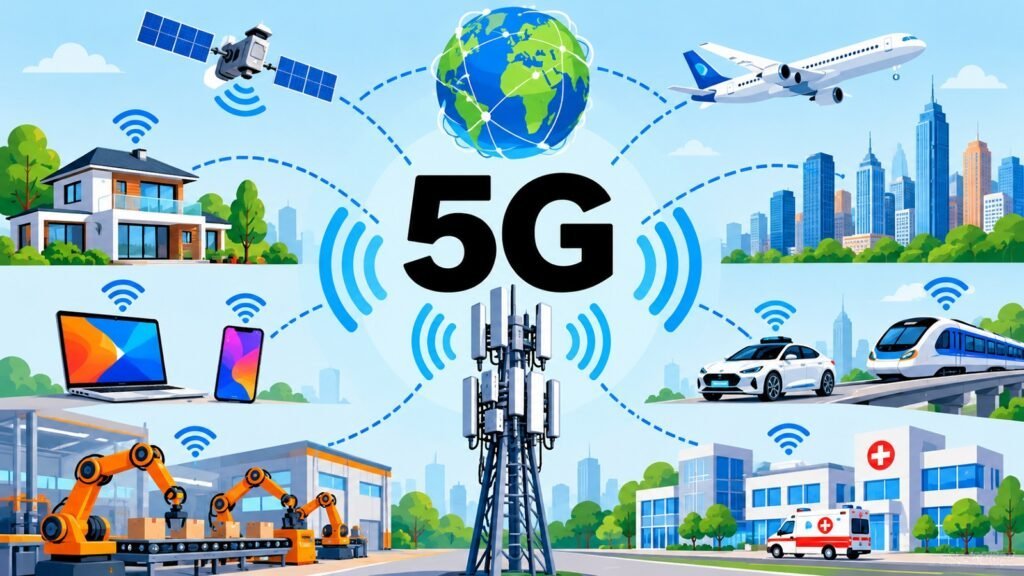
5G is an important Internet Connectivity technology rather than a separate kind of internet, and it supplies wireless access to the same services that fixed and earlier mobile networks reach, while supporting high-speed mobile broadband, low-latency communication, and a diverse population of connected devices. Its significance lies in the layer it occupies, namely the access and core infrastructure through which phones, sensors, vehicles, and industrial machines reach cloud platforms and one another. Understanding it therefore means examining how radio, transport, and core design decisions combine to shape what users actually experience.
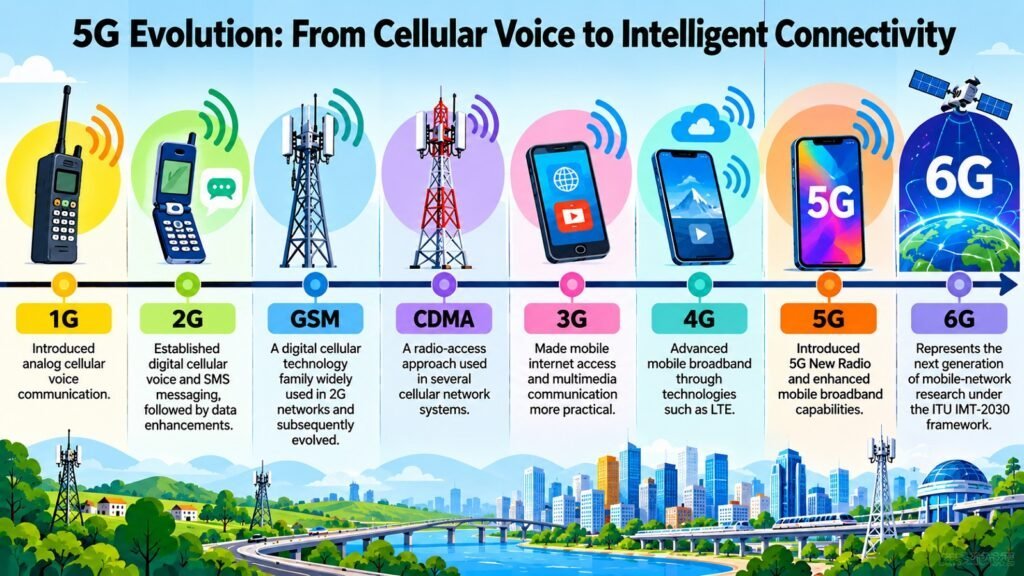
The technology arrived through successive generations, in which 1G carried analog voice, 2G introduced digital voice and messaging with data services added later, 3G made mobile internet practical, and 4G advanced mobile broadband to mass-market scale. GSM and CDMA, often mistaken for generations, were cellular technology families that operated across the 2G and 3G eras rather than generations in themselves.
5G deserves dedicated study because it redistributes functionality across radio, transport, and core domains, yet delivered connectivity still depends on spectrum, deployment choices, infrastructure, and application requirements, so no two networks offer identical capabilities. This article examines eight aspects for graduate, postgraduate, and doctoral readers, from architecture to 6G, and separates standardized capability from commercial reality throughout. The table below previews that scope.
Table 1: 5G Aspects Covered in This Article
| 5G Aspect | Core Focus |
| 5G Network Architecture | Functional roles of devices, radio access, transport, and the service-based core |
| 5G New Radio and Spectrum | Air interface design, frequency bands, and radio techniques |
| 5G Standalone and Non-Standalone Networks | Deployment arrangements combining NR with LTE or the 5G core |
| 5G Speed, Latency, and Performance | Metric definitions, measurement conditions, and real-world variability |
| 5G Network Slicing and Core Capabilities | Differentiated services over shared infrastructure |
| 5G Applications and Internet Connectivity | Consumer, enterprise, and industrial uses linked to requirements |
| 5G Security, Reliability, and Deployment Challenges | Threat surfaces, safeguards, and economic or infrastructure constraints |
| 5G Evolution and the Future of 6G | Standards releases, 5G-Advanced, and research directions |
1. 5G Network Architecture: How the Core Infrastructure Works
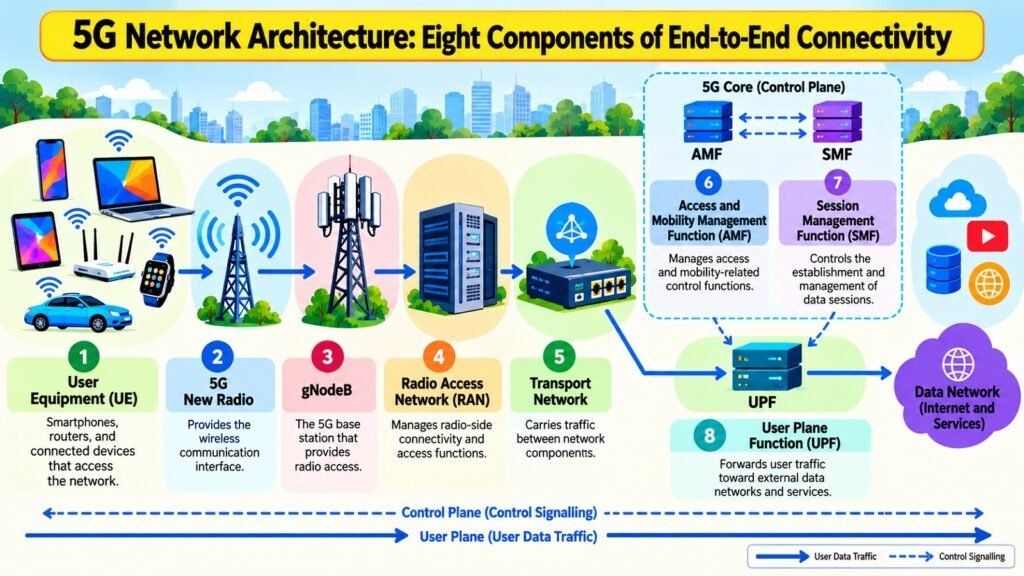
A 5G network works as a chain of dependent functions, and its behavior emerges from how those functions interact rather than from any single element. The user equipment, such as a smartphone or cellular module, connects over the 5G New Radio (NR) air interface to a gNodeB, the base station defined for the next-generation radio access network in 3GPP TS 38.300. The gNodeB passes traffic into transport infrastructure, typically fiber or microwave backhaul, which links it to the 5G core.
Consider a handset requesting a video stream. It first registers with the network, a step coordinated by the Access and Mobility Management Function (AMF), while the Authentication Server Function (AUSF), supported by unified data management, verifies the subscriber. The Session Management Function (SMF) then establishes a protocol data unit session and selects a User Plane Function (UPF), applying rules supplied by the Policy Control Function (PCF). Uploaded packets travel from the device through the gNodeB to the UPF and onward to the internet destination, and the responses retrace that path in reverse, which completes the exchange.
This sequence illustrates the separation of control plane from user plane, because signalling for registration, mobility, and session setup is handled by functions such as the AMF and SMF, whereas user traffic flows through the UPF. The separation lets operators place forwarding close to users while keeping signalling centralized, a choice with consequences for latency and scalability (3GPP TS 23.501).
The core adopts a service-based architecture in which network functions expose services to one another through HTTP-based interfaces, with a repository function supporting discovery. Because the functions are software, operators may virtualize them or run them as cloud-native workloads, gaining elasticity and faster upgrades at the price of orchestration complexity and a wider software attack surface. The specifications standardize functions and interfaces, whereas the distribution, scaling, and hosting of those functions remain implementation decisions.
Table 2: Key Components in 5G Network Architecture
| Component | Role |
| User equipment | Attaches to the network and originates or receives traffic |
| gNodeB | NR base station managing radio resources and linking devices to the core |
| Transport network | Fiber or microwave backhaul between radio sites and the core |
| AMF | Handles registration, connection management, and mobility |
| SMF | Establishes and manages sessions and selects the user-plane function |
| UPF | Forwards user packets and connects to external data networks |
| AUSF and UDM | Authenticate subscribers and hold subscription data |
| PCF | Supplies policy rules governing quality of service and charging |
2. 5G New Radio and Spectrum: The Technology Behind Wireless Connectivity
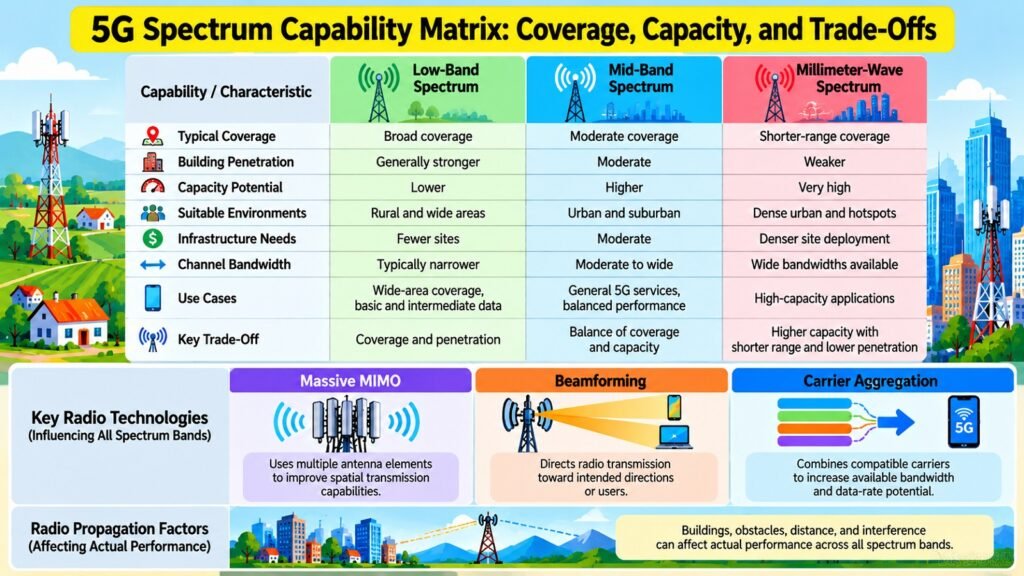
5G NR is the radio access technology through which user equipment and base stations exchange data over licensed or shared spectrum. Connectivity quality depends on a coupled set of variables: frequency band, channel bandwidth, propagation conditions, antenna design, and instantaneous radio conditions such as interference and mobility. NR operates across two frequency ranges defined in 3GPP TS 38.104, FR1, covering roughly 410 MHz to 7.125 GHz, and FR2, covering millimeter-wave bands from about 24.25 GHz to 52.6 GHz.
Deployments within these ranges are usually grouped as low-band, mid-band, and millimeter-wave. Low-band spectrum travels far and penetrates buildings but offers limited bandwidth, mid-band balances coverage with capacity, and millimeter-wave offers wide channels, up to 400 MHz per carrier in the standard, but attenuates quickly and is easily blocked, which demands dense sites. These tendencies are engineering regularities rather than absolute rules, since terrain, antenna height, and clutter can shift them.
A simplified illustration shows why frequency and bandwidth act differently. Under free-space propagation, path loss in decibels is 20·log10(d) + 20·log10(f) + 32.44, with distance d in kilometers and frequency f in megahertz. Moving from 3.5 GHz to 28 GHz at the same distance adds 20·log10(8), about 18 dB of loss, before blockage is considered, whereas capacity follows the Shannon relation C = B·log2(1 + SNR), so it scales linearly with bandwidth B but only logarithmically with signal-to-noise ratio. Wider millimeter-wave channels therefore raise potential capacity, provided dense infrastructure restores the lost signal margin.
Four techniques extend this baseline: massive MIMO uses many antenna elements for spatial multiplexing, beamforming steers energy toward individual users, carrier aggregation combines carriers to widen effective bandwidth, and flexible numerology scales subcarrier spacing from 15 kHz upward to suit different frequencies and latency needs. Standardized allocations and capabilities should not be conflated with what an operator actually licenses and activates.
Table 3: 5G Spectrum Characteristics and Radio Techniques
| Characteristic or Technique | Engineering Implication |
| Low-band spectrum | Wide-area and indoor coverage with limited bandwidth |
| Mid-band spectrum | Balances coverage and capacity; common capacity layer |
| Millimeter-wave spectrum | Large bandwidth but short range and sensitivity to blockage |
| Channel bandwidth | Scales potential capacity roughly linearly |
| Massive MIMO | Raises capacity through spatial multiplexing across many antenna elements |
| Beamforming | Concentrates energy toward users, improving signal quality |
| Carrier aggregation | Combines carriers to widen bandwidth, subject to device support |
| Flexible numerology | Adjusts subcarrier spacing and slot duration to frequency and latency needs |
3. 5G Standalone and Non-Standalone Networks: Deployment Models Explained
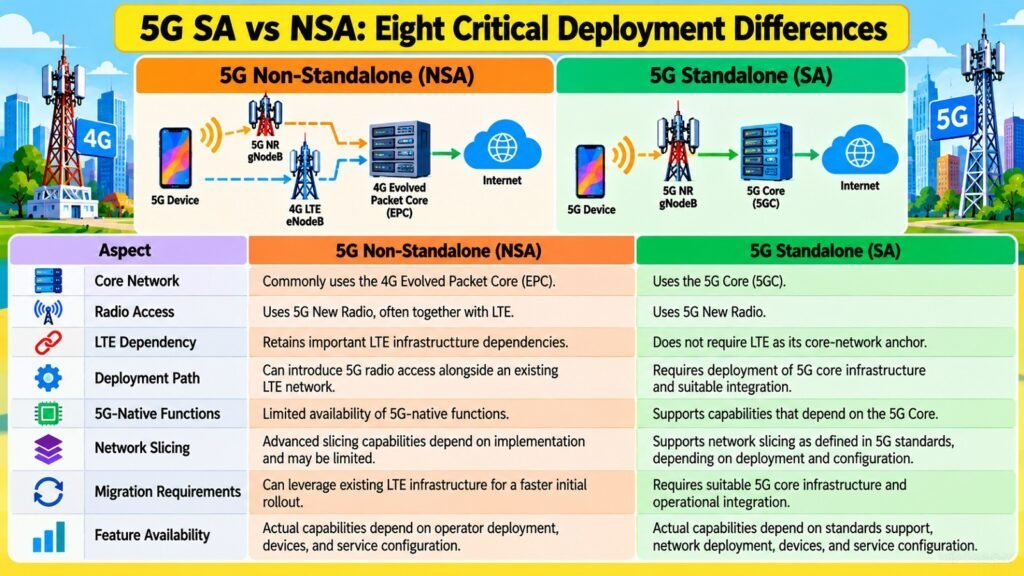
Standalone (SA) and non-standalone (NSA) describe how NR is attached to a core network, not distinct generations of mobile technology. In the most common NSA arrangement, an LTE base station anchors control signalling while NR adds capacity through E-UTRA-NR dual connectivity (3GPP TS 37.340), and the 4G Evolved Packet Core continues to perform essential functions. SA instead pairs NR with the 5G core, so radio, signalling, and session management are all native to 5G. Both remain parts of one standard, differing mainly in which elements carry signalling.
The specifications reflect this staging, with 3GPP completing NSA in December 2017 and SA in June 2018 within Release 15, which gave operators a rapid route to market. NSA reuses existing LTE coverage and core assets, which reduces initial investment and gives devices a reliable anchor, but it inherits the limits of the 4G core and requires devices to maintain both radio links. SA removes that dependency and enables core-based features such as network slicing and voice over NR, although a standalone network does not automatically expose them; they still require operator configuration, supporting devices, and commercial design.
A realistic scenario clarifies the sequencing. An operator with dense LTE coverage and newly acquired mid-band spectrum can add NR carriers to existing sites and offer faster mobile broadband within months, while the 5G core is still being procured, integrated, and tested. SA capabilities then arrive region by region and service by service as devices, roaming arrangements, and enterprise demand mature. Rollout order therefore differs across countries and operators: consumers see mainly added capacity, enterprises wait for core-dependent services, and providers bear dual-network costs during migration.
Table 4: 5G Standalone and Non-Standalone Deployment Characteristics
| Characteristic | SA and NSA Distinction |
| Radio access | NSA pairs NR with an LTE anchor; SA uses NR alone |
| Core network | NSA relies on the 4G core; SA uses the 5G core |
| Control signalling | NSA anchors signalling in LTE; SA signalling is native to NR |
| Network slicing | Depends on the 5G core, so generally an SA capability |
| Voice | NSA typically uses LTE-based voice; SA can support voice over NR |
| Migration role | NSA is an incremental step; SA completes the transition |
| Device requirement | NSA devices need LTE and NR; SA devices need SA support |
| Feature availability | Core-dependent features still require operator implementation |
4. 5G Speed, Latency, and Performance: What Users Can Expect
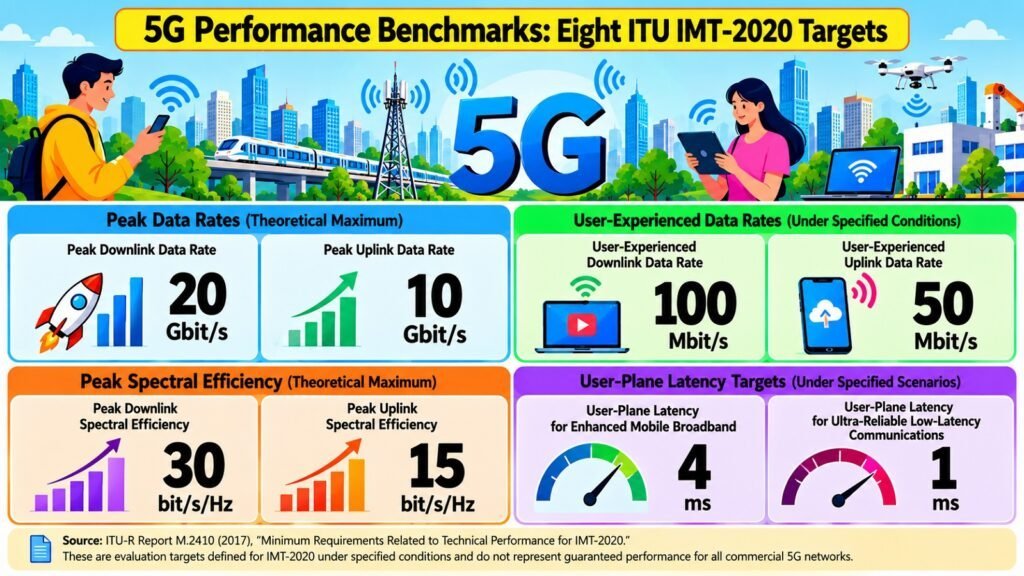
Performance claims about 5G are often imprecise because the underlying metrics are related but not interchangeable. Bandwidth is the spectrum width a channel occupies, throughput is the data rate actually delivered, latency is the delay in transferring a packet, jitter is the variation in that delay, packet loss measures undelivered packets, reliability describes the probability of successful delivery within a stated time, and connection capacity denotes how many devices a network can serve. A link can have ample bandwidth and still suffer high latency or loss.
Evidence must also be classified, and ITU-R Recommendation M.2410 sets minimum IMT-2020 requirements, including a 20 Gbit/s peak downlink rate and user-plane latency targets of 4 ms for enhanced mobile broadband and 1 ms for ultra-reliable low-latency communication, and these are design benchmarks under defined conditions, not typical experience. Commercial results vary with spectrum, signal quality, congestion, scheduling, backhaul, core configuration, device capability, and server location. Radio-interface latency excludes queuing, transport, and distance to the application server, so end-to-end delay is usually larger, and a strong signal guarantees neither high throughput nor low delay.
A compact worked example illustrates the arithmetic. Suppose a device downloads 1.2 GB (decimal) in 40 s, in which case throughput equals data divided by time and (1.2 × 8 Gbit) ÷ 40 s gives 0.24 Gbit/s, or 240 Mbit/s. The calculation assumes a single flow and steady conditions, so it describes one test rather than a guaranteed outcome. Reported figures should therefore state the transfer size, duration, protocol, and server location alongside the result, because omitting them makes comparison between studies unreliable.
Field studies show why such tests need context. Narayanan and colleagues, in a 2020 paper presented at The Web Conference, measured commercial millimeter-wave 5G on smartphones in US cities and found high throughput under favorable conditions but marked sensitivity to blockage, mobility, and device orientation. Their findings reflect particular operators, devices, and locations, and they should not be generalized.
Table 5: 5G Performance Metrics and Measurement Considerations
| Metric or Consideration | Meaning or Influence |
| Throughput | Delivered data rate over a defined interval and flow |
| Bandwidth | Channel spectrum width, setting an upper bound on capacity |
| Latency | Packet delay, distinguishing radio-interface from end-to-end values |
| Jitter | Delay variation that affects real-time applications |
| Packet loss | Share of undelivered packets, interacting with transport protocol behavior |
| Reliability | Probability of successful delivery within a specified time |
| Connection capacity | Devices supported per area under stated conditions |
| Test conditions | Device, location, load, and server affect reproducibility |
5. 5G Network Slicing and Core Capabilities: Flexible Connectivity
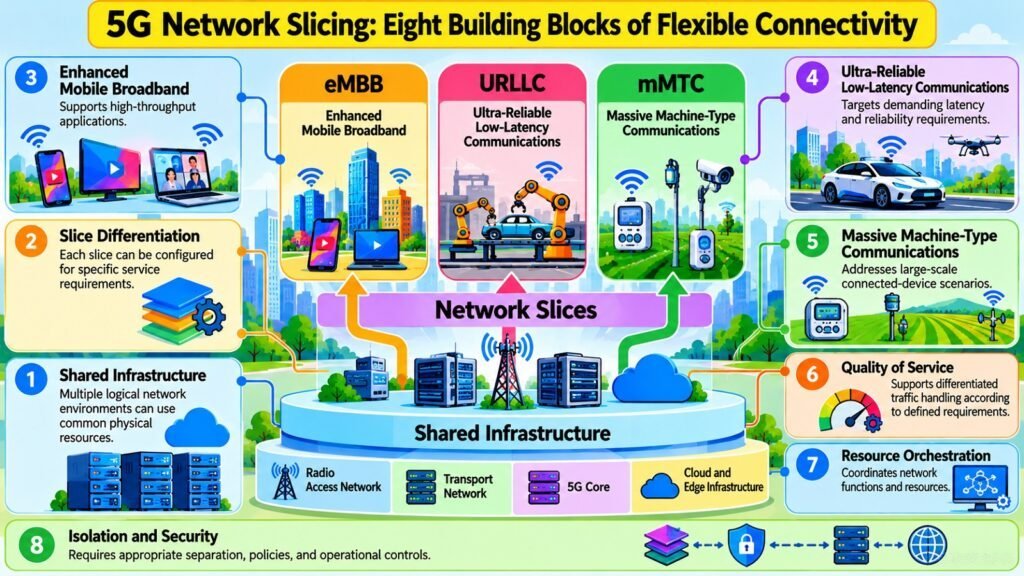
5G supports differing communication requirements through core capabilities that allocate resources according to service need rather than uniformly. Network slicing, defined in 3GPP TS 23.501, creates logically differentiated network environments over shared infrastructure, each identified by a single network slice selection assistance information (S-NSSAI). Slices need not occupy separate physical networks; they combine configured resources, policies, and network functions to meet particular objectives.
Three service categories frame these objectives. Enhanced mobile broadband (eMBB) targets high data rates, ultra-reliable low-latency communications (URLLC) targets stringent delay and reliability, and massive machine-type communications (mMTC) targets large populations of low-power devices. They are design categories, and no commercial network is obliged to provide all of them, so availability depends on what an operator chooses to build and sell. 3GPP TS 23.501 defines standardized slice and service type values corresponding to these categories, which gives vendors and operators a shared vocabulary, yet a standardized label says nothing about the performance a particular operator commits to deliver.
Several mechanisms translate these categories into managed services. Policy control and quality-of-service flows assign treatment to traffic, the service-based architecture lets functions be composed per slice, and virtualization with orchestration instantiates and scales those functions, with slice management specified in 3GPP TS 28.530. Consider a stadium video upload alongside a factory vibration-monitoring system. The first needs sustained throughput and tolerates occasional delay, whereas the second sends small packets that require predictable delivery, so a shared network must treat them differently.
Limits remain. Slices compete for shared radio and compute resources, so isolation depends on reservation and admission control. Orchestration across vendors is complex, every slice enlarges the security and monitoring burden, and service-level agreements need measurable and enforceable controls. Separating standard-defined functions from commercial offers is therefore essential.
Table 6: 5G Network Slicing and Core Capabilities
| Capability | Function or Implication |
| Network slicing | Logical service separation over shared infrastructure |
| S-NSSAI | Identifier used to select and associate traffic with a slice |
| QoS flows | Differentiated packet treatment within a session |
| Policy control | Applies rules for quality of service and charging |
| Service-based architecture | Lets core functions be composed and scaled independently |
| Virtualization | Runs functions as software on shared hardware |
| Orchestration | Automates lifecycle management, scaling, and assurance of slices |
| Admission control | Limits new demand to protect resources promised to existing services |
6. 5G Applications and Internet Connectivity: Transforming Digital Services
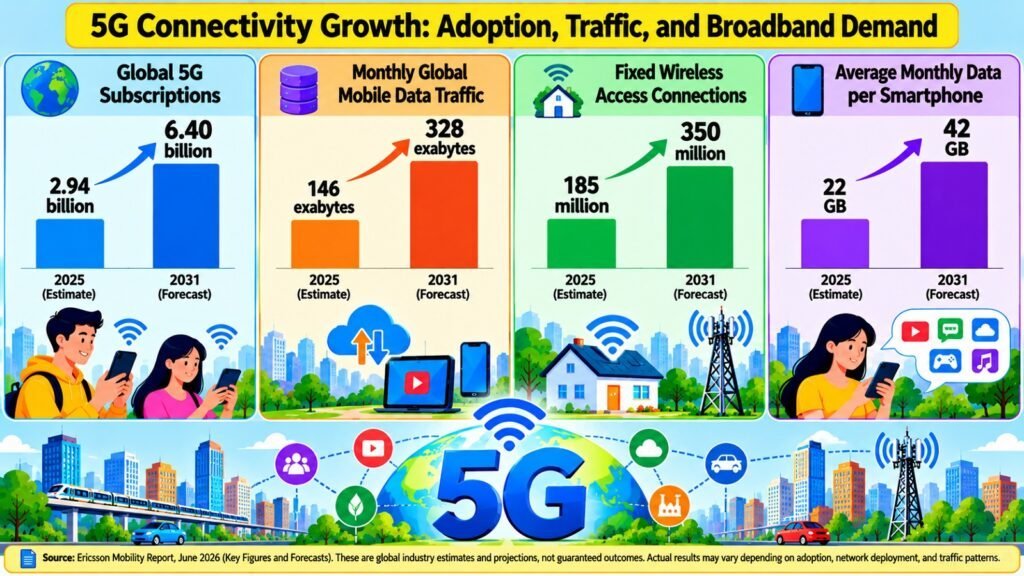
5G functions as an important Internet Connectivity technology because it converts radio characteristics into usable access across consumer, enterprise, and industrial settings. Mobile broadband is the most established use, supporting video streaming, cloud services, and video conferencing for people on the move. Fixed wireless access extends the same cellular infrastructure to homes and businesses as a broadband substitute, particularly where fiber is costly to install, although capacity is shared among subscribers on each cell. Streaming and conferencing mainly stress sustained throughput, which explains why mid-band capacity has mattered more to these services than headline peak rates.
Industrial uses are more conditional, because connected sensors, asset tracking, and monitoring depend on device density and battery life, while robotics and connected vehicles impose tighter latency and reliability demands that radio access alone cannot satisfy. Private cellular networks, which give an organization controlled coverage and policy, are the clearest documented industrial deployment. Mercedes-Benz and Telefónica Deutschland announced a 5G network for the Factory 56 plant in Sindelfingen to connect production equipment. That evidence shows such networks reaching real factories, but public reporting does not independently establish operational gains.
5G rarely works alone. Wi-Fi offers inexpensive local capacity, fiber supplies stable high-capacity fixed links and backhaul, and edge computing reduces application delay by moving processing closer to users. Fiber frequently carries the backhaul on which radio performance depends, and edge sites help only when applications are designed to exploit them. The best choice depends on mobility, coverage, bandwidth, latency, reliability, cost, and deployment conditions. Constraints persist in device compatibility, infrastructure availability, application design, and pricing, and none of these technologies guarantees safe autonomy or automatic business benefit.
Table 7: 5G Application Areas and Connectivity Roles
| Application Area | Connectivity Role and Evidence Status |
| Mobile broadband | Established; wide-area access for streaming and conferencing |
| Fixed wireless access | Established; cellular broadband for homes and businesses |
| Private cellular networks | Deployed; controlled coverage for factories and campuses |
| Industrial monitoring | Deployed at some sites; depends on reliability and device support |
| Asset tracking | Established, largely on low-power cellular; 5G extends scale |
| Smart infrastructure | Emerging; sensors across utilities and cities with varied connectivity |
| Connected vehicles | Emerging; vehicle communication needing low latency and wide coverage |
| Robotics and remote operation | Conditional; requires deterministic latency and resilient design |
7. 5G Security, Reliability, and Deployment Challenges: Risks and Limitations
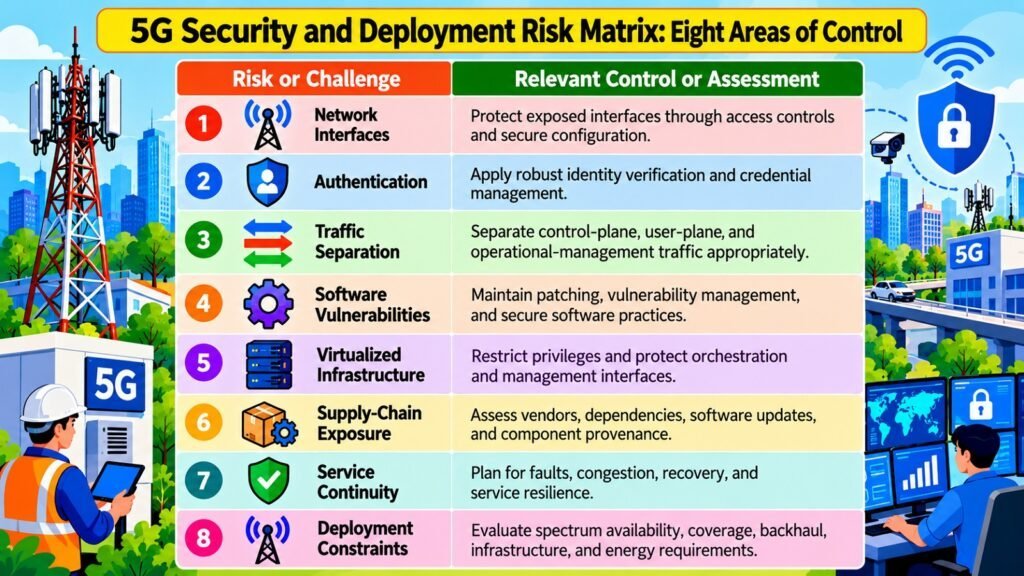
Security in 5G rests on standards, architecture, implementation quality, configuration, and operational discipline, not on the generation label. 3GPP TS 33.501 specifies mutual authentication, encryption, integrity protection for signalling, and concealment of the permanent subscriber identifier within a concealed identifier, which addresses the long-standing exposure of identities over the air. Standards define available protections, but operators must still enable and maintain them. Reliability is a related but distinct concern, since service continuity depends on redundancy, power resilience, backhaul diversity, and the discipline of network operations as much as on radio design.
Risk areas follow the architecture. Software vulnerabilities and misconfiguration affect virtualized network functions, exposed interfaces broaden the attack surface, supply-chain dependencies complicate assurance, and large device populations strain authentication and lifecycle management. Safeguards include encryption, access control, secure configuration, timely updates, monitoring, incident response, and risk-based management. ENISA’s 2019 threat landscape for 5G networks catalogues assets and threats using desk research and expert input; it is qualitative and assigns no probabilities, so it informs prioritization rather than prediction. The EU coordinated 5G toolbox of 2020 likewise treats supply-chain exposure as a matter of risk assessment and mitigation rather than a fixed verdict.
A compact example shows the reasoning. A misconfigured service-based interface in the core could let an unauthorized function request subscriber data, with potential exposure of sensitive information as the impact. The relevant mitigation is mutual authentication and authorization between functions, as specified in TS 33.501, together with configuration audits. Deployment constraints are equally uneven, since spectrum availability, backhaul, indoor coverage, site density, energy consumption, device compatibility, and affordability vary with band, region, and use case. Such findings rarely transfer intact between bands, regions, or deployment models.
Table 8: 5G Security Risks and Deployment Constraints
| Risk or Constraint | Implication or Mitigation |
| Software vulnerabilities | Require patching, testing, and vulnerability management |
| Exposed interfaces | Enlarge attack surface; mitigated by segmentation and authentication |
| Supply-chain dependency | Calls for vendor risk assessment and assurance processes |
| Misconfiguration | Can nullify standard protections; addressed through audits |
| Device scale | Strains authentication and lifecycle management |
| Spectrum and site density | Limit coverage and capacity, especially at higher frequencies |
| Backhaul and indoor coverage | Can bottleneck service despite strong radio links |
| Energy and affordability | Affect operating costs and equitable access |
8. 5G Evolution and the Future of 6G: What Comes Next?
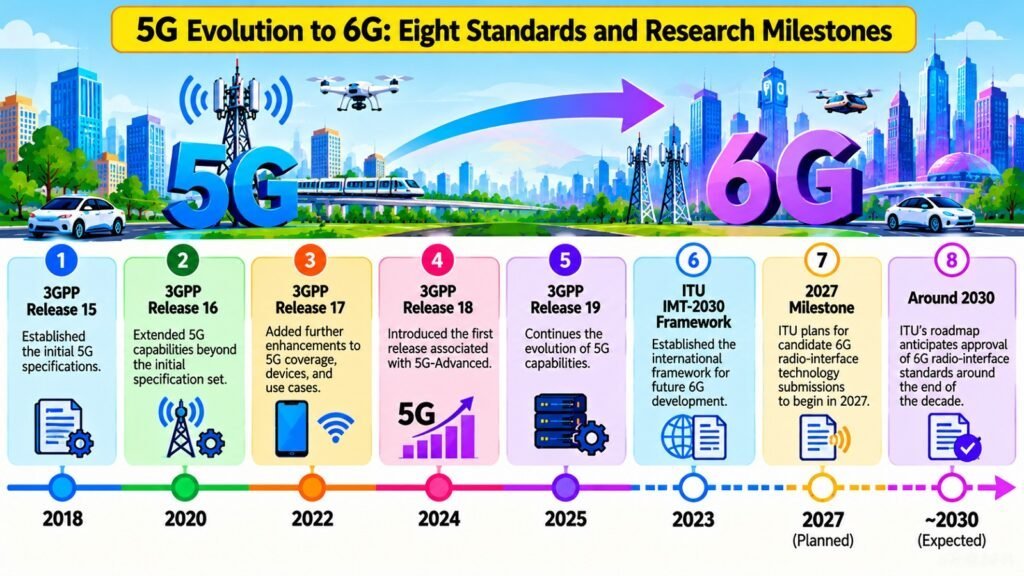
5G continues to evolve through successive 3GPP releases. Release 15 delivered the first specifications, Release 16 extended industrial and ultra-reliable capabilities, Release 17 added reduced-capability devices and initial non-terrestrial support, and Release 18 launched 5G-Advanced, which broadens AI-assisted optimization, energy savings, and positioning. A specification defines potential only; availability depends on vendor implementation, device support, and commercial decisions. 5G-Advanced should therefore be read as a continuation of 5G rather than a new generation, reusing the same core and radio foundations.
6G is the proposed next generation, and its evidence base is layered. ITU-R approved the IMT-2030 framework, Recommendation M.2160, in 2023, outlining usage scenarios that include immersive communication, integrated sensing and communication, and AI-related services. 3GPP began 6G studies in Release 20, and formal specifications are expected from Release 21, while commercial deployment around 2030 is a widely cited projection rather than a commitment. Dates and targets in this area come from the working plans of standards bodies and may shift. Published research, standards work, proposed targets, and deployed systems must be kept separate, since no 6G system has yet been standardized or deployed.
Research directions answer identifiable problems. AI-native networking seeks to embed learning in network design to manage growing complexity, integrated sensing and communication reuses radio signals to detect objects and motion, energy efficiency responds to rising network power use, immersive services stress capacity and latency, and terrestrial and non-terrestrial integration targets coverage gaps. Unresolved questions include trustworthy AI behavior, spectrum availability, device cost, and the economic case, since earlier generations show that technical capability does not guarantee returns. Each direction also raises measurement questions, because proposed targets cannot be judged until agreed definitions, test methods, and field evidence exist.
Table 9: 5G Evolution and 6G Research Directions
| Stage or Direction | Status and Significance |
| Release 15 | First 5G specifications, including NSA and SA options |
| Release 16 | Extended industrial IoT, URLLC, and unlicensed operation |
| Release 17 | Added reduced-capability devices and initial non-terrestrial support |
| Release 18 | First 5G-Advanced release, with efficiency, positioning, and AI-related work |
| AI-native networking | Research direction; standardization scope unresolved |
| Integrated sensing and communication | Research direction in IMT-2030 scenarios; unproven at scale |
| Terrestrial and non-terrestrial integration | Partly specified in 5G; deeper integration proposed for 6G |
| Energy efficiency | Ongoing objective across releases; measurable targets under discussion |
Conclusion — 5G: Building the Future of Modern Connectivity
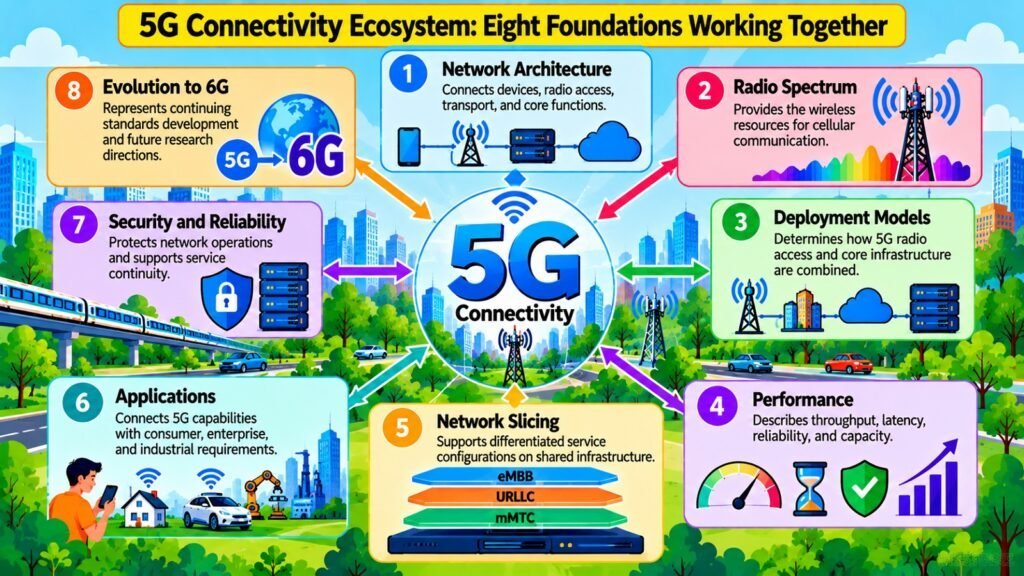
5G is best understood as an integrated system, and this article has traced how its parts depend on one another. The architecture separates signalling from forwarding and organizes the core as software services, NR and spectrum choices determine what the radio interface can deliver, and the SA and NSA models decide how quickly core-based features become available. Performance emerges from all of these layers together rather than from any single one. No single layer explains the experience a user receives, which is the principal reason the technology rewards system-level analysis.
The value of 5G extends beyond speed. Slicing and policy mechanisms permit flexible service delivery, additional spectrum and spatial techniques increase network capacity, and distinct service categories support applications with different communication requirements. Practical outcomes nevertheless depend on spectrum, coverage, infrastructure, device compatibility, configuration, security, and application design, which is why evidence-based evaluation matters and why theoretical capability must be separated from deployed performance.
Within the longer history of mobile networks, 5G stands as a major stage that 5G-Advanced is refining and that 6G research will eventually succeed. Its real-world value, however, will be decided by effective implementation and by applications that make genuine use of what it offers. It is therefore a foundation to be assessed with evidence, not a guarantee.
Table 10: Summary of Central 5G Aspects
| Aspects | Central Finding |
| Architecture | Service-based core with separated control and user planes |
| New Radio and spectrum | Band choice trades coverage against capacity |
| SA and NSA | Deployment models determine availability of core-based features |
| Performance | Metrics differ; peak targets are not typical experience |
| Slicing and core capabilities | Differentiated services over shared infrastructure, within resource limits |
| Applications | Established broadband uses; conditional industrial and vehicular uses |
| Security and deployment | Safeguards depend on implementation; constraints vary by context |
| Evolution | 5G-Advanced refines 5G while 6G remains under research |