Table of Contents
Introduction — Password Security: The Foundation of Digital Safety
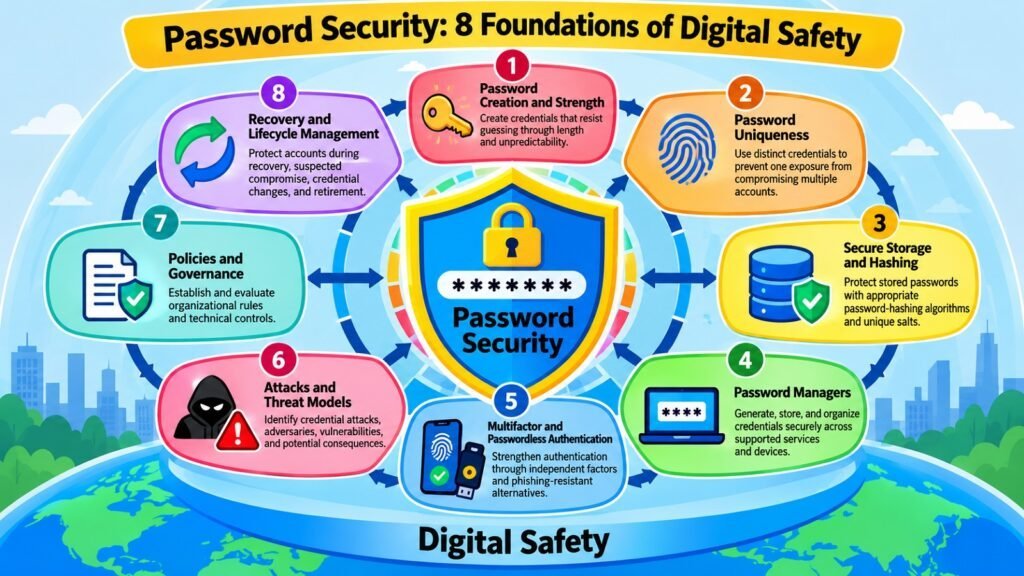
Every consequential digital interaction, from a bank transfer to a cloud deployment, begins with a claim of identity that a system must be able to test. Passwords remain the most widespread means of testing it, and Password Security is an important aspect of Digital Safety because it decides whether that claim can be trusted. We define Password Security as the principles, technologies, practices, and governance mechanisms used to protect passwords and control access to digital resources, a scope that concerns individuals, developers, security professionals, organizations, and researchers in distinct but overlapping ways. Its stakes are practical as well as scholarly, since credential compromise remains a routine entry point into systems that are otherwise well defended.
Four ideas deserve separation at the outset: password strength, credential protection, authentication assurance, and overall account security. A strong password can still be phished, a well-protected database can still hold weak secrets, and neither guarantees that the account is safe. Compromised credentials enable unauthorized access, identity theft, financial loss, and data exposure, yet passwords operate within wider authentication and access-control systems whose design shapes the outcome. This distinction recurs throughout the article, because treating any one of them as a proxy for the others is a frequent source of misplaced confidence.
The article asks how passwords resist guessing, why uniqueness matters, how stored credentials are protected and managed, how authentication can be strengthened, how attacks exploit weakness, how organizations govern practice, and how protection persists across the credential lifecycle. It treats these as a connected body of theory, empirical research, cryptographic principle, and implementation practice, because effective Password Security requires understanding the mechanisms behind recommendations, the evidence supporting them, and their limitations.
Table 1: Password Security Foundations Previewed
| Password Security Foundation | Core Focus |
| Creating strong passwords | Length, unpredictability, and resistance to guessing |
| Preventing reuse | Credential uniqueness and breach containment |
| Secure storage | Hashing, salting, and cryptographic protection |
| Password managers | Generating and safeguarding unique credentials |
| Multifactor and passwordless access | Authentication beyond shared secrets |
| Attacks and threat models | Adversary behavior and proportionate defenses |
| Policies and governance | Organizational standards and oversight |
| Recovery and lifecycle management | Recovery, monitoring, and credential retirement |
1. Password Security: Creating Strong and Resilient Passwords
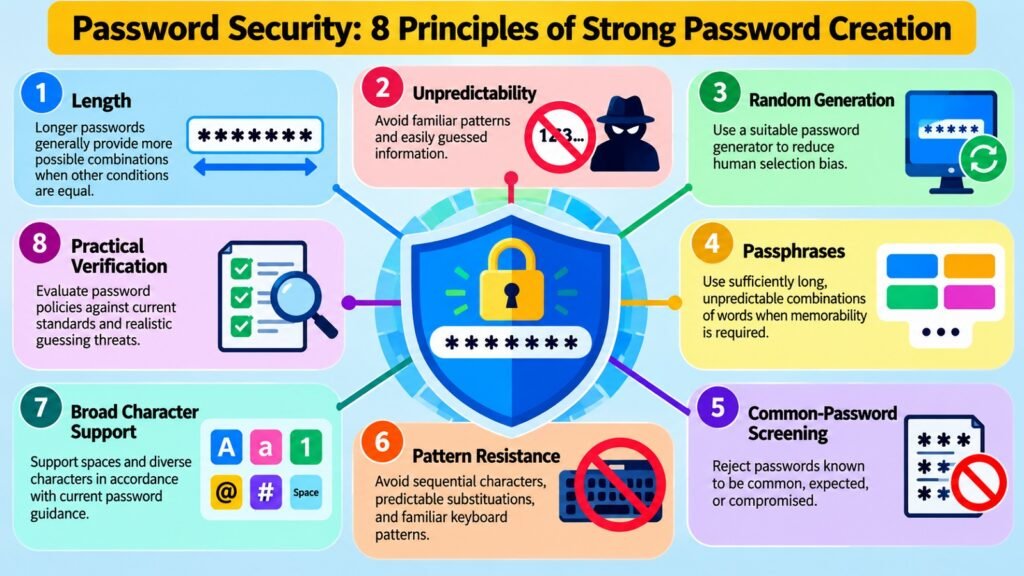
Password creation is, at bottom, a problem of unpredictability under the constraints of human memory. Entropy quantifies that property for a secret drawn from a known distribution: a twelve-character password chosen uniformly from the 94 printable ASCII symbols carries roughly 78.7 bits, since twelve multiplied by log2(94) is about 78.7. The calculation assumes uniform random selection, which is precisely what people do not do, so theoretical entropy describes a search space and not the effort a realistic adversary would spend.
Empirical work makes the gap plain. Bonneau’s analysis of roughly seventy million anonymized Yahoo! passwords showed human choices clustering in a small set of popular values, and Weir and colleagues found that entropy-based estimates predicted resistance to real cracking poorly. Dictionary words, personal details, keyboard walks, and habitual substitutions let attackers order guesses by likelihood and traverse only a fraction of the theoretical space.
NIST SP 800-63B-4 responds by favouring length, permitting long passphrases, screening candidates against blocklists of common and compromised values, and discouraging arbitrary composition rules, which Komanduri and colleagues found tend to produce formulaic compliance. For researchers, the lesson is that password distributions, not individual passwords, are the relevant unit of analysis; for practitioners, it is that a creation system should be tested against realistic guessing models rather than nominal character-class counts.
Each mechanism carries trade-offs. Generators deliver near-uniform randomness but need somewhere to keep the result; blocklists catch known weak values without constraining the rest of the space; strength meters help only when their models resemble attacker behaviour, and mislead when they do not. The shared principle is that resistance to guessing grows with length and genuine randomness and shrinks with every pattern an adversary can anticipate. Evaluators should accordingly compare designs by guessing resistance under stated attacker models, usability burden, and failure modes, and should avoid presenting any password as completely unbreakable. In short, long, randomly generated, and screened passwords resist guessing best.
Table 2: Password Security: Password Creation Factors
| Password Creation Factor | Security Implication |
| Length | Enlarges the search space exponentially when characters are random |
| Uniform random generation | Removes human bias, making entropy estimates reliable |
| Human-chosen passwords | Cluster around popular values, weakening entropy claims |
| Predictable substitutions | Modeled by cracking rules and add little protection |
| Composition rules | Can induce formulaic patterns without length requirements |
| Blocklists | Reject common and breached values without restricting the remaining space |
| Strength estimation | Useful only if its model approximates real guessing order |
| Passphrases | Combine memorability with length when words are randomly selected |
2. Password Security: Preventing Password Reuse and Credential Exposure
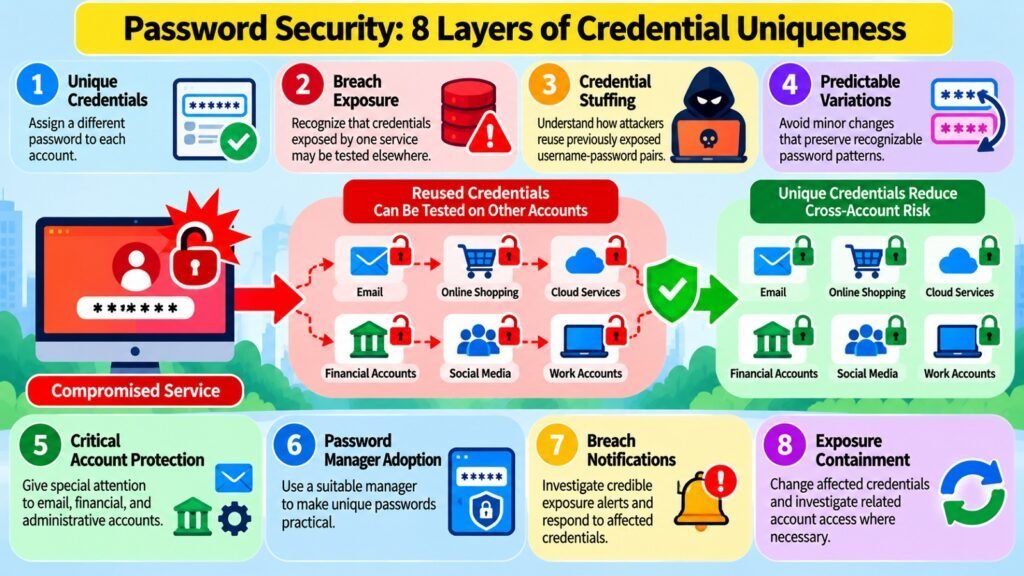
Credential uniqueness addresses a different failure from weakness: even an excellent password becomes a liability once it protects several services. Reuse couples the security of unrelated systems, so a breach at the weakest provider hands attackers a verified identifier and secret to try everywhere else. Credential stuffing automates this by replaying leaked pairs against many login endpoints. It differs from password spraying, which tries a few common passwords across many accounts, and from brute force, which enumerates candidates against a single target. The consequence is a cascading structure in which exposure, automation, and reuse interact: leaked pairs feed automated login attempts, and each success becomes a foothold for further compromise.
Reuse persists because of cognitive load rather than carelessness. Das and colleagues, studying leaked datasets at NDSS 2014, found that users often reuse passwords or modify them predictably, and that cross-site guessing succeeded against a meaningful share of accounts; their figures reflect particular leaked corpora and should not be generalized to every population. Changing a digit or suffix per service therefore offers little protection, because guessers model such transformations. Email compromise deserves special attention, since password-reset links turn one mailbox into a master key for linked services. Service-specific variations feel like a compromise between memorability and uniqueness, but they preserve the very correlation that reuse creates.
The practical response combines unique generated passwords, a password manager to carry the memory burden, and breach notifications that signal when a credential has surfaced in known exposures. Individuals and organizations can assess exposure through k-anonymity range queries or hashed comparisons without circulating plaintext passwords. Prioritizing email, financial, and administrative accounts limits the damage of any single exposure. Uniqueness does not substitute for strength, but it ensures that one compromise remains one compromise. Critical accounts should be secured first, and any suspected exposure should prompt replacement of the affected credential wherever it was reused.
Table 3: Password Security Credential Risks
| Password Security Credential Risk | Implications on Password Security |
| Password reuse | One breach exposes every service sharing the secret |
| Credential stuffing | Automated replay of leaked pairs; unique passwords neutralize it |
| Password spraying | Few common passwords across many accounts; throttling and MFA help |
| Exposed databases | Leaked pairs circulate and stay usable until credentials change |
| Predictable variations | Pattern-based guessing exploits minor changes between services |
| Email-account compromise | Reset links open linked services; protect email first |
| Credential separation | Isolates breaches so one exposure stays contained |
| Breach notification | Prompts timely replacement of exposed credentials |
3. Password Security: Secure Storage, Hashing, and Cryptographic Protection
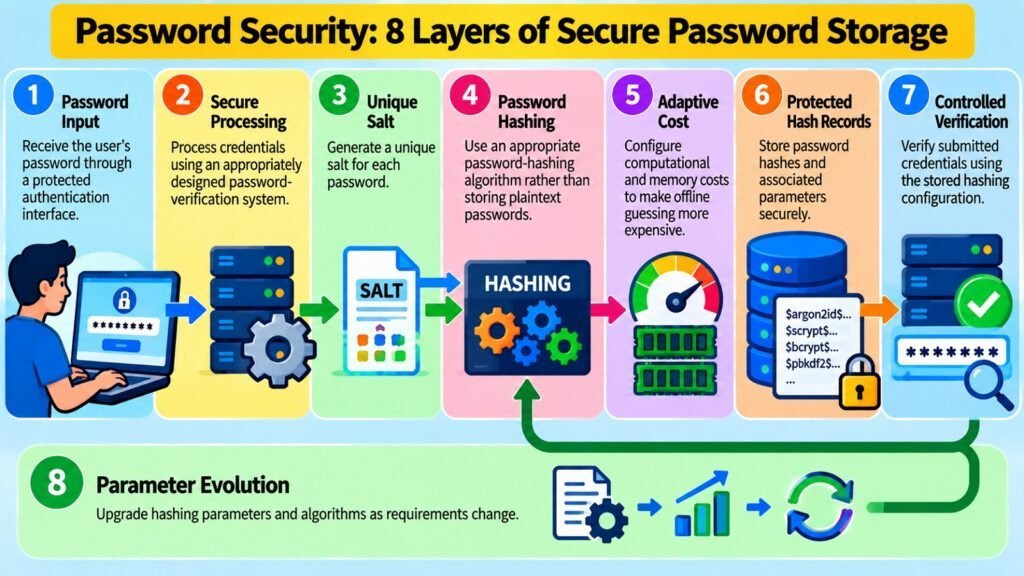
Storing passwords in plaintext, or in reversibly encrypted form, converts any database disclosure into immediate account compromise. Hashing offers a better model because verification requires only recomputing a one-way function and comparing outputs, never recovering the original. Encryption is reversible by design and so leaves a key whose theft restores every password. Salting adds a unique random value per credential, ensuring identical passwords yield different digests and defeating precomputed tables. Transport protection is a separate matter: TLS shields credentials in transit, while a well-hashed database does nothing for a password intercepted during login. Because attackers who steal a database can guess offline, free of throttling and detection, the hash must carry the entire burden of slowing them.
Fast general-purpose functions such as SHA-256 used alone are unsuitable because their speed, an advantage elsewhere, lets attackers test enormous numbers of candidates against a stolen database. Purpose-built schemes add tunable cost. PBKDF2 (RFC 8018) iterates a pseudorandom function and is widely supported but demands little memory; bcrypt uses a small fixed memory footprint yet truncates inputs at 72 bytes; scrypt (RFC 7914) and Argon2id (RFC 9106) are memory-hard, raising the cost of parallel hardware attacks. OWASP currently recommends Argon2id where available, with the others as compatibility options, and parameters should track deployment constraints and attacker resources. Salts need not be secret, only unique, and they should come from a cryptographically secure random source.
Design evaluation should examine the algorithm and parameters, salt generation, upgrade paths for legacy hashes, access restrictions on the database, and any pepper, a secret held outside the database, for example in a hardware security module. A pepper helps only when the database alone leaks, and no scheme survives weak passwords, so storage complements rather than replaces strong creation. Practical inspection also asks how quickly a breach would be detected, whether secrets and keys are isolated from application servers, and how parameters will be raised as hardware improves, since a design that cannot be upgraded eventually becomes a liability.
Table 4: Password Security Cryptographic Concepts
| Cryptographic Concept | Password Security Functions |
| Plaintext storage | Exposes every credential immediately upon disclosure |
| Hashing | One-way verification without recovering the password |
| Encryption | Reversible; key theft restores all passwords |
| Salt | Unique per credential; defeats precomputed tables |
| Work factor | Raises per-guess cost, slowing offline cracking |
| Memory-hard algorithms | Argon2id and scrypt demand memory, limiting parallel attacks |
| Parameter upgrades | Rehash at login to raise cost and retire legacy schemes |
| Pepper | External secret that limits the value of a stolen database |
4. Password Security: Password Managers and Credential Management
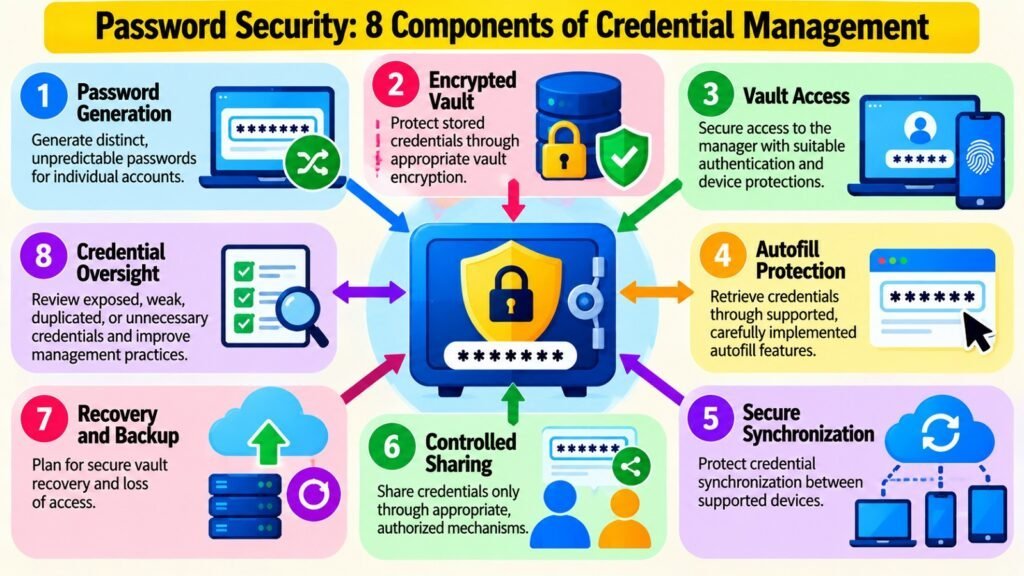
Password managers support Password Security by relocating the burden of memory from the person to software that generates, stores, organizes, and autofills unique credentials. Implementations range from browser-integrated and operating-system stores to dedicated applications and enterprise platforms offering secure sharing and administrative control. Most protect an encrypted vault whose key is derived from a primary secret through a key-derivation function, while synchronization services replicate the encrypted data across devices. The security gain is indirect but substantial: when remembering is no longer required, users can adopt long random passwords that they could never retain unaided.
Architecture determines the threat model. Cloud-synchronized vaults offer accessibility, backup, and recovery but require trust in the provider’s implementation and expose a synchronization attack surface; local vaults reduce provider dependence at the price of manual backup and greater loss risk. Neither is universally superior. Research has also exposed weaknesses in autofill and client-side integration, as in Silver and colleagues’ analysis of browser autofill and Li and colleagues’ study of web-based managers, a reminder that convenience features widen the attack surface. Usability findings nonetheless favour managers, since they make unique passwords practical.
The manager’s own credentials become the single point of failure, so a strong primary secret, multifactor authentication, device security, and carefully designed recovery are essential. Managers cannot defend against compromised endpoints, unsafe sharing, or unlocked vaults left accessible. Evaluation should rest on transparent criteria such as independent audits, documented cryptography, breach history, export options, and recovery design, not promotional claims. Consumer tools should also be distinguished from privileged access management and secrets management, which govern administrator credentials, service accounts, API keys, and other machine identities. Organizations should extend these considerations to the shared vaults, where membership changes and role-based access must be reviewed as carefully as any other privilege.
Table 5: Password Security Credential Management
| Management Approach or Feature | Security Benefit or Limitation |
| Unique-password generation | Prevents reuse without a memorization burden |
| Encrypted vault | Protects entries; strength depends on the primary secret |
| Key derivation | Slows guessing of the primary secret but cannot rescue a weak one |
| Cloud synchronization | Convenient access and backup; requires provider trust |
| Local storage | Reduces provider dependence; shifts backup duty to the user |
| Secure sharing | Avoids plaintext transmission; requires careful access control |
| Recovery mechanisms | Prevent lockout, yet weak designs create takeover routes |
| Enterprise credential management | Adds policy and auditing; needs dedicated administration |
5. Password Security: Multifactor Authentication and Passwordless Access
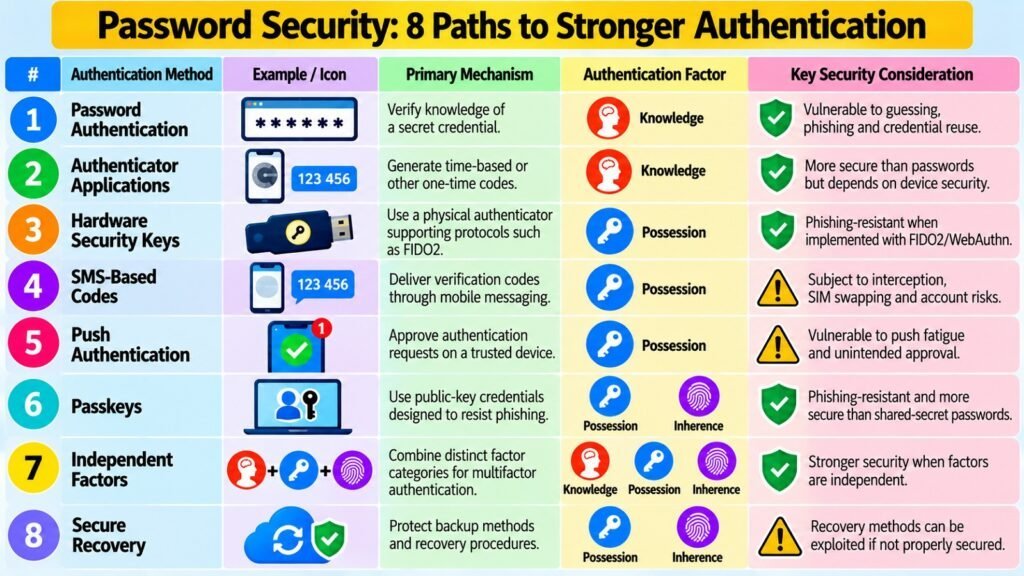
Identification asserts who a party claims to be, authentication verifies the claim, and authorization determines what the verified party may do. Passwords belong to the knowledge category, alongside possession and inherence. Genuine multifactor authentication combines independent categories; two sequential knowledge checks are merely two steps. MFA limits the consequences of a stolen password because the attacker must also obtain a second factor, yet it does not stop adversaries who relay or capture both in real time. The comparison that follows therefore asks which attacks each method resists, not merely how many steps it adds. Evaluation should therefore begin from the attacker’s capabilities.
Methods differ sharply in security properties. SMS and email codes are convenient but vulnerable to SIM swapping, interception, and phishing, and NIST treats the public telephone network as a restricted authenticator. Authenticator applications avoid the carrier but still produce codes that a phishing site can relay. Push approvals invite fatigue attacks unless number matching is used. Hardware keys and passkeys built on FIDO2 differ in kind: WebAuthn (W3C) and CTAP (FIDO Alliance) use public-key challenge-response, with credentials bound to the relying party’s origin, so a lookalike domain cannot elicit a usable assertion, and the server holds no shared secret to leak. NIST SP 800-63B reserves its strongest assurance level for cryptographic, phishing-resistant authenticators, which reflects the same logic.
The passkeys can replace passwords for many services, and synced variants trade some assurance for portability and easier recovery, a distinction NIST SP 800-63B-4 acknowledges. Passwordless designs still leave exposure in account recovery, device replacement, cross-device flows, and session theft after authentication, any of which can undermine strong authentication. Choosing a method therefore means matching phishing resistance, accessibility, deployment cost, and recovery capability to the threat model. Accessibility and compatibility matter equally, since a mechanism that excludes users or legacy applications pushes them toward weaker fallbacks that attackers then target.
Table 6: Password Security Authentication Methods
| Authentication Method | Security Characteristics or Limitations |
| SMS codes | Susceptible to SIM swapping and interception; NIST restricts their use |
| Email codes | Only as secure as the mailbox; phishable |
| Authenticator apps | Avoid carrier risk; codes can still be relayed by phishing sites |
| Push authentication | Usable, but prone to approval fatigue; number matching mitigates |
| Hardware security keys | Phishing-resistant; require possession and backup keys |
| Device-bound passkeys | Phishing-resistant public-key credentials; recovery needs planning |
| Synced passkeys | Easier recovery and portability; depend on provider account security |
| Biometrics | Inherence factor, typically verified locally; cannot be revoked easily |
6. Password Security: Understanding Password Attacks and Threat Models
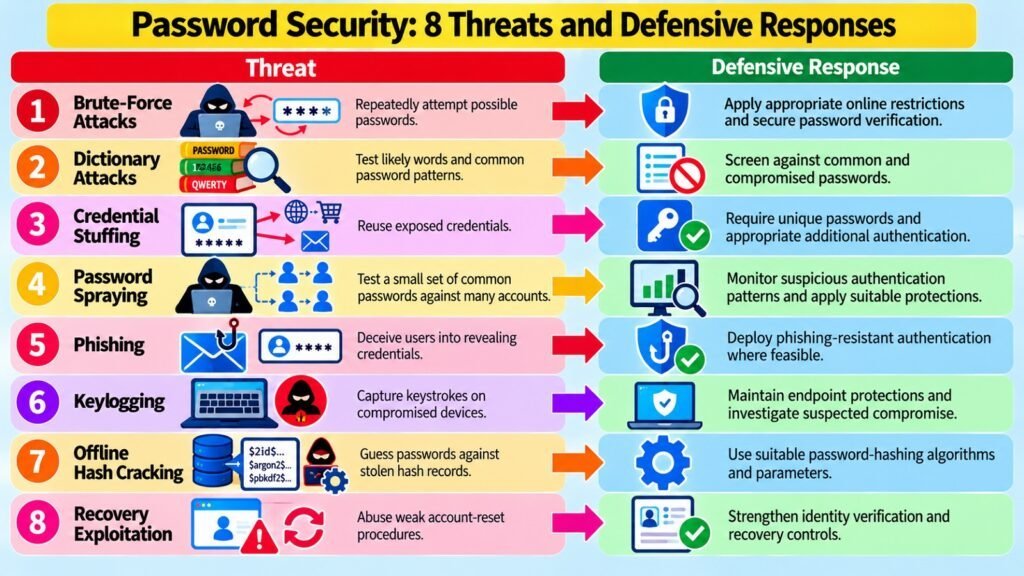
Attacks against passwords divide by what they target. Online guessing, spraying, and credential stuffing probe the login interface, whereas offline cracking, whether by dictionary, rule-based, or brute-force enumeration, works against stolen hashes where only computation limits the attacker. Phishing, social engineering, keylogging, and credential-stealing malware bypass guessing altogether by capturing the secret from the user or device. The distinction matters because a control effective against one class may be irrelevant to another: hashing does nothing against phishing, and phishing-resistant authentication does nothing against a weak hash. These attacks also chain: credentials obtained through deception can be used for an ordinary login that looks entirely legitimate to the server.
Threat modeling supplies the discipline for matching defenses to adversaries. It identifies protected assets, adversary capabilities, attack surfaces, trust boundaries, and assumptions, then weighs consequences that differ greatly between a personal account, a banking application, and a cloud administrator console. Rate limiting, throttling, breached-password screening, secure hashing, MFA, and monitoring each address distinct weaknesses, and each has costs: aggressive lockouts invite denial of service against legitimate users, monitoring can miss low-and-slow attempts, and false positives erode trust. Empirical studies and incident analyses should anchor these judgments, with theoretical attack models kept clearly separate from observed behavior.
Consider a hypothetical consultancy whose staff reuse passwords and whose VPN accepts passwords alone. Modeling suggests that credential stuffing, not brute force, is the likeliest route, so proportionate controls include breached-password screening, source-based throttling, phishing-resistant MFA for remote access, and monitoring for anomalous logins. Weaknesses also combine: a phished credential, an email-dependent recovery flow, and a long-lived session token together defeat controls that would each hold in isolation. Consequently, Password Security should be evaluated as an integrated framework of interconnected safeguards, an approach that is demonstrated in the MITRE ATT&CK framework’s compilation of credential-access methodologies. The scenario is illustrative and concerns defensive reasoning only; controls are chosen for the adversary actually expected, not the one most vivid.
Table 7: Password Security Attacks and Threats
| Attack or Threat | Mechanism or Defensive Implication |
| Online guessing | Repeated login attempts; rate limiting constrains it |
| Offline hash cracking | Computation against stolen hashes; slow salted hashing raises cost |
| Dictionary attack | Tries likely words and variants; blocklists reduce success |
| Brute-force attack | Exhaustive enumeration; sufficient length makes it infeasible |
| Password spraying | Few common passwords across many accounts; evades per-account lockout |
| Credential stuffing | Replays leaked pairs; uniqueness and MFA blunt it |
| Phishing and social engineering | Deceives users into disclosure; phishing-resistant authentication helps |
| Keylogging and malware | Captures secrets on endpoints; endpoint protection and device-bound factors needed |
7. Password Security: Policies, Standards, and Organizational Governance
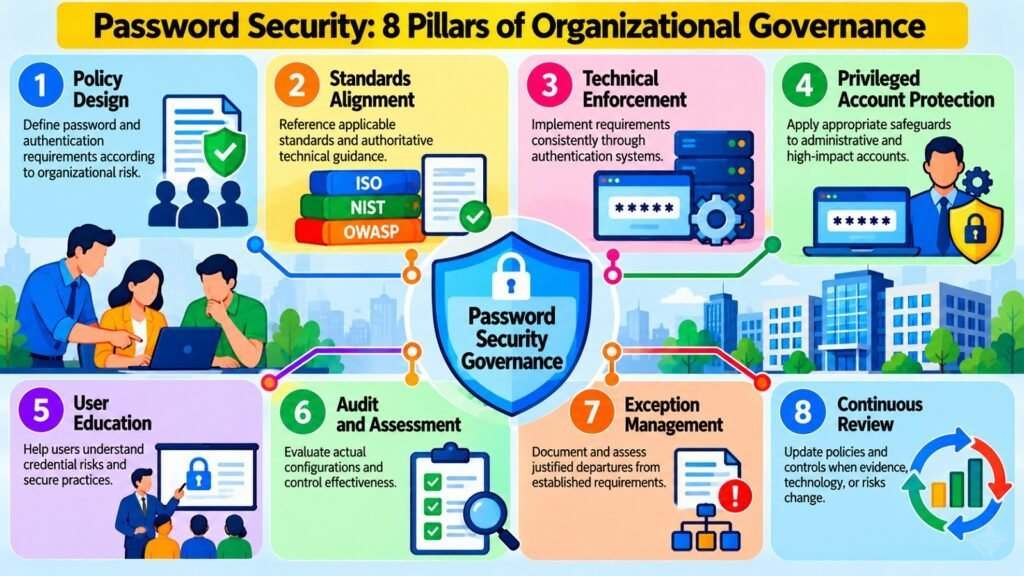
Organizational Password Security begins with a policy that converts security objectives into enforceable technical settings and realistic user expectations. The policy sits within identity and access management, risk management, and compliance, and it covers employees, contractors, customers, administrators, applications, and service accounts, each with different exposure. NIST SP 800-63B-4 is the most influential source: it favours length, blocklist screening, no mandatory composition rules, no routine rotation absent evidence of compromise, and MFA where risk warrants. Zhang and colleagues’ study of password expiration helps explain why, showing that forced changes often yield predictable transformations of earlier passwords. Policy language should state requirements as verifiable settings, such as minimum length and screening, rather than as aspirations.
Standards must be read for their status. NIST guidance binds federal systems but is advisory elsewhere; ISO/IEC 27001:2022 and 27002:2022 address authentication information through controls on its allocation and management; PCI DSS v4.0 sets specific requirements, including minimum password length and MFA, for entities within its scope; OWASP guidance is voluntary. Organizations should not assume every standard applies to them, and legacy systems that cannot meet current guidance need documented compensating controls. Version matters, since NIST SP 800-63B-4 supersedes the 2017 edition and raises expectations on length and MFA.
A written policy does not prove effectiveness. Governance depends on audits comparing actual configurations with stated requirements, managed exceptions, staff education, access reviews, incident reporting, and scheduled policy updates. Security teams, developers, administrators, compliance staff, management, and users each own distinct duties. Measurement should examine behavior and enforcement, not mere documentation, and usability deserves explicit attention because burdensome rules provoke workarounds. Research on compliance suggests that people follow rules they find workable, but such findings are context-dependent and should inform, rather than replace, local measurement. Operational monitoring then closes the loop by revealing whether controls behave as written.
Table 8: Password Security Governance Controls
| Governance Control | Purpose or Evaluation Criterion |
| Policy design | Aligns requirements with current guidance and risk |
| Technical enforcement | Configurations must match the written policy |
| Compromised-password screening | Blocks known exposed values at creation and change |
| Multifactor requirements | Scope tied to risk, especially privileged access |
| Security audits | Verify actual settings and detect configuration drift |
| Staff training | Builds understanding; effectiveness needs measurement |
| Exception management | Documented, approved, time-limited, with compensating controls |
| Periodic policy review | Updates rules as standards and threats evolve |
8. Password Security: Recovery, Monitoring, and Credential Lifecycle Management
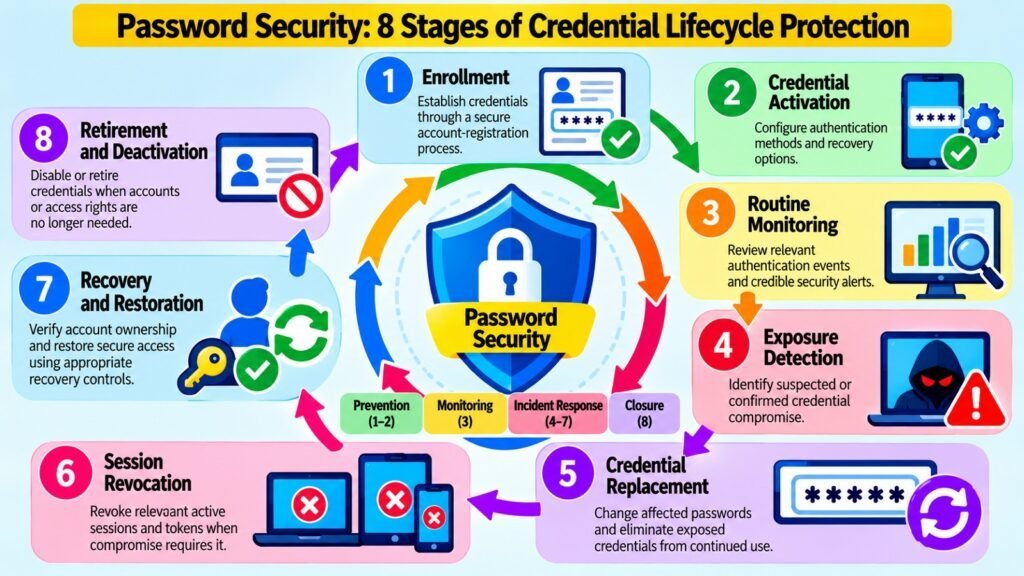
Password Security continues after creation, through enrollment, recovery, monitoring, replacement, and retirement. Recovery deserves particular scrutiny because it forms part of the authentication boundary: if a reset needs only a knowledge question or an insecure channel, an attacker can bypass even strong authentication. Sound recovery combines verified channels, single-use time-limited reset links, recovery codes stored offline, backup authenticators, and support-assisted procedures designed to resist impersonation. Enrollment sets the baseline for everything that follows, since a weakly verified identity at registration cannot be repaired later by strong authentication.
Monitoring separates confirmed exposure, such as a credential appearing in a breach corpus, from suspected compromise indicated by anomalous logins, and both from routine failed attempts that reflect ordinary typing errors. Alerts support timely action, though telemetry is incomplete, false positives burden users, and monitoring raises privacy considerations that policy must address. When exposure is confirmed, changing the password is necessary but insufficient. Responders should review reused credentials, revoke sessions and tokens, inspect recovery settings, secure linked email, and examine account activity, while organizations add incident-response duties of containment and investigation consistent with NIST SP 800-61. User-level actions are limited to what an individual can see and change, whereas organizations can correlate logs, force resets, and hunt for persistence.
Lifecycle management also covers onboarding, offboarding with prompt deactivation, privileged-access changes, and service-account rotation. Periodic password changes are not universally beneficial, and NIST advises against mandatory rotation without evidence of compromise, although machine secrets may warrant scheduled rotation for operational reasons. Reliable protection over time rests on secure recovery, proportionate monitoring, revocation, and controlled retirement. Controlled retirement matters as much as creation, because dormant accounts and forgotten service credentials remain valid attack paths long after anyone remembers them. Offboarding failures are especially costly when departing staff held privileged access or knew shared secrets.
Table 9: Password Security Lifecycle Actions
| Lifecycle Event | Appropriate Security Action |
| Enrollment | Verify identity and register strong authenticators |
| Password reset | Use verified channels and single-use expiring links |
| Account recovery | Offer recovery codes or backup authenticators; verify support requests |
| Suspected compromise | Investigate logins and require re-authentication |
| Confirmed exposure | Replace the password and review reused credentials |
| Session revocation | Invalidate active sessions and tokens after credential change |
| Employee offboarding | Deactivate accounts promptly and rotate shared secrets |
| Credential retirement | Disable and remove unused credentials and service accounts |
Conclusion — Password Security: Building Lasting Digital Protection
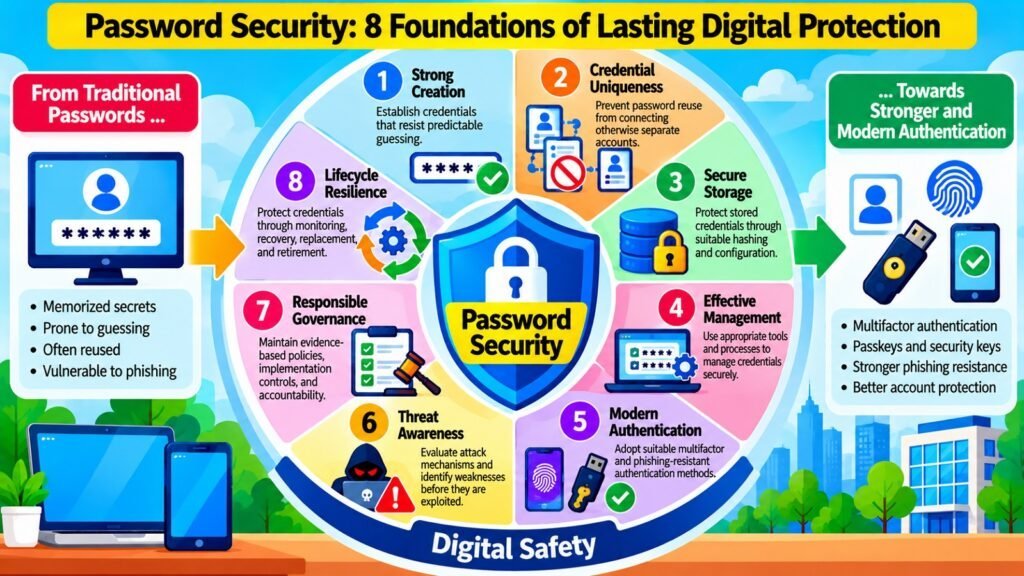
Taken together, the eight foundations describe a layered system in which each control compensates for the limits of another. Strong creation resists guessing, uniqueness contains breaches, hashing limits the value of a stolen database, managers make good habits practical, modern authentication blunts phishing, threat modeling directs effort, governance sustains it, and lifecycle management keeps accounts trustworthy over time. Password Security is an important aspect of Digital Safety because credentials guard personal identities, finances, communications, organizational systems, and sensitive information. No single foundation carries the system; weakness in any one, such as a flawed recovery flow, can undermine the strength of the others.
Isolated rules are not enough. Effective protection depends on understanding mechanisms, weighing credible research, applying suitable controls, and recognizing the limits of every approach. Passkeys and other passwordless methods are growing in importance, yet they do not remove the need for secure recovery, identity protection, and appropriate access controls. Theory explains why controls work, evidence shows whether they work in practice, and implementation determines whether they work for a particular organization. Each claim here rests on documented mechanisms rather than prediction.
Password Security is best understood as an ongoing technical and organizational discipline within Digital Safety. Readers can use this article as a reference for study, research, system evaluation, and practical security decisions. Unique credentials, appropriate storage, secure authentication, reliable recovery, and continuous evaluation remain the practical core.
Table 10: Password Security Foundations Summarized
| Password Security Foundation | Enduring Takeaway |
| Creating strong passwords | Length and randomness resist guessing |
| Preventing reuse | Unique credentials contain breaches |
| Secure storage | Slow, salted hashing limits stolen-database damage |
| Password managers | Make unique passwords practical, with caveats |
| Multifactor and passwordless access | Phishing resistance matters most |
| Attacks and threat models | Controls must match actual adversaries |
| Policies and governance | Enforcement and audit make policy real |
| Recovery and lifecycle management | Recovery and retirement preserve account integrity |