Table of Contents
Introduction: Endpoint Security and Its Role in Cybersecurity
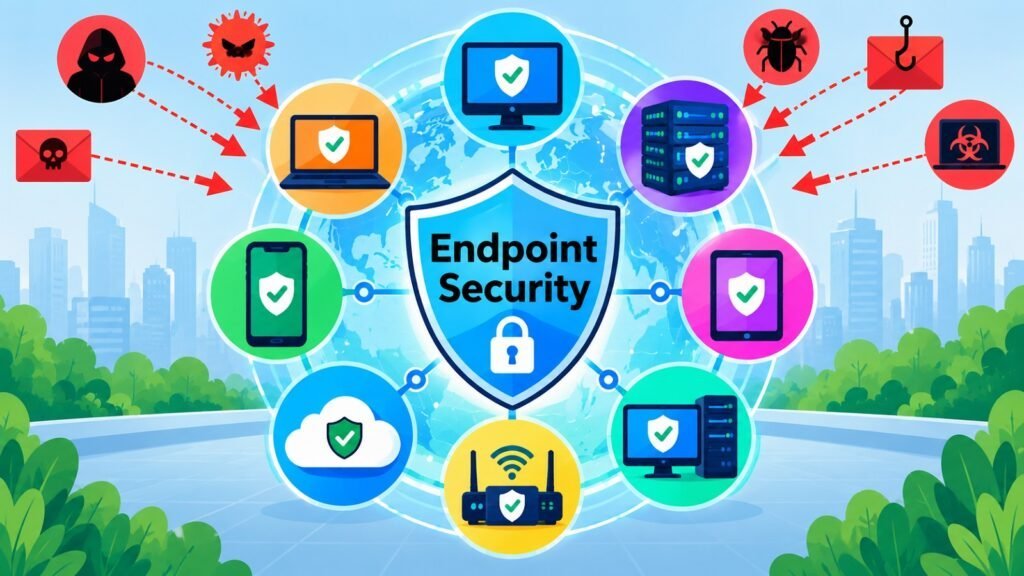
Endpoint Security is the discipline of protecting the devices through which people and processes interact with organizational information, and it constitutes an important aspect of Cybersecurity. An endpoint is any computing system that terminates a network connection and processes or stores data, including desktops, laptops, servers, smartphones, tablets, and a growing range of embedded and connected devices. Because each endpoint executes code, accepts input, and holds credentials, it links the organizational information system to the wider threat environment, and its compromise can become the first step toward lateral movement across that system. The consequences concern individuals, firms, universities, and research organizations alike, since all depend on devices that adversaries can reach.
The field rests on seven principles: preventive protection, threat detection, vulnerability management, access control, data protection, security architecture, and operational management. Mastering them requires theoretical understanding, because controls embody assumptions about adversaries; research evidence, because claims of effectiveness often fail under scrutiny; practical analysis, because environments differ; and continuous adaptation, because threats evolve.
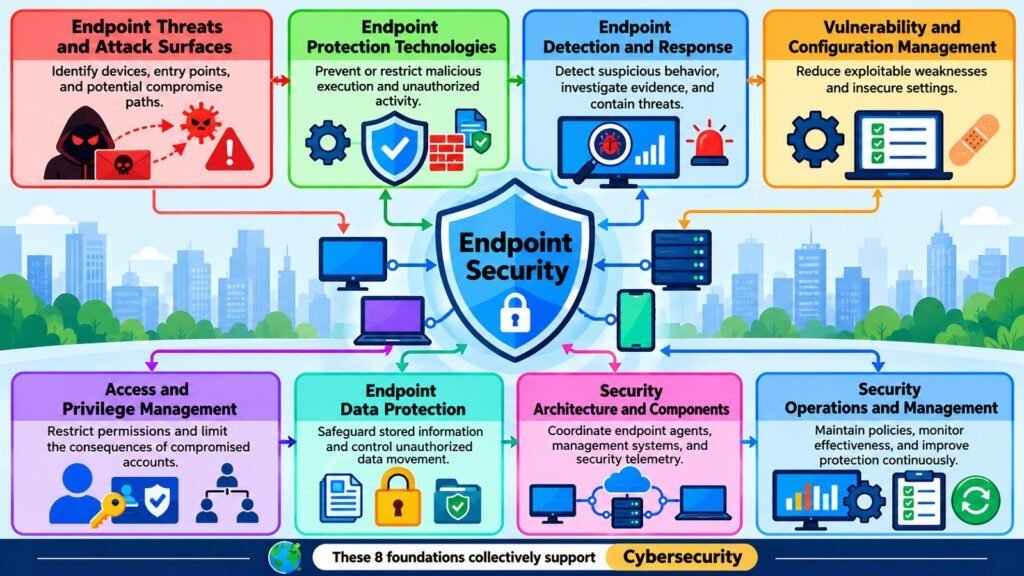
This article connects established principles, drawn from NIST guidance and MITRE ATT&CK, with the technical mechanisms and real-world applications that implement them. The eight aspects below are best read as an integrated framework rather than as isolated technologies, since weakness in one aspect weakens the others. Each aspect appears in the roadmap below and is then developed in sequence, moving from exposure to prevention, response, hardening, control, protection, design, and management.
Table 1: Endpoint Security Roadmap of Eight Core Aspects
| Endpoint Security Aspect | Primary Focus |
| Threats and attack surfaces | Adversary techniques and exposure points |
| Protection technologies | Preventive blocking and enforcement |
| Detection and response | Monitoring, investigation, and containment |
| Vulnerability and configuration management | Reducing exploitable weaknesses |
| Access and privilege management | Limiting rights and unauthorized activity |
| Data protection | Confidentiality of stored and transferred data |
| Architecture and components | Agents, consoles, and cloud services |
| Operations and management | Governance, metrics, and continuous improvement |
1. Endpoint Security: Threats and Attack Surfaces
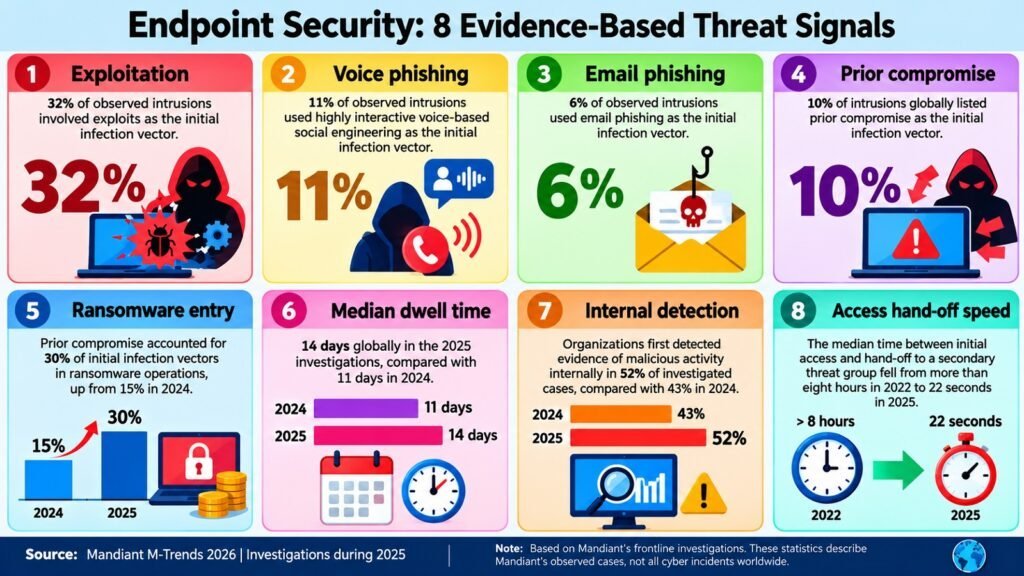
Analysis of endpoint exposure begins with vocabulary, because the terms are often conflated: a threat is a potential cause of harm, a vulnerability is a weakness that a threat may exploit, an attack vector is the path by which exploitation occurs, and an attack surface is the total set of points at which an adversary can attempt to interact with a system. Endpoints enlarge the attack surface because they run diverse software, accept external files and messages, and are operated by people whose decisions cannot be fully constrained.
Documented behavior is catalogued in MITRE ATT&CK, which records techniques such as phishing, user execution, abuse of command and scripting interpreters, use of valid accounts, and data encrypted for impact. Malware and ransomware commonly arrive through these routes, while unpatched software, insecure configurations, and excessive privileges determine how far an intrusion progresses. NIST and CISA guidance treats these mechanisms as established patterns; claims about their relative frequency, however, vary by dataset and sector and deserve caution.
Consider an illustrative scenario, not a reported incident, in which an employee opens a document received by email and an embedded macro launches a script interpreter that retrieves a second-stage payload. If the user holds local administrator rights and the system lacks recent patches, the payload may disable protective services, harvest cached credentials, and reach file shares. With standard privileges and current software, the same chain might stall early, so the attack surface shapes consequences as much as the initial compromise does.
Examining threats one at a time has limits, since successful intrusions usually combine several weaknesses across successive stages, as the kill chain model of Hutchins, Cloppert, and Amin illustrates. Threat analysis therefore informs prioritization and safeguard selection, while the technologies that prevent, detect, and remediate such events belong to later sections, and because tools change, documented techniques also supply a stable vocabulary for reasoning about risk.
Table 2: Endpoint Security Threats and Attack Surfaces
| Endpoint Threat or Attack Surface | Mechanism and Security Implication |
| Malware execution | Malicious code runs with user rights, enabling persistence and theft. |
| Ransomware | Encrypts files for extortion, disrupting availability and recovery. |
| Malicious scripts | Abuse of built-in interpreters evades file-based inspection. |
| Unpatched software vulnerabilities | Known flaws permit remote or local code execution. |
| Compromised accounts | Valid credentials let intruders blend into normal activity. |
| Phishing-driven compromise | Deceptive messages induce execution or credential disclosure. |
| Removable media | Infected devices or files carry code across network boundaries. |
| Excessive privileges | Administrative rights let processes alter settings and disable controls. |
2. Endpoint Security: Protection Technologies
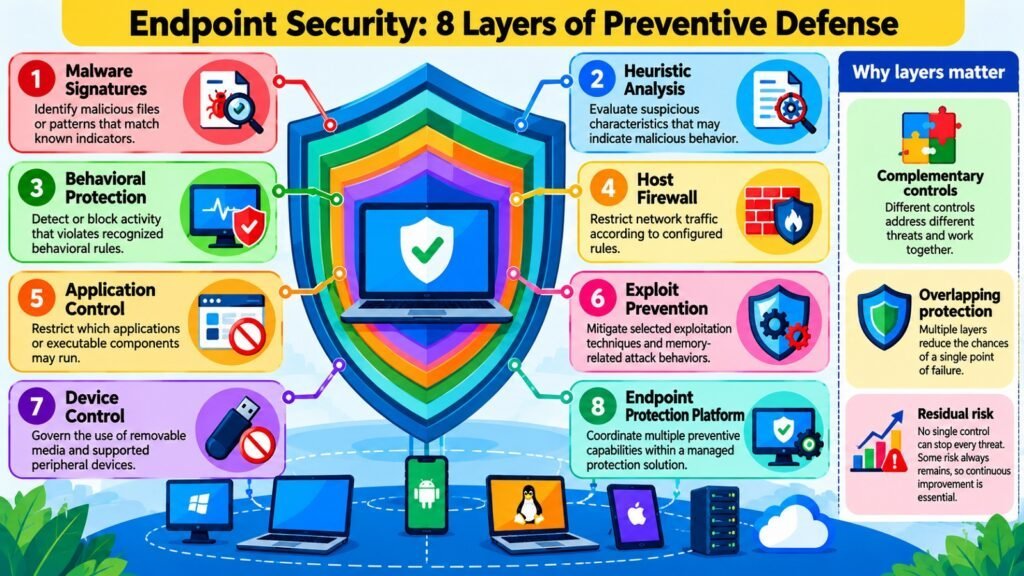
Preventive technologies aim to stop malicious activity before it causes harm, and they remain the first layer of Endpoint Security. Antivirus and anti-malware software traditionally relied on signature-based detection, which matches files against known indicators and performs well against catalogued threats but poorly against novel ones. Heuristic methods examine structural or code characteristics to generalize beyond signatures, while behavior-based protection observes runtime actions such as process injection or mass file modification, and each approach trades coverage against the risk of false positives.
Endpoint Protection Platforms integrate these engines with host-based firewalls, application control, exploit prevention, and device control. Firewalls enforce rules on traffic by port, protocol, and application, as NIST SP 800-41 describes; application control permits only approved executables, following NIST SP 800-167; exploit prevention interferes with memory-corruption techniques; and device control restricts peripherals and removable storage. These mechanisms differ in operating principle and protection boundary: allowlisting constrains what may run, whereas signature matching identifies what is already known to be malicious. Traditional protection centered on file scanning, whereas integrated platforms combine several engines under unified policy and reporting, although integration alone does not guarantee better detection.
Layered defense matters because no single control is complete, and complementary mechanisms reduce dependence on any one failure mode. Limitations nonetheless persist: detection gaps allow unseen malware through, misconfigured policies leave protections inactive, compatibility constraints force exclusions, and false positives erode trust and disrupt work, while malicious activity may also bypass controls entirely by abusing legitimate tools. Configuration matters as much as capability: an exploit-prevention feature left in audit mode, or an allowlist riddled with exceptions, protects far less than its specification suggests.
Organizations should evaluate protective capability against their threat exposure, operating environments, and security requirements, rather than relying on product rankings or vendor assertions, because independent testing, standards-based criteria, and pilot deployments yield better evidence, and legacy or specialized systems may favor different controls from standardized office laptops. The behavioral investigation and response that address what prevention misses are examined next, under detection and response.
Table 3: Endpoint Security Protection Technologies
| Protection Technology | Primary Function and Limitation |
| Signature-based antivirus | Blocks known malware; misses novel or modified samples. |
| Heuristic analysis | Flags suspicious code traits; raises false-positive risk. |
| Behavior-based protection | Halts malicious runtime actions; may act after execution begins. |
| Endpoint Protection Platform | Consolidates preventive engines; effectiveness depends on configuration. |
| Host-based firewall | Filters traffic per device; cannot judge encrypted content within permitted flows. |
| Application control | Permits approved executables only; demands allowlist maintenance. |
| Exploit prevention | Disrupts memory-corruption techniques; cannot stop stolen-credential misuse. |
| Device control | Restricts peripherals and storage; hinders legitimate workflows if rigid. |
3. Endpoint Security: Detection and Response
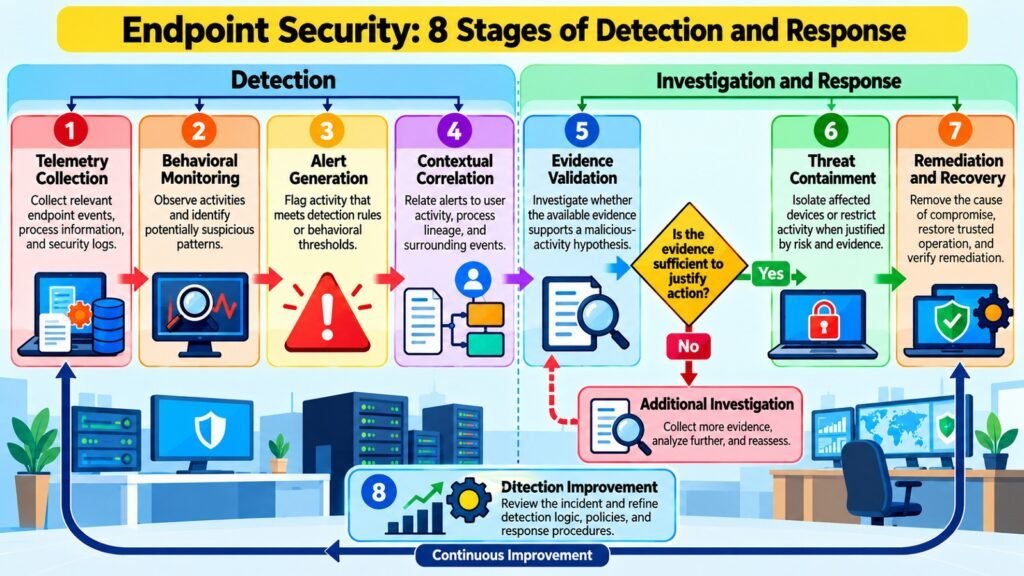
Endpoint Detection and Response extends Endpoint Security beyond prevention by assuming that some malicious activity will evade preventive controls. Sensors collect endpoint telemetry, including process creation, file and registry changes, network connections, and authentication events. Detection logic then applies rules, event correlation, behavioral analysis, and anomaly detection to identify sequences that deviate from expected activity. EDR complements Endpoint Protection Platforms, which emphasize blocking; implementations differ, however, and capabilities should not be presumed identical across products.
When an alert fires, analysts reconstruct process lineage, examine timelines, and weigh corroborating evidence before deciding whether to contain the device and begin remediation, a workflow consistent with NIST SP 800-61. Analysts also document the evidence they relied on, so that decisions can be reviewed and defended later. An alert is a hypothesis rather than a verdict, since legitimate administrative tools often resemble attacker tradecraft.
Detection quality demands careful measurement: precision is the proportion of alerts that reflect genuine malicious activity, recall is the proportion of malicious activity detected, and false negatives are the cost of missing it. Because malicious events are rare relative to benign ones, even a low false-positive rate can bury analysts in spurious alerts, a point Axelsson made through the base-rate fallacy. Sommer and Paxson likewise cautioned that learned detectors struggle outside closed evaluation settings, and Pendlebury and colleagues showed that unrealistic temporal assumptions inflate reported malware classification performance.
Practical constraints compound the problem: telemetry may be incomplete, alerts noisy, sensors costly in resources, and previously unseen or carefully concealed behavior hard to distinguish from routine activity, particularly when adversaries deliberately operate below detection thresholds.
Consider an illustrative investigation in which an alert reports a word processor spawning a command interpreter; the analyst finds an encoded command, an outbound connection to a rarely contacted domain, and a newly created scheduled task. Each observation alone is ambiguous, but together they support isolating the endpoint, a defensible decision grounded in converging evidence, whereas prevention, covered earlier, acts before execution rather than after.
Table 4: Endpoint Security Detection and Response Capabilities
| Detection or Response Capability | Purpose and Evaluation Consideration |
| Telemetry collection | Records endpoint events; coverage gaps create blind spots. |
| Behavioral analysis | Identifies suspicious action sequences; needs tuning against benign variance. |
| Event correlation | Links events into incidents; depends on accurate timestamps and context. |
| Anomaly detection | Highlights deviations from baselines; yields false positives amid change. |
| Alert triage | Prioritizes alerts for review; accuracy depends on analyst context. |
| Forensic investigation | Reconstructs activity timelines; limited by retained data. |
| Containment | Isolates affected endpoints; may disrupt business operations. |
| Remediation | Removes artifacts and restores state; success requires verification. |
4. Endpoint Security: Vulnerability and Configuration Management
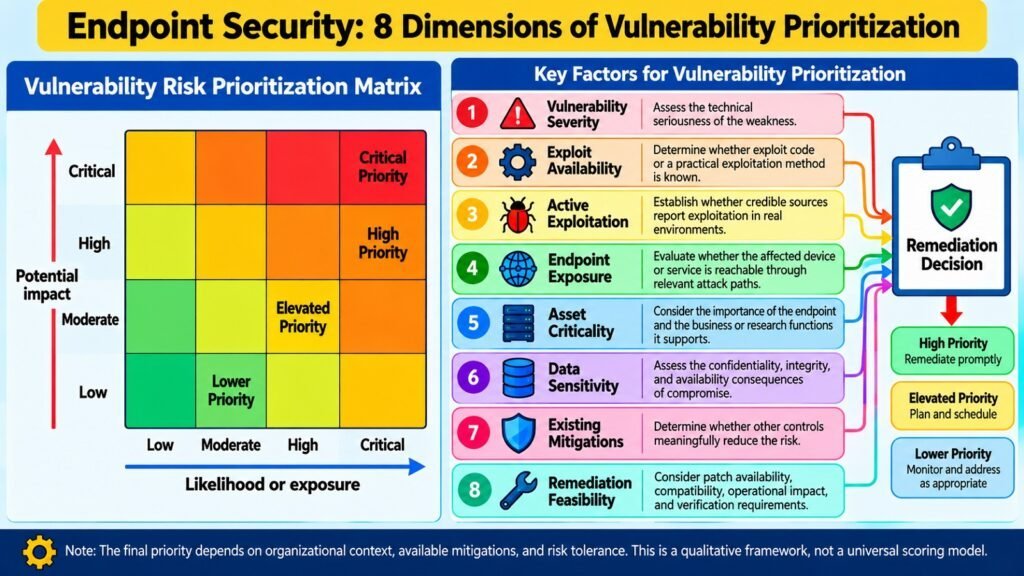
Endpoint Security reduces exposure not only by blocking attacks but by removing the weaknesses they depend on. Vulnerability management addresses flaws in software and firmware, whereas configuration management addresses insecure settings, unsupported operating systems, unnecessary services, and misconfigured applications. The disciplines are related but distinct: a fully patched system may still run an exposed service, and a hardened system may still contain an unpatched library. Both depend on accurate software and hardware inventory, which NIST SP 800-53 and CISA directive BOD 23-01 treat as foundational.
A mature program proceeds through assessment, patch management, adherence to secure configuration baselines such as the CIS Benchmarks, detection of configuration drift, and verification, with NIST SP 800-40 and SP 800-128 supplying underlying guidance. Prioritization requires more than severity scores, because exploitability, exposure, asset importance, available mitigations, and operational constraints all shape risk. The CISA Known Exploited Vulnerabilities catalog reflects this logic by identifying flaws with evidence of active exploitation, and risk acceptance, when documented and time-limited, is a legitimate outcome where remediation is infeasible.
Heterogeneous fleets complicate the work, since differing operating systems, intermittently connected laptops, and legacy applications resist uniform configuration, while rapid updating risks incompatibility, downtime, and disruption of business continuity; staged deployment and compensating controls often resolve the tension, although they extend exposure windows. Mobile and remote devices complicate verification further, since they may remain offline for days and then connect over networks the organization does not control.
Deploying an update does not guarantee that risk has fallen; rescanning, version confirmation, and configuration auditing establish whether remediation succeeded, since installation can fail silently, await a reboot, or leave vulnerable components elsewhere. A hypothetical case illustrates the point: a patch applied to one application leaves an older bundled library in another, and only a post-remediation scan reveals it. This section concerns exploitable weaknesses; protective technologies and access policies are addressed elsewhere.
Table 5: Endpoint Security Vulnerability and Configuration Practices
| Management Practice | Security Purpose and Consideration |
| Asset inventory | Establishes what needs protection; incomplete discovery undermines other practices. |
| Vulnerability assessment | Identifies known flaws; scans miss unknown weaknesses. |
| Patch management | Corrects known flaws; compatibility testing can delay deployment. |
| Secure configuration baselines | Standardize hardened settings; need tailoring to operational requirements. |
| Drift monitoring | Detects deviation from baselines; generates noise during legitimate change. |
| Risk-based prioritization | Focuses effort on likely exploitation; depends on reliable context. |
| Unsupported software retirement | Removes unpatchable systems; replacement costs and compatibility burdens follow. |
| Remediation verification | Confirms exposure reduction; requires repeated scanning. |
5. Endpoint Security: Access and Privilege Management
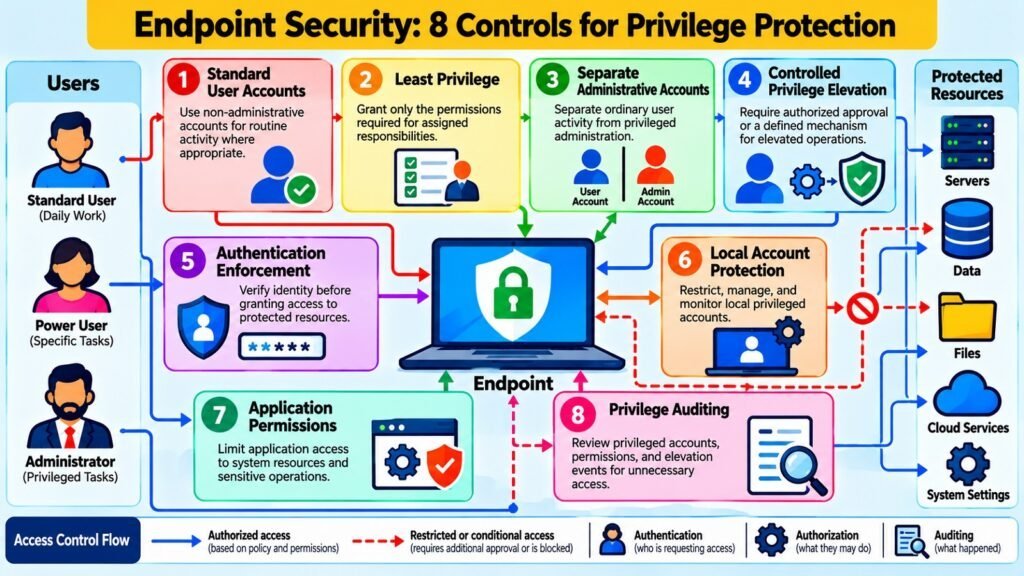
Access and privilege management limits what a user, process, or compromised account can do on an endpoint, thereby constraining the consequences of intrusion. The principle of least privilege, codified in NIST SP 800-53 control AC-6, holds that subjects should receive only the permissions their tasks require. In practice, this means separating administrative and standard-user accounts, controlling privilege elevation, securing local accounts, enforcing authentication, and restricting application permissions and privileged operations.
The rationale is straightforward: a process inherits the rights of the account that starts it, so excessive privileges allow malware to modify system settings, read sensitive resources, install drivers, or disable security agents, and MITRE ATT&CK documents abuse of elevation controls and valid accounts as recurrent techniques. Careful permission design reduces unnecessary exposure, yet it cannot prevent every attack, because adversaries can still exploit flaws that yield privileges or misuse the access that legitimate users hold.
Endpoint access controls connect to operating-system security mechanisms, identity protection, and Zero Trust principles, which NIST SP 800-207 frames as continuous verification rather than implicit trust based on network location. The connection should not be mistaken for a full identity program, since this discussion addresses device-level enforcement. Implementation is demanding: privilege models differ across Windows, macOS, and Linux, administrators need legitimate elevation, and overly restrictive settings encourage workarounds.
Organizations can judge whether permissions fit responsibilities through access reviews, privilege audits, and analysis of elevation requests. Least privilege is an established principle, whereas particular tools and workflows are implementation choices, and privilege creep, in which entitlements accumulate as roles change, is a common finding of such reviews; protecting the information itself is treated in the next section.
Table 6: Endpoint Security Access and Privilege Mechanisms
| Endpoint Security Access Control Mechanisms | Security Benefit and Limitation |
| Least privilege | Restricts permissions to necessity; requires continual role review. |
| Standard-user accounts | Limit routine exposure to administrative rights; frustrate some legitimate tasks. |
| Privilege elevation control | Mediates administrative actions; approval fatigue weakens it. |
| Local account management | Prevents shared credential reuse; needs automated rotation. |
| Authentication enforcement | Verifies identity before access; stolen credentials can still succeed. |
| Role-based authorization | Grants rights by role; role sprawl erodes precision. |
| Application permissions | Constrain resource access by program; defaults often remain permissive. |
| Privileged operation restriction | Blocks driver or setting changes; may impede troubleshooting. |
6. Endpoint Security: Data Protection
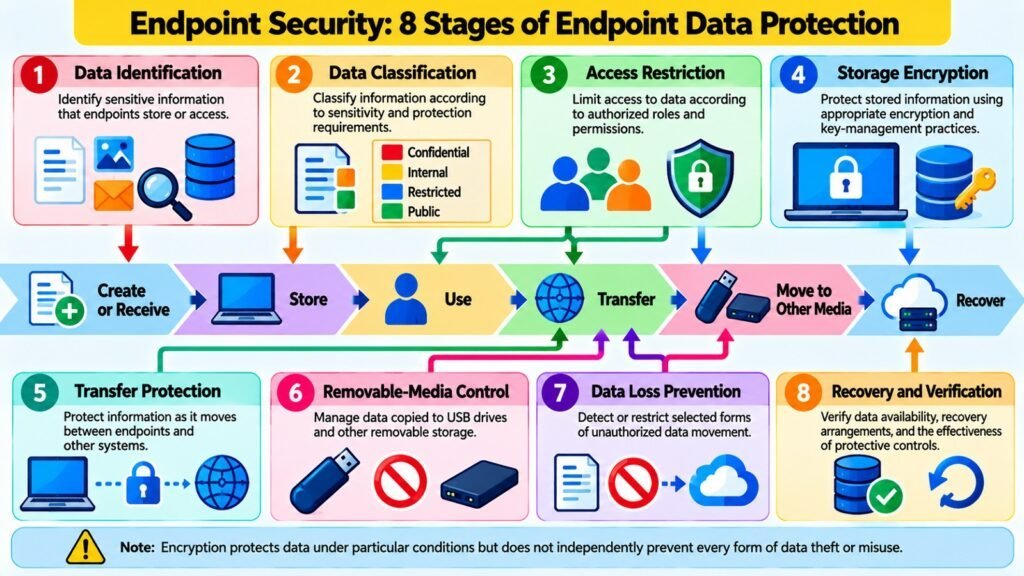
Data protection addresses information stored on, accessed through, or transferred from endpoints. Three distinct goals apply: confidentiality, which prevents unauthorized disclosure; integrity, which limits unauthorized modification; and availability, which preserves access when needed. Device loss and theft expose data at rest; compromised endpoints expose data in use; and malicious insiders and accidental disclosure expose data in transit, so each risk requires different safeguards.
Full-disk encryption, described in NIST SP 800-111, protects data on lost or stolen devices, with file-level protection supplementing it where individual items need separate safeguards. Data loss prevention inspects content and context to detect or block unauthorized transfers, and removable-media restrictions narrow exfiltration paths. These controls are complementary: encryption offers little once an authenticated session runs on a compromised device, access controls cannot stop a permitted user from sending data to an unauthorized destination, and data loss prevention depends on classification that may be incomplete, so none of them alone guarantees complete protection.
Implementation raises design questions; key management determines whether encryption is trustworthy, as NIST SP 800-57 emphasizes, and recovery arrangements must permit legitimate restoration without creating a weak path. Halderman and colleagues showed that keys residing in memory can be recovered through DRAM remanence under certain conditions, a reminder that cryptography operates within physical and procedural limits. Data classification, informed by FIPS 199, scales controls to sensitivity, while user workflows determine whether protections are followed or bypassed.
A hypothetical example is a laptop left in transit: with encryption and sound key custody, the loss becomes a hardware incident; without them, it becomes a disclosure event. Protecting information is separate from managing privileges, yet the two reinforce each other.
Table 7: Endpoint Security Data Protection Mechanisms
| Endpoint Security Data Protection Mechanisms | Purpose and Practical Limitation |
| Full-disk encryption | Protects data at rest on lost devices; limited once unlocked. |
| File-level encryption | Secures selected items; users may mishandle keys. |
| Data loss prevention | Detects or blocks sensitive transfers; depends on accurate classification. |
| Removable-media restrictions | Limit exfiltration and malware entry; inconvenience legitimate transfers. |
| Data classification | Aligns controls with sensitivity; requires consistent labeling. |
| Key management | Governs key creation, storage, and recovery; weak recovery undermines encryption. |
| Secure data deletion | Prevents recovery from retired devices; effectiveness varies with storage media. |
| Backup and recovery | Maintains availability after loss or tampering; backups need protection. |
7. Endpoint Security: Architecture and Components
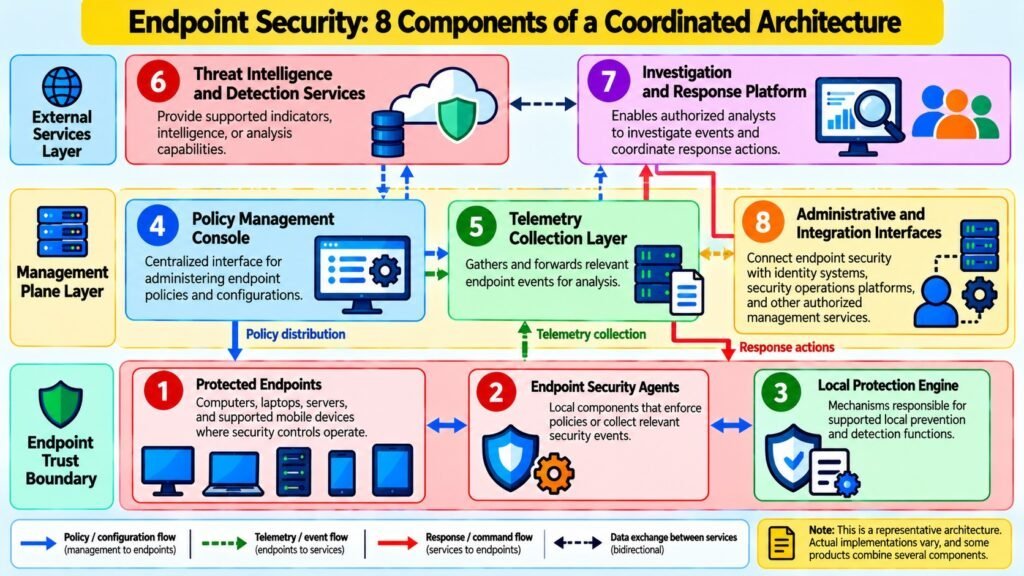
Architecture determines how Endpoint Security components coordinate protection across devices and the wider environment: an endpoint agent on each device enforces policy, hosts a local security engine, and collects telemetry. A centralized management console distributes policy, receives events, and supports administration, while cloud-based threat intelligence supplies reputation data and detection updates. Communication channels link these elements, and integration with wider security platforms, such as security information and event management systems, allows correlation beyond a single device.
Responsibilities divide naturally: local components perform time-critical enforcement, since blocking cannot wait for a network round trip, and they keep functioning when disconnected, retaining protection and queuing telemetry until connectivity returns. Centralized or cloud services perform heavier analysis, aggregate data across fleets, and maintain intelligence, and this division shapes scalability, availability, visibility, management complexity, resource consumption, and dependence on connectivity.
Locally managed deployments keep the console within the organization’s infrastructure and give direct control, but they require capacity planning, patching, and a path for remote devices to reach the server. Cloud-managed deployments reduce infrastructure burden and simplify coverage of remote devices, while introducing dependence on a provider’s availability and raising questions about data residency. Agentless approaches exist but generally offer less depth of visibility and control, so the documented trade-offs concern operations rather than universal superiority.
Trust boundaries deserve explicit attention; agents typically run with high privileges, so a compromised management console could distribute malicious policy or commands to every endpoint. Mutually authenticated communication, strong administrative authentication, and segmentation of management infrastructure are therefore central, consistent with the zero trust architecture described in NIST SP 800-207.
As an illustrative architecture, imagine a mixed fleet in which agents report to a cloud console, which forwards alerts to a security information platform, while a locally hosted server caches updates for offices with limited connectivity. This is an example, not an actual deployment, and the focus here remains design, with administration of such systems following.
Table 8: Endpoint Security Architecture Components and Models
| Endpoint Security Architecture Components / Models | Role and Design Consideration |
| Endpoint agent | Enforces policy and gathers telemetry; consumes device resources. |
| Local security engine | Performs on-device blocking; needs frequent updates. |
| Management console | Centralizes policy and visibility; becomes a high-value target. |
| Policy distribution | Delivers consistent settings; delays leave devices outdated. |
| Cloud threat intelligence | Supplies reputation and indicators; requires connectivity. |
| Secure communication channel | Protects agent-console traffic; certificate management adds complexity. |
| Locally managed deployment | Keeps control on-premises; demands infrastructure maintenance. |
| Cloud-managed deployment | Simplifies remote coverage; depends on provider availability. |
8. Endpoint Security: Operations and Management
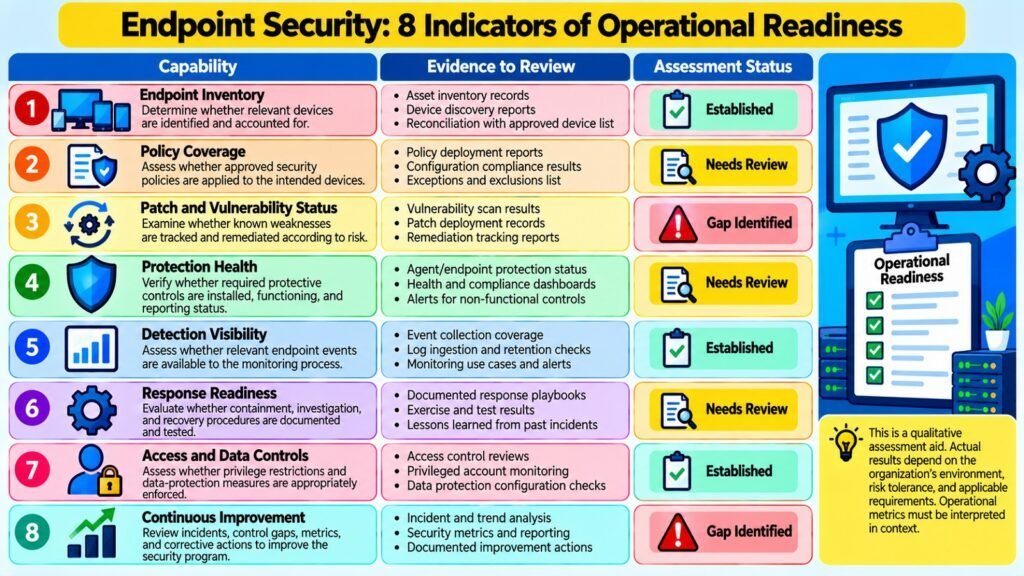
Operations turn architecture into sustained protection: organizations administer Endpoint Security through centralized policy administration, device inventory, remote endpoint management, compliance checking, operational monitoring, and alert handling, then use security metrics to drive continuous improvement. Consistent protection across device types, operating systems, locations, and risk levels requires policy tiers and exception processes, since a uniform policy rarely suits every context, and ownership must be explicit, since controls with no accountable team tend to decay.
The implementation obstacles are substantial: geographically dispersed personnel access systems through uncontrolled network infrastructure, budgetary limitations constrain personnel allocation, technical interoperability requirements necessitate relaxed security protocols, excessive notifications impair analyst decision-making capabilities, and insufficient monitoring coverage permits unidentified endpoints to remain vulnerable. Frameworks such as the CIS Controls, ISO/IEC 27001, and NIST SP 800-137 on continuous monitoring offer structure, although each must be adapted to local circumstances; mobile devices and personally owned equipment, meanwhile, widen the gap between policy and reality.
Evaluation relies on measures such as detection precision, false-positive rates, patch coverage, baseline compliance, and times to detect or contain incidents. Each reveals something narrow: patch coverage indicates deployment, not reduced exploitability; time to detect depends on which incidents are discovered at all; compliance with a baseline shows adherence to a standard, not adequacy of that standard. NIST SP 800-55 and ISO/IEC 27004 emphasize that measures must be tied to objectives and interpreted in context.
Reviewing control effectiveness therefore requires triangulation: incident reviews, adversary emulation, audits, and metric trends together. Lessons from incidents can adjust policies and reorder priorities, while changes should be tested for unintended effects. No single metric demonstrates overall security, and optimizing one may degrade another, as when aggressive alert suppression lowers noise but raises false negatives. Periodic exercises that simulate adversary behavior test whether controls respond as assumed rather than as documented.
This section concerns governance, administration, and improvement; the components on which these activities depend were treated in the preceding architecture discussion.
Table 9: Endpoint Security Operational Practices and Metrics
| Endpoint Security Operational Practices or Metrics | Purpose and Evaluation Consideration |
| Centralized policy administration | Applies consistent settings; exceptions erode uniformity. |
| Device inventory | Establishes visibility; stale records mislead. |
| Compliance monitoring | Checks adherence to baselines; compliance does not equal security. |
| Alert handling | Ensures timely review; alert fatigue reduces effectiveness. |
| Patch coverage | Measures deployment breadth; does not measure exploitability. |
| Detection precision | Shows the share of alerts that are true; ignores missed events. |
| Time to detect or contain | Measures responsiveness; depends on discovery and definitions. |
| Post-incident review | Feeds lessons into policy; depends on complete reporting. |
Conclusion: Endpoint Security and Stronger Cyber Defense
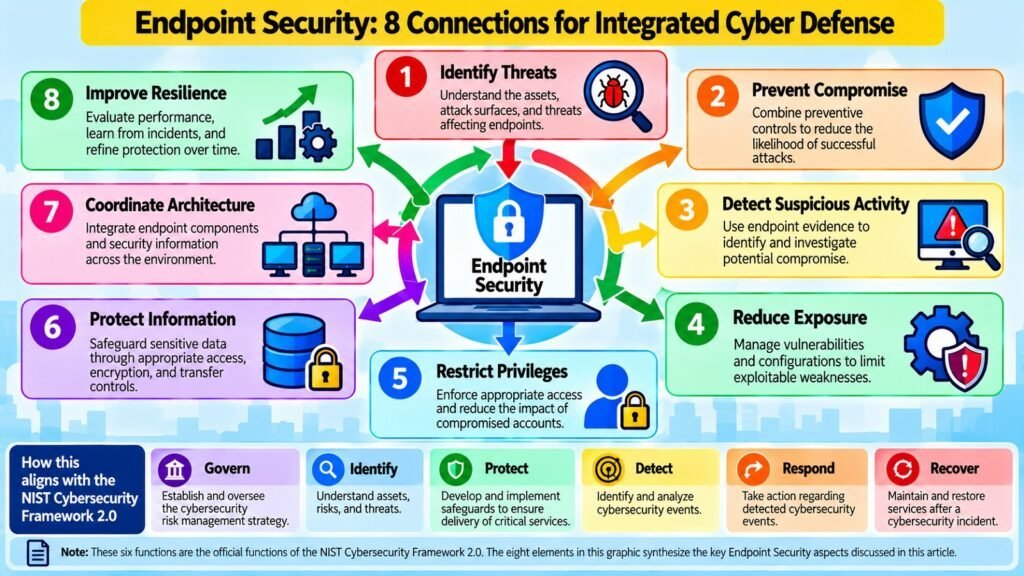
The eight foundations examined here form a single argument about Endpoint Security. Understanding threats informs preventive controls, detection and response address what prevention misses, vulnerability management and privilege restriction shrink the room in which adversaries operate, data protection limits the harm of compromise, architecture binds the components together, and operations sustain them. Weakness in one area can undermine benefits in others, as when excellent detection is paired with incomplete telemetry, or strict privilege policy is defeated by an unpatched flaw. Because adversaries pursue the weakest path, defenders must evaluate the combined system rather than its best component.
Endpoint Security remains an important aspect of Cybersecurity precisely because its effectiveness depends on relations among technical controls, sound operational practice, evidence-based decisions, and continuous evaluation. Layered protection, risk-based prioritization, and reliable evidence endure even as technologies change, and critical evaluation guards against mistaking activity for assurance. Readers should treat claims of effectiveness as hypotheses to be tested, and metrics as indicators whose meaning depends on how they were produced.
Looking forward, the field needs rigorous research on detection methods that withstand concept drift and imbalanced data, architectures that remain trustworthy under compromise, and means of evaluating protection in real environments rather than controlled tests. Closer collaboration between researchers and practitioners would help close the gap between laboratory results and operational reality. Progress will depend on honest measurement as much as on new tools.
Table 10: Endpoint Security Foundations and Their Contributions
| Endpoint Security Foundations | Contribution to Cyber Defense |
| Threats and attack surfaces | Reveal exposure and guide prioritization. |
| Protection technologies | Block known and suspicious activity early. |
| Detection and response | Identify and contain activity that evades prevention. |
| Vulnerability and configuration management | Remove exploitable weaknesses. |
| Access and privilege management | Limit damage from compromised accounts. |
| Data protection | Preserves confidentiality, integrity, and availability. |
| Architecture and components | Coordinate enforcement, telemetry, and administration. |
| Operations and management | Sustain and improve protection through measurement. |