Table of Contents
Introduction: Why Carbon Management Is Becoming a Business Imperative
Carbon Management used to sit on the edge of corporate life. It lived in sustainability reports and earned a passing mention at shareholder meetings. That era is over. Carbon Management has moved into the center of business strategy, sitting next to finance, talent, and technology as something leaders must actively run. This shift has not happened by accident. Investors ask harder questions about climate risk. Regulators write stricter rules. Customers expect honesty about environmental impact. Carbon Management is now an important aspect of Sustainable Business, and companies that treat it lightly are discovering the cost of that choice.
The reasons behind this change are practical, not just ethical. Carbon Management touches operational efficiency, since reducing energy waste often lowers expenses too. It shapes risk management because carbon-intensive operations face higher transition risk as policy tightens. It affects regulatory compliance, particularly where disclosure laws are now mandatory. It influences investor confidence, since institutional investors increasingly screen for climate exposure. It protects brand reputation, given how quickly trust erodes after greenwashing accusations. It even drives innovation, pushing companies toward new materials and business models.
Large companies have already shown what is possible. Microsoft built an internal carbon fee and aims to remove more carbon than it emits by 2030. Unilever embedded sustainability targets across its supply chain. Google shifted its energy strategy toward long-term clean power contracts. Walmart pushed thousands of suppliers toward emissions cuts through structured programs. Schneider Electric folded its carbon strategy into its core business model rather than treating it as a side project. Each built Carbon Management into daily operations, the same way it manages budgets or staffing.
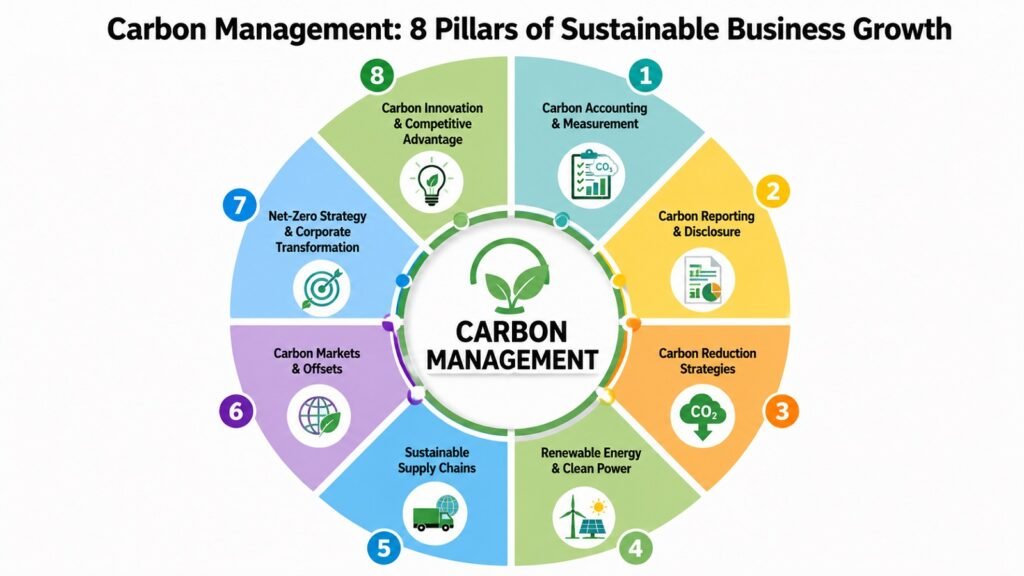
This article breaks Carbon Management into eight pillars that work together as one system. Each pillar supports the next, starting with measurement and ending with innovation. The table below offers a roadmap for what follows.
Carbon Management Pillars: A Strategic Roadmap for Sustainable Business
| Pillar | Role in Carbon Management |
| Carbon Accounting & Measurement | Provides the data foundation for tracking emissions accurately |
| Carbon Reporting & Disclosure | Builds transparency and trust with investors and regulators |
| Carbon Reduction Strategies | Turns measurement into direct emissions cuts and savings |
| Renewable Energy & Clean Power | Shifts operations toward low-carbon electricity sources |
| Sustainable Supply Chains | Extends carbon responsibility across suppliers and partners |
| Carbon Markets & Offsets | Addresses residual emissions through credits and removal projects |
| Net-Zero Strategy & Transformation | Aligns governance and capital with long-term climate goals |
| Carbon Innovation & Advantage | Converts climate action into products and market differentiation |
1. Carbon Management Through Carbon Accounting & Measurement
Every serious Carbon Management strategy begins the same way financial management begins, with accurate numbers. A company cannot manage what it cannot measure, and carbon is no exception. Carbon accounting works much like financial accounting. It tracks inputs, assigns values, and produces a clear picture of where emissions originate. Without this picture, reduction targets become guesswork, and reduction efforts become difficult to evaluate.
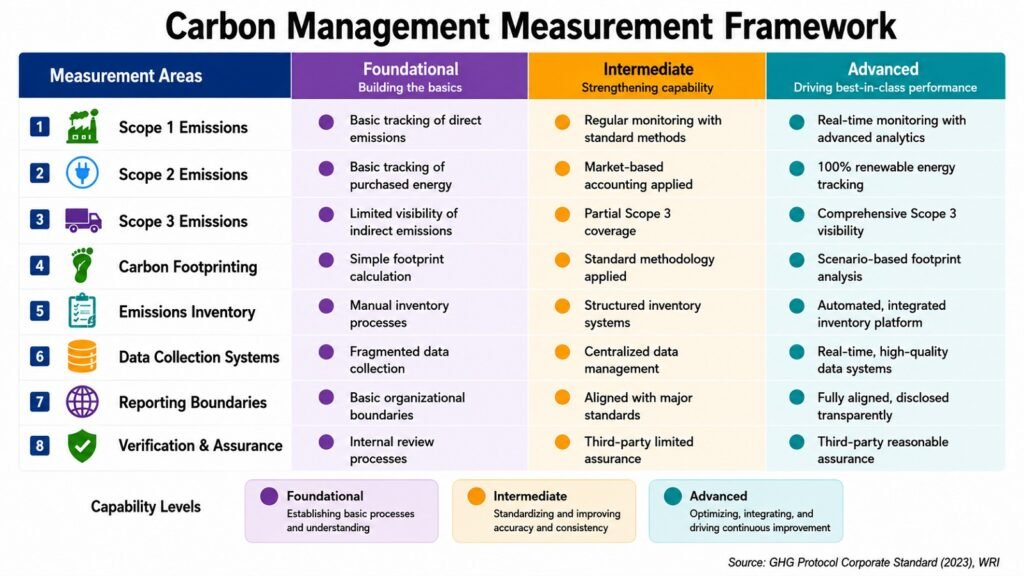
The starting point for most organizations is the Greenhouse Gas Protocol, which separates emissions into three categories. Scope 1 covers direct emissions from owned operations, such as fuel burned in company vehicles or factory boilers. Scope 2 covers indirect emissions from purchased electricity, heating, or cooling. Scope 3 covers everything else across the value chain, including supplier emissions, employee travel, and the use of sold products. For most companies, Scope 3 represents the largest share of their total footprint, often dwarfing Scope 1 and Scope 2 combined. This is why supply chain emissions have become such a central concern across nearly every industry.
Microsoft offers a useful case study in measurement discipline. The company introduced an internal carbon fee in 2012, charging its own business divisions for the emissions they generated. This fee created a financial incentive to measure carbon closely, since divisions that polluted more paid more. Over time, Microsoft expanded the fee to cover supply chain and value chain emissions as well, not just its direct operations. The lesson for other businesses is straightforward. When carbon carries an internal price tag, measurement stops being an afterthought and starts shaping daily decisions across the organization.
Accurate measurement also depends on data collection systems that can track energy use, fuel consumption, and supplier activity across many locations. Many companies struggle here, since older systems were never designed with carbon tracking in mind. Building this infrastructure takes time, but it pays off through better forecasting and more credible public claims. Measurement done poorly invites scrutiny, while measurement done well becomes a competitive asset.
Once a company understands its emissions profile, it can prioritize the areas offering the greatest reduction potential. This is the strategic value of accounting. It turns a vague environmental goal into a specific, trackable business plan with milestones that can be reviewed by leadership.
Carbon Management Through Accurate Carbon Accounting and Measurement Frameworks
| Framework / Concept | Practical Role |
| GHG Protocol | Global standard for categorizing emissions into Scope 1, 2, and 3 |
| Scope 1 Emissions | Direct emissions from owned operations and vehicles |
| Scope 2 Emissions | Indirect emissions from purchased electricity and energy |
| Scope 3 Emissions | Value chain emissions, often the largest share of total footprint |
| Carbon Footprint Inventory | Complete record of emissions across a defined period |
| Internal Carbon Fee | Internal pricing mechanism that incentivizes emissions tracking |
| Emissions Data Systems | Software and sensors that collect activity-based carbon data |
| Science Based Targets | Verified reduction goals aligned with climate science |
2. Carbon Management Through Carbon Reporting & Disclosure
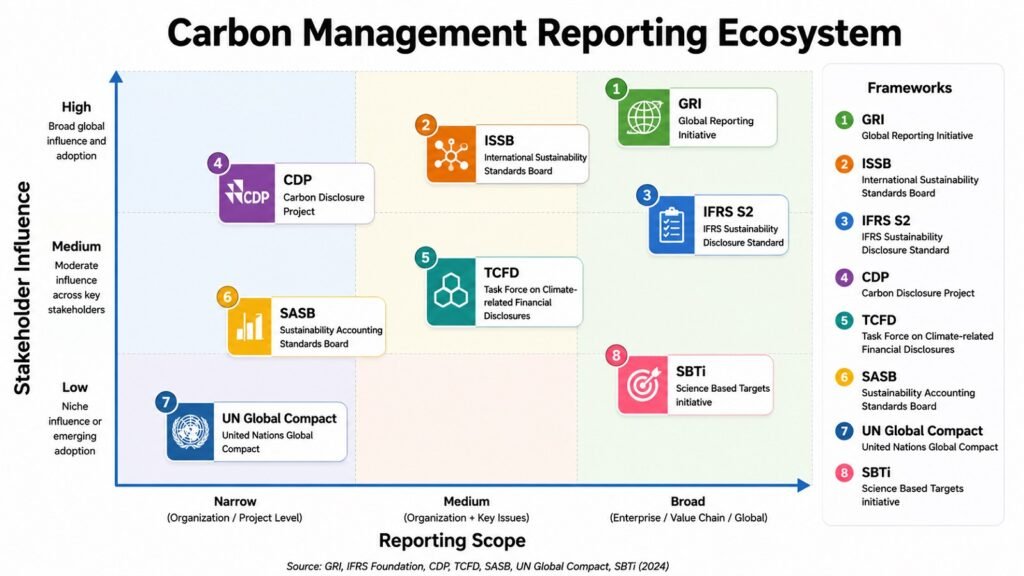
Measurement only matters if it leads somewhere, and for most organizations, that destination is disclosure. Carbon Management depends on transparency because investors, regulators, and customers increasingly want proof rather than promises. A company can measure its emissions perfectly, but if it never shares that data in a credible format, the work loses much of its strategic value. Reporting transforms private data into public accountability.
Several reporting frameworks have emerged to standardize how companies disclose climate information. The Global Reporting Initiative, known as GRI, was created in 1997 and remains one of the most widely used frameworks for broad sustainability reporting across environmental, social, and governance topics. The Carbon Disclosure Project, now simply called CDP, runs detailed questionnaires that more than eighteen thousand companies use to report climate, water, and forest data. The Task Force on Climate-related Financial Disclosures, known as TCFD, focused specifically on climate risk through four pillars: governance, strategy, risk management, and metrics. Its recommendations have since been folded into the International Sustainability Standards Board, or ISSB, which now serves as an emerging global baseline for investor-focused climate disclosure.
These frameworks are not mutually exclusive. Many large companies report through several at once, since each serves a different audience. GRI tends to serve broad stakeholder communication, while CDP and ISSB speak more directly to investors. Microsoft uses an annual Environmental Sustainability Report to communicate progress against its carbon negative commitment, drawing on globally recognized standards to support its claims. Schneider Electric similarly publishes detailed sustainability disclosures tied directly to financial reporting cycles, reinforcing the idea that climate data belongs alongside earnings data rather than separate from it.
Why does transparency matter so much strategically? Investors use disclosed carbon data to assess transition risk before allocating capital. Regulators in the European Union now require detailed sustainability disclosures from thousands of companies under rules like the Corporate Sustainability Reporting Directive. Customers, particularly younger ones, increasingly factor environmental transparency into purchasing decisions. A company that under-reports or reports inconsistently risks both regulatory penalties and reputational damage once gaps are noticed.
Transparent reporting also creates internal discipline. Once a company commits to public disclosure, internal teams face pressure to ensure the underlying data holds up to scrutiny. This pressure often improves data quality across the organization, creating a feedback loop between reporting and measurement.
Carbon Management Through Transparent Carbon Reporting and Disclosure Frameworks
| Framework / Practice | What It Provides |
| GRI Standards | Broad sustainability reporting across environmental and social topics |
| CDP Questionnaires | Structured climate, water, and forest disclosure for investors |
| TCFD Recommendations | Climate risk disclosure organized around governance and strategy |
| ISSB Standards | Emerging global baseline for investor-focused climate reporting |
| CSRD Compliance | Mandatory EU sustainability disclosure for large companies |
| Annual Sustainability Reports | Company-level public communication of climate progress |
| Third-Party Assurance | Independent verification that strengthens disclosure credibility |
| Integrated Financial Reporting | Linking carbon data directly to financial statements |
3. Carbon Management Through Carbon Reduction Strategies
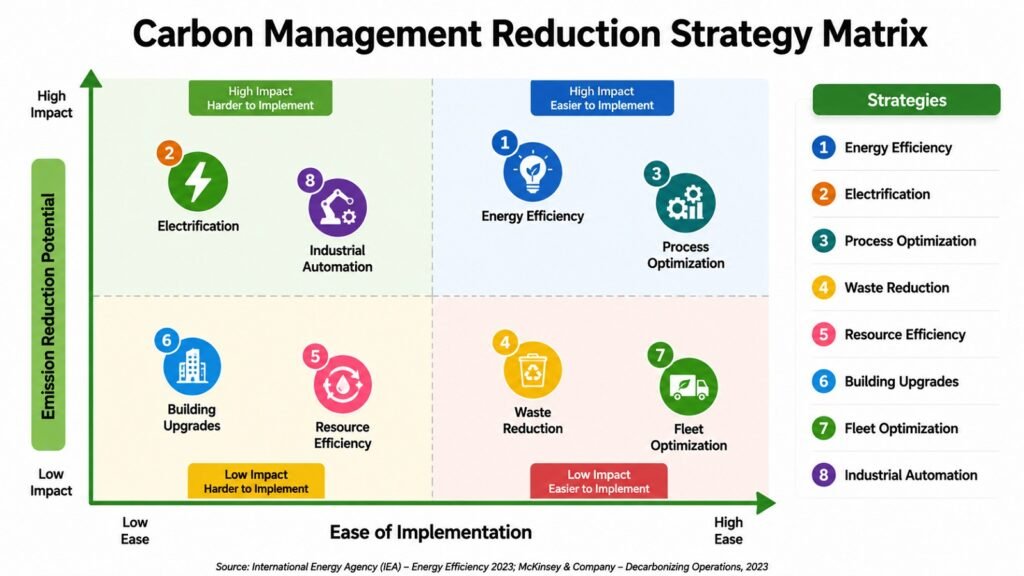
Measurement and reporting set the stage, but Carbon Management ultimately demands action. This is where reduction strategies come in, turning data into real cuts in emissions. Most reduction work falls into a few broad categories: energy efficiency, electrification, process redesign, waste reduction, and resource optimization. None of these is an exotic idea. Many are improvements companies would consider anyway, since they also tend to lower operating costs.
Energy efficiency remains the most accessible starting point for most organizations. Upgrading lighting, improving insulation, and optimizing equipment schedules can cut energy use significantly without requiring new technology. Electrification follows closely behind, replacing fossil fuel-powered equipment with electric alternatives that can run on increasingly clean grids. Process redesign goes further, rethinking how products get made so that fewer raw materials and less energy enter the system in the first place.
Toyota illustrates how reduction strategies can align with long-standing operational philosophy. The company’s manufacturing approach has long emphasized eliminating waste, and this same discipline now extends to carbon. Toyota has invested heavily in hybrid and electrified vehicle technology, treating emissions reduction as a natural extension of efficiency principles it has practiced for decades. The lesson here is that companies do not need to invent reduction strategies from scratch. Many already have operational cultures that can be redirected toward carbon goals with the right framing.
Interface, a flooring manufacturer, took an even more ambitious path. The company set a mission to become carbon negative across its full product life cycle, redesigning manufacturing processes and sourcing recycled materials wherever possible. Interface’s experience shows that reduction strategies can extend beyond a company’s own operations and into product design itself, creating environmental benefits that follow products throughout their use and disposal.
The financial case for reduction strategies is often underappreciated. Energy efficiency investments frequently pay for themselves within a few years through lower utility costs. Waste reduction initiatives can cut disposal expenses while also reducing emissions tied to manufacturing surplus material. This dual benefit, environmental and financial, is part of why reduction strategies tend to find faster internal support than other climate initiatives. Executives can justify them using ordinary financial logic, not just sustainability language.
Carbon Management Through Practical Carbon Reduction Strategies and Business Benefits
| Reduction Strategy | Primary Business Benefit |
| Energy Efficiency Upgrades | Lower utility costs alongside reduced emissions |
| Electrification of Equipment | Reduced reliance on fossil fuels as grids get cleaner |
| Process Redesign | Less raw material and energy use per unit produced |
| Waste Reduction Programs | Lower disposal costs and reduced upstream emissions |
| Resource Optimization | Improved efficiency across production and logistics |
| Low-Carbon Materials | Reduced embodied carbon in products and packaging |
| Equipment Modernization | Higher output with lower energy intensity |
| Circular Manufacturing | Extended material life and reduced extraction demand |
4. Carbon Management Through Renewable Energy & Clean Power
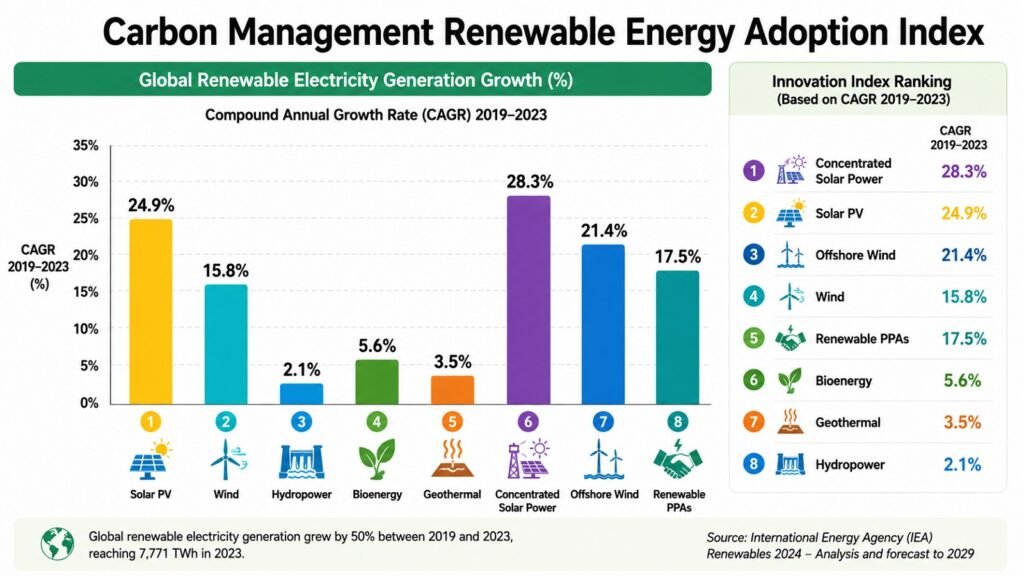
Few pillars of Carbon Management are as visible to the public as renewable energy. Solar panels and wind turbines have become symbols of corporate climate commitment, but behind these images lies a more complex set of business decisions about how companies source electricity. Renewable energy procurement now ranks among the largest levers companies have for cutting Scope 2 emissions tied to purchased power.
Power purchase agreements, often called PPAs, have become a preferred procurement method. Under a PPA, a company commits to buying electricity from a specific renewable project, often for ten years or longer, providing the financial certainty developers need to build new wind or solar capacity. Microsoft’s renewable energy journey began with a modest 110 megawatt agreement in Texas back in 2013 and has since grown into a contracted clean energy portfolio spanning dozens of countries and tens of gigawatts of capacity. This growth illustrates how a single early commitment can scale into a defining feature of corporate energy strategy.
Other companies have pursued different paths within the same broad category. On-site generation, where companies install solar panels directly on facilities, offers more direct control but typically covers a smaller share of total energy needs. Green tariffs, offered by utilities in some markets, let companies pay a premium for renewable electricity without negotiating individual contracts. Battery storage and grid flexibility programs are increasingly paired with renewable procurement, helping companies manage the variability that comes with solar and wind generation.
The strategic logic behind these investments is rarely environmental alone. Long-term renewable contracts often lock in stable electricity prices, protecting companies against volatile fossil fuel markets. As clean energy technology costs have fallen over the past decade, renewable procurement has become competitive with conventional power in many regions, removing much of the financial trade-off that once existed. Companies that secured early contracts often benefited from favorable pricing as renewable costs continued to decline afterward.
Carbon Management Through Renewable Energy and Clean Power Procurement Models
| Approach | Description |
| Power Purchase Agreements | Long-term contracts securing renewable electricity from specific projects |
| On-Site Solar Generation | Direct installation of solar panels at company facilities |
| Wind Energy Contracts | Procurement agreements tied to wind farm electricity output |
| Green Energy Tariffs | Utility-offered premium plans for renewable electricity |
| Renewable Energy Certificates | Tradable certificates representing renewable generation |
| Battery Storage Integration | Technology that manages variability in renewable supply |
| Grid Decarbonization Partnerships | Collaboration with utilities to expand clean power capacity |
| Virtual Power Purchase Agreements | Financial contracts enabling renewable procurement without direct delivery |
5. Carbon Management Through Sustainable Supply Chains
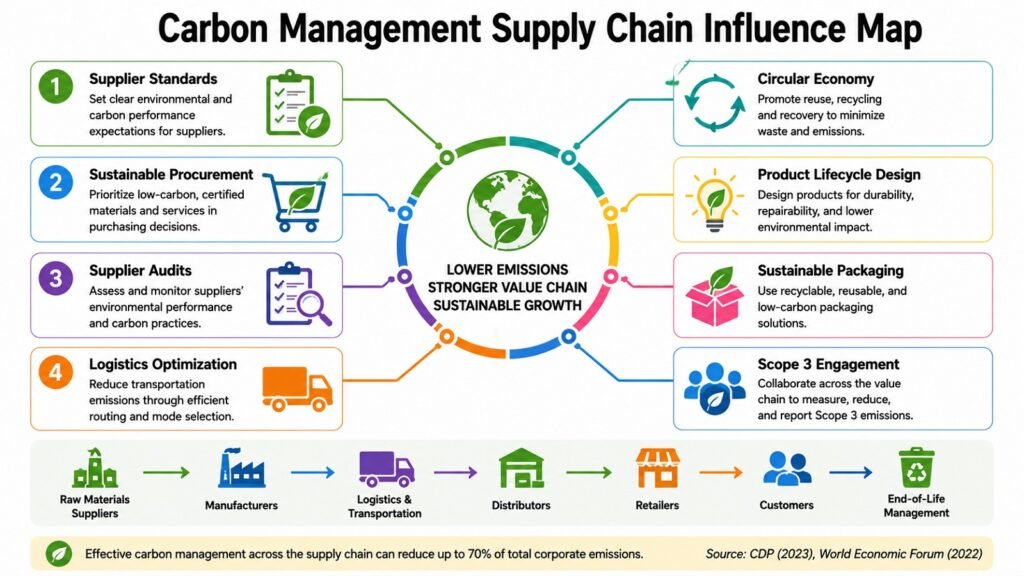
For most companies, the largest share of emissions does not come from their own factories or offices. It comes from suppliers, transportation networks, and the broader chain of activity that surrounds a finished product. This is why Carbon Management increasingly focuses on supply chains, where Scope 3 emissions often dominate a company’s total footprint. Reducing direct operations matters, but it cannot solve the larger problem on its own.
Walmart’s Project Gigaton offers one of the clearest examples of supply chain engagement at scale. Launched in 2017, the initiative invited suppliers to commit to reducing, avoiding, or sequestering emissions across six focus areas, including energy use, packaging, waste, and transportation. More than five thousand nine hundred suppliers eventually joined the effort. Walmart reported reaching its goal of one billion metric tons of avoided or reduced emissions six years ahead of its original 2030 target. The company achieved this not through mandates alone, but through education, financial incentives, and public recognition programs that made participation appealing to suppliers of every size.
The lesson from Walmart’s experience extends well beyond retail. Large buyers carry enormous influence over supplier behavior simply through the scale of their purchasing power. When a major customer asks for emissions data and improvement plans, suppliers tend to respond, particularly when that customer also offers practical tools and calculators to make the process manageable. Patagonia has applied a related philosophy on a smaller scale, prioritizing recycled materials and transparent supply chain reporting to reduce the environmental footprint embedded in its products before they ever reach customers.
Supply chain Carbon Management also requires patience. Suppliers operate with their own cost pressures and competing priorities, and emissions reductions often require new processes or materials that take time to implement. Companies that succeed tend to combine clear expectations with genuine support, rather than treating supplier engagement as a one-time compliance exercise.
Carbon Management Through Sustainable Supply Chain Practices
| Practice | Contribution to Carbon Management |
| Supplier Engagement Programs | Mobilizes value chain partners toward shared emissions goals |
| Packaging Redesign | Reduces material use and associated upstream emissions |
| Transportation Optimization | Cuts fuel use through better logistics and routing |
| Recycled Material Sourcing | Lowers embodied carbon compared to virgin materials |
| Supplier Scorecards | Tracks and benchmarks supplier emissions performance |
| Circular Economy Practices | Extends product life and reduces raw material extraction |
| Scope 3 Calculators | Helps suppliers estimate and act on emissions reduction options |
| Collaborative Goal Setting | Aligns supplier targets with company-wide climate commitments |
6. Carbon Management Through Carbon Markets & Offsets
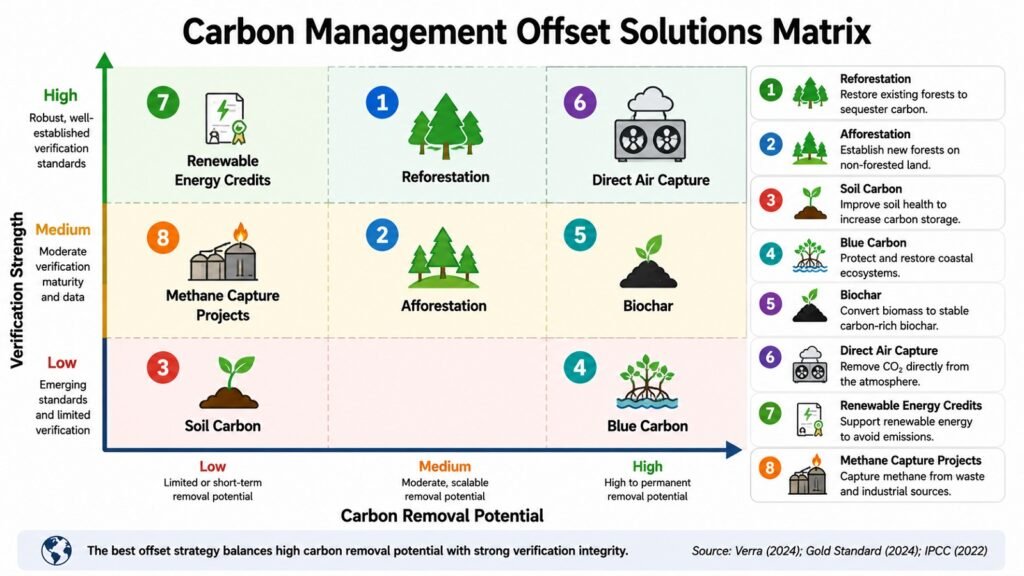
Not every emission can be eliminated through efficiency or clean energy alone. Some activities, particularly in heavy industry and aviation, remain difficult to decarbonize with current technology. This is where carbon markets and offsets enter the Carbon Management picture, offering a way to address emissions that cannot yet be removed directly.
Carbon markets generally fall into two categories. Compliance markets operate under government regulation, requiring companies in certain sectors to hold permits for their emissions, often through cap-and-trade systems. Voluntary markets, by contrast, allow companies to purchase carbon credits outside any regulatory requirement, typically to support climate commitments that go beyond legal obligation. Within voluntary markets, credits can come from a wide range of project types, including reforestation, renewable energy development, methane capture, and newer carbon removal technologies such as direct air capture.
The quality of these credits varies considerably, and this has become a serious point of debate. Some offset projects have faced criticism for overstating their climate benefit or failing to deliver permanent emissions reductions. Microsoft has responded to this concern by prioritizing carbon removal projects with strong scientific verification and long-term durability, rather than relying heavily on cheaper, shorter-term credits. The company has also shifted away from certain unbundled renewable energy certificates that critics argued did little to drive new clean energy development, choosing instead to fund higher-impact projects.
The broader lesson for businesses considering offsets is one of sequencing. Offsets work best as a complement to direct emissions reductions, not a substitute for them. A company that buys credits while ignoring its own operational emissions risks accusations of greenwashing, since critics and regulators increasingly scrutinize offset-heavy climate claims. Used responsibly, though, offsets and removal credits give companies a path to address emissions that current technology cannot yet eliminate, while still investing directly in their own reduction efforts.
Carbon Management: Carbon Markets, Credits, and Offset Mechanisms
| Mechanism | Description |
| Compliance Carbon Markets | Government-regulated systems requiring emissions permits |
| Voluntary Carbon Markets | Optional credit purchases supporting climate commitments |
| Reforestation Credits | Carbon credits generated through tree planting projects |
| Renewable Energy Credits | Credits tied to clean energy generation projects |
| Methane Capture Projects | Credits from preventing methane release at landfills or farms |
| Direct Air Capture | Emerging technology that removes carbon dioxide from the atmosphere |
| Carbon Pricing Mechanisms | Internal or external fees applied to emissions activity |
| Third-Party Verification | Independent review ensuring offset project quality and integrity |
7. Carbon Management Through Net-Zero Strategy & Corporate Transformation
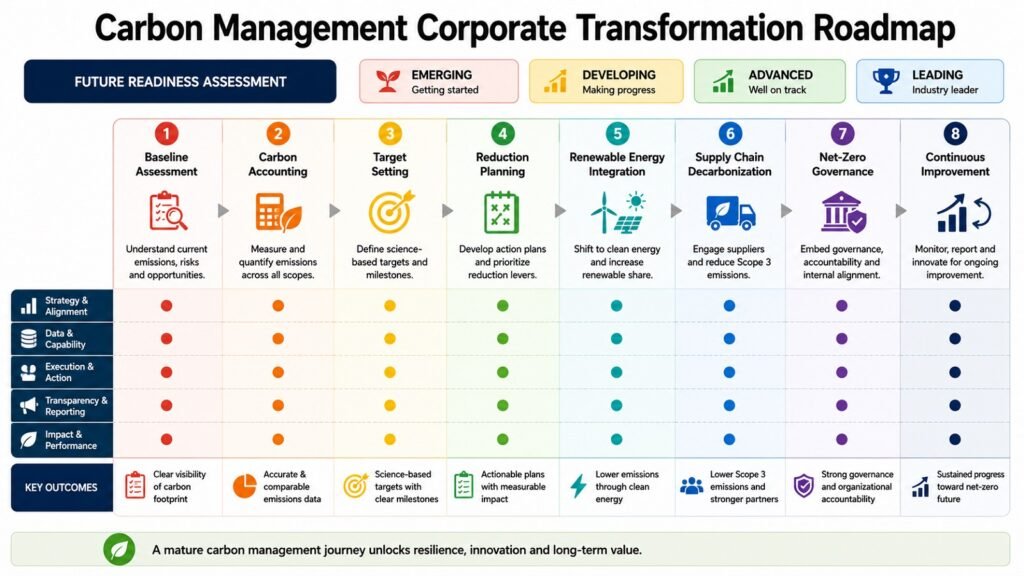
Net-zero commitments represent the most ambitious expression of Carbon Management, requiring companies to rethink governance, capital allocation, and organizational structure rather than just individual processes. A net-zero strategy is not a single initiative. It is a long-term roadmap that touches nearly every department, from procurement to finance to product design.
Building this kind of roadmap typically starts with executive ownership. Companies that succeed tend to place climate accountability with senior leadership, often through a dedicated chief sustainability officer who reports directly to the chief executive. Microsoft’s Chief Sustainability Officer leads the company’s carbon negative, water positive, and zero waste targets, giving these goals the same organizational weight as financial targets. This structural choice signals to employees and investors alike that climate goals are not a side project managed by a small team, but a core business priority backed by senior leadership.
Capital allocation follows naturally from this kind of governance. Microsoft’s billion-dollar Climate Innovation Fund directs capital specifically toward emerging carbon reduction and removal technologies, treating climate investment as a strategic capital decision rather than a charitable expense. Ørsted, the Danish energy company, transformed its entire business model over roughly a decade, shifting from a fossil fuel-heavy utility into one of the world’s largest offshore wind developers. This transformation required years of capital reallocation, asset divestment, and organizational change, demonstrating that a net-zero strategy can reshape an entire company’s identity when pursued consistently.
These transformations rarely happen quickly or without friction. Shifting capital away from established revenue sources requires confidence that new models will eventually replace lost income, and that confidence often takes years to build internally. Companies that rush this process without securing leadership buy-in or financial planning tend to see strategies stall once initial enthusiasm fades. Successful net-zero transformation requires patience built into the plan from the start, not added afterward.
Carbon Management: Net-Zero Strategy and Corporate Transformation Components
| Component | Role in Transformation |
| Executive Climate Ownership | Embeds accountability at senior leadership level |
| Decarbonization Roadmaps | Provides structured timeline toward emissions targets |
| Capital Reallocation | Directs investment toward low-carbon business activities |
| Governance Integration | Builds climate oversight into board level decision making |
| Innovation Funds | Finances emerging carbon reduction and removal technology |
| Business Model Redesign | Shifts revenue sources toward lower-carbon offerings |
| Employee Engagement Programs | Builds internal culture supporting climate goals |
| Stakeholder Communication | Maintains transparency throughout the transformation process |
8. Carbon Management Through Carbon Innovation & Competitive Advantage
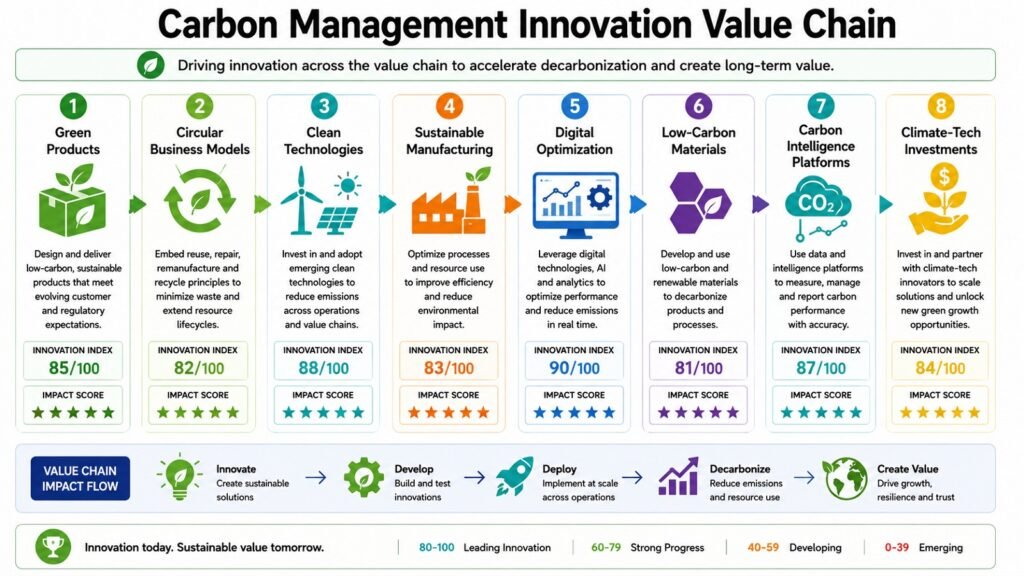
The final pillar of Carbon Management asks a different question than the others. Instead of focusing on compliance or risk reduction, it asks how climate action can become a source of growth. Companies that treat Carbon Management purely as a cost center miss an opportunity that some of their competitors have already captured: using climate strategy to build new products, new markets, and stronger customer loyalty.
Tesla built its entire business around this premise, demonstrating that an electric vehicle could outperform an internal combustion engine in terms of speed and design while also reducing emissions. The company’s early bet on electrification, made when battery costs were still high and charging infrastructure was sparse, eventually positioned it among the most valuable automakers in the world. This case shows how a genuine commitment to low-carbon technology can create market advantages that are difficult for slower-moving competitors to replicate quickly.
Interface again provides a useful example, having built its brand identity around carbon-negative flooring products years before sustainability became a mainstream purchasing consideration. This early positioning allowed the company to capture customers specifically seeking lower-carbon building materials, a market segment that has only grown as construction industry sustainability standards have tightened. Ørsted’s transformation from fossil fuels to offshore wind similarly created a new growth platform, turning what began as a defensive climate response into the foundation of the company’s entire revenue model.
These examples share a common thread. Each company treated Carbon Management not as a constraint imposed from outside, but as a lens for identifying genuine business opportunity. Customer expectations around sustainability continue to rise, particularly among younger buyers, creating durable demand for lower-carbon products and services. Companies that internalize this shift early often gain first-mover advantages in emerging markets, while companies that wait risk playing catch-up once demand becomes mainstream.
Carbon Management: Innovation-Driven Practices and Competitive Strategies
| Practice | Strategic Benefit |
| Low-Carbon Product Lines | Captures growing customer demand for sustainable alternatives |
| Electrification Strategy | Builds market position around clean technology adoption |
| Carbon Negative Product Design | Differentiates brand identity through verified climate performance |
| Renewable Business Model Shift | Converts climate response into long-term revenue growth |
| Green Technology Investment | Creates intellectual property and first-mover market advantage |
| Sustainable Materials Research | Reduces embodied carbon while enabling new product features |
| Customer Transparency Tools | Builds loyalty through verifiable sustainability claims |
| Cross-Industry Partnerships | Accelerates shared innovation in low-carbon technology |
Conclusion: The Future of Carbon Management and Sustainable Growth
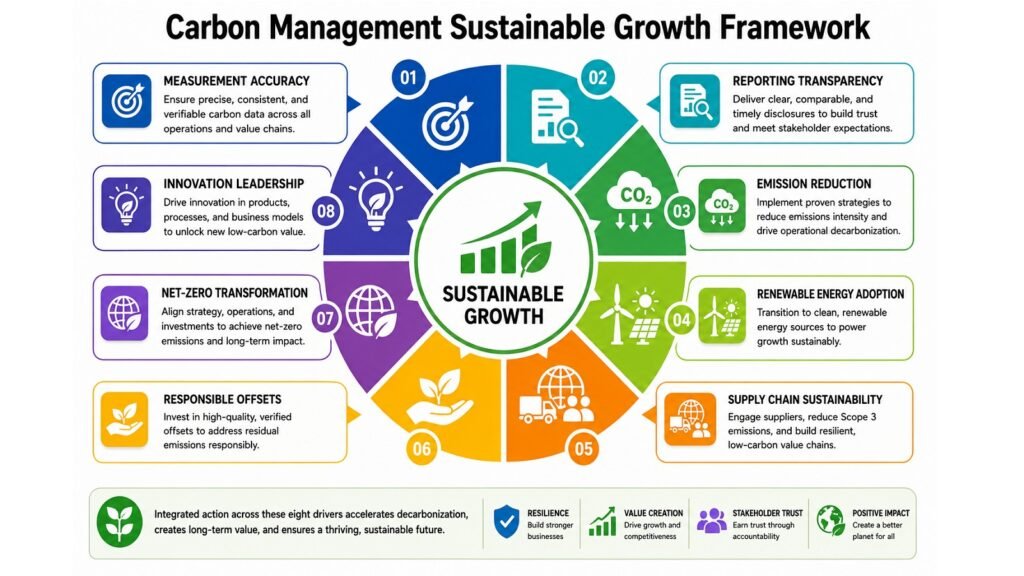
The eight pillars covered in this article do not operate in isolation. They form a connected system, one where measurement enables reporting, reporting builds trust, reduction strategies create savings, clean energy lowers market exposure, supply chain engagement multiplies impact, offsets address what remains, net-zero strategy aligns the organization, and innovation turns climate action into growth. Carbon Management is now an important aspect of Sustainable Business precisely because these pillars reinforce one another rather than functioning as separate checkboxes.
The companies referenced throughout this article illustrate this connection in practice. Microsoft paired internal carbon pricing with transparent reporting and a dedicated innovation fund, building a system rather than a single initiative. Walmart proved that supply chain engagement, paired with the right incentives, can deliver results years ahead of schedule. Ørsted showed that net-zero transformation can become the foundation for an entirely new business model rather than a constraint on an old one. Tesla and Interface demonstrated that climate-driven innovation can produce lasting competitive advantage rather than short-term goodwill.
Looking ahead, the pressure driving Carbon Management forward shows no sign of easing. Climate-related regulation continues to expand across major economies. Investors continue refining how they evaluate climate risk within portfolios. Customers, particularly younger generations, increasingly expect transparency as a baseline rather than a bonus feature. Technological change, from better batteries to more efficient carbon removal methods, will likely lower the cost of climate action over time, making ambitious targets more achievable for companies that act early.
Businesses that treat these eight pillars as a connected system, rather than isolated obligations, will likely find themselves better prepared for whatever shifts arrive next. Carbon Management rewards patience and consistency far more than short bursts of activity. The companies profiled here did not succeed overnight, and most are still refining their approach today. That ongoing refinement may be the clearest sign of what effective Carbon Management actually looks like in practice.
Carbon Management Pillars and Their Core Business Value
| Pillar | Primary Business Value Created |
| Carbon Accounting & Measurement | Reliable data foundation for strategic decisions |
| Carbon Reporting & Disclosure | Investor trust and regulatory compliance |
| Carbon Reduction Strategies | Lower operating costs alongside emissions cuts |
| Renewable Energy & Clean Power | Price stability and reduced market exposure |
| Sustainable Supply Chains | Expanded impact across the full value chain |
| Carbon Markets & Offsets | Coverage for hard-to-eliminate residual emissions |
| Net-Zero Strategy & Transformation | Organizational alignment around long-term goals |
| Carbon Innovation & Advantage | New revenue streams and market differentiation |