
Table of Contents
Introduction — Entrepreneurial Innovation: The Foundation of Entrepreneurial Value Creation
Entrepreneurial Innovation is one of the most important and defining aspects of Entrepreneurship. It is the engine through which entrepreneurs convert recognized opportunities and novel ideas into products, services, processes, and business models that generate meaningful value. Without innovation, entrepreneurship would be little more than routine business management. With it, entrepreneurs can challenge established industries, reshape customer experiences, and build enterprises that endure.
Entrepreneurial Innovation can be defined as the process of identifying opportunities, developing new or improved solutions, and bringing those solutions into practical use under conditions of uncertainty. Schumpeter’s concept of creative destruction placed the innovating entrepreneur at the center of economic change, while Leibenstein’s X-Efficiency Theory emphasized the entrepreneur’s role in overcoming organizational inefficiency and improving the effective use of resources. Together, these perspectives establish that innovation is not accidental but is driven by entrepreneurs who actively seek and act on information that others ignore, supported by an entrepreneurial mindset focused on identifying possibilities and improving performance.
This distinguishes Entrepreneurial Innovation from general business innovation. Large organizations can commit substantial resources to well-defined R&D programs. Entrepreneurs, by contrast, operate under significant uncertainty with limited resources, bear personal risk, and must simultaneously identify opportunities and develop solutions. Innovation itself is also broader than invention or technological novelty: it can involve products, services, processes, customer experiences, new markets, or entirely new business models.
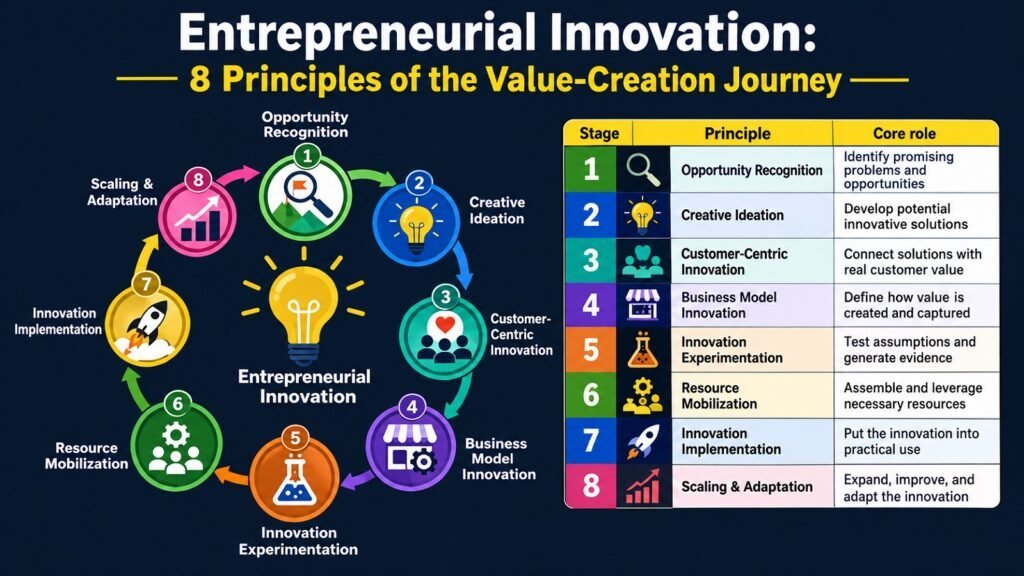
This article examines eight interconnected principles that form a practical framework for Entrepreneurial Innovation, from the initial recognition of an opportunity to the long-term scaling and adaptation of a successful solution.
Table 1: Eight Principles of Entrepreneurial Innovation and Their Role
| Principles of Entrepreneurial Innovation | Role in Entrepreneurial Innovation |
| Opportunity Recognition | Identifies unmet needs and market gaps that make innovation possible |
| Creative Ideation | Transforms opportunities into potential solutions through divergent thinking |
| Customer-Centric Innovation | Grounds innovations in genuine customer needs and meaningful value |
| Business Model Innovation | Changes how value is created, delivered, and captured |
| Innovation Experimentation | Tests assumptions about customers and solutions before full commitment |
| Resource Mobilization | Assembles the inputs needed to move from concept to implementation |
| Innovation Implementation | Delivers validated innovations into practical use or commercialization |
| Scaling and Adaptation | Extends and adjusts successful innovations as conditions change |
1. Opportunity Recognition and Entrepreneurial Innovation
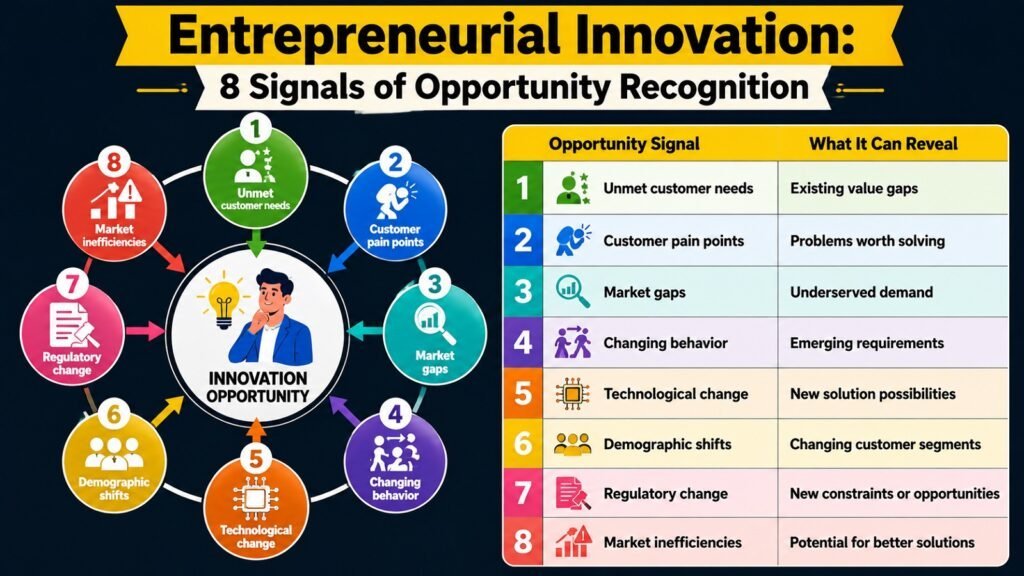
Opportunity recognition is where the Entrepreneurial Innovation process begins. Before any idea can be developed, any experiment designed, or any resource assembled, an entrepreneur must first identify a condition in the environment that could be transformed into something valuable. That condition might be an unmet customer need, a market gap, a technological development that creates new possibilities, a regulatory change that opens new space, a shift in consumer behavior, or a problem that existing solutions address only partially or poorly.
Scholars studying entrepreneurial mindset have approached opportunity recognition from several angles. Leibenstein’s X-Efficiency Theory suggests that entrepreneurial mindset can play an important role in identifying and addressing inefficiencies, particularly when existing resources and organizational capabilities are not being used to their full potential. Others, drawing on work by Shane and Venkataraman, argue that opportunity recognition is significantly shaped by prior knowledge. A person with deep experience in a particular domain is more likely to notice when conditions in that domain are changing in ways that open new possibilities. Networks and social connections can also influence what opportunities become visible to an entrepreneur, while an entrepreneurial mindset can shape how individuals recognize inefficiencies, interpret changing conditions, and act on emerging possibilities.
An important distinction separates noticing a market trend from genuinely recognizing an innovation opportunity. Observing that digital photography was growing rapidly was not, by itself, an innovation opportunity. An opportunity emerged when an entrepreneur could identify who would benefit from a specific solution, what problem would be solved, why existing alternatives were insufficient, and how the solution could be delivered in a way that captures value. Kodak observed the digital photography trend but failed to translate that observation into a viable Entrepreneurial Innovation path, despite having developed early digital camera technology internally.
Not every perceived opportunity is a viable one. Entrepreneurs must evaluate whether a recognized condition represents a genuine problem worth solving, whether customers would value a solution sufficiently to change their behavior, whether the timing is right, and whether the opportunity can realistically be addressed given available or accessible resources. Premature recognition, where an entrepreneur identifies a real opportunity too early for the market to support it, is as problematic as failing to recognize an opportunity at all.
Table 2: Eight Opportunity Signals and Recognition Considerations in Entrepreneurial Innovation
| Signal or Considerations Entrepreneurial Innovation | Relevance to Entrepreneurial Innovation |
| Unmet customer needs | Problems customers face but existing products or services do not adequately solve |
| Market gaps | Segments or use cases underserved by current offerings, indicating space for new solutions |
| Technological change | New technologies that make previously impossible or uneconomical solutions viable |
| Shifting consumer behavior | Changes in how people work, communicate, or purchase that create new demand patterns |
| Regulatory or policy changes | New rules that open previously restricted markets or create compliance-driven demand |
| Prior knowledge and experience | Domain familiarity that helps entrepreneurs detect anomalies others overlook |
| Timing and market readiness | Whether the market, technology, and infrastructure can currently support a solution |
| Competitive inadequacy | Existing alternatives that are costly, inconvenient, or inaccessible to important customers |
2. Creative Ideation and Entrepreneurial Innovation
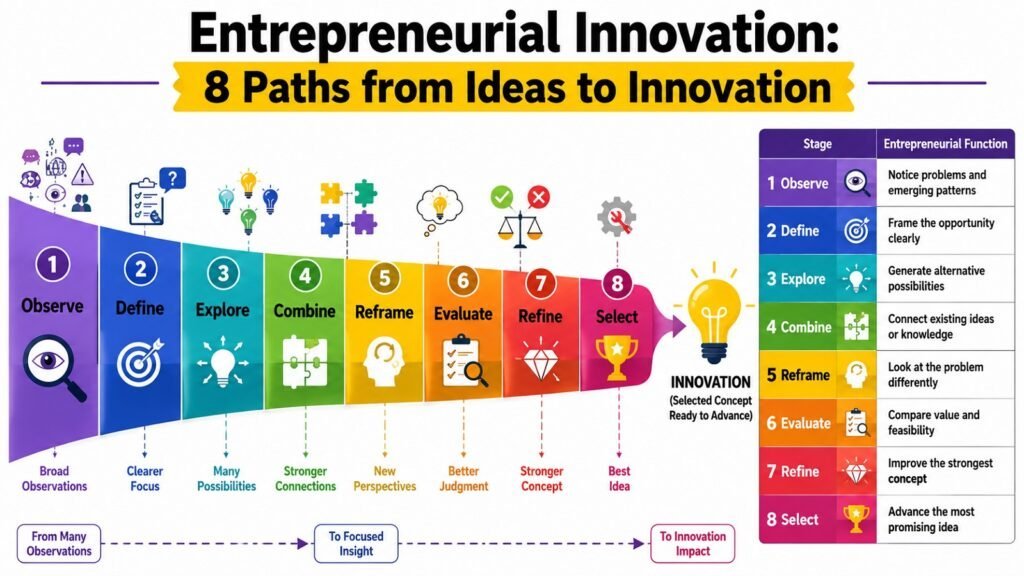
Once an opportunity is recognized, the entrepreneur faces the challenge of developing a response. Creative ideation is the stage in the Entrepreneurial Innovation process where observations, problems, and potential opportunities are transformed into specific concepts and potential solutions. It is the bridge between seeing something and deciding what to do about it.
A useful distinction separates four closely related terms. Creativity is the cognitive ability to generate original or useful ideas. An idea is the conceptual output of that process. An invention is a technically novel creation, often protected by intellectual property. An innovation is an implemented idea that creates value in practice. Entrepreneurial Innovation requires all four to some degree, but the relationship among them matters. Many good ideas are never developed. Many inventions are never commercially implemented. And many innovations succeed not because they involve unprecedented invention but because they apply or recombine existing knowledge in a context where it was not previously used.
Research on entrepreneurial creativity highlights divergent thinking, the ability to generate multiple possibilities from a single starting point, as a valuable capacity during ideation. Problem reframing is equally important. Entrepreneurs who ask a different question about a customer problem often arrive at solution concepts that others miss. When Reed Hastings considered why video rental customers paid late fees, he did not ask how to reduce the fees. He reframed the question to ask whether there was a better rental model altogether, which contributed to the concept that became Netflix’s original subscription approach.
Evaluating ideas analytically is as important as generating them. Novelty does not make an idea valuable. Entrepreneurs must assess whether a concept solves a real and important problem, whether it is sufficiently distinct from alternatives, whether it is technically and economically feasible, and whether there is credible evidence that customers would value it. The danger of idea fixation, where an entrepreneur becomes attached to a concept regardless of contrary evidence, is well documented in entrepreneurship research and can significantly impair the quality of later innovation decisions.
Table 3: Eight Creative Ideation Principles for Entrepreneurial Innovation
| Ideation Principles for Entrepreneurial Innovation | Application in Entrepreneurial Innovation |
| Divergent thinking | Generate multiple solution concepts before evaluating or selecting any single approach |
| Problem reframing | Ask different questions about a problem to uncover solutions that conventional framing misses |
| Recombination of knowledge | Apply existing ideas, methods, or technologies in new contexts to create novel value |
| Simplification | Strip unnecessary complexity from existing solutions to improve accessibility or cost |
| Customer-problem anchoring | Evaluate ideas against specific customer problems rather than abstract innovation criteria |
| Feasibility assessment | Test whether an idea can realistically be developed and delivered within available constraints |
| Avoiding idea fixation | Remain willing to discard or significantly modify ideas that lack supporting evidence |
| Distinguishing creativity from innovation | Recognize that an idea becomes an innovation only when it is successfully implemented and valued |
3. Customer-Centric Innovation and Entrepreneurial Innovation
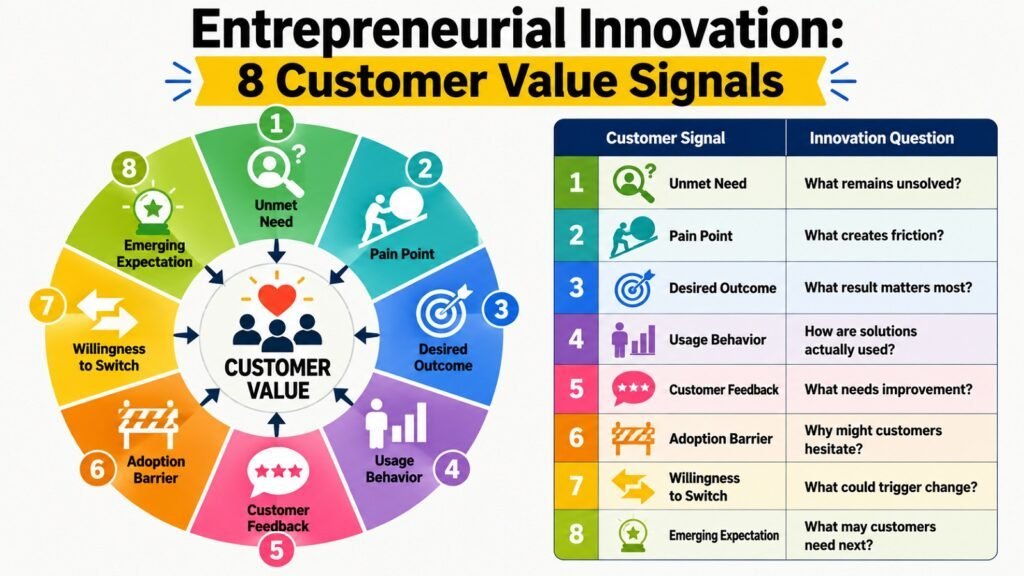
An innovative idea creates value only if it addresses something that genuinely matters to customers. Customer-Centric Innovation is not simply a philosophy of being helpful. It is a rigorous approach to ensuring that the direction of Entrepreneurial Innovation is guided by real understanding of what customers experience, value, struggle with, and ultimately need. Without this grounding, even technically impressive innovations can fail in the market.
Entrepreneurs pursuing customer-centric approaches look beyond stated preferences to understand actual behavior, pain points, workarounds, and unmet needs. The jobs-to-be-done framework, developed by Clayton Christensen and colleagues, offers a useful lens: customers do not simply buy products; they hire them to accomplish specific outcomes in their lives or work. An entrepreneur who understands the job a customer is trying to accomplish is better positioned to design an innovation that performs that job more effectively, conveniently, or affordably than existing alternatives.
Customer discovery, a concept developed in the lean startup tradition, is the systematic process of testing assumptions about who customers are and what they value before significant resources are committed. Rather than assuming a recognized problem is real and widespread, entrepreneurs engaging in customer discovery conduct structured conversations, observe behavior in context, and gather evidence to validate or refute key assumptions. Airbnb founders conducted this type of direct customer engagement early in their development, visiting hosts personally to understand their concerns and improve the experience, which directly shaped several core product decisions.
There is an important boundary within Customer-Centric Innovation that entrepreneurs must navigate carefully. While customer understanding should inform innovation decisions, it cannot always determine them. Customers frequently cannot articulate needs they have not yet experienced. Henry Ford reportedly noted that customers would have asked for faster horses rather than automobiles. Successful Entrepreneurial Innovation often requires entrepreneurs to anticipate latent needs and introduce solutions that customers recognize as valuable only after experiencing them. Being customer-centric means understanding customers deeply, not simply executing whatever they request.
Table 4: Eight Customer-Centered Considerations in Entrepreneurial Innovation
| Customer Considerations in Entrepreneurial Innovation | Relevance to Entrepreneurial Innovation |
| Unmet needs and pain points | The most promising space for innovation lies where existing solutions fall short |
| Jobs to be done | Understanding the outcome customers seek clarifies what an innovation must actually deliver |
| Behavioral observation | What customers do often reveals more about their needs than what they say |
| Customer discovery interviews | Structured conversations test assumptions before large resource commitments are made |
| Willingness to pay | Customer value must translate into economic support for the innovation to be viable |
| Adoption barriers | Switching costs, habits, or trust gaps can prevent customers from adopting new solutions |
| Feedback integration | Continuous input from early users helps entrepreneurs refine innovations after launch |
| Latent need anticipation | Some innovations must create demand by introducing customers to value they did not expect |
4. Business Model Innovation and Entrepreneurial Innovation
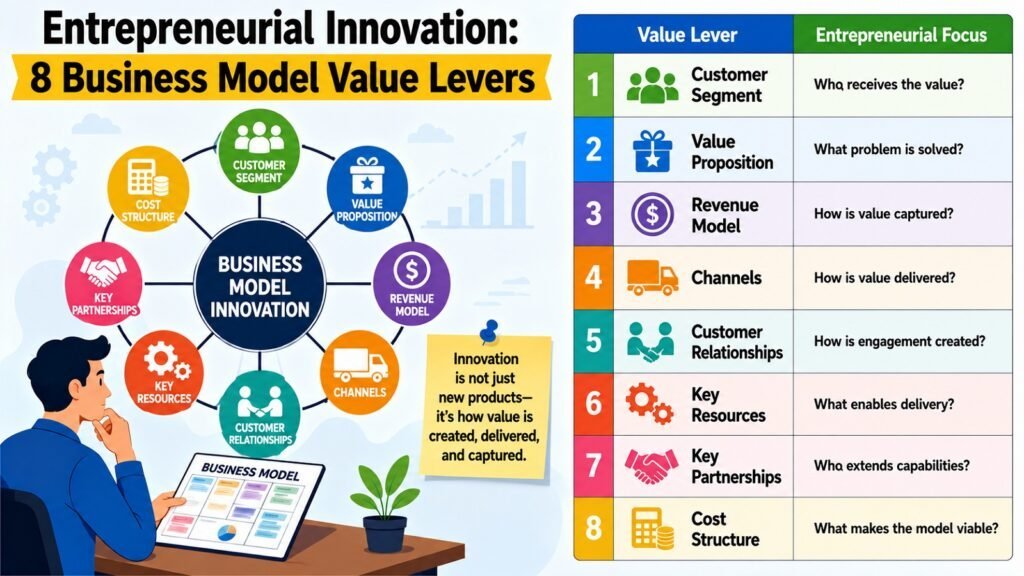
Entrepreneurial Innovation does not always originate in a new technology or an unprecedented product. In many cases, the most significant innovation is in how a business creates value for customers, delivers that value, and captures a portion of it as revenue. This is what Business Model Innovation means: changing the structure or logic through which a business operates, not merely what it sells.
A business model can be understood as the logic through which an enterprise creates value for customers, delivers that value through chosen channels and relationships, and captures a share of that value through a revenue mechanism. Entrepreneurs who question conventional assumptions about any of these dimensions can discover innovation opportunities that competitors rooted in established models do not see. Researchers, including Alexander Osterwalder, have formalized these components through tools like the Business Model Canvas, which identifies elements such as value propositions, customer segments, channels, revenue streams, cost structures, and key partnerships as configurable building blocks.
Spotify provides a useful illustration. Music existed long before Spotify launched. Recorded music was distributed on physical media and later through digital downloads. What Spotify innovated was not the music itself but the model: from ownership to access, from purchase to subscription, from album-centric to playlist-centric, and from physical or download distribution to streaming. The same underlying content was delivered through a fundamentally different value-creation and revenue logic, and that model redefined the economics and behavior of an entire industry.
Business model innovation carries real risks. A new revenue model may face customer resistance from people accustomed to different pricing structures. Operational complexity can increase when partners, platforms, or new delivery mechanisms are involved. Competitors can observe and imitate business model changes more readily than they can replicate proprietary technology. Entrepreneurs must therefore evaluate not just whether a new business model is conceptually appealing but whether it is economically sustainable, operationally executable, and sufficiently differentiated to create lasting advantage.
Table 5: Eight Business Model Dimensions and Their Relevance to Entrepreneurial Innovation
| Business Model Dimension | Entrepreneurial Innovation Relevance |
| Value proposition | Defines what benefit the innovation delivers and why customers would choose it over alternatives |
| Revenue mechanism | Innovating how value is monetized, for example through subscriptions, platforms, or freemium models |
| Customer segments | Redefining who is served can open markets previously ignored by established competitors |
| Distribution channels | Delivering value through new or more efficient channels can itself be a source of competitive advantage |
| Key partnerships | External relationships can provide capabilities, reach, or resources the entrepreneur does not possess internally |
| Cost structure | Changing how costs are incurred can enable pricing or scale impossible under conventional operating models |
| Customer relationships | Self-service, community, or co-creation models can change both cost and perceived value |
| Platform logic | Multi-sided platforms create value by connecting participants, generating network effects that increase switching costs |
5. Innovation Experimentation and Entrepreneurial Innovation
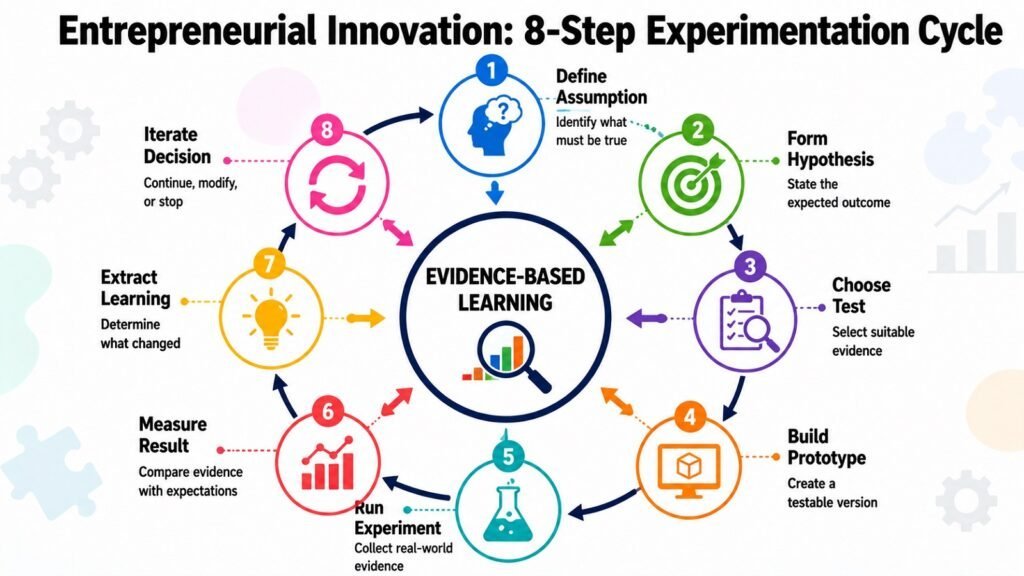
Entrepreneurial Innovation takes place under conditions of genuine uncertainty. An entrepreneur cannot know in advance whether customers will value a new solution, whether a distribution approach will work, whether pricing assumptions are correct, or whether a business model will generate sustainable revenue. Experimentation is the mechanism through which uncertainty is reduced before larger commitments are made.
Effective experimentation in Entrepreneurial Innovation is not the same as random trial and error. A well-structured experiment begins with a specific assumption that can be tested, a prediction of what the evidence would look like if the assumption is correct, and a method for generating that evidence. The result either confirms that an assumption is reasonable or reveals that it needs revision. Each experiment should therefore produce actionable learning, not simply activity. This distinction between generating evidence and simply attempting things is what makes experimentation a genuine innovation capability.
The lean startup movement, associated primarily with Eric Ries, popularized the concept of the minimum viable product as a tool for testing critical assumptions about customer demand and product-market fit without building a complete solution first. Dropbox is a frequently cited example. Before investing in the infrastructure required to build a cloud storage product, founder Drew Houston created a short demonstration video explaining what the product would do. The video generated over 70,000 signups overnight from people interested in the concept, providing strong evidence of demand before a single line of the actual product was written. That experiment dramatically reduced the risk of a large subsequent investment.
Experimentation has meaningful limitations. An experiment conducted in a narrow context may not predict how a solution performs at scale. Early adopters often differ significantly from mainstream customers. Some assumptions are difficult to test without building substantial infrastructure. And interpreting experimental results requires judgment: what looks like disconfirming evidence may reflect poor execution rather than a flawed underlying concept. Entrepreneurs must therefore treat experimentation as one important input into innovation decisions rather than as an infallible guide.
Table 6: Eight Experimentation Considerations in Entrepreneurial Innovation
| Experimentation Consideration | Role in Entrepreneurial Innovation |
| Assumption identification | Determine which beliefs about customers, solutions, or markets carry the most risk if wrong |
| Hypothesis formation | State the assumption clearly and specify what evidence would confirm or refute it |
| Minimum viable testing | Design the simplest test that can generate meaningful evidence about the key assumption |
| Prototype use | Physical or digital prototypes can reveal usability, appeal, and functional issues before launch |
| Evidence quality | Distinguish between reliable evidence and signals distorted by context, sample, or execution |
| Iteration discipline | Use results to revise specific elements rather than abandoning an entire concept prematurely |
| Early adopter bias | Recognize that initial users may differ substantially from the mainstream market the innovation targets |
| Learning velocity | Design experiments to generate evidence quickly enough to inform decisions before resources are depleted |
6. Resource Mobilization and Entrepreneurial Innovation
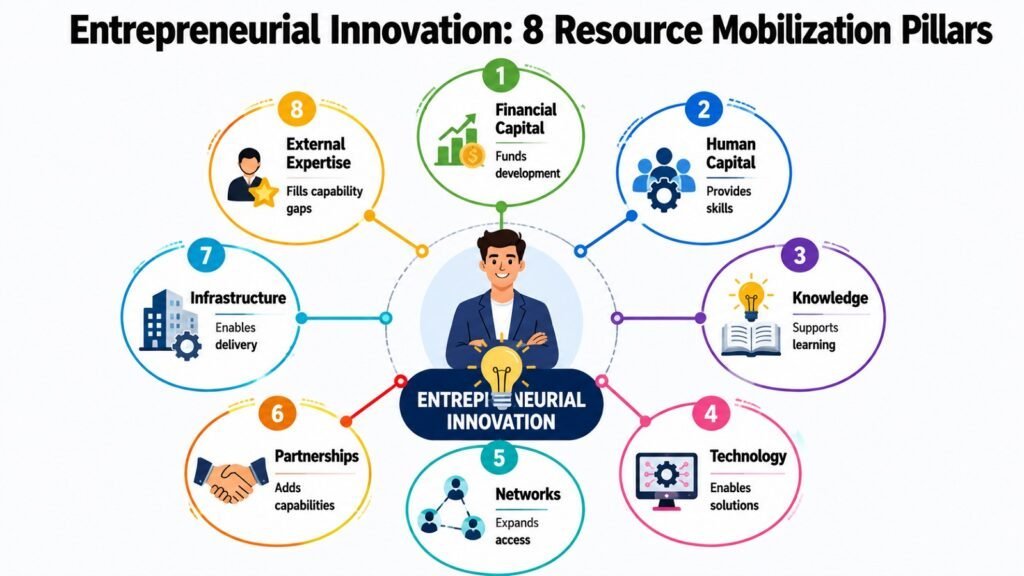
Ideas and opportunities do not become innovations without resources. Turning a recognized opportunity into a working product, service, or business model requires financial capital, human talent, technological infrastructure, information, time, and often access to networks, expertise, or partnerships. Resource Mobilization is therefore a fundamental and practical component of Entrepreneurial Innovation.
What makes resource mobilization distinctively entrepreneurial is the challenge of assembling the necessary inputs under conditions of scarcity, uncertainty, and constraint. Most entrepreneurs lack the broad organizational resources available to established corporations. Research on resource bricolage, developed by Ted Baker and Reed Nelson, shows that entrepreneurs often create innovative solutions by repurposing, combining, and stretching resources that are already at hand rather than acquiring ideal inputs through established channels. This resourcefulness, the capacity to do more with less through creative combination, is itself an important entrepreneurial competence.
Sara Blakely’s founding of Spanx is a frequently cited example of resource mobilization under constraint. Blakely started with personal savings of five thousand dollars, conducted early market research herself, initially handled sales visits to department stores alone, and sourced manufacturing through persistent direct outreach rather than through established industry relationships. Her ability to mobilize limited resources effectively, rather than waiting for ideal conditions, was central to getting the innovation to market.
Entrepreneurs must make strategic distinctions in resource mobilization. Not all resources need to be owned: licensing, partnership, subcontracting, and platform access can provide capabilities without the cost of ownership. The relevant question is not only what resources an entrepreneur has but which are truly essential to the innovation, which can be accessed through external relationships, and where creative combinations can reduce the resource threshold for implementation. Possessing resources and being capable of mobilizing them effectively are not the same thing, and the latter is often the more important entrepreneurial capability.
Table 7: Eight Resource Categories and Their Relevance to Entrepreneurial Innovation
| Resource Category | Role in Entrepreneurial Innovation |
| Financial capital | Funds product development, marketing, hiring, and operational costs during innovation execution |
| Human talent | Skills in design, technology, sales, and operations are required to build and deliver innovations |
| Social and network capital | Connections provide access to expertise, customers, partners, and market intelligence |
| Technological infrastructure | Tools, platforms, and systems enable development, delivery, and scaling of innovative solutions |
| Domain knowledge | Deep understanding of an industry or problem space reduces uncertainty in innovation decisions |
| Intellectual property | Patents, trademarks, and proprietary processes protect differentiation and commercial advantage |
| Strategic partnerships | External relationships extend the entrepreneur’s resource base without requiring full ownership |
| Time as a resource | Effective time allocation across development, testing, and execution stages directly influences outcomes |
7. Innovation Implementation and Entrepreneurial Innovation
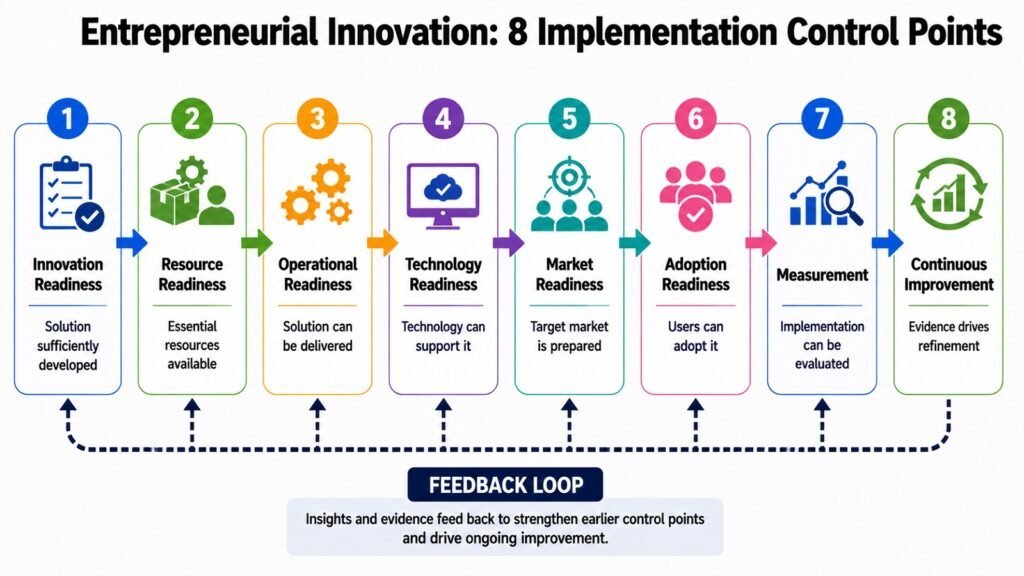
An idea is not an innovation. Experimentation validates assumptions and reduces uncertainty, but the real test of any innovation comes when it moves from concept into actual practice, whether that means launching a product, deploying a service, commercializing a technology, or embedding a new process in an organization. Implementation is the stage at which Entrepreneurial Innovation produces its real consequences.
Innovation scholars have long recognized implementation as a distinct and often underappreciated challenge. Research by Everett Rogers on the diffusion of innovations established that even genuinely superior innovations can fail to achieve widespread adoption if implementation factors such as complexity, compatibility with existing habits, and observability of benefits are not managed effectively. An entrepreneur may develop a technically excellent solution that customers nonetheless resist because the friction of adoption exceeds the perceived benefit. Implementation must therefore address not only how an innovation is built but how it will be adopted.
The launch of Amazon Web Services in 2006 illustrates several dimensions of innovation implementation. Amazon had developed sophisticated internal cloud computing infrastructure to support its own retail operations. The decision to offer that infrastructure as a commercial service to external developers required not only technical packaging but also pricing decisions, documentation, support capabilities, and a go-to-market approach. Each of these implementation elements shaped whether the innovation reached customers effectively and whether it could scale. AWS subsequently became one of the most commercially significant platform innovations of the decade, but its success depended heavily on implementation discipline.
Implementation frequently reveals new information that the entrepreneur did not have during earlier development stages. Customers may use an innovation in unexpected ways. Operational processes may prove more costly or complex than anticipated. Early adoption patterns may differ from projections. Entrepreneurs who treat implementation as a learning phase, rather than simply an execution phase, are better positioned to respond to this new information by adjusting their approach without abandoning the underlying innovation.
Table 8: Eight Implementation Considerations for Entrepreneurial Innovation
| Implementation Considerations for Entrepreneurial Innovation | Role in Entrepreneurial Innovation |
| Operational readiness | Processes, systems, and people must be capable of consistently delivering the innovation |
| Customer adoption planning | Reducing friction and clearly communicating value accelerates adoption of new solutions |
| Timing and market conditions | Launching before or after optimal market readiness can significantly affect adoption outcomes |
| Regulatory compliance | Legal and regulatory requirements must be addressed before some innovations can reach the market |
| Feedback mechanisms | Collecting structured data from early users enables rapid identification of implementation problems |
| Resource allocation discipline | Implementation requires clear prioritization of financial and human resources across execution tasks |
| Milestone definition | Specific, measurable implementation milestones create accountability and clarify progress |
| Iteration readiness | Entrepreneurs must be prepared to modify the innovation based on evidence gathered during implementation |
8. Innovation Scaling and Adaptation in Entrepreneurial Innovation
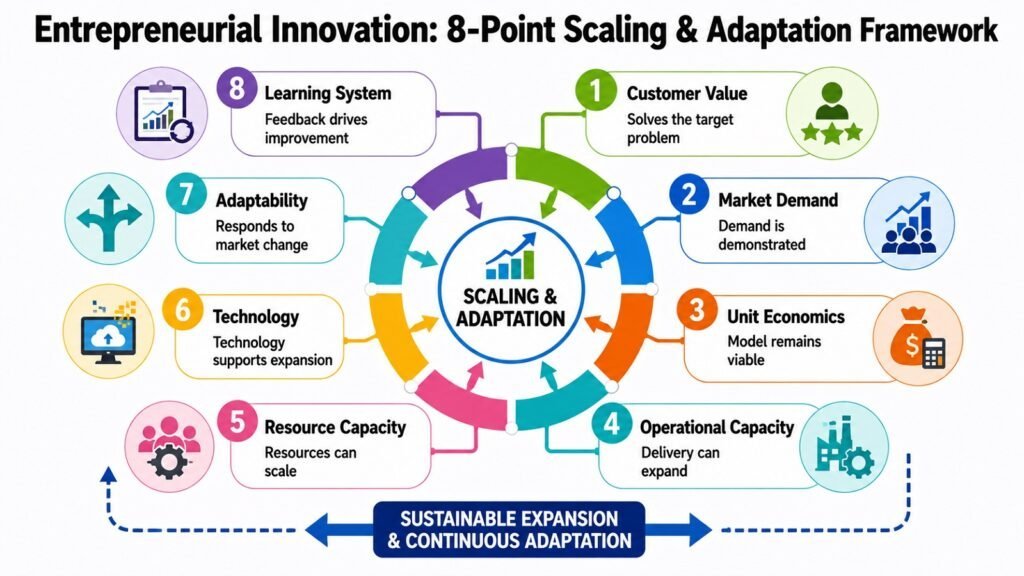
Entrepreneurial Innovation does not conclude when a product launches or a process begins operating. Markets evolve, customer expectations shift, competitive conditions change, and technologies develop in ways that require entrepreneurs to continuously reassess whether their innovation is still delivering the value it was designed to create. Scaling and adaptation represent the ongoing dimension of Entrepreneurial Innovation.
Scaling and adaptation are related but distinct activities. Scaling involves extending a proven innovation to reach more customers, more markets, or greater operational capacity while preserving the value proposition and the economic logic that made the innovation work initially. Adaptation involves modifying the innovation itself, sometimes significantly, in response to market feedback, competition, or changing conditions. Both require capabilities that scholars of strategic management associate with dynamic capabilities: the ability to sense changes in the environment, seize new opportunities, and reconfigure existing resources and processes to maintain competitive relevance.
Instagram offers a useful illustration of adaptive Entrepreneurial Innovation. The platform began as Burbn, a location-based social app with multiple features. Usage data revealed that customers primarily engaged with its photo-sharing functionality. The founders adapted by stripping away most of the application’s features and focusing entirely on photo sharing with social interaction. That adaptation produced a vastly simpler product that grew to one million users within two months of its relaunch and was acquired by Facebook for one billion dollars eighteen months later. Adaptation here was not a retreat from the original vision but a disciplined response to evidence.
Scaling deserves careful evaluation before it is pursued. Expanding an innovation before the underlying value proposition is well understood, before operations are reliable, or before the economic model is sustainable can amplify existing weaknesses rather than build on proven strengths. Some innovation failures arise not from poor ideas but from premature scaling that overwhelms operational capacity or dilutes customer experience. The appropriate question is not simply whether an innovation can be scaled but whether it is ready to be scaled.
Table 9: Eight Scaling and Adaptation Considerations in Entrepreneurial Innovation
| Scaling or Adaptation Considerations in Entrepreneurial Innovation | Relevance to Entrepreneurial Innovation |
| Market validation before scaling | Confirm that the value proposition is robust and repeatable before committing to expansion |
| Operational capacity assessment | Scaling requires systems, processes, and people capable of maintaining quality at greater volume |
| Performance monitoring | Ongoing data collection reveals whether the innovation continues to deliver intended customer value |
| Competitive response anticipation | Successful innovations attract imitation, requiring entrepreneurs to plan for competitive pressure |
| Adaptation triggers | Define in advance what evidence would indicate that the innovation needs to be meaningfully modified |
| Geographic or segment expansion | Different markets may require localization or repositioning that amounts to a distinct adaptation |
| Dynamic capability development | Building the organizational ability to sense change and respond builds long-term innovation resilience |
| Continuous improvement discipline | Systematic refinement of an innovation over time extends its competitive life and customer value |
Conclusion — Entrepreneurial Innovation: Building Sustainable Entrepreneurial Advantage
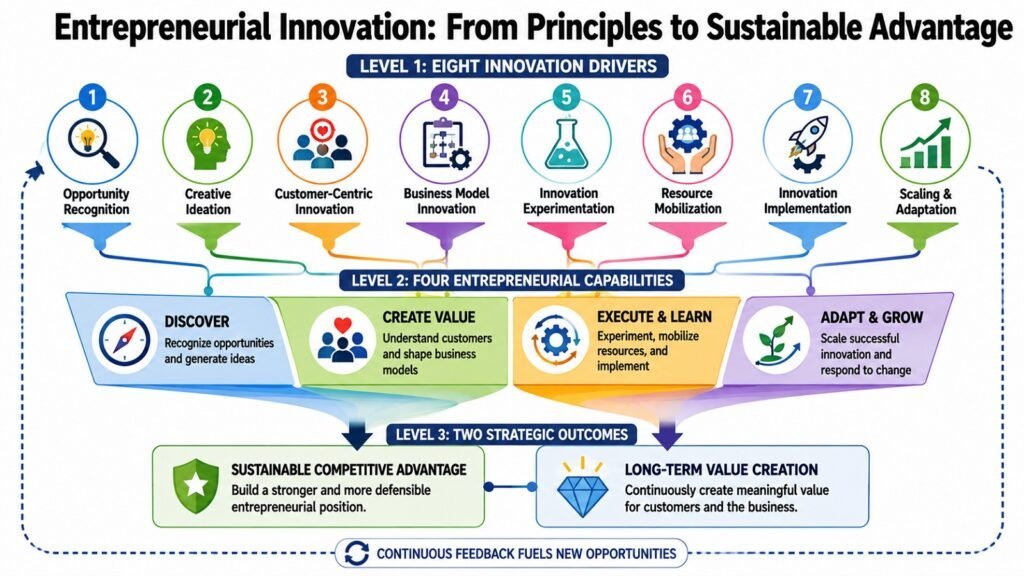
Entrepreneurial Innovation is not a single event but a continuous capability that spans the entire entrepreneurial journey. The eight principles of Entrepreneurial Innovation, discussed in this article, form an interconnected framework: weakness at one stage can undermine outcomes at every stage that follows. Recognizing an opportunity without creative ideation produces no innovation. An original idea that ignores customer reality creates a product without a market. A sound product without a viable business model fails to sustain the entrepreneur. Experimentation, resources, implementation, and adaptation each compound the value created at every earlier stage.
What distinguishes Entrepreneurial Innovation from broader organizational innovation is ultimately the role of the entrepreneur: operating under genuine uncertainty, with limited resources, bearing personal risk, and maintaining the judgment to revise decisions when evidence demands it. That combination of alertness, resourcefulness, and adaptive decision-making is what makes entrepreneurial innovation distinctive and difficult to replicate within institutional settings.
Looking ahead, the ability to innovate continuously will matter more, not less. The acceleration of technological change, evolving customer expectations, and intensifying global competition mean that entrepreneurs who treat innovation as a practiced and integrated way of working, rather than a one-time event, will be better positioned to create value that lasts.
Table 10: The Eight Principles of Entrepreneurial Innovation as an Integrated Framework
| Principles of Entrepreneurial Innovation | Contribution to Sustainable Entrepreneurial Advantage |
| Opportunity Recognition | Initiates the innovation process by identifying problems worth solving |
| Creative Ideation | Converts opportunities into actionable solution concepts |
| Customer-Centric Innovation | Anchors innovation in genuine customer value rather than novelty |
| Business Model Innovation | Shapes how value is created, delivered, and economically captured |
| Innovation Experimentation | Reduces risk by generating evidence before large commitments |
| Resource Mobilization | Enables execution by assembling the required inputs effectively |
| Innovation Implementation | Determines whether an innovation reaches and creates value for customers |
| Scaling and Adaptation | Sustains competitive relevance by extending and continuously refining innovations |