
Table of Contents
Introduction: Market Insights: The Foundation of Innovation Strategy
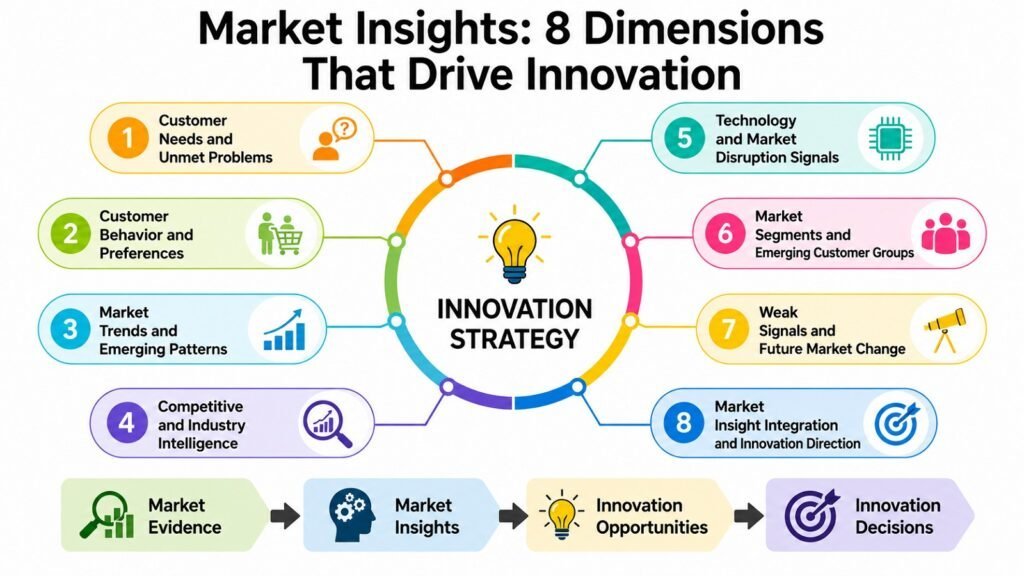
Innovation without evidence is speculation. Organizations that base their decisions on real market understanding consistently outperform those that rely on assumptions or visible trends alone. Market Insights are one of the most important aspects of Innovation Strategy because they connect what a business decides to build or invest in with what is actually happening in the market.
A useful distinction runs through this article. Market data is raw material. Market information organizes data into patterns. Market Insights go further: they interpret evidence, explain why it matters, and point toward a conclusion that guides a business decision. An insight is not a fact you observe; it is a meaning you construct from what you observe.
The central progression is logical. Businesses observe markets, interpret the signals those observations contain, identify opportunities those signals point toward, and use that interpretation to guide Innovation Strategy. Most organizations struggle at the interpretation stage — collecting data and producing reports without extracting the meaning that would make those observations actionable.
Relying only on customer surveys, historical data, or well-publicized trends creates predictable blind spots. Surveys capture what customers can articulate. Historical data reflects conditions that may already be changing. Obvious trends attract competitors quickly. The most useful Market Insights come from examining behavior, unmet needs, structural change, and early signals.
This article examines eight interconnected dimensions of Market Insights and shows how each contributes to Innovation Strategy, drawing on established theory, real business examples, and practical tools.
Table 1: Market Insights — Eight Dimensions and Their Contribution to Innovation Strategy
| Market Insights Dimension | Contribution to Innovation Strategy |
| Customer needs and unmet problems | Identifies where existing solutions fall short and where new value can be created |
| Customer behavior and preferences | Reveals hidden demand, friction, and use cases that stated preferences often miss |
| Market trends and emerging patterns | Shows the direction and significance of market change to guide innovation priorities |
| Competitive and industry intelligence | Exposes gaps, shifting expectations, and areas where competitors leave needs unresolved |
| Technology and disruption signals | Assesses how technological change alters customer expectations and business-model options |
| Market segments and emerging customer groups | Uncovers underserved or overlooked groups whose needs can become innovation opportunities |
| Weak signals and future market change | Provides early indicators of possible change so businesses can prepare ahead of the curve |
| Integration and innovation direction | Synthesizes all dimensions into prioritized insights that guide resource allocation and innovation visions and decisions |
1. Market Insights Through Customer Needs and Unmet Problems
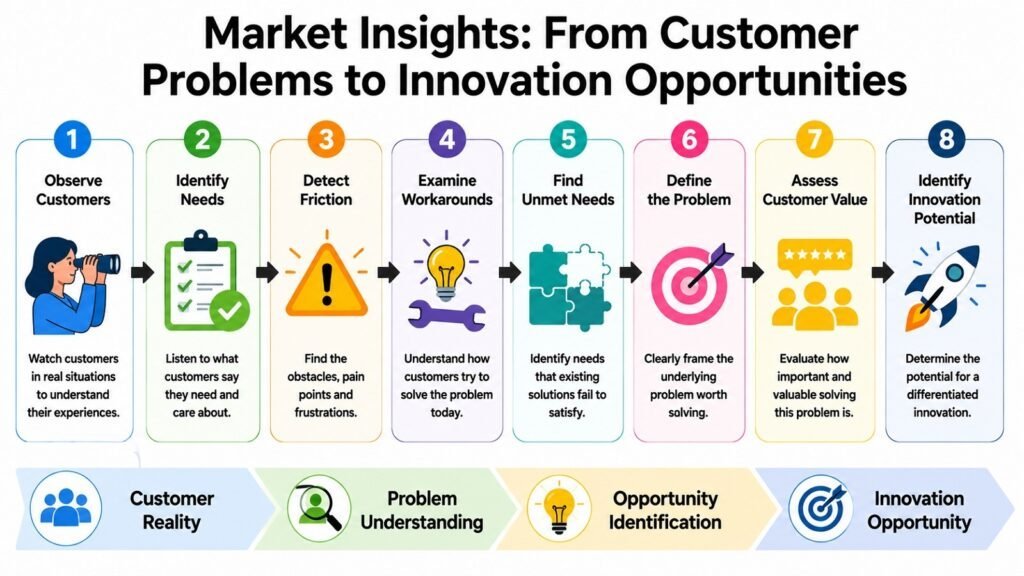
Understanding what customers genuinely need — not just what they say they want — is one of the most reliable sources of Market Insights for Innovation Strategy. Customers frequently describe needs in terms of current solutions rather than underlying goals, so recognizing the deeper need is what enables a response that can change the market.
Customer needs take several forms. Expressed needs can be stated directly. Latent needs exist but remain unarticulated, often because the customer has adapted to limitations they no longer notice. Pain points are friction within current experience. Workarounds are the informal solutions customers invent when existing products fall short — they confirm both that a real problem exists and that the customer is motivated enough to address it independently. Desired outcomes describe the results customers want, independent of any specific product.
Jobs-to-be-Done, developed through Clayton Christensen’s work, argues that customers hire products to accomplish a specific task — a reframing that directs attention toward the underlying job rather than features. Voice of the Customer research captures expressed needs systematically. Design Thinking encourages observation in the customer’s actual context rather than relying on reported data alone.
Procter and Gamble’s Swiffer demonstrates this logic. Ethnographic observation revealed that quick floor cleaning had no genuinely good solution — the insight was not that consumers wanted a better mop but that the job itself was unserved. A practical evaluation asks whether the problem affects enough customers, is painful enough to motivate spending, and whether existing solutions are genuinely inadequate.
Table 2: Market Insights — Types of Customer Needs and Their Innovation Implications
| Customer Need Type | Innovation Implication |
| Expressed needs | Indicates minimum requirements; meeting them is necessary but rarely a source of differentiation |
| Latent needs | Reveals unarticulated demand; addressing them can create entirely new product categories |
| Pain points | Signals friction in current experience; resolving them improves adoption and satisfaction |
| Workarounds | Confirms a real unmet problem; the workaround itself often hints at the required solution |
| Desired outcomes | Reorients innovation toward results rather than features; supports Jobs-to-be-Done analysis |
| Compromises | Reveals where customers accept an imperfect solution; creates opportunity for meaningful improvement |
| Non-consumption | Shows where customers avoid a product due to cost or complexity; signals an underserved market |
| Over-served needs | Indicates where solutions exceed requirements; creates space for simpler, lower-cost alternatives |
2. Market Insights Through Customer Behavior and Preferences
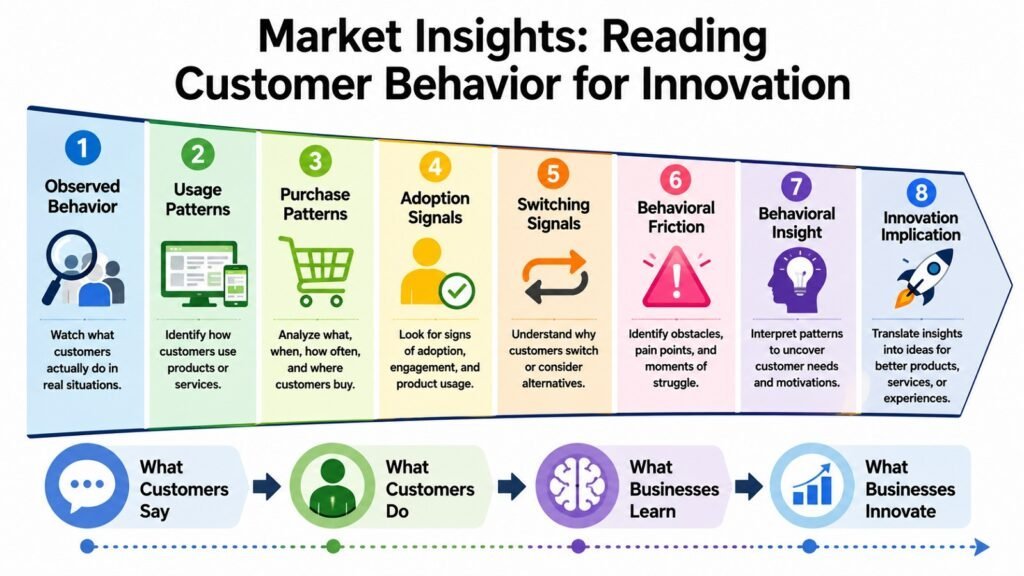
What customers do consistently reveals more than what they say they prefer. People evaluate choices differently when answering a survey and when actually spending money or committing time. Market Insights grounded in behavioral evidence account for this gap and tend to be more reliable inputs for Innovation Strategy.
Relevant behavioral signals include purchasing patterns, product usage habits, adoption and abandonment rates, switching behavior, and how customers adapt products for purposes they were not designed for. Digital environments have expanded access to behavioral evidence considerably — clickstream analysis, session recordings, and feature usage data allow organizations to observe customer actions at a granularity that was previously impractical.
Daniel Kahneman’s work on dual-process thinking helps explain why stated preferences and actual choices diverge: customers state what they value in a reflective mode but make real decisions faster and more situationally. Netflix has illustrated this publicly — viewing completion rates diverged from ratings data in ways that affected content investment decisions, because watching and rating are fundamentally different behaviors.
A practical framework for interpreting behavioral signals asks four questions: What are customers actually doing? What might explain that behavior? Where does friction appear and why does it persist? And what innovation could reduce that friction or amplify behavior that is already creating value?
Table 3: Market Insights — Customer Behavioral Signals and Innovation Implications
| Behavioral Signal | Innovation Implication |
| High abandonment at a specific product step | Indicates friction or unmet expectation at that point; redesign or simplification may be needed |
| Unexpected product use cases | Reveals unanticipated demand; may signal an adjacent market or a new positioning opportunity |
| Rapid adoption among a specific customer group | Points toward an underserved segment with high receptivity to further innovation |
| Frequent switching between competing products | Suggests no current solution is fully satisfactory; creates opportunity for differentiated value |
| Low feature usage despite high visibility | Indicates a mismatch between design assumptions and actual user needs or workflows |
| Sustained workaround behavior | Confirms an unmet need that current offerings do not resolve adequately |
| Declining repeat purchase rates | May signal eroding satisfaction, changing needs, or a superior competitive alternative emerging |
| High search volume with low conversion | Reveals unmet demand where available options fail to satisfy customer intent |
3. Market Insights Through Market Trends and Emerging Patterns
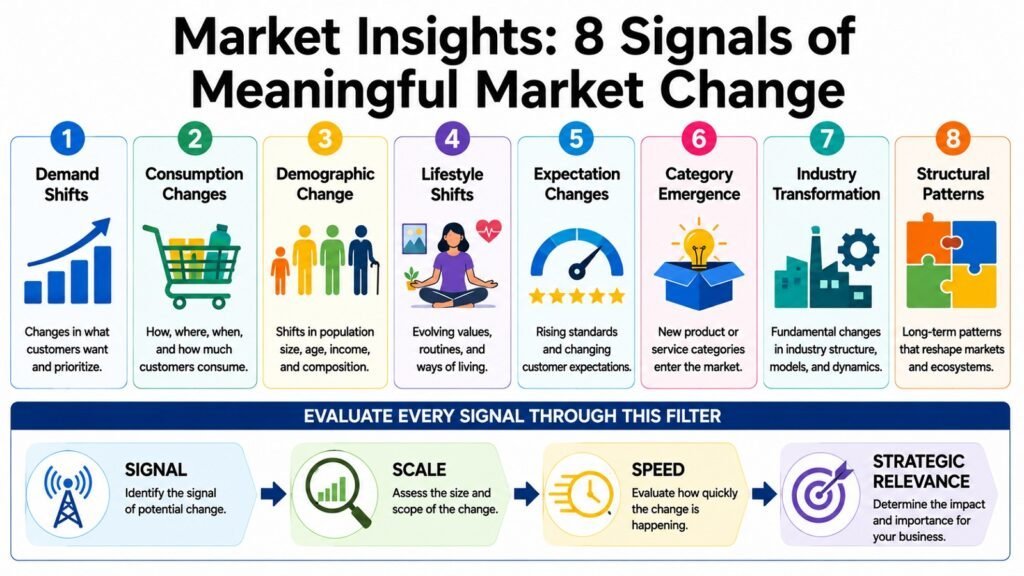
Not every shift in market behavior represents a meaningful trend. One of the most valuable contributions of Market Insights to Innovation Strategy is the ability to distinguish temporary fluctuations, passing fads, genuine trends, and structural shifts that reshape market conditions over time.
A fad attracts early attention but does not reflect a durable change in customer needs. A trend describes a sustained directional movement in behavior or demand. A structural shift represents a fundamental change in how a market is organized — the digitization of media and the rise of platform economies each redefined innovation priorities across industries. Confusing these categories leads to misallocated investment.
Everett Rogers’ diffusion of innovation research helps businesses assess where a trend sits in its adoption curve, since acting too early can be as costly as acting too late. Beyond Meat’s market entry was timed against accumulating evidence of changing consumer attitudes toward meat that appeared in foodservice data and ingredient procurement patterns before the trend attracted mainstream attention.
Practical trend evaluation examines scale, adoption speed, persistence across different conditions, the underlying drivers, and strategic implication — whether the trend creates a new opportunity, threatens existing business, or both. Trends that score clearly across all five are stronger candidates for influencing Innovation Strategy.
Table 4: Market Insights — Types of Market Trends and Their Innovation Implications
| Trend Type | Innovation Implication |
| Demographic shift | Alters which customer groups are growing; highlights where new needs and innovation opportunities may emerge |
| Lifestyle and values change | Shifts what customers prioritize; creates demand for products aligned with new expectations |
| Economic condition change | Affects affordability and willingness to spend; can open or close market segments for innovation |
| Technology adoption trend | Enables or normalizes new customer behaviors; creates conditions for platform or product innovation |
| Regulatory or policy shift | Imposes new requirements or removes barriers; can accelerate or constrain certain innovation directions |
| Industry structure change | Alters competitive dynamics and value chains; creates space for new entrants or business-model innovation |
| Environmental and sustainability trend | Shapes customer expectations and regulatory environment; influences product design and supply-chain decisions |
| Cross-industry convergence | Creates unexpected competitive threats and innovation opportunities from adjacent sectors |
4. Market Insights Through Competitive and Industry Intelligence
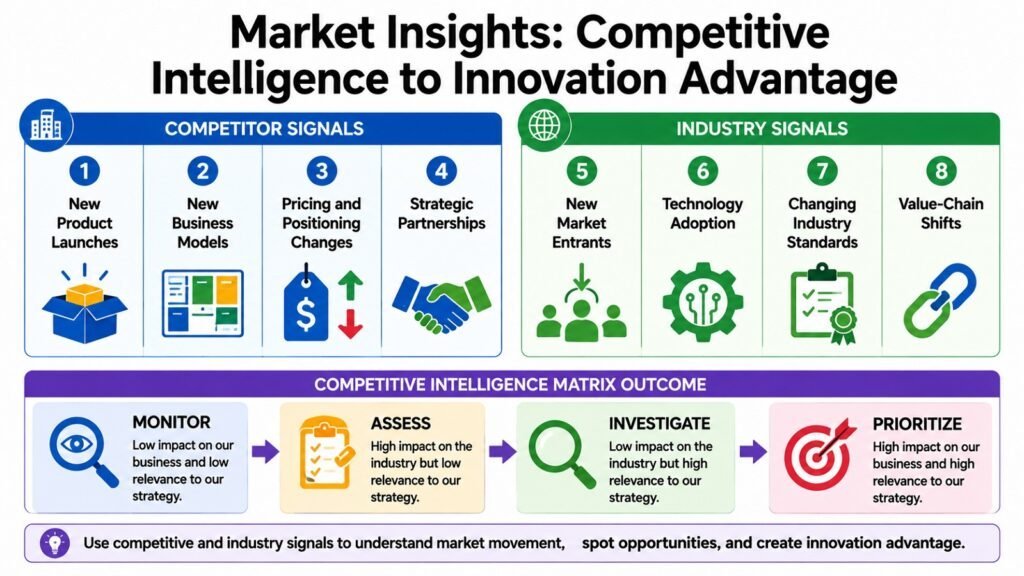
Market Insights extend beyond customers to include the competitive landscape and industry structure. Understanding what competitors are doing and what it reveals about where the market is heading is a distinct input for Innovation Strategy. The strategic value lies not in replicating what others do but in interpreting what competitive movements signal about evolving customer expectations and unaddressed needs.
Relevant sources include competitor product launches, pricing changes, business-model shifts, technology investments, partnerships, new entrants, and gaps in existing offerings. Porter’s Five Forces framework is useful for assessing structural competitive pressure, while the resource-based view, associated with Jay Barney, adds that sustainable differentiation comes from capabilities competitors find difficult to replicate.
Amazon Web Services illustrates how intelligence from adjacent industries can shape innovation direction. AWS emerged from Amazon’s recognition that its internal infrastructure capabilities represented a genuine market opportunity in enterprise IT — an industry where existing solutions were expensive and inflexible. Industry intelligence that crossed sector boundaries produced the insight that guided one of the most consequential business-model innovations of the past two decades.
Evaluating competitive signals productively asks four questions: How relevant is this development to our specific customers? What does it signal about shifting expectations? Does it expose a gap we are better positioned to address? And does it represent a durable market change or a short-term tactical move?
Table 5: Market Insights — Forms of Competitive Intelligence and What They Reveal
| Competitive Intelligence Form | What It Can Reveal for Innovation |
| Competitor product launches | Signals where competitors perceive unmet demand; reveals market validation for new categories |
| Pricing and positioning changes | Indicates shifts in competitive strategy; may reveal a move toward lower-cost or premium differentiation |
| Business-model innovation by competitors | Shows how value creation and capture are evolving; can signal where old models are becoming vulnerable |
| Competitor partnerships and acquisitions | Reveals capability gaps they are trying to fill; signals emerging competitive territory |
| New entrant strategies | Brings fresh assumptions that challenge industry conventions; often reveals underserved segments |
| Technology investments by industry players | Indicates where future competitive advantage may be built; highlights emerging capability requirements |
| Gaps in competitor offerings | Exposes customer needs that are inadequately served; creates differentiation opportunities |
| Industry standard formation | Signals where collective customer expectations are crystallizing; defines minimum requirements for participation |
5. Market Insights Through Technology and Market Disruption Signals
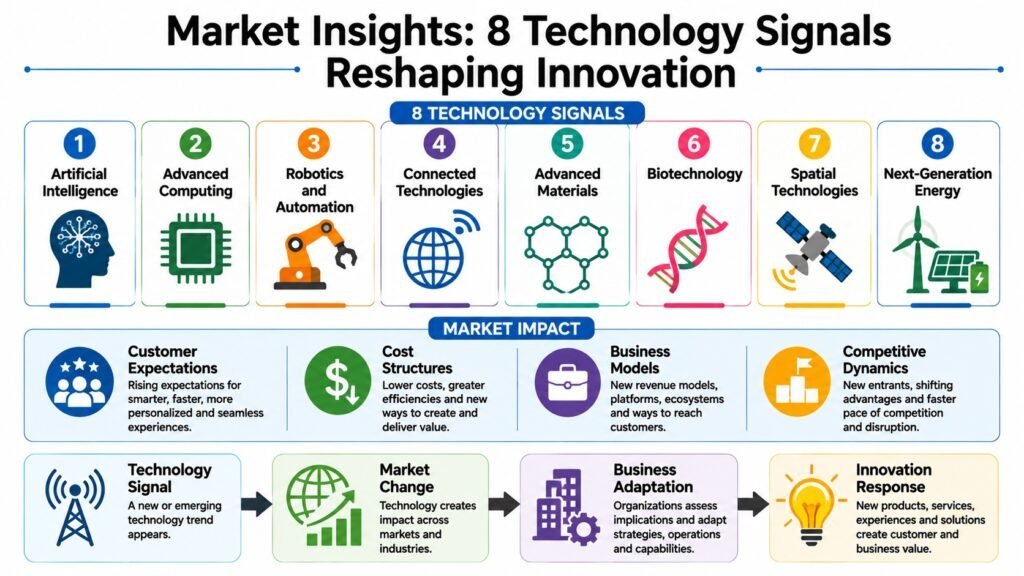
Technology generates some of the most consequential Market Insights available to Innovation Strategy, but only when businesses examine what a technology changes rather than merely what it does. The strategic question is whether it alters customer expectations, reduces costs in ways that open new markets, enables new business-model options, or makes existing offerings structurally vulnerable.
Smartphones illustrate this well. Their market significance lay not in the device itself but in what it changed: internet access became ambient rather than stationary, creating location-aware computing at scale and transforming how people communicate, shop, pay, and consume media. Businesses that examined only the hardware missed the disruption; those that examined what it changed about customer behavior were better positioned to innovate.
Christensen’s disruptive innovation framework describes how technologies initially inferior on established performance dimensions can still displace incumbents by serving overlooked segments more affordably. This pattern has appeared across disk storage, personal computing, and digital photography. Artificial intelligence presents a current example: in medical imaging, legal document analysis, and software development, AI tools are already changing cost structures and redefining competitive differentiation.
Evaluating technology signals requires examining market relevance, adoption trajectory, customer impact, competitive consequence, and what strategic response the organization could realistically execute — moving from signal to innovation direction rather than simply tracking the technology itself.
Table 6: Market Insights — Technology and Disruption Signals and Their Innovation Implications
| Technology or Disruption Signal | Market or Innovation Implication |
| Rapid cost decline in a key technology | Enables previously uneconomic offerings; can open mass-market segments to new entrants |
| Widespread smartphone penetration | Normalizes mobile-first customer behavior; creates platform and app-based innovation opportunities |
| AI adoption in professional services | Changes cost and quality benchmarks; requires rethinking which tasks create differentiated value |
| Cloud computing infrastructure expansion | Reduces capital barriers to digital product development; enables new competitors and business models |
| Digital platform growth | Shifts power toward platform owners; creates both threat and opportunity for adjacent businesses |
| Automation of routine production tasks | Alters cost structures and workforce requirements; creates space for higher-value service innovation |
| Emergence of new distribution channels | Changes how customers access and evaluate offerings; can obsolete established go-to-market models |
| Open-source technology proliferation | Reduces proprietary advantage in some areas; shifts competitive differentiation toward application and service |
6. Market Insights Through Market Segments and Emerging Customer Groups
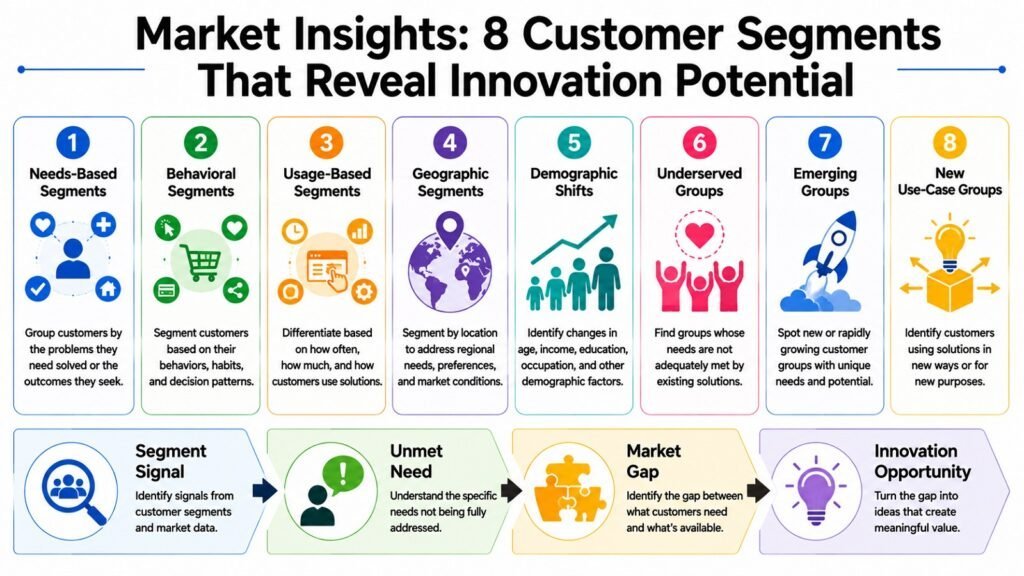
Not all customers experience a market the same way, and some of the most valuable Market Insights come from examining how different groups have different needs and levels of satisfaction with current offerings. Innovation Strategy that treats a market as undifferentiated often misses the specific opportunities that segment-level analysis can reveal.
Segmentation can be approached through demographics, behavior, needs, or usage context. Combining multiple perspectives typically produces more actionable Market Insights than any single approach, because different lenses reveal different aspects of why customers are or are not well served by what the market currently offers.
M-Pesa, launched in Kenya by Safaricom in 2007, succeeded because it was built specifically around the needs and constraints of customers without reliable access to formal banking, rather than adapted from a product designed elsewhere. IKEA similarly adjusts product lines and store formats to reflect the housing conditions and economic circumstances of each market it enters — both examples of segment-level Market Insights driving concrete innovation decisions.
A segment should not automatically become an innovation priority simply because it is large or growing. Evaluation should include need intensity, accessibility, growth potential, and strategic fit with the organization’s capabilities. High need intensity combined with strong accessibility can justify investment even at modest scale, if the segment connects to the company’s core strengths.
Table 7: Market Insights — Customer Segment Types and Their Innovation Implications
| Segment Type | Innovation Implication |
| Underserved demographic group | Indicates unmet needs with limited competitive attention; creates space for targeted innovation |
| Emerging market customers | Often brings mobile-first or cash-constrained needs that challenge product and service assumptions |
| Overserved mainstream customers | Signals opportunity for simpler, more affordable alternatives that strip away unnecessary complexity |
| Users in adjacent or non-obvious contexts | Reveals how a product is already being used beyond its intended purpose |
| Early adopter communities | Provides insight into where mainstream demand may be developing; useful for product refinement |
| Customers with workflow or integration constraints | Highlights friction that a better-integrated or specialized solution could eliminate |
| Rapidly growing demographic cohort | Creates long-term demand for solutions designed around their specific preferences and expectations |
| Customers currently excluded by price or complexity | Represents non-consumption opportunity; often addressed through simplification or new delivery models |
7. Market Insights Through Weak Signals and Future Market Change
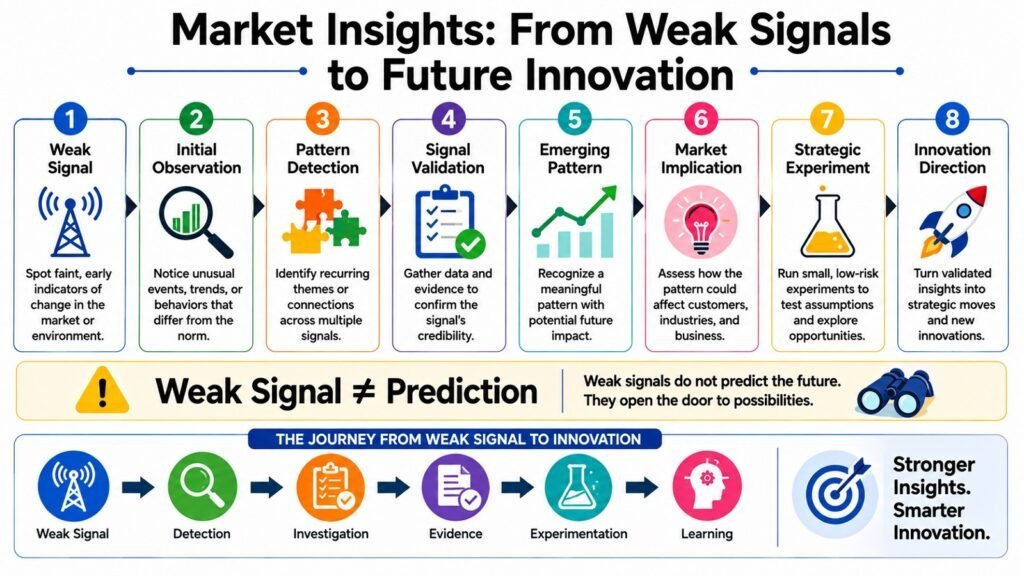
The most consequential Market Insights are often found before they become obvious. By the time a trend is widely recognized, competitive intensity is rising and the window for first-mover advantage is narrowing. Weak signals — early indicators pointing toward significant future change — allow businesses to investigate possibilities before they crystallize into established trends.
A weak signal is a fragment of evidence suggesting something may be changing, where that evidence is not yet sufficient to confirm a clear direction. Sources include unusual behavior among niche communities, early technology adoption in non-obvious sectors, experimental business models in adjacent markets, regulatory discussions before legislation is enacted, and academic findings beginning to appear in industry publications.
The internet’s early development offers a well-documented example. In the early 1990s, signals of what networked computing might become were visible in academic institutions and a small number of businesses. Companies that examined those signals seriously — including Amazon — positioned themselves ahead of what became the most structurally significant technology shift of the era.
A useful evaluation considers five factors: novelty, whether the signal represents something genuinely new; relevance to the business’s market; persistence across contexts or over time; potential impact if the signal develops; and supporting evidence from additional observations. Signals scoring well across several factors warrant investigation and, in some cases, early experimentation.
Table 8: Market Insights — Weak Signal Categories and Future Innovation Implications
| Weak Signal Category | Potential Future Market or Innovation Implication |
| Niche community behavior change | May indicate emerging needs or preferences that will reach mainstream adoption over time |
| Early technology adoption in non-obvious sectors | Can signal future cross-industry applications or business-model disruption |
| Grassroots or DIY product modifications | Reveals unmet needs not yet addressed by commercial offerings; often precedes market demand |
| Regulatory discussion and policy exploration | Indicates where market conditions may change; creates early-mover opportunities for compliance-ready innovation |
| Emerging academic or research findings | Points toward technologies or approaches that may reach practical application within a strategic horizon |
| Unusual partnership or investment patterns | Signals where established players believe future value will be created or disrupted |
| Changing values among a younger demographic cohort | May reshape long-term demand and the expectations applied to existing product categories |
| New business-model experiments in adjacent markets | Can indicate customer willingness to engage with fundamentally different value propositions |
8. Market Insights Through Integration and Innovation Direction
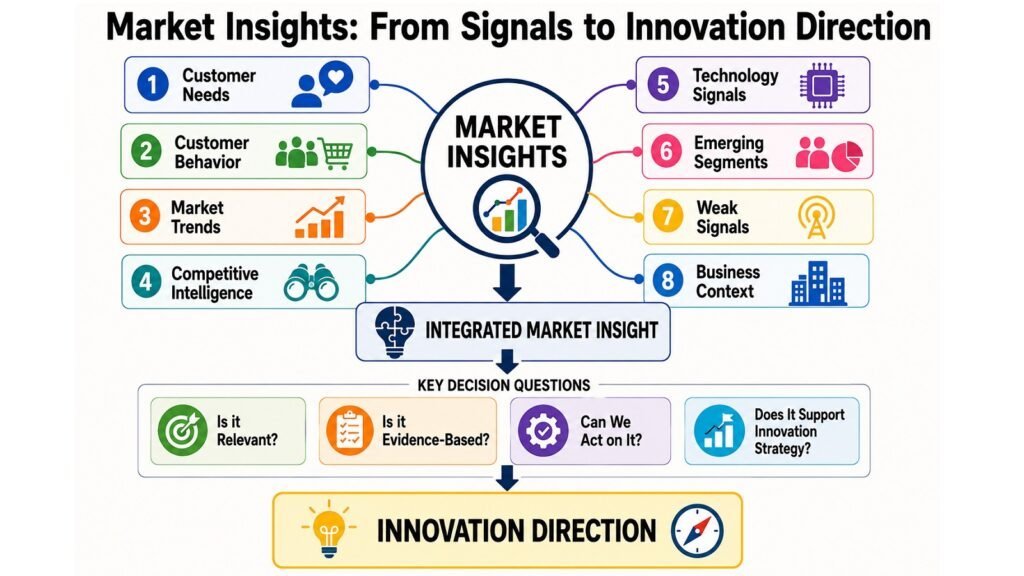
Collecting Market Insights across seven dimensions creates raw material for Innovation Strategy, but raw material alone does not drive decisions. Organizations that gather customer need data, behavioral observations, trend analysis, competitive intelligence, technology signals, segment information, and weak signals in separate silos risk making innovation decisions informed by parts of the picture while missing the whole.
The transition from information to insight requires interpretation — asking what a set of observations means in combination and what conclusion an informed analyst would draw. The transition from insight to action requires prioritization, since not every valid insight can generate an innovation initiative and not all insights carry equal strategic weight.
Dynamic capabilities, associated with David Teece, describe the ability to sense environmental change, seize opportunities, and reconfigure resources in response. Absorptive capacity, from Cohen and Levinthal, describes the ability to recognize the value of new external knowledge, assimilate it, and apply it productively. Both concepts point to the same requirement: organizations need processes that make Market Insights actionable rather than simply archived. Innovation portfolio management adds that integrated insights typically reveal opportunities across different time horizons that should be managed as a balanced portfolio.
A practical Insight-to-Action approach evaluates each insight on five criteria: Is it credible? Is it relevant to the business’s specific market position? Is it strategically significant enough to justify investment? Is it actionable given current capabilities? And could it meaningfully influence innovation vision and decisions now? When multiple dimensions converge — a customer need, a behavioral shift, a competitive gap, and a technology enabler all pointing in the same direction — that convergence marks precisely where Innovation Strategy transitions from market understanding to opportunity identification.
Table 9: Market Insights — Stages in Moving from Market Insights to Innovation Direction
| Stage | Action and Purpose |
| Signal collection | Gather inputs from customer, behavioral, competitive, trend, technology, segment, and weak-signal sources |
| Pattern identification | Look across sources for recurring themes, reinforcing signals, and consistent gaps in current market offerings |
| Interpretation | Assign meaning to the combined evidence; move from what happened to why it matters for innovation decisions |
| Credibility assessment | Evaluate the strength of evidence supporting each potential insight before treating it as reliable input |
| Relevance filtering | Determine which insights connect to the business’s specific market position, customers, and capabilities |
| Prioritization | Rank insights by strategic significance, actionability, and potential impact on innovation direction |
| Opportunity framing | Convert the prioritized insight into a defined opportunity statement that can guide further exploration |
| Portfolio integration | Allocate exploration and development resources across insight-driven opportunities at different time horizons |
Conclusion: Market Insights — Turning Market Understanding into Innovation
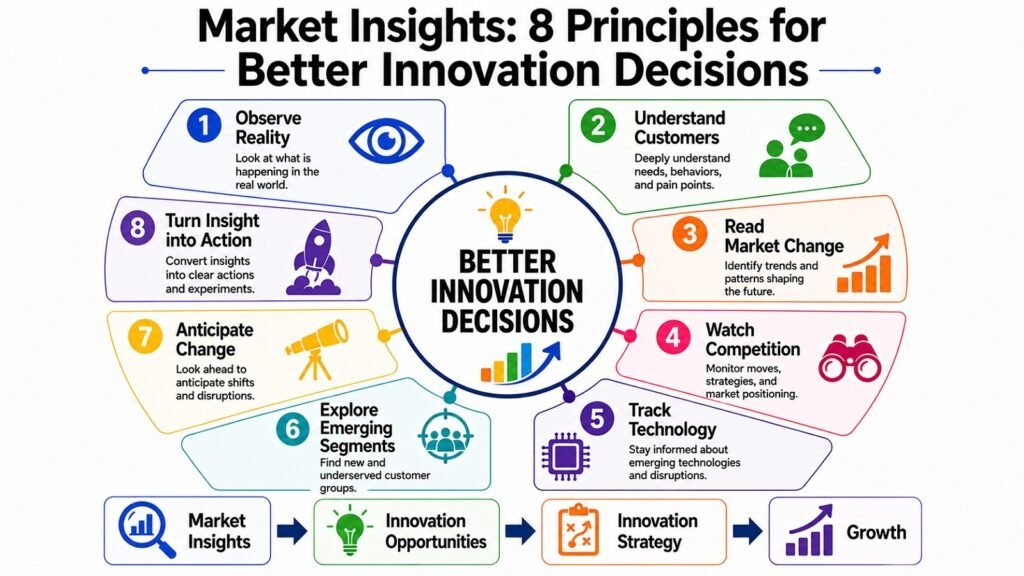
Market Insights are not the output of a research exercise. They are the connection between what is happening in a market and what a business decides to do about it through innovation. When that connection is weak, even well-resourced organizations innovate in directions their markets do not reward.
The distinction between data, information, insight, opportunity, and innovation clarifies where strategic value accumulates. Data is abundant. Information organizes data into patterns. Market Insights interpret those patterns and explain their significance. Opportunities emerge from insights pointing toward unmet needs or structural changes where value can be created. Innovation converts those opportunities into products, services, or business models that change competitive conditions.
The eight dimensions examined here — customer needs, customer behavior, market trends, competitive intelligence, technology signals, emerging segments, weak signals, and integration — are interconnected lenses. A single lens may produce a useful partial insight. Multiple lenses focused on the same market consistently produce insights that are more reliable, more specific, and more strategically useful than any individual analysis could achieve alone.
Market Insights should be an organizational capability rather than an occasional project. Businesses that build systematic processes for gathering, interpreting, and acting on market evidence consistently outperform those that rely on periodic research or reactive responses to visible change. That sustained discipline separates organizations that anticipate market change from those that follow it — and it is the bridge that connects market understanding to the next stage of Innovation Strategy: identifying and prioritizing Innovation Opportunities.
Table 10: Market Insights — Eight Key Principles and Their Innovation Strategy Implications
| Market Insights Principle | Innovation Strategy Implication |
| Interpret evidence, not just collect it | Insights require analysis of meaning, not merely accumulation of data or research reports |
| Address latent and unmet needs, not only expressed ones | The most significant innovation opportunities often lie in problems customers can not yet articulate |
| Observe behavior alongside stated preferences | Behavioral evidence reveals hidden demand and friction that preference surveys consistently underestimate |
| Distinguish trends from fads and structural shifts | Matching innovation investment to the right category of market change reduces strategic risk |
| Use competitive intelligence to find gaps, not copy leaders | The strategic value of competitor observation lies in understanding what customer needs remain unresolved |
| Evaluate technology signals by market impact, not novelty | A technology matters for innovation when it changes customer expectations, costs, or competitive dynamics |
| Monitor weak signals before they become obvious trends | Early investigation and experimentation ahead of mainstream change creates durable competitive positioning |
| Integrate insights across dimensions before acting | Convergence of multiple market signals produces more reliable and strategically significant innovation direction |