
Table of Contents
Introduction — Emotional Intelligence: A Powerful Business Essential
Every working day involves more than strategy, data, or technical skill. A manager delivers difficult feedback and watches the team disengage. A negotiation stalls because both parties feel unheard. A capable leader makes a poor call under pressure — not because the analysis was wrong, but because anxiety shaped the judgment. Emotions are not separate from business life. They are part of it.
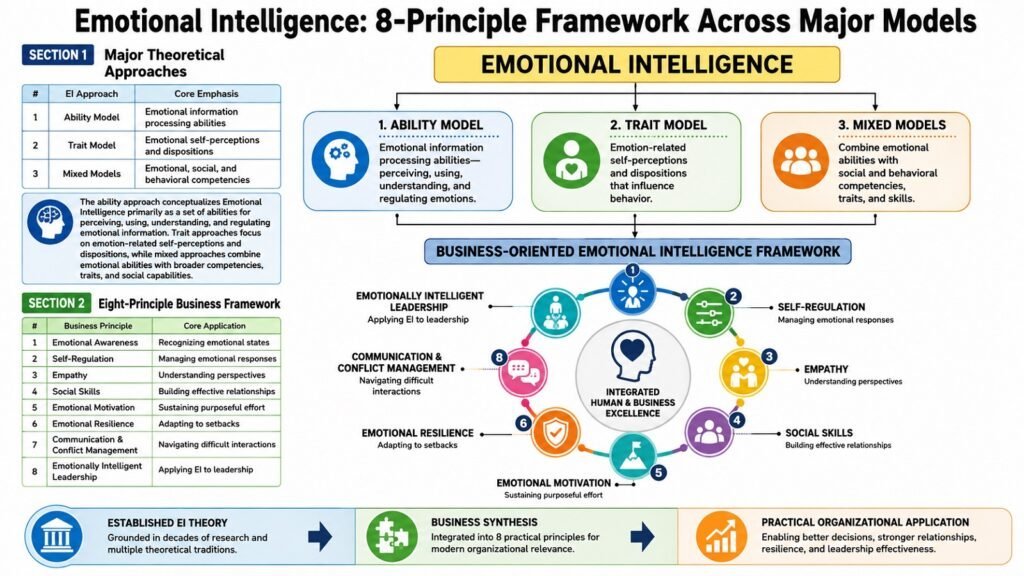
The central question this article addresses is how people can recognize, understand, regulate, communicate, and respond to emotions in ways that support effective individual and organizational performance. Emotional Intelligence — abbreviated as EI or EQ — refers to the capacity to perceive, understand, manage, and use emotional information to guide effective thinking and action. As an important Business Essential, Emotional Intelligence helps organizations strengthen how people think, interact, make decisions, manage challenges, and lead others.
The concept of EI is not a single unified model. Peter Salovey and John Mayer developed an ability-based framework treating EI as a cognitive capacity. Daniel Goleman extended it into organizational competencies. Reuven Bar-On proposed a broader emotional-social model. Each tradition has generated meaningful research and practical insights.
This article combines established theory, research evidence, practical applications, and critical perspectives across these traditions. It presents eight principles as a business-oriented framework: Emotional Awareness, Self-Regulation, Empathy, Social Skills, Emotional Motivation, Emotional Resilience, Emotional Communication and Conflict Management, and Emotionally Intelligent Leadership. The framework is intended as a foundational reference, not as a list of workplace tips.
Table 1: Emotional Intelligence — Eight Principles and Their Role in the Framework
| Emotional Intelligence Principles | Role in the Emotional Intelligence Framework |
| Emotional Awareness | Recognizing one’s own emotional states as the foundation for all other EI capabilities |
| Self-Regulation | Managing emotional responses constructively so awareness leads to deliberate behavior |
| Empathy | Understanding another person’s emotional state and perspective to support productive relationships |
| Social Skills | Translating emotional understanding into effective interpersonal behavior and collaboration |
| Emotional Motivation | Using emotional awareness to sustain purposeful commitment toward meaningful goals |
| Emotional Resilience | Responding adaptively to setbacks and pressure while maintaining the capacity to function |
| Emotional Communication & Conflict Management | Applying EI during difficult conversations, feedback, and workplace conflict |
| Emotionally Intelligent Leadership | Integrating all eight principles into leadership behavior that supports people and decisions |
1. Emotional Intelligence and Emotional Awareness
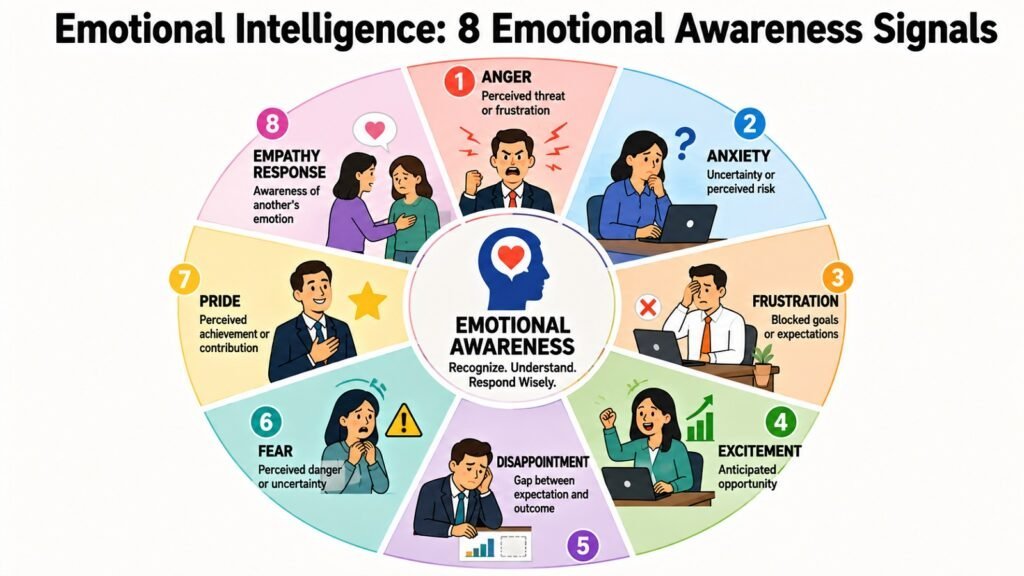
Emotional Awareness is the starting point of this framework. Without it, no other principle can operate effectively. You cannot regulate emotions you have not noticed, empathize with others while blind to your own reactions, or make deliberate decisions when emotional signals are shaping your thinking undetected.
In established EI theory, this capability aligns with the self-awareness dimension. Salovey and Mayer describe it as the ability to perceive and identify emotions accurately in oneself and others. Goleman places self-awareness at the base of his competency model, defining it as recognizing how one’s emotions affect others. This article uses Emotional Awareness as a business-oriented expression of that concept: recognizing, identifying, and understanding one’s own emotional states, their triggers, and their influence on thoughts, decisions, and professional interactions.
Research supports the relevance of this capability. A study in the Academy of Management Journal found that managers with higher self-awareness made more effective people-management decisions and received stronger peer evaluations. When people understand what they are feeling and why, they can choose responses rather than simply react. Consider a product manager receiving sharp criticism in a leadership meeting. Awareness allows her to recognize the defensive reaction as separate from the feedback and respond more deliberately.
A practical tool is the STOP method: Stop before responding, Take a breath, Observe the emotion — name it and identify its trigger — then Proceed with a chosen rather than automatic response. Awareness does have limits: people regularly misidentify their own emotions. Its value lies in what it enables — the Self-Regulation examined next.
Table 2: Emotional Intelligence — Eight Emotional Signals and Professional Considerations
| Emotional Signal or Situation | Professional Consideration |
| Defensive reaction to feedback | Separate emotional discomfort from the factual content of the criticism before responding |
| Irritability before a key presentation | Recognize performance anxiety as a signal to prepare rather than a reason to avoid |
| Discomfort during a difficult conversation | Identify whether discomfort reflects a genuine concern or simply conflict avoidance |
| Enthusiasm driving a risky decision | Check whether positive emotion is amplifying optimism beyond what the evidence supports |
| Fatigue affecting communication quality | Acknowledge reduced capacity and adjust timing or expectations accordingly |
| Anxiety in response to organizational change | Distinguish uncertainty about the future from a reasoned assessment of actual risk |
| Frustration with a colleague’s performance | Assess whether expectations have been clearly communicated before attributing failure |
| Reluctance to raise a concern with a manager | Consider whether avoidance is driven by discomfort rather than a realistic appraisal of consequences |
2. Emotional Intelligence and Self-Regulation
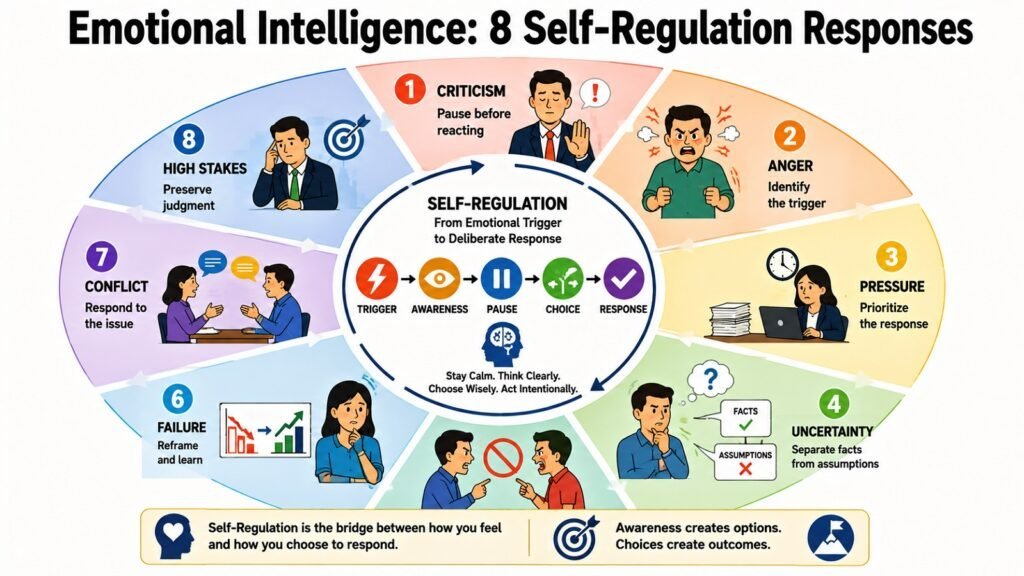
Emotional Awareness creates the opportunity for a better response. Self-Regulation determines whether that opportunity is taken. It is the ability to manage emotional responses constructively after recognizing them — not by suppressing what is felt, but by choosing how to respond based on what the situation requires rather than what the emotion demands.
This distinction matters. Research by James Gross at Stanford University shows that suppression — pushing an emotion down without acknowledging it — is associated with increased physiological stress, reduced cognitive performance, and poorer interpersonal outcomes. Effective self-regulation is not about appearing emotionless. It involves acknowledging emotional information, understanding what it signals, and selecting a contextually appropriate response. Gross’s research on cognitive reappraisal — changing how you interpret an emotionally significant event — demonstrates that reframing can reduce emotional intensity without suppression’s negative consequences.
Practical mechanisms include pausing before responding, naming the emotion to reduce its automatic pull, and reconsidering how a situation is interpreted. Consider a sales manager whose team loses a major client. Immediate sharp criticism relieves frustration momentarily but damages morale and blocks the honest conversation needed to understand what went wrong. A regulated response — brief reflection, then a review anchored in accountability and curiosity — produces better outcomes.
A practical framework is the RULER pause: Recognize the emotion, Understand its trigger, Label it specifically, Express it constructively, and Regulate before acting. Self-regulation does not require professionals to appear permanently composed. The timely, intentional expression of frustration or concern is itself a credible professional behavior — when it is chosen rather than reflexive.
Table 3: Emotional Intelligence — Eight Workplace Triggers and Constructive Response Approaches
| Workplace Emotional Trigger | Constructive Response Approach |
| Unexpected public criticism | Pause, acknowledge the comment, and defer a detailed response until emotions settle |
| A project plan rejected by leadership | Reframe as an opportunity to gather clearer requirements before proceeding |
| Conflict with a peer on a shared deliverable | Separate the interpersonal frustration from the substantive issue before the next conversation |
| Feeling overlooked for a promotion | Identify what information is actually needed before interpreting the outcome as a reflection of worth |
| A team member’s repeated underperformance | Address the pattern early and directly rather than allowing frustration to accumulate unspoken |
| Sudden change in project scope or priorities | Acknowledge the disruption, then redirect attention toward what remains within control |
| Pressure from a stakeholder near a deadline | Respond with a concrete status update rather than a defensive or dismissive reply |
| Receiving a lower performance rating than expected | Request a follow-up conversation to understand evaluation criteria and expectations clearly |
3. Emotional Intelligence and Empathy
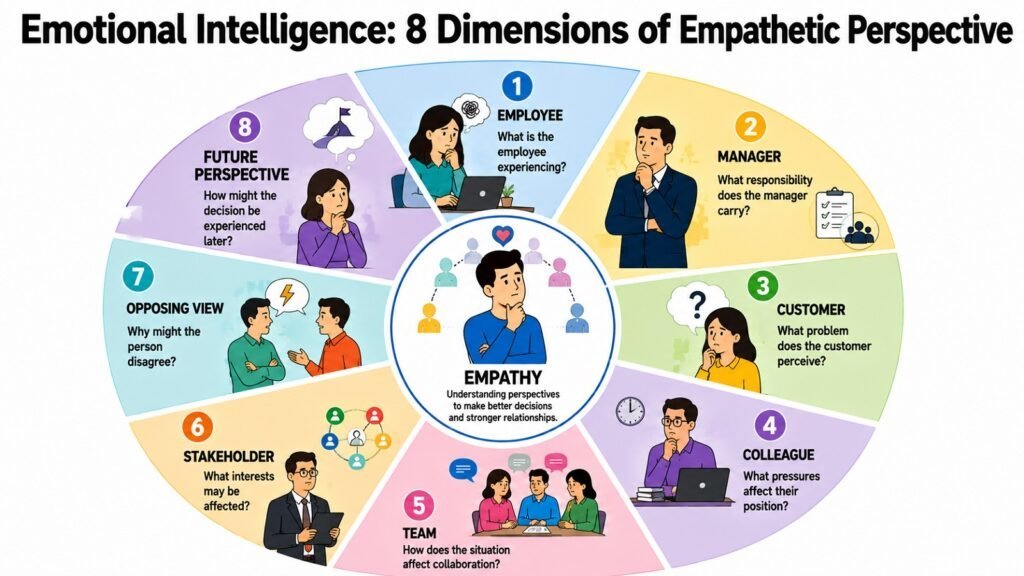
Empathy is the interpersonal dimension of Emotional Intelligence that bridges self-understanding and effective relationships. Commonly mischaracterized as a fixed personality trait, it is more accurately understood as a learnable set of cognitive and emotional skills that allow a person to recognize, understand, and respond to another person’s emotional state and perspective.
Empathy is not sympathy, agreement, or unconditional approval. Understanding why a colleague feels frustrated does not mean accepting every judgment they make. Researchers distinguish cognitive empathy — intellectually understanding another person’s perspective — from affective empathy, which involves resonating with their emotional experience. In professional settings, cognitive empathy is particularly relevant to leadership, negotiation, and communication because it enables understanding without the risk of emotional overload.
The organizational research is meaningful. Businessolver’s annual Workplace Empathy Monitor consistently shows that employees whose managers demonstrate empathy report higher engagement, greater loyalty, and stronger performance. A meta-analysis in the Journal of Applied Psychology found that leader empathy was positively associated with follower performance and well-being. The underlying mechanism involves trust: when people feel genuinely understood, they communicate more openly, take constructive risks, and invest more fully in the working relationship.
Consider a missed deadline. The leader sees a failure of effort; the team member experienced unclear requirements and insufficient resources. Both views can be simultaneously accurate. Empathy means understanding why the other perspective exists before responding — not accepting every explanation uncritically. A leader who asks about the experience first is more likely to uncover actionable information. Assuming you understand without checking is its own error.
Table 4: Emotional Intelligence — Eight Workplace Situations and Perspective-Taking Considerations
| Workplace Situation | Perspective or Human Consideration to Recognize |
| Employee missing a deadline | Consider whether workload, resource gaps, or unclear expectations contributed before addressing compliance |
| Colleague reacting defensively to feedback | Recognize that past criticism or low psychological safety may be shaping the current response |
| Client who repeatedly escalates issues | Understand whether earlier experiences with the organization have established a pattern of distrust |
| Team member disengaged during meetings | Consider whether the person feels excluded from decisions or unclear about their contribution |
| A peer who resists a proposed change | Identify whether the resistance reflects a legitimate concern that has not been addressed |
| Employee who underdelivers after a promotion | Recognize the adjustment challenges that commonly accompany new roles and higher expectations |
| A manager who micromanages closely | Consider whether the behavior reflects pressure from above rather than a deliberate style choice |
| A customer expressing strong frustration | Understand that the response may reflect cumulative experience, not only the immediate issue |
4. Emotional Intelligence and Social Skills
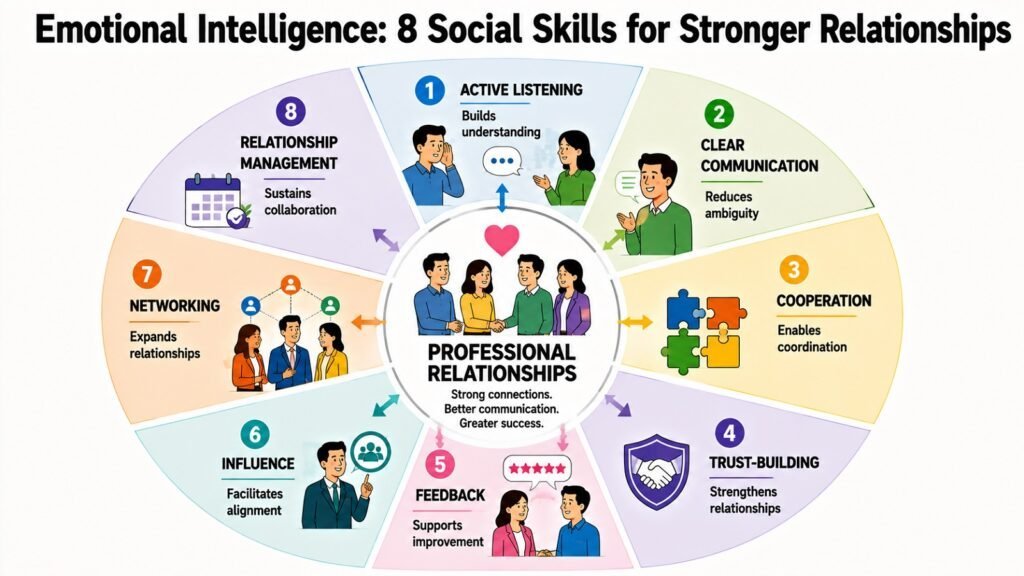
Social Skills are the practical expression of Emotional Intelligence in interpersonal behavior. Emotional Awareness, Self-Regulation, and Empathy provide significant internal capability, but that capability only becomes organizationally valuable when it translates into how people communicate, collaborate, and build relationships. Social skills are the bridge between internal understanding and external impact.
In Goleman’s EI framework, the social skills dimension encompasses relationship management, influence, conflict management, teamwork, and communication. The common thread is adapting effectively to the actual dynamics of a given conversation or group rather than following a fixed script. Research consistently identifies interpersonal effectiveness as one of the strongest predictors of career advancement and leadership success, independent of technical competence.
Active listening is among the most consequential social skills in professional settings. Research by Carl Rogers and Richard Farson established that listening fully — attending to the speaker, reflecting understanding, and withholding premature judgment — strengthens relationships, reduces defensiveness, and creates conditions for honest information sharing. Feedback delivered privately, with a clear explanation of what needs to change and an offer of support, is far more likely to be heard constructively than the same words spoken without context after a tense meeting.
Developing social skills requires deliberate practice: seeking feedback on communication style, observing how approaches affect others, and adapting. A critical ethical boundary separates effective social skill from manipulation. Emotional Intelligence should enable authentic, respectful influence — using genuine understanding to communicate effectively — not exploit emotional knowledge to mislead or control. Influence that serves legitimate organizational goals is a strength; manipulation undermines the trust that relationships depend on.
Table 5: Emotional Intelligence — Eight Social Behaviors and Their Relationship-Building Purpose
| Social Behavior | Relationship-Building Purpose |
| Active listening without interruption | Signals respect and creates the conditions for honest, open communication |
| Naming what you observed before drawing conclusions | Reduces misunderstanding and shows the other person’s experience has been considered |
| Checking in after a difficult meeting | Maintains relational trust and demonstrates concern beyond the immediate task |
| Asking clarifying questions before responding to criticism | Reduces defensiveness and increases the likelihood of a constructive exchange |
| Acknowledging a contribution publicly and specifically | Reinforces behaviors that matter and strengthens ongoing engagement |
| Adapting communication style to the individual | Increases the likelihood the message is received as intended rather than merely as phrased |
| Expressing disagreement while affirming the relationship | Separates the substantive difference from the personal dynamic to reduce escalation |
| Following through on a committed action | Builds credibility and demonstrates that commitments are taken seriously |
5. Emotional Intelligence and Emotional Motivation
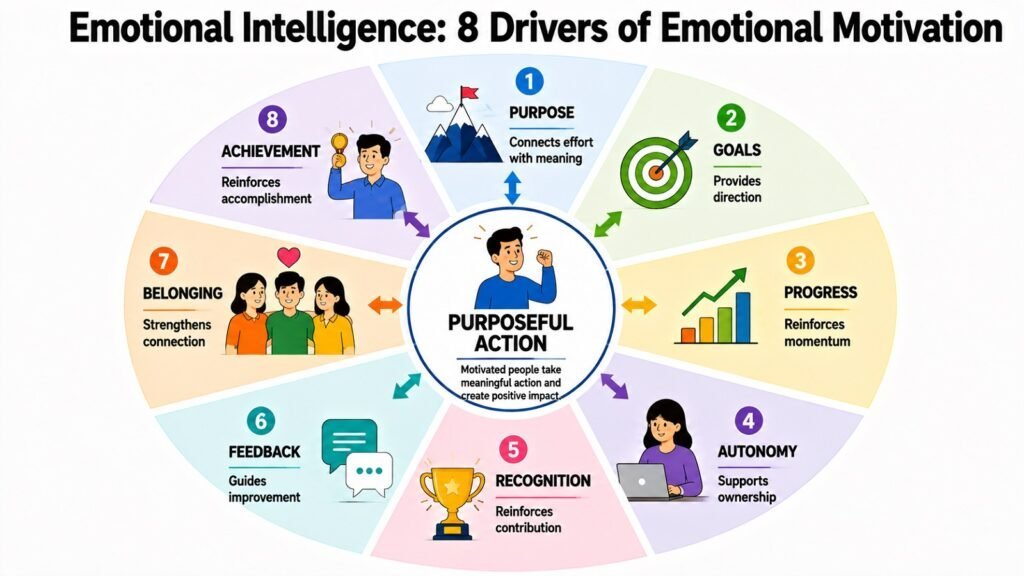
Motivation is not simply willpower or positive thinking. Edward Deci and Richard Ryan’s Self-Determination Theory demonstrates that intrinsic motivation — driven by interest, meaning, and a sense of competence and autonomy — produces more sustained and adaptive performance than motivation driven by external rewards or pressure alone. Emotional Motivation, within this EI framework, refers to how emotional awareness and understanding can support purposeful, committed engagement with meaningful goals.
Emotionally intelligent professionals are better positioned to recognize when they are disengaging, distinguish whether it reflects genuine misalignment or a temporary emotional state, and respond in ways that reconnect effort with purpose. Teresa Amabile’s research at Harvard Business School on the progress principle found that even incremental forward movement is the single most significant factor in maintaining positive emotion and motivation during complex, extended work.
Consider a product development team experiencing months of delays and shifting requirements. A manager who dismisses the team’s frustration with generic encouragement is unlikely to restore engagement. One who acknowledges the difficulty, names specific recent progress, and removes concrete obstacles is responding with both emotional intelligence and practical effectiveness. Forced positivity often deepens disengagement.
Organizational conditions shape motivation as much as individual emotional capability. Emotional Intelligence does not allow people to override structural problems through attitude alone. What it can do is help navigate the emotional dimensions of sustained effort — frustration, doubt, temporary disengagement — more constructively. That capacity connects directly to Emotional Resilience, examined in the following section.
Table 6: Emotional Intelligence — Eight Motivational Challenges and Emotionally Intelligent Responses
| Motivational Challenge | Emotionally Intelligent Consideration or Response |
| Feeling disconnected from a project’s purpose | Reconnect to the broader goal the work serves rather than focusing only on immediate tasks |
| Repeated setbacks on a difficult objective | Treat each setback as information about what to adjust rather than evidence of inability |
| Low energy during a long project cycle | Identify smaller milestones to mark progress and restore a sense of forward movement |
| Unfavorable comparison of progress to peers | Redirect attention from social comparison toward individual development and the work itself |
| Losing interest after initial enthusiasm fades | Distinguish temporary motivational fluctuation from a deeper signal of genuine misalignment |
| Working without visible feedback or acknowledgment | Seek specific feedback actively rather than waiting for unsolicited validation |
| Feeling overwhelmed by a large or complex goal | Break the objective into achievable steps and focus on what is actionable in the current period |
| Receiving recognition for effort rather than results | Acknowledge the value of recognition while using it to sustain continued effort toward the outcome |
6. Emotional Intelligence and Emotional Resilience
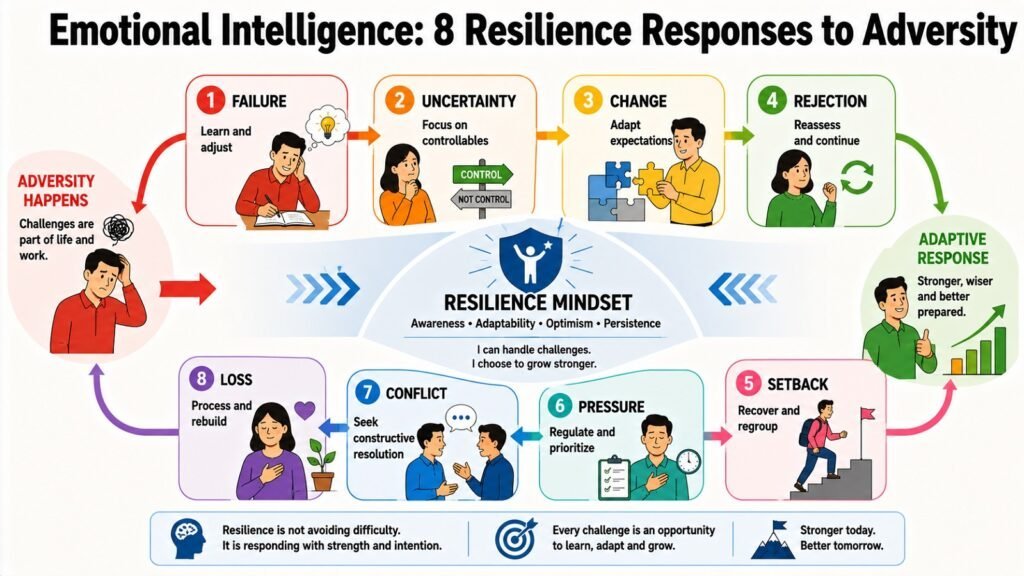
In psychological research, resilience refers to positive adaptation in the face of adversity — the capacity to respond constructively to setbacks, pressure, uncertainty, and change while maintaining the ability to function. It is not the absence of distress. Resilient people still experience difficulty; what distinguishes them is how they process and respond to it.
Emotional Intelligence contributes to resilience through awareness and self-regulation. When people can recognize what they are experiencing during a difficult period, name it accurately, and manage their responses rather than becoming overwhelmed or avoidant, they are better placed to engage constructively with the challenge. Ann Masten’s research at the University of Minnesota identified adaptive coping, realistic appraisal, and social support as core resilience components — all connected to emotional and interpersonal capability.
An important distinction applies. Emotional resilience is not the same as emotional suppression, excessive endurance, or tolerance of unhealthy workplace conditions. Organizations that celebrate resilience without addressing excessive workloads, unclear expectations, or poor management practices are asking individuals to absorb systemic problems rather than solving them. A senior analyst who loses a competitive bid faces disappointment, uncertainty, and professional self-doubt. An emotionally resilient response means acknowledging the loss honestly, reviewing what can actually be learned, and re-engaging with what comes next. A practical reflection tool is the LEARN framework: Loss acknowledged, Emotions processed, Analysis of lessons, Recovery planning, and Next focus identified.
Table 7: Emotional Intelligence — Eight Workplace Challenges and Adaptive Resilience Considerations
| Workplace Challenge | Adaptive Resilience Consideration |
| Losing a major client or contract | Distinguish what can be learned from the outcome and what falls outside individual control |
| Being passed over for a leadership role | Seek specific, actionable feedback before interpreting the outcome as a reflection of capability |
| Experiencing a public professional setback | Acknowledge the experience without amplifying its significance beyond the immediate situation |
| Navigating significant organizational restructuring | Focus on what remains within control while building clarity about the new structure and expectations |
| Sustaining performance during prolonged uncertainty | Maintain consistent work routines and seek human connection as a buffer against sustained stress |
| Recovering after a team conflict | Allow time for emotions to settle before initiating a resolution conversation with clear intent |
| Managing failure on a high-visibility project | Conduct a structured review to separate systemic causes from individual contributions |
| Dealing with prolonged high-pressure workloads | Escalate concerns about sustainable workload to management rather than absorbing the pressure alone |
7. Emotional Intelligence and Emotional Communication & Conflict Management
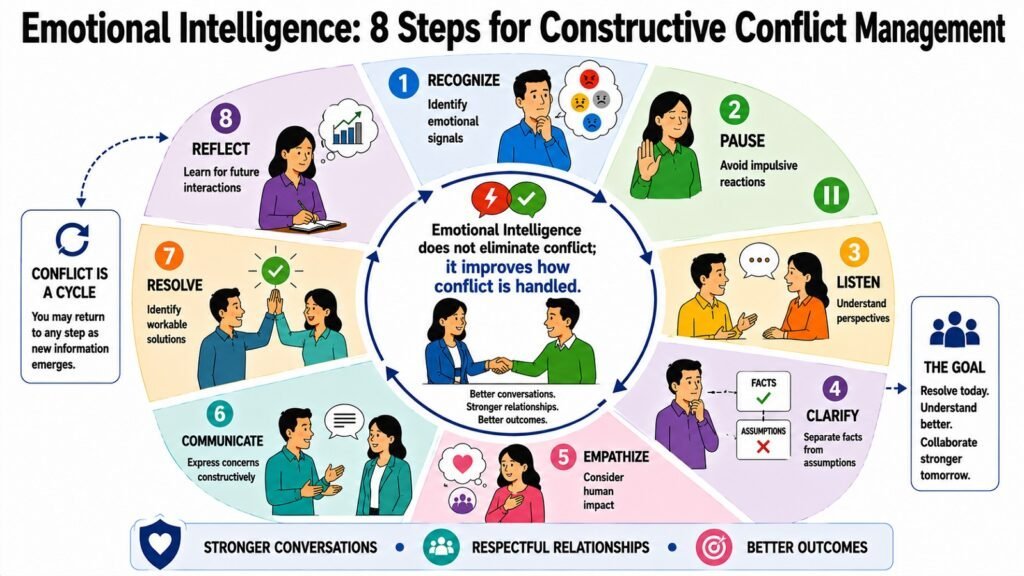
Difficult conversations are among the most consequential and most avoided events in professional life. Whether the situation involves critical feedback, a performance issue, or a dispute between functions, emotional factors are almost always present — and they frequently determine whether the exchange produces understanding or escalation.
This is where earlier EI principles integrate. Awareness helps recognize one’s emotional state before entering the conversation. Self-regulation prevents a reactive response. Empathy enables recognition of the other person’s perspective. Social skills shape how the message is delivered and received. Fisher, Ury, and Patton’s negotiation research in Getting to Yes established the importance of separating people from problems — a principle that depends directly on emotional awareness and perspective-taking.
Effective conflict communication does not mean avoiding conflict or ensuring everyone agrees. Organizational research distinguishes task conflict — substantive disagreement about ideas and decisions — from relationship conflict, which involves personal antagonism and emotional tension. Task conflict, managed well, often improves decision quality. Relationship conflict consistently undermines it. The goal is creating conditions where substantive disagreements can be examined honestly without being derailed by emotional reaction or personal defensiveness.
A practical preparation framework: clarify your objective before the conversation, anticipate the other party’s perspective through cognitive empathy, address specific behaviors rather than characterizing the person, choose an appropriate time and setting, and listen more than you speak early on. Using emotional knowledge to engineer agreement through pressure or selective disclosure is not Emotional Intelligence — it is manipulation, and it damages the trust that professional relationships depend on.
Table 8: Emotional Intelligence — Eight Conflict Signals and Communication Responses
| Conflict Signal or Situation | Emotionally Intelligent Communication Response |
| Conversation becoming personal rather than substantive | Redirect to the specific issue: “Let’s focus on what happened rather than on intent” |
| One party becoming defensive or silent | Acknowledge the tension before continuing: “This feels difficult — can we slow down?” |
| Recurring disagreement about the same issue | Name the pattern and propose a structured conversation with agreed ground rules |
| Misunderstanding escalating into conflict | Check your understanding: “Help me understand what you meant when you said…” |
| Passive resistance after a disagreement | Surface the unresolved issue directly rather than interpreting silence as agreement |
| Two teams with competing priorities | Establish shared organizational goals as a reference point before addressing the specific dispute |
| A complaint that seems disproportionate | Consider whether the current issue reflects accumulated frustration from earlier unresolved situations |
| Receiving feedback that feels inaccurate | Acknowledge the feedback, request specific examples, and defer a full response until after reflection |
8. Emotional Intelligence and Emotionally Intelligent Leadership
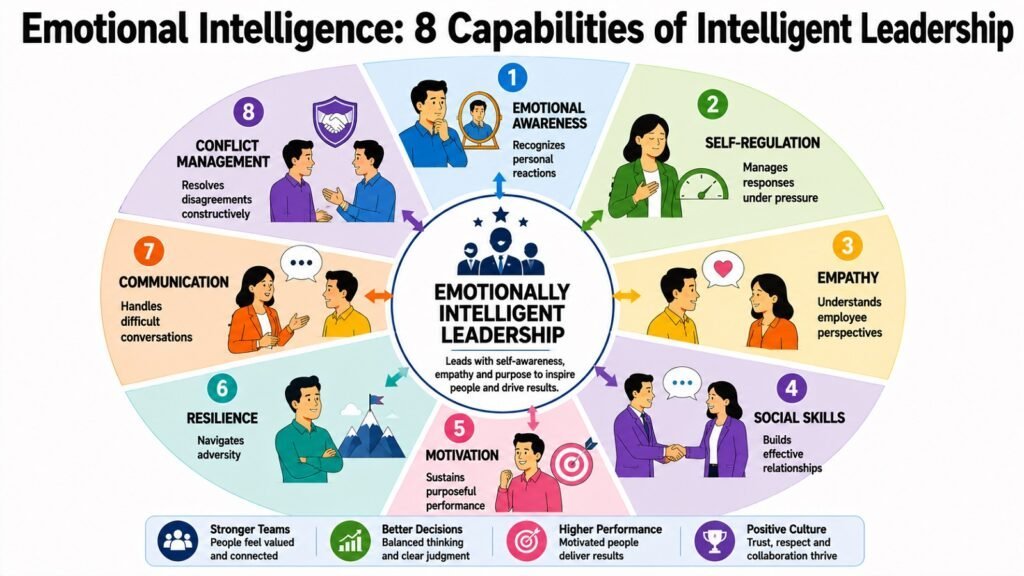
Leadership at its most demanding requires exactly the capabilities the preceding seven principles have developed. Leaders make consequential decisions under uncertainty, communicate honestly with people holding competing perspectives, navigate conflict while maintaining accountability, and sustain their own engagement through prolonged difficulty. Emotionally Intelligent Leadership is the culmination of this framework.
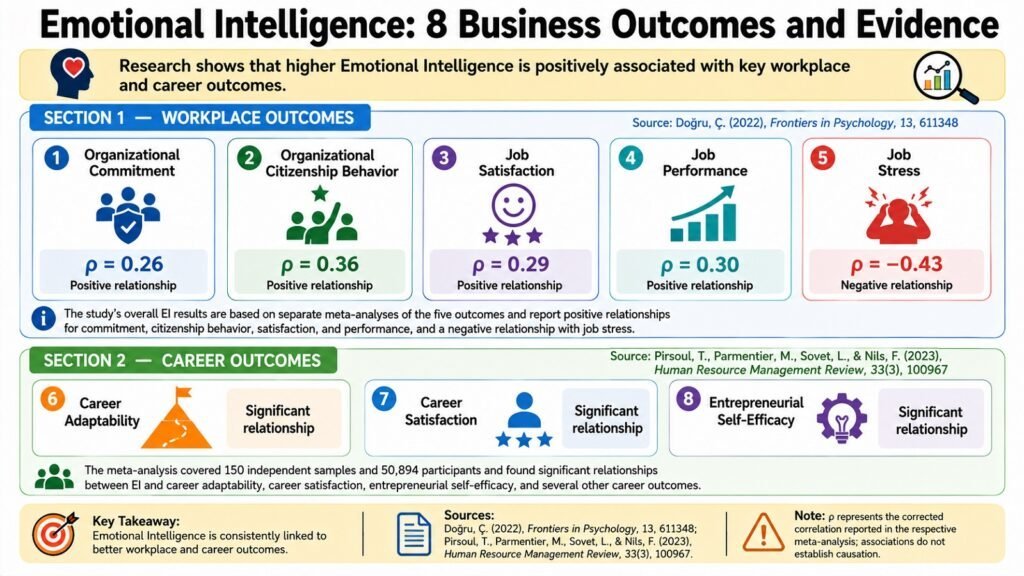
Research on EI and leadership effectiveness is substantial, though it requires careful interpretation. A meta-analysis by Joseph and Newman, published in the Journal of Applied Psychology, found meaningful relationships between EI and leadership effectiveness, particularly in roles requiring significant interpersonal communication. Côté and colleagues found that leaders high in emotional intelligence were rated more effective by subordinates and peers. However, EI is not uniformly predictive across all contexts, and measurement remains an active area of development in the field.
What research consistently supports is that emotionally intelligent behaviors — managing one’s own emotional responses, demonstrating genuine empathy, communicating clearly during difficulty, and building trust through authentic interaction — are positively associated with employee engagement, team performance, and retention. These outcomes are not caused by EI alone; strategic judgment, technical understanding, and organizational context all matter.
Consider a restructuring that creates genuine uncertainty. A leader who acknowledges the difficulty, communicates what is known and what remains uncertain, and follows through on commitments demonstrates emotionally intelligent leadership. One who retreats behind optimistic messaging or deflects hard questions will undermine trust at exactly the moment it matters. EI complements strategy and judgment — it does not replace them.
Table 9: Emotional Intelligence — Eight Leadership Situations and Emotionally Intelligent Behaviors
| Leadership Situation | Emotionally Intelligent Leadership Behavior |
| Announcing an unpopular organizational change | Acknowledge the impact on people before presenting the rationale and expected outcomes |
| A high-performing employee who is disengaging | Initiate a direct, private conversation to understand the cause before addressing performance |
| Conflict between two senior team members | Facilitate a structured conversation anchored in shared organizational interests, not personal positions |
| Receiving critical feedback from senior leadership | Model self-regulation: acknowledge the feedback, reflect, and respond with specificity rather than defensiveness |
| A team under pressure near a critical deadline | Acknowledge the strain openly, remove specific obstacles, and be present rather than just issuing targets |
| Making a decision that later proves wrong | Acknowledge the error clearly, explain the revised reasoning, and direct attention to the path forward |
| Leading a team through significant uncertainty | Communicate what is known, what is not yet known, and when more information will be available |
| Holding someone accountable for a serious failure | Separate the accountability conversation from personal emotional reaction and maintain dignity throughout |
Conclusion — Emotional Intelligence: Building Stronger Business Capability
The eight principles in this article form a progression. Emotional Awareness creates the foundation — recognizing emotional states as they shape thought and behavior. Self-Regulation builds on it by enabling deliberate responses rather than automatic reactions. Empathy extends that understanding toward others, and Social Skills translate it into effective relationships and communication. Each principle depends on and reinforces the ones that precede it.
Emotional Motivation then provides the engine for sustained purposeful effort. Emotional Resilience provides the capacity to function through setbacks and difficulty. Emotional Communication and Conflict Management bring multiple capabilities together during the interpersonal situations that test them most. Emotionally Intelligent Leadership represents the full integration of the framework, applied at the level of people, decisions, and organizational direction.
Emotional Intelligence is not a single, uniformly defined concept. The evidence supports meaningful relationships between EI-related capabilities and workplace outcomes including leadership effectiveness, employee engagement, and team performance. Questions around measurement, construct boundaries, and causal mechanisms remain open. EI complements technical competence, strategic thinking, and analytical ability — it does not replace them. Identify the principle that offers the greatest development opportunity, apply the tools, observe what changes, and continue deliberately. Emotional Intelligence is a practical human capability with genuine relevance to modern business.
Table 10: Emotional Intelligence — Eight Principles and the Business Capability Each Strengthens
| Emotional Intelligence Principle | Primary Business Capability Strengthened |
| Emotional Awareness | Self-knowledge that supports better judgment, communication, and professional self-management |
| Self-Regulation | The ability to respond deliberately rather than reactively under pressure or criticism |
| Empathy | Interpersonal understanding that builds trust, collaboration, and effective communication |
| Social Skills | Relationship management, influence, and adaptive communication across people and contexts |
| Emotional Motivation | Sustained engagement and adaptive effort toward meaningful goals through difficulty |
| Emotional Resilience | Constructive response to setbacks and uncertainty while maintaining functional performance |
| Emotional Communication & Conflict Management | Effective navigation of difficult conversations, disagreement, and workplace conflict |
| Emotionally Intelligent Leadership | Integrated leadership capability applying all eight principles when leading people and decisions |