Table of Contents
Introduction: Circular Economy and Sustainable Business
For most of the past century, businesses operated on a single dominant assumption: extract raw materials, manufacture products, sell them, and eventually discard what remains. This linear model served industrial growth well when resources were cheap and environmental expectations were limited. Today, volatile commodity costs, tightening regulation, and more demanding customers and investors are making its structural limitations increasingly difficult to ignore.
The Circular Economy offers a coherent alternative. It treats products, components, and materials as assets that can retain value across multiple cycles of use rather than as items to be consumed once and discarded. Circular Economy is an important aspect of Sustainable Business because it directly addresses the resource risk, environmental performance, and market adaptability that sustainable enterprises must manage over the long term.
Circular Economy should not be reduced to recycling. It encompasses far broader changes in product design, material selection, business models, supply chains, product lifecycles, recovery processes, and performance measurement. Recycling is one element within this system, but keeping a product or component in active use preserves considerably more economic value than recovering material after the product has been discarded.
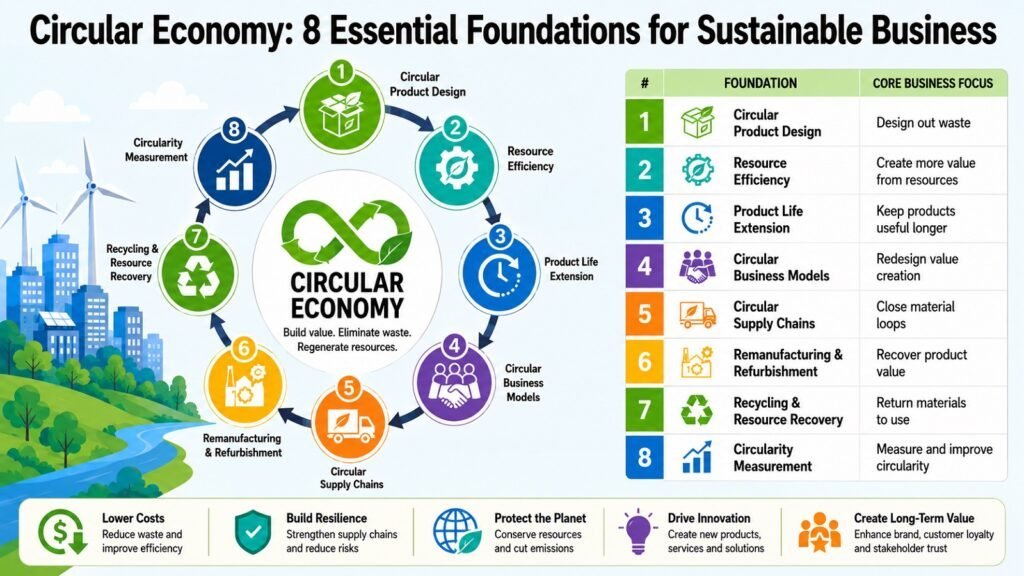
This article is a foundational and research-oriented guide that examines eight interconnected foundations of Circular Economy, each explored separately but best understood as components of a coherent circular strategy.
Table 1: Circular Economy — Eight Foundations at a Glance
| Foundation | Role in Circular Economy |
| Circular Product Design | Embeds durability, repairability, and material recovery into products from the outset |
| Resource Efficiency | Maximizes value from materials, energy, and water while minimizing waste |
| Product Life Extension | Keeps products and components in productive use longer through maintenance, repair, and reuse |
| Circular Business Models | Restructures value creation, delivery, and capture to support longer use and recovery |
| Circular Supply Chains | Integrates reverse flows and recovered materials into sourcing and manufacturing |
| Remanufacturing & Refurbishment | Recovers functional and economic value from used products at industrial scale |
| Recycling & Resource Recovery | Returns material value to the economy when product-level recovery is no longer viable |
| Circularity Measurement | Tracks circular performance to guide strategy, investment, and improvement |
1. Circular Economy and Circular Product Design
Circular Economy begins, in the most consequential sense, at the product-design stage. The decisions made when a product is conceived—which materials to use, how components connect, how the product will eventually be repaired or recovered—determine the practical range of circular outcomes available at every later stage of its life. A product designed without these considerations will be difficult to repair, costly to disassemble, and largely unrecoverable at end of life.
The Ellen MacArthur Foundation identifies design as the point at which roughly 80 percent of a product’s environmental impact is determined. This reflects the reality that material choices, structural complexity, and finish treatments all constrain what can realistically be done once a product reaches the market. Intervening at the design stage is far more effective—and far less costly—than attempting to retrofit circular outcomes after manufacture.
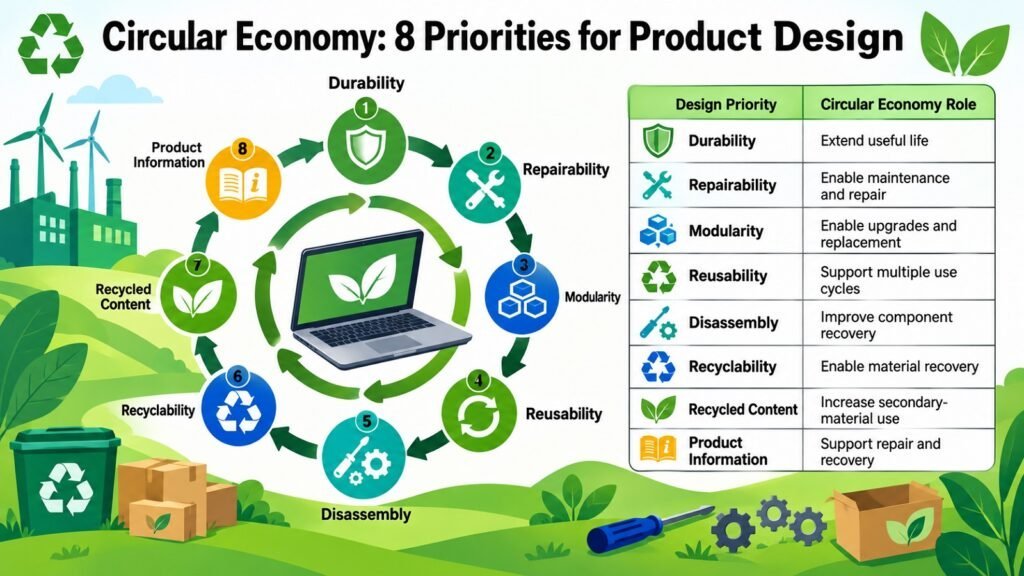
In practice, circular product design covers several overlapping considerations. Designing for durability means choosing materials and methods that extend functional life. Designing for repairability ensures components can be accessed and replaced without destroying adjacent parts. Designing for modularity structures the product so that elements can be upgraded independently—a priority in electronics and industrial equipment. Designing for disassembly enables clean separation of materials at end of life. Designing for recyclability means selecting materials with established, economically viable recovery pathways.
Fairphone, the Dutch electronics company, offers a documented example. Its smartphones use replaceable modules—battery, screen, and camera—allowing users to repair or upgrade specific components without replacing the entire device. Fairphone has published life-cycle data confirming extended product use and reduced material consumption: customers retain devices longer, reducing replacement frequency while lowering material cost per device over its useful life.
For businesses evaluating their own design practices, a useful starting point is to ask whether a product can be repaired with standard tools, whether its components are separately available, and whether its materials have realistic recovery pathways. These questions reveal quickly whether design is enabling or undermining circular outcomes.
Table 2: Circular Product Design — Key Considerations and Circular Economy Relevance
| Design Consideration | Circular Economy Relevance |
| Durability | Extends product lifespan, reducing replacement frequency and material demand |
| Repairability | Enables component-level fixes rather than whole-product disposal |
| Modularity | Supports selective upgrades and component reuse without full product replacement |
| Disassembly | Enables efficient component and material recovery at end of life |
| Material selection | Determines whether recovered materials can re-enter production economically |
| Recyclability | Ensures materials are technically and economically recoverable at scale |
| Non-toxic composition | Prevents contamination of recovered material streams, preserving reuse value |
| Standardized components | Reduces spare-part complexity and supports repair ecosystems across products |
2. Circular Economy and Resource Efficiency
Resource efficiency is fundamental to the economic principles of the Circular Economy; however, it is often misunderstood as merely consuming less. The Circular Economy defines it more accurately: deriving greater useful value from a specific amount of material, energy, or water while sustaining or enhancing economic output. While using less may occasionally diminish value, employing resources more wisely does not.
The International Resource Panel, convened by the United Nations Environment Programme, has documented that global material extraction roughly tripled between 1970 and 2015. Improving resource efficiency globally, the panel argues, could significantly reduce greenhouse gas emissions and material costs without constraining economic output. For businesses in material-intensive sectors, this trajectory signals rising long-term input costs and supply risk.
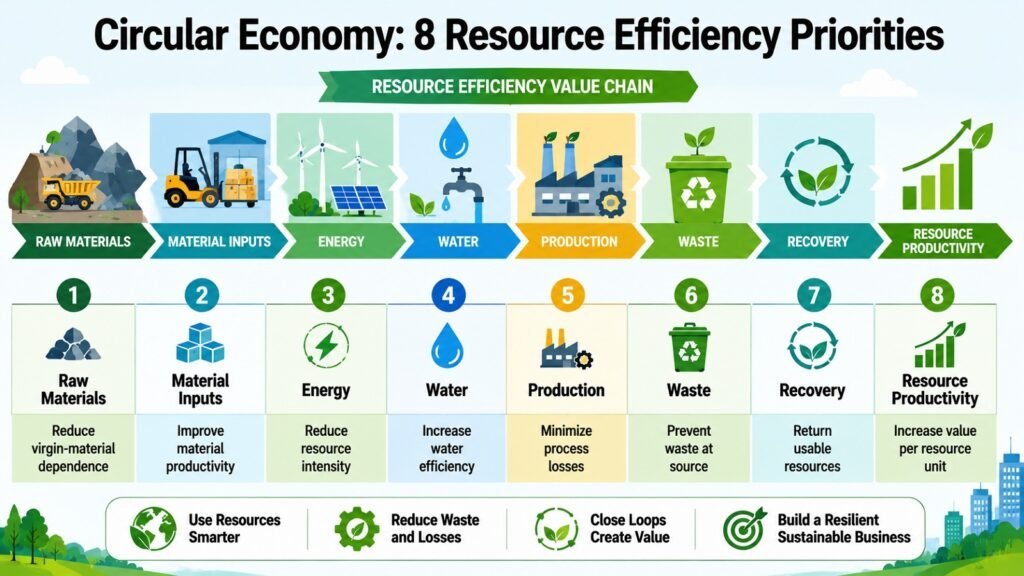
In a circular system, resource efficiency functions on various levels. At the material level, companies can minimize production waste, reclaim manufacturing scraps, and replace virgin inputs with recovered materials when quality allows. At the product level, resource efficiency entails preserving the value already inherent in a product—prolonging its lifespan, recovering components, or designing it to require less material from the outset. At the system level, it encompasses the coordination of flows throughout supply chains, ensuring that one company’s waste serves as another’s input.
A McKinsey Global Institute analysis found that improving resource productivity in key industrial sectors could generate substantial economic value, much of it accruing to businesses that reduce input costs and production losses. For companies in manufacturing, food, construction, or packaging, even modest improvements in resource productivity can yield meaningful cost reductions without capital-intensive change.
In practice, resource efficiency analysis begins by mapping material flows through production—tracking where resources enter, are transformed, and exit as product or waste. This frequently reveals losses that had been treated as normal operating costs, and identifying them is the first step toward eliminating them.
Table 3: Circular Economy and Resource Efficiency — Key Considerations
| Resource Efficiency Area | Circular Economy Relevance |
| Material flow mapping | Identifies where resources are lost, underused, or wasted in production |
| Production waste reduction | Keeps materials in the value chain rather than diverting them to disposal |
| Recycled and recovered inputs | Reduces dependence on virgin materials and associated extraction costs |
| Water use optimization | Lowers operational risk in water-scarce regions and reduces treatment costs |
| Energy efficiency in production | Cuts input costs and supports decarbonization of manufacturing operations |
| Precision manufacturing | Reduces material overuse by matching inputs more accurately to product specification |
| Closed-loop process recovery | Returns manufacturing by-products to the process rather than disposing of them |
| Resource productivity benchmarking | Compares output per unit of resource against sector norms to identify gaps |
3. Circular Economy and Product Life Extension
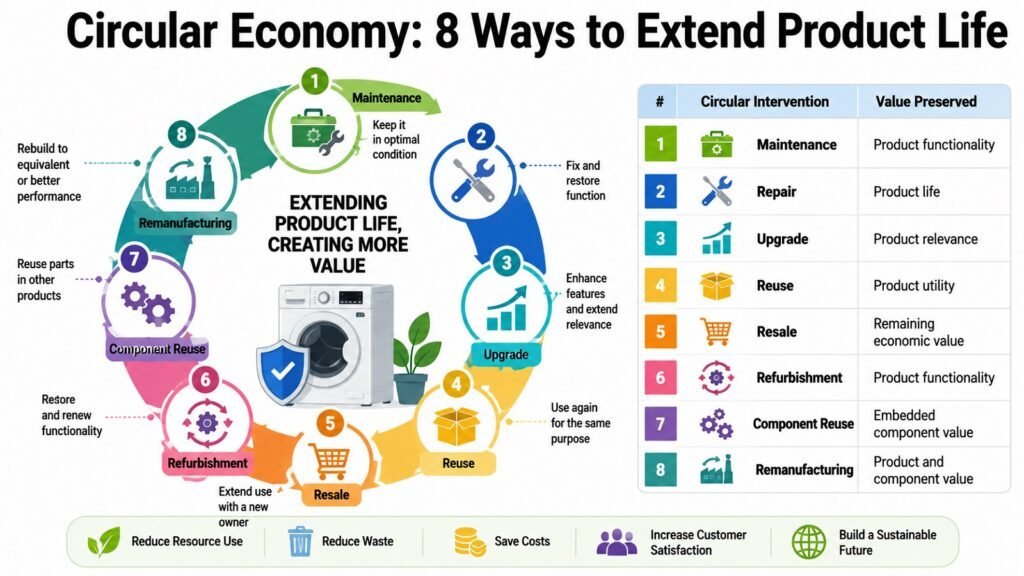
Circular Economy places significant emphasis on keeping products useful and economically valuable for as long as reasonably possible. A manufactured product contains accumulated value: materials, labor, energy, design effort, and logistics. Discarding that value prematurely is economically wasteful, and product life extension is one of the most direct ways to recover it more fully.
The distinction between product life extension and recycling is important. Recycling recovers material value after a product is discarded but loses the functional, structural, and design value embedded in it. Keeping a product in active use retains all of that embedded value while continuing to deliver the service it was designed for. The Ellen MacArthur Foundation’s value hierarchy identifies inner loops—reuse, repair, refurbishment—as significantly more value-preserving than the outer loop of material recycling.
In business terms, product life extension covers several distinct strategies. Maintenance and servicing allow products to remain functional over extended periods. Repair addresses specific failures without triggering whole-product replacement. Upgrading allows products to remain current by replacing outdated components—particularly relevant in electronics, industrial machinery, and medical equipment. Resale and reuse extend service life for a second or subsequent user. Component harvesting recovers high-value elements from products that can no longer function as a whole.
Caterpillar’s Cat Reman division is a well-documented example. The program recovers used components from returned heavy machinery, restores them to original performance specifications, and sells them at a discount to equivalent new parts. The process requires less energy and fewer materials than manufacturing new components, and it enables Caterpillar to retain customers who might otherwise purchase third-party alternatives.
Businesses can identify life extension opportunities by examining return flows, warranty claims, and replacement patterns. These data often reveal that products are replaced not because they have failed but because repair is unavailable or inconvenient—a gap that, once addressed, can improve customer satisfaction, create service revenue, and reduce material consumption simultaneously.
Table 4: Circular Economy and Product Life Extension — Approaches and Circular Value
| Life Extension Approach | Circular Value Preserved or Created |
| Preventive maintenance | Extends functional life by preventing premature component failure |
| Repair services | Addresses specific faults, avoiding whole-product disposal |
| Component upgrading | Keeps the product current without replacing the full unit |
| Product refurbishment | Restores used products to a functional condition for resale |
| Reuse by second users | Extends the service period of an existing product for a new customer |
| Component harvesting | Recovers high-value parts from end-of-life products for use elsewhere |
| Take-back programs | Enables businesses to recover, extend, or recycle products systematically |
| Leasing and servicing models | Incentivizes manufacturers to maintain product longevity rather than drive replacement |
4. Circular Economy and Circular Business Models
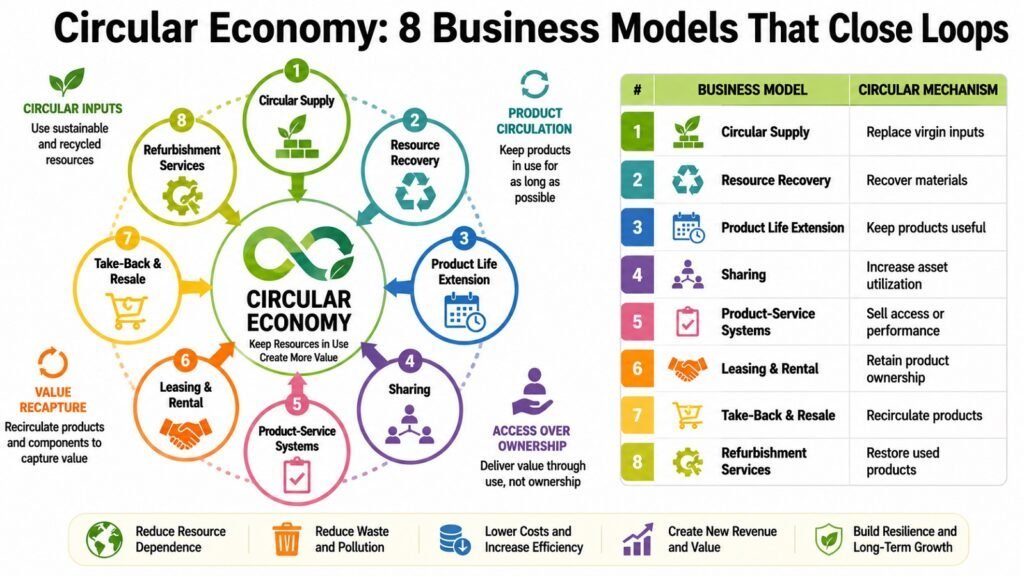
Circular Economy is not only an operational challenge. It is also a question of how a business creates, delivers, and captures value. The conventional model generates revenue primarily through product sales, creating a structural incentive to maximize unit volume. In a linear system, selling more products and replacing them frequently is commercially rational. In a circular system, that same incentive can actively work against keeping products in use and recovering their value.
Circular business models address this structural tension by decoupling revenue from unit sales and creating alternative ways to capture value from product use and recovery. Academic research, including work published by Accenture, identifies several distinct model categories that are documented in real commercial practice.
Product-as-a-service is among the most widely discussed. Rather than selling a product, the company retains ownership and charges customers for the service the product delivers. Michelin’s contract services for truck fleet operators charge per kilometer of tire performance rather than per tire sold. Michelin therefore bears the replacement cost and has a direct financial incentive to produce tires that last longer—an alignment between manufacturer interest and product longevity that a conventional sale does not create.
Take-back and recovery models create structured collection systems for used products, enabling refurbishment, remanufacturing, or material recovery. Leasing and rental models allow customers to access products without ownership, making asset recovery at contract end commercially straightforward. Sharing platforms increase utilization of existing assets, reducing the total number of products needed to meet a given level of demand.
Suitability for any given circular model depends on product value, durability, and repairability; on customer preferences between ownership and access; on the availability of reverse logistics infrastructure; and on the economics of recovery at scale. These models reward careful analysis rather than default adoption.
Table 5: Circular Economy — Recognized Circular Business Model Approaches
| Business Model | Circular Economy Business Logic |
| Product-as-a-service | Shifts manufacturer incentive toward durability and performance over the service period |
| Leasing and rental | Retains manufacturer ownership, enabling controlled recovery at contract end |
| Sharing platforms | Increases asset utilization, reducing total product volume needed to meet demand |
| Take-back schemes | Creates recovery flows supporting remanufacturing, refurbishment, or recycling |
| Resale and secondary markets | Extends product life and captures residual value for the seller or an intermediary |
| Performance-based contracting | Links payment to outcomes rather than units, rewarding longevity and efficiency |
| Repair and maintenance services | Creates recurring revenue from product longevity rather than from replacement |
| Subscription with returns | Provides ongoing access while enabling systematic product collection and recovery |
5. Circular Economy and Circular Supply Chains
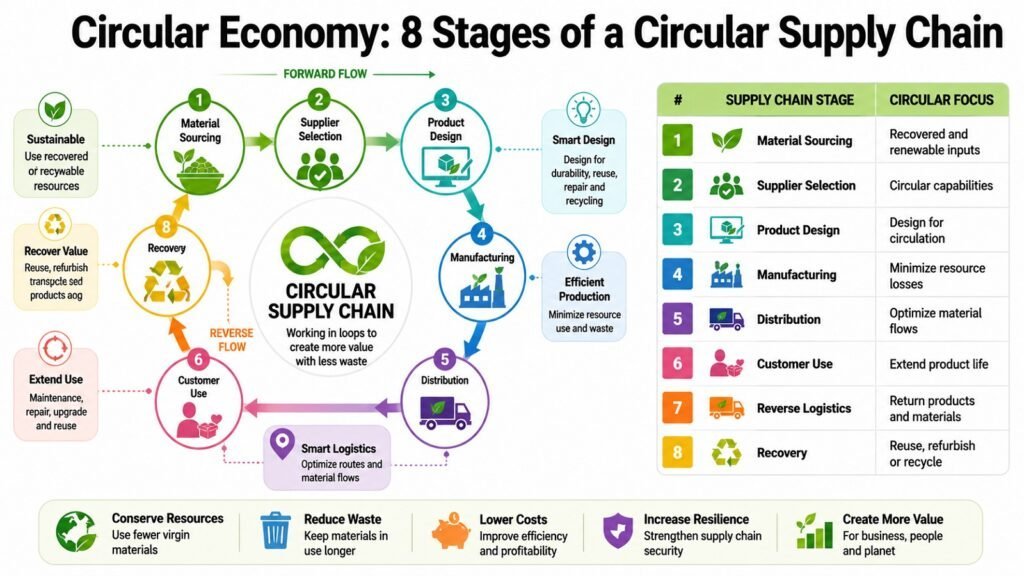
Circular Economy extends beyond individual products and companies into the broader supply chain. Realizing circular outcomes at scale requires coordination among suppliers, manufacturers, distributors, customers, collectors, and processors. A business can design a circular product and adopt a circular business model but still find its circular performance limited if its supply chain moves materials in only one direction.
A conventional supply chain is essentially linear: raw material extraction flows through processing, manufacturing, and distribution to consumption, with disposal at the end. A circular supply chain adds reverse flows that bring products, components, and materials back into the system—returning products for remanufacturing, channeling components to refurbishers, or recovering materials for new production runs.
The business rationale has strengthened in recent years. Supply disruptions, commodity price volatility, and tightening regulatory scrutiny of material origins have all created incentives to diversify and secure material sources. Recovered and recycled materials can provide that security, but accessing them reliably requires deliberate investment in collection, sorting, and quality assurance infrastructure rather than treating recovery as incidental.
Renault’s Flins facility in France, developed as a circular economy hub for vehicle parts and materials, illustrates this at industrial scale. The facility processes returned vehicles, refurbishes components, and coordinates material recovery—reducing dependence on externally sourced raw materials and creating resilience that a purely forward-facing supply chain cannot replicate.
Circular supply chains also depend on material traceability: the ability to track where materials came from, what processes they have undergone, and what quality they retain. Without traceability, recovered materials cannot be reliably specified into new products. Digital tools such as product passports are being deployed to address this challenge, though adoption remains uneven across industries and geographies.
Table 6: Circular Economy and Circular Supply Chains — Key Elements
| Supply Chain Element | Circular Economy Relevance |
| Reverse logistics | Enables physical return of products and materials from customers to recovery points |
| Supplier collaboration | Aligns upstream material decisions with circular design and recovery requirements |
| Material traceability | Ensures recovered inputs meet quality and composition standards for reuse |
| Recovered material sourcing | Substitutes virgin inputs with secondary materials, reducing extraction pressure |
| Collection infrastructure | Provides the network for retrieving used products from distributed end-users |
| Quality assurance for returns | Validates material and component quality to enable safe reuse or remanufacturing |
| Multi-actor coordination | Circular supply chains require collaboration beyond what any single company can achieve alone |
| Closed-loop supplier agreements | Formalizes commitments to return, recover, and reuse materials within defined partnerships |
6. Circular Economy and Remanufacturing & Refurbishment
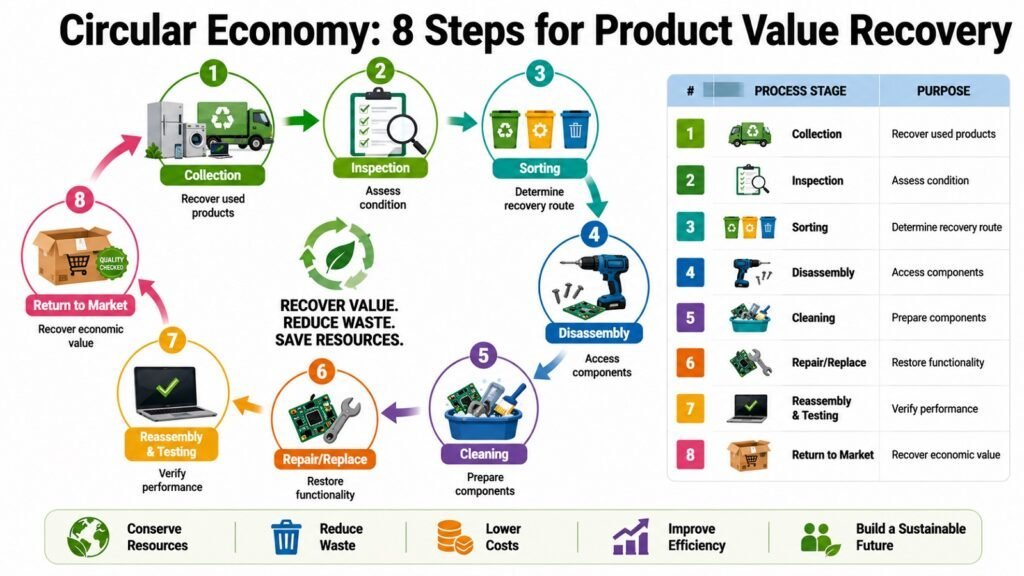
Remanufacturing and refurbishment are among the most economically significant activities within the Circular Economy. Both recover value from used products rather than replacing them with newly manufactured equivalents, but they differ substantially in process depth, quality expectations, and commercial application—distinctions that matter when selecting the right approach for a given business context.
Remanufacturing is an industrial process in which used products or components are disassembled, cleaned, inspected, restored or replaced where necessary, and reassembled to performance standards equivalent to those of new products. The British Standards Institution defines remanufacturing as producing a result with equivalent performance and a warranty comparable to new. It is well established in automotive components, aerospace parts, heavy machinery, and industrial equipment—sectors where component value is high, and recovery economics are favorable.
Refurbishment is not as rigidly defined, yet it typically involves returning a pre-owned product to a functional and visually appealing state, without the requirement of matching the performance of a new item. Categories that commonly engage in refurbishment include consumer electronics, office machinery, medical equipment, and telecommunications devices. Products that have been refurbished usually come at reduced prices, catering to customers who value cost-effectiveness over the assurance of new performance.
Both approaches share the circular logic of recovering value already embedded in existing products. A remanufactured automotive alternator requires an estimated 80 to 85 percent less energy than a new one, according to the Automotive Parts Remanufacturers Association—a figure that illustrates the resource efficiency gains that accompany value recovery at this depth of intervention.
Practical constraints apply. Not all products are suitable: components that degrade chemically, goods with safety-critical tolerances, and products with hazardous compositions may not be recoverable at acceptable cost or quality. Collection logistics, inspection costs, and variable return quality all affect commercial viability and must be included in any realistic business case.
Table 7: Circular Economy — Remanufacturing and Refurbishment Compared
| Characteristic | Remanufacturing / Refurbishment |
| Process depth (remanufacturing) | Full disassembly, inspection, restoration, and reassembly to new-equivalent standard |
| Process depth (refurbishment) | Cleaning, functional restoration, and cosmetic improvement without full disassembly |
| Quality standard | Remanufactured products carry warranties comparable to new; refurbished products vary by seller |
| Primary sectors | Automotive parts, aerospace, heavy machinery, industrial equipment, medical devices |
| Energy saving (remanufacturing) | Industry estimates indicate up to 80–85% less energy than new production for some components |
| Customer segment | Remanufactured: performance-sensitive buyers; refurbished: value-oriented buyers |
| Economic viability drivers | High product value, reliable collection, disassembly feasibility, and stable demand |
| Key limitations | Not all products qualify; collection logistics and inspection costs constrain scale |
7. Circular Economy and Recycling & Resource Recovery
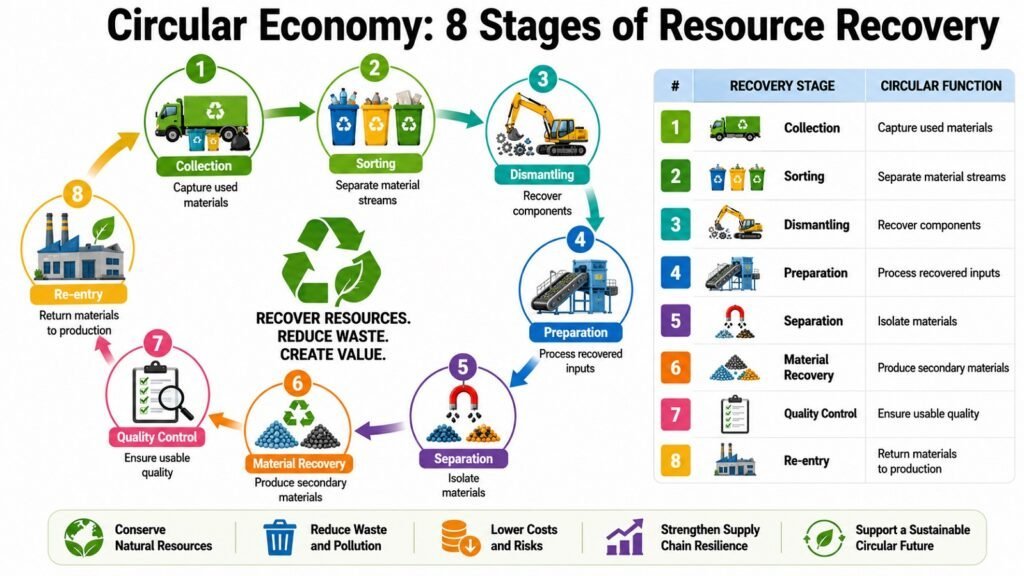
Recycling occupies an important but specific position within Circular Economy. It is common for businesses and policy discussions to use recycling as shorthand for circular behavior—a framing that misrepresents the hierarchy of value that defines a genuine circular system. Circular Economy does not dismiss recycling; it situates it correctly as one tool among several, and generally not the first choice when higher-value recovery remains viable.
The reasoning follows from how value is embedded in products. A manufactured product contains material value but also design, engineering, functional, and structural value. When recycled, the material is recovered but most other forms of embedded value are lost. When repaired, refurbished, or remanufactured, considerably more embedded value is retained. The Ellen MacArthur Foundation’s butterfly diagram places reuse, repair, and remanufacture in inner loops—prioritized over the outer loop of material recycling.
That said, recycling is indispensable. Many products reach a point where further life extension or component recovery is not economically or technically viable, and recovering materials cleanly at that stage is far preferable to landfill or incineration. Secondary aluminum requires approximately 95 percent less energy than primary production, according to the International Aluminium Institute—a saving that makes aluminum recycling both economically and environmentally compelling in most markets.
Recycling has real limitations that any honest circular strategy must acknowledge. Many materials lose quality with each cycle, a phenomenon known as downcycling. Collection and sorting infrastructure varies enormously by geography. Contaminated or mixed material streams reduce the value of what is recovered. And demand for secondary materials can be volatile, affecting whether recycling remains economically viable in any given period.
Design decisions made upstream profoundly affect what is recoverable downstream. Products using bonded mixed materials, adhesives, or composite structures are often technically difficult and economically unviable to recycle effectively. Circular product design is therefore a prerequisite for effective material recovery—what enters the recycling system is determined long before the product is discarded.
Table 8: Circular Economy — Recycling and Resource Recovery Considerations
| Recycling / Recovery Consideration | Circular Economy Relevance |
| Material quality retention | Some materials lose performance with each cycle; design must account for recovery limits |
| Collection system coverage | Effective recycling depends on accessible, well-managed collection infrastructure |
| Sorting and separation technology | Determines which materials can be recovered at acceptable purity levels |
| Design for recyclability | Upstream design choices directly determine what can be recovered downstream |
| Secondary material demand | Recycling economics depend on stable market demand for recovered outputs |
| Energy intensity of recycling | Secondary materials such as aluminum offer large energy savings vs. primary production |
| Contamination risk | Mixed or contaminated streams reduce quality and value of recovered materials |
| Downcycling risk | Repeated recycling may degrade material quality, limiting substitution of virgin input |
8. Circular Economy and Circularity Measurement
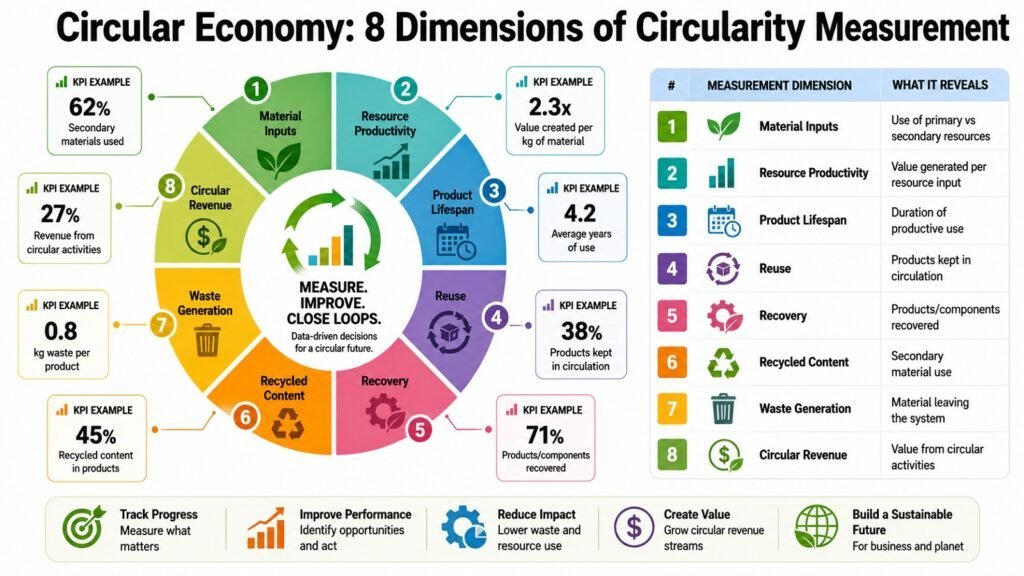
Without measurement, Circular Economy remains an aspiration. Businesses can commit to circular principles and introduce individual initiatives, but without reliable performance data, it is impossible to determine whether circularity is actually increasing, whether investments are delivering results, or where the most significant gaps lie. Measurement converts circular strategy into accountability rather than leaving it as a statement of intention.
Circularity measurement is distinct from broader sustainability metrics. Environmental indicators such as carbon emissions, energy use, and water consumption are valuable, but they do not directly capture how circular a company’s material flows are. A business can reduce its carbon footprint entirely through renewable energy while operating a wholly linear product model. Circularity metrics specifically assess the degree to which materials and components are kept in use, recovered, and reintegrated rather than lost as waste.
Recognized approaches have been developed by the Ellen MacArthur Foundation, the European Environment Agency, and academic research groups. The Material Circularity Indicator, developed by the Ellen MacArthur Foundation and Granta Design, assesses product-level circularity based on recycled or renewable inputs and the proportion of material recovered at end of life, adjusted for product utility and lifespan. It provides a structured basis for comparing products or tracking performance over time.
At the business level, relevant measurement areas include the share of recycled or recovered content in total material input; the proportion of products returned for reuse, refurbishment, or recycling; average product lifespan relative to a defined baseline; the share of revenue linked to circular activities; and waste generation per unit of output. The appropriate selection depends on the industry, product type, supply chain structure, and the circular strategy being pursued.
A measurement program typically begins with a baseline assessment of material flows, recovery rates, and product lifespans. From there, businesses select a small number of meaningful and measurable indicators, set targets, and track results over time. This iterative approach builds circularity assessment capability progressively, which is more practical than attempting to quantify everything at once.
Table 9: Circular Economy — Measurement Areas and What Each Reveals
| Measurement Area | What It Helps Businesses Understand |
| Recycled /Recovered material input | How much production relies on secondary rather than virgin materials |
| Product return and recovery rate | What proportion of sold products is retrieved for reuse, refurbishment, or recycling |
| Average product lifespan | Whether products are lasting as designed and whether life extension is improving |
| Circular revenue share | What proportion of revenue comes from circular activities such as repair or leasing |
| Material productivity | How much economic output is generated per unit of material consumed |
| Waste generation per unit | Whether production processes generate less waste relative to output over time |
| Material Circularity Indicator (MCI) | A composite score assessing product-level circularity from inputs to end-of-life recovery |
| End-of-life recovery quality | Whether recovered materials meet standards required for genuine productive reuse |
Conclusion: Circular Economy and the Future of Sustainable Business
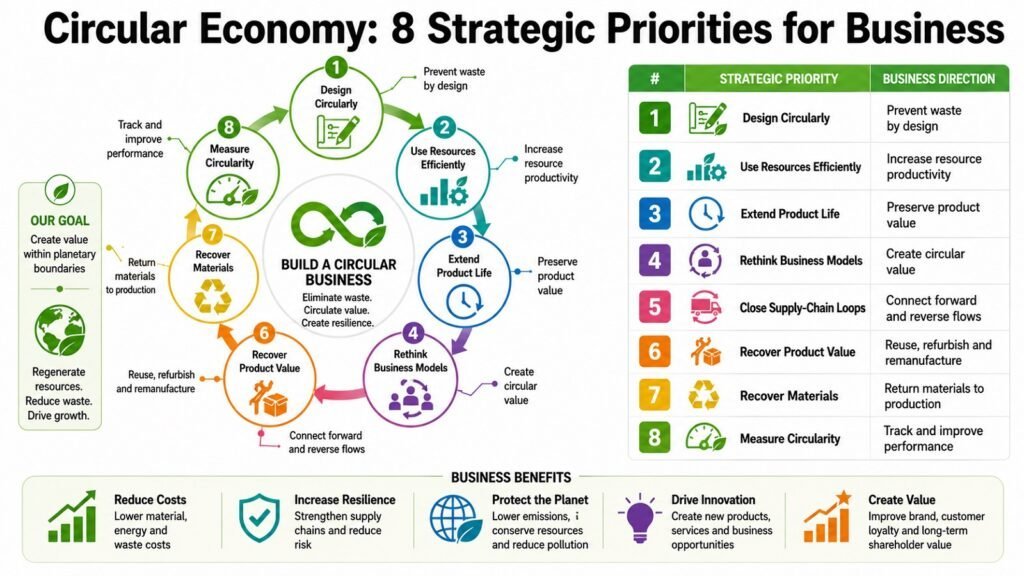
The eight foundations examined in this article do not operate independently. Circular product design creates the conditions for effective product life extension. Resource efficiency gains compound when supply chains incorporate reverse flows and recovered materials. Circular business models make remanufacturing commercially viable at scale. Circularity measurement provides the feedback that allows all of these activities to improve continuously. The value of Circular Economy lies in these interconnections as much as in any single foundation.
Circular Economy is an important aspect of Sustainable Business, and its relevance is likely to grow as regulatory requirements around material use become more demanding, as resource costs and supply uncertainties intensify, and as investors and customers require greater environmental transparency. A circular approach addresses these pressures not by adding compliance costs but by generating operational efficiency, supply chain resilience, and new revenue—outcomes that align environmental performance with commercial value.
It is worth reaffirming what this article established at the outset: Circular Economy is not synonymous with recycling or waste minimization. It encompasses the full arc of a product’s existence—from how it is designed and what resources it uses, through how its life is extended and its value recovered, to how performance is tracked and improved. Treating any single dimension as the whole of circularity misses the system-level logic that gives it strategic significance.
The practical implication is that circularity is an ongoing business transformation rather than a one-time program. Businesses that approach it incrementally—focusing first on the foundations where the opportunity is clearest—are more likely to build genuine circular capability than those who attempt comprehensive change at once.
Table 10: Circular Economy — Eight Foundations and Their Primary Business Implications
| Circular Economy Foundations | Primary Business Implication |
| Circular Product Design | Design decisions determine the viability of every downstream circular activity |
| Resource Efficiency | Intelligent resource use reduces input costs and builds supply resilience |
| Product Life Extension | Longer product life preserves embedded value and can create new service revenue |
| Circular Business Models | Value creation logic must align with circular incentives, not just linear sales volume |
| Circular Supply Chains | Reverse flows and recovered materials require deliberate infrastructure and collaboration |
| Remanufacturing & Refurbishment | High-value asset recovery is commercially viable when collection and quality can be assured |
| Recycling & Resource Recovery | Material recovery is essential at end of life but most effective when design enables it |
| Circularity Measurement | Transparent metrics turn circular commitments into accountable business performance |