Table of Contents
Introduction: Global Finance and the Modern Global Economy
Global Finance is one of the most important building blocks of the Global Economy. It refers to the international system through which money, capital, credit, investment, and financial risk move across national borders, connecting individuals, businesses, governments, and institutions in nearly every country. Understanding how this system works is no longer the exclusive concern of economists and financiers.
In a world where a central bank decision in one major economy can shift exchange rates, asset prices, and credit conditions worldwide within hours — and where a financial crisis originating in one country can quickly ripple across dozens of others — a working knowledge of Global Finance has become essential for anyone trying to make sense of modern economic life.
At its essence, Global Finance revolves around the distribution of financial resources on a global scale. Financial markets, international banking systems, foreign exchange frameworks, capital movements, investment choices, debt markets, institutional governance, and financial stability are interconnected. A disturbance in one sector can rapidly influence others in unexpected ways.
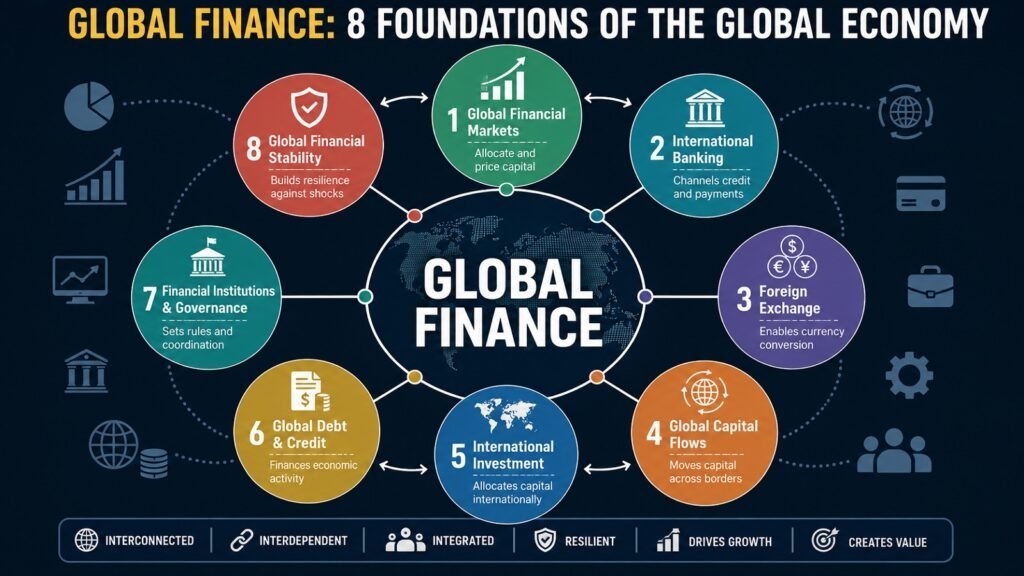
The 2008 global financial crisis illustrated this precisely: problems concentrated in one segment of the American housing market produced credit contractions, market dislocations, and economic slowdowns across dozens of countries. This article examines eight foundations of that system, treating them as parts of one connected whole so readers can better interpret financial events, understand policy debates, and navigate the forces shaping the Global Economy.
Table 1: Global Finance — Eight Foundations at a Glance
| Foundation | Role in Global Finance |
| Global Financial Markets | Connect investors, borrowers, and institutions across borders for capital allocation and risk transfer |
| International Banking | Facilitate cross-border payments, credit, trade finance, and financial intermediation |
| Foreign Exchange | Enable currency conversion essential to international trade, investment, and capital movement |
| Global Capital Flows | Channel financial resources between economies in response to returns, risk, and growth differentials |
| International Investment | Allocate global savings to productive assets, businesses, and infrastructure across borders |
| Global Debt and Credit | Provide governments, corporations, and institutions with external financing for growth and spending |
| Financial Institutions and Governance | Supply the rules, oversight, and coordination that give the global financial system its structure |
| Global Financial Stability | Determine the system’s capacity to absorb shocks and sustain economic activity during stress |
1. Global Finance and Global Financial Markets
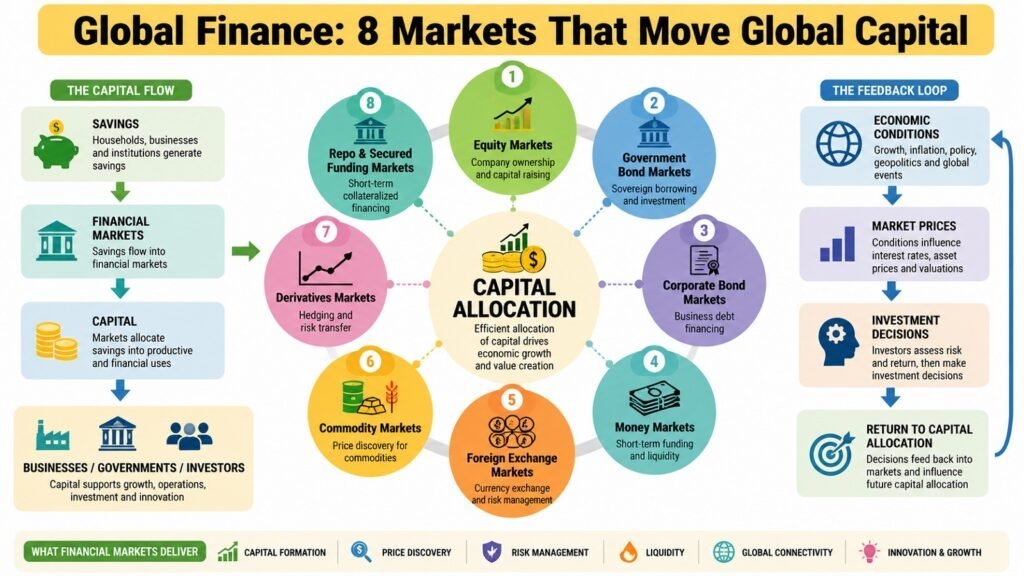
Financial markets are the circulatory system of Global Finance, providing channels through which capital moves from those who have it to those who need it, whether in the same country or on opposite sides of the world. They perform several essential economic functions: capital allocation directs savings toward investments that generate returns; price discovery aggregates dispersed information into observable prices; liquidity allows assets to be bought or sold without causing large price movements; and risk transfer enables participants to redistribute financial exposures they are unwilling or unable to carry.
Global Finance encompasses several major market categories that perform distinct but related roles. Equity markets allow companies to raise capital by selling ownership stakes. Bond markets fund governments and corporations through debt instruments. Money markets provide short-term liquidity management tools for financial institutions.
Commodity markets establish benchmark prices for raw materials that are integral to global supply chains and inflation. Derivatives markets facilitate hedging and risk transfer across various asset classes. These markets are closely interconnected through shared participants, common risk factors, and cross-border capital movements that transmit conditions from one to another with remarkable speed.
The depth of these linkages becomes visible during stress. The 2013 taper tantrum illustrated this clearly: signals from the U.S. Federal Reserve that it might reduce asset purchases triggered capital outflows, currency depreciation, and market volatility across multiple emerging economies within days. For anyone monitoring global market conditions, several indicators deserve consistent attention.
Sovereign bond yields in major economies reveal growth and inflation expectations. Credit spreads measure investor risk appetite. Equity volatility indexes such as the VIX reflect market uncertainty. Together, these signals provide a practical window into how global markets are pricing risk and opportunity at any given moment.
Table 2: Global Finance — Key Global Financial Market Concepts
| Market or Concept | Primary Function or Significance |
| Equity Markets | Enable companies to raise capital and give investors ownership exposure to corporate growth |
| Bond Markets | Fund governments and corporations through debt; sovereign yields benchmark global borrowing costs |
| Money Markets | Provide short-term liquidity management instruments for banks and large financial institutions |
| Commodity Markets | Set global benchmark prices for raw materials influencing inflation and trade balances |
| Derivatives Markets | Allow hedging and risk transfer across interest rates, currencies, equities, and commodities |
| Credit Spreads | Measure risk appetite; widening spreads signal rising investor caution or financial stress |
| Capital Allocation | Core function of markets — directing financial resources toward their most productive use |
| Price Discovery | Aggregation of dispersed information into observable prices that guide economic decisions |
2. Global Finance and International Banking
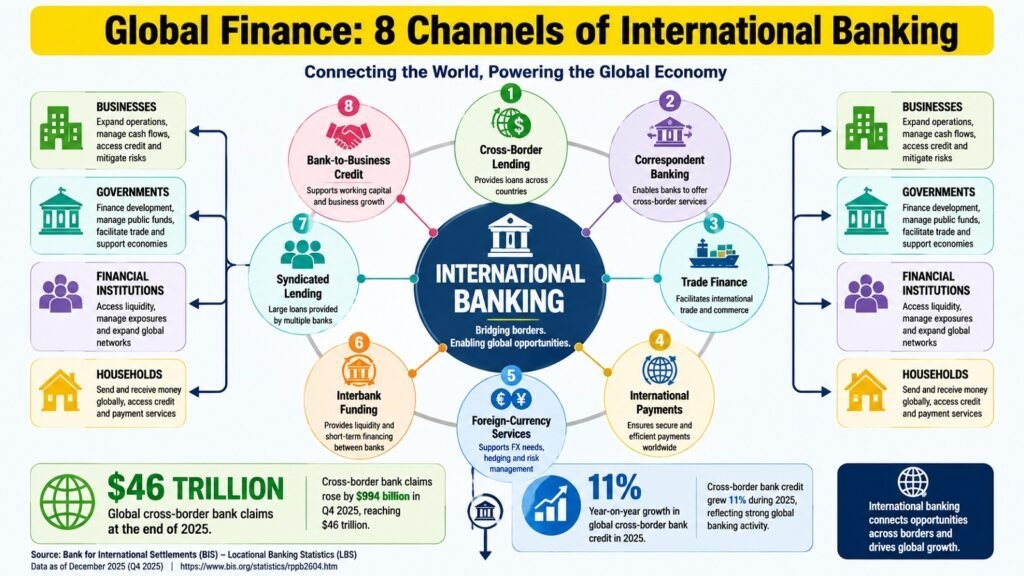
If global financial markets serve as the circulatory system of Global Finance, international banks function as its plumbing. They provide the necessary infrastructure for the movement of money between nations — where trade is financed, payments are processed, credit is granted, and financial services are provided across borders.
Banks perform a function economists call financial intermediation, standing between those with surplus capital and those who need it. At the international level, this becomes considerably more complex, as multinational banks simultaneously manage different regulatory requirements, currencies, legal systems, and counterparty risks across dozens of jurisdictions.
Correspondent banking relationships are vital to this infrastructure. Since most banks do not operate directly in every country, they establish accounts with partner banks in different jurisdictions, facilitating cross-border payments, trade finance, and foreign-currency settlements on a large scale. Trade finance instruments, such as letters of credit, instill confidence in exporters regarding payment while assuring importers that goods will be delivered prior to the release of funds — thereby mitigating the counterparty risks associated with international trade. These networks remain largely unseen by most participants in global trade yet are absolutely essential to its operation.
International banking also creates channels through which financial stress spreads. When banks face losses or liquidity pressure, they may reduce cross-border lending or withdraw interbank funding. The sudden contraction of international bank lending during the 2008 financial crisis contributed significantly to the credit crunch felt in countries far from the original source of stress.
Regulatory responses under Basel III introduced higher capital requirements and stronger liquidity buffers for internationally active banks. Digital payment systems and fintech developments are also reshaping cross-border payments, with faster settlement rails beginning to challenge traditional correspondent banking arrangements and gradually altering the efficiency of international banking infrastructure within Global Finance.
Table 3: Global Finance — International Banking Components and Roles
| Component | Role in Global Finance |
| Financial Intermediation | Banks channel savings from surplus units to borrowers across national borders |
| Correspondent Banking | Partner-bank networks enable cross-border payments and settlements without direct presence |
| Cross-Border Lending | Banks extend credit to foreign corporations and governments, transmitting credit conditions globally |
| Trade Finance | Letters of credit and similar instruments reduce payment risk in international trade transactions |
| International Payments | Banks process the currency transfers that underpin global trade and investment flows |
| Foreign-Currency Services | Banks provide hedging, conversion, and FX risk management for multinational clients |
| Basel III Standards | Capital and liquidity requirements aimed at strengthening internationally active bank resilience |
| Liquidity Management | Banks maintain buffers to sustain cross-border lending and payment functions during stress |
3. Global Finance and Foreign Exchange
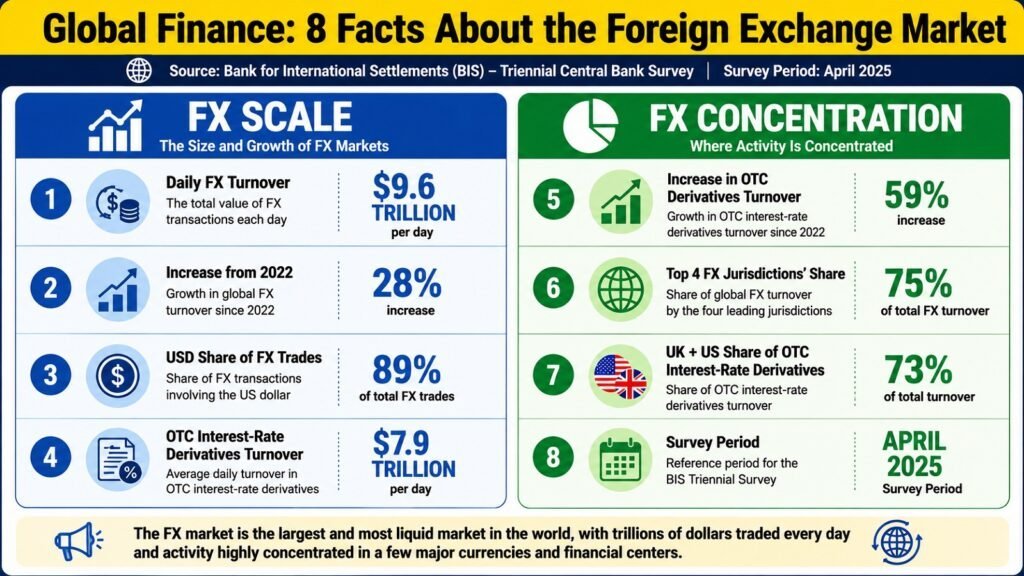
Foreign exchange sits at the intersection of almost every dimension of Global Finance. International trade, investment, borrowing, and cross-border capital movement all typically require currencies to be converted, and the rates at which those conversions take place carry real economic consequences for businesses, consumers, governments, and investors worldwide.
Exchange rates are prices — the price of one currency expressed in terms of another — determined continuously in decentralized markets involving banks, corporations, investment funds, central banks, and governments. The foreign exchange market is the largest and most liquid financial market in the world, with daily trading volumes that dwarf equity and bond markets combined.
Several forces drive exchange rate movements. Interest rate differentials attract capital to higher-yielding currencies. Inflation differentials erode purchasing power and weaken currencies over time. Current account positions influence currency demand. Capital flows and risk appetite add further volatility, with currencies of more vulnerable economies often depreciating sharply when global risk aversion rises. The practical consequences are significant: a weaker domestic currency makes exports more competitive but raises import costs and puts upward pressure on inflation.
Governments and corporations with foreign-currency debt face rising service burdens when their own currency weakens — a dynamic the 1997 Asian financial crisis illustrated starkly, as currency depreciations transformed manageable debts into severe solvency problems across the region.
Reading foreign exchange markets analytically requires attention to interest rate differentials between major central banks, current account trends, inflation comparisons, and capital flow direction. These indicators help distinguish between exchange rate shifts driven by fundamentals and those driven by speculative positioning or temporary sentiment changes. For investors and businesses operating internationally, this distinction directly influences decisions about hedging, pricing, financing, and cross-border capital allocation.
Table 4: Global Finance — Foreign Exchange Concepts and Their Significance
| FX Concept or Indicator | What It Represents or Why It Matters |
| Exchange Rate | Price of one currency in terms of another; affects trade competitiveness and investment returns |
| Interest Rate Differentials | Drive capital flows toward higher-yielding currencies, influencing their relative value |
| Purchasing Power Parity | Long-run framework suggesting currencies adjust to equalize prices of identical goods across countries |
| Current Account Balance | Reflects net trade flows; persistent deficits can put sustained downward pressure on a currency |
| Currency Depreciation | Makes exports cheaper but raises import costs and increases foreign-currency debt burdens |
| Central Bank Intervention | Direct currency market activity by monetary authorities to stabilize or manage exchange rates |
| Carry Trade | Borrowing in low-rate currencies to invest in high-rate ones; sensitive to risk sentiment reversals |
| Currency Mismatch | Borrowing in foreign currency while earning in domestic currency creates exchange rate risk |
4. Global Finance and Global Capital Flows
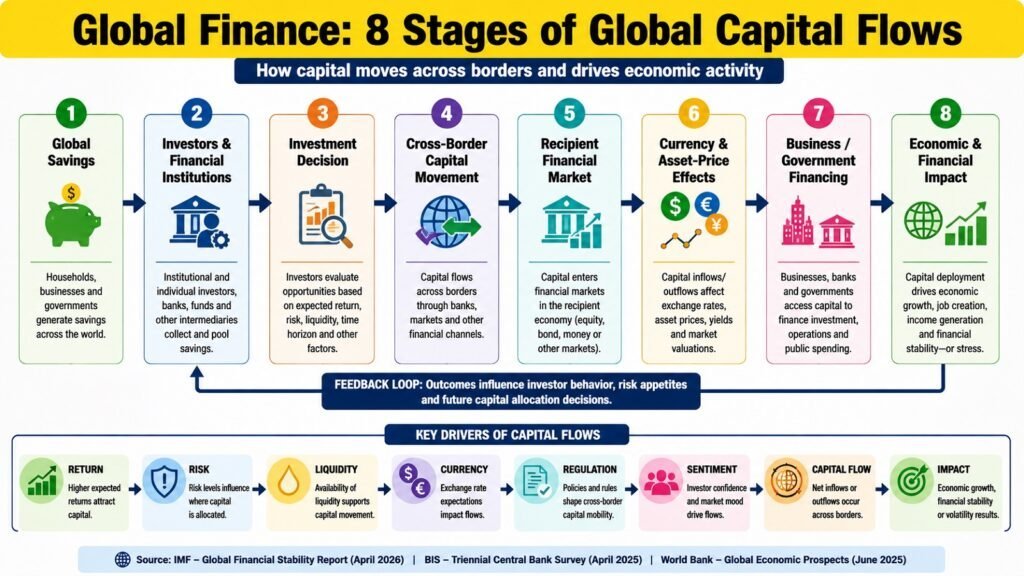
Capital does not stay still. Financial resources move continuously between countries as investors, corporations, banks, and governments pursue returns, manage risks, and respond to changing economic conditions. These cross-border movements — global capital flows — are among the most powerful forces shaping the Global Economy. They take several distinct forms.
Foreign direct investment involves taking a controlling stake in a foreign business or facility, bringing not only capital but also technology and management expertise, and tends to be relatively stable. Portfolio investment covers the purchase of equities and bonds without seeking operational control and is more sensitive to shifting market conditions. Bank lending provides credit to foreign borrowers. The composition of a country’s capital inflows can matter as much as their overall volume.
Investors allocate capital across borders in pursuit of enhanced returns, improved growth opportunities, or more favorable risk-adjusted investments. While short-term financial flows are influenced by interest rate differentials, growth expectations draw in long-term investments. Factors such as regulatory frameworks, political stability, legal safeguards, and currency forecasts all play a role in determining the movement of capital and its duration in a given location. Nations with robust macroeconomic fundamentals and effective institutions generally attract more stable and productive investment types, whereas those with weaker fundamentals may rely on more volatile external financing.
Capital inflows can support investment and growth but carry real risks. Economies attracting large short-term flows can face sudden reversals when global risk appetite falls, or domestic conditions deteriorate — putting downward pressure on currencies, raising borrowing costs, and tightening credit. Both the 1997 Asian financial crisis and the 2013 taper tantrum showed how quickly capital can reverse and how damaging the consequences can be. Analyzing capital flows requires examining their direction, composition, and sustainability alongside conditions in both sending and receiving countries.
Table 5: Global Finance — Types, Drivers, and Consequences of Global Capital Flows
| Capital Flow Concept | Significance in Global Finance |
| Foreign Direct Investment | Provides stable capital along with technology transfer, management expertise, and employment creation |
| Portfolio Investment | Purchases of foreign equities and bonds; more mobile than FDI and sensitive to risk sentiment changes |
| Cross-Border Bank Lending | Supplies external credit to sovereigns and corporations; can contract sharply during financial stress |
| Sudden Stop | Abrupt reversal of capital inflows causing currency pressure, credit tightening, and economic disruption |
| Interest Rate Differentials | Key driver of short-term capital flows toward higher-yielding economies and assets |
| Capital Account Openness | Degree to which a country permits free movement of financial capital across its borders |
| Push and Pull Factors | Global conditions push capital toward risk assets; domestic fundamentals pull it to specific countries |
| Flow Composition | The share of FDI vs. portfolio vs. debt flows determines stability and vulnerability of capital inflows |
5. Global Finance and International Investment
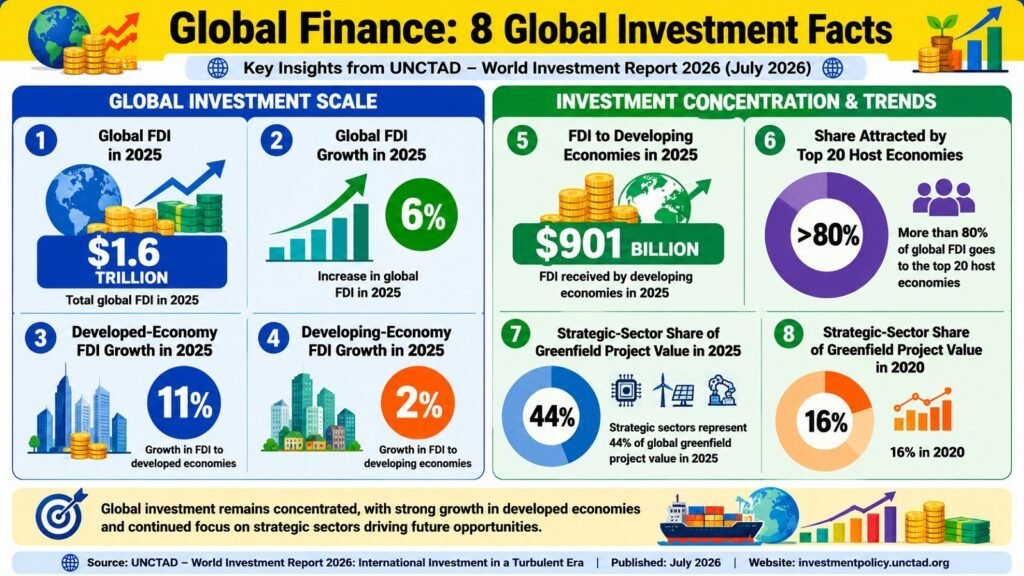
International investment is the mechanism through which global savings are translated into productive assets, business expansion, and economic development across borders. The two primary forms are foreign direct investment and portfolio investment. Foreign direct investment gives the investing party meaningful ownership or control over a business or asset in another country — through building a facility, acquiring a company, or establishing a joint venture.
Portfolio investment involves acquiring financial assets, primarily equities and bonds, in foreign markets without seeking operational influence. Each form reflects different investor motivations and carries different risk and return characteristics, with direct investment generally more stable and portfolio flows more sensitive to shifting market conditions.
Companies invest internationally for strategic reasons: access to growing markets, proximity to natural resources or specialized labor, lower production costs, and advanced technology. Regulatory conditions, tax environments, and institutional quality all influence these decisions. Institutional investors — pension funds, insurance companies, and sovereign wealth funds — allocate capital internationally to achieve diversification and improve risk-adjusted returns.
Sovereign wealth funds alone manage assets exceeding $10 trillion globally, much of it deployed across international markets for long-term return objectives. These flows shape where industries grow, which markets develop, and how capital is allocated across the global economy.
The risks accompanying international investment are real and varied. Currency risk means returns earned abroad may lose value when converted back to the investor’s home currency. Political risk covers government policy changes, regulatory shifts, expropriation, and geopolitical instability. Market volatility can produce sharp short-term losses even in fundamentally sound positions, while regulatory differences across jurisdictions create compliance complexity.
Evaluating international investment requires attention to conditions in target markets, the institutional environment, currency trends, and the investment’s structural form — placing it at the center of Global Finance rather than at its edges.
Table 6: Global Finance — International Investment Concepts, Participants, and Risks
| Investment Concept or Factor | Relevance to Global Finance |
| Foreign Direct Investment | Cross-border ownership stake providing capital, technology, and operational control or influence |
| Portfolio Investment | Purchase of foreign equities and bonds for return and diversification without operational control |
| Sovereign Wealth Funds | State-owned investment vehicles allocating national savings across international asset classes |
| Currency Risk | Risk that exchange rate movements reduce returns when foreign earnings are repatriated |
| Political Risk | Government policy changes, regulatory shifts, or instability that impair investment value or viability |
| Diversification | Spreading investment across countries and asset classes to reduce concentration risk |
| Market Access Motivation | Companies invest internationally to reach consumers in faster-growing or underserved markets |
| Institutional Investors | Pension funds, insurers, and endowments directing savings into international markets for long-run returns |
6. Global Finance and Global Debt and Credit
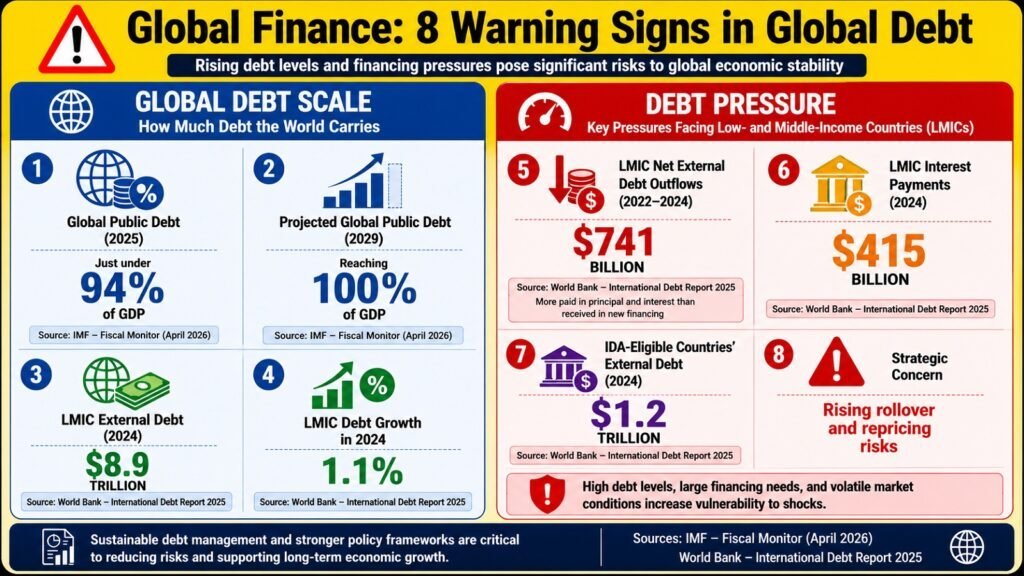
Debt and credit are fundamental mechanisms through which governments, businesses, financial institutions, and households obtain resources before they generate sufficient income to fund their activities. Used wisely, credit enables investment, growth, and development that would otherwise be impossible. Used excessively or under unfavorable conditions, it becomes a source of serious financial vulnerability. Global Finance is the system through which credit crosses borders, and understanding this dimension is essential to understanding where the broader system’s fault lines lie.
The global debt landscape encompasses multiple forms of cross-border borrowing. Sovereign debt involves governments issuing bonds or taking loans from foreign investors, international financial institutions, or bilateral creditors to finance spending or deficits. Corporate debt includes bonds issued in international capital markets or loans from foreign banks.
Syndicated loans spread credit risk across a group of lenders and are a common mechanism for large-scale cross-border financing. International bonds denominated in major reserve currencies allow borrowers to access deep and liquid markets but introduce foreign-currency exposure that can become costly when exchange rates move against the borrower.
Credit serves vital economic functions: infrastructure built with borrowed funds can raise productivity for decades, businesses can expand ahead of future cash flows, and governments can smooth economic cycles by borrowing during downturns. The critical question is not whether debt exists but whether the resources it finances generate returns sufficient to service the obligations it creates. Excessive leverage introduces vulnerabilities that tighten when global conditions turn. Rising interest rates increase debt service costs, and currency depreciation raises the real burden of foreign-currency obligations.
The Latin American debt crises of the 1980s and recurring emerging market pressures during periods of dollar strength illustrate how abruptly these conditions can shift — and how quickly manageable debt can become a constraint on economic activity.
Table 7: Global Finance — Debt and Credit Concepts, Instruments, and Risks
| Debt or Credit Concept | Significance in Global Finance |
| Sovereign Debt | Government borrowing from foreign investors or institutions to finance spending or deficits |
| Corporate Bonds | Debt securities issued in international markets allowing firms to access cross-border capital |
| Syndicated Loans | Large loans shared among multiple banks, spreading credit risk across international lenders |
| Foreign-Currency Debt | Borrowing denominated in a non-domestic currency, creating exchange rate risk for the borrower |
| Debt Service Ratio | Measures borrowing costs as a share of income; rising ratios signal potential repayment stress |
| Refinancing Risk | Risk that maturing debt cannot be renewed on affordable terms when credit conditions tighten |
| Leverage | Ratio of debt to assets or income; high leverage amplifies both gains and financial vulnerabilities |
| Credit Rating | Assessment by agencies of a borrower’s capacity to service debt; affects borrowing costs and market access |
7. Global Finance and Financial Institutions and Governance
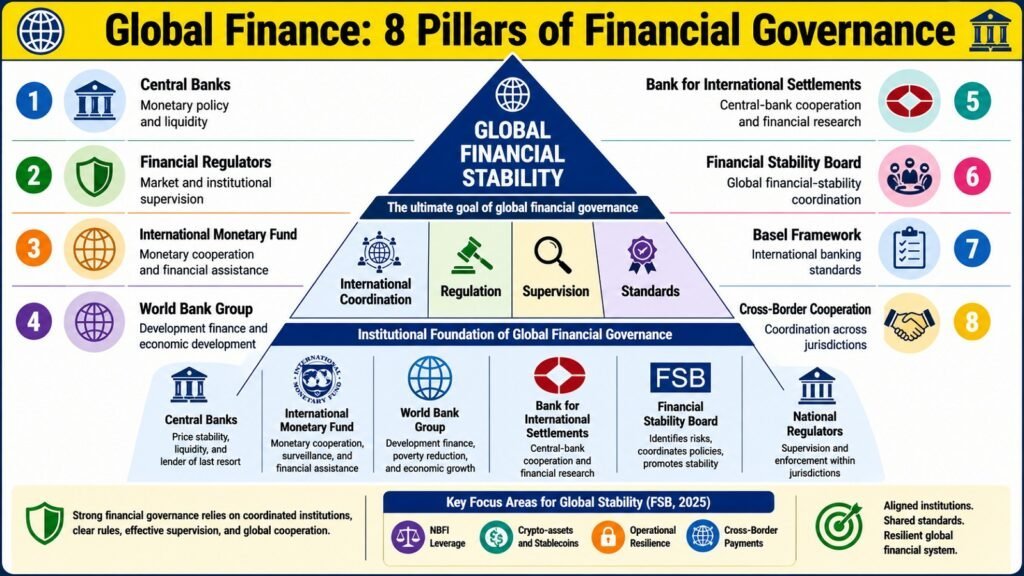
Markets do not govern themselves. For Global Finance to support economic activity and reduce the risk of crises, it requires institutions, rules, standards, and coordination mechanisms. Central banks are the most powerful actors in this framework. They set benchmark interest rates that influence borrowing costs across entire economies, manage foreign exchange reserves, act as lenders of last resort, and deploy unconventional monetary tools when conventional ones prove insufficient. The Federal Reserve, the European Central Bank, the Bank of England, and the Bank of Japan all make decisions that reverberate through global markets.
International financial institutions provide a second layer of architecture. The International Monetary Fund supplies short-term financing and policy advice to countries facing balance-of-payments difficulties. The World Bank finances long-term development projects and structural reforms in lower-income economies. The Bank for International Settlements acts as a bank for central banks, facilitating monetary cooperation and hosting the Basel Committee on Banking Supervision, which sets global standards for bank capital and liquidity. The Financial Stability Board coordinates international regulatory policy and monitors systemic risks across the global financial system.
Domestic regulators oversee institutions within their jurisdictions, while international coordination through the Basel Committee and the Financial Stability Board works to align standards and close gaps that cross-border financial activity might otherwise exploit. IMF Article IV consultations, Basel Committee guidance, and Financial Stability Board reports are valuable analytical reference points — they reflect the considered judgments of organizations whose information and expertise exceeds most individual actors in the system, and they signal how the institutional framework of Global Finance is evolving.
Table 8: Global Finance — Key Institutions, Governance Mechanisms, and Their Roles
| Institution or Mechanism | Role in Global Finance |
| Central Banks | Set interest rates, manage reserves, act as lender of last resort, and implement monetary policy |
| International Monetary Fund | Provides emergency financing and policy advice to countries facing balance-of-payments crises |
| World Bank Group | Finances long-term development projects and structural reform in developing economies |
| Bank for International Settlements | Facilitates central bank cooperation and hosts the Basel Committee on Banking Supervision |
| Basel III Standards | International bank capital and liquidity requirements designed to strengthen global banking resilience |
| Financial Stability Board | Coordinates cross-border regulatory policy and monitors systemic risks in global finance |
| Financial Regulation | National and international rules governing risk-taking, disclosure, and conduct in financial markets |
| Macroprudential Policy | System-level oversight tools used to manage risks that build up across the financial system as a whole |
8. Global Finance and Global Financial Stability
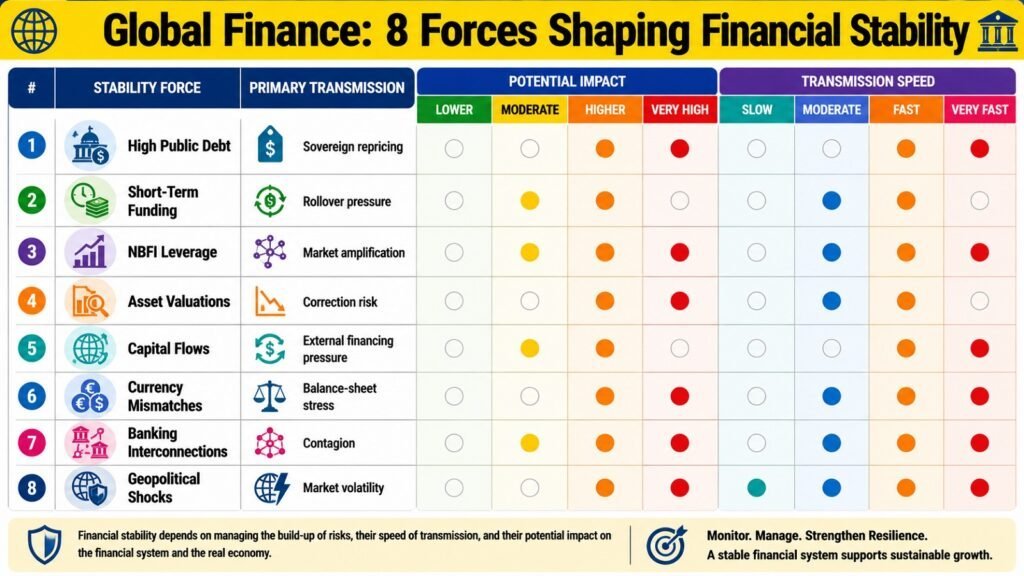
Global financial stability refers to the capacity of the international financial system to keep performing its core functions — allocating capital, processing payments, extending credit, and pricing risk — even when conditions deteriorate. A stable system absorbs shocks without breaking down in ways that damage the broader economy.
Systemic risk is the possibility that one failing institution triggers a broader collapse. Leverage amplifies gains and losses, making highly indebted institutions vulnerable when asset values fall. Liquidity is critical because even solvent institutions can fail if they cannot meet short-term obligations; financial contagion is how stress spreads through direct exposures, confidence channels, or asset price dynamics.
The global financial crisis of 2007 to 2009 demonstrated how instability spreads. Problems in the U.S. subprime mortgage markets moved through structured credit products and interbank lending to produce a global credit contraction, equity market collapse, and the worst downturn since the Great Depression — showing that financial systems can appear stable while vulnerabilities accumulate below the surface.
Regulatory responses reshaped the framework: Basel III raised capital requirements and introduced liquidity coverage ratios; macroprudential policy gave regulators tools to address system-level risk; stress testing became a regular supervisory tool; and the Financial Stability Board improved cross-border monitoring of emerging risks.
Recognizing early warning signs of rising stress requires monitoring several indicators simultaneously. Widening credit spreads signal growing lender caution. Declining bank equity valuations reflect concern about asset quality. Tightening financial conditions indexes indicate credit is becoming harder to access. Exchange rate volatility and capital outflows point to deteriorating external conditions.
Together, these signals reveal stress building before it crystallizes into serious disruption — and why financial stability is ultimately what makes the rest of Global Finance function sustainably.
Table 9: Global Finance — Financial Stability Concepts, Risks, and Policy Tools
| Stability Concept or Tool | Relevance to Global Finance |
| Systemic Risk | Risk that one institution’s failure cascades through the financial system with broad economic consequences |
| Leverage | Amplifies losses in downturns; highly leveraged systems are more vulnerable to shocks and contagion |
| Liquidity Risk | Risk that institutions cannot meet short-term obligations even when fundamentally solvent |
| Financial Contagion | Mechanism by which stress spreads across borders through markets, banks, and investor behavior |
| Capital Adequacy | Minimum equity buffers under Basel III designed to keep banks solvent during adverse conditions |
| Macroprudential Policy | System-level regulatory tools that limit risk accumulation across the financial sector as a whole |
| Stress Testing | Supervisory exercise assessing bank resilience under severe hypothetical economic scenarios |
| Lender of Last Resort | Central bank role providing emergency liquidity to solvent institutions during funding crises |
Conclusion: Global Finance and the Future of the Global Economy
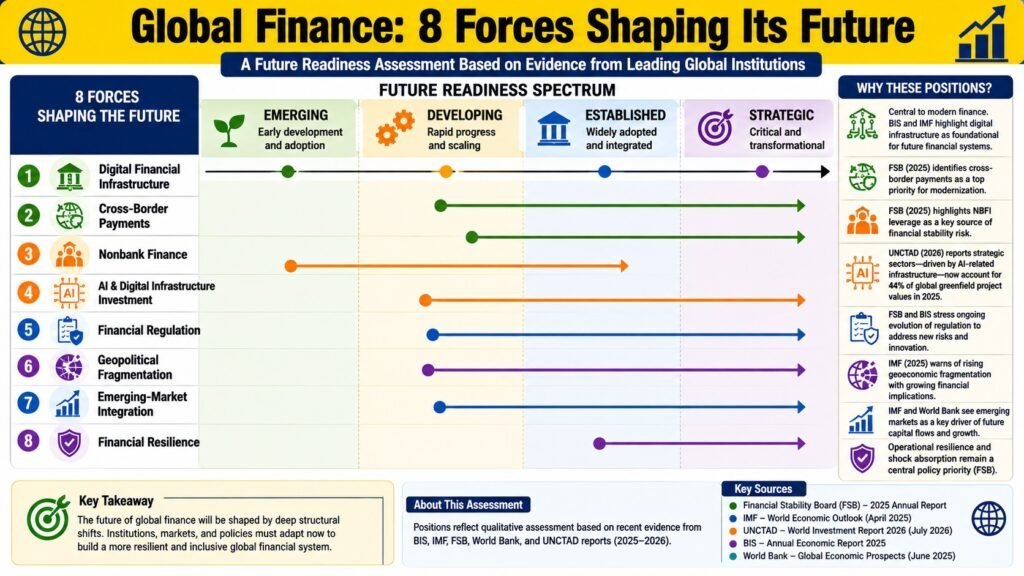
Global Finance is not a collection of separate topics but an integrated system in which markets, banking, currencies, capital flows, investment, debt, institutions, and financial stability interact continuously.
A rise in global interest rates simultaneously affects bond prices, exchange rates, debt service costs, and investment decisions across dozens of economies. A shift in investor risk appetite changes currency valuations, alters capital flow patterns, and modifies financing conditions for governments and businesses. The eight foundations make that interconnectedness concrete rather than abstract.
Several structural forces will shape Global Finance in the years ahead: technological change transforming payment systems and financial intermediation; evolving monetary conditions influencing global liquidity; regulatory frameworks adjusting to new systemic risks; the growing financial weight of emerging markets; and geopolitical developments affecting cross-border investment flows.
These trends make a foundational understanding of Global Finance more valuable, not less. Each of the eight foundations will be examined in greater depth in dedicated articles extending the analysis from this central reference point — building the framework needed to interpret how Global Finance continues to evolve and how those changes ripple through the Global Economy.
Table 10: Global Finance — Key Insights on the Global Economy Connection
| Global Finance Insight | Relationship with the Global Economy |
| System Interconnectedness | Disruption in one foundation transmits rapidly through others via markets, banks, and capital flows |
| Monetary Policy Spillovers | Central bank decisions in major economies affect interest rates, currencies, and credit globally |
| Financial Stability as Foundation | Without stable financial conditions, capital allocation and economic growth are fundamentally constrained |
| Capital Flow Volatility | Sudden reversals of cross-border flows can destabilize currencies, credit markets, and fiscal positions |
| Debt Sustainability | The composition and conditions of global debt determine whether credit supports or threatens growth |
| Institutional Architecture | Rules, standards, and international coordination reduce systemic risk and support market confidence |
| Technology and Digital Finance | Emerging payment systems and digital assets are restructuring cross-border financial intermediation |
| Emerging Market Integration | Rising share of global financial activity in emerging economies shifts the structure of Global Finance |