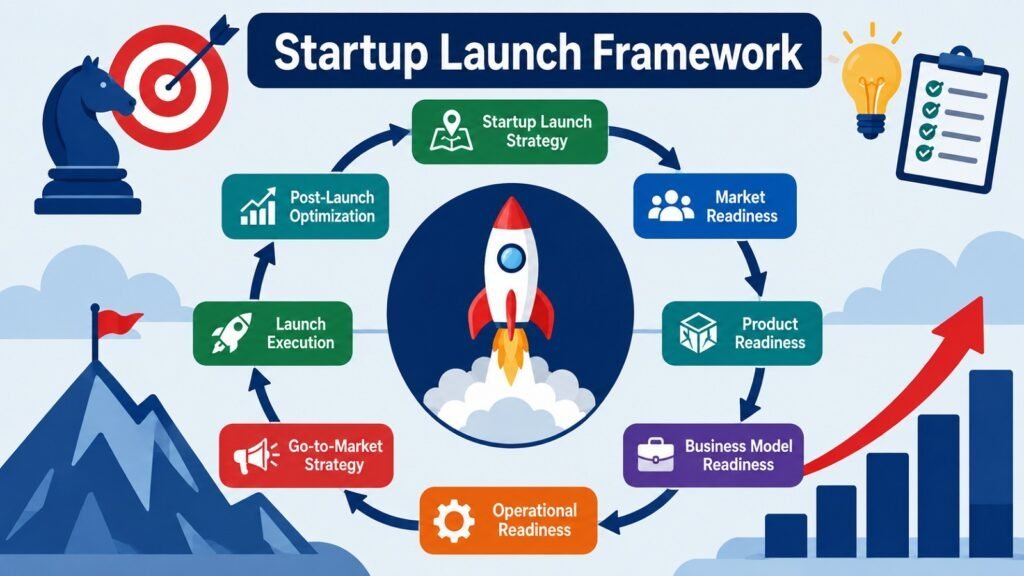
Table of Contents
Introduction: Building the Startup Launch Framework for Market Entry
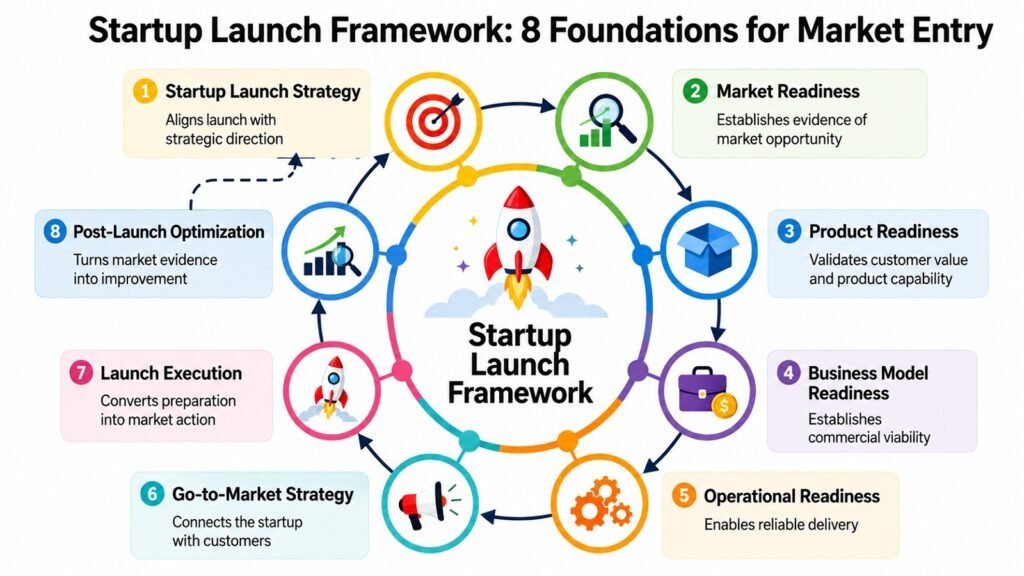
A startup launch is not simply the moment a product becomes available to the public. It is the transition from strategic intent to market reality, and that transition demands far more than a polished product or an enthusiastic announcement. Many startups enter the market with a clear sense of direction but without the underlying readiness that market entry actually requires. The Startup Launch Framework addresses this gap directly.
Having a Startup Strategy does not automatically mean a startup is prepared for market entry. Strategy defines where the business intends to go and how it intends to compete, but even a well-constructed strategy can rest on untested assumptions about customers, demand, pricing, and execution.
The Startup Launch Framework serves as a central operating framework within a broader Startup Strategy, connecting strategic direction with the evidence, capabilities, and coordinated execution that market entry requires. Beneath it sits a Startup Launch Checklist — a practical layer for translating framework requirements into concrete readiness and execution actions. The framework does not guarantee success; it provides a structured way to examine assumptions, identify weaknesses, and respond to real market feedback.
Table 1: Startup Launch Framework – Eight Components and Their Contribution to Market Entry
| Framework Component | Contribution to Market Entry |
| Startup Launch Strategy | Connects the Startup Strategy to market entry by establishing objectives, positioning, timing, and resource priorities |
| Market Readiness | Assesses evidence of real customer need, demand validation, competitive context, and market timing |
| Product Readiness | Determines whether the product can deliver meaningful value under real market conditions |
| Business Model Readiness | Evaluates commercial viability by examining revenue model, pricing, unit economics, and customer willingness to pay |
| Operational Readiness | Confirms that the startup has sufficient capability to serve customers reliably after launch |
| Go-to-Market Strategy | Identifies how the startup will reach, engage, and convert its initial target customers |
| Launch Execution | Coordinates the activities, communication, and monitoring required for structured market entry |
| Post-Launch Optimization | Converts market evidence into learning, adjustment, and improvement of strategy and execution |
1. Startup Launch Framework: Startup Launch Strategy
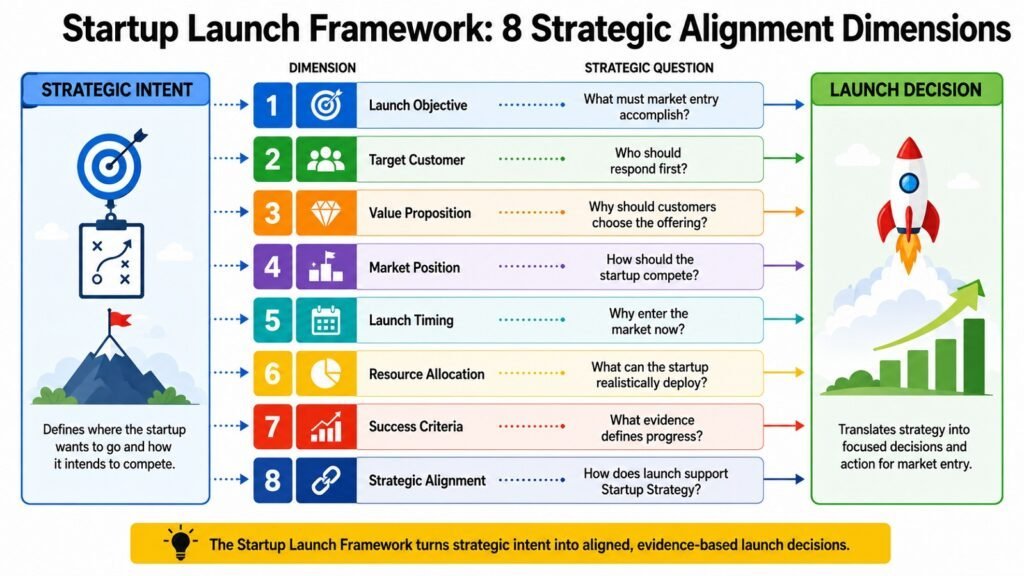
Startup Launch Strategy is the strategic foundation of the Startup Launch Framework. It translates a broader Startup strategy from a directional document into a practical guide for entering a specific market at a specific time. Without it, the other seven components lack a coherent reference point, because decisions about customer targeting, pricing, operations, and distribution all depend on strategic direction being established first.
A common problem among early-stage startups is intense activity without strategic alignment. Teams can move fast and build features without defining what they are trying to accomplish through launch, who they are targeting, or how they intend to compete. Sarasvathy’s research on effectual reasoning shows that expert entrepreneurs maintain clear awareness of their means, constraints, and acceptable outcomes. Porter’s work on competitive strategy shows that a startup idea without a defensible position — through cost advantage, differentiation, or focus — will struggle where alternatives exist. Christensen’s disruption theory adds that targeting underserved segments often provides more traction than confronting established competitors directly.
The Startup Launch Framework helps founders distinguish between what they believe about their market and what they have evidence to support. Assumptions about customer behavior, competitive response, and resource requirements should be made explicit rather than buried in an optimistic plan. When visible, they become testable. Weaknesses here tend to surface as inconsistencies in Market Readiness, Business Model Readiness, and Go-to-Market Strategy — which is why this component must be resolved first.
Table 2: Startup Launch Framework – Strategic Considerations and Their Practical Implications
| Strategic Consideration | Practical Implication |
| Launch objective clarity | Determines whether execution activities are aligned toward a defined outcome or dispersed across competing priorities |
| Initial customer segment | Defines who the startup is targeting first and why, preventing unfocused go-to-market efforts |
| Competitive positioning | Specifies how the startup differs from alternatives, informed by Porter’s differentiation or focus strategies |
| Market timing assessment | Evaluates whether the market is ready to adopt the solution and whether the startup can capitalize on current conditions |
| Resource allocation | Identifies where limited capital, time, and talent should be concentrated for maximum strategic impact |
| Assumption identification | Surfaces beliefs about customers, demand, and competition that have not yet been validated with evidence |
| Strategic priority sequencing | Determines which decisions must be made before launch and which can be deferred without increasing risk |
| Measurable launch outcomes | Establishes indicators that will confirm whether the strategic intent is being achieved through market activity |
2. Startup Launch Framework: Market Readiness
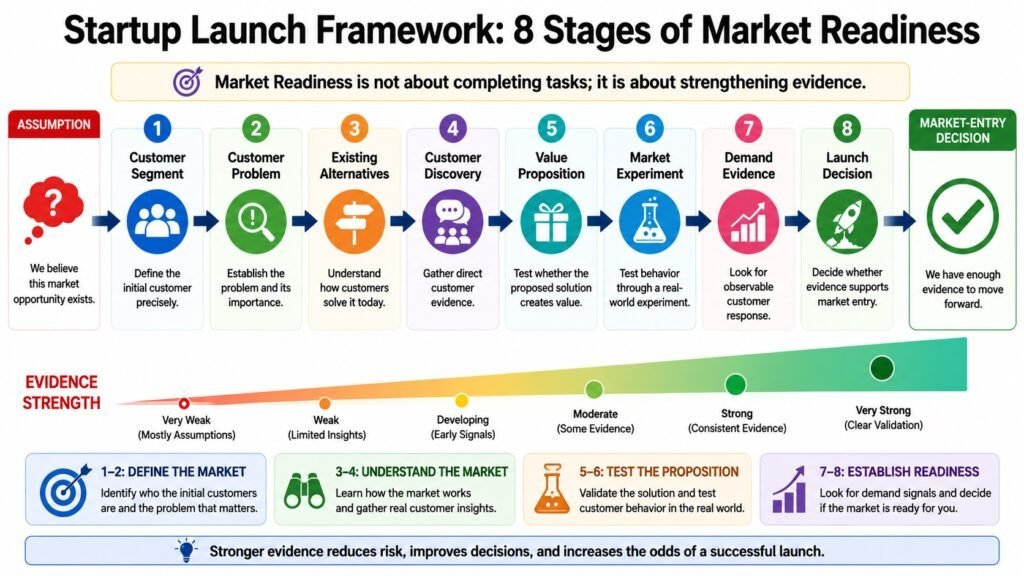
Market Readiness is the component of the Startup Launch Framework concerned with whether the startup has sufficient evidence of a meaningful market opportunity before committing to entry. It is not enough for a founder to believe that a problem exists. Market Readiness requires genuine evidence: that a defined group of customers experiences the problem, that they currently seek alternatives to address it, and that they have a reason to adopt something new.
Steve Blank’s customer development methodology established a rigorous approach to this inquiry. His central argument — which shaped the Lean Startup movement — was that startups are temporary organizations searching for a repeatable and scalable business model, and that search must begin with the customer. Ries extended this by arguing that validated learning, derived from real market experiments, is the most important unit of startup progress. Research by CB Insights consistently identifies the absence of market need as a leading cause of startup failure — not poor execution, but a mismatch between product and market. Rogers’s diffusion of innovation research adds that adoption is shaped by perceived risk and switching costs, not technical superiority alone.
Within the Startup Launch Framework, Market Readiness directly shapes Product Readiness and Go-to-Market Strategy. Weak or ambiguous market evidence means that investing in a more complete product or broader distribution is unlikely to improve outcomes. Market Readiness is an ongoing diagnostic process, not a one-time prerequisite.
Table 3: Startup Launch Framework – Market Readiness Dimensions and Key Diagnostic Questions
| Market Readiness Dimension | Diagnostic Question |
| Customer problem evidence | Is there direct evidence that a defined customer group experiences this problem with meaningful frequency or cost? |
| Demand validation | Have customers demonstrated willingness to pay, switch from alternatives, or take action in response to the offering? |
| Target market definition | Is the initial target market specific enough to enable focused and effective customer acquisition? |
| Competitive alternatives | What do customers currently use to address this problem, and what would cause them to switch? |
| Willingness to adopt | What are the perceived risks and switching costs that may slow or prevent customer adoption? |
| Market timing | Are technological, regulatory, behavioral, or economic conditions favorable for adoption at this moment? |
| Market size evidence | Is there credible evidence of sufficient addressable demand to support the startup’s strategic objectives? |
| Segment prioritization | Which customer segment offers the best combination of urgency, accessibility, and strategic value for initial entry? |
3. Startup Launch Framework: Product Readiness
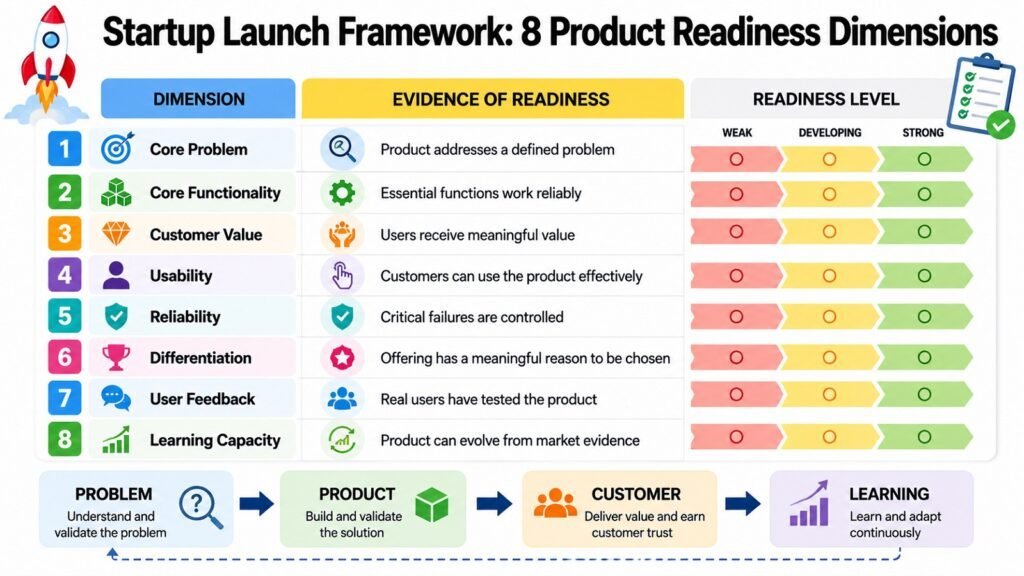
Product Readiness within the Startup Launch Framework is not about achieving perfection before launch. It is about determining whether the product can deliver meaningful value to real customers under real market conditions. Many startups either delay launch while pursuing an ideal product, or rush to market with something below the threshold for a satisfactory customer experience. Both approaches defer the market learning that actual launch exposure would provide.
The Minimum Viable Product (MPV) concept, developed by Ries and rooted in Blank’s earlier work, is central here. An MVP is the most focused version of a product that enables the startup to test its most important assumptions using the least development effort. The objective is to learn, not to impress. When Dropbox launched with a short video demonstrating a product that did not yet fully exist, it gathered over 75,000 signups overnight — evidence of demand that shaped development without requiring a complete product.
Blank’s customer development model treats product development and customer learning as parallel processes, which is why Product Readiness cannot be assessed independently of market evidence. A technically capable product that does not match what the market wants is not ready regardless of quality, and adding features without validating demand is usually a way of avoiding the learning that launch would force.
Table 4: Startup Launch Framework – Product Readiness Dimensions and Their Practical Meaning
| Product Readiness Dimension | Practical Meaning |
| Core functionality reliability | The product performs its primary function consistently enough to deliver a predictable customer experience |
| Usability for target customers | Real customers can use the product without requiring excessive guidance, support, or tolerance for friction |
| Problem-solution alignment | The product addresses the specific problem identified through market and customer discovery |
| MVP scope discipline | Development has focused on testing the most important assumptions rather than building comprehensive features |
| Early user feedback quality | Feedback from genuine users in real conditions has shaped product decisions, not just internal testing |
| Differentiation clarity | The product offers a meaningful and recognizable advantage compared to what customers currently use |
| Customer experience adequacy | The end-to-end experience of using the product is sufficient to retain early customers and generate honest feedback |
| Iterative development capacity | The team has the ability to update, improve, and respond to market evidence after launch |
4. Startup Launch Framework: Business Model Readiness
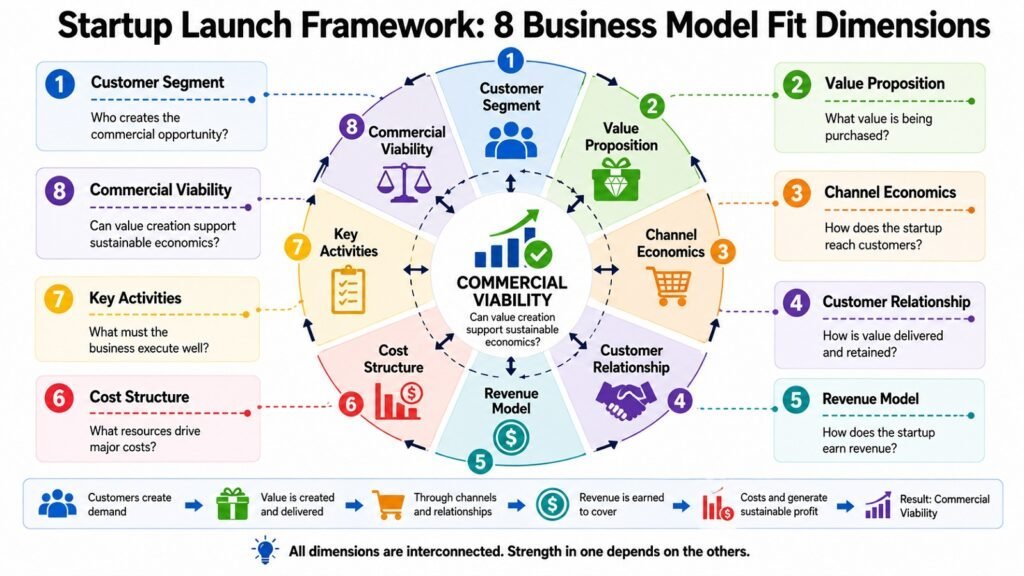
Business Model Readiness is the component of the Startup Launch Framework that examines whether the startup can create, deliver, and capture value after entering the market. A compelling product and strong market demand are necessary but not sufficient conditions for a sustainable business. Many startups discover, after significant investment, that their approach to generating revenue does not match what the market will support.
Osterwalder and Pigneur’s Business Model Canvas is a useful starting point, but only as valuable as the evidence behind its assumptions. A completed canvas filled with untested beliefs about customer willingness to pay and cost structure is a hypothesis document. Pricing is among the most consequential dimensions. Ariely’s research on price anchoring shows that customers evaluate prices against alternatives and perceived value, not in isolation. Unit economics deserve equal scrutiny: the relationship between customer acquisition cost and customer lifetime value is one of the clearest indicators of whether a business model can scale.
A startup spending more to acquire each customer than it earns from that relationship is not generating value for itself, regardless of volume. Within the Startup Launch Framework, Business Model Readiness interacts directly with Market Readiness, Product Readiness, and Go-to-Market Strategy, helping expose contradictions between what the startup wants to sell, what customers value, and what the business needs to earn.
Table 5: Startup Launch Framework – Business Model Considerations and Their Commercial Relevance
| Business Model Consideration | What It Reveals About Commercial Readiness |
| Revenue model structure | Whether the chosen revenue mechanism (subscription, transaction, licensing, etc.) matches customer purchasing behavior |
| Pricing assumption testing | Whether customers have confirmed willingness to pay at the proposed price point through observable behavior |
| Unit economics baseline | Whether the relationship between acquisition cost and lifetime value is understood and moving in a sustainable direction |
| Customer acquisition cost | Whether the cost of gaining each customer is consistent with the revenue and margin the business model generates |
| Cost structure alignment | Whether fixed and variable costs are understood well enough to identify the conditions under which the business becomes viable |
| Payment and billing mechanisms | Whether the processes for collecting revenue are functional, tested, and capable of handling real customer transactions |
| Value proposition-price alignment | Whether the price the startup wants to charge is supported by the value customers recognize and prioritize |
| Scalability assumptions | Whether the economics improve, worsen, or remain stable as the customer base grows, and why |
5. Startup Launch Framework: Operational Readiness
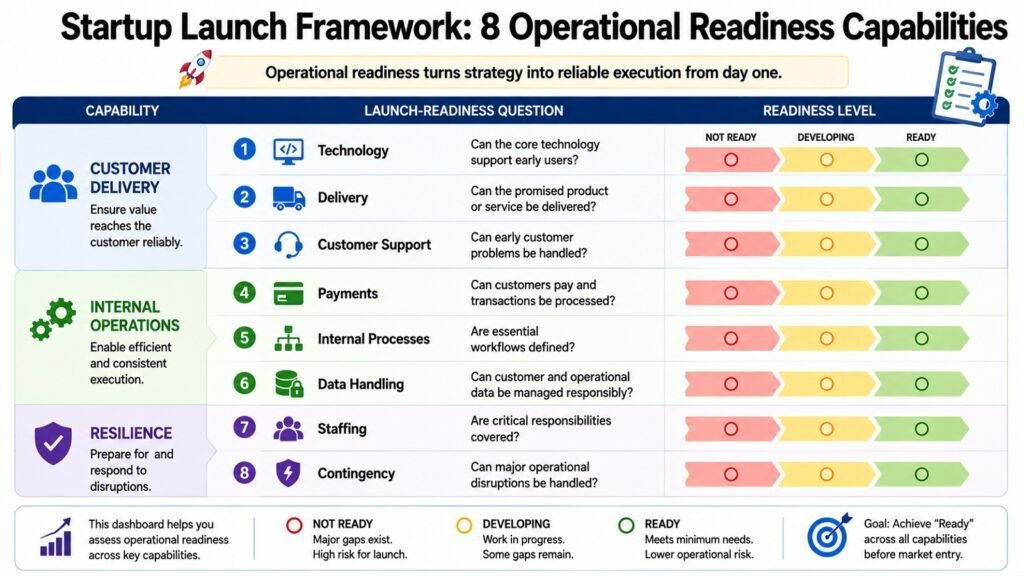
Operational Readiness is the component of the Startup Launch Framework that determines whether the startup can deliver its promised value consistently once real customers begin arriving. A startup that has validated demand and developed a capable product can still disappoint early customers if the systems, processes, and capabilities required to serve them reliably are not in place.
Mintzberg’s work on organizational design emphasizes that structure and process should follow strategy. A startup pursuing a high-volume, low-touch model needs different operational capabilities than one delivering a premium, high-touch service. The principle of minimum viable operations is a useful guide: founders do not need large corporate infrastructure before launch — they need enough capability to fulfill their core promise, handle early transactions and support requests, and maintain basic compliance.
Operational weaknesses tend to surface at the worst possible moment: during a successful launch. A startup that generates real interest but cannot onboard users efficiently, process payments reliably, or resolve support issues promptly will convert enthusiasm into frustration. Negative early experiences spread quickly in markets where social proof shapes adoption decisions.
Within the Startup Launch Framework, Operational Readiness protects the customer experience during Launch Execution and supports the learning that Post-Launch Optimization requires. Stable operations ensure that post-launch data reflects the product and business model rather than operational noise.
Table 6: Startup Launch Framework – Operational Dimensions and Practical Readiness Questions
| Operational Dimension | Practical Readiness Question |
| Technology infrastructure | Can the platform, application, or service perform reliably under the transaction volumes expected at launch? |
| Fulfillment and delivery | Are the processes for delivering the product or service to customers consistent, scalable, and tested? |
| Customer support capacity | Is there a functional mechanism for receiving, tracking, and resolving customer questions and issues promptly? |
| Payment processing | Are billing, invoicing, and payment collection systems functional and tested with real transactions? |
| Data handling and privacy | Are customer data storage, access controls, and compliance obligations understood and addressed appropriately? |
| Staffing and capability | Does the team have the skills and capacity to manage early customer volume without operational collapse? |
| Compliance requirements | Are the relevant legal, regulatory, or industry-specific obligations identified and addressed before launch? |
| Issue response process | Is there a clear process for identifying, escalating, and resolving operational problems quickly during and after launch? |
6. Startup Launch Framework: Go-to-Market Strategy
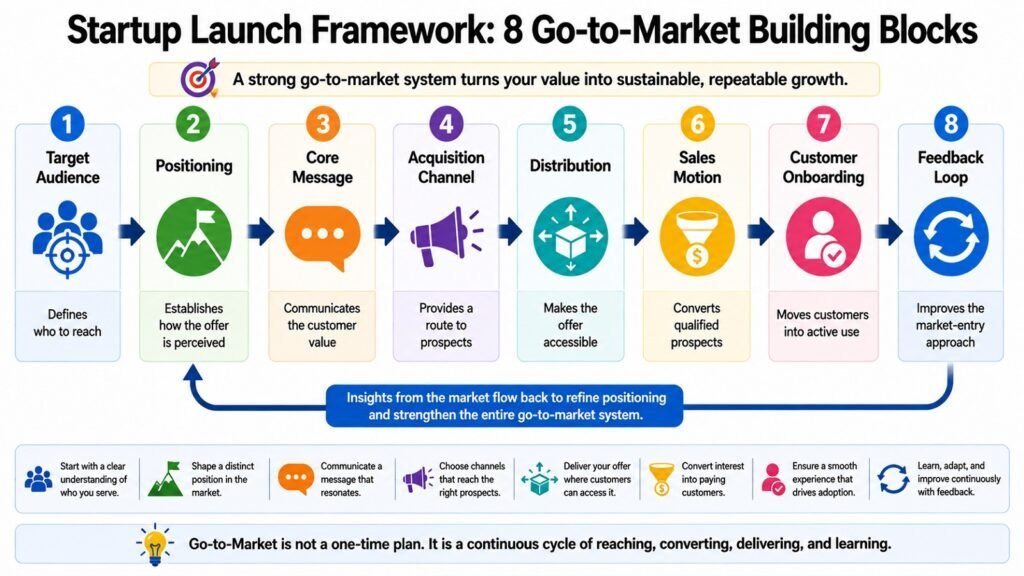
Go-to-Market Strategy is the component of the Startup Launch Framework concerned with how the startup reaches and converts its intended initial customers. It is distinct from Startup Launch Strategy, which establishes broader strategic direction. Go-to-Market Strategy is more specific: it defines the acquisition channels, messaging, positioning, and distribution approaches through which the startup brings its validated value proposition to market.
A common error in go-to-market planning is selecting channels based on popularity rather than evidence of where the target customer makes purchasing decisions. Peter Thiel has argued that most successful startups find one distribution channel that works well before diversifying — spreading resources across too many channels too early means none gets properly validated. Rogers’s diffusion of innovation research supports this: early adopters typically seek new solutions through specialist publications, professional communities, and peer recommendations, not the mainstream channels that reach later-stage buyers. Targeting early adopters through the channels they actually use generates more meaningful traction than designing for a broader audience not yet aware of the problem being solved.
Messaging should reflect what Market Readiness and Product Readiness have established about the customer and the problem. Positioning that uses terms customers do not recognize is unlikely to create the resonance acquisition requires. Within the Startup Launch Framework, Go-to-Market Strategy must also be commercially coherent with Business Model Readiness: if acquiring customers through a chosen channel costs more than the business model can support, the channel is not viable regardless of its reach.
Table 7: Startup Launch Framework – Go-to-Market Dimensions and Their Market-Entry Purpose
| Go-to-Market Dimension | Market-Entry Purpose |
| Target audience precision | Ensures acquisition efforts are directed at the specific customer segment with the highest urgency and accessibility |
| Channel selection rationale | Confirms that chosen channels are based on evidence of where the target customer actually makes purchase decisions |
| Positioning clarity | Establishes how the startup is differentiated from alternatives in terms the target customer recognizes and values |
| Messaging alignment | Ensures that external communication reflects the language, priorities, and concerns of the target customer |
| Acquisition cost feasibility | Confirms that the cost of reaching customers through chosen channels is consistent with the business model’s economics |
| Early adopter focus | Prioritizes reaching customers most likely to adopt new solutions, provide feedback, and influence others |
| Partnership and distribution | Identifies whether third-party channels, platforms, or partners can extend reach in a cost-effective manner |
| Channel testing approach | Defines how the startup will measure and compare the performance of initial acquisition channels before committing resources |
7. Startup Launch Framework: Launch Execution
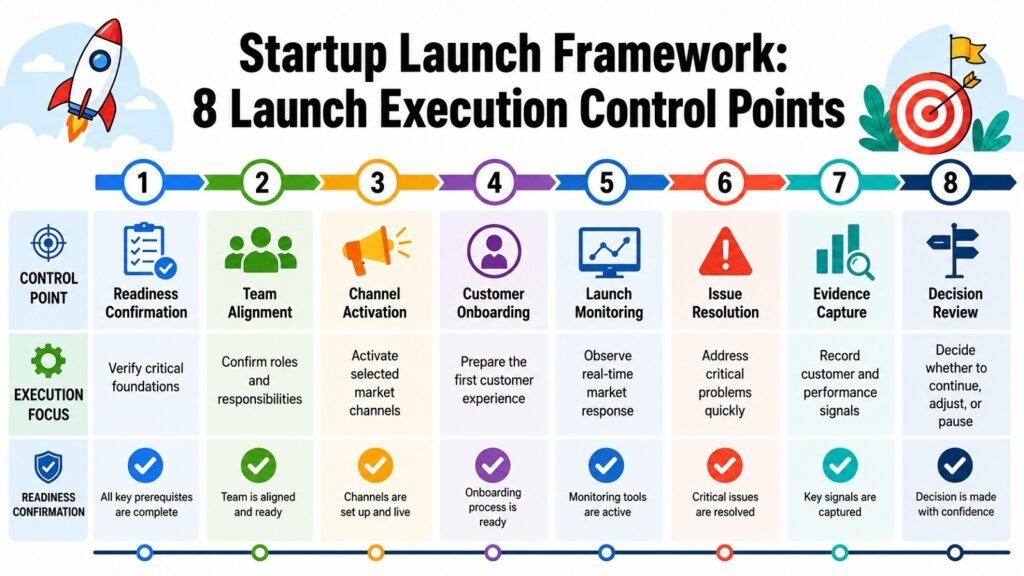
Launch Execution is the component of the Startup Launch Framework where preparation becomes action. It is the stage at which strategic, market, product, commercial, operational, and go-to-market foundations are coordinated and converted into actual market activity. How well that coordination happens determines whether strategic preparation translates into meaningful early results.
Launch is better understood as a process than a single event. Galbraith’s research on organizational coordination shows that execution quality depends on clarity of roles, shared understanding of objectives, effective communication, and the ability to make rapid decisions when circumstances diverge from the plan.
Launch teams should monitor what is happening in the market and be prepared to adjust — early customer responses, acquisition channel performance, onboarding completion rates, and support volume all provide early signals about whether the launch is proceeding as intended. This is where the Startup Launch Checklist enters as a secondary practical layer: it translates framework requirements into specific tasks and verification points covering readiness confirmation, communication sequences, monitoring protocols, escalation processes, and decision triggers. The checklist supports strategic judgment rather than replacing it.
Clear decision-making authority matters equally: ambiguity about who can make which decisions during a live launch can turn manageable problems into customer-facing failures. A clear framework for when to proceed, pause, investigate, or adjust helps teams maintain momentum without ignoring signals that warrant attention.
Table 8: Launch Execution Considerations and Their Role During Market Entry
| Execution Consideration | Role During Market Entry |
| Ownership and accountability | Ensures each critical launch activity has a named owner who is responsible for completion and quality |
| Communication sequence | Coordinates internal and external messaging so that team activity and customer-facing communications are synchronized |
| Channel activation timing | Ensures that acquisition channels are activated in a sequence that allows early data to inform subsequent decisions |
| Customer onboarding monitoring | Tracks whether new customers successfully complete the onboarding experience and where friction or drop-off occurs |
| Real-time signal monitoring | Establishes what data the team will watch during launch and how quickly they will respond to unexpected patterns |
| Issue escalation process | Defines how problems are identified, communicated, and resolved during the launch period |
| Startup Launch Checklist use | Translates framework requirements into specific tasks and verification points without replacing strategic judgment |
| Decision trigger framework | Specifies the conditions under which the team should proceed, pause, investigate, or adjust the launch plan |
8. Startup Launch Framework: Post-Launch Optimization
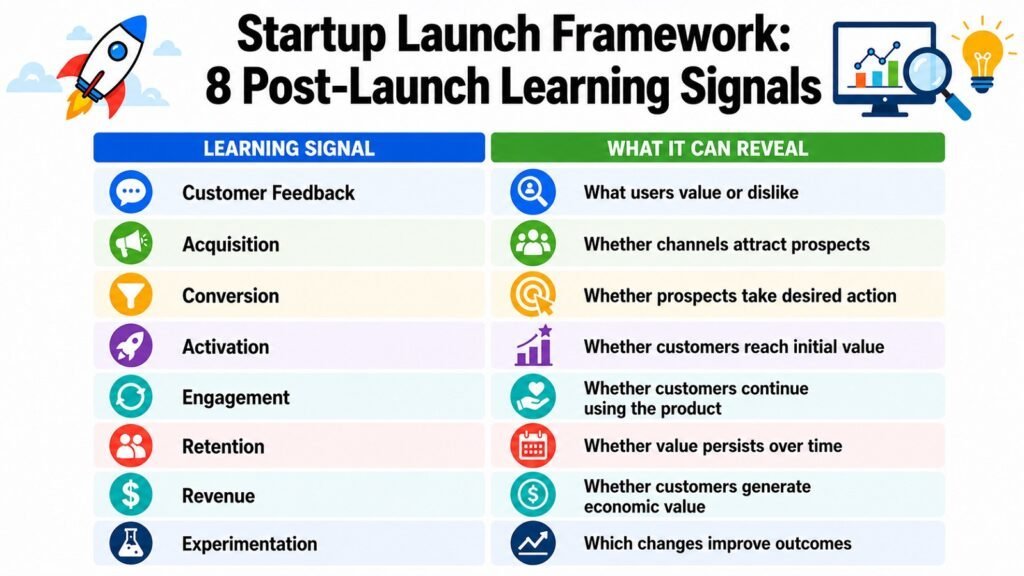
Post-Launch Optimization is the component of the Startup Launch Framework that transforms market entry from a single event into an ongoing process of evidence, learning, and improvement. The assumption that launch completion means the work is finished is one of the most common and damaging misconceptions in early-stage entrepreneurship. Market entry is the beginning of the startup’s relationship with real customers under real conditions, not its conclusion.
Ries argues that the fundamental activity of a startup is to turn ideas into products, measure how customers respond, and learn whether to persevere or pivot. This cycle intensifies after launch, because the startup now has access to real behavior analytics and data, and unfiltered feedback that pre-launch research cannot replicate. The choice of what to measure matters as much as measuring itself. Vanity metrics — numbers that look impressive but do not reveal whether the business is improving — can mislead founders when underlying dynamics are fragile.
Slack’s development path illustrates how post-launch evidence drives consequential decisions: the company pivoted from a gaming venture (Glitch) to an internal communication tool after observing how its own team used a messaging system built for operations. Usage behavior, not the original strategy, drove the change. Within the Startup Launch Framework, Post-Launch Optimization makes the system iterative rather than linear — evidence gathered after launch can send a startup back to reconsider its market assumptions, product, business model, or go-to-market approach, and this is the framework functioning as intended.
Table 9: Post-Launch Signals and What They Reveal
| Post-Launch Signal | What It Reveals for Decision-Making |
| Activation rate | Whether new customers successfully complete the initial steps required to experience the product’s core value |
| Retention and churn | Whether customers continue using the product after initial exposure, revealing the strength of the value proposition |
| Revenue conversion | Whether customers are willing to pay at the proposed price point, confirming or challenging Business Model Readiness |
| Acquisition channel performance | Which channels are delivering customers at a cost and quality consistent with the go-to-market assumptions |
| Customer support patterns | What problems customers most frequently encounter, indicating where product, onboarding, or communication needs improvement |
| Net Promoter Score trends | Whether customers would recommend the product to others, providing an early signal of word-of-mouth potential |
| Feature usage distribution | Which product capabilities customers actually use, revealing whether development priorities matched real needs |
| Customer feedback themes | What customers consistently say about the product’s value, limitations, and comparison to alternatives |
Conclusion: Strengthening Market Entry with the Startup Launch Framework
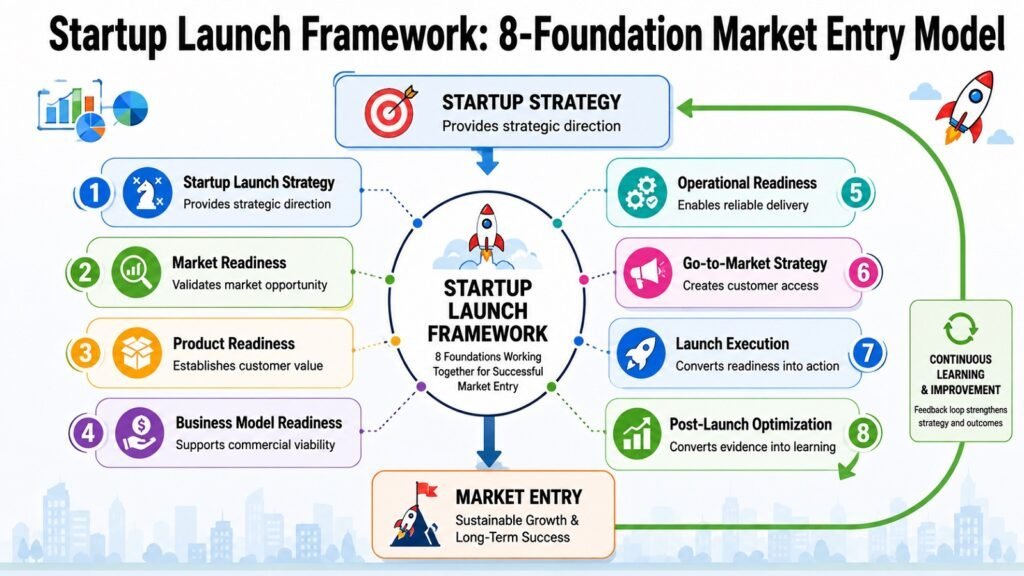
The Startup Launch Framework should not be viewed as a set of eight separate tasks; rather, it is a cohesive system. Each element is interdependent and affects the others — starting with the Startup Launch Strategy, which sets the course for all subsequent decisions, and continuing through Market Readiness, Product Readiness, Business Model Readiness, Operational Readiness, and Go-to-Market Strategy, culminating in Launch Execution and Post-Launch Optimization. The overall effectiveness of the system is determined by its weakest link.
This is the most important insight the framework offers: weaknesses in one area create problems elsewhere. A startup that has not validated its market assumptions may invest heavily in a product customers do not value. One that has not examined its business model may discover only after acquiring customers that the economics do not work at the price the market will accept. The Startup Launch Framework helps founders see these interconnections before they become expensive failures. Strategy establishes where the business intends to go; the framework translates that intent into a structured approach to readiness assessment, coordinated execution, and evidence-based learning.
The Startup Launch Checklist operates as an implementation layer beneath the framework, converting requirements into specific readiness tasks for before, during, and after launch. The framework is iterative rather than linear — post-launch evidence should send founders back to revisit market assumptions, product direction, business model, or go-to-market approach as the market requires. It does not guarantee startup success, but it provides a structured way to examine assumptions, gather evidence, make disciplined decisions, and respond to what the market reveals. Founders who use it as a recurring decision tool will find it considerably more valuable than those who use it once and move on.
Table 10: Startup Launch Framework – Eight Foundations and Their Contribution to Launch Readiness
| Framework Foundation | Contribution to Overall Launch Readiness |
| Startup Launch Strategy | Aligns all other components around clear objectives, positioning, timing, and priorities drawn from the Startup Strategy |
| Market Readiness | Provides evidence-based confidence that a meaningful customer problem and addressable market opportunity exist |
| Product Readiness | Confirms the product can deliver consistent value to the customers and problem identified through market validation |
| Business Model Readiness | Establishes that the startup can capture value commercially through a viable revenue model and sustainable unit economics |
| Operational Readiness | Ensures the startup has sufficient capability to deliver reliably, handle customers, and maintain service quality at launch |
| Go-to-Market Strategy | Defines the evidence-based path through which the startup will reach, engage, and convert its initial target customers |
| Launch Execution | Translates preparation into coordinated, monitored, and responsive market activity supported by the Startup Launch Checklist |
| Post-Launch Optimization | Converts market evidence into ongoing learning that refines the Startup Strategy and improves each framework component |