Table of Contents
Introduction: Why Cloud Computing Powers Modern Technology
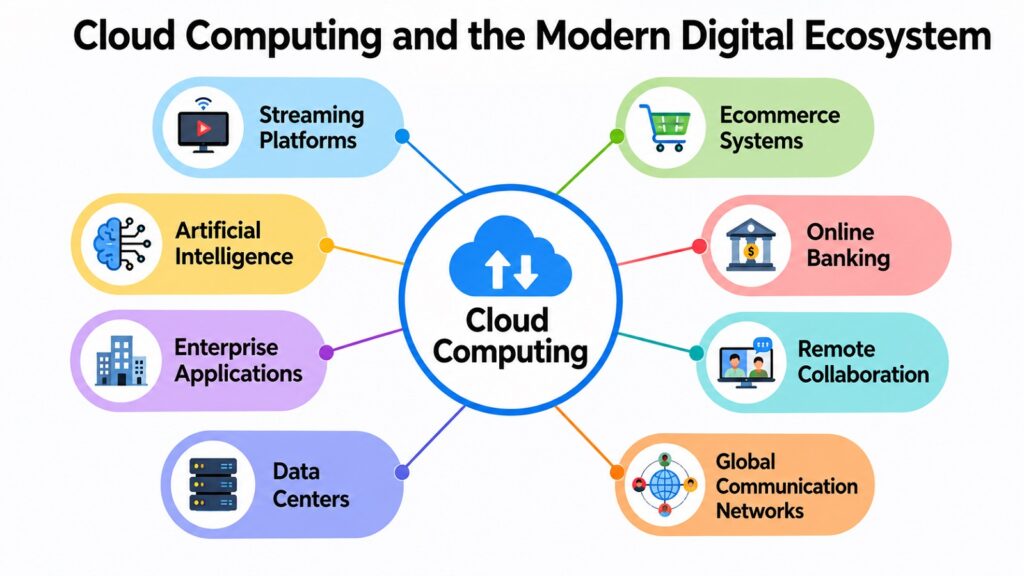
Every time you stream a movie, transfer money through a banking app, or search for a product online, Cloud Computing is working behind the scenes. It is one of the most important aspects of modern technology, holding up the digital world that billions of people rely on every day. Without it, the platforms and services that feel instant and reliable would struggle to function at any meaningful scale.
Think about what it takes to run a global streaming service or a payment system like Stripe. These platforms must serve millions of simultaneous users, store enormous volumes of data, and recover from hardware failures without anyone noticing. Traditional server infrastructure could not keep up. Cloud Computing changed that by turning infrastructure into something flexible and globally distributed. Artificial intelligence systems, e-commerce platforms during peak sales events, and global communication networks all depend on the same model: distribute workloads intelligently across vast data center networks and let the infrastructure adapt as conditions change.
This article walks through eight foundational pillars that explain how Cloud Computing actually works. Each section covers a distinct aspect of the technology, from the virtualization layers beneath cloud infrastructure to the DevOps practices that keep cloud environments evolving quickly. Together, these eight areas offer a complete picture of what Cloud Computing is built on and why it matters.
Table 1: Cloud Computing Foundations at a Glance
| Cloud Computing Foundation | Core Role and Relevance |
| Virtualization & Hypervisors | Abstracts physical hardware into virtual machines, enabling multiple workloads to share one server efficiently |
| Cloud Service Models | Delivers infrastructure, platforms, and software as on-demand services (IaaS, PaaS, SaaS, Serverless) |
| Cloud Deployment Models | Defines where workloads run: public, private, hybrid, or multi-cloud environments |
| Distributed Computing Systems | Spreads workloads across many servers globally to ensure fault tolerance and high availability |
| Containers & Orchestration | Packages applications with their dependencies for consistent, portable deployment across any cloud environment |
| Cloud Scalability & Elasticity | Automatically adjusts computing resources in real time to match fluctuating demand |
| Cloud Security Architecture | Protects data, identities, and infrastructure through encryption, access control, and compliance frameworks |
| Cloud Automation & DevOps | Uses code-driven automation and continuous delivery pipelines to manage and evolve cloud infrastructure rapidly |
1. Cloud Computing and Virtualization & Hypervisors
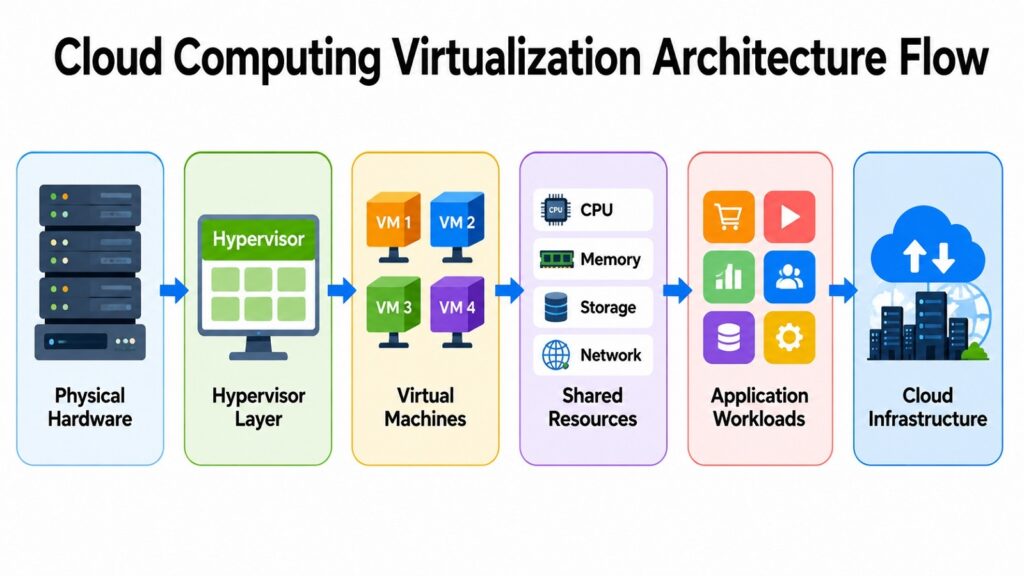
Before Cloud Computing became practical, organizations ran separate physical servers for each workload, yet most ran at only fifteen to twenty percent of their capacity. Buying more servers to handle peak traffic meant hardware sitting idle the rest of the time. It was expensive and wasteful. Virtualization solved this by introducing a software layer that made one physical machine behave like several independent computers, each with its own operating system and applications, all sharing the same underlying hardware.
At the center of virtualization sits a hypervisor, which creates and manages virtual machines. A Type 1 hypervisor like VMware ESXi or Microsoft Hyper-V runs directly on physical hardware. A Type 2 hypervisor like VMware Workstation runs on top of a host operating system and is more common in development environments than in large-scale production cloud infrastructure.
Cloud Computing providers like AWS, Azure, and Google Cloud use virtualization to carve their physical data center infrastructure into thousands of isolated virtual environments. When a customer launches a virtual machine on AWS, they receive a slice of a server that might simultaneously host dozens of other workloads. The hypervisor ensures complete isolation, and because virtual machines are software constructs, they can be moved, backed up, and restored without interruption. This resource pooling is what makes Cloud Computing economically viable: a provider aggregates hundreds of servers and allocates capacity dynamically, so a startup can access the same quality of infrastructure as a large enterprise without the capital outlay.
Table 2: Key Cloud Computing Virtualization Technologies and Hypervisors
| Technology / Platform | Role in Cloud Computing Virtualization |
| VMware ESXi | Type 1 bare-metal hypervisor widely used in enterprise private cloud and VMware vSphere deployments |
| Microsoft Hyper-V | Native Type 1 hypervisor integrated into Windows Server, underpins Microsoft Azure virtual machine infrastructure |
| KVM (Kernel-based VM) | Open-source Type 1 hypervisor built into the Linux kernel, used by Red Hat OpenStack and many public cloud providers |
| Xen Hypervisor | Type 2 hypervisor is used in developer and testing environments for running multiple operating systems on one machine |
| AWS Nitro System | Custom hypervisor and hardware offload stack developed by Amazon to improve EC2 performance and isolation |
| VMware vSphere | Enterprise virtualization platform combining ESXi with vCenter management for large-scale private cloud infrastructure |
| Oracle VM VirtualBox | Type 2 hypervisor used in developer and testing environments for running multiple operating systems on one machine |
| Google Cloud Hypervisor | Custom KVM-based virtualization layer that powers Google Compute Engine virtual machine instances globally |
2. Cloud Computing and Cloud Service Models
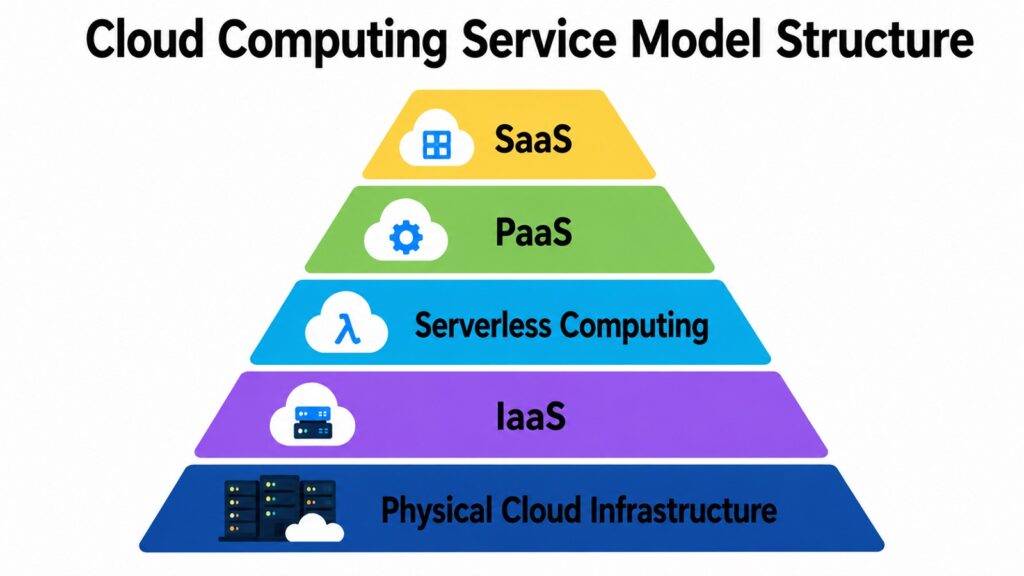
Not long ago, building a web application meant buying servers, configuring software, and managing everything for years. Cloud Computing changed this by introducing service-based delivery models that let teams focus on their products rather than their hardware. These models stack on top of each other, each one removing another layer of infrastructure complexity.
Infrastructure as a Service, or IaaS, sits at the base. Customers rent virtualized hardware: virtual machines, storage, and networking. AWS EC2, Azure Virtual Machines, and Google Compute Engine are the main examples. The customer controls the operating systems and software, while the provider manages the physical hardware. Platform as a Service, or PaaS, goes further by removing even the operating system from the customer’s responsibility. Google App Engine and Heroku let developers upload code while the platform handles runtime, scaling, and patching automatically.
Software as a Service, or SaaS, is what most people encounter daily. Google Workspace, Salesforce, and Microsoft 365 are all SaaS products: complete applications hosted by the provider and accessed through a browser. Serverless computing, or Function as a Service, goes even further by running individual code functions in response to specific events. AWS Lambda and Azure Functions bill customers only for the milliseconds their code actually executes.
Each Cloud Computing service model offers a different balance of control and convenience. IaaS gives the most flexibility with the most maintenance work. SaaS removes nearly all technical overhead but limits customization. PaaS and serverless sit in between, well-suited for teams that want infrastructure speed without operational complexity.
Table 3: Cloud Computing Service Models and Real-World Examples
| Service Model | Description and Real-World Example |
| IaaS – Amazon EC2 | Provides virtualized servers, storage, and networking; organizations control the OS and software stack above the hardware layer |
| IaaS – Google Compute Engine | Offers scalable virtual machine instances across Google’s global infrastructure with custom CPU and memory configurations |
| PaaS – Google App Engine | Fully managed application hosting that auto-scales based on traffic and removes the need to manage servers or runtimes |
| PaaS – Heroku | Developer-friendly cloud platform that supports multiple programming languages and simplifies deployment of web applications |
| SaaS – Salesforce CRM | Fully hosted customer relationship management software delivered via browser; no installation or server management required |
| SaaS – Microsoft 365 | Cloud-hosted productivity suite including Outlook, Word, and Teams, managed entirely by Microsoft across global data centers |
| Serverless – AWS Lambda | Runs individual code functions in response to events with automatic scaling; customers pay only for actual execution time |
| Serverless – Azure Functions | Microsoft’s event-driven serverless compute service integrated with Azure cloud services and enterprise workflows |
3. Cloud Computing and Cloud Deployment Models
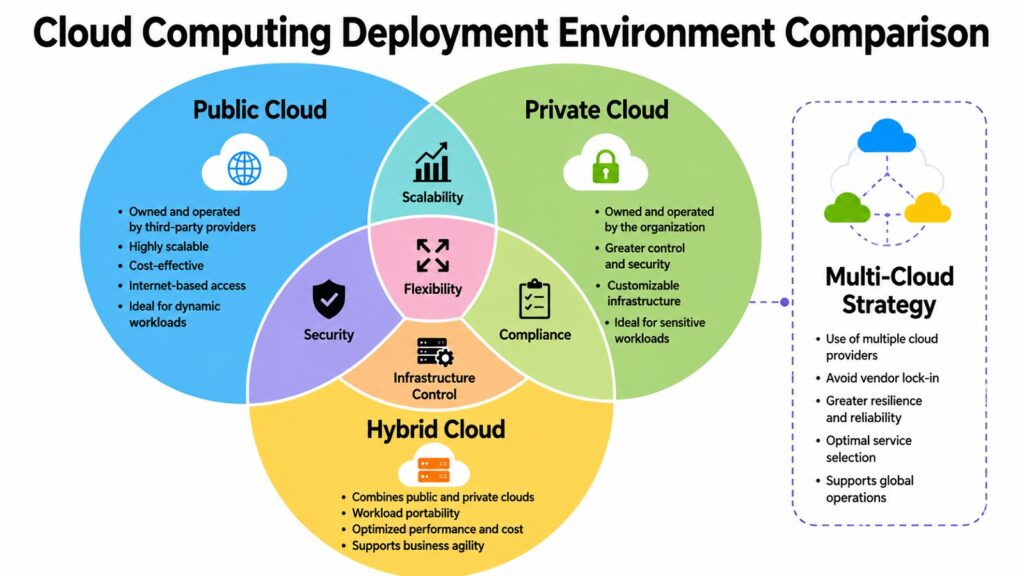
Choosing a Cloud Computing deployment model means deciding where infrastructure lives, who controls it, and how it connects to other systems. The choice affects security, compliance, cost, and flexibility. Most organizations face a genuine trade-off between the scalability of shared environments and the control that comes with dedicated infrastructure.
The public cloud is the most widely used model. AWS, Azure, and Google Cloud Platform own and operate the infrastructure, and customers access it over the internet on a pay-as-you-go basis. The private cloud works differently: infrastructure is dedicated to a single organization, hosted on-premises or in a colocation facility. Banks, healthcare institutions, and defense contractors often prefer private clouds for greater control over data location and compliance. VMware vSphere and OpenStack are common platforms for building them.
Hybrid cloud connects public and private environments so workloads can move between them as needed. A company might keep sensitive customer data on a private cloud while using public cloud capacity for analytics or traffic bursts. Microsoft Azure Arc and AWS Outposts are built specifically for this. Multi-cloud goes further by using services from two or more public cloud providers, avoiding vendor lock-in and letting organizations pick the best tool from each platform.
Regulatory requirements frequently influence deployment choices more than technical inclinations. Financial institutions are obligated to maintain customer data within designated national boundaries. Government agencies might be mandated to utilize certified cloud environments. In response, cloud providers have developed sovereign cloud regions and specialized government platforms such as AWS GovCloud to meet these requirements.
Table 4: Cloud Computing Deployment Models and Enterprise Use Cases
| Deployment Model / Example | Strategic Use Case and Key Characteristic |
| Public Cloud – AWS | Startups and enterprises use AWS global regions for scalable, pay-as-you-go infrastructure without owning hardware |
| Public Cloud – Google Cloud Platform | Data analytics, machine learning pipelines, and containerized workloads benefit from GCP’s specialized global infrastructure |
| Private Cloud – VMware vSphere | Enterprises with strict compliance or data sovereignty requirements deploy dedicated infrastructure using VMware-based private clouds |
| Private Cloud – OpenStack | Open-source private cloud platform used by telecoms and research institutions for full control over compute and storage resources |
| Hybrid Cloud – Microsoft Azure Arc | Connects on-premises servers and private cloud resources to Azure for unified management, governance, and monitoring |
| Hybrid Cloud – AWS Outposts | Brings AWS infrastructure physically into an enterprise data center for low-latency hybrid cloud workloads |
| Multi-Cloud – Anthos (Google) | Manages containerized applications consistently across AWS, Azure, and GCP from a single control plane |
| Government Cloud – AWS GovCloud | Isolated US-based cloud regions designed for government agencies with FedRAMP High and ITAR compliance requirements |
4. Cloud Computing and Distributed Computing Systems
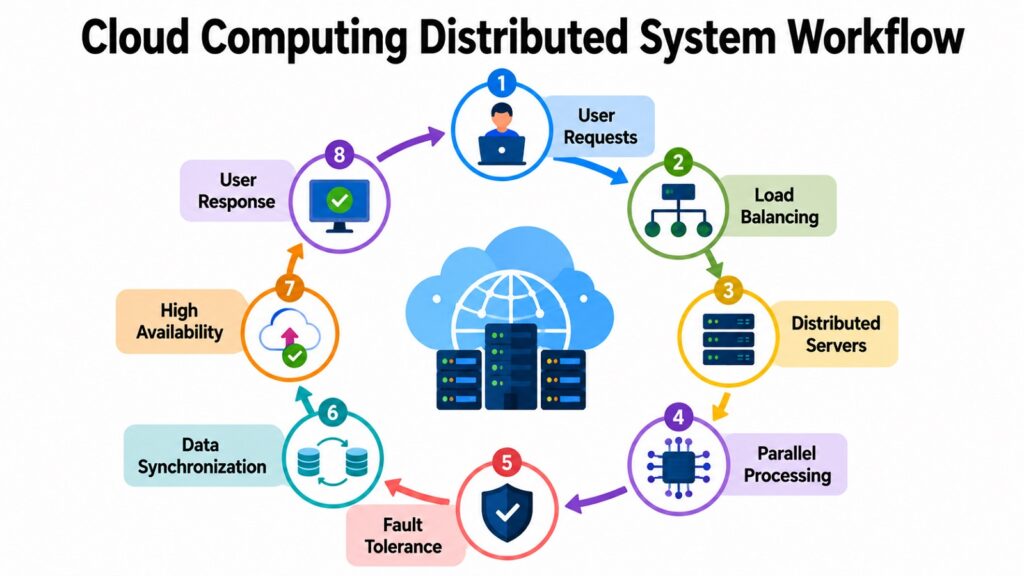
Imagine a streaming service during the final episode of a major series. Millions of viewers hit play at nearly the same moment, requesting streams from different cities and continents. No single server could handle that load. Distributed computing systems exist to solve exactly this problem, and they sit at the heart of how Cloud Computing delivers reliability at scale.
A distributed system breaks a workload across many computers that coordinate through a network. From the user’s perspective, everything looks like a single service. Behind the scenes, requests are routed, data is replicated, and tasks run in parallel across thousands of machines. Fault tolerance is a defining property: if one node fails, others absorb the traffic without interruption. Cloud providers build redundancy into every layer, from power supplies to storage controllers, because any single point of failure becomes unacceptable at cloud scale.
Load balancing distributes incoming traffic across multiple servers to prevent bottlenecks. Services like AWS Elastic Load Balancing and Google Cloud Load Balancing route requests based on server health and available capacity. Distributed storage systems like Apache Hadoop, Amazon DynamoDB, and Apache Cassandra store data across many nodes simultaneously, combining high availability with the parallel processing that large-scale analytics demands.
The CAP theorem shapes how architects design distributed databases in Cloud Computing. It states that a distributed system can guarantee at most two of three properties: consistency, availability, and partition tolerance. Google Spanner prioritizes strong consistency across regions, while DynamoDB prioritizes availability and low latency. The right choice depends on what the application needs most.
Table 5: Distributed Computing Frameworks and Technologies in Cloud Computing
| Technology / System | Role in Cloud Computing Distributed Architecture |
| Apache Hadoop | Distributed storage and batch processing framework that splits large datasets across clusters using HDFS and MapReduce |
| Apache Kafka | Distributed event streaming platform used for real-time data pipelines and messaging between cloud-based microservices |
| Amazon DynamoDB | Fully managed distributed NoSQL database designed for single-digit millisecond performance at any scale across AWS regions |
| Google Spanner | Globally distributed relational database that provides strong consistency and automatic sharding across Google Cloud regions |
| Apache Cassandra | Highly available distributed database with no single point of failure, used by Netflix, Apple, and other large-scale platforms |
| AWS Elastic Load Balancing | Automatically distributes incoming traffic across EC2 instances, containers, and IP addresses for high availability |
| Kubernetes (cluster federation) | Extends container orchestration across multiple clusters and cloud regions to maintain distributed application availability |
| Apache ZooKeeper | Distributed coordination service that manages configuration, naming, and synchronization for large-scale cloud applications |
5. Cloud Computing and Containers & Orchestration
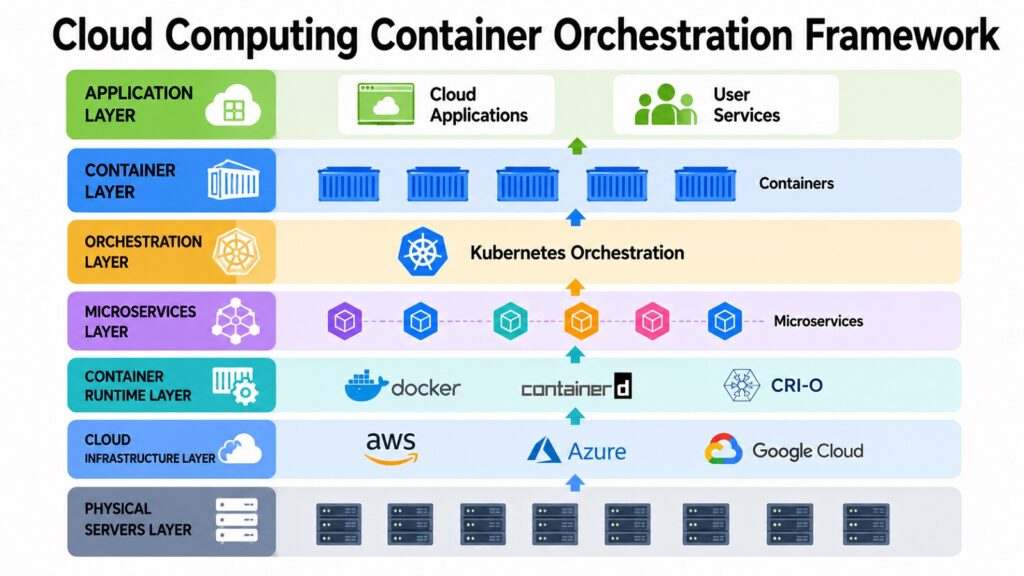
For much of early Cloud Computing history, deploying software meant configuring virtual machines, installing dependencies, and hoping the production environment matched what developers had tested locally. It rarely did. Environment mismatches caused failures and delayed releases. Containers offered a cleaner solution.
A container packages an application with all its dependencies and runtime libraries into a single portable unit. Unlike a virtual machine, it shares the host operating system’s kernel, making containers far lighter and faster to start. Docker, released in 2013, brought this to a wide audience and became the standard packaging format for Cloud Computing workloads. A container starts in seconds, often uses just a few hundred megabytes, and runs identically whether on a developer laptop or a production cloud environment.
As organizations began running hundreds or thousands of containers, managing them manually became impossible. Kubernetes, developed from Google’s internal experience at scale, became the dominant orchestration platform. It handles scheduling, auto-restarting failed containers, scaling in response to traffic, and networking between services. Companies like Uber, Spotify, and Netflix run large microservice architectures on Kubernetes, where each service lives in its own container and can be updated independently.
Cloud providers built managed Kubernetes services to reduce operational overhead. Amazon EKS, Google Kubernetes Engine, and Azure Kubernetes Service handle control plane management, freeing engineering teams to focus on their applications. These services integrate with cloud-native logging, monitoring, and security tools, making containers a natural fit for modern Cloud Computing environments.
Table 6: Container and Orchestration Technologies in Cloud Computing
| Technology / Platform | Role in Cloud Computing Container Ecosystem |
| Docker | Standard container runtime and image format that packages applications with dependencies for consistent deployment anywhere |
| Kubernetes | Open-source container orchestration platform that automates deployment, scaling, and management of containerized workloads |
| Amazon EKS | Managed Kubernetes service on AWS that removes control plane management overhead from engineering teams |
| Google Kubernetes Engine (GKE) | Google Cloud’s managed Kubernetes platform with Autopilot mode for fully managed, serverless container operation |
| Azure Kubernetes Service (AKS) | Microsoft’s managed Kubernetes offering with tight integration into Azure Active Directory and Azure Monitor |
| Helm | Kubernetes package manager that templates and deploys complex multi-container applications as reusable charts |
| Istio | Open-source service mesh that manages traffic, security policies, and observability between microservices in Kubernetes clusters |
| Red Hat OpenShift | Enterprise Kubernetes distribution with added developer tools, security policies, and multi-cloud deployment capabilities |
6. Cloud Computing and Cloud Scalability & Elasticity
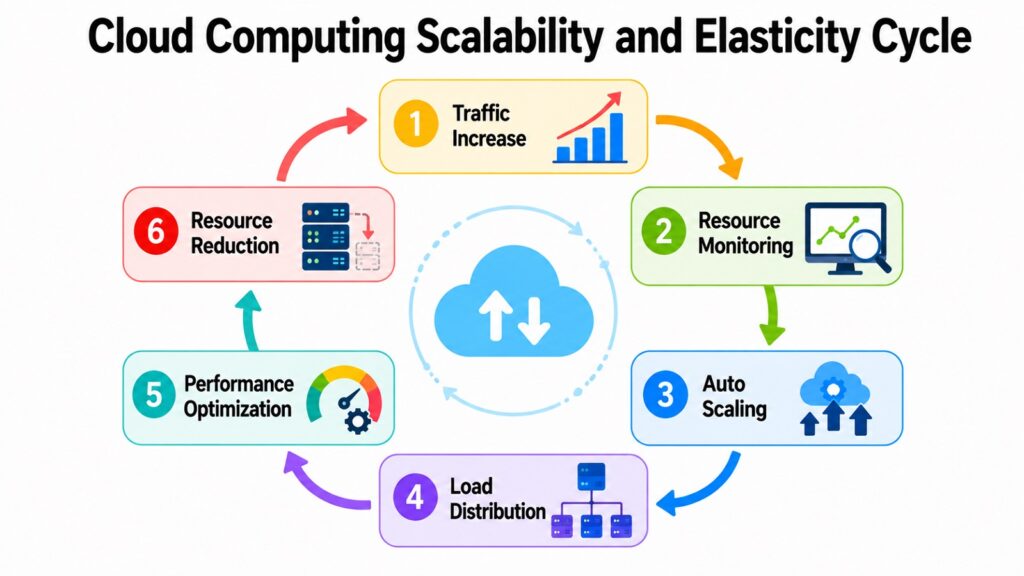
Black Friday illustrates why scalability matters in Cloud Computing. A major retailer might receive fifty times its normal traffic in just a few hours. Traditional infrastructure had to be sized for that peak, which meant paying for capacity that sat idle most of the year. Cloud Computing addresses this through scalability and elasticity: the ability to add resources as demand grows, and release them automatically when it falls.
Horizontal scaling adds more instances of a service to distribute load. When a web application faces a traffic spike, an auto-scaling system can launch additional server instances within minutes and route traffic through a load balancer. AWS Auto Scaling, Azure Virtual Machine Scale Sets, and Google Cloud Instance Groups all provide this. Vertical scaling instead increases the resources on an existing instance by upgrading to a larger machine type. Most Cloud Computing architectures combine both strategies depending on the needs of each component.
Streaming services demonstrate elasticity in practice. A music platform like Spotify handles significant traffic variation across morning commutes, evening workouts, and weekend events. Cloud Computing infrastructure adjusts the server count continuously in the background, keeping response times consistent while costs scale directly with actual usage.
Content delivery networks extend Cloud Computing scalability by caching data at edge locations around the world. Amazon CloudFront and Cloudflare bring content physically closer to users, reducing latency and taking load off origin servers. Spreading requests across hundreds of global edge nodes is itself a form of horizontal scaling, one that keeps response times low regardless of where users happen to be.
Table 7: Cloud Computing Scalability Technologies and Auto-Scaling Systems
| Technology / Service | Scalability Function in Cloud Computing |
| AWS Auto Scaling | Automatically adds or removes EC2 instances based on CloudWatch metrics like CPU utilization or request count |
| Azure Virtual Machine Scale Sets | Deploys and manages groups of identical Azure VMs that scale in or out automatically based on demand metrics |
| Google Cloud Instance Groups | Managed instance groups on GCP that auto-scale based on load balancing traffic, CPU usage, or custom metrics |
| Amazon CloudFront | Content delivery network with over 600 global edge locations that caches and distributes content close to end users |
| Cloudflare Workers | Serverless compute platform running at Cloudflare’s global edge network to process requests close to users at low latency |
| Kubernetes Horizontal Pod Autoscaler | Automatically scales container pod replicas in Kubernetes clusters based on CPU, memory, or custom application metrics |
| AWS Elastic Load Balancing | Distributes incoming application traffic across multiple targets for fault tolerance and consistent performance |
| Google Cloud Spanner auto-sharding | Automatically redistributes database load across nodes as traffic grows to maintain consistent latency at any scale |
7. Cloud Computing and Cloud Security Architecture
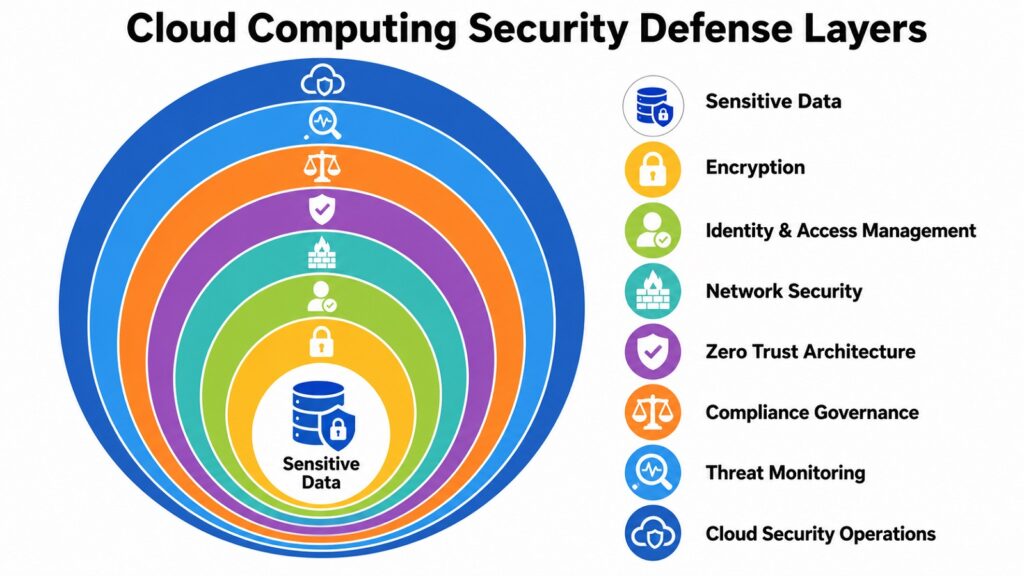
The scale that makes Cloud Computing powerful also makes it a high-value target. A single provider might hold the data of thousands of organizations across every industry. A serious breach is not one company’s problem: it can touch healthcare records, financial transactions, and government systems at the same time. This puts security architecture at the center of how Cloud Computing environments are designed.
The shared responsibility model defines the security boundary between providers and customers. The cloud provider secures the underlying infrastructure: data centers, hypervisors, and network hardware. The customer secures what runs on top: operating systems, applications, data, and access controls. The boundary shifts by service model — with SaaS the provider handles nearly everything, with IaaS the customer carries considerably more. AWS IAM, Azure Active Directory, and Google Cloud IAM enforce least privilege, ensuring users and services can only access what they actually need.
Zero trust architecture has become a widely adopted security framework in Cloud Computing. Rather than trusting users automatically once they are inside a network, zero trust verifies every access request continuously, regardless of origin. Workloads span multiple providers, remote workers, partner networks, and mobile devices, making traditional perimeter-based security inadequate. Encryption protects data both in transit and at rest. AWS Key Management Service and Azure Key Vault let organizations manage their own encryption keys, maintaining data sovereignty even on shared infrastructure.
Regulatory compliance frameworks shape security requirements across industries. HIPAA governs healthcare data in the United States, GDPR covers personal data for European residents, and PCI DSS applies to payment card systems. Cloud providers publish compliance attestations, but organizations remain responsible for configuring their own environments to meet these standards.
Table 8: Cloud Computing Security Technologies and Frameworks
| Technology / Framework | Security Function in Cloud Computing Environments |
| AWS IAM (Identity & Access Management) | Controls user and service permissions across AWS resources using fine-grained policy-based access control |
| Azure Active Directory | Microsoft’s cloud identity platform managing authentication, single sign-on, and conditional access for enterprise environments |
| Zero Trust Network Access (ZTNA) | Enforces per-request verification of identity and device posture, eliminating implicit trust inside cloud networks |
| AWS Key Management Service | Manages cryptographic keys for encrypting data stored in S3, RDS, EBS, and other AWS services |
| Google Cloud Armor | Web application firewall and DDoS protection service that defends cloud-hosted applications from volumetric and application-layer attacks |
| GDPR Compliance Framework | EU regulation requiring cloud deployments handling European personal data to meet strict data protection and sovereignty standards |
| NIST Cybersecurity Framework | Widely adopted risk management framework used by enterprises and government agencies to structure cloud security programs |
| CrowdStrike Falcon (Cloud Security) | Cloud-native security platform providing endpoint detection, threat intelligence, and workload protection across cloud environments |
8. Cloud Computing and Cloud Automation & DevOps
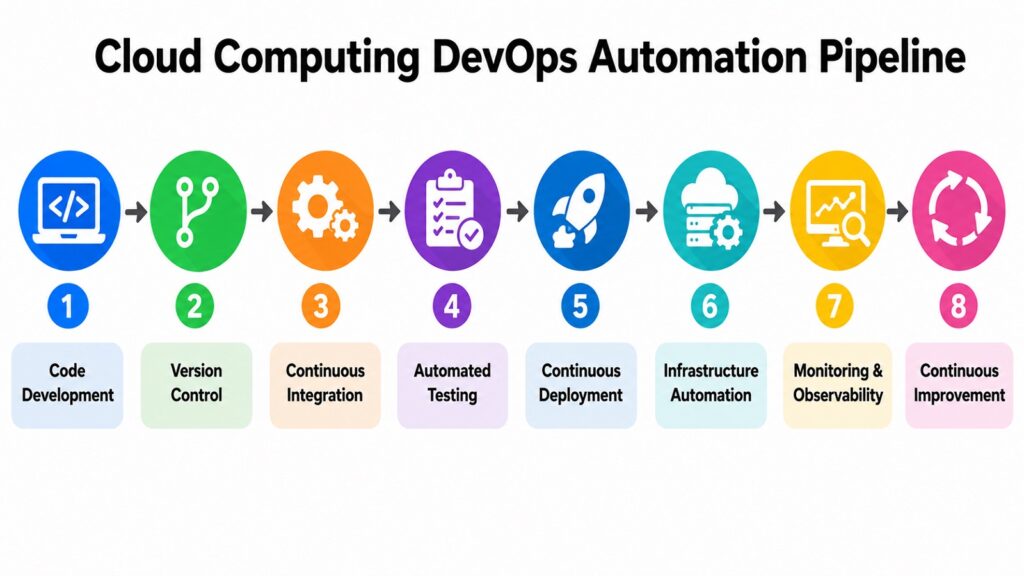
Before automation transformed Cloud Computing, provisioning a server meant submitting a ticket, waiting days or weeks, and manually configuring software once hardware arrived. Deployments required coordination across multiple teams and could drag on for weeks. DevOps emerged as a movement that brought development and operations teams together, using automated tooling to enable rapid and reliable software delivery in Cloud Computing environments.
Infrastructure as Code is one of the most important practices in Cloud Computing automation. Rather than clicking through a web console, engineers write configuration files that define infrastructure declaratively. HashiCorp Terraform, AWS CloudFormation, and Pulumi allow teams to provision entire cloud environments from a single command. These files are stored in version control like application code, enabling review, history, and rollback when something goes wrong.
Continuous Integration and Continuous Deployment pipelines carry code from a developer’s commit all the way to production automatically. A CI pipeline builds and tests code on every push. If it passes, a CD pipeline deploys the update to staging and then production. GitHub Actions, Jenkins, and GitLab CI power these workflows. Observability platforms like Datadog, Prometheus with Grafana, and AWS CloudWatch give teams real-time visibility into how cloud environments are performing.
Configuration management tools like Ansible, Puppet, and Chef keep servers and cloud resources in a consistent and known state over time. Without them, systems drift as manual changes accumulate across hundreds of machines. In large Cloud Computing environments, automated configuration management is what keeps infrastructure predictable, auditable, and recoverable.
Table 9: Cloud Computing Automation and DevOps Tools
| Tool / Platform | Automation Role in Cloud Computing Operations |
| HashiCorp Terraform | Infrastructure as Code tool that provisions and manages cloud resources across AWS, Azure, GCP, and other providers declaratively |
| AWS CloudFormation | Amazon’s native IaC service that provisions and configures AWS resources using JSON or YAML template files |
| GitHub Actions | CI/CD automation platform integrated into GitHub for building, testing, and deploying applications to cloud environments |
| Jenkins | Open-source automation server widely used for building CI/CD pipelines in enterprise Cloud Computing workflows |
| Ansible | Agentless configuration management and automation tool used for provisioning and configuring cloud infrastructure at scale |
| Datadog | Cloud monitoring and observability platform providing metrics, logs, traces, and alerting across multi-cloud environments |
| Prometheus with Grafana | Open-source monitoring stack used for collecting cloud metrics and visualizing infrastructure and application performance |
| ArgoCD | GitOps-based continuous delivery tool for Kubernetes that synchronizes cluster state with declarative configuration stored in Git |
Conclusion: The Expanding Future of Cloud Computing
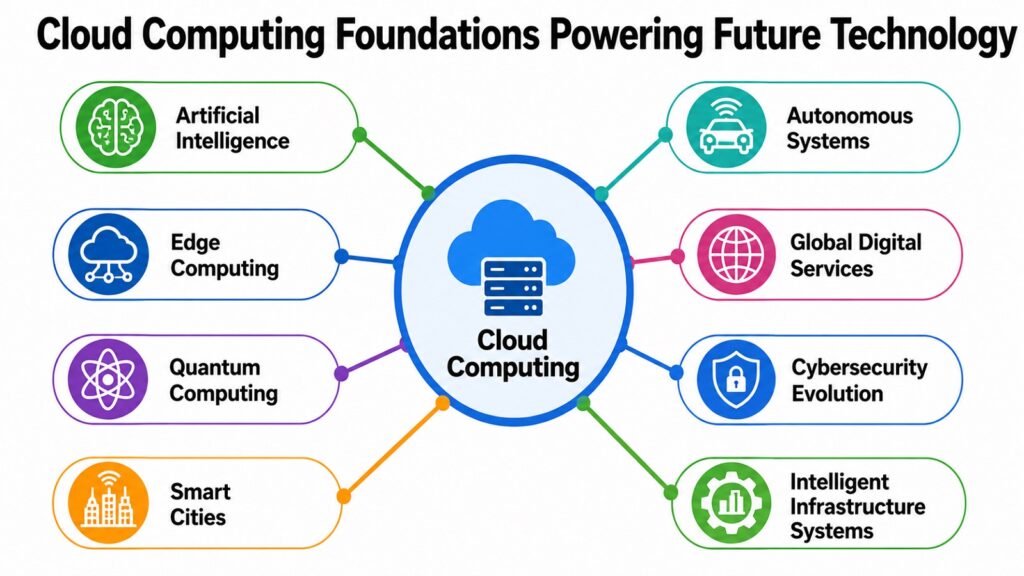
The eight foundations in this article do not exist in isolation. Virtualization enables service models to function. Distributed systems underpin the reliability of every deployment model. Containers depend on automation to operate at scale. Security threads through all of them. Together, these pillars describe how Cloud Computing works today and why it has become so deeply embedded in modern technology and daily life.
Cloud Computing has moved well beyond being a cost-saving alternative to buying servers. Healthcare systems store patient records on it. Financial markets process transactions through it. Researchers model climate systems and simulate drug molecules using cloud-based computing clusters. The global economy depends on the distributed, scalable, and automated infrastructure that Cloud Computing provides.
The evolution of Cloud Computing is already visible in several converging directions. Artificial intelligence is driving investment in GPU clusters and custom silicon like Google’s Tensor Processing Units and Amazon’s Trainium chips. Edge computing is pushing Cloud Computing beyond data centers and closer to where data is generated, enabling low-latency applications in factories, vehicles, and remote infrastructure. AWS Wavelength and Azure Edge Zones represent this shift in practice.
Sustainability and data sovereignty are becoming significant dimensions of Cloud Computing strategy. Providers are investing in renewable energy and more efficient hardware. Sovereign cloud regions are emerging to meet national compliance requirements. Organizations that understand the eight foundations in this article are better positioned to navigate these changes, building systems that are resilient, efficient, and ready for whatever Cloud Computing becomes next.
Table 10: Cloud Computing Future Trends and Emerging Technologies
| Emerging Trend / Technology | Significance for Cloud Computing’s Future |
| AI Infrastructure as a Service | Cloud providers offer GPU clusters and custom AI chips (AWS Trainium, Google TPUs) to support large-scale model training |
| Edge Computing (AWS Wavelength) | Extends cloud compute to telecom network edges, enabling ultra-low latency for autonomous systems and industrial IoT |
| Quantum Computing in the Cloud | IBM Quantum, AWS Braket, and Azure Quantum offer cloud access to quantum processors for scientific and optimization research |
| Confidential Computing | Hardware-based secure enclaves (Intel SGX, AMD SEV) allow sensitive data to be processed without exposing it to cloud operators |
| Sovereign Cloud Regions | Cloud providers build isolated regional infrastructure to meet national data residency laws and government compliance mandates |
| FinOps (Cloud Financial Management) | Emerging discipline combining engineering and finance to optimize cloud spending through real-time cost visibility and automation |
| Cloud-Native AI Platforms | Platforms like Vertex AI (Google) and Azure Machine Learning integrate MLOps workflows directly into cloud infrastructure |
| Sustainable Cloud Infrastructure | Providers commit to 100% renewable energy and carbon-neutral operations as environmental accountability reshapes cloud strategy |