Table of Contents
Introduction: Smart Cities as the Perfect Integration of Technology and Society
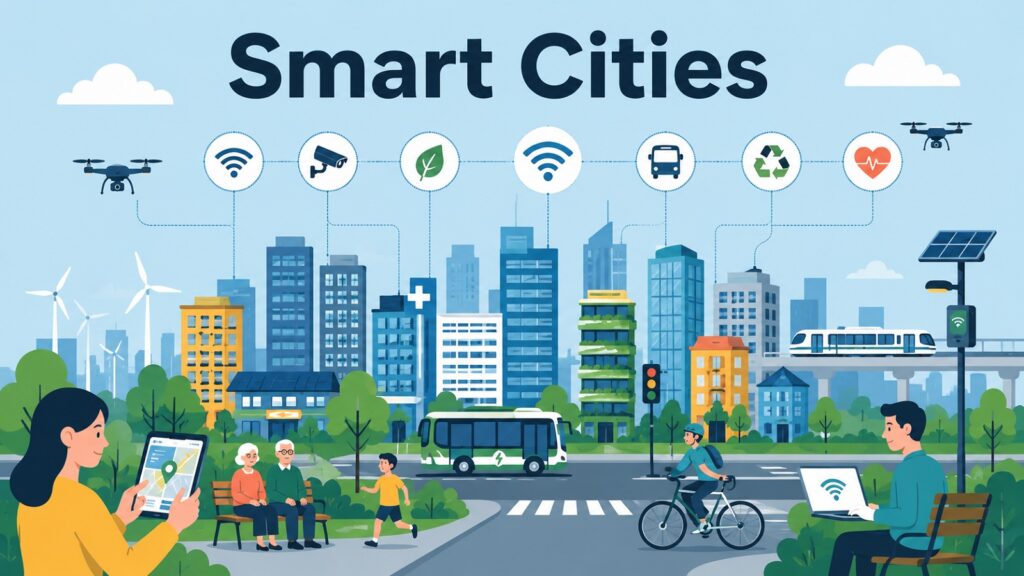
Cities are growing faster than the systems built to manage them. By 2050, the United Nations estimates that nearly seven in ten people on Earth will live in urban areas. That shift brings familiar pressures that many cities already struggle to contain. Traffic gridlock strained public services, rising pollution, aging infrastructure, and widening inequality are not new problems. But they are becoming harder to ignore.
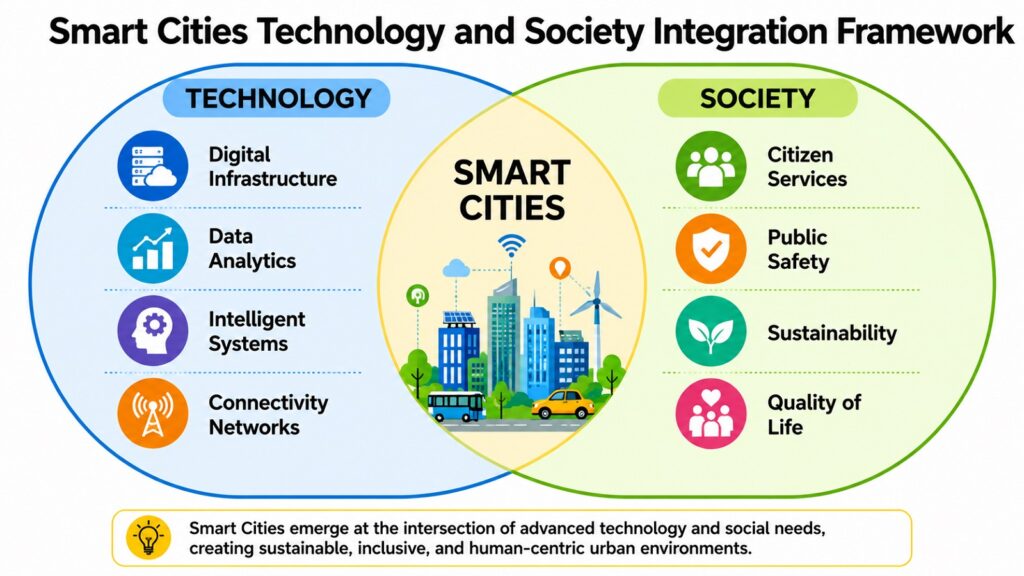
Smart Cities represent the perfect integration of technology and society. This is not a marketing phrase. It is a genuine design philosophy in which technology is deployed not to impress, but to improve everyday life. Traffic sensors that shorten commutes, digital platforms for government services, environmental monitoring systems, and public Wi-Fi networks that connect underserved communities are all part of that same commitment.
This article examines five cities with serious, well-documented Smart City programs. Seoul, South Korea, has invested heavily in intelligent transport and digital public services. Singapore has built sophisticated urban management systems covering road pricing, emergency response, and governance. Tallinn, Estonia, has become a global reference point for digital administration despite being a relatively small capital. Amsterdam has pioneered smart sustainability programs in energy and water management. Barcelona has woven sensors, connectivity, and data analytics across multiple urban domains simultaneously.
These cities appear frequently in Smart City research because they have moved beyond pilot projects. They have implemented systems at scale, measured outcomes, and published enough data for meaningful comparison. The central research question of this article is straightforward: how do Smart Cities use technology to improve urban life? The answer unfolds across six dimensions, each examined through specific programs, documented outcomes, and lessons that other cities can apply.
Table 1: Smart Cities and Their Primary Areas of Innovation
| Smart Cities | Primary Innovation Area |
| Seoul, South Korea | Integrated transport systems and digital citizen services |
| Singapore | Electronic road pricing, smart governance, and emergency management |
| Tallinn, Estonia | Digital identity infrastructure and paperless public administration |
| Amsterdam, Netherlands | Smart energy grids, water management, and circular economy programs |
| Barcelona, Spain | Sensor networks, smart street lighting, and urban data platforms |
| Tokyo, Japan | Disaster resilience systems and mobility optimization |
| Vienna, Austria | Smart energy buildings and sustainable urban planning |
| Dubai, UAE | AI-driven government services and paperless city initiatives |
1. Smart Cities Improve Urban Mobility Through Intelligent Transportation
Transportation is one of the most visible measures of how well a city works. Urban mobility affects how people spend their time, how accessible jobs and services are, and how much pollution a city generates. Smart Cities have made transportation a priority investment area, and the results are measurable.
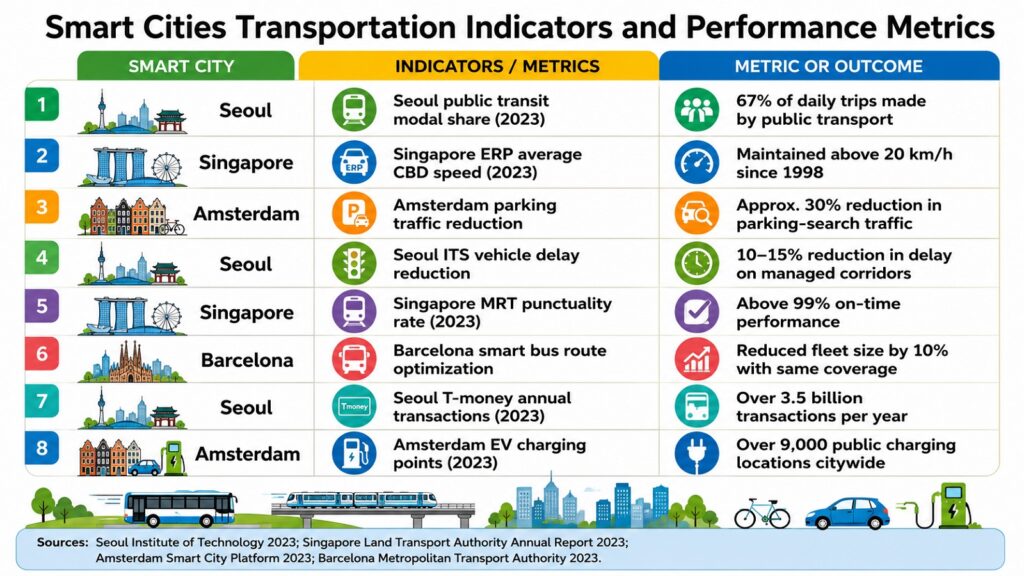
Seoul built its T-money integrated fare payment system in the early 2000s. T-money allows passengers to use a single contactless card across the entire metropolitan network, covering subways, buses, and taxis. The system generates extensive travel data that the Seoul Metropolitan Government uses to optimize route frequencies, identify underserved areas, and adjust service during peak periods. A transfer discount structure within T-money encouraged more commuters to shift from cars to public transit, helping reduce both congestion and emissions across the metropolitan area.
Seoul also deployed an Intelligent Transportation System that integrates real-time traffic data from thousands of sensors, cameras, and GPS units. The platform adjusts signal timing dynamically, reroutes traffic during incidents, and shares information with drivers through overhead signs and mobile applications. The Seoul Institute of Technology documented a 10 to 15 percent reduction in vehicle delay times on managed corridors following full system deployment.
Singapore’s Electronic Road Pricing system, introduced in 1998 and substantially upgraded since, charges drivers a variable fee to enter congested zones. The fee changes with actual traffic conditions. The system has kept average speeds in the central business district consistently above 20 kilometers per hour, a threshold that the Land Transport Authority has maintained as a formal policy target. Amsterdam’s smart mobility program complements this approach with sensor-controlled signal priority for trams and buses and a parking guidance system that has reduced parking-search traffic in the inner city by around 30 percent. The shared lesson is clear: cities that integrate data across transport modes produce system-level improvements that isolated investments simply cannot achieve.
2. Smart Cities Strengthen Public Services Through Digital Governance
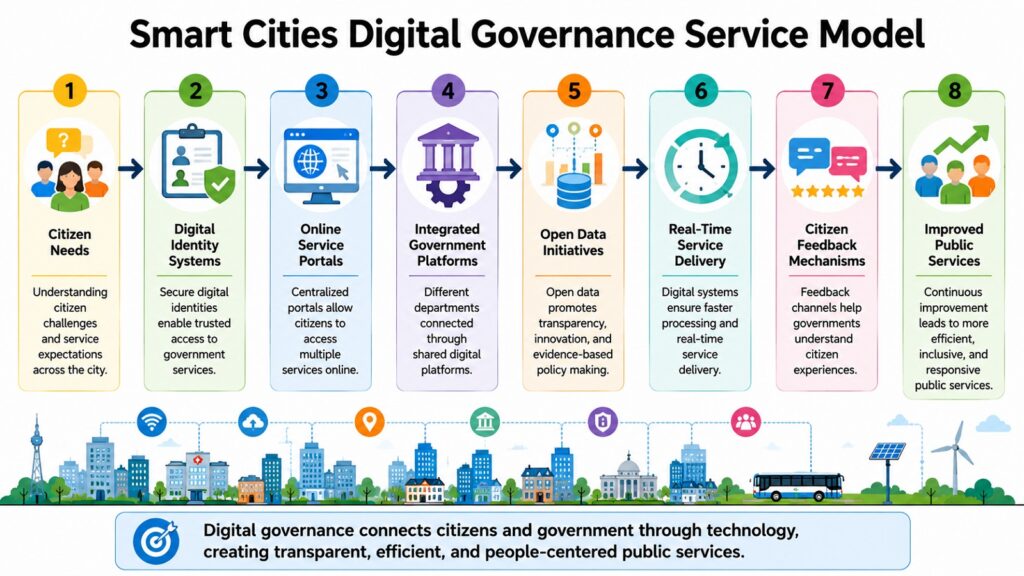
The relationship between citizens and their governments is fundamentally about access. Can people get information when they need it? Can they resolve bureaucratic matters without losing a working day? Digital governance, when it works well, answers yes to both. Smart Cities have made genuine progress here, though the path is never entirely smooth.
Tallinn is the most cited example of digital governance in Smart City research. Estonia built its digital identity infrastructure in the early 2000s, offering every citizen a secure digital ID that can authenticate identity and sign documents legally. By 2024, over 99 percent of Estonian government services are available online, including tax filing, business registration, and health record access. Citizens have been able to vote in elections from any internet connection in the world since 2005, and government functions run on a decentralized, encrypted infrastructure designed to survive physical disruptions.
Singapore’s Singpass platform had more than 4.5 million registered users by 2023, in a country of 5.9 million people. Through Singpass, citizens access over 2,000 services from more than 700 government agencies and private organizations. Mobile authentication using face or fingerprint ID is fully supported. Seoul added its mGov mobile application to this landscape, allowing residents to pay parking fines, apply for permits, and manage utility accounts from their phones as part of a broader Digital Master Plan that digitized thousands of formerly paper-based processes.
These programs share a common thread: they reduce friction. Every interaction previously requiring a physical visit or a long phone queue has been redesigned around what citizens actually need. There are legitimate concerns too. Citizens who lack digital skills or reliable internet access can be left behind when services shift entirely online. Singapore and Tallinn have both retained non-digital service channels and invested in literacy programs to address this, but the challenge of balancing efficiency with inclusion has not been fully resolved anywhere.
Table 3: Smart Cities Digital Governance Initiatives and Citizen Benefits
| Digital Governance Initiatives Of Smart Cities | Primary Citizen Benefit |
| Estonia e-Identity and X-Road platform | Access to 99%+ government services online |
| Singapore Singpass (2023) | Single login for 2,000+ government and private services |
| Seoul mGov mobile platform | Mobile access to permits, fines, and utility payments |
| Tallinn e-Voting system | Legally valid online voting from any location worldwide |
| Barcelona Open Data Portal | Public access to real-time city data for citizens and researchers |
| Amsterdam Digital City Agenda | Coordinated digital access for residents across all boroughs |
| Singapore LifeSG app | Personalized government service recommendations by life stage |
| Seoul Digital New Deal citizen portals | Online access to 3,200 administrative services citywide |
3. Smart Cities Enhance Public Safety Through Data-Driven Management
Public safety is where the tension between innovation and individual rights shows up most visibly. Smart Cities have deployed powerful technologies to reduce crime, manage emergencies, and improve disaster response. The results have been real. So have the concerns about surveillance, data privacy, and civil liberties, and both deserve fair treatment.
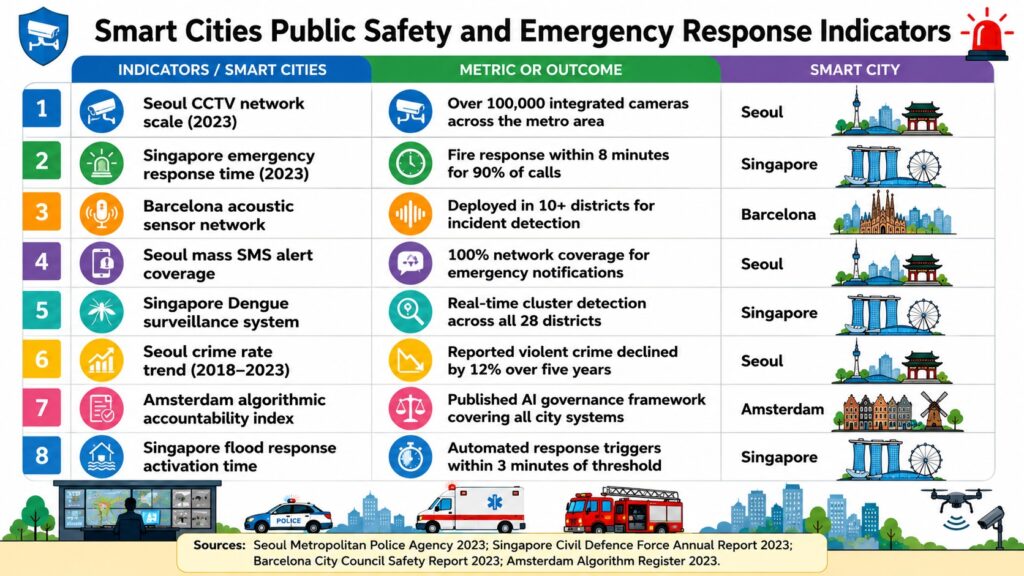
Seoul operates an Urban Safety Management Center integrating more than 100,000 CCTV cameras across the metropolitan area into a single monitoring platform. Video analytics detect unusual patterns and send automatic alerts to response teams. Seoul also runs a mass emergency notification system that reaches all phones in a targeted area during natural disasters or severe weather. The system improved coordination during typhoon seasons and was particularly valuable during COVID-19 outbreak management, when rapid location-based alerts helped contain community spread.
Singapore’s Intelligent Operations Center aggregates data from transport networks, surveillance systems, environmental sensors, and public services into a single real-time view of the city. When flooding events occur, the system can simultaneously trigger road closures, activate pumping infrastructure, and send resident alerts within minutes. Barcelona’s Guardia Urbana uses predictive analytics to allocate patrol resources more efficiently, analyzing historical crime data alongside urban activity patterns to identify times and locations where incidents are more likely.
The privacy dimension of these systems matters enormously. Camera networks, predictive policing algorithms, and real-time location monitoring create genuine risks of overreach and bias. Amsterdam published an algorithmic accountability framework that governs exactly how data collected from public infrastructure can and cannot be used. Barcelona established similar ethical guidelines. These governance frameworks are not merely ethical necessities. They are also prerequisites for public trust, without which smart safety systems face political resistance that undermines their effectiveness entirely.
4. Smart Cities Support Sustainability Through Intelligent Resource Management
Urban environments account for roughly 70 percent of global greenhouse gas emissions despite occupying less than 2 percent of Earth’s land area, according to UN-Habitat. That concentration of both the problem and its potential solution makes cities central to the sustainability challenge. Smart Cities have moved beyond pledges to deploy systems producing measurable change in energy, water, waste, and carbon outcomes.
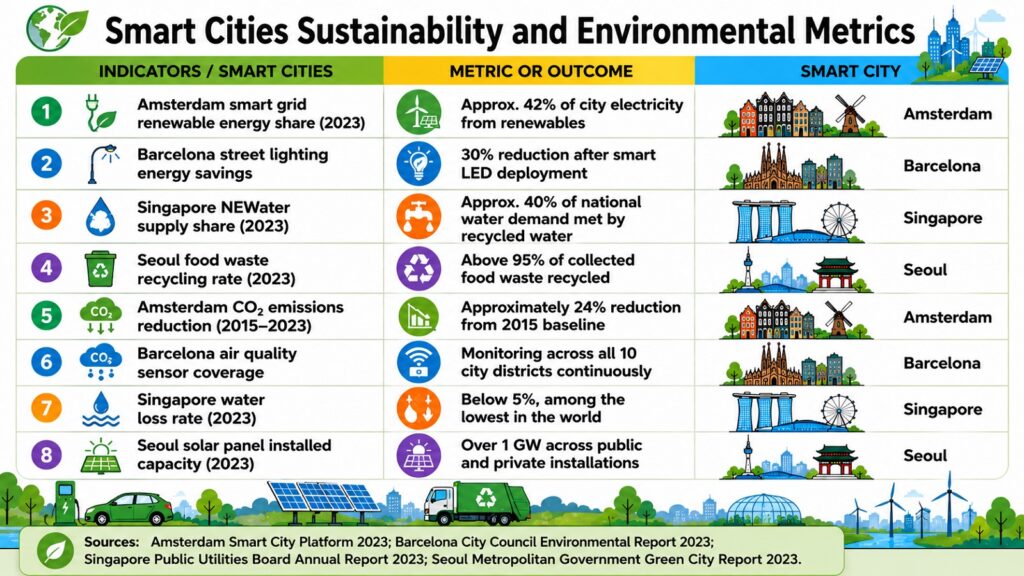
Amsterdam built one of Europe’s most sophisticated smart energy programs around its decentralized grid infrastructure. Neighborhoods use energy management systems that balance supply and demand in real time across solar panels, battery storage, and the main grid. In the Buiksloterham district, an experimental circular zone in Amsterdam North, buildings generate, store, and trade energy among themselves with minimal reliance on external supply. The city has committed to carbon neutrality by 2050, with interim targets tracked through its environmental monitoring network.
Barcelona’s smart street lighting program replaced traditional fixtures with LED lights managed centrally. The system adjusts brightness based on time of day, weather conditions, and pedestrian presence detected by sensors. Barcelona reported a 30 percent reduction in street lighting energy consumption within two years of full deployment. Environmental sensors mounted on street furniture monitor air quality, temperature, humidity, and noise levels continuously across all districts, with data published on a public dashboard for residents and researchers.
Singapore’s Public Utilities Board deployed smart metering across the island for real-time monitoring of water consumption at household and district levels. Anomaly detection algorithms identify leaks and unauthorized use automatically. The NEWater recycled water program, supported by this monitoring infrastructure, now supplies approximately 40 percent of national water needs. Seoul has approached waste similarly, equipping public bins with sensors for optimized collection routing and using RFID-tagged bins to track food waste by household, contributing to recycling rates above 95 percent.
5. Smart Cities Expand Digital Inclusion and Citizen Connectivity
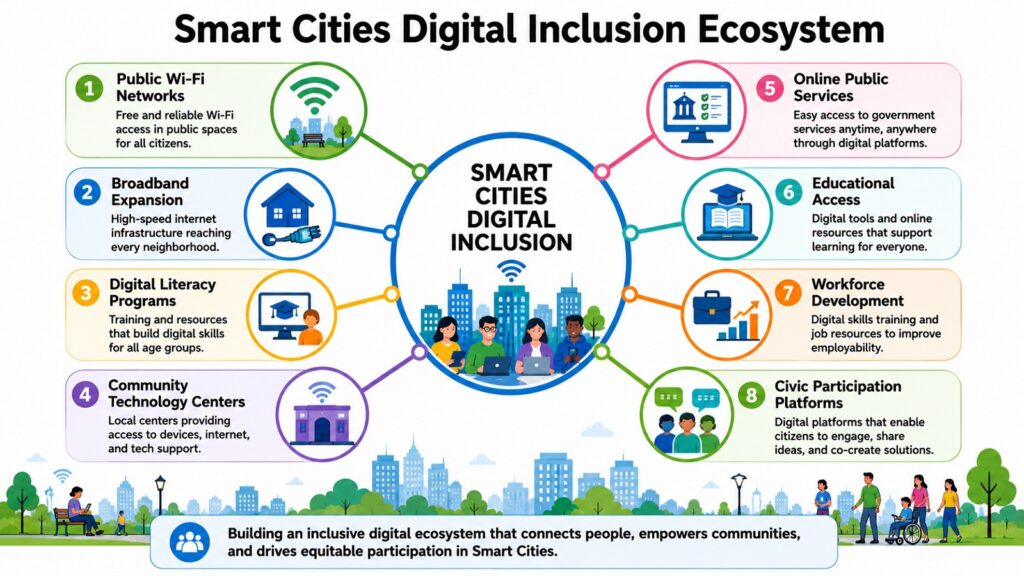
A city can deploy the most advanced technology in the world. But if large parts of its population cannot access or use that technology, the benefits will concentrate among those who already have advantages. Digital inclusion is not a secondary concern in Smart City development. It sits at the center of whether smart programs improve life for everyone or only for the already-connected.
Seoul recognized early that broad connectivity was a precondition for everything else its smart programs were trying to achieve. The city built a free public Wi-Fi network with over 20,000 access points by 2023, covering parks, public squares, transit stations, and many indoor public spaces. Its Digital New Deal program subsidized broadband subscriptions and provided devices to low-income households and students, with targeted outreach to elderly residents who face the steepest barriers to digital participation.
Singapore’s Infocomm Media Development Authority runs the Digital Access for All initiative targeting seniors, low-income households, and people with disabilities. The program provides subsidized devices, low-cost broadband plans, and hands-on digital literacy training through community centers in every district. By 2023, over 200,000 seniors had received skills training through government-supported programs. The Digital Ambassadors network deploys trained volunteers and staff to provide one-on-one guidance to citizens who struggle with digital services, addressing the human dimension that technology infrastructure alone cannot solve.
Tallinn demonstrates that meaningful digital inclusion is achievable without enormous resources. Estonia’s Digiriik framework treats digital access as a citizen right. Public libraries across Tallinn offer free computer and internet access, and government workers receive training to guide citizens through digital systems. The evidence from all three cities shows that connectivity alone is insufficient. People need skills, devices, and confidence. Smart Cities that treat inclusion as an equity priority, rather than just an infrastructure checklist, produce improvements that reach a much wider share of urban residents.
Table 6: Smart Cities Digital Inclusion Initiatives and Social Benefits
| Digital Inclusion Initiatives Of Smart Cities | Primary Social Benefit |
| Seoul free metropolitan Wi-Fi (20,000+ points) | Universal wireless access for all residents in public spaces |
| Seoul Digital New Deal device subsidy | Internet and device access for low-income households and students |
| Singapore Digital Access for All program | Subsidized broadband and devices for three priority groups |
| Singapore Digital Ambassadors network | Human-assisted onboarding for digitally excluded citizens |
| Tallinn public library connectivity program | Free computer and internet access in every city district |
| Estonia Digiriik framework | Digital access as a statutory citizen right, not optional service |
| Singapore seniors digital skills training | 200,000+ seniors trained in digital literacy by 2023 |
| Seoul Digital New Deal youth focus | Devices and training provided to 50,000+ students annually |
6. Smart Cities Improve Quality of Life Through Integrated Urban Innovation
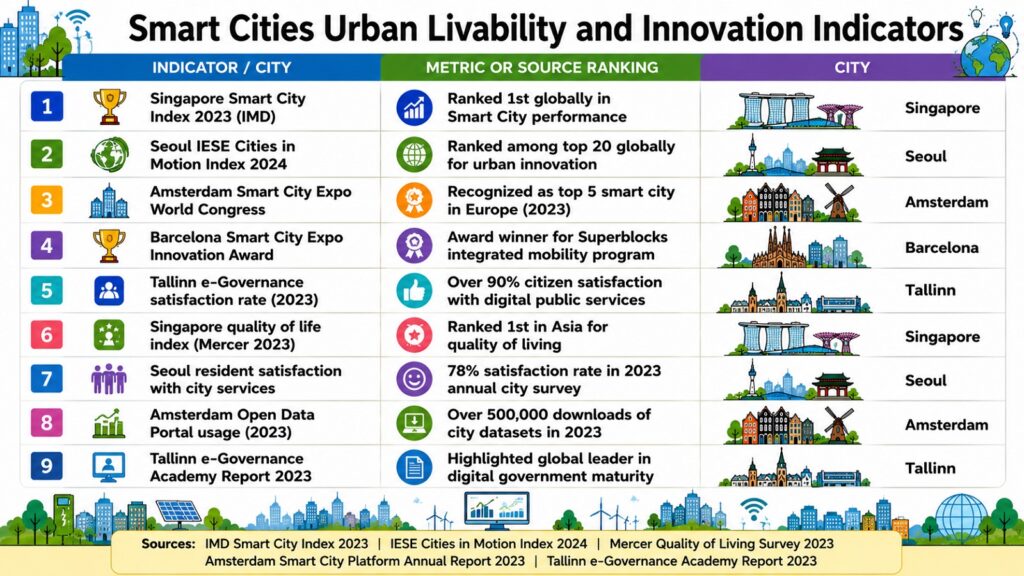
The first five sections examined Smart City programs one dimension at a time. But the cities that consistently perform best in global rankings do not operate separate silos for transport, governance, safety, sustainability, and connectivity. They integrate these systems so that each reinforces the others. That integration is what separates cities with impressive technology from cities that use technology to genuinely improve daily life.
Seoul’s Smart City Data Hub connects data streams from transportation, environment, public safety, and social services into a single platform. City administrators can see in real time how transit demand is shifting, where air quality is deteriorating, and where public service requests are concentrating. This allows coordinated responses rather than fragmented reactions. During the COVID-19 pandemic, Seoul used this integrated infrastructure to trace contacts, manage quarantine, and allocate medical resources in ways that drew international attention and were studied by health agencies worldwide.
Singapore’s Virtual Singapore project is a detailed three-dimensional model of the entire city, updated continuously with data from sensors, satellites, and administrative databases. Planners, engineers, and agencies use the model to simulate scenarios and test infrastructure changes before committing to implementation. Amsterdam connects its sustainability, mobility, and data programs through the Amsterdam Smart City network, a public-private partnership involving more than 100 organizations that publishes outcomes openly and allows researchers, businesses, and community groups to build services on top of city data.
Barcelona’s Superblocks initiative redesigns nine-block clusters of the urban grid to restrict through traffic, reduce pollution, expand pedestrian areas, and create new community spaces. It is managed using data from environmental sensors, traffic monitors, and citizen feedback platforms simultaneously. Early evaluations showed measurable reductions in air pollutants, noise levels, and traffic-related injuries within Superblock zones. Tallinn rounds out this picture by demonstrating that integration does not require enormous budgets. Estonia’s coherent national digital backbone, shared across health, tax, transit, and identity systems, produces more value than disconnected platforms at twice the cost.
The common characteristics of these high-performing Smart Cities are consistent across all five cases. They invest in data infrastructure before individual applications. They build governance frameworks before deploying sensors. They design for citizens first and technology second. They measure outcomes rigorously and adjust programs when the data demands it. Those qualities matter more than any particular technology choice, and they are replicable by cities that do not yet appear on any global smart city ranking.
Conclusion: Smart Cities and the Future of Urban Life
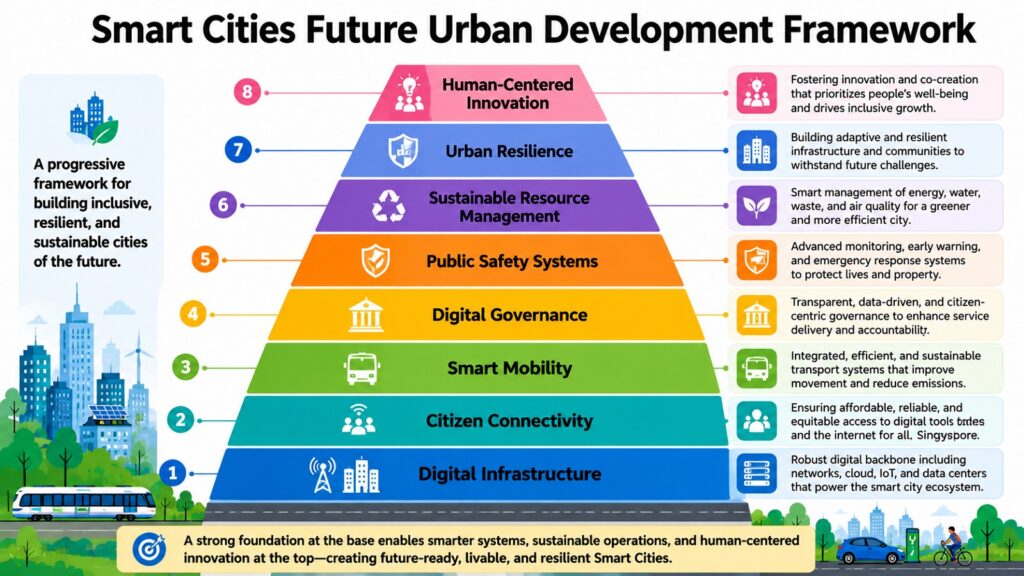
This article examined six dimensions of urban development through five smart cities. Across every dimension, the same pattern emerges. The cities that improve urban life most effectively are not simply those with the most sensors or the fastest networks. They are the ones that deploy technology in service of clear social goals, governed by transparent frameworks, and designed around the needs of real citizens.
Returning to the central question, the evidence points to a few consistent answers. Smart Cities reduce the friction that makes cities exhausting to live in. Shorter commutes, faster public services, cleaner air, and safer streets are not abstract policy outcomes. They are experienced daily by millions of people. Every minute saved on a commute, every permit completed without a waiting line, every flood warning received in time represents a concrete improvement in someone’s actual day.
The five smart cities examined here succeeded for different reasons but shared certain foundations. Each built a coherent data infrastructure before building applications on top of it. Each invested in governance alongside technology. Each measured outcomes and used the evidence to adjust its programs. And each, to varying degrees, treated digital inclusion as an integral part of the design rather than an afterthought added later when gaps became embarrassing.
Looking ahead, the next wave of Smart City development will be shaped by artificial intelligence, greater automation, and expanding sensor coverage across domains that are still largely analog. AI-driven traffic management, predictive public health systems, and automated building energy management are already emerging in pilot programs. These technologies carry genuine promise and genuine risk. Without strong governance, they can amplify existing inequalities, create new surveillance burdens, or produce decisions that citizens cannot understand or contest.
The most important lesson from the cities examined here may be the simplest one. Technology alone does not create a Smart City. What creates a Smart City is the decision to use technology in the service of people, governed by institutions accountable to those same people, and evaluated by whether urban life actually improves. That is a harder problem than deploying sensors. It is also the only problem worth solving.
Table 8: Smart Cities Key Lessons and Implications for Future Urban Development
| Lessons From Smart Cities | Practical Implication for Urban Development |
| Data infrastructure must precede applications | Invest in open, interoperable data platforms before building systems |
| Governance frameworks enable public trust | Publish algorithmic accountability rules before deploying AI systems |
| Integration multiplies value of individual investments | Connect transport, safety, and governance systems through shared data |
| Digital inclusion is a prerequisite, not an add-on | Design citizen access programs alongside technology deployment |
| Measurable outcomes drive continuous improvement | Define metrics before implementation and publish results openly |
| Small cities can lead on digital governance | Tallinn’s model shows budget size is less important than coherent design |
| Citizen-centered design produces lasting adoption | Co-design services with residents to ensure actual uptake and use |
| Technology alone does not solve urban problems | Social policy, political will, and governance matter as much as sensors |