Table of Contents
Introduction — Cloud Infrastructure as a Foundation of the Digital Ecosystem
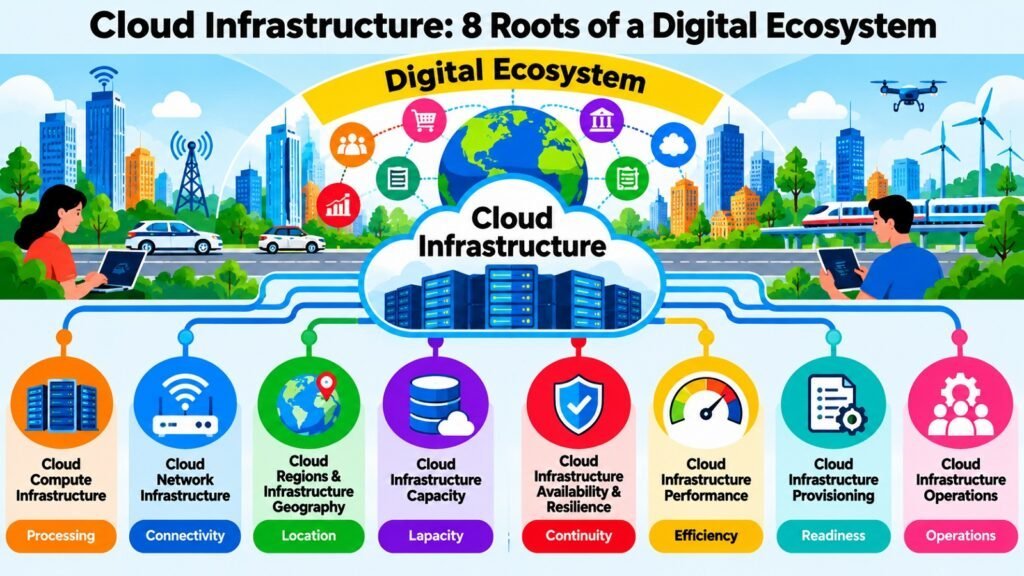
Cloud Infrastructure is the physical and logical foundation through which compute resources, network pathways, geographic locations, capacity pools, resilience mechanisms, performance characteristics, provisioning processes, and operational practices collectively support digital services, platforms, applications, users, and the full range of participants in a Digital Ecosystem. It is an important building block of that ecosystem — not a peripheral concern but the bedrock on which everything else depends.
Understanding Cloud Infrastructure requires clear distinctions from related disciplines. Cloud Computing describes the service models, virtualization techniques, orchestration mechanisms, and automation practices through which cloud capabilities are delivered and managed. Cloud Security addresses the protection of those environments from threats and unauthorized access. Cloud Infrastructure, by contrast, is the structural foundation beneath both — the set of resources and organizational decisions that determines whether digital services can operate reliably, reach their intended users, and evolve as ecosystem requirements grow.
The value of Cloud Infrastructure is best understood when it is treated as an interconnected foundation rather than a collection of isolated technical resources. Compute capacity, network connectivity, geographic distribution, resilience characteristics, performance behavior, provisioning efficiency, and operational practices each influence the others, and decisions made in one dimension ripple across the broader ecosystem. The eight aspects examined in this article — compute, network, geography, capacity, resilience, performance, provisioning, and operations — collectively determine the strength, reach, and dependability of a Digital Ecosystem, and each section combines theoretical analysis with practical evaluation frameworks to help readers examine real infrastructure environments.
Cloud Infrastructure Aspects and Their Role in the Digital Ecosystem
| Cloud Infrastructure Aspect | Role in the Digital Ecosystem |
| Compute Infrastructure | Provides the processing foundation that powers applications, workloads, analytics, and digital services |
| Network Infrastructure | Enables communication between cloud resources, services, users, and ecosystem participants |
| Regions and Infrastructure Geography | Determines the geographic reach, latency profile, resilience, and data residency of ecosystem services |
| Capacity | Ensures infrastructure resources are sufficient for current and anticipated ecosystem demand |
| Availability and Resilience | Supports continuous service delivery and recovery from infrastructure failures or disruptions |
| Performance | Governs the efficiency, responsiveness, and throughput of infrastructure supporting ecosystem workloads |
| Provisioning | Translates infrastructure requirements into correctly configured, ready-to-use environments |
| Operations | Maintains infrastructure health, visibility, and alignment with ecosystem requirements over time |
1. Cloud Infrastructure and Compute Infrastructure
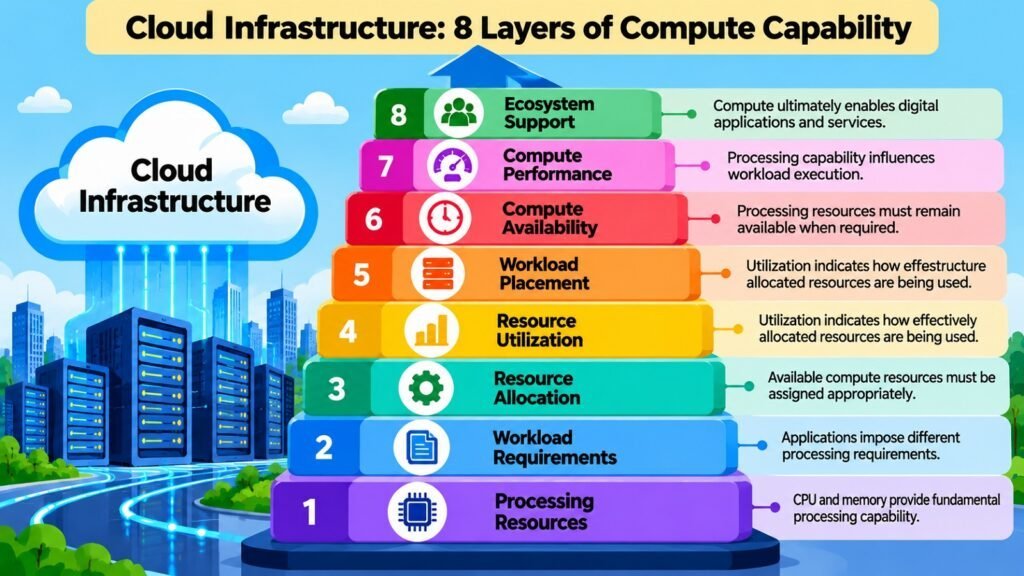
Compute infrastructure is the processing foundation of Cloud Infrastructure. It encompasses the physical and logical resources — processors, memory, storage-access pathways, and computing environments — that handle the workloads, applications, analytics operations, and platform activities that animate a Digital Ecosystem. Without adequate compute, other infrastructure elements lose practical value: networks carry data to services that cannot process it, and storage holds data that cannot be meaningfully accessed or analyzed.
The distinction between processing capacity, workload requirements, resource utilization, and compute availability matters in an ecosystem context because these four concepts interact continuously, and an imbalance among them can affect downstream services and business processes. A Digital Ecosystem supporting an analytics platform, a customer application, and third-party integrations may find that insufficient compute for peak analytics operations delays reporting cycles, which in turn affects decisions that depend on timely data — a downstream effect visible not at the infrastructure level but in application slowdowns and missed operational commitments. The NIST definition of cloud computing acknowledges the importance of on-demand resource pooling and measured service, reflecting how compute availability is understood at a foundational level in contemporary cloud environments.
Evaluating compute infrastructure requires attention to workload characteristics rather than raw capacity figures. The nature of workloads — whether continuous and predictable, bursty and variable, latency-sensitive, or throughput-intensive — should guide infrastructure decisions. Organizations should ask: Does available compute align with current and anticipated workload profiles? How does the infrastructure handle simultaneous demand from multiple services or tenants? Compute infrastructure is one foundational root of Cloud Infrastructure precisely because its characteristics propagate through an entire ecosystem — a well-dimensioned compute environment allows applications to respond consistently, analytics to complete on schedule, and platforms to serve users without degradation.
Cloud Infrastructure: Compute Infrastructure Concepts and Evaluation Considerations
| Compute Concept | Infrastructure Significance |
| Processing Capacity | The aggregate computational power available to handle workloads within the infrastructure environment |
| Workload Requirements | The specific processing demands generated by applications, analytics operations, and digital services |
| Resource Utilization | The proportion of available compute capacity actively consumed by running workloads at any moment |
| Compute Availability | Whether processing resources are operational and accessible when workloads require them |
| Workload Characteristics | The nature of demand — continuous, bursty, latency-sensitive, or throughput-intensive — that shapes compute selection |
| Resource Contention | Competition among workloads for shared compute resources, potentially degrading performance and reliability |
| Processing Efficiency | How effectively compute resources convert available capacity into productive output for active workloads |
| Compute Alignment | The degree to which infrastructure compute configuration matches actual and anticipated workload profiles |
2. Cloud Infrastructure and Network Infrastructure
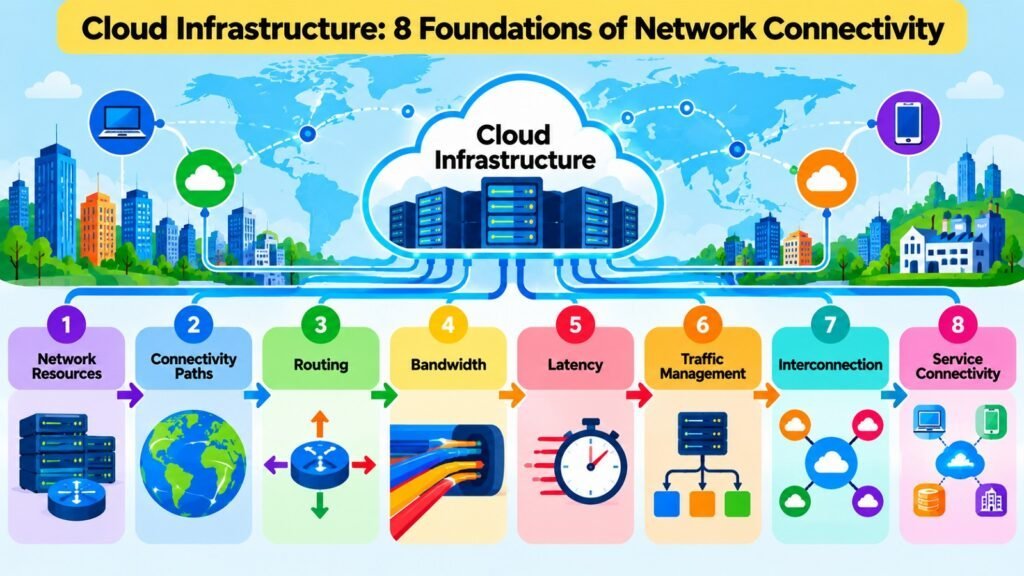
Network infrastructure constitutes the foundational connectivity mechanism through which cloud resources, applications, platforms, users, devices, and services establish communication within and across a Digital Ecosystem. Network pathways represent the logical and physical conduits along which data traverses between components and external destinations. Bandwidth specifies the volume of data capable of traversing a designated pathway within a specified timeframe.
Latency quantifies the duration required for data transmission between two distinct points. Traffic flow characterizes the movement patterns evident throughout the infrastructure. Interconnection denotes the linkages established between cloud provider networks, enterprise environments, content delivery networks, and internet exchange points. Collectively, these elements establish the degree to which network infrastructure effectively facilitates ecosystem communication.
The practical stakes are tangible. A retail Digital Ecosystem linking an e-commerce platform, an inventory system, a payment gateway, and a customer analytics service depends on continuous, low-latency communication among its components. Consistently high latency between the payment gateway and the inventory system degrades the checkout experience perceptibly. Insufficient bandwidth between the analytics service and its data sources causes reporting to lag during peak periods, affecting the business decisions that depend on it. Network infrastructure is distinct from network security, which addresses protecting pathways from unauthorized access, and from platform integration, which concerns logical compatibility between systems rather than the underlying connectivity that makes communication physically possible.
Practical evaluation questions include: Are network pathways designed to support the communication patterns of the ecosystem? What is the impact of latency or bandwidth constraints on time-sensitive services? How does the network handle traffic volume increases during peak demand? Network infrastructure is the connectivity root of Cloud Infrastructure — the medium through which all ecosystem participants interact — and designing it with care is as important as the applications it carries.
Cloud Infrastructure: Network Infrastructure Characteristics and Evaluation Considerations
| Network Concept | Infrastructure Significance |
| Network Pathways | Logical and physical routes through which data travels between infrastructure components and external destinations |
| Bandwidth | The maximum volume of data that can pass through a network pathway within a defined period |
| Latency | The time required for data to travel between two network points, directly affecting application responsiveness |
| Traffic Flow | Patterns of data movement across the infrastructure, including volume, directionality, and timing between services |
| Interconnection | Links between cloud provider networks, enterprise networks, delivery networks, and internet exchange points |
| Connectivity Reliability | The consistency with which network pathways remain functional and deliver data without loss or interruption |
| Network Redundancy | Duplicate network pathways that maintain connectivity if a primary route fails or degrades unexpectedly |
| Throughput Consistency | The ability of network infrastructure to sustain required data volumes across varying demand conditions |
3. Cloud Infrastructure and Regions and Infrastructure Geography
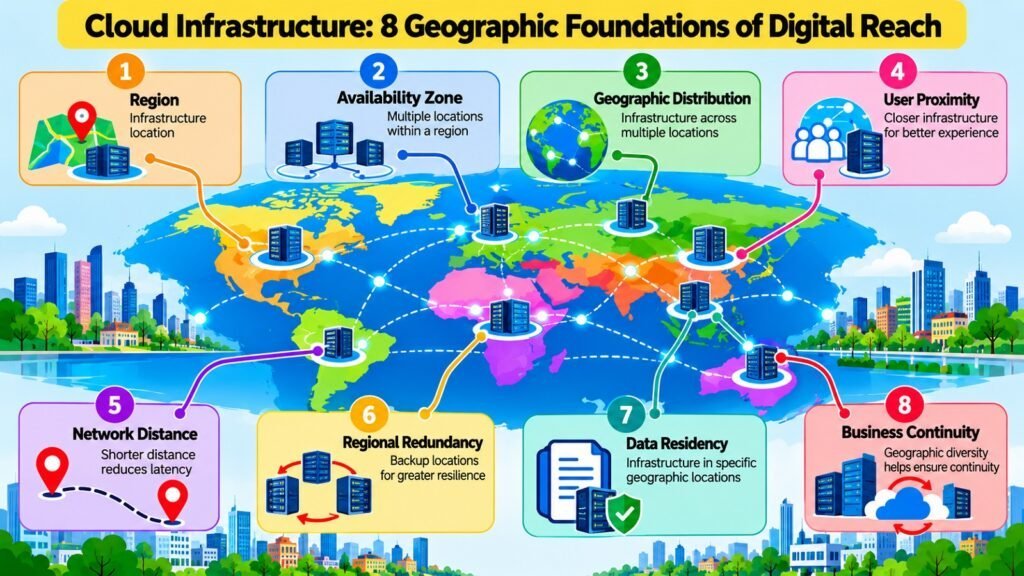
Geography is a foundational dimension of Cloud Infrastructure that shapes the latency, availability, data residency compliance, service reach, and resilience of a Digital Ecosystem. Cloud providers organize their infrastructure into regions — distinct geographic areas containing multiple physically separated data center locations called availability zones. Zones within a region are designed to be independent in terms of power, cooling, and network infrastructure, so that a failure in one zone does not automatically affect the others. This structure allows organizations to distribute workloads and data across locations to support continuity while maintaining proximity to users and connected systems.
The practical implications of infrastructure geography are significant. Latency between an infrastructure location and its users is influenced by physical distance and the quality of network pathways connecting them. Interactive digital services — where users perceive delays directly — benefit from infrastructure located closer to those users. Geographic distribution also supports business continuity: distributing infrastructure across multiple regions reduces the risk that a single disruption affects the entire ecosystem.
Amazon Web Services, Microsoft Azure, and Google Cloud each publish detailed documentation on their regional infrastructure, reinforcing the importance of geographic placement in infrastructure design. Data residency — the requirement that certain data remain within defined geographic boundaries — acts as a location-selection constraint rather than a data governance topic, shaping how ecosystems are designed across borders.
Infrastructure geography is not a deployment-model decision. It is a foundational aspect of where and how cloud resources are physically organized and distributed. As Digital Ecosystems serve increasingly global audiences, geographic infrastructure decisions become more consequential, and organizations that evaluate geography carefully are better positioned to serve distributed participants while meeting continuity, performance, and residency requirements simultaneously.
Cloud Infrastructure: Geographic and Regional Concepts and Evaluation Considerations
| Geographic Concept | Infrastructure Significance |
| Cloud Region | A distinct geographic area containing multiple data center locations operated by a cloud provider |
| Availability Zone | A physically separated data center location within a region, with independent power, cooling, and network |
| Geographic Distribution | Spreading infrastructure across multiple regions or zones to support continuity and reduce localized risk |
| Infrastructure Latency | The network delay between infrastructure locations and the users or systems they serve |
| Data Residency | The requirement that certain data remain within defined geographic boundaries for regulatory or policy reasons |
| Regional Redundancy | Duplicating infrastructure across regions to maintain availability if one region experiences disruption |
| Service Reach | The geographic range within which infrastructure can serve users with acceptable performance characteristics |
| Location Selection | Choosing infrastructure locations based on user proximity, regulatory requirements, and continuity objectives |
4. Cloud Infrastructure and Capacity
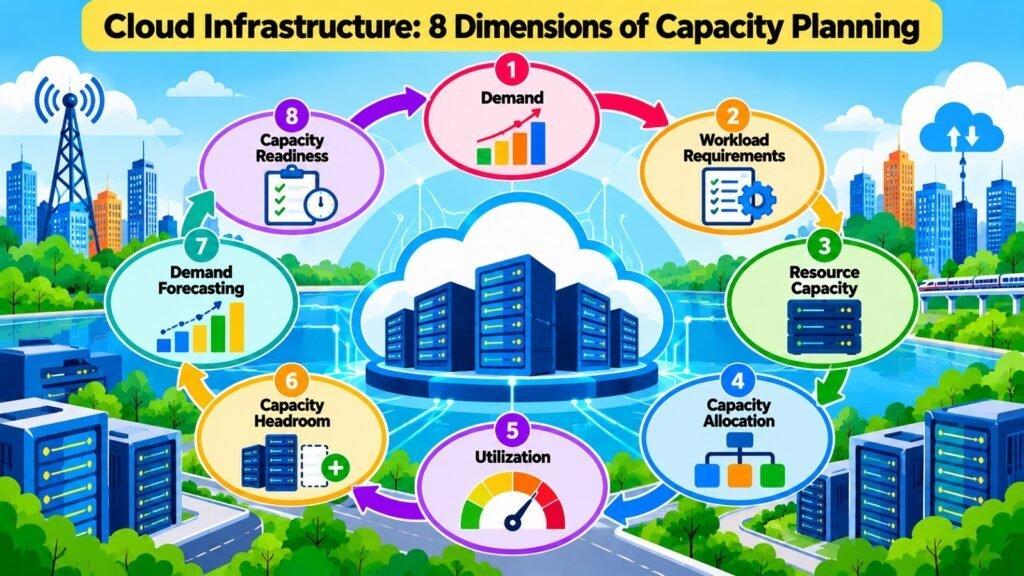
Capacity is the ability of Cloud Infrastructure to provide sufficient resources to meet the current and anticipated requirements of a Digital Ecosystem. Its deficiencies tend to appear at the worst moments — during peak demand, at the point of business growth, or when multiple services compete for the same resource pool. Capacity refers to the total resources available within an infrastructure environment. Demand is actual resource consumption at any given moment. Utilization measures how much of that capacity is being consumed. Headroom is the buffer between current demand and the practical upper limit of capacity — the margin that allows an environment to absorb additional load without immediate degradation.
Capacity is explicitly separate from scalability and elasticity, which belong to the Cloud Computing discipline. Scalability and elasticity describe mechanisms for adjusting resource footprints dynamically in response to demand. Capacity planning is about understanding the resource requirements of the ecosystem and ensuring that infrastructure provides an appropriate foundation before those dynamic mechanisms are invoked. Organizations that conflate the two may find that reactive scaling cannot compensate for fundamentally inadequate infrastructure dimensioning. The Uptime Institute has documented that poor capacity planning contributes to avoidable service disruptions, noting that resource contention under peak demand is a common and preventable source of performance degradation.
Practical evaluation questions include: What is current utilization relative to available capacity? How has demand grown over time, and how does that trajectory relate to current provisioning? What headroom exists to support unexpected demand spikes or ecosystem growth? Treating capacity as a strategic infrastructure consideration rather than a procurement afterthought strengthens every other dimension of Cloud Infrastructure and supports the long-term reliability of the Digital Ecosystem.
Cloud Infrastructure: Capacity Concepts and Evaluation Considerations
| Capacity Concept | Infrastructure Significance |
| Available Capacity | The total infrastructure resources provisioned within the environment for compute, network, and storage |
| Workload Demand | The actual resource consumption generated by active services, users, and operations at any given moment |
| Resource Utilization | The proportion of available capacity actively consumed, indicating proximity to environmental limits |
| Infrastructure Headroom | The buffer between current demand and practical capacity limits, enabling absorption of additional load |
| Peak Demand Profile | The maximum resource requirements the ecosystem generates, which should inform capacity planning decisions |
| Demand Growth Trajectory | The rate at which ecosystem resource requirements are increasing over time and must be accommodated |
| Resource Contention Risk | The probability that competing workloads will exhaust available resources during periods of high demand |
| Capacity Alignment | The degree to which provisioned resources match the present and near-term requirements of the ecosystem |
5. Cloud Infrastructure and Availability and Resilience
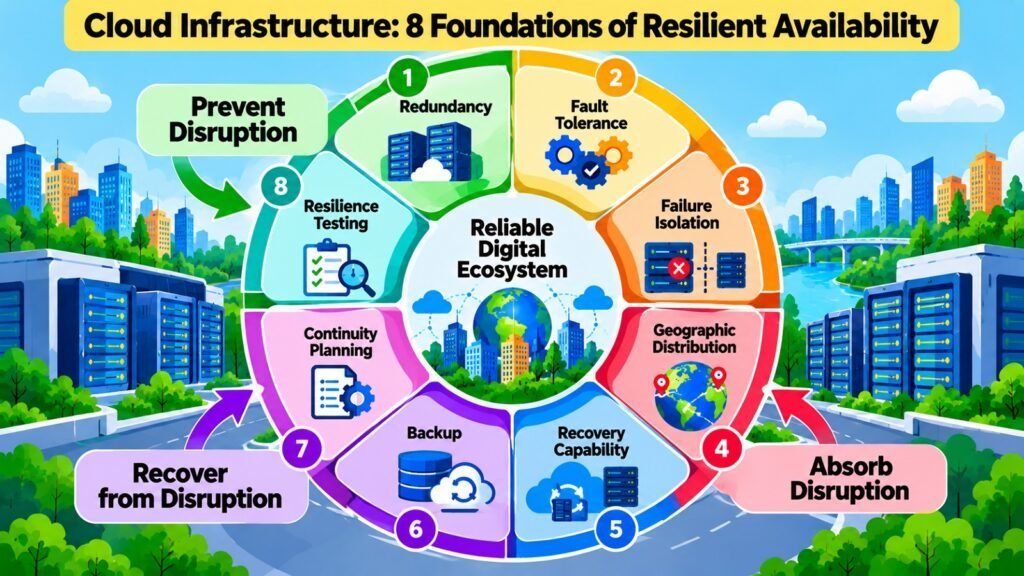
Availability and resilience determine whether Cloud Infrastructure can support dependable Digital Ecosystem services not only under normal conditions but also when components fail, degrade, or encounter unexpected disruptions. Availability is the proportion of time that infrastructure resources are operational and accessible — 99.9% availability implies approximately 8.7 hours of potential downtime per year. Redundancy is the practice of duplicating critical components so a backup can assume the function of a failed primary. Fault tolerance is the ability to continue operating despite component failures. Failure isolation prevents failures in one area from cascading to others. Resilience encompasses the capacity to absorb disruptions, maintain acceptable service levels, and recover with minimal lasting impact.
A robust Digital Ecosystem extends beyond the mere reliability of individual components; rather, it represents infrastructure architected to prevent failures in one domain from cascading into dependent services. Consider a healthcare platform whose database infrastructure concentrates within a single availability zone—such a configuration renders every dependent application vulnerable to complete failure should that zone experience disruption. Conversely, distributing identical infrastructure across multiple zones with suitable redundancy enables the platform to sustain operations despite zone-level interruptions.
Infrastructure resilience must be distinguished from cybersecurity: resilience encompasses the preservation and restoration of infrastructure capabilities in response to technical malfunctions, whereas cybersecurity focuses on mitigating and managing intentional threats. Both ISO 22301 and the NIST Cybersecurity Framework recognize operational resilience, albeit from distinct yet complementary viewpoints.
Organizations should ask: What redundancy exists for critical infrastructure components? How does the infrastructure isolate failures to prevent cascading effects? What recovery mechanisms exist, and how quickly can they restore normal operations? Resilience is a foundational property of dependable Cloud Infrastructure — one designed in from the start rather than addressed reactively after disruptions occur.
Cloud Infrastructure: Availability and Resilience Concepts and Evaluation Considerations
| Resilience Concept | Infrastructure Significance |
| Availability | The proportion of time infrastructure resources are operational and accessible for their intended workloads |
| Redundancy | Duplicate infrastructure components that assume the function of failed primaries to maintain continuity |
| Fault Tolerance | The ability of infrastructure to continue operating correctly despite the failure of one or more components |
| Failure Isolation | Design that prevents a failure in one component or zone from cascading into other parts of the environment |
| Resilience | The capacity to absorb disruptions, maintain acceptable service levels, and recover with minimal lasting impact |
| Recovery Time | The duration required to restore normal infrastructure operation following a disruption or failure event |
| Recovery Point | The point in time to which data or operations can be restored following an infrastructure disruption |
| Continuity Design | Infrastructure architecture explicitly designed to maintain service delivery despite component or zone failures |
6. Cloud Infrastructure and Performance
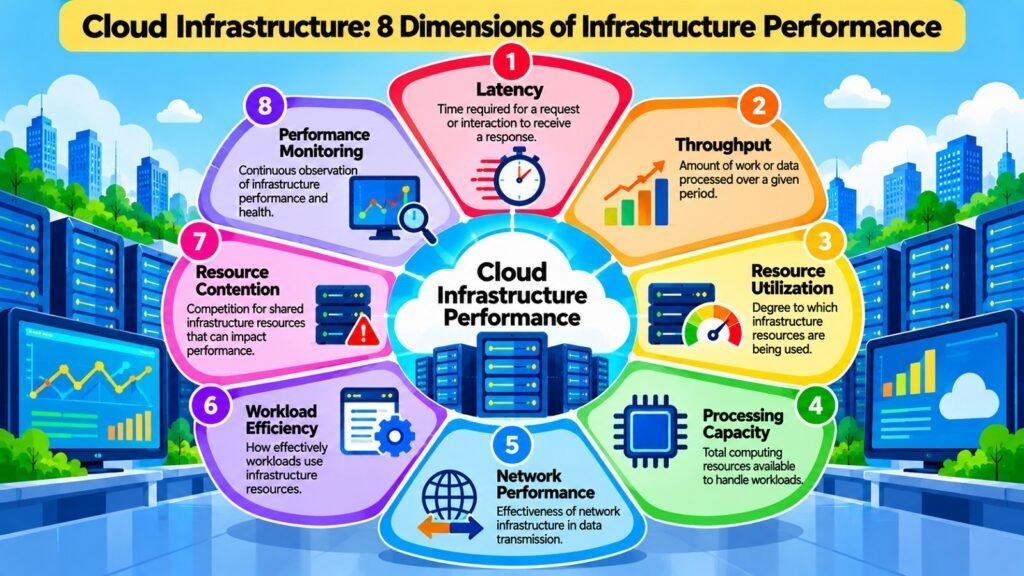
Performance is the ability of Cloud Infrastructure to support workloads and digital services efficiently and consistently across a Digital Ecosystem. It is not a single measurement but a collection of characteristics: latency is the time required for data to travel between infrastructure components or between infrastructure and users; throughput is the volume of data or transactions processed in a defined period; resource utilization describes how efficiently compute, network, and storage resources are being used; processing efficiency reflects how well infrastructure translates available capacity into productive workload output; and bottlenecks are specific components or pathways where demand consistently exceeds capacity, constraining overall system performance.
Understanding infrastructure performance requires a system-level perspective rather than a component-level view. A single fast compute instance is irrelevant if the network pathway connecting it to its data source is saturated or if storage access patterns create waiting states that idle the processor. Google’s Site Reliability Engineering documentation emphasizes that system-level performance analysis produces more meaningful insights than isolated component benchmarking. A financial analytics platform illustrates how bottlenecks propagate: if storage throughput is insufficient, data retrieval extends, compute resources wait, results arrive late, and downstream reporting processes are disrupted — a storage constraint whose effects are felt across the entire workflow.
Performance is distinct from scalability and elasticity, which address mechanisms for adjusting resource capacity dynamically. Organizations should ask: What are the latency and throughput characteristics of the current environment? Where do bottlenecks appear under realistic workload conditions? How does performance change as ecosystem activity increases? Infrastructure that appears adequate during light use may reveal limitations only under realistic conditions — performance should be measured and understood rather than assumed.
Cloud Infrastructure: Performance Dimensions and Evaluation Considerations
| Performance Dimension | Infrastructure Significance |
| Latency | The time required for data to travel between infrastructure components or between infrastructure and users |
| Throughput | The volume of data or transactions that infrastructure can process successfully within a defined period |
| Resource Utilization | How efficiently compute, network, and storage resources are being used relative to available capacity |
| Processing Efficiency | How effectively infrastructure resources translate available capacity into productive workload output |
| Bottleneck | A specific component or pathway where demand consistently exceeds capacity, constraining overall performance |
| Infrastructure Responsiveness | The speed and predictability with which infrastructure reacts to workload demands and requests |
| Performance Consistency | The degree to which infrastructure delivers stable performance characteristics across time and load variations |
| Workload Behavior | The resource consumption patterns of applications and services that infrastructure must reliably support |
7. Cloud Infrastructure and Provisioning
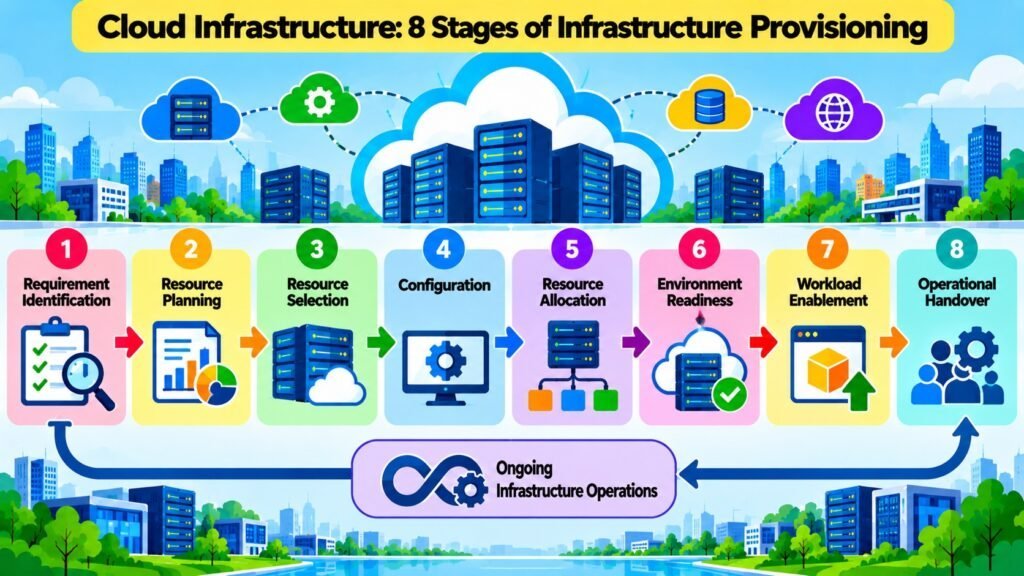
Provisioning is the process through which required infrastructure resources are made available, allocated, configured, and prepared for the workloads and services that depend on them within a Digital Ecosystem. It is the operational link between infrastructure planning and infrastructure use — the step that converts resource requirements into functioning environments ready to support applications, platforms, and digital services. Infrastructure requirements describe what a workload needs to operate correctly. Resource allocation assigns specific resources to meet those requirements. Configuration sets up allocated resources according to workload specifications. Environment readiness is the state in which a provisioned environment is correctly configured, validated, and prepared for use. Lifecycle management extends provisioning into ongoing maintenance, updating, and eventual decommissioning.
Provisioning directly influences how quickly and consistently organizations can establish infrastructure capabilities for new services and ecosystem initiatives. Slow or inconsistent provisioning introduces delays and configuration errors at precisely the moment when new services need to be ready. Provisioning is explicitly different from Cloud Automation and DevOps, which belong to the Cloud Computing discipline and describe methodologies and tooling for automating infrastructure management. Provisioning in this context is about the readiness and correctness of infrastructure resources — the lifecycle from requirement to operational environment. The AWS Well-Architected Framework acknowledges configuration consistency and environment readiness as foundational operational considerations.
Organizations should ask: Are provisioning processes consistent and repeatable across different environment types? How is correctness validated before workloads are deployed? How does the provisioning process align with the capacity planning and performance requirements of the ecosystem? Effective provisioning creates a dependable starting point for infrastructure operations — it translates planning into infrastructure reality, and its quality determines how reliably the Digital Ecosystem can expand, adapt, and serve its participants.
Cloud Infrastructure: Provisioning Concepts and Evaluation Considerations
| Provisioning Concept | Infrastructure Significance |
| Resource Allocation | Assigning specific infrastructure resources to meet the defined requirements of a workload or service |
| Configuration | Setting up allocated resources according to the technical and operational specifications of the workload |
| Environment Readiness | The state in which a provisioned environment is correctly configured and validated for workload use |
| Provisioning Consistency | The repeatability of provisioning processes across different environments and workload types over time |
| Lifecycle Management | Maintenance, updating, and decommissioning of infrastructure environments throughout their operational life |
| Requirements Alignment | The degree to which provisioned resources match the actual needs of the workloads they are intended to support |
| Configuration Validation | Verification that provisioned environments meet defined standards before workloads are deployed to them |
| Operational Handoff | The transfer of a provisioned environment to operational oversight once it is correctly prepared for use |
8. Cloud Infrastructure and Operations
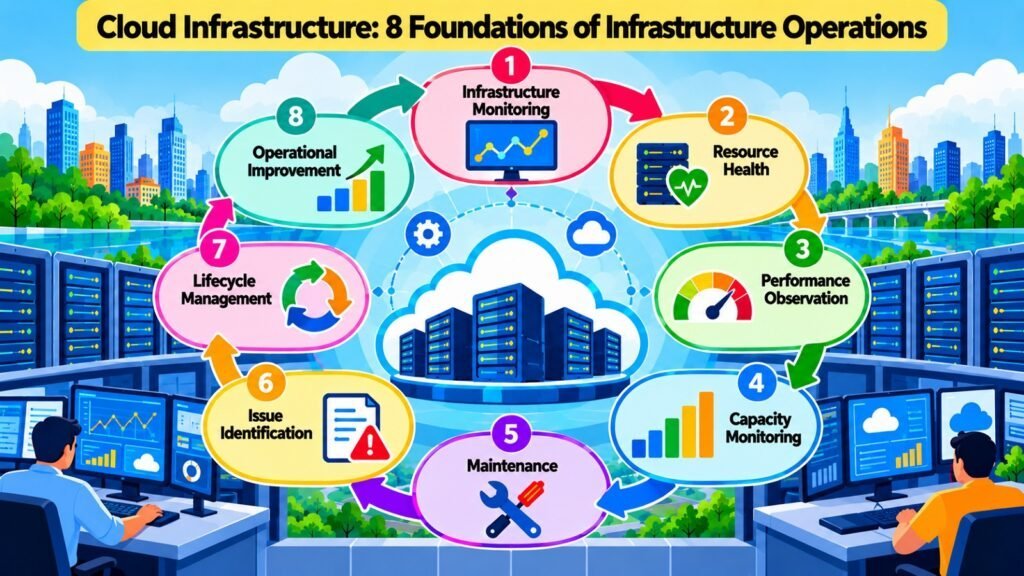
Cloud Infrastructure operations encompass the ongoing activities and capabilities required to maintain infrastructure health, operational visibility, resource effectiveness, and continuity across a Digital Ecosystem. Provisioning creates infrastructure environments; operations keep them functioning, performing, and aligned with ecosystem requirements throughout their useful life. Monitoring collects data about infrastructure state, utilization, health indicators, and performance characteristics in near real time. Resource health management assesses the condition of compute, network, and storage components to identify degradation or emerging problems. Maintenance covers scheduled activities — patching, updates, hardware replacement — that sustain infrastructure integrity over time. Operational visibility is the degree to which teams have accurate, timely awareness of what is happening within their environment.
The importance of operations grows as Digital Ecosystems become more distributed and interdependent. In a complex ecosystem, degradation in one area may produce symptoms in a different part of the environment. A logistics platform across multiple cloud regions may show gradual data synchronization slowness as the first indication of a network configuration issue between regions — a problem that proactive monitoring catches before it disrupts core operations. Infrastructure operations are distinct from Cloud Security Operations, which focuses on threat detection and incident response, and from Cloud Automation and DevOps, which addresses how infrastructure is built and deployed. The Uptime Institute finds that proactive, measurement-driven operations lead to fewer severe disruptions than reactive approaches.
Organizations should ask: Does the operations model provide real-time visibility across all infrastructure components? How are emerging problems identified before they affect dependent services? Are operational practices aligned with the scale and complexity of the ecosystem? Cloud Infrastructure creates value only when it remains effectively operated throughout its lifecycle — operations is the discipline that determines whether infrastructure investment translates into reliable, consistent, and measurable Digital Ecosystem performance.
Cloud Infrastructure: Operations Concepts and Evaluation Considerations
| Operations Concept | Infrastructure Significance |
| Infrastructure Monitoring | Continuous collection of data about infrastructure state, utilization, health, and performance characteristics |
| Resource Health Management | Assessing compute, network, and storage component condition to detect degradation or emerging problems |
| Operational Visibility | The degree to which teams have accurate, timely awareness of what is occurring across the infrastructure |
| Maintenance | Scheduled activities — patching, updates, hardware replacement — that sustain infrastructure integrity over time |
| Administration | Day-to-day management of resources, including access control, configuration, allocation, and lifecycle tracking |
| Issue Identification | Detection of anomalies, performance deviations, or health indicators that signal emerging infrastructure problems |
| Proactive Oversight | Anticipatory monitoring and management practices that address issues before they affect dependent services |
| Operational Continuity | The ability to sustain consistent infrastructure management practices across the full ecosystem lifecycle |
Conclusion — Cloud Infrastructure as the Roots of the Digital Ecosystem
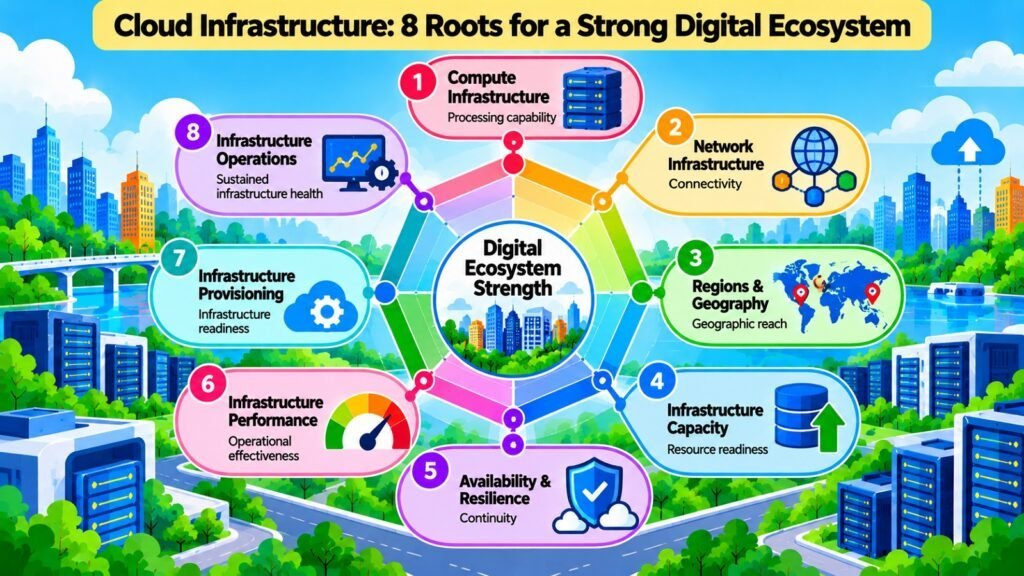
Cloud Infrastructure is an important foundation of the Digital Ecosystem — not because it provides a single critical capability but because it provides the interconnected foundation on which digital services, platforms, applications, users, and ecosystem participants collectively depend. The eight aspects examined in this article are distinct but interdependent. Compute infrastructure supports digital workloads, but its effectiveness depends on network connectivity and geographic placement. Capacity determines whether infrastructure can meet demand, but capacity without resilience means failures can still disrupt services. Performance is influenced simultaneously by compute, network, geographic distribution, and the headroom that capacity planning provides.
Provisioning translates planning into operational reality, and operations sustain the entire foundation over time — maintaining the visibility and engagement that keep infrastructure aligned with evolving ecosystem requirements. Recognizing the distinctions among Cloud Infrastructure, Cloud Computing, and Cloud Security helps organizations allocate responsibility and investment appropriately across these related but separate disciplines.
The evaluation questions developed throughout this article — about workload alignment, network characteristics, geographic distribution, capacity headroom, resilience design, performance measurement, provisioning consistency, and operational visibility — provide a reusable framework for examining any Cloud Infrastructure environment. As Digital Ecosystems grow in complexity, geographic reach, and interdependence, resilient, capable, and effectively operated Cloud Infrastructure will remain fundamental to their evolution. Organizations that understand Cloud Infrastructure as an integrated foundation are best positioned to build and sustain Digital Ecosystems that serve their participants reliably.
Cloud Infrastructure Aspects and Their Fundamental Contribution to the Digital Ecosystem
| Aspects | Fundamental Contributions |
| Compute Infrastructure | Processing foundation that determines whether digital workloads and services can operate reliably at all |
| Network Infrastructure | Connectivity foundation that enables all ecosystem components and participants to communicate effectively |
| Regions and Infrastructure Geography | Location foundation that shapes latency, reach, continuity, and data residency compliance across the ecosystem |
| Capacity | Resource foundation that determines whether infrastructure can meet current and future ecosystem demand |
| Availability and Resilience | Continuity foundation that enables services to withstand failures and recover without sustained disruption |
| Performance | Efficiency foundation that governs how effectively infrastructure supports workloads and user experiences |
| Provisioning | Readiness foundation that translates planning into correctly configured, operational infrastructure environments |
| Operations | Sustaining foundation that maintains infrastructure health and visibility throughout the full ecosystem lifecycle |