Table of Contents
Introduction: Software Architecture – The Foundation of Modern Software Systems
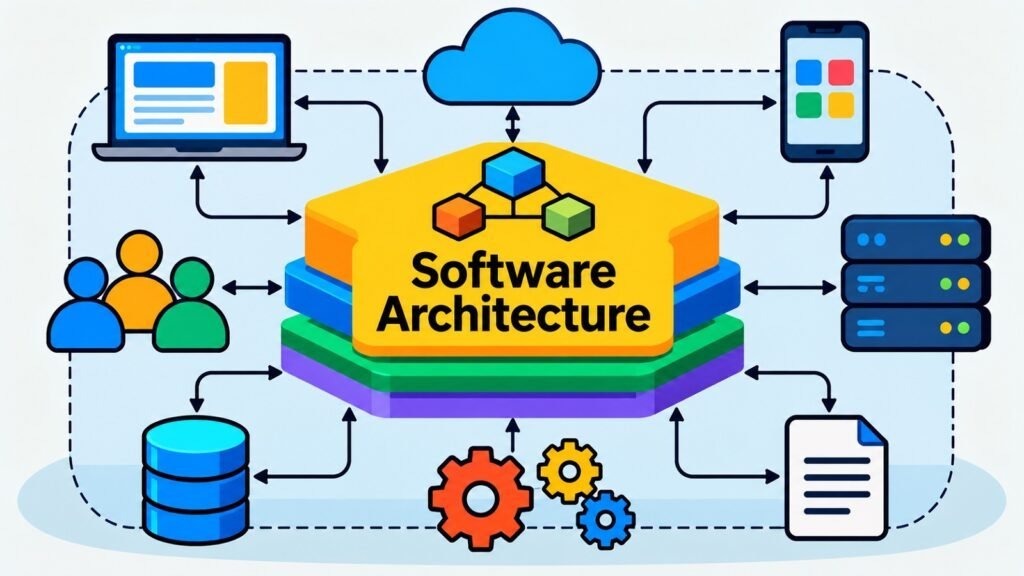
Software Architecture is the high-level structural organization and decision framework that defines how the major elements of a software system are arranged, related, and governed. It establishes the organizing blueprint through which capabilities, responsibilities, and relationships are shaped before and during development. Software Architecture is an important component of software systems because it determines structural integrity, quality characteristics, and long-term adaptability.
Understanding the scope of Software Architecture requires distinguishing it from related concepts. Software Systems are the complete, functioning products that architecture helps organize. Software Development encompasses the processes and practices through which systems are built. Software design addresses detailed structural decisions within individual components. Application Software and System Software describe product categories by purpose and function. Software Architecture provides the organizing framework above all of these — the level at which major structural decisions are made and governed.
Architecture is not simply a diagram produced at project initiation. It represents a combination of guiding principles, structural choices, architectural styles and patterns, trade-off reasoning, multiple representations, and ongoing governance. Architects make choices that shape how systems behave, evolve, and remain comprehensible, and those choices carry consequences well beyond the initial release.
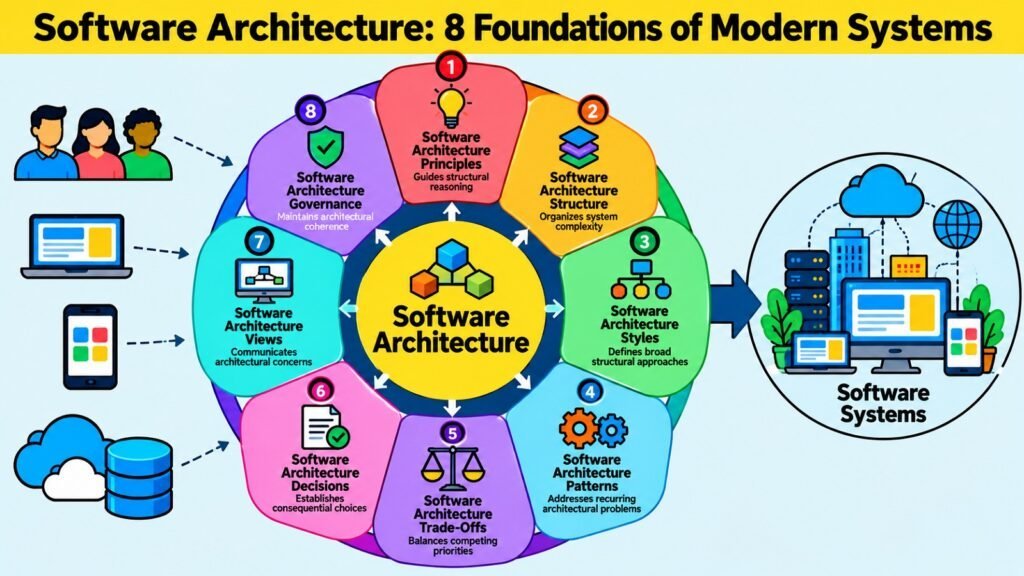
Effective architecture is fundamentally about balancing competing priorities rather than identifying one universally superior solution. Performance, maintainability, flexibility, scalability, and simplicity frequently pull against one another, and architects navigate these tensions according to the actual constraints and objectives of each system. This article explores eight interconnected aspects that form a coherent framework for understanding the field.
Software Architecture: Eight Aspects Covered in This Article
| Software Architecture Aspects | What It Addresses |
| Software Architecture Principles | Guiding constraints that shape structural decisions and manage complexity |
| Software Architecture Structure | Organization of systems into boundaries, layers, modules, and responsibilities |
| Software Architecture Styles | Broad organizational approaches that define system-wide structural relationships |
| Software Architecture Patterns | Reusable solutions to recurring structural problems |
| Software Architecture Trade-Offs | Competing priorities architects balance through reasoned decisions |
| Software Architecture Decisions | The process of making, documenting, and evaluating major structural choices |
| Software Architecture Views | Representations that communicate architecture to different stakeholder groups |
| Software Architecture Governance | Mechanisms that maintain consistency, standards, and coherence over time |
1. Software Architecture Principles: Guiding Modern Systems
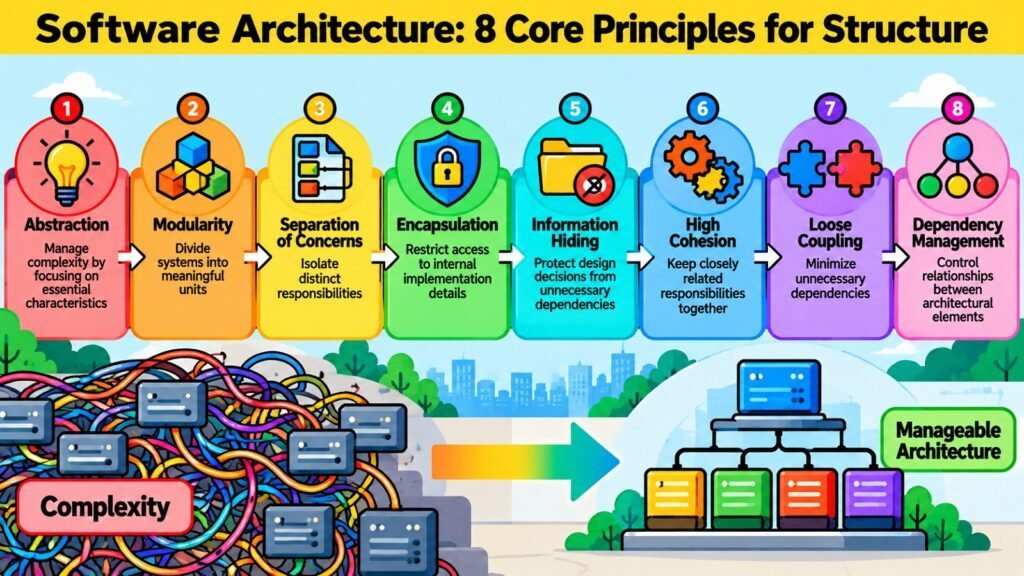
Architectural principles are the foundational ideas that guide how architects organize software systems, manage complexity, and make structural choices. They operate at the level of system organization — not as generic programming rules — and help architects reason consistently about structure, boundaries, and responsibilities across a system’s lifetime.
Abstraction allows architects to represent complex systems through simplified models, making large systems intellectually manageable. A service boundary, for instance, can be understood through what it exposes via its interface rather than through implementation details hidden within. Modularity extends this idea by decomposing a system into distinct units with well-defined responsibilities, making the structure easier to understand, change, and test in isolation.
Separation of concerns prevents different responsibilities from becoming structurally entangled. When data access logic, business rules, and user interface concerns occupy the same component, changing one element frequently disrupts the others. At the architectural level, this principle drives decisions about where to place boundaries between components, layers, and services.
Cohesion and coupling measure the quality of architectural boundaries. High cohesion means the elements within a structural unit are genuinely related and serve a unified purpose. Low coupling means structural units depend on each other as little as possible. David Parnas introduced information hiding in his influential 1972 paper, establishing that implementation details should be concealed behind interfaces, reducing the surface area through which change propagates.
Dependency management and simplicity complete the practical toolkit. Complex dependency chains make individual components difficult to modify safely. Simplicity — choosing the least complex structure that satisfies real requirements — reduces cognitive overhead and limits the accumulation of structural problems over time. These principles function as guiding constraints rather than rigid rules; the skill lies in applying them deliberately, with clear reasoning, when context demands a trade-off among them.
Software Architecture Principles: Eight Guiding Constraints and Their Architectural Purpose
| Principle | Architectural Purpose |
| Abstraction | Manages complexity by hiding unnecessary detail behind clear interfaces |
| Modularity | Organizes systems into independent, replaceable units with clear boundaries |
| Separation of Concerns | Prevents unrelated responsibilities from becoming structurally entangled |
| High Cohesion | Ensures structural units contain genuinely related elements serving one purpose |
| Low Coupling | Reduces inter-unit dependencies to limit the propagation of change |
| Information Hiding | Conceals implementation details behind interfaces to protect system integrity |
| Dependency Management | Controls how structural units depend on one another to reduce fragility |
| Simplicity | Favors the least complex structure that satisfies the actual requirements |
2. Software Architecture Structure: Organizing System Complexity
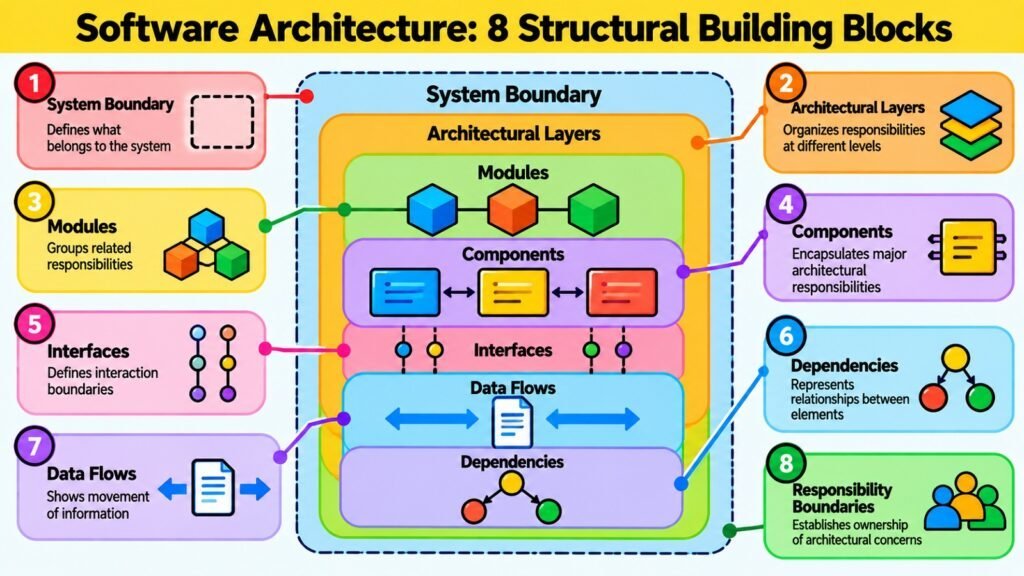
Structure is one of the most tangible expressions of Software Architecture. Where principles provide the reasoning behind architectural decisions, structure is the result: the layers, modules, components, interfaces, and relationships that give a complex system an organization that makes it comprehensible, manageable, and capable of change without constant instability.
Architectural structure differs from detailed software design. Design decisions at the component level address how individual classes or data models are organized internally. Architectural structure addresses how major system elements are divided, where boundaries are drawn, and how responsibilities and dependencies are arranged across the whole system. This distinction determines which decisions belong to the architect and which belong to the development team within a component.
Consider a system managing logistics operations across multiple regions. At the architectural level, the structure might separate order management, routing, inventory, and reporting into distinct structural units with clearly defined interfaces. That is an architectural decision. How order management stores and retrieves individual records is a design decision made within the component.
Decomposition is the primary activity through which architects create structure. A complex system is broken into units small enough to be understood and developed independently while remaining coordinated through their interfaces. Clear structural boundaries allow individual units to be changed, replaced, or tested in isolation, directly supporting maintainability and flexibility. When boundaries are unclear or absent, change becomes unpredictable because modifications in one part of the system may propagate unexpectedly to others.
Structural decisions also shape scalability. A system organized around genuinely independent responsibilities is more amenable to scaling individual capabilities independently than one where concerns are tightly woven together throughout the codebase. A useful evaluative question: does the division of responsibilities reflect the actual problem domain, or does it mirror the original preferences? Structure that mirrors real problem boundaries tends to remain stable as the system evolves.
Software Architecture Structure: Eight Structural Elements and Their Architectural Role
| Structural Element | Architectural Role |
| Layers | Separate distinct responsibility domains and control the direction of dependencies |
| Modules | Group related functionality into independently developable and replaceable units |
| Components | Define well-bounded structural units with explicit responsibilities and interfaces |
| Interfaces | Establish the contracts through which structural units interact |
| Boundaries | Prevent unrelated concerns from becoming structurally entangled |
| Dependencies | Represent the relationships and communication paths between structural units |
| Responsibilities | Assign clear ownership of functionality or data to specific structural units |
| Decomposition | Breaks complex systems into understandable, independently manageable structural units |
3. Software Architecture Styles: Proven Ways to Organize Systems
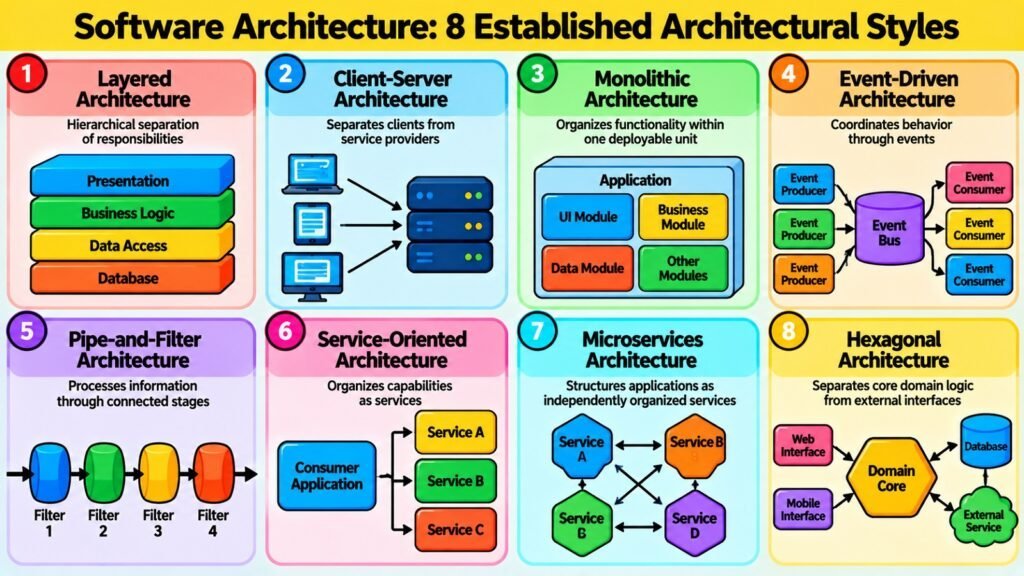
An architectural style is a broad, named approach that defines the general way a software system’s structure and component relationships are organized. Styles operate at a higher level of abstraction than patterns. Where a pattern addresses a specific recurring structural problem, a style establishes the fundamental organizational character of the entire system.
Layered architecture organizes a system into horizontal tiers where each layer communicates primarily with the layers immediately above or below it. Business logic, data access, and presentation occupy distinct layers with defined interaction rules. This style has been widely adopted in enterprise applications because it enforces separation of concerns at the system level and supports independent development of each layer.
Client-server architecture divides a system into two fundamental roles: clients that request services and servers that provide them. This style underpins web applications and database systems, naturally separating user-facing concerns from shared data and processing. Monolithic architecture places all functionality into a single deployable unit; despite its reputation, a well-structured monolith can be appropriate for systems with limited scope, stable requirements, or small teams, where the simplicity of deployment and coordination is a genuine advantage.
Event-driven architecture organizes a system around the production, routing, and consumption of events rather than direct component calls, reducing coupling and allowing independent scaling. Service-oriented architecture structures a system as interoperable services communicating through standardized interfaces, emphasizing reusability across organizational boundaries. Microservices architecture decomposes a system into small, independently deployable services aligned with business capabilities, enabling independent development and scaling at the cost of significant distributed-systems complexity.
Pipe-and-filter architecture organizes processing as a series of independent transformation steps, well suited to data processing workflows. Hexagonal architecture — ports-and-adapters — separates core business logic from external systems through abstract interfaces so that the core depends on nothing external. No style is universally superior; context, constraints, organizational capabilities, and expected change all influence the appropriate choice.
Software Architecture Styles: Eight Established Styles and Their Defining Structural Idea
| Architectural Style | Defining Structural Idea |
| Layered Architecture | Organizes a system into horizontal tiers with controlled dependency direction |
| Client-Server Architecture | Separates service requestors from service providers across a network boundary |
| Monolithic Architecture | Packages all system functionality into a single deployable unit |
| Event-Driven Architecture | Decouples components through event production and consumption rather than direct calls |
| Service-Oriented Architecture | Structures a system as interoperable services via standardized interfaces |
| Microservices Architecture | Decomposes a system into small, independently deployable, capability-aligned services |
| Pipe-and-Filter Architecture | Organizes processing as a sequence of independent transformation steps |
| Hexagonal Architecture | Isolates business logic from external systems through abstract ports and adapters |
4. Software Architecture Patterns: Reusable Solutions for Complexity
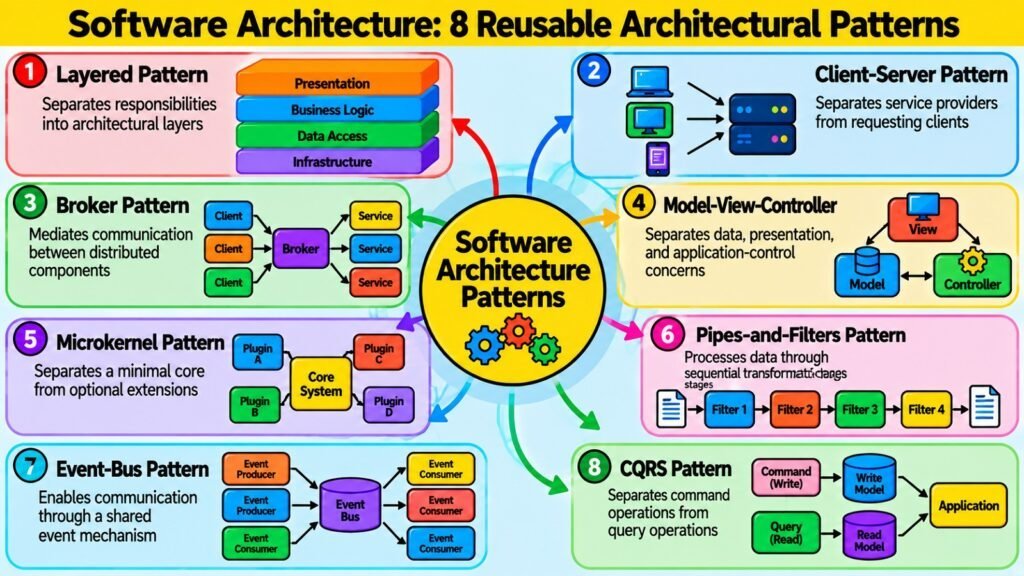
Architectural patterns represent reusable solutions to recurring structural problems in software systems. They occupy a distinct conceptual space: styles define the broad organizational character of a system; architectural patterns address specific recurring structural problems within or across systems; design patterns such as those in the Gang of Four book address implementation-level solutions within individual components. Keeping these levels distinct prevents confusion about which tool belongs to which layer of reasoning.
The Model-View-Controller (MVC) pattern separates a system’s data and business logic, the user interface, and the coordination between them into three distinct roles. It addresses the recurring complexity that arises when data, presentation, and user interaction logic are combined in the same structural unit. MVC and its variation, Model-View-ViewModel (MVVM), have become foundational patterns in user-facing software because they make relationships among these concerns explicit and independently manageable.
The Repository pattern introduces an abstraction layer between domain logic and data access. By defining a repository interface that the domain layer depends on, the pattern prevents business logic from coupling directly to specific storage technologies, simplifying testing and enabling storage strategies to change without rewriting business rules. The Broker pattern introduces an intermediary that manages communication between clients and services in distributed systems, decoupling clients from the specific location and implementation of their providers.
The Microkernel pattern organizes a system around a minimal stable core, with additional functionality implemented as plug-in components. Eclipse IDE and certain operating systems use this approach to keep the core stable while allowing extensions to evolve independently. The Event Bus pattern provides a shared communication channel through which components publish and subscribe to events without direct dependencies, reducing coupling at the cost of traceability.
Command Query Responsibility Segregation (CQRS) separates read and write data models and operations, enabling independent optimization in systems with significantly asymmetric demand. The pattern introduces structural complexity and is only justified when the demand asymmetry is real. Applying a pattern where the problem it addresses does not genuinely exist adds complexity without value — the real risk when patterns are chosen from habit rather than judgment.
Software Architecture Patterns: Eight Established Patterns and Their Primary Architectural Purpose
| Architectural Pattern | Primary Architectural Purpose |
| Model-View-Controller (MVC) | Separates data, presentation, and coordination into distinct structural roles |
| Model-View-ViewModel (MVVM) | Adapts MVC for data-binding environments via a ViewModel intermediary |
| Repository | Abstracts data access from business logic to reduce storage-technology coupling |
| Broker | Mediates communication in distributed systems through a central intermediary |
| Microkernel | Separates a minimal stable core from independently evolving extension components |
| Event Bus | Decouples producers and consumers through a shared event communication channel |
| CQRS | Separates read and write models to enable independent optimization of each |
| Pipe-and-Filter Pattern | Structures sequential data transformation as independent, chainable processing steps |
5. Software Architecture Trade-Offs: Balancing Competing Priorities
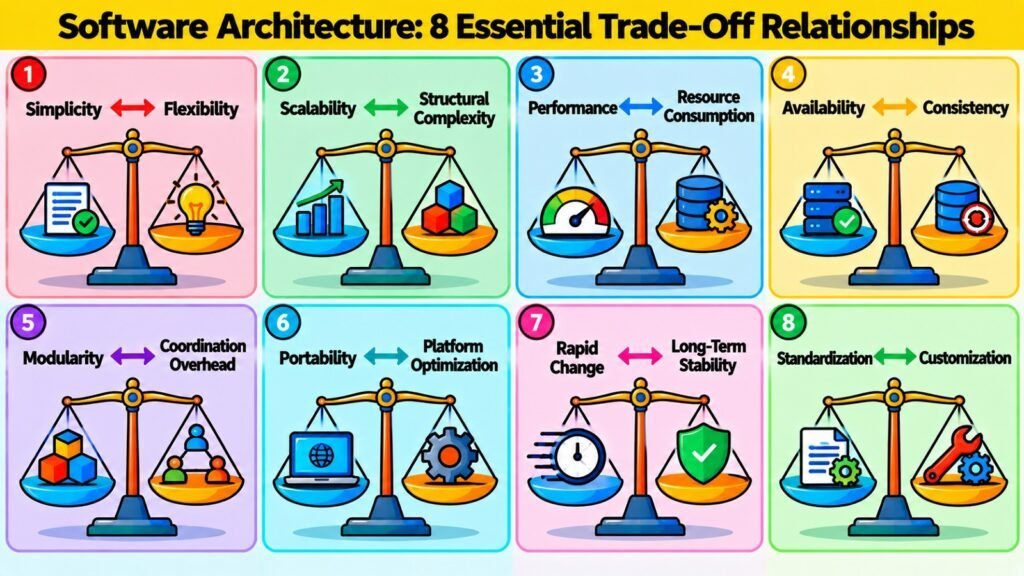
Architectural work is fundamentally the practice of deliberate trade-offs. The idea that a clearly superior architecture exists for any given problem is inconsistent with how architectural decisions actually play out. Every structural choice that improves one characteristic of a system tends to impose costs or constraints on others, and understanding this tension is what distinguishes careful architectural reasoning from simple technology selection.
Performance and maintainability illustrate this clearly. A system optimized for raw throughput may rely on tight coupling between components, shared memory, or abbreviated abstractions that permit efficient execution. Those same characteristics make the system difficult to modify, because changes must account for shared state and interdependent logic across many locations simultaneously. A loosely coupled architecture may be easier to maintain and extend but introduces coordination overhead that reduces throughput.
Scalability and complexity follow a similar pattern. Distributing a system into independently scalable services allows individual capabilities to grow under load without requiring the entire system to scale. However, distributed systems introduce network latency, partial-failure modes, distributed transaction management, and consistency challenges that a single-process system never faces. Whether the scalability benefits justify that complexity is an architectural question that depends entirely on the actual system context.
Flexibility and simplicity represent another productive tension. Highly flexible architectures introduce abstraction layers and extension points that allow easier accommodation of future change. Those layers add structural complexity justified only if the anticipated change actually occurs. Architects who build for maximum flexibility frequently deliver systems that are harder to understand and more expensive to develop than the actual variability of the problem required.
The Software Engineering Institute introduced architectural drivers to describe the forces — functional requirements, quality attributes, constraints, and concerns — that shape architectural choices. A practical trade-off process identifies competing priorities, clarifies which matter most, generates alternatives that balance them differently, evaluates each against the drivers, selects the option whose limitations are most acceptable in context, and documents the reasoning so future architects understand why each trade-off was made.
Software Architecture Trade-Offs: Eight Common Trade-Off Relationships in Architecture
| Trade-Off | Competing Priorities |
| Performance vs. Maintainability | Optimized execution paths often increase coupling, reducing ease of modification |
| Scalability vs. Complexity | Independent scalability in distributed systems adds coordination and operational costs |
| Flexibility vs. Simplicity | Designing for future change adds structural layers that may never be needed |
| Reliability vs. Cost | Higher fault tolerance through redundancy increases infrastructure and development costs |
| Consistency vs. Availability | Ensuring consistency in distributed systems often reduces availability under failure |
| Portability vs. Performance | Avoiding platform-specific optimizations limits the performance ceiling |
| Modularity vs. Performance | Strong module boundaries and interfaces introduce communication overhead |
| Security vs. Usability | Stricter access controls and validation add friction to system interaction |
6. Software Architecture Decisions: Making Better Structural Choices
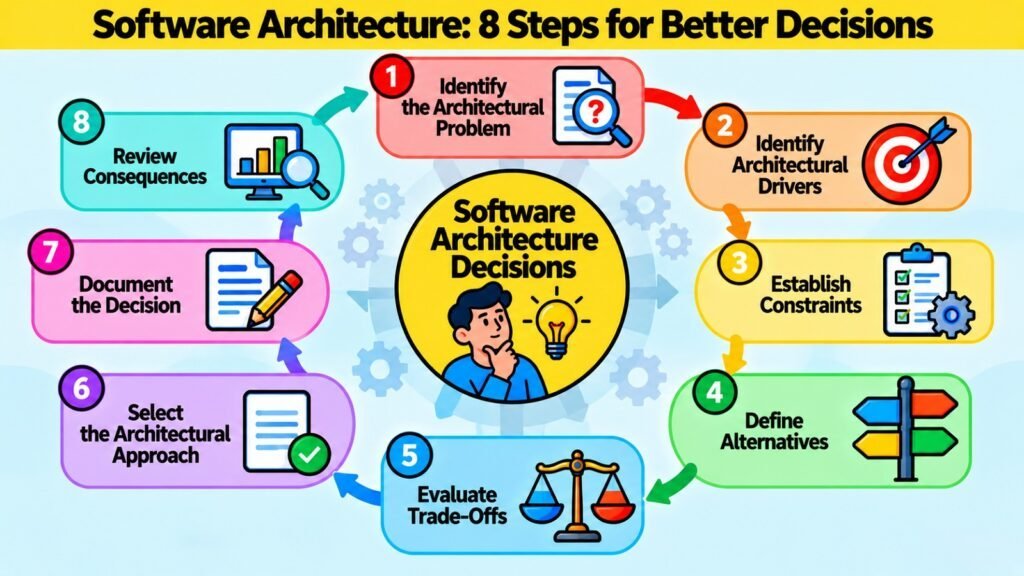
Architectural decisions are the major structural choices that establish the boundaries, relationships, technologies, and approaches around which a software system is organized. Unlike routine implementation choices, they are consequential commitments that shape how a system functions, evolves, and is understood over its lifetime. Making them well — and preserving the reasoning behind them — is among the most important activities an architect performs.
Every architectural decision begins with a structural problem: a question for which multiple feasible approaches exist and for which the choice will carry lasting consequences. Identifying the problem clearly is essential because architects who move directly to solutions often discover they have answered the wrong question or acted at the wrong level of abstraction.
Once the problem is clear, constraints and drivers must be established. Constraints are non-negotiable limits — regulatory requirements, existing infrastructure, team capabilities, or technology commitments — that eliminate options outright. Architectural drivers — performance requirements, scalability expectations, maintenance priorities — provide the criteria against which alternatives are evaluated. Generating multiple alternatives is important even when one option seems obvious; alternatives force explicit comparison and reveal what is being surrendered.
The decision itself is only part of the value. The reasoning behind it — why alternatives were rejected, what constraints were binding, which trade-offs were accepted — is often more useful to future architects than the choice alone. Architecture Decision Records (ADRs) capture this reasoning by recording the context, options considered, decision made, and expected consequences, preserving institutional knowledge that would otherwise be lost when team members move on.
Technical debt can result from decisions made under time or resource pressure. Documenting any such compromise — including conditions under which it should be revisited — reduces the risk of it becoming permanent. Useful evaluative questions: Has the problem been stated at the right level? Have binding constraints been identified? Have multiple alternatives been genuinely considered? Is the reasoning based on evidence rather than preference?
Software Architecture Decisions: Eight Key Elements of the Architectural Decision Process
| Decision Element | Architectural Purpose |
| Problem Identification | States the structural question clearly at the right level of abstraction |
| Constraints | Defines non-negotiable limits that eliminate certain alternatives outright |
| Architectural Drivers | Establishes evaluation criteria — quality attributes and requirements |
| Alternative Generation | Produces at least two or three feasible approaches for genuine comparison |
| Trade-Off Evaluation | Assesses each alternative against drivers to identify costs and benefits |
| Decision and Rationale | Records the chosen approach and the reasoning that led to it |
| Architecture Decision Record | Preserves context, options, decision, and consequences in retrievable form |
| Consequence Review | Identifies expected outcomes and conditions for revisiting the decision |
7. Software Architecture Views: Understanding Complex Systems Clearly
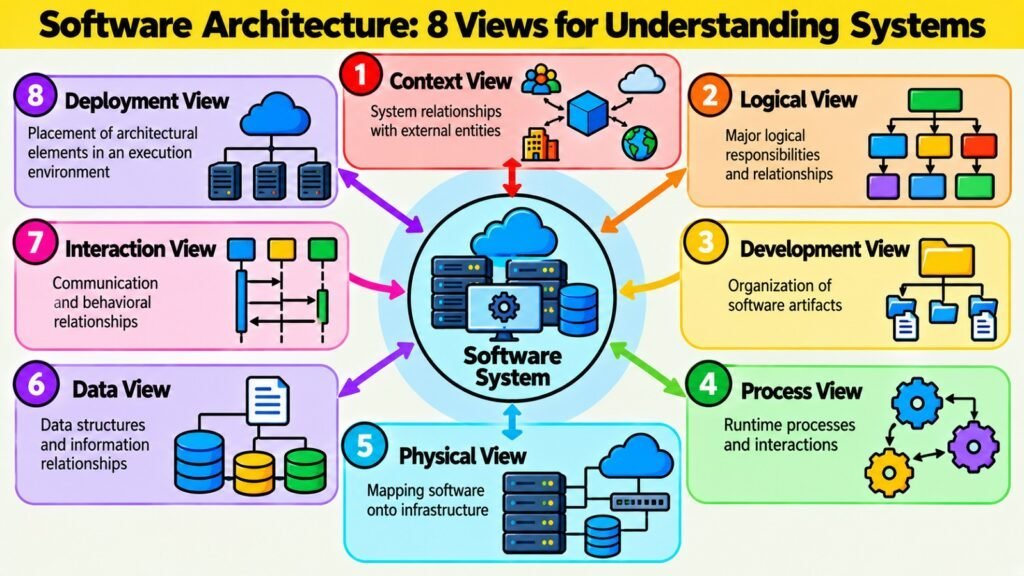
Complex software systems cannot be fully understood through a single diagram or representation. A single view would either be so abstract that it communicates nothing specific, or so detailed that it becomes incomprehensible as a whole. Architectural views address this challenge by providing different representations of the same architecture, each focused on the structural concerns that matter to a particular stakeholder group.
Different stakeholders have genuinely different concerns about the same system. Developers need to understand how it is decomposed into components they can work with. Technical leaders need to understand how responsibilities are distributed and how components interact. Operations teams need to understand deployment and runtime behavior. Business stakeholders may need to understand major structural boundaries without engaging with technical implementation detail.
Philippe Kruchten’s 4+1 architectural view model, published in 1995, formalized this multi-view approach. The model includes a logical view describing the system’s functional structure, a development view representing how the system is organized for development, a process view describing runtime behavior and concurrency, a physical view describing deployment to hardware and infrastructure, and a scenarios view that illustrates how the other views relate through specific use cases. The C4 model, developed by Simon Brown, offers a more contemporary approach organized around four levels of abstraction — context, containers, components, and code — practical because each level corresponds to what a different audience needs.
An architectural view is not the architecture itself but a representation that selects certain structural concerns while omitting others. No single view is authoritative; multiple views together provide a more complete picture than any one could alone. The goal of multi-view documentation is not exhaustive diagrams but ensuring each significant stakeholder concern is addressed by at least one representation its intended audience can understand and act on.
Software Architecture Views: Eight Architectural Representations and What They Help Stakeholders Understand
| Architectural View | What It Helps Stakeholders Understand |
| Logical View | How the system is decomposed into functional elements and their relationships |
| Development View | How the system is organized into units for development and version control |
| Process View | How the system behaves at runtime, including concurrency and process interactions |
| Physical (Deployment) View | How system elements are distributed across infrastructure and hardware |
| Data View | How data is structured, stored, and flows through the system |
| Interaction View | How major components communicate to fulfill system behavior |
| Context View | How the system relates to its external environment, users, and other systems |
| Scenarios View | How the other views relate through specific behavioral use cases |
8. Software Architecture Governance: Sustaining Architectural Integrity
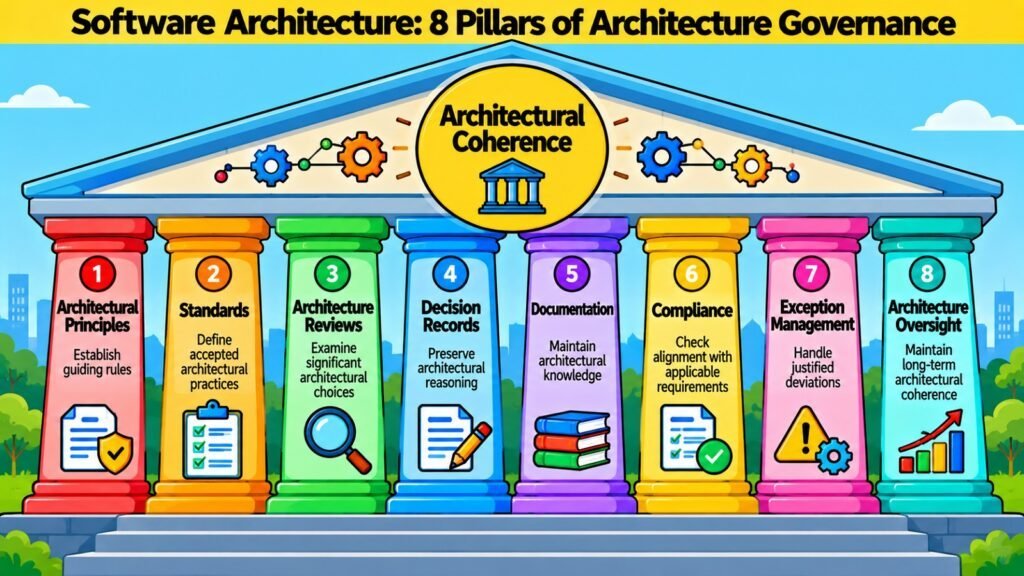
Software Architecture Governance encompasses the mechanisms through which organizations maintain architectural consistency, enforce standards, preserve decision traceability, and ensure that systems evolve in alignment with their structural principles. Without governance, even well-designed systems tend to drift over time as teams make local decisions that collectively undermine the coherence of the original architecture.
Governance is sometimes misunderstood as bureaucratic control. Effective governance looks quite different: it provides architects and teams with clear principles, documented decisions, and accessible standards so that most structural choices can be made correctly without centralized approval. The goal is coherent architectural evolution, not constraint for its own sake.
Architectural standards codify the principles and structural conventions a system or organization has agreed to follow, covering interface protocols, dependency rules, or technology boundaries. Architecture reviews examine significant structural decisions before implementation, identifying risks and confirming alignment with principles and existing structural commitments. Reviews are most valuable when they occur early enough to influence the outcome rather than ratify decisions already made.
Compliance monitoring confirms that implemented systems reflect the architecture as intended. Automated tooling can detect dependency violations or structural divergence without constant manual oversight. Exception handling is an underappreciated concern: a clear exception process prevents workarounds from accumulating undocumented while avoiding the rigidity that produces parallel informal systems.
Consider an organization with multiple teams on a shared platform. Without governance, each team may independently introduce different data access strategies, dependency inversion approaches, or inter-service communication protocols. The cumulative effect is a system that is difficult to maintain, extend, or reason about as a whole. Governance mechanisms — shared standards, documented decisions, and regular reviews — preserve the structural coherence that makes large systems navigable. Good governance adapts as systems grow, incorporating evidence from experience rather than enforcing initial assumptions.
Software Architecture Governance: Eight Governance Mechanisms and Their Architectural Purpose
| Governance Mechanism | Architectural Purpose |
| Architectural Principles | Provide the guiding constraints that shape consistent structural decisions |
| Architectural Standards | Define agreed conventions for interfaces, dependencies, and technology boundaries |
| Architecture Reviews | Evaluate significant structural decisions before implementation for alignment and risk |
| Architecture Decision Records | Preserve decision context and rationale to support future governance and evolution |
| Compliance Monitoring | Detect structural divergence from documented architecture through ongoing observation |
| Exception Handling Process | Provides a structured path for justified deviations that are documented and reviewed |
| Architectural Oversight | Maintains accountability for structural coherence across teams and systems |
| Feedback and Adaptation | Allows governance standards to evolve based on evidence from system experience |
Conclusion: Software Architecture – Building Stronger Software Systems
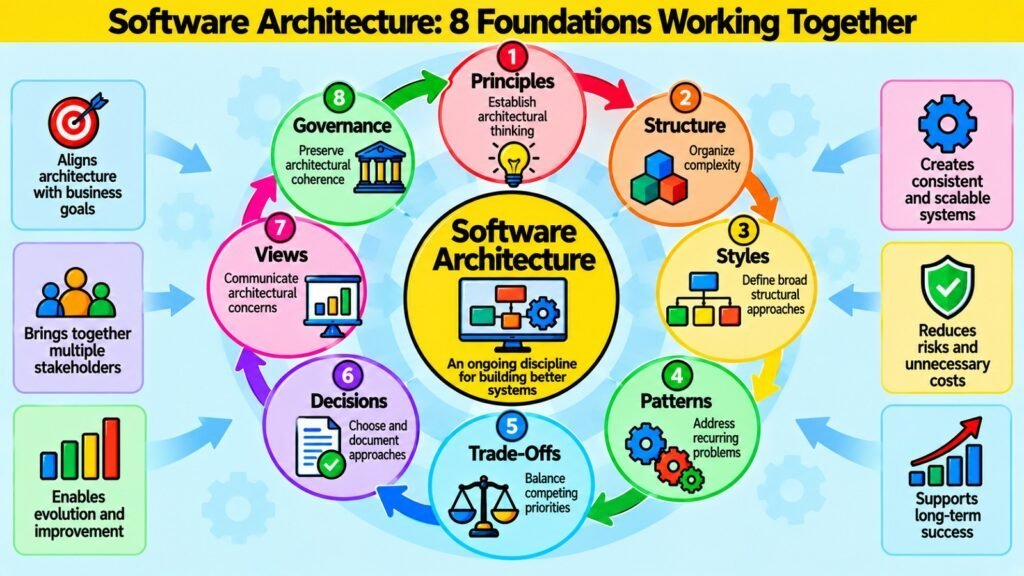
Software Architecture is an important component of software systems because it provides the structural and decision-making foundation through which complex capabilities are organized, evaluated, communicated, and governed. The eight aspects examined in this article are not isolated subjects; they form a coherent framework in which each element reinforces the others.
Principles guide architectural thinking by establishing the constraints within which sound structures can be built. Structure organizes complexity through decomposition, clear boundaries, and assigned responsibilities. Styles offer broad organizational approaches proven across many systems. Patterns provide reusable structural solutions at a level of specificity that styles do not address. Trade-offs expose the competing priorities architects must balance through reasoned judgment. Decisions establish consequential structural commitments that demand documented rationale and awareness of consequences. Views communicate architectural concerns through representations tailored to each stakeholder audience. Governance maintains the coherence of architectural intent as systems, teams, and requirements evolve.
The emphasis throughout this article has been on evidence, context, and explicit reasoning rather than architectural trends or technology preferences. Software Architecture is not primarily about selecting frameworks or following industry fashion. It is a discipline of managing structural complexity through informed decisions whose reasoning is explicit, whose trade-offs are understood, and whose consequences are tracked over time.
The relevance of architecture does not diminish as programming languages, platforms, and technologies change. Principles of modularity, separation of concerns, clear boundaries, and deliberate decision-making apply across all technology stacks, providing the stable foundation that allows systems to accommodate change without losing coherence. Software Architecture is an ongoing discipline — not a phase that ends when development begins — for making consequential structural choices, communicating them clearly, and preserving the reasoning so that systems can evolve responsibly.
Software Architecture: Eight Key Takeaways Corresponding to the Eight Aspects
| Aspect | Key Takeaway |
| Software Architecture Principles | Modularity, cohesion, and separation of concerns guide consistent structural reasoning |
| Software Architecture Structure | Boundaries, layers, and decomposition organize complexity into manageable units |
| Software Architecture Styles | Broad organizational approaches suited to different system contexts and constraints |
| Software Architecture Patterns | Reusable structural solutions to recurring architectural problems, applied contextually |
| Software Architecture Trade-Offs | Every architectural choice involves costs; reasoned trade-offs are unavoidable |
| Software Architecture Decisions | Major structural choices require documented rationale, not just recorded outcomes |
| Software Architecture Views | Multiple representations address different stakeholder concerns about the same system |
| Software Architecture Governance | Governance preserves architectural coherence as systems and teams grow over time |