Table of Contents
Introduction: Competitive Advantage as the Core of Business Success
Every business that lasts has something working quietly in its favor. It might be a lower price, a product people cannot find elsewhere, or a service that makes customers feel genuinely valued. That quiet force is competitive advantage. It is not a single move or a lucky break. It is a system of choices, built over time, that helps a business win consistently even when markets get difficult.
Think about how you choose between two coffee shops. One is cheaper. The other always gets your order right and remembers your name. Both are using competitive advantage, just through different paths. Price is one path. Experience is another. Branding, innovation, and technology are more. The remarkable thing is that many businesses never stop to identify which path they are actually on.
Competitive advantage is not a luxury reserved for large corporations, but a business essential for all types of organizations. A small bakery that uses fresher ingredients than anyone nearby has it. A software company that answers support calls faster than its rivals has it too. It shows up in ways big and small, and it separates businesses that grow from those that simply survive.
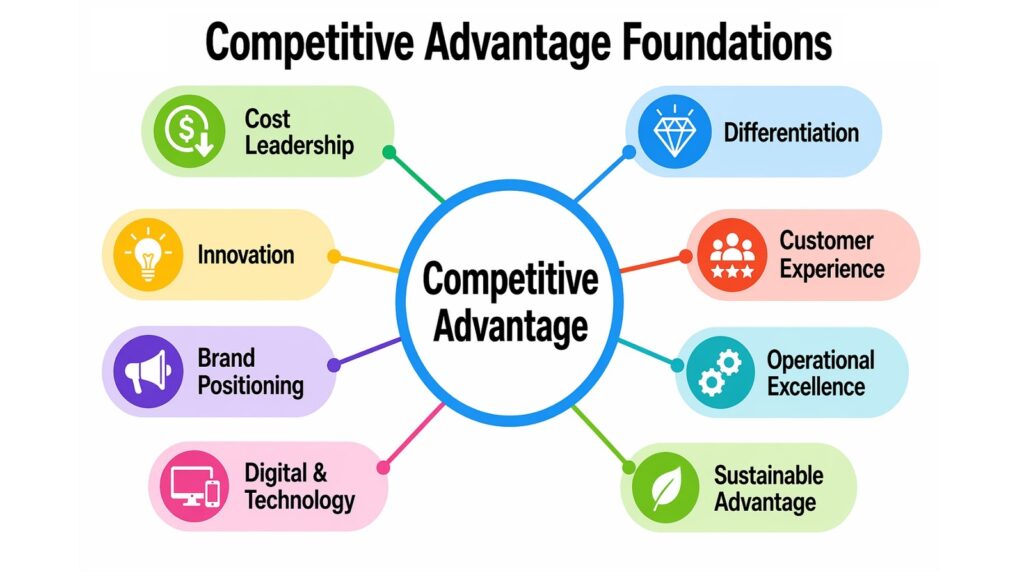
This article walks through 8 powerful ways to build competitive advantage. Each one represents a different direction a business can take. Some companies master one deeply. Others combine several over time. The goal here is to make each path clear, practical, and worth thinking about. Whether you are building something new or improving something existing, understanding these 8 paths gives you a sharper way to see the game.
Table 1: Competitive Advantage — 8 Paths at a Glance
| Advantage Type | What It Means for a Business |
| Cost Leadership | Producing goods or services at a lower cost than competitors to enable better pricing or higher margins |
| Differentiation | Offering something distinct in quality, design, or experience that customers are willing to pay more for |
| Innovation | Creating new products, processes, or business models before competitors do |
| Customer Experience | Building loyalty through consistently better service, ease, and personalization |
| Brand Positioning | Occupying a strong, clear place in the customer’s mind through trust and recognition |
| Operational Excellence | Executing internal processes with greater speed, consistency, and efficiency than rivals |
| Digital & Technology | Using automation, data, and platforms to make decisions faster and scale more effectively |
| Sustainability | Building advantages through culture, systems, and long-term thinking that are difficult to copy |
1. Competitive Advantage Through Cost Leadership
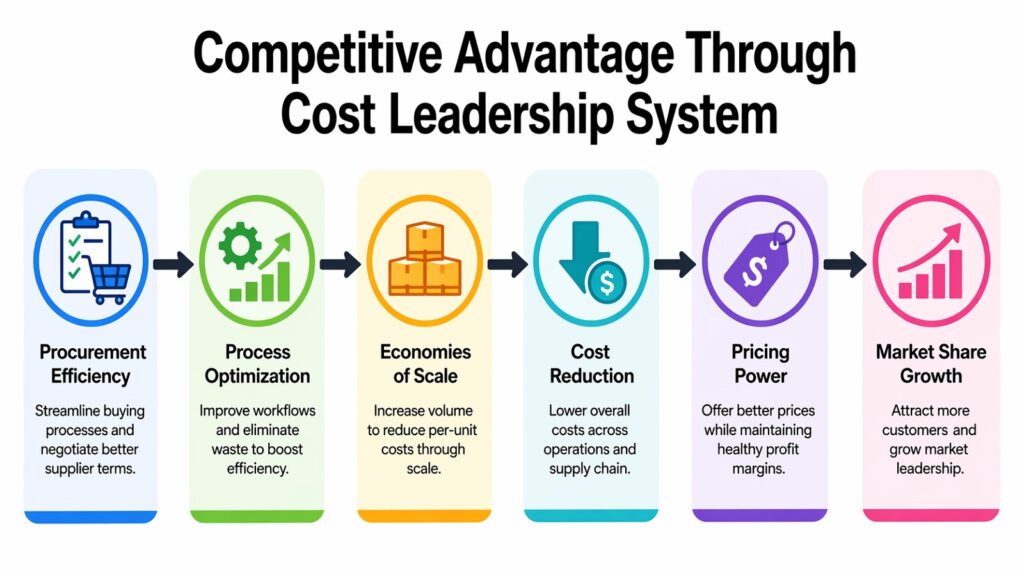
Cost leadership is one of the oldest forms of competitive advantage, and it still works. The idea is simple: if you can produce what you sell for less than your competitors, you have options they do not. You can price lower and attract more customers. Or you can price the same and keep more of the margin. Either way, lower costs create room to maneuver.
Walmart built its entire business on this idea. By negotiating hard with suppliers, investing in logistics, and running stores with disciplined efficiency, it consistently undercuts most rivals on price. IKEA does the same in furniture, designing products specifically for flat-pack shipping and customer self-assembly to reduce costs at every step. These are not accidents. They are deliberate systems.
Scale plays a major role in cost leadership. The more units a business produces, the lower its cost per unit tends to be. A factory making a million chairs spends far less per chair than one making ten thousand. That cost difference, compounded over years, becomes a genuine barrier that smaller rivals struggle to cross.
Efficiency matters just as much as scale, though. A business that wastes less material, uses energy smartly, and runs lean processes can outperform a larger rival that runs sloppily. Disciplined spending throughout the organization, from procurement to staffing to logistics, is what makes cost leadership durable rather than temporary.
It is worth noting that cost alone rarely wins forever. A competitor can always find a way to cut costs further, and competing purely on price often erodes value over time. Cost leadership works best when it is paired with something else, like operational excellence or a strong brand. That natural tension is what leads us to the next path.
Table 2: Competitive Advantage Through Cost Leadership — Key Principles
| Principle | How It Builds Competitive Advantage |
| Economies of Scale | Higher production volume reduces per-unit costs, making pricing more competitive |
| Supply Chain Efficiency | Strong supplier relationships and logistics reduce input and distribution costs |
| Lean Operations | Eliminating waste in processes lowers overhead without sacrificing output quality |
| Technology Investment | Automation and process software cut labor and error costs over time |
| Disciplined Procurement | Buying smarter and negotiating better keeps input costs consistently low |
| Standardization | Using uniform components and processes reduces complexity and training costs |
| Volume Pricing Power | Large order volumes give businesses leverage to negotiate deeper discounts |
| Fixed Cost Spreading | Spreading fixed costs across more units reduces average cost per product |
2. Competitive Advantage Through Differentiation
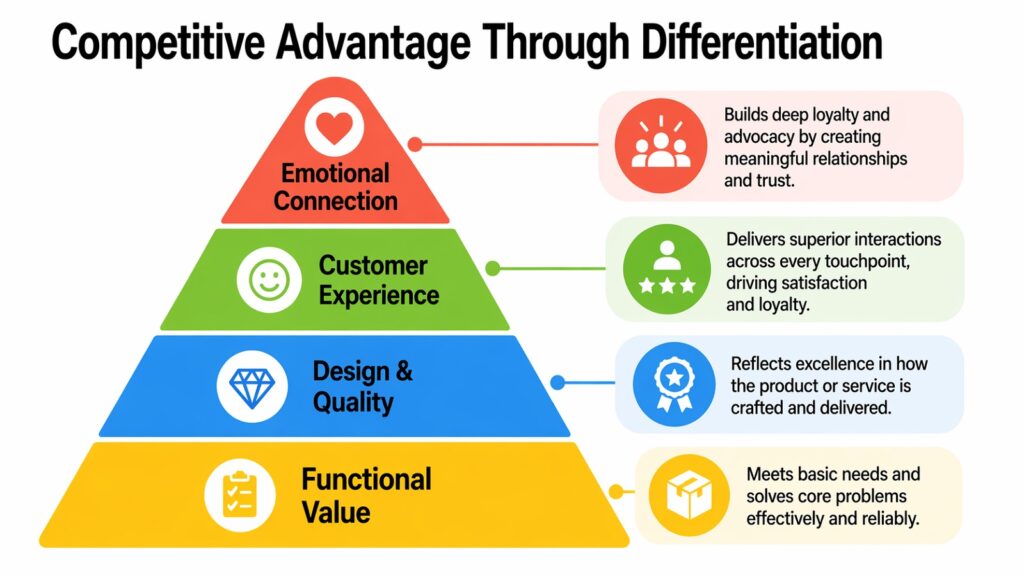
If cost leadership is about being cheaper, differentiation is about being better, or at least different in a way that people genuinely value. A differentiated business gives customers a reason to choose it that has nothing to do with price. That reason could be a unique feature, superior quality, stunning design, or an experience that feels unlike anything else.
Apple is the most cited example of differentiation for a reason. Its products are rarely the cheapest option in any category, yet people line up for them. The differentiation comes from design, software integration, brand identity, and the feeling that Apple products simply work well together. Customers pay a premium not because they have to, but because they perceive the gap is worth it.
Differentiation also works at smaller scales. A local restaurant that uses only seasonal, locally sourced ingredients differentiates itself from chains that use standardized menus. A consulting firm that specializes in one narrow industry differentiates itself from generalists. The key is that the difference must be real, visible, and meaningful to the customer.
One of the clearest benefits of differentiation is pricing power. When a business stands out, it reduces direct price comparison. Customers are not weighing you against a dozen identical options anymore. They are asking whether this particular thing is worth its particular price. That shift in the buying decision is enormously valuable.
Differentiation does require sustained effort. A unique feature can be copied. A design can be imitated. What is harder to copy is the combination of culture, expertise, and customer relationship that a differentiated business builds over the years. That depth is where differentiation becomes a real and lasting advantage.
Table 3: Competitive Advantage Through Differentiation — Key Principles
| Principle | How It Builds Competitive Advantage |
| Product Uniqueness | Offering features or qualities that competitors do not match reduces direct comparison |
| Design Quality | Superior aesthetics and usability create stronger perceived value and customer preference |
| Specialization | Deep expertise in a narrow area builds credibility that generalists cannot replicate |
| Premium Positioning | Distinct offerings allow businesses to charge above-market prices sustainably |
| Customer Relationships | Personalized service and deep engagement create loyalty that price alone cannot buy |
| Brand Identity | A clear and consistent identity gives customers a non-price reason to choose the brand |
| Continuous Improvement | Regular product and service enhancements keep the differentiation gap from closing |
| Proprietary Features | Unique technologies, formulas, or methods that cannot be easily replicated by rivals |
3. Competitive Advantage Through Innovation
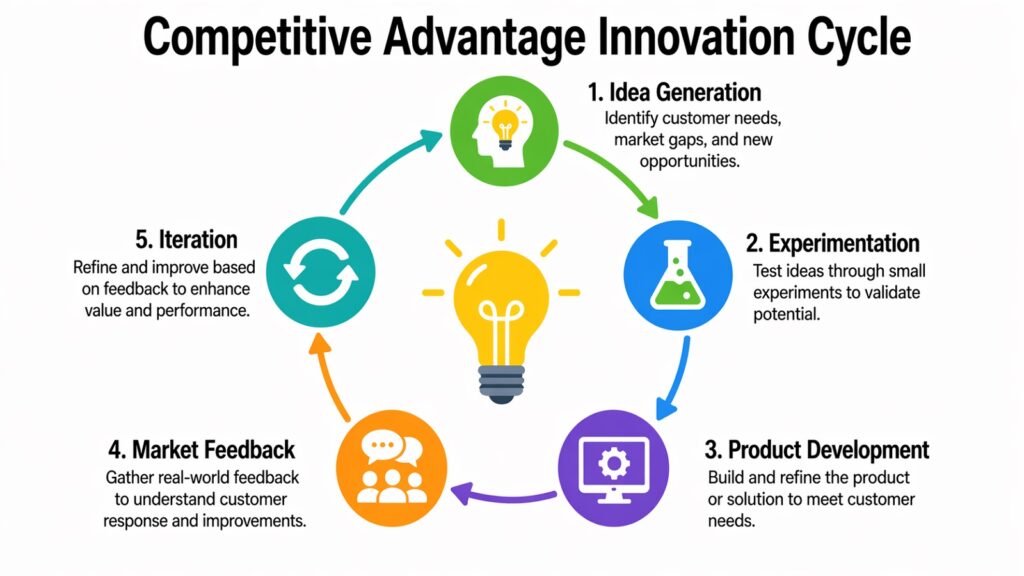
Innovation is competitive advantage in motion. It comes from doing something before others do, or doing something others simply have not figured out yet. Markets change constantly, and businesses that innovate stay relevant while those that stand still gradually lose ground.
Amazon did not start as a cloud computing company. It built AWS after recognizing that its internal server infrastructure could be sold as a service to others. That insight, developed quietly over the years, became one of the most profitable businesses in the world. Innovation does not always look like invention. Sometimes it looks like seeing a new use for something you already have.
Small, continuous innovation matters just as much as breakthrough moments. A company that improves its product slightly every quarter compounds those improvements over the years into a large advantage. Toyota’s production philosophy, which emphasizes constant small improvements by every worker at every level, helped it become one of the most efficient manufacturers on earth. No single improvement was dramatic. All of them together were transformative.
Innovation also applies to business models. Netflix did not invent movies or television. It invented a new way to distribute them, first by mail, then by streaming. That model innovation gave it a decade-long lead over traditional studios and broadcasters who were slow to respond. The technology was secondary. The new model was the real advantage.
For innovation to become a sustained advantage, it needs to be embedded in how a company operates. Companies that only innovate when forced to are always behind. Those that build curiosity, experimentation, and fast iteration into their culture tend to stay ahead more reliably, even when individual innovations do not always work out.
Table 4: Competitive Advantage Through Innovation — Key Principles
| Principle | How It Builds Competitive Advantage |
| First-Mover Advantage | Entering a new space early builds customer habits and market share before rivals arrive |
| Continuous Improvement | Small, regular enhancements compound into large performance gaps over time |
| R&D Investment | Consistent spending on research creates a pipeline of future advantages |
| Business Model Innovation | Rethinking how value is delivered can outpace competitors improving existing models |
| Fast Iteration | Shorter development cycles allow quicker response to market and customer feedback |
| Cross-Industry Learning | Applying ideas from unrelated fields often produces breakthrough improvements |
| Experimentation Culture | Organizations that test and learn quickly adapt better to changing conditions |
| Technology Adoption | Using emerging tools before competitors becomes an efficiency and capability gap |
4. Competitive Advantage Through Customer Experience
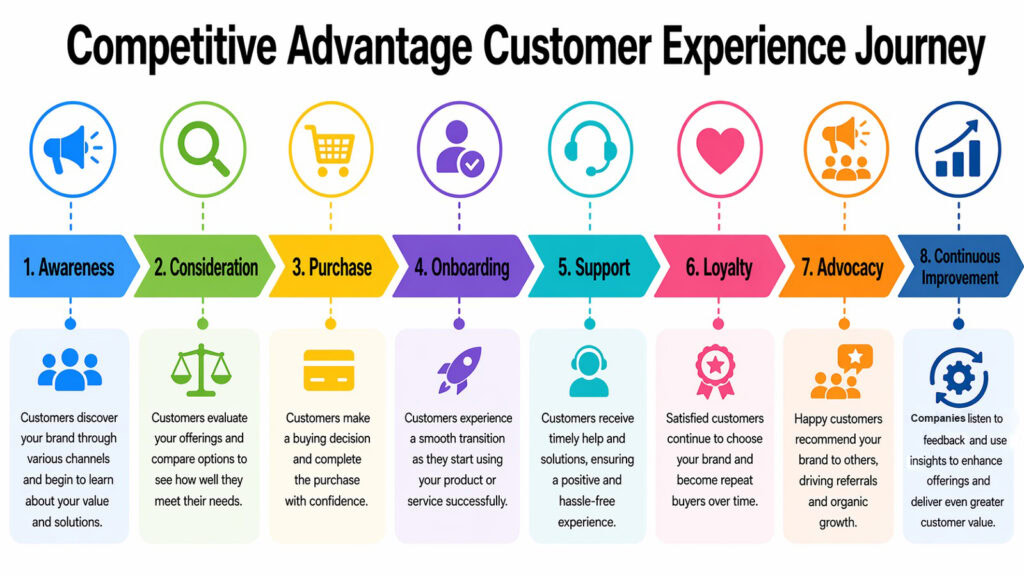
Products can be copied. Prices can be matched. But the way a customer feels when they deal with your business is much harder to replicate. Customer experience as competitive advantage is about building loyalty through how people are treated, not just what they are sold.
Zappos built its entire reputation on customer service. Its famous return policy, responsive support, and genuine warmth turned shoe buying into something people remembered and talked about. The products were not dramatically better than competitors. The experience was. That experience drove word-of-mouth growth that no advertising budget could have bought.
Ease of use is a major part of customer experience that often gets overlooked. A product that is frustrating to set up, a website that is hard to navigate, or a return process that requires three phone calls all erode the experience, even if the core product is good. Reducing friction at every customer touchpoint is itself a form of competitive advantage.
Personalization has become increasingly important here. When a streaming service remembers what you like, when a bank anticipates your needs, or when an email newsletter feels like it was written specifically for you, the connection deepens. Customers who feel understood are far more likely to stay and spend more than those who feel like an account number.
The economics of customer experience advantage are worth understanding. Research from Bain & Company found that increasing customer retention by just 5 percent can boost profits by 25 to 95 percent. Loyal customers spend more, churn less, and refer others. That is why improving experience often delivers better returns than acquiring new customers.
Table 5: Competitive Advantage Through Customer Experience — Key Principles
| Principle | How It Builds Competitive Advantage |
| Service Quality | Consistently helpful and responsive service builds trust and reduces churn |
| Friction Reduction | Removing obstacles in the buying and support process improves satisfaction |
| Personalization | Tailored interactions make customers feel valued, deepening loyalty |
| Post-Sale Support | Strong after-purchase service turns one-time buyers into repeat customers |
| Omnichannel Consistency | Seamless experience across online and offline touchpoints strengthens brand trust |
| Customer Feedback Loops | Actively gathering and acting on feedback shows customers they are heard |
| Response Speed | Fast resolution of issues prevents dissatisfaction from becoming churn |
| Emotional Connection | Creating moments that feel memorable or thoughtful builds lasting loyalty |
5. Competitive Advantage Through Brand Positioning
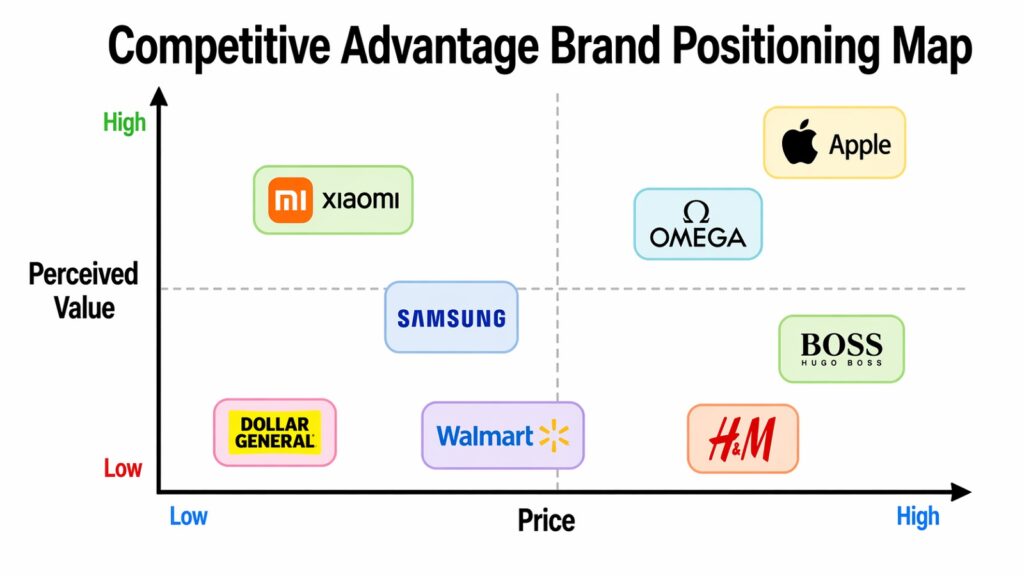
Competitive advantage through brand positioning lives in the customer’s mind. A well-positioned brand does not just sell products. It carries meaning. When people trust a brand, they return to it without comparison shopping. When they feel connected to it, they recommend it to others. That trust and recognition are genuinely hard to build and even harder for competitors to displace.
Nike is not just a shoe company. It is associated with athletic ambition, performance, and a particular kind of aspiration. That positioning was built deliberately over decades through advertising, athlete partnerships, and product design. The result is that Nike can charge premiums that pure shoe functionality would never justify. The brand itself is the advantage.
Brand positioning is not just for consumer products. In professional services, a law firm or consulting company known for a specific type of work commands higher fees than a generalist. In manufacturing, a supplier known for reliability earns long-term contracts that cheaper rivals struggle to displace. The principle is the same: clarity and consistency in how you present yourself creates a perception that becomes genuinely valuable.
Consistency is the quiet engine of brand positioning. Every customer interaction, from a website visit to a product package to a customer service call, contributes to the brand’s meaning. Businesses that deliver consistently across those touchpoints build stronger brands than those that invest heavily in advertising but deliver inconsistently in reality.
Strong brand positioning also reduces the cost of growth over time. When a brand is trusted, new product launches succeed more easily. When it is loved, marketing spreads through word-of-mouth rather than paid channels. The brand becomes its own engine of acquisition and retention, which is an economic advantage that compounds for years.
Table 6: Competitive Advantage Through Brand Positioning — Key Principles
| Principle | How It Builds Competitive Advantage |
| Clear Positioning | A specific, memorable identity makes the brand easier to choose over generic alternatives |
| Emotional Resonance | Brands that connect emotionally generate loyalty that price discounts cannot break |
| Consistency | Delivering the same quality and tone across every touchpoint builds deep trust |
| Premium Justification | Strong brands command higher prices by shifting value perception beyond product features |
| Heritage and Trust | Long-established brands benefit from credibility that new entrants cannot buy quickly |
| Storytelling | Compelling brand narratives help customers feel part of something larger than a transaction |
| Endorsement and Association | Partnerships with trusted figures or causes transfer positive perception to the brand |
| Brand Loyalty Programs | Structured rewards systems reinforce habitual buying and increase switching costs |
6. Competitive Advantage Through Operational Excellence
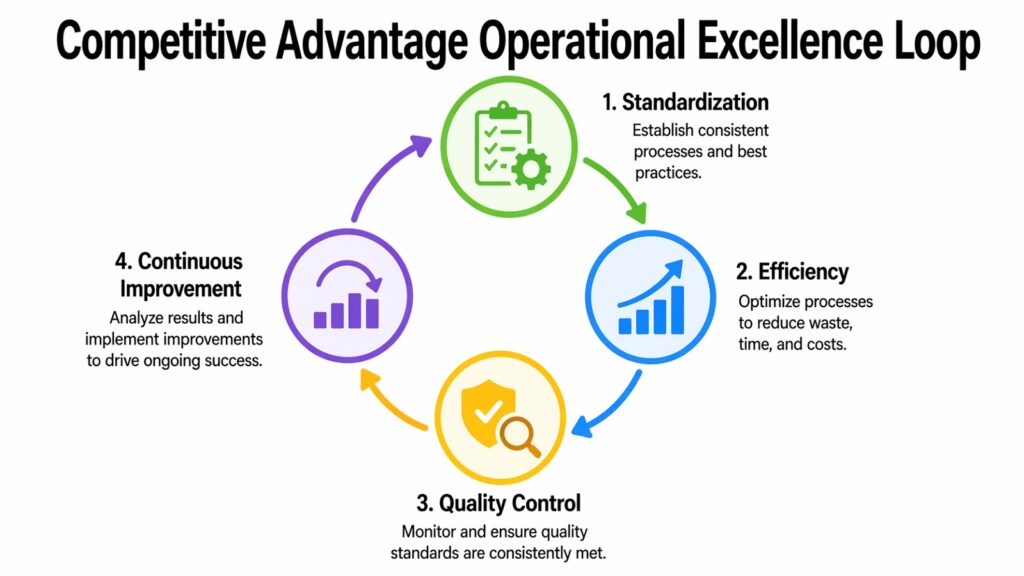
Operational excellence is the competitive advantage that runs quietly behind the scenes. It shows up in faster delivery, fewer errors, more consistent quality, and lower costs per unit of output. While it rarely makes headlines, it separates businesses that execute reliably from those that promise much and deliver inconsistently.
McDonald’s is a textbook example. It does not have the best food in any objective sense. What it has is a system so refined that a customer in Tokyo and a customer in Toronto receive nearly identical experiences. That operational consistency at massive scale is genuinely difficult to achieve and extremely hard to replicate. The real product is not the burger. It is the system.
Supply chain management plays a crucial role in achieving operational excellence. A company that efficiently sources materials, swiftly moves products, and manages inventory without waste possesses a structural advantage over competitors who approach these processes with less rigor. Amazon’s investment in its fulfillment infrastructure provided it with a delivery speed advantage that took years for its rivals to start replicating.
Process improvement methodologies like Six Sigma and Lean manufacturing have helped companies systematically remove inefficiency from operations. General Electric, Toyota, and dozens of others used these frameworks to reduce defects, shorten cycle times, and improve output quality. The improvements may seem incremental, but they accumulate into large competitive gaps over time.
Operationally excellent businesses also tend to be more resilient. When markets contract or costs rise, they have more room to absorb pressure. Their processes allow them to adapt faster. And their consistency earns customer trust that carries through difficult periods. Execution, done well every day, is its own form of strategy.
Table 7: Competitive Advantage Through Operational Excellence — Key Principles
| Principle | How It Builds Competitive Advantage |
| Process Standardization | Uniform procedures reduce variation, errors, and training costs across the organization |
| Lean Methodology | Eliminating non-value-adding steps improves speed and reduces cost simultaneously |
| Supply Chain Mastery | Reliable sourcing and logistics reduce delays and inventory costs |
| Quality Control Systems | Consistent output quality reduces returns, complaints, and rework costs |
| Speed of Execution | Faster operations improve customer satisfaction and reduce carrying costs |
| Capacity Optimization | Using assets and labor at optimal levels avoids waste and improves unit economics |
| Performance Metrics | Tracking operational KPIs keeps teams aligned and identifies inefficiencies early |
| Continuous Training | Regular skill development ensures teams execute at a consistently high level |
7. Competitive Advantage Through Digital & Technology
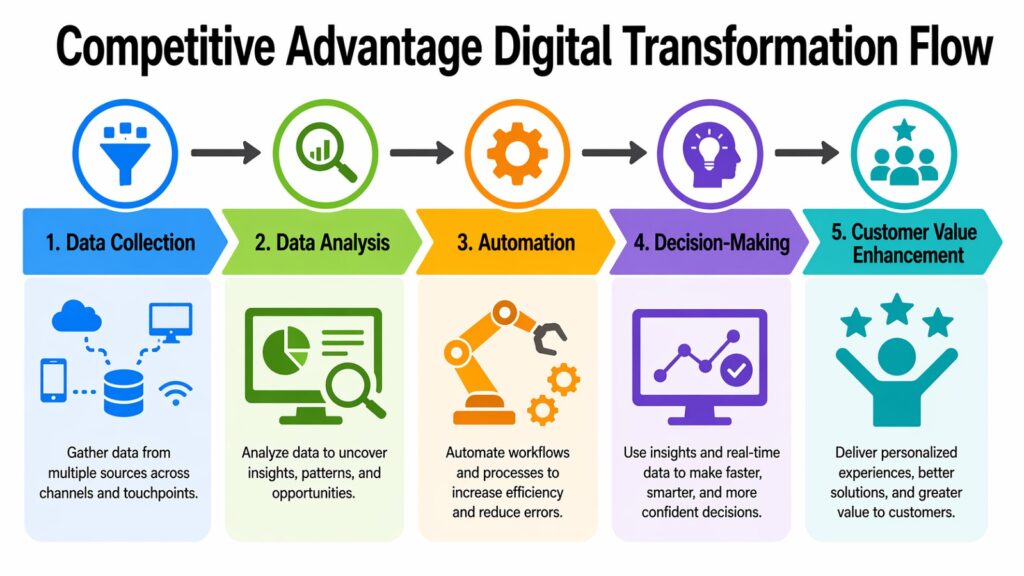
Technology has become one of the most powerful amplifiers of competitive advantage. It does not replace the fundamentals, but it makes them faster, sharper, and harder to match. A business with better data makes better decisions. A business with better automation scales without proportional cost increases. A business with better digital platforms reaches customers wherever they are.
Data is perhaps the most underappreciated technological advantage. Companies like Google and Facebook built empires not just on software, but on the data that software collected. That data allowed them to target advertising with precision no traditional media could match, and that precision became the business model. The data itself became the moat.
For most businesses, the advantage from technology is more practical and accessible than that. A retailer that uses inventory software to prevent stockouts reduces both lost sales and excess holding costs. A service firm that uses a CRM system to track customer history serves clients better and closes deals faster. A manufacturer that uses sensors on equipment to predict maintenance needs avoids costly breakdowns. None of these require cutting-edge technology. They require consistent, intelligent use of available tools.
Automation is another form of technological advantage that is becoming widely accessible. Businesses that automate repetitive tasks free up their people to focus on work that requires judgment and creativity. That reallocation of human effort, combined with the speed and accuracy of automated processes, creates a real productivity gap over competitors still doing things manually.
Digital platforms also expand reach in ways that physical presence cannot match. A business with a well-designed e-commerce platform, strong search visibility, and active digital marketing can compete nationally or globally without the infrastructure costs that once made such reach prohibitive. That democratization of reach rewards businesses that invest thoughtfully in their digital presence.
Table 8: Competitive Advantage Through Digital & Technology — Key Principles
| Principle | How It Builds Competitive Advantage |
| Data Analytics | Using customer and operational data to make faster and more accurate decisions |
| Process Automation | Replacing repetitive manual tasks with software reduces cost and error rates |
| Digital Platforms | Online channels expand reach and reduce the cost of customer acquisition |
| CRM Systems | Tracking customer relationships improves service quality and sales conversion |
| Cloud Infrastructure | Scalable cloud resources reduce IT costs and allow faster product deployment |
| AI and Machine Learning | Predictive tools improve forecasting, personalization, and operational efficiency |
| Cybersecurity | Protecting digital assets builds customer trust and prevents costly disruptions |
| E-Commerce Capability | A strong online presence enables sales at scale without proportional cost increases |
8. Competitive Advantage Through Sustainability
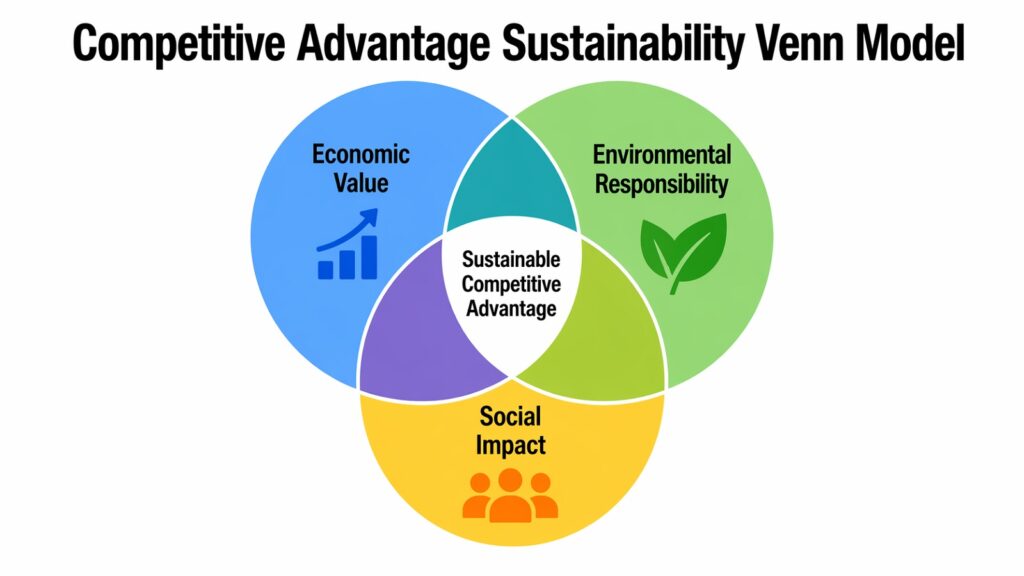
The most durable competitive advantages are the ones that cannot simply be bought or copied. They come from culture, relationships, accumulated knowledge, and ways of working that take years to develop. This kind of sustainability in competitive advantage is about building strengths that hold up over time, not just in the next quarter.
Berkshire Hathaway has maintained investment returns that most competitors have not matched over decades. The advantage is not a secret formula. It is a consistent philosophy, a culture of patient capital allocation, and a reputation that attracts exceptional businesses to sell to it. No rival can copy that by hiring a few people or changing a strategy document. It took sixty years to build.
Sustainable competitive advantage often comes from network effects. A marketplace like Etsy becomes more valuable as more sellers join, because more sellers attract more buyers, and more buyers attract more sellers. Once that flywheel starts spinning, it becomes extremely difficult for new entrants to displace the leader even with significant investment.
Proprietary knowledge and skills also create durable advantages. A pharmaceutical company that has spent twenty years developing expertise in a specific therapeutic area, a logistics company that has built routing algorithms optimized on decades of real data, or a family business that has deep relationships with every major supplier in its region, all have advantages that newcomers cannot shortcut.
Culture itself is one of the most undervalued sources of sustainable advantage. A business where employees genuinely care about quality, where people work with creative intensity, and where institutional knowledge passes effectively from experienced workers to newer ones, operates at a level that is very difficult for competitors to match by throwing money at the problem. Culture, built slowly and protected carefully, may be the most defensible advantage of all.
Table 9: Competitive Advantage Through Sustainability — Key Principles
| Principle | How It Builds Competitive Advantage |
| Network Effects | Value grows as more users join, creating a self-reinforcing barrier against new entrants |
| Proprietary Knowledge | Accumulated expertise and processes that competitors cannot easily acquire or replicate |
| Strong Culture | An organizational identity that drives consistent performance and retains top talent |
| Long-Term Relationships | Deep ties with customers, suppliers, and partners reduce the risk of competitor disruption |
| Brand Equity | Years of consistent brand-building create a trust asset that new entrants cannot buy quickly |
| Switching Costs | Products or ecosystems that are costly to leave keep customers loyal over the long term |
| Regulatory Advantage | Licenses, patents, or compliance capabilities that competitors struggle to obtain |
| Patient Capital Allocation | Investing for long-term returns rather than short-term metrics builds structural strength |
Conclusion: Competitive Advantage as a System of Winning
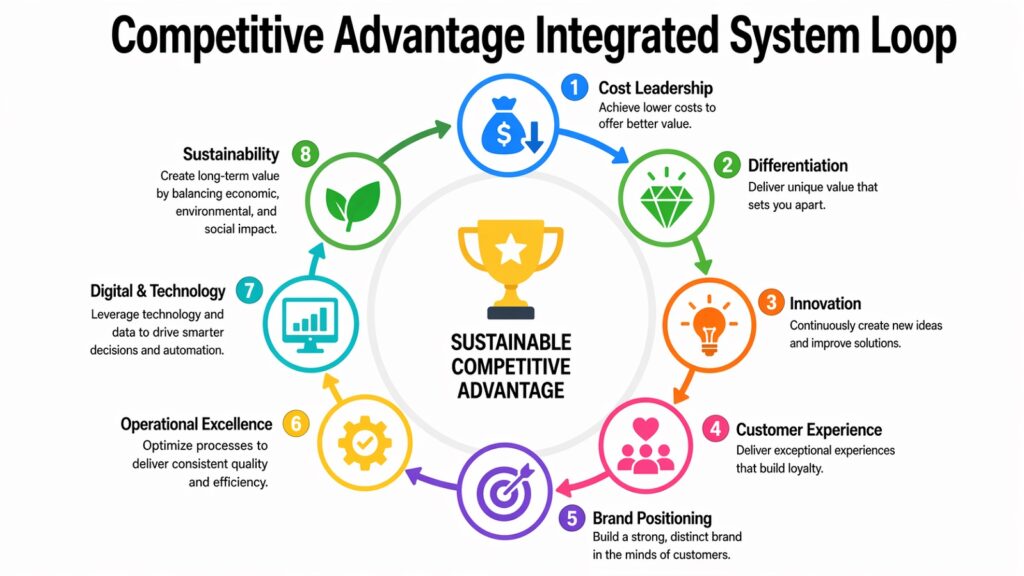
The eight paths described in this article are not separate strategies to be picked from a menu. They are interconnected strengths that, when combined, form a system of winning. A company with cost efficiency and strong operations beats competitors on price and reliability. One with differentiation and brand strength commands premium pricing and loyal customers. One that innovates while also delivering excellent customer experience builds advantages that compound over time.
No business needs to master all eight at once. Most successful companies have started with one or two and expanded from there. What matters is understanding how these paths connect. An investment in technology often improves operations. A commitment to customer experience often strengthens the brand. A culture of innovation tends to create differentiation. The pieces support each other when built thoughtfully.
Short-term wins matter. A well-timed price cut or a well-executed campaign can move the needle quickly. But a durable advantage is built slowly, through repeated good decisions that accumulate into something hard to displace. The businesses that last, the ones that people still talk about decades after they were founded, almost always have at least one of these paths deeply embedded in how they operate.
This article is the foundation. Each of the eight aspects discussed here is worth exploring in much greater depth through a Competitive Advantage Framework. The underlying mechanics of cost leadership, the psychology behind differentiation, the culture required to sustain innovation, the systems needed for operational excellence — each deserves its own careful study. Understanding them at this level is the first step. The real advantage comes from applying them.
Table 10: Competitive Advantage — Summary of All Eight Winning Paths
| Advantage Type | Core Takeaway for Building Long-Term Competitive Advantage |
| Cost Leadership | Lower costs create pricing flexibility and margin strength that outlasts rivals in tough markets |
| Differentiation | Standing out on quality, design, or experience allows premium pricing and loyal customers |
| Innovation | Moving first and improving constantly keeps businesses relevant as markets shift |
| Customer Experience | How customers feel drives retention, referrals, and long-term revenue growth |
| Brand Positioning | A trusted, clear brand identity reduces competition and increases customer lifetime value |
| Operational Excellence | Reliable and efficient execution creates structural advantages that scale well |
| Digital & Technology | Smart use of tools and data amplifies speed, reach, and decision-making quality |
| Sustainability | Culture, relationships, and long-term thinking create advantages that are hardest to copy |