Table of Contents
Introduction: CPU Technology as the Foundation of Modern Computing Hardware
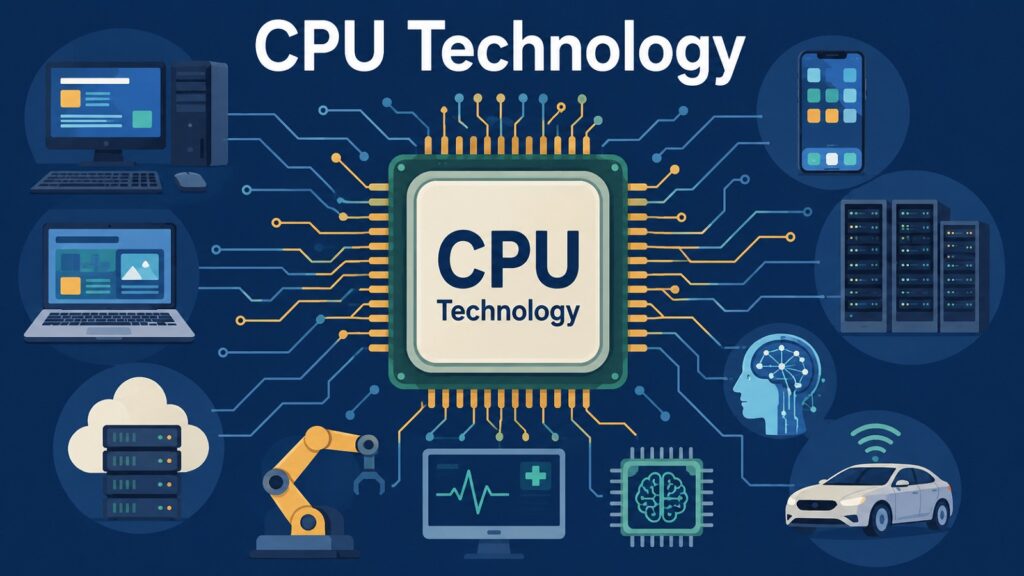
Every digital action, from opening an app to training an artificial intelligence model, depends on one quiet workhorse sitting inside the machine. CPU Technology is the engine that converts electrical signals into the calculations that power modern life. It is one of the most important computing hardware, and without it, even the most elegant software becomes useless, because there is nothing to carry out its instructions.
It is tempting to think of a processor as just another component bolted onto a circuit board. That view misses the bigger picture. CPU Technology has shaped how computers are designed, how software is written, and how entire industries plan their products. Smartphones fit in a pocket because processors became smaller and more efficient. Cloud platforms can serve millions of users because data center processors became faster and more parallel. None of these advances happened by accident. Each one came from decades of research, competition, and engineering refinement.
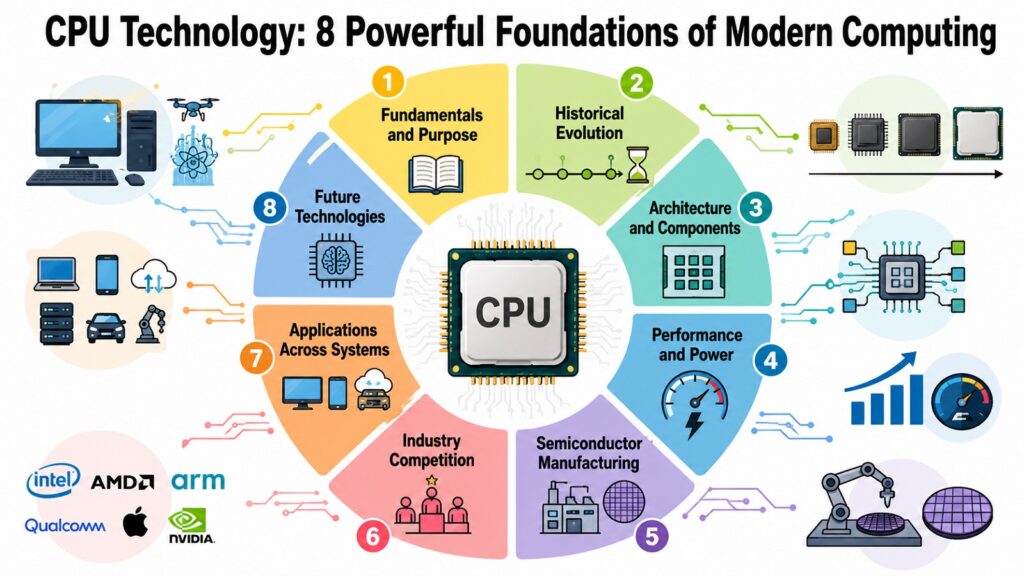
This article treats CPU Technology the way a Harvard case study might treat a major industry shift. Instead of offering a quick technical overview, it walks through eight connected aspects: the basic purpose of processors, their historical evolution, their internal architecture, their performance characteristics, the manufacturing process behind them, the competitive landscape among chipmakers, their real-world applications, and the trends shaping their future.
Understanding CPU Technology properly requires more than a definition. It requires historical context to see how today’s processors came from yesterday’s breakthroughs. It requires theoretical grounding to understand why certain design choices were made. It requires industrial perspective to see why companies compete the way they do. This combination of viewpoints is what makes the subject genuinely interesting rather than a dry technical topic.
The sections ahead move from foundational ideas toward more advanced territory, ending with a look at where processors are headed next. Readers do not need an engineering background to follow along. The goal is to build a clear, grounded picture of why CPU Technology continues to sit at the center of computing.
CPU Technology: Eight Key Aspects Covered in This Article
| Aspect Covered | Why It Matters |
| Fundamentals and Purpose | Explains why processors are essential to all computing devices |
| Evolution and Historical Milestones | Shows how innovation and competition shaped today’s chips |
| Architecture and Key Components | Reveals how internal parts work together to run instructions |
| Performance and Processing Power | Clarifies what actually makes one processor faster than another |
| Semiconductor Manufacturing and Design | Connects chip performance to fabrication capability |
| Industry Competition | Highlights strategic lessons from major chipmakers |
| Applications Across Computing Systems | Demonstrates the broad reach of processors in daily life |
| Future Trends and Emerging Technologies | Prepares readers for where computing is heading next |
1. CPU Technology Fundamentals and Purpose: Understanding the Brain of Computing
Modern society operates on computations occurring at velocities beyond human comprehension. CPU technology is designed to execute these calculations, which underscores the significance of processors. A processor interprets instructions, determines the appropriate actions, and executes the operation, whether it involves adding two numbers, transferring data, or selecting the next path in a program. This process is repeated billions of times each second, establishing the basis for every digital interaction.
It helps to think about what happens during something as ordinary as opening a spreadsheet. The processor retrieves the program from storage, loads relevant data into memory, and begins executing instructions one after another. It checks formulas, updates cell values, and refreshes the screen, all while juggling background tasks. None of this is visible to the user, who only sees a responsive application.
Personal computers depend on this coordination constantly. A single click can trigger thousands of operations across the operating system and open applications. Smartphones rely on the same principle but under tighter constraints, since mobile processors must balance speed with battery life and heat. Every scrolled feed and every captured photo passes through a mobile chip that has to be both fast and efficient.
Servers and cloud platforms scale this idea further. A single data center processor might handle requests from thousands of users simultaneously, switching between tasks so quickly that each user experiences near-instant responses. Without sufficiently capable CPU Technology, cloud computing as it exists today would not be possible.
Memory and storage cannot function without a processor directing traffic between them. Memory holds data temporarily for quick access, storage holds data permanently, and the processor decides what moves where and when. This relationship forms the backbone of computing, and it explains why CPU Technology is sometimes called the brain of a computer.
Recognizing this role changes how people think about technology. A faster phone is not just convenient, it reflects improvements in how its processor manages tasks. A slower laptop is not simply old, its processor may be struggling to keep pace with modern software demands.
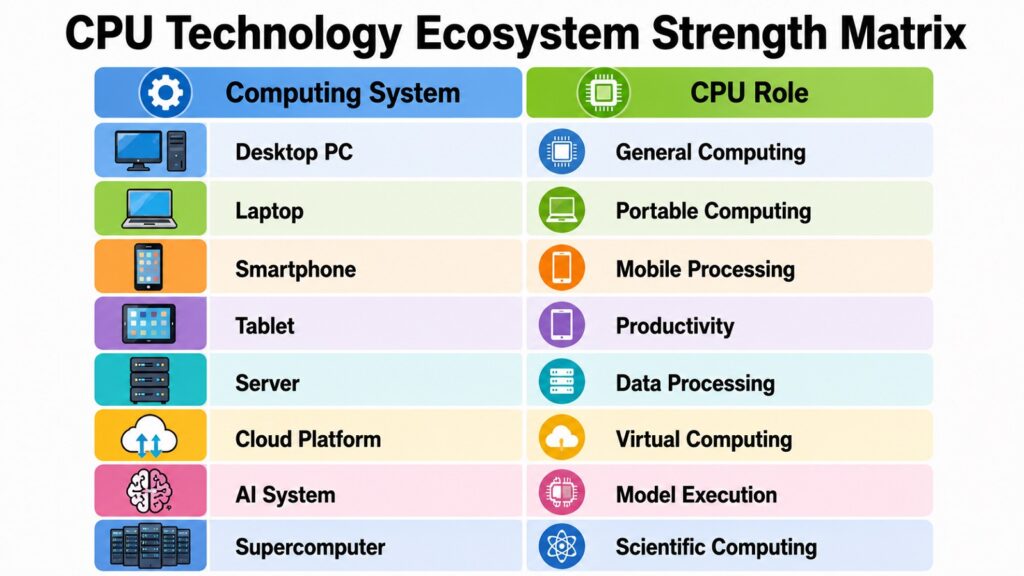
CPU Technology: Role of Processors in Common Computing Devices
| Computing Device or System | Role Played by CPU Technology |
| Personal Computers | Runs the operating system and coordinates all installed applications |
| Smartphones | Balances performance and battery life for mobile tasks |
| Servers | Processes requests from many users at the same time |
| Cloud Platforms | Powers virtual machines and distributed computing services |
| Laptops | Manages everyday productivity tasks with limited power budgets |
| Gaming Consoles | Handles game logic alongside dedicated graphics processing |
| Embedded Systems | Controls specific functions in appliances and machinery |
| Workstations | Supports demanding professional software like video editing |
2. CPU Technology Evolution and Historical Milestones: Lessons from Computing History
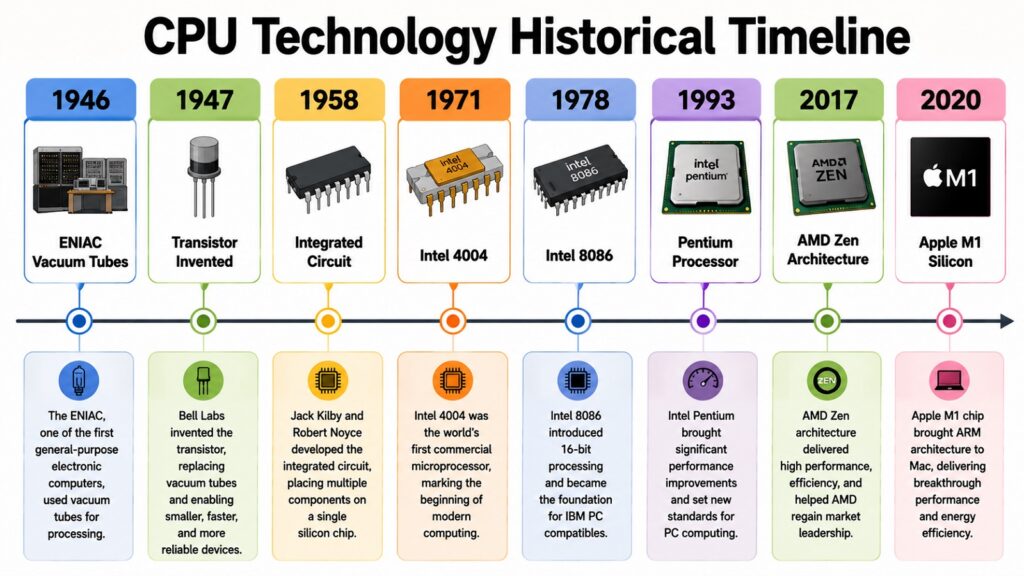
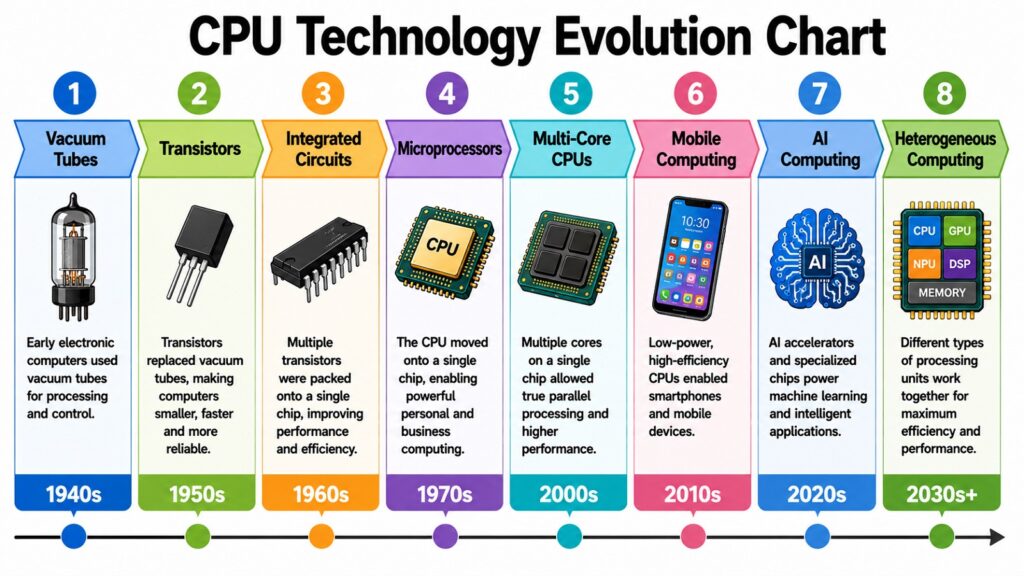
The story of CPU Technology is a story of relentless improvement driven by necessity and competition. Early computers used vacuum tubes, which were bulky, fragile, and produced enormous amounts of heat. The invention of the transistor in the late 1940s changed everything, offering a smaller and more reliable way to control electrical signals. This breakthrough set the stage for decades of miniaturization.
Integrated circuits arrived next, allowing multiple transistors to be combined onto one piece of silicon. This innovation reduced cost and size while improving reliability, and it paved the way for the microprocessor. In 1971, Intel released the 4004, widely regarded as the first commercially available microprocessor, proving that a complete processing unit could exist on a single piece of silicon.
The subsequent decades witnessed swift advancements. In the 1990s, Intel’s Pentium processors gained widespread recognition, promoting their raw performance directly to consumers and facilitating the transition of personal computers into mainstream devices. Concurrently, AMD rose as a formidable rival, compelling Intel to accelerate its innovation efforts.
ARM processors took a different path, focusing on energy efficiency rather than raw power. This design philosophy became essential as mobile devices grew popular, since smartphones needed processors that could deliver decent performance without draining batteries quickly. ARM’s licensing model became one of the most influential business strategies in the history of CPU Technology.
Apple’s shift to its own silicon, branded as Apple Silicon, marked another turning point. By designing processors specifically for its own devices, Apple gained tighter control over performance, efficiency, and integration between hardware and software, illustrating that vertical integration can produce significant advantages.
Each milestone offers a lesson beyond technical details. The shift from vacuum tubes to transistors teaches that physical limitations eventually force fundamental redesigns. The Intel and AMD rivalry teaches that sustained competition accelerates innovation. ARM’s rise teaches that efficiency-focused design can outcompete raw power when the market shifts toward mobility.
CPU Technology: Historical Milestones and Their Significance
| Historical Milestone | Significance |
| Invention of the Transistor | Replaced vacuum tubes with smaller, more reliable components |
| Integrated Circuits | Allowed multiple transistors to fit on a single chip |
| Intel 4004 (1971) | First commercial microprocessor on a single chip |
| Intel Pentium Era | Brought processor branding directly to everyday consumers |
| Rise of AMD | Introduced sustained competitive pressure on Intel |
| ARM Architecture | Prioritized energy efficiency for mobile computing |
| Multi-Core Processors | Enabled parallel processing within a single chip |
| Apple Silicon | Demonstrated benefits of vertical hardware integration |
3. CPU Technology Architecture and Key Components: Inside a Modern Processor
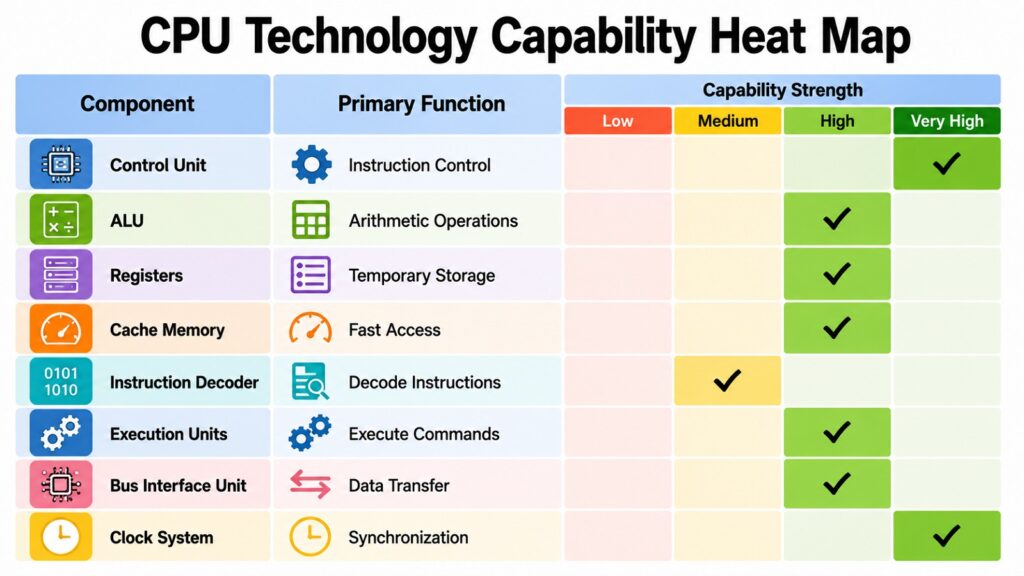
Opening up the architecture of a processor reveals an organized system rather than a random cluster of circuits. CPU Technology relies on several major components working in close coordination. The Control Unit acts as the conductor, directing the flow of instructions and making sure each part of the processor knows what to do and when to do it.
The Arithmetic Logic Unit, often shortened to ALU, performs the actual mathematical and logical operations. Addition, subtraction, comparisons, and other calculations all pass through this component. Working closely with the ALU are registers, extremely fast storage locations used to hold data being processed right now. Because registers sit directly inside the processor, they are far quicker to access than memory located elsewhere on the system.
Cache memory sits between the processor and the slower main memory, storing frequently used data so the processor does not need to fetch it repeatedly from farther away. This layered approach to memory access balances speed and cost effectively. The Instruction Decoder translates incoming instructions into a form the rest of the processor can act on, essentially serving as a translator between software commands and hardware actions.
Execution Units carry out the decoded instructions, and modern processors often include multiple execution units so they can handle several operations simultaneously. The Bus Interface Unit manages communication between the processor and the rest of the system, including memory and input or output devices. Meanwhile, the Clock System sets the timing for every operation, ensuring all components stay synchronized.
This entire arrangement traces back to ideas first formalized by John von Neumann in the 1940s, often called the Von Neumann architecture. The concept of storing both instructions and data in the same memory space, then processing them sequentially, became the template for most processors that followed. Modern designs have added complexity such as parallel execution, but the underlying logic still echoes those early theoretical foundations.
Picturing the processor as a coordinated team rather than isolated parts makes its function much clearer. The Control Unit gives direction, the ALU performs the work, registers and cache keep relevant data close at hand, the decoder translates instructions, and execution units carry them out. This cooperative structure is what allows CPU Technology to execute billions of instructions every second without losing coherence.
CPU Technology: Key Components and Their Primary Functions
| Key Component | Primary Function |
| Control Unit | Directs instruction flow and coordinates processor activity |
| Arithmetic Logic Unit | Performs mathematical and logical calculations |
| Registers | Store data temporarily during active processing |
| Cache Memory | Holds frequently used data for faster access |
| Instruction Decoder | Translates instructions into executable actions |
| Execution Units | Carry out decoded instructions, often in parallel |
| Bus Interface Unit | Manages communication with memory and devices |
| Clock System | Synchronizes timing across all processor operations |
4. CPU Technology Performance and Processing Power: What Makes Processors Fast
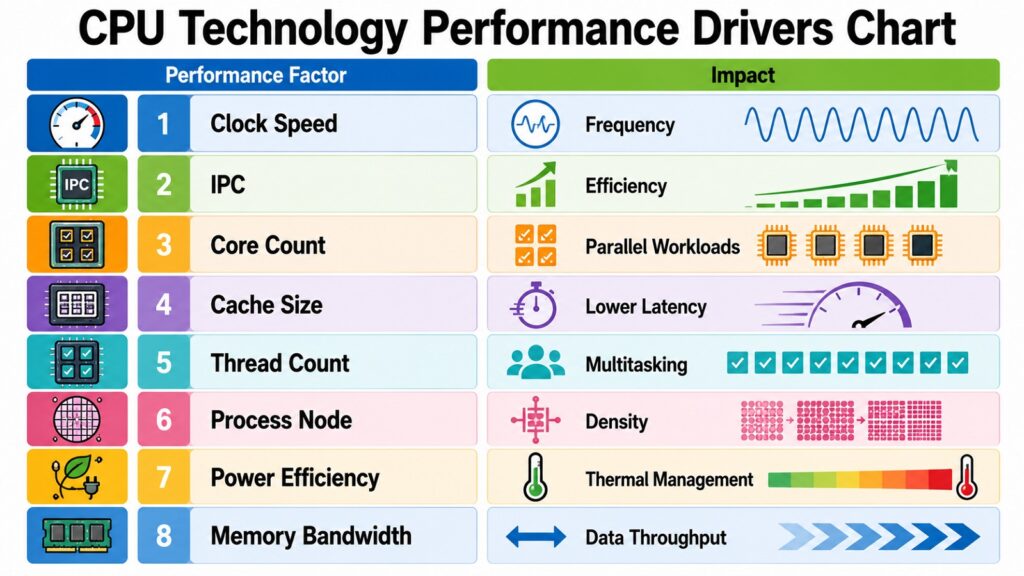
Many people assume that clock speed alone determines how fast a processor is, but CPU Technology performance depends on a far more layered set of factors. Clock speed, measured in gigahertz, indicates how many cycles a processor completes each second. A higher number sounds impressive, but it only tells part of the story, because how much work happens during each cycle matters just as much as how many cycles occur.
This is where Instructions Per Cycle, often abbreviated as IPC, becomes important. A processor with a lower clock speed but higher IPC can outperform one with a higher clock speed but lower IPC, since it accomplishes more useful work during each cycle. Architectural improvements that raise IPC have driven significant performance gains over the years, sometimes more than raw frequency increases ever could.
Cache memory plays a major role as well. When a processor can find the data it needs in cache rather than waiting for slower main memory, it avoids wasted cycles. Larger and smarter cache designs reduce these delays, which translates directly into smoother performance for everyday tasks like loading applications or switching between programs.
Core count adds another dimension. A processor with multiple cores can handle several tasks at once instead of one at a time, which matters greatly for modern workloads involving multitasking or video editing. However, more cores only help if software is designed to take advantage of them, which is why developers must write programs that distribute work effectively across available cores.
Power efficiency and thermal considerations round out the picture. A processor that runs too hot must slow itself down to avoid damage, a process known as thermal throttling. Intel, AMD, and Apple each approach this challenge differently. Intel and AMD have historically focused on raw desktop and server performance, while Apple has prioritized efficiency, allowing its chips strong performance without excessive heat or battery drain.
Evaluating a processor intelligently means looking beyond a single number. Clock speed, IPC, cache size, core count, and power efficiency all interact with one another, and the right balance depends on the task at hand. A processor optimized for gaming may emphasize different qualities than one optimized for battery-powered mobile use. Understanding these trade-offs gives readers a clearer lens for judging real-world performance.
CPU Technology: Performance Factors and Their Impact
| Performance Factor | Impact on CPU Technology |
| Clock Speed | Determines cycles completed per second |
| Instructions Per Cycle | Measures useful work done within each cycle |
| Cache Memory Size | Reduces delays from accessing main memory |
| Core Count | Enables handling multiple tasks simultaneously |
| Power Efficiency | Affects battery life and sustained performance |
| Thermal Management | Prevents slowdown caused by overheating |
| Parallel Processing | Distributes workloads across multiple execution paths |
| Architecture Design | Shapes how effectively other factors translate into speed |
5. CPU Technology: Semiconductor Manufacturing and Design: From Silicon to Chips
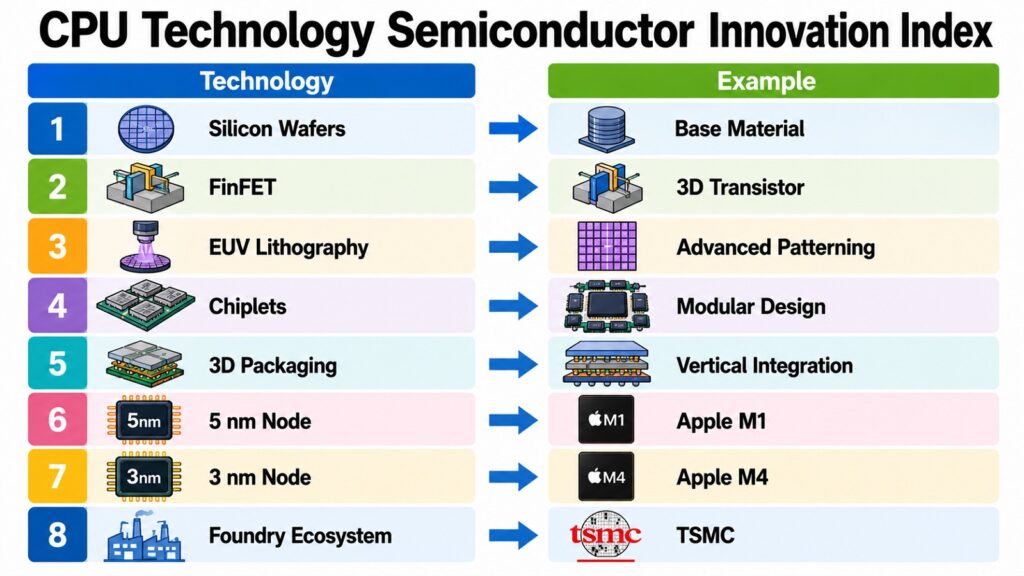
Behind every processor lies a manufacturing process that turns raw silicon into one of the most complex objects humans produce at scale. CPU Technology begins as a thin, polished wafer of silicon, which then undergoes a process called lithography. This technique uses light to project incredibly small circuit patterns onto the wafer’s surface, etching the pathways that will carry electrical signals.
Transistor density refers to how many transistors can fit into a given area of the chip. As manufacturing techniques have advanced, companies have packed exponentially more transistors into the same physical space, allowing processors to become more powerful without growing larger. This density is often described using process nodes, expressed in nanometers, although modern naming conventions reflect marketing as much as precise physical measurements.
Fabrication facilities, commonly called fabs, represent some of the most expensive and technically demanding factories on the planet. Building a leading-edge fab can cost tens of billions of dollars, and only a handful of companies worldwide possess the expertise to operate one at the cutting edge. This barrier to entry explains why semiconductor manufacturing has become concentrated among a small number of specialized firms.
TSMC, based in Taiwan, has emerged as the dominant contract manufacturer, producing chips designed by companies such as Apple, AMD, and Nvidia. Samsung Foundry operates similarly, manufacturing chips for its own products and external clients, while competing directly with TSMC for leading-edge business. Intel Foundry represents a different model, since Intel has traditionally designed and manufactured its own chips in-house, though it has recently opened its fabs to outside customers as well.
Semiconductor leadership carries weight far beyond the technology industry. Governments now view chip manufacturing capability as a matter of strategic importance, since processors underpin everything from consumer electronics to military systems. This has led to significant public investment in domestic chip production across multiple countries, reflecting how deeply manufacturing capability shapes economic competitiveness.
The insight derived from this segment of the industry is that processor performance is influenced by factors beyond just innovative architecture. A sophisticated chip design holds little value if it cannot be produced consistently at scale with satisfactory yields. Excellence in manufacturing and ongoing investment in fabrication technology are equally crucial to CPU technology as the engineering efforts that shape a chip’s design.
CPU Technology: Semiconductor Technologies and Their Significance
| Semiconductor Technology or Company | Significance |
| Silicon Wafers | Serve as the base material for chip fabrication |
| Lithography | Etches microscopic circuit patterns onto wafers |
| Transistor Density | Determines how much processing power fits in a given space |
| Process Nodes | Indicate generational improvements in manufacturing precision |
| TSMC | Leading contract manufacturer for major chip designers |
| Samsung Foundry | Major competitor in advanced chip manufacturing |
| Intel Foundry | Combines in-house design with expanding external manufacturing |
| Fabrication Facilities | Represent massive capital investment and specialized expertise |
6. CPU Technology Industry Competition: Case Studies in Innovation and Strategy
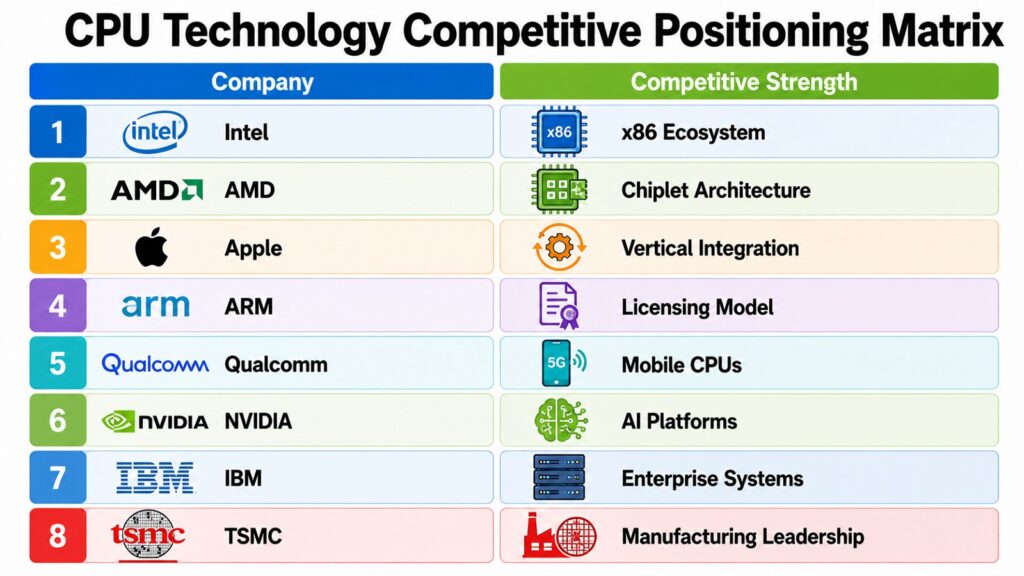
Competition has been the engine driving CPU Technology forward more than any single invention. Viewing the chip industry through a business strategy lens reveals patterns familiar from other competitive markets, where companies must constantly innovate or risk losing relevance. Intel spent decades as the dominant force in personal computer processors, but its position never went unchallenged, and that ongoing pressure shaped much of the industry’s progress.
AMD’s rise offers a compelling case study in persistence. For years, AMD struggled to match Intel’s manufacturing scale and research budget. Yet AMD’s Ryzen processors, introduced in 2017, represented a turning point built on a new architectural approach that delivered strong multi-core performance at competitive prices. This success forced Intel to accelerate its own roadmap, demonstrating how a smaller competitor can reshape an entire market through focused innovation.
Apple’s situation exemplifies a distinct strategic lesson: vertical integration. By creating its own chips instead of depending on external suppliers, Apple secured control over performance optimization, energy efficiency, and software enhancement all at once. Although this strategy necessitated significant initial investment, it ultimately enabled Apple to set its products apart in ways that competitors utilizing standard processors found challenging to imitate.
ARM took yet another path by avoiding manufacturing entirely. Instead, ARM licenses its processor designs to other companies, including Qualcomm and Apple, collecting fees without bearing the enormous cost of building factories. This licensing model spread ARM architecture across billions of devices worldwide, proving that controlling intellectual property can be just as powerful a strategy as controlling physical production.
Qualcomm built its strength around mobile connectivity and processors optimized for smartphones. Nvidia, originally known for graphics processors, expanded aggressively into artificial intelligence computing, recognizing early that parallel processing architectures suited for graphics could also accelerate machine learning workloads. IBM shifted its processor focus toward specialized enterprise and mainframe systems where reliability matters most. TSMC, though not a chip designer itself, became indispensable by mastering the manufacturing side that every other company depends on.
These cases collectively illustrate several strategic lessons. Sustained investment in research can overturn established dominance, as AMD demonstrated. Vertical integration can create defensible advantages, as Apple showed. Licensing intellectual property can scale a business without manufacturing risk, as ARM proved. Together, these strategies reveal that success in CPU Technology depends as much on business judgment as on engineering talent.
CPU Technology: Companies and Their Strategic Contributions
| Company | Major Contribution or Strategic Strength |
| Intel | Long-standing leadership in personal computer and server processors |
| AMD | Resurgence through competitive multi-core architecture |
| Apple | Vertical integration of chip design and device software |
| ARM | Licensing model enabling widespread architecture adoption |
| Qualcomm | Deep specialization in mobile and wireless processors |
| Nvidia | Expansion from graphics processing into AI computing |
| IBM | Focus on enterprise-grade and mainframe processor systems |
| TSMC | Manufacturing leadership supporting the entire chip industry |
7. CPU Technology Applications Across Computing Systems: Powering the Digital World
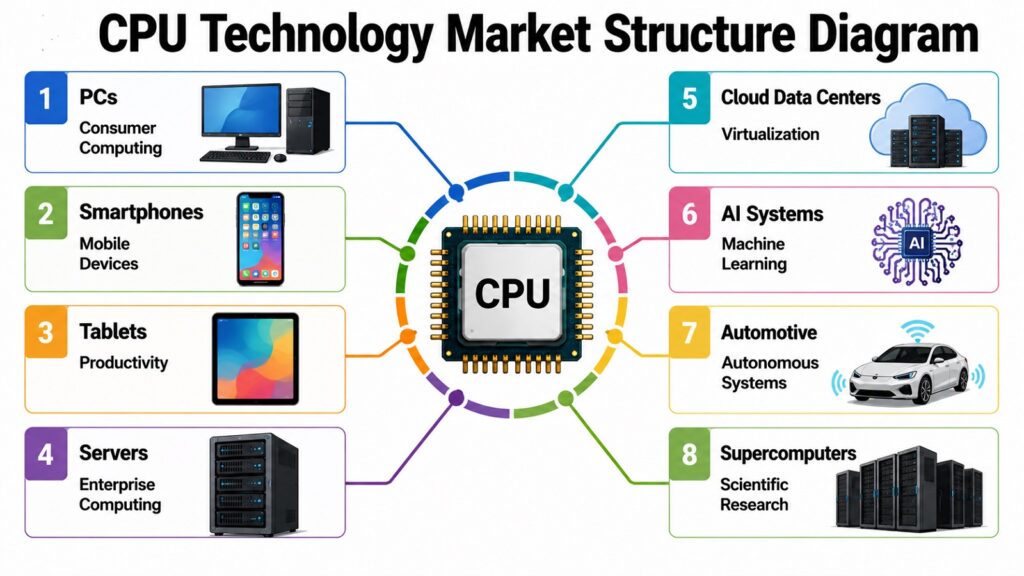
The reach of CPU Technology extends far beyond the obvious examples of laptops and smartphones. Processors quietly operate within nearly every digital system that touches daily life, and recognizing this scope helps explain why the technology receives so much attention. Personal computers and smartphones remain the most familiar examples, handling everything from word processing to video calls through constant processor activity.
Servers extend this reach into the business world, running databases, websites, and enterprise applications that organizations depend on daily. Cloud computing builds on server infrastructure at massive scale, allowing companies to rent processing power rather than maintaining their own data centers. This shift has made advanced computing accessible to businesses of nearly any size.
Artificial intelligence systems place some of the heaviest demands on modern processors. Training a machine learning model requires performing enormous numbers of calculations across massive datasets, and specialized processors have emerged specifically to handle these parallel workloads efficiently. Even running an AI model on a phone requires capable on-device processing to deliver quick responses.
Automotive systems increasingly rely on embedded processors for navigation, safety features, and increasingly autonomous driving functions. Industrial automation depends on processors to control robotic equipment with split-second precision. Edge computing pushes processing power closer to where data is generated, reducing the delay involved in sending data to distant servers.
Supercomputers represent the far end of this spectrum, combining thousands of processors to tackle problems like climate modeling and drug discovery. These machines demonstrate the upper limits of what coordinated processing power can achieve at extraordinary scale.
Taken together, these applications show that CPU Technology is not confined to any single industry. It forms an invisible layer beneath transportation, healthcare research, entertainment, and communication. This ubiquity is precisely why understanding processors matters, since their continued advancement shapes what becomes possible across nearly every sector of society.
CPU Technology: Applications Across Industries and Systems
| Application or Industry | Role of CPU Technology |
| Personal Computing | Runs everyday software and productivity applications |
| Cloud Computing | Provides scalable processing power for businesses |
| Artificial Intelligence | Executes the calculations behind machine learning models |
| Automotive Systems | Supports navigation, safety, and driving assistance features |
| Industrial Automation | Controls robotic and manufacturing equipment precisely |
| Edge Computing | Processes data closer to where it is generated |
| Supercomputing | Combines thousands of processors for complex simulations |
| Telecommunications | Manages data routing and network infrastructure |
8. CPU Technology Future Trends and Emerging Technologies: The Next Era of Computing
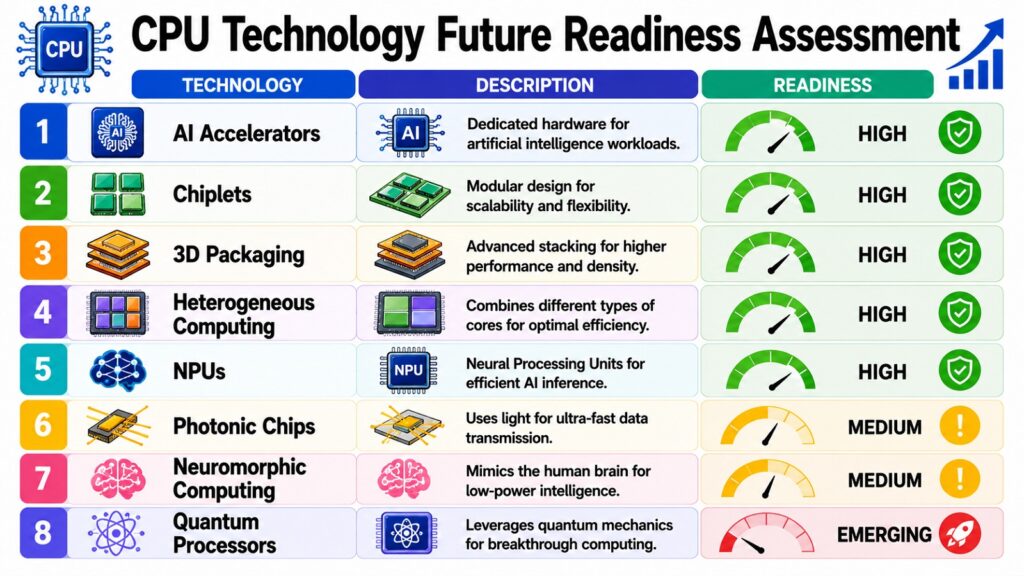
The next chapter of CPU Technology is already taking shape, driven by changing workloads and the limits of traditional design approaches. Artificial intelligence has become a major influence, pushing companies to design processors with dedicated sections optimized specifically for machine learning calculations rather than general-purpose tasks alone.
Chiplet architectures represent another significant shift. Instead of building one massive piece of silicon, manufacturers now combine several smaller chips, or chiplets, into a single package. This approach improves manufacturing yields and allows companies to mix and match components more flexibly, since a defect in one small chiplet does not waste an entire large chip.
Heterogeneous computing takes this flexibility further by combining different types of processing cores within the same system, each optimized for specific tasks. Some cores might prioritize raw speed while others prioritize energy efficiency, allowing the overall system to allocate work intelligently based on what each task actually requires.
Three-dimensional packaging stacks chip components vertically rather than spreading them across a flat surface, shortening the distance data must travel and improving both speed and efficiency. Neuromorphic chips attempt a more radical rethink, drawing inspiration from how biological brains process information, potentially offering efficiency gains for certain pattern recognition tasks.
Photonic processors, which use light rather than electrical signals to move data, remain an active research area with the potential to reduce heat and increase speed for specific applications. Quantum computing represents the most fundamentally different approach, relying on quantum mechanical properties rather than traditional binary logic, and could eventually solve problems beyond the reach of conventional processors.
None of these directions are based solely on speculation. Each one is founded on ongoing research and substantial engineering investments that are currently being made across the industry. As workloads increasingly transition towards artificial intelligence and real-time data processing, it is probable that CPU technology will continue to evolve along various paths concurrently, similar to its historical development.
CPU Technology: Emerging Technologies and Their Potential Impact
| Emerging Technology | Potential Impact |
| AI-Optimized Processors | Improves efficiency for machine learning workloads |
| Chiplet Architectures | Increases manufacturing flexibility and yield |
| Heterogeneous Computing | Matches different core types to specific tasks |
| 3D Packaging | Reduces data travel distance for faster performance |
| Neuromorphic Chips | Offers brain-inspired efficiency for pattern recognition |
| Photonic Processors | Uses light to potentially reduce heat and boost speed |
| Quantum Computing | Could solve specific problems beyond classical limits |
| Specialized Accelerators | Targets specific workloads like graphics or encryption |
Conclusion: CPU Technology and Its Enduring Role in Modern Computing
CPU Technology stands as one of the most consequential forms of Computing Hardware ever developed, and the journey through its many dimensions makes clear why that distinction is well earned. From its basic purpose of executing instructions to its role in powering artificial intelligence, processors sit at the center of nearly everything digital. This central position did not emerge overnight, and it did not come from any single breakthrough.
Looking back across the eight aspects covered, a consistent theme emerges, interdependence. Architecture determines how efficiently a processor can work, but manufacturing determines whether that architecture can be built reliably at scale. Competition among companies pushes both architecture and manufacturing forward faster than any single firm could manage alone. Real-world applications then test whether all of this effort actually translates into useful technology.
These connections matter because they explain why CPU Technology has remained relevant for decades rather than becoming a solved problem. Each generation of processors raises new questions about efficiency, scale, and capability, and each answer tends to create fresh challenges that drive the next wave of innovation. This cycle of problem and solution is what has kept the field moving rather than settling into stagnation.
Looking forward, the importance of CPU Technology shows no sign of diminishing. Artificial intelligence, edge computing, and increasingly data-intensive applications will continue placing new demands on processors, and the industry’s history suggests it will respond with fresh architectural ideas and competitive pressure, just as it always has. Quantum computing and photonic processing may eventually open entirely new categories of computation, but even these future directions build on lessons learned from decades of conventional processor development.
CPU Technology: Eight Key Takeaways from This Article
| Key Takeaway | Significance |
| Processors Coordinate Computing | They direct memory, storage, and software working together |
| History Shows Continuous Innovation | Progress came through competition and problem-solving |
| Architecture Enables Efficiency | Internal components must cooperate to execute instructions |
| Performance Involves Many Factors | Speed depends on more than clock frequency alone |
| Manufacturing Shapes Capability | Fabrication quality determines what designs can achieve |
| Competition Drives Progress | Rival strategies have pushed the entire industry forward |
| Applications Are Everywhere | Processors support nearly every digital system in use |
| Future Trends Point Forward | New architectures will address emerging computing demands |