Table of Contents
Introduction: Why Gaming Devices Are Essential Personal Tech Devices
Gaming Devices have quietly become one of the most important categories of Personal Tech Devices that people own today. They are no longer simple boxes built only to run games. A modern gaming device blends entertainment, computing power, communication tools, creative software, and competitive platforms into a single piece of hardware. People use them to play, but they also use them to chat with friends, watch streams, and join communities that span the globe. This shift grew out of decades of steady improvement in processors, graphics, displays, and networks.
In the early days, gaming hardware was narrow in purpose. A console played games and nothing else, and a handheld system offered a few hours of distraction during travel. Today, Gaming Devices sit at the center of how millions of people interact with digital life. They stream movies, run video calls, and even power small businesses built around content creation, which is why they deserve to be discussed alongside smartphones and laptops rather than treated as a separate, smaller hobby category.
The scale of the gaming industry backs up this claim. Recent industry tracking placed the global games market at roughly 188.8 billion dollars in yearly revenue, with mobile gaming alone responsible for more than half of that figure. Console revenue grew at the fastest rate among the major platforms, even though it holds a smaller overall share than mobile, while PC gaming continues to anchor competitive play and content creation. These numbers show that Gaming Devices are a growing, diversified part of the consumer technology economy, touching hardware makers, software studios, and online service providers all at once.
Culturally, gaming has also moved into the mainstream. Streaming platforms turned gameplay into a spectator activity, and esports tournaments now fill arenas and draw online audiences that rival traditional sports broadcasts. Social platforms treat gaming clips and highlights as everyday content rather than a niche interest. Gaming Devices sit underneath all of this activity, acting as the entry point through which people experience these moments, whether they are playing themselves or watching someone else play.
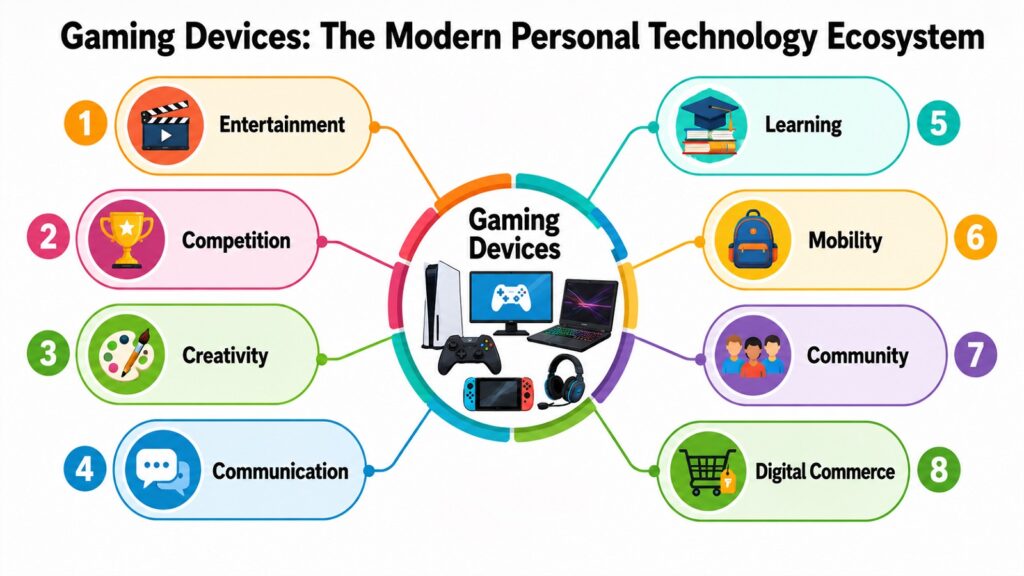
This article looks at eight distinct types of Gaming Devices that together make up the modern gaming landscape. Gaming consoles offer a simple, unified experience built around a closed ecosystem, while gaming PCs deliver raw power and endless customization. Gaming laptops bring that power into a portable shell, and handheld gaming devices remove location limits altogether. Gaming smartphones turn an everyday device into a serious gaming tool, while monitors, controllers, and peripherals round out the picture by shaping how players see, feel, and interact with every game they touch.
Gaming Devices Overview: A Roadmap of This Article
| Gaming Device | Primary Role |
| Gaming Consoles | Deliver a unified, plug-and-play gaming ecosystem |
| Gaming PCs | Provide top-tier, customizable gaming performance |
| Gaming Laptops | Combine strong performance with portability |
| Handheld Gaming Devices | Enable gaming without location limits |
| Gaming Smartphones | Turn everyday phones into serious gaming tools |
| Gaming Monitors | Shape visual quality, speed, and immersion |
| Gaming Controllers | Connect players to games through precise input |
| Gaming Peripherals | Extend performance, communication, and content creation |
1. Gaming Devices Through Gaming Consoles: Dedicated Platforms for Interactive Entertainment
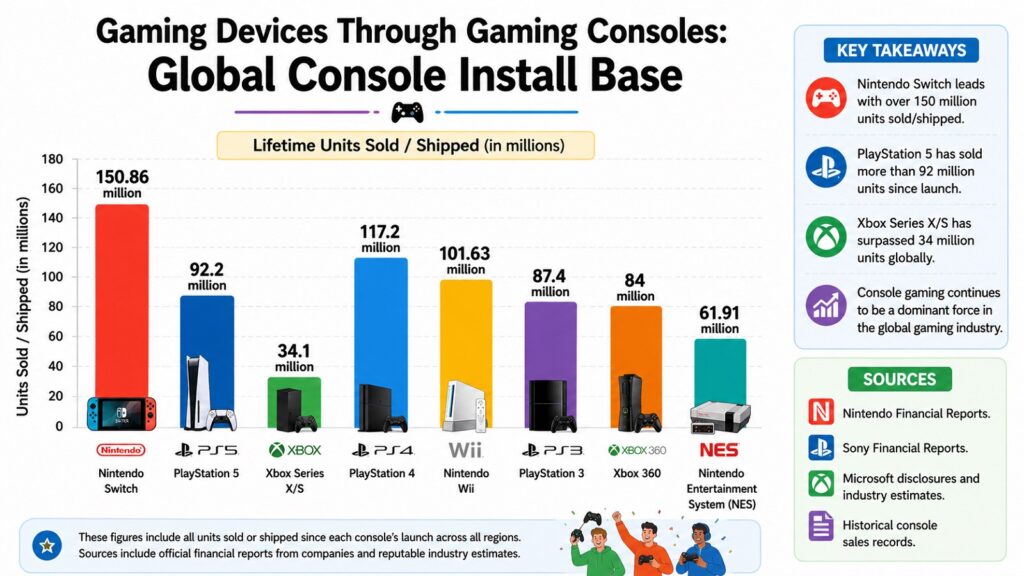
Gaming consoles remain one of the most recognizable Gaming Devices in the entire technology industry. Their strength comes from the idea of a platform ecosystem, where hardware, software, online services, and a digital storefront all work together inside one closed system. Instead of asking a buyer to assemble parts or manage software updates, a console manufacturer controls the entire experience from the moment the device is unboxed. This approach lowers the technical barrier for everyday players while giving manufacturers tight control over performance and compatibility.
Consoles evolved gradually from standalone machines into connected entertainment hubs. Early systems played physical cartridges or discs and offered no online features at all. Modern consoles connect to the internet by default, support digital downloads, and sync game progress through cloud saves. This shift turned the console from a single-purpose toy into a broader entertainment center.
Consumer adoption research consistently shows that ecosystem loyalty plays a major role in console purchases. Once a player buys games and subscribes to an online service tied to one brand, switching to a competing platform becomes costly and inconvenient. Exclusive titles reinforce this loyalty even further, since a single highly anticipated exclusive game can drive hardware sales on its own.
A useful case study involves the long-running rivalry between major console manufacturers such as Sony, Microsoft, and Nintendo. Sony has leaned heavily on first-party exclusive titles to build brand loyalty, while Microsoft has invested in a subscription service that bundles a large game library with online play. Nintendo has taken a different path, focusing on unique hardware concepts and family-friendly exclusives rather than competing purely on raw power. In 2025, Nintendo launched the Switch 2, continuing its strategy of pairing distinctive hardware with strong first-party software.
Consoles offer real strengths. They are simple to set up, consistent in performance, and backed by structured online services. Their main limitation is reduced flexibility compared with PCs, since players cannot easily upgrade internal components or run software outside the manufacturer’s approved store. Looking ahead, cloud gaming integration is steadily reducing the importance of local hardware power, and subscription models continue to expand alongside early AI-enhanced features such as smarter recommendations and adaptive difficulty tools.
Gaming Devices Comparison: Console Features and Milestones
| Console Feature | Description |
| Closed ecosystem | Hardware, software, and store managed by one company |
| Exclusive titles | Games available only on a specific console brand |
| Online subscription services | Paid tiers unlocking online play and game libraries |
| Cloud save syncing | Game progress stored online across sessions |
| Backward compatibility | Ability to play older games on newer hardware |
| Hybrid design | Switch 2 continues handheld-and-docked flexibility |
| Digital storefronts | Direct downloads without physical media |
| Cloud gaming support | Streaming titles without full local processing |
2. Gaming Devices Through Gaming PCs: High-Performance Systems for Advanced Gaming
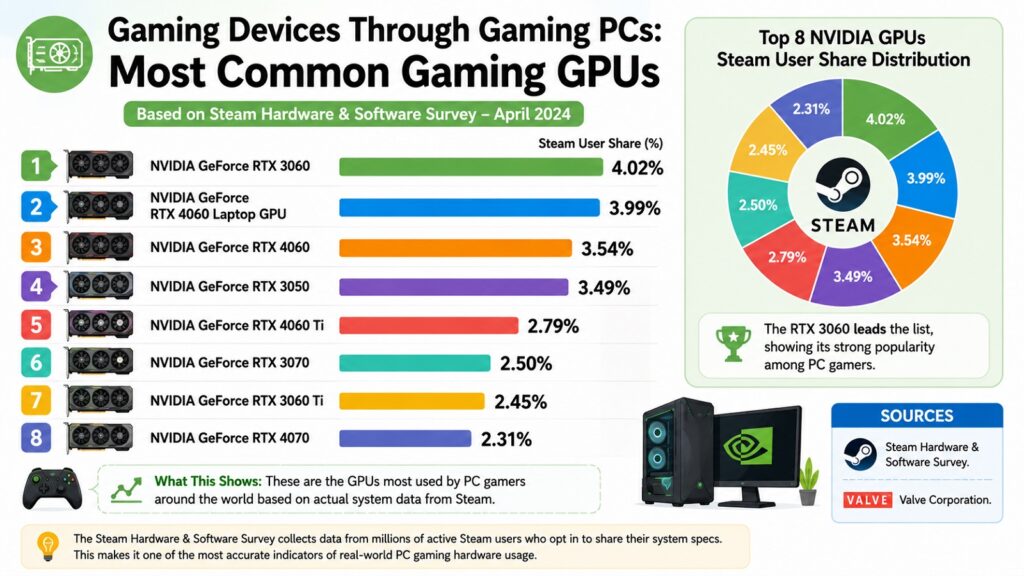
Gaming PCs sit at the top of the performance ladder among Gaming Devices, and they remain central to the industry for a simple reason: they can be customized and upgraded in ways no console or laptop can match. The theoretical foundation here is modular computing. A gaming PC is built from separate components, including a processor, graphics card, memory, cooling system, and storage drives, each of which can be replaced or upgraded independently. This modularity means a gaming PC bought today can often stay competitive for years simply by swapping out one or two parts.
Each component plays a distinct role in gaming performance. The processor manages overall system instructions and game logic, while the graphics card renders the visual world, handling lighting, textures, and frame rates. Memory keeps frequently used data ready for fast access, reducing stutter and loading delays. Fast solid-state storage has dramatically cut loading times compared with older mechanical hard drives.
Research into the esports and content creation space shows why gaming PCs hold such a strong position. Competitive esports players favor PCs because of high frame rates, customizable input devices, and precise control over settings. Streamers and video creators rely on PCs to record gameplay and run broadcasting software, often at the same time. Enthusiast communities built around PC gaming have grown into a major cultural force.
A clear case study can be seen in professional esports organizations, which depend on high-performance gaming PCs to support tournament play at the highest level. Titles played competitively at a serious level demand consistently high frame rates and minimal input delay, conditions that only a well-built gaming PC can reliably deliver. This same hardware also supports the streaming setups used by full-time content creators, who often run multiple monitors and background applications without sacrificing in-game performance.
This flexibility comes with a trade-off in terms of cost and complexity. Assembling or servicing a gaming PC necessitates more technical know-how than merely connecting a console, and high-end parts are considerably more expensive. However, the strategic advantages are apparent for players desiring peak performance and future upgrade possibilities. AI-enhanced performance optimization is beginning to emerge in graphics drivers, assisting systems in automatically balancing visual fidelity and frame rates.
Gaming Devices Breakdown: Key Gaming PC Components
| PC Component | Role in Gaming |
| Processor (CPU) | Handles game logic and overall system instructions |
| Graphics card (GPU) | Renders visuals, lighting, and frame rates |
| RAM (memory) | Stores active data for fast, smooth performance |
| Solid-state storage | Cuts load times compared with older drives |
| Cooling systems | Prevents overheating during long sessions |
| Power supply | Delivers stable energy to high-performance parts |
| Motherboard | Connects and coordinates all internal components |
| Upgradeability | Allows long-term performance improvements over time |
3. Gaming Devices Through Gaming Laptops: Portable Power for Modern Gamers
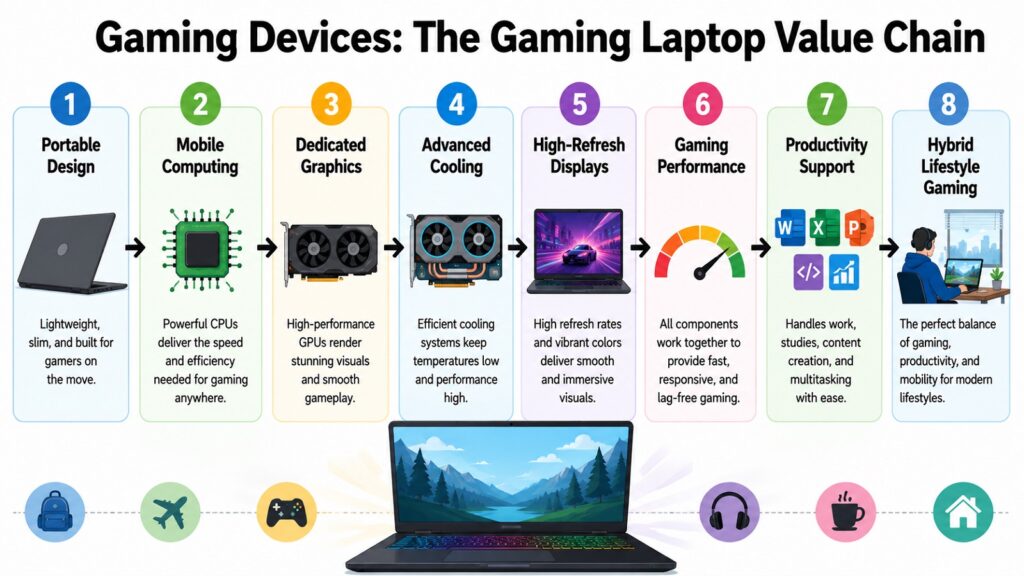
Gaming laptops occupy a unique space among Gaming Devices because they attempt to solve a genuinely difficult engineering problem. Manufacturers must balance portability, thermal management, battery life, and raw computing power inside a single thin chassis. Unlike a desktop tower with ample room for airflow, a laptop has to manage heat in a tightly packed space while still delivering frame rates that satisfy serious players. This balancing act has driven years of innovation in cooling design and component miniaturization.
Advances in mobile processors and compact graphics chips have narrowed the performance gap between gaming laptops and desktop gaming PCs. High refresh rate display panels now ship in laptops that weigh only a few pounds, and vapor chamber cooling has replaced older, simpler heat sinks, allowing sustained performance without dangerous overheating.
Broader lifestyle trends support this growth. Hybrid work arrangements mean more people split time between home, office, and travel, and a gaming laptop lets them carry serious computing power wherever they go. Students represent another major user segment, since one laptop can handle coursework, creative projects, and gaming without a separate desktop.
A useful case study involves university students who travel frequently between dormitories, home, and study locations. For this group, a gaming laptop replaces what would otherwise require two separate machines, a desktop for gaming and a separate laptop for classwork. The convenience of one portable device that handles both tasks creates real value, even at a higher price.
The trade-offs are still real. Gaming laptops generally cost more than desktop PCs with comparable specifications, and their components cannot be upgraded as freely. Battery life during demanding games remains short compared with everyday laptop use, since high-performance components draw significant power. Despite these limits, gaming laptops continue to close the gap with desktops year after year as chip efficiency keeps improving.
Gaming Devices Spotlight: Gaming Laptop Innovations
| Laptop Feature | Why It Matters |
| High refresh rate displays | Smoother motion for fast-paced games |
| Vapor chamber cooling | Manages heat in a slim chassis |
| Compact graphics chips | Brings desktop-level visuals to portable hardware |
| Fast charging support | Reduces downtime between sessions |
| Hybrid CPU designs | Balances efficiency with peak performance |
| Multi-purpose use | Handles study, work, and gaming on one device |
| Lightweight chassis materials | Improves portability without sacrificing strength |
| External GPU support | Allows added power when docked at home |
4. Gaming Devices Through Handheld Gaming Devices: Gaming Without Location Limits
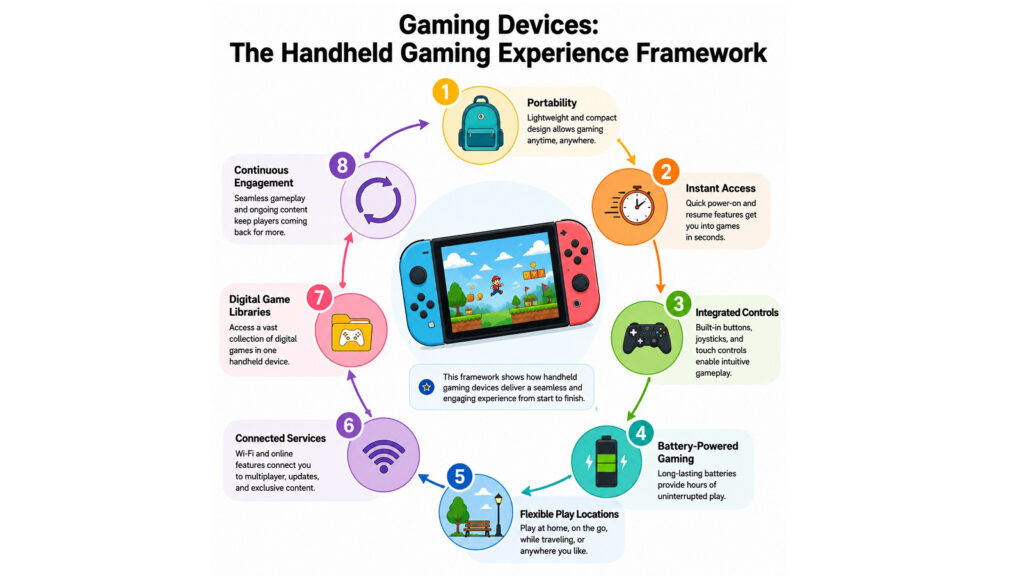
Handheld gaming devices expand the reach of Gaming Devices by removing the location restrictions that come with consoles, PCs, and even most laptops. Mobility has long been a powerful force in consumer technology, since people consistently choose devices that fit into their daily routines rather than requiring a dedicated space or setup time. Handheld systems bridge the gap between traditional consoles, smartphones, and full PCs by offering dedicated gaming hardware that fits in a bag or even a large pocket.
Technological progress has steadily increased what handheld devices can actually do. Early handhelds offered simple graphics and short battery life, while current devices pack capable processors into a small frame. Many now run console-quality games while still being battery-powered and fully portable, a leap made possible by improved screens and more efficient chips.
Consumer research on gaming habits shows a clear demand for flexible play. Commuters, travelers, and people with irregular schedules often cannot commit to long sessions in front of a television. Handheld devices fit naturally into short breaks or travel time, and this demand has pushed manufacturers to treat handhelds as a serious category.
Nintendo’s handheld and hybrid systems offer a strong case study in this space. The original Switch combined handheld and docked play in one device, and its successor, the Switch 2 launched in 2025, continued that same hybrid approach with stronger hardware and a larger display. This strategy proved that players want both portability and a big-screen experience, depending on the moment.
Handheld devices still face real limitations, including smaller screens, shorter battery life during demanding games, and less raw power compared with desktop systems. Even so, opportunities continue to grow as chip efficiency improves and battery technology advances, and future handheld devices are likely to close more of the performance gap with consoles while keeping their core advantage of traveling wherever the player goes.
Gaming Devices Insights: Handheld System Milestones
| Handheld Innovation | Impact on Gaming |
| Hybrid handheld-console design | Lets players switch between TV and portable play |
| Improved battery efficiency | Extends play sessions away from a charger |
| Compact high-resolution screens | Sharper visuals in a small form factor |
| Detachable controllers | Adds flexibility for multiplayer or solo play |
| Cartridge and digital storage | Supports both physical and downloaded games |
| Cloud save compatibility | Keeps progress synced with other devices |
| Lightweight builds | Improves comfort during long travel sessions |
| Expanding indie game libraries | Broadens content beyond major franchise titles |
5. Gaming Devices Through Gaming Smartphones: The Rise of Mobile Gaming Technology
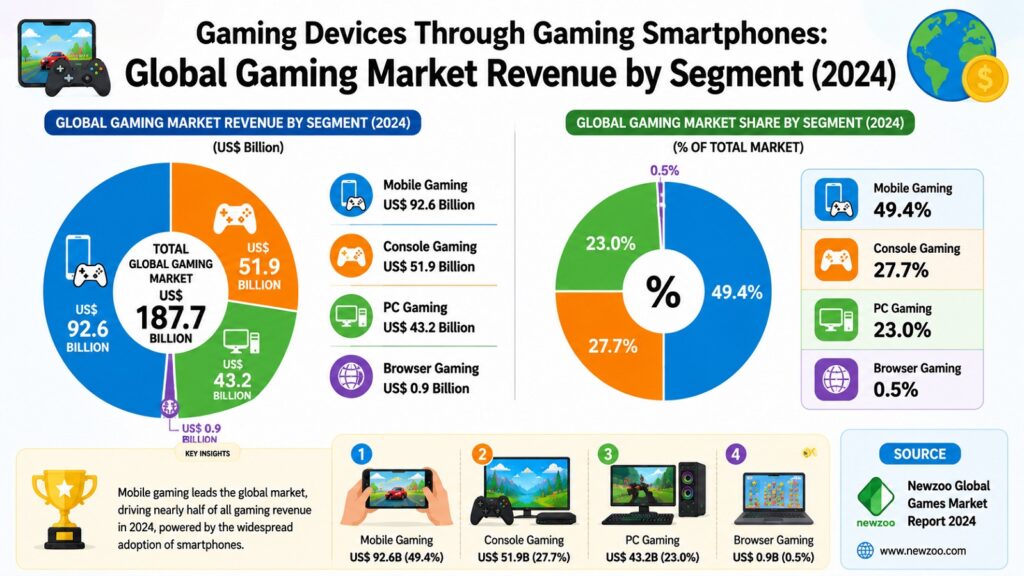
Gaming smartphones represent the fastest-growing branch among modern Gaming Devices. Mobile computing has steadily closed the gap between everyday convenience and serious gaming capability, since nearly everyone already carries a smartphone for daily life. This built-in accessibility gives mobile gaming a reach that no other Gaming Device can match, since no separate purchase is required to start playing.
Hardware advancements have driven this growth just as much as accessibility. Mobile processors now rival entry-level gaming laptops in raw performance, while high refresh rate displays make fast-paced games feel responsive rather than sluggish. Better cooling, longer battery life, and widespread 5G connectivity have made cloud gaming on smartphones more practical than it was just a few years ago.
The data behind mobile gaming adoption is striking. Industry tracking from Newzoo placed mobile gaming revenue at roughly 103 billion dollars in a recent year, accounting for around 55 percent of the entire global games market, ahead of both console and PC revenue combined. The most engaged age groups span from younger Gen Alpha and Gen Z players through Millennials and Gen X.
A clear case study comes from the rise of competitive mobile titles that built massive global audiences entirely on smartphone hardware, proving that mobile platforms could support fast, skill-based competition once reserved for consoles and PCs. Their success encouraged hardware makers to design phones specifically tuned for gaming, with dedicated shoulder triggers and enhanced cooling.
Gaming smartphones offer unmatched convenience and a massive built-in player base, but they still trail consoles and PCs in raw graphical power and precise physical controls. Touchscreen input, while improving, cannot fully replace the tactile feedback of a dedicated controller for every genre. Looking forward, cloud gaming integration is likely to keep narrowing this gap, while AI-driven personalization continues to shape how mobile games keep players engaged.
Gaming Devices Data: Mobile Gaming Technology Trends
| Mobile Gaming Trend | Supporting Detail |
| Mobile revenue share | Roughly 55 percent of global games market revenue |
| 5G connectivity | Improves cloud gaming and online multiplayer stability |
| Vapor chamber cooling | Reduces overheating during long mobile sessions |
| High refresh rate screens | Smoother visuals for competitive mobile titles |
| Cross-platform play | Connects mobile players with console and PC users |
| Cloud gaming apps | Streams console-level titles to mobile hardware |
| Dedicated gaming phone models | Built with shoulder triggers and tuned cooling |
| Broad generational adoption | Strong engagement across Gen Alpha through Gen X |
6. Gaming Devices Through Gaming Monitors: Visual Performance That Shapes Gameplay
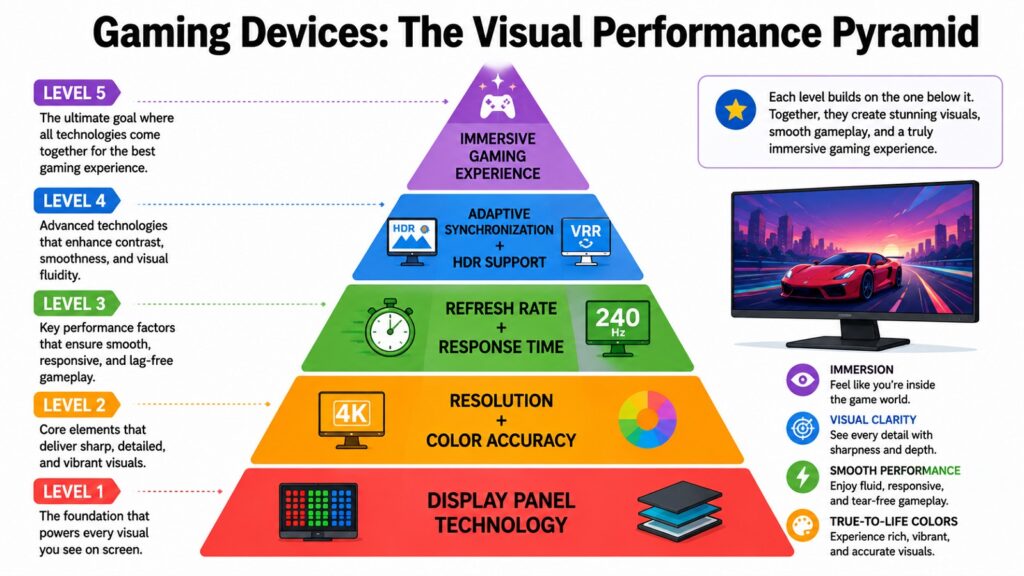
Gaming monitors might not be the first thing people think of as Gaming Devices, but they shape almost every part of the gaming experience. Visual feedback plays a central role in human-computer interaction, since players react to what they see on screen in fractions of a second. A monitor that displays motion smoothly and responds quickly to input can make the difference between landing a precise action and missing it entirely.
Several technical factors determine how well a monitor supports gaming. Refresh rate measures how many times per second the screen updates, with higher numbers producing smoother motion. Response time measures how quickly pixels can change color, affecting motion blur during fast scenes. Adaptive synchronization reduces screen tearing, and HDR capability expands the range of brightness and color a screen can display.
Research into competitive gaming consistently shows that display quality affects real outcomes, not just visual comfort. Players using higher refresh rate monitors can perceive and react to on-screen movement faster than those using standard panels, an advantage that becomes especially clear in fast-paced competitive genres.
A pertinent case study highlights the emergence of high refresh rate monitors in the realm of professional esports. Tournament organizers frequently adopt monitors with exceptionally high refresh rates to guarantee equitable and consistent conditions for all participants. This standardization has influenced consumer expectations, as players who view professional competitions often pursue similar display technologies for their personal setups, prompting manufacturers to enhance refresh rates across more budget-friendly product lines.
Within the broader Gaming Devices ecosystem, monitors act as the final visual layer that determines whether a powerful console or PC actually delivers a smooth experience. Pairing top-tier hardware with an outdated display undercuts the benefits of that hardware entirely. Future display technologies, including improved HDR implementations and even higher refresh rates, will likely keep raising the baseline for what a serious gaming setup includes.
Gaming Devices Comparison: Monitor Technologies and Features
| Monitor Feature | Effect on Gaming |
| High refresh rate | Produces smoother on-screen motion |
| Low response time | Reduces motion blur in fast scenes |
| Adaptive sync technology | Prevents screen tearing during gameplay |
| HDR support | Expands brightness and color range |
| High resolution panels | Improves overall image sharpness |
| Curved display options | Increases peripheral immersion |
| Low input lag design | Keeps on-screen action closely tied to input |
| Esports-standard panels | Sets consistent conditions for competitive play |
7. Gaming Devices Through Gaming Controllers: Precision Interfaces for Player Interaction
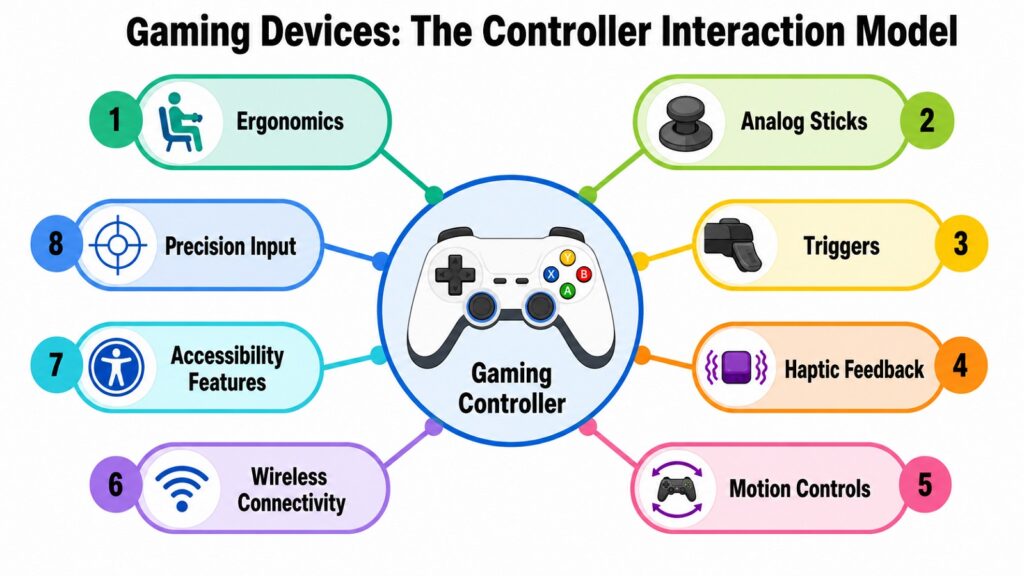
Gaming controllers serve as the direct link between a player and the digital world inside a game, making them essential Gaming Devices in their own right. Human-computer interface design plays a major role here, since the way input technology feels in someone’s hands directly shapes how natural and responsive a game feels. A poorly designed controller can make even a well-built game frustrating, while a thoughtfully designed one can make complex actions feel effortless.
Controller design has advanced significantly over the years. Ergonomic shaping now accounts for different hand sizes and longer play sessions, reducing fatigue during extended use. Haptic feedback systems create more detailed sensations than older basic vibration motors, and adaptive triggers can adjust resistance dynamically to simulate tension tied to on-screen action.
Additionally, wireless connectivity has transformed expectations, with the majority of contemporary controllers depending on reliable wireless connections while ensuring minimal input latency. Advancements in accessibility have also propelled this category forward, resulting in specialized controllers designed for players with limited mobility, featuring larger buttons and customizable layouts.
A strong case study involves the introduction of advanced haptic feedback and adaptive trigger technology in recent console generations. These features changed player expectations almost immediately, since the added sensory detail made games feel noticeably more immersive without requiring any change to the games themselves. Other manufacturers and accessory makers quickly began developing similar feedback systems, showing how a single controller innovation can ripple across the entire industry.
Controllers offer intuitive, comfortable input for a wide range of game genres, but they still face limits in precision-heavy genres where keyboard and mouse setups often perform better. Strategic depth, in this case, comes from choice rather than dominance, since different input methods suit different types of games and players. Looking forward, accessibility-focused design and more advanced haptic systems are likely to keep expanding who can comfortably play.
Gaming Devices Overview: Controller Technologies and Features
| Controller Feature | Player Benefit |
| Ergonomic shaping | Reduces hand fatigue during long sessions |
| Advanced haptic feedback | Adds detailed, realistic in-game sensations |
| Adaptive triggers | Simulates resistance tied to on-screen actions |
| Low-latency wireless connection | Maintains responsiveness without cables |
| Motion sensing | Enables tilt-based or gesture-driven controls |
| Customizable button mapping | Adapts controls to personal preference |
| Accessibility-focused designs | Expands gaming access for more players |
| Cross-platform compatibility | Allows use across multiple Gaming Devices |
8. Gaming Devices Through Gaming Peripherals: Expanding the Gaming Experience
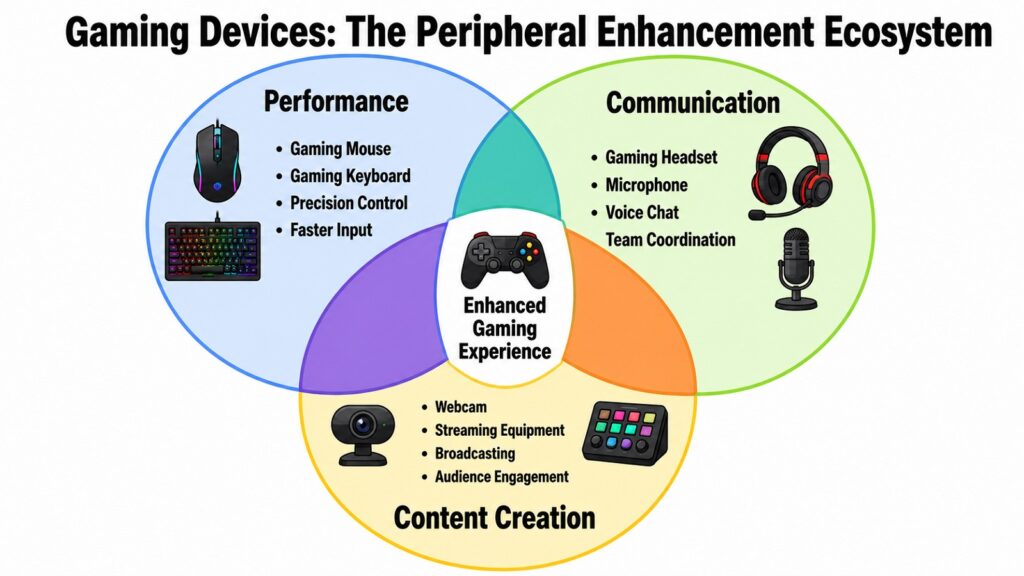
Gaming peripherals round out the broader category of Gaming Devices by extending what a core system can do. Gaming keyboards, mice, headsets, microphones, and webcams are not simple add-ons. Each one is a specialized tool built to improve performance, communication, or content creation in ways that general-purpose accessories cannot match. The underlying idea is specialization, where a tool built for one specific task consistently outperforms a tool built to do many things adequately.
Gaming keyboards often use mechanical switches that register input faster and more reliably than standard keyboards, which matters when milliseconds can decide an outcome. Gaming mice offer adjustable sensitivity suited to fast or detailed movements, while headsets deliver positional audio that helps players judge distance and direction within a game.
Research into competitive gaming and streaming culture shows how much these peripherals matter beyond simple convenience. Professional players frequently credit precise mice and responsive keyboards as critical to their performance, while full-time streamers depend on quality microphones to build an audience and maintain engagement.
A useful case study comes from the streaming industry, where creators build their entire setup around specialized peripherals. A streamer might use a high-precision mouse for gameplay, a broadcast-quality microphone for narration, and a dedicated webcam for face-cam footage, all running alongside their main gaming PC or console.
The strategic value of peripherals lies in how they let players and creators fine-tune their setup to match specific needs, whether that means competitive precision, clear communication, or content production quality. Emerging innovations continue to push this category forward, including more advanced wireless audio systems and smarter software that adapts settings automatically based on the game being played.
Gaming Devices Reference: Peripheral Categories and Functions
| Peripheral Type | Primary Function |
| Mechanical keyboards | Fast, reliable input registration |
| Gaming mice | Precise tracking and adjustable sensitivity |
| Gaming headsets | Positional audio and clear voice communication |
| Microphones | Improve clarity for streaming and team play |
| Webcams | Support content creation and face-cam streaming |
| Mouse pads and surfaces | Improve tracking consistency and comfort |
| Capture cards | Record and stream console gameplay externally |
| Controller and keyboard accessories | Add grips, palm rests, or extra customization |
Conclusion: The Growing Importance of Gaming Devices in Personal Technology
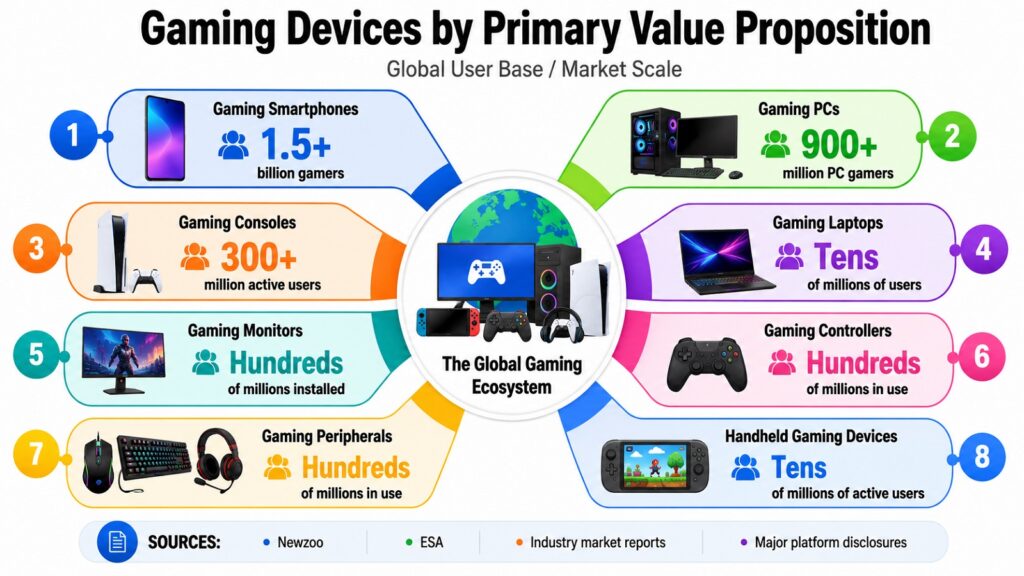
Gaming Devices have grown into one of the most essential categories of Personal Tech Devices, reaching far beyond simple entertainment. Gaming consoles offer accessible, unified ecosystems built around exclusive content, while gaming PCs deliver unmatched performance through modular design. Gaming laptops bring that power into a portable shell suited to hybrid lifestyles, handheld gaming devices remove location limits entirely, and gaming smartphones turn an everyday device into a serious gaming platform used by billions of people.
Gaming monitors, controllers, and peripherals complete this picture by shaping how players see, feel, and interact with every title they play. None of these categories function in isolation. A powerful gaming PC still depends on a quality monitor to show its output clearly, and a console still relies on a well-designed controller to translate intent into action.
The research and case studies throughout this article point to a consistent theme. Gaming Devices influence far more than how people play. They shape technology adoption patterns, consumer purchasing behavior, and digital ecosystems built around exclusive content. They support entire careers in content creation and streaming, and they drive communication technology forward through headsets and team-based multiplayer experiences.
Looking ahead, several developments are likely to reshape this category further. Artificial intelligence is already appearing in performance optimization, personalized recommendations, and adaptive gameplay systems, and its role will likely expand across every device type discussed in this article. Cloud gaming continues to reduce the importance of raw local hardware power. Advanced connectivity, including wider 5G, and improved home networks, continue to support this shift. Immersive technologies, including improved haptic feedback and display innovations, will continue narrowing the gap between digital worlds and physical sensation. As these trends converge, Gaming Devices seem certain to remain at the center of personal technology for years to come.
Gaming Devices Summary: Key Takeaways by Category
| Gaming Device | Key Takeaway |
| Gaming Consoles | Win through ecosystem loyalty and exclusive content |
| Gaming PCs | Lead in performance through modular upgradeability |
| Gaming Laptops | Balance power and portability for hybrid lifestyles |
| Handheld Gaming Devices | Remove location limits from serious gaming |
| Gaming Smartphones | Reach the largest global player base by far |
| Gaming Monitors | Determine how smoothly gameplay actually feels |
| Gaming Controllers | Shape comfort, precision, and accessibility |
| Gaming Peripherals | Extend performance, communication, and content creation |