Table of Contents
Introduction: Quantum Computing and the Future of Computing
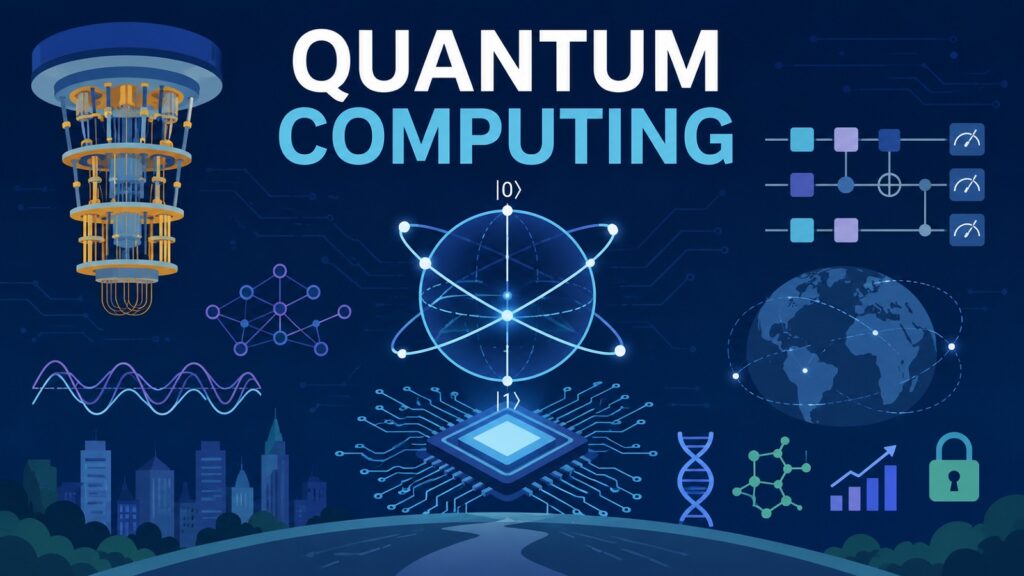
Something remarkable is stirring at the edge of science and technology. Quantum computing is rising as one of the most vital fields in Future Computing, and the world is paying close attention. For decades, classical computers have powered everything from space probes to smartphones, growing faster with each passing year. Yet some problems — molecular design, large-scale planning, advanced code-breaking — remain far beyond their practical reach. Quantum computing takes on those exact problems from a different angle, one built on the laws of quantum mechanics.
A traditional computer processes information using bits, each assigned a value of either zero or one. In contrast, a quantum computer utilizes qubits. A qubit possesses the ability to represent a combination of both values simultaneously, a characteristic referred to as superposition. Furthermore, when two qubits become entangled, the state of one qubit is instantaneously influenced by the state of the other, a phenomenon known as entanglement. Additionally, interference plays a role in guiding calculations towards accurate outcomes, resulting in a fundamentally novel approach to information processing. Quantum computing does not supplant classical computing; rather, it enhances the potential of computing.
Global momentum is real. By April 2025, public investment in quantum technology had passed ten billion dollars. Japan pledged 7.4 billion dollars. Spain committed nearly 900 million dollars. Private venture funding in the sector reached about two billion dollars in 2024, more than fifty percent above 2023 levels. Companies such as IBM, Google, Microsoft, and IonQ are pushing their systems forward each year. Universities, national labs, and startups are all expanding rapidly across the field.
The reach of quantum computing spans many industries. In healthcare and drug development, it could speed up the search for new medicines by simulating how molecules behave at a level of detail no classical machine can match. In finance, it promises faster ways to manage risk and build better portfolios. In cybersecurity, it is both a threat to old encryption systems and a force driving stronger new ones. Climate science, logistics, materials research, and artificial intelligence all stand to gain as the technology matures.
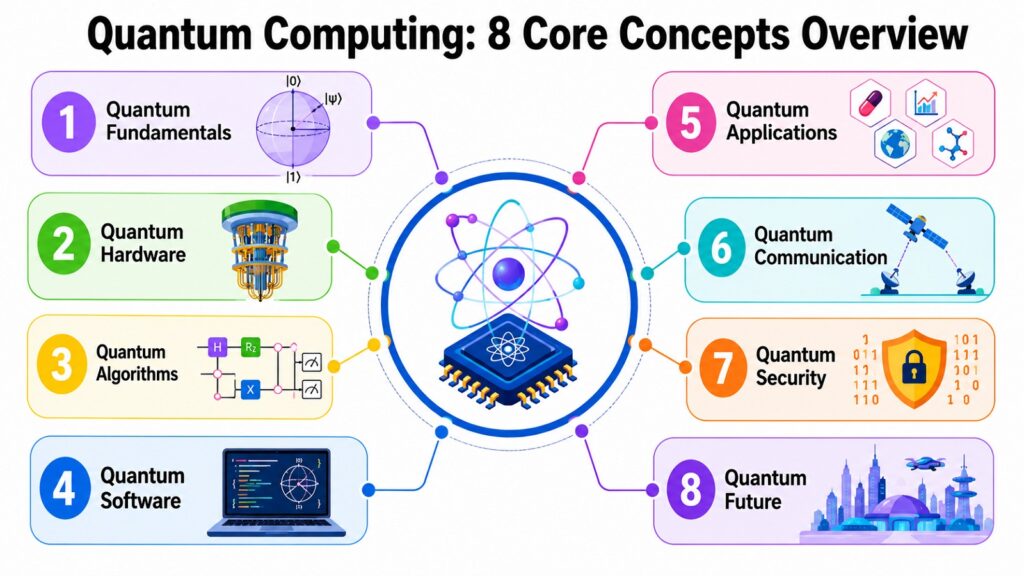
This article covers eight major concepts that together form a solid base for understanding quantum computing. It is careful to separate what the technology can do right now from what it is expected to deliver in the years ahead. Readers who work through all eight sections will be well placed to explore more detailed topics in the articles that follow.
Quantum Computing Overview: Eight Concepts at a Glance
| Concept | What You Will Learn |
| 1. Fundamentals | The core quantum mechanics principles that make quantum computing possible |
| 2. Hardware | How quantum machines are built and why engineering them is so difficult |
| 3. Algorithms | The unique computational methods quantum computers use and where they excel |
| 4. Software | The tools, frameworks, and cloud platforms that enable quantum programming |
| 5. Applications | The industries and use cases where quantum computing is expected to have impact |
| 6. Communication | How quantum principles enable more secure networks and communications |
| 7. Security | The risks quantum computing poses to encryption and how the world is responding |
| 8. Future | The challenges and opportunities that will shape the field over the coming decades |
1. Quantum Computing Fundamentals: Understanding the Core Principles
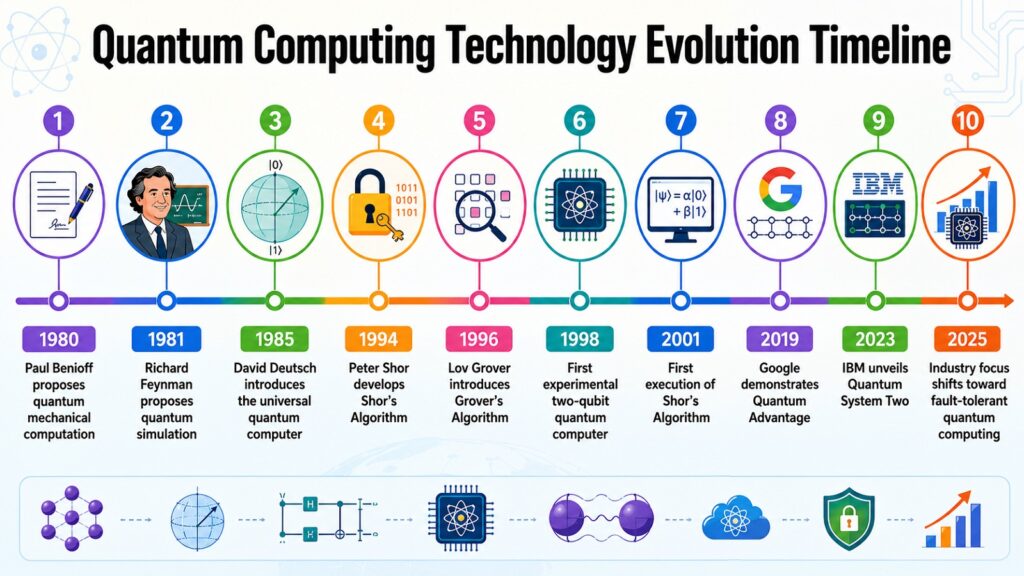
To understand quantum computing, it helps to first accept that matter at the smallest scales behaves in ways that seem very strange. Electrons and photons follow rules described by quantum mechanics, a branch of physics built up in the early twentieth century. These rules have no direct counterpart in everyday life. Quantum computing takes those rules and puts them to work as a tool for processing information.
The most basic building block is the qubit. A classical bit is always zero or one. A qubit can be both at the same time, in a state called superposition. This is not a trick or a shorthand — it is how quantum systems genuinely behave before they are read. When many qubits are held in superposition together, a quantum computer can look at a vast number of possible states at once. But superposition ends the moment a qubit is observed, and the system gives back one clear classical value. Good quantum algorithm design means knowing exactly when to take that reading.
Entanglement is the second key idea. When two qubits become entangled, their states are tied together. Learning the state of one tells you something about the other right away, no matter how far apart they are. This does not let information travel faster than light — physics rules that out clearly — but it lets quantum computers link operations across many qubits in ways that have no classical match.
Quantum interference operates similarly to waves converging on a body of water. In a quantum system, probability paths can either combine or cancel each other out. A well-constructed quantum algorithm organizes these paths so that those leading to incorrect answers diminish, while those leading to correct answers are amplified. This principle is what provides algorithms like Grover’s search with their speed advantage. However, decoherence poses a significant challenge. Any interaction with the environment—such as heat, vibrations, or stray signals—can rapidly disrupt a qubit’s quantum state. Protecting qubits from external influences while maintaining the ability to control and read them remains one of the most formidable challenges in the field.
Quantum Computing Fundamentals: Eight Core Concepts
| Concept | Brief Explanation |
| Qubit | The basic unit of quantum information, capable of superposition of both zero and one |
| Superposition | A qubit’s ability to hold multiple states at once until it is measured |
| Entanglement | A link between qubits so that the state of one instantly reflects the state of the other |
| Interference | Amplification of correct paths and cancellation of incorrect ones in a quantum calculation |
| Measurement | Reading a qubit, which collapses its quantum state into a single classical value |
| Decoherence | Loss of quantum properties caused by heat, vibration, or other environmental disturbances |
| Quantum gate | An operation applied to qubits to carry out a step in computation, like a classical logic gate |
| Error correction | Techniques that protect quantum information by spreading it across groups of physical qubits |
2. Quantum Computing Hardware: Building Quantum Machines
Building a quantum computer is nothing like shrinking classical electronics further. It requires physical systems that follow quantum rules long enough to finish useful work. This has proved to be very hard, and the hardware challenge is still far from solved.
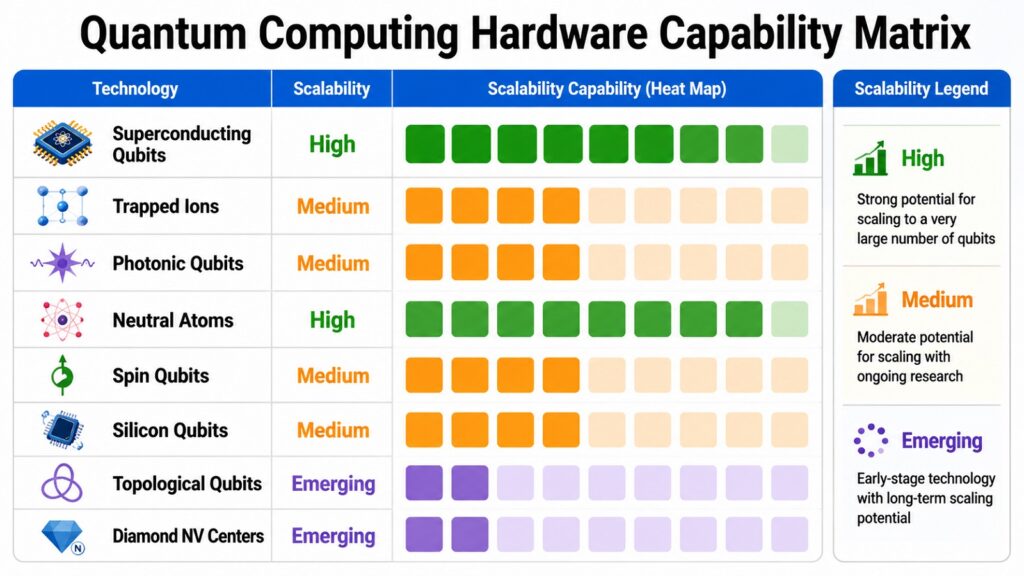
Most leading quantum computers today use superconducting qubits. These are tiny circuits cooled to temperatures near absolute zero — about fifteen millikelvin, colder than outer space — where certain metals lose all electrical resistance and behave in quantum ways. IBM, Google, and Rigetti build their systems using this approach. IBM’s largest processors now hold over a thousand physical qubits. But qubit count alone does not decide usefulness. Error rates and how long qubits stay stable both matter just as much, often more.
Trapped ion systems follow a different path. They use single charged atoms held in place by electric fields and guided by lasers. Trapped ion machines tend to make fewer errors per operation than superconducting systems at similar qubit counts. Quantinuum’s H-Series has shown two-qubit gate accuracy above 99.9 percent. The tradeoff is slower gates and harder scaling.
Other approaches are moving forward as well. Neutral atom processors from QuEra and Pasqal hold arrays of uncharged atoms in focused laser beams. These systems reach over a thousand physical qubits and stay stable for usefully long periods. Photonic quantum computers use light particles as qubits and can run at room temperature, but routing single photons with low loss is still technically tough. Microsoft’s topological qubit work, highlighted by the Majorana 1 chip in 2025, aims for qubits that resist certain noise types by design. Every platform makes different tradeoffs in speed, accuracy, scale, and engineering complexity. No single approach has yet emerged as the clear long-term winner.
Quantum Computing Hardware: Components and Functions
| Component | Primary Function |
| Superconducting qubit | Encodes quantum information in cooled circuits operating near absolute zero |
| Trapped ion qubit | Uses laser-controlled charged atoms for high-fidelity quantum operations |
| Neutral atom qubit | Employs arrays of uncharged atoms in optical traps for scalable quantum processing |
| Photonic qubit | Uses photon properties for quantum computation at room temperature |
| Topological qubit | Encodes information in exotic quantum states designed to resist certain error types |
| Quantum gate | Applies controlled operations to qubits to perform each step of a computation |
| Cryogenic system | Maintains the ultra-low temperatures needed by superconducting quantum hardware |
| Control electronics | Delivers precise signals to manipulate and read qubit states accurately |
3. Quantum Computing Algorithms: Solving Problems Differently
Hardware sets the stage, but algorithms decide what quantum computing can actually do. Quantum algorithms are not simply classical programs running on faster chips. They are built from the ground up around superposition, entanglement, and interference. This gives them a completely different structure and a different set of strengths.
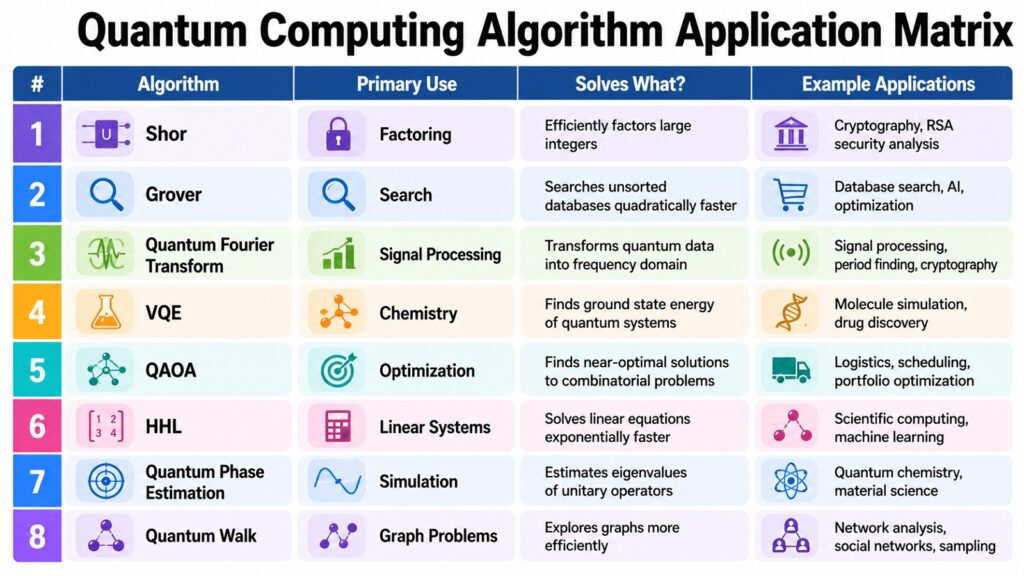
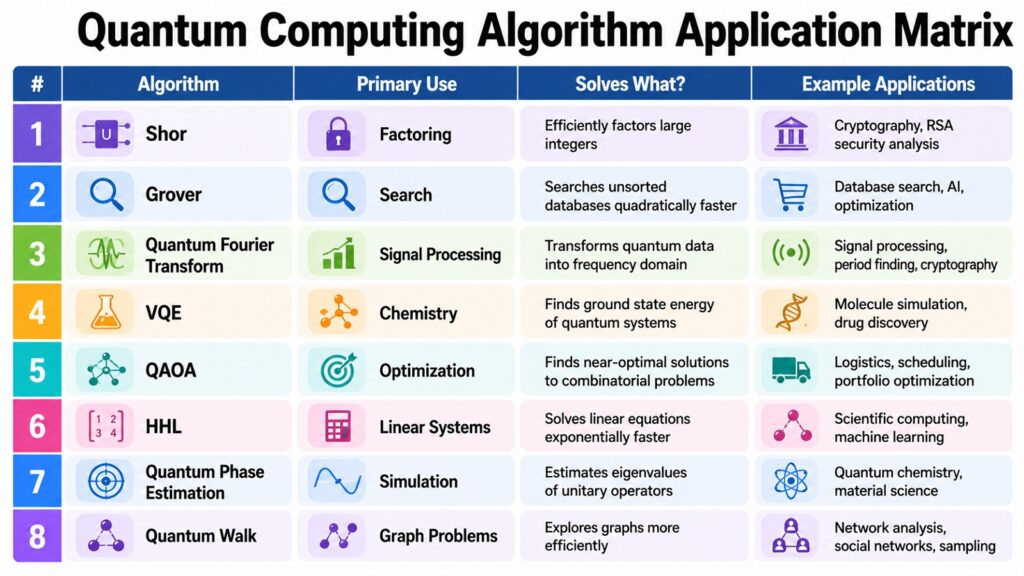
Shor’s algorithm, created by Peter Shor in 1994, remains the most talked-about example. It can break a large number into its prime factors far faster than any known classical method. Most public-key encryption used on the internet today — including RSA — relies on the fact that factoring large numbers is too slow for any classical machine to do in a useful time frame. A large fault-tolerant quantum computer running Shor’s algorithm could break that assumption. Such a machine does not exist yet, but the idea has been well understood for thirty years and is the main reason so much work is now going into building quantum-resistant encryption.
Grover’s algorithm gives a quadratic speedup for searching a list with no obvious order. If a classical machine needs up to a million checks to find one item in a million-entry list, Grover’s algorithm does it in roughly a thousand steps. That is not the dramatic exponential leap of Shor’s algorithm, but it applies broadly to search, optimization, and pattern-finding tasks.
The Quantum Fourier Transform picks out repeating patterns in quantum states and is central to Shor’s algorithm and several others. The Variational Quantum Eigensolver uses a quantum processor to set up quantum states and a classical optimizer to refine the result. It works well on today’s noisy hardware because it uses short circuits. The Quantum Approximate Optimization Algorithm uses a similar hybrid approach for scheduling and routing problems. It is worth noting that quantum algorithms are not faster for every task. They offer real gains on a specific set of problem types, and knowing which problems those are is essential for making good use of the technology.
Quantum Computing Algorithms: Notable Examples and Purposes
| Algorithm | Primary Purpose |
| Shor’s Algorithm | Factors large integers exponentially faster than classical methods, threatening current encryption |
| Grover’s Algorithm | Searches unstructured data with a quadratic speedup over classical linear search |
| Quantum Fourier Transform | Extracts periodic structure from quantum states and underpins many key algorithms |
| Variational Quantum Eigensolver | Finds ground-state energy of molecules using hybrid quantum-classical computation |
| Quantum Approximate Optimization | Solves combinatorial problems like scheduling and routing on near-term hardware |
| Quantum Phase Estimation | Estimates eigenvalues of quantum systems, used in chemistry and physics simulation |
| Quantum Walk | Models how states spread across a graph, useful for search and network analysis |
| HHL Algorithm | Solves systems of linear equations with a potential exponential speedup in certain settings |
4. Quantum Computing Software: Programming the Quantum Era
Hardware tells you what is physically possible. Software tells you how easy it is to actually get there. The quantum software ecosystem has grown a great deal in recent years, though it is still young compared to the tools available for classical programming.
Qiskit, made by IBM and freely available as open-source code, is the most widely used quantum programming toolkit today. It runs in Python, which means most developers can pick it up without learning a new language from scratch. It lets users design quantum circuits, test them on a simulated machine, and send them to real IBM quantum processors through the cloud. By 2025, IBM Quantum had drawn over half a million registered users globally. Google’s Cirq offers similar circuit tools with tighter links to Google’s hardware and to TensorFlow for machine learning work. PennyLane, from Xanadu, is built around differentiable quantum programming and has become popular for quantum machine learning projects.
Microsoft offers Q#, a language built from the ground up for quantum work, tied into its Azure Quantum cloud platform. D-Wave’s Ocean SDK serves its own quantum annealing hardware, which targets optimization problems using a model that differs from standard gate-based quantum computers. All these toolkits include simulators, so developers can test code on a regular computer before sending it to actual quantum hardware. That matters a lot, since real quantum processor time is limited and costly.
Cloud access has opened the door to a much wider group of users. IBM Quantum, Amazon Braket, Google Cloud, Microsoft Azure Quantum, and IonQ’s cloud service all let users run programs on real quantum hardware through a pay-per-use or subscription model. Small research teams, individual developers, and students can now run real quantum experiments without owning any hardware at all. Hybrid quantum-classical workflows have become the dominant pattern, where the quantum chip handles specific parts of a problem and a classical machine manages the rest.
Quantum Computing Software: Tools, Frameworks, and Platforms
| Tool or Platform | Primary Purpose |
| Qiskit (IBM) | Open-source Python toolkit for circuit design, simulation, and IBM hardware access |
| Cirq (Google) | Framework for near-term quantum circuits with TensorFlow machine learning integration |
| PennyLane (Xanadu) | Differentiable quantum programming toolkit for quantum machine learning workflows |
| Q# (Microsoft) | Domain-specific quantum language connected to the Azure Quantum cloud platform |
| Ocean SDK (D-Wave) | Software toolkit for quantum annealing and combinatorial optimization problems |
| Amazon Braket | Managed cloud service giving access to multiple quantum hardware backends and simulators |
| OpenQASM | Low-level language for describing quantum circuits across different hardware platforms |
| Quantum simulators | Classical-hardware tools that test and debug quantum programs before real hardware runs |
5. Quantum Computing Applications: Transforming Industries
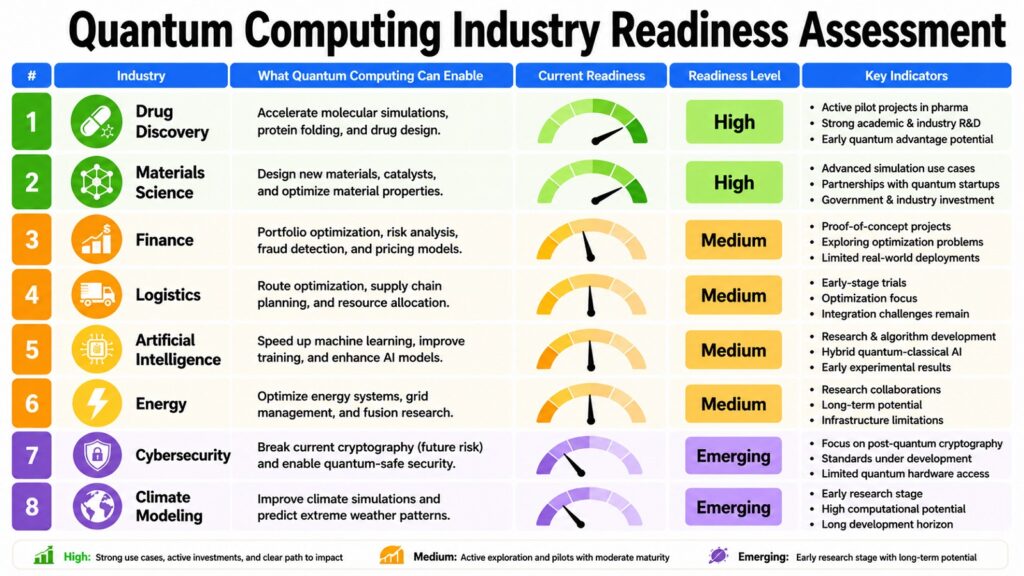
Quantum computing’s true value lies in solving hard problems that no classical machine can crack, no matter how much hardware is stacked up. Several industries are already investing because their most pressing challenges happen to fall into exactly the kind of problem quantum computers are built to handle.
Drug discovery and molecular modeling sit near the top of most priority lists. Simulating even a moderately complex molecule is too much for the largest classical supercomputers, because the quantum interactions among electrons grow in step with the number of atoms involved. A quantum computer, built on the same physical laws as the molecules it studies, could map binding behavior and reaction pathways with a level of accuracy that classical machines cannot reach. Pharmaceutical firms including Roche and Biogen have already begun early-stage research partnerships with quantum computing providers.
Finance is another area drawing serious attention. Portfolio balancing, risk modeling, and options pricing all involve large combinatorial problems. Quantum algorithms like QAOA show real theoretical promise for these tasks, and banks such as JPMorgan Chase have built quantum research teams internally. Early results have been small in scale, but the competitive weight of even small speed gains in finance keeps investment flowing well ahead of proven quantum advantage.
Cybersecurity is touched by quantum computing from two sides. On one side, a powerful enough quantum machine could break widely used encryption schemes. On the other side, quantum technologies open the door to fundamentally stronger protection methods. Logistics companies are exploring quantum approaches to supply chain planning. Energy researchers are looking at quantum simulation for better battery materials. Climate scientists see potential in more precise models of atmospheric chemistry. AI researchers are testing whether quantum methods can speed up training on certain tasks. Most of these are still in early stages, but the breadth of serious interest across sectors is hard to miss.
Quantum Computing Applications: Sectors and Primary Benefits
| Application Area | Primary Benefit or Use Case |
| Drug discovery | Accurate molecular modeling to find new drugs and treatment paths more rapidly |
| Materials science | Simulation of new materials for batteries, chips, and advanced manufacturing processes |
| Financial optimization | Portfolio management, risk analysis, and options pricing with higher computational speed |
| Cybersecurity | Quantum-resistant encryption and quantum key distribution for physics-backed security |
| Supply chain logistics | Optimization of routing, scheduling, and inventory across complex global networks |
| Artificial intelligence | Potential acceleration of specific learning tasks using quantum-enhanced methods |
| Climate and energy | Simulation of atmospheric chemistry and design of more efficient energy technologies |
| Scientific research | Simulation of quantum systems in physics and chemistry beyond classical machine reach |
6. Quantum Computing Communication: Enabling Secure Quantum Networks
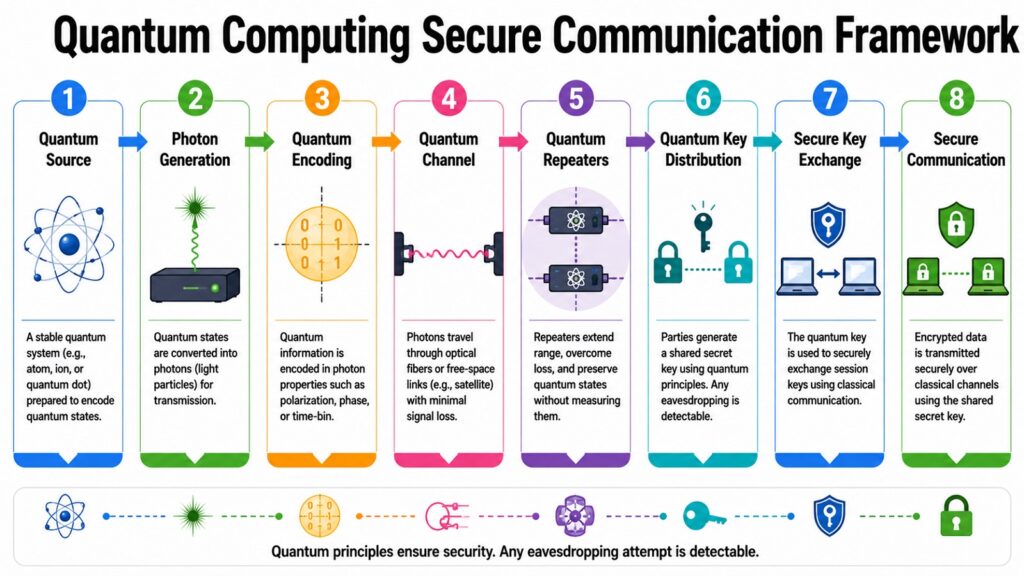
Quantum computing’s reach goes beyond calculation into communication. Several of the same physical principles that give quantum computers their power can also be used to build communication systems with security that no classical method can offer.
Quantum key distribution is the most commercially ready technology in this space. It uses the properties of single photons to share an encryption key between two parties. Any attempt to intercept the signal disturbs the quantum states being sent, which creates detectable errors in the data stream. When errors rise above a safe level, both parties know the channel has been tampered with and can stop and try again. Governments and financial institutions in several countries have already deployed working quantum key distribution networks. Companies like ID Quantique and Toshiba sell commercially available systems today.
Reaching greater distances requires quantum repeaters, devices that can pass on a quantum signal without measuring it and breaking it. Classical repeaters cannot do this job because measuring a quantum state destroys it. Quantum repeaters are still largely in the research phase, but they are necessary for any quantum network that spans a continent. Satellites offer an alternative for long-range links. China’s Micius satellite, launched in 2016, sent quantum encryption keys over distances of more than a thousand kilometers. European and Canadian satellite projects are in various stages of planning to build on that lead.
Quantum teleportation sounds like science fiction, but it is real and has been tested in the lab many times. It moves the quantum state of one particle to another at a distant location, using entanglement and a separate classical channel together. It does not move information faster than light. But it is a key protocol for future quantum networks. The long-range goal is a quantum internet where machines at different locations share entangled states, enabling distributed quantum work with security rooted in physics rather than in the difficulty of a math problem.
Quantum Computing Communication: Technologies and Functions
| Technology | Primary Function |
| Quantum key distribution | Shares encryption keys using photon states that reveal any eavesdropping attempt |
| Quantum teleportation | Moves a quantum state between distant points using entanglement and a classical channel |
| Quantum repeater | Passes on quantum signals over long distances without measuring and collapsing them |
| Satellite-based QKD | Extends quantum key distribution to intercontinental distances from orbit |
| Quantum random number generator | Produces truly unpredictable numbers from quantum events for cryptographic use |
| Entanglement distribution | Shares entangled photon pairs between distant nodes as a network resource |
| Quantum memory | Stores a quantum state temporarily so that network nodes can synchronize their actions |
| Quantum internet | A long-term vision of globally connected quantum nodes for secure distributed computing |
7. Quantum Computing Security: Protecting the Digital Future
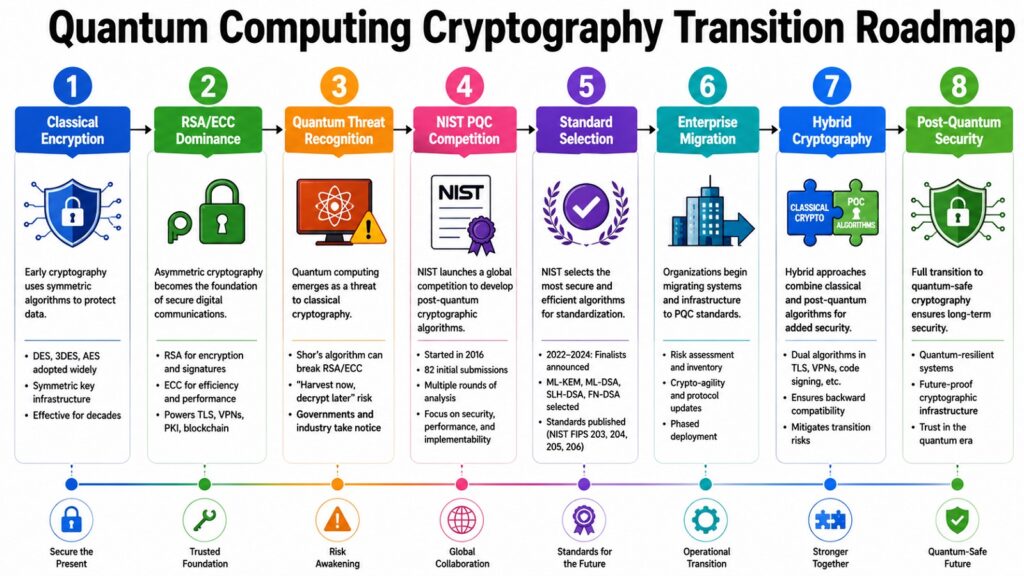
The same power that makes quantum computing so exciting for science and business also creates a direct threat to the encryption systems that keep most of the world’s digital data safe. Understanding this threat — and the work being done to address it — matters for anyone in technology, finance, government, or security.
Most public-key encryption used today, including RSA and elliptic curve methods, relies on mathematical problems that are too slow for any classical computer to crack in a practical time frame. Factoring large integers is the main example. Shor’s algorithm solves that problem quickly on a large enough quantum computer. A fault-tolerant machine with enough qubits to run Shor’s algorithm at full scale would make these systems obsolete. That machine does not exist yet, but the time needed to replace cryptographic systems across global infrastructure has pushed security agencies and standards bodies to start planning far in advance.
In August 2024, the US National Institute of Standards and Technology published its first three finalized post-quantum cryptography standards: ML-KEM, ML-DSA, and SLH-DSA. These rely on math problems believed to be hard even for quantum computers, drawing on lattice-based and hash-based approaches. Organizations are being urged to start moving to these new standards as soon as they can. The US government has set a goal of completing the shift for many federal systems by 2035.
The phrase ‘harvest now, decrypt later’ names a real concern. An adversary who cannot break encrypted data today can still collect it now and save it for when quantum capabilities are ready. This means data encrypted with current classical methods may not stay private forever. Healthcare records, financial data, and national security material face the biggest risk because they need to stay confidential for many years. Quantum key distribution adds another layer of protection here, because its security is based on physics and not on the difficulty of solving a math problem.
Quantum Computing Security: Key Concepts and Their Significance
| Security Concept | Significance |
| Shor’s algorithm threat | Could break RSA and elliptic curve encryption on a sufficiently powerful quantum computer |
| Post-quantum cryptography | Math-based systems believed to be secure against quantum attacks, standardized by NIST in 2024 |
| ML-KEM (FIPS 203) | NIST’s lattice-based key encapsulation standard for quantum-resistant encryption |
| ML-DSA (FIPS 204) | NIST’s lattice-based digital signature standard replacing classical signature schemes |
| Harvest now, decrypt later | Adversaries collect encrypted data today to decrypt it once quantum computers grow powerful |
| Quantum key distribution | Physics-based key sharing that detects eavesdropping through disruptions to quantum states |
| Grover’s speedup on symmetric keys | Halves the effective key length of symmetric ciphers, requiring longer keys for equal safety |
| Cryptographic migration | The global process of replacing vulnerable classical algorithms with quantum-resistant ones |
8. Quantum Computing Future: Challenges and Opportunities Ahead
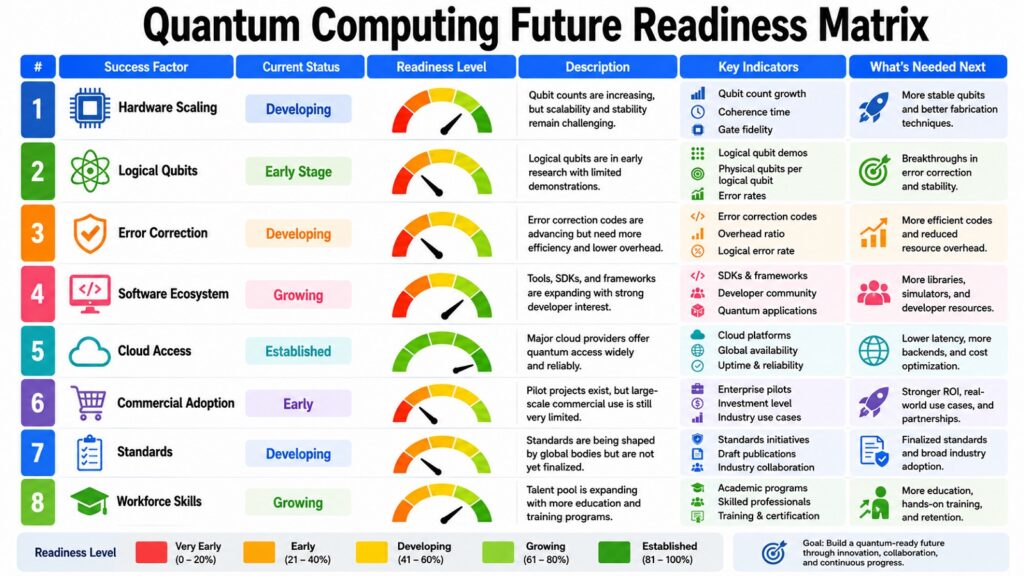
Quantum Computing technology has moved well beyond theory into real machines with hundreds or thousands of qubits. But the gap between today’s noisy systems and the large-scale fault-tolerant quantum computers that most high-value applications need is still wide. Knowing what has been done, what must still be solved, and what timelines make sense matters for anyone making decisions about quantum technology today.
The most pressing technical challenge is growing qubit counts while keeping quality high. More qubits are useless if error rates climb along with the count. Fault-tolerant quantum computing needs logical qubits guarded by error correction, and each logical qubit may need dozens to hundreds of physical qubits to support it, depending on the hardware and the correction method used. IBM’s roadmap calls for a first error-corrected quantum system by 2029. Progress across multiple platforms fits that aim, but the engineering work is genuinely demanding.
Decoherence is a constant problem. Holding many qubits in a clean quantum state long enough to run a deep circuit requires ongoing progress on multiple fronts. Cryogenic systems need to scale up. Control electronics need to grow more precise. Qubit connectivity — how easily any two qubits can work together — shapes how well algorithms run, and different hardware platforms make different tradeoffs in this area.
Commercial growth is picking up speed despite the technical hurdles. McKinsey estimated in 2025 that quantum technologies could bring in up to 97 billion dollars in global revenue by 2035, with quantum computing taking the largest share. Workforce development is often named as a limiting factor, since the mix of quantum physics, algorithm design, and software engineering this field needs is still rarely taught in standard programs. Government-funded research centers, university courses, and industry training efforts are all working to close that gap over the next ten years.
Quantum Computing Future: Opportunities and Challenges
| Topic | Key Consideration |
| Fault-tolerant computing | Requires logical qubits built from many physical qubits with active error detection and fixing |
| Scalability | Growing qubit counts while keeping error rates low is the central engineering challenge |
| Decoherence | Environmental noise continues to limit qubit stability and reduce gate quality |
| Error correction | Overhead of protecting qubits from errors will shape near-term computational capacity |
| Commercialization | Revenue expected to grow fast by 2035 as hardware matures and use cases become clearer |
| Workforce development | Shortage of trained quantum scientists and engineers may slow commercial progress |
| Industry collaboration | Partnerships among hardware firms, cloud services, and end users are speeding up progress |
| Quantum advantage timeline | Most high-value applications need fault-tolerant systems that are likely still years away |
Conclusion: Why Quantum Computing Will Shape the Future of Technology
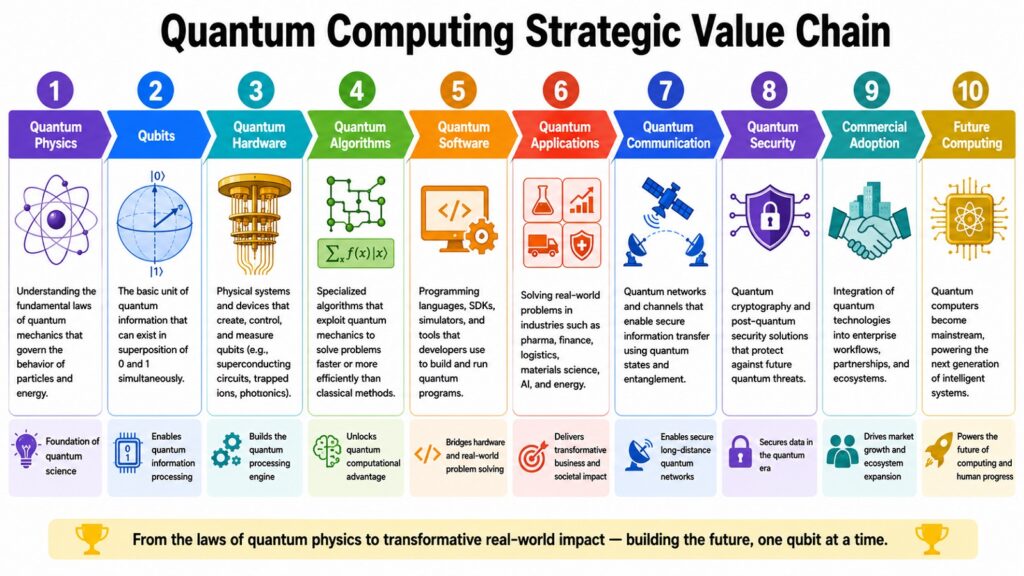
Quantum computing has reached a real turning point. It has moved well past being a theory on a blackboard and is now a field that governments, big companies, and research labs are treating with growing urgency. The eight concepts covered in this article — fundamentals, hardware, algorithms, software, applications, communication, security, and the road ahead — together give a full picture of where the field stands and why it matters for the future of computing.
This is not a claim that quantum computing has already changed the world. The hardware is still fragile. Most algorithms that would show a clear win over classical machines need fault-tolerant systems that do not yet exist at scale. Most of the exciting use cases are still at the research or early pilot stage. But the scientific progress over recent years has been genuine, and the direction is steady. The pieces are coming together.
Quantum computing draws on physics, math, engineering, and software development all at once. That mix makes it one of the most demanding fields in science, and also one of the richest. The articles linked to this guide go deeper into each of the eight concepts. The field moves fast, and there is always more to learn. Start with any section that connects to your own work or curiosity, and build from there.
Quantum Computing: Key Takeaways from Each Concept
| Concept | Key Takeaway |
| Fundamentals | Qubits, superposition, entanglement, and interference are the physical roots of quantum computation |
| Hardware | Multiple hardware platforms compete, each making different tradeoffs in fidelity, speed, and scale |
| Algorithms | Quantum algorithms offer speedups on specific problem types, not across every computational task |
| Software | A growing open-source and cloud ecosystem is making quantum programming steadily more accessible |
| Applications | Healthcare, finance, cybersecurity, and logistics are the most actively pursued areas today |
| Communication | Quantum key distribution gives security backed by physics, not by hard math problems |
| Security | NIST’s 2024 post-quantum standards form the core of the coming global cryptographic transition |
| Future | Fault-tolerant quantum computing is the next big goal and will likely take years of steady work to reach |