Table of Contents
Introduction: Customer Experience as the Core of Winning Customers
Think about the last time you walked into a store, asked a simple question, and got passed around from one person to another. No one knew the answer. No one took responsibility. You left empty-handed, and you never went back. That moment had nothing to do with the product on the shelf. It had everything to do with Customer Experience.
Customer Experience is the total impression a customer forms from every interaction with a business, from the first time they hear about it to the moment they decide to stay or leave. It is not a single touchpoint. It is not a customer service call or a loyalty program. It is the entire arc of how a business makes someone feel, and how that feeling shapes behavior over time.
Businesses that understand this tend to grow steadily. Businesses that confuse Customer Experience with occasional gestures tend to lose customers quietly, without knowing why. According to a 2023 Qualtrics report, 80 percent of customers say the experience a company provides is just as important as its products or services. That number has been rising every year.
Customer Experience is, without question, an important business essential. It connects directly to trust, which determines whether someone buys. It connects to retention, which determines whether they return. And it connects to acquisition, because satisfied customers refer others. These three outcomes are not separate goals. They are the result of a well-managed Customer Experience system.
The word system matters here. Customer Experience is not a checklist of good intentions. It is a set of interconnected parts where each one influences the others. A gap in one area weakens the rest. A strength in one area can compensate for a weakness elsewhere, but only temporarily.
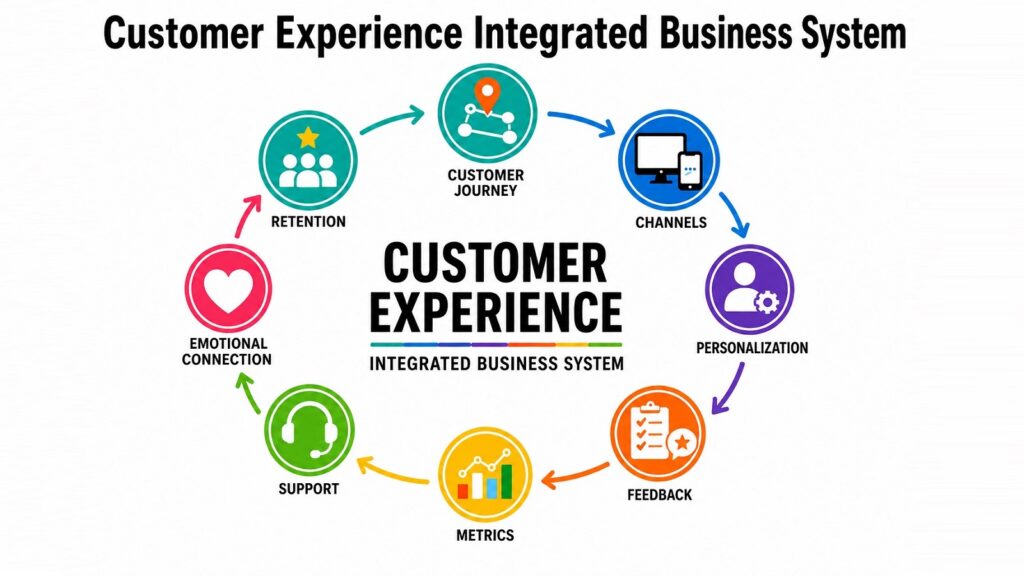
This article looks at eight aspects of Customer Experience that, when approached with clarity and consistency, help businesses win and hold onto customers. They are: Customer Journey Mapping, Omnichannel Experience, Customer Personalization, Customer Feedback Systems, Customer Satisfaction Metrics, Customer Support Experience, Emotional Customer Connection, and Customer Retention Strategies. Together, they form a practical framework for building something that actually lasts.
Customer Experience: 8 Aspects and Their Core Role in Business
| Customer Experience Aspects | Core Role in Customer Experience |
| Customer Journey Mapping | Reveals friction points and gaps across the full customer lifecycle |
| Omnichannel Experience | Ensures consistency as customers move between channels |
| Customer Personalization | Makes interactions feel relevant and timely for each individual |
| Customer Feedback Systems | Captures real customer voice and drives meaningful service improvements |
| Customer Satisfaction Metrics | Provides measurable signals to guide experience improvements |
| Customer Support Experience | Resolves problems and shapes lasting customer perception |
| Emotional Customer Connection | Builds trust and loyalty through consistent tone and empathy |
| Customer Retention Strategies | Converts one-time buyers into loyal, repeat customers |
1. Customer Experience Through Customer Journey Mapping
A customer visits a software company’s website, finds the product they need, clicks to start a free trial, and then lands on a page asking for a credit card number before any trial has begun. They close the tab. The company never finds out why signups are low. That is a journey mapping failure disguised as a conversion problem.
Customer journey mapping is the process of tracing every step a customer takes from the moment they first encounter a brand to the moment they complete a purchase and beyond. It makes the invisible visible. When you lay out the full sequence of steps, you start to see where customers feel confident, where they hesitate, and where they give up entirely.
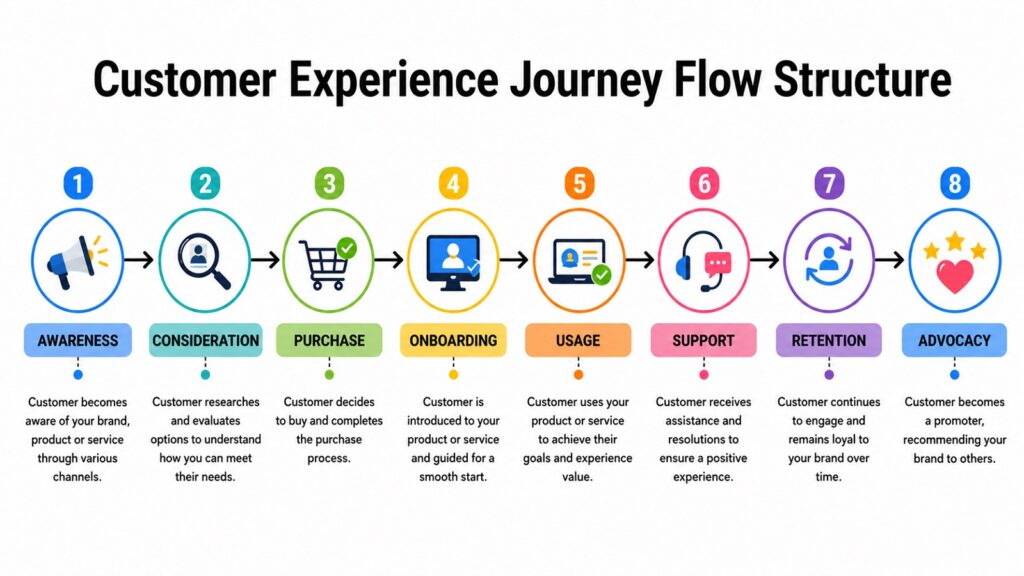
Customer Experience is shaped across several core stages. In the awareness stage, a customer encounters your brand and forms a first impression. In the consideration stage, they compare options and look for reasons to trust you. In the purchase stage, ease and clarity matter enormously. In the post-purchase stage, they evaluate whether the experience matched the expectation. Each stage carries its own risks and opportunities.
Mapping these stages forces a business to look at the experience through the customer’s eyes rather than through internal processes. A company might feel its onboarding is clear, but a journey map might reveal that new users encounter three separate logins before reaching their dashboard. That kind of friction does not announce itself in a spreadsheet.
The practical value of journey mapping lies in what it connects. When you can see that a high drop-off rate in a particular stage coincides with a confusing form or a broken link, you can fix the specific cause rather than guessing. Improved visibility translates directly to better Customer Experience outcomes because the improvements are targeted, not generic.
Customer Experience Journey Stages and Common Customer Pain Points
| Journey Stages | Typical Customer Pain Point |
| Awareness | Inconsistent brand messaging across different channels creates confusion about what the company offers |
| Consideration | Difficulty finding clear pricing or feature comparisons forces customers to look elsewhere |
| Decision | Complicated account creation or lengthy forms cause drop-off before purchase is completed |
| Purchase | Unexpected fees at checkout or limited payment options lead to cart abandonment |
| Onboarding | Lack of guided setup or unclear instructions causes frustration in first-time use |
| Engagement | Generic follow-up emails that ignore purchase history reduce ongoing interest |
| Support | Long wait times or repeated explanation of issues to multiple agents damages trust |
| Renewal/Advocacy | No recognition of loyalty or personalized offers weakens motivation to return or recommend |
2. Customer Experience in Omnichannel Experience Design
A customer chats with a support agent online about a billing issue, gets a reference number, and then calls the phone line the next day to follow up. The agent on the phone has no record of the previous conversation. The customer has to start over. They hang up feeling like they were talking to two completely different companies, because effectively, they were.
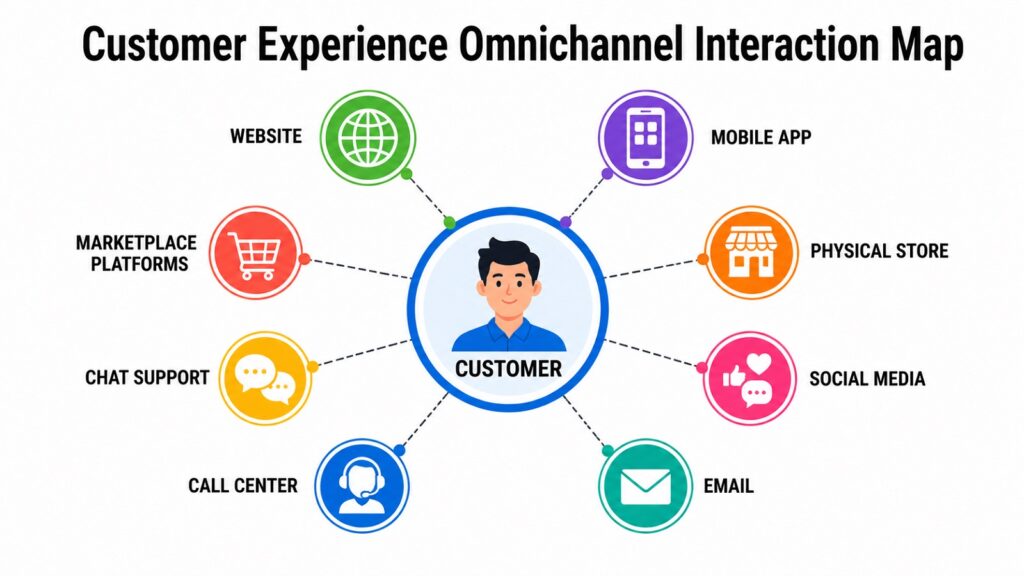
Omnichannel customer experience means delivering a connected, consistent Customer Experience across every channel a customer might use: website, mobile app, physical store, phone, social media, or email. The key word is connected. It is not enough to be present on multiple channels. Those channels need to share information, maintain context, and deliver the same quality of service.
Customer Experience weakens fast when channels operate in isolation. A customer who gets one answer online and a different answer in-store does not blame the channel. They blame the business. That inconsistency, multiplied across enough interactions, erodes trust in ways that are hard to recover from.
Integration is what makes omnichannel work. When a customer’s data, preferences, and history move with them across channels, the business can serve them without friction. A study by Aberdeen Group found that companies with strong omnichannel strategies retain around 89 percent of their customers, compared to 33 percent for companies with weak cross-channel integration. The gap is significant.
For everyday businesses, this does not necessarily mean investing in complex technology right away. It can start with something straightforward: ensuring that customer records are accessible to every team, that messaging is consistent across platforms, and that handoffs between channels include relevant context. Small improvements to channel continuity add up to a noticeably better Customer Experience.
Customer Experience Consistency Issues Across Channels
| Channel | Common Consistency Issue |
| Website | Promotional offers shown online are not honored in-store or on phone channels |
| Mobile App | Account data or order history does not sync with web platform in real time |
| In-Store | Staff cannot access online order records or customer preferences from digital channels |
| Phone Support | Agents lack access to previous chat or email interaction history with the customer |
| Automated emails reference outdated product details or promotions that have already ended | |
| Social Media | Customer complaints addressed on social media are not linked to formal support records |
| Live Chat | Chat agents do not receive context when customers are transferred mid-conversation |
| SMS/Messaging Apps | Messages sent via SMS are not visible in the main customer support system |
3. Customer Experience Driven by Customer Personalization
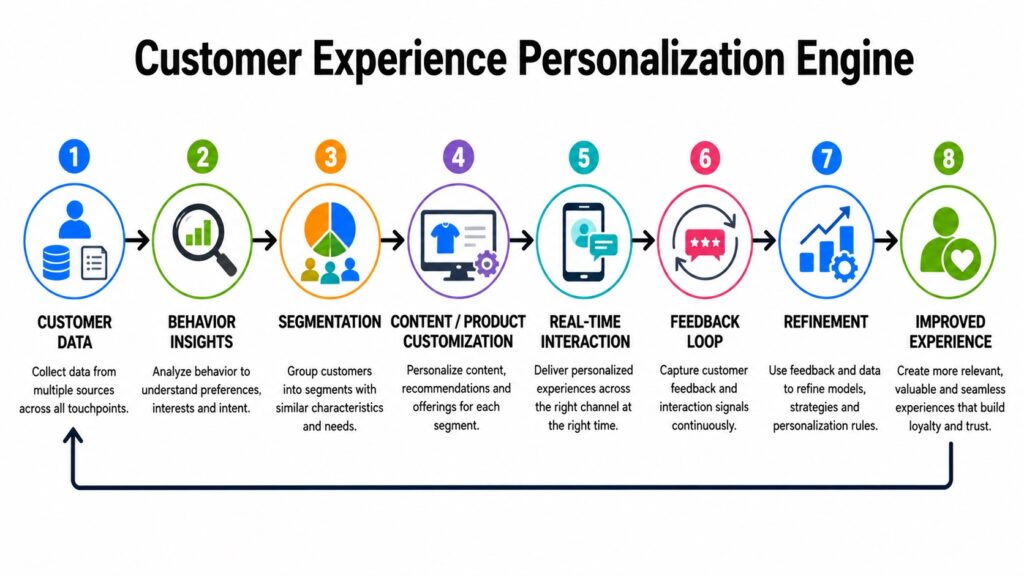
A retail clothing brand sends the same promotional email to its entire database. It features men’s winter coats. Half the recipients are women. A third of the list lives in a tropical climate. The open rate is low. The unsubscribe rate spikes. The brand concludes that email marketing is not working. The real problem is that the communication felt irrelevant to nearly everyone who received it.
Personalization in Customer Experience means tailoring interactions to what you actually know about a customer, based on their behavior, preferences, purchase history, or stated needs. It does not require predicting the future. It requires using the data you already have in a thoughtful way.
Customer Experience improves when people feel seen rather than processed. A returning customer who is greeted by name, shown products related to their last purchase, or offered support for a specific issue they raised before is more likely to engage and return. Research from McKinsey suggests that personalization can reduce customer acquisition costs by as much as 50 percent and lift revenues by 5 to 15 percent.
Practical personalization includes things like showing relevant product recommendations based on browsing history, sending follow-up emails about items left in a cart, adjusting content on a website based on the customer’s location or past visits, and training support agents to review a customer’s history before initiating contact. None of these requires cutting-edge technology. They require discipline and intention.
The effect on Customer Experience is direct. Generic communication signals indifference. Relevant communication signals attention. And customers respond to attention. When they feel that a business understands what they need, they are more likely to trust that business with their time and money.
Customer Experience Personalization Methods and Their Impact
| Personalization Method | Impact on Customer Engagement or Satisfaction |
| Product recommendations based on purchase history | Increases average order value and reduces time spent searching for relevant items |
| Triggered emails for abandoned carts | Recovers between 5 and 15 percent of abandoned purchases when sent within one hour |
| Location-based content on websites | Improves relevance of promotions and reduces irrelevant offer exposure |
| Loyalty rewards tied to individual behavior | Strengthens repeat purchase behavior by linking reward value to personal spending patterns |
| Personalized onboarding flows for new users | Reduces early churn by showing users features relevant to their stated goals |
| Support agents reviewing customer history before calls | Reduces call handling time and improves first-contact resolution rates |
| Birthday or anniversary messages with offers | Improves brand sentiment and produces measurable uptick in short-term purchase activity |
| Segment-based email content by demographics | Improves open and click-through rates by ensuring message relevance to the recipient |
4. Customer Experience Strengthened by Customer Feedback Systems
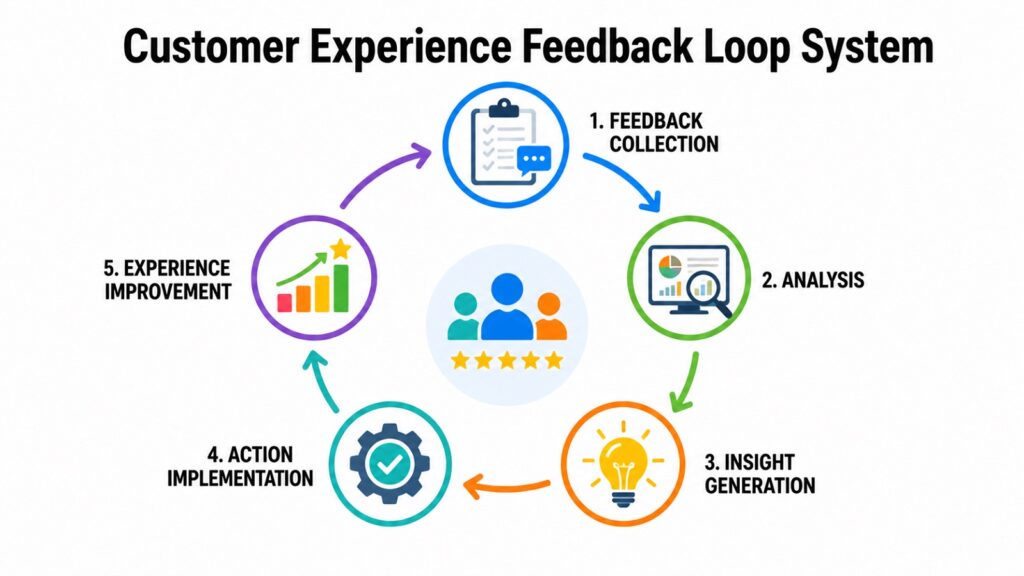
A restaurant chain sends a satisfaction survey to every customer after their visit. The results consistently show that wait times are too long. Month after month, the score is noted, added to a report, and filed away. Wait times remain the same. Customers who filled out the survey notice nothing has changed. Some stop filling it out. Others stop coming in.
Collecting feedback is not the same as using it. A feedback system is only valuable when it closes the loop between what customers say and what the business does. The four stages of a functioning feedback loop are collect, analyze, act, and improve. Skipping any one of them reduces the system to a performance of listening rather than actual listening.
Customer Experience improves when feedback is treated as operational data, not as a public relations exercise. When a business sees that a specific product page is consistently frustrating users, or that a particular support agent is receiving repeated complaints about tone, those are addressable problems. The feedback points to the fix.
Different feedback methods produce different kinds of insight. A net promoter score tells you sentiment at scale. An open-text survey response tells you the specific reason behind that sentiment. A customer complaint call tells you the emotional weight of a problem. Businesses that combine these sources build a fuller picture of their Customer Experience than those that rely on a single measure.
The customers who give feedback are often the most engaged. They are telling you something because they still believe the business can do better. Ignoring that signal is one of the fastest ways to convert an engaged customer into a lost one. Responding to it, even in small ways, signals that the business is paying attention. That signal matters more than most businesses realize.
Customer Experience Feedback Methods and the Insights They Provide
| Feedback Method | Type of Insight Provided |
| Net Promoter Score (NPS) survey | Measures overall customer loyalty and likelihood to recommend the brand |
| Post-purchase email survey | Captures immediate satisfaction with a specific transaction or product |
| In-app feedback prompt | Identifies friction points during product or feature use in real time |
| Live chat transcripts | Reveals recurring language, confusion points, and unresolved customer questions |
| Customer complaint calls | Surfaces emotional intensity of dissatisfaction and specific failure moments |
| Social media mentions and comments | Provides unprompted, candid customer sentiment across a broad audience |
| Focus groups or customer interviews | Generates qualitative depth on motivations, expectations, and unmet needs |
| Return or refund reason codes | Indicates product or service quality failures that drive dissatisfaction |
5. Customer Experience Measured by Customer Satisfaction Metrics
A company’s leadership team meets quarterly to review performance. Sales numbers look steady. Operational costs are in line. Everyone agrees things are going well. Six months later, a competitor enters the market offering a nearly identical product. Customers switch in large numbers. The leadership team is blindsided. The problem is that they were measuring the wrong things. They had no clear window into how customers actually felt.
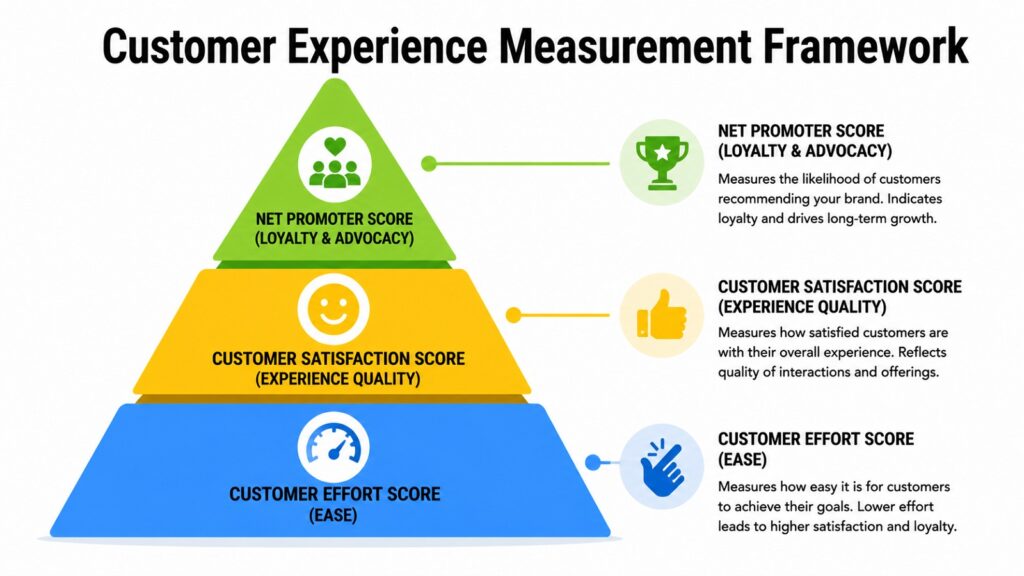
Customer satisfaction metrics are the instruments that make Customer Experience visible and comparable over time. The three most widely used are Net Promoter Score, Customer Satisfaction Score, and Customer Effort Score. Each one reveals something different.
Net Promoter Score, or NPS, asks customers how likely they are to recommend a business on a scale of zero to ten. It is a measure of loyalty and emotional confidence in the brand. Customer Satisfaction Score, or CSAT, asks customers to rate a specific interaction. It captures the quality of a single experience at a defined moment. Customer Effort Score, or CES, asks how easy it was to accomplish something. It reveals friction, which is one of the most reliable predictors of churn.
What these metrics do, when used well, is guide improvement rather than simply report on performance. A declining NPS score over three quarters is not a final verdict. It is a signal to investigate why customers are becoming less enthusiastic. A low CES on a specific support channel suggests that the process needs to be simplified. The metric does not fix the problem. It tells you where to look.
Businesses that measure Customer Experience regularly tend to make more targeted decisions than those that operate on assumptions. According to Bain and Company, companies that are leaders in customer satisfaction metrics outgrow their competitors by two to three times in revenue. The measurement itself does not produce growth. But it enables the kind of clear-eyed decision-making that does.
Customer Experience Metrics and What They Reveal
| Metric | What It Reveals About CX |
| Net Promoter Score (NPS) | Measures overall loyalty and the likelihood customers will recommend the brand to others |
| Customer Satisfaction Score (CSAT) | Captures satisfaction with a specific interaction, product, or support event |
| Customer Effort Score (CES) | Reveals how easy or difficult it was for a customer to complete a task or resolve an issue |
| First Contact Resolution Rate (FCR) | Shows how effectively support teams resolve issues in a single interaction |
| Customer Churn Rate | Indicates the percentage of customers who stop engaging within a given period |
| Average Resolution Time | Measures how long it takes to fully close a customer issue from start to finish |
| Customer Lifetime Value (CLV) | Estimates the total revenue a business can expect from a single customer over time |
| Repeat Purchase Rate | Tracks how frequently customers return to buy again, indicating loyalty and satisfaction |
6. Customer Experience in Customer Support Experience
A customer’s order arrives damaged. They contact support through the chat function. The first agent says it is a shipping carrier problem and ends the conversation. The second agent, reached by phone, says the return window has passed. The third attempt, by email, gets an auto-response. The customer posts about it publicly. The brand loses not just that customer but everyone reading the post. A single support failure, repeated three times, became a public story.
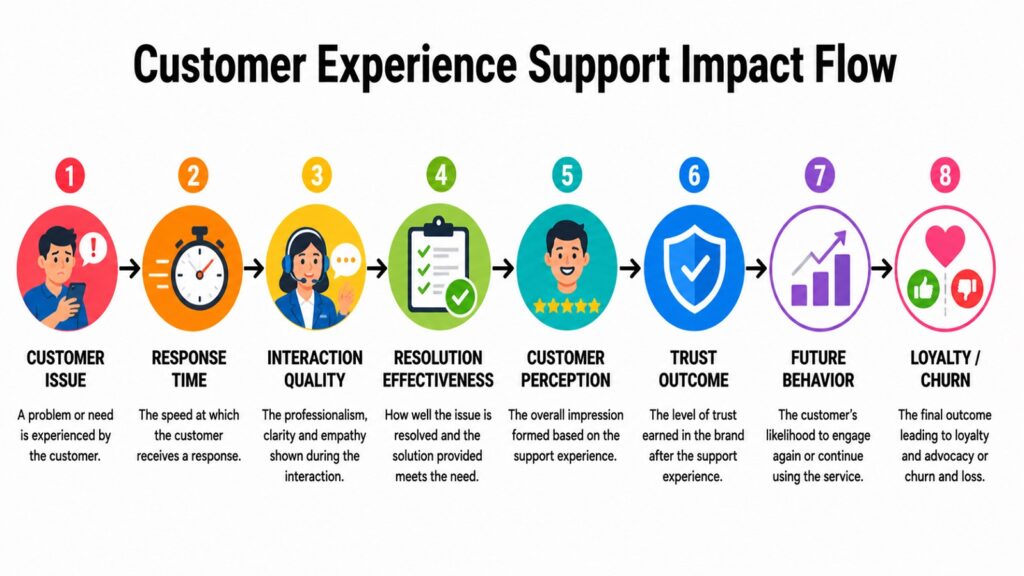
Support is what researchers often call a moment of truth. It is the point where the gap between a brand’s promise and its actual behavior becomes visible. When support goes well, it does something powerful: it can turn a negative situation into a reason to stay. When it fails, it compounds the original problem and often amplifies it.
Three factors shape customer perception during a support interaction: response time, clarity of communication, and resolution quality. Response time tells customers whether they matter enough to receive attention. Clarity of communication tells them whether the agent understands the problem. Resolution quality tells them whether the business is actually willing to help.
According to a Zendesk Customer Experience Trends Report, 61 percent of customers say they would switch to a competitor after just one bad support experience. That number rises to 76 percent after two bad experiences. These are not edge cases. They represent a substantial portion of any customer base.
The cause-and-effect relationship in support is direct. A fast, clear, empathetic response to a problem does not just resolve the issue. It reinforces the idea that the business takes its customers seriously. That reinforcement shapes Customer Experience in ways that no marketing campaign can replicate. What a business does in its hardest moments is what customers remember most clearly.
Customer Experience Support Factors and Their Impact on Customer Perception
| Support Factor | Impact on Customer Perception |
| Response time under one hour | Signals urgency and respect, significantly raising satisfaction scores in follow-up surveys |
| First contact resolution | Reduces frustration and increases trust by showing the team is capable and prepared |
| Agent knowledge and accuracy | Builds confidence in the brand and reduces need for customers to seek external help |
| Empathetic tone and language | Softens the emotional impact of a problem and improves willingness to continue the relationship |
| Clear escalation process | Prevents customers from feeling stuck and provides a visible path toward resolution |
| Proactive follow-up after resolution | Shows the business cares about outcome beyond closing the ticket, increasing post-resolution satisfaction |
| Multi-channel support availability | Reduces friction by letting customers choose the channel that fits their situation and urgency |
| Consistency across agents and shifts | Prevents contradictory answers and maintains a coherent, trustworthy brand voice |
7. Customer Experience Built on Emotional Customer Connection
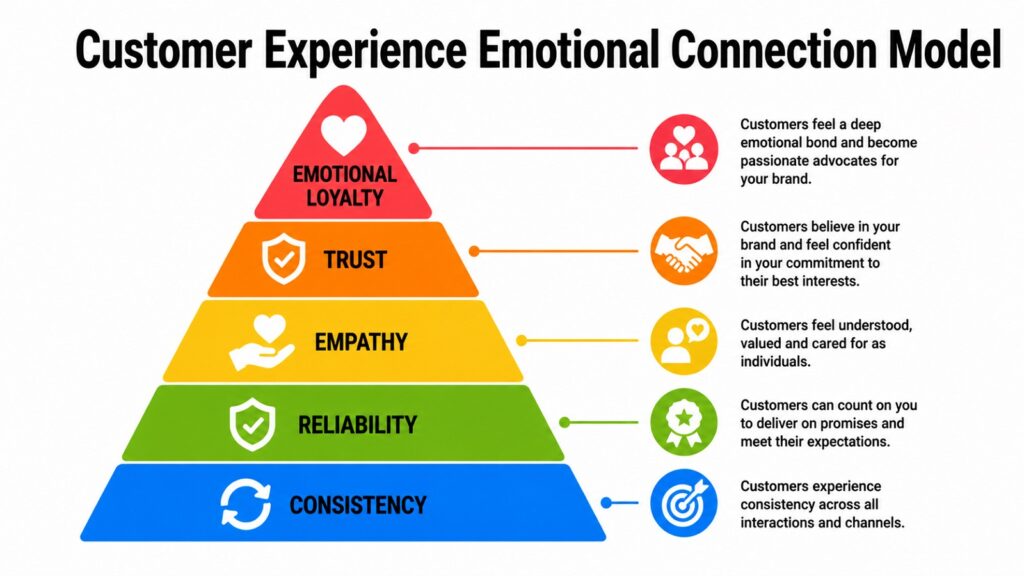
Two coffee shops sit on the same street. One has slightly better coffee. The other has staff who remember your name, know your usual order, and occasionally notice when you seem rushed and skip the small talk. Most regular customers end up at the second shop. It is not because the product is superior. It is because that shop makes them feel something. That feeling is what emotional connection looks like in a business context.
Emotional connection in Customer Experience is not about sentimentality. It is about consistency, tone, and the sense that a business sees its customers as people rather than transactions. When customers feel that, they do not just return. They advocate. They forgive mistakes more readily. They give the benefit of the doubt.
Customer Experience deepens through observable behaviors: responding to complaints with genuine acknowledgment rather than scripted apologies, following up on a concern without being asked, maintaining the same warmth across channels and over time. These are not grand gestures. They are the result of a business that has decided how it wants customers to feel and built that intention into its daily operations.
Research from the Harvard Business Review found that emotionally connected customers are more than twice as valuable as highly satisfied customers. They buy more, visit more often, show less price sensitivity, and recommend the brand more widely. The gap between a satisfied customer and an emotionally connected one is significant in business terms.
The way emotional connection erodes is also observable. A brand that changes its tone without explanation, withdraws features that customers relied on, or handles a public mistake badly will feel distant even if the product remains good. Consistency is not just a nice quality in a brand. It is the infrastructure that emotional connection is built on.
Customer Experience Emotional Drivers and Their Influence on Customer Behavior
| Emotional Driver | Influence on Customer Behavior |
| Trust | Customers return more frequently and are more willing to try new products from a trusted brand |
| Empathy during problems | Reduces customer anger and increases willingness to remain with the brand after a negative event |
| Consistency across interactions | Builds a reliable expectation that reduces customer anxiety and increases loyalty over time |
| Recognition and acknowledgment | Makes customers feel valued, increasing the likelihood they will recommend the brand |
| Tone of communication | Friendly, human tone signals approachability and reduces transactional distance |
| Transparency in difficult situations | Preserves trust even when problems occur by demonstrating honesty and accountability |
| Shared values and purpose | Customers who feel aligned with a brand’s values tend to develop stronger long-term loyalty |
| Surprise and delight moments | Unexpected positive gestures create strong emotional memory and increase word-of-mouth referrals |
8. Customer Experience Enhanced by Customer Retention Strategies
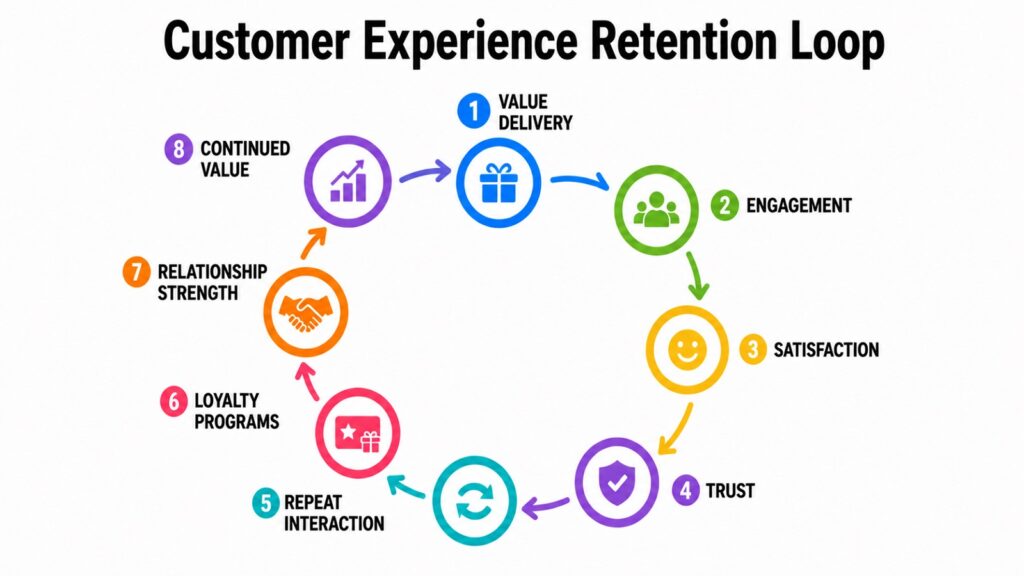
A software company builds a product that works well. The onboarding is smooth. The first month’s experience is positive. By month three, however, customers start leaving. Not because the product broke. Not because a competitor offered something dramatically better. But because the company stopped communicating. There were no updates, no check-ins, no acknowledgment that the relationship continued. Customers drifted away from something that was still working because the business gave them no reason to stay actively engaged.
Retention is the result of sustained Customer Experience, not just a single good impression. A business can acquire a customer with strong marketing, convert them with a good product, and still lose them through neglect. Retention happens when value is continuously demonstrated, not assumed.
Customer Experience drives repeat engagement in specific ways. Customers who feel recognized are more likely to return. Customers who receive relevant communication between purchases are more likely to remain engaged. Customers who have their problems resolved quickly are more likely to stay than those who never had a problem at all, because resolution demonstrates commitment.
According to research from Bain and Company, increasing customer retention by just five percent can increase profits anywhere from 25 to 95 percent, depending on the industry. The variance is wide, but the direction is consistent. Keeping a customer is substantially more cost-effective than replacing one.
The strategies that support retention are not complicated in concept, but they require consistency in practice. Loyalty programs work when they offer genuine value, not just points. Regular communication works when it is relevant, not just frequent. Post-purchase follow-up works when it is personal, not templated. The difference in each case is whether the business is delivering Customer Experience or merely performing it.
Customer Experience Retention Strategies and Their Effect on Loyalty
| Retention Strategy | Effect on Repeat Behavior or Loyalty |
| Personalized loyalty rewards programs | Increases repeat purchase frequency by tying rewards to individual spending patterns and preferences |
| Post-purchase follow-up communication | Demonstrates ongoing care and increases the likelihood of a second purchase within 90 days |
| Proactive customer success outreach | Reduces churn by identifying and resolving dissatisfaction before customers decide to leave |
| Exclusive early access for loyal customers | Creates a sense of privilege and belonging that deepens emotional attachment to the brand |
| Re-engagement campaigns for inactive customers | Recovers a portion of lapsed customers at lower cost than acquiring new ones |
| Subscription or membership models | Creates structured commitment that sustains revenue and regular touchpoints over time |
| Community building around the brand | Generates peer-to-peer loyalty reinforcement and reduces the influence of competitor offers |
| Regular product or service updates | Shows existing customers that their investment in the brand continues to grow in value |
Conclusion: Customer Experience as the Engine of Sustainable Business Success
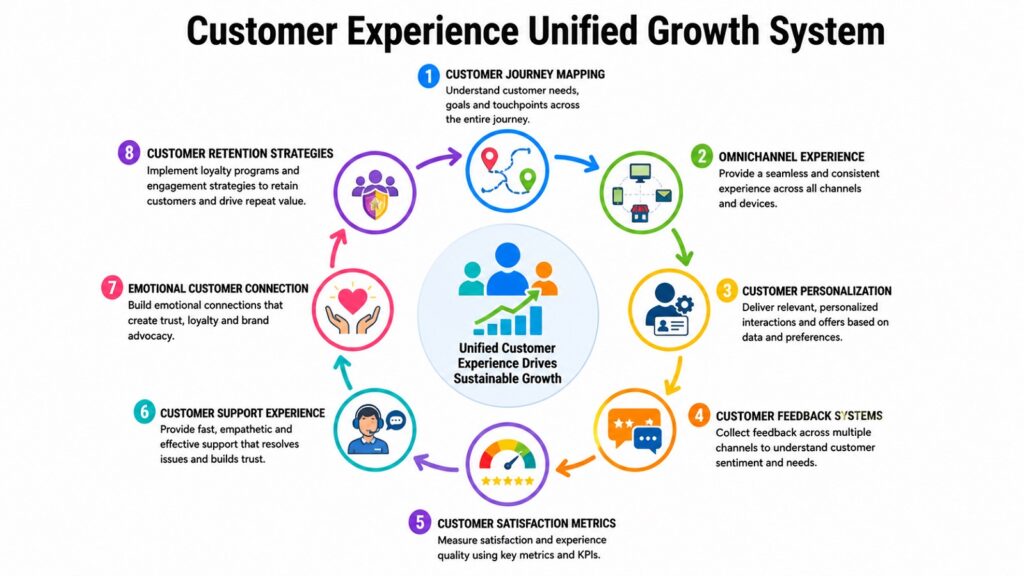
Each of the eight aspects covered in this article works as part of a connected system. Journey mapping shows where the experience breaks down. Omnichannel design ensures it holds together across channels. Personalization makes it feel relevant. Feedback systems keep it honest. Satisfaction metrics make it legible. Support defines how the business behaves under pressure. Emotional connection determines how deeply customers invest in the relationship. And retention strategies ensure that investment compounds over time.
None of these elements functions well in isolation. A business that measures Customer Experience carefully but ignores feedback will optimize for the wrong things. A business that personalizes communication but delivers fragmented omnichannel service will feel inconsistent. A business that builds emotional connection but fails to retain customers is not converting feeling into lasting value. The strength of the system depends on how well these parts reinforce each other.
Customer Experience is also not something a business finishes. It is continuous. Customer expectations shift. Markets change. New channels emerge. What felt like a thoughtful experience three years ago may now feel ordinary or even outdated. Businesses that manage Customer Experience well understand this. They treat it as an ongoing responsibility rather than a completed project.
The businesses that consistently outperform their competitors are often not the ones with the best product or the lowest price. They are the ones that have built a system where every customer, at every stage, feels that the business is paying attention. That kind of sustained attention is hard to replicate and hard to compete with. It becomes, over time, the most durable advantage a business can have.
Customer Experience: 8 Aspects and the Primary Outcome Each Delivers
| Aspect | Primary Outcome Delivered to Customer Experience |
| Customer Journey Mapping | Identifies and eliminates friction that causes customer drop-off at key lifecycle stages |
| Omnichannel Experience | Maintains continuity and trust as customers move between different service channels |
| Customer Personalization | Converts generic interactions into relevant, individually meaningful exchanges |
| Customer Feedback Systems | Creates a data-driven loop that connects customer voice to operational improvements |
| Customer Satisfaction Metrics | Provides measurable benchmarks that guide targeted and evidence-based improvements |
| Customer Support Experience | Transforms problem moments into opportunities to reinforce trust and loyalty |
| Emotional Customer Connection | Builds long-term loyalty that is more durable than product satisfaction alone |
| Customer Retention Strategies | Sustains repeat engagement and converts one-time buyers into long-term advocates |