Table of Contents
Introduction: Marketing Technology – The Foundation of Modern Digital Marketing
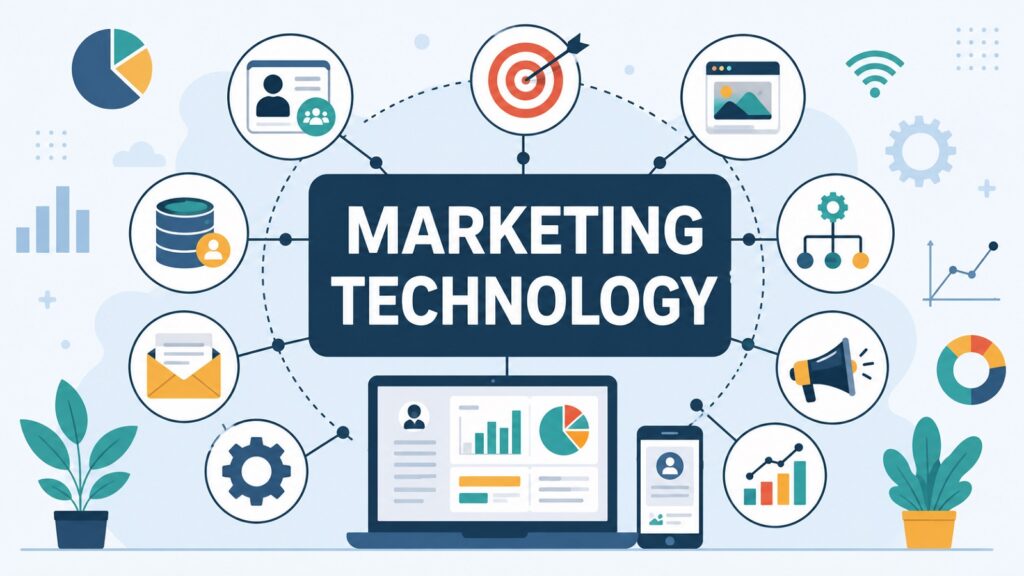
Marketing Technology is the ecosystem of software, platforms, and digital systems that enable businesses to plan, execute, automate, measure, and optimize modern marketing activities. It sits at the heart of how organizations communicate with customers today. Without it, modern marketing could not function at the scale or speed that businesses now require.
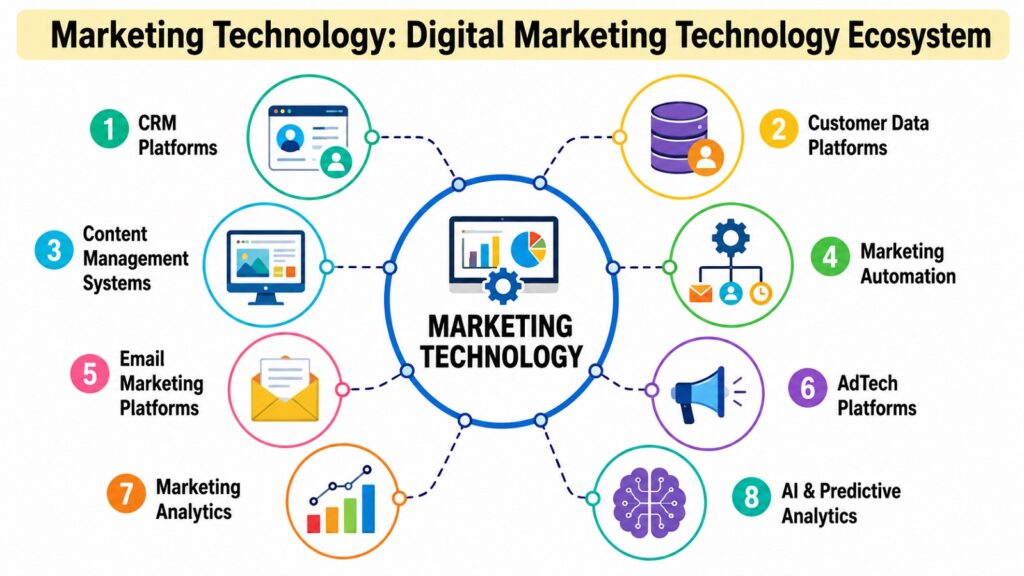
Marketing Technology is one of the most important aspects of Digital Marketing. It connects customer data, content, communication, advertising, automation, analytics, and artificial intelligence into a unified ecosystem. This ecosystem supports the entire customer journey, from the first moment a person discovers a brand all the way through to retention and long-term advocacy.
The evolution of Marketing Technology has been notable. A decade ago, most organizations relied on standalone tools, each serving a narrow purpose. A company might use one platform for email, another for social media, and a third for web analytics. These tools rarely connected with each other. Today, the landscape looks very different. Organizations now build integrated MarTech ecosystems where platforms share data, workflows connect across channels, and decisions are informed by real-time intelligence.
This shift has not happened by accident. Consumer behavior has changed. Digital channels have multiplied. Customer expectations around personalization and responsiveness have grown considerably. Organizations that depend on disconnected tools struggle to keep pace. Those that invest in integrated Marketing Technology are better positioned to deliver consistent experiences and make smarter decisions with greater confidence.
What makes Marketing Technology particularly significant is that it has become a strategic business capability. It is no longer simply a collection of software applications managed by the IT department. It now shapes how marketing teams operate, how campaigns are designed, and how business leaders measure success. Organizations across every size and sector depend on these technologies to improve customer experiences, operational efficiency, and marketing performance.
This article examines eight core foundations of Marketing Technology. Each one contributes a distinct function to the overall ecosystem. Together, they explain why Marketing Technology has become so central to modern Digital Marketing.
Marketing Technology: Eight Core Foundations at a Glance
| Foundation | Primary Role in Marketing Technology |
| CRM Platforms | Centralizes customer data and relationship management |
| Customer Data Platforms | Unifies data from multiple sources for audience insights |
| Content Management Systems | Manages and delivers digital content across channels |
| Marketing Automation | Automates workflows and personalizes customer engagement |
| Email and Engagement Platforms | Drives communication and retention through targeted messaging |
| Advertising Technology | Manages and optimizes paid digital campaigns |
| Marketing Analytics Tools | Measures performance and supports data-driven decisions |
| AI and Predictive Analytics | Enables intelligent automation and behavioral forecasting |
1. Marketing Technology for Customer Relationship Management (CRM) Platforms
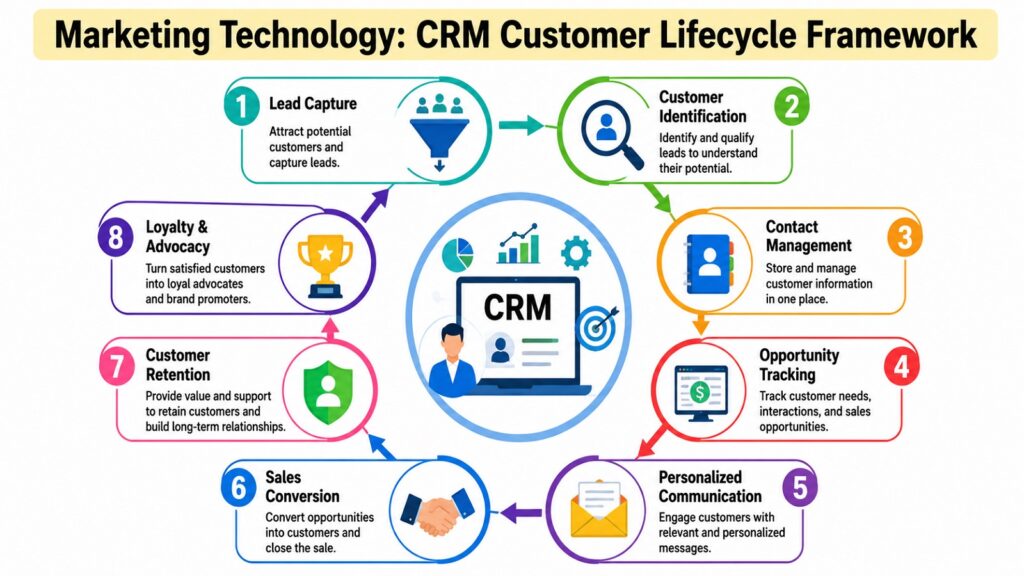
Customer Relationship Management platforms form one of the core foundations of Marketing Technology. Their primary purpose is to give organizations a single, centralized location where all customer information, interactions, and communication history are stored and managed. Without this foundation, most customer-facing marketing activities become difficult to coordinate or sustain at scale.
The theoretical purpose of CRM within the broader Marketing Technology ecosystem is straightforward. Every customer relationship generates data over time. That data includes purchase history, service inquiries, email responses, and content preferences. CRM platforms capture and organize this data so that marketing, sales, and service teams can work from the same picture of each customer. This alignment is critical for delivering consistent experiences across channels.
CRM platforms support customer acquisition, retention, loyalty, and personalized marketing in several practical ways. During acquisition, they help teams track leads and monitor where prospects are in the buying process. During retention, they enable organizations to identify customers who are at risk of disengaging and respond with targeted communication. For loyalty, they provide the data necessary to reward high-value customers and deepen relationships over time.
The connection between CRM and customer lifecycle management is one of the most important concepts in Marketing Technology. A customer’s lifecycle moves through awareness, consideration, purchase, retention, and advocacy. CRM platforms make it possible to manage each stage with relevant data and timely action.
Research consistently shows that CRM adoption continues to expand globally. This growth reflects how central these platforms have become to marketing strategy. Businesses that implement CRM effectively report improved lead conversion, stronger customer retention rates, and greater alignment between marketing and sales teams.
Implementation presents real challenges. Many organizations invest in CRM but fail to see the full benefit because data quality is poor, teams are not properly trained, or the platform is not integrated with other Marketing Technology components. Successful implementations prioritize data quality, user adoption, and integration from the start.
Looking ahead, CRM platforms are evolving to include more automation, artificial intelligence, and predictive capabilities. These developments make them even more central to the Marketing Technology ecosystem.
Marketing Technology: CRM Capabilities and Their Business Value
| CRM Capability | Business Value or Marketing Benefit |
| Centralized contact management | Single view of each customer across teams |
| Interaction history tracking | Enables context-aware and relevant communication |
| Lead and pipeline management | Improves conversion rates and sales efficiency |
| Segmentation and filtering | Supports targeted and personalized campaigns |
| Sales and marketing alignment | Reduces friction between teams and improves handoffs |
| Automated follow-up triggers | Ensures timely outreach without manual effort |
| Customer retention tracking | Identifies at-risk customers for proactive engagement |
| Reporting and performance dashboards | Measures relationship health and campaign outcomes |
2. Marketing Technology for Customer Data Platforms (CDPs)
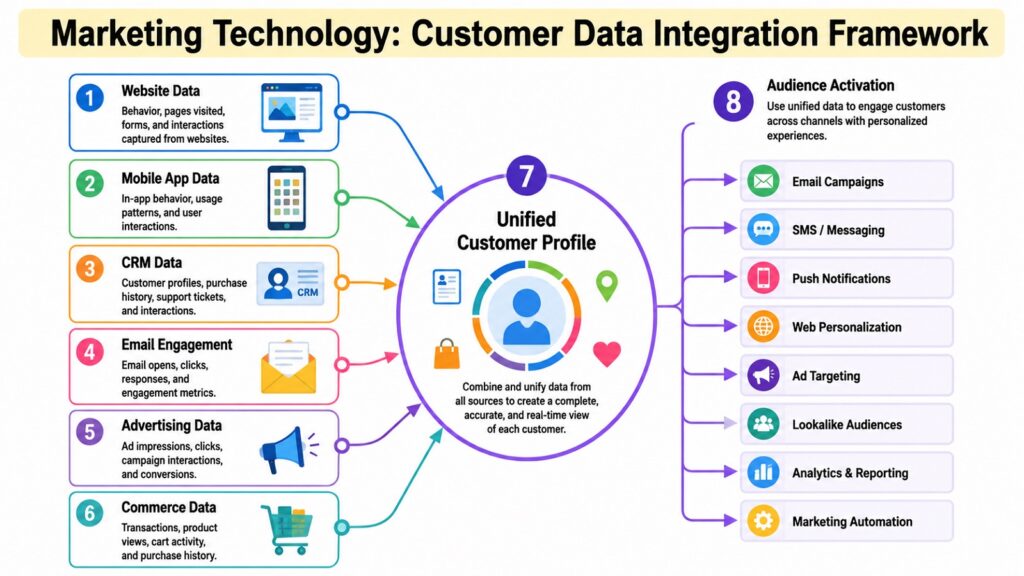
Customer Data Platforms strengthen Marketing Technology by collecting, integrating, organizing, and activating customer data from multiple online and offline sources. Where CRM platforms are built to manage relationships and sales processes, CDPs are built to unify data and create a complete, persistent view of each individual customer. This distinction matters because it shapes how each platform serves the broader ecosystem.
The theoretical purpose of unified customer data is to eliminate the gaps that arise when information is scattered across different systems. A customer might visit a website, open an email, make a purchase in a physical store, and contact customer support through a mobile app. Each of these events generates data. Without a CDP, these data points sit in separate systems and never connect. With a CDP, they are linked to a single customer profile through a process known as identity resolution.
Identity resolution is one of the most important functions CDPs perform within Marketing Technology. It matches data from different sources to the same individual, even when that data arrives through different devices or channels. The result is a unified customer profile that reflects the full breadth of a person’s engagement with a brand.
CDPs also play a central role in first-party data strategies. As privacy regulations like GDPR and CCPA have restricted third-party data collection, organizations have shifted toward data that customers share directly. CDPs are designed to collect and manage first-party data at scale while maintaining compliance with evolving requirements.
Research from the CDP Institute has found that adoption has grown substantially as organizations seek better ways to activate customer data across channels. Personalization, campaign efficiency, and cross-channel consistency are consistently cited as primary business drivers behind CDP investment.
Businesses use CDPs to improve audience segmentation, deliver more relevant content, and reduce wasted spend on broad advertising. They also help organizations understand how customers move through the buying journey by making behavioral data visible across touchpoints.
The quality of customer data has become one of the most valuable strategic assets in modern Digital Marketing. CDPs exist specifically to protect, organize, and activate that asset.
Marketing Technology: CDP Functions and Their Marketing Purpose
| CDP Function | Primary Marketing Purpose |
| Identity resolution | Links data from different channels to one customer profile |
| First-party data collection | Builds a privacy-compliant foundation for personalization |
| Real-time data ingestion | Enables timely and relevant customer engagement |
| Audience segmentation | Supports targeted campaigns with precise customer groups |
| Cross-channel data unification | Creates consistent experiences across touchpoints |
| Behavioral tracking and analysis | Reveals how customers interact with a brand over time |
| Privacy and consent management | Ensures data use complies with regulatory requirements |
| Audience activation | Pushes unified segments to advertising and engagement tools |
3. Marketing Technology for Content Management Systems (CMS)
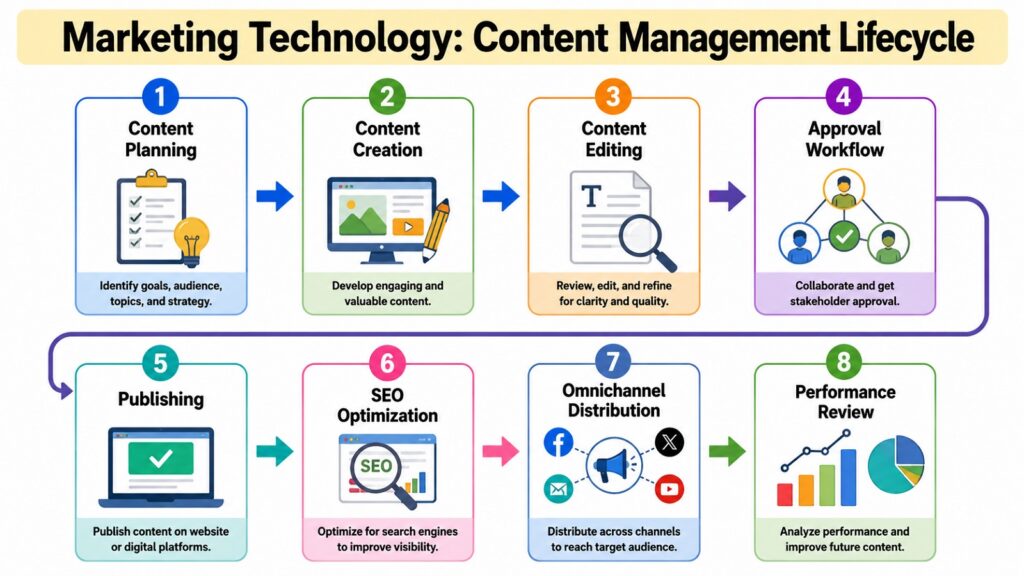
Content Management Systems serve as one of the essential publishing foundations of Marketing Technology. They enable organizations to create, organize, manage, and deliver digital content efficiently. Without a capable CMS, marketing teams face significant challenges in keeping websites updated, managing publishing workflows, and delivering content consistently across digital channels.
The role of CMS platforms within digital marketing begins with a simple idea. Content is how brands communicate their value to customers. Whether that content takes the form of articles, product pages, landing pages, or downloadable guides, it all needs to be organized and published somewhere. A CMS provides the infrastructure that makes this possible without requiring technical expertise for every publishing task.
Modern CMS platforms do considerably more than manage websites. They support omnichannel content delivery, meaning the same content can be distributed across websites, mobile apps, social platforms, and other digital touchpoints from a single system. This capability is valuable as organizations work to maintain consistent messaging across an increasingly fragmented digital landscape.
CMS platforms also integrate with other Marketing Technology components. A well-connected CMS shares data with CRM systems, feeds content into automation workflows, supports personalization, and connects with analytics tools that measure content performance. This integration turns a CMS from a simple publishing tool into an active part of the marketing stack.
Research consistently identifies content as one of the top priorities for marketing organizations. Content drives organic search traffic, supports lead generation, builds brand authority, and improves customer education throughout the buying journey. Effective content management amplifies all of these outcomes.
Implementation challenges are common. Teams often struggle with content governance, meaning the processes and standards that keep content consistent, accurate, and on-brand. As content libraries grow, they become difficult to maintain without clear workflows and editorial oversight. Best practices include defining clear content ownership, establishing structured review processes, and auditing content regularly. When these are in place, a CMS becomes a genuine source of competitive advantage.
Marketing Technology: CMS Capabilities and Their Business Contribution
| CMS Capability | Business or Marketing Contribution |
| Content creation and editing | Enables efficient publishing without technical skills |
| Publishing workflow management | Improves content quality through structured review processes |
| SEO optimization support | Helps content rank better in organic search results |
| Omnichannel content delivery | Ensures consistent messaging across digital touchpoints |
| Media and asset management | Organizes images, videos, and files for efficient reuse |
| Personalization support | Delivers tailored content to different audience segments |
| Integration with analytics tools | Measures content performance and audience engagement |
| Scalability for growing libraries | Supports increasing content volume without loss of control |
4. Marketing Technology for Marketing Automation
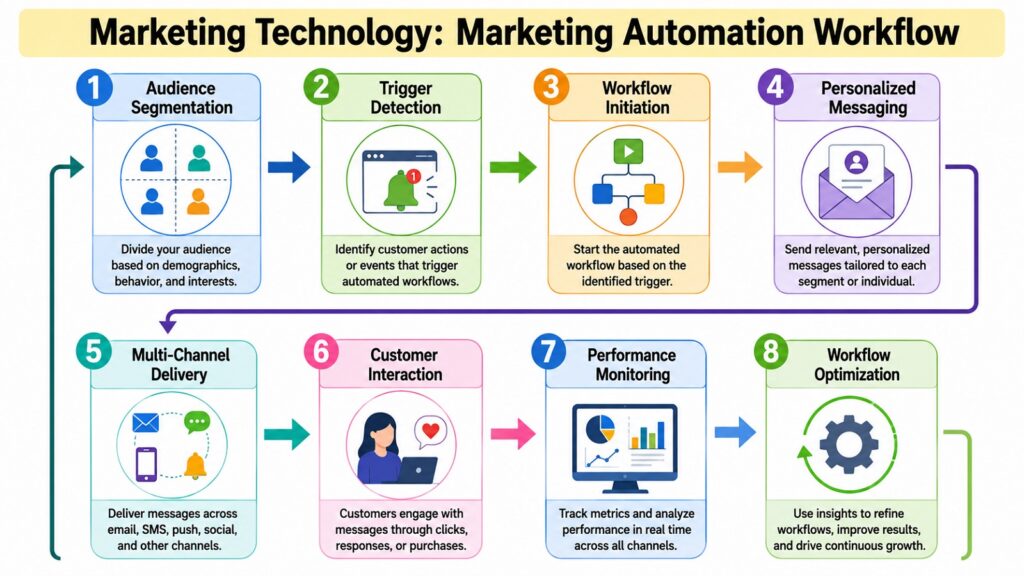
Marketing Automation enables Marketing Technology to deliver personalized, scalable, and timely customer engagement with greater operational efficiency. It is the mechanism by which organizations move from one-size-fits-all campaigns to experiences that respond to individual customer behavior and needs.
The theoretical principles behind marketing automation rest on a clear observation. Human marketing teams can only manage a limited number of interactions manually. As customer databases grow and digital channels multiply, manual approaches break down. Automation solves this by allowing organizations to define rules, triggers, and workflows in advance and let the system execute them consistently at any scale.
Workflows are the building blocks of marketing automation. A workflow might trigger a welcome email when someone subscribes to a newsletter, then send a series of educational messages over the following weeks, then route the contact to a sales team once certain engagement thresholds are reached. These sequences run automatically without requiring teams to manage each step individually.
Behavioral triggers add an important layer of responsiveness. Rather than relying solely on time-based sequences, behavioral triggers respond to what customers actually do. If a customer visits a pricing page multiple times, that behavior can trigger a relevant sales follow-up. If a customer abandons a shopping cart, an automated reminder can be sent within minutes. These responses feel timely because they are based on real actions.
Research from various industry sources indicates that organizations using marketing automation consistently report improvements in lead quality, pipeline efficiency, and campaign ROI. The operational benefits are substantial, and the customer experience improvements are equally significant when automation is implemented thoughtfully.
Practical implementation requires judgment about which activities should be automated and which should remain human-driven. Automation works best for repetitive, rule-based tasks where consistency matters most. For complex or sensitive customer interactions, human judgment remains essential. Common mistakes include over-automating, which can make communication feel impersonal, and neglecting to update workflows that have become outdated.
Marketing Technology: Automation Capabilities and Their Marketing Objectives
| Automation Capability | Primary Marketing Objective |
| Lead nurturing workflows | Moves prospects through the buying journey over time |
| Behavioral trigger campaigns | Responds to specific customer actions with relevant content |
| Audience segmentation and routing | Delivers experiences tailored to customer profiles |
| Multi-channel campaign orchestration | Coordinates messaging across email, ads, and web |
| Lead scoring and qualification | Identifies sales-ready prospects based on engagement data |
| Lifecycle stage management | Supports customers through acquisition to retention |
| A/B testing and optimization | Improves campaign performance through iterative testing |
| CRM and CDP integration | Connects automation workflows with unified customer data |
5. Marketing Technology for Email Marketing and Customer Engagement Platforms
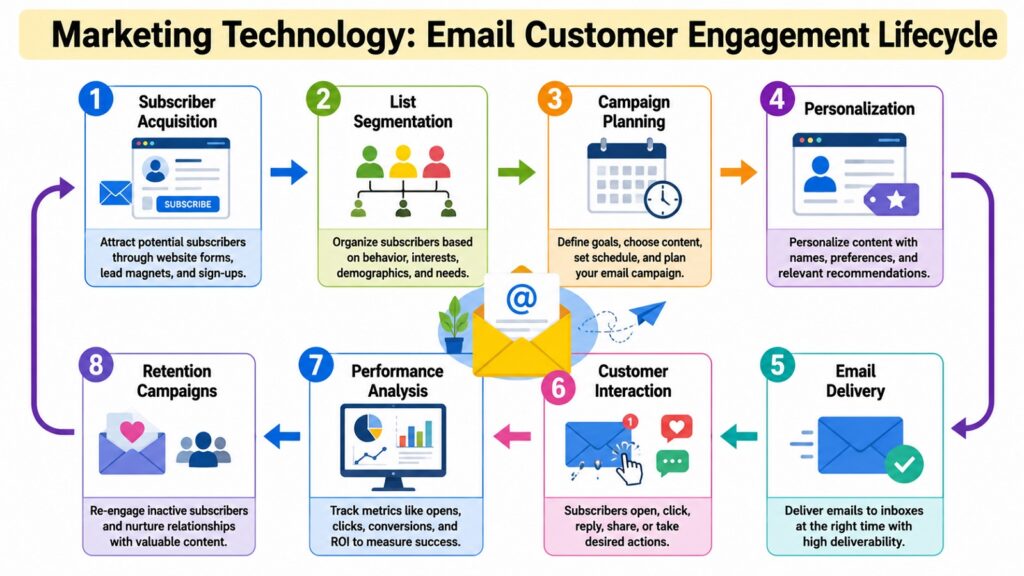
Email Marketing and Customer Engagement Platforms remain one of the most effective communication components within Marketing Technology despite the continuous evolution of digital channels. Email has been part of digital marketing for decades, yet it continues to deliver strong results for organizations that use it thoughtfully and with purpose.
The theoretical importance of permission-based communication is central to understanding why email remains relevant. When a customer provides their email address, they are granting a brand direct access to one of the most personal communication channels available. That permission carries significant responsibility. Organizations that use it well build lasting relationships. Those that abuse it with irrelevant or excessive messages damage trust and face deliverability problems.
Subscriber management is the operational foundation of any email program. It includes collecting contacts, maintaining list hygiene, managing preferences, and respecting unsubscribes. Without strong list management practices, performance degrades quickly. Low engagement leads to high unsubscribe rates and deliverability issues that are difficult to recover from.
Segmentation and personalization are where modern email marketing truly distinguishes itself. Rather than sending the same message to every subscriber, organizations now deliver content based on customer behavior, purchase history, lifecycle stage, and other variables. Research consistently finds that personalized email campaigns generate higher open rates, better click-through rates, and stronger revenue outcomes than broadcast approaches.
Lifecycle campaigns are among the most strategic applications of email in Marketing Technology. These automated sequences assist customers at various stages, such as onboarding, re-engagement, post-purchase follow-up, and renewal reminders. They convey a personal touch as they are activated by genuine customer interactions instead of random timelines.
Cross-platform integration is another key feature of modern email platforms. They connect with CRM systems, CDPs, and marketing automation tools to ensure that email communication reflects the fullest possible picture of each customer. Email consistently ranks among the highest-ROI channels in digital marketing.
Marketing Technology: Email Marketing Capabilities and Customer Engagement Benefits
| Email Capability | Customer Engagement Benefit |
| Subscriber list management | Maintains a healthy, engaged, and compliant contact base |
| Behavioral segmentation | Delivers messages relevant to each subscriber’s interests |
| Personalized content delivery | Improves open rates and strengthens customer relationships |
| Automated lifecycle campaigns | Supports customers at key moments in their journey |
| Transactional and trigger messaging | Provides timely information that customers expect and value |
| A/B testing for optimization | Improves performance through evidence-based iteration |
| Engagement analytics and reporting | Reveals what content resonates and what needs adjustment |
| Integration with CRM and CDP | Aligns email strategy with unified customer data |
6. Marketing Technology for Advertising Technology (AdTech) Platforms
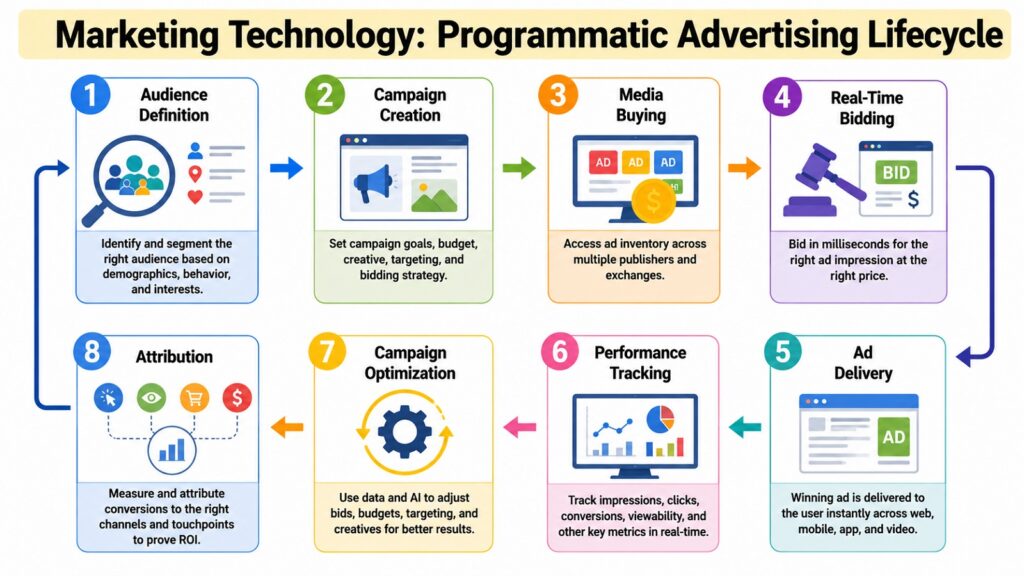
Advertising Technology extends Marketing Technology into paid digital marketing by enabling organizations to manage, automate, optimize, and measure advertising campaigns across multiple digital channels. AdTech is what makes modern programmatic advertising possible, and it has fundamentally changed how marketers, publishers, and audiences interact.
The theoretical foundations of AdTech rest on the idea of precision. Traditional advertising involved buying broad audiences and hoping that a sufficient portion was relevant. Digital advertising made it possible to target specific audiences based on demographics, interests, and behaviors. AdTech platforms automate and scale this targeting capability across thousands of placements simultaneously.
Programmatic advertising is one of the most significant developments within AdTech. It refers to the automated buying and selling of advertising inventory in real time through demand-side platforms and supply-side platforms. Real-time bidding allows advertisers to evaluate each impression individually and bid only for those that match their audience criteria. This process happens in milliseconds, millions of times per day.
The relationship between MarTech and AdTech is complementary but distinct. MarTech focuses on owned and earned marketing activities. AdTech focuses on paid media. Where they connect is in audience data. Customer segments built within a CRM or CDP can be activated through AdTech platforms to reach similar audiences with paid advertising. This bridge between the two ecosystems is one of the most powerful capabilities in modern Marketing Technology.
Privacy regulations have created significant pressure on the AdTech industry. The move away from third-party cookies has forced advertisers to rethink how they target audiences. Many organizations now invest in contextual advertising, first-party data activation, and privacy-preserving measurement as practical alternatives.
Research indicates that global digital advertising spending continues to grow, with programmatic advertising accounting for the majority of display ad spend in major markets. Attribution remains a persistent challenge, as connecting specific ads to business outcomes across a complex customer journey is technically difficult.
Marketing Technology: AdTech Capabilities and Their Business Purpose
| AdTech Capability | Business or Marketing Purpose |
| Programmatic advertising | Automates ad buying across multiple channels and placements |
| Audience targeting and segmentation | Reaches specific customer groups with relevant messages |
| Real-time bidding | Optimizes ad spend by evaluating each impression individually |
| Cross-channel campaign management | Coordinates ads across search, display, social, and video |
| Attribution modeling | Measures which channels and ads drive business outcomes |
| Creative optimization | Tests and improves ad formats and messages automatically |
| Privacy-compliant audience activation | Targets audiences using consented, first-party data |
| Campaign performance reporting | Provides visibility into ad spend efficiency and ROI |
7. Marketing Technology for Marketing Analytics and Reporting Tools
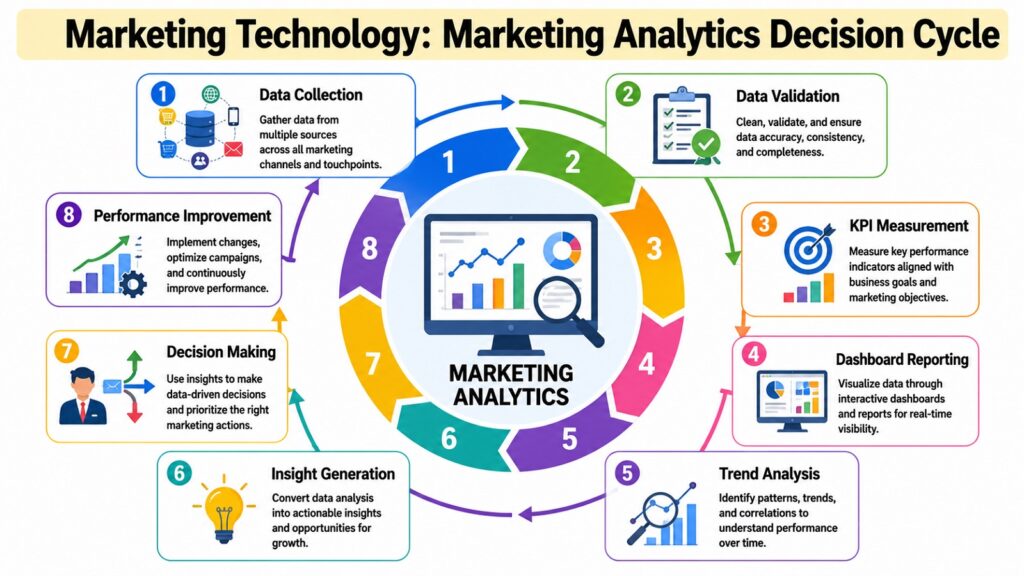
Marketing Analytics and Reporting Tools provide the measurement and decision-making foundation of Marketing Technology. Without reliable analytics, organizations are operating without feedback. They spend money on campaigns but cannot clearly explain what worked, what did not, or how to improve next time.
The theoretical importance of performance measurement begins with a basic principle. Marketing decisions should be grounded in evidence rather than intuition alone. Data does not replace judgment, but it informs and improves it. Analytics tools make performance visible, which allows marketing teams to learn from what they observe and continuously refine their approach over time.
Key performance indicators form the language of marketing analytics. These are the specific metrics organizations use to evaluate whether marketing activities are achieving their goals. Common examples include website traffic, conversion rates, cost per acquisition, customer lifetime value, and return on ad spend. The right KPIs depend on the organization’s objectives, industry, and stage of growth.
Dashboards bring these metrics together in a visual format that makes patterns and trends easier to detect. A well-designed dashboard gives marketing leaders a real-time view of how campaigns are performing. It also surfaces anomalies that might otherwise go unnoticed, such as a sudden drop in conversions or an unexpected spike in traffic from an unfamiliar source.
Attribution modeling represents one of the most intricate domains within marketing analytics. It involves the method of allocating credit for a conversion to the relevant marketing touchpoints throughout a customer journey, which may extend over several weeks, involve various devices, and encompass numerous channels. Various attribution models provide distinct insights, and no individual model can fully encapsulate the entire scenario by itself.
Research consistently confirms that organizations with strong analytics capabilities outperform those that rely primarily on intuition. Best practices include defining measurement frameworks before campaigns launch, investing in data quality and integration, and building reporting processes that translate data into decisions rather than simply accumulating numbers in a dashboard that nobody reads.
Marketing Technology: Analytics Capabilities and Their Business Purpose
| Analytics Capability | Primary Business Purpose |
| KPI tracking and dashboards | Provides visibility into overall marketing performance |
| Conversion tracking | Measures how effectively campaigns drive desired actions |
| Attribution modeling | Assigns credit to the right channels and touchpoints |
| Customer journey analysis | Reveals how customers move toward a purchase decision |
| Campaign ROI measurement | Evaluates the financial return on marketing investment |
| Audience behavior analysis | Identifies patterns in how customers engage with content |
| Predictive trend identification | Surfaces early signals of performance shifts |
| Cross-channel reporting | Unifies performance data from multiple marketing sources |
8. Marketing Technology for AI and Predictive Analytics
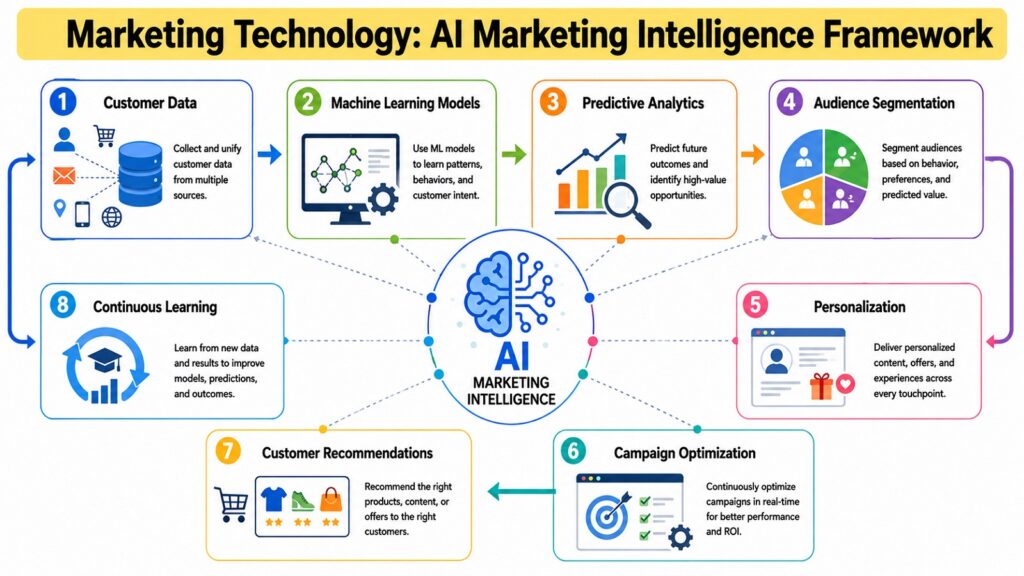
Artificial Intelligence and Predictive Analytics represent the next evolution of Marketing Technology. They enable intelligent automation, predictive decision-making, customer behavior forecasting, personalization at scale, and advanced business insights. They do not replace the other foundations covered in this article. Instead, they enhance every one of them.
The principles behind artificial intelligence in marketing are rooted in machine learning. Machine learning algorithms analyze large volumes of data to identify patterns that would be impossible for humans to detect manually. These patterns then inform predictions, recommendations, and automated decisions. The more data an AI system processes, the more accurate and useful its outputs tend to become over time.
Recommendation engines are among the most familiar applications of AI within Marketing Technology. They power the product suggestions customers see on e-commerce sites and the content recommendations that appear in email newsletters. These systems analyze historical behavior, purchase patterns, and browsing activity to surface content or products that a specific customer is likely to find relevant.
Conversational AI, including chatbots and virtual assistants, represents another significant application. These tools handle customer inquiries, qualify leads, and support service interactions at any hour. Their quality has improved considerably as large language models have matured and become more accessible to marketing teams looking for practical applications.
Generative AI has emerged as one of the most discussed developments in marketing in recent years. It enables teams to produce content at greater speed while supporting creative workflows. However, it raises important questions about content quality, authenticity, and editorial oversight that organizations must address with care.
Predictive modeling uses AI to forecast customer behavior before it happens. This might include predicting which customers are likely to churn, which leads are most likely to convert, or which products a customer is most likely to buy next. These predictions allow organizations to act proactively rather than simply reacting to what has already occurred. Ethical AI governance is essential as these systems become more influential in marketing decisions.
Marketing Technology: AI Capabilities and Their Marketing Applications
| AI Capability | Primary Marketing Application |
| Machine learning models | Identifies patterns in customer data to guide decisions |
| Recommendation engines | Delivers personalized product and content suggestions |
| Predictive churn modeling | Identifies at-risk customers before they disengage |
| Conversational AI and chatbots | Automates customer interactions and lead qualification |
| Generative AI for content | Supports content production at greater speed and scale |
| Predictive lead scoring | Prioritizes leads most likely to convert |
| Sentiment analysis | Measures customer opinions from reviews and feedback |
| Campaign optimization AI | Adjusts targeting and creative in real time for better results |
Conclusion: Marketing Technology as the Engine of Digital Marketing Success
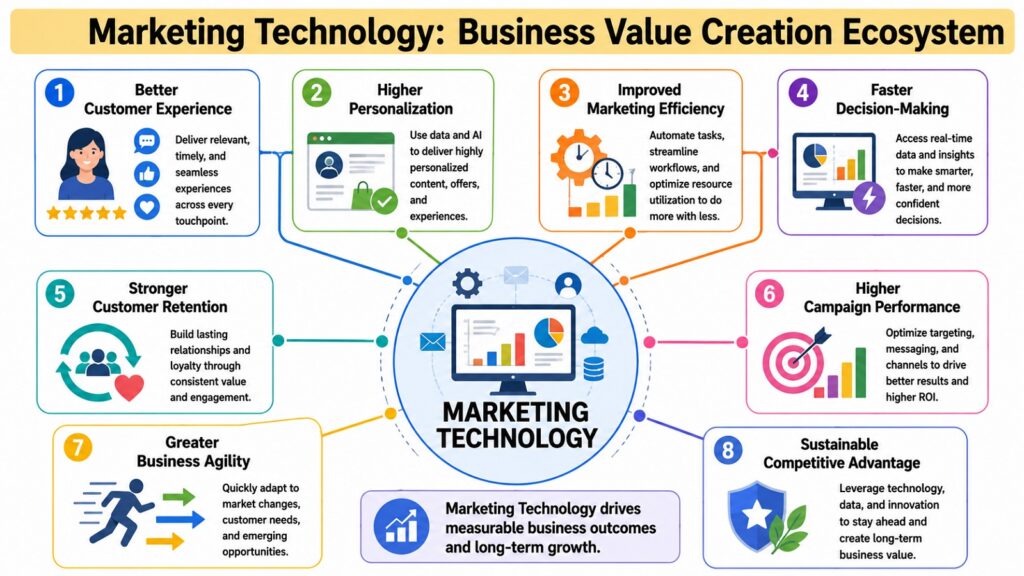
Marketing Technology integrates customer relationship management, customer data, content management, marketing automation, email engagement, advertising technology, analytics, and artificial intelligence into one coordinated ecosystem. Each of these eight foundations plays a distinct role, but their real power emerges when they work together as a unified whole.
CRM systems serve as the foundation for customer relationships. Customer Data Platforms (CDPs) consolidate the data that drives all marketing decisions. Content Management Systems (CMS) guarantee that content is delivered to the appropriate audiences at optimal times. Marketing automation enhances engagement while preserving relevance. Email and engagement platforms facilitate ongoing communication with customers during their entire journey. Advertising Technology broadens reach into paid channels with increased accuracy. Analytics tools evaluate key metrics and support ongoing enhancement. Artificial Intelligence and predictive analytics convert raw data into insights and actionable strategies.
Together, these eight foundations create something that no single platform could achieve alone: a scalable, data-driven, and customer-centric marketing ecosystem. Organizations that understand how these foundations connect are better positioned to make technology investments that deliver lasting value rather than short-term gains.
Marketing Technology is not simply a collection of software platforms. It is a strategic business capability. Organizations that plan intentionally, invest in integration, build strong data foundations, and develop the internal skills to use these tools effectively are the ones that consistently outperform those that approach it as a purely operational concern.
Looking ahead, several forces will continue to shape Marketing Technology. Artificial intelligence is advancing rapidly, and its influence across every part of the ecosystem will deepen. Privacy regulations are tightening in markets around the world, placing greater emphasis on first-party data, consent management, and transparent data practices. Customer expectations around personalization and responsiveness continue to rise, and the pace of technological change shows no sign of slowing.
Organizations that view Marketing Technology as an ongoing strategic investment, rather than a one-time implementation project, are the ones that will navigate these changes most successfully. The eight foundations explored in this article are not endpoints. They are starting points for building marketing capabilities that grow alongside the business they support.
Marketing Technology: Eight Foundations and Key Takeaways
| Marketing Technology Foundation | Key Takeaway |
| CRM Platforms | Centralizes customer relationships and supports lifecycle marketing |
| Customer Data Platforms | Unifies first-party data to enable personalization and privacy compliance |
| Content Management Systems | Powers content delivery and supports omnichannel publishing |
| Marketing Automation | Scales personalized engagement without proportional increases in effort |
| Email and Engagement Platforms | Sustains direct customer communication with high ROI |
| Advertising Technology | Extends reach through precise, data-driven paid media campaigns |
| Marketing Analytics Tools | Measures performance and informs evidence-based decisions |
| AI and Predictive Analytics | Enables foresight, intelligent automation, and continuous optimization |