Table of Contents
Introduction: Digital Marketing as the Foundation of Modern Business Growth
Digital marketing is an important aspect of modern-day marketing. It has fundamentally changed how businesses communicate with customers, build brands, generate demand, and achieve growth. Where traditional marketing used print, television, and radio, digital marketing works across search engines, social media, email, websites, and mobile platforms. The shift has not simply been about changing channels. It reflects a deeper change in how businesses and their customers relate to each other.
Digital marketing can be defined as the use of internet-connected channels, data, and technology to promote products or services and achieve measurable business outcomes. Unlike traditional marketing, digital marketing enables two-way interaction. A business speaks to a customer, and the customer can respond, click, share, or ignore. That interaction generates data, and data allows marketers to improve every future communication. McKinsey research has noted that companies using customer data effectively tend to outperform competitors on both revenue and profitability.
HubSpot research has shown that most buyers conduct online research before making a purchase decision. This makes digital visibility essential for any business that wants to grow. Whether a company sells software or furniture, customers are comparing options online before speaking to anyone. Digital marketing is the system that ensures a business is compelling during the discovery process.
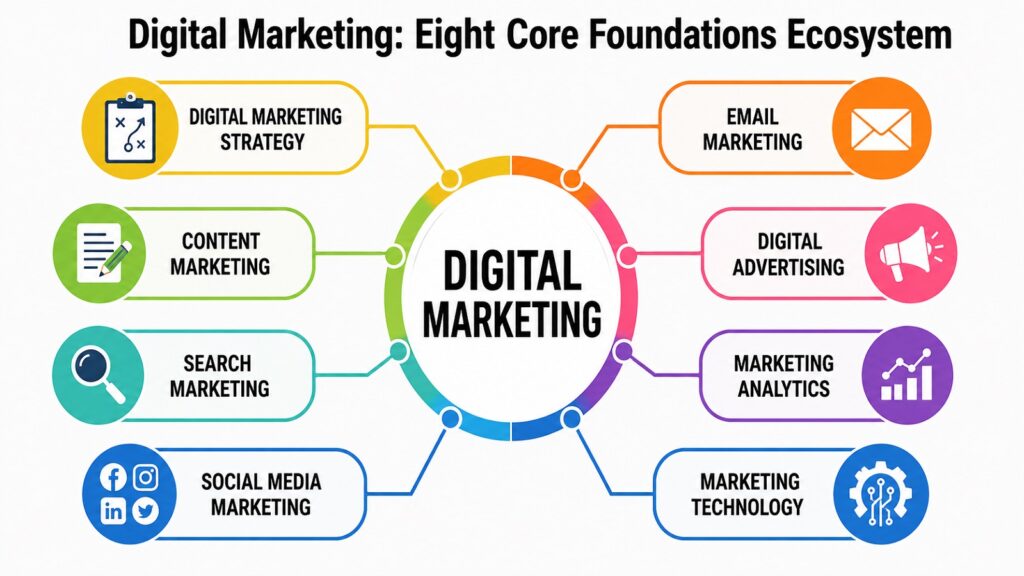
This article examines eight foundations of digital marketing: strategy, content marketing, search marketing, social media marketing, email marketing, digital advertising, marketing analytics, and marketing technology. Each foundation has a distinct role, but they work together as an integrated ecosystem. A business that builds all eight foundations creates a competitive advantage that compounds over time rather than fading with each new trend.
Table 1: Digital Marketing — Eight Foundations and Their Primary Purpose
| Digital Marketing Foundation | Primary Purpose |
| Digital Marketing Strategy | Provides direction, priorities, and a roadmap for all marketing efforts |
| Content Marketing | Builds trust and educates audiences through valuable and relevant content |
| Search Marketing | Increases online discoverability through organic rankings and paid search |
| Social Media Marketing | Builds communities, drives engagement, and extends brand reach |
| Email Marketing | Nurtures customer relationships through direct and personalized communication |
| Digital Advertising | Accelerates growth through targeted and measurable paid campaigns |
| Marketing Analytics | Tracks performance and guides decisions through data and measurement |
| Marketing Technology | Powers and automates digital marketing through integrated platforms |
1. Digital Marketing Strategy: Building a Roadmap for Success
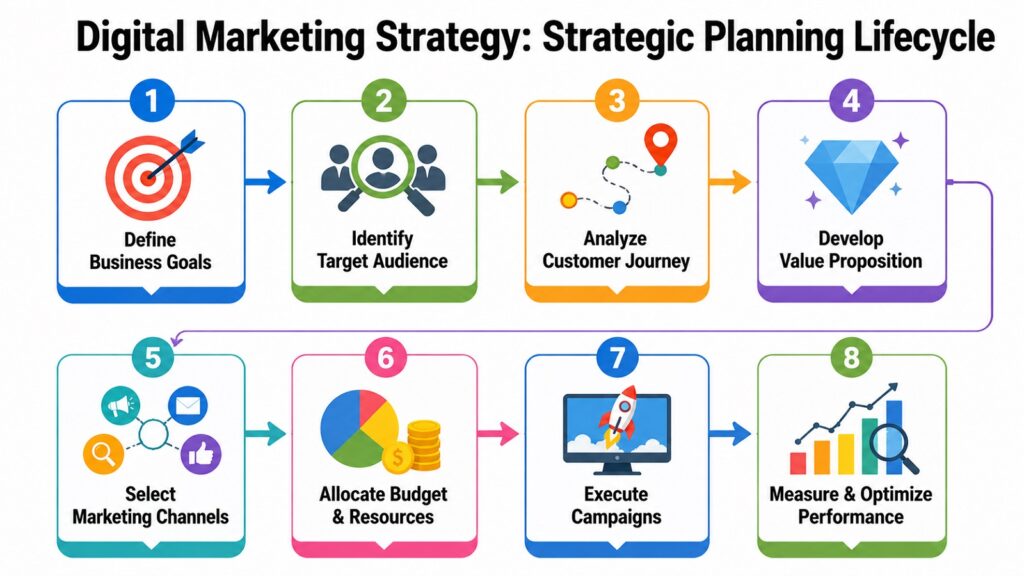
Every successful digital marketing program starts with a strategy. A digital marketing strategy is the plan that defines where a business wants to go, which audiences it needs to reach, which channels it will use, and how it will know whether the effort worked. Without that plan, even strong creative ideas and sophisticated technology tend to produce uneven results.
Strategy begins with business objectives. A company expanding into a new market needs a different approach than one trying to retain existing customers. The marketing plan must reflect the business goal, not the other way around. Before any campaign is launched, a marketer must understand what the organization is trying to achieve and how marketing can contribute to that outcome.
Audience understanding comes next. Effective digital marketing depends on knowing who the customer is, what problems they are trying to solve, and where they spend time online. Businesses that invest in customer research and persona development are better positioned to create messages that connect. A study by Deloitte found that companies with a customer-first orientation consistently achieve higher growth than those focused primarily on product features.
Channel selection follows from audience insight. Different customers use different platforms at different stages of their buying process. A B2B company may concentrate on LinkedIn, email, and webinars. A consumer brand may invest in Instagram, YouTube, and search. Strategy determines which channels deserve resources and in what proportion. Budget allocation is embedded in this process, because a strategy that cannot be resourced is not really a strategy at all.
Performance planning closes the loop. A well-formed strategy defines the metrics that will measure success before a campaign begins. This prevents marketers from measuring whatever happens to look positive after the fact. Organizations with clearly defined digital marketing strategies consistently achieve better outcomes because they know what they are working toward and can adjust when early results fall short.
Table 2: Digital Marketing Strategy — Key Planning Elements and Their Purpose
| Strategic Planning Element | Purpose |
| Business Objective Alignment | Ensures marketing goals directly support broader company priorities |
| Target Audience Definition | Identifies who the marketing is meant to reach and influence |
| Customer Journey Mapping | Outlines the path from awareness to purchase and beyond |
| Channel Selection | Determines which platforms and channels best reach the target audience |
| Budget Allocation | Distributes resources across channels based on priority and expected return |
| Competitive Positioning | Clarifies how the brand will differentiate itself in the market |
| Content and Messaging Plan | Defines what will be communicated and why it matters to the audience |
| Performance Measurement Plan | Establishes the metrics that will determine whether strategy is working |
2. Content Marketing: Creating Valuable Digital Marketing Experiences
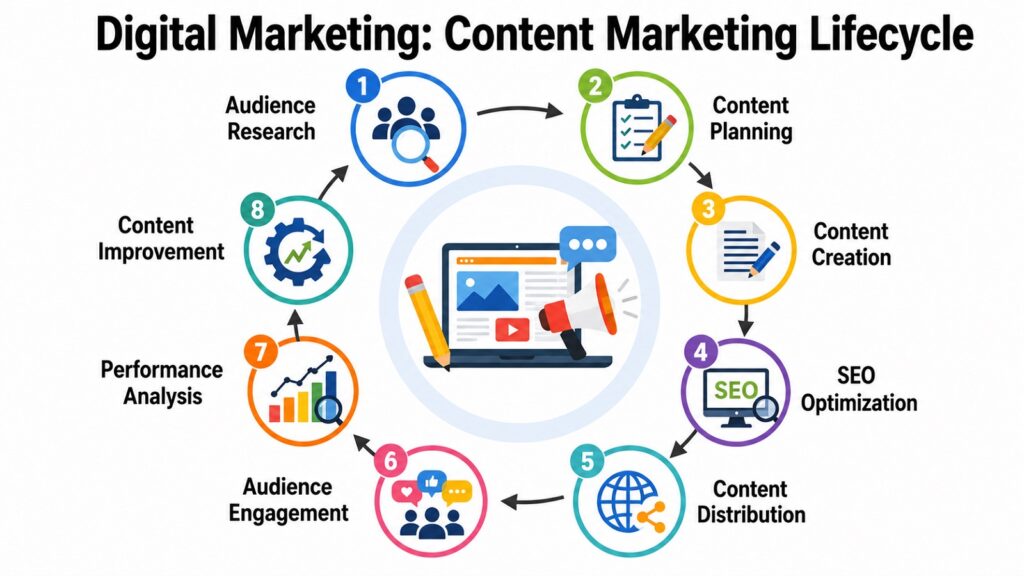
Content marketing is the practice of creating and distributing material that is genuinely useful to an audience, with the long-term goal of building trust and influencing behavior. It is one of the oldest ideas in marketing, now given new reach and measurability by digital channels. The core distinction between content marketing and traditional advertising is that advertising interrupts, while content earns attention by offering something of value.
This difference matters because modern customers have strong resistance to messages they recognize as purely commercial. When a company publishes a guide that helps someone solve a real problem, or a video that explains something complex in plain terms, it creates an experience that feels different from a sales pitch. That experience builds credibility over time, and credibility converts strangers into buyers and buyers into loyal customers.
Content marketing can take many forms. Blogs, long-form guides, case studies, podcasts, videos, infographics, webinars, and email newsletters all serve different purposes and suit different audience preferences. A software company might use detailed tutorials to help users succeed. A professional services firm might publish essays to demonstrate expertise. A consumer brand might invest in short video to entertain and educate simultaneously.
Salesforce developed a comprehensive educational content initiative via its Trailhead platform, designed to instruct customers on maximizing the value of its software. This approach lowers support expenses, enhances customer retention, and fosters loyalty that promotional materials seldom attain. This example illustrates a principle applicable across various sectors: content that aids customers in achieving success fortifies the brand relationship more effectively than content that merely advertises the business.
Content also serves every stage of the buyer journey. At the awareness stage it introduces a concept to someone who may not yet recognize they have a problem. At the consideration stage it provides information to evaluate options. At the decision stage it supplies evidence, such as case studies, that moves a prospect toward commitment. Content marketing compounds over time, which is why organizations with sustained content programs tend to outperform those that treat content as a one-off campaign.
Table 3: Digital Marketing Content Formats and Their Primary Business Purpose
| Content Format | Primary Business Purpose |
| Blog Articles | Drives organic search traffic and establishes topical authority |
| Long-Form Guides | Educates audiences deeply and builds credibility on complex topics |
| Case Studies | Demonstrates real results and helps prospects evaluate the brand |
| Videos | Increases engagement and simplifies complex ideas through visual storytelling |
| Podcasts | Builds audience loyalty and reaches users during passive listening moments |
| Webinars | Generates qualified leads while providing interactive educational value |
| Infographics | Communicates data or processes quickly in a visually digestible format |
| Email Newsletters | Maintains ongoing relationships with existing audiences and subscribers |
3. Search Marketing: Increasing Digital Marketing Visibility
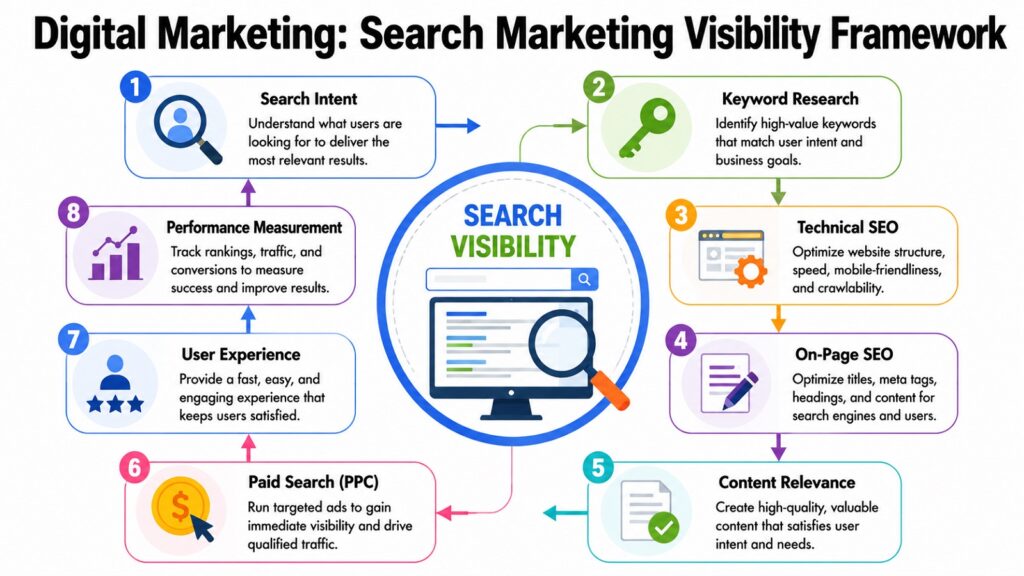
Search marketing is the practice of making a business visible to people who are actively looking for something. That active intent is what separates search from almost every other marketing channel. A person typing a query into a search engine is not passively browsing. They are looking for an answer, a product, or a solution, and being present in that moment with a relevant response is one of the most effective positions any business can occupy.
Search marketing has two main components. The first is search engine optimization, or SEO, which is the process of making a website more likely to appear in organic search results through content quality, technical performance, and authority earned through links from other trusted sites. SEO takes time to build but produces durable results that strengthen as a website accumulates relevance and trust.
The second element involves paid search advertising. Businesses can utilize platforms such as Google Ads to bid on keywords and showcase advertisements prominently at the top of results pages. In contrast to SEO, paid search can provide immediate visibility. However, the downside is that this visibility ceases once the budget is exhausted. Strategies that integrate both organic and paid methods generally yield the best results, with paid search addressing short-term requirements while SEO fosters enduring discoverability.
Search intent is the concept at the heart of effective search marketing. Not all searches carry the same meaning. Someone looking up a general term is in early research. Someone comparing product features is approaching a purchase. Matching content and advertisements to the right type of intent improves relevance, reduces wasted spend, and increases the likelihood that a search leads to a meaningful outcome for both parties.
According to data from Google, a large proportion of consumers say search is the first place they turn when looking for a new product or service. This makes search visibility a foundational requirement for any business in a digital economy. A brand absent from search results is effectively invisible to much of its potential market.
Table 4: Digital Marketing Search Marketing Concepts and Their Role
| Search Marketing Concept | Role in Digital Marketing |
| Search Engine Optimization | Builds organic visibility and long-term discoverability in search results |
| Paid Search Advertising | Delivers immediate visibility for targeted keywords through paid placement |
| Keyword Research | Identifies the terms and phrases a target audience uses when searching |
| Search Intent Matching | Aligns content and ads with the purpose behind each search query |
| On-Page Optimization | Improves relevance and structure of individual web pages for search engines |
| Technical SEO | Ensures site speed, indexability, and technical health support search rankings |
| Link Building | Earns backlinks that signal authority and improve organic search rankings |
| Quality Score Optimization | Improves ad relevance to lower cost-per-click in paid search campaigns |
4. Social Media Marketing: Expanding Digital Marketing Reach
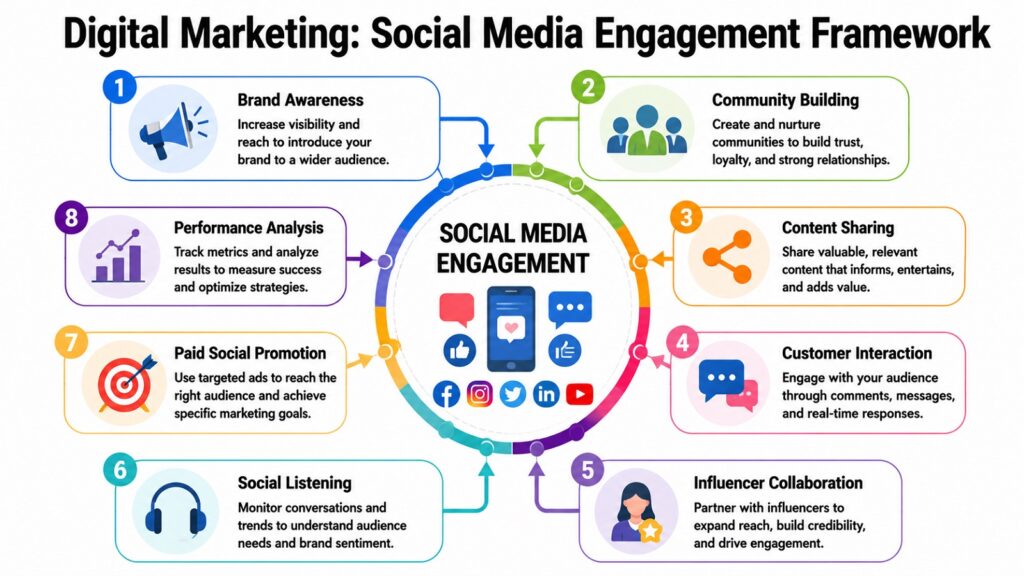
Social media marketing is the use of social platforms to build brand presence, engage communities, and maintain ongoing relationships with audiences at scale. It occupies a distinctive place in digital marketing because it blends paid and organic approaches, operates in real time, and allows audiences to respond, share, and participate in conversations around a brand in ways that no other channel quite replicates.
The role of social media in digital marketing is broader than many businesses initially recognize. It is not simply a place to distribute promotional content. At its best, social media is where a brand develops and expresses its personality, earns trust through consistent engagement, learns directly from its audience, and builds a sense of community around shared interests. These outcomes take time but produce a loyalty that is difficult for competitors to replicate.
Different platforms serve different purposes. A business might use one platform to reach professionals with thought leadership content, another to build visual brand identity through images and short video, and another to handle customer service in a transparent way. The key is selecting platforms based on where the target audience actually spends time and what kind of engagement is realistic given available resources.
Research from the Reuters Institute and similar organizations has consistently shown that younger audiences discover brands through social media more often than through traditional media or even search. This means businesses absent or inactive on social platforms risk being unknown to an entire generation of potential customers, regardless of how strong their presence may be elsewhere.
Social media also amplifies other digital marketing functions. Organic social content drives traffic to websites and generates engagement signals that support search visibility. Social advertising complements paid search by reaching audiences based on interests and demographics rather than search behavior alone. User-generated content shared by customers provides peer endorsement that brand-created content cannot replicate. When social media is integrated into the broader digital marketing strategy, it lifts results across the board.
Table 5: Digital Marketing Social Media Functions and Their Business Value
| Social Media Marketing Function | Business Value |
| Brand Awareness Building | Increases recognition and familiarity among new and existing audiences |
| Community Engagement | Fosters loyalty by creating dialogue between the brand and its followers |
| Content Distribution | Extends the reach of content marketing assets to wider audiences |
| Customer Service | Resolves issues quickly and publicly, demonstrating responsiveness and care |
| Social Listening | Monitors conversations to understand sentiment and identify emerging trends |
| Influencer Partnerships | Amplifies brand messages through trusted third-party voices and creators |
| Paid Social Advertising | Targets specific audience segments with precision through sponsored content |
| User-Generated Content | Builds authenticity and trust through real customer stories and experiences |
5. Email Marketing: Strengthening Digital Marketing Relationships
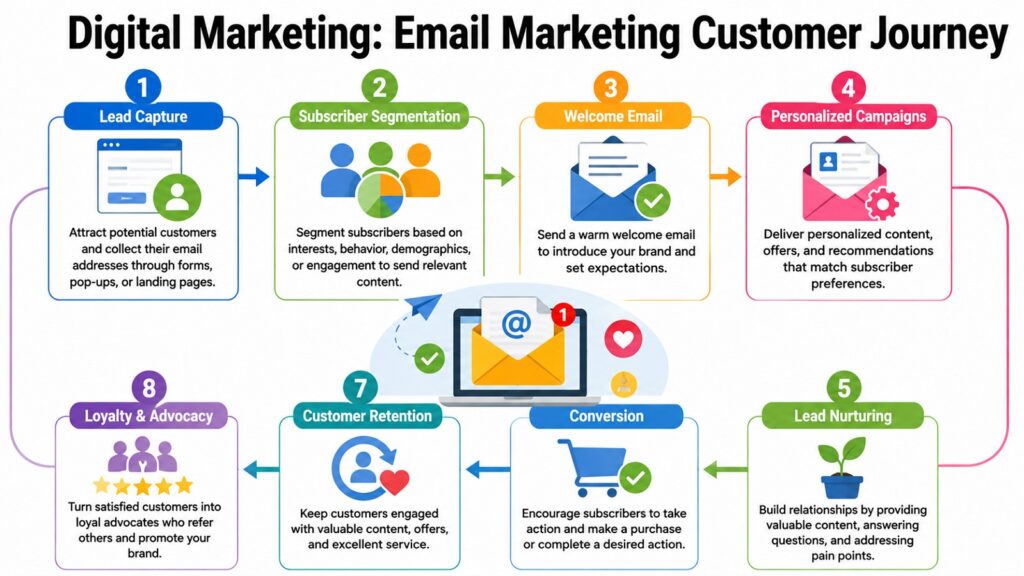
Email marketing has outlasted more predictions of its decline than almost any other digital channel. Despite the rise of messaging apps and social platforms, email continues to deliver some of the strongest returns in digital marketing. The reason is fundamental: email is an owned channel. A business that builds an email list owns that relationship in a way it cannot with social followers or paid traffic.
This distinction between owned and rented channels matters practically. Social platforms can change their algorithms, reduce organic reach, or shut down. Paid traffic stops when the budget does. An email list belongs to the business. It can be used to communicate at any time, without paying a platform for access, and without an algorithm deciding who sees the message.
The effectiveness of email marketing depends heavily on segmentation and personalization. Sending the same email to every subscriber produces mediocre results because different subscribers have different needs and different histories with the brand. A new subscriber needs introductory content. A long-term customer needs recognition and exclusive value. Someone who abandoned a cart needs a timely reminder. Tailoring each message to the relevant group makes email far more effective than generic broadcasting.
Lifecycle marketing is closely tied to email. The idea is that the most relevant message depends on where a customer is in their relationship with the brand. Automated email sequences, sometimes called drip campaigns, can welcome a new lead, educate them, handle common concerns, and move them toward a decision, all without manual effort at each step. HubSpot and similar platforms have made this kind of automation accessible even to businesses with small marketing teams.
Email also connects other parts of the digital marketing ecosystem. A customer who finds a brand through social media may join an email list and be nurtured toward a purchase over weeks. Someone who finds a blog through search might subscribe to a newsletter that keeps bringing them back. This ability to bridge channels makes email a connecting thread in the broader digital marketing strategy.
Table 6: Digital Marketing Email Marketing Practices and Their Objectives
| Email Marketing Practice | Primary Objective |
| List Segmentation | Groups subscribers by behavior or profile to improve message relevance |
| Welcome Sequences | Introduces new subscribers to the brand and sets early expectations |
| Personalization | Tailors subject lines and content to individual preferences and behavior |
| Drip Campaigns | Automates a series of messages to guide leads through the purchase journey |
| Re-engagement Campaigns | Reconnects with inactive subscribers to recover their interest |
| Transactional Emails | Delivers purchase confirmations, receipts, and account notifications |
| Newsletter Programs | Maintains regular contact and delivers ongoing value to subscribers |
| A/B Testing | Tests variations in subject lines and content to improve open and click rates |
6. Digital Advertising: Accelerating Digital Marketing Results
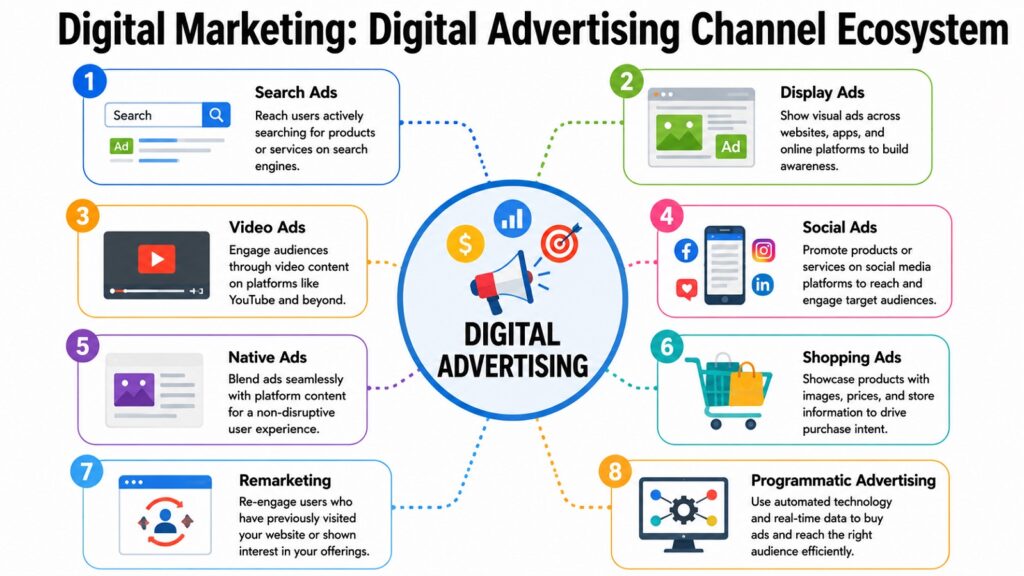
Digital advertising allows businesses to reach specific audiences with specific messages at specific moments, and to measure exactly what happens afterward. This combination of precision, speed, and accountability sets it apart from traditional advertising. A business can launch a campaign, monitor performance in real time, adjust the approach, and see results within hours. That feedback loop is something traditional media has never been able to offer.
Search advertising reaches people while they are actively looking for a product or service. Display advertising works differently, placing visual ads across websites and apps based on audience characteristics and browsing behavior. This format is better suited to building awareness and keeping a brand visible across the environments where its target audience spends time, even when that audience is not actively searching.
Video advertising has experienced significant growth due to the rise in online video consumption. Platforms such as YouTube enable businesses to connect with audiences via pre-roll and in-stream advertisements. The synergy of visual storytelling and targeted marketing renders video a powerful tool for brand communication and fostering emotional connections. Data from Cisco indicates that video constitutes a substantial portion of global internet traffic, underscoring its pivotal role in the online content consumption landscape.
Remarketing is one of the more efficient forms of digital advertising. It targets people who have already visited a website or interacted with a brand, showing them relevant ads across other platforms they visit afterward. People who have already shown interest tend to convert at higher rates than cold audiences, so budget directed toward remarketing generates better returns than equivalent spend on entirely new audiences.
Native advertising takes a different approach by matching the style and format of the content surrounding it. A sponsored article on a news site or a promoted post in a social feed does not look like a traditional advertisement, which tends to generate higher engagement. Native advertising must still be genuinely useful to the audience. The moment it feels deceptive rather than informative, the trust that makes it work disappears.
Table 7: Digital Marketing Advertising Formats and Their Business Objectives
| Digital Advertising Format | Primary Business Objective |
| Search Advertising | Captures high-intent audiences actively searching for related products |
| Display Advertising | Builds brand awareness across the websites and apps an audience visits |
| Video Advertising | Engages audiences through story-driven content on streaming platforms |
| Native Advertising | Blends promotional content into editorial environments for higher engagement |
| Social Media Advertising | Targets specific demographics and interests through platform-based ad tools |
| Remarketing Campaigns | Re-engages previous visitors to improve conversion rates efficiently |
| Programmatic Advertising | Automates ad buying to optimize targeting, placement, and budget in real time |
| Affiliate Advertising | Drives conversions through performance-based partnerships with publishers |
7. Marketing Analytics: Measuring Digital Marketing Performance
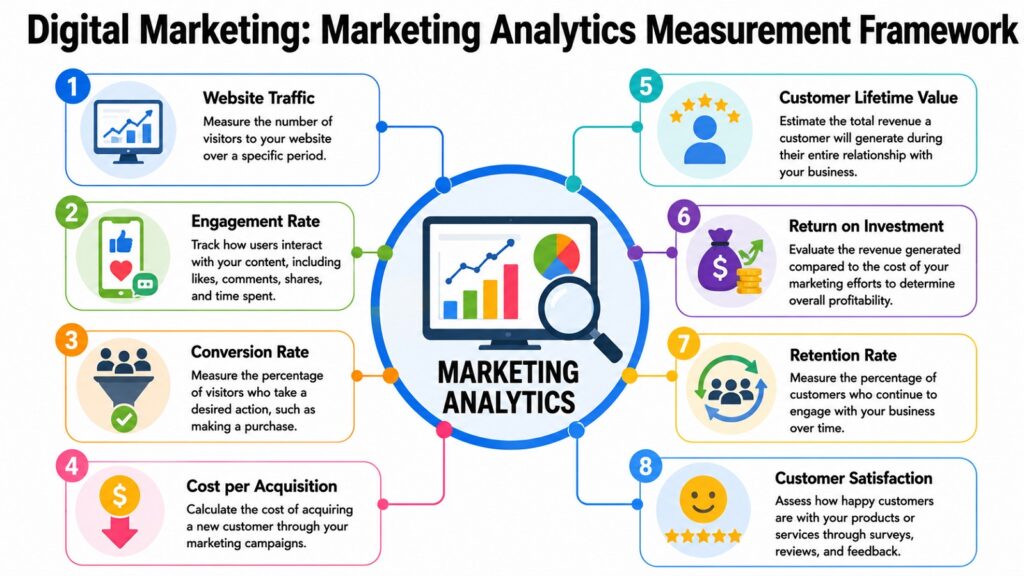
Marketing analytics is what separates digital marketing from guesswork. Without measurement, a business cannot know which channels are working, which messages are resonating, or where to invest next. Analytics transforms digital marketing from an activity into a discipline that improves with each cycle of data, reflection, and adjustment. It is a practical necessity for any business that wants its marketing investment to grow more efficient over time.
Web analytics is the most visible layer of measurement. Metrics such as traffic volume, bounce rate, time on page, and session duration describe what happens when people visit a website. These are useful starting points, but they are descriptive. They tell you what happened, not why, and not what should change.
Conversion tracking adds meaning by connecting marketing activities to real outcomes. When a visitor completes a purchase or fills out a form, a well-configured analytics system can trace that action back to the channel, campaign, and message that brought the visitor to the site. This attribution information is essential for deciding where to allocate budget and which creative approaches are actually driving results.
Key performance indicators provide the framework for ongoing performance management. A software company might track cost per acquisition and customer lifetime value. A media business might focus on newsletter subscriptions and returning visitor rates. Gartner has noted that marketing leaders who connect measurement directly to business outcomes achieve stronger organizational support and more sustained marketing investment.
Attribution is one of the more complex challenges in marketing analytics. A customer might discover a brand through social media, read a blog article, receive an email, and finally buy after clicking a paid search ad. Different attribution models answer the credit question differently, and the choice significantly affects how budget is allocated. Understanding attribution is a strategic question that shapes how a business invests in its future.
Table 8: Digital Marketing Analytics Metrics and Their Business Significance
| Marketing Metric or Concept | Business Significance |
| Website Traffic | Measures the volume of visitors and identifies top-performing channels |
| Conversion Rate | Shows the percentage of visitors who complete a desired action |
| Cost Per Acquisition | Calculates the average marketing spend needed to gain one new customer |
| Customer Lifetime Value | Estimates the total revenue a customer generates over their relationship with the brand |
| Return on Ad Spend | Measures how much revenue is generated for every dollar invested in advertising |
| Bounce Rate | Indicates whether landing pages are engaging or failing to hold visitor attention |
| Attribution Modeling | Assigns credit to the channels and touchpoints that influence conversions |
| Cohort Analysis | Tracks behavior of customer groups over time to measure retention and value |
8. Marketing Technology: Powering Modern Digital Marketing
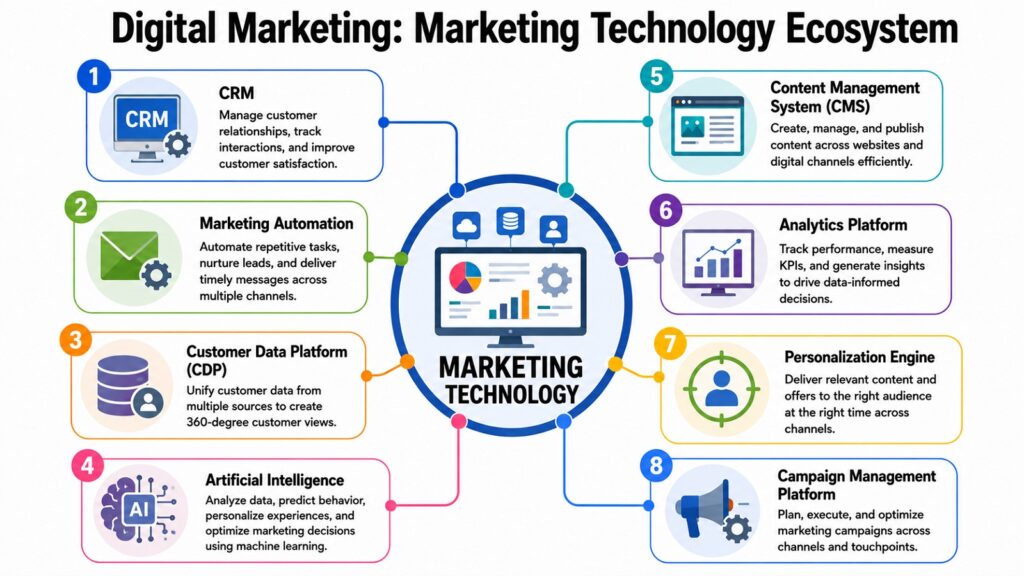
Marketing technology, often called MarTech, is the infrastructure that makes modern digital marketing possible at scale. Without it, a business with thousands of customers cannot personalize communication, automate repetitive tasks, or track performance across multiple channels. Technology has made the kind of marketing that was once available only to large enterprises accessible to businesses of nearly every size.
Customer Relationship Management platforms, known as CRMs, are the backbone of most marketing technology stacks. They store customer data, track interactions, and provide the foundation for segmentation, personalization, and lifecycle marketing. A CRM allows a marketing team to see the full history of a customer relationship, from the first website visit through every purchase and service interaction. This visibility makes communication feel personal rather than generic, which matters more than ever when customers have unlimited alternatives.
Marketing automation extends the power of CRM by triggering communications based on customer behavior. When a visitor downloads a guide, an automation sends a relevant follow-up email the next day. When a customer has not purchased in ninety days, the system sends a re-engagement message automatically. These workflows operate continuously without manual effort, allowing teams to maintain personalized communication at a scale that would otherwise require far more staff.
Customer Data Platforms, or CDPs, emerged to address fragmented customer data. Modern customers interact with brands across multiple channels and devices, generating data in many places simultaneously. A CDP collects and unifies that data into a single customer profile, giving marketers a more complete view of behavior than any single channel provides. Salesforce, Adobe, and other platform providers have invested heavily in CDP capabilities because unified data has become central to meaningful personalization.
Artificial intelligence is increasingly embedded in marketing technology. Predictive analytics tools use historical data to forecast future customer behavior, identifying who is likely to churn or make a repeat purchase. AI-powered personalization engines determine the most relevant content for each website visitor in real time. McKinsey has observed that organizations embedding AI into their marketing operations achieve measurable improvements in campaign efficiency and customer experience. The capabilities are expanding rapidly, and fluency with these tools now will be an advantage as they continue to mature.
Table 9: Digital Marketing Technology Capabilities and Their Contribution
| Marketing Technology Capability | Contribution to Digital Marketing |
| CRM Platforms | Centralizes customer data to enable personalized and consistent communication |
| Marketing Automation | Triggers and sequences communications based on customer behavior at scale |
| Customer Data Platforms | Unifies data across channels to create a single view of each customer |
| AI and Predictive Analytics | Forecasts behavior and personalizes experiences using machine learning |
| Email Marketing Platforms | Manages subscriber lists, automations, and campaign delivery efficiently |
| Content Management Systems | Publishes and organizes digital content across websites and channels |
| Analytics and Reporting Tools | Measures performance across campaigns and channels in real time |
| Ad Technology Platforms | Manages, optimizes, and automates digital advertising campaigns at scale |
Conclusion: The Future of Digital Marketing in a Connected World
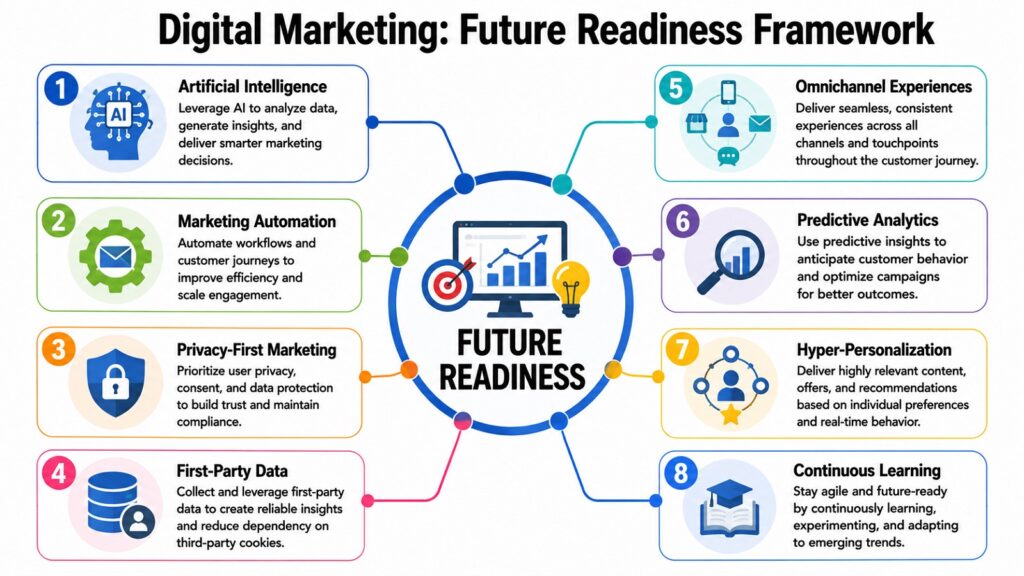
The eight aspects analyzed in this article do not exist in isolation. They form a connected system where each element strengthens the others. Strategy gives direction to content. Content improves search visibility. Search visibility drives traffic that email marketing can capture and nurture. Digital advertising accelerates results while organic efforts build momentum. Analytics measures what matters and guides adjustments. Technology enables the entire ecosystem to work consistently and at scale.
Understanding this interconnection is more valuable than mastering any single channel in isolation. A business that invests in content marketing but ignores analytics will not know what is working. One with excellent analytics but no strategy will measure the wrong things. One with sophisticated technology but weak content will automate communications that nobody wants to receive. Success requires building all eight foundations and ensuring they serve common business objectives.
Looking ahead, digital marketing will continue evolving under several converging forces. Artificial intelligence is changing how content is produced, how audiences are targeted, and how campaigns are optimized. Privacy regulations and the decline of third-party cookies are shifting the balance toward first-party data strategies, which makes owned channels like email and CRM even more central. Changing customer expectations around personalization, speed, and authenticity will require continuous investment in understanding audiences and improving communication.
Digital marketing is not a destination. It is a capability that deepens with sustained attention and honest learning. Businesses that treat it as a strategic priority and build all eight foundations with care will find that the discipline rewards patience. Those that look for shortcuts will find results as fleeting as the tactics they are borrowing.
Table 10: Digital Marketing — Eight Foundations and Key Takeaways
| Digital Marketing Foundation | Key Takeaway |
| Digital Marketing Strategy | Clear direction before execution determines whether investment delivers results |
| Content Marketing | Valuable content builds trust over time in ways that advertising alone cannot |
| Search Marketing | Organic and paid search together ensure visibility across the full buyer journey |
| Social Media Marketing | Consistent presence and genuine engagement build communities that sustain brands |
| Email Marketing | Owned communication channels preserve relationships independent of platform changes |
| Digital Advertising | Precision targeting and real-time measurement make paid media uniquely accountable |
| Marketing Analytics | Evidence-based decisions consistently outperform those driven by assumption |
| Marketing Technology | The right tools allow great marketing thinking to operate at meaningful scale |