Table of Contents
Introduction: Customer-Facing Technology as an Important Business Technology
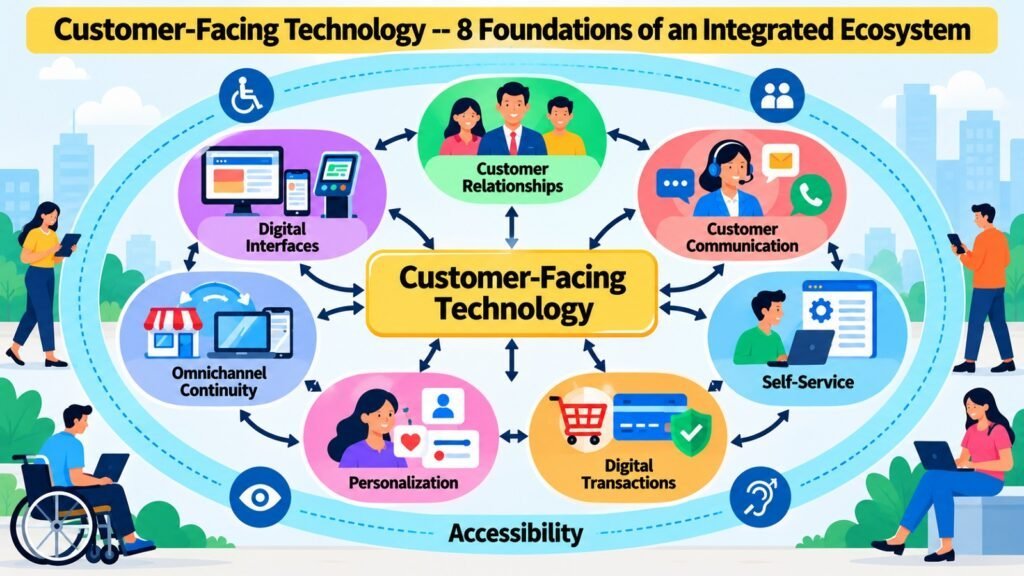
Customer-Facing Technology constitutes a critical component of Business Technology, as it establishes the interface through which an organization’s digital capabilities are directly experienced, utilized, and evaluated by customers. It comprises the systems through which a firm interacts with customers directly: relationship management platforms, digital interfaces, communication channels, self-service tools, commerce systems, personalization engines, accessibility features, and the connected touchpoints that link them. The defining criterion is exposure rather than sophistication, since a technology belongs to this domain when customers use it, or are directly affected by its behavior, during an interaction with the organization.
This criterion establishes a meaningful demarcation within the broader business technology landscape. Enterprise resource planning, data warehousing, and payment settlement infrastructure are essential to service delivery, yet they operate largely behind the scenes and are judged by operational criteria such as throughput and integrity. Customer-facing systems are judged differently, through usability, accessibility, trust, and the quality of the interaction itself, which is why they warrant systematic study by students and researchers. Drawing the boundary carefully also prevents the category from expanding until it describes the entire enterprise and loses analytical value.
This article is a foundational resource that connects established theories of technology acceptance and relationship marketing, empirical research, technical standards such as the Web Content Accessibility Guidelines, practical applications, and critical evaluation. It proceeds through eight aspects, from relationship technology and interfaces, through communication, self-service, and commerce, to personalization, accessibility, and omnichannel coordination. Together they describe distinct dimensions of a single phenomenon, and the table below clarifies the scope of each.
Table 1: Scope of Customer-Facing Technology Across Eight Aspects
| Aspects of Customer-Facing Technology | Core Focus |
| Customer Relationship Technology | Managing customer profiles, histories, and ongoing relationships |
| Customer Interfaces and Digital Channels | Providing access points to information and services |
| Customer Communication Technology | Enabling two-way exchange and assistance |
| Customer Self-Service Technology | Supporting independent task completion |
| Digital Commerce and Transactions | Enabling discovery, ordering, payment, and booking |
| Customer Personalization Technology | Adapting interactions to individual needs and context |
| Accessibility and Inclusive Interaction | Removing barriers across diverse abilities and conditions |
| Omnichannel Customer Interaction | Maintaining continuity across connected touchpoints |
1. Customer-Facing Technology: Customer Relationship Technology
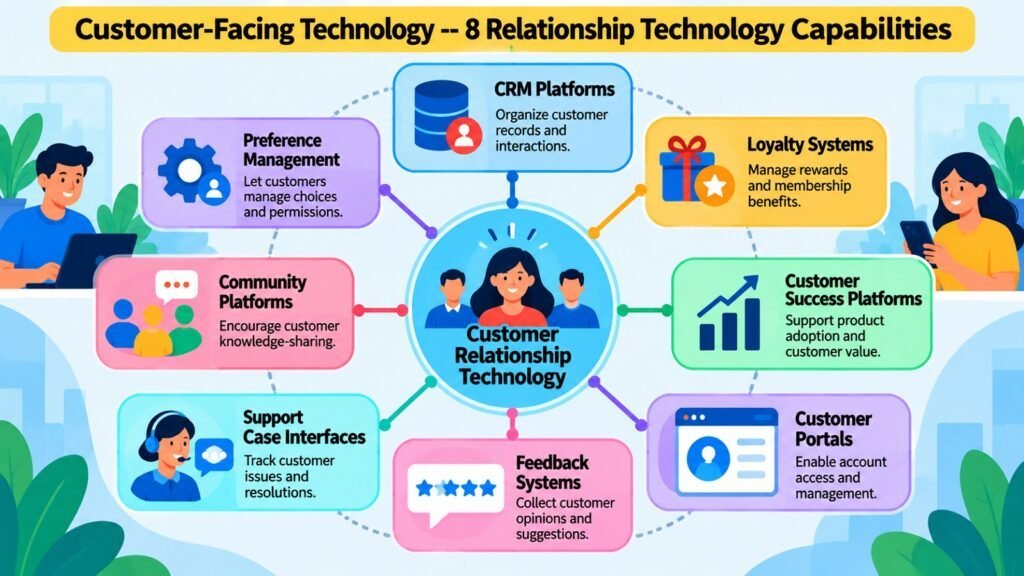
Customer Relationship Technology is used here as a descriptive umbrella for systems that help organizations establish, manage, strengthen, and sustain relationships with customers. Customer relationship management (CRM) software is its most recognized member, but loyalty platforms, customer success platforms, and account portals perform related functions, including maintaining customer profiles, preserving interaction histories, supporting service continuity, and administering loyalty activity. The distinction matters analytically: CRM denotes an established software and management category, whereas the umbrella term captures any customer-facing capability whose purpose is relational.
Theory explains why such systems might matter. Morgan and Hunt (1994) established trust and commitment as fundamental mediators through which relationship marketing achieves success, whereas Payne and Frow (2005) reconceptualized CRM as an integrated cross-functional strategic initiative rather than merely a technological acquisition. Technology can support these mechanisms by making a customer’s history available at the moment of contact, yet it cannot create trust independently. Value emerges from the interplay of technology, people, and process, a conclusion consistent with the adoption literature that builds on Davis (1989).
Several conditions govern usefulness. Information quality is decisive, because duplicated, outdated, or inconsistent records produce interactions that feel impersonal or simply wrong. The efficacy of organizational processes determines whether accumulated knowledge is effectively disseminated to relevant employees and customer-facing interfaces, regulatory privacy requirements establish boundaries regarding permissible data collection and storage, and system integration capabilities determine whether customer profiles present a comprehensive view or merely represent a single department’s partial understanding of that customer. Without these conditions, even a well-configured platform tends to reproduce the fragmentation it was acquired to remove.
The limitations deserve equal attention. The mere adoption of a platform does not inherently strengthen customer relationships, and the substantial implementation challenges documented throughout CRM research—encompassing inadequate user adoption rates and misaligned strategic objectives—demonstrate that favorable outcomes remain contingent upon proper execution rather than assured by technology deployment alone. Relationship technology is best understood as an enabler whose effects depend on strategy and execution, a framing that also provides the foundation for a deeper sub-pillar examination of CRM and its neighbors.
Table 2: Customer-Facing Technology Types for Relationship Management
| Customer-Facing Technology Types | Relationship Management Function |
| Customer relationship management system | Consolidates customer records and interaction histories |
| Customer loyalty platform | Administers rewards, points, and membership tiers |
| Customer success platform | Monitors account health and supports retention activity |
| Customer account portal | Lets customers view and manage account details |
| Customer data platform | Unifies data from several sources into customer profiles |
| Feedback management system | Collects and organizes customer survey responses |
| Subscription management platform | Handles plan changes, renewals, and recurring billing |
| Case management system | Tracks service requests through to resolution |
2. Customer-Facing Technology: Customer Interfaces and Digital Channels
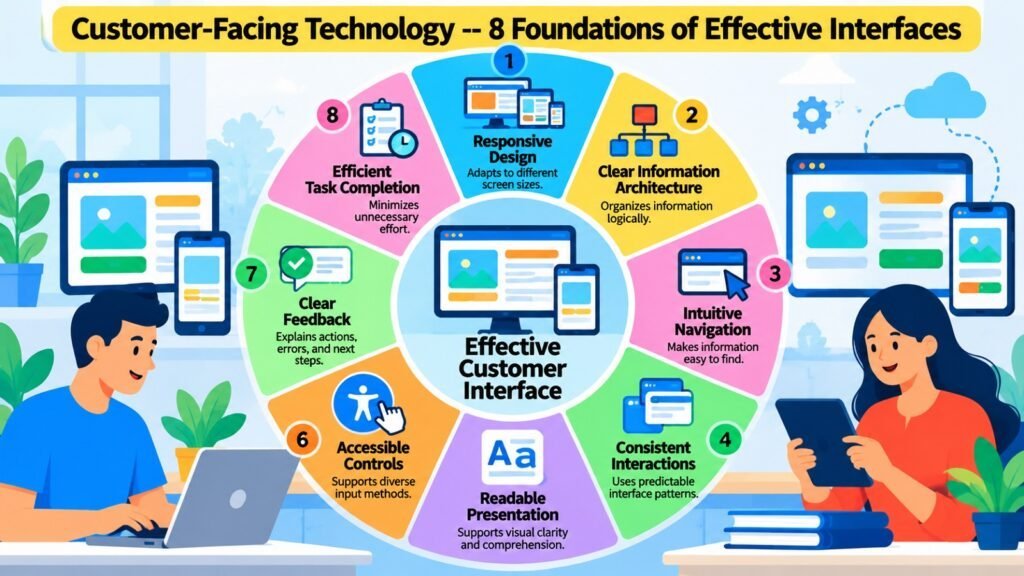
Customer interfaces are the surfaces through which customers reach business information, products, and services, and digital channels are the pathways that carry those interactions. Digital platforms—encompassing websites, mobile applications, customer portals, and digital kiosks—represent distinct categories, each optimized for specific functions, technological environments, and operational contexts. These interfaces serve a fundamental objective: enabling customers to locate required information, evaluate available alternatives, and accomplish their intended objectives with reasonable efficiency. Success is measured by the extent to which customers achieve their goals.
Human-computer interaction supplies the analytical vocabulary. ISO 9241-11 defines usability through effectiveness, efficiency, and satisfaction within a specified context, a formulation that makes context explicit rather than incidental. Nielsen’s usability heuristics, including visibility of system status and consistency, and the human-centred design process described in ISO 9241-210 translate that definition into evaluable practice. Navigation, information architecture, feedback, and responsiveness each influence task completion, although empirical results vary with user populations and task types, so general design rules are better treated as hypotheses to be tested than as laws.
Interface suitability therefore cannot be settled in the abstract. A mobile application may serve frequent, short interactions well, while a complex insurance claim may be better handled on a larger screen with fuller documentation. Organizations must assess appropriateness by considering customer requirements, operational complexity, technological limitations, and service expectations, employing empirical observation and systematic usability evaluation rather than relying on presumption. Standards such as WCAG, discussed later, also constrain which design choices are acceptable, so suitability includes conformance as well as preference.
Documented instances of frequent failures include navigational confusion, inconsistent information across multiple pages and communication channels, and obstacles to user interaction such as unresponsive design elements or ambiguous error notifications. These deficiencies generate cumulative expenses through incomplete task abandonment and unnecessary staff engagement.
Furthermore, interface design must be differentiated from related but distinct disciplines. Customer Experience Management addresses the cumulative experience across the whole relationship, and integration architecture governs how data moves between systems, whereas interface design concerns what the customer sees and does. This section lays the groundwork for a dedicated sub-pillar article on interfaces and digital channels.
Table 3: Customer-Facing Technology Interfaces and Digital Channels
| Customer-Facing Technology Interfaces or Channel Types | Primary Customer Use |
| Website | Browsing information, comparing options, completing transactions |
| Mobile application | Frequent, on-the-go access to services |
| Progressive web application | Installable, app-like access through a browser |
| Customer portal | Managing accounts, documents, and requests securely |
| Digital kiosk | On-site access to services such as check-in |
| Social media platform | Public inquiries and service requests |
| Voice assistant | Hands-free information requests and commands |
| Wearable device interface | Brief alerts and quick actions |
3. Customer-Facing Technology: Customer Communication Technology
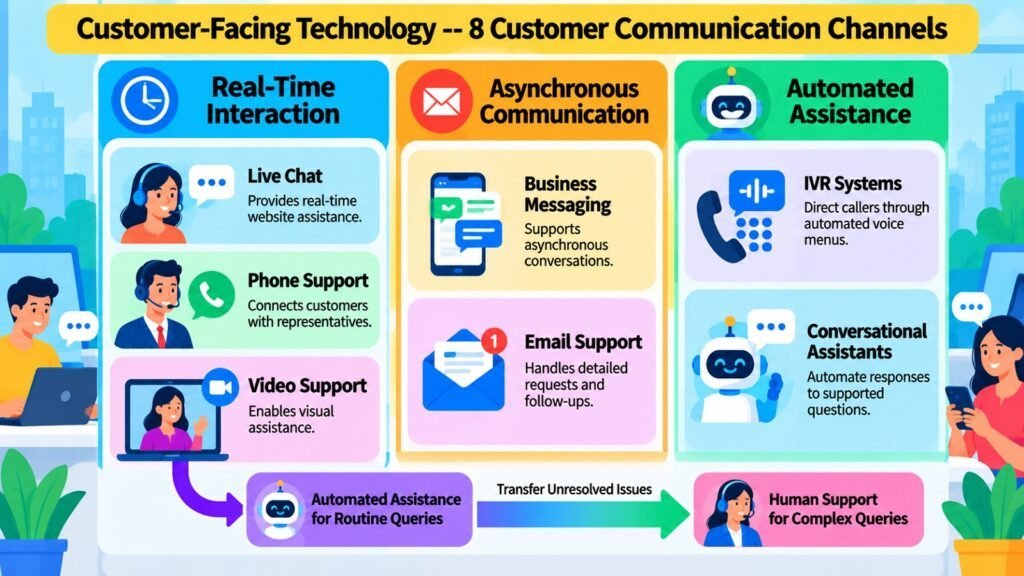
Customer Communication Technology allows customers and businesses to exchange information, request help, receive answers, and sustain direct contact. Live chat, messaging systems, interactive voice response, contact center interfaces, video assistance, and email-based service communication are its established forms. They differ in synchronicity, richness, and the degree of human involvement, and those differences determine which interactions each can support effectively. Choosing among them is therefore a design decision with consequences for cost, speed, and customer effort.
Media richness theory (Daft and Lengel, 1986) holds that complex or ambiguous messages are better handled through richer media, while media synchronicity theory (Dennis, Fuller, and Valacich, 2008) shifts attention to the match between communication processes and media capabilities. Both treat channel choice as a problem of fit. A password reset may suit an automated voice menu or chat, whereas a disputed charge involving ambiguity and frustration usually benefits from conversation with a person. Response time, accessibility, privacy, and customer preference add further criteria: email leaves a record but invites delay, and video may disclose a customer’s surroundings.
Problems arise less from any single channel than from poor management of several. Conversations fragment when customers must repeat details after a transfer, information conflicts across channels, and automated routing sends people to a mechanism unsuited to their problem. Research on service delivery and trust suggests that perceived competence and responsiveness shape evaluations, but no channel is universally superior, and claims to the contrary typically reflect convenience for firms more than evidence about customers. Evidence on cost and effort remains context-specific.
Communication technology should also be separated from marketing automation, promotional campaign management, and broader engagement strategy. Those practices use channels for persuasion and outreach, whereas this section concerns mechanisms for service exchange initiated by, or responsive to, the customer. The practical and theoretical task is to select technologies that fit the customer, the task, and the business context, which prepares the ground for a sub-pillar article on Customer Communication Technology.
Table 4: Customer-Facing Technology for Communication
| Customer-Facing Technology for Communication | Primary Interaction Function |
| Live chat | Real-time text assistance during a session |
| Messaging application | Asynchronous conversation that persists over time |
| Interactive voice response | Automated telephone menus and call routing |
| Telephone contact center | Spoken assistance from trained agents |
| Video assistance | Visual support and demonstration |
| Email service communication | Documented inquiries and confirmations |
| Text message notification | Short alerts, reminders, and confirmations |
| Co-browsing | Agent guidance within the customer’s web session |
4. Customer-Facing Technology: Customer Self-Service Technology
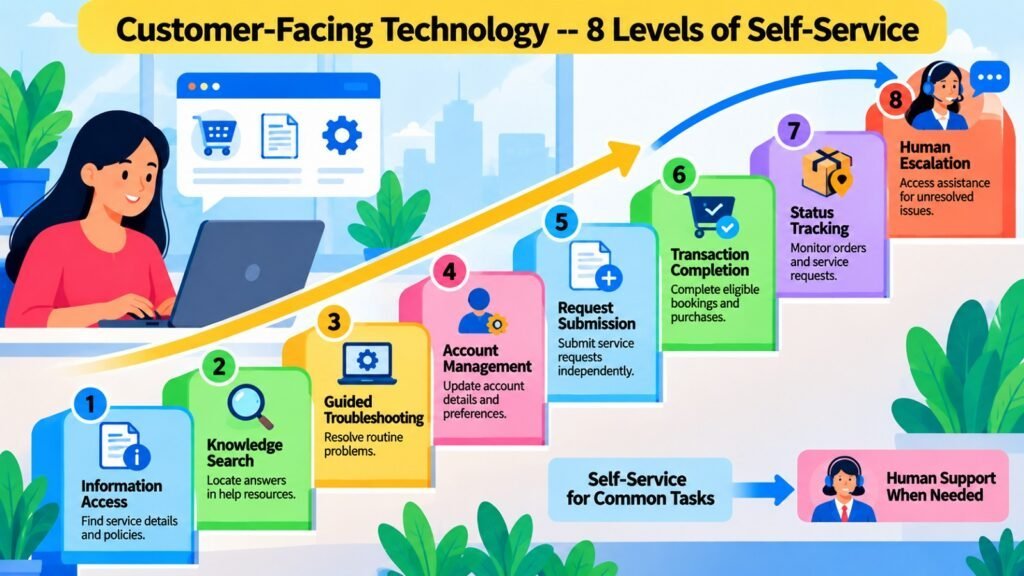
Customer Self-Service Technology lets customers obtain information, resolve routine problems, and complete tasks without always involving an employee. Knowledge bases, frequently asked question pages, self-service portals, automated troubleshooting, customer-facing virtual assistants, and service kiosks represent the principal forms. The emphasis falls on customer autonomy, meaning the customer’s ability to finish a task independently, rather than on the internal help-desk systems used by employees. Because customers bear the effort, the design burden shifts toward clarity, error prevention, and recovery.
The plausible benefits are convenience, round-the-clock availability, and reduced reliance on assisted channels, but these are hypotheses requiring evidence in each setting rather than guaranteed outcomes. Meuter, Ostrom, Roundtree, and Bitner (2000) examined satisfying and dissatisfying self-service encounters and found that technology failure, poor design, and process problems drove dissatisfaction as readily as success drove delight. Acceptance research, including the Technology Acceptance Model and Parasuraman’s (2000) Technology Readiness Index, further shows that willingness to use such systems varies across individuals.
Limitations follow from this variability. Confusing instructions, inaccessible workflows, and inaccurate automated responses can leave customers worse off than if no system existed, and some situations, such as urgent, emotionally charged, or unusual problems, demand human judgment. Escalation pathways are therefore an essential element of design rather than an admission of failure. Customers who reach the limit of a self-service tool should be able to move to assisted service with their context intact, so that effort already expended is not wasted. Self-service that cannot recover from a failed attempt shifts the cost back to the customer.
Service design and human-computer interaction both counsel against automating every task for every customer. Bitner, Ostrom, and Meuter (2002) argued that successful implementation depends on matching technology to customer capabilities and providing recovery when things fail. The practical question is which tasks are routine, well-bounded, and low-risk enough for independent completion. This reasoning provides the basis for a later sub-pillar article on Customer Self-Service Technology.
Table 5: Customer-Facing Technology for Self-Service
| Customer-Facing Technology for Self-Service | Primary Customer Task |
| Knowledge base | Searching articles to answer questions |
| FAQ page | Finding quick answers to common questions |
| Self-service portal | Managing accounts and submitting requests |
| Automated troubleshooting guide | Diagnosing and fixing problems step by step |
| Customer-facing virtual assistant | Resolving routine inquiries through conversation |
| Self-service kiosk | Checking in, ordering, or paying on site |
| Self-checkout terminal | Scanning and paying for purchases |
| Online community forum | Obtaining peer-supplied answers and advice |
5. Customer-Facing Technology: Digital Commerce and Transactions
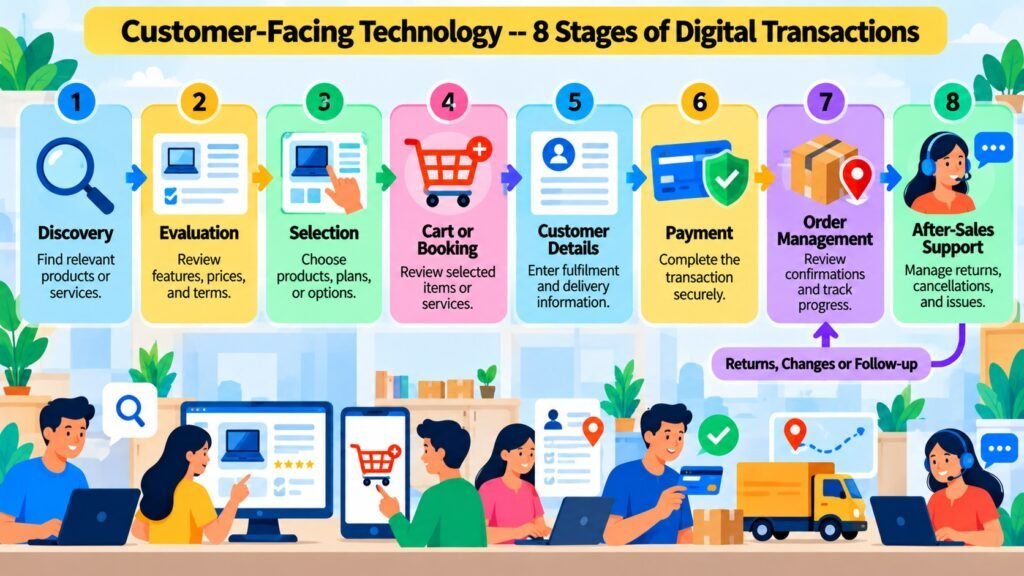
Digital commerce technologies allow customers to discover offerings, evaluate products and services, place orders, pay, book services, and manage purchases already made. Online storefronts, product catalogs, shopping carts, checkout interfaces, digital payment interfaces, booking systems, and subscription purchasing systems together form the transactional layer of Customer-Facing Technology. Each reduces the effort of buying while introducing risks of its own, particularly where money, personal data, and legal commitments are involved. Clarity about price, obligation, and outcome distinguishes a dependable transaction from a frustrating one.
Research on online purchasing consistently identifies trust and perceived risk as central constructs. Gefen, Karahanna, and Straub (2003) integrated trust with the Technology Acceptance Model in online shopping, and Kim, Ferrin, and Rao (2008) modeled how trust and perceived risk jointly shape purchase intention. Design features should therefore be assessed for what they communicate: transparent pricing, clear product information, visible confirmation, and intelligible error recovery all signal reliability. Payment security has a technical dimension, addressed by standards such as the Payment Card Industry Data Security Standard, and a perceptual one, since customers judge security through what they can see.
Requirements differ by setting. Retail purchasing favors speed and low friction, travel booking demands accurate availability and changeable reservations, financial services impose authentication and regulatory disclosures, and business-to-business transactions often involve negotiated prices, approvals, and purchase orders. Transaction design also involves trade-offs, since extra verification may reduce fraud while adding friction. No interface automatically increases conversion, and claims to that effect require controlled evidence.
The customer-facing transaction process should be separated from backend payment infrastructure and from e-commerce business strategy. Payment gateways, settlement networks, and pricing strategy matter greatly, but this section examines what the customer sees and does. Failed transactions deserve particular attention, because uncertainty about whether a payment succeeded provokes anxiety and duplicate attempts. These themes frame a prospective sub-pillar article on Digital Commerce and Transactions. Reliable recovery matters as much as the successful path.
Table 6: Customer-Facing Technology in Digital Commerce
| Customer-Facing Technology in Digital Commerce | Customer-Facing Function |
| Online storefront | Presents offerings and enables browsing |
| Product catalog | Organizes searchable product information |
| Shopping cart | Holds selected items before purchase |
| Checkout interface | Collects delivery, payment, and order details |
| Digital wallet | Stores payment credentials for faster payment |
| Booking system | Reserves appointments, seats, or accommodation |
| Subscription purchasing system | Manages recurring plans and renewals |
| Order confirmation and tracking | Reports order status and records purchases |
6. Customer-Facing Technology: Customer Personalization Technology
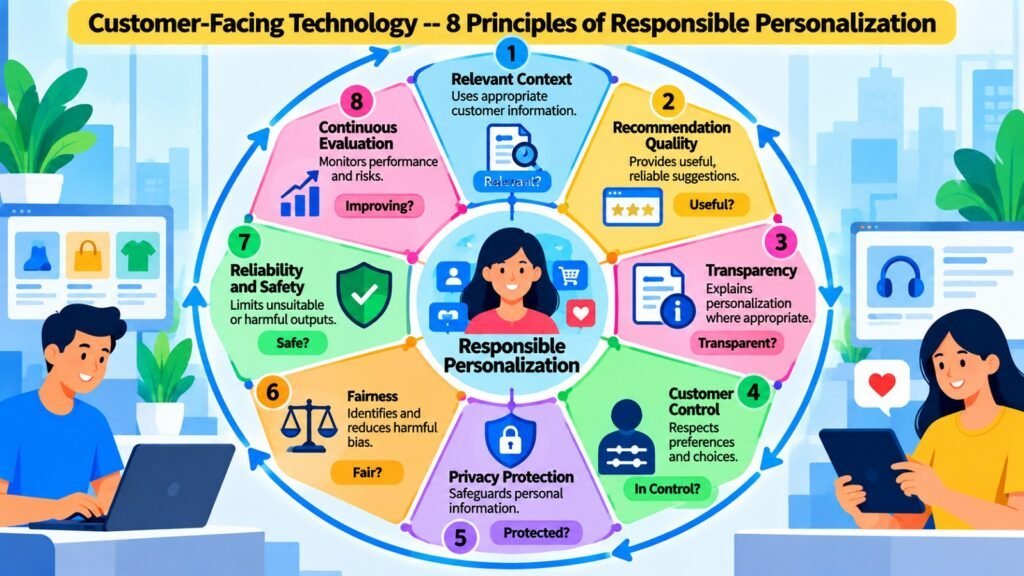
Customer Personalization Technology adapts interactions to individual needs, preferences, behavior, or context. Recommendation engines, personalized product displays, adaptive interfaces, contextual content, and AI-supported personalization are its established capabilities. Conceptually, most systems infer relevance from data, whether the customer’s own history, the behavior of similar customers, the attributes of items, or situational signals such as location and device. The underlying logic is statistical, so personalization is probabilistic and will sometimes be wrong.
Recommender systems research distinguishes collaborative filtering, content-based filtering, and hybrid approaches, each with characteristic weaknesses such as sparse data for new users and a tendency toward narrow recommendations (Ricci, Rokach, and Shapira, 2015). Personalization may improve relevance and reduce search effort, particularly where choice sets are large, although evidence of benefit depends on context and on how outcomes are measured. Relevance for the firm is not identical to value for the customer, and correlations between personalization and sales should not be read as causal without experimental design.
The risks are substantial. Inaccurate recommendations waste attention, intrusive targeting can feel invasive, inappropriate inferences may expose sensitive characteristics, and customers can lose control over what they see. Awad and Krishnan (2006) described how customers value personalization yet resist the data collection that enables it, a tension often termed the personalization-privacy paradox. Responsible practice therefore requires transparency about data use, consent where applicable, accessible controls, and evaluation against outcomes that matter to customers, not merely engagement.
Personalization should be separated from marketing campaign automation, which schedules and targets outbound marketing, and from the infrastructure that collects and processes customer data. The customer-facing question is what the person experiences, and not every customer benefits equally. Established capabilities such as recommendation sit alongside emerging applications, including generative AI-supported interactions, where reliability and accountability remain unresolved. This distinction guides a future sub-pillar article on Customer Personalization Technology. Evaluation should ask whether customers complete tasks with less effort, not only whether they click.
Table 7: Customer-Facing Technology for Personalization
| Customer-Facing Technology for Personalization | Customer-Facing Application |
| Collaborative filtering | Suggesting items liked by similar customers |
| Content-based filtering | Recommending items resembling prior choices |
| Hybrid recommender system | Combining methods to offset individual weaknesses |
| Personalized search ranking | Ordering results by individual relevance |
| Personalized product display | Tailoring homepage or catalog arrangement |
| Adaptive interface | Adjusting layout or features to usage patterns |
| Contextual content delivery | Presenting content by location, device, or time |
| AI-supported conversational assistance | Adapting responses to stated needs and history |
7. Customer-Facing Technology: Accessibility and Inclusive Interaction
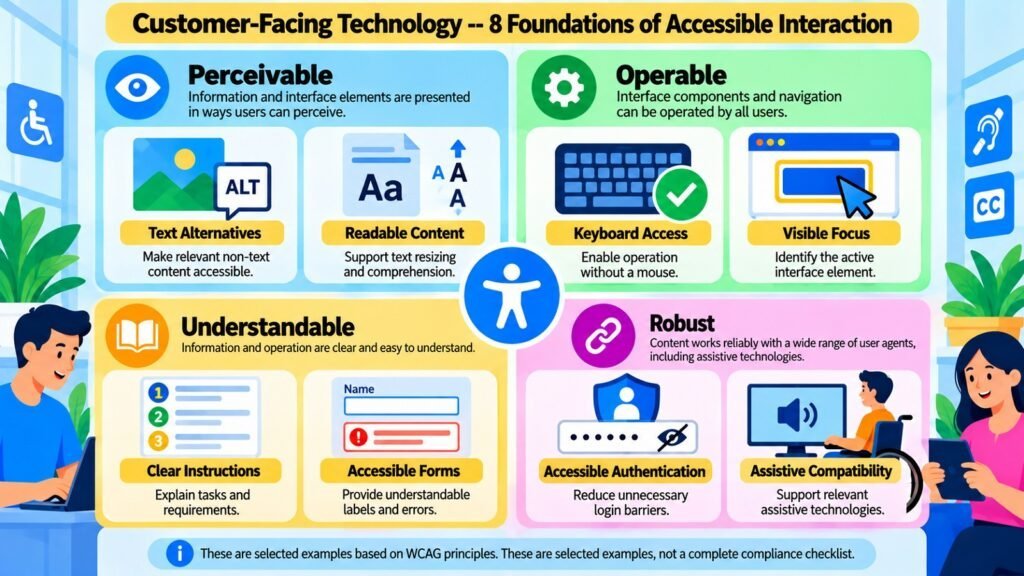
Accessibility and inclusive interaction concern whether customers with different abilities, devices, languages, levels of digital literacy, and access conditions can use customer-facing systems effectively. Relevant practices include screen-reader compatibility, keyboard navigation, captions, readable content, accessible forms, and support for assistive technologies. Their conceptual roots lie in universal design, formulated by the Center for Universal Design (Connell et al., 1997), and in inclusive design, which Persson and colleagues (2015) distinguish from universal and accessible design. Digital literacy and connectivity matter alongside disability, since exclusion often results from several overlapping constraints.
The Web Content Accessibility Guidelines, established by the World Wide Web Consortium, represent the most widely acknowledged technical standard. Release 2.2, published in 2023, structures requirements according to four foundational principles—perceivable, operable, understandable, and robust—alongside conformance levels designated as A, AA, and AAA. Numerous legal frameworks incorporate references to WCAG, thereby establishing conformance as a substantive obligation across many jurisdictions, though particular requirements differ by region. Determining which conformance level an organization pursues, and the rationale underlying that decision, constitutes an essential component of any credible accessibility strategy.
Conformance and inclusion represent distinct concepts. A system may fulfill success criteria while simultaneously creating obstacles for users, given that guidelines cannot account for every possible intersection of disability type, device platform, and user objective, and no standardized checklist can ensure usability across all populations. Assessment should therefore integrate automated testing mechanisms, specialized accessibility reviews conducted by experts, and direct evaluation involving individuals who depend on assistive technologies, as automated systems identify only a subset of conceivable accessibility issues. Truly inclusive design methodology recognizes user diversity as a fundamental design principle rather than a peripheral consideration requiring special accommodation.
Accessibility barriers may impede access to content, services, or support resources: inadequately labeled input fields, visual indicators that depend solely on color differentiation, authentication mechanisms lacking accessible alternatives, and multimedia content presented without textual captions. Businesses can incorporate accessibility into the evaluation of customer-facing systems from procurement onward, treating established requirements such as WCAG criteria as the baseline and context-dependent recommendations, such as simplified language for lower digital literacy, as design judgments. The discussion establishes a foundation for a sub-pillar article on Accessibility and Inclusive Interaction.
Table 8: Accessibility Principles and Techniques in Customer-Facing Technology
| Accessibility Principles or Techniques in Customer-Facing Technology | Customer-Facing Application |
| Text alternatives | Describing images for screen-reader users |
| Keyboard navigation | Operating every function without a mouse |
| Captions and transcripts | Providing spoken content to deaf or hard-of-hearing customers |
| Sufficient color contrast | Keeping text legible for low-vision users |
| Accessible forms | Labeling fields and identifying errors clearly |
| Screen-reader compatibility | Exposing structure through semantic markup |
| Resizable text and reflow | Supporting zoom and small screens |
| Plain language | Aiding comprehension across literacy levels |
8. Customer-Facing Technology: Omnichannel Customer Interaction
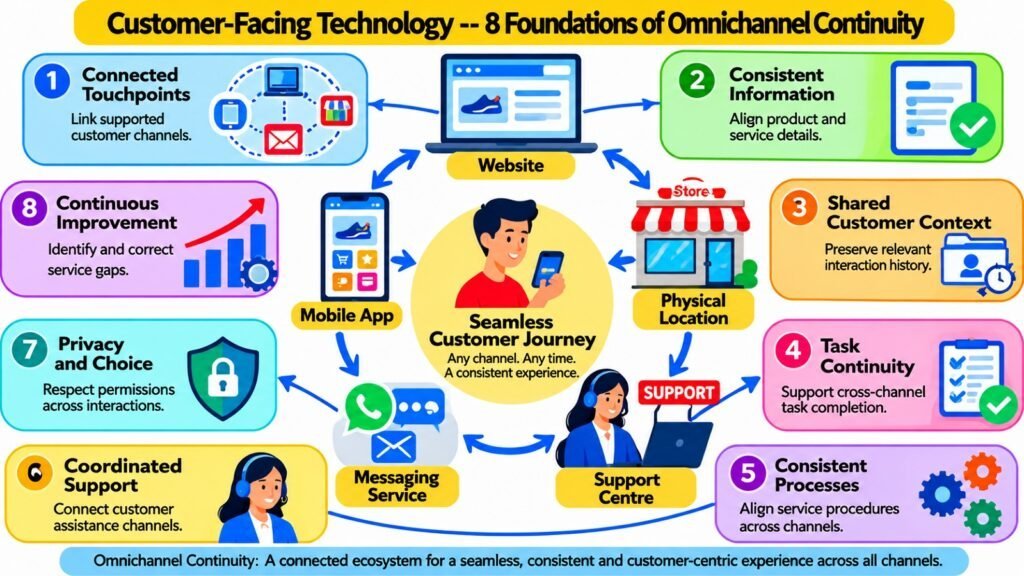
Omnichannel Customer Interaction connects customer-facing touchpoints so that customers can move among them with greater continuity. Websites, mobile applications, physical stores, messaging systems, and support channels are the usual components. The aim is that information, context, and service processes carry across channels, so a customer who begins an inquiry in one place need not start again in another. The accomplishment of coordination represents both an organizational and technical achievement of equal significance.
Multichannel availability and omnichannel coordination are different conditions. Offering many channels describes breadth, whereas omnichannel interaction describes integration, a distinction developed in work such as Verhoef, Kannan, and Inman (2015) and Beck and Rygl (2015). Lemon and Verhoef (2016) conceptualized customer experience across touchpoints in the customer journey, which provides a frame for assessing continuity. The conceptual literature is more settled than the empirical: expectations of benefit from integration are plausible and partly supported, but results vary by industry and by how integration is measured.
Implementation is difficult. Information fragments when systems do not share data, service processes differ between stores and online teams, and channels differ in capability, so an action possible in an application may be impossible by telephone. Continuity of context also raises privacy questions about how much history should travel between channels and with what consent. Integration is thus a necessary enabler, though this section does not turn to backend architecture. Customers notice discontinuities quickly, and each repeated request signals that channels operate as separate silos.
Businesses can evaluate continuity by tracing representative customer journeys across channels, noting repeated information requests, inconsistent answers, and abandoned transitions, and by complementing that analysis with customer feedback. Documented retail practices such as buying online and collecting in store illustrate the idea, though they show feasibility rather than universal benefit. Customer Experience Management is wider than channel continuity, and this section confines itself to coordination among touchpoints, preparing a sub-pillar article on Omnichannel Customer Interaction.
Table 9: Touchpoints in Omnichannel Customer-Facing Technology
| Touchpoints in Omnichannel Customer-Facing Technology | Role in Omnichannel Interaction |
| Website | Provides shared account and product information |
| Mobile application | Supports continued tasks and notifications |
| Physical store | Enables in-person pickup, returns, and assistance |
| Messaging system | Carries conversation history between sessions |
| Telephone support | Offers voice help informed by prior interactions |
| Delivers confirmations and links back to tasks | |
| Social media | Routes public inquiries into support channels |
| Kiosk or point-of-sale terminal | Connects in-store transactions to customer records |
Conclusion: Customer-Facing Technology and Its Foundations for Business Success
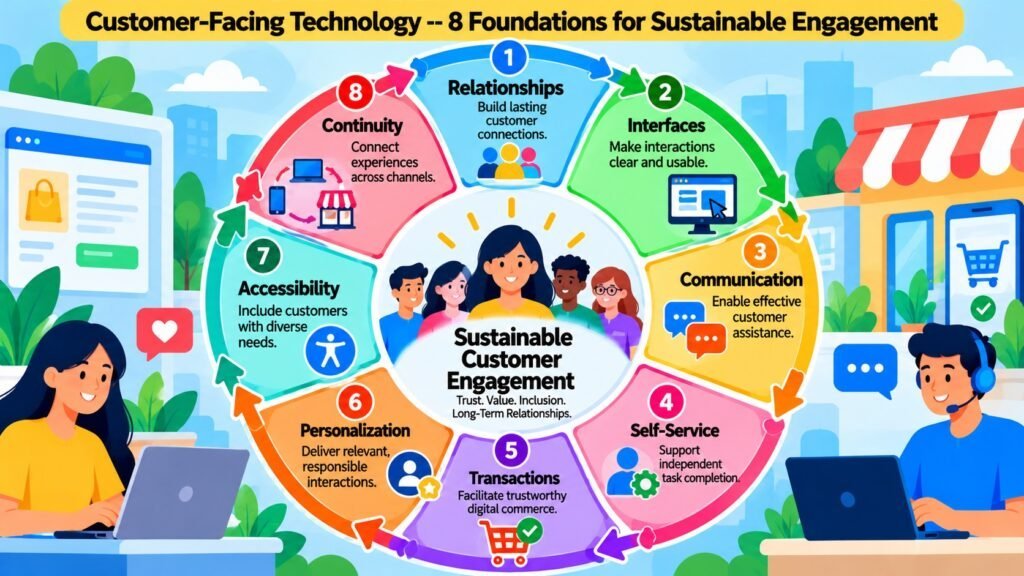
The eight foundations describe a single proposition from different angles: customer-facing technology shapes how organizations are experienced, and it succeeds when technical capability, customer needs, and organizational process align. Relationship technology preserves context, interfaces provide access, communication and self-service enable assistance, commerce supports transactions, personalization adapts relevance, accessibility widens participation, and omnichannel coordination binds the whole together. Customer-Facing Technology is an important Business Technology precisely because these dimensions interact.
Across them runs a common set of requirements: usability, accessibility, privacy, security, reliability, and continuity. Effectiveness depends on context, organizational processes, customer expectations, and evaluation, not on adoption alone. A sophisticated platform deployed without data discipline or escalation routes may underperform a modest one that is well governed, and responsible implementation means treating customers as participants in the system rather than as sources of data.
Considerable uncertainty remains. The causal links between particular technologies and loyalty, satisfaction, or growth are context-dependent and rarely established with the rigor that promotional claims suggest. Research is still needed on emerging capabilities, on customer behavior across channels, on implementation barriers, and on the conditions under which customer-facing systems create value. Distinguishing established findings from open questions is itself a methodological discipline.
For students and researchers, the framework offers a basis for focused inquiry into each aspect, and for practitioners it offers criteria for informed decisions. The task ahead is to evaluate these systems against meaningful customer outcomes and to refine them as evidence accumulates. Both groups derive advantages from approaching each assertion regarding customer-facing systems as a testable hypothesis requiring empirical validation.
Table 10: Foundational Principles of Customer-Facing Technology
| Foundational Principles of Customer-Facing Technology | Implication for Customer-Facing Technology |
| Customer-centered design | Begin design with customer tasks and contexts |
| Relationship continuity | Preserve accurate context across interactions |
| Communication suitability | Match channels to customer, task, and complexity |
| Independent task completion | Pair clear self-service with escalation routes |
| Reliable transactions | Sustain trust through transparent, secure processes |
| Responsible personalization | Ensure transparency, consent, and customer control |
| Accessibility | Widen who can use systems through inclusive design |
| Cross-channel coordination | Integrate touchpoints for the coherent journeys |