Table of Contents
Introduction: Employee Experience – The Foundation of Human-Centered Organizations
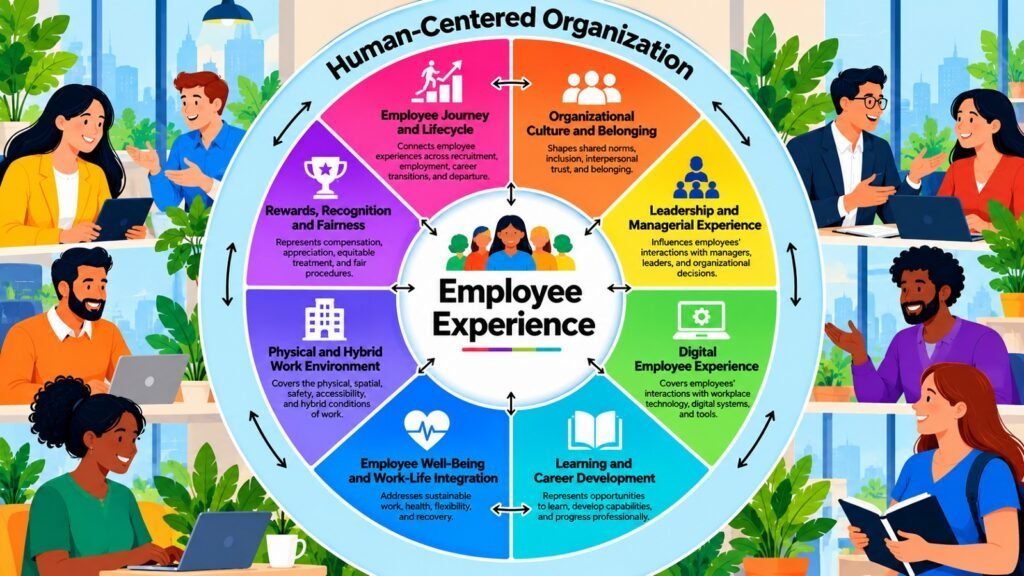
Employee Experience (EX) denotes the perceptions, interpretations, and responses that arise from employees’ interactions with an organization, its people, leadership, culture, technologies, systems, and working environments throughout the employment relationship (Plaskoff, 2017). Employee Experience is an important aspect of Human-Centered Organizations, because such organizations can not treat employees merely as resources to be allocated; they must examine how structures, policies, decisions, and everyday practices are actually lived by the people who are subject to them.
The construct is easily conflated with neighbouring ideas. Employee Engagement, commonly defined as a work-related state of vigour, dedication, and absorption (Schaufeli et al., 2002), is an outcome that experience may influence, while Employee Satisfaction is an evaluative attitude toward the job (Locke, 1976). Employee Relations concerns the formal management of the employment relationship, including grievance and collective processes. Experience is the broader perceptual field within which each of these is situated.
Because no single discipline captures that field, this article draws on human resource management, organizational behaviour, organizational psychology, leadership studies, workplace technology research, and organizational design. Its central question is how organizational systems, relationships, technologies, and working conditions jointly shape experience, and how that experience can be understood and improved through evidence-based, human-centered design. Each section progresses systematically from theoretical underpinnings and foundational concepts through established frameworks to empirical data, rigorous analysis, and actionable implementation, thereby addressing the requirements of both scholarly advancement and organizational application. The scope is deliberately conceptual and integrative, and its contribution lies in connecting these literatures to organizational practice without claiming a validated model.
Table 1: Eight Dimensions of Employee Experience at a Glance
| Aspect | Distinctive Contribution |
| Employee Journey and Lifecycle | Temporal sequence of stages and transitions |
| Organizational Culture and Belonging | Shared norms, inclusion, and trust |
| Leadership and Managerial Experience | Everyday interactions with managers and leaders |
| Digital Employee Experience | Usability and friction of workplace technology |
| Learning and Career Development | Opportunities for skill growth and progression |
| Employee Well-Being and Work-Life Integration | Sustainable demands, recovery, and flexibility |
| Physical and Hybrid Work Environment | Spatial conditions and location arrangements |
| Rewards, Recognition and Fairness | Perceived equity of outcomes, procedures, and treatment |
1. Employee Experience: Understanding the Employee Journey and Lifecycle
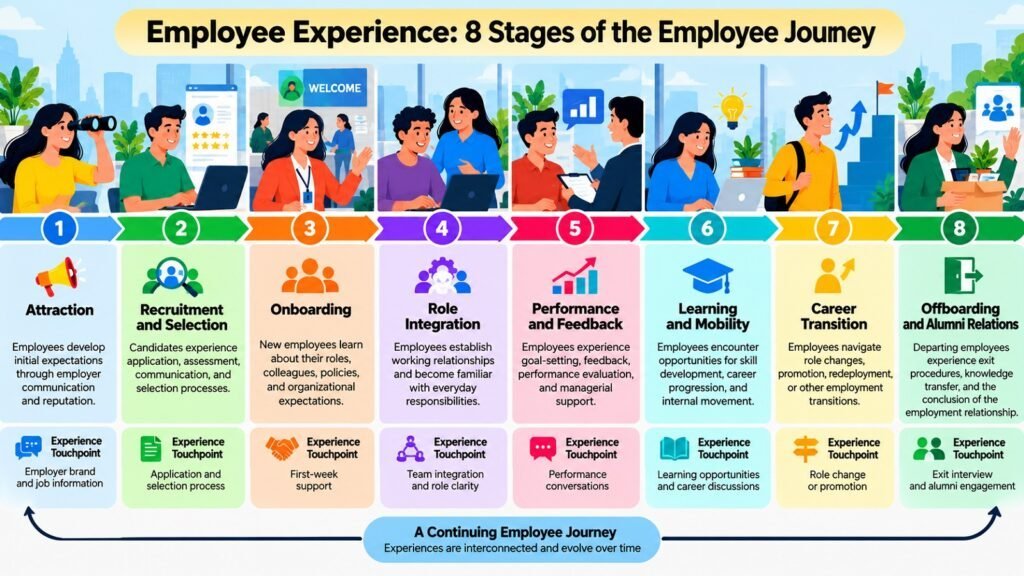
The employee journey is the chronologically ordered and mutually dependent sequence of encounters through which a person engages with an organization, from recruitment and onboarding through daily work, development, internal mobility, career transitions, and offboarding. The employee lifecycle is merely the skeleton of employment stages, whereas Employee Experience is the set of perceptions and interpretations attached to them. Two employees can traverse identical stages and emerge with opposed assessments, which is why a count of stages reveals little without evidence about meaning. Treating the journey as a series of interdependent episodes also reminds practitioners that an early disappointment can colour later events, so experience accumulates and is not simply averaged.
Journey mapping exploits this distinction by locating critical touchpoints and moments that matter, in which expectations are either confirmed or breached. Psychological contract research suggests that perceived breaches of employer promises, often seeded during recruitment, erode trust and commitment (Morrison and Robinson, 1997).
Organizational socialization theory, from Van Maanen and Schein (1979) onward, holds that newcomers acquire roles and norms through the tactics an organization adopts, and a meta-analysis found newcomer adjustment to mediate between socialization and later attitudes (Bauer et al., 2007). Person–organization fit research adds that perceived value congruence relates to satisfaction and intention to remain (Kristof-Brown et al., 2005), although fit is judged against what an organization visibly does, not what it advertises. Performance conversations, role changes, and exit processes similarly shape inferences about fairness and support.
Methodologically, interviews and focus groups yield rich accounts of meaning but are costly and vulnerable to retrospective reconstruction. Lifecycle surveys scale and permit comparison across stages, yet they compress nuance and capture only the moments that designers chose to measure. Longitudinal designs best expose change within persons, although attrition limits them. A usable map therefore records, for each stage, the employee need, probable friction, supporting evidence, and an improvement opportunity, while leaving culture, leadership, technology, and well-being for separate analysis. Hypothetical illustrations should be labelled as such, never reported as findings.
Table 2: Employee Experience Considerations Across Lifecycle Stages
| Lifecycle Stage | Experience Consideration |
| Recruitment | Accuracy of promises and employer signals |
| Onboarding | Newcomer adjustment and role clarity |
| Daily work | Task meaning, autonomy, and support |
| Performance review | Perceived fairness of criteria and feedback |
| Development | Access to learning and stretch opportunities |
| Internal mobility | Transparency of movement and promotion routes |
| Organizational change | Uncertainty, communication, and trust |
| Offboarding | Dignity of exit and residual employer image |
2. Employee Experience: Organizational Culture and Belonging
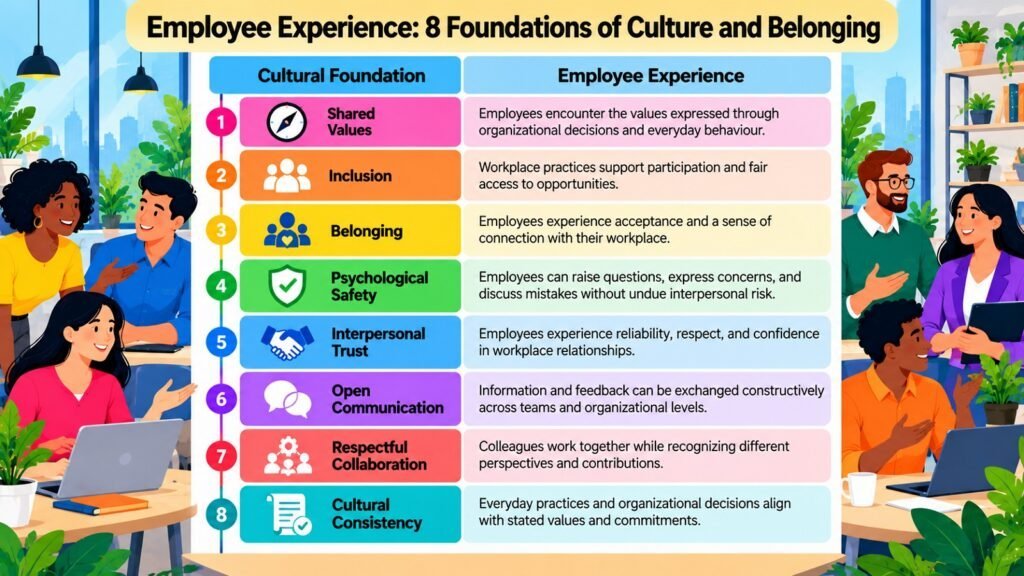
Culture shapes Employee Experience through shared assumptions, values, and behavioural norms that tell employees what is expected, rewarded, and tolerated (Schein, 2010). The analytical difficulty lies in the gap between espoused values and enacted behaviour, since employees infer culture from what colleagues and leaders do under pressure rather than from published statements. Baumeister and Leary (1995) conceptualized belonging as a fundamental need for stable, positive interpersonal bonds, and social identity theory (Tajfel and Turner, 1979) explains why group identification colours the interpretation of events. Neither, however, specifies which organizational practices generate belonging, which marks the limit of their explanatory reach. This matters practically because employees who notice such a gap may reinterpret later signals through it.
Psychological safety, a shared belief that interpersonal risk-taking is acceptable (Edmondson, 1999), links the discussion to how disagreement, questions, and mistakes are received. Inclusion research frames acceptance as the combination of belonging with respect for uniqueness (Shore et al., 2011). Informal norms may nonetheless contradict formal policy, and occupational or demographic groups often inhabit one organization as if it were several different cultures. Performative inclusion, inconsistent leadership behaviour, and belonging campaigns that leave structural barriers untouched show how declared commitments can coexist with exclusion. Different groups may therefore report different experiences of identical policies, which means aggregate scores can conceal exactly the variation that a human-centered analysis most needs to see.
Investigation should triangulate. Interviews, focus groups, and open feedback illuminate meaning, and carefully designed surveys permit comparison, but self-reports capture perception and cross-sectional designs cannot establish the direction of effects. No practice should be presumed to produce identical outcomes across contexts. A practical culture assessment therefore separates four layers, namely stated values, observable behaviours, employee perceptions, and organizational responses to deviations, and then examines where they diverge. The framework is diagnostic and not prescriptive, since its purpose is to expose inconsistencies that deserve explanation before any intervention is chosen, because similar surface symptoms may stem from quite different causes.
Table 3: Cultural Conditions and Their Implications for Employee Experience
| Cultural Condition | Implication for Employees |
| Espoused–enacted value gap | Cynicism and eroded credibility |
| Psychological safety | Willingness to raise concerns and errors |
| Inclusive norms | Acceptance alongside distinctiveness |
| Informal norms contradicting policy | Mixed signals about acceptable conduct |
| Subcultural variation | Divergent experiences within one organization |
| Performative inclusion | Scepticism toward diversity initiatives |
| Structural barriers | Limited effect of belonging messages |
| Responses to mistakes | Calibrated interpersonal risk-taking |
3. Employee Experience: Leadership and Managerial Experience
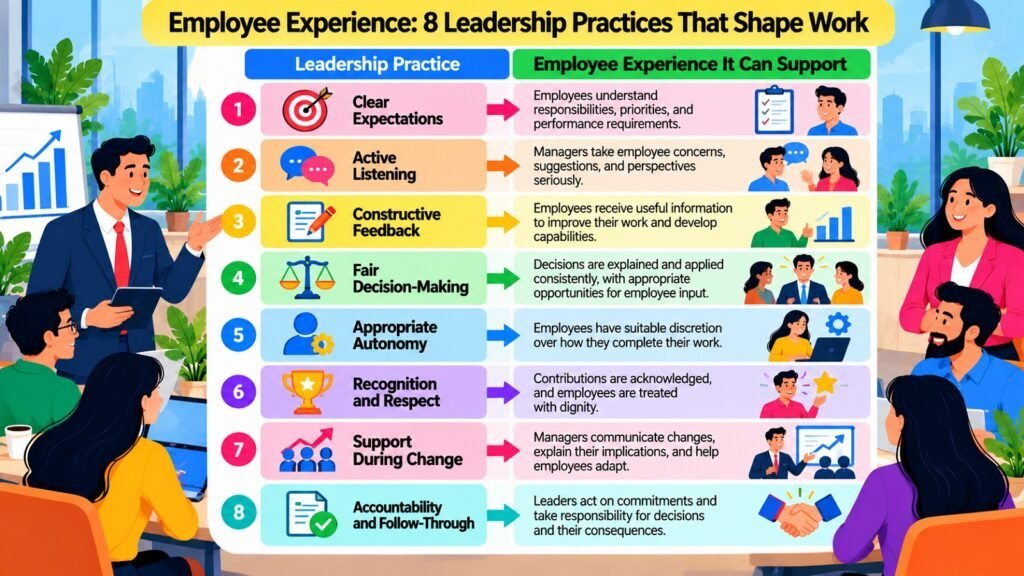
Employees encounter an organization largely through people: direct managers, team leaders, and, more distantly, senior executives. Communication, accessibility, feedback, transparency, accountability, decision-making latitude, and responsiveness to concerns shape perceptions of trust, support, fairness, role clarity, and the safety of contributing ideas. Organizational support theory proposes that employees personify the organization through supervisors’ conduct and form beliefs about whether it values them (Eisenberger et al., 1986), and a meta-analysis tied perceived support to commitment and performance (Rhoades and Eisenberger, 2002). Because supervisors mediate how policies are translated into daily practice, the same organizational rule can feel supportive under one manager and arbitrary under another.
Leadership theories illuminate different facets. Transformational leadership (Bass, 1985) emphasizes inspiration and individualized consideration, with meta-analytic links to follower outcomes (Judge and Piccolo, 2004). Servant leadership prioritizes follower growth (Greenleaf, 1977), ethical leadership stresses normative conduct and fairness (Brown et al., 2005), and inclusive leadership foregrounds openness and availability (Carmeli et al., 2010).
Much of this evidence is correlational and often rests on a single respondent source, so effects may be inflated and cross-cultural transfer remains uncertain. Intention is also not experience: a manager who believes they are empowering may be perceived as controlling, and guidance becomes control when autonomy disappears from expectation setting, performance conversations, error responses, change, and explanations of difficult decisions. Contextual differences matter as well, since preferences for directive or participative styles vary with culture, task complexity, and employee experience, so no single leadership model can be treated as universally superior.
Assessment can combine structured feedback, upward appraisal, interviews, and leadership assessments, yet power asymmetry, social desirability, and fear of retaliation distort candour, which makes confidentiality, aggregation thresholds, and independent administration essential. A concise diagnostic therefore compares observed behaviours, employee perceptions, and improvement opportunities for each managerial practice. Findings should then be read alongside workload and structural constraints, because managers often work within limits they did not set, and attributing every problem to individual behaviour would misdirect remedies.
Table 4: Leadership Practices and Associated Employee Experience
| Leadership Practice | Experience Potentially Shaped |
| Clear expectation setting | Role clarity and reduced ambiguity |
| Regular, specific feedback | Perceived competence and fairness |
| Transparent decision explanation | Trust and procedural fairness |
| Accessible, responsive listening | Voice and perceived support |
| Autonomy-supportive delegation | Ownership and motivation |
| Accountable follow-through | Credibility of commitments |
| Inclusive invitation of views | Belonging and contribution |
| Excessive monitoring | Perceived distrust and constrained discretion |
4. Employee Experience: Digital Employee Experience
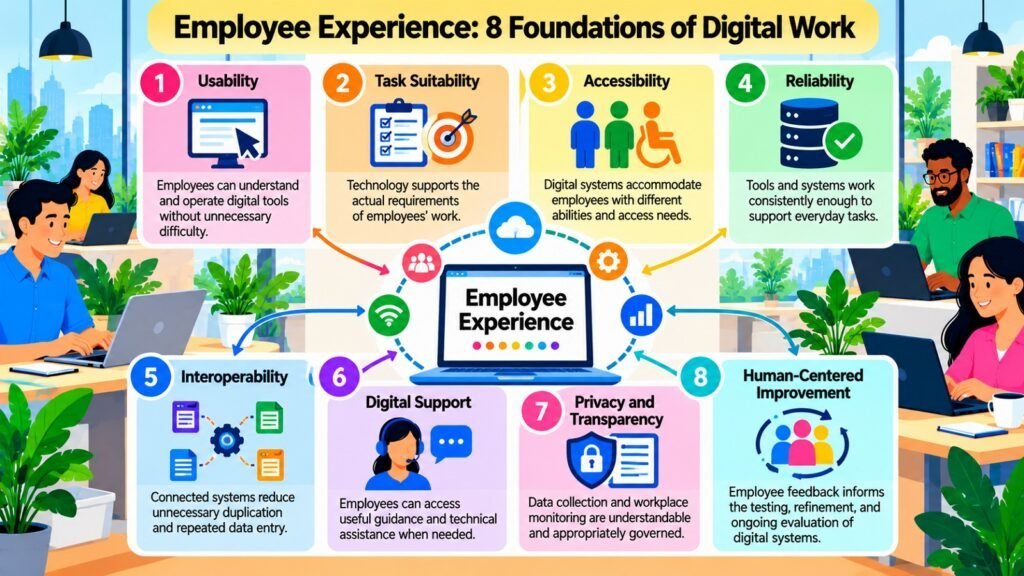
Digital Employee Experience (DEX) concerns how employees perceive the software, collaboration platforms, portals, enterprise systems, automation, and AI-enabled tools through which much work is now performed. Its quality turns on usability, accessibility, reliability, interoperability, technical support, and the cognitive effort a task demands. ISO 9241-11 defines usability as effectiveness, efficiency, and satisfaction in a specified context of use, a reminder that usability is relational and not a property of software alone. Inadequately designed digital systems levy an imperceptible cost upon cognitive resources, which organizational personnel internalize through informal solutions that conventional measurement frameworks may fail to capture.
Adoption does not guarantee improvement. The technology acceptance model proposes that perceived usefulness and ease of use predict intention to use (Davis, 1989), yet mandated systems are used regardless of satisfaction, so usage data conflate compliance with endorsement. Sociotechnical systems theory (Trist and Bamforth, 1951) argues that technical and social subsystems should be designed jointly, and poor integration, redundant approvals, and information overload show what follows when they are not.
Technostress research links some technology demands to strain (Tarafdar et al., 2007), though effects depend on context. Remote collaboration, self-service, generative AI, and monitoring raise further questions about privacy and algorithmic transparency, and studies of algorithmic management indicate that such systems can reshape autonomy and trust (Kellogg et al., 2020). Such effects are context-dependent, so claims of universal harm or benefit are unwarranted.
Investigation can combine interviews, usability testing, task-completion measures, accessibility evaluation against the Web Content Accessibility Guidelines, and governed workplace analytics. Telemetry alone misses frustration, autonomy, and trust, so quantitative traces need qualitative interpretation. A practical framework identifies friction through observed tasks, ranks it by employee impact, frequency, and evidence, and prioritizes remedies accordingly, staying with employees’ experience of technology rather than infrastructure or security architecture. Findings should distinguish established research, such as usability principles, from plausible design considerations that remain untested in a given workplace, and employees ought to take part in prioritization so that remedies reflect lived experience.
Table 5: Digital Workplace Conditions and Employee Experience Implications
| Digital Condition | Implication |
| Intuitive interface design | Lower cognitive effort and fewer errors |
| Accessibility conformance | Equitable participation across abilities |
| System reliability | Continuity of work and trust in tools |
| Tool interoperability | Fewer duplicate entries and context switches |
| Information overload | Attention fragmentation and strain |
| Responsive technical support | Faster recovery from disruption |
| Algorithmic transparency | Perceived fairness of automated decisions |
| Monitoring and analytics | Privacy concerns and autonomy effects |
5. Employee Experience: Learning and Career Development
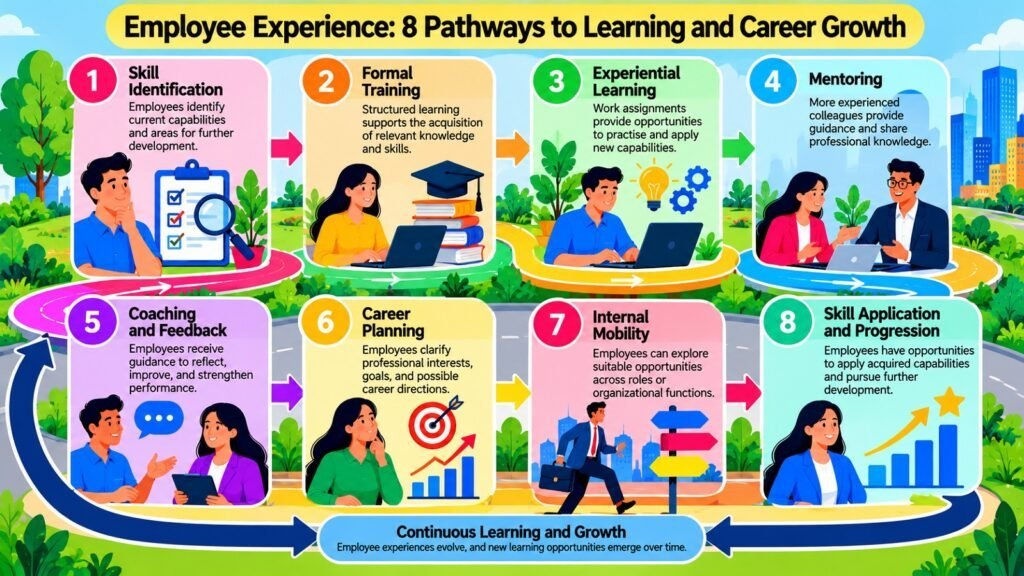
Opportunities to build skills, acquire knowledge, and advance professionally shape Employee Experience because they signal organizational investment and open future possibilities. Practices range from formal training to informal learning, mentoring, coaching, stretch assignments, job rotation, and internal mobility. Human capital theory (Becker, 1964) treats skills as investments yielding returns, while self-determination theory (Ryan and Deci, 2000) explains why development sustains intrinsic motivation through competence and autonomy. Career development perspectives add that aspirations differ widely, and perceived organizational support may rise when employees read development as genuine commitment. Development opportunities also communicate priorities, since decisions about who receives investment convey implicit judgements about whose future the organization expects to share.
The evidence demands care, because participation in training is not learning, learning is not transfer, and transfer is not advancement. Meta-analyses indicate that training can improve outcomes (Arthur et al., 2003), yet transfer depends on trainee characteristics, design, and work environment (Blume et al., 2010). Mentoring has been associated with career and attitudinal benefits, though effects are modest (Eby et al., 2008).
Unequal access, vague promotion criteria, managerial gatekeeping, and shifting skill requirements can all restrict opportunity, so organizations should make development reachable across roles, career stages, and working arrangements, including remote and shift workers. Employability, understood as the capacity to remain valuable in the labour market, introduces a tension, because development that raises external mobility may heighten turnover risk even as it may strengthen the employment relationship.
Evaluation can draw on interviews, skill assessments, development plans, internal mobility records, and longitudinal analysis of career progression. Course completions and promotion counts are incomplete proxies, since they ignore relevance, applied use, and employees who value lateral growth. A practical framework asks whether opportunities are relevant, accessible, applied, and aligned with needs, keeping the focus on individual progression rather than organizational knowledge management. Evaluation should respect that some employees seek depth of expertise, others breadth, and others stability, so alignment is assessed against individual aspirations and not assumed from a uniform ladder of advancement.
Table 6: Development Mechanisms and Their Intended Employee Experience Support
| Mechanism | Intended Capability or Experience |
| Formal training | Structured skill acquisition |
| Informal learning | Contextual, peer-based knowledge |
| Mentoring | Career guidance and psychosocial support |
| Coaching | Individual performance reflection |
| Stretch assignments | Competence through challenge |
| Job rotation | Broader perspective and adaptability |
| Internal mobility | Visible career pathways |
| Development planning | Alignment of goals with opportunity |
6. Employee Experience: Employee Well-Being and Work-Life Integration
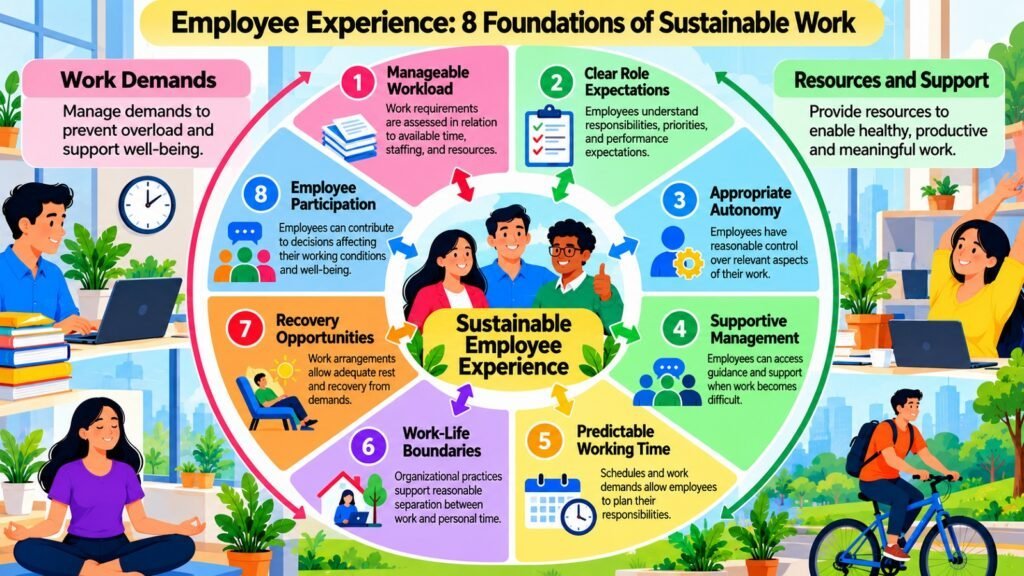
Working conditions, and not merely individual resilience, determine how sustainable work feels. Workload, schedules, flexibility, psychological and physical demands, recovery time, boundaries, and organizational support jointly shape Employee Experience. The Job Demands–Resources model proposes that high demands drain energy and contribute to exhaustion, whereas resources such as autonomy and support foster engagement and buffer strain (Demerouti et al., 2001; Bakker and Demerouti, 2007). Interactions are not uniform, since the same demand may challenge one employee and overwhelm another, and the relevant resources vary across jobs. Recovery deserves particular emphasis, because resources replenish only when employees can psychologically detach from work during non-work time.
Well-supported relationships include the link between sustained high demands and burnout, which the World Health Organization classifies as an occupational phenomenon arising from chronic workplace stress that has not been successfully managed. Evidence on flexibility is more mixed. A meta-analysis found modest benefits of flexible work for work–family conflict (Allen et al., 2013), yet flexibility can blur boundaries, and persistent connectivity can impede recovery (Sonnentag and Fritz, 2007).
Staffing, managerial expectations, and scheduling determine whether policies relieve or merely mask pressure, and well-being programmes tend to disappoint when underlying workload remains unaddressed. These trade-offs show why well-being cannot be delegated to wellness offerings alone, and why caregiving responsibilities, which differ markedly across employees, call for schedules that accommodate varied obligations without penalty.
Researchers can use confidential surveys, interviews, workload assessments, and governed indicators such as absence or turnover, although privacy, stigma, and ambiguity limit what numbers reveal without contextual evidence. ISO 45003 offers guidance on managing psychosocial risk. A practical approach catalogues demands, identifies available resources, and targets improvements at their source, remaining distinct from medical advice and physical workplace design. Findings should guide changes to staffing, scheduling, and expectations and not merely individual coping advice, and any indicator should be treated as a prompt for inquiry rather than a verdict. Employees’ own accounts of what makes work sustainable should anchor this analysis.
Table 7: Workplace Demands, Resources, and Employee Experience Relevance
| Demand or Resource | Relevance |
| Excessive workload | Exhaustion risk and reduced recovery |
| Time pressure | Strain without adequate control |
| Job autonomy | Buffer against demands and source of engagement |
| Supervisor support | Resource for coping and perceived care |
| Schedule predictability | Planning ability and caregiving compatibility |
| Flexible arrangements | Control over timing, with boundary risks |
| After-hours connectivity | Impeded psychological detachment |
| Adequate staffing | Sustainable workload distribution |
7. Employee Experience: Physical and Hybrid Work Environment
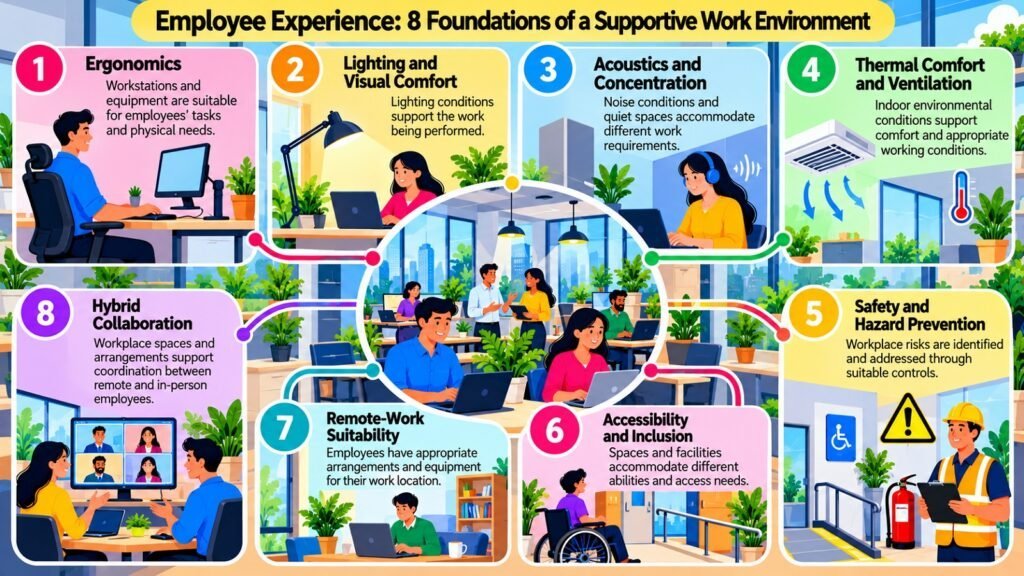
Physical and spatial conditions influence Employee Experience through comfort, concentration, collaboration, privacy, safety, and accessibility. Layout, ergonomics, lighting, acoustics, temperature, equipment, and meeting spaces matter, as does the choice among office, remote, and hybrid arrangements. Environmental psychology and ergonomics treat the fit between environment and person-task demands as decisive, and Vischer (2007) argues that comfort and control underpin performance. Inclusive design extends this logic by insisting that environments accommodate varied abilities, while standards such as ISO 45001 supply minimum protections. Because suitability depends on tasks, abilities, and working patterns, a layout that supports focused analysis may frustrate collaborative design work, and neither deserves treatment as the default for everyone.
Evidence rebuts any claim of a universally ideal setting. Kim and de Dear (2013) found that the interaction benefits of open-plan offices were outweighed by noise and privacy drawbacks, and a field study reported reduced face-to-face interaction after open layouts were introduced (Bernstein and Turban, 2018), yet task type moderates such effects. Remote and hybrid work add distinct difficulties: unequal equipment, isolation, visibility differences, unsuitable home conditions, and coordination between on-site and remote colleagues.
A randomized trial of hybrid work at one large firm reported no detectable harm to performance and lower attrition (Bloom et al., 2024), but a single setting does not license general conclusions. These conditions remain separate from software usability and culture, although they interact with both. Recognition that physical conditions also influence safety and accessibility reinforces that some provisions are obligations and not preferences, and should not be traded against convenience.
Workplace assessments, accessibility reviews, interviews, observation, and feedback reveal mismatches. Occupancy data and stated preferences mislead when detached from task requirements, safety, accessibility, and personal circumstances. A practical approach links measured conditions to reported experience and to actual work needs. Employees working from home may bear costs for equipment and space, so equitable support requires attention to differences in housing circumstances, which employer policy rarely observes directly. Findings should inform adjustments that respect safety and accessibility first.
Table 8: Physical Workplace Conditions and Employee Experience Relevance
| Condition | Relevance |
| Acoustic environment | Concentration and privacy |
| Lighting quality | Visual comfort and alertness |
| Thermal comfort | Comfort and sustained attention |
| Ergonomic equipment | Prevention of musculoskeletal strain |
| Accessibility provisions | Equitable physical participation |
| Meeting and collaboration spaces | Support for interaction-heavy tasks |
| Home workspace suitability | Remote comfort and safety |
| Hybrid coordination | Visibility and parity across locations |
8. Employee Experience: Rewards, Recognition and Fairness
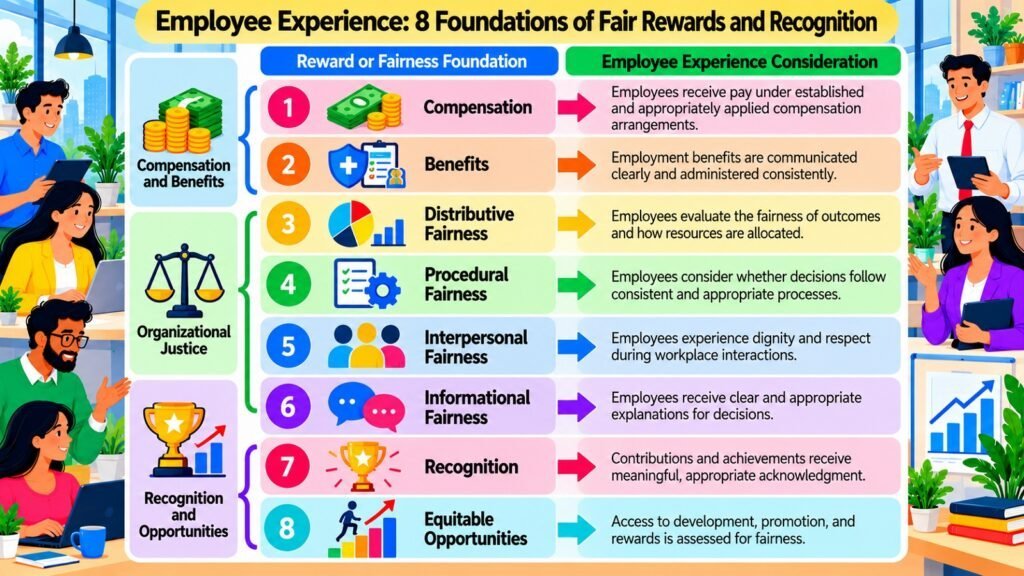
Compensation, benefits, recognition, performance evaluation, promotion, and equitable treatment shape Employee Experience both materially and psychologically. Employees assess not only what they receive but whether it seems fair, so perceived fairness may diverge from a reward’s formal value or an employer’s stated intention.
Social exchange theory (Blau, 1964) frames employment as reciprocal obligation sustained by fair treatment, and equity theory (Adams, 1963) predicts comparison of input-outcome ratios with those of others. Organizational justice encompasses three distinct dimensions: distributive justice, which pertains to the allocation of outcomes; procedural justice, which addresses the fairness of decision-making processes; and interpersonal justice, which relates to the respectful treatment of individuals. Meta-analytic research demonstrates that all three dimensions are significantly associated with employee attitudes and workplace behaviors (Colquitt et al., 2001). The distinction matters because a generous reward delivered through an arbitrary process may be judged less favourably than a modest one delivered transparently.
The practical consequences are considerable. Pay transparency, consistent performance criteria, accessible benefits, and well-explained decisions can strengthen perceived procedural fairness, although transparency may also expose inequities that an organization is unprepared to address. Favouritism, opaque pay systems, biased evaluations, performative recognition, and tournament-like rewards can corrode trust and encourage unhealthy competition. Meta-analytic evidence further suggests that tangible rewards can undermine intrinsic motivation under some conditions (Deci et al., 1999), so identical rewards are neither automatically fair nor equally effective across cultures and organizations. Recognition raises a parallel concern, since appreciation that feels formulaic or is distributed unevenly may signal indifference rather than regard.
Investigation can combine interviews, pay-equity analysis, performance-review audits, compensation comparisons, and surveys. Perceptions must be distinguished from verifiable evidence on pay, promotion, and implementation, since self-reports may reflect incomplete information and collecting compensation data raises confidentiality concerns. A review framework examines reward outcomes, decision procedures, communication, and interpersonal treatment, staying clear of general motivation and grievance procedures. Findings should separate what employees believe from what records show, and discrepancies between the two are themselves informative, pointing either to genuine inequity or to failures of communication that deserve repair.
Table 9: Reward and Fairness Concepts and Employee Experience Implications
| Concept | Implication |
| Distributive justice | Perceived fairness of outcomes received |
| Procedural justice | Trust in how decisions are made |
| Interpersonal justice | Dignity in treatment and communication |
| Informational justice | Adequacy of decision explanations |
| Equity comparison | Sensitivity to input-outcome ratios |
| Social exchange | Reciprocity of obligations and effort |
| Pay transparency | Clarity, alongside exposure of inequities |
| Recognition practices | Appreciation, undermined when performative |
Conclusion: Employee Experience – Advancing Human-Centered Organizations
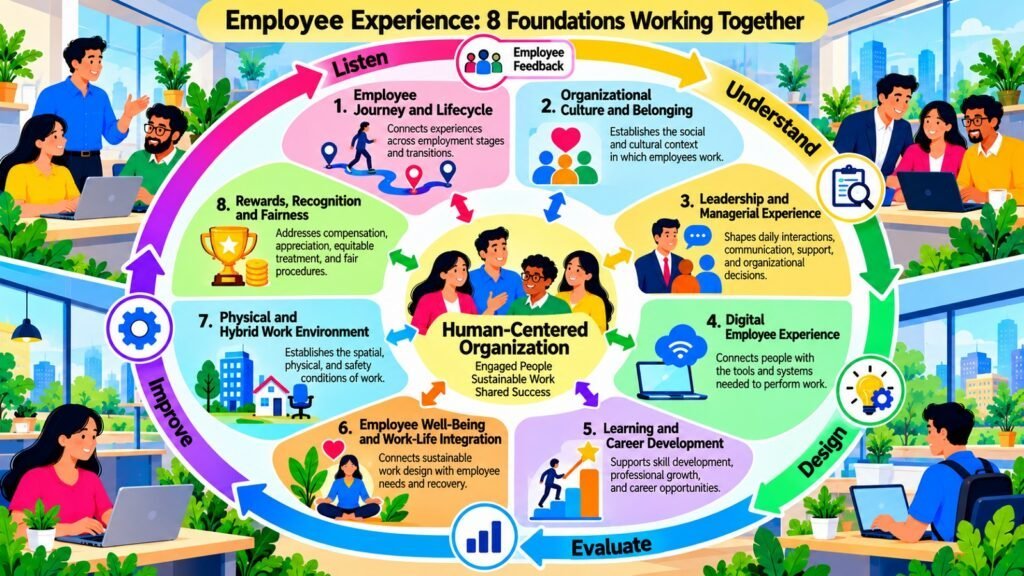
The eight foundations jointly shape Employee Experience, and their interactions matter as much as their individual contributions. Journeys are interpreted through culture, mediated by managers, enabled or hampered by technology and space, sustained by learning and well-being, and judged through the fairness of rewards. Employee Experience is therefore an important aspect of Human-Centered Organizations, because it reveals how structures, relationships, technologies, leadership practices, development opportunities, working conditions, and reward systems affect the people who work within them. No individual organizational foundation possesses the capacity to encompass the full spectrum of employee experiences, and advancement achieved in a particular domain is probable to remain constrained provided that other dimensions persist in presenting challenges.
The distinctions drawn at the outset remain useful. Engagement, satisfaction, and employee relations each illuminate part of the picture, yet none replaces the broader perceptual field that experience names. Understanding it requires employee perspectives, qualitative inquiry, suitable quantitative measures, and contextual analysis rather than a single score or isolated indicator. Ongoing stakeholder engagement, participatory design methodologies, responsible information stewardship, open communication regarding decision-making processes, and research-informed enhancement initiatives establish foundational principles for workplaces that prioritize human welfare and dignity.
Caution is nonetheless warranted. The eight-part framework is a conceptual organizing device, not a validated scientific model, and experience is context-dependent. Measurement, theory, and links with organizational outcomes remain open to investigation, so causal claims should be made sparingly. Even so, integrated study can help researchers examine workplace conditions and help organizations build systems that respect human needs while pursuing sustainable objectives. Progress will probably come from accumulating comparable, context-sensitive studies and from organizations that treat experience data as a basis for dialogue, not for ranking or discipline.
Table 10: Eight Foundations of Employee Experience and Their Human-Centered Contributions
| Foundation | Human-Centered Contribution |
| Journey and lifecycle | Coherence across employment stages |
| Culture and belonging | Trust and shared respect |
| Leadership and management | Supportive, accountable guidance |
| Digital experience | Low-friction, accessible work tools |
| Learning and development | Growth and employability |
| Well-being and integration | Sustainable demands and recovery |
| Physical and hybrid environment | Suitable, accessible workplaces |
| Rewards and fairness | Legitimate, transparent treatment |