Table of Contents
Introduction: Cybersecurity as the Foundation of Digital Defense
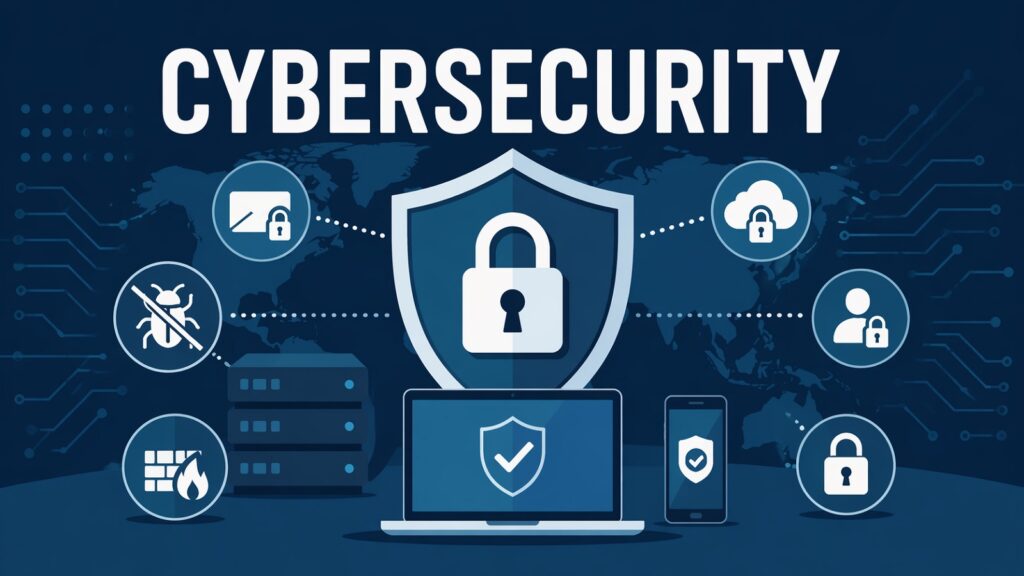
There is something almost invisible about the systems that keep our digital lives intact. You do not notice them when everything works. You only feel their absence when something goes wrong. That invisible layer is Cybersecurity, and it has become one of the most important aspects of modern technology today.
Every time data moves across a network, every time a user logs into an application, and every time a company stores sensitive records in the cloud, Cybersecurity is working in the background. It holds the entire digital infrastructure together. Without it, the systems we rely on for banking, healthcare, communication, and commerce would be wide open to abuse.
The digital world is deeply interconnected now. Devices talk to servers. Servers talk to other servers. Applications pull data from dozens of sources at once. This level of connectivity creates enormous opportunity, but it also creates enormous risk. Cybersecurity acts as the backbone of defense across all of these connections, making sure that information flows safely and that systems stay reliable.
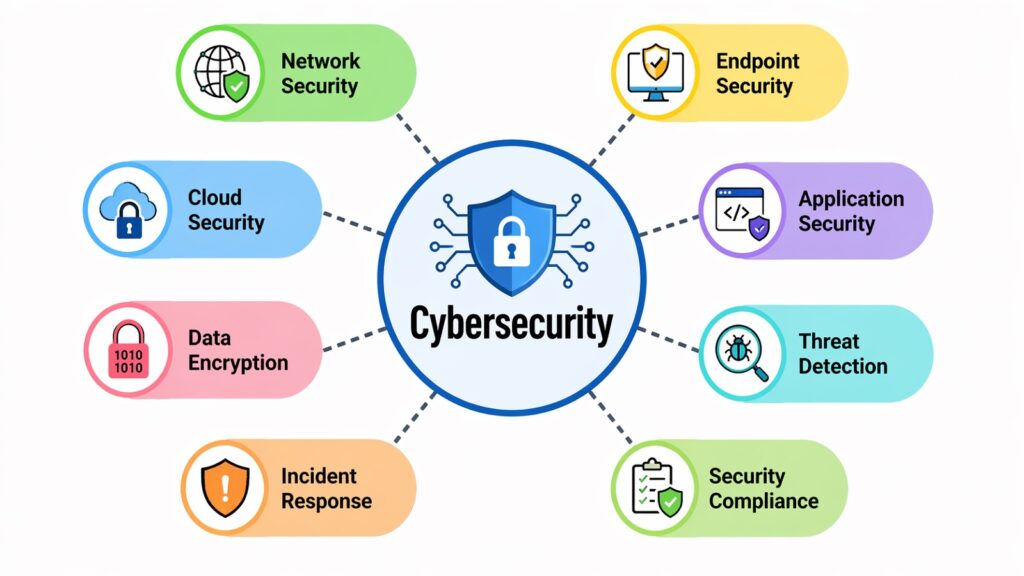
This article looks at eight powerful foundations of Cybersecurity. Each one covers a different layer of protection, from the networks that carry data to the regulations that govern how organizations handle it. Together, these eight areas form a complete picture of what it means to defend a digital environment.
Cybersecurity Foundations Overview
| Cybersecurity Foundations | What It Protects |
| Network Security | Communication channels, routers, and data flow between systems |
| Endpoint Security | Laptops, mobile devices, servers, and other access points |
| Cloud Security | Cloud-hosted data, services, and distributed infrastructure |
| Application Security | Software systems, web apps, and development pipelines |
| Data Encryption | Sensitive data in transit and at rest across all systems |
| Threat Detection | Real-time monitoring of anomalies and suspicious behavior |
| Incident Response | Containment, recovery, and continuity after security events |
| Security Compliance | Adherence to legal, regulatory, and industry standards |
1. Cybersecurity in Network Security: Protecting System Connections
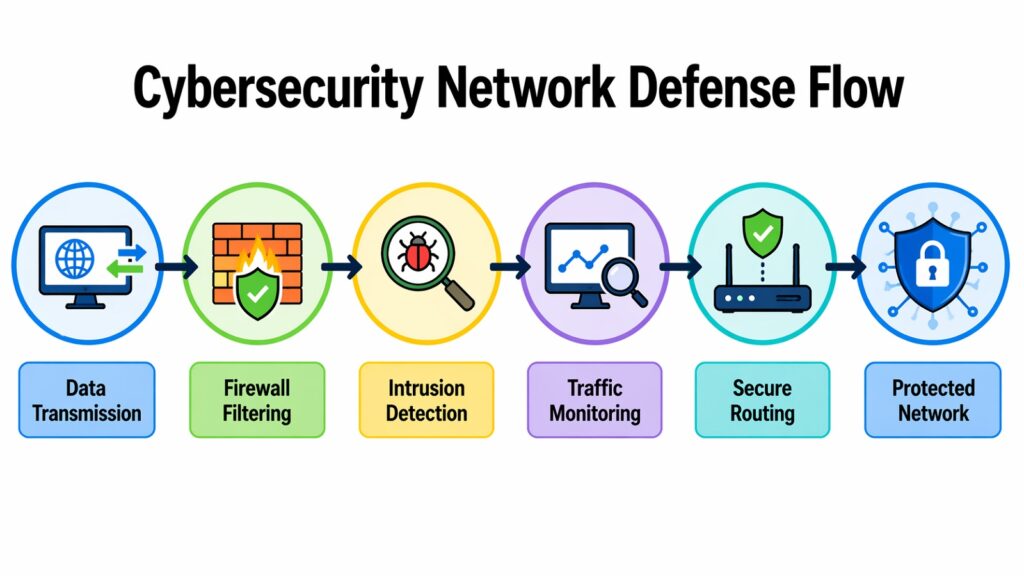
Every piece of data you send or receive travels through a network. It passes through cables, wireless signals, routers, and switches before it reaches its destination. All of this movement creates opportunities for interception, manipulation, or disruption. At the network level, cybersecurity exists to close those gaps.
Firewalls are among the oldest and most fundamental tools for network security. They examine incoming and outgoing traffic based on defined rules and block what does not belong. A well-configured firewall prevents a great deal of unwanted access before it even reaches the systems behind it. But firewalls alone are not enough in a modern network environment.
Intrusion prevention systems go a step further by actively monitoring traffic for patterns that indicate an attack. If a system detects that someone is probing ports or sending unusual volumes of traffic, it can respond automatically and block the threat. This kind of automated defense is essential because attacks often move faster than human review allows.
Secure routing ensures that data takes the expected path from source to destination. Without it, traffic can be redirected through systems controlled by an attacker, allowing them to read or alter the data in transit. Cybersecurity at the network level uses protocols and monitoring to prevent this kind of interference.
Segmentation is another key concept here. Dividing a network into smaller zones means that if one area is compromised, the damage does not automatically spread everywhere. Cybersecurity treats the network as a series of protected compartments rather than a single open space.
Cybersecurity in Network Security: Key Concepts
| Concepts | Description |
| Firewalls | Filter traffic based on rules; block unauthorized access at the perimeter |
| Intrusion Prevention Systems | Monitor and automatically block suspicious network activity in real time |
| VPN (Virtual Private Network) | Encrypts data in transit; creates secure tunnels over public networks |
| Network Segmentation | Divides the network into zones to contain breaches and limit lateral movement |
| Secure DNS | Prevents DNS hijacking by validating domain resolution responses |
| DDoS Mitigation | Detects and absorbs volumetric attacks to keep services available |
| Zero Trust Networking | Treats every connection as untrusted until verified, even inside the network |
| Traffic Analysis | Monitors data flows for unusual patterns that may indicate an intrusion |
2. Cybersecurity in Endpoint Security: Securing Devices and Access Points
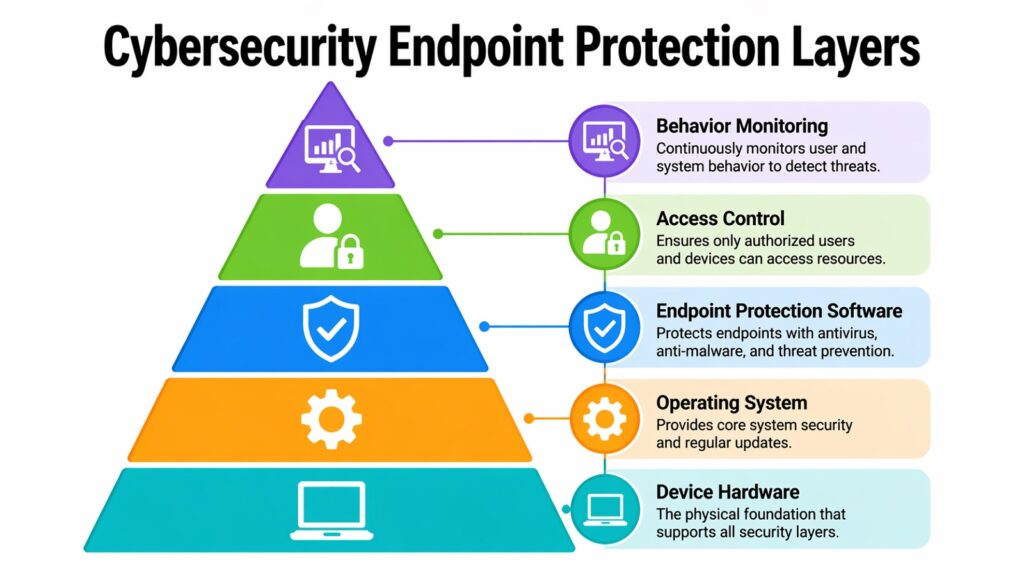
A network can be fortified, but if the devices connecting to it are vulnerable, the protection unravels quickly. Endpoints are the devices at the edge of any network: laptops, desktops, smartphones, tablets, and servers. Each one is a potential entry point for an attacker, and Cybersecurity must address all of them.
The number of endpoints in any organization has grown significantly over the past decade. Remote work, personal devices used for professional tasks, and the expansion of connected infrastructure have all contributed to a much larger attack surface. Each device added to a network represents a potential gap that adversaries can exploit.
Endpoint protection platforms provide continuous monitoring of device behavior. They look for signs of compromise: unusual processes running in the background, attempts to access files that the device has no reason to touch, or communication with servers that are known to host malicious content. When something suspicious is detected, the platform can isolate the device before the threat spreads.
Access control is crucial at the endpoint level. Cybersecurity guarantees that only authorized users and devices are permitted to connect to systems. Multi-factor authentication introduces an extra layer of security by necessitating more than merely a password. Even if credentials are compromised, an attacker lacking the second factor cannot gain access.
Patch management is often overlooked but is one of the most practical aspects of endpoint Cybersecurity. Outdated software contains known vulnerabilities that attackers actively exploit. Keeping devices updated removes those vulnerabilities before they can be used.
Cybersecurity in Endpoint Security: Key Concepts
| Concept | Description |
| Endpoint Detection and Response (EDR) | Continuously monitors endpoint activity and responds to detected threats |
| Multi-Factor Authentication (MFA) | Requires additional verification beyond passwords to confirm user identity |
| Patch Management | Ensures operating systems and apps are updated to remove known vulnerabilities |
| Device Encryption | Protects stored data on devices if they are lost or stolen |
| Mobile Device Management (MDM) | Controls and monitors mobile devices connected to organizational systems |
| Application Whitelisting | Allows only approved software to run; blocks unknown or malicious programs |
| Privilege Access Control | Restricts system access to only what each user or device needs |
| Behavioral Analysis | Detects anomalies in how endpoints behave to identify potential threats |
3. Cybersecurity in Cloud Security: Safeguarding Digital Infrastructure
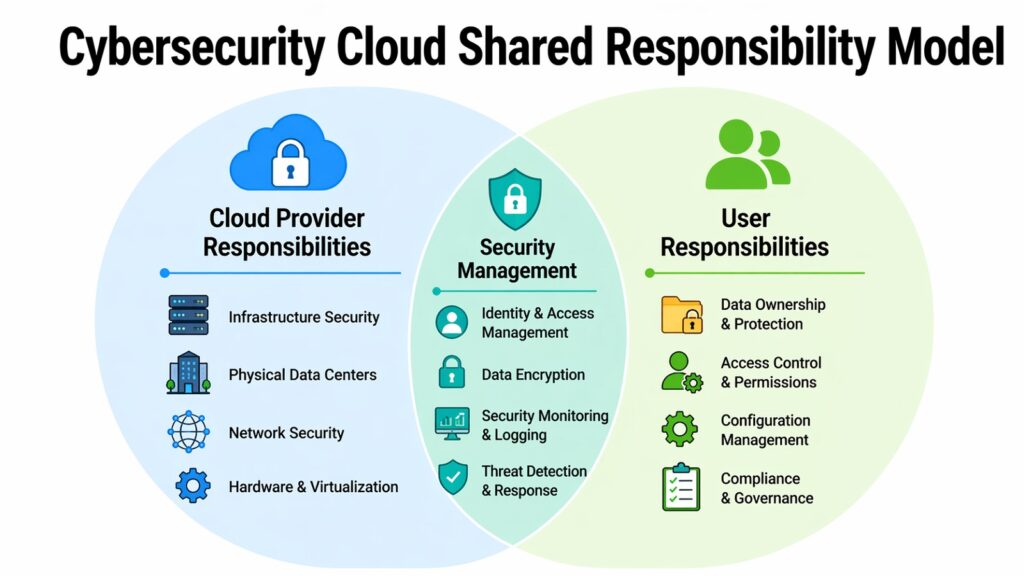
Cloud computing changed the way organizations manage data and services. Instead of storing everything on local servers, businesses now rely on remote infrastructure managed by providers like Amazon, Microsoft, and Google. This shift brought flexibility and scale, but it also introduced a new set of Cybersecurity challenges.
In a cloud environment, the physical infrastructure is owned by the provider. However, the data stored on it, the applications operating within it, and the configurations that govern it are the customer’s responsibility. This division is referred to as the shared responsibility model. A common cause of cloud security failures is the misunderstanding of where responsibility begins and ends.
Data storage protection in the cloud requires careful attention to how information is organized, who has access to it, and how it is backed up. A storage bucket left open to the public by misconfiguration has exposed sensitive records at organizations of all sizes. Cybersecurity involves auditing these configurations regularly and setting access permissions with care.
Identity and access management become especially important in cloud environments because there is no physical perimeter to rely on. Cloud security in this context means controlling who can access which resources, for how long, and from where. Temporary credentials, least-privilege policies, and continuous verification all play a role.
Cloud environments are also dynamic. Resources scale up and down based on demand, and new services are added frequently. Cybersecurity must keep pace with this change, ensuring that new infrastructure is secured from the moment it is deployed.
Cybersecurity in Cloud Security: Key Concepts
| Concept | Description |
| Shared Responsibility Model | Defines what the cloud provider secures versus what the customer must protect |
| Cloud Access Security Broker (CASB) | Monitors and enforces security policies between users and cloud services |
| Identity and Access Management (IAM) | Controls who can access cloud resources and under what conditions |
| Data Loss Prevention (DLP) | Prevents sensitive cloud-stored data from being exfiltrated or misused |
| Cloud Security Posture Management | Continuously checks cloud configurations for misconfigurations and risks |
| Encryption at Rest | Protects data stored in cloud databases and storage buckets |
| Secure API Management | Ensures cloud APIs are authenticated, monitored, and protected from abuse |
| Logging and Monitoring | Tracks all cloud activity to detect unauthorized actions or changes |
4. Cybersecurity in Application Security: Building Secure Software Systems
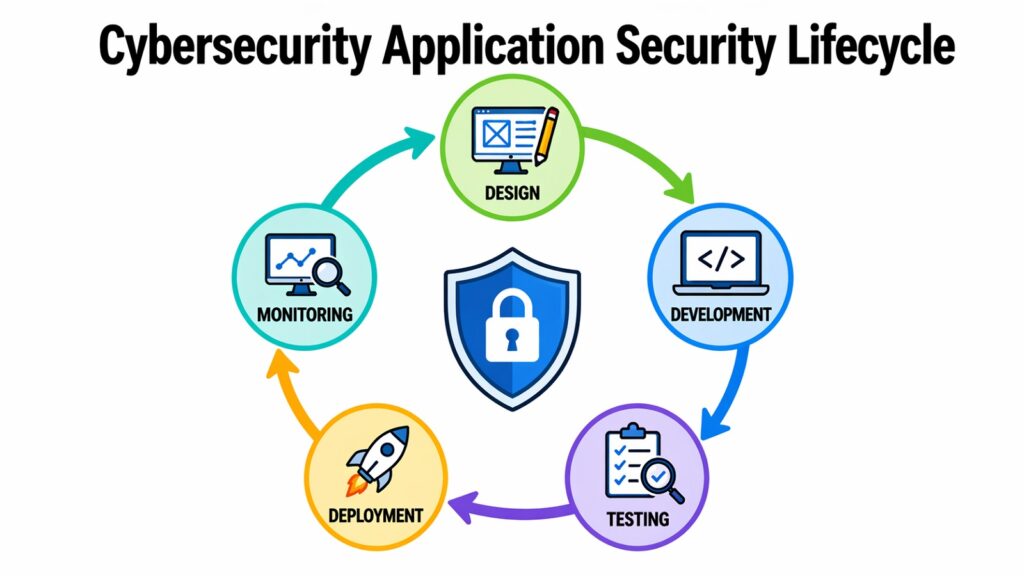
Software is everywhere. It runs the systems that process payments, manage medical records, control industrial equipment, and connect people across continents. Every application is a potential entry point for attack, and Cybersecurity must be built into software from the very beginning rather than applied as an afterthought.
Application vulnerabilities come in many forms. For example, SQL injection occurs when an attacker inserts malicious commands into a database query through an input field that was not properly validated. Cross-site scripting allows attackers to inject code into web pages that other users then load. Buffer overflow attacks exploit poor memory management to execute unauthorized code. These are not theoretical problems. They appear regularly in reports of real-world breaches.
Secure coding practices address these risks during development. Developers who validate all input, handle errors without exposing system details, and avoid storing sensitive information in insecure locations are already doing a great deal to reduce risk. Cybersecurity training for development teams helps make these practices consistent rather than dependent on individual awareness.
Testing is a critical phase in application Cybersecurity. Static analysis tools scan source code before it is compiled, looking for patterns associated with vulnerabilities. Dynamic testing runs the application and attempts to find weaknesses by interacting with it as an attacker would. Penetration testing takes this further by having skilled professionals actively try to break the system.
Security does not end at deployment. Applications need ongoing monitoring and regular updates. New vulnerabilities are discovered constantly, and attackers adapt to find them in production systems. Cybersecurity treats application security as a continuous process rather than a one-time task.
Cybersecurity in Application Security: Key Concepts
| Concept | Description |
| OWASP Top 10 | A widely referenced list of the most critical web application security risks |
| Static Application Security Testing (SAST) | Analyzes source code for vulnerabilities before the application is deployed |
| Dynamic Application Security Testing (DAST) | Tests a running application to find vulnerabilities through active probing |
| Secure Software Development Lifecycle (SSDLC) | Integrates security reviews and practices at every stage of development |
| Input Validation | Ensures all user-supplied data is checked before being processed by the system |
| Dependency Scanning | Detects known vulnerabilities in third-party libraries used by the application |
| Web Application Firewall (WAF) | Filters and monitors HTTP traffic to block common application-layer attacks |
| Code Review | Manual or automated review of code to identify security flaws before release |
5. Cybersecurity in Data Encryption: Protecting Information Integrity
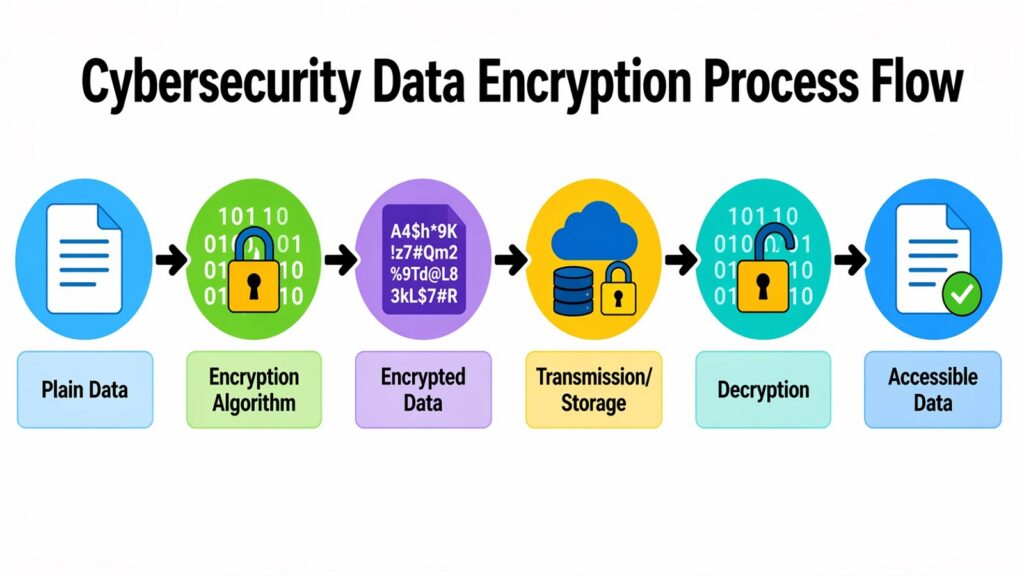
Encryption is one of the oldest ideas in the history of protecting information. The concept of encoding a message so that only the intended recipient can read it goes back centuries. In the context of modern Cybersecurity, encryption is a core technical mechanism that protects data wherever it lives and wherever it travels.
Data in transit refers to data that is being transmitted over a network. When you fill out a form on a website, send an email, or upload a file to a cloud server, that data is considered to be in transit. In the absence of encryption, any individual located between the sender and the recipient has the ability to access and read it. Transport Layer Security, often abbreviated as TLS, is the established protocol that secures data in transit for online communications. This is the mechanism that causes the padlock icon to display in a browser’s address bar.
Data at rest is data stored in databases, file systems, and storage devices. Even if a network is secure, a stolen hard drive or unauthorized database access can expose sensitive records. Encryption at rest means that stored data is unreadable without the appropriate keys, so physical or logical access to storage does not automatically mean access to the data inside.
Key management is one of the most difficult aspects of encryption in practice. An encrypted system is only as secure as the keys that protect it. If keys are stored alongside the data they encrypt, the protection is significantly weakened. Cybersecurity practices require that keys be stored separately, rotated regularly, and protected with strong access controls.
End-to-end encryption takes the concept further by ensuring that data is encrypted at the source and only decrypted at the destination. Not even the service provider in the middle can read it. This approach is increasingly used in messaging applications and file-sharing services where privacy is a priority.
Cybersecurity in Data Encryption: Key Concepts
| Concept | Description |
| TLS/SSL | Encrypts data in transit between web clients and servers; standard for HTTPS |
| AES (Advanced Encryption Standard) | Widely used symmetric encryption standard for securing data at rest |
| RSA Encryption | Asymmetric encryption used for key exchange and digital signatures |
| End-to-End Encryption (E2EE) | Ensures only the sender and recipient can decrypt the data exchanged |
| Public Key Infrastructure (PKI) | Manages digital certificates and keys to enable trusted encrypted communication |
| Key Management Systems (KMS) | Tools for securely generating, storing, and rotating encryption keys |
| Hashing | One-way function that verifies data integrity without storing the original value |
| Tokenization | Replaces sensitive data with non-sensitive tokens to reduce exposure in systems |
6. Cybersecurity in Threat Detection: Identifying Risks in Real Time
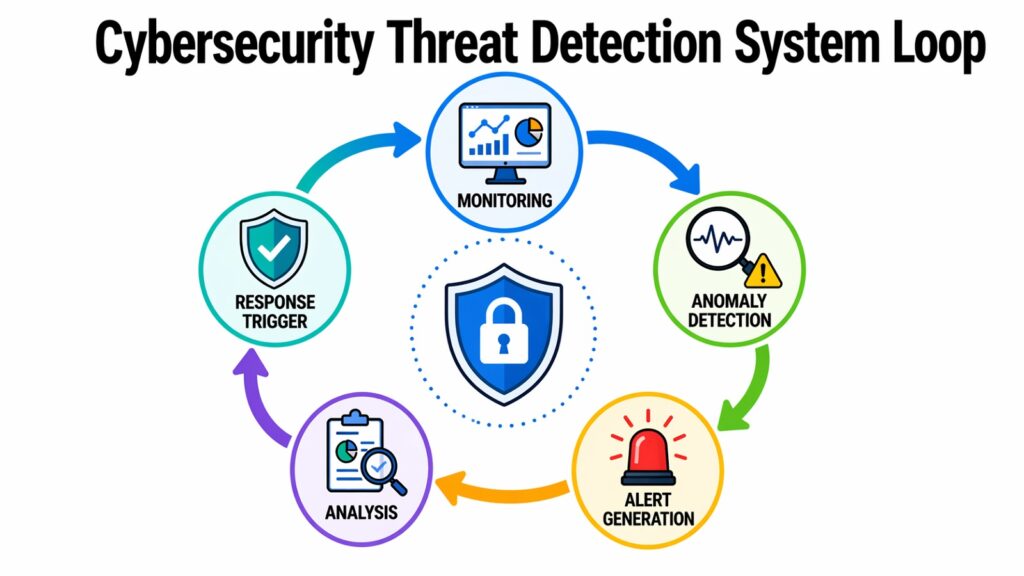
A defense that only responds after damage is done is not much of a defense. The goal of threat detection in Cybersecurity is to identify risks as early as possible, before they escalate into serious incidents. Early identification changes the outcome significantly. An attacker who spends days inside a system undetected can do far more harm than one who is identified within hours.
Security information and event management systems, commonly called SIEM platforms, aggregate logs and events from across an organization’s infrastructure. They correlate data from firewalls, servers, applications, and endpoints to identify patterns that suggest malicious activity. A single failed login attempt might be nothing. Hundreds of failed attempts followed by a successful one from an unusual location is a very different signal.
Anomaly detection looks for behavior that deviates from established baselines. If a user account that normally accesses a few internal files suddenly starts downloading large volumes of data late at night, that is an anomaly worth investigating. Cybersecurity systems flag these deviations and route them to analysts or automated response systems for action.
Threat intelligence adds another dimension to detection. Organizations share information about known attack techniques, malicious IP addresses, and compromised credentials. When this intelligence is fed into detection systems, those systems can recognize the signatures of known threats much faster. Industry groups, government agencies, and private firms all contribute to threat intelligence networks.
User and entity behavior analytics, often abbreviated as UEBA, uses statistical models and machine learning to understand normal behavior and detect departures from it. Unlike rule-based systems that require someone to define what to look for in advance, UEBA can surface novel threats that do not match any pre-existing pattern.
Cybersecurity in Threat Detection: Key Concepts
| Key Concepts | Description |
| SIEM (Security Information and Event Management) | Aggregates and correlates logs from multiple sources to identify security events |
| Anomaly Detection | Flags behavior that deviates from established normal patterns in the system |
| Threat Intelligence Feeds | Shares data on known threats, indicators of compromise, and attacker tactics |
| UEBA (User and Entity Behavior Analytics) | Uses behavioral models to detect insider threats and account compromise |
| Intrusion Detection Systems (IDS) | Monitors traffic or host activity and alerts when suspicious patterns are found |
| Log Management | Collects, stores, and indexes system logs for analysis and forensic investigation |
| Indicators of Compromise (IoC) | Observable evidence that a system may have been breached or targeted |
| Security Orchestration (SOAR) | Automates repetitive detection tasks and coordinates response workflows |
7. Cybersecurity in Incident Response: Managing and Containing Attacks
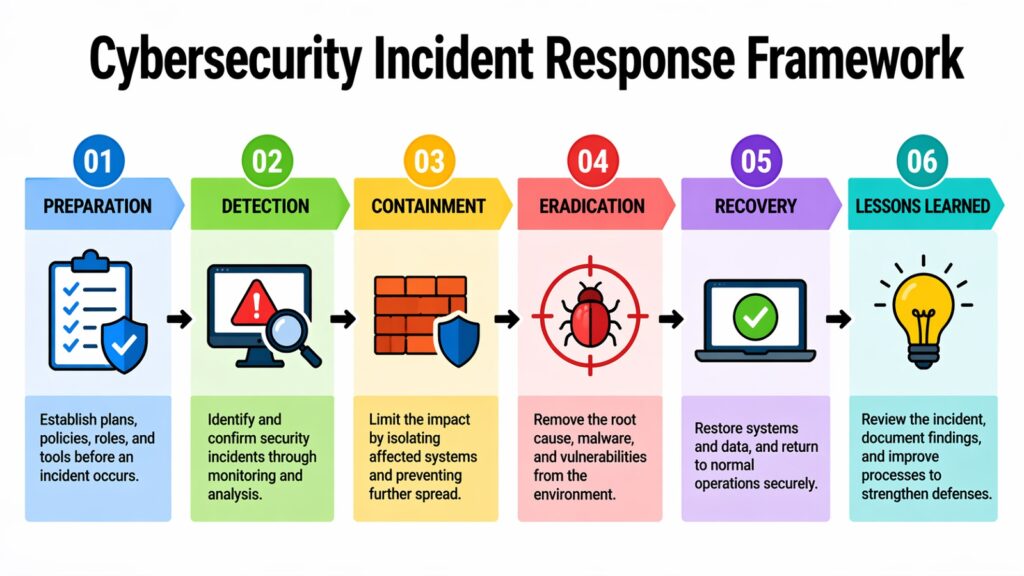
No system is perfectly immune to attack. No matter how well-built the defenses are, the possibility of a security incident always exists. What separates organizations that recover quickly from those that suffer lasting damage is often not the strength of the attack but the quality of the response. Cybersecurity incident response is the structured approach to managing what happens when something goes wrong.
The first phase of incident response is preparation. This means having a documented response plan, trained personnel, and the right tools in place before an incident happens. Organizations that build incident response capabilities in advance are in a far better position than those scrambling to create processes in the middle of a crisis.
Detection and analysis follow. Once an alert is raised, the response team investigates to understand the scope and nature of the incident. Is this a phishing attempt that compromised a single account, or is it a coordinated intrusion that has spread across multiple systems? The answer shapes everything that comes next.
Containment is the immediate priority once the nature of the incident is understood. Isolating affected systems prevents the attack from spreading further. In some cases, this means taking systems offline temporarily. In others, it means changing credentials, blocking network paths, or quarantining devices. Cybersecurity response teams make these decisions quickly and with careful consideration of the trade-off between containing the threat and maintaining operational continuity.
Eradication removes the threat from the environment. This might involve removing malware, closing the vulnerability that was exploited, or resetting compromised accounts. Recovery restores systems to normal operation. And the post-incident review examines what happened and why, so that the organization can improve its defenses before the next incident arrives.
Cybersecurity in Incident Response: Key Concepts
| Phase | Description |
| Preparation | Building response plans, tools, and team capabilities before an incident occurs |
| Detection and Analysis | Identifying and investigating the scope, source, and nature of the incident |
| Containment | Isolating affected systems to prevent the attack from spreading further |
| Eradication | Removing the threat, closing exploited vulnerabilities, and cleaning compromised systems |
| Recovery | Restoring systems and services to normal operation safely and systematically |
| Post-Incident Review | Analyzing what happened to improve defenses and prevent recurrence |
| Communication Plan | Defines how to notify stakeholders, regulators, and customers during an incident |
| Forensic Investigation | Preserving and analyzing evidence to understand attack methods and attribution |
8. Cybersecurity in Security Compliance: Meeting Standards and Regulations
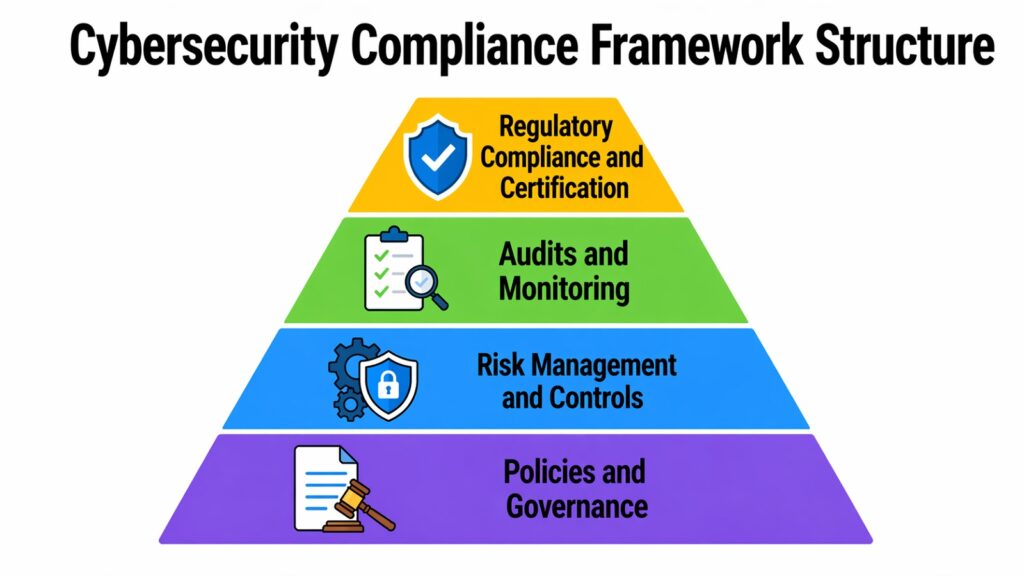
Cybersecurity does not operate in a vacuum. Governments, industry bodies, and international organizations have developed a wide range of frameworks and regulations that define how organizations must handle data and protect systems. Compliance with these standards is both a legal obligation and a mark of trustworthiness.
The General Data Protection Regulation, known as GDPR, set a new standard for data privacy in Europe and influenced privacy law globally. It requires organizations to protect personal data, notify authorities and affected individuals in the event of a breach, and give users meaningful control over their own information. Non-compliance carries significant financial penalties.
In the United States, the Health Insurance Portability and Accountability Act, or HIPAA, governs how healthcare organizations handle medical records. The Payment Card Industry Data Security Standard, known as PCI DSS, defines requirements for any organization that processes credit card payments. Each of these frameworks addresses a specific industry and type of data, but they share a common focus on accountability and protection.
The NIST Cybersecurity Framework, developed by the National Institute of Standards and Technology, provides a voluntary but widely adopted structure for managing Cybersecurity risk. It organizes controls around five functions: identify, protect, detect, respond, and recover. Organizations across many industries use it as a foundation for building their security programs.
Compliance is more than a checkbox exercise. Organizations that take it seriously tend to have stronger security postures overall because the process of meeting standards forces them to examine their practices, document their controls, and address gaps. It also builds trust with customers and partners who need assurance that their data is being handled responsibly.
Cybersecurity in Security Compliance: Key Frameworks
| Framework / Regulation | Scope and Focus |
| GDPR (General Data Protection Regulation) | EU regulation governing the collection, storage, and use of personal data |
| HIPAA (Health Insurance Portability and Accountability Act) | US law protecting the privacy and security of health information |
| PCI DSS (Payment Card Industry Data Security Standard) | Standards for securing systems that process credit card transactions |
| NIST Cybersecurity Framework | Voluntary US framework organizing Cybersecurity practices into five core functions |
| ISO/IEC 27001 | International standard for establishing and managing an information security system |
| SOC 2 (Service Organization Control 2) | Auditing framework for service providers handling customer data |
| CCPA (California Consumer Privacy Act) | California law giving residents rights over how their personal data is used |
| CIS Controls | Prioritized set of actions for defending systems against the most common cyber threats |
Conclusion: Cybersecurity as a Unified System of Digital Defense
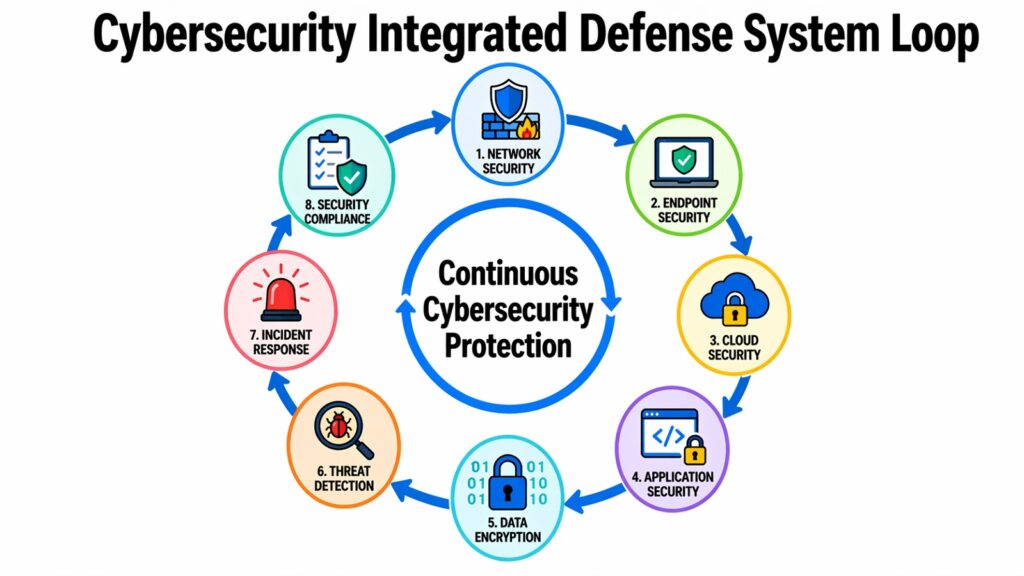
Each of the eight foundations covered in this article addresses a distinct part of the digital environment. Networks, endpoints, cloud systems, applications, data, detection, response, and compliance all represent different layers of the same challenge: keeping digital systems trustworthy and resilient. But none of these layers works well in isolation.
A strong network perimeter does little good if endpoint devices are unpatched and unmonitored. Excellent encryption loses its value if the keys are mismanaged or if attackers are already inside the system and going undetected. Compliance frameworks that are met on paper but not in practice provide only the illusion of security. Cybersecurity is most effective when all eight foundations reinforce each other.
The organizations that approach Cybersecurity as an integrated system rather than a checklist of individual tools and controls are the ones that tend to fare best. They connect their detection capabilities to their response processes. They feed compliance requirements back into their development practices. They treat incident reviews as learning opportunities that improve every other layer of their defense.
The digital landscape will keep evolving. Artificial intelligence is already being used both to improve threat detection and to make attacks more sophisticated. The expansion of connected devices, from industrial sensors to consumer electronics, continues to grow the attack surface. Quantum computing poses long-term questions about the future of current encryption standards.
Cybersecurity will have to evolve alongside all of these changes. The eight foundations explored in this article are not fixed endpoints but living practices that require constant attention, investment, and adaptation. What remains constant is the underlying purpose: protecting the systems, data, and people that digital technology serves.
Cybersecurity: Eight Foundations at a Glance
| Cybersecurity Foundations | Core Purpose |
| Network Security | Secures communication channels and prevents unauthorized access to data in transit |
| Endpoint Security | Protects devices and access points from compromise and unauthorized use |
| Cloud Security | Safeguards distributed infrastructure, stored data, and cloud-hosted services |
| Application Security | Embeds protection into software development and deployment lifecycles |
| Data Encryption | Ensures sensitive information remains unreadable to unauthorized parties |
| Threat Detection | Provides real-time visibility into risks and suspicious activity across systems |
| Incident Response | Manages, contains, and recovers from security events with minimal damage |
| Security Compliance | Aligns organizational practices with legal and regulatory standards for accountability |