Table of Contents
Introduction: Data Management as a Strategic Business Technology
Data Management is one of the most important disciplines within Business Technology and serves as the foundation for transforming raw information into a valuable business asset. It is an important aspect of Business Technology because organizations across every industry depend on it to support strategic decision-making, operational efficiency, customer experience, product innovation, regulatory compliance, and long-term competitiveness. Without it, the enormous volumes of data that organizations generate every day remain difficult to trust, interpret consistently, or use responsibly. Business value emerges only when information is governed, protected, and managed with discipline.
According to the Data Management Association International, known as DAMA, Data Management encompasses the development and execution of architectures, policies, practices, and procedures that properly manage the full data lifecycle of an enterprise. That definition reflects a core truth: organizations generate enormous volumes of data every day through transactions, customer interactions, supply chains, and digital platforms, yet generating data alone creates no value. Managing it well is what transforms information into competitive advantage.
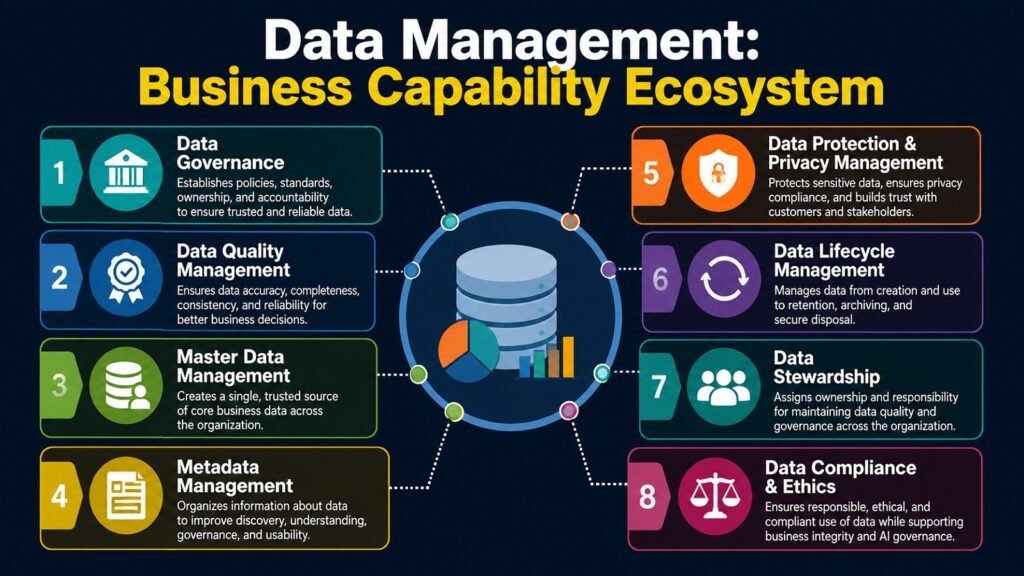
Artificial intelligence, digital transformation, and cloud computing have intensified this need considerably. AI models are only as reliable as the data they are trained on, which means quality and governance have become prerequisites for successful technology adoption rather than secondary concerns. Organizations pursuing digital transformation cannot build new capabilities on a foundation of inconsistent or untrustworthy information. This article examines eight foundational pillars of Data Management that together provide the structure needed to govern, maintain, protect, and maximize the long-term value of organizational information.
Data Management: Eight Pillars and Their Business Purpose
| Data Management Pillars | Primary Business Purpose |
| Data Governance | Establishes policies, ownership, and accountability for information assets |
| Data Quality Management | Ensures information is accurate, complete, and reliable for decision-making |
| Master Data Management | Creates a single trusted version of core business entities across systems |
| Metadata Management | Makes data discoverable, understandable, and consistently interpreted |
| Data Protection & Privacy | Safeguards sensitive information and ensures responsible data handling |
| Data Lifecycle Management | Manages information from creation through to secure and compliant disposal |
| Data Stewardship | Assigns human accountability for maintaining data quality and governance |
| Data Compliance & Ethics | Aligns data practices with legal requirements and ethical obligations |
1. Data Management Through Effective Data Governance
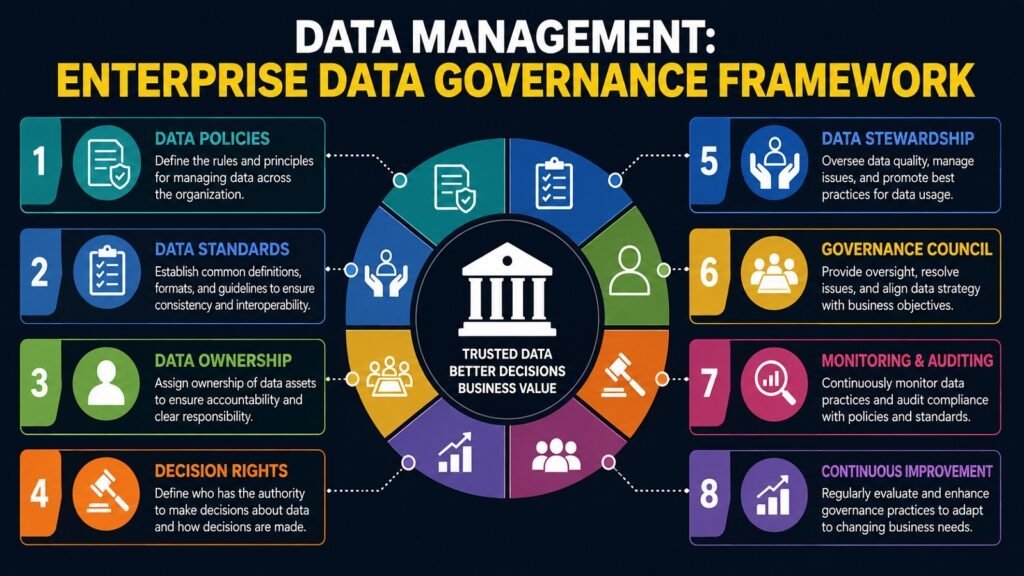
Data Governance forms the strategic foundation of effective Data Management by establishing the policies, standards, accountability structures, and decision-making authority that determine how information is handled across the organization. Without governance, even sophisticated data tools produce inconsistent results, because people in different departments interpret and use information according to their own assumptions rather than shared standards. DAMA International defines data governance as the exercise of authority and control over the management of data assets, a framing that reflects why it must operate at the leadership level rather than as a purely technical function.
From a business perspective, governance creates the consistency that allows organizations to trust their information. When finance, marketing, sales, and operations each define a customer differently, comparing reports across functions becomes unreliable. Governance resolves this by establishing agreed definitions through a business glossary that applies uniformly across departments, reducing friction in cross-functional work and improving executive decision-making. Research from Gartner has consistently identified poor governance as a leading cause of analytics failure in large organizations, linking unclear data ownership to higher remediation costs, slower reporting cycles, and greater regulatory exposure.
Governance frameworks such as the DAMA-DMBOK and the COBIT framework both recognize data governance as a foundational discipline. Rather than prescribing a single approach, they identify the principles, roles, and processes that every program must address, allowing organizations of different sizes to design models suited to their context while maintaining the core objective: trusted, consistently managed information.
Data Governance is the first pillar upon which every other dimension of Data Management depends. Organizations that invest in it early build the conditions for sustainable information management, because every quality improvement, protection initiative, and analytics program rests on the assumption that roles, policies, and standards already exist to give those efforts direction and authority.
Data Management Through Governance: Key Components and Business Purpose
| Governance Component | Business Purpose |
| Data ownership | Assigns clear responsibility for information assets to specific roles |
| Business glossary | Ensures consistent definitions of key data terms across departments |
| Data policies | Establishes rules for how information is created, used, and shared |
| Governance council | Provides cross-functional oversight and decision-making authority |
| Data standards | Maintains consistency in how information is formatted and recorded |
| Access controls | Limits data availability to authorized users based on defined roles |
| Issue escalation | Creates structured processes for resolving data conflicts and disputes |
| Compliance alignment | Connects governance practices to relevant regulatory requirements |
2. Data Management for High Data Quality
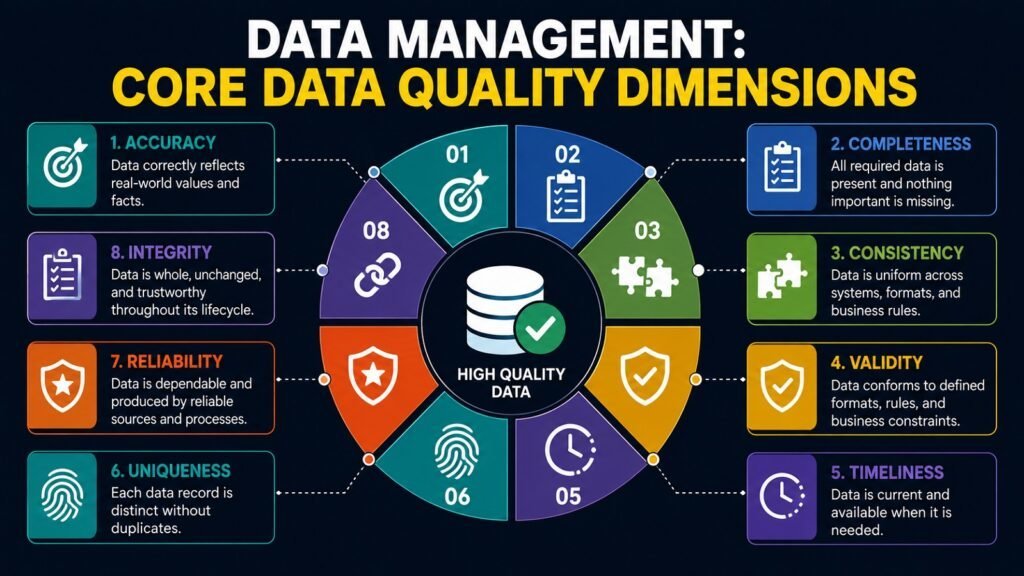
Of all the objectives that Data Management pursues, maintaining high data quality carries the most direct business impact. Organizations make decisions, serve customers, manage operations, and plan strategy based on the information available to them, and when that information is inaccurate, incomplete, or outdated, the consequences range from minor inefficiencies to significant financial harm. Data Quality Management is the discipline of ensuring that information consistently meets the standards required for its intended purpose, measured across dimensions such as accuracy, completeness, consistency, validity, timeliness, and reliability.
The business case is substantial. A study by IBM estimated that poor data quality costs the United States economy approximately 3.1 trillion dollars annually. Individual organizations experience these failures in specific ways: marketing campaigns reaching wrong audiences, financial reports containing errors, supply chains disrupted by incorrect inventory records, and customer service teams acting on outdated account information. Analytics and artificial intelligence amplify the stakes further. Machine learning models trained on low-quality data produce unreliable predictions regardless of algorithmic sophistication, and data scientists frequently report spending the majority of project time on data preparation rather than modeling.
Customer experience is particularly sensitive to quality failures. When a retailer recommends a product the customer never browsed, or a bank references a closed account, the immediate effect is frustration and the longer-term consequence is eroded trust. Organizations that treat data quality as a continuous discipline, rather than an occasional cleanup exercise, consistently outperform those that address it reactively.
Poor information does not just reduce the reliability of individual reports; it undermines confidence in the entire data environment, causing analysts and executives to question findings and delay decisions. Embedding quality management as a core pillar of Data Management ensures that organizations can trust their information and act on it with confidence.
Data Management for Quality: Key Dimensions and Business Significance
| Quality Dimension | Business Significance |
| Accuracy | Ensures decisions and reports reflect reality rather than erroneous data |
| Completeness | Prevents gaps in information that lead to flawed analysis or missed actions |
| Consistency | Aligns data values across systems to support reliable cross-functional reporting |
| Validity | Confirms data conforms to business rules, reducing processing errors |
| Timeliness | Keeps information current enough to support operational and strategic needs |
| Reliability | Builds confidence that data will produce consistent results over time |
| Uniqueness | Eliminates duplicate records that distort analytics and inflate costs |
| Integrity | Maintains valid relationships between related data sets across the organization |
3. Data Management with Master Data Management
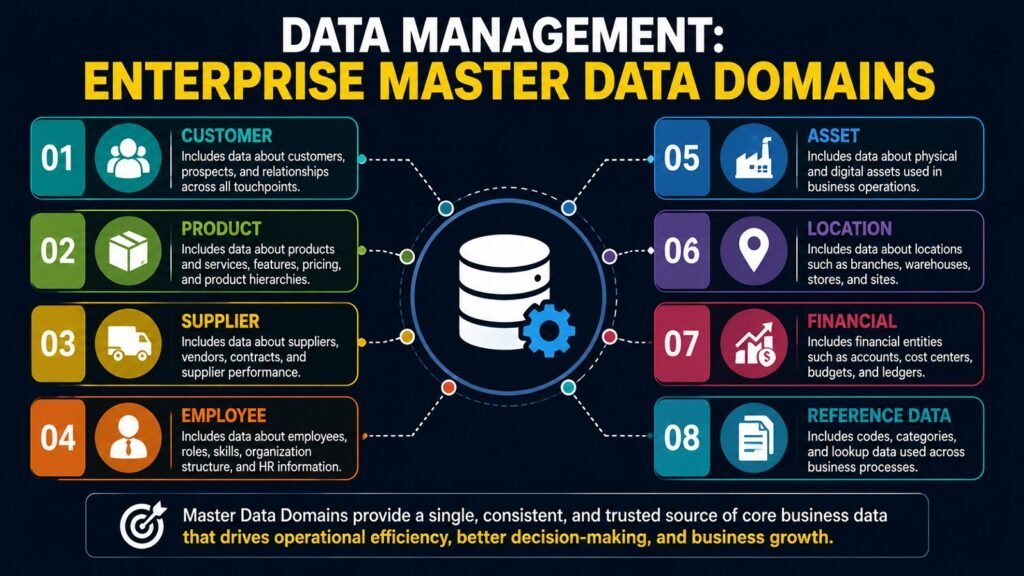
Master Data Management, commonly known as MDM, addresses one of the most persistent challenges in enterprise Data Management: multiple conflicting versions of the same core business information existing across different systems. A large organization may run dozens of applications, each maintaining its own records for customers, products, suppliers, employees, or financial accounts. When these systems disagree, basic questions become unreliable: How many unique customers does the organization have? What is total revenue from a given product line? MDM solves this by establishing a single authoritative source, often called a golden record, for each key entity type.
The business value is wide-ranging. Consistent master data allows reporting teams to produce comparable figures across divisions, customer service teams to access complete account histories, and supply chain managers to make purchasing decisions based on reliable supplier records. McKinsey research has found that organizations with mature data management practices, including strong MDM capabilities, achieve measurably better outcomes through improved operational efficiency and more accurate strategic planning. When leaders trust that reports draw from the same authoritative data, they spend less time questioning figures and more time acting on insights.
MDM also supports regulatory compliance in sectors where accurate entity identification is a legal requirement. Financial services organizations must maintain precise customer records to fulfill know-your-customer obligations, and healthcare providers require consistent patient identifiers to support clinical safety. In both cases, MDM is not merely a preference but a practical compliance necessity. This combination of operational and regulatory benefit makes it one of the most strategically important investments an enterprise can make in its information infrastructure.
As a foundational pillar of Data Management, Master Data Management creates the consistency that allows an organization to function as a coherent whole. Without it, governance policies lack a reliable foundation and quality improvements address symptoms rather than root causes.
Data Management with MDM: Master Data Categories and Business Value
| Master Data Category | Business Value |
| Customer data | Enables consistent customer identification across sales, service, and marketing |
| Product data | Supports accurate pricing, inventory, and catalog management across channels |
| Supplier data | Improves procurement decisions and supplier relationship management |
| Employee data | Ensures consistent HR records, payroll, and organizational reporting |
| Financial account data | Supports accurate consolidation and regulatory financial reporting |
| Location data | Aligns geographic information across logistics, sales, and operations |
| Asset data | Provides a reliable inventory of physical and digital organizational assets |
| Regulatory entity data | Maintains accurate legal identifiers required for compliance reporting |
4. Data Management Through Metadata Management
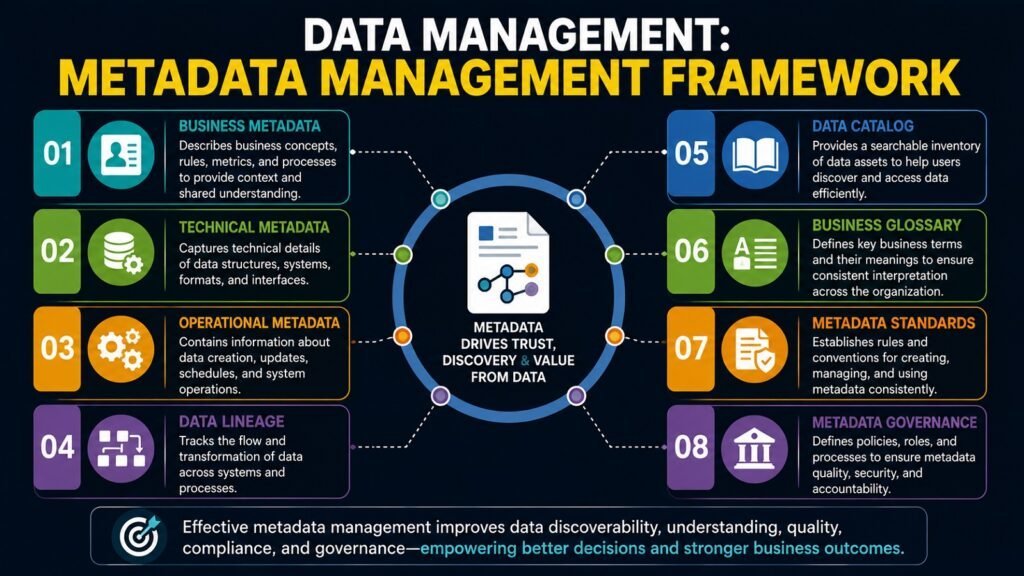
Metadata is commonly described as data about data, but that definition understates its strategic importance to Data Management. Metadata provides the context that makes information meaningful, discoverable, and usable across an organization. In business terms, it describes what a data element means, where it came from, how it was processed, who owns it, and what rules govern its use. When a financial analyst retrieves a revenue figure from a data warehouse, metadata explains which business unit contributed, what period it covers, and which calculation rules were applied. Without that context, even well-maintained data becomes ambiguous and potentially misleading.
The discipline recognizes several distinct types. Technical metadata describes structural characteristics such as file formats and data types. Business metadata provides the definitions, glossary terms, and ownership information that non-technical users need to interpret information reliably. Operational metadata records processing history, supporting quality monitoring and audit. Process metadata tracks data lineage, showing how information flows from source systems through transformations to final outputs. Lineage is particularly valuable in regulated industries: when a bank must explain how a risk metric was calculated, or a pharmaceutical company must verify clinical data handling, lineage provides the audit trail that supports that explanation.
Metadata Management directly accelerates business intelligence work. Analysts routinely spend a significant portion of project time finding and understanding datasets before analysis can begin. A well-maintained business glossary and data catalog, both core metadata tools, reduce this discovery time substantially and enable self-service analytics across the organization without requiring technical assistance for every query.
By making organizational information transparent, consistently interpreted, and easier to govern, Metadata Management strengthens every other Data Management discipline. It transforms data from an opaque technical resource into a well-documented organizational asset that different teams can use with shared understanding and confidence.
Data Management Through Metadata: Key Elements and Business Purpose
| Metadata Element | Business Purpose |
| Data definitions | Establishes agreed meanings for key data terms across the organization |
| Data lineage | Traces the origin and transformation path of information for audit and trust |
| Data ownership | Records who is accountable for each data element or dataset |
| Data classification | Labels information by sensitivity and appropriate use or access level |
| Business glossary | Provides a shared reference for consistent terminology across departments |
| Data catalog | Makes datasets discoverable and understandable for analysts and business users |
| Retention rules | Documents how long data should be kept and when it should be disposed of |
| Operational metadata | Captures processing history to support quality monitoring and compliance |
5. Data Management with Data Protection & Privacy Management
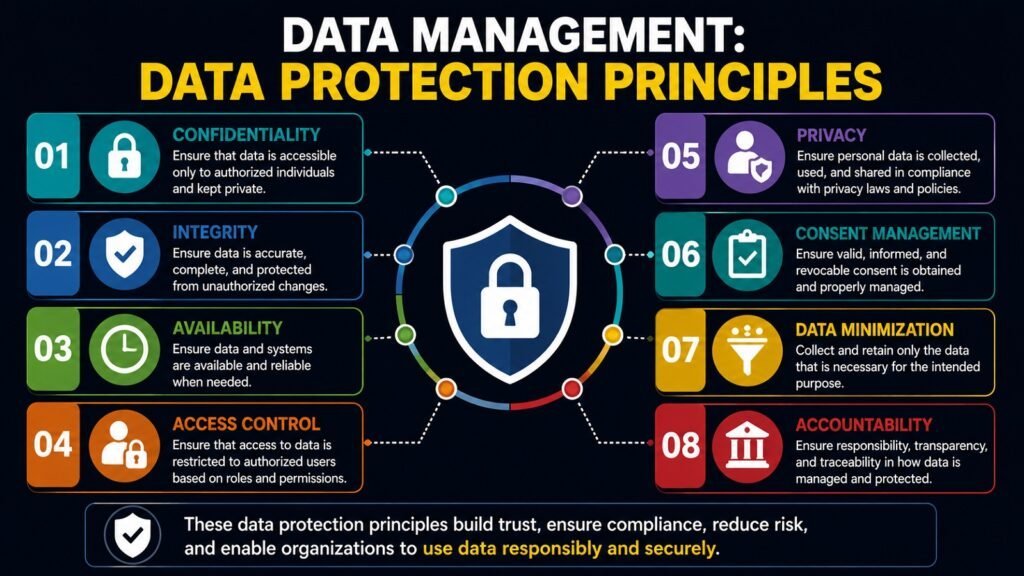
Data protection and privacy management represent the dimension of Data Management most directly concerned with trust. While cybersecurity focuses on defending systems from external threats, data protection and privacy management address how information is handled, accessed, shared, and governed within the organization. Confidentiality is a core protection principle: sensitive information relating to customers, employees, financial performance, or intellectual property should be accessible only to those with a legitimate and authorized need. Access governance structures define who can view or modify which data categories and must be actively maintained as roles change, systems are updated, and business relationships evolve.
Privacy management pertains to the rights individuals hold over their personal information. Regulations like the General Data Protection Regulation in Europe, the California Consumer Privacy Act in the United States, and comparable laws in numerous jurisdictions establish mandatory requirements regarding the collection, processing, storage, and deletion of personal data. Failure to comply with these regulations can result in severe penalties: fines under the GDPR can amount to four percent of a company’s global annual revenue. Furthermore, research conducted by Cisco indicates that a significant number of consumers take into account how organizations handle their personal data when making purchasing choices, thereby making privacy management a crucial factor in customer acquisition and retention.
Ethical dimensions extend the responsibility beyond legal minimums. An organization may be permitted to use data in a particular way while still acting in a manner stakeholders would consider unfair. This is especially relevant as organizations deploy AI systems that make consequential decisions in areas such as credit scoring, hiring, and healthcare. Responsible Data Management requires evaluating these uses against ethical principles, not just legal thresholds.
Data protection and privacy management are not constraints on Data Management but essential components of it. Organizations that embed responsible information handling throughout their practices build safer businesses, stronger customer relationships, and more durable reputations, all of which represent tangible competitive advantages.
Data Management for Protection and Privacy: Key Practices and Business Benefits
| Protection or Privacy Practice | Primary Business Benefit |
| Access governance | Limits data exposure to authorized users, reducing insider risk |
| Data classification | Identifies sensitive information requiring additional protection measures |
| Consent management | Ensures personal data is used only with appropriate individual authorization |
| Privacy impact assessment | Identifies and mitigates privacy risks before new data processes launch |
| Data minimization | Reduces organizational risk by collecting only necessary personal information |
| Retention and deletion | Removes data when no longer needed, reducing liability and storage costs |
| Breach response planning | Prepares organizations to respond quickly and effectively to incidents |
| Regulatory compliance tracking | Maintains alignment with evolving privacy laws across jurisdictions |
6. Data Management Across the Data Lifecycle
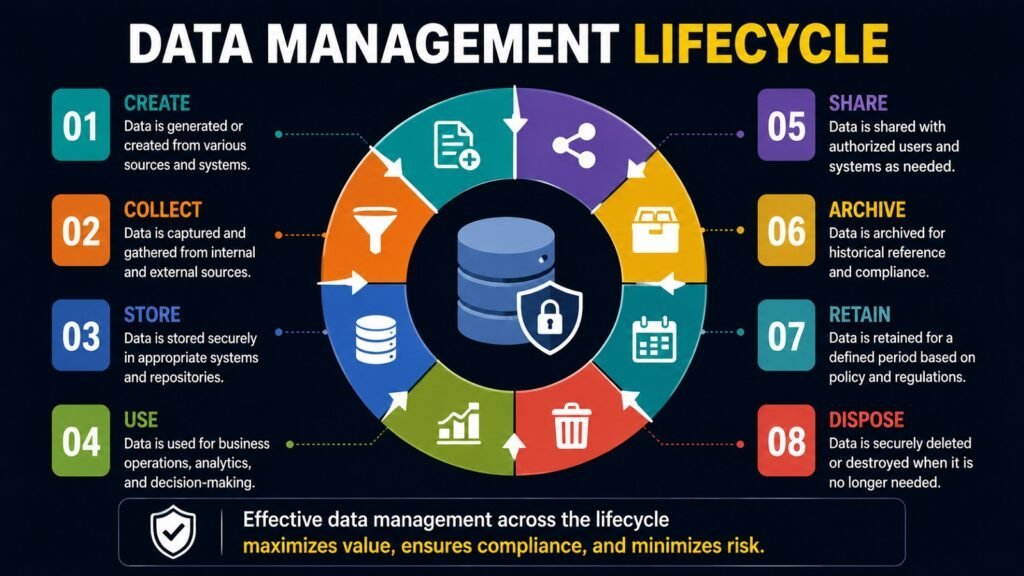
Every piece of information within an organization has a lifecycle. It is created or acquired, used for various business purposes across its active life, and eventually retired or deleted when no longer needed or when retention obligations have been fulfilled. Data Lifecycle Management is the practice of actively governing each of these stages to maximize the value of information while minimizing the costs and risks of retaining data indefinitely. The concept recognizes that data has fundamentally different value at different points in its existence, and that treating all data as equally important at all times is neither efficient nor responsible.
Lifecycle management directly supports regulatory compliance. Many privacy and data protection laws specify maximum retention periods for categories of personal data and require secure deletion once those periods pass. Without systematic lifecycle governance, organizations often retain information far longer than permitted, accumulating storage costs and legal exposure without corresponding business benefit. Unmanaged data environments also accumulate what practitioners call ROT data, meaning redundant, obsolete, or trivial information, which degrades analytics performance and complicates governance over time.
Storage optimization is a financially significant benefit. Cloud storage costs accumulate rapidly when retention policies are absent or unenforced. Organizations that implement structured lifecycle management find that removing unnecessary data improves system performance, reduces infrastructure costs, and makes remaining data easier to govern and audit. Lifecycle thinking also supports quality: when outdated records persist alongside current information, analysts risk using stale data, undermining the confidence that good Data Management is designed to build.
Data Lifecycle Management keeps Data Management sustainable over time. As volumes grow and regulatory requirements evolve, organizations with well-defined lifecycle frameworks adapt more effectively than those managing information without clear policies for what to keep, archive, or remove.
Data Management Across the Lifecycle: Stages and Management Objectives
| Lifecycle Stage | Primary Management Objective |
| Creation or acquisition | Ensure data is captured accurately and tagged with appropriate metadata |
| Storage and organization | Maintain data in structured, accessible, and appropriately secured repositories |
| Active use | Support reliable access for authorized users while enforcing quality standards |
| Sharing and distribution | Govern how data is transferred internally and to external parties |
| Archiving | Preserve data that is no longer active but still required for compliance or reference |
| Compliance review | Assess retained data against applicable legal and regulatory retention rules |
| Disposal or deletion | Securely remove data that has exceeded its retention period or business value |
| Audit and documentation | Maintain records of lifecycle decisions to demonstrate governance and compliance |
7. Data Management Through Data Stewardship
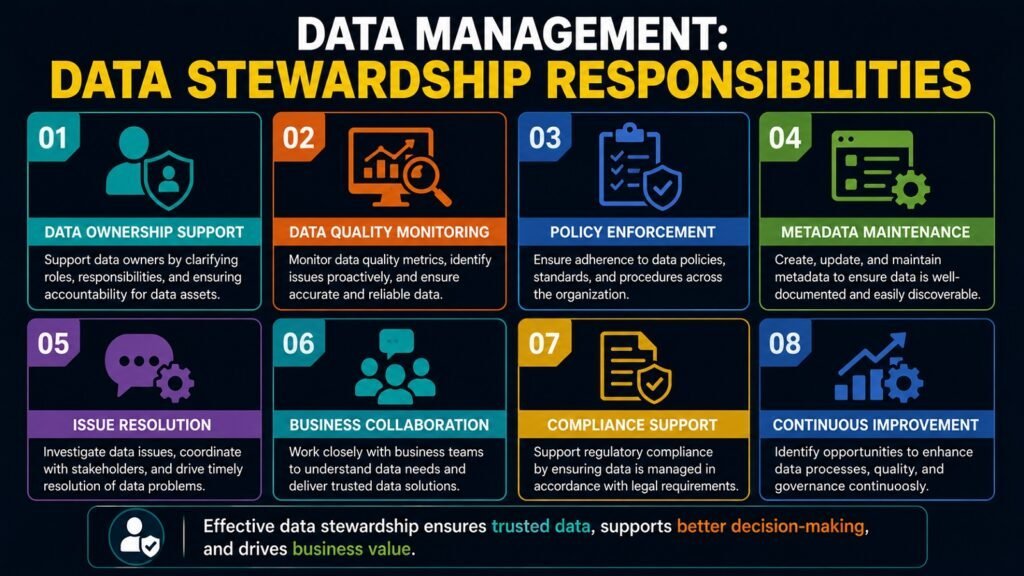
Policies, frameworks, and technology platforms can define how data should be managed, but they cannot manage data on their own. Data Stewardship provides the human dimension of Data Management by assigning specific individuals with ongoing responsibility for ensuring that organizational information remains accurate, consistently governed, and aligned with business needs. A data steward is typically a business professional, not a technical specialist, who takes ownership of a defined domain such as customer, financial, or product data. Their responsibilities include monitoring quality within that domain, resolving data issues, collaborating with governance councils and IT teams, and ensuring that standards are applied consistently in day-to-day operations.
The distinction between governance and stewardship is important. Governance establishes the policies and authority structures that define how data should be managed. Stewardship is the active execution of those policies within business operations. A governance council may define the standard for how customer addresses should be recorded, but a data steward is responsible for ensuring frontline teams follow that standard and that exceptions are corrected. Without stewardship, governance frameworks become documents that no one maintains, and quality programs fade after launch.
Research on data management maturity consistently identifies stewardship as one of the factors that separates effective information programs from those that struggle. The DAMA-DMBOK framework explicitly recognizes stewardship as a critical governance role. Stewards also contribute to organizational culture: when business professionals take active ownership of data quality within their domains, they help shift the broader mindset from viewing data as an IT concern to understanding it as a shared business asset.
As organizations pursue digital transformation, stewardship becomes even more critical. New systems and analytical capabilities are only as effective as the quality and governance of the information they rely on, making stewardship the organizational dimension that ensures digital expansion does not come at the cost of information integrity.
Data Management Through Stewardship: Responsibilities and Business Contributions
| Stewardship Responsibility | Business Contribution |
| Data quality monitoring | Identifies and resolves data errors before they affect business decisions |
| Definition management | Maintains accurate and agreed definitions within the business glossary |
| Issue resolution | Provides a clear escalation path for resolving data conflicts and discrepancies |
| Standards enforcement | Ensures data policies are applied consistently in day-to-day operations |
| Cross-functional collaboration | Bridges the gap between IT data management and business operational needs |
| Governance participation | Represents business domain interests within data governance councils |
| Training and awareness | Promotes data literacy and responsible information practices among colleagues |
| Compliance support | Assists in documenting data practices and preparing for regulatory reviews |
8. Data Management Through Data Compliance & Ethics
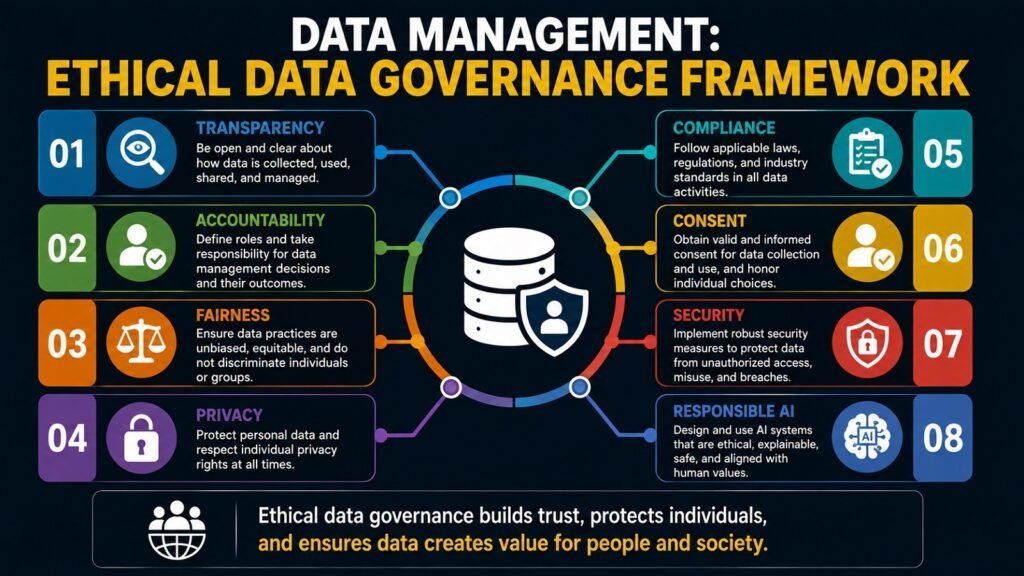
Data Management does not exist in a regulatory or ethical vacuum. Every organization that collects, uses, and stores information operates within a complex web of legal obligations, industry standards, and stakeholder expectations. Compliance refers to the formal obligation to meet those legal requirements, which vary significantly by industry and geography. Financial services organizations must satisfy frameworks such as the Sarbanes-Oxley Act and anti-money laundering directives. Healthcare organizations in the United States must meet HIPAA standards for patient data, and companies operating globally must navigate privacy laws including the GDPR. Organizations that treat compliance as a one-time checklist rather than an ongoing management responsibility consistently face greater regulatory risk.
Ethical data management extends responsibility beyond legal minimums. An organization may be legally permitted to collect and use data in a particular way while still acting in a manner reasonable stakeholders would consider unfair or harmful. Research from the AI Now Institute has documented cases where algorithmic systems amplified racial, gender, or socioeconomic biases embedded in training data, producing discriminatory outcomes in credit scoring, hiring, and law enforcement. Ethical Data Management requires evaluating these risks as part of how information is collected, processed, and applied, not as an afterthought once systems are in production.
Transparency is central to both compliance and ethics. Customers, employees, and regulators increasingly expect organizations to be open about how they handle data. Those that operate transparently build stronger trust, while those that obscure their practices face growing scrutiny from regulators and advocacy groups. Accountability structures and ethical review processes are essential in a regulatory environment that continues to tighten globally.
Compliance and ethics are not limitations on Data Management but sources of organizational strength. Businesses that manage information legally and responsibly earn the confidence of customers, partners, and regulators, and that trust constitutes a genuine competitive asset in data-intensive industries.
Data Management for Compliance and Ethics: Key Principles and Business Significance
| Compliance or Ethical Principle | Business Significance |
| Regulatory compliance | Avoids legal penalties and demonstrates organizational accountability |
| Data transparency | Builds stakeholder trust by clearly communicating how information is used |
| Fairness in data use | Prevents discriminatory outcomes that create legal and reputational risk |
| Accountability | Assigns responsibility for ethical data decisions across the organization |
| Responsible AI governance | Mitigates algorithmic bias and ensures equitable automated decision-making |
| Consent and purpose limitation | Ensures personal data is used only for its stated and authorized purpose |
| Ethical review processes | Evaluates new data initiatives against ethical standards before deployment |
| Cross-border compliance | Aligns data practices with regulations across the jurisdictions of operation |
Conclusion: Why Data Management Drives Long-Term Business Success
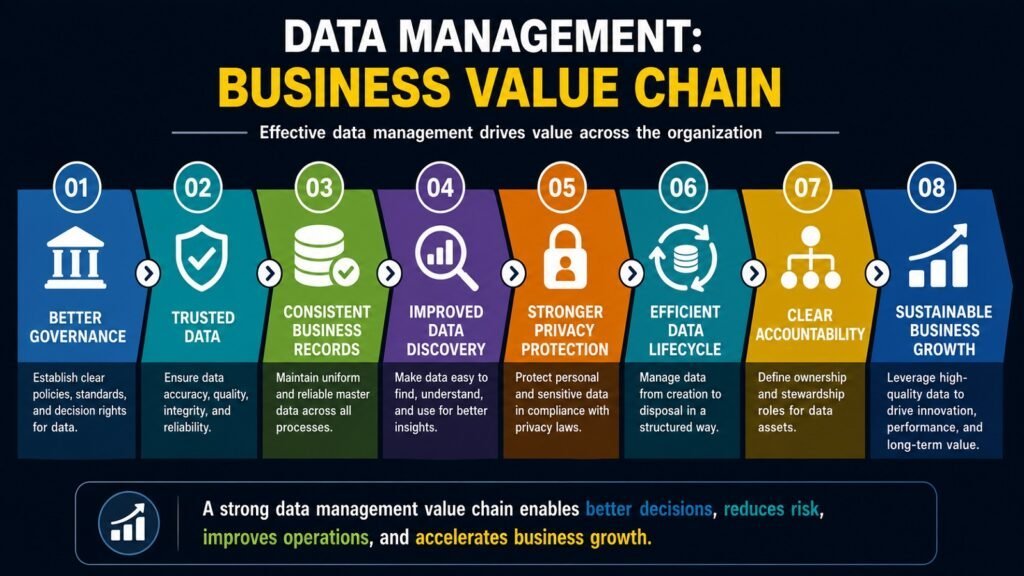
The eight pillars examined in this article are not independent disciplines but an interconnected system in which each dimension strengthens the others. Data Governance creates the authority structures that all other pillars operate within. Data Quality provides the accuracy and reliability that every use of information depends on.
Master Data Management ensures consistent entity definitions across systems. Metadata Management makes data discoverable and interpretable, amplifying the value that governance and quality programs produce. Data Protection and Privacy safeguard that value from legal, financial, and reputational risk. Lifecycle Management keeps the framework sustainable as volumes grow. Data Stewardship converts policies into daily practice through human accountability. Compliance and Ethics ensure every pillar operates within legal boundaries and principles that stakeholders can trust.
When these pillars function together, organizations gain what none of them can deliver individually: a trusted, well-governed, and business-ready information environment. That environment supports better executive decisions, more efficient operations, stronger customer relationships, and more reliable innovation. Organizations that achieve this integration consistently demonstrate stronger outcomes across financial performance and operational resilience.
Looking ahead, the importance of Data Management will only grow. Artificial intelligence requires well-governed and responsibly managed information, not just large volumes of it. As regulatory requirements expand and data volumes increase, organizations with mature frameworks will be better positioned to adapt and compete. Data Management is a continuous organizational capability, and those who invest in building it today are establishing one of the most durable advantages available in the data-driven economy.
Data Management: Eight Pillars and Key Takeaways
| Pillar | Key Takeaway |
| Data Governance | Creates the policies and accountability structures that all other pillars depend on |
| Data Quality Management | Ensures information is accurate and reliable enough to drive confident decisions |
| Master Data Management | Provides a single trusted version of core entities across all business systems |
| Metadata Management | Makes data discoverable, understandable, and consistently governed across functions |
| Data Protection & Privacy | Safeguards sensitive information and builds stakeholder trust through responsible handling |
| Data Lifecycle Management | Keeps information environments sustainable, compliant, and free of unnecessary data |
| Data Stewardship | Embeds human accountability for data quality and governance in business operations |
| Data Compliance & Ethics | Aligns data practices with legal obligations and stakeholder expectations of fairness |