Table of Contents
Introduction: Business Strategy as the Foundation of Long-Term Business Success
Every organization, regardless of size or industry, faces the same core challenge: how to grow, compete, and sustain performance in an environment that never stays the same. Without a coherent direction, even well-resourced organizations drift, misallocate effort, and lose competitive ground. Business Strategy solves this problem by providing the long-term direction that enables organizations to create value, compete effectively, allocate resources wisely, and build the capabilities required for sustainable success.
Business Strategy is far more than a planning activity. It is a continuous organizational capability and a business essential that connects leadership, decision-making, resource allocation, execution, performance evaluation, governance, and innovation into a unified system. When strategy functions well, every part of the organization moves in the same direction. When it is absent or poorly defined, confusion, misalignment, and wasted resources are the predictable result.
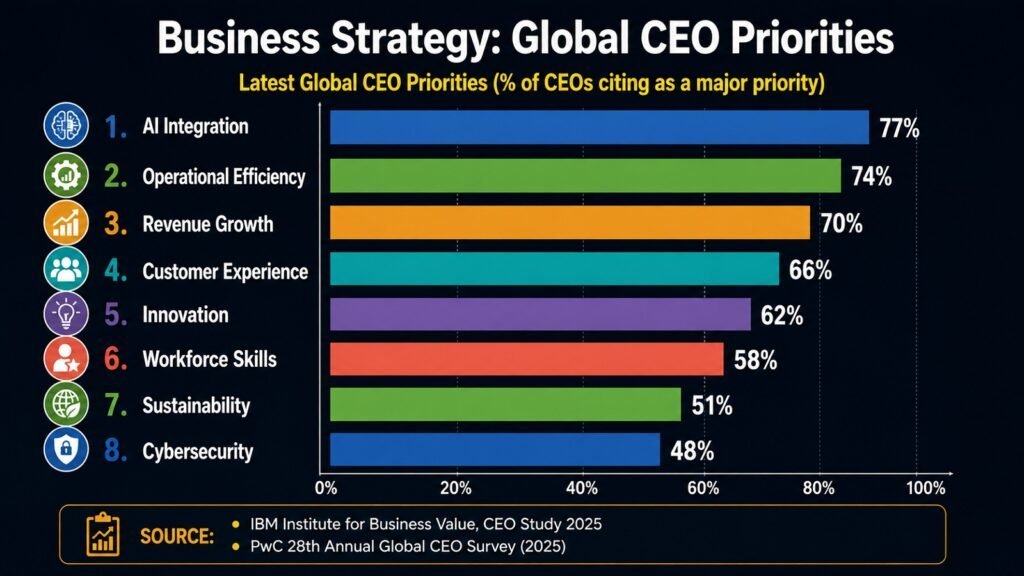
Modern organizations operate in environments more dynamic than ever before. Technological change is accelerating. Globalization continues reshaping competitive landscapes. Customer expectations evolve faster than many organizations can respond, and competitive pressure intensifies as digital platforms and disruptive business models challenge established players. In this context, Business Strategy is not optional. It is the mechanism through which organizations build long-term resilience and growth.
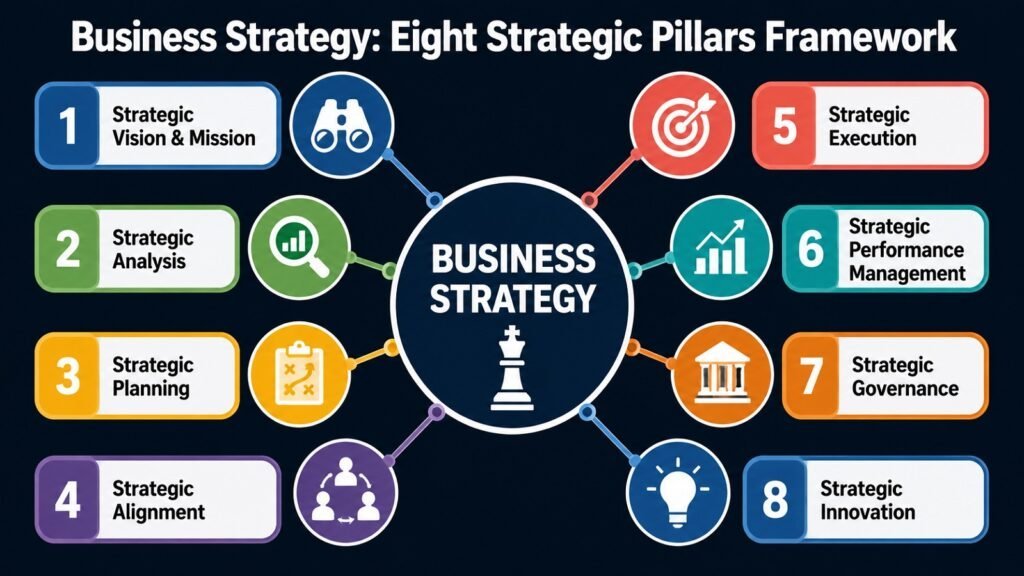
This article examines Business Strategy through eight strategic pillars: Strategic Vision and Mission, Strategic Analysis, Strategic Planning, Strategic Alignment, Strategic Execution, Strategic Performance Management, Strategic Governance, and Strategic Innovation. Together, these pillars form an integrated framework for developing, implementing, managing, and continuously improving Business Strategy. Each pillar addresses a distinct strategic dimension while reinforcing the others to create a system greater than the sum of its parts. Understanding these pillars individually and in combination equips leaders, managers, and strategists with a practical foundation for building and sustaining strategic capability.
Table 1: Business Strategy — Eight Strategic Pillars
| Pillars of Business Strategy | Role in Business Strategy |
| Strategic Vision and Mission | Defines organizational purpose and long-term direction |
| Strategic Analysis | Evaluates internal capabilities and external business environment |
| Strategic Planning | Translates strategy into structured objectives and roadmaps |
| Strategic Alignment | Ensures people, resources, and goals support strategy consistently |
| Strategic Execution | Converts plans into measurable organizational outcomes |
| Strategic Performance Management | Measures, evaluates, and improves strategic progress |
| Strategic Governance | Provides leadership, accountability, and oversight for strategy |
| Strategic Innovation | Drives continuous improvement and long-term competitiveness |
1. Business Strategy Through Strategic Vision and Mission
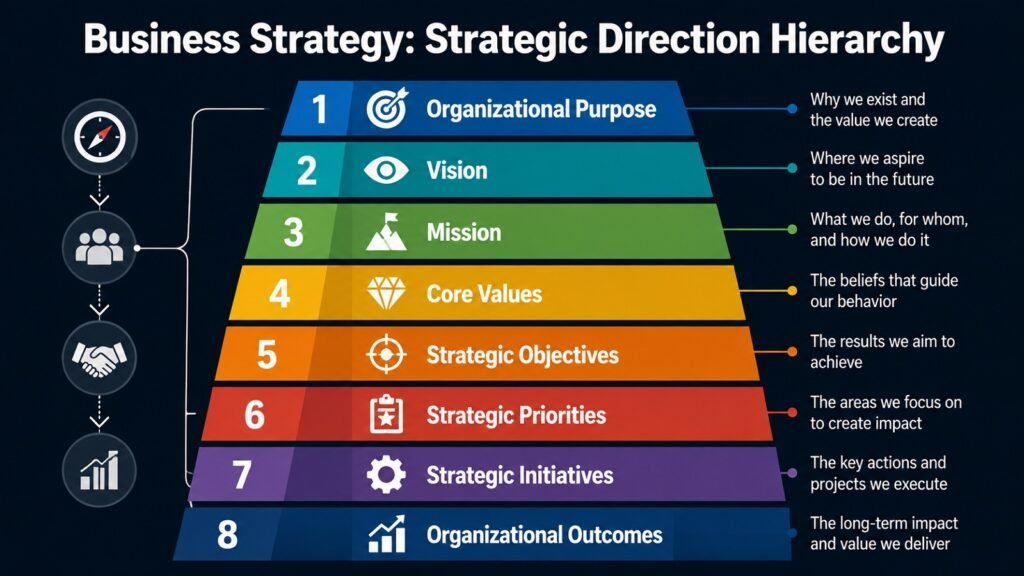
Organizations that lack a clear sense of direction make decisions reactively, shifting priorities in response to short-term pressures rather than long-term goals. This creates strategic drift, where the organization moves without coherent purpose. Strategic Vision and Mission solve this by establishing where an organization intends to go and why it exists, providing the stable foundation from which Business Strategy is built and sustained.
A vision statement describes the desired future state of the organization, articulating a long-term aspiration that motivates leaders, employees, and stakeholders. A mission statement defines the organization’s current purpose: what it does, who it serves, and how it creates value. While the vision points to the future, the mission anchors the present. Together, they create a strategic compass that guides leadership priorities, resource allocation, and organizational behavior.
The distinction between vision and mission matters in practice. A compelling vision generates strategic ambition and inspires the organization to pursue long-term goals that require sustained transformation. A clear mission prevents the organization from losing sight of its core purpose in the process. Peter Drucker long emphasized that organizations must clearly define their purpose to make effective decisions, and strategic scholars such as Michael Porter have connected organizational purpose to competitive positioning, arguing that consistent choices made in support of a clear direction create durable advantage.
Strategic objectives emerge directly from vision and mission. Once an organization knows what it exists to do and where it aims to be, it can translate that direction into specific, measurable goals that guide planning, resource deployment, and performance evaluation. Without this translation, vision and mission remain aspirational rather than operative.
Organizational culture is significantly influenced by the vision and mission of the organization. When leaders consistently articulate and reinforce the organization’s purpose, they foster shared values and behaviors that dictate how tasks are accomplished. This cultural aspect of strategy enhances execution by linking individual contributions to a collective goal. The Strategic Vision and Mission are not merely decorative statements; they serve as the foundation of Business Strategy and the benchmark against which all strategic decisions should be evaluated.
Table 2: Business Strategy — Strategic Vision and Mission Concepts
| Concept or Practice | Strategic Role |
| Vision Statement | Articulates where the organization intends to be in the long term |
| Mission Statement | Defines organizational purpose and core reason for existence |
| Strategic Objectives | Translate vision and mission into specific, measurable goals |
| Organizational Values | Guide leadership behavior and internal culture aligned with strategy |
| Purpose-Driven Strategy | Strengthens stakeholder engagement and long-term commitment |
| Strategic Leadership | Communicates vision and aligns people around a shared direction |
| Balanced Scorecard | Links vision and mission to performance measures across functions |
| Strategic Coherence | Ensures decisions across the organization reflect the same direction |
2. Business Strategy Through Strategic Analysis
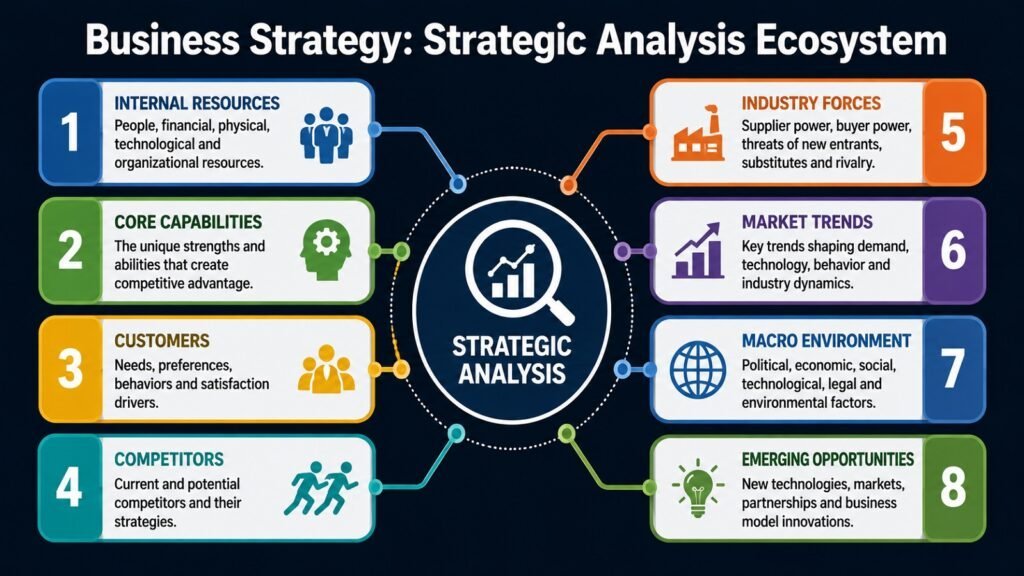
Making strategic decisions without understanding the business environment is like navigating without a map. Organizations that skip rigorous analysis risk investing resources in the wrong markets, underestimating competitors, or missing emerging threats before they cause serious damage. Strategic Analysis addresses this by providing the evidence-based understanding needed to develop a Business Strategy grounded in reality rather than assumption.
Effective Strategic Analysis examines both internal and external dimensions of the business. Internal analysis assesses organizational strengths, weaknesses, capabilities, and resources. External analysis evaluates market trends, competitive dynamics, regulatory conditions, and macro-environmental forces. Neither perspective alone is sufficient. A strategy built only on internal capabilities may ignore market realities. A strategy focused exclusively on external opportunities may overestimate what the organization can realistically achieve.
SWOT Analysis, which examines strengths, weaknesses, opportunities, and threats, remains widely used for combining internal and external insights. PESTLE Analysis extends external understanding across political, economic, social, technological, legal, and environmental dimensions. Porter’s Five Forces helps organizations understand competitive intensity by analyzing buyer and supplier power, the threat of new entrants, substitutes, and rivalry among existing competitors. The Resource-Based View, associated with Jay Barney, shifts attention inward, arguing that sustainable competitive advantage derives from unique, valuable, and difficult-to-imitate organizational resources.
These frameworks work in harmony rather than in opposition. An organization that integrates SWOT analysis with Porter’s Five Forces achieves both a comprehensive strategic overview and targeted competitive insights. Incorporating Value Chain Analysis helps identify where value is generated or diminished within the organization. Strategic Analysis reaches its full potential when approached as an ongoing practice rather than a one-time task, consistently updated to incorporate new market insights and competitive changes.
Table 3: Business Strategy — Strategic Analysis Frameworks and Concepts
| Framework or Concept | Strategic Purpose |
| SWOT Analysis | Identifies organizational strengths, weaknesses, opportunities, and threats |
| PESTLE Analysis | Examines macro-environmental factors affecting the business |
| Porter’s Five Forces | Assesses competitive intensity and industry structural dynamics |
| Value Chain Analysis | Identifies sources of competitive advantage within internal operations |
| Resource-Based View | Evaluates internal capabilities and resources that drive competitive strength |
| Competitive Benchmarking | Compares organizational performance against industry leaders |
| Customer Insights Analysis | Reveals evolving customer expectations and unmet market needs |
| Market Trend Analysis | Identifies emerging patterns that create strategic opportunities or risks |
3. Business Strategy Through Strategic Planning
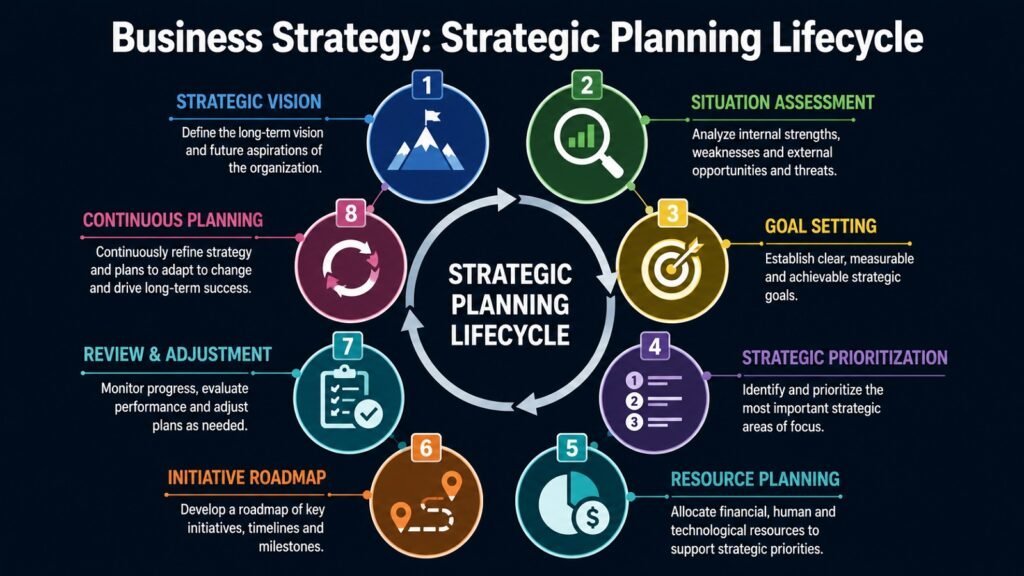
Vision and analysis create clarity about direction and context, but they do not by themselves produce results. Organizations need a structured process for translating strategic intent into concrete plans, timelines, and resource commitments. Without this bridge, strategy remains aspirational. Strategic Planning converts Business Strategy into organized action, ensuring that long-term goals are pursued systematically with appropriate resource support.
Strategic Planning defines strategic objectives, establishes planning horizons, prioritizes initiatives, allocates resources, and builds the roadmaps that guide implementation. Planning horizons help manage the tension between long-term ambition and short-term operational demands. A three-to-five-year horizon provides directional clarity, while annual and quarterly plans keep resources and activities aligned with evolving priorities.
Prioritization is one of the most important aspects of Strategic Planning. Organizations that pursue too many initiatives simultaneously dilute effort, exhaust resources, and deliver weak results. Effective strategic plans concentrate organizational capacity on the initiatives that offer the greatest impact. This requires difficult trade-offs, but it is precisely through these choices that organizations demonstrate genuine strategic judgment rather than simply listing aspirations.
Scenario planning adds strategic resilience by preparing the organization for multiple possible futures rather than a single expected one. Adaptive planning extends this further, embedding the expectation that strategic plans will be continuously reviewed and refined as conditions change. These planning practices do not undermine strategic commitment. They make strategic commitment more durable by building in the flexibility to respond when the environment shifts in unexpected ways.
Strategic Planning connects directly to Strategic Analysis and Strategic Alignment. Analysis provides the intelligence that informs planning decisions, while alignment ensures those decisions translate consistently into organizational action. Together, they form the foundation on which Strategic Execution depends.
Table 4: Business Strategy — Strategic Planning Components and Functions
| Planning Component | Strategic Function |
| Strategic Objectives | Define specific, measurable outcomes the organization aims to achieve |
| Planning Horizons | Structure strategy across short, medium, and long-term timeframes |
| Initiative Prioritization | Focuses organizational energy and resources on high-impact activities |
| Strategic Roadmap | Sequences strategic initiatives across time to guide implementation |
| Resource Planning | Aligns financial, human, and operational capacity with strategic priorities |
| Scenario Planning | Prepares the organization for multiple possible future environments |
| Adaptive Planning | Enables strategic plans to evolve in response to changing conditions |
| Stakeholder Planning | Integrates stakeholder expectations into strategic priorities and timelines |
4. Business Strategy Through Strategic Alignment
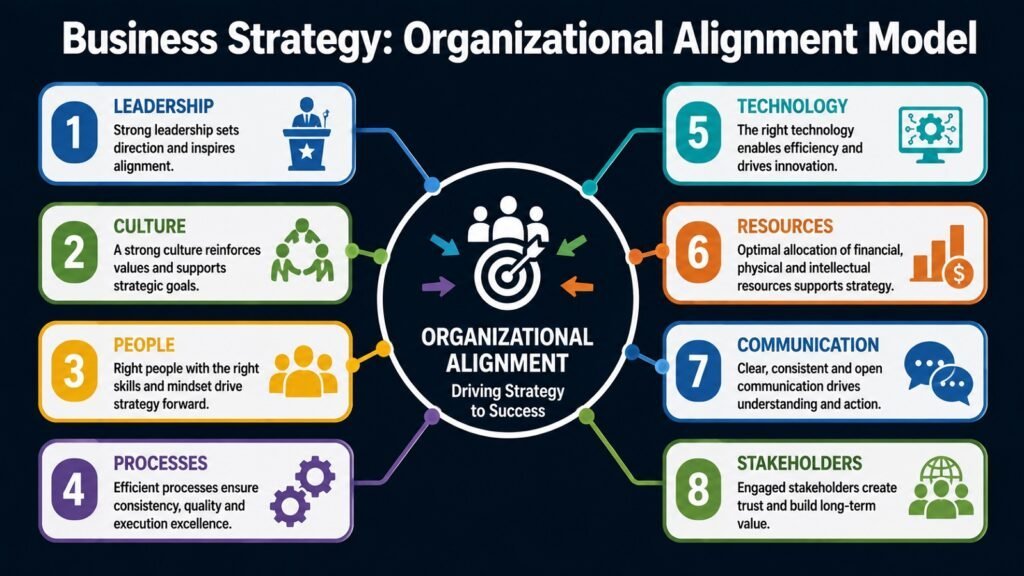
One of the most common reasons Business Strategy fails has nothing to do with the quality of the strategy itself. It fails because the people, processes, resources, and systems supposed to implement it are not consistently pointing in the same direction. Misalignment is a silent strategy killer. It shows up gradually in conflicting priorities, inconsistent decisions, and wasted effort. Strategic Alignment addresses this by ensuring every dimension of the organization consistently supports the chosen strategy.
Leadership alignment is the starting point. When senior executives interpret strategy differently or make decisions that contradict the strategic direction, the rest of the organization follows their lead in the wrong direction. Effective alignment requires leaders to consistently model the strategy in behavior, communication, and resource decisions. Departmental alignment extends this coherence downward. Business units and support functions each need to understand how their specific goals contribute to the broader strategy; without this, departments optimize for their own objectives rather than collective outcomes.
Organizational culture plays a crucial role. When values, norms, and expected behaviors reinforce strategic priorities, alignment becomes self-reinforcing. Technology and resource alignment are equally important. Digital systems must support the strategic direction rather than constrain it, and budget and staffing decisions should reflect strategic priorities rather than historical spending patterns. Stakeholder alignment broadens the picture further, ensuring customers, partners, and investors understand and support the organization’s direction.
Strategic Alignment requires ongoing attention and recalibration. As strategies evolve and markets change, alignment must be continuously renewed. Organizations that treat alignment as a sustained discipline rather than a one-time initiative are significantly better positioned to execute their Business Strategy consistently over time.
Table 5: Business Strategy — Strategic Alignment Areas and Contributions
| Alignment Area | Organizational Contribution |
| Leadership Alignment | Ensures executives consistently model and communicate strategic priorities |
| Departmental Coordination | Connects business unit goals to the overall strategic direction |
| Organizational Culture | Embeds shared values and behaviors that support strategy execution |
| Resource Alignment | Directs financial and human resources toward strategic priorities |
| Technology Alignment | Ensures digital systems and infrastructure support strategic objectives |
| Stakeholder Alignment | Builds shared understanding and commitment among key stakeholders |
| Communication Alignment | Delivers consistent strategic messaging across all organizational levels |
| Performance Alignment | Links individual and team performance metrics to strategic outcomes |
5. Business Strategy Through Strategic Execution
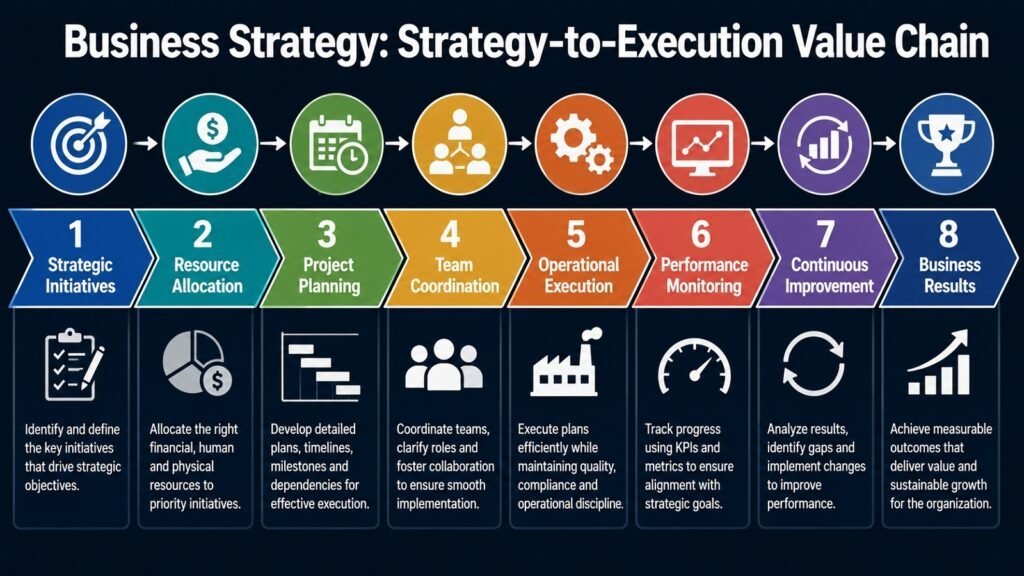
A well-developed Business Strategy that is never effectively implemented is no strategy at all. Research consistently identifies execution failure, rather than poor strategic thinking, as one of the leading causes of organizational underperformance. Strategic Execution is the discipline that converts strategic plans into measurable outcomes, and it demands as much organizational attention as any other dimension of Business Strategy.
Effective execution begins with implementation planning, which translates strategic objectives into specific activities, milestones, timelines, and ownership. Leadership accountability is central to execution success. When senior leaders take personal ownership of strategic initiatives, communicate progress transparently, and hold teams responsible for results, execution gains the organizational momentum needed to deliver. Operational coordination ensures that execution activities are sequenced and synchronized across departments, preventing duplication, gaps, and conflicting resource demands.
Change management is often an overlooked challenge in execution. Many strategic initiatives necessitate that individuals alter their work habits, embrace new systems, or abandon long-standing practices. In the absence of a structured change management approach, resistance can subtly erode even the most technically proficient execution plans. Leaders who prioritize preparing their teams for change, clearly communicating the rationale behind strategic choices, and providing support during transitions generally experience markedly improved execution results.
Execution is not a one-time activity. It is a continuous discipline that requires ongoing performance monitoring, feedback loops, and willingness to adjust when results diverge from expectations. Organizations that treat execution as a living organizational practice, rather than the final step in a planning cycle, build the execution capability that sustains Business Strategy over the long term.
Table 6: Business Strategy — Strategic Execution Components and Functions
| Execution Component | Strategic Function |
| Implementation Planning | Translates strategic objectives into specific operational tasks and timelines |
| Leadership Accountability | Assigns clear ownership of strategic initiatives to senior leaders |
| Operational Coordination | Aligns day-to-day business activities with strategic priorities |
| Resource Deployment | Directs funding, talent, and technology to strategic initiatives |
| Change Management | Guides the organization through behavioral and structural shifts during execution |
| Performance Monitoring | Tracks implementation progress against planned strategic milestones |
| Cross-Functional Collaboration | Coordinates execution activities across departments and business units |
| Feedback and Adjustment | Incorporates execution insights to refine plans and improve outcomes |
6. Business Strategy Through Strategic Performance Management
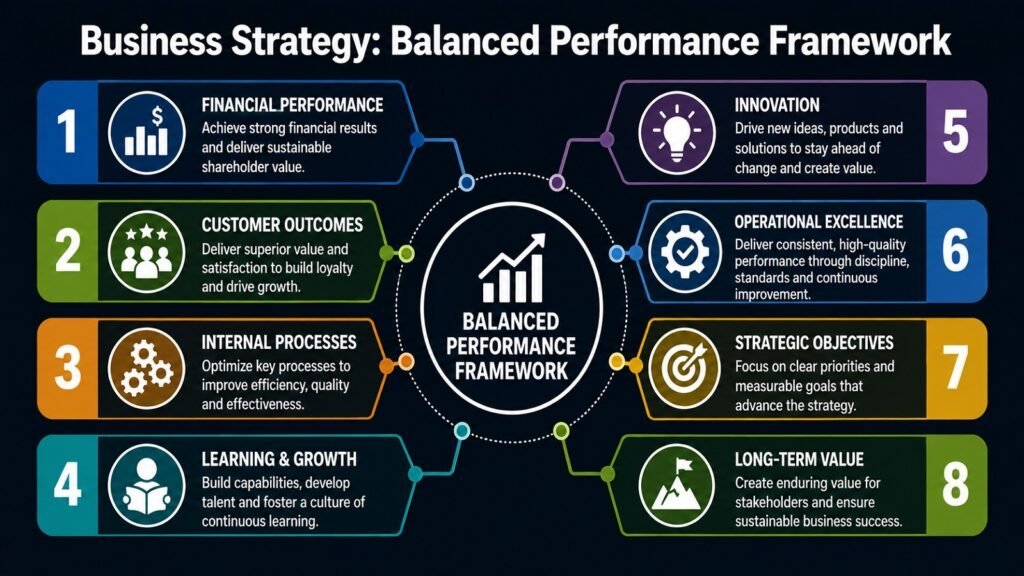
Organizations that implement strategy without measuring outcomes operate on faith rather than evidence. Strategic intent, however clearly defined, does not guarantee results. Conditions change, assumptions prove incorrect, and execution encounters unexpected obstacles. Strategic Performance Management provides the feedback system that enables organizations to evaluate whether their Business Strategy is delivering intended results and, when it is not, to understand why and make informed corrections.
Key performance indicators are the most direct tool for tracking strategic progress. Effective KPIs are specific, measurable, and directly connected to strategic objectives rather than operational activity. The Balanced Scorecard, developed by Robert Kaplan and David Norton, extends performance measurement beyond financial results by evaluating performance across four perspectives: financial outcomes, customer value, internal process effectiveness, and organizational learning and growth. This multi-dimensional view prevents organizations from focusing narrowly on short-term financial metrics while neglecting the capabilities that drive long-term performance.
Strategic dashboards translate performance data into accessible visual formats supporting real-time decision-making. Benchmarking adds an external perspective, comparing organizational performance against industry peers to identify gaps and opportunities. Strategic reviews create structured opportunities for leadership teams to evaluate progress deliberately and connect performance evidence to planning and resource decisions.
OKRs, popularized by organizations such as Google and Intel, provide a complementary approach that connects team-level goals directly to broader strategic objectives. Unlike traditional performance reviews that evaluate outcomes after the fact, OKRs create forward-looking accountability by setting ambitious targets with defined measures at the beginning of each planning cycle.
The primary aim of Strategic Performance Management is to foster organizational learning. By thoughtfully analyzing performance data and linking it to planning and governance decisions, one can uncover what is effective, what is ineffective, and what modifications are necessary to consistently enhance Business Strategy.
Table 7: Business Strategy — Strategic Performance Management Tools and Applications
| Performance Management Tool | Strategic Application |
| Key Performance Indicators | Quantify strategic progress against defined organizational objectives |
| Balanced Scorecard | Evaluates performance across financial, customer, process, and learning dimensions |
| Strategic Dashboards | Provide real-time visibility into organizational performance metrics |
| Benchmarking | Compares internal performance against industry standards and best practices |
| Strategic Reviews | Assess progress and recalibrate priorities based on performance evidence |
| OKRs (Objectives and Key Results) | Align team-level goals with broader strategic objectives |
| Continuous Improvement | Uses performance data to incrementally strengthen strategic outcomes |
| Organizational Learning | Converts performance insights into improved strategic decision-making |
7. Business Strategy Through Strategic Governance
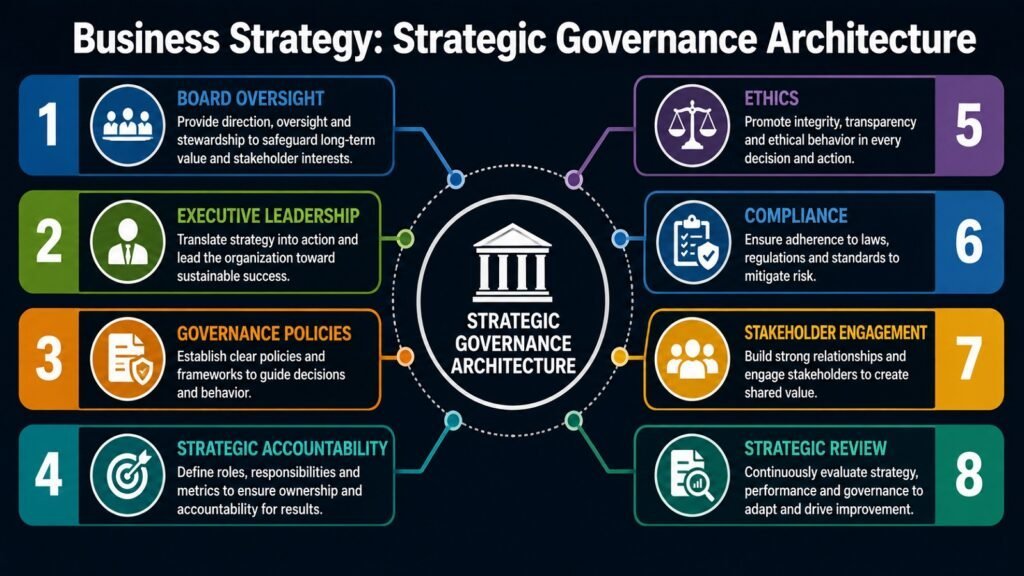
Even a well-designed and effectively executed Business Strategy can be undermined without the leadership structures, accountability mechanisms, and oversight processes needed to sustain it responsibly. Strategic Governance provides the framework within which strategy is directed, monitored, and held accountable. It connects strategic ambition with organizational responsibility, ensuring that the pursuit of long-term goals is guided by sound judgment, ethical standards, and transparent decision-making.
Board oversight is a foundational governance function. Directors are responsible for challenging and approving strategic direction, evaluating organizational performance, and ensuring executive leadership remains accountable to stakeholders. Effective boards bring independent judgment to strategic questions, reducing groupthink and ensuring that major decisions are examined from multiple perspectives. Governance frameworks define the policies and processes that guide how strategic decisions are made, who holds authority to approve major commitments, how risks are managed, and how performance is reported.
Corporate ethics sits at the center of good governance. Organizations that embed ethical standards into their governance structures make better long-term decisions, build greater stakeholder trust, and reduce reputational risks that can permanently impair strategic progress. Risk oversight ensures that strategic risks, including competitive disruption, regulatory change, and operational vulnerability, are actively managed rather than treated as separate from Business Strategy.
Strategic Governance also reinforces external stakeholder trust. Organizations that demonstrate transparent governance and consistent accountability attract stronger stakeholder support and are better positioned to sustain their Business Strategy through challenging periods. Governance is not a constraint on strategy. It is the foundation of long-term strategic credibility.
Table 8: Business Strategy — Strategic Governance Elements and Functions
| Governance Element | Strategic Function |
| Board Oversight | Ensures strategic decisions align with organizational purpose and stakeholder interests |
| Executive Accountability | Holds senior leadership responsible for strategic outcomes and commitments |
| Governance Framework | Establishes the structures, policies, and processes that guide strategic oversight |
| Corporate Ethics | Upholds integrity, transparency, and responsible decision-making within strategy |
| Risk Oversight | Identifies and manages strategic risks before they impair organizational performance |
| Policy Development | Creates guidelines that govern strategic behavior across the organization |
| Stakeholder Accountability | Communicates strategic progress and performance to key stakeholders |
| Strategic Audit | Independently reviews strategic decisions and governance processes for effectiveness |
8. Business Strategy Through Strategic Innovation
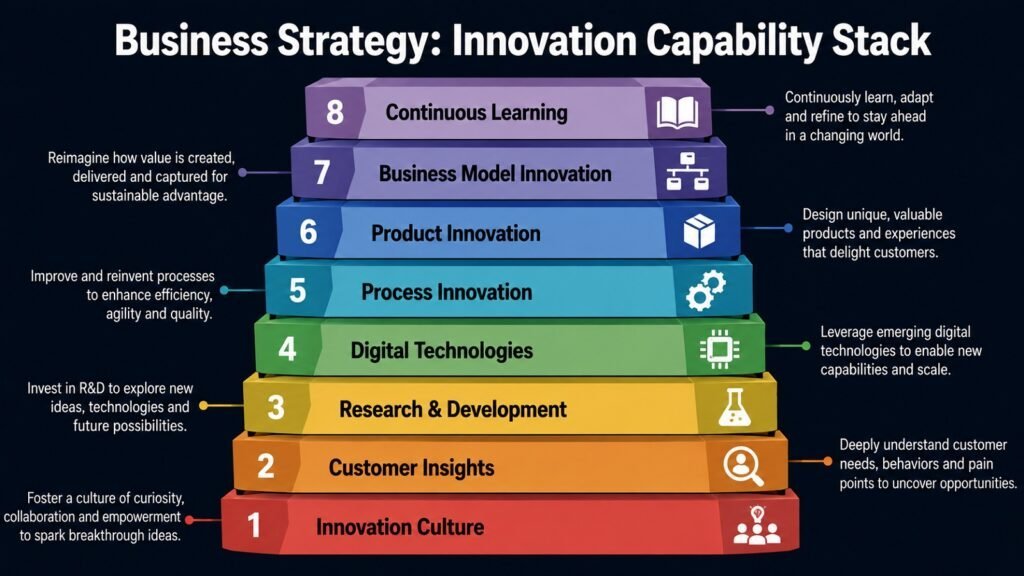
Competitive advantages that organizations build today will not last forever. Markets evolve, technologies disrupt established business models, customer expectations shift, and new competitors emerge from unexpected directions. Organizations that rely too heavily on existing strengths without actively innovating are vulnerable to displacement. Strategic Innovation addresses this by embedding continuous renewal into Business Strategy, ensuring that organizations build the capabilities needed for future competitiveness rather than defending only their current position.
Digital transformation has become one of the most consequential drivers of Strategic Innovation. Organizations that integrate digital technologies into their operations, customer relationships, and business models can create fundamentally new sources of value and efficiency. Beyond digital transformation, innovation takes multiple forms. Product innovation expands market reach. Process innovation improves internal efficiency and competitive agility. Service innovation enhances customer experience in ways that are difficult for competitors to replicate quickly.
Business model innovation represents perhaps the most disruptive form of Strategic Innovation. Companies such as Apple, Amazon, and Airbnb did not simply improve existing offerings. They introduced fundamentally new ways of delivering value that transformed entire industries. While not every organization needs to pursue business model transformation, every organization must evaluate whether its current model remains competitive as conditions evolve.
Open innovation, which involves collaborating with external partners and research institutions, extends organizational innovation capacity beyond internal boundaries. Emerging technologies, from artificial intelligence to advanced analytics, create new opportunities to rethink how organizations operate and compete. Strategic Innovation does not replace the other pillars of Business Strategy. It enhances all of them, improving planning, execution, governance, and long-term value creation. In a dynamic business environment, innovation is what keeps Business Strategy relevant.
Table 9: Business Strategy — Strategic Innovation Drivers and Contributions
| Innovation Driver | Strategic Contribution |
| Digital Transformation | Enables new business models and operational capabilities through technology |
| Product Innovation | Creates new offerings that expand market reach and customer value |
| Process Innovation | Improves internal efficiency and competitive agility across operations |
| Service Innovation | Enhances customer experience and differentiates the organization competitively |
| Organizational Learning | Builds adaptive capability by converting knowledge into strategic improvement |
| Emerging Technology Adoption | Integrates new technologies to sustain long-term competitive advantage |
| Business Model Innovation | Redefines how the organization creates, delivers, and captures value |
| Open Innovation | Leverages external partnerships, ecosystems, and ideas to accelerate innovation |
Conclusion: Business Strategy as the Blueprint for Sustainable Business Success
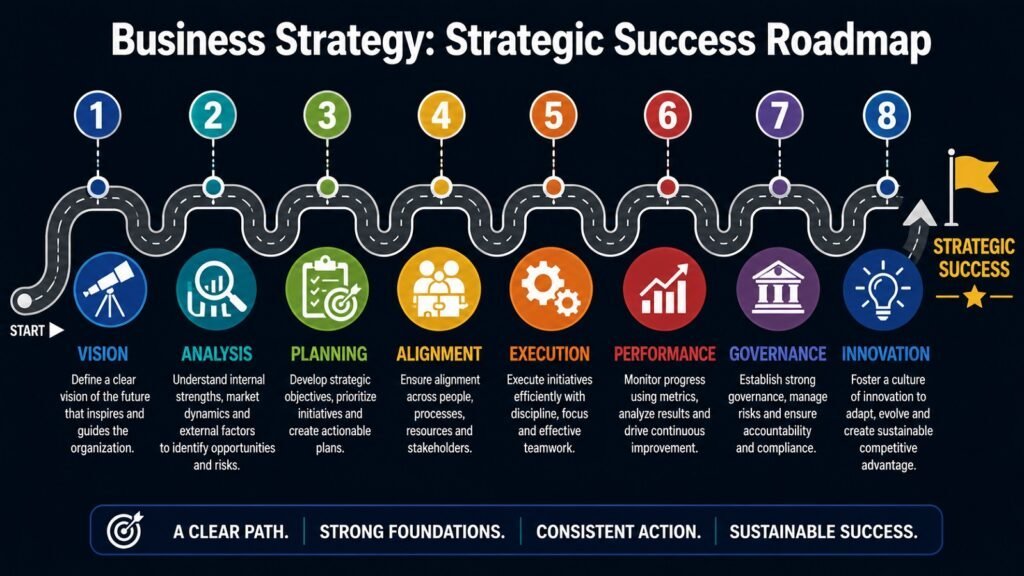
Business Strategy is not a single decision or a plan produced at a leadership offsite. It is the integrated system through which organizations translate purpose into performance, analysis into action, and intent into sustainable value creation. The eight strategic pillars examined in this article do not operate in isolation. Each reinforces the others, creating a comprehensive framework that strengthens the organization’s capacity to compete, adapt, and grow over time.
The vision and mission establish the direction that ensures all subsequent strategic activities are coherent. Analysis provides the necessary evidence for making informed decisions. Planning transforms that evidence into organized priorities and roadmaps. Alignment guarantees that the organization progresses collectively rather than in conflicting paths. Execution yields results. Performance management assesses those results, identifies discrepancies, and promotes ongoing improvement. Governance offers the accountability and oversight essential for maintaining responsible strategic leadership. Innovation guarantees that Business Strategy remains adaptable and pertinent as circumstances continue to change.
The most important insight this framework offers is that Business Strategy is an ongoing organizational capability, not a one-time event. Organizations that treat strategy as a periodic exercise are poorly equipped for the pace and complexity of modern business environments. Organizations that cultivate strategy as a continuously refined discipline are significantly better positioned to build resilience, seize opportunities, and deliver long-term value. As business environments continue to evolve, sustained investment in all eight pillars, connected into a unified strategic system, is what transforms Business Strategy from a planning document into a genuine blueprint for sustainable success.
Table 10: Business Strategy — Eight Pillars and Their Primary Contributions
| Pillars of Business Strategy | Primary Contribution to Business Strategy |
| Strategic Vision and Mission | Establishes organizational purpose and long-term direction |
| Strategic Analysis | Builds evidence-based understanding of internal and external environments |
| Strategic Planning | Converts strategic intent into structured objectives and roadmaps |
| Strategic Alignment | Ensures people, resources, and systems consistently support strategy |
| Strategic Execution | Translates plans into measurable organizational outcomes |
| Strategic Performance Management | Evaluates progress and drives continuous strategic improvement |
| Strategic Governance | Maintains leadership, accountability, and ethical oversight of strategy |
| Strategic Innovation | Enables long-term competitiveness through continuous strategic renewal |