Table of Contents
Introduction: Strategic Thinking as the Foundation of Exceptional Leadership
What separates exceptional leaders from competent managers is the capacity to think beyond immediate circumstances and guide organizations toward sustainable success. Strategic thinking is one of the most important aspects of leadership because it enables leaders to anticipate change, understand organizational complexity, make informed decisions under uncertainty, and align resources with a coherent long-term vision.
It is important to distinguish strategic thinking from strategic planning. Strategic planning is a structured process for translating decisions into actionable roadmaps. Strategic thinking is an ongoing leadership mindset — the continuous process of analyzing environments, questioning assumptions, and identifying possibilities before committing to a direction. Strategic planning follows decisions; strategic thinking informs them. Organizations that confuse the two risk producing detailed plans built on shallow analysis.
The demand for strategic thinking has grown significantly at every leadership level. Globalization has expanded competitive landscapes. Technological disruption has compressed decision cycles. Economic uncertainty has made long-range forecasting harder, requiring leaders to manage ambiguity rather than eliminate it. Digital transformation and shifting customer expectations have further intensified the need for leaders who can synthesize complex information and make sound judgments under pressure.
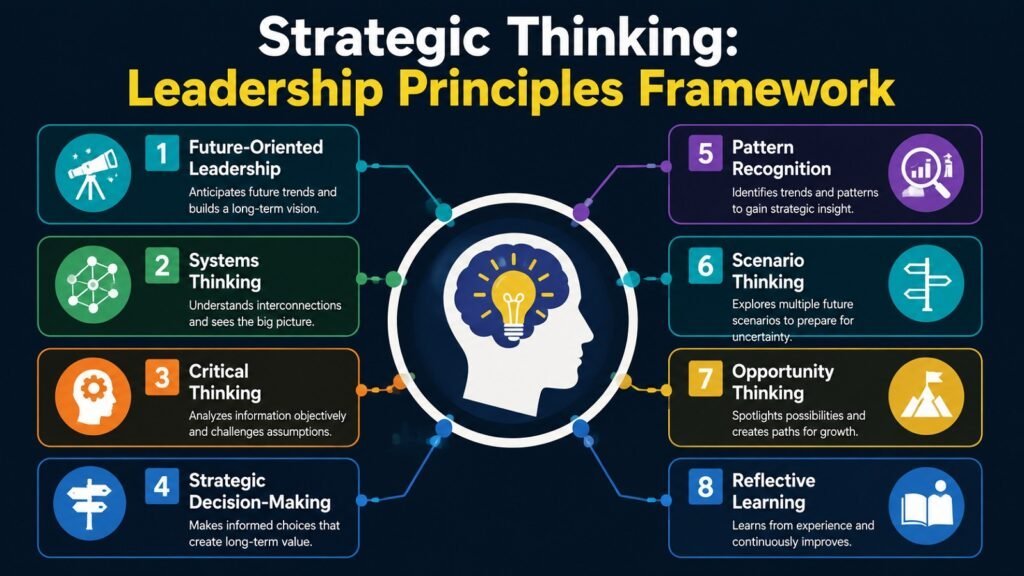
Research in leadership theory consistently supports this view. James Brian Quinn’s concept of logical incrementalism, Henry Mintzberg’s distinction between deliberate and emergent strategy, and Gary Hamel and C. K. Prahalad’s work on strategic intent all lead to the same conclusion: effective leadership requires thinking across time horizons, systems, and possibilities. This article draws on such research alongside practical business experience to examine eight interconnected principles that collectively develop strategic thinking. Each principle addresses a distinct dimension of the leadership mindset, forming a progressive framework applicable at any organizational level.
Table 1: Strategic Thinking — Overview of the Eight Leadership Principles
| Leadership Principles of Strategic Thinking | Core Contribution to Strategic Thinking |
| Future-Oriented Leadership | Develops long-term perspective and organizational resilience |
| Systems Thinking | Reveals interdependencies and prevents unintended consequences |
| Critical Thinking | Improves judgment by challenging assumptions and reducing bias |
| Strategic Decision-Making | Supports sound choices under uncertainty and complexity |
| Pattern Recognition | Identifies trends and connections before competitors respond |
| Scenario Thinking | Prepares organizations for multiple possible futures |
| Opportunity Thinking | Converts emerging signals into sustainable competitive advantage |
| Reflective Learning | Strengthens strategic judgment through continuous adaptation |
1. Strategic Thinking Through Future-Oriented Leadership
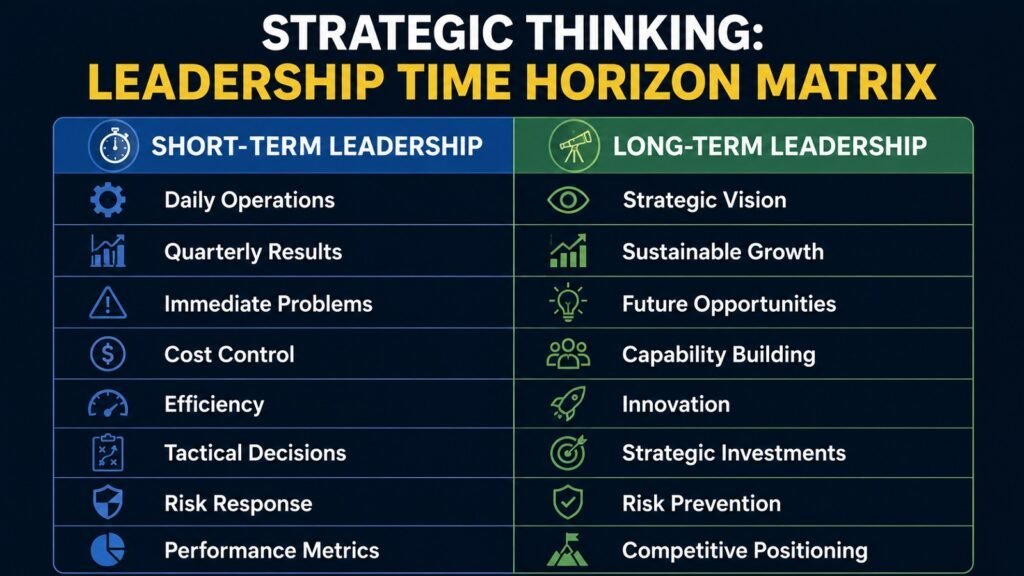
One of the defining characteristics of strategic leaders is the ability to resist short-term pressures and maintain a clear focus on long-term organizational positioning. Future-oriented leadership is not about prediction; it is about developing the discipline to ask where an organization needs to be in five or ten years and working backward to determine what must be done today. Strategic thinking enables this shift by encouraging leaders to evaluate decisions against their future consequences rather than immediate results.
Gary Hamel and C. K. Prahalad introduced the concept of strategic intent to describe organizations that maintain a consistent long-term ambition even as their methods evolve. Their analysis of companies like Komatsu and Canon showed that sustained competitive success begins not with superior resources but with a compelling long-range aspiration. This finding demonstrates that future orientation is a leadership discipline applicable at every organizational scale, not a luxury reserved for large corporations.
Many organizations fail not because current operations are poorly managed but because leaders focus too heavily on immediate performance metrics. When quarterly results dominate strategic conversations, investment in capabilities that will pay off in three to five years tends to decline, gradually eroding competitive positioning. Kodak’s inability to transition from film to digital photography, despite having developed early digital camera technology, is a well-documented example of how present-focus can override future readiness.
Amazon’s sustained investment in infrastructure, logistics, and cloud computing during years when those investments suppressed near-term profitability illustrates the opposite discipline. Jeff Bezos communicated a multi-year horizon to shareholders, prioritizing long-term positioning over short-term earnings. That orientation allowed Amazon to build capabilities competitors found difficult to replicate once their strategic value became apparent. Leaders who want to develop future-oriented thinking can begin by deliberately extending their analytical time frame — asking what customer expectations and competitive dynamics will look like in five years creates the mental habit of scanning beyond immediate circumstances. Future-oriented thinking naturally connects to the next principle: understanding systems.
Table 2: Strategic Thinking and Future-Oriented Leadership — Key Principles
| Dimension | Leadership Application |
| Long-term perspective | Evaluates decisions against future consequences |
| Strategic intent | Sustains ambition through changing methods |
| Short-termism risk | Immediate focus erodes long-term competitive position |
| Investment horizon | Accepts near-term cost for future capability building |
| Competitive positioning | Shapes future advantage before it becomes visible |
| Time-frame extension | Deliberately scans 5–10 year horizons |
| Organizational resilience | Prepares resources for anticipated disruption |
| Cultural expectation | Embeds long-range thinking into leadership dialogue |
2. Strategic Thinking Through Systems Thinking
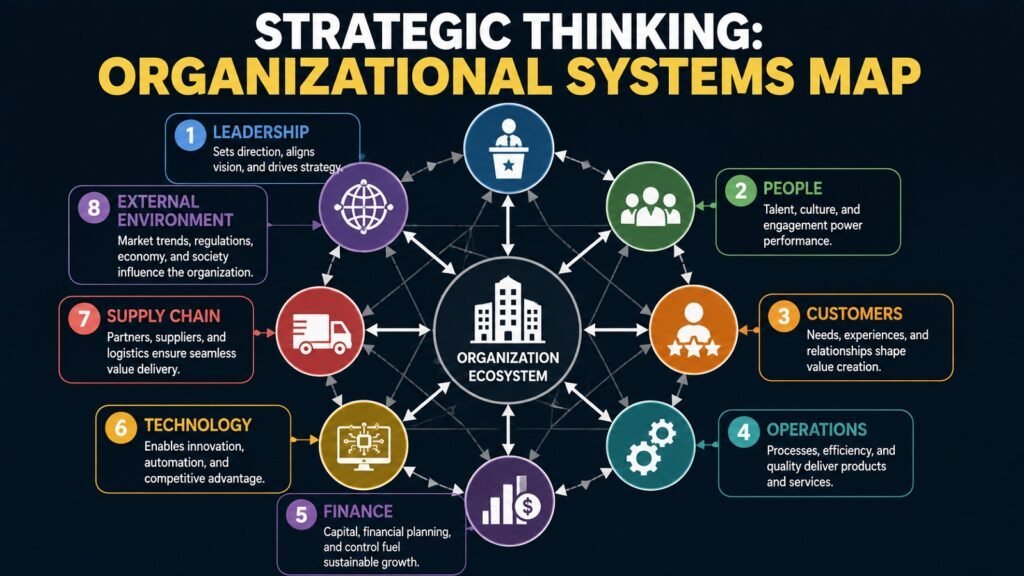
Organizations are not collections of independent functions. They are interconnected systems in which a decision made in one area produces effects in others. Strategic thinking requires leaders to understand this reality and factor it into significant choices. Systems thinking is the discipline that makes this possible — it trains leaders to see relationships, feedback loops, and interdependencies rather than isolated events or individual performance metrics.
Peter Senge’s work in The Fifth Discipline established systems thinking as a foundational organizational learning discipline. Senge argued that the most persistent organizational problems are caused not by isolated failures but by structural dynamics that produce recurring difficulties regardless of who leads. His concept of the learning organization depends on leaders seeing these structural patterns rather than reacting to surface symptoms. Jay Forrester’s earlier system dynamics research provided the mathematical foundations for understanding how feedback loops amplify or dampen organizational behavior over time.
The practical significance becomes clear when examining decisions that appear sound in isolation but create systemic problems. A workforce reduction to cut costs may improve short-term profitability while simultaneously damaging service quality, reducing institutional knowledge, and accelerating voluntary turnover — secondary effects that often exceed the initial savings. Leaders who think systemically anticipate these cascades before committing to action. Toyota’s production system is a well-studied example of systems thinking applied at scale: rather than optimizing individual production stages, Toyota treated quality, efficiency, supplier relationships, and employee development as mutually reinforcing elements of one integrated system.
For leaders who want to strengthen systems thinking, the most practical starting point is asking second-order questions before significant decisions: who else will be affected, what downstream consequences might emerge, and whether feedback mechanisms could undermine the intended outcome. This analytical depth forms the foundation for the critical analysis discussed next.
Table 3: Strategic Thinking and Systems Thinking — Key Principles
| Dimension | Leadership Application |
| Organizational interdependence | Decisions in one area affect multiple functions |
| Feedback loops | Actions amplify or dampen outcomes over time |
| Structural dynamics | Recurring problems often reflect systemic causes |
| Learning organization | Systems thinking underpins continuous organizational learning |
| Second-order effects | Anticipates downstream consequences before acting |
| Unintended consequences | Prevents well-intentioned decisions from producing harm |
| Integrated design | Treats quality, efficiency, and people as one system |
| System signals | Problems as diagnostic information, not isolated failures |
3. Strategic Thinking Through Critical Thinking
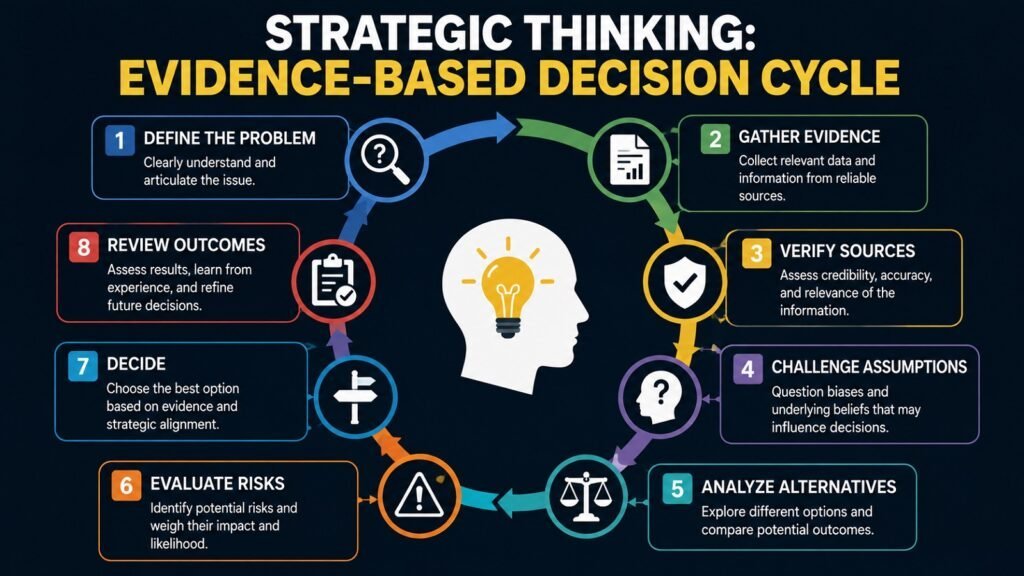
Strategic thinking without rigorous critical analysis is incomplete. Leaders who can visualize the future and understand organizational systems still need the intellectual discipline to evaluate information objectively, challenge their own assumptions, and recognize the cognitive biases that distort judgment. Critical thinking is not simply the ability to analyze data; it is the structured habit of questioning whether information is reliable, whether conclusions are logical, and whether alternative explanations have been properly considered.
Daniel Kahneman’s research, summarized in Thinking, Fast and Slow, identified several biases that systematically undermine leadership judgment. Confirmation bias leads decision-makers to favor information that supports existing beliefs while dismissing contradictory evidence. Overconfidence causes leaders to underestimate uncertainty. The availability heuristic causes recent or memorable events to be weighted more heavily than statistically representative data. Each bias is more dangerous in high-stakes strategic decisions because the consequences accumulate over time.
Poor assumptions are an equally significant source of strategic failure. Nokia’s decline is partly attributable to an embedded assumption that software was secondary in mobile phones — a belief never critically examined even as Apple’s iOS strategy made software the dominant competitive variable. Making assumptions explicit and challenging them regularly, rather than accepting them as background conditions, is essential to sound strategic thinking. Structuring red-team exercises where a group specifically argues against a proposed strategy, and documenting key assumptions before major decisions, are practical ways to embed critical analysis into leadership routines.
At the individual level, leaders who cultivate genuine intellectual humility — who remain open to being wrong — tend to make better strategic decisions over time. Objective analysis of this kind directly improves the quality of the decisions discussed in the next section.
Table 4: Strategic Thinking and Critical Thinking — Key Principles
| Dimension | Leadership Application |
| Confirmation bias | Tendency to favor information that supports existing views |
| Overconfidence | Overestimating forecast accuracy in uncertain conditions |
| Assumption testing | Making implicit beliefs explicit and challenging them |
| Red-team analysis | Structuring deliberate opposition to proposed strategies |
| Disconfirming evidence | Actively seeking information that challenges current views |
| Availability heuristic | Overweighting recent or memorable events in decisions |
| Intellectual humility | Remaining open to being wrong improves long-term judgment |
| Analytical discipline | Structured questioning reduces strategic reasoning errors |
4. Strategic Thinking Through Strategic Decision-Making
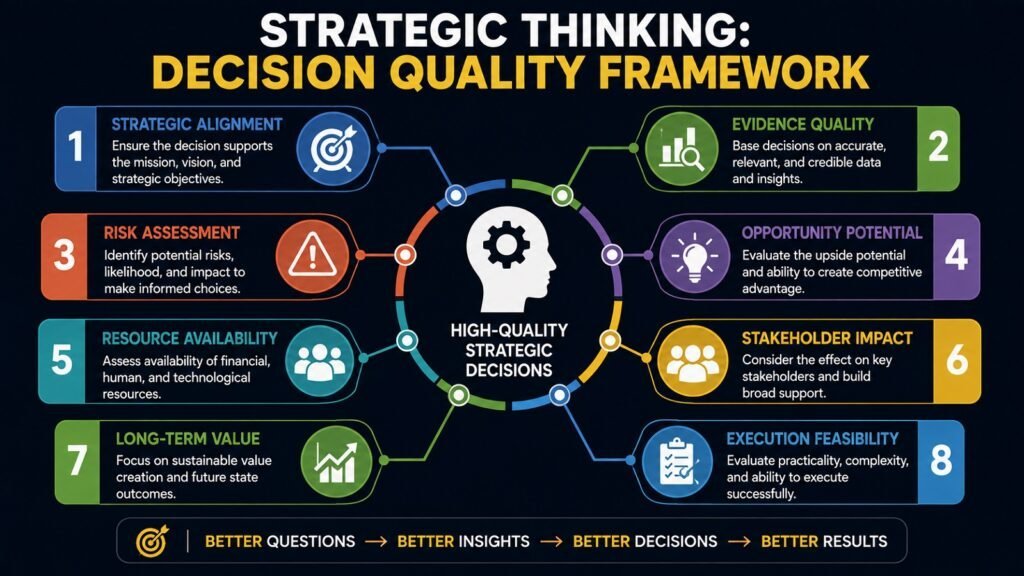
Every leadership principle discussed so far ultimately serves one purpose: improving the quality of decisions that shape organizational direction. Strategic decision-making is where thinking becomes action, and where the quality of analytical preparation is most consequential. Strategic thinking supports better decisions not by eliminating uncertainty but by ensuring that leaders engage with it deliberately rather than underestimating it or avoiding it entirely.
Herbert Simon’s concept of bounded rationality established that leaders cannot optimize decisions as classical economic theory assumes. Available information is always incomplete, cognitive capacity is limited, and time constraints prevent exhaustive analysis. What distinguishes effective strategic decision-makers is their ability to work intelligently within these constraints — identifying the most consequential uncertainties, gathering targeted information, and applying structured frameworks to evaluate alternatives before committing.
Philip Tetlock’s research on expert forecasting found that the most accurate forecasters were distinguished not by superior intelligence but by their willingness to integrate diverse perspectives, update beliefs when evidence changed, and maintain calibrated uncertainty rather than projecting false confidence. Microsoft’s strategic shift under Satya Nadella — from a Windows-centric model to cloud and subscription services — illustrates this discipline in practice. The decision involved significant uncertainty about adoption rates and competitive response, but reflected rigorous evaluation of market trends and existing organizational strengths. Sustained commitment through internal resistance validated the strategic judgment behind it.
Practical tools such as scenario analysis, decision trees, and pre-mortem exercises — where leaders imagine a decision has failed and identify the likely causes — improve strategic judgment by forcing explicit consideration of alternatives. Better decisions also depend on recognizing meaningful patterns, which is the focus of the next section.
Table 5: Strategic Thinking and Strategic Decision-Making — Key Principles
| Dimension | Leadership Application |
| Bounded rationality | Decisions made with incomplete information and limited time |
| Calibrated uncertainty | Maintaining honest confidence levels in forecasts |
| Alternative evaluation | Structuring comparison of options before committing |
| Pre-mortem analysis | Imagining failure in advance to identify risks |
| Targeted information | Gathering relevant data rather than comprehensive data |
| Belief updating | Revising strategic views when evidence changes |
| Risk-opportunity balance | Weighing downside and upside before acting |
| Commitment under uncertainty | Sustaining strategic direction despite ambiguity |
5. Strategic Thinking Through Pattern Recognition
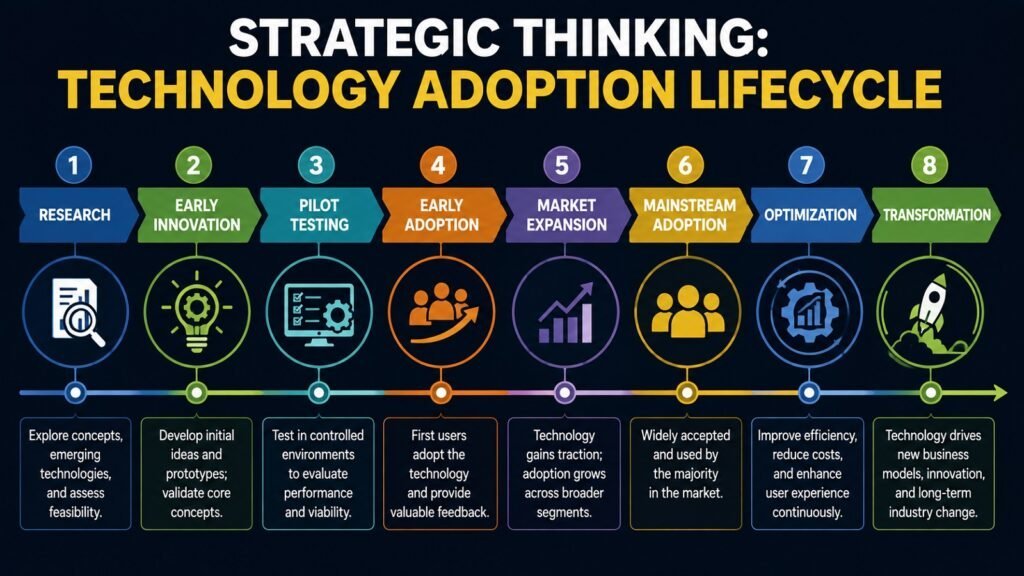
Experienced leaders often describe an ability to sense where a market is heading before the signals become obvious to others. This is not intuition in a mystical sense but pattern recognition: the capacity to connect observations across time, industries, and contexts and identify meaningful trends before they become dominant. Strategic thinking depends on this capability because the most valuable strategic insights tend to emerge from recognizing what recurring structures suggest about the future.
Research on expertise by Anders Ericsson demonstrated that what distinguishes experts from novices is not simply knowledge but sophisticated mental models that allow rapid pattern detection in complex situations. Leaders who have observed multiple economic cycles, competitive transitions, and organizational transformations develop internal reference libraries that they can compare against current circumstances, accelerating strategic judgment in novel situations.
The distinction between pattern recognition and event-driven reaction matters enormously in fast-changing markets. Leaders who react to individual events — a competitor’s product launch, a regulatory announcement — often find themselves in a reactive cycle that consumes resources without building advantage. Leaders who recognize the structural pattern behind multiple events — a shifting customer preference, an emerging technology standard — can respond to the underlying change rather than its individual symptoms. Netflix’s recognition of the digital delivery pattern in the music industry informed its aggressive investment in streaming infrastructure before it became the dominant customer preference, establishing a competitive position that proved difficult for rivals to match.
Developing pattern recognition requires deliberate practice: reading broadly across industries, maintaining learning journals, and engaging in structured reflection after significant business events. Recognizing patterns prepares leaders for the next capability — thinking across multiple possible futures.
Table 6: Strategic Thinking and Pattern Recognition — Key Principles
| Dimension | Leadership Application |
| Mental models | Accumulated experience enables faster pattern detection |
| Cross-industry observation | Patterns in one sector predict transitions in another |
| Structural change recognition | Identifies shifts beneath individual events |
| Expert forecasting | Pattern-based insight outperforms event-by-event reaction |
| Learning journals | Recording observations builds recognizable pattern libraries |
| Trend differentiation | Separates lasting trends from temporary fluctuations |
| Early mover advantage | Pattern recognition enables pre-emptive positioning |
| Reflective practice | Deliberate review after events sharpens future recognition |
6. Strategic Thinking Through Scenario Thinking
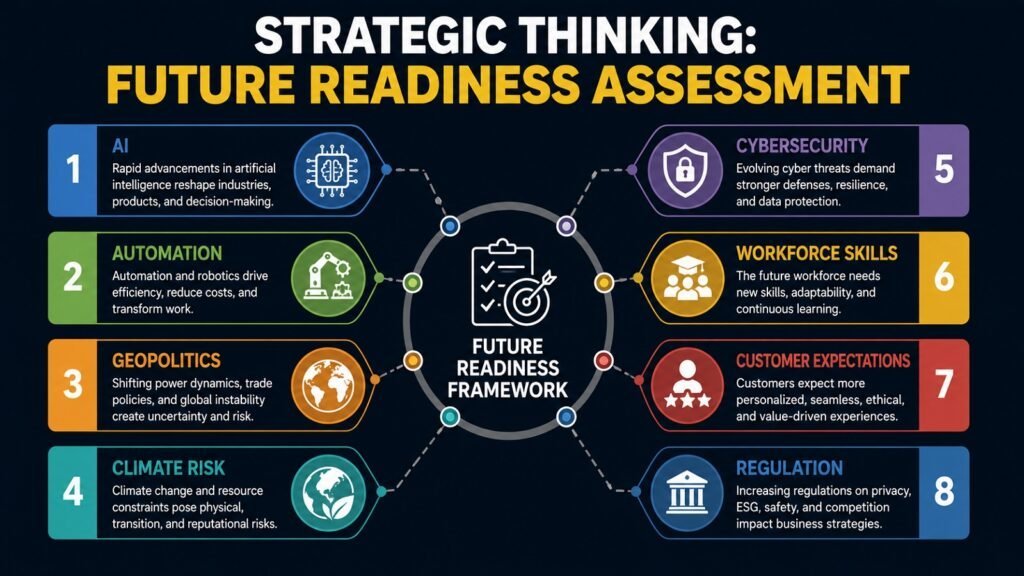
One of the most significant errors in strategic leadership is treating the future as a predictable extension of the present. Organizations that plan around one expected future are exposed to serious disruption when reality unfolds differently, as it almost always does. Scenario thinking addresses this vulnerability by encouraging leaders to develop and reason through multiple plausible futures rather than optimizing for a single projected outcome.
The intellectual foundations of scenario thinking were developed by Herman Kahn at the RAND Corporation in the 1950s and later refined for business by Pierre Wack and colleagues at Royal Dutch Shell in the 1970s. Shell’s scenario planning process gained recognition when it helped the organization respond more effectively to the 1973 oil crisis than most competitors. Having previously constructed scenarios that included a major supply disruption, Shell’s leadership could activate pre-developed strategies quickly, compressing the decision cycle at a critical moment.
The practical value of scenario thinking lies not in predicting which future will occur but in preparing the organization to recognize which scenario is emerging and respond appropriately. Organizations that engaged in pandemic risk scenarios before COVID-19, even treating that outcome as a low-probability possibility, were better positioned to activate supply chain alternatives, remote working infrastructure, and liquidity reserves quickly. Those relying on single-forecast planning found their response constrained by the absence of contingency plans. The lesson is not that organizations should have predicted the pandemic but that structured consideration of adverse scenarios creates organizational readiness that single-forecast planning cannot.
Leaders can integrate scenario thinking into their routine strategy discussions by pinpointing critical uncertainties, establishing early warning indicators, and periodically evaluating alternative futures. This approach fosters a preparedness that enables leaders to capitalize on the opportunities outlined subsequently.
Table 7: Strategic Thinking and Scenario Thinking — Key Principles
| Dimension | Leadership Application |
| Multiple futures | Avoids single-forecast vulnerability in planning |
| Shell scenario method | Structured scenario process improves crisis readiness |
| Strategic flexibility | Prepared resource shifts accelerate adaptation |
| Key uncertainties | Identifies variables that most determine future outcomes |
| Early warning indicators | Signals that reveal which scenario is unfolding |
| Low-probability risks | Considers adverse scenarios even when unlikely |
| Contingency readiness | Pre-developed responses reduce reaction time in crisis |
| Periodic review | Embeds scenario updates into regular strategy conversations |
7. Strategic Thinking Through Opportunity Thinking
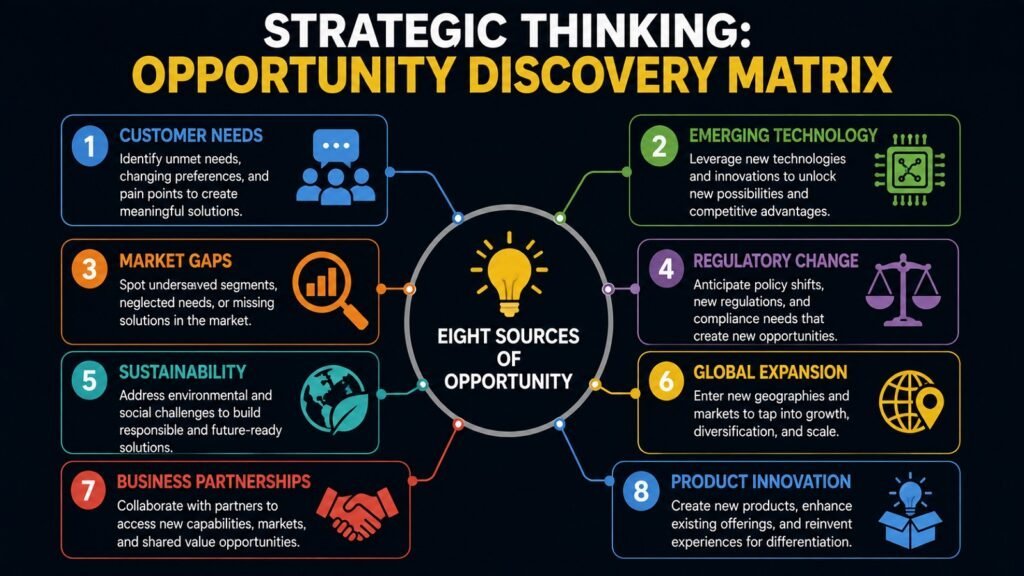
Strategic thinking is sometimes associated primarily with risk management, but its most generative application involves identifying opportunities before competitors recognize them. Opportunity thinking converts environmental change — whether technological, competitive, demographic, or regulatory — into a source of sustainable organizational advantage. Leaders who develop this capability contribute more to long-term organizational success than those who focus primarily on managing existing operations.
Peter Drucker argued that effective leaders consistently focus on identifying where new value can be created rather than protecting existing positions. This connects to W. Chan Kim and Renée Mauborgne’s blue ocean strategy, which demonstrated that the most successful business innovations often occur when leaders identify uncontested market spaces rather than competing more aggressively within existing ones. Opportunity thinking is the leadership mindset that makes this value creation possible.
The difference between opportunity thinking and optimism is significant. Optimism represents an emotional perspective, whereas opportunity thinking is a methodical analytical approach. Leaders who adopt an opportunistic mindset analyze market indicators, recognize unfulfilled customer demands, evaluate the sufficiency of organizational capabilities, and allocate resources in a systematic, evidence-driven manner.
Apple’s entry into music distribution with iTunes in 2001 illustrates this. The music industry was focused on combating piracy; Apple recognized that the underlying customer behavior — selecting individual songs rather than full albums — represented an unmet commercial need. Apple built a platform that addressed customer preference and rights holder concerns simultaneously, reshaping the competitive landscape of consumer electronics and media.
Leaders can cultivate opportunity thinking by creating cultures that reward market observation alongside operational execution. Allocating resources for experimentation and celebrating learning from failed attempts alongside successful ones builds the organizational capacity for opportunity recognition. Opportunity thinking becomes most powerful when leaders continuously learn from experience — which leads to the final principle.
Table 8: Strategic Thinking and Opportunity Thinking
| Dimension | Leadership Application |
| Value creation focus | Leaders pursue new value rather than protecting old positions |
| Blue ocean strategy | Seeks uncontested market spaces over direct competition |
| Analytical discipline | Opportunity thinking differs from optimism by requiring evidence |
| Unmet customer needs | Environmental change reveals new demands to serve |
| Capability assessment | Evaluates whether the organization can capture the opportunity |
| Market signal reading | Identifies emerging trends before they reach full visibility |
| Experimental culture | Allocates resources to test ideas before full commitment |
| Cross-functional observation | Diverse teams surface more opportunity signals |
8. Strategic Thinking Through Reflective Learning
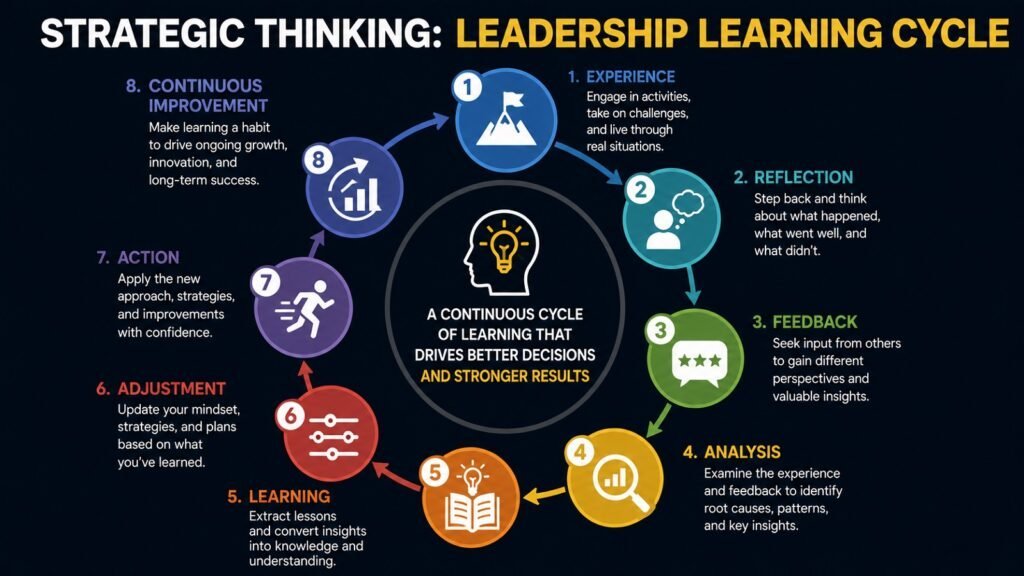
All the strategic thinking capabilities discussed in this article — from future orientation and systems understanding to pattern recognition and opportunity creation — depend on one discipline that holds them together: the willingness and ability to learn continuously from experience. Reflective learning is not simply reviewing what happened. It is the structured process of examining why outcomes occurred, what assumptions proved incorrect, and what these findings suggest for future strategic judgment.
Chris Argyris and Donald Schon’s work on organizational learning introduced the distinction between single-loop and double-loop learning. Single-loop learning corrects errors within an existing framework, adjusting tactics when results fall short. Double-loop learning questions the framework itself — examining whether underlying assumptions and strategies are still valid. Strategic thinking develops most significantly through double-loop learning because it challenges the mental models leaders use to interpret complex environments.
David Kolb’s experiential learning cycle provides a practical model for individual development. The cycle moves from concrete experience through reflective observation to abstract conceptualization and then to active experimentation. Leaders who complete this cycle deliberately, rather than moving from one situation to the next without reflection, progressively develop richer mental models. This is why experienced leaders who reflect carefully often outperform equally intelligent counterparts with equivalent experience but less reflective practice.
Organizations that embed reflective learning into their cultures adapt more effectively than those that treat situations as independent. After-action reviews — developed in the United States Army and later adopted by organizations including General Electric and Pixar — create structured opportunities for teams to examine what happened, why it differed from expectations, and what should change next time.
At the individual level, maintaining a decision journal — writing down the reasoning behind significant decisions and reviewing outcomes against those expectations — creates a personal feedback loop that accelerates learning from both successes and failures. Strategic thinking is ultimately a lifelong leadership capability that deepens through decades of experience, reflection, and intellectual engagement with a changing business environment.
Table 9: Strategic Thinking and Reflective Learning
| Dimension | Leadership Application |
| Double-loop learning | Questions assumptions, not just tactics, after outcomes |
| Experiential learning cycle | Converts experience into improved strategic models |
| After-action review | Structured team reflection after significant decisions |
| Decision journaling | Personal record of reasoning strengthens feedback loops |
| Mental model development | Reflection progressively enriches strategic frameworks |
| Organizational memory | Accumulated learning reduces repeated strategic errors |
| Intellectual humility | Openness to failure as information accelerates growth |
| Lifelong development | Strategic thinking deepens continuously, never finishes |
Conclusion: Strategic Thinking for Long-Term Leadership Success
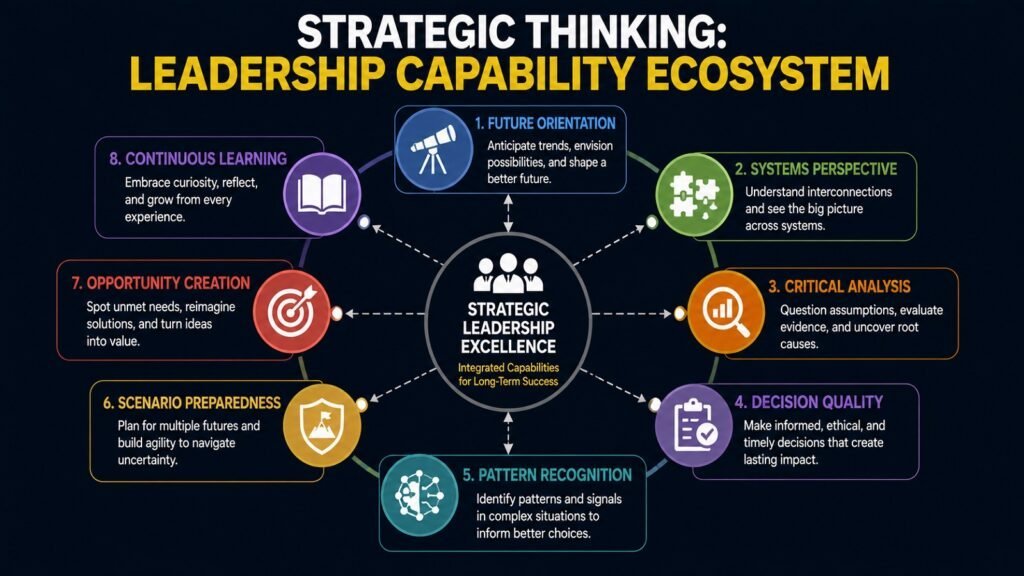
Strategic thinking stands as one of the most consequential capabilities a leader can develop. It enables leaders to anticipate change before it becomes disruptive, understand the interconnected systems within which their organizations operate, apply rigorous critical analysis to complex problems, make sound decisions under uncertainty, recognize meaningful patterns across markets and industries, prepare for multiple possible futures, identify and pursue emerging opportunities, and strengthen judgment continuously through reflective learning.
What makes strategic thinking distinctive is that it is not a single management technique or a set of analytical tools. It is an integrated leadership mindset that combines theoretical knowledge, research-based insights, practical organizational experience, and disciplined intellectual habits. The eight principles examined in this article are deeply interconnected. Future-oriented thinking provides the time horizon that systems thinking helps to analyze. Critical thinking ensures that analysis is reliable. Decision-making converts analysis into action. Pattern recognition accelerates insight. Scenario thinking builds resilience. Opportunity thinking drives value creation. Reflective learning deepens every other capability over time.
Organizations led by individuals who cultivate this mindset tend to outperform those led by skilled operators who lack strategic depth. The business environment will continue evolving in ways that are difficult to predict — driven by technological acceleration, geopolitical shifts, changing workforce expectations, and sustainability pressures. The leaders who will create lasting value in that environment are those who have built the mental habits, analytical practices, and learning disciplines that constitute genuine strategic thinking.
Readers who want to develop this capability should begin not with a single framework but with a commitment to ongoing learning. Reading broadly, seeking diverse perspectives, reflecting deliberately on experience, and applying each of the eight principles in everyday leadership contexts creates the compound development that no training program can replicate alone. Strategic thinking is not a destination. It is a leadership practice that grows stronger with every deliberate, reflective application.
Table 10: Strategic Thinking — Key Takeaway from Each Leadership Principle
| Leadership Principles of Strategic Thinking | Key Takeaway |
| Future-Oriented Leadership | Long-term focus builds advantage before it becomes visible |
| Systems Thinking | Interdependence awareness prevents costly unintended consequences |
| Critical Thinking | Challenging assumptions and bias sharpens strategic judgment |
| Strategic Decision-Making | Structured reasoning improves choices under uncertainty |
| Pattern Recognition | Connecting observations across time enables proactive strategy |
| Scenario Thinking | Multiple-futures planning builds resilience and readiness |
| Opportunity Thinking | Evidence-based value creation drives sustainable advantage |
| Reflective Learning | Continuous reflection deepens strategic capability over time |