Table of Contents
Introduction: Decision Intelligence as the Core of Modern Business Decisions
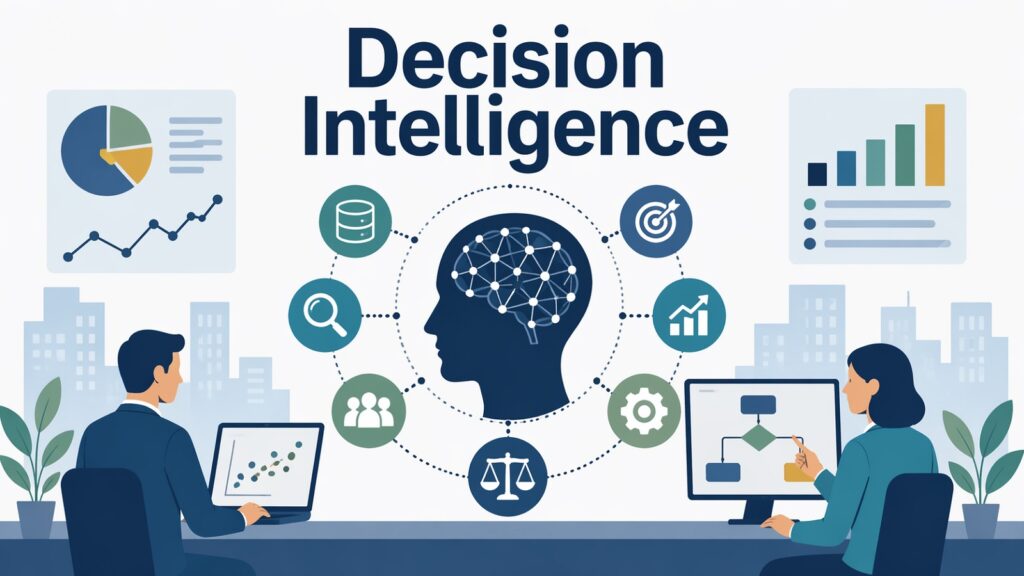
Every organization makes decisions every single day. Some are small. Some are enormous. But almost all of them share a common problem: they are made without a clear system. Decision Intelligence is what changes that. It integrates data, analytical models, and human judgment into one unified way of making better choices. Think of it as a framework that gives every decision a shape, a purpose, and a path forward.
The world of business has changed. Organizations now sit on mountains of data, but data alone does not make a decision good. You can have perfect numbers and still walk in the wrong direction if you do not know how to use them. In today’s corporate world, Decision Intelligence fills that gap. It takes raw information and turns it into something actionable, something that your team can actually work with. Decision Intelligence has become an important business essential without which modern organizations can’t function properly.
Cassie Kozyrkov, who served as Chief Decision Scientist at Google, is widely credited with defining and popularizing Decision Intelligence as a formal discipline. She described it as the application of decision science to practical problems, combining tools from social science, decision theory, and machine learning. This gives the field both a scientific backbone and a human face.
What makes Decision Intelligence especially relevant now is the pace of business. Decisions that used to take weeks must now happen in hours. Mistakes are more costly. Opportunities disappear faster. Organizations that rely on gut instinct alone, or that drown in data without direction, tend to fall behind. Decision Intelligence offers a way out of both traps.
This article explores eight core foundations that make Decision Intelligence work. Each one plays a specific role, and together they form a complete system. These are not just abstract ideas. They are practical building blocks that businesses can apply right now to improve how they think, choose, and act.
Decision Intelligence: 8 Core Dimensions at a Glance
| Dimension | What It Covers in Decision Intelligence |
| Decision Context | The environment, constraints, stakeholders, and timing surrounding a decision |
| Decision Models | Statistical, simulation, and rule-based tools that structure how data becomes insight |
| Decision Criteria | The standards used to evaluate options, such as cost, risk, quality, and alignment |
| Prescriptive Analytics | Data-driven recommendations that suggest the best course of action to take |
| Decision Automation | Automated systems that handle repetitive or high-volume decisions at scale |
| Human in the Loop | Human oversight, validation, and judgment in automated or complex decision flows |
| Decision Platforms | Integrated technology systems that bring data, models, and workflows together |
| Decision Feedback | Tracking outcomes and feeding results back to refine models and processes |
1. Decision Intelligence and Decision Context: Understanding the Situation
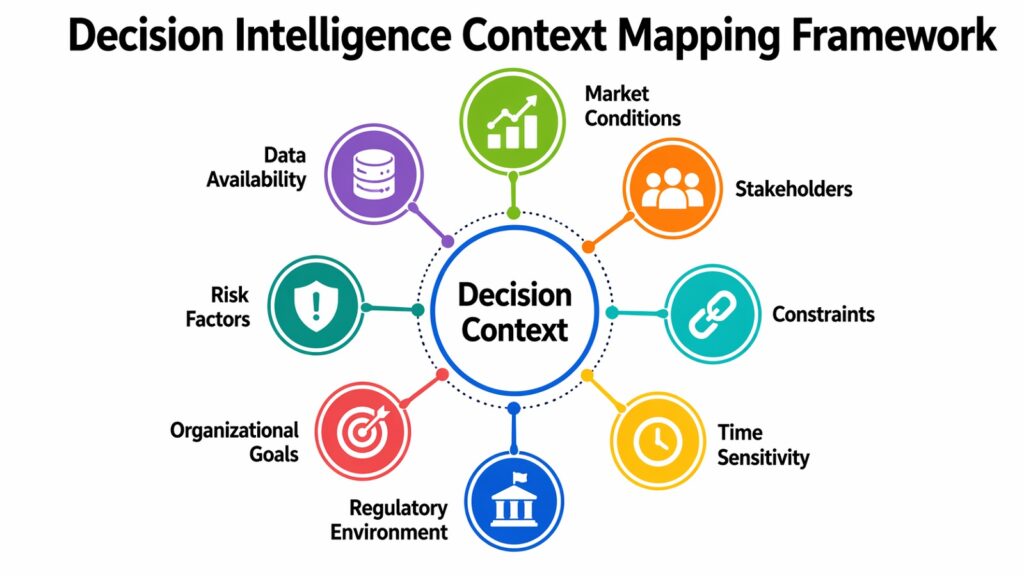
Before any model runs or any data is pulled, there is something more fundamental that needs attention. That something is context. Decision Context is the full picture of the situation in which a decision is being made. It includes the business environment, the people involved, the constraints at play, and the timing of the choice. Without it, even a perfect dataset can lead you to the wrong answer.
Think about a retail company deciding whether to expand into a new market. The data might show strong demand signals. But the context might reveal that the company is already stretched thin with logistics, or that a major competitor just signed an exclusive distribution deal in that region. The data says go. The context says wait. Decision Intelligence requires you to understand both.
Context also means knowing who the decision affects. A pricing change might look efficient from a financial model but could damage long-term customer loyalty. When businesses ignore the human side of context, they often win the calculation and lose the relationship. McKinsey research has noted that companies that factor in stakeholder context during decision-making tend to implement decisions more smoothly and face less internal resistance.
Timing represents an additional aspect of context that is often neglected. A decision reached too soon may be considered hasty. Conversely, the same decision made too late can become insignificant. Decision Intelligence educates teams to inquire not only about what to decide but also about when to make that decision, and the significance of the timing. Properly framing the problem from the outset is not merely a best practice. It serves as the cornerstone upon which all other elements are established.
Decision Intelligence and Decision Context: Key Dimensions
| Context Dimension | Role in Decision Intelligence |
| Business Environment | External market conditions, competition, and economic factors that shape decision boundaries |
| Stakeholder Mapping | Identifying who is affected and how their interests influence the decision outcome |
| Constraints | Budget limits, regulatory requirements, and resource gaps that narrow available options |
| Timing | The urgency and window of opportunity that determine when a decision must be made |
| Problem Framing | Defining the actual decision to be made, not just the symptoms or surface issues |
| Risk Landscape | Current risk exposure and tolerance levels within the organization |
| Historical Precedent | Past decisions and their outcomes that provide relevant reference points |
| Strategic Fit | Alignment of the decision with broader organizational goals and priorities |
2. Decision Intelligence and Decision Models: Structuring Thinking
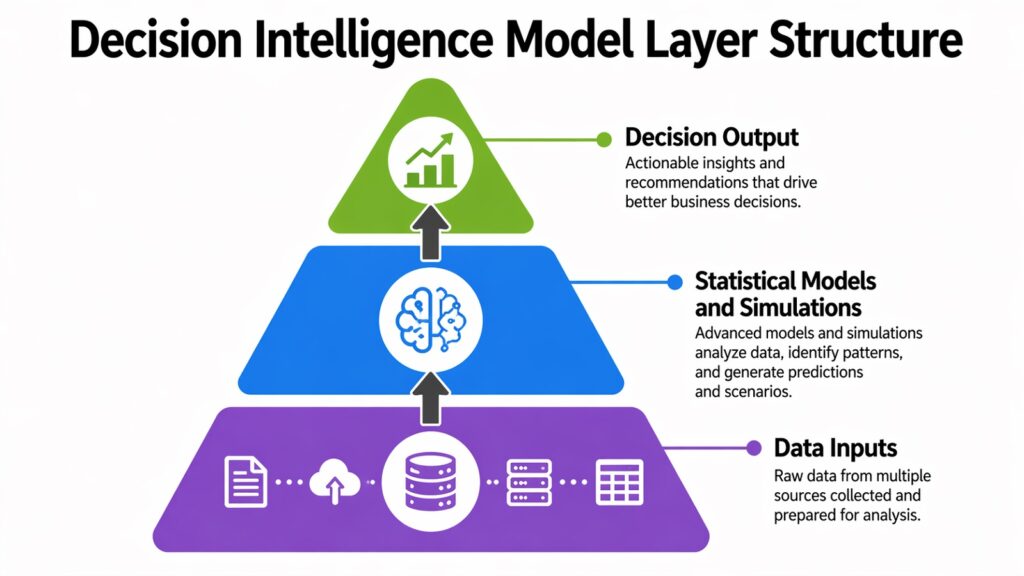
Once you understand the context, you need a way to think through the problem systematically. That is where Decision Models come in. A decision model is essentially a structured way of taking data and turning it into insight. It removes the guesswork and replaces it with logic, whether that logic comes from statistics, simulations, or business rules.
There are several kinds of models that organizations use. Statistical models analyze historical patterns to make predictions. Simulation models test many possible futures before committing to one. Business rule models encode established policies so that decisions follow consistent guidelines. Each type serves a different purpose, and a mature Decision Intelligence system usually draws on more than one.
A well-known example is demand forecasting in retail. Companies like Walmart use advanced statistical models to predict what products will sell, where, and when. These models process enormous amounts of historical sales data, seasonal patterns, local trends, and promotional events. Without the model, a buyer would need to rely on memory and intuition. With the model, the decision becomes structured, testable, and repeatable.
The key value of decision models is consistency. When a human makes a decision without a model, the result can vary depending on mood, experience, or the quality of available information at that moment. A model applies the same logic every time, which means the decisions it supports tend to be more reliable. Decision Intelligence uses models not to replace human thinking but to discipline it, to give it a shape it can hold onto.
Decision Models: Types and Applications
| Model Type | Application in Decision Intelligence |
| Statistical Models | Used in demand forecasting, risk scoring, and customer segmentation based on historical data |
| Simulation Models | Applied in scenario planning and supply chain optimization to test outcomes before acting |
| Business Rule Models | Encode policies like credit approval thresholds or compliance requirements into automated logic |
| Machine Learning Models | Detect patterns in large datasets for fraud detection, personalization, and predictive maintenance |
| Optimization Models | Used in pricing, scheduling, and resource allocation to find the best solution within constraints |
| Decision Trees | Visualize branching decision paths for classification and rule-based reasoning |
| Bayesian Models | Update probability estimates as new data arrives, useful in dynamic or uncertain environments |
| Agent-Based Models | Simulate behavior of multiple actors in complex systems like financial markets or logistics networks |
3. Decision Intelligence and Decision Criteria: Defining What Matters
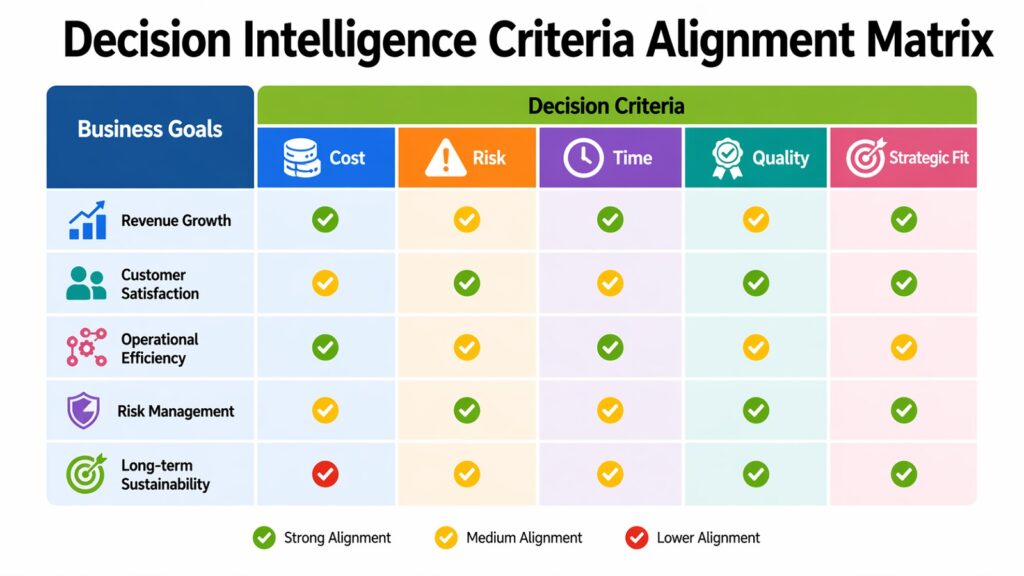
A model can indicate what is probable to occur. However, it cannot determine what is of utmost importance to your organization. This responsibility falls to Decision Criteria. Criteria serve as the benchmarks you utilize to assess your alternatives. They respond to the inquiry: what constitutes a favorable outcome for us at this moment?
The most common criteria in business decisions are cost, time, quality, risk, and strategic alignment. But the tricky part is that these criteria often conflict. A low-cost option might carry a higher risk. A fast option might sacrifice quality. Decision Intelligence asks organizations to be explicit about which criteria take priority, and under what conditions that priority might shift.
Consider a company choosing between two vendors. One is cheaper but has a spotty delivery record. The other is more expensive but consistently reliable. If the company’s primary criterion is cost, they choose the first. If reliability drives their supply chain strategy, they choose the second. The data is the same in both cases. What changes is the criteria, and that changes everything.
Poor or unclear criteria are one of the most common reasons decisions create conflict inside organizations. Different departments often have different priorities. Finance wants the cheapest option. Operations wants the most reliable one. Marketing wants the fastest one. Decision Intelligence addresses this by bringing all stakeholders together to agree on criteria before evaluating options. When the criteria are clear and shared, decisions become far less political and far more purposeful.
Decision Intelligence and Decision Criteria: Key Evaluation Standards
| Decision Criterion | Role in Decision Intelligence |
| Cost | Measures financial impact, including upfront investment and long-term total cost of ownership |
| Risk | Evaluates the probability and severity of negative outcomes, including regulatory and reputational risk |
| Time | Assesses speed of implementation and time-to-value relative to business urgency |
| Quality | Defines standards for output, accuracy, or service level that must be met or exceeded |
| Strategic Alignment | Checks whether the decision supports long-term goals and organizational direction |
| Scalability | Evaluates whether the chosen option can grow or adapt as business needs evolve |
| Stakeholder Impact | Measures how the decision affects customers, employees, partners, and communities |
| Reversibility | Considers how easy or costly it would be to undo the decision if circumstances change |
4. Decision Intelligence and Prescriptive Analytics: Recommending Actions
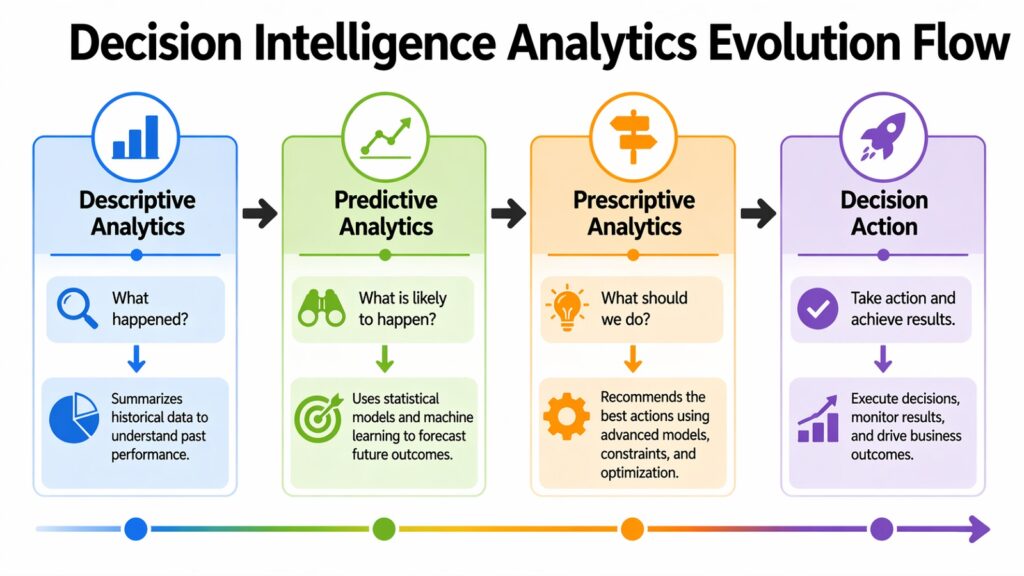
There is a big difference between knowing what happened, knowing what might happen, and knowing what to do about it. The first is descriptive analytics. The second is predictive analytics. The third, and most powerful for decision-making, is prescriptive analytics. Decision Intelligence depends heavily on this third layer because it is the one that actually suggests action.
Prescriptive analytics takes the outputs of predictive models and uses optimization techniques or rules to recommend a specific course of action. It does not just say that customer churn is likely to rise. It says reduce prices for these specific segments by this specific amount to retain them. That shift from insight to recommendation is what makes Decision Intelligence operational rather than theoretical.
Supply chain management serves as a prominent example. Organizations such as UPS employ prescriptive analytics to enhance delivery routes in real time. Their system, known as ORION, assesses millions of potential route combinations and suggests the most efficient path according to prevailing conditions. As stated by UPS, this system conserves over 100 million miles of driving annually. This illustrates prescriptive analytics transforming data into large-scale decision-making.
Another strong example is dynamic pricing. Airlines and hotel chains use prescriptive models to adjust prices moment by moment based on demand signals, competitive pricing, and booking patterns. The model does not just predict what demand will be. It recommends the price that will maximize revenue given current conditions. Decision Intelligence becomes actionable the moment prescriptive analytics enters the picture.
Decision Intelligence and Prescriptive Analytics: Real-World Applications
| Application Area | How Prescriptive Analytics Supports Decision Intelligence |
| Route Optimization | UPS ORION recommends delivery routes saving over 100 million miles annually |
| Dynamic Pricing | Airlines and hotels adjust prices in real time based on demand, competition, and booking data |
| Inventory Management | Recommends optimal stock levels and reorder points to balance cost and service levels |
| Healthcare Staffing | Suggests nurse and staff scheduling based on predicted patient volumes and acuity levels |
| Financial Portfolio | Recommends asset allocation adjustments based on risk tolerance and market signals |
| Energy Management | Prescribes optimal power usage and grid dispatch based on consumption forecasts |
| Marketing Spend | Allocates budget across channels to maximize return based on predicted audience response |
| Fraud Prevention | Recommends transaction blocks or reviews based on real-time risk scoring models |
5. Decision Intelligence and Decision Automation: Scaling Decisions
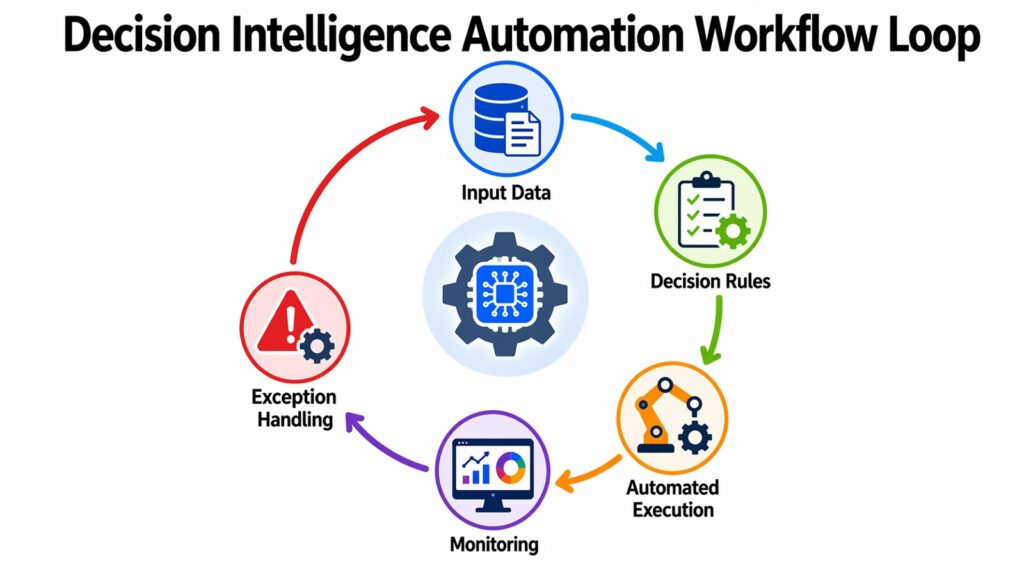
Some decisions happen once a quarter in a boardroom. Others happen ten thousand times a day inside a system. Decision Automation is what allows Decision Intelligence to operate at the second kind of scale. It takes the models, criteria, and prescriptive logic that have been developed and encodes them into systems that can act without waiting for a human to review each case.
The clearest examples of decision automation are in banking and e-commerce. When you apply for a credit card online, a decision is often returned within seconds. No human reviewed your application in that time. An automated system evaluated your credit score, income signals, risk profile, and dozens of other variables against a pre-built decision model. The same happens when an e-commerce platform flags a transaction as suspicious. The system decides, and it decides fast.
According to a report by McKinsey, organizations that automate high-volume, rule-based decisions can reduce processing time by up to 80 percent and significantly cut error rates compared to manual review. Industries like insurance, retail banking, and telecommunications have embraced this heavily, automating everything from claims triage to customer tier assignment.
But automation without oversight carries real risks. A model trained on biased data will make biased decisions at scale. A rule that worked well in one market condition may fail in another. Decision Intelligence insists on controls, monitoring, and periodic review even for automated decisions. The goal is to scale without loss of accountability. Automation should expand the reach of good decision logic, not replace the judgment that validates it.
Decision Automation: Benefits and Risks
| Aspect | Detail in Decision Intelligence Context |
| Speed | Automated systems can process thousands of decisions per minute compared to hours for manual review |
| Consistency | Removes variability caused by human fatigue, bias, or inconsistent application of rules |
| Cost Reduction | McKinsey notes automation of rule-based decisions can cut processing costs by up to 80 percent |
| Fraud Detection | Real-time automated scoring systems flag suspicious transactions in milliseconds |
| Customer Interaction | Chatbots and recommendation engines automate personalized responses at scale |
| Bias Risk | Models trained on flawed data can automate and amplify discriminatory outcomes |
| Model Drift | Automated decisions degrade over time if models are not monitored and updated regularly |
| Oversight Requirement | Human review layers are essential to catch errors, handle exceptions, and ensure accountability |
6. Decision Intelligence and Human in the Loop: Balancing Judgment
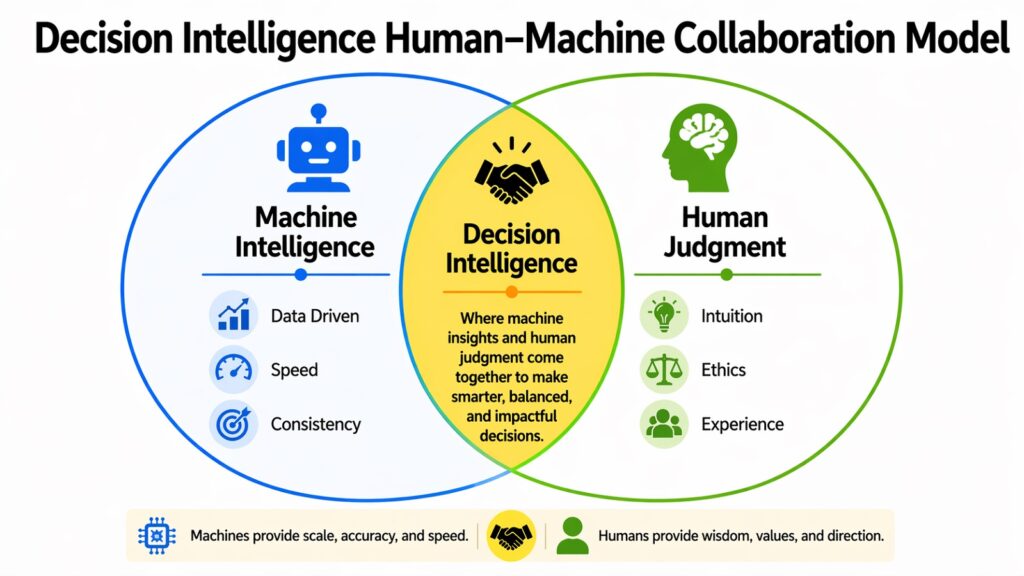
Automation is powerful. But it is not enough on its own, especially when the stakes are high or the situation is genuinely ambiguous. Human in the Loop refers to the deliberate inclusion of human judgment at key points in the decision process. It is not a fallback for when automation fails. It is a designed part of how Decision Intelligence works.
Consider the example of hiring decisions. Many companies now use automated systems to screen resumes and rank candidates based on keywords, experience patterns, and other signals. These systems save enormous amounts of time. But the final hiring decision almost always involves a human being. The reason is that hiring involves nuance that models still struggle with, things like cultural fit, potential, and the kind of judgment that comes from actually talking to someone.
Medical diagnosis is another area where humans must stay in the loop. AI systems have demonstrated impressive accuracy in detecting certain cancers from imaging data, sometimes outperforming individual radiologists on specific tasks. But clinicians still review, validate, and ultimately make the treatment decision. The stakes are simply too high to remove human accountability from the chain.
Research by MIT Sloan Management Review has found that the highest-performing organizations tend to be those that combine machine intelligence with human oversight, not those that rely on one or the other exclusively. Human in the Loop is not about distrust of technology. It is about recognizing that complex, ethical, and high-consequence decisions need a human being who can be held responsible and who can bring moral clarity to situations that data alone cannot fully map.
Decision Intelligence and Human in the Loop: Application Areas
| Decision Area | Role of Human Judgment in Decision Intelligence |
| Hiring and Talent | Humans evaluate final candidates after automated screening to assess fit and potential |
| Medical Diagnosis | Clinicians review AI-generated findings before making treatment decisions |
| Legal Compliance | Lawyers validate automated contract or regulatory analysis for accuracy and context |
| Strategic Planning | Executives interpret model-generated scenarios and apply experiential judgment |
| Content Moderation | Human reviewers handle ambiguous or borderline cases flagged by automated systems |
| Ethical AI Governance | Ethics committees review model decisions for fairness, bias, and societal impact |
| Crisis Response | Leadership overrides automated protocols when unique circumstances require it |
| Customer Escalations | Human agents step in when automated customer service fails to resolve complex issues |
7. Decision Intelligence and Decision Platforms: Enabling Systems
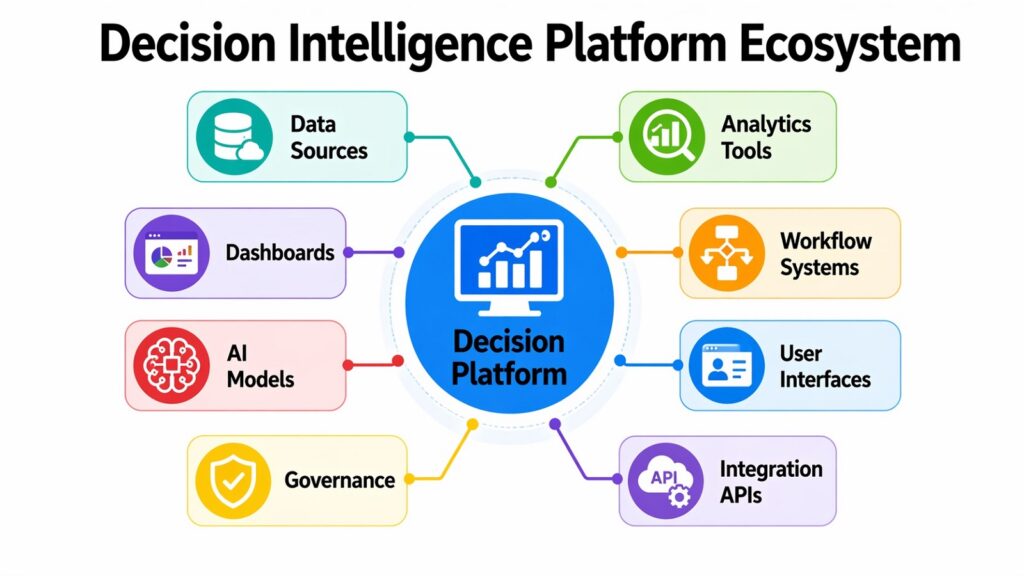
All the thinking in the world does not matter if there is no infrastructure to support it. Decision Platforms are the technological systems that bring together data, analytical models, and operational workflows into one coherent environment. They are what allow Decision Intelligence to move from concept to practice inside a real organization. At the heart of these platforms is a well-designed Decision Intelligence Architecture that ensures every component works together as a unified decision ecosystem.
A decision platform is not just a dashboard. It is an integrated system where data flows in, models run, outputs are displayed, and decisions are tracked. Business Intelligence tools like Tableau and Power BI represent one part of this, providing visibility into performance data. But more advanced decision platforms also include workflow engines, model management layers, and feedback tracking systems that connect the full decision cycle. A robust Decision Intelligence Architecture defines how these technologies, data sources, and decision processes are structured and integrated across the enterprise.
Companies like Salesforce have built decision platform capabilities directly into their CRM systems, allowing sales managers to see AI-generated recommendations about which deals to prioritize alongside the historical data that justifies those recommendations. IBM’s Watson Decision Platform took a similar approach, aiming to centralize decision support across enterprise functions. These platforms work because they make the decision process visible, collaborative, and auditable.
One of the most significant benefits of decision platforms is that they break down information silos. In many organizations, finance has one set of data, operations has another, and marketing has a third. Decisions made in isolation by each team often conflict. A shared decision platform creates a common view of reality and a shared space for deliberation. Decision Intelligence, when supported by the right platform and Decision Intelligence Architecture, becomes an organizational capability rather than just a technical one.
Decision Platforms: Key Capabilities
| Platform Capability | Function |
| Data Integration | Connects disparate sources into a unified view for consistent and complete decision inputs |
| Model Deployment | Hosts and runs analytical models that generate recommendations and scoring outputs |
| Dashboard and Visualization | Makes decision-relevant information visible and accessible to decision makers |
| Workflow Automation | Routes decisions through defined steps, approvals, and escalation paths |
| Collaboration Tools | Enables multiple stakeholders to review, comment on, and jointly resolve decisions |
| Audit Trail | Records who made which decision, when, and based on what information or model output |
| Feedback Loop Integration | Connects outcome data back into the platform to refine models and track decision quality |
| Cloud Scalability | Supports growing data volumes and user bases without requiring new infrastructure builds |
8. Decision Intelligence and Decision Feedback: Learning and Improving
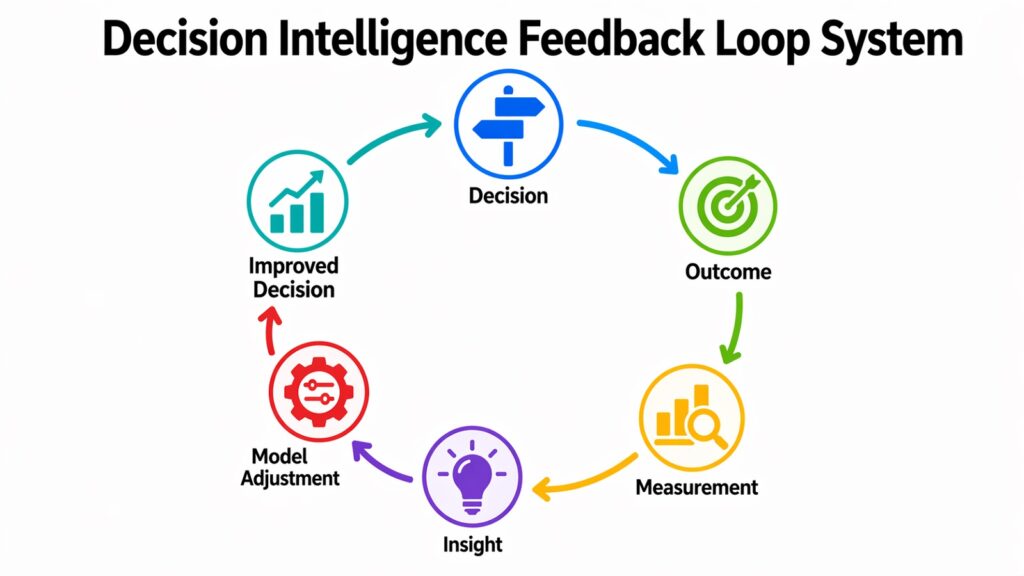
Every decision produces an outcome. And every outcome carries information about whether the decision was good. Decision Feedback is the mechanism through which Decision Intelligence captures that information and uses it to get better over time. Without feedback, even the best system eventually loses calibration. With it, the system keeps improving, adjusting, and sharpening its accuracy.
A/B testing is one of the most familiar forms of decision feedback. Companies like Amazon and Netflix run thousands of experiments simultaneously, testing different versions of interfaces, recommendations, pricing structures, and messaging. Each test is a decision. Each result is feedback. The winning version gets implemented. The losing version becomes a lesson. Over time, this continuous loop of test and learn makes their systems significantly smarter.
Performance reviews in organizations serve a similar function. When a hiring decision is made and a candidate is brought on board, tracking how that person performs over time is decision feedback. If candidates hired through one method consistently outperform those hired through another, the feedback loop signals that the first method produces better decisions. This kind of institutional learning is what separates improving organizations from stagnant ones.
Customer feedback loops close the same kind of circle in product development and service delivery. When organizations track how customers respond to changes, they are using real-world outcomes to validate or challenge the assumptions embedded in their decision models. According to research from Bain and Company, companies that build strong feedback loops into their decision processes are significantly more likely to sustain high performance over time than those that treat decisions as one-time events. Decision Intelligence matures through feedback. It is not static. It grows.
Decision Feedback: Mechanisms and Benefits
| Feedback Mechanism | Role |
| A/B Testing | Compares outcomes of two decision variants to identify which produces better results |
| Performance Reviews | Tracks outcomes of hiring, investment, or operational decisions over time |
| Customer Surveys | Captures user experience data to validate whether decisions improved satisfaction |
| Model Accuracy Monitoring | Measures how closely model predictions matched actual outcomes after deployment |
| Post-Mortem Analysis | Reviews failed decisions to identify root causes and prevent similar errors |
| KPI Tracking | Monitors key metrics to assess whether a decision moved business performance in the right direction |
| Feedback Dashboards | Centralizes outcome data so decision teams can review performance in real time |
| Continuous Learning Loops | Automatically retrains models using new outcome data to maintain accuracy over time |
Conclusion: Decision Intelligence as a Unified System for Success
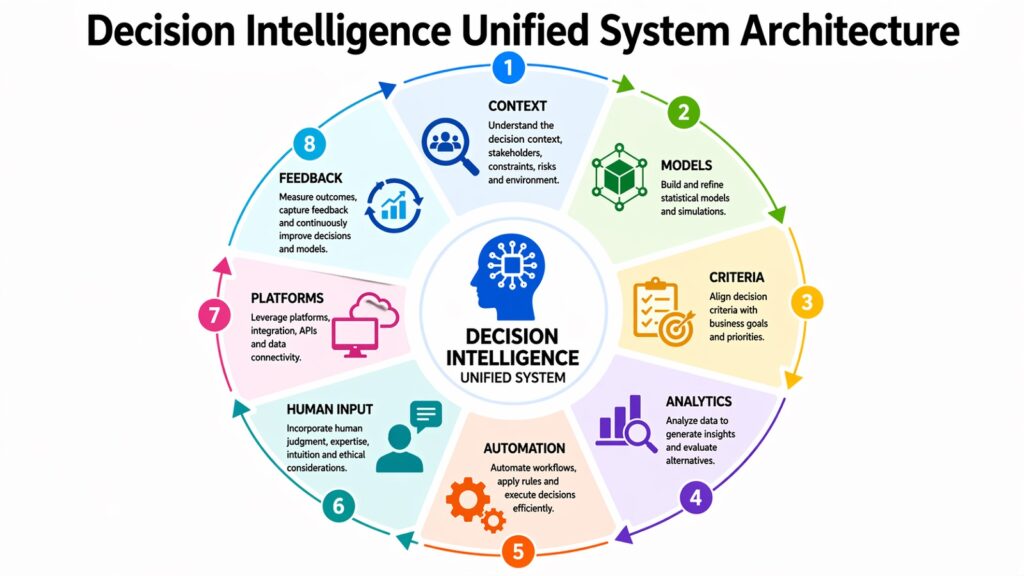
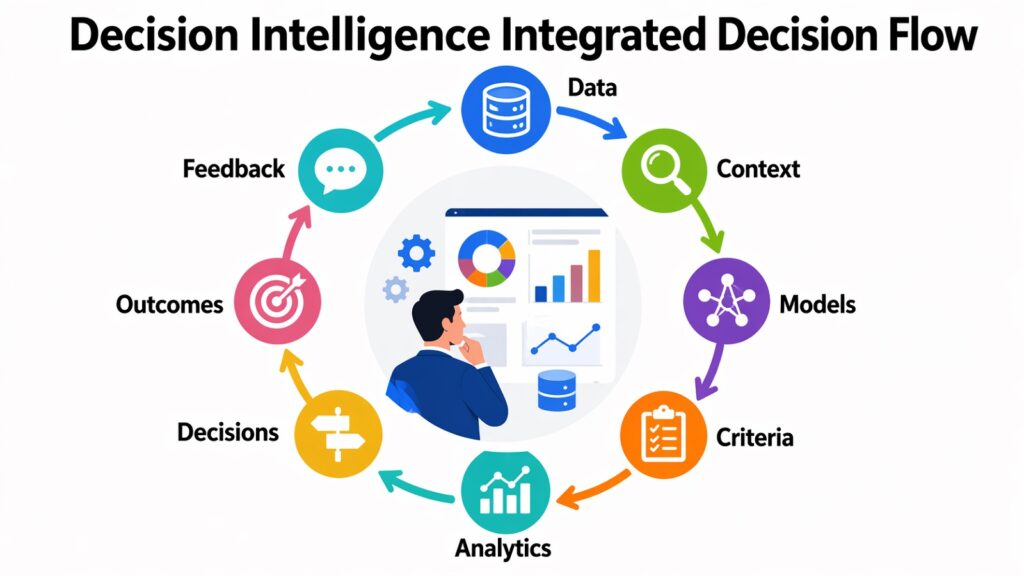
Each of the eight foundations explored in this article plays its own role. But the power of Decision Intelligence comes from how they work together. Context tells you what the situation really is. Models give your thinking a structure. Criteria define what a good outcome looks like. Prescriptive analytics turn insight into action. Automation makes that action scalable. Human in the Loop keeps it accountable. Platforms give it infrastructure. And feedback makes it smarter over time.
This is not a linear process. It is a cycle. Feedback from one decision feeds context for the next. Model performance informs how the criteria should be updated. Platform data reveals where automation needs adjustment. Organizations that understand this interconnection stop treating decisions as isolated events and start treating them as part of a living, learning system.
The competitive advantage this creates is real. A 2022 survey by Gartner found that data and analytics leaders who invested in structured decision-making capabilities reported faster time to decision, higher confidence in outcomes, and fewer costly reversals than those who did not. The organizations that perform consistently well are not just those with the best data or the most sophisticated technology. They are the ones that have built Decision Intelligence into how they operate every day.
Decision Intelligence is not a tool you buy or a software platform you install. It is a way of thinking, built up layer by layer, foundation by foundation. Organizations that invest in developing this capability now will be far better prepared for whatever the future brings. The foundations are here. The path is clear. The question is whether you choose to walk it.
Decision Intelligence: A Unified System for Organizational Success
| Business Outcome | How Decision Intelligence Drives It |
| Faster Decision Speed | Automation and platforms reduce deliberation time while maintaining decision quality |
| Higher Decision Accuracy | Models and feedback loops continuously refine how options are evaluated and chosen |
| Reduced Decision Bias | Structured criteria and model-based evaluation reduce the influence of personal bias |
| Scalable Operations | Automation extends good decision logic across high-volume processes without added headcount |
| Stronger Accountability | Audit trails and human oversight ensure decisions can be traced and reviewed |
| Continuous Learning | Feedback loops mean the system improves with every decision cycle completed |
| Competitive Advantage | Organizations using Decision Intelligence adapt faster and with greater confidence |
| Future Readiness | A structured decision system prepares organizations to handle increasing complexity and AI-driven change |