Table of Contents
Introduction: Digital Entertainment as a Core Force in Modern Technology
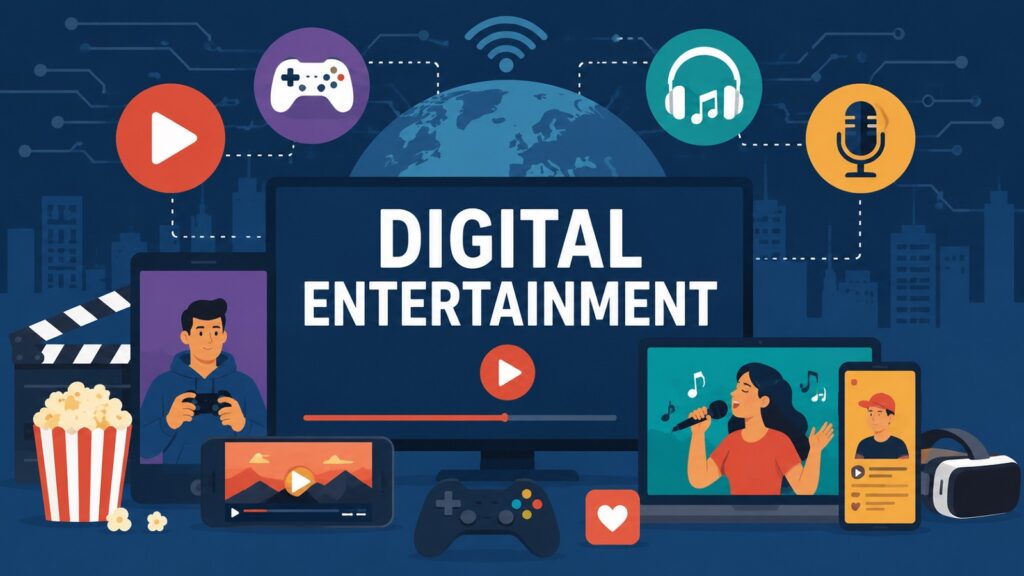
Picture a Thursday evening in a busy apartment. One person is watching a new series on a streaming platform. Another is mid-game with friends across three countries. A third listens to a curated playlist while cooking and glances at short videos between songs. This is not an unusual night. This is just what life looks like now. Digital entertainment has become the background hum of modern daily existence.
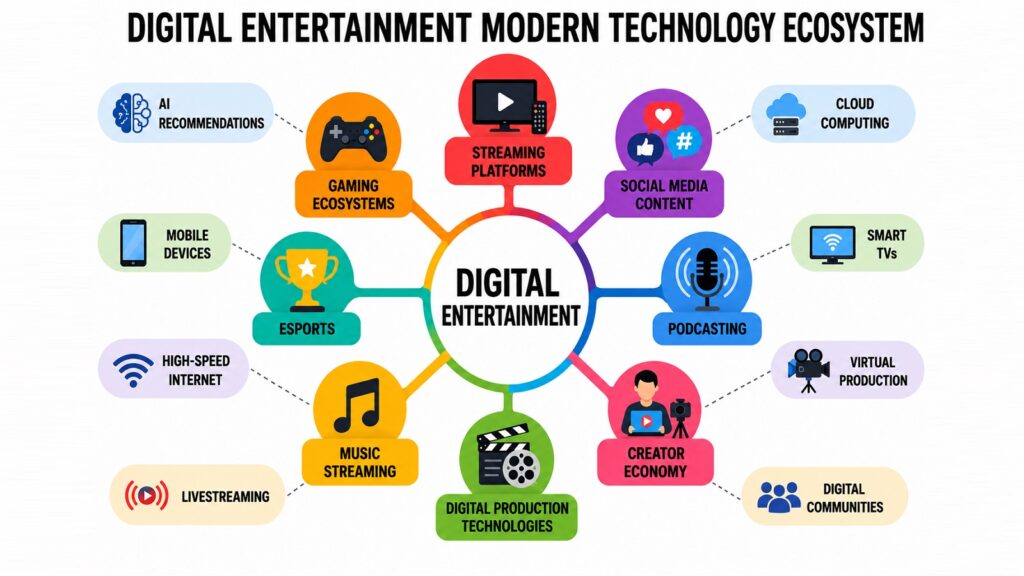
Digital entertainment stands as a crucial element of modern technology. It has altered the ways in which individuals communicate, how culture transcends borders, how businesses expand, and how communities are formed around common interests. What initially started as a means to watch films or engage in gaming has evolved into a vast interconnected ecosystem that influences nearly every aspect of everyday life. Streaming services now reach hundreds of millions of households. Mobile gaming produces more revenue than both console and PC gaming combined. Esports competitions are broadcast to audiences that rival those of traditional sports events.
This article explores the eight powerful foundations holding the digital entertainment ecosystem together. From streaming platforms and music services to gaming worlds and visual effects studios, each foundation plays a distinct role in shaping how people experience media today. Future developments like AI-driven personalization, immersive media, and virtual experiences are already visible on the horizon.
Table 1: Digital Entertainment — Eight Foundations at a Glance
| Foundation | What It Covers in Digital Entertainment |
| Streaming Ecosystems | On-demand video platforms, OTT services, subscription models, recommendation algorithms |
| Music and Audio Streaming | Cloud-based music libraries, playlist systems, artist discovery, royalty structures |
| Interactive Gaming Worlds | Console, PC, and mobile gaming, multiplayer ecosystems, cloud gaming, in-game economies |
| Esports and Competitive Culture | Professional gaming tournaments, livestreaming, digital fanbases, sponsorships |
| Creator Economy | Independent content creators, influencer platforms, direct audience monetization |
| Short-Form Social Video | Vertical video platforms, algorithmic feeds, viral content, mobile-first consumption |
| Podcasting and Audio Storytelling | Long-form audio content, storytelling formats, niche communities, creator monetization |
| VFX, CGI, and Virtual Production | Visual effects, CGI environments, motion capture, real-time rendering, AI-assisted tools |
1. Digital Entertainment Through Streaming Ecosystems and OTT Platforms
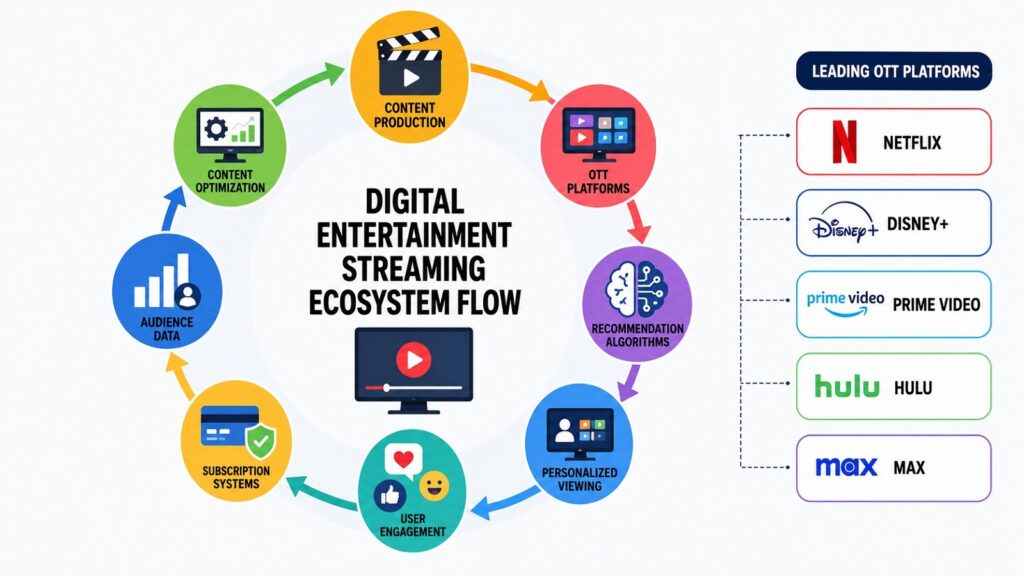
There was a period when viewing a series required one to set aside a specific hour. If you missed it, it was lost forever. The Streaming Ecosystem has completely transformed this experience. Nowadays, an individual can begin watching a drama at two in the morning on a tablet, continue it on a television that same afternoon, and conclude it on a phone during their commute. The content adapts to the viewer’s schedule, and the timing is dictated solely by the audience.
Over-the-top platforms, known as OTT services, deliver video directly through the internet without traditional cable systems. Netflix, Disney Plus, Amazon Prime Video, HBO Max, and Apple TV Plus have each built ecosystems around subscription access to large content libraries. The monthly fee removes the friction of paying per title and encourages binge-watching behavior across entire seasons.
What sustains these platforms beyond good content is the recommendation engine running beneath every session. Netflix tracks what you watch, how long you watch, when you pause, and what you search for, then builds a feed designed to keep you engaged. These algorithms learn patterns across millions of users and surface content before the viewer consciously wants it. Competition has driven enormous investment in original programming, with Netflix spending approximately 17 billion USD on content in 2023 alone.
The cultural reach of streaming has dissolved geographic boundaries in entertainment. South Korean dramas, Spanish thrillers, and Japanese anime now reach tens of millions of viewers far from their origins. Future directions include deeper AI personalization, interactive storylines, and immersive formats designed for virtual reality headsets. The streaming ecosystem is not finished evolving, but it is already the dominant model for delivering digital entertainment at scale.
Table 2: Digital Entertainment — OTT Platforms and Streaming Ecosystem Insights
| Aspect | Real Observation in Digital Entertainment |
| Netflix Recommendation Engine | Drives over 80% of content watched on the platform through personalized suggestions |
| Binge-Watching Behavior | Netflix popularized full-season releases, fundamentally changing how audiences consume serialized content |
| Global Content Reach | South Korean series Squid Game became the most-watched Netflix show globally in 2021 |
| Disney Plus Growth | Reached 100 million subscribers in just 16 months after its November 2019 launch |
| Adaptive Bitrate Streaming | Technology automatically adjusts video quality to match the viewer’s available internet speed |
| Ad-Supported Tiers | Netflix and Disney Plus introduced lower-cost ad-supported plans to expand subscriber bases |
| Smart TV Dominance | Over 70% of streaming hours are consumed on connected televisions rather than mobile devices |
| Original Content Investment | Netflix spent approximately 17 billion USD on content in 2023 to compete for subscriber attention |
2. Digital Entertainment and the Rise of Audio and Music Streaming
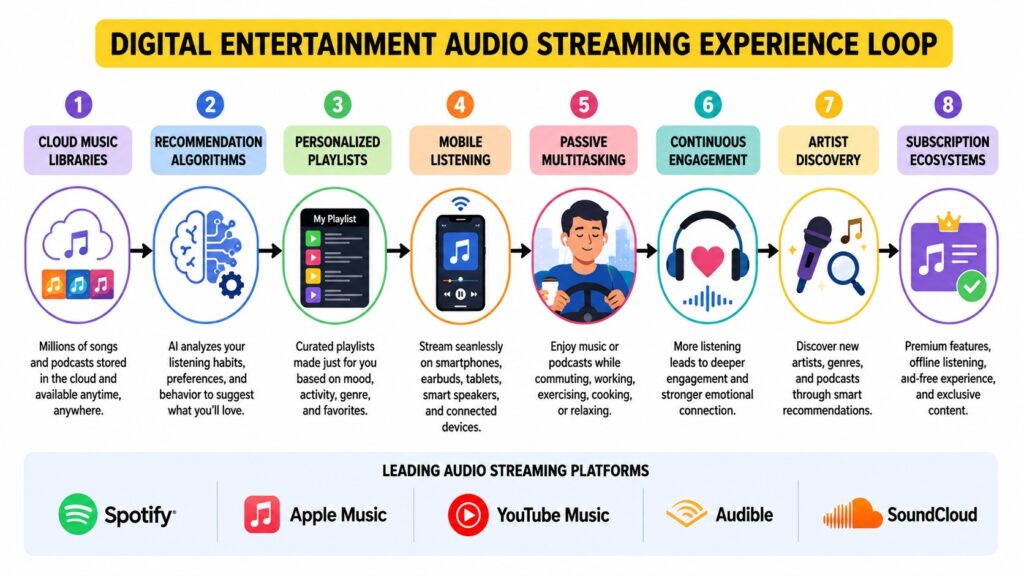
Think about what it meant to listen to audio twenty years ago. Shelves of CDs, individual track downloads, physical albums, and radio schedules shaped how people discovered and consumed audio. However, today a person can whisper the title of an obscure 1970s track into a phone and hear it within seconds. The transition has been quiet but total.
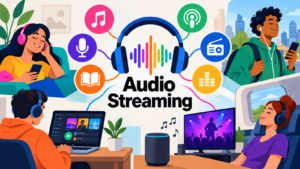
Services like Spotify, Apple Music, Amazon Music, and YouTube Music have transformed music consumption from ownership into access. Users pay a monthly fee for immediate access to vast libraries of songs, albums, and playlists, without physical storage or individual purchases. Music Streaming has become an important part of the broader Audio Streaming ecosystem, giving listeners convenient access to music across smartphones, computers, cars, smart speakers, and other connected devices.
Yet Audio Streaming extends well beyond music. Podcasts, audiobooks, internet radio, meditation guides, news, educational programs, and spoken-word content have created a broader on-demand listening environment. Discovery has transformed alongside access, with recommendation systems analyzing listening history, preferences, and behavior to surface content tailored to individual interests. This has opened new opportunities for artists, podcasters, publishers, and independent creators to reach audiences globally.
The future points toward increasingly personalized and adaptive audio experiences that respond to mood, activity, context, and listening habits. As access, discovery, personalization, and diverse audio formats converge, Audio Streaming is becoming an increasingly influential foundation of Digital Entertainment.
Table 3: Digital Entertainment — Audio and Music Streaming Landscape
| Aspect | Real Observation in Digital Entertainment |
| Spotify Catalog Size | Hosts over 100 million tracks with more than 600 million active users globally as of 2024 |
| Discover Weekly | Spotify’s personalized playlist uses collaborative filtering and audio analysis to match listener taste |
| Royalty Structure | Spotify pays artists approximately 0.003 to 0.005 USD per stream, which has drawn industry criticism |
| Apple Music Spatial Audio | Offers Dolby Atmos-based spatial audio tracks that simulate three-dimensional sound environments |
| Podcast Integration | Spotify acquired Gimlet Media and Anchor to build a dominant podcast production and distribution arm |
| Offline Listening | Premium subscribers download music for offline playback, expanding access in low-connectivity regions |
| AI Playlist Tools | Spotify introduced AI DJ feature in 2023, offering personalized commentary alongside curated music |
| YouTube Music Growth | Leverages YouTube’s video catalog to offer music videos and live performances alongside audio tracks |
3. Digital Entertainment Inside Interactive Gaming Worlds
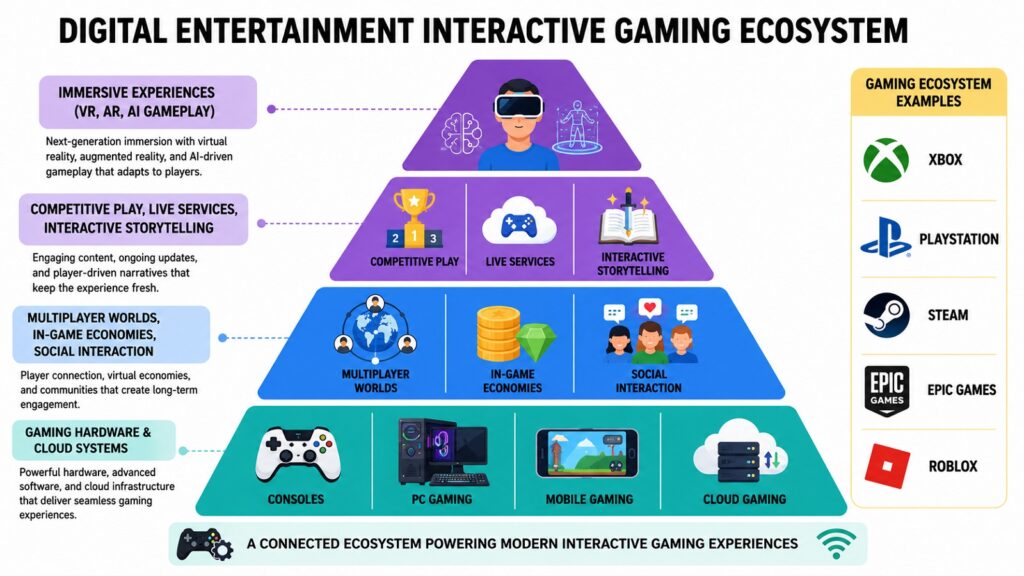
Modern games are not just games anymore. When millions log into Fortnite or World of Warcraft on a given evening, they are attending concerts, meeting friends, trading items, forming communities, and watching stories unfold. The game has become the world, and that world runs on servers. Gaming has grown into one of the most immersive and socially connected forms of digital entertainment available.
Console gaming through PlayStation and Xbox delivers cinematic experiences on powerful home hardware. PC gaming offers deep customization and competitive depth. Mobile gaming has brought interactive entertainment to billions who never owned a dedicated device, making smartphones the most widely used gaming platform by sheer player count. Titles like Minecraft have sold over 300 million copies and maintain over 140 million monthly active players simultaneously across all platforms.
Cloud gaming is removing the hardware barrier entirely. Xbox Cloud Gaming and NVIDIA GeForce Now stream game data from remote servers to any device, meaning a basic smartphone can run graphically intense games that would normally require expensive hardware. The business has also shifted toward live-service models where major titles operate as ongoing platforms with seasonal updates and in-game stores rather than one-time purchases.
Gaming is deeply connected to psychology. Achievement systems, level-ups, rare item drops, and competitive rankings activate dopamine pathways in ways that make the experience rewarding and difficult to leave. Virtual reality through PlayStation VR2 and Meta Quest is pushing gaming toward full spatial immersion. The gap between watching a screen and inhabiting a digital world is narrowing, and gaming is the primary place where that transition is actively being tested.
Table 4: Digital Entertainment — Interactive Gaming World Insights
| Aspect | Real Observation in Digital Entertainment |
| Mobile Gaming Revenue | Mobile games generated over 90 billion USD in 2023, exceeding PC and console gaming combined |
| Fortnite Social Events | Epic Games hosted Travis Scott’s virtual concert inside Fortnite, attracting 12.3 million live attendees |
| Xbox Cloud Gaming | Streams games directly to devices without dedicated hardware through Microsoft’s Azure infrastructure |
| Live-Service Model | Games like Fortnite and Destiny 2 operate as ongoing platforms with seasonal content and in-game purchases |
| Minecraft Player Base | Minecraft has sold over 300 million copies and maintains over 140 million monthly active players |
| Game Engine Dominance | Unreal Engine and Unity power the majority of commercial games across all major platforms |
| PlayStation VR2 | Sony’s second-generation headset uses eye-tracking and adaptive haptics for immersive gaming experiences |
| Steam Platform | Valve’s Steam has over 132 million active accounts and distributes the majority of PC gaming titles worldwide |
4. Digital Entertainment and the Expansion of Esports Culture
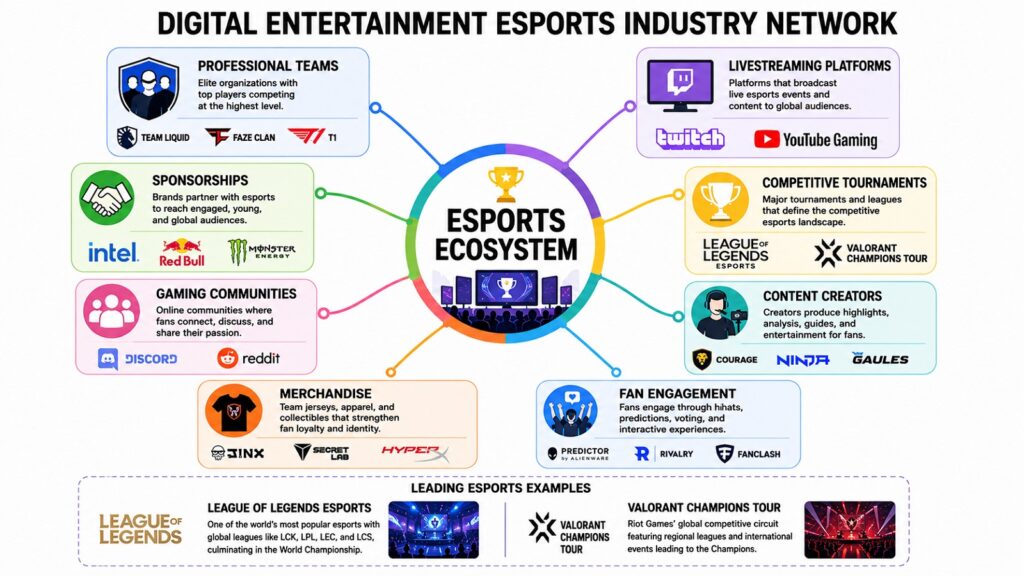
In 2019, the League of Legends World Championship final attracted nearly one hundred million viewers online, more than watched the Super Bowl that year. The players were professional athletes in the same sense that footballers and tennis players are, earning salaries, working with coaches, and competing before massive global audiences. Esports had arrived as a fully developed cultural institution built on digital entertainment infrastructure.
Tournaments are staged in arenas, streamed through Twitch and YouTube, and followed by communities spanning every continent. Games like Dota 2, Counter-Strike, Valorant, and Overwatch each have dedicated competitive scenes with leagues, seasonal championships, and star players carrying enormous fan followings. Twitch enables viewers to chat live, subscribe to channels, tip streamers, and interact in ways that feel closer to attending an event than watching television.
Esports has created entirely new career categories within digital entertainment. Professional players, coaches, broadcast analysts, and tournament organizers now form a recognized industry. Over 200 US universities offer varsity esports programs with scholarships. Major brands, including Intel, Red Bull, BMW, and Mastercard have signed sponsorship deals to reach audiences that are young, digitally native, and highly engaged during broadcast hours.
Fan psychology mirrors traditional sports closely. People form lasting attachments to teams, celebrate victories personally, and mourn defeats with genuine emotion. The next evolution points toward AI coaching analytics, decentralized tournament structures, and metaverse-based arenas where fans attend as digital avatars. The competitive gaming world is young enough that its most significant changes are likely still ahead.
Table 5: Digital Entertainment — Esports Culture and Ecosystem Insights
| Aspect | Real Observation in Digital Entertainment |
| League of Legends Worlds 2019 | Final drew nearly 100 million peak viewers, making it one of the most-watched esports events ever |
| Dota 2 Prize Pool | The International 2021 Dota 2 tournament had a prize pool exceeding 40 million USD from community funding |
| Twitch Platform | Twitch hosts over 7 million unique streamers monthly and serves billions of viewing minutes weekly |
| Esports Scholarships | Over 200 US universities offer varsity esports programs with scholarships as of 2023 |
| Red Bull Sponsorship | Red Bull sponsors multiple esports teams and events globally as part of its youth culture strategy |
| Riot Games Valorant League | Riot manages the Valorant Champions Tour with regional leagues across Americas, EMEA, and Pacific regions |
| Counter-Strike Majors | Valve-sponsored CS2 Majors offer 1.25 million USD prize pools and attract tens of millions of viewers |
| Esports Revenue Forecast | Global esports market revenue exceeded 1.38 billion USD in 2022 across media rights, sponsorships, and merchandise |
5. Digital Entertainment in the Creator Economy and Influencer Era
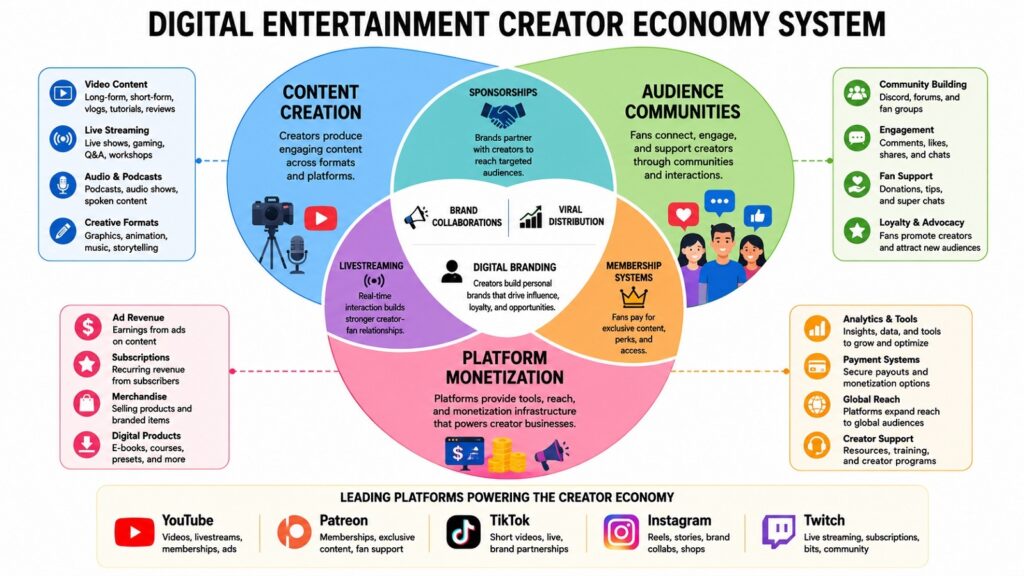
A decade ago, the gatekeepers of entertainment were television executives, record label scouts, and film studios. They decided what got made, who made it, and who saw it. That power structure still exists, but it has been cracked open. Today, a person with a camera, a microphone, and a reliable internet connection can build an audience of millions and earn a living through digital platforms alone.
The creator economy runs through YouTube, Instagram, TikTok, Twitch, Patreon, and Substack, each with different tools for turning audience attention into income. YouTube pays through advertising revenue sharing. Twitch enables subscriptions and tips. Patreon gives creators a direct membership model where fans pay monthly for exclusive access. MrBeast has over 300 million YouTube subscribers, generating revenues that rival traditional entertainment companies.
What makes the creator economy culturally powerful is the parasocial bond between creator and audience. Viewers who follow a creator daily develop a sense of personal familiarity even though the relationship is entirely one-directional. This trust transfers directly to product recommendations. Creator platforms have also enabled niche communities, from vintage typewriter restoration to competitive speedrunning, that could never have sustained a career in broadcast media.
Successful creators now manage multiple revenue streams, balancing sponsorships, merchandise, memberships, and licensing with full support teams behind them. Future trends include AI-generated virtual influencers, decentralized platforms, and automation tools for parts of the production process. The question of authenticity will grow more complex as audiences encounter digital personalities whose human origin becomes uncertain.
Table 6: Digital Entertainment — Creator Economy and Influencer Platform Insights
| Aspect | Real Observation in Digital Entertainment |
| YouTube Partner Program | Pays creators 55% of advertising revenue generated by their content, split by Google’s AdSense system |
| MrBeast Subscriber Count | MrBeast surpassed 300 million YouTube subscribers in 2024, becoming the most subscribed individual creator |
| Patreon Model | Patreon hosts over 250,000 creators earning direct monthly income from over 8 million active patrons |
| Twitch Subscription Revenue | Twitch takes 50% of subscription fees from standard partners, with top creators negotiating higher splits |
| TikTok Creator Fund | Launched in 2020 with 1 billion USD committed to pay creators based on views and engagement |
| Influencer Marketing Industry | Global influencer marketing spending exceeded 21 billion USD in 2023 across all platforms |
| Virtual Influencers | AI-generated influencers like Lil Miquela have millions of followers and active brand partnerships |
| Substack Newsletter Growth | Substack hosts over 500,000 paid newsletter subscriptions across creator-run publications as of 2023 |
6. Digital Entertainment Through Short-Form and Social Video Content
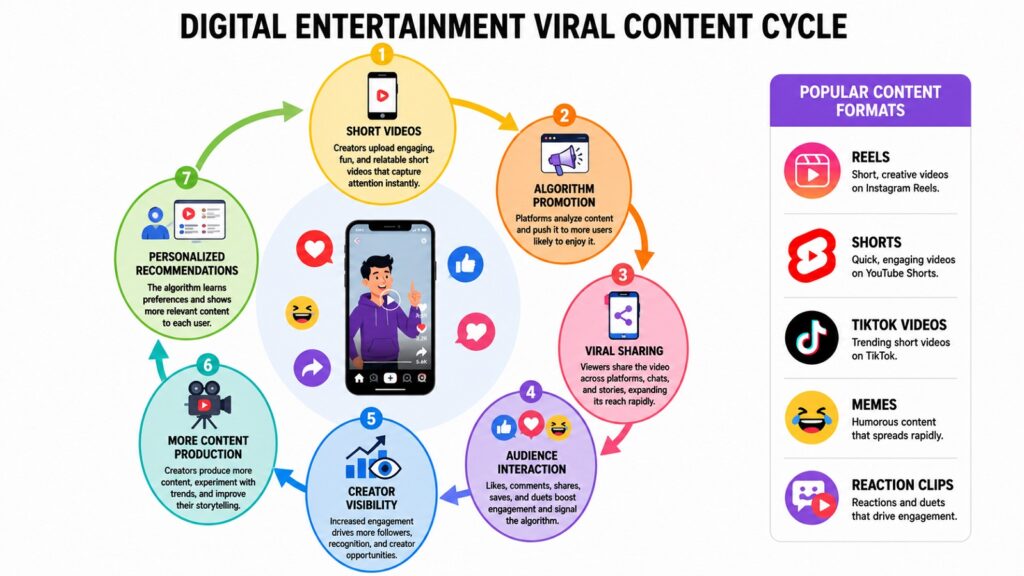
Open any social platform on a phone and within seconds something is already playing. A street performer clip. A forty-second comedy sketch. A recipe compressed into a minute. Short-form video has become one of the most instinctive behaviors in digital entertainment, woven so tightly into daily habits that people rarely notice how much time passes inside these feeds.
TikTok popularized the format. Vertical videos between fifteen seconds and three minutes, fed by an algorithm that learns preferences with startling speed. Instagram responded with Reels, YouTube with Shorts, and Snapchat with Stories. Each platform runs the same core idea: match content to demonstrated preference, keep the viewer watching, and surface new creators through algorithmic amplification rather than social connections.
The recommendation systems are extraordinarily sophisticated. TikTok’s For You Page considers watch time, replays, shares, and even how the device is held. Infinite scroll removes natural stopping points. Autoplay removes the decision to continue. The brain’s variable reward response to each unknown video makes swiping feel instinctive, and the feed grows more tailored with every second of attention given to it.
For businesses and creators, short-form video is the most effective organic discovery channel available. A single viral video can introduce a brand to millions overnight. TikTok’s BookTok community has repeatedly driven physical book sales and launched musical careers. Traditional pre-roll advertisements perform poorly here, so branded creator integrations, native-style ads, and sponsored participation challenges have become the dominant formats. Future developments point toward AI-generated short content and fully personalized media experiences.
Table 7: Digital Entertainment — Short-Form and Social Video Platform Insights
| Aspect | Real Observation in Digital Entertainment |
| TikTok For You Page Algorithm | Uses watch time, replays, shares, and device behavior to personalize each user’s content feed |
| Instagram Reels Launch | Meta launched Reels in 2020 directly in response to TikTok’s rapid growth in short-video consumption |
| YouTube Shorts Milestone | YouTube Shorts surpassed 70 billion daily views in 2023, making it one of the most-used short video features |
| BookTok Influence | TikTok’s BookTok community has repeatedly driven physical book sales, reviving out-of-print and older titles |
| Vertical Video Adoption | Over 90% of social video consumption on mobile now occurs in vertical orientation rather than horizontal |
| TikTok Global Users | TikTok reached over 1 billion monthly active users in 2021 and continues growing across international markets |
| Snapchat Stories Format | Snapchat introduced the Stories format in 2013, which was later adopted by Instagram, Facebook, and WhatsApp |
| Branded Hashtag Challenges | TikTok branded hashtag challenges can generate billions of impressions and encourage mass user participation |
7. Digital Entertainment Through Podcasting and Audio Storytelling
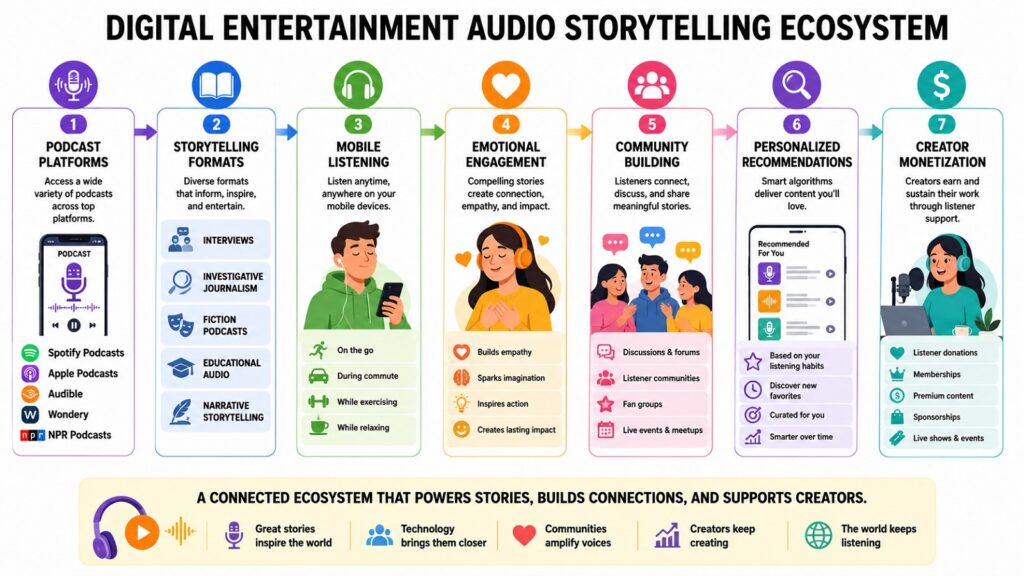
There exists a unique quality in audio that other forms of media are unable to duplicate. When a voice is transmitted through earphones while commuting, an intimate experience occurs. There are no visuals to interpret. The imagination compensates for what the eyes are unable to perceive. Audio establishes a mental environment that feels more personal than reading and more immersive than background music. Podcasting has developed a complete entertainment industry centered on that intimacy, attracting over 500 million monthly listeners globally.
Podcasts are on-demand audio programs distributed through Spotify, Apple Podcasts, and Amazon Music. The format holds a casual two-person conversation as naturally as a deeply produced investigative journalism series, a scripted audio drama, or an expert interview show in any niche imaginable. This range allowed podcasting to grow from a hobbyist format into a serious commercial frontier within digital entertainment.
Spotify has invested billions in podcast content, acquiring studios like Gimlet Media and signing exclusive deals including a reported 250 million USD agreement with Joe Rogan. Podcast listeners consistently show higher trust in hosts than in other media personalities, and host-read advertisements carry recall rates significantly above standard digital advertising. The intimacy of the format transfers directly into commercial effectiveness, making podcasting valuable for both creators and advertisers.
Future developments include AI voices narrating personalized content, interactive episodes where listeners choose story paths, spatial audio placing sound in three-dimensional space, and adaptive audio that adjusts to detected emotional state. Podcasting is young enough that its most interesting formats are likely still being invented, making it one of the more open frontiers remaining in digital entertainment.
Table 8: Digital Entertainment — Podcasting and Audio Storytelling Insights
| Aspect | Real Observation in Digital Entertainment |
| Joe Rogan Spotify Deal | Spotify signed an exclusive deal with Joe Rogan reported at around 250 million USD for content rights |
| Apple Podcasts Subscriptions | Apple introduced paid podcast subscriptions in 2021, allowing creators to charge directly for premium episodes |
| Global Podcast Listeners | Over 500 million people worldwide listen to podcasts monthly as of 2024 across all major platforms |
| Spotify for Podcasters | Spotify’s free hosting tool, formerly Anchor, handles recording, distribution, and monetization in one platform |
| Serial Investigation Format | NPR’s Serial podcast, launched in 2014, popularized the long-form investigative narrative audio format globally |
| Host-Read Ad Performance | Host-read podcast advertisements have recall rates significantly higher than standard digital display advertising |
| Audio Drama Resurgence | Scripted audio fiction series have returned strongly through platforms like Spotify and Audible Originals |
| Dynamic Ad Insertion | Technology allows different advertisements to be served to different listeners in the same podcast episode |
8. Digital Entertainment Through VFX, CGI, and Virtual Production
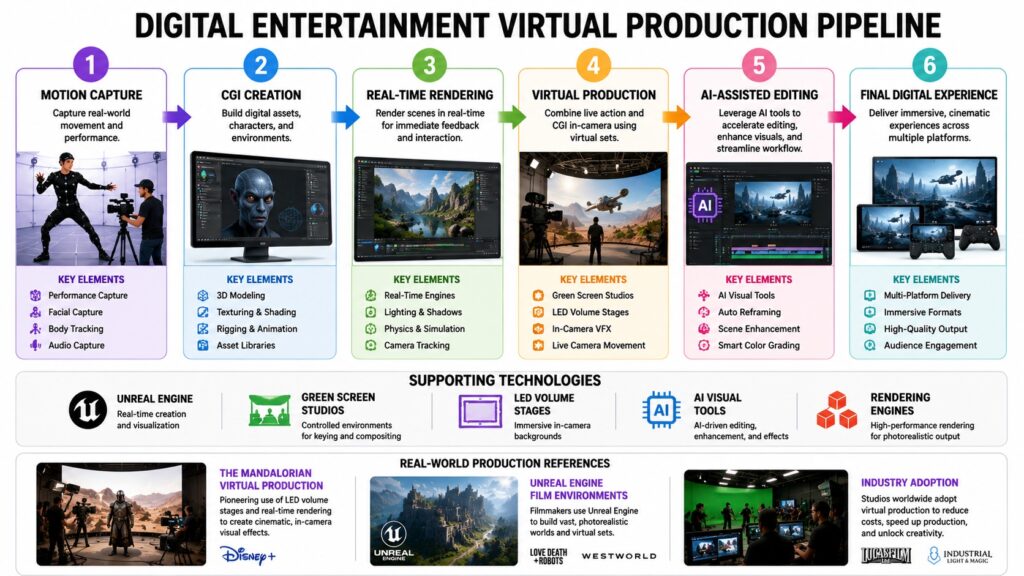
The Mandalorian changed something fundamental about how productions are made. Instead of flying cast and crew to remote locations, the production used a massive LED wall displaying photorealistic environments generated in real time by a game engine. Actors performed against digital sunsets and alien landscapes without leaving a Los Angeles studio. The audience saw something that looked entirely real, because the technology had advanced far enough to make digital environments indistinguishable from physical ones.
CGI allows production teams to build entire worlds inside computers, from building architecture to the behavior of water, fire, and light. Motion capture translates actor movement directly into digital character behavior. Andy Serkis used this system to bring Gollum to life in The Lord of the Rings, and it now drives digital humans capable of speaking and emoting with photorealistic believability. Rendering engines built originally for games now generate film-quality imagery in real time, compressing production timelines from weeks to hours.
AI has entered the visual effects pipeline in meaningful ways, upscaling footage, removing objects from scenes, generating textures, and predicting how physical elements should behave. Virtual production studios are emerging globally as streaming platforms and advertising agencies need high volumes of visual content produced more efficiently. LED volume stages are replacing location shoots for campaigns that would previously have required international travel.
The future points toward AI systems generating entire visual sequences from text descriptions, digital human performers existing only in software, and interactive environments responding to real-time viewer choices. The creative ceiling in digital entertainment has effectively been removed, and the pace at which these tools are becoming accessible to smaller productions is accelerating every year.
Table 9: Digital Entertainment — VFX, CGI, and Virtual Production Insights
| Aspect | Real Observation in Digital Entertainment |
| The Mandalorian LED Volume | Used a 270-degree LED wall powered by Unreal Engine to replace physical sets with real-time CGI environments |
| Unreal Engine in Film | Epic’s Unreal Engine is now used across film, advertising, and architecture visualization beyond gaming |
| ILM StageCraft System | Industrial Light and Magic developed the StageCraft virtual production system used in major Hollywood productions |
| Motion Capture Technology | Weta Digital used markerless performance capture for Avatar: The Way of Water to capture underwater scenes |
| AI Upscaling Tools | Tools like Topaz Video AI use neural networks to upscale archival and low-resolution footage to 4K and 8K |
| CGI Creature Creation | Framestore created the CGI polar bears in The Golden Compass using fluid simulation and fur rendering systems |
| Digital De-Aging | Marvel Studios uses ILM’s Iverse system to digitally de-age actors like Samuel L. Jackson and Robert Downey Jr. |
| Real-Time Rendering Growth | Real-time rendering through game engines has reduced certain VFX timelines from weeks to hours |
Conclusion: The Future of Digital Entertainment in Modern Technology
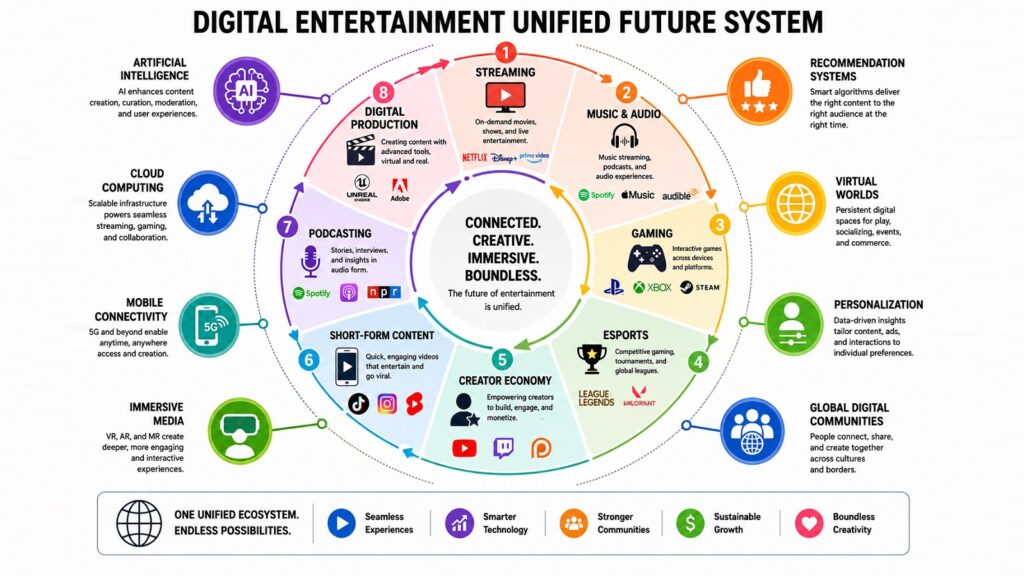
Digital entertainment is not a single industry. It is a web of interconnected systems, each one amplifying the others. Streaming platforms feed demand for original content, which drives visual effects innovation, which raises audience expectations, which pushes gaming toward cinematic territory, which attracts creators who build communities, which fuels short-form video culture, which discovers podcasters. These systems are not parallel. They are woven together.
The eight foundations have a shared core: technology that minimizes the friction between an individual’s desire for entertainment and the actual experience. Streaming has done away with the television schedule. Music streaming has rendered the record store obsolete. Gaming has removed geographical limitations from multiplayer experiences. Short-form video has negated the necessity to search for content altogether. Podcasting has eliminated the need for a broadcast tower. Virtual production has made location shoots unnecessary. This pattern remains constant. Digital technology dismantles the obstacles that previously separated individuals from their desires.
The cultural consequences are still unfolding. Audience attention has fragmented across dozens of competing platforms. Creators have gained power that once belonged to large institutions. Local cultures have found global audiences. Business models built on physical media and broadcast rights have had to transform or accept diminishing relevance. Identity, community, and shared experience are now meaningfully shaped by digital entertainment choices in ways no previous generation experienced.
Artificial intelligence sits at the center of nearly every future projection for digital entertainment. It already shapes recommendations, personalizes feeds, assists music production, and enables realistic virtual characters. Within the coming years, AI systems capable of generating entire films and interactive worlds from simple descriptions will become commercially viable. Immersive media through virtual and augmented reality is building toward experiences that are not watched from a distance but inhabited directly. Digital entertainment will remain one of the most influential forces shaping modern technology, culture, and commerce for the foreseeable future, and understanding it means understanding where the next era of human experience is headed.
Table 10: Digital Entertainment — Future Trends and Long-Term Transformations
| Trend or Transformation | Direction and Significance in Digital Entertainment |
| AI-Driven Personalization | Platforms like Netflix and Spotify are deepening AI recommendation engines to predict content preferences more precisely |
| Virtual Production Expansion | LED volume stages and real-time rendering are replacing location shoots across film, advertising, and streaming production |
| Short-Form Video Dominance | TikTok, YouTube Shorts, and Instagram Reels continue to shift consumption habits toward mobile-first, rapid-fire content |
| Immersive Audio Growth | Spatial audio formats on Apple Music and Spotify are establishing new standards for how digital sound is experienced |
| Creator Economy Maturation | Creator businesses are scaling into multi-revenue media companies with teams, merchandise, and licensing operations |
| Cloud Gaming Adoption | Xbox Cloud Gaming and NVIDIA GeForce Now are reducing hardware barriers and expanding gaming accessibility globally |
| Esports Infrastructure | Esports leagues, university programs, and media rights deals are formalizing competitive gaming as a professional industry |
| AI-Generated Media | Generative AI tools for video, music, and visuals are entering the production pipeline across all digital entertainment formats |