
Table of Contents
Introduction: Blockchain Technology and the Rise of Emerging Computing
Blockchain Technology is one of the most important Emerging Computing Technologies today. It stands beside Artificial Intelligence, Cloud Computing, Edge Computing, and Quantum Computing. But it solves a different problem. Those other tools focus on speed or smarts. Blockchain Technology focuses on trust. It builds a shared record that many people can trust. No single boss or company needs to manage it.
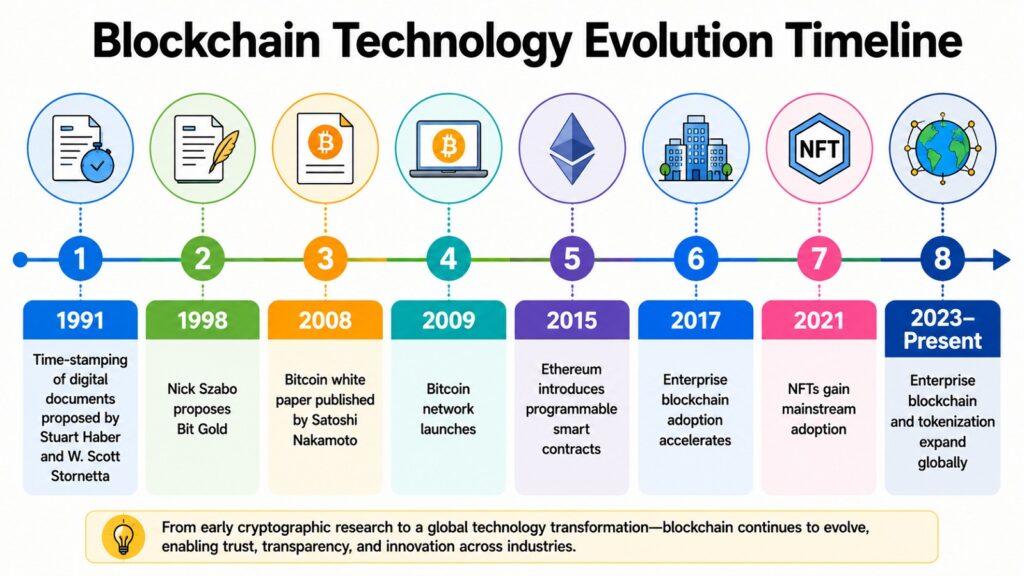
The story started with Bitcoin in 2009. Back then, blockchain had one job: track digital coin payments. Since then, it has grown far past that. Banks use it to settle trades faster. Hospitals use it to guard patient records. Factories use it to track parts as they move across the world. Governments use it to issue digital IDs and cut down on fraud. This growth proves blockchain is not just a tool for crypto fans anymore. It is now a serious technology used in finance, health care, shipping, and government work.
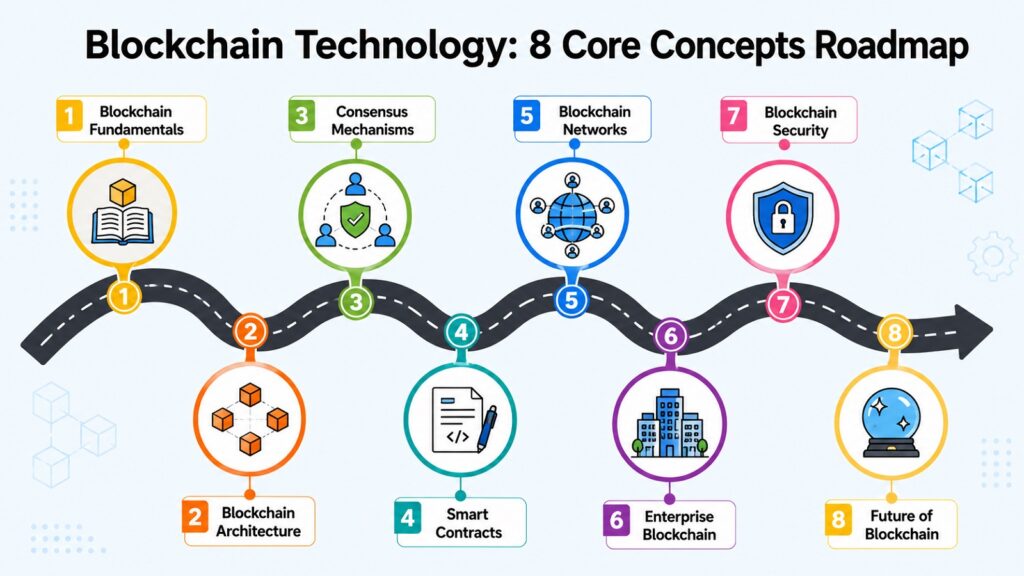
This article digs deep into the topic. It mixes plain explanations with real business cases. You will not just learn terms. You will see how those terms play out in the real world. Each section builds on the one before it. We start with the basics of how blockchain works. Then we move to its structure, its rules for agreement, its smart contracts, its network types, its use in business, its safety record, and its future.
The table below lists the eight ideas this guide covers. Each one builds toward a full picture of why Blockchain Technology matters now and in the years ahead.
Blockchain Technology: Eight Core Concepts Covered in This Guide
| Core Concepts of Blockchain Technology | What It Covers |
| Fundamentals | Core ideas, history, and the problems blockchain solves |
| Architecture | Blocks, hashes, nodes, and how the parts fit together |
| Consensus Mechanisms | How spread-out networks agree on what is true |
| Smart Contracts | Deals that run themselves without a middleman |
| Networks | Public, private, group, and mixed blockchain setups |
| Enterprise Applications | Real business case studies across many industries |
| Security | Strengths, risks, and how firms manage them |
| Future of Blockchain Technology | Web3, tokens, digital cash, and what comes next |
1. Blockchain Technology Fundamentals
Blockchain Technology records data in a way that is hard to change, hack, or fake. It works as a shared ledger. The same record sits on many computers, called nodes, instead of one central server. When someone wants to add new data, the network checks it first. This means no bank or middleman has to step in to confirm a deal is real.
The idea did not pop up overnight. People studied linked digital records back in the 1990s. But it took the 2008 money crisis and the 2009 Bitcoin paper to push blockchain into wide use. Satoshi Nakamoto, the name used by Bitcoin’s creator, wanted a payment system that did not lean on banks. Many people had lost trust in banks at the time. That single idea opened the door to a much bigger technology.
A blockchain is made of blocks, and each block holds a batch of transactions. Every block carries a hash. A hash is like a digital fingerprint built from the block’s data. This hash also points back to the hash of the block before it. That link is what forms the “chain.” If someone tries to change an old record, the hash breaks. Every block after it would break too. This is why people call blockchain records immutable, or unchangeable. Rewriting history this way would mean fixing thousands of computers at once. That is nearly impossible in real life.
Spreading data out is the second key idea. Instead of one server holding the master copy, thousands of nodes hold the same copy. No single group can quietly edit the ledger. Every other node would spot the mismatch right away. This setup builds trust between people who do not know each other. A small shop owner in Kenya and a buyer in Germany can trade with confidence. The blockchain itself, not a personal bond, backs up the deal.
These basics matter beyond the tech world. Blockchain lowers the cost of trust. Old systems lean on lawyers, auditors, and clearing firms to check deals. That work costs time and money. Blockchain automates much of that checking. This is why banks, insurers, and factories have poured billions into blockchain pilots since 2017.
Blockchain Technology Fundamentals: Key Facts and Concepts
| Key Terms of Blockchain Technology | Why It Matters |
| Distributed Ledger | The same data is copied across many separate computers |
| Hashing | Builds a fingerprint that flags any change right away |
| Block | A batch of checked transactions added to the chain |
| Immutability | Old records cannot change without breaking the chain |
| Decentralization | No single group controls or edits the ledger alone |
| Bitcoin White Paper (2009) | Brought blockchain in to solve trust without banks |
| Node | A computer that stores and checks a copy of the ledger |
| Transparency | Users can view and check the shared record history |
2. Blockchain Technology Architecture
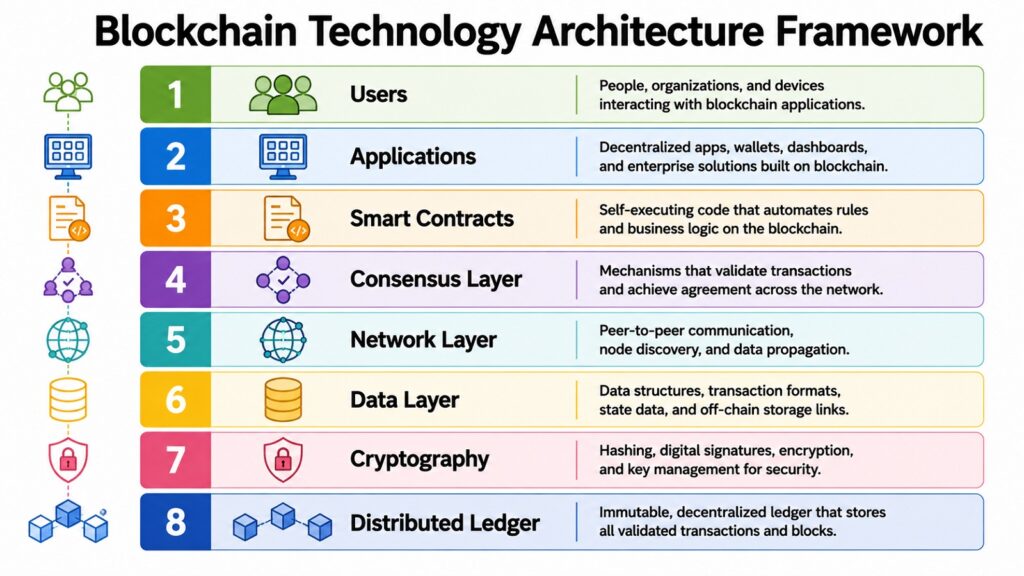
The fundamentals show what blockchain does. The architecture shows how it actually works under the hood. Every block has two main parts: a header and the transaction data. The header holds key facts, such as a timestamp and the hash of the last block. It also holds a number called a nonce, used during certain checks. This header is what links each block to the one before it. That link forms the unbroken chain that gives blockchain its name.
Inside each block, transactions are not just listed one after another. They sit inside a Merkle Tree. This structure pairs up transactions and hashes them again and again. In the end, one “root hash” stands for the whole block. This matters because any node can quickly check if one transaction belongs in a block. It does not need to download the whole data set. For a network handling millions of transactions, this speed matters a lot.
Digital signatures add another layer of safety. When someone sends a transaction, they sign it with a private key only they hold. Other nodes can then check that signature using the sender’s public key. This proves the deal is real without ever showing the private key to anyone else. This pairing of public and private keys lets strangers trade safely. No bank needs to vouch for either side.
Nodes talk to each other through peer-to-peer links. Instead of reporting to one main server, nodes send new transactions straight to each other. Each node checks the transaction against the network’s rules on its own. It confirms, for example, that the sender truly owns the funds being spent. Once enough nodes agree the deal is valid, it joins a block and spreads further. This check is what stops fraud, such as someone trying to spend the same digital coin twice.
In real-world use, this architecture supports more than money transfers. Hyperledger Fabric, an open tool kept by the Linux Foundation, sets up its nodes a bit differently. It supports closed business networks while still using the same core ideas of hashing and shared storage. Firms like IBM have built business products on this design, since the base structure flexes to support both open coin networks and closed business groups.
Blockchain Technology Architecture: Core Components
| Core Components of Blockchain Technology | Primary Function |
| Block Header | Stores key facts, a time stamp, and a link to the last block |
| Merkle Tree | Sorts transactions for fast, easy checking |
| Hash Pointer | Connects each block to the one right before it |
| Private Key | Lets a user sign and approve their own transactions |
| Public Key | Lets others check a deal without seeing the signer’s private key |
| Peer-to-Peer Network | Sends transactions straight between nodes |
| Node Validation | Confirms transactions follow network rules before they pass |
| Distributed Storage | Keeps matching ledger copies across many computers |
3. Blockchain Technology Consensus Mechanisms
A blockchain only works if thousands of nodes can agree on one shared truth. This holds true even when some users may lie or go offline. Consensus mechanisms are the rules that make this agreement happen without a referee in charge. This is likely the most important design choice behind any blockchain. It shapes the network’s safety, speed, and power use.
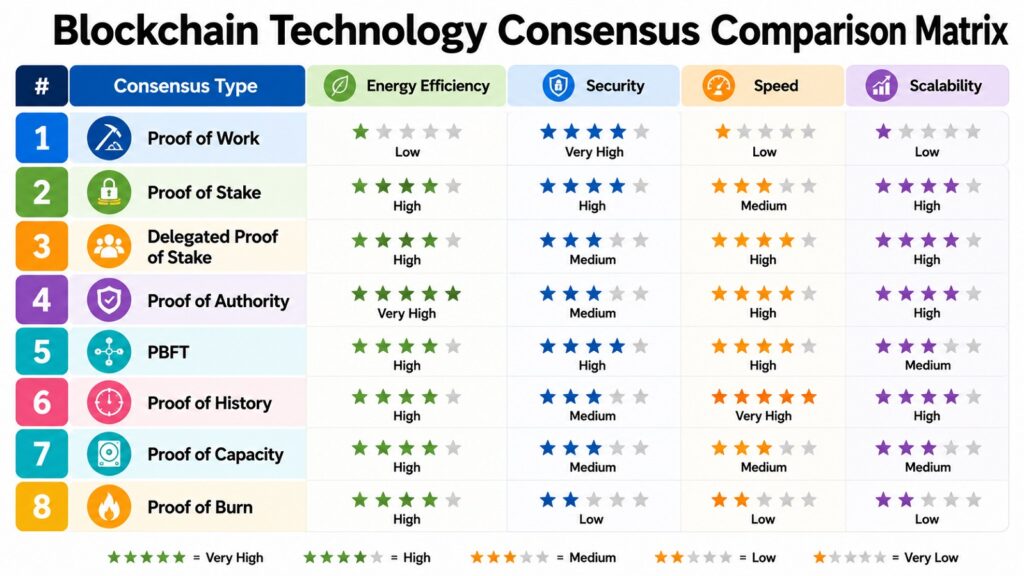
Proof of Work, used by Bitcoin, was the first major model. Nodes called miners race to solve a tough math puzzle. The winner adds the next block and earns a reward. This race burns real computing power and real electricity, which makes cheating costly. To attack the network, a bad actor would need more computing power than the rest of the world combined. This is called a 51% attack. On a network as large as Bitcoin, that attack is too costly and hard to pull off.
Proof of Stake takes a different path. Instead of racing with computing power, validators lock up their own coins as a kind of deposit. The network then picks validators to approve new blocks, partly based on how much they have staked. If a validator approves a fake transaction, they lose their stake. Ethereum switched from Proof of Work to Proof of Stake in September 2022. This switch, known as the Merge, cut the network’s energy use by close to 99.95 percent, based on figures from the Ethereum Foundation.
Other models fit more specific needs. Delegated Proof of Stake lets coin holders vote for a smaller group of trusted validators, which speeds things up but gives up some spread-out control. Practical Byzantine Fault Tolerance, often used in closed networks like Hyperledger Fabric, has nodes trade messages directly to confirm agreement, which suits small, known groups rather than open networks. Proof of Authority relies on a fixed list of approved validators. It trades spread-out control for speed, which suits private business chains.
No single model wins in every case. Open coin networks tend to value trust and safety over raw speed. Private networks often value speed and lower power costs over full decentralization. Firms picking a platform usually ask which trade-off matters most for their own goals.
Blockchain Technology Consensus Mechanisms Compared
| Blockchain Technology Consensus Mechanism | Key Trait |
| Proof of Work | Strong safety, high power use, used by Bitcoin |
| Proof of Stake | Validators stake coins; far less power use than Proof of Work |
| Delegated Proof of Stake | Coin holders vote for a small group of validators |
| Practical Byzantine Fault Tolerance | Nodes confirm deals directly; fits closed networks |
| Proof of Authority | Fixed, approved validators; fast but less spread out |
| 51% Attack Risk | A threat when one group controls most of the network |
| The Merge (2022) | Ethereum’s switch to Proof of Stake cut power use by 99.95% |
| Energy Efficiency | A top factor when firms pick a consensus model |
4. Blockchain Technology Smart Contracts
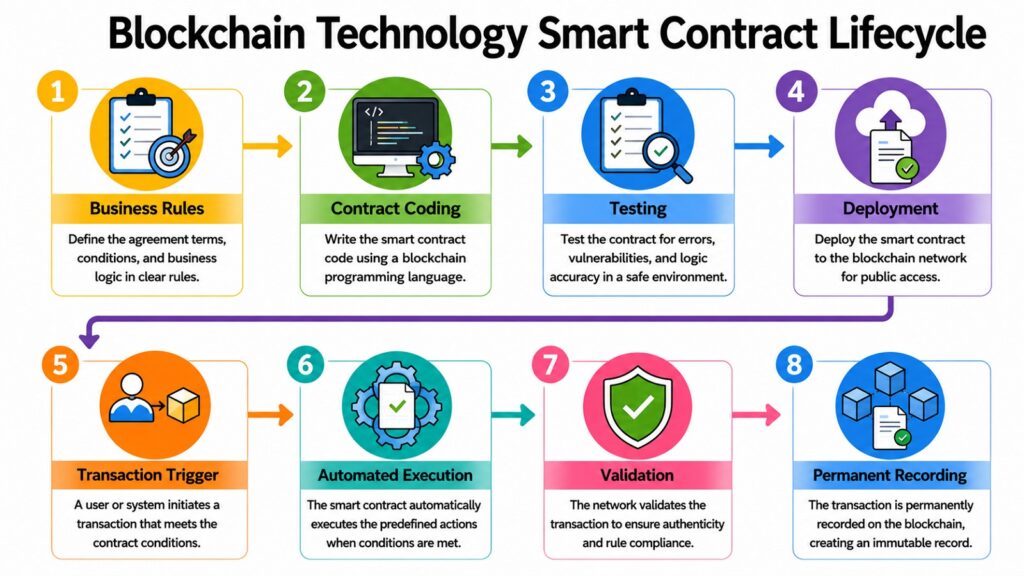
Smart contracts represent one of the most valuable innovations arising from Blockchain Technology. A smart contract is essentially a compact program that resides on a blockchain. It operates autonomously once predetermined conditions are satisfied. There is no requirement for a lawyer or an escrow agent to enforce the agreement. The code executes the contract precisely as specified, without exception.
Ethereum brought smart contracts to the wider world when it launched in 2015. It gave coders a programmable blockchain, not just one limited to simple payments. Since then, thousands of decentralized apps, often called DApps, have been built on smart contract tools. Think of a vending machine: you pay, you get your snack, no clerk needed. Smart contracts use that same logic for far bigger jobs. They can release an insurance payout the moment a flight is delayed, or transfer a house title once payment clears.
Building a smart contract means writing code in a language such as Solidity. Coders test it with care, then send it live on the blockchain, where it becomes nearly impossible to change. That permanence cuts both ways. Once live, a contract runs exactly as coded, but if the code holds a bug, that flaw stays put unless the contract was built to be upgraded. The 2016 DAO hack is a famous warning, where attackers found a flaw and drained close to 3.6 million Ether. It remains a key lesson on why smart contracts need careful checks before they go live.
Business use has grown well past finance. Supply chain firms use smart contracts to release payment once sensors confirm a shipment arrived in good shape. Insurance firms use them to settle small claims without a manual review. Real estate platforms use them to make property transfers simpler. In each case, the appeal stays the same: faster work, fewer fights, and lower costs, since code enforces the rules instead of people.
Even with these gains, firms face real hurdles. Code checks are a must, since flaws can get costly once found by the wrong person. Legal systems are still catching up on how to treat smart contracts when a dispute lands in court. Even so, the technology keeps growing, since it cuts friction that has slowed business deals for centuries.
Blockchain Technology Smart Contracts: Key Concepts and Uses
| Blockchain Technology Smart Contracts Concept | Practical Application |
| Self-Execution | A contract runs on its own once terms are met |
| Solidity | A common language for writing Ethereum smart contracts |
| DApps | Apps built to run on top of smart contract platforms |
| Immutability Risk | Bugs in live code can be hard or impossible to fix |
| Code Auditing | Outside review cuts the risk of costly exploits |
| Insurance Payouts | Claims settle on their own once terms are verified |
| Supply Chain Payments | Funds release once delivery terms are confirmed |
| Property Transfers | Smart contracts can speed up title transfers |
5. Blockchain Technology Networks
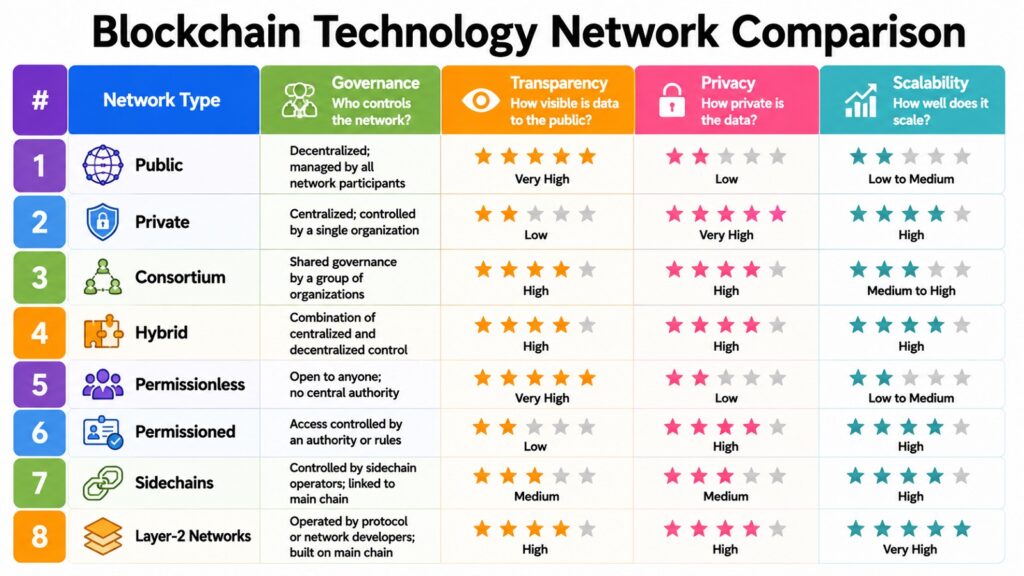
Not every blockchain looks the same. Firms that adopt this technology must pick a network type that fits their goals. Public, private, group, and mixed blockchains each serve different needs. Knowing these differences matters before any real project begins.
Public blockchains, like Bitcoin and Ethereum, are open to all. Anyone with internet access can join, view deals, and help check them. This open setup builds strong trust and stands up well against censorship, since no one group runs the show. The trade-off is slower speed and less privacy. Most public blockchains show deal details in the open, even though user names stay hidden behind wallet codes.
Private blockchains limit who can join, often to one firm’s own team. A bank might run a private chain inside its own walls to speed up record-keeping between teams. This setup gives speed and tight control, since fewer nodes need to check each deal. But it gives up the open trust model that makes public chains stand out. Critics say a private chain run by one firm acts more like a fast database than a true spread-out system.
Group blockchains, often called consortium chains, sit between the two extremes. A group of firms, not just one, jointly runs the network. This model fits industries where rival firms must share data, but no single party should hold full control. Bank groups, for example, have used this setup to settle deals between banks faster, while keeping power split among the member firms.
Mixed, or hybrid, blockchains blend public and private parts. A firm can keep sensitive data private while still proving certain deals on a public chain for extra trust. This approach has grown as firms look for ways to meet rules while still gaining the trust that public checks bring.
Picking between these models depends a lot on the industry and use case. Strict fields like health care and finance often favor private or group models, where access stays tightly locked down. Fields built on open proof, like supply chain tracking or public records, often favor public or mixed setups. These let outside parties check the facts on their own.
Blockchain Technology Network Types Compared
| Blockchain Technology Network Types | Best Suited For |
| Public Blockchain | Open access, censorship resistance, digital coins |
| Private Blockchain | One firm’s control, faster internal work |
| Consortium Blockchain | Shared data among trusted, rival firms |
| Hybrid Blockchain | Mixing private data with public proof |
| Permissionless Access | Anyone can join and help check, as with Bitcoin |
| Permissioned Access | Only approved members can join or check |
| Governance Model | Sets who can propose or approve network changes |
| Regulatory Fit | Private and group models fit strict industries best |
6. Enterprise Blockchain Technology Applications
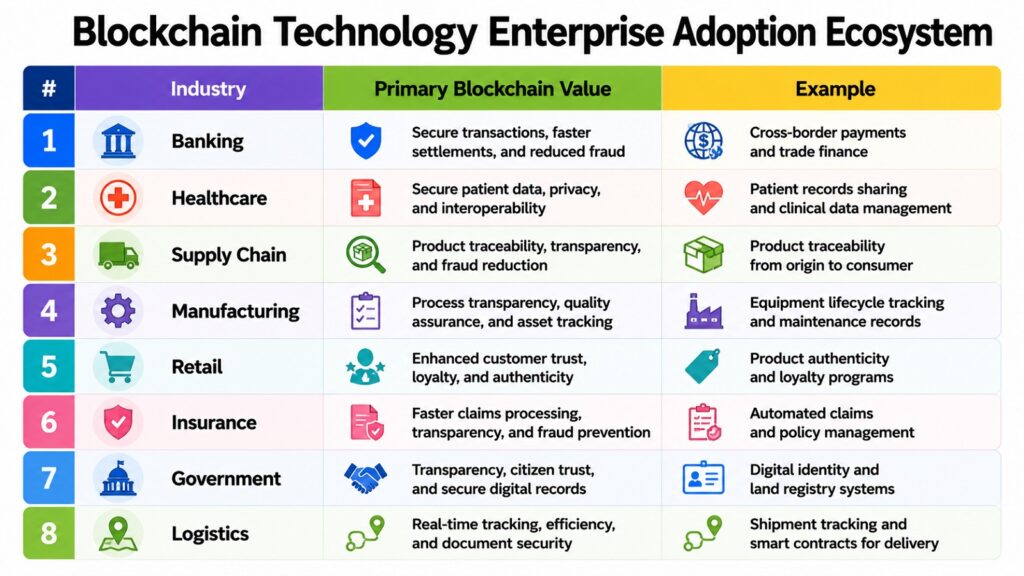
Business use is where Blockchain Technology moves from theory into real, measured value. Big firms in finance, health care, supply chains, and government have spent years testing this tech under real pressure. A few case studies now offer clear lessons on what works and what does not.
Walmart’s work with IBM stands out as one of the most cited supply chain stories. Using Hyperledger Fabric, Walmart and IBM ran pilot projects to trace mangoes sold in United States stores and pork sold in China stores. Before blockchain, tracing a batch of sliced mangoes back to its farm took nearly seven days of paperwork and phone calls. With blockchain in place, that same trace took about 2.2 seconds. The result was so strong that Walmart later told leafy green suppliers they must join the IBM Food Trust network. Faster tracing cuts the size and cost of food recalls and limits harm during contamination scares.
Banking has moved even faster. JPMorgan built its Onyx platform, now renamed Kinexys, to handle bank repo deals and cross-border payments on blockchain rails. Since launch, the platform has moved past 1.5 trillion dollars in total value. It now handles over 2 billion dollars in deals each day, on average. This proves blockchain has moved past small pilot projects at big banks. It now handles real bank money at a serious scale.
Health care has moved with more care, but still with clear reasons to push forward. Patient data often sits spread across many systems that do not talk to each other, and checking medical history can mean slow, manual requests between hospitals. Projects like MedRec, built through research at MIT, tested using blockchain to give patients more control over their own records, while letting providers check that the data was real without copying private details across many servers.
Not every business blockchain project has worked out, and that honesty matters for anyone weighing this tech. Maersk and IBM shut down TradeLens, their blockchain shipping platform, in 2023 after four years of work. Despite signing up more than 150 firms, the platform never reached full industry teamwork, since rival shipping lines did not want to share competitive data on a platform tied closely to Maersk, one of their direct rivals. The lesson matters a lot: blockchain can work well on the tech side while still failing as a business if trust and incentives are not built in from the start.
Government use is growing too. Estonia has used blockchain-based systems since 2012 to guard health, court, and legal records, helping the country run one of the most digital public systems in the world. Across these wins and setbacks, one thread stands out: blockchain adds value when it solves a clear trust problem, and struggles when success depends on rivals freely sharing private data.
Enterprise Blockchain Technology Applications by Industry
| Organization / Sector | Real-World Result |
| Walmart and IBM (Retail) | Mango tracing cut from 7 days to 2.2 seconds |
| JPMorgan Onyx / Kinexys (Banking) | Over $1.5 trillion in total value moved through the platform |
| MedRec (Healthcare, MIT) | Lets patients control their own blockchain medical records |
| Estonia (Government) | Blockchain-secured health and court records since 2012 |
| Maersk and IBM TradeLens (Shipping) | Shut down in 2023 despite signing up 150-plus firms |
| IBM Food Trust (Supply Chain) | Several retailers share one tracing ledger |
| Insurance Sector | Smart contracts settle claims without manual review |
| Manufacturing | Tracks parts to confirm they are real, cutting fakes |
7. Blockchain Technology Security
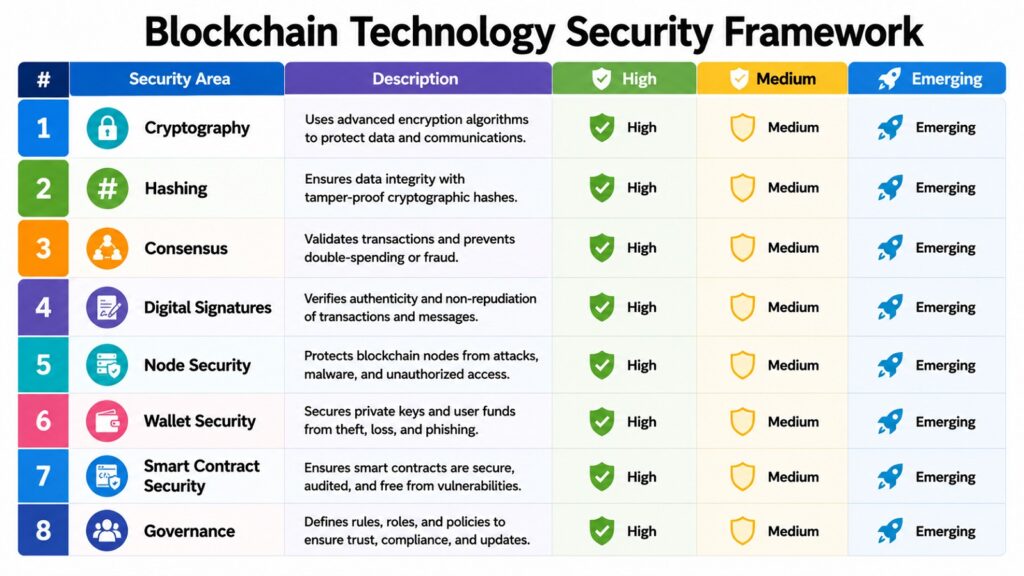
Security is often called blockchain’s biggest strength, and in many ways, that is true. Cryptographic hashing makes old records very hard to quietly change. Spreading data out removes the single weak point that makes normal databases an easy hacking target. Digital signatures confirm that only the true owner of an asset can move it. Put together, these traits give blockchain a safety record that old, central systems struggle to match.
Still, blockchain is not risk-free, and knowing its limits matters just as much as knowing its strengths. Losing a private key is one of the most common failure points. A lost bank password can be reset. A lost private key usually means losing access for good, since there is no central office to call for help. Phishing attacks prey on this fact often. They trick users into giving up their keys or signing harmful deals dressed up to look real.
Smart contract flaws bring up another real risk, as covered in the DAO hack story earlier. Since live code is hard to change, one missed flaw can lead to big losses before anyone can step in. This is why solid blockchain projects now spend heavily on outside code checks before launching contracts that hold real value.
The 51% attack stays a real risk, mostly on smaller networks. If one group gains control of most of a network’s checking power, they can twist which deals get confirmed. Big networks like Bitcoin and Ethereum stand strong against this, since gaining that much power costs too much. But smaller chains have suffered real 51% attacks, losing tens of millions of dollars in some cases.
Growth limits and privacy also tie into safety. Public blockchains that favor open records expose deal patterns. Even though names stay hidden, sharp analysis can sometimes trace a wallet back to a real person. Rules and laws are still catching up, which leaves firms unsure how to balance open networks with strict compliance needs. Cutting these risks takes layered defense: safe key storage, regular code checks, careful network design, and clear rules on who answers when something goes wrong.
Blockchain Technology Security: Strengths and Risks
| Blockchain Technology Security Factors | Security Impact |
| Cryptographic Hashing | Makes old records very hard to change |
| Decentralization | Removes the single weak point found in central databases |
| Private Key Loss | Often means losing access for good |
| Phishing Attacks | Tricks users into giving up keys or signing harmful deals |
| Smart Contract Bugs | Lasting flaws that can be hit before fixes go live |
| 51% Attack | Majority control can twist which deals get confirmed |
| Code Auditing | Cuts the risk of exploits before contracts go live |
| Regulatory Uncertainty | Rules are still taking shape across countries |
8. Future of Blockchain Technology
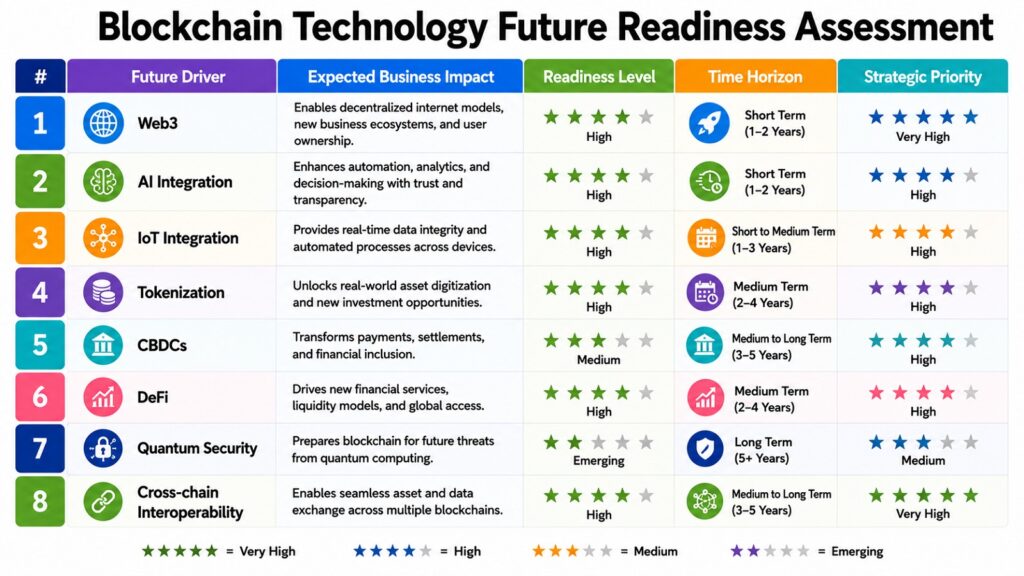
Blockchain Technology is still growing, and its next ten years look set to focus less on hype and more on blending with everyday financial and digital systems. A few trends already point to where this tech is headed, backed by real data rather than guesswork.
Web3, the broad idea of a more spread-out internet, keeps pushing blockchain into digital identity and the ownership of online items. Decentralized finance, often shortened to DeFi, has built lending, trading, and savings tools that run without a bank in the middle. Decentralized Autonomous Organizations, or DAOs, let groups manage shared funds through blockchain votes instead of a normal company structure. Legal rules for DAOs still vary a lot from country to country.
Tokenization is the act of turning real assets, like real estate or bonds, into blockchain tokens. It is drawing serious interest from big firms. JPMorgan has already turned United States Treasury bonds into tokens on its Kinexys platform. Large asset managers have also looked into tokenizing money fund shares to make them easier to trade and move.
Central Bank Digital Currencies show that governments now see blockchain-style tech as core money infrastructure, not a side project. The Atlantic Council’s tracker shows that well over 130 countries are exploring digital currencies. Dozens already run active pilots, and a handful have fully launched. This shift suggests blockchain-related tools will increasingly sit under everyday payment systems, even when users never touch a blockchain directly.
Linking different blockchain networks together, known as interoperability, is another active research area, since most chains today work fairly separately from one another. Projects focused on linking them aim to let data and assets move smoothly across platforms instead of staying stuck in one place. Artificial Intelligence is also gaining ground here, with AI tools helping watch blockchain networks for fraud and speeding up how deals get processed.
Security is gearing up for a future test too: quantum computing. In August 2024, the National Institute of Standards and Technology (NIST) finalized its first quantum-safe codes. This gives firms a road map to start moving their systems, including blockchain tools, before quantum computers grow strong enough to crack today’s encryption. None of these trends mean blockchain will replace today’s systems overnight. But together, they show a technology growing up into long-term, lasting infrastructure.
Future of Blockchain Technology: Emerging Trends
| Blockchain Technology Future Trends | Why It Matters |
| Decentralized Finance (DeFi) | Financial tools that run without a bank in the middle |
| Tokenization | Real-world assets turned into tradable blockchain tokens |
| Central Bank Digital Currencies | Over 130 countries exploring government-backed digital cash |
| Decentralized Autonomous Organizations | Group decisions made through blockchain voting |
| Interoperability | Links separate blockchain networks for smoother data flow |
| AI Integration | AI tools help watch and speed up blockchain networks |
| Quantum-Resistant Cryptography | New 2024 standards prepare blockchain safety for quantum risk |
| Institutional Tokenized Assets | Banks turn bonds and fund shares into easy-to-trade tokens |
Conclusion: Blockchain Technology as the Foundation of Digital Trust
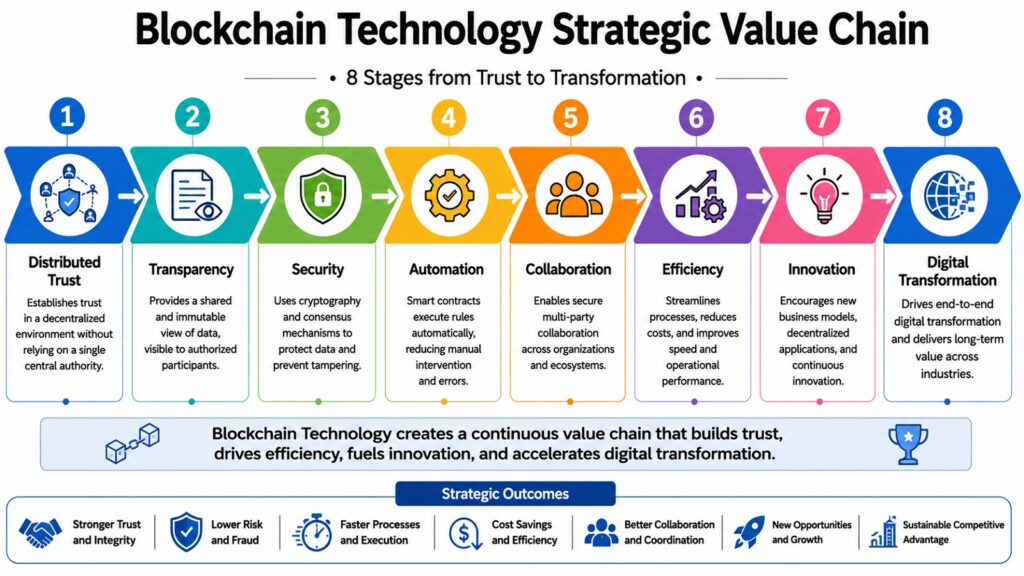
Blockchain Technology has grown from a narrow tool for tracking coin payments into a core piece of digital infrastructure. Across the eight ideas in this guide, one pattern stands out. Decentralization and hashing build records that resist tampering. The structure of blocks, Merkle Trees, and digital signatures turns that idea into a working system. Consensus rules let thousands of strangers agree on what is true without a referee. Smart contracts automate deals that once needed lawyers and middlemen.
Network types show that blockchain is not a one-size-fits-all tool. Public, private, group, and mixed models each fit different business needs. Business case studies, from Walmart’s near-instant food tracing to JPMorgan’s massive payment platform, prove this tech can deliver real value. Yet TradeLens shutting down is a useful reminder: working tech does not always mean a working business. Security remains a real strength built on strong codes, even as risks like lost keys and buggy contracts need steady attention. And the future, shaped by tokens, digital cash, and quantum-safe codes, points toward deeper ties with everyday systems, not a retreat from them.
Readers should leave this guide seeing Blockchain Technology as a long-term, strategic tool, not just a technology tied to coin price swings. Mastering these eight core ideas sets readers up to dig deeper into each topic through the linked articles tied to this guide. That deeper dive builds a stronger grasp of one of the defining Emerging Computing Technologies of this decade.
Blockchain Technology: Summary of Eight Core Concepts
| Blockchain Technology Concepts | Primary Significance |
| Fundamentals | Sets up decentralization, hashing, and unchangeable records |
| Architecture | Defines how blocks, nodes, and signatures link up safely |
| Consensus Mechanisms | Lets spread-out networks agree without a referee |
| Smart Contracts | Automates deals without a traditional middleman |
| Networks | Matches blockchain models to different business needs |
| Enterprise Applications | Shows real, measured business value in the field |
| Security | Balances strong codes with risks firms can manage |
| Future of Blockchain Technology | Points toward deeper ties with global infrastructure |