Table of Contents
Introduction: Understanding Digital Infrastructure as a Core Business Technology
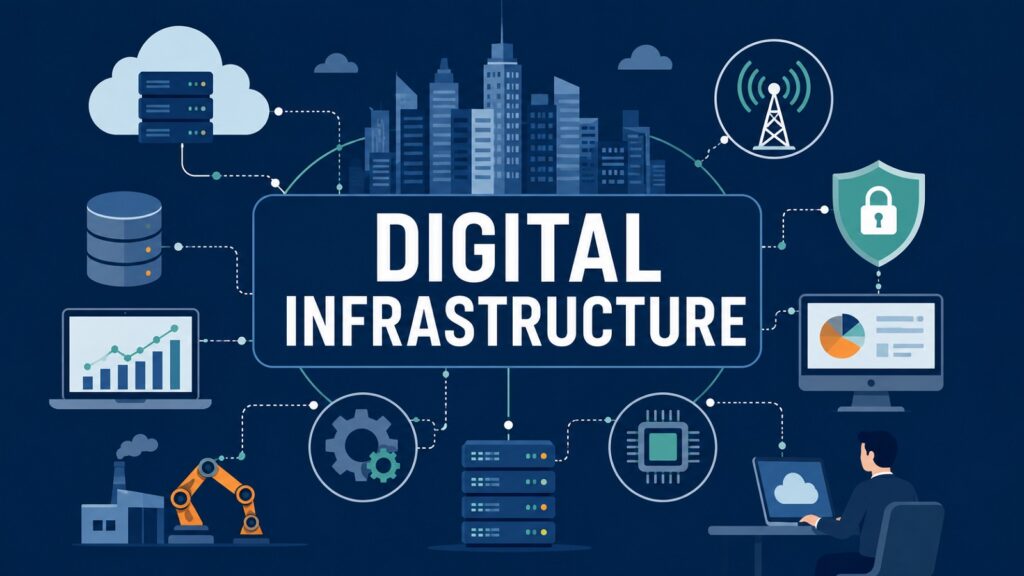
Every organization today runs on something most customers never see. Behind every order placed, every customer call answered, and every report generated sits a layer of technology that keeps operations moving. This layer is Digital Infrastructure, and it has quietly become one of the most important forms of Business Technology in the modern economy. It is no longer a back-office concern handled only by IT departments. It is a strategic asset that determines how fast a company can grow, how well it can serve customers, and how confidently it can handle disruption.
For decades, infrastructure meant physical assets such as factories, warehouses, and transportation networks. Today, a parallel layer of digital assets carries equal weight. Servers, networks, software platforms, and data systems now decide whether a business can scale into new markets or whether it gets stuck repeating manual processes year after year. Companies that treat Digital Infrastructure as a strategic priority tend to move faster and adapt to changing customer expectations with less friction. Those that ignore it often find themselves outpaced by competitors who invested earlier.
This shift did not happen overnight. It built up gradually as cloud computing matured, as data volumes exploded, and as customers began expecting instant digital interactions. Organizations that once viewed technology spending as a cost center started to see it as a growth lever. Digital Infrastructure became the thread connecting innovation, efficiency, and resilience. It supports remote work, powers e-commerce, secures financial transactions, and feeds the analytics that guide executive decisions. Without it, modern business cannot function at the pace markets now demand.
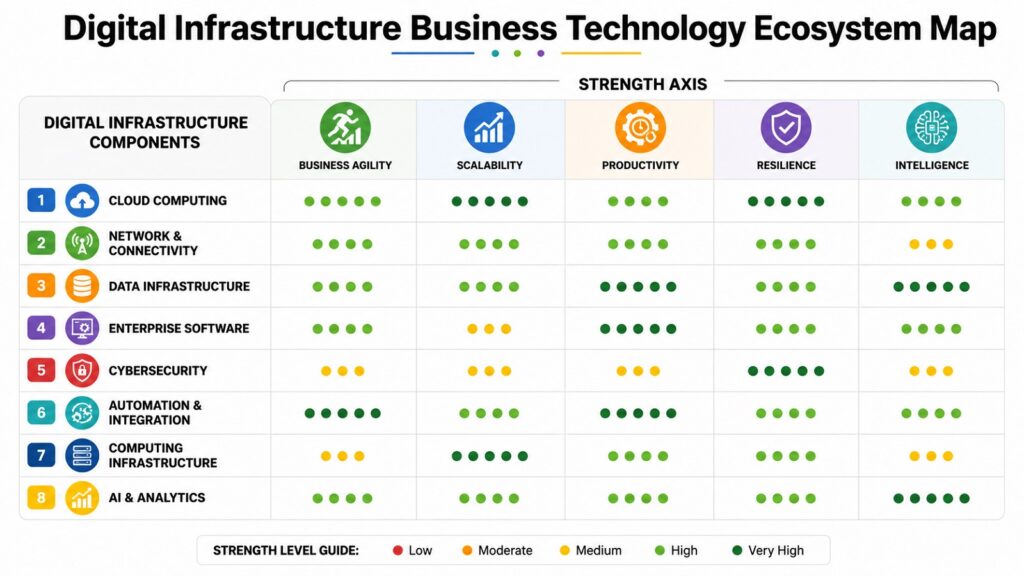
This article examines Digital Infrastructure through eight interconnected pillars that together form the technological backbone of a modern enterprise. Cloud computing provides the flexible foundation for storage and processing. Network and connectivity carry information between people, systems, and partners. Data infrastructure turns raw information into a usable asset. Enterprise software ties together functions like finance, sales, and human resources. Cybersecurity protects all of this from theft and disruption. Automation and integration remove friction from repetitive processes. Computing infrastructure supplies the processing power behind every application. AI and analytics convert accumulated data into forward-looking insight.
Each pillar deserves attention on its own, yet none functions well in isolation. A company can have excellent software but weak security, or strong connectivity but poor data governance. The real advantage comes from treating Digital Infrastructure as a connected system rather than a collection of separate purchases. Leaders who understand this connection make better investment decisions and avoid the common trap of fixing one weakness while leaving others exposed.
The sections that follow take a closer look at each pillar, tracing how it developed, why it matters to business outcomes, and what separates organizations that use it well from those that struggle. The goal is to offer a strategic guide that helps decision makers understand why Digital Infrastructure deserves a permanent place on the executive agenda.
Eight Pillars of Digital Infrastructure in Business Technology
| Digital Infrastructure Aspects | Description |
| Cloud Computing | Flexible foundation for storage and processing |
| Network and Connectivity | Carries information across people and systems |
| Data Infrastructure | Turns raw data into a usable asset |
| Enterprise Software | Connects finance, sales, and HR functions |
| Cybersecurity | Protects digital assets and customer trust |
| Automation and Integration | Removes friction from repetitive processes |
| Computing Infrastructure | Supplies processing power for applications |
| AI and Analytics | Converts data into forward-looking insight |
1. Digital Infrastructure and Cloud Computing: Enabling Agile Business Technology
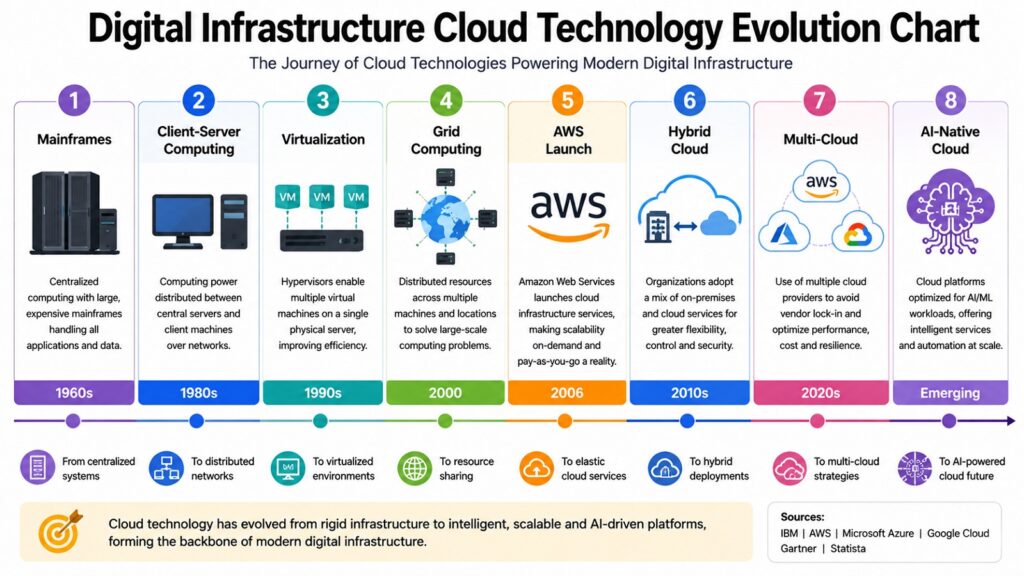
Cloud computing stands as one of the clearest examples of how Digital Infrastructure reshaped Business Technology. Before cloud platforms existed, companies bought physical servers, housed them in dedicated rooms, and hired staff to maintain them around the clock. This approach tied up large amounts of capital and made it hard to scale quickly when demand shifted. A retailer expecting a holiday rush had to guess how much server capacity to buy months in advance, often overspending or running short at the worst possible moment.
The arrival of commercial cloud platforms changed this equation. Amazon launched Amazon Web Services in 2006, offering computing power and storage on a pay-as-you-go basis. Microsoft and Google followed with their own platforms, and within a decade, renting computing capacity became the default choice for new digital projects. Businesses no longer needed to predict demand years in advance. They could add capacity within minutes and release it just as quickly once a spike passed. This flexibility turned a major capital expense into a variable operating cost, which freed up funds for other priorities.
Cloud adoption also reshaped how teams collaborate. Shared platforms let employees in different offices, or different countries, work on the same documents and systems in real time. During the pandemic, organizations that had already shifted core operations to the cloud adapted to remote work far more smoothly than those still tied to on-premises systems. Many companies that resisted cloud migration found themselves scrambling to set up remote access overnight, often through insecure workarounds.
Netflix offers a widely studied example of cloud strategy done well. The company moved its entire technology stack to the cloud over several years, a decision that let it scale streaming capacity globally without owning a single data center. By contrast, several retail chains that delayed cloud adoption struggled to support online ordering surges, losing sales to competitors with more flexible infrastructure.
The lesson for businesses today is straightforward. Cloud computing is not just a cost-saving measure. It is a strategic enabler that determines how quickly a company can respond to opportunity or disruption. Organizations that build their Digital Infrastructure around cloud-first principles tend to launch new products faster, recover from outages with less damage, and support a distributed workforce without friction. As markets continue to demand speed and flexibility, cloud computing remains the foundation that makes rapid adaptation possible.
Digital Infrastructure: Cloud Computing Trends and Benefits
| Aspect | Description |
| AWS launch, 2006 | Introduced pay-as-you-go cloud computing |
| Hybrid cloud | Combines private and public cloud systems |
| Multi-cloud strategy | Reduces dependence on a single provider |
| Elastic scaling | Adds capacity automatically during demand spikes |
| Netflix cloud migration | Enabled global streaming without owned servers |
| Disaster recovery | Cloud backups reduce downtime risk |
| Remote collaboration | Shared platforms support distributed teams |
| Capital expense reduction | Converts hardware costs into operating costs |
2. Digital Infrastructure and Network & Connectivity: Supporting Business Communication
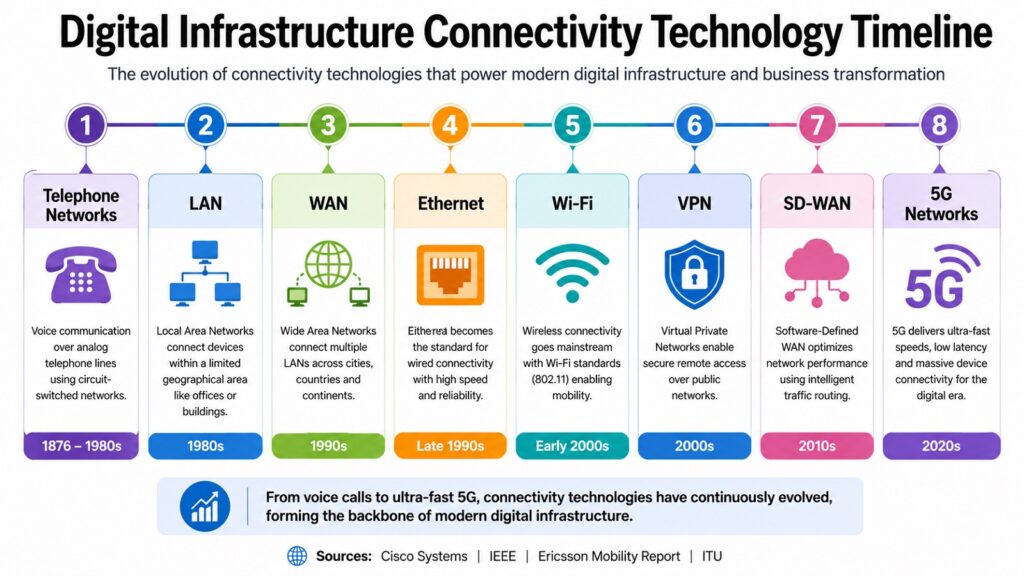
If cloud computing is the engine of Digital Infrastructure, network and connectivity form the roads that connect everything together. Every cloud service, every software application, and every remote worker depends on a stable connection to function. Without reliable networks, even the most advanced systems become useless the moment a connection drops, which is why connectivity deserves just as much strategic attention as the applications it carries.
Business networks used to be simple, often limited to a single office with a handful of connected computers. As companies expanded into multiple locations and adopted cloud platforms, networks had to evolve into something far more complex. Wide area networks linked offices across cities and countries. Virtual private networks let remote employees access company systems securely from home. More recently, software-defined networking gave IT teams the ability to manage traffic flexibly across these sprawling systems.
The shift toward remote and hybrid work made connectivity a daily concern for nearly every employee, not just the IT department. Video conferencing, cloud file sharing, and real-time messaging all depend on networks that can handle heavy traffic without lag. Companies that invested early in robust connectivity infrastructure kept productivity steady through the transition to hybrid work.
Connectivity also shapes how businesses interact with customers and partners. Retailers use network infrastructure to synchronize inventory across stores and online channels in real time, preventing the frustration of an item showing as available when it has already sold out. Manufacturers rely on connected sensors throughout their supply chains to track shipments and flag delays before they become costly.
As 5G networks expand and more devices connect to corporate systems, the demands on business networks will only grow. Smart sensors, connected equipment, and mobile applications all add traffic that older networks were never designed to handle. Organizations that treat connectivity as a strategic priority, rather than a background utility, position themselves to support new technologies as they emerge. Strong network infrastructure is no longer optional. It is the connective tissue holding every other part of Digital Infrastructure together.
Digital Infrastructure: Network and Connectivity Technologies
| Aspect | Description |
| Wide area networks | Connect offices across multiple locations |
| Virtual private networks | Allow secure remote system access |
| Software-defined networking | Manages traffic without rewiring hardware |
| 5G connectivity | Supports faster, more connected devices |
| Real-time inventory sync | Keeps stock levels accurate everywhere |
| Connected supply chains | Sensors track shipments and delays |
| Video conferencing infrastructure | Supports stable hybrid work connections |
| Bandwidth management | Prioritizes critical traffic during peaks |
3. Digital Infrastructure and Data Infrastructure: Building Data-Driven Business Technology
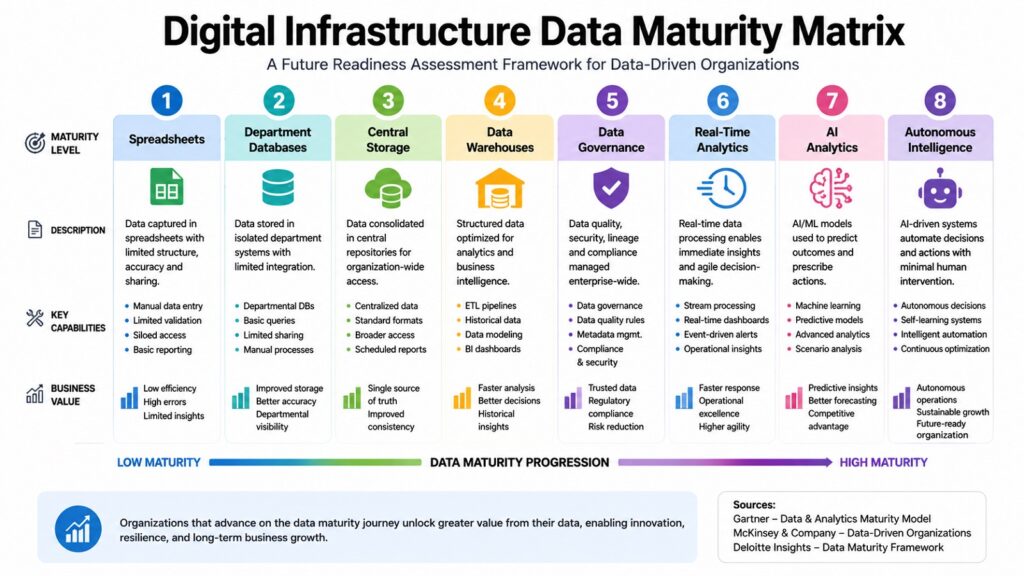
Data has become one of the most valuable assets a company owns, yet raw data on its own is not particularly useful. It needs structure, storage, and governance before it can guide decisions. This is the role of data infrastructure within the broader system of Digital Infrastructure, and it has grown far more sophisticated over the past two decades as the volume and variety of business information exploded.
Early business systems stored information in isolated databases tied to specific applications. A sales team might track customer records in one system while finance tracked invoices in a completely separate one, and neither system spoke to the other. This fragmentation made it difficult to get a complete picture of the business, since pulling information from multiple sources required manual effort and often produced inconsistent results. As companies grew larger and more complex, this patchwork approach became unsustainable.
Data warehouses emerged to solve part of this problem by consolidating information from different systems into a single repository built specifically for analysis. Later, data lakes extended this idea further, allowing companies to store unstructured information such as text, images, and sensor readings alongside traditional structured records. Cloud-based data platforms made this consolidation more accessible to companies of all sizes, removing the need for expensive on-premises hardware.
Governance became just as important as storage capacity. As data accumulated, companies discovered that poor-quality or duplicated records led to flawed analysis and misguided decisions made in good faith but on bad information. Organizations that invested in data governance, including clear ownership rules and consistent data definitions across departments, found their analytics teams could trust the numbers they worked with. Retailers that unified customer data across online and in-store channels gained a much clearer view of buying behavior than competitors still working with fragmented records.
The contrast between strong and weak data practices shows up clearly in business outcomes. Companies with disorganized data often duplicate effort, miss emerging trends, and make decisions based on outdated information. Companies that treat data as a managed asset can spot shifts in customer behavior faster and respond before competitors notice the same signal.
Digital Infrastructure: Data Infrastructure Practices
| Aspect | Description |
| Data warehouses | Consolidate structured data for analysis |
| Data lakes | Store unstructured data like images, text |
| Cloud data platforms | Reduce hardware costs for storage |
| Data governance | Establishes ownership and data definitions |
| Master data management | Maintains one accurate version of records |
| Customer data unification | Combines online and in-store records |
| Data quality monitoring | Detects duplicate or inaccurate records |
| Real-time data pipelines | Feed live data into dashboards |
4. Digital Infrastructure and Enterprise Software: Powering Core Business Technology
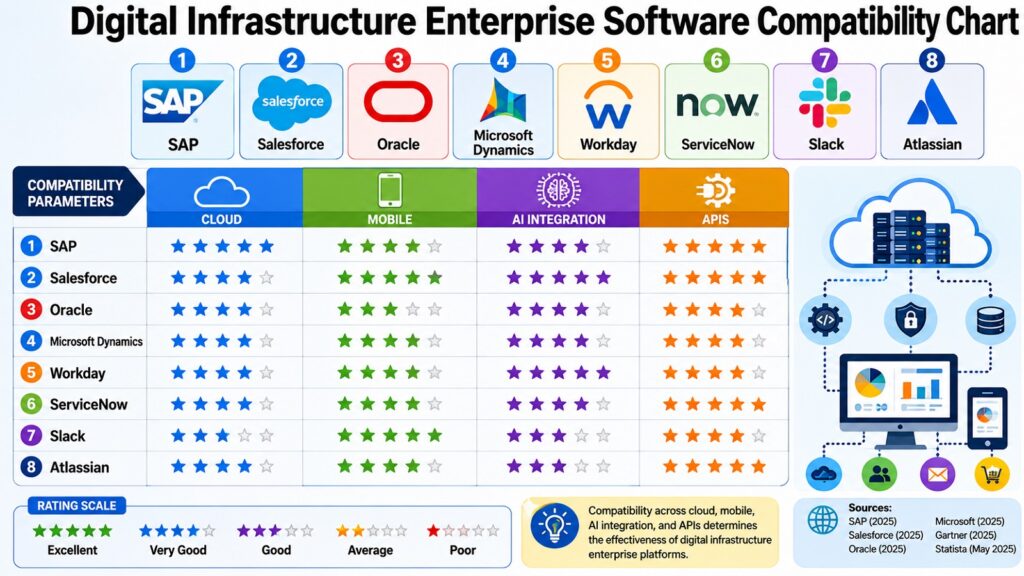
Enterprise software is perhaps the most visible layer of Digital Infrastructure, since employees interact with it directly every working day. These systems handle everything from processing payroll to managing customer relationships, and their evolution tells a clear story about how Business Technology matured over time from scattered tools into connected platforms.
Decades ago, most companies ran separate systems for separate functions. Accounting software handled finances, a different system tracked inventory, and customer information often lived in spreadsheets maintained by individual employees. This fragmentation created blind spots, since no single system gave leadership a complete view of the business at any given moment. Enterprise resource planning systems changed this by integrating core functions like finance, procurement, and operations into one connected platform.
Customer relationship management software followed a similar path, consolidating scattered customer notes and sales records into a single system that sales and support teams could share in real time. Human resources management systems brought similar consistency to hiring, payroll, and performance tracking. Collaboration tools added another layer, letting teams coordinate projects and share documents without relying on lengthy email chains that often left people out of the loop.
The strategic value of enterprise software lies less in any single feature and more in the integration it provides across the organization. A sales team that can see real-time inventory data closes deals with more confidence. A finance team connected to operational data forecasts more accurately and catches problems sooner. Companies that implemented these integrated platforms well often reported smoother operations and faster decision-making.
Of course, enterprise software implementations are not automatically successful. Poorly planned rollouts can disrupt operations and frustrate employees who must learn unfamiliar systems under pressure. The businesses that get the most value tend to invest time in training and change management alongside the technology itself. When done well, enterprise software becomes the connective layer that turns isolated business functions into one coordinated organization.
Digital Infrastructure: Enterprise Software Applications
| Aspect | Description |
| ERP systems | Integrate finance, procurement, and operations |
| CRM platforms | Consolidate customer records for teams |
| HRMS software | Manages hiring, payroll, performance centrally |
| Collaboration tools | Support shared editing and coordination |
| Supply chain management software | Tracks inventory and suppliers digitally |
| Business process management | Standardizes recurring operational workflows |
| Change management training | Helps employees adapt to new systems |
| System integration | Connects applications to share data |
5. Digital Infrastructure and Cybersecurity: Protecting Business Technology Assets
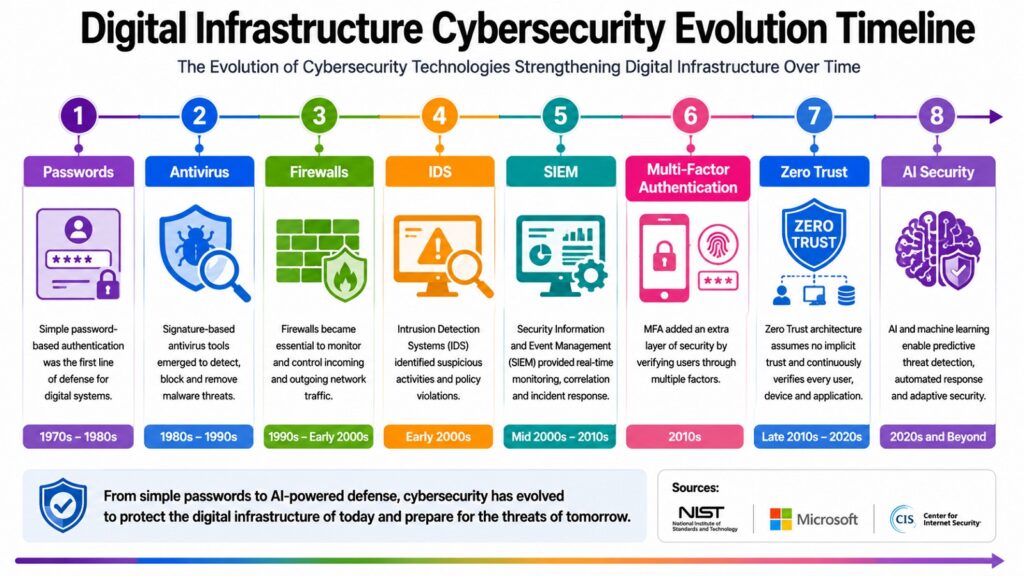
As businesses moved more operations into digital systems, those same systems became attractive targets for criminals seeking financial gain or sensitive information. Cybersecurity evolved from a narrow technical task into one of the central pillars of Digital Infrastructure, and treating it as anything less than a business priority has proven costly for many organizations.
In the initial stages of business computing, security was often limited to a password and a firewall that separated internal systems from external threats. However, as organizations connected an increasing number of devices, opened additional digital channels, and accumulated more customer data, this simplistic approach proved insufficient. Attackers became more advanced, employing tactics such as phishing emails, ransomware, and supply chain attacks that could circumvent basic defenses. Consequently, security frameworks needed to adapt, transitioning towards layered strategies that recognize the possibility of any single barrier eventually failing.
Modern cybersecurity strategy rests on principles like zero trust, where systems verify every user and device repeatedly rather than granting broad access after a single login. Multi-factor authentication, continuous monitoring, and regular security audits have become standard practice among companies that take digital risk seriously. Employee training has also become a core part of this strategy, since many breaches begin with a single person clicking a deceptive link rather than a technical flaw in the system itself.
The consequences of weak cybersecurity show up clearly in well-documented cases. Companies that suffered major data breaches often faced steep financial penalties, lengthy public scrutiny, and lasting damage to customer confidence that took years to rebuild. By contrast, organizations that invested early in strong security practices generally weathered attempted attacks with minimal disruption, since their layered defenses caught problems before they could spread further.
Cybersecurity has evolved from being a mere back-office function confined to the IT department. It now plays a crucial role in shaping how customers, partners, and investors view an organization’s trustworthiness. As digital systems manage more sensitive information than ever, businesses that integrate security into every aspect of their Digital Infrastructure not only safeguard their data but also protect their long-term reputation.
Digital Infrastructure: Cybersecurity Practices and Risks
| Aspect | Description |
| Zero trust architecture | Verifies every user repeatedly |
| Multi-factor authentication | Adds a second verification step |
| Ransomware attacks | Encrypt data and demand payment |
| Phishing emails | Trick employees into revealing credentials |
| Security audits | Identify vulnerabilities before exploitation |
| Continuous monitoring | Detects unusual activity in real time |
| Employee security training | Reduces human error, a common cause |
| Data breach costs | Include fines and reputational damage |
6. Digital Infrastructure and Automation & Integration: Enhancing Business Technology Efficiency
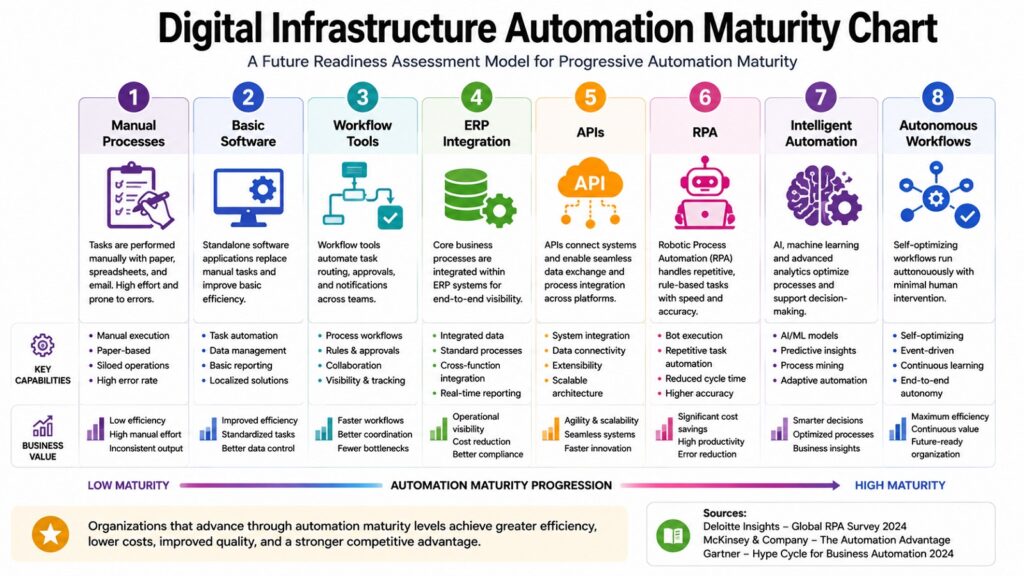
Many of the inefficiencies that slow businesses down come from manual, repetitive tasks scattered across disconnected systems. Automation and integration address this problem directly, transforming isolated processes into smooth digital workflows that require less manual intervention and produce fewer errors.
For much of business history, routine tasks like data entry, invoice processing, and report generation required dedicated staff working through repetitive steps by hand. This approach was slow and prone to mistakes, since even careful employees occasionally mistype numbers or skip steps under time pressure. As software matured, companies began automating these routine tasks, freeing employees to focus on work that required judgment rather than repetition.
Workflow automation tools are now responsible for managing tasks such as routing approval requests, updating records across various systems, and triggering notifications based on specific conditions. Integration platforms facilitate the connection of previously isolated software applications, enabling automatic data flow between them rather than relying on manual information copying. Application programming interfaces, commonly referred to as APIs, have made much of this integration feasible by providing a standardized method for different software systems to exchange information. This synergy has eliminated many of the silos that once confined information within individual departments.
Companies that embraced this shift often reported measurable productivity gains. Sales teams using automated lead routing closed deals faster, since prospects reached the right representative without delay. Finance departments using automated invoice processing cut down on errors that previously required time-consuming corrections.
The strategic benefit of automation and integration goes beyond simple time savings. Connected systems give leadership a more accurate, real-time view of operations, since data updates automatically rather than waiting for someone to compile a report manually. As Digital Infrastructure continues to mature, businesses that automate thoughtfully will find themselves operating with the kind of efficiency that manual processes can never match.
Digital Infrastructure: Automation Tools and Outcomes
| Aspect | Description |
| Workflow automation | Routes approvals without manual steps |
| Robotic process automation | Handles repetitive data entry tasks |
| Application programming interfaces | Let systems exchange data directly |
| Integration platforms | Connect applications for automatic updates |
| Automated invoice processing | Reduces errors in finance operations |
| Automated lead routing | Sends prospects to the right rep |
| Process mining | Identifies workflow inefficiencies to automate |
| Reduced manual silos | Removes repeated data entry steps |
7. Digital Infrastructure and Computing Infrastructure: Strengthening Business Technology Performance
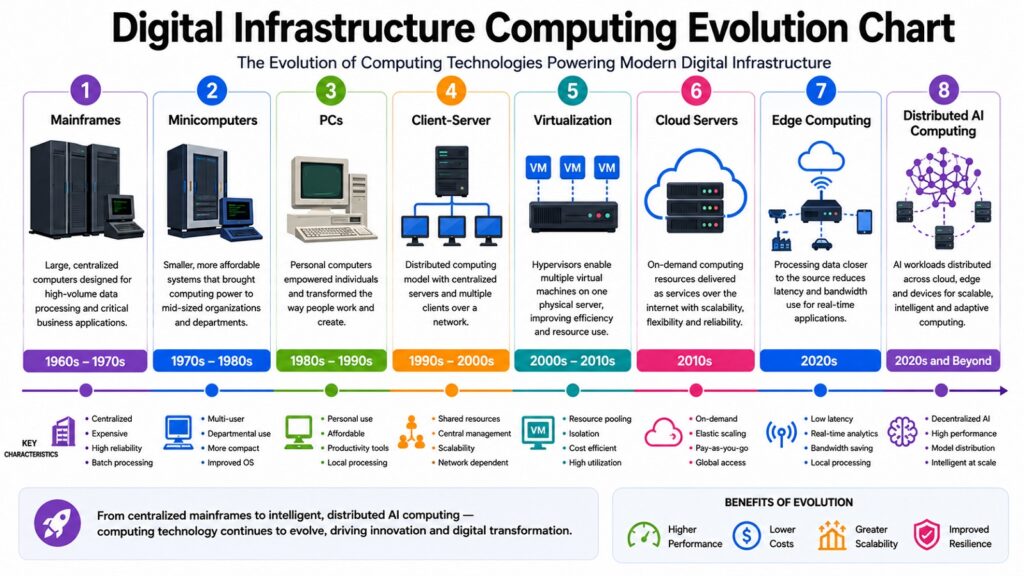
Behind every application, database, and AI model sits raw computing power that makes the work possible. Computing infrastructure forms the physical and virtual foundation supporting all other layers of Digital Infrastructure, and its evolution explains much of how Business Technology became as capable as it is today.
For many years, companies relied on dedicated physical servers housed in their own buildings, often in rooms specifically cooled and secured for that purpose. Each server typically ran one application, which meant computing capacity often sat idle outside of peak demand periods. This was an expensive way to operate, since businesses paid for hardware capacity they rarely used in full. Virtualization technology changed this picture by letting multiple virtual machines run on a single physical server, dramatically improving how efficiently hardware resources got used.
Cloud computing pushed this evolution further by abstracting computing resources entirely, letting businesses rent processing power without owning any physical hardware at all. Distributed computing, where workloads spread across many machines working together, allowed companies to handle far larger tasks than any single server could manage alone. This shift made it possible for businesses to run complex applications, process huge data sets, and support thousands of simultaneous users.
Performance and reliability became central concerns as companies grew more dependent on these systems. A retailer running an online store cannot afford slow page loads during a peak shopping period, since customers abandon carts within seconds of frustration. Organizations that invested in scalable computing infrastructure handled demand surges smoothly, while those relying on outdated systems often faced costly outages at the worst possible times.
As computing demands keep rising, particularly with the growth of AI workloads that require significant processing power, businesses that maintain flexible, scalable computing infrastructure position themselves to support whatever technology comes next. This pillar may operate quietly in the background, but its performance ripples outward into nearly every customer-facing experience a business delivers.
Digital Infrastructure: Computing Technologies and Capabilities
| Aspect | Description |
| Server virtualization | Runs multiple virtual machines per server |
| Distributed computing | Spreads workloads across many machines |
| Edge computing | Processes data closer to its source |
| Containerization | Packages applications for consistent performance |
| Auto-scaling infrastructure | Adjusts capacity during demand spikes |
| High-availability systems | Maintain uptime through redundancy |
| GPU computing | Provides power for AI workloads |
| Infrastructure monitoring | Tracks performance to prevent outages |
8. Digital Infrastructure and AI & Analytics: Advancing Intelligent Business Technology
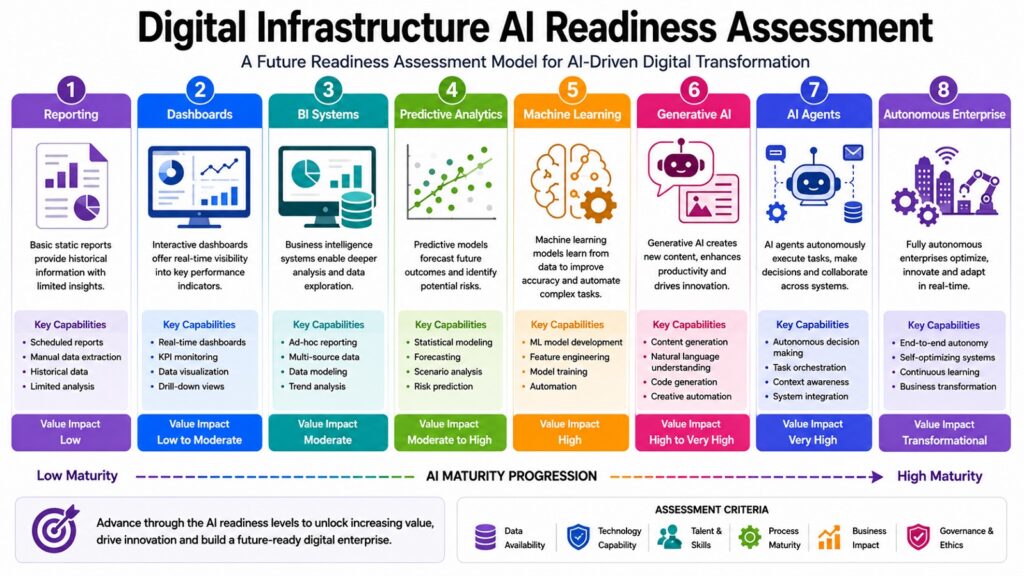
Artificial intelligence and analytics represent the most forward-looking pillar of Digital Infrastructure, turning accumulated data into genuine business intelligence rather than simple historical record-keeping. This pillar has evolved rapidly, moving from simple historical reporting into systems capable of predicting outcomes and supporting real-time decisions across nearly every business function, from marketing to logistics.
Business intelligence tools initially provided organizations with the capability to summarize historical performance through dashboards and reports that were updated at intervals rather than continuously. These tools addressed valuable yet retrospective inquiries, informing leaders about events that had already transpired instead of what could occur in the upcoming weeks. Predictive analytics transformed this landscape by employing statistical models to project future trends based on past patterns, enabling businesses to proactively plan rather than merely respond after issues had arisen and become expensive to resolve.
Machine learning further enhanced this functionality, permitting systems to autonomously refine their predictions as new data became available, eliminating the need for constant manual reprogramming by engineering teams. Retailers adopted these methodologies to more accurately predict demand, thereby minimizing both excess inventory and lost sales opportunities during seasonal fluctuations. Similarly, banks utilized these techniques to identify fraudulent transactions in real time, capturing suspicious activities that older rule-based systems frequently overlooked. Streaming services implemented recommendation algorithms to tailor content suggestions, which kept viewers engaged significantly longer than generic programming could achieve on its own.
The gap between companies that use AI and data analytics well and those that do not continues to widen each year. Organizations that built strong data foundations first found AI initiatives delivered real value relatively quickly, since clean, well-organized data is the raw material these systems depend on entirely. Companies that rushed into AI projects without solid data infrastructure in place often saw disappointing results, since flawed inputs inevitably produce flawed predictions regardless of how advanced the underlying model happens to be. This pattern echoes a familiar warning from data science: a sophisticated model fed with messy data will still produce unreliable output, no matter how impressive the underlying technology sounds in a sales pitch.
Looking ahead, AI and analytics will likely become even more embedded into everyday business operations rather than existing as separate, specialized projects run by a small technical team. As this happens, the businesses that treat data quality and infrastructure as a prerequisite, not an afterthought, will be the ones that turn intelligent systems into a genuine and durable competitive advantage that compounds over time.
Digital Infrastructure: AI and Analytics Applications
| Aspect | Description |
| Business intelligence dashboards | Summarize past performance for managers |
| Predictive analytics | Forecasts trends from historical data |
| Machine learning models | Improve predictions as data arrives |
| Demand forecasting | Reduces wasted inventory and missed sales |
| Fraud detection systems | Identify suspicious transactions in real time |
| Recommendation engines | Personalize content and product suggestions |
| Natural language processing | Powers chatbots and support tools |
| Data quality as AI foundation | Determines whether predictions are reliable |
Conclusion: Why Digital Infrastructure Will Define the Future of Business Technology
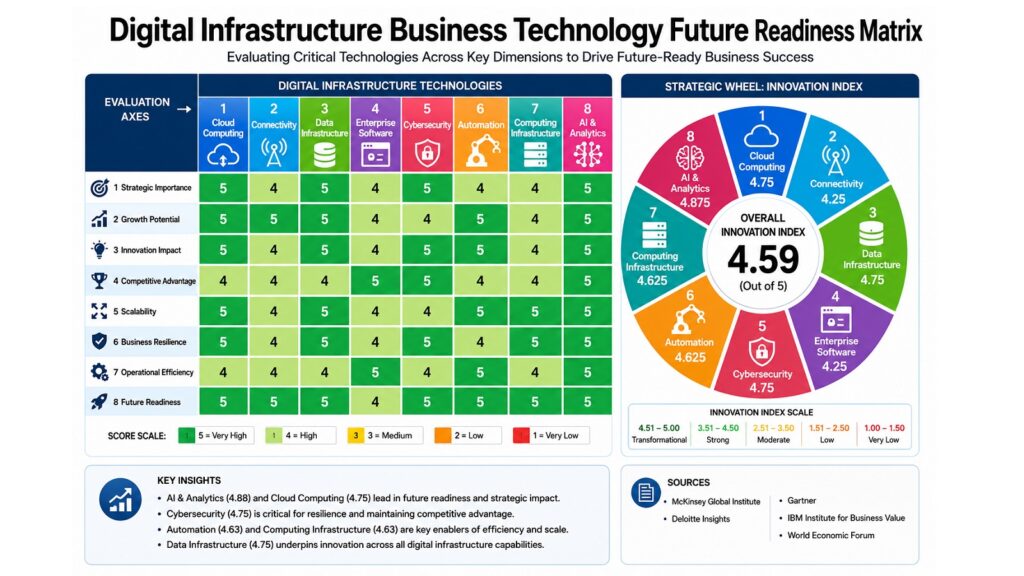
Across the eight pillars covered in this article, a single theme keeps surfacing. Digital Infrastructure is not a loose collection of unrelated technologies. It is a connected system, and each pillar reinforces the others in ways that are easy to overlook until something breaks down. Cloud computing supplies the flexible foundation. Network and connectivity carry information between people and systems. Data infrastructure turns that information into something usable. Enterprise software ties core business functions together. Cybersecurity protects everything built on top of these layers. Automation and integration remove friction from daily operations. Computing infrastructure supplies the raw processing power behind it all. AI and analytics turn accumulated data into forward-looking insight that shapes real decisions.
The central argument running through this discussion is that Digital Infrastructure has moved well beyond its origins as a technical concern handled quietly by IT departments. It now shapes how fast a company can grow, how well it can serve customers, and how confidently it can handle disruption when conditions change without warning. Business leaders who treat these eight pillars as strategic priorities tend to build organizations that adapt faster and recover from setbacks with less damage.
The lesson for leaders is not that every company needs to invest equally in all eight areas at once. Priorities will differ depending on industry, size, and growth stage. What matters more is recognizing that weakness in one pillar eventually limits the value of strength in another. Digital Infrastructure rewards organizations that think holistically rather than chasing isolated upgrades.
Looking forward, the pace of technological change shows no sign of slowing down. Organizations that keep strengthening these eight pillars, rather than treating any one investment as a finished project, will be the ones best positioned to seize new opportunities and absorb unexpected shocks. In the years ahead, Digital Infrastructure will not just support business strategy. It will continue to define what is possible for businesses willing to invest in it properly.
Digital Infrastructure: Strategic Contribution of Each Pillar
| Digital Infrastructure Aspects | Description |
| Cloud Computing | Supports agility and faster response |
| Network and Connectivity | Sustains reliable communication at scale |
| Data Infrastructure | Builds the base for sound decisions |
| Enterprise Software | Keeps core functions coordinated |
| Cybersecurity | Protects continuity and reputation long-term |
| Automation and Integration | Sustains efficiency as complexity grows |
| Computing Infrastructure | Provides the backbone for new technology |
| AI and Analytics | Drives ongoing innovation and advantage |