
Table of Contents
Introduction: Entrepreneurial Opportunities and the Foundations of Entrepreneurship
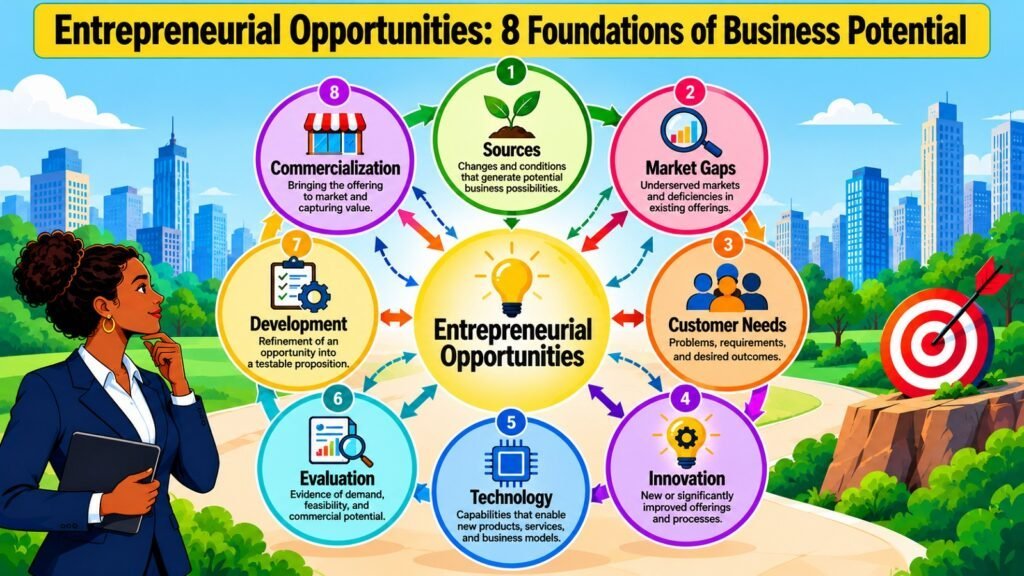
Entrepreneurial Opportunities are important aspects of Entrepreneurship, because they define the conditions under which new ventures are conceived, innovation acquires economic meaning, markets develop, and value is created. Shane and Venkataraman (2000) argued that the distinctive subject of the field is the nexus between enterprising individuals and valuable opportunities, which makes a rigorous account of the latter indispensable. Opportunity research therefore carries both academic and practical weight across industries and institutional settings. Without a defensible account of how possibilities arise and mature, claims about venture creation remain descriptive rather than explanatory.
In this article, Entrepreneurial Opportunities are treated as potential possibilities for creating or improving products, services, processes, or business models that address customer requirements and may support viable commercial activity. The definition separates them from ordinary business ideas, which lack evidential grounding; from inventions, which establish technical novelty without demonstrating demand; and from opportunities that have already demonstrated commercial viability. An appealing idea is therefore not automatically a viable opportunity, since its commercial significance depends on market conditions, customer requirements, available capabilities, and supporting evidence.
The central research question is how Entrepreneurial Opportunities emerge, acquire commercial significance, develop into viable propositions, and reach markets. The eight foundations examined below are interconnected analytical dimensions rather than unrelated topics, and the processes they describe may involve discovery, creation, experimentation, evaluation, and repeated refinement instead of one universally fixed sequence (Alvarez & Barney, 2007). Each section isolates a distinct question, so that overlap between topics is deliberate and traceable. The discussion combines established theory, research-based evidence, documented business examples, critical interpretation, and practical analytical tools. The first table orients the readers to this framework.
Table 1: Eight Foundations of Entrepreneurial Opportunities
| Foundations of Entrepreneurial Opportunities | Central Question |
| Sources | Which conditions give rise to possibilities? |
| Market gaps | Where are customer requirements insufficiently served? |
| Customer needs | Which problems warrant a commercial solution? |
| Innovation | How do new methods create or expand possibilities? |
| Technology | Which capabilities make new offerings feasible? |
| Commercial evaluation | What evidence indicates viability? |
| Business development | How does potential become a testable proposition? |
| Commercialization | How does a proposition reach customers and capture value? |
1. Sources of Entrepreneurial Opportunities: Where Possibilities Begin
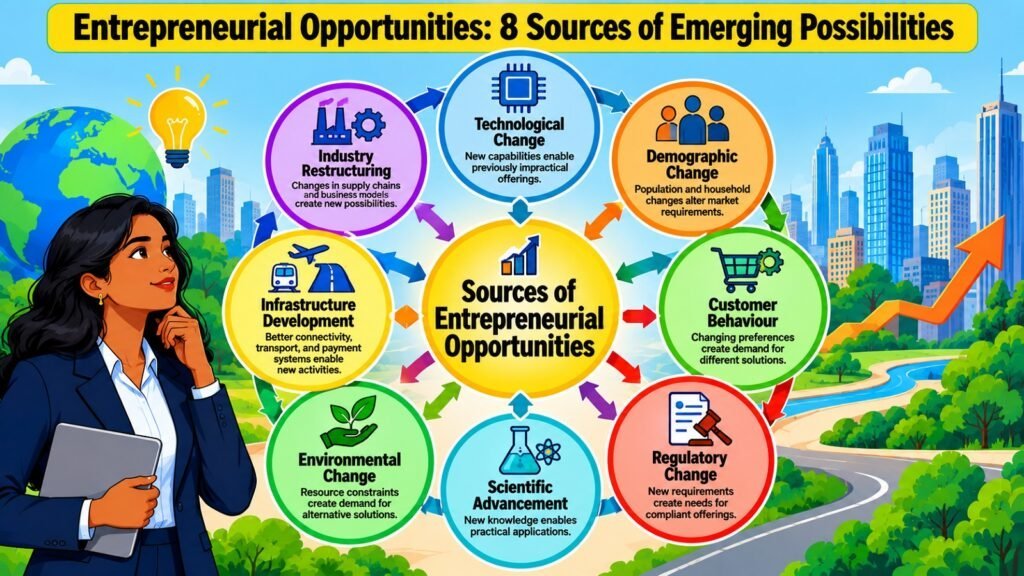
Entrepreneurial Opportunities do not materialize from nothing; they are conditioned by the environments in which firms, customers, and institutions operate. Economic shifts in relative prices or income, technological advances, demographic transitions, regulatory reform, social change, environmental pressure, scientific breakthroughs, and industrial restructuring each alter what is feasible and what customers will value. These conditions are sources of potential rather than opportunities in themselves, and the distinction matters analytically.
Sources must also be separated from the processes through which possibilities are identified, interpreted, and developed. Two research traditions describe those processes. Kirzner (1973) emphasized discovery, in which opportunities exist as latent market disequilibria awaiting identification. Alvarez and Barney (2007) contrasted this with creation, in which opportunities take shape through entrepreneurial action, experimentation, and interaction with customers and other stakeholders. The perspectives rest on different assumptions about whether opportunities exist independently of action, yet they need not be exclusive, since some possibilities follow visible market change while others emerge from iterative engagement.
The mechanisms linking change to possibility are specific. Shifts in consumer requirements alter demand; demographic patterns reshape segment size; regulation redistributes permitted activity; infrastructure lowers delivery costs; scientific knowledge expands feasible products; resource availability changes relative costs; and industry structure determines which positions are contestable. Each mechanism operates through changes in costs, demand, permitted activity, or competitive structure, which gives analysts a concrete basis for tracing a possibility to its origin.
The European Union’s revised Payment Services Directive offers a documented illustration. Directive (EU) 2015/2366, applicable from January 2018, required banks to give authorized third-party providers access to account data and payment initiation, subject to customer consent. These provisions are verified. My interpretation is that the rule weakened an incumbent advantage in account data and thereby made aggregation and payment-initiation services plausible, although the viability of any particular service remains a separate question.
Table 2 summarizes eight source categories, and its analytical value lies in making the generative mechanism explicit. A source alone never proves commercial viability.
Table 2: Sources of Entrepreneurial Opportunities and Their Mechanisms
| Source of Opportunity | Mechanism Creating Potential |
| Economic change | Shifting relative prices or incomes alter viable offerings |
| Technological advance | Falling costs or new capabilities enable products |
| Demographic shifts | Changing age or household structure reshapes demand |
| Regulatory reform | New rules open or restrict permitted activity |
| Social change | Evolving norms modify consumption expectations |
| Environmental pressure | Resource constraints create demand for alternatives |
| Scientific discovery | New knowledge expands feasible products |
| Industrial restructuring | Consolidation or unbundling exposes uncontested positions |
2. Market Gaps and Entrepreneurial Opportunities: Finding Untapped Potential
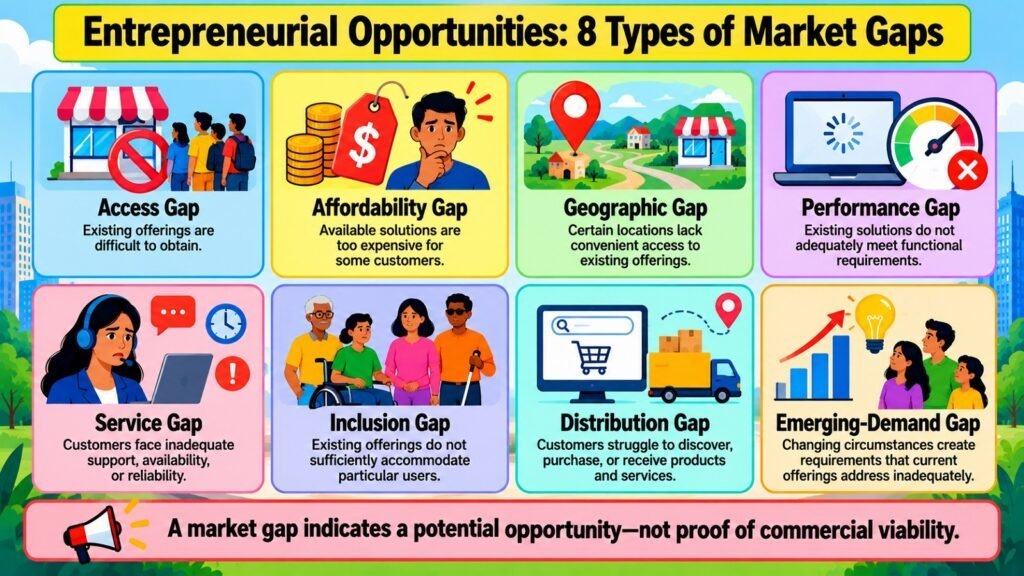
A market gap exists where customer requirements remain insufficiently served by prevailing products, services, distribution systems, or business models. Precision matters here, because a gap differs from a general complaint, a temporary inconvenience, or the unexamined assumption that every established market conceals a profitable opening. A gap is defined by a demonstrable shortfall between what customers require and what the market supplies.
Several mechanisms produce such shortfalls: inadequate supply, underserved customer groups, geographic inaccessibility, affordability constraints, product limitations, service deficiencies, and shifts in competitive conditions. Information asymmetries, as Akerlof (1970) demonstrated, can erode trust and thin markets, while institutional barriers and distribution limitations may prevent otherwise feasible offerings from reaching particular populations.
Not every gap represents a viable opportunity. Demand may be too limited, customers may be unable to afford the proposed solution, serving the market may be prohibitively costly, or existing alternatives may already meet the underlying requirement adequately. Analysts should therefore examine actual customer behavior, current alternatives, market structure, and, above all, the conditions that sustain the gap, because a persistent gap often signals an obstacle rather than neglect.
Kenya’s M-Pesa illustrates how deficiency can imply possibility. Safaricom launched the mobile money service in 2007, relying on a network of agents to convert cash into electronic value and back. Jack and Suri (2014) found that households with access to the service were better able to maintain consumption after adverse shocks, which suggests that it addressed a genuine shortfall in transfer and risk-sharing options. Context mattered, however, since widespread mobile phone use, a tolerant regulatory stance, and agent economics shaped the outcome, and these conditions need not recur elsewhere.
Table 3 distinguishes eight gap types by observable conditions. The presence of a gap indicates a possible opportunity, not proof of commercial attractiveness, so researchers must investigate why it exists, whom it affects, and under what conditions addressing it could support a viable proposition. Gap analysis is therefore interpretive work that requires explanation, not simple detection.
Table 3: Market Gaps Underlying Entrepreneurial Opportunities
| Type of Market Gap | Observable Market Condition |
| Supply shortfall | Persistent shortages or long waiting times |
| Underserved segment | Mainstream offerings overlook specific user groups |
| Geographic inaccessibility | Remote areas lack providers or delivery |
| Affordability constraint | Adoption limited by price relative to income |
| Product limitation | Users adopt workarounds for missing functions |
| Service deficiency | Poor support or reliability among incumbents |
| Information asymmetry | Buyers cannot judge quality before purchase |
| Distribution limitation | Existing channels do not reach intended customers |
3. Customer Needs and Entrepreneurial Opportunities: Creating Relevant Solutions
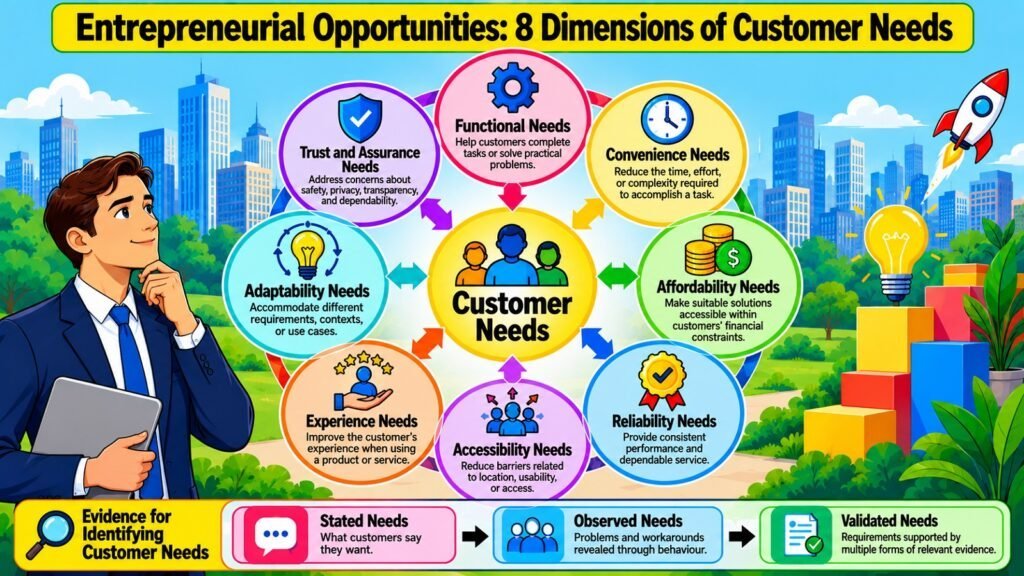
Customer needs connect to Entrepreneurial Opportunities through the capacity of a potential offering to resolve a problem, satisfy a requirement, enable a desired outcome, or meet unmet demand. Needs may be stated explicitly, or they may be inferred from behavior, recurring workarounds, dissatisfaction with alternatives, and changing consumption patterns. Inference is often necessary because customers cannot always articulate requirements for solutions they have never encountered.
A customer having a problem does not mean the problem is commercially addressable. Addressability requires that enough customers experience the problem with sufficient intensity, can be reached at acceptable cost, and will exchange resources for relief. Customer value, in the sense developed by Zeithaml (1988), reflects perceived trade-offs between benefits and sacrifices, and it spans functional, experiential, and other dimensions without guaranteeing a sufficiently large or accessible market. A functional need concerns task performance, an experiential need concerns the quality of interaction, and either may weaken when alternatives are inexpensive or switching is easy.
Evidence strengthens the connection only when its limitations are understood. Interviews and observation reveal context and practice; purchasing records reveal behavior; feedback and prototype testing expose reactions to concrete solutions. Stated interest, hypothetical purchase intentions, actual willingness to pay, and repeated use constitute progressively stronger evidence, yet each has weaknesses, including social desirability in interviews and novelty effects in early usage. No single indicator can conclusively establish viability.
Christensen, Hall, Dillon, and Duncan (2016) describe a fast-food milkshake case in which observers noticed that many purchases occurred during early morning commutes, apparently to make a monotonous drive more tolerable. The publicly reported facts are the timing of purchases and the reinterpretation of the product’s role; the claim that customers were hiring the milkshake for a distinct job is analytical, and the chain involved remains unnamed.
Table 4 identifies dimensions of need alongside supporting evidence. Combining sources yields a more credible understanding than any single method and prevents customer interest from being mistaken for proven demand.
Table 4: Customer Needs Shaping Entrepreneurial Opportunities
| Dimension of Customer Need | Relevant Evidence |
| Functional performance | Observed task completion (direct) |
| Experiential quality | Usability testing and session feedback |
| Economic value | Prices accepted in actual transactions (direct) |
| Accessibility | Usage barriers recorded across user groups |
| Convenience | Time and effort spent on observed workarounds |
| Reliability | Complaint records and repeat purchases |
| Social or symbolic meaning | Interview accounts (indirect) |
| Frequency of need | Purchase or usage intervals from records |
4. Innovation and Entrepreneurial Opportunities: Turning Ideas into Value
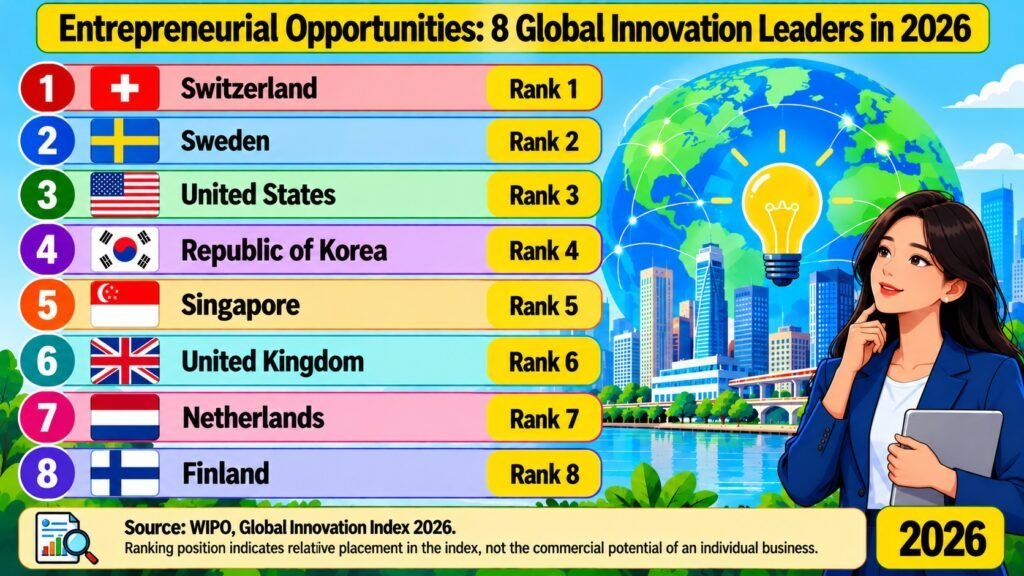
Innovation expands Entrepreneurial Opportunities when new or significantly improved products, services, processes, and business models create possibilities that did not previously exist or were not previously accessible. An idea is a conceptual proposal, an invention is a novel technical or conceptual realization, and an innovation is an implemented change that reaches potential users. The OECD and Eurostat (2018) Oslo Manual formalizes this threshold by defining innovation as a new or improved product or business process, or a combination of the two, that differs significantly from earlier versions and has been made available to potential users or brought into use.
The definition is analytically useful because it locates innovation at implementation rather than conception, and so ties it to markets. Incremental improvements refine existing offerings, whereas more substantial innovations can alter architectures or competitive structures. Business model and process innovation, in turn, can address unmet requirements, change production economics, improve accessibility, create new uses, or reshape the conditions of competition. Such mechanisms explain why identical technical novelty can produce divergent commercial outcomes in different settings.
Schumpeter (1934) described innovation as new combinations that disturb existing equilibria, and his later account of creative destruction (1942) stressed that such disturbances reorganize industries. Neither claims that every innovation yields a viable opportunity. Novelty does not guarantee customer value, and commercial significance depends on the relation among the innovation, customer requirements, market conditions, and the ability to deliver the offering (Teece, 1986).
Containerization offers a documented example. Malcolm McLean’s Ideal X carried containers from Newark to Houston in 1956, and Levinson (2006) shows that standardized boxes reduced cargo handling labor and delay. Those points are historical. My interpretation is that the process innovation made certain shipping services economical that were previously impractical, although its wider effect also required complementary port, rail, and regulatory change.
Table 5 maps eight forms of innovation to opportunity mechanisms. The categories overlap, and a single initiative may combine several. Their value as analytical categories lies in clarifying how a given change creates a possibility.
Table 5: Innovation Forms Generating Entrepreneurial Opportunities
| Form of Innovation | Potential Opportunity Mechanism |
| Product innovation | Introduces functions addressing unmet requirements |
| Process innovation | Lowers costs or raises production quality |
| Business model innovation | Reconfigures value creation and capture |
| Incremental innovation | Refines offerings for existing customers |
| Radical innovation | Establishes new product categories |
| Architectural innovation | Recombines components into new systems |
| Disruptive innovation | Serves overlooked segments before moving upmarket |
| Service innovation | Redesigns delivery and customer interaction |
5. Technology and Entrepreneurial Opportunities: Unlocking New Markets
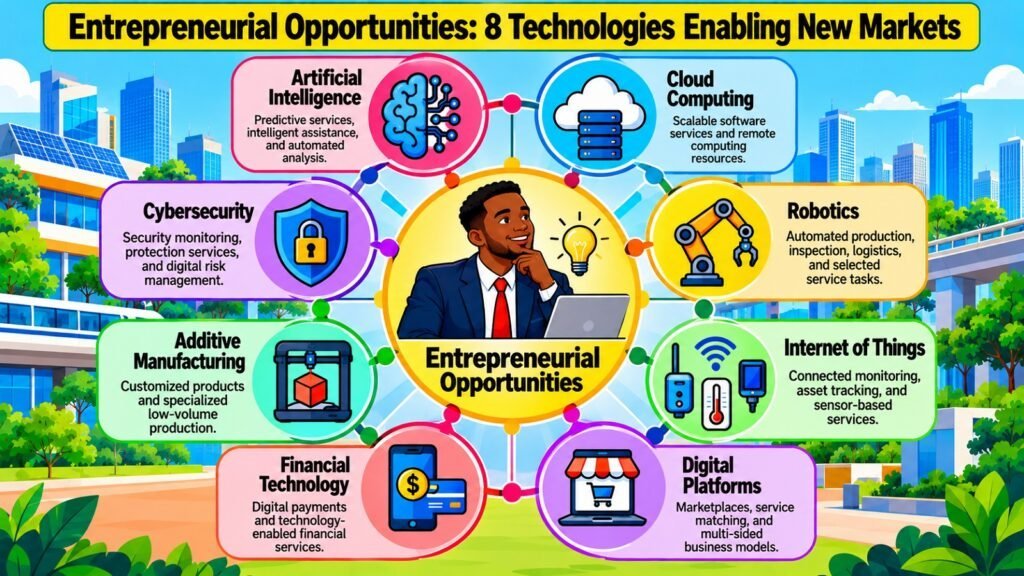
Technological capabilities enable Entrepreneurial Opportunities by altering what businesses can produce, how services are delivered, how resources are coordinated, and which customers can be reached. Cloud computing, for example, converts fixed infrastructure investment into variable cost, while digital platforms lower coordination costs among distributed participants. Machine learning permits pattern recognition at scale, automation and robotics shift labor constraints, Internet of Things devices generate operational data, and financial technology restructures payments and credit. These capabilities differ in maturity, so their relevance to Entrepreneurial Opportunities varies with the stage of diffusion and the availability of complements.
The analytical task is to identify the constraint that each capability relaxes, since access to technology alone rarely constitutes an opportunity. Commercial potential depends on complementary conditions, including infrastructure, technical expertise, data access, interoperability, customer adoption, regulation, implementation costs, and resource availability. Because these conditions vary, one technology yields different opportunities across industries; machine learning in medical imaging confronts regulatory clearance, whereas in retail logistics it faces mainly data integration and operational adoption.
Amazon Web Services illustrates the enabling role. Amazon announced its Simple Storage Service in March 2006 and opened Elastic Compute Cloud in beta that August, offering metered access to computing resources. Armbrust and colleagues (2010) emphasize that elasticity and the removal of upfront commitment lowered barriers for new service providers. The example is instructive because the capability reduced the fixed commitments that previously accompanied new digital services, thereby changing the economics of experimentation. The capability and its pricing structure are verifiable; the claim that it enabled particular ventures is an inference, and technological capability must not be conflated with demonstrated commercial success for any individual adopter.
Predictions about emerging technologies deserve skepticism, because forecasts have often overstated the speed of adoption. Table 6 therefore qualifies each application and treats technological possibility as necessary but insufficient. Its rows show how capability becomes relevant to Entrepreneurial Opportunities only through interaction with customer needs, market conditions, and practical implementation requirements (Nambisan, 2017).
Table 6: Technologies Enabling Entrepreneurial Opportunities
| Technological Capability | Potential Commercial Application |
| Machine learning | Predictive analytics supporting decisions |
| Cloud computing | On-demand infrastructure for software services |
| Automation | Standardized production or administrative workflows |
| Robotics | Warehouse and manufacturing task execution |
| Digital platforms | Marketplaces coordinating independent participants |
| Internet of Things | Sensor-based monitoring and maintenance services |
| Financial technology | Digital payments and alternative credit assessment |
| Mobile connectivity | Remote service delivery to dispersed users |
6. Entrepreneurial Opportunities and Commercial Evaluation: Assessing Viability
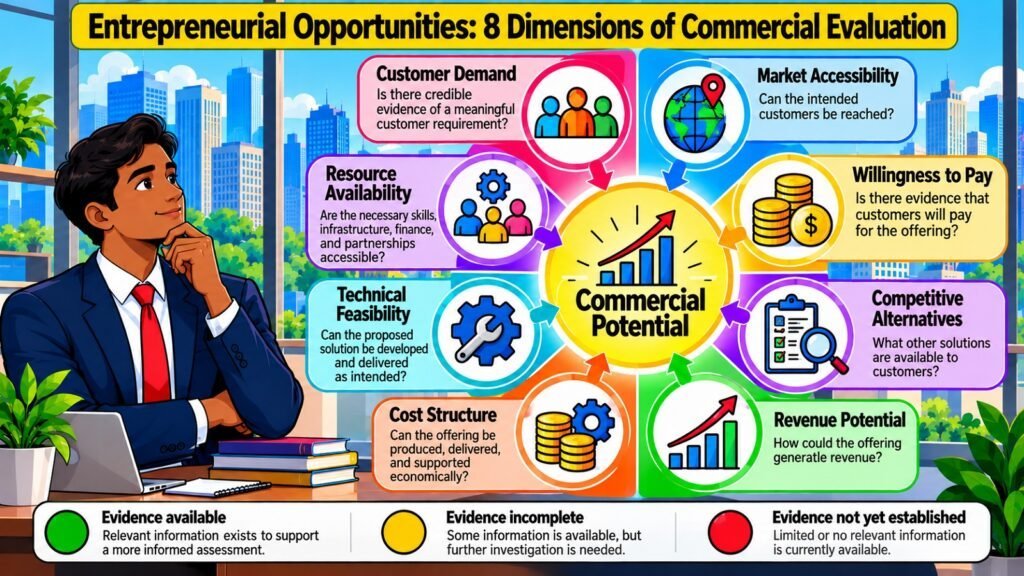
Evaluating Entrepreneurial Opportunities requires separating the existence of a possible market opportunity from evidence that a particular offering can serve that market successfully. A large market indicates potential demand, but it says little about whether a specific proposition can acquire customers, deliver at acceptable cost, and generate adequate returns. The relevant dimensions include market size and accessibility, customer demand, willingness to pay, competitive alternatives, revenue potential, cost structure, technical feasibility, operational requirements, and resource availability.
These dimensions interact rather than accumulate. An apparently attractive market may support an unviable proposition when customer acquisition, delivery, or operating costs consume revenue, and Porter’s (2008) analysis of competitive forces shows how buyer power, rivalry, and substitutes can erode the profit that demand appears to promise. Evaluation is consequently comparative and multidimensional, requiring that weak criteria be examined alongside strong ones rather than averaged away.
Early-stage evidence is inherently limited. Forecasts and market estimates rest on assumptions about behavior that has not yet occurred, and Kahneman and Lovallo (1993) documented a tendency toward inside-view forecasting that neglects the outcomes of comparable projects. Analysts should therefore distinguish observed facts, reasonable assumptions, and unresolved questions explicitly. Early evidence remains valuable when its provenance and limitations are stated candidly.
Webvan, the online grocer that filed for bankruptcy in 2001 after building automated distribution centers, offers a documented illustration of multi-criterion assessment. Its heavy infrastructure investment and its collapse are verified. Interpreting the failure as a combination of high fulfillment costs, thin grocery margins, and uncertain demand is analytical, and the relative weight of those factors remains debated.
The author-developed scorecard in Table 7 pairs each criterion with the evidence required. Analysts might rate each criterion on a three-point scale from weak to strong evidence, but this rating is a heuristic, not a validated predictor of venture success. It supports structured comparison without eliminating uncertainty or replacing context-specific investigation, and criteria need not carry equal weight in every industry.
Table 7: Evaluating Entrepreneurial Opportunities Through Evidence
| Evaluation Criterion | Evidence Required |
| Market size and accessibility | Segment data and reachable customer counts |
| Customer demand | Observed purchase or usage behavior |
| Willingness to pay | Prices accepted by comparable buyers |
| Competitive alternatives | Competitor offerings, pricing, and switching costs |
| Revenue potential | Documented pricing and conversion assumptions |
| Cost structure | Supplier quotations and unit-cost analysis |
| Technical feasibility | Prototype performance and expert assessment |
| Resource availability | Confirmed capital, talent, and partner access |
7. Entrepreneurial Opportunities and Business Development: From Potential to Proposition
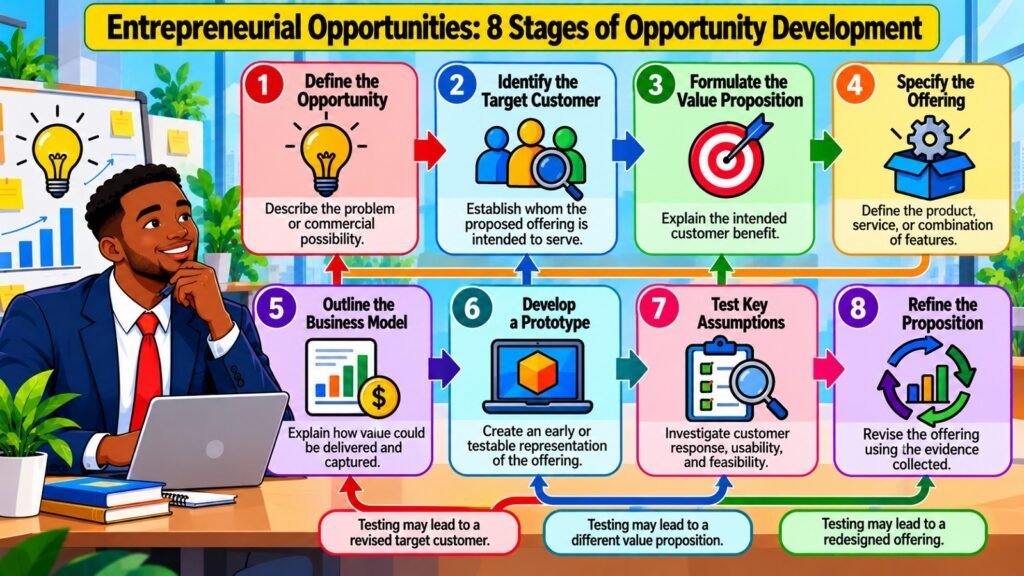
Development transforms a potential opportunity into a defined, testable proposition. It differs from commercial evaluation: evaluation examines evidence about viability, whereas development specifies and refines the offering, target customer, value proposition, delivery approach, and business model. A coherent proposition states whom it serves, which requirement it addresses, how it differs from alternatives, and how value will be delivered. Development is accordingly a design problem as much as an evaluative one, and it often exposes requirements that evaluation could not anticipate.
Several established approaches guide this work. Osterwalder and Pigneur (2010) provide a canvas for articulating business model components systematically, while Blank (2013) and Ries (2011) advocate customer validation and minimum viable products as vehicles for learning. Eisenmann, Ries, and Dillard (2012) frame such activity as hypothesis-driven, with each experiment directed at a meaningful question about a specific assumption. Prototyping, in this literature, serves to expose assumptions to evidence cheaply, before substantial resources are committed to an untested configuration.
Design matters, since positive feedback alone does not establish market viability. Courteous enthusiasm, curiosity, and free trials can all produce favorable responses without implying that customers will pay or persist. Experiments should therefore specify in advance which result would confirm or refute an assumption, and results may modify the proposition, reveal new requirements, or return the process to evaluation.
Dropbox offers a documented example. Drew Houston released a demonstration video showing file synchronization before a complete product was available, and Ries (2011) recounts that the beta waiting list rose from roughly 5,000 to 75,000 people overnight. Those details come from published accounts. Interpreting the response as evidence of latent demand is analytical, and a waiting list measures interest rather than willingness to pay. The case therefore illustrates how a minimal demonstration can test a proposition’s appeal, but it does not establish retention or revenue.
Table 8 distinguishes eight development elements by purpose or intended output. Development is iterative and context-dependent, not a guaranteed sequence leading to success, and each cycle can restructure the proposition underlying Entrepreneurial Opportunities.
Table 8: Developing Entrepreneurial Opportunities into Propositions
| Development Element | Purpose or Intended Output |
| Customer segmentation | Defined target group |
| Problem definition | Specified requirement to address |
| Value proposition | Statement of differentiated benefit |
| Business model design | Logic of value creation and capture |
| Assumption mapping | Ranked list of untested beliefs |
| Prototyping | Tangible artifact for feedback |
| Minimum viable product | Smallest version enabling validated learning |
| Customer validation | Evidence confirming or refuting assumptions |
8. Entrepreneurial Opportunities and Commercialization: Reaching the Market
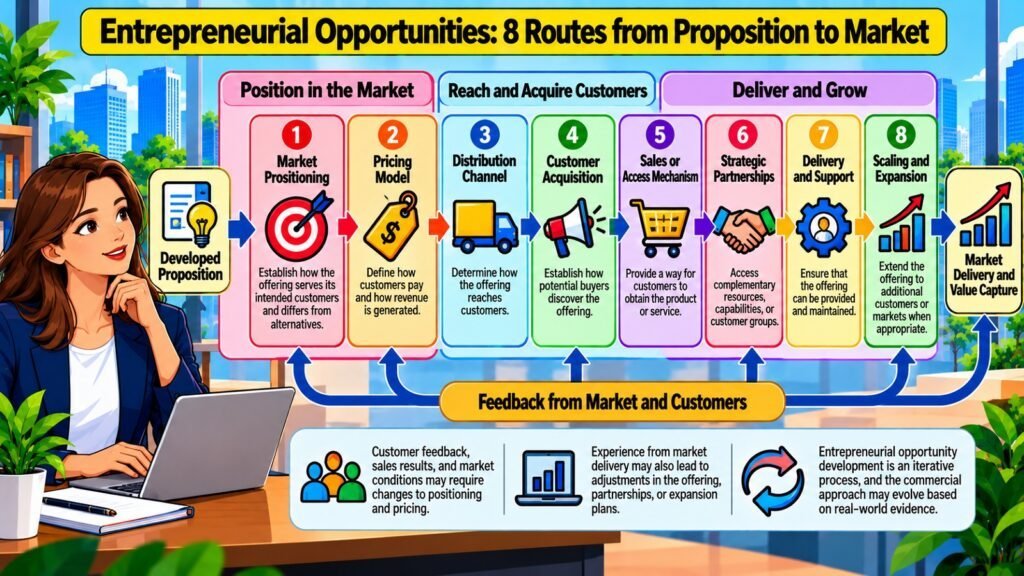
Commercialization carries a developed proposition to its intended market and establishes how the business captures value. Where development defines and refines the proposition, commercialization concerns the arrangements through which the offering reaches customers and sustains economic activity. Relevant decisions include market entry, pricing, revenue mechanisms, distribution and delivery, customer acquisition, partnerships, complementary resources, and expansion into additional customer groups or markets. These decisions are interdependent, since pricing shapes customer segments and distribution shapes cost.
The suitable approach depends on the nature of the offering, customer behavior, competitive conditions, regulatory requirements, and available capabilities. Teece (1986) argued that innovators capture returns only when appropriability conditions and complementary assets favor them, which explains why technological feasibility or customer interest does not ensure success. Chesbrough and Rosenbloom (2002) similarly showed that a technology acquires economic value through the business model that carries it to market.
A proposition may therefore falter through inadequate distribution, inappropriate pricing, weak customer access, high delivery costs, scarce complementary resources, or a mismatch with market requirements. Netflix provides a documented example. It began renting DVDs by mail in 1998, adopted a subscription model in 1999, and introduced streaming in 2007, altering delivery and revenue mechanisms as conditions changed. The sequence is instructive because each shift responded to a change in technology or customer access rather than following a predetermined template.
Constraints are visible as well. In 2011, Netflix separated its DVD and streaming plans, announced the Qwikster brand, and reversed that decision within weeks after subscriber backlash, an episode widely reported in the business press. Those events are verified; reading them as evidence of the difficulty of altering established customer arrangements is interpretation, and success stories should not function as universal templates.
Table 9 identifies eight commercialization elements with distinct functions. Commercialization is context-dependent and may require changes to the proposition when real market conditions differ from initial assumptions. Value capture depends on whether the business can retain a meaningful share of the value it creates.
Table 9: Commercializing Entrepreneurial Opportunities in Markets
| Commercialization Element | Role in Reaching the Market |
| Market entry strategy | Selects initial segment and timing |
| Pricing | Translates value into acceptable revenue |
| Revenue mechanism | Structures how payments are collected |
| Distribution and delivery | Moves the offering to customers |
| Customer acquisition | Builds awareness and conversion pathways |
| Partnerships | Provide access, credibility, or capabilities |
| Complementary resources | Supply assets supporting delivery and use |
| Expansion | Extends the offering to new segments or markets |
Conclusion: Entrepreneurial Opportunities and the Future of Entrepreneurship
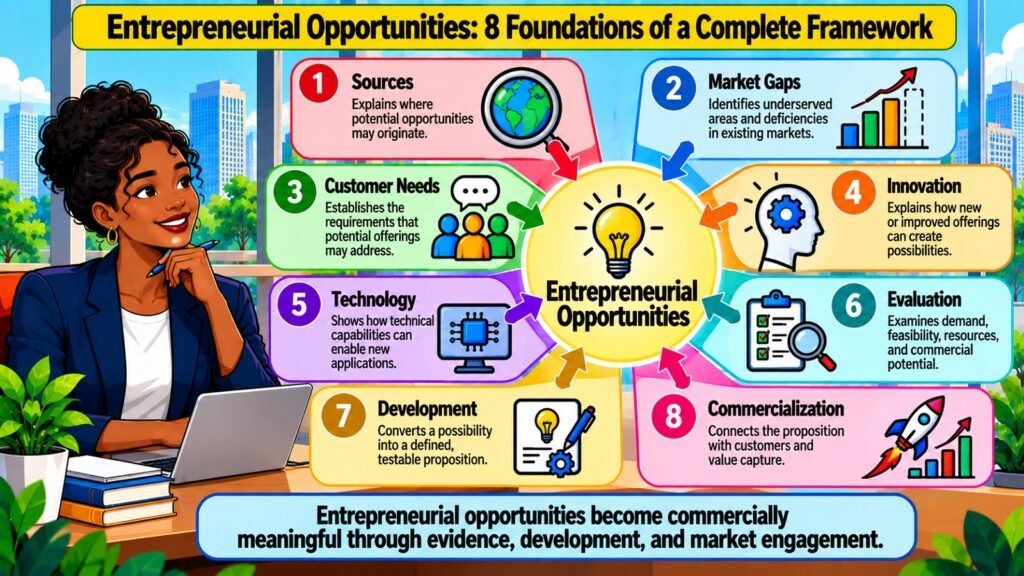
Entrepreneurial Opportunities may originate in changing economic, technological, social, and institutional conditions, become visible through market gaps and customer requirements, gain new possibilities through innovation and technology, undergo commercial evaluation, develop into defined propositions, and reach markets through commercialization. The framework’s contribution lies in the connections among these foundations: evaluation can send a proposition back toward customer evidence, and commercialization can reveal gaps that earlier analysis missed. It is an analytical aid, not a universal linear model. Understanding these relationships is what distinguishes opportunity analysis from a checklist of success factors.
Returning to the central question, the framework helps readers investigate how opportunities emerge, acquire significance, develop, and reach markets. Insights drawn from established research, such as the discovery-creation debate, the Oslo Manual’s definition of innovation, and the role of complementary assets, should be distinguished from the organizing relationships synthesized here. Formation and viability depend on industry, institutional, technological, and market contexts, so conclusions seldom transfer without adjustment. Future research could examine institutional environments, changing technologies, customer behavior, and the relationship between opportunity formation and commercial outcomes.
For students, researchers, and entrepreneurs, the practical message is that the value of an opportunity must be investigated through theory, credible evidence, contextual analysis, and systematic development. The framework guarantees no success; it helps readers formulate sharper research questions, weigh competing interpretations, and examine commercial possibilities more rigorously. Claims about opportunity quality persuade most when they specify the evidence on which they depend. Table 10 consolidates the eight foundations as a final reference.
Table 10: Key Takeaways on Entrepreneurial Opportunities
| Foundations of Entrepreneurial Opportunities | Key Takeaway |
| Sources | Conditions create potential, not proof of viability |
| Market gaps | Shortfalls matter once their causes are understood |
| Customer needs | Interest differs from evidenced demand |
| Innovation | Implemented novelty creates value only alongside demand |
| Technology | Capability enables offerings through complementary conditions |
| Commercial evaluation | Evidence and assumptions must be separated |
| Business development | Iterative testing refines propositions |
| Commercialization | Market access and value capture shape outcomes |