Table of Contents
Introduction: Minimum Viable Product and Its Role in Startup Strategy
The Minimum Viable Product (MVP) has become one of the most widely used and most frequently misunderstood constructs in entrepreneurship, product development, innovation, and evidence-based business decision-making. Properly understood, it is an initial offering that delivers sufficient value to its intended users while allowing a startup to investigate assumptions about customer needs, product functionality, and market demand. It is not a synonym for an unfinished product or a shortened feature list, because its scope must remain adequate to create meaningful value and generate usable evidence.
Minimum Viable Product is an important aspect of Startup Strategy because new ventures act under uncertainty, with scarce funding, incomplete market information, and limited time and expertise. An MVP helps founders examine critical assumptions, prioritize resources, observe customer responses, and decide with better information before committing to extensive development. It connects naturally to the Lean Startup methodology (Ries, 2011), validated learning, customer feedback, experimentation, and iterative improvement.
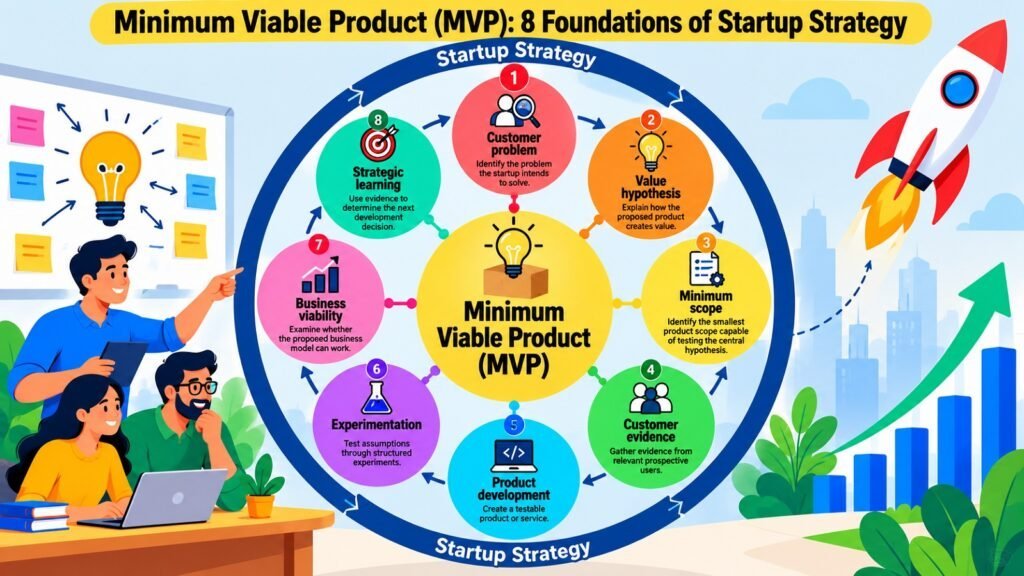
This article is a research-informed reference that integrates theory, academic literature, practical tools, documented evidence, and critical analysis across eight foundations. The effectiveness of an MVP is treated throughout as contingent on the quality of its design, the relevance of its experiments, the reliability of its evidence, and the soundness of the decisions drawn from its findings. Table 1 maps the eight foundations to the questions that organize them.
Table 1: Minimum Viable Product Foundations and Central Research Questions
| Minimum Viable Product Foundations | Central Research Question |
| MVP Principles and Philosophy | What does an MVP assume, and what does it not claim? |
| MVP Design and Feature Prioritization | Which capabilities are necessary to test the core proposition? |
| MVP and Customer Validation | Does the solution address a genuine customer problem? |
| MVP Development Process | How does a defined problem become an evaluable product? |
| MVP Measurement and Experimentation | What evidence emerges, and how reliably is it interpreted? |
| MVP and Business Model Validation | Can the offering sustain an economically viable business? |
| MVP Risk Assessment and Uncertainty Reduction | Which unresolved assumptions matter most, and how are they tested? |
| MVP Evolution, Scaling, and Strategic Decisions | How should evidence guide iteration, pivoting, or expansion? |
1. Minimum Viable Product Principles and Philosophy
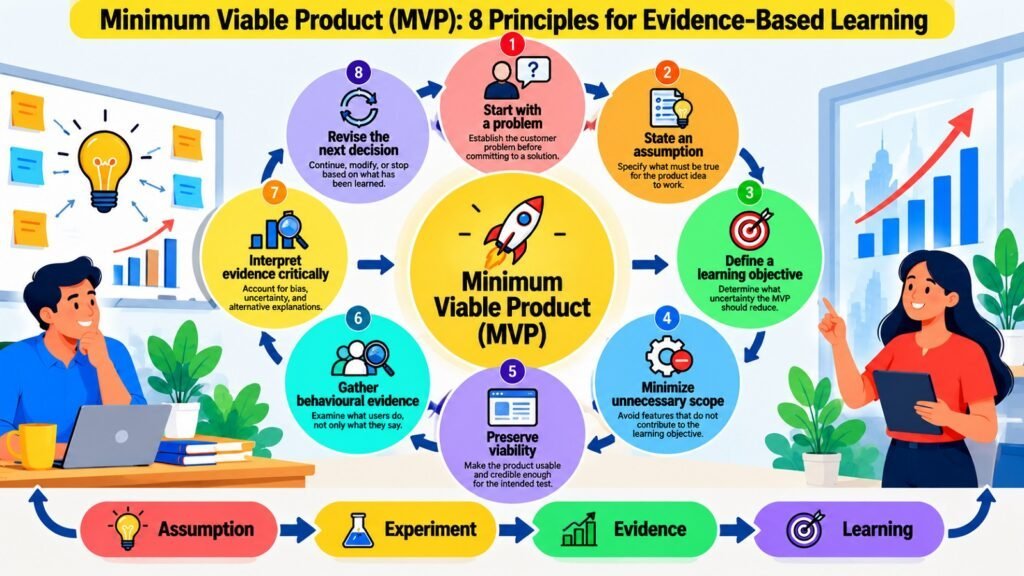
The philosophical core of the Minimum Viable Product lies in treating a new venture as a set of testable hypotheses rather than a finished plan. Ries (2011) popularized the idea within the Lean Startup, where the product exists to maximize validated learning for the least effort, and Eisenmann, Ries, and Dillard (2012) formalized the logic as hypothesis-driven entrepreneurship. Camuffo et al. (2020) supplied rare experimental support, reporting that Italian startups trained in systematic hypothesis testing outperformed controls, although the sample and context limit generalization. The method also inherits Blank’s (2013) customer development and the agile tradition, which explains its emphasis on rapid cycles.
The two words carry distinct obligations. Minimum signals deliberate scope reduction aimed at a stated assumption, whereas viable requires that the offering be useful enough for real users to respond honestly; viability in this sense is practical, not proof of long-term commercial success. Systematic reviews show that definitions remain inconsistent (Lenarduzzi and Taibi, 2016), and Duc and Abrahamsson (2016) proposed that an MVP may need to serve technical, product, and business purposes simultaneously. It also differs from a prototype, a proof of concept, a pilot, and a full product, whose purposes overlap without being identical. Practitioner accounts tend to stress speed, whereas scholarly treatments stress the learning objective, and the two should not be conflated.
The belief that smaller and faster is always better deserves scrutiny. A product stripped too far cannot test the intended hypothesis, whereas superfluous functionality raises cost and obscures which element produced an observed result, and without explicit hypotheses, iteration degrades into unstructured feature accretion. Contigiani and Levinthal (2019) caution that Lean Startup logic fits some environments better than others, and experimentation with real users raises ethical questions of consent and harm, as the controversy over the Facebook emotional-contagion study illustrated (Kramer et al., 2014).
Table 2: Minimum Viable Product Concepts and Their Meaning
| Concept or Principles of Minimum Viable Product | Meaning for Minimum Viable Product |
| Hypothesis-driven development | Each release tests an explicit, falsifiable assumption about customers. |
| Validated learning | Evidence from real behavior, not opinion, justifies the next decision. |
| Minimum | Deliberate scope reduction aligned with the hypothesis under test. |
| Viable | Sufficient usefulness for authentic user response; not proof of success. |
| Prototype | Explores design or feasibility, often without real customers. |
| Proof of concept | Demonstrates technical possibility, not market demand. |
| Pilot | Tests operation within a bounded, supported setting. |
| Build-measure-learn loop | Iterative cycle linking product changes to evidence. |
2. Minimum Viable Product Design and Feature Prioritization
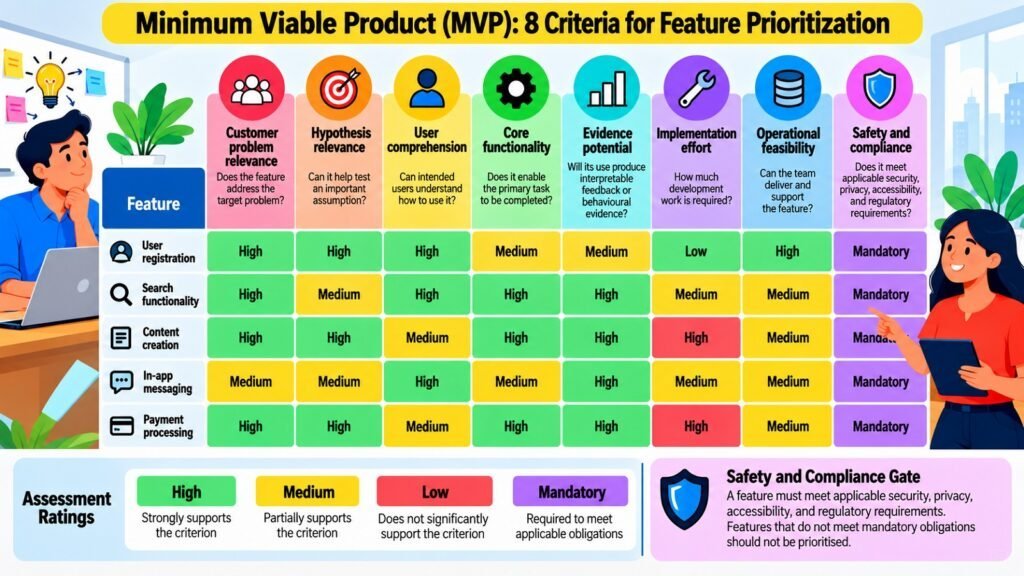
Design begins when a founder translates a business idea into a bounded proposition by specifying the customer problem, the intended user group, the core value proposition, the principal hypothesis, and the smallest set of capabilities that delivers meaningful value. Feature selection should follow from the evidence the startup needs, not from the assumption that additional functionality improves a product. User research, requirements analysis, user stories, journey mapping, and low-fidelity prototyping help teams convert that logic into an initial scope.
Several prioritization approaches exist, and none is universally superior. MoSCoW, which originated in the DSDM community, sorts requirements into must-have, should-have, could-have, and won’t-have categories, which suits negotiation under fixed time. The Kano model (Kano et al., 1984) separates basic expectations, performance attributes, and delighters, showing that some features matter mainly when absent. Weighted decision methods balance value against effort, feasibility, strategic importance, and uncertainty, although their apparent precision can mask subjective inputs, and choosing among them is itself a judgment about context.
Overengineering, excessive reduction, premature optimization, and uncritical imitation of competitors all distort an MVP. Security, privacy, accessibility, reliability, and legal obligations cannot be deferred merely because a product is minimal, since their absence harms users and compromises the experiment. Tying scope to testability also links design to Startup Strategy, because every retained feature consumes limited resources and should earn its place by contributing to learning.
A transparent procedure can be adapted to most products. State the hypothesis, list candidate features, and ask whether each is essential to the core proposition or to producing the required evidence. Then rate value, effort, and uncertainty on a simple ordinal scale and postpone features that fail the first test. This scoring is an illustrative decision aid rather than an empirically validated instrument, and disagreement about a score often exposes an untested assumption worth examining directly.
Table 3: Minimum Viable Product Feature Prioritization Criteria
| Minimum Viable Product Prioritization Criterion | Application to MVP Design |
| Customer value | Retain features that directly resolve the target customer problem. |
| Link to hypothesis | Include capabilities required to test the principal assumption. |
| Development effort | Defer costly features whose contribution remains uncertain until evidence arrives. |
| Technical feasibility | Avoid dependencies that delay learning without adding evidence. |
| Strategic importance | Favor capabilities supporting the intended market position. |
| Uncertainty | Prioritize features whose value is least understood. |
| Operational constraints | Match scope to team skills, budget, and timeline. |
| Non-negotiable requirements | Retain security, privacy, accessibility, and legal compliance. |
3. Minimum Viable Product and Customer Validation
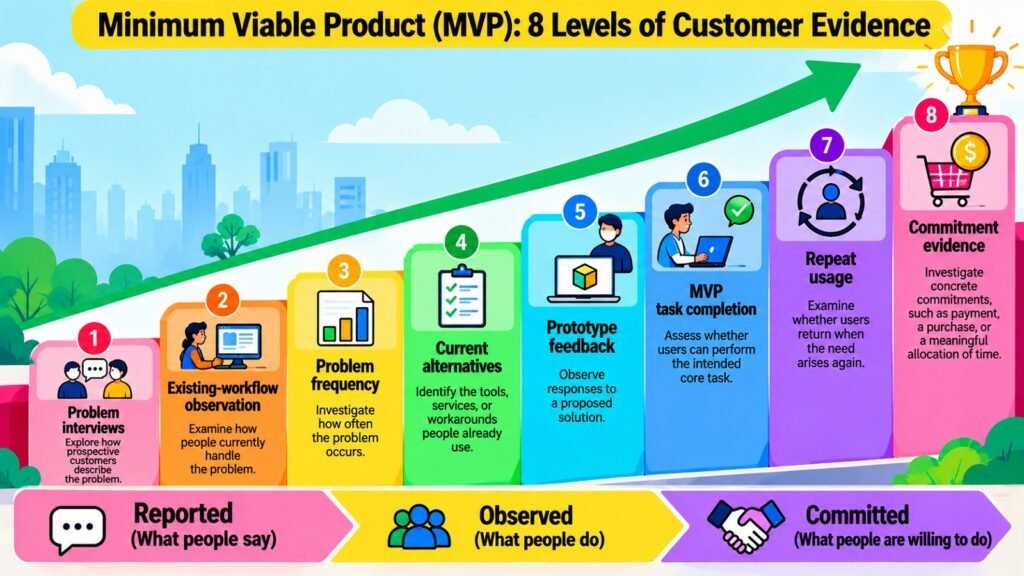
Customer validation asks whether a proposed solution addresses a genuine problem, and the answer depends on which kind of evidence is examined. Identifying a problem, receiving praise for an idea, observing real use, and demonstrating willingness to pay answer progressively different questions, so treating them as interchangeable proof of demand is a common and costly error. Fitzpatrick (2013) and Blank (2013) both emphasize that behavior and commitment are more informative than compliments, and Blank’s customer development model frames discovery as an iterative search rather than a one-time survey.
Available methods include discovery interviews, surveys, usability testing, pilot programs, early-access releases, and behavioral observation. Interviews reveal context and motivation but depend on recall and interpretation, surveys scale but invite leading questions, and observation captures what people do, which may diverge from what they say. Early adopters should be recruited for their relevance to the intended market, since enthusiastic but unrepresentative participants produce flattering and misleading signals. Pilots and early-access releases add realism but introduce self-selection, so their results describe participants more securely than the wider market.
Methodological hazards deserve explicit management: sampling bias, leading questions, survivorship bias, confirmation bias, and generalization from a handful of participants can each inflate confidence. Teams should document findings systematically, examine contradictory feedback rather than discarding it, and label results preliminary until further testing corroborates them. Leatherbee and Katila (2020), studying early-stage teams, found that hypothesis-based probing shaped how teams revised their ideas, though their sample was small.
A usable procedure begins with a falsifiable customer hypothesis, for example that a defined segment experiences a specific problem often enough to seek a remedy. The team then selects the cheapest method able to challenge it. The evidence informs target-market selection, positioning, and later investment, which is how validation feeds Startup Strategy, although positive responses never establish product-market fit alone.
Table 4: Minimum Viable Product Customer Validation Methods
| Minimum Viable Product Validation Methods | Evidence or Limitation |
| Discovery interviews | Reveal problems and context; vulnerable to interviewer bias. |
| Surveys | Reach many respondents; stated preferences may differ from behavior. |
| Usability testing | Exposes friction in use; says little about demand. |
| Pilot programs | Show real use in bounded settings; limited generalizability. |
| Early-access releases | Reveal adoption patterns; self-selected participants may mislead. |
| Behavioral observation | Captures actual conduct; requires careful interpretation. |
| Early adopter recruitment | Requires market relevance; otherwise sampling bias follows. |
| Review of contradictory feedback | Counters confirmation bias and premature generalization. |
4. Minimum Viable Product Development Process
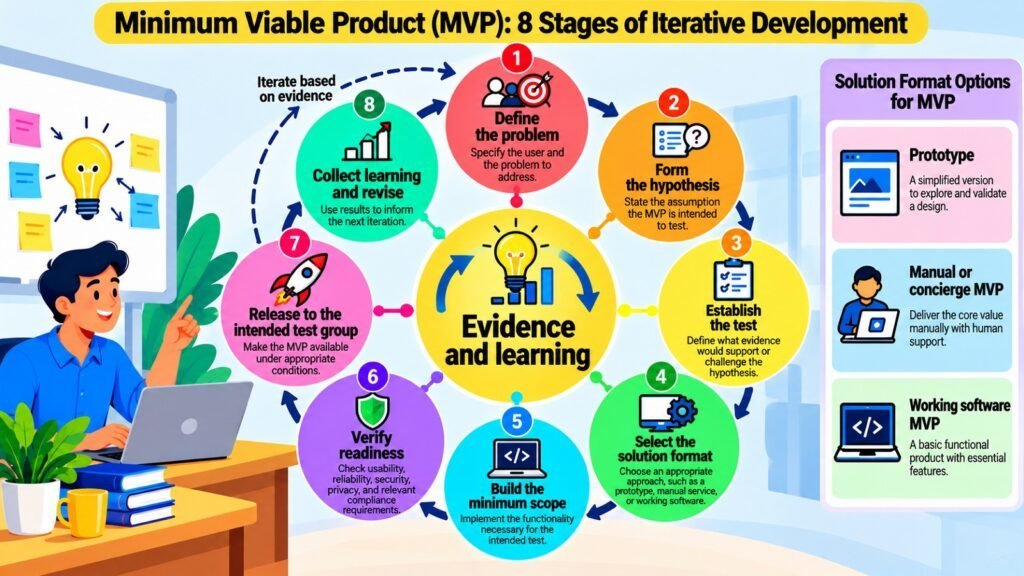
The development lifecycle moves from problem definition through hypothesis formulation, scope definition, planning, implementation, testing, launch, feedback, and iteration. It is best treated as an adaptable pattern rather than a fixed sequence, because a software service, a hardware device, and a marketplace impose different constraints. Treating the lifecycle as a loop reflects the build-measure-learn cycle, in which the output of each pass becomes the input of the next. What matters is that every activity can be traced to the intended value proposition or learning objective.
Responsibilities span product managers, designers, developers, researchers, and business stakeholders, whose priorities often conflict. Implementation choices include custom software, low-code or no-code tools, existing components, manual service delivery, and functional prototypes. The right choice depends on complexity, technical requirements, expertise, budget, time, and longer-term objectives; concierge approaches, for instance, can test demand before automation is justified, though they may conceal the cost of delivering at scale. Cost, speed, and fidelity trade against one another, and no option dominates across all three.
Reduced scope does not license weak engineering, because requirements definition, architecture, testing, deployment, onboarding, and feedback collection still demand discipline, and data protection, cybersecurity, accessibility, and reliability remain obligatory. Bosch et al. (2013) proposed the Early Stage Software Startup Development Model to operationalize lean principles, while research on Internet of Things MVPs (Nguyen-Duc et al., 2020) catalogues recurring pitfalls, suggesting that hardware dependencies complicate rapid iteration. Iterative methods help only if uncontrolled feature expansion is resisted.
A practical approach preserves a traceable chain. Define the problem, write the hypothesis, specify the evidence that would support or refute it, derive the minimum capabilities, build and test them, release to a defined audience, and review results against the original criteria. When the chain breaks, work proceeds without purpose and the product cannot be evaluated responsibly. Feature-selection logic from Section 2 enters here only as a constraint on delivery.
Table 5: Minimum Viable Product Development Process Stages
| Development Stages of Minimum Viable Product | Purpose or Deliverable |
| Problem definition | Articulate the customer problem and target users. |
| Hypothesis formulation | State falsifiable assumptions and success criteria. |
| Scope definition | Specify minimum capabilities required to test the hypothesis. |
| Planning | Allocate roles, timeline, budget, and implementation approach. |
| Implementation | Build or simulate the offering with essential quality safeguards. |
| Testing | Verify functionality, security, accessibility, and reliability. |
| Launch and onboarding | Release to a defined audience with clear instrumentation. |
| Feedback and iteration | Compare evidence with criteria and decide the next step. |
5. Minimum Viable Product Measurement and Experimentation
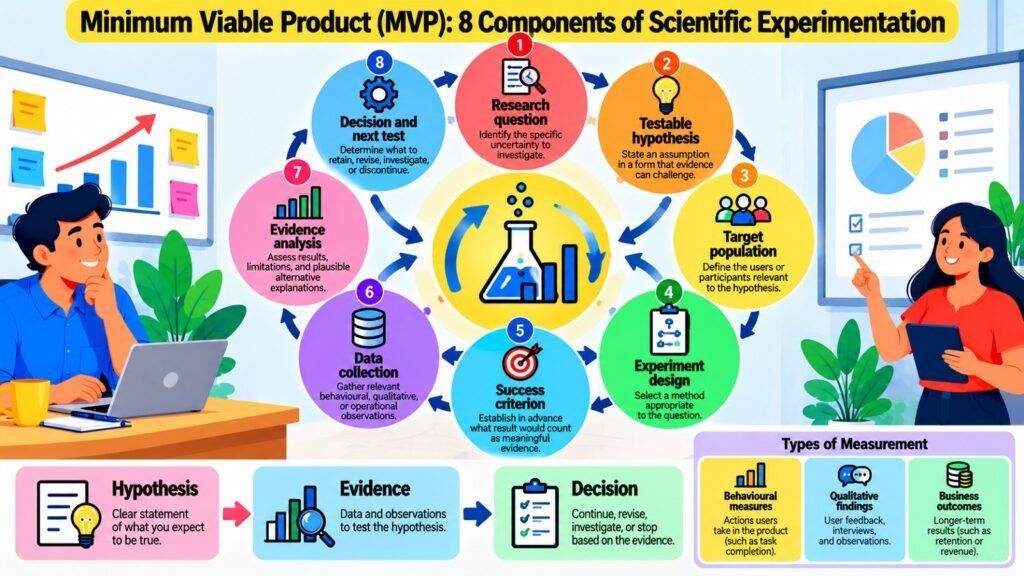
Measurement turns product activity into evidence only when it is organized around a question. Observing that users click, register, or visit does not show that the product creates value, and disciplined experimentation therefore requires explicit hypotheses, research questions, operational definitions, measurement methods, and decision criteria fixed before results arrive. Measurement is itself a design problem, because a metric that cannot change a decision is rarely worth collecting. Predefined criteria guard against the retrospective rationalization of ambiguous data.
Common measures include activation, engagement, conversion, retention, task completion, repeat usage, and, where appropriate, revenue. Their relevance depends on the product, the users, the business model, and the question asked. Vanity metrics such as cumulative registrations or page views can rise while genuine value stagnates, which is why cohort analysis, tracking groups over time, often exposes retention patterns that aggregate totals conceal.
Methods range from usability tests and landing-page tests to controlled experiments and structured customer research. A/B testing suits settings with sufficient traffic and well-defined outcomes (Kohavi, Tang, and Xu, 2020), whereas inadequate samples, selection bias, short observation periods, confounding variables, and unreliable instrumentation yield misleading conclusions, and peeking at results before a test concludes inflates false positives unless stopping rules are fixed in advance. Koning, Hasan, and Chatterji (2022) reported that startups adopting A/B testing tended to perform better, yet the pattern reflects particular firms and does not make the practice universally beneficial.
Evidence should be sorted into support, challenge, and inconclusive categories, and a negative result retains value because it narrows the space of viable options. Causal inference literature stresses that randomization, not data volume, licenses causal claims, and small early-stage samples seldom provide the power to detect modest effects, and a result that is statistically detectable may still be commercially trivial. An experiment log recording hypothesis, method, sample, result, limitations, and resulting decision keeps findings connected to action.
Table 6: Minimum Viable Product Measurement and Experimentation Methods
| Measurement or Methods of Minimum Viable Product | Interpretation or Limitation |
| Activation | Shows users reaching initial value; definition is product-specific. |
| Engagement | Indicates intensity of use; may not reflect perceived value. |
| Conversion | Measures progression to a target action; depends on funnel definition. |
| Retention and cohorts | Reveal sustained use; require adequate observation periods. |
| Task completion | Assesses usability outcomes; limited to tested tasks. |
| Landing-page test | Gauges initial interest; signals intent, not satisfaction. |
| A/B test | Supports causal inference when randomized with adequate samples. |
| Vanity metrics | Cumulative totals that rarely guide decisions reliably. |
6. Minimum Viable Product and Business Model Validation
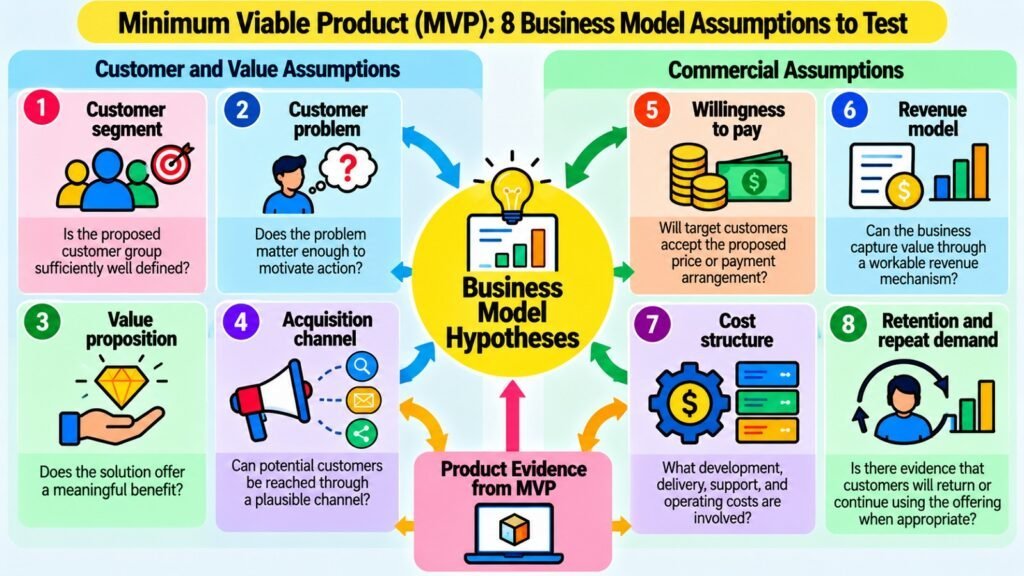
Evidence that customers find a solution useful does not show that a company can acquire them, earn sufficient revenue, and serve them economically. Business model validation therefore tests a different layer of assumptions, covering value propositions, customer segments, pricing, payment preferences, distribution channels, acquisition costs, revenue mechanisms, and recurring demand. Teece (2010) argued that a business model articulates how an organization creates and captures value, which is precisely what usefulness alone cannot demonstrate. A paid pilot persuades more than a survey because money forces trade-offs, yet a few friendly buyers may reflect relationships rather than market demand.
Paid pilots, limited commercial releases, subscription trials, and pre-orders can each illuminate specific commercial assumptions, although their suitability depends on the product and market. The Business Model Canvas (Osterwalder and Pigneur, 2010) provides a structure for locating these assumptions, since early evidence may inform decisions about customer relationships, channels, key activities, partnerships, costs, and revenue. Maurya (2012) adapted the format into the Lean Canvas, which foregrounds problems and metrics.
The evidential ladder matters: free registrations, stated willingness to pay, actual purchases, repeat purchases, and sustainable economic performance are increasingly credible but distinct signals. Customer acquisition cost, gross margin, retention, revenue per customer, and unit economics make the ladder quantifiable. Early data of a Minimum Viable Product rarely support reliable estimates of long-term profitability, especially when samples are small, acquisition channels are unstable, or operating costs remain incompletely observed. Gross margin in particular is easily overstated when founders absorb manual labor that would not scale, and unit economics should be revisited as volumes and channels change.
Kerr, Nanda, and Rhodes-Kropf (2014) frame entrepreneurship as experimentation under high uncertainty, which implies that inexpensive commercial tests deserve priority before capital-intensive commitments. Findings should be reported as documented evidence, separated from illustrative scenarios, and linked to Startup Strategy through investment timing, pricing, market entry, and business-model refinement. This section concerns commercial assumptions rather than the methods of Sections 3 and 5.
Table 7: Minimum Viable Product Business Model Assumptions and Validation
| Business Model Assumption | Validation Approach |
| Value proposition | Compare against alternatives in structured customer comparisons. |
| Customer segment | Assess which groups adopt and retain the offering. |
| Pricing | Run price tests or paid pilots. |
| Payment preference | Observe actual payment choices in limited releases. |
| Distribution channel | Test reach through small acquisition experiments. |
| Acquisition cost | Track spending against customers actually acquired. |
| Revenue mechanism | Trial subscriptions or transactions with real buyers. |
| Recurring demand | Monitor repeat purchases and renewals over time. |
7. Minimum Viable Product Risk Assessment and Uncertainty Reduction
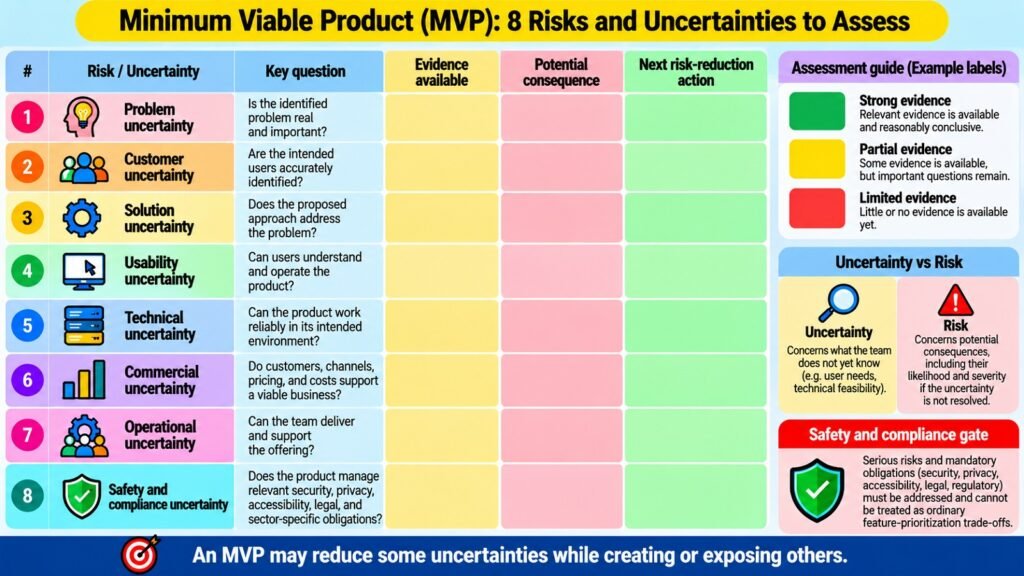
An MVP does not eliminate risk; it provides a structured means of gathering evidence about uncertainties that could materially alter product or business decisions. The relevant uncertainties span customer problems, solution effectiveness, technical feasibility, market demand, commercial viability, operational readiness, and adoption, and they interact, since a technically elegant solution may still fail if customers do not adopt it. Founders should therefore identify which unresolved assumptions would cause the greatest damage if wrong. Prioritizing in this way keeps testing effort proportionate to what a mistaken assumption would cost.
Assumptions can be ranked by importance, uncertainty, and consequence of failure, a logic reflected in the assumption-mapping tools of Bland and Osterwalder (2019). Interviews, prototypes, technical experiments, pilots, and limited releases each suit different categories, so the appropriate test depends on the nature of the assumption rather than the popularity of a methodology. Evidence quality should be graded before it informs a decision, since a well-designed small test can outweigh a large but biased sample. McGrath and MacMillan (1995) similarly argued that plans should rest on assumptions checked at milestones.
Uncertainty reduction has limits, because weak research designs, unrepresentative participants, shifting market conditions, unreliable measurements, and premature conclusions can all produce false assurance. Some uncertainties, including regulatory exposure, deep technical feasibility, and safety performance, cannot be resolved by releasing a product and demand technical research, expert assessment, or formal review. Sarasvathy (2001) adds a counterpoint, since entrepreneurs often act on affordable loss rather than predicted return, which shapes how much uncertainty they choose to resolve.
Privacy, cybersecurity, safety, and regulatory requirements apply where relevant, and the desire to learn quickly cannot justify exposing customers to unacceptable harm. Distinct from general risk management, the MVP perspective concentrates on the link between experiments, unresolved assumptions, evidence quality, and decisions. Within Startup Strategy, that discipline supports more responsible resource allocation and more defensible investment choices.
Table 8: Minimum Viable Product Uncertainty Categories and Investigation
| Minimum Viable Product Uncertainty Categories | Relevant Investigation |
| Customer problem | Discovery interviews and observation of current workarounds. |
| Solution effectiveness | Usability tests and prototype trials. |
| Technical feasibility | Technical experiments and expert review. |
| Market demand | Landing-page tests and pre-orders. |
| Commercial viability | Paid pilots and unit-economics analysis. |
| Operational readiness | Limited releases observing delivery and support capacity. |
| Customer adoption | Cohort tracking of onboarding and repeat use. |
| Regulatory and safety exposure | Legal review and compliance assessment before release. |
8. Minimum Viable Product Evolution, Scaling, and Strategic Decisions
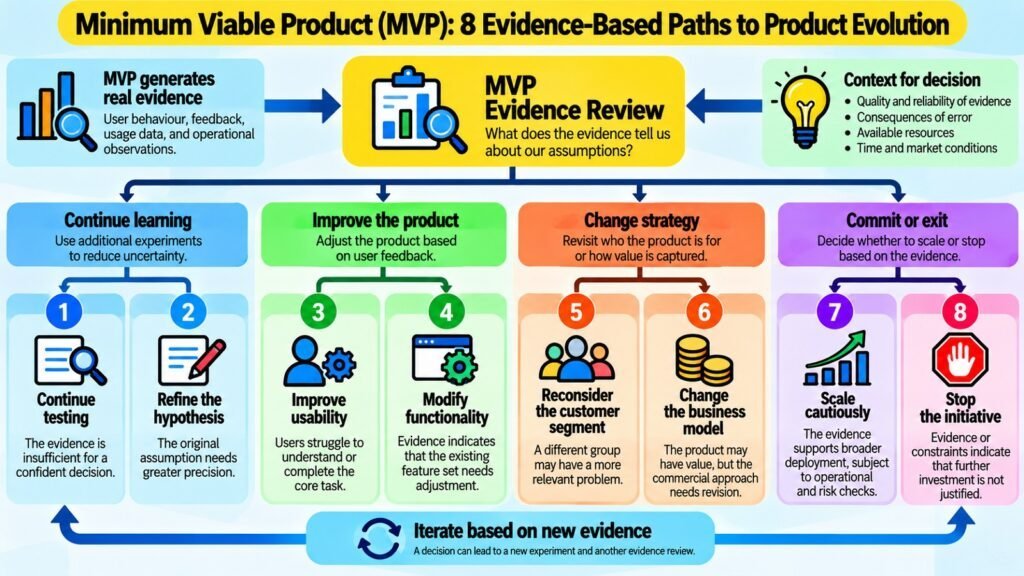
Launching an MVP converts uncertainty into evidence that must be interpreted, and the interpretation determines which response is warranted: improving the product, running further experiments, revising assumptions, changing direction, discontinuing the initiative, or scaling. Decisions about features, segments, value propositions, distribution, pricing, and operational investment should rest on the strength and relevance of evidence rather than enthusiasm, sunk costs, growth pressure, or isolated success indicators. Each response answers a different question, and conflating them, for example by scaling a product that merely needs refinement, wastes scarce capital.
Findings feed the roadmap in different ways: feedback and usage patterns inform design priorities, technical performance informs engineering investment, retention indicates durable value, and commercial evidence shapes go-to-market choices. Segment-level analysis is particularly useful, since an average can conceal a strongly engaged minority that points toward a better market. A pivot is not automatically required after disappointing results, because implementation flaws, experimental limitations, or alternative explanations deserve investigation first (Ries, 2011; Shepherd and Gruber, 2021).
Scaling demands a higher standard, and investment in infrastructure, automation, staffing, acquisition, and operational capacity is justified when customer value is sustained, reliability and security hold, support is manageable, operating costs are understood, and delivery is consistent. Early registrations, media attention, or a successful pilot do not independently establish readiness for expansion. Support load and unit costs often rise before efficiencies appear, so premature scaling can magnify defects that a smaller operation could absorb.
Within Startup Strategy, post-launch evidence guides investment, organizational priorities, and growth decisions. The research base is encouraging but incomplete, as the review by Bortolini et al. (2021) indicates, so this guidance should be read as a practical recommendation rather than settled law, and the table below offers proportionate responses rather than universal thresholds.
Table 9: Minimum Viable Product Evidence and Strategic Responses
| Evidence or Situation | Possible Strategic Response |
| Strong retention with clear user value | Invest cautiously in capacity while monitoring costs. |
| Positive feedback but weak usage | Investigate friction before adding features. |
| Interest without willingness to pay | Test pricing, segments, or alternative revenue models. |
| Inconclusive results | Redesign the experiment with a larger, better-targeted sample. |
| Persistent contradiction of the core hypothesis | Revise assumptions and consider a pivot. |
| Strong usage in an unexpected segment | Explore that segment through targeted experiments. |
| Technical or security weaknesses | Remediate before expanding exposure. |
| Repeated failure to reach viable economics | Consider discontinuation or fundamental redesign. |
Conclusion: Minimum Viable Product as a Foundation for Startup Success
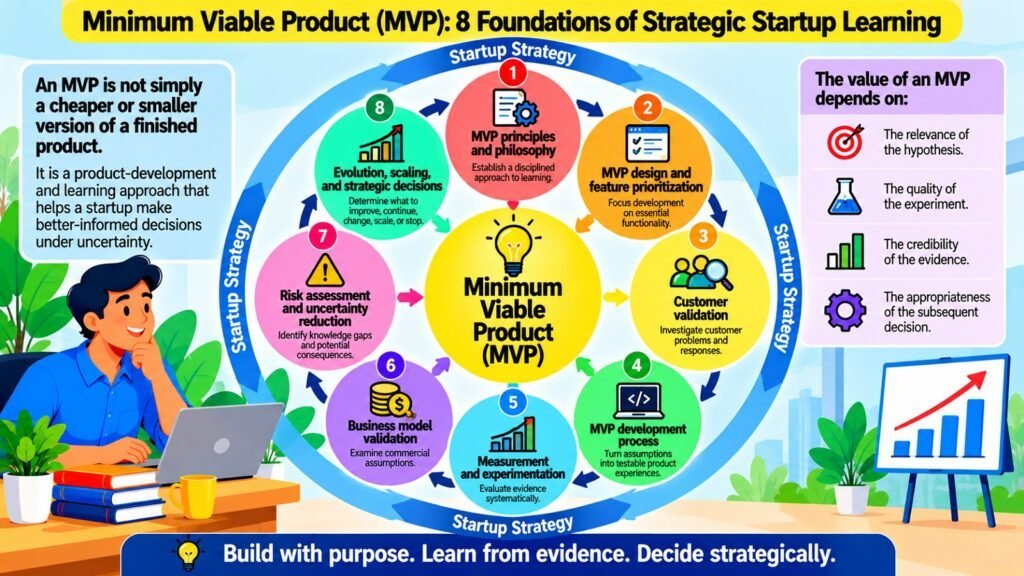
The Minimum Viable Product is best understood as a deliberately scoped offering that combines customer value, experimentation, and evidence-based learning. The eight foundations form a connected chain: principles establish the logic, design fixes the scope, customer validation tests relevance, development delivers an evaluable product, measurement generates evidence, business model validation examines economics, uncertainty reduction directs attention to what matters most, and strategic decisions convert findings into action.
Minimum Viable Product is an important aspect of Startup Strategy because it helps founders investigate assumptions, prioritize resources, evaluate evidence, and make better-informed decisions about development and future investment. It does not guarantee product-market fit, profitability, or survival, and its usefulness depends on suitable research questions, meaningful experiments, reliable evidence, and responsible interpretation.
A strong approach demands more than rapid launches or minimal features. It requires a clear grasp of the customer problem, a scope adequate to test the proposition, fitting measurements, and willingness to adapt when evidence contradicts initial beliefs. Theory, empirical research, practical tools, and critical judgment each compensate for the weaknesses of the others.
Looking ahead, the MVP will remain valuable as a discipline of entrepreneurial learning, provided practitioners and researchers keep refining how evidence is generated and interpreted. Its enduring contribution lies less in any single technique than in treating strategy as a sequence of claims that can be examined.
Table 10: Minimum Viable Product Foundations and Key Takeaways
| MVP Foundations | Key Takeaway |
| Principles and Philosophy | Treat the venture as a set of testable hypotheses. |
| Design and Feature Prioritization | Scope the offering by purpose and required evidence. |
| Customer Validation | Distinguish praise from behavior and payment. |
| Development Process | Trace every task to a hypothesis or learning goal. |
| Measurement and Experimentation | Predefine criteria and avoid overstating causation. |
| Business Model Validation | Test acquisition, revenue, and economics separately. |
| Risk Assessment and Uncertainty Reduction | Match each investigation to the assumption at stake. |
| Evolution, Scaling, and Strategic Decisions | Respond proportionately to the strength of evidence. |