Table of Contents
Introduction: Ethical Supply Chain – Foundations of Sustainable Business
Ethical Supply Chain management concerns a firm’s conduct toward people it rarely meets, and Ethical Supply Chain is an important aspect of Sustainable Business because responsibility cannot stop at the organizational boundary. Contemporary production is distributed across suppliers, contractors, manufacturers, and logistics providers whose practices shape outcomes for workers and communities long before a product reaches its buyer. The reasoning presented here suggests that ethical accountability is fundamentally rooted in relational and systemic contexts, rather than in disconnected policy frameworks.
The concept can be defined as a system of policies, decisions, relationships, and practices intended to identify, prevent, mitigate, and address ethical harm throughout supply chains. Its primary concern is human rights, labour standards, responsible conduct, and accountability, which distinguishes it from sustainable supply chain management, where environmental dimensions carry equal or greater weight.
The need for such a system arises from structural features of global trade: international business relationships, multiple supplier tiers, information asymmetry between buyers and producers, divergent working conditions, and uneven regulatory enforcement. Its normative foundation lies in the OECD Guidelines for Multinational Enterprises on Responsible Business Conduct and the UN Guiding Principles on Business and Human Rights, which set expectations that frequently exceed legal minimums.
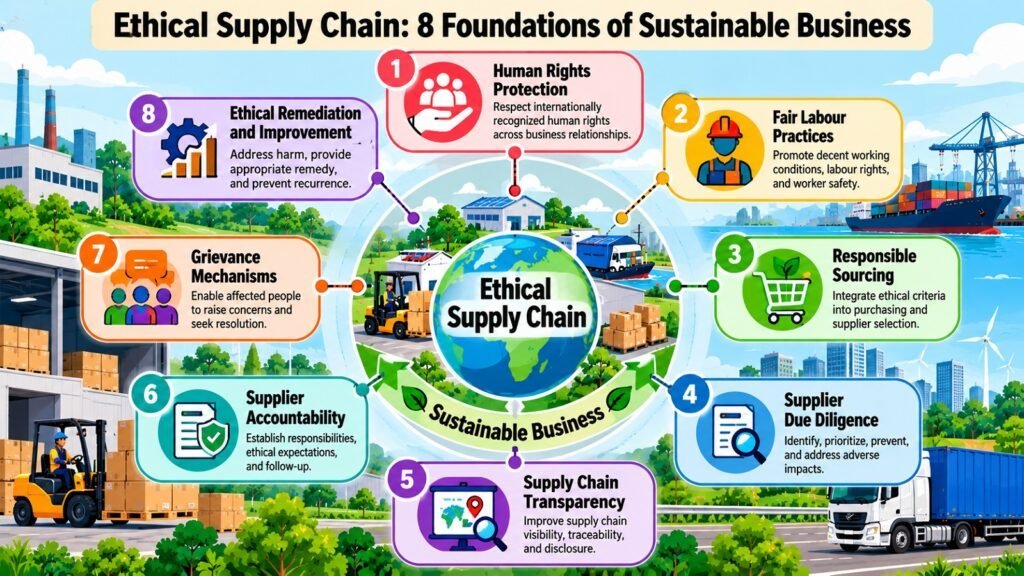
This article treats the field as a framework for theoretical understanding, critical investigation, and practical application. Eight foundations, summarized below, are examined in sequence, and each performs a function that the others cannot replace. Together they move from the rights at stake, through employment conditions and purchasing, to risk management, disclosure, governance, complaint handling, and repair.
Table 1: Ethical Supply Chain Foundations at a Glance
| Ethical Supply Chain Foundation | Core Focus |
| Human Rights Protection | Respecting internationally recognized rights across all business relationships and operations |
| Fair Labour Practices | Securing lawful, safe, and equitable employment conditions for supplier workers |
| Responsible Sourcing | Embedding ethical criteria in purchasing, supplier selection, and contract terms |
| Supplier Due Diligence | Managing adverse impacts through continuing, risk-based assessment and response |
| Supply Chain Transparency | Making credible, verifiable information available and communicated to stakeholders |
| Supplier Accountability | Allocating responsibilities and responding consistently to performance failures |
| Grievance Mechanisms | Enabling workers and communities to raise concerns safely and confidentially |
| Ethical Remediation and Improvement | Addressing harm, restoring rights where possible, and preventing recurrence |
1. Ethical Supply Chain: Human Rights Protection
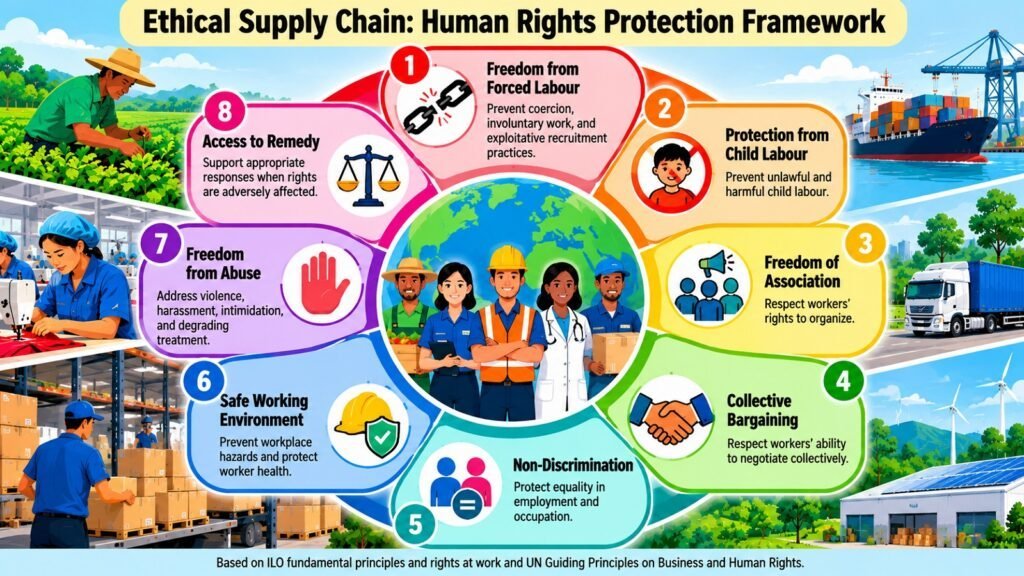
Human rights protection defines what an Ethical Supply Chain must safeguard before any question of process arises. Under the UN Guiding Principles on Business and Human Rights, firms bear a responsibility to respect rights by avoiding infringement and by addressing adverse impacts they cause, contribute to, or are directly linked to through business relationships. That responsibility reaches beyond direct employees to the workers of suppliers, subcontractors, recruitment agencies, and other partners.
The relevant rights include freedom from forced labour, child labour, trafficking, discrimination, and abuse, alongside freedom of association, collective bargaining, and privacy. International Labour Organization instruments and OECD guidance supply the normative content, and they describe internationally recognized standards rather than the statutory duties of any single jurisdiction, which differ considerably. Written policy therefore demonstrates intent, not protection.
Prioritization is the practical difficulty, and the Guiding Principles direct attention to the most severe impacts, judged by scale, scope, and irremediability, and to groups facing heightened vulnerability, such as migrant workers dependent on recruiters. Informal employment, hidden subcontracting, limited lower-tier visibility, and weak enforcement all conceal harm from buyers. Such triage accepts that no buyer can address every harm simultaneously, so the reasoning behind sequencing must be documented and open to scrutiny.
Empirical work warns against equating documentation with experience: LeBaron and Lister’s analysis of ethical audit regimes argues that audits often capture procedural compliance while missing coercion and abuse, and supplier declarations inherit the same weakness. Separating established findings from allegation and interpretation is therefore an analytical duty rather than a courtesy.
Four diagnostic questions help evaluators. Which rights risks were identified and ranked, and on what evidence? Were affected workers consulted directly? Did findings alter purchasing or investment decisions? Can protection be corroborated independently of supplier statements? Answers that rest on policy statements alone should be treated as incomplete.
Table 2: Ethical Supply Chain Human Rights Risks and Principles
| Human Rights Issue | Relevance to Ethical Supply Chain |
| Forced labour | Includes debt bondage and retained identity documents that restrict leaving employment |
| Child labour | Requires age verification and protective alternatives rather than abrupt dismissal |
| Human trafficking | Often linked to deceptive recruitment through intermediaries and false promises |
| Discrimination | Affects hiring, pay, and treatment of vulnerable groups in recruitment and employment |
| Freedom of association | Enables workers to organize and voice concerns without reprisal |
| Collective bargaining | Provides a channel for negotiating conditions on wages and conditions |
| Privacy | Limits intrusive surveillance and misuse of worker data by employers or recruiters |
| Vulnerable workers | Migrant and informal workers face heightened exposure, requiring tailored safeguards |
2. Ethical Supply Chain: Fair Labour Practices
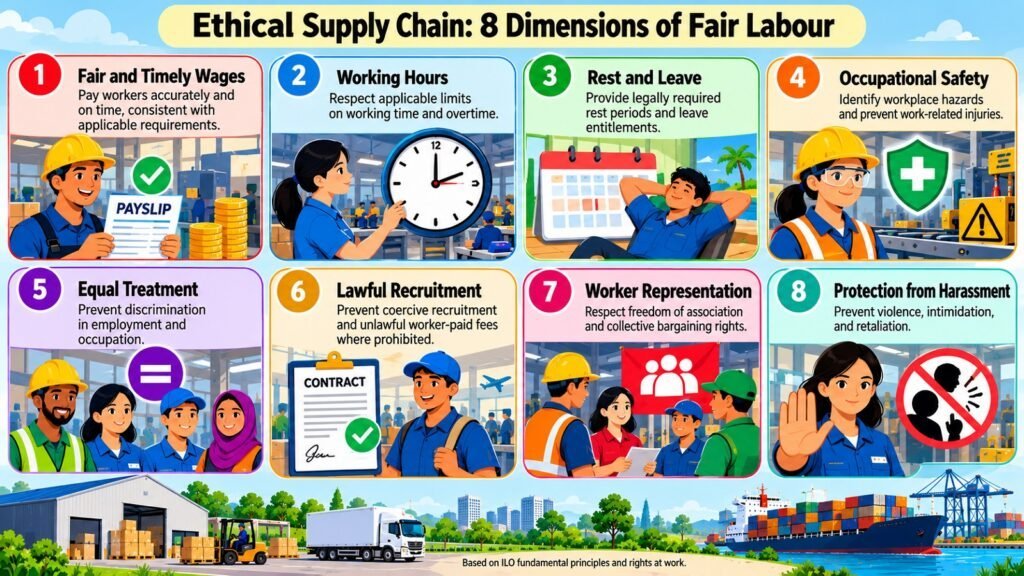
Fair labour practices form the employment-centred foundation of an Ethical Supply Chain, covering wages, working hours, rest, occupational safety, equal opportunity, lawful recruitment, and protection from harassment, coercion, and retaliation. The ILO Declaration on Fundamental Principles and Rights at Work, which now includes a safe and healthy working environment, anchors the baseline, while specific conventions address wages, hours, and safety.
Wage terminology requires care because statutory minimum wages reflect legal thresholds, collectively negotiated wages reflect bargaining outcomes, and living wages reflect the cost of meeting essential needs. Compliance with the first does not establish adequacy under the third, and the gap matters most where legal minimums lag behind living costs. Ethically serious buyers therefore ask what wage workers actually need, not only what the law requires.
Labour conditions are shaped by commercial incentives further up the chain: low prices, sudden order changes, compressed deadlines, and delayed payments push suppliers toward excessive overtime, wage withholding, and precarious contracts. Research by Locke and colleagues on apparel and electronics suppliers suggests that monitoring alone yields limited improvement, whereas pairing oversight with cooperative, longer-term buyer relationships performs better.
A comprehensive evaluation framework should incorporate multiple data sources, including wage documentation analysis, working-hour documentation reviews, on-site workplace examinations, direct worker consultations, and occupational health and safety assessments. The credibility of such evaluations is substantially compromised by advance notification of audits and deficient record-keeping practices, while assessments that exclude workers’ firsthand testimonies overlook the most critical information. Legal requirements, voluntary standards, and recommended practice should be distinguished explicitly, because firms sometimes present the latter as the former. Where enforcement is weak, voluntary standards may be the only operative constraint, which raises the stakes of designing them credibly.
Credible protection can be tested by asking whether wages are paid on time and in full, whether overtime is voluntary, whether workers may refuse unsafe tasks without penalty, and whether the buyer’s own conduct has been examined; wider rights questions belong to the preceding section, and missing answers are themselves informative.
Table 3: Ethical Supply Chain Labour Standards and Risks
| Labour Standard or Risk | Practical Significance to Ethical Supply Chain |
| Wage payment | Timely, full payment prevents withholding and debt dependence and wage-based coercion |
| Living wage | Tests whether legal minimums meet essential needs in workers’ real purchasing context |
| Working hours | Limits excessive overtime and fatigue in production peaks |
| Rest periods | Protects health and recovery between shifts and working weeks |
| Occupational safety | Prevents injury, illness, and fatal accidents and prevents preventable fatalities |
| Non-discrimination | Ensures equal opportunity and treatment in hiring, pay, and promotion |
| Recruitment fees | Employer-pays principle reduces debt vulnerability as a recognized forced-labour risk |
| Retaliation protection | Allows workers to raise concerns safely after complaints or organizing |
3. Ethical Supply Chain: Responsible Sourcing
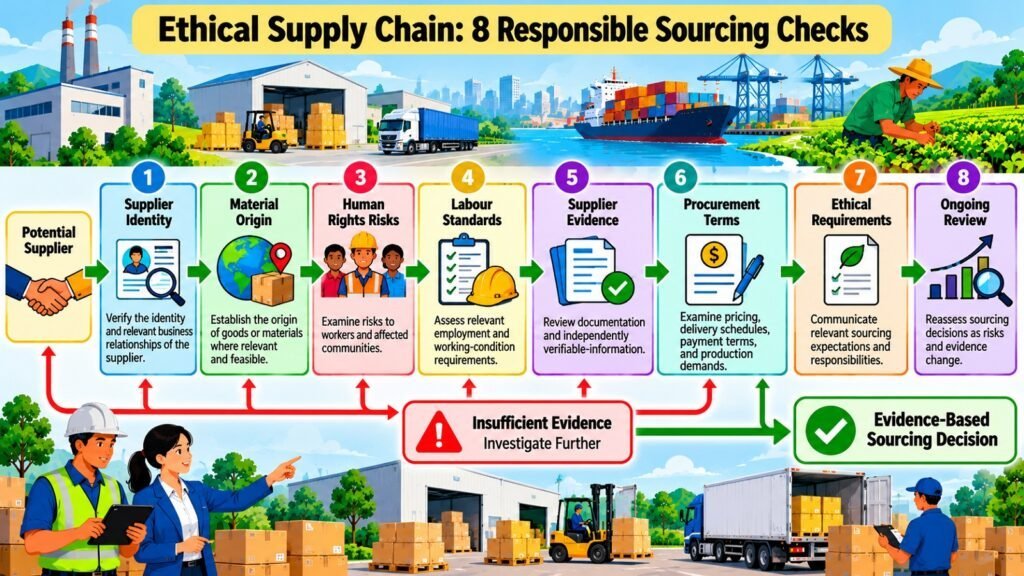
Responsible sourcing embeds ethical criteria in decisions to buy goods, materials, components, and services. Procurement matters because supplier selection determines which labour conditions a firm underwrites and how commercial pressure is distributed across the network. In an Ethical Supply Chain, sourcing policy is therefore a lever of influence rather than an administrative function.
Practical instruments include supplier qualification, origin verification, purchasing criteria, tender requirements, and contract terms that bind suppliers to stated expectations. High-risk commodities and contexts deserve enhanced scrutiny, as in the OECD guidance for minerals from conflict-affected and high-risk areas, and documented problems in textiles, agriculture, electronics, and food production show how intermediaries and thin origin data obscure risk.
Trade-offs among price, quality, availability, delivery schedules, and ethical performance are unavoidable. A low price may conceal costs transferred to workers or communities, yet price alone is not proof of abuse, and assumptions about particular countries or suppliers should be tested rather than presumed. Long-term relationships generally give buyers more leverage, and suppliers more incentive to invest, than repeated spot purchasing. Evaluating them requires knowledge of supplier cost structures that buyers often lack, one reason open-book costing is sometimes discussed.
Responsible sourcing differs from environmental sourcing: environmental criteria may serve wider sustainability objectives, but this discussion concerns the ethics of selection and purchase rather than carbon or circular material flows. It also precedes due diligence and accountability, which address risk management and governance respectively.
Useful decision criteria include whether origin can be verified beyond the first tier, whether the offered price is consistent with lawful labour costs, whether independent evidence supports supplier claims, and whether the buyer’s purchasing practices would even permit compliance. Gaps in any answer signal a need for further investigation, since such questions convert abstract policy into testable purchasing judgments.
Table 4: Ethical Supply Chain and Responsible Sourcing Criterias
| Sourcing Criterion | Practical Application |
| Ethical sourcing policy | Sets purchasing expectations that bind buyers for buyers and procurement staff |
| Supplier qualification | Screens ethical capability before contracting before any contract is signed |
| Origin verification | Confirms where materials and labour originate beyond the first tier |
| High-risk commodity review | Applies enhanced scrutiny to vulnerable sectors such as minerals and agricultural goods |
| Tender requirements | Makes ethical performance a selection criterion alongside price and quality |
| Contract provisions | Converts expectations into enforceable obligations and links them to audit rights |
| Price and lead-time review | Checks feasibility of lawful labour costs against realistic labour costs |
| Evidence verification | Tests supplier claims through independent sources rather than supplier self-reporting |
4. Ethical Supply Chain: Supplier Due Diligence
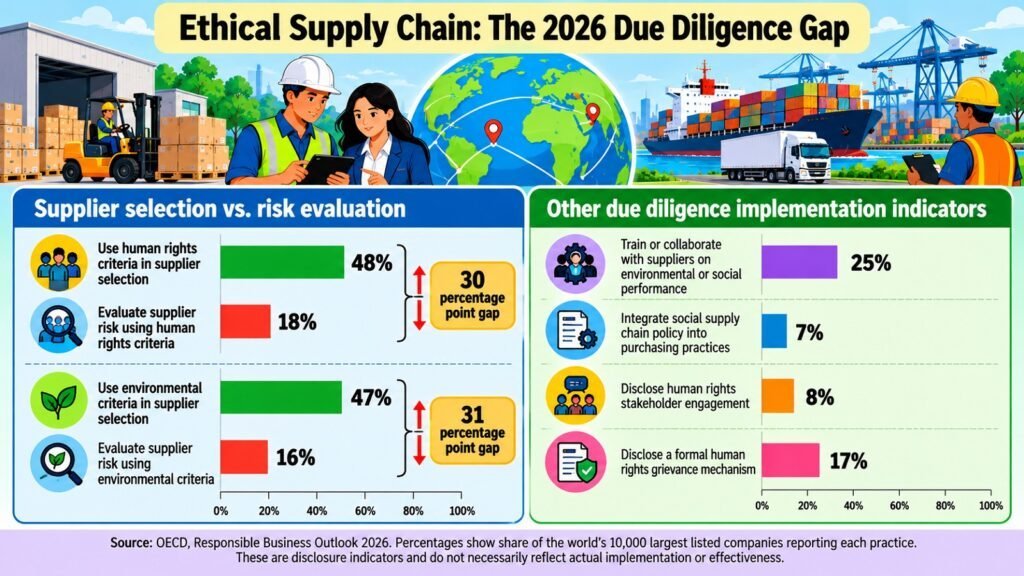
Supplier due diligence is an ongoing, risk-based process for identifying, assessing, prioritizing, preventing, mitigating, and monitoring adverse impacts connected to a supply chain. It is the central operating logic of an Ethical Supply Chain, and it differs from one-time audits, questionnaires, certifications, and contractual declarations, each of which captures a moment or a claim rather than a continuing process. Because the standard concerns conduct rather than outcome, a diligent firm may still encounter harm, so candid reporting of limitations matters.
The OECD Due Diligence Guidance for Responsible Business Conduct describes six elements: embedding responsible conduct in policies and management systems, identifying and assessing impacts, ceasing, preventing, or mitigating harm, tracking implementation and results, communicating how impacts are addressed, and providing for or cooperating in remediation where appropriate.
Risk indicators include sector, geography, commodity, supplier tier, recruitment arrangements, labour intensity, business relationships, and prior findings. Prioritization is determined by the interplay of severity, likelihood, and the specific circumstances of those affected, with the understanding that low probability events should not automatically diminish the significance of severe consequences. The United Nations Guiding Principles further establish important distinctions among harm that an organization directly causes, harm to which it contributes, and harm with which it maintains a direct connection—distinctions that fundamentally inform the selection of appropriate remedial measures.
Assessment methods range from screening and document verification to site visits, worker engagement, independent assessment, and credible external information. Each has limits, since falsified records, audit fatigue, announced inspections, fragmented supplier networks, and weak worker participation can produce reassuring but misleading results. Triangulating sources is the usual safeguard, and worker voice is among the most reliable correctives to document-based assurance.
Integration into procurement, compliance, enterprise risk management, and management oversight makes findings actionable: practitioners should rank findings, choose preventive actions proportionate to their leverage, assign named owners, and monitor whether interventions change conditions rather than merely generate paperwork, while recurring findings should prompt review of the business relationship itself, not only the supplier.
Table 5: Ethical Supply Chain Due Diligence Activities
| Due Diligence Activity | Purpose in Ethical Supply Chain Management |
| Embed policy | Anchors responsible conduct in management systems and management systems |
| Scope risks | Identifies where harm is most likely across tiers and sectors |
| Assess impacts | Evaluates actual and potential adverse impacts including those linked indirectly |
| Prioritize | Directs effort toward the most severe risks by severity, scale, and irremediability |
| Prevent or mitigate | Reduces likelihood or severity of harm through tailored supplier actions |
| Track results | Tests whether actions work using indicators and worker evidence |
| Communicate | Explains findings and responses to stakeholders publicly and to affected groups |
| Support remediation | Addresses harm that has occurred where the firm caused or contributed |
5. Ethical Supply Chain: Supply Chain Transparency
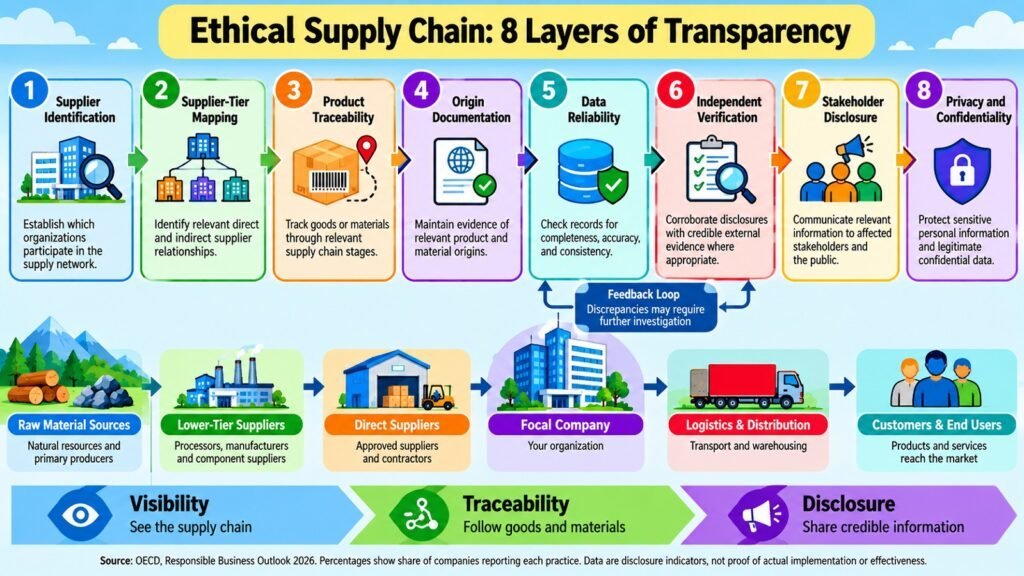
Supply chain transparency is the availability and communication of credible information about suppliers, sourcing practices, network structure, and efforts to address ethical risk. It supports verification, stakeholder understanding, and accountability in an Ethical Supply Chain, although disclosure alone does not eliminate harm. Traceability is a distinct concept: transparency concerns access to and communication of information, whereas traceability concerns following products, materials, or transactions through supply chain stages. The distinction matters because a firm may trace a product flawlessly yet say little about conditions, or publish supplier lists without any capacity to follow goods.
Supplier mapping, multi-tier visibility, origin documentation, record keeping, product identifiers, and public disclosure all contribute. First-tier information often fails to reveal risks involving subcontractors, recruitment intermediaries, and raw-material producers, which is why visibility must extend upstream. Digital records help, yet incomplete, inaccurate, or manipulated data can lend false authority to what remains unverified. Mapping exercises should state their boundaries openly, since a partial map presented as complete is more misleading than none.
Disclosure must be balanced against commercial confidentiality, data protection, and worker safety, since publishing names or locations can expose individuals to retaliation. Legal obligations vary, from statement requirements such as the UK Modern Slavery Act 2015 to mandatory due diligence laws in some jurisdictions, and these should be separated from voluntary reporting frameworks such as the GRI Standards. Reviews of statements published under disclosure laws have frequently found generic content, so the legal presence of a statement says little about its quality.
Substantive communication names risks, methods, limitations, and unresolved problems, whereas vague sustainability claims offer reassurance without evidence. Organizations earn credibility by acknowledging uncertainty, and readers can assess quality by asking who produced the information, how it was verified, which tiers it covers, and what it omits.
Table 6: Ethical Supply Chain Transparency Mechanisms
| Mechanism or Information Type | Relevance or Limitation |
| Supplier mapping | Reveals structure but may omit lower tiers and ownership links |
| Multi-tier visibility | Exposes upstream risk yet is costly to obtain across subcontractors and raw materials |
| Origin documentation | Supports verification when records are reliable and shipment records |
| Product identifiers | Enable traceability without proving working conditions or batch tracking systems |
| Record keeping | Provides evidence that can be falsified and verification trails |
| Public disclosure | Builds accountability when specific and verifiable with limits on disclosed detail |
| Stakeholder communication | Informs affected groups and civil society including workers and civil society |
| Data protection safeguards | Balance openness against worker privacy and safety under applicable law |
6. Ethical Supply Chain: Supplier Accountability
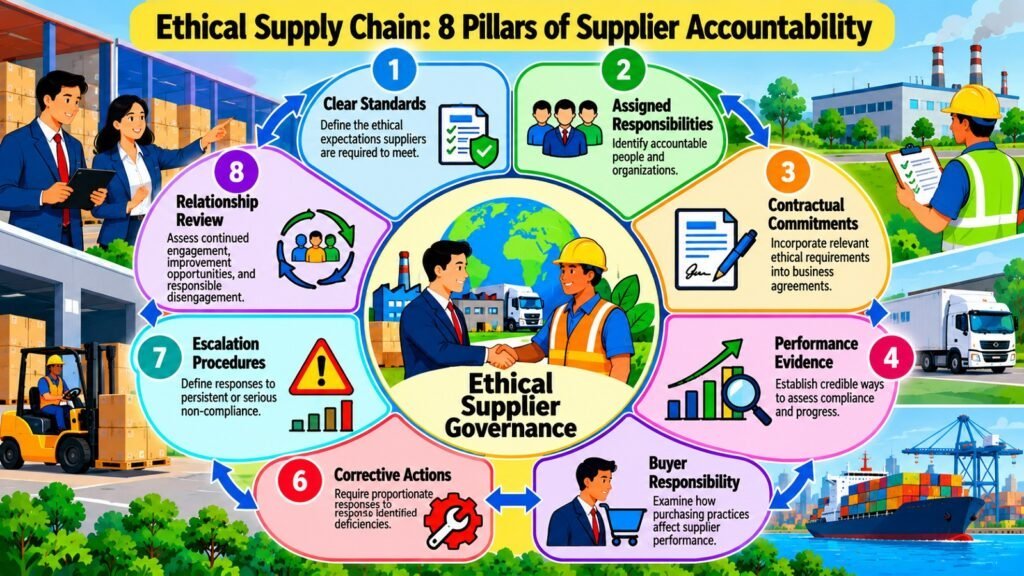
Supplier accountability is the governance system that sets responsibilities, ethical expectations, performance requirements, and responses to non-compliance across an Ethical Supply Chain. Its instruments include supplier codes of conduct, contractual provisions, qualification requirements, performance indicators, management reviews, corrective-action obligations, escalation procedures, and decisions about continuing or ending relationships. Governance of this kind translates ethical intent into allocated authority, budgets, and consequences, without which codes remain aspirational.
Written commitments do not demonstrate ethical conduct in practice; expectations must reach relevant supplier tiers, and responsibility for implementation, monitoring, evidence collection, and follow-up needs named owners. Compliance scores deserve particular caution, because they measure documented conformity and may diverge from workers’ experience. Communicating expectations through tiers is difficult because lower-tier suppliers rarely contract with the buyer, so reliance on first-tier suppliers to cascade requirements must be tested.
Accountability also runs toward the buyer, because unrealistic pricing, unstable orders, short lead times, delayed payments, and excessive production demands undermine the standards buyers impose, and OECD guidance recognizes that firms must examine their own contribution to harm. Putting all responsibility upon suppliers with weak negotiating capacity represents both an analytically inefficient approach and an ethically indefensible position. Academic researchers specializing in private regulatory frameworks have identified this fundamental contradiction, wherein purchasing entities mandate adherence to standards while simultaneously imposing commercial conditions that substantially increase compliance expenses.
Constructive responses include training, capability building, joint improvement plans, performance reviews, and proportionate consequences, and disengagement is sometimes necessary, but abrupt termination may leave workers or communities worse off, so likely consequences should shape the decision. Due diligence identifies and manages risk, whereas accountability establishes obligations, governance, and responses to failure. Before termination, alternatives such as time-bound improvement plans, remediation for affected workers, and responsible exit planning deserve examination.
Practical tests ask whether responsibilities are clearly assigned, expectations measurable, decisions consistent, and follow-up grounded in evidence, and compliance scores should be one input among several, never a verdict.
Table 7: Ethical Supply Chain Accountability Mechanisms
| Accountability Mechanism | Accountability Function |
| Supplier code of conduct | States minimum ethical expectations and the standards suppliers must meet |
| Contract clauses | Make expectations enforceable with defined audit and remedy rights |
| Performance indicators | Render conduct measurable tied to ethical, not only commercial, outcomes |
| Management review | Assigns internal oversight through accountable senior oversight |
| Corrective-action obligations | Require timely response to findings with deadlines and verification |
| Escalation procedures | Define consequences for persistent failure when improvement stalls repeatedly |
| Buyer-conduct review | Examines purchasing practices contributing to harm across pricing, ordering, and payment |
| Responsible disengagement | Weighs harm to workers before exit after assessing consequences for affected people |
7. Ethical Supply Chain: Grievance Mechanisms
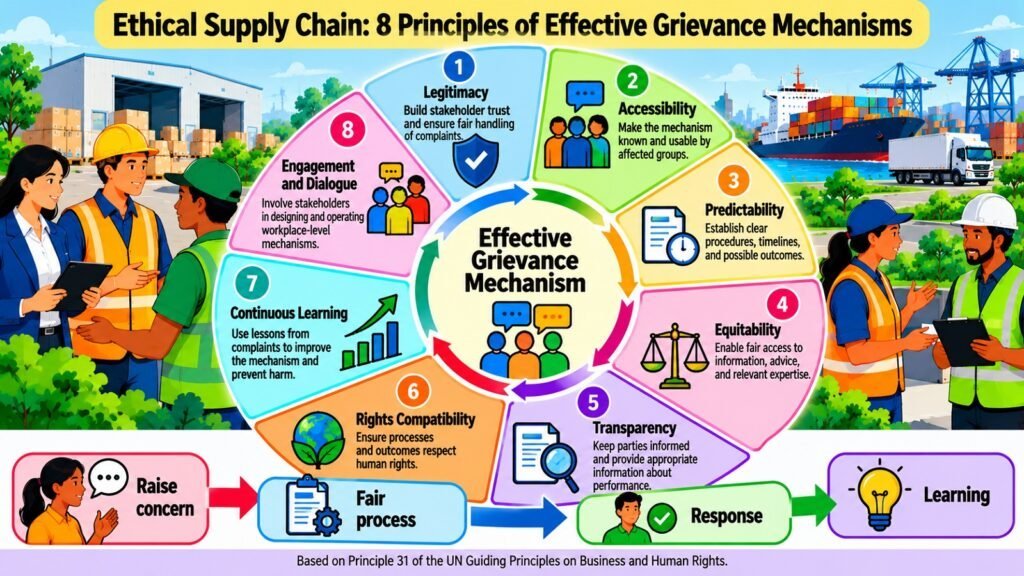
Grievance mechanisms allow workers, communities, and other stakeholders to raise concerns about actual or potential harm connected to an Ethical Supply Chain. They matter because audits and management systems can miss problems that affected people observe daily. Channels include workplace reporting systems, worker representatives, trade unions, confidential hotlines, independent complaint channels, and community-based mechanisms. Their value lies partly in early warning, since concerns raised internally can surface problems before they escalate into severe harm or public dispute.
Accessibility depends on language, literacy, disability, digital access, employment status, migrant status, cultural context, and, above all, trust in those who receive complaints. Principle 31 of the UN Guiding Principles sets effectiveness criteria for non-judicial mechanisms: legitimacy, accessibility, predictability, equity, transparency, rights compatibility, continuous learning, and, for operational-level mechanisms, engagement and dialogue. Mechanisms designed without consultation frequently fail on exactly these dimensions.
A channel’s existence does not establish its effectiveness, because confidentiality, anonymous reporting where feasible, protection against retaliation, impartial assessment, timely responses, documentation, and escalation determine whether workers actually use it. Company mechanisms complement rather than replace courts, regulators, and collective bargaining procedures. Trade union representation can provide stronger legitimacy than management-run channels because workers themselves govern it.
Under-reporting, fear of dismissal, conflicts of interest, weak investigations, and inadequate follow-up are recurrent failures. Low complaint numbers therefore cannot be read as evidence of ethical conditions, since silence may signal distrust. Worker participation in design and evaluation is essential for judging whether the mechanism is trusted. Usage patterns across worker groups, complainant outcomes, and survey evidence on trust give a fuller picture than counts alone.
Assessment criteria should ask whether stakeholders can reach the mechanism safely, understand its procedures, receive appropriate responses, and see improvements result. The focus here remains raising and handling concerns, leaving corrective action and remedy to the next section.
Table 8: Ethical Supply Chain Grievance Mechanism Criteria
| Effectiveness Criterion | Practical Significance |
| Legitimacy | Builds trust through accountable governance and stakeholder confidence |
| Accessibility | Reaches all groups despite barriers for migrants, women, and informal workers |
| Predictability | Provides clear procedures and timeframes so users know what happens next |
| Equity | Gives complainants fair access to information and expertise against more powerful respondents |
| Transparency | Keeps parties informed of progress and outcomes where confidentiality permits |
| Rights compatibility | Ensures outcomes respect recognized human rights and international human rights standards |
| Continuous learning | Uses complaints to improve systems and prevents repeated failures |
| Engagement and dialogue | Involves users in design and evaluation on process design and review |
8. Ethical Supply Chain: Ethical Remediation and Improvement
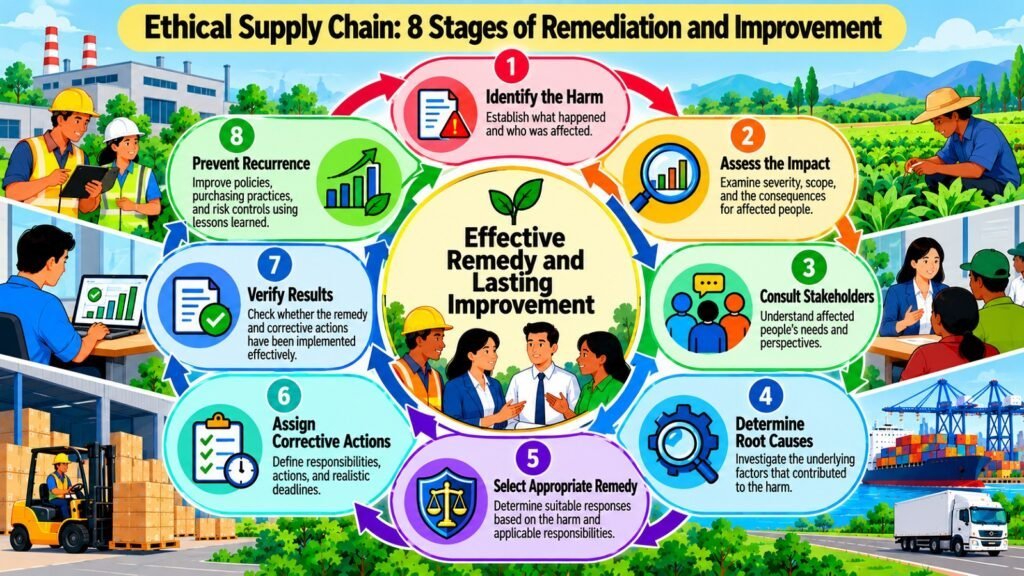
Ethical remediation addresses adverse impacts connected to an Ethical Supply Chain and, where appropriate, provides or cooperates in remedy for affected people. It differs from prevention, which seeks to avoid harm, and from mitigation, which reduces severity or likelihood; remediation concerns impacts that have already occurred. It also differs from grievance intake, since it focuses on addressing harm, restoring rights where possible, and improving systems. Remediation is where responsibility becomes concrete, because a firm’s connection to the harm determines whether it provides remedy, contributes to it, or uses leverage to encourage it.
Remedies include corrective-action plans, restitution, recovery of withheld wages, compensation, reinstatement where suitable, improved working conditions, and changes to recruitment practices. The appropriate form depends on the nature of the harm, the needs and rights of those affected, applicable law, and the business’s connection to the impact. Financial compensation cannot resolve every problem, and a completed action plan does not by itself prove that harm has been remedied.
Effective practice begins with root-cause analysis and consultation with affected stakeholders, followed by assigned responsibilities, realistic deadlines, measurable actions, independent verification where appropriate, and continued monitoring. Repeated findings may point to deeper problems in management incentives, supplier selection, purchasing practices, or governance. Self-reported improvement deserves scepticism, and the experiences of affected people are central to judging whether a remedy works, since remedies imposed without consultation can reproduce the power imbalances that produced the harm.
Learning completes the process: organizations can revise policies, build supplier capability, strengthen risk assessment, and test whether corrective actions prevent recurrence. Remediation thus returns evidence to every earlier foundation, linking the eight into a continuing cycle of responsibility and learning, consistent with OECD guidance and the UN Guiding Principles. Lessons should travel to purchasing and governance functions, not remain within compliance teams.
Table 9: Ethical Supply Chain Remediation Measures
| Remediation Measure | Purpose or Verification Requirement |
| Root-cause analysis | Identifies systemic drivers of harm rather than symptoms only |
| Stakeholder consultation | Shapes remedies around affected people’s needs and affected communities |
| Wage recovery | Restores withheld pay, verified through records paid in full to workers |
| Compensation | Addresses losses, with adequacy judged by those affected and non-financial restitution where relevant |
| Reinstatement | Restores employment where suitable and wanted without penalty or pressure |
| Recruitment reform | Prevents recurrence of fee-related debt and employer-paid hiring |
| Independent verification | Tests whether claimed improvements occurred that includes affected workers’ views |
| Ongoing monitoring | Detects recurrence and drives learning through audits and feedback |
Conclusion: Ethical Supply Chain – Building a Responsible Future
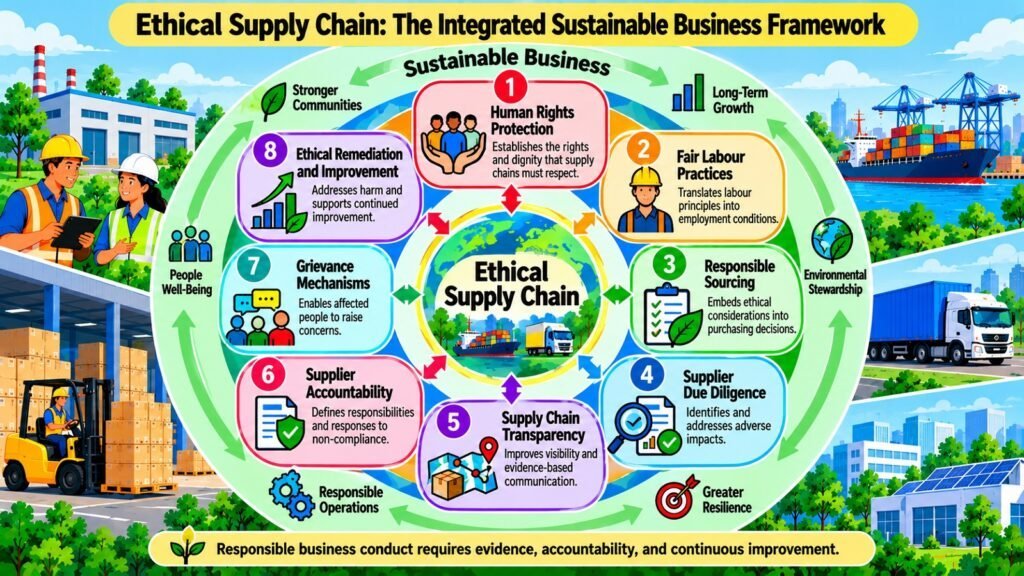
Ethical Supply Chain is an important foundation of Sustainable Business because responsible conduct must extend across supplier relationships and the wider supply network. The eight foundations form a connected framework: human rights protection establishes the rights to be respected, fair labour practices address employment conditions, responsible sourcing incorporates ethical criteria into purchasing, and supplier due diligence identifies and manages adverse impacts. Transparency improves visibility and communication, accountability establishes responsibilities and governance, grievance mechanisms enable affected stakeholders to raise concerns, and remediation addresses harm while supporting continuous improvement.
These foundations reinforce one another, and no single policy, audit, certification, disclosure, or supplier declaration suffices. The framework’s wider relevance lies in responsible corporate conduct, stakeholder relationships, risk management, and organizational resilience, although ethical practice neither guarantees profitability nor eliminates all harm. Credible evidence, meaningful engagement, critical assessment, monitoring, and corrective action remain the common requirements, while comparative analysis across sectors can test which combinations of foundations prove durable.
For researchers, the framework supports further study, comparative analysis, and research design, while practitioners can use it for evaluation. Readers should treat the explanations and assessment tools here as a starting point, not a substitute for specialized research or legal advice. Each foundation will connect to a corresponding sub-pillar article as further reading becomes available, and evidence should be gathered from workers and communities, not solely from management.
Table 10: Ethical Supply Chain Foundations Summary
| Ethical Supply Chain Foundation | Contribution to Responsible Business |
| Human Rights Protection | Defines the rights that must be respected across all business relationships |
| Fair Labour Practices | Secures decent employment conditions and fair treatment at work |
| Responsible Sourcing | Integrates ethics into purchasing into supplier selection |
| Supplier Due Diligence | Identifies and manages adverse impacts through continuing assessment |
| Supply Chain Transparency | Improves visibility and communication for verification and trust |
| Supplier Accountability | Establishes responsibilities and governance for performance and consequences |
| Grievance Mechanisms | Gives affected stakeholders a voice about harm and unmet needs |
| Ethical Remediation and Improvement | Repairs harm and drives learning from incidents into system change |