
Table of Contents
Introduction — Global Innovation: The Foundation of a Strong Global Economy
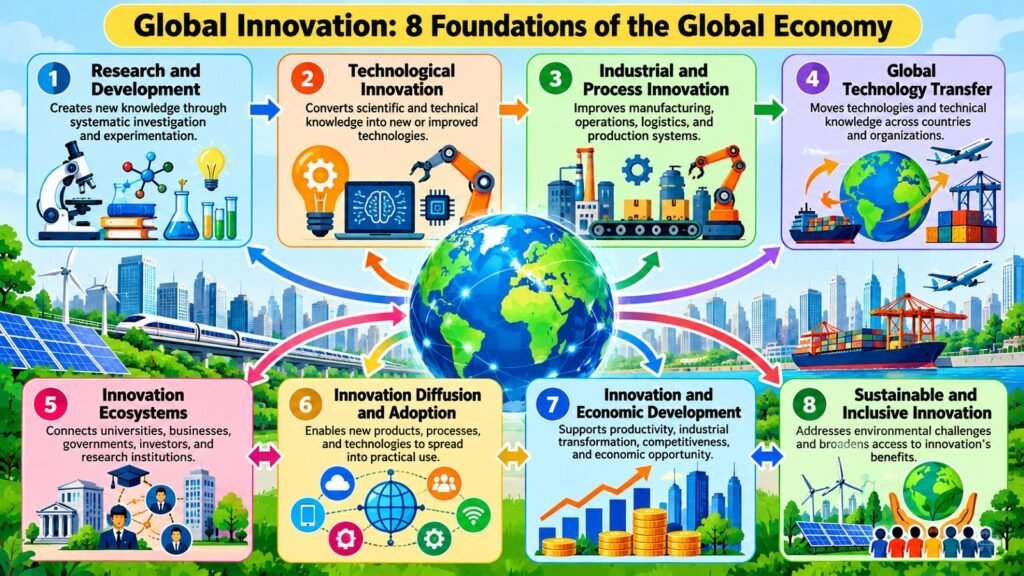
Global Innovation is one of the most important aspects of the Global Economy, because it determines how knowledge is converted into productivity, competitiveness, and rising living standards across borders. Innovation reaches well beyond business, entrepreneurship, and product development and also encompasses scientific research, technological advancement, industrial transformation, international knowledge exchange, economic development, and sustainable social progress, all of which interact within a connected system rather than a series of isolated breakthroughs.
That systemic character explains why the subject rewards sustained study. Innovation shapes productivity, employment, international economic relationships, and environmental outcomes, yet its benefits depend on how discoveries are developed, transferred, adopted, and translated into practice. Capabilities also differ sharply among countries, and WIPO’s Global Innovation Index, OECD statistics, and UNESCO science data consistently indicate that institutions, infrastructure, education, investment, and international cooperation account for much of the divergence. Treating innovation as a system clarifies why national performance depends on the connections among institutions, not on any single laboratory or firm.
Table 1: Eight Foundations of Global Innovation at a Glance
| Foundation of Global Innovation | Role in the Global Economy |
| Research and Development | Generates the scientific knowledge on which later innovation builds |
| Technological Innovation | Expands what economies can produce, compute, and connect |
| Industrial and Process Innovation | Raises efficiency and quality in production and delivery |
| Global Technology Transfer | Moves knowledge and know-how across national borders |
| Innovation Ecosystems | Link institutions, capital, and talent into working systems |
| Innovation Diffusion and Adoption | Converts availability into widespread productive use |
| Innovation and Economic Development | Translates new capabilities into growth and structural change |
| Sustainable and Inclusive Innovation | Aligns innovation with environmental limits and broad access |
This article examines eight foundations: research and development, technological innovation, industrial and process innovation, global technology transfer, innovation ecosystems, diffusion and adoption, economic development, and sustainable and inclusive innovation. These foundations reinforce one another, and the process is rarely linear, since adoption failures redirect research and ecosystem weaknesses constrain transfer. Each section combines theory, evidence, and an analytical framework that advanced readers can adapt, while treating those frameworks as heuristics rather than validated instruments.
1. Research and Development — Global Innovation Through Knowledge Creation
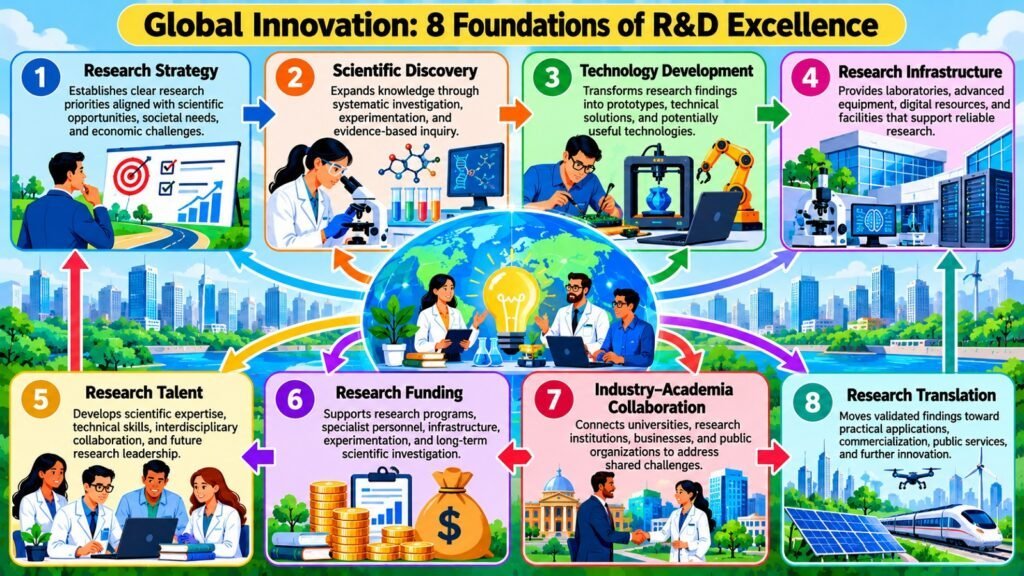
Research and development supplies the scientific and intellectual base on which Global Innovation rests. The OECD’s Frascati Manual separates basic research, which pursues understanding without a specific application, from applied research directed at a practical objective, and from experimental development, which uses existing knowledge to produce new materials, devices, or processes. The categories overlap in practice, yet each contributes differently: the first widens what is knowable, the second narrows the distance to use, and the third converts knowledge into prototypes.
Universities, public laboratories, corporate research units, and government programs divide this work unevenly across countries. Basic research is often publicly funded because its returns are diffuse and slow, a point central to Nelson’s and Arrow’s classic arguments about appropriability. The mRNA vaccines of the pandemic period illustrate the lag, since they drew on decades of foundational work recognized by the 2023 Nobel Prize in Physiology or Medicine. Endogenous growth theory, especially Romer’s 1990 model, links such knowledge accumulation to long-run productivity. Public support also matters because firms underinvest in research whose benefits spill over to competitors.
Table 2: R&D Dimensions Shaping Global Innovation
| R&D Dimension | Contribution to Global Innovation |
| Basic research | Expands fundamental scientific understanding |
| Applied research | Directs knowledge toward specific practical problems |
| Experimental development | Produces prototypes, materials, and processes |
| Universities | Train researchers and generate open scientific knowledge |
| Public research institutes | Sustain long-horizon and mission-oriented programs |
| Corporate laboratories | Commercialize findings and finance development at scale |
| International collaboration | Pools costly infrastructure, as in CERN’s shared facilities |
| Research funding agencies | Allocate competitive support through peer review |
Capacity differs widely. UNESCO Institute for Statistics data show R&D intensity above 4 percent of GDP in Israel and South Korea, against well under 1 percent in many low-income economies. Spending, however, is an input rather than an outcome, and research quality, institutional coordination, incentives, and the ability to exploit discoveries determine returns. Bloom and colleagues (2020) found that research productivity has declined in several fields even as effort has risen.
A practical R&D capability assessment can structure comparison across five dimensions: funding, scientific talent, infrastructure, institutional collaboration, and knowledge outputs. Scoring each dimension against a common benchmark exposes imbalances, such as generous funding paired with a thin talent pipeline. The framework is analytical rather than validated, and it inherits the weaknesses of its indicators. Publication counts ignore quality, expenditure ignores efficiency, and long time lags separate effort from measurable payoff, so interpretation demands caution. Interpretation therefore requires pairing quantitative scores with qualitative institutional judgment.
2. Technological Innovation — Global Innovation Through Breakthrough Technologies
Technological innovation expands what the global economy can do by creating or substantially improving technologies. Artificial intelligence, semiconductors, biotechnology, robotics, advanced materials, telecommunications, computing, and energy technologies each open new capabilities while upgrading existing goods and services. These processes are linked but distinct: scientific discovery explains phenomena, engineering designs solutions under constraints, and technological development packages those solutions into reliable artifacts that practical applications then test. Practical implementations materialize exclusively when these phases establish reciprocal relationships with one another, exemplified by instances wherein production challenges recalibrate investigative objectives.
Theories of technological change, including Nelson and Winter’s evolutionary account and Arthur’s work on increasing returns, stress cumulative learning and path dependence. Capabilities therefore translate into competitiveness, productivity potential, and resilience unevenly. Semiconductor fabrication shows the strategic stakes, with advanced manufacturing heavily concentrated in Taiwan and South Korea, a pattern that creates supply dependencies for every importing economy. Further barriers include high development costs, shortages of technical skills, cybersecurity exposure, and unequal access, all of which reinforce concentration in a few countries and firms.
Table 3: Technology Fields Driving Global Innovation
| Technology Field | Potential Economic Application |
| Artificial intelligence | Automating analysis, translation, and diagnostic support |
| Semiconductors | Enabling computing, communications, and automotive electronics |
| Biotechnology | Developing vaccines, biologics, and improved crop varieties |
| Robotics | Automating assembly, warehousing, and hazardous tasks |
| Advanced materials | Lightening vehicles and improving battery components |
| Telecommunications | Extending connectivity for commerce and public services |
| Computing | Supporting simulation, cloud services, and data processing |
| Energy technologies | Lowering the cost of solar, wind, and storage |
Empirical documentation demonstrates the expansive sectoral penetration of these innovations, with the International Energy Agency recording substantial reductions in expenditures for solar photovoltaic systems and battery technologies, International Telecommunication Union statistics documenting the proliferation of mobile broadband infrastructure, and the World Intellectual Property Organization’s World Intellectual Property Indicators monitoring patent applications throughout diverse technological domains. Improving a technology, however, differs from changing production methods, moving it across borders, or achieving widespread adoption, which later sections treat separately. Sector effects diverge sharply, because digital technologies spread across services quickly while biotechnology and energy systems face lengthy regulatory and capital-intensive pathways.
A technology maturity assessment compares candidate technologies on technical performance, reliability, scalability, affordability, infrastructure requirements, and suitability for particular applications. It helps researchers rank possibilities consistently, but maturity is not destiny, since technically superior options sometimes fail commercially while modest ones spread widely. Indicators also mislead, since patent counts vary in value, differ across legal systems, and miss tacit knowledge, so no single measure captures Global Innovation in full. Field reliability often matters more than laboratory benchmarks.
3. Industrial and Process Innovation — Global Innovation in Production and Operations
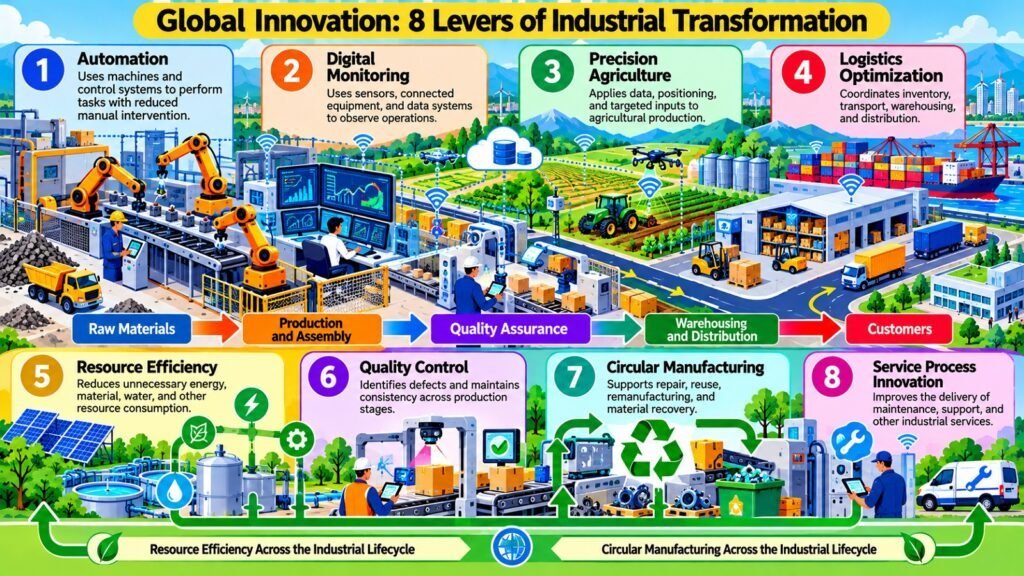
Industrial and process innovation changes how goods and services are produced, processed, transported, distributed, and delivered. It spans manufacturing systems, automation, precision agriculture, logistics, resource-efficient production, quality control, and service delivery. The distinction from technological innovation matters: a technology exists once it is invented, whereas process innovation occurs when firms combine technologies, organizational knowledge, and refined methods to alter how economic activity is actually carried out. Because such improvements are embedded in routines and skills, they are harder to imitate than equipment and often diffuse more slowly.
Research on production systems, from Womack and colleagues’ study of lean manufacturing to scholarship on organizational learning, shows that process gains often depend on managerial practice as much as machinery. The standardized shipping container, analyzed in Levinson’s history, reshaped global supply chains without any dramatic scientific advance. Better processes reduce costs, improve quality and flexibility, and conserve resources, yet they also widen gaps between countries with deep industrial capabilities and economies still modernizing production.
Table 4: Process Innovation Areas in Global Innovation
| Process Innovation Area | Operational Implication |
| Lean manufacturing | Reduces waste and shortens production cycles |
| Industrial automation | Raises consistency and throughput while displacing tasks |
| Precision agriculture | Targets water, fertilizer, and pesticide inputs |
| Containerized logistics | Lowers handling costs and speeds freight movement |
| Statistical quality control | Detects defects and reduces variation |
| Predictive maintenance | Anticipates equipment failure and limits downtime |
| Additive manufacturing | Enables low-volume, customized, and complex parts |
| Digital service delivery | Extends banking, education, and health access remotely |
Evidence extends well beyond factories. The International Federation of Robotics reports more than half a million new industrial robots installed annually, while OECD and UNIDO analyses document comparable changes in precision agriculture, energy systems, hospital logistics, and rail operations. Costs matter, however, because implementation expenses, infrastructure limits, workforce displacement, retraining needs, and energy use can offset benefits, and efficiency gains may trigger rebound effects that raise total resource consumption.
A process comparison framework evaluates an existing process and an alternative using productivity, quality, cost, resource use, and waste. Three safeguards are essential: select comparable measurements, establish a baseline before the change, and account for external influences such as demand shifts or input prices. Even then, a before-and-after comparison remains descriptive, and attributing improvement causally requires controls, comparison groups, or quasi-experimental designs. Where a baseline cannot be reconstructed, analysts should say so plainly instead of inferring gains.
4. Global Technology Transfer — Global Innovation Across National Borders
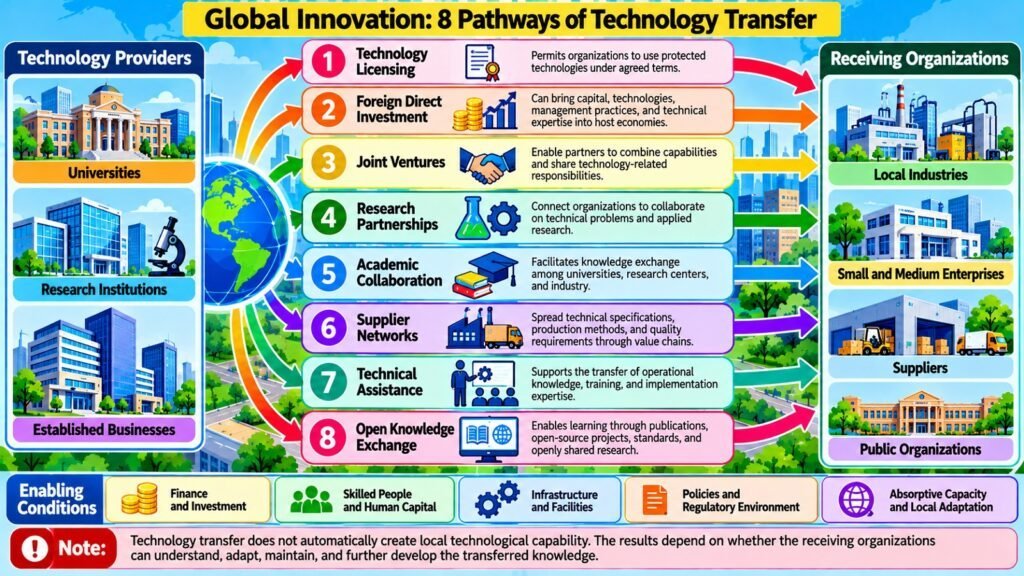
Global Innovation advances across borders through the movement of technologies, scientific knowledge, technical expertise, intellectual property, and practical know-how. Principal channels include international licensing, foreign direct investment, research partnerships, academic exchange, technology agreements, multinational production networks, and development programs. Crossing a border, however, is only the first step, since domestic adaptation and broad adoption of transferred knowledge follow separately and determine whether capability actually accumulates.
Academic research on knowledge spillovers and technological diffusion provides the analytical framework necessary for understanding these phenomena. The seminal 1995 work by Coe and Helpman established a connection between a nation’s productivity levels and the foreign research and development capital stocks, demonstrating that these effects are more pronounced in economies characterized by greater openness to international trade. Cohen and Levinthal’s concept of absorptive capacity explains why imported equipment or patents alone rarely suffice: recipients need technical skills, research capacity, supportive infrastructure, financing, and institutions able to adapt external knowledge to local needs. Technological learning, as Linsu Kim described it for Korea, is deliberate and cumulative. Transfer is therefore better understood as interactive learning than as a one-way shipment of technology.
Table 5: Transfer Mechanisms in Global Innovation
| Transfer Mechanism | Role in Cross-Border Innovation |
| Technology licensing | Grants legal access to patented methods and designs |
| Foreign direct investment | Brings equipment, management practice, and training |
| Joint ventures | Pair local knowledge with foreign technical expertise |
| Research partnerships | Share costs, data, and scientific capacity |
| Academic exchange | Moves skilled people and tacit knowledge |
| Capital goods imports | Embed foreign technology in machinery and equipment |
| Multinational supply chains | Diffuse standards and quality requirements to suppliers |
| Development cooperation | Funds capacity building in lower-income economies |
Documented cases span renewable energy, agriculture, healthcare, digital infrastructure, and manufacturing. UNCTAD and World Bank studies describe how licensing and joint ventures shaped industrial upgrading in East Asia, and the Montreal Protocol’s Multilateral Fund financed the substitution of ozone-depleting substances in developing countries. Risks accompany these gains, including technological dependence, unequal bargaining power, limited knowledge sharing, and restrictive access conditions. Continuing WIPO and WTO debates over intellectual property show how contested the terms remain. Evidence of success is strongest where recipients invested in engineers and suppliers alongside imported capital.
A technology transfer readiness assessment examines technical compatibility, local skills, financing, intellectual property arrangements, infrastructure, and opportunities for domestic learning. Researchers can apply it to compare competing arrangements and locate binding constraints. Its limits are considerable, because informal knowledge flows, such as worker mobility and observation, resist measurement, and transfer effects are hard to separate from simultaneous policy or market changes.
5. Innovation Ecosystems — Global Innovation Through Collaboration and Institutions
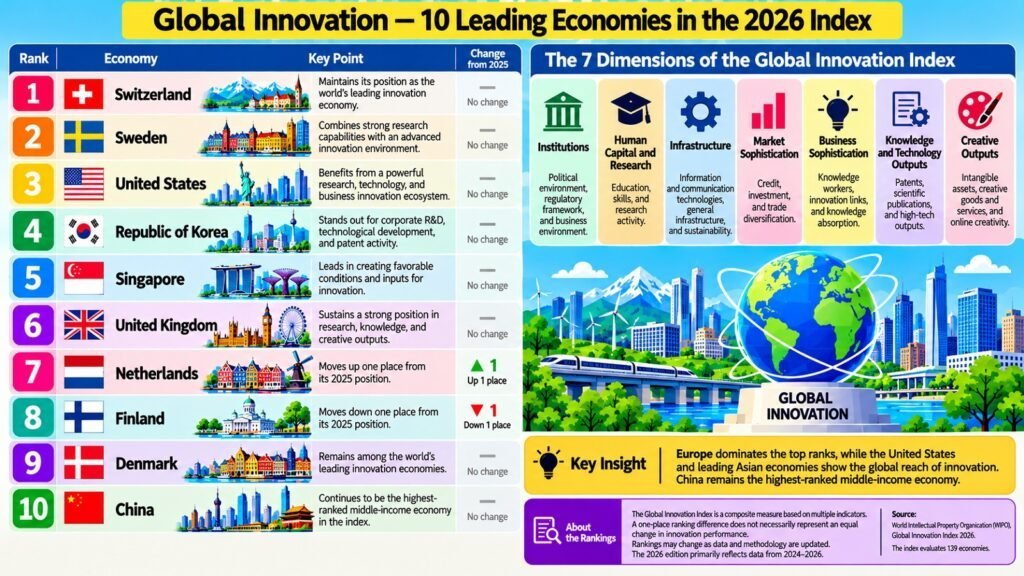
An innovation ecosystem connects the institutions, resources, relationships, and capabilities that support the creation and development of innovations. Governments, universities, research institutions, firms, investors, entrepreneurs, technical communities, infrastructure providers, and international organizations all participate. The ecosystem is not their sum but a system of interactions, incentives, knowledge flows, and institutional conditions, so weak connections can neutralize strengths in individual institutions. Geography matters because proximity eases the exchange of tacit knowledge, yet digital networks and international collaboration increasingly extend ecosystems beyond a single city.
This view draws on the national innovation systems literature of Freeman, Lundvall, and Nelson, on institutional economics, and on research about the link between public science and industrial capability. Education, research funding, access to capital, skilled labour, infrastructure, regulation, intellectual property arrangements, and collaboration all shape capacity. Saxenian’s comparison of Silicon Valley and Route 128 suggested that open, networked regional cultures outperformed more insular corporate hierarchies, although later scholars have qualified that account.
Table 6: Ecosystem Components of Global Innovation
| Ecosystem Component | Enabling Role |
| Research universities | Produce knowledge and skilled graduates |
| Government agencies | Fund research and set regulatory conditions |
| Venture and risk capital | Finance high-uncertainty commercialization |
| Technology firms | Convert knowledge into marketable products |
| Intellectual property systems | Define rights that reward and disclose invention |
| Technology transfer offices | Link academic discoveries to commercial partners |
| Digital and physical infrastructure | Enable communication, testing, and production |
| Standards bodies | Secure interoperability and market confidence |
Comparative evidence comes from WIPO’s Global Innovation Index, which has ranked Switzerland first for well over a decade, and from OECD, UNESCO, and World Bank publications. Documented systems include Finland’s coordinated public and private research funding and Israel’s Yozma program, launched in 1993 to stimulate venture capital. Success rarely traces to one policy or institution, however, and the Bayh-Dole Act in the United States, for instance, operated alongside deep research universities and capital markets.
An ecosystem mapping framework identifies key actors, resources, relationships, knowledge flows, and institutional bottlenecks, then compares maps across regions or periods. It describes the conditions in which R&D, technology transfer, and adoption occur rather than those activities themselves. A descriptive map cannot establish causation, and it overlooks the informal ties that often matter most. Comparative mapping is most useful when it records the strength of ties, not merely their existence, and when it distinguishes formal from informal connections.
6. Innovation Diffusion and Adoption — Global Innovation in Widespread Use
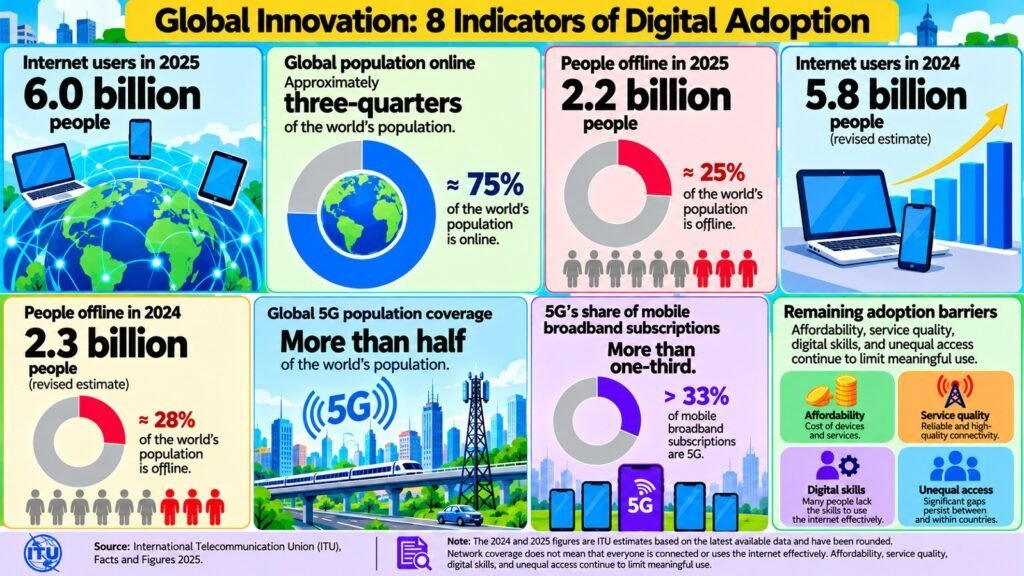
Diffusion is the process through which innovations spread from developers and early users to other organizations, communities, industries, and countries. Availability, adoption, sustained use, and effective integration are distinct stages, and a technology may be sold widely yet used superficially. Affordability, infrastructure, skills, trust, regulation, compatibility, incentives, and local conditions determine how far each stage is reached. Diffusion is rarely smooth, since adopters differ in resources and risk tolerance, and early users often shape standards that later adopters inherit.
Rogers’s diffusion of innovations framework, Katz and Shapiro’s work on network effects, and Cohen and Levinthal’s absorptive capacity explain why an identical technology can spread rapidly in one setting and stall in another. Communication networks, markets, professional communities, supply chains, public programs, and international cooperation carry knowledge, while training, maintenance, financing, local adaptation, and complementary infrastructure decide whether adoption yields practical benefits. Local adaptation frequently determines success, because products designed for one market seldom fit another without modification.
Table 7: Adoption Barriers in Global Innovation
| Adoption Barrier | Effect on Innovation Uptake |
| Limited access | Excludes populations lacking connectivity or electricity |
| Affordability | Delays purchase of devices, services, and equipment |
| Skills gaps | Reduce capacity to operate and maintain technology |
| Low trust | Discourages use of digital payments and health tools |
| Weak infrastructure | Undermines reliability of dependent technologies |
| Regulatory uncertainty | Raises compliance risk for firms and users |
| Incompatibility | Increases switching costs with legacy systems |
| Institutional resistance | Slows organizational change and process redesign |
Digital connectivity illustrates both progress and gaps, as ITU estimates that roughly 2.6 billion people remained offline in 2024 despite rapid growth in mobile broadband. The World Bank’s Global Findex 2021 recorded that 76 percent of adults worldwide held an account, aided by mobile money such as Kenya’s M-Pesa, which Suri and Jack (2016) estimated had lifted about 2 percent of Kenyan households out of poverty. Adoption nonetheless offers no guarantee of productivity or welfare gains, as digital divides, cost constraints, and institutional resistance demonstrate.
An adoption barrier analysis examines access, affordability, skills, trust, infrastructure, institutional readiness, and compatibility. Applied across countries, sectors, or populations, it separates initial uptake from sustained, effective use, which is what ultimately matters for productivity. Adoption indicators, however, record presence rather than quality of use, and observed patterns seldom reveal causal effects because early adopters differ systematically from late ones.
7. Innovation and Economic Development — Global Innovation as a Driver of Growth
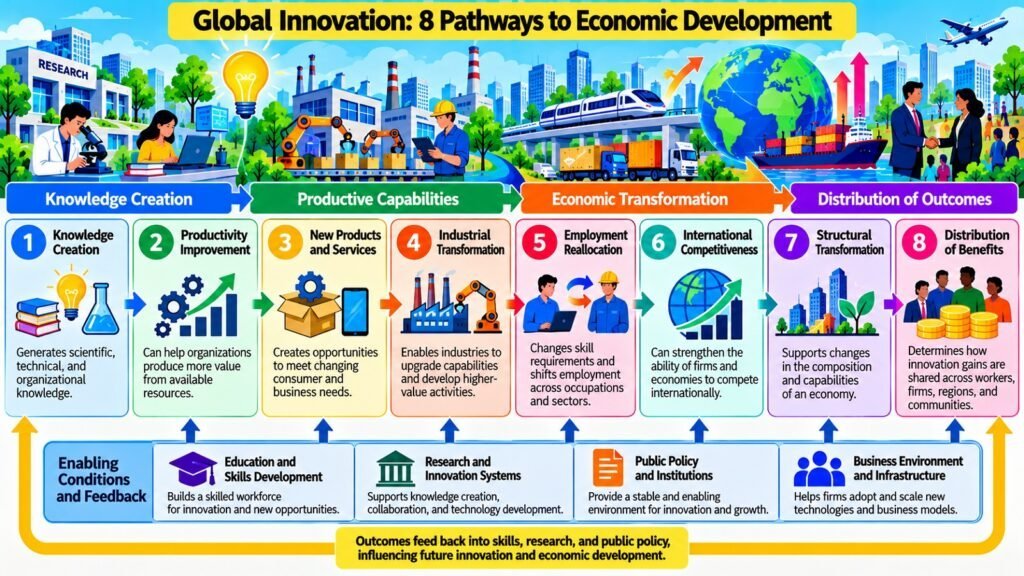
Global Innovation influences productivity, growth, employment, wages, industrial competitiveness, structural transformation, and living standards. New knowledge, better technologies, and more effective production methods support new industries, improve existing activities, and change the composition of national economies. A careful analyst separates potential effects from demonstrated ones, because many claimed benefits rest on correlation or on forecasts. Measurement is difficult because innovation’s contribution is partly captured in quality improvements and new products that conventional output statistics record poorly.
Solow’s growth accounting attributed much of long-run output growth to technical change, Romer and Aghion and Howitt formalized endogenous mechanisms, and Schumpeter’s creative destruction emphasized displacement alongside renewal. Human capital, institutions, infrastructure, investment, trade, and technological capabilities condition these dynamics. Advanced economies push the frontier, emerging economies combine imitation with upgrading, and developing economies often face foundational constraints, so no single development pathway can be assumed. Empirical work also shows that returns to innovation depend on the absorptive capacity of the economy, which links this section to adoption.
Table 8: Economic Outcomes Linked to Global Innovation
| Economic Outcome | Relationship to Global Innovation |
| Productivity growth | Rises with improved technology and organization, often after lags |
| Employment | Shifts as innovation creates and displaces tasks |
| Wages | Reflect skill demand, which innovation reshapes |
| Structural transformation | Moves resources toward higher-productivity activities |
| Industrial competitiveness | Depends on technological capability and learning |
| Income inequality | Can widen when gains favor skilled workers or capital owners |
| Regional disparities | Reflect geographic clustering of innovation activity |
| Market concentration | Follows scale advantages in knowledge-intensive sectors |
OECD and World Bank evidence documents persistent productivity gaps between frontier firms and laggards. Trade-offs are well recorded as well, and Acemoglu and Restrepo found that exposure to industrial robots in the United States reduced employment and wages in affected local labour markets, and an IMF analysis estimated that about 40 percent of global employment is exposed to artificial intelligence, rising to roughly 60 percent in advanced economies. Market concentration, regional disparities, and lags before productivity gains become measurable complicate any optimistic narrative.
An economic impact assessment framework organizes analysis around productivity, employment, wages, industrial composition, distributional effects, and context. It helps readers structure inquiry, but correlation must be distinguished from causation by considering confounders, time lags, and measurement differences. Innovation should never be presented as an automatic guarantee of growth or equity.
8. Sustainable and Inclusive Innovation — Global Innovation for Shared Progress
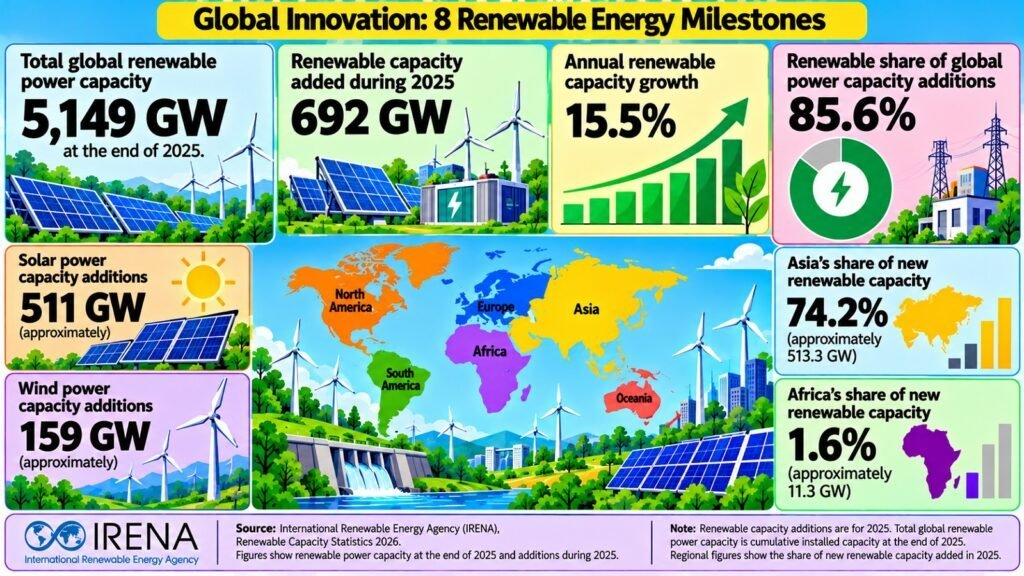
Global Innovation can advance environmental sustainability, social inclusion, economic resilience, and living standards. Clean energy, low-carbon technologies, circular production, resource efficiency, sustainable agriculture, affordable healthcare, and accessible education all illustrate this potential. Economic value therefore cannot be the sole criterion, and environmental effects, accessibility, affordability, and the distribution of benefits belong in any serious assessment. Inclusion extends beyond access to affordability, usability, and relevance, since a technology priced or designed for wealthier users may leave poorer populations unserved.
Research on sustainable innovation, environmental economics, and inclusive development shows that technological change supports climate mitigation and adaptation, eases resource pressures, and broadens access to essential services only under supportive conditions. Public policy, international cooperation, appropriate financing, institutional capacity, and inclusive design prove decisive. Acemoglu, Aghion, Bursztyn, and Hemous argued in 2012, through their model of directed technical change, that policy can redirect innovation toward cleaner technologies. Evaluating outcomes therefore requires attention to who gains, who bears costs, and over what time horizon.
Table 9: Sustainable and Inclusive Applications of Global Innovation
| Innovation Application | Sustainability or Inclusion Objective |
| Solar and wind power | Decarbonize electricity generation |
| Electric vehicles | Reduce transport emissions |
| Circular production | Recover materials and cut waste |
| Drip irrigation | Conserve water in agriculture |
| Mobile health services | Extend care to remote communities |
| Off-grid solar systems | Provide electricity where grids are absent |
| Mobile money | Broaden financial inclusion |
| Open educational resources | Widen access to learning materials |
The IEA reports that electric cars grew from a marginal share of new sales a decade ago to roughly one in five globally in 2024, and solar power has become among the cheapest sources of new electricity in many markets, yet trade-offs persist. The Global E-waste Monitor 2024, produced by UNITAR and ITU, recorded 62 million tonnes of electronic waste in 2022, with only about 22 percent documented as formally collected and recycled. Resource-intensive production, unequal access, and affordability constraints can concentrate benefits among wealthier countries and populations.
A sustainability and inclusion assessment examines environmental effects, resource use, accessibility, affordability, distributional consequences, and the needs of affected populations. It helps identify benefits, costs, and trade-offs, but it cannot replace formal environmental or social impact assessment. Its concerns also differ from the growth analysis of the preceding section, since an innovation may raise output while degrading ecosystems or excluding vulnerable groups.
Conclusion — Global Innovation and the Future of the Global Economy
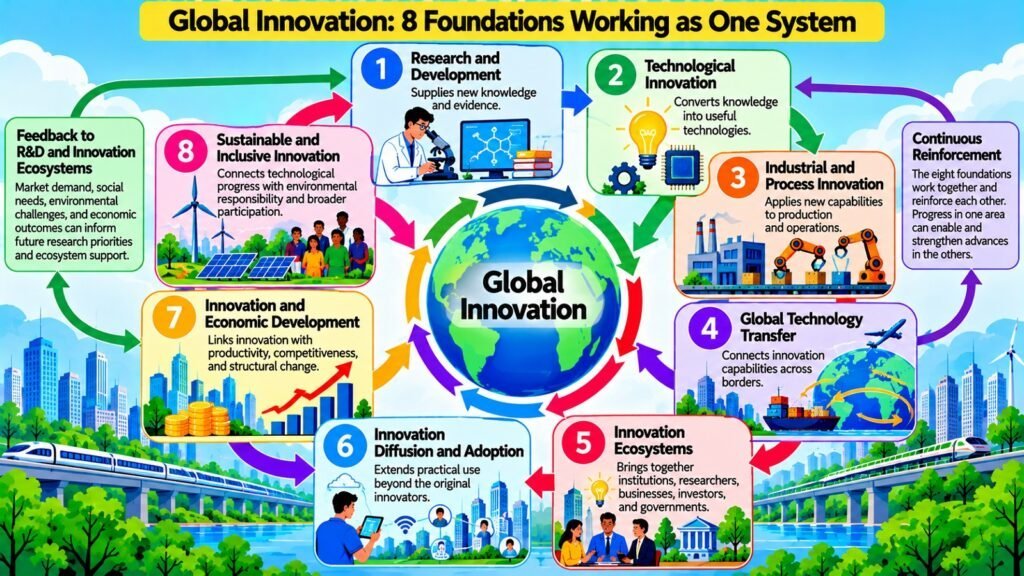
The eight foundations of Global Innovation operate as a connected system. Research creates knowledge, technological innovation turns it into capability, process innovation embeds capability in production, and technology transfer carries it across borders. Ecosystems coordinate the actors involved, diffusion extends use, economic development registers the aggregate outcome, and sustainable and inclusive innovation tests whether that outcome is broadly beneficial. The foundations interact continuously rather than in sequence, which is why relationships among them matter as much as any single one.
Central insight is that innovation creates possibilities without guaranteeing results. Effects depend on institutional conditions, technological capabilities, access to resources, policy choices, and the capacity to adopt and adapt knowledge. Balanced evaluation must therefore weigh productivity gains against international inequalities, labour-market changes, environmental pressures, and the uneven distribution of economic opportunities.
Table 10: Collective Contribution of the Foundations of Global Innovation
| Global Innovation Foundations | Contribution to the Global Innovation System |
| Research and Development | Supplies the knowledge stock that sustains long-run progress |
| Technological Innovation | Converts knowledge into usable capability |
| Industrial and Process Innovation | Embeds capability in efficient production |
| Global Technology Transfer | Spreads capability across national boundaries |
| Innovation Ecosystems | Coordinate actors, finance, and institutional support |
| Diffusion and Adoption | Determine how widely capability becomes productive use |
| Innovation and Economic Development | Reveals aggregate effects on growth and structure |
| Sustainable and Inclusive Innovation | Checks that gains are durable and broadly shared |
The frameworks introduced in this article are tools for structured comparison rather than instruments with proven predictive power. Used together, they help researchers evaluate innovation systems, compare countries, scrutinize policy choices, and frame further questions, such as how ecosystem design affects diffusion or how transfer conditions shape inclusion. They also expose where evidence is weakest, which is where new research is most needed.
Looking ahead, the Global Economy will reward countries that strengthen research collaboration, build technological capabilities, widen access to innovation, and steer progress toward resilient, inclusive, and sustainable economic development.