Table of Contents
Internet Technology as the Backbone of Modern Technology
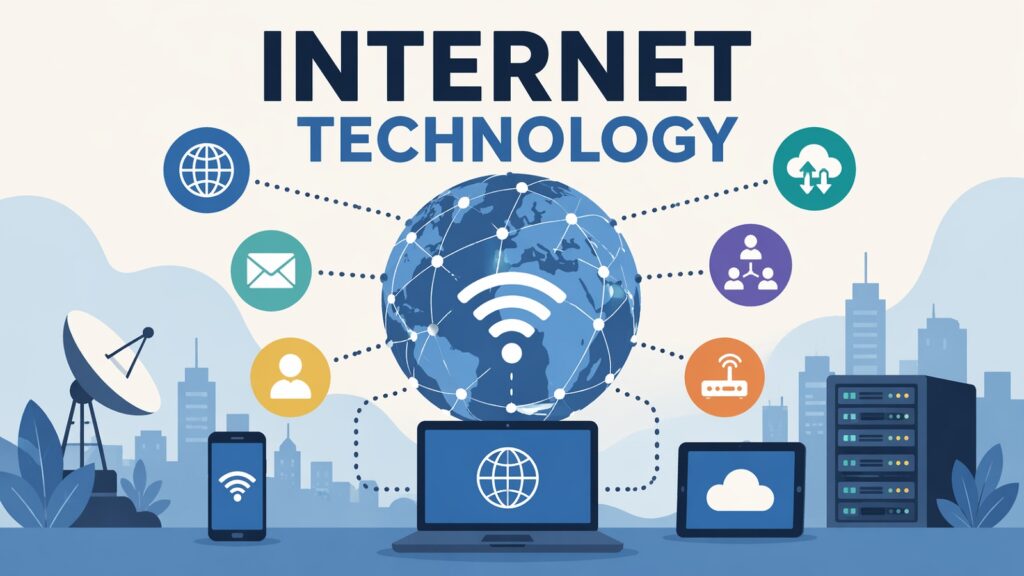
There is something quietly remarkable about the way the internet has folded itself into everyday life. You wake up, check your phone, send a message, read the news, and pay a bill — all before breakfast. None of this would be possible without Internet Technology, a vast and layered system that connects devices, people, and data across the entire world. In many ways, the Internet is an important aspect of modern technology, shaping how we interact with the digital world every single day.
Internet Technology is not a single invention. It is a combination of protocols, physical infrastructure, software systems, and agreed-upon rules that all work together without most people ever noticing. It shapes how businesses operate, how governments communicate, how students learn, and how families stay in touch across continents, reinforcing its central role within modern technology.
At its heart, Internet Technology is about moving information reliably and quickly between two points anywhere on earth. Whether you are streaming a film, running a video call, or simply searching for a recipe, the same underlying foundations make it possible.
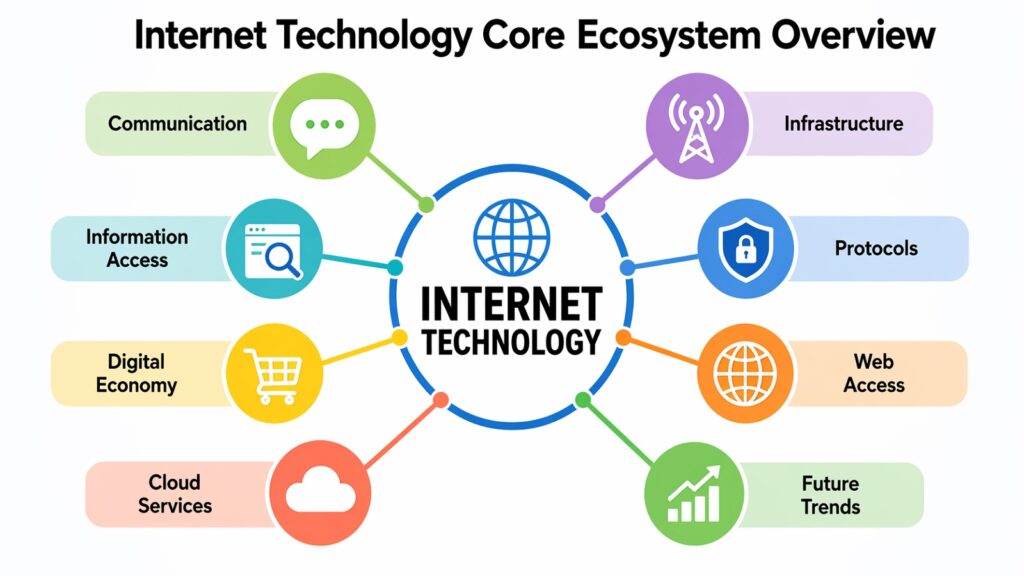
This article walks through eight of those foundations. From the basic concept of what Internet Technology actually is, to the physical cables buried under oceans, to the future trends reshaping connectivity — each section builds a clearer picture of how this invisible system works and why it matters.
Table 1: Internet Technology at a Glance — Eight Foundations
| Foundation | What It Covers |
| What Is Internet Technology | The core concept of connecting devices, people, and data across global networks |
| Evolution of the Internet | The journey from early research networks to today’s mobile and broadband world |
| Global Data Flow | How data packets travel between devices and servers across the world |
| Internet Infrastructure | Physical systems including undersea cables, data centers, and satellites |
| Internet Protocol | The addressing and rule system that allows devices to communicate reliably |
| Domain Name System | The translation layer that converts website names into machine-readable addresses |
| Internet-Based Services | Cloud computing, video streaming, and AI systems powered by internet connectivity |
| Future of Internet Technology | Emerging trends such as 5G expansion, satellite internet, and AI-driven networks |
1. What Is Internet Technology: Understanding the Core Concept
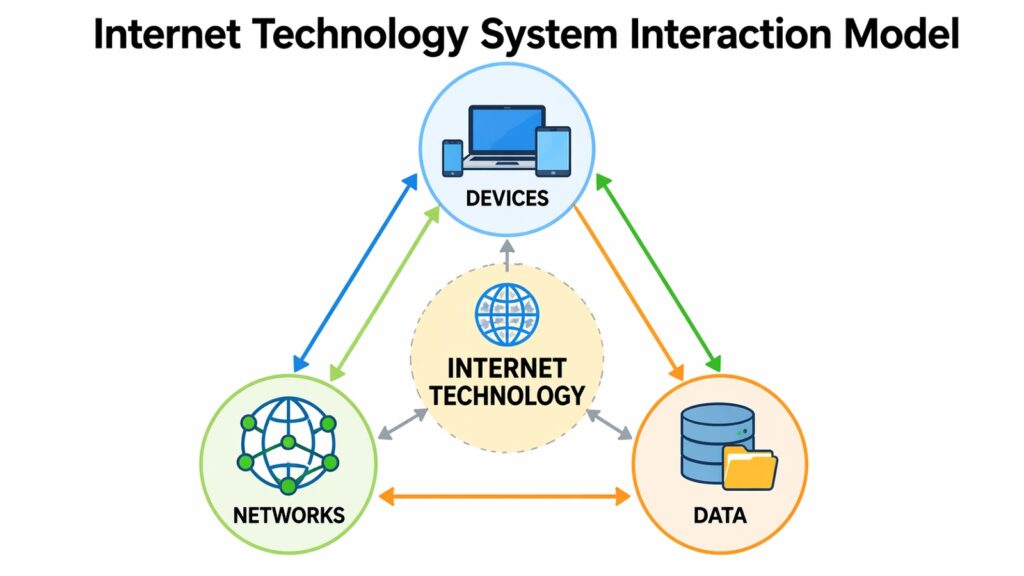
Internet Technology, at its simplest, is the collection of tools, systems, and rules that allow computers and devices to connect and share information with each other. It is not one thing but many things working in coordination, like instruments in an orchestra that produce something greater than any single part.
When you send an email or open a webpage, your device reaches out across a network to find another device or server somewhere else in the world. Internet Technology is the reason that connection happens at all, and the reason it happens in milliseconds rather than days.
The internet itself is a network of networks. It connects millions of smaller private networks — homes, offices, universities, and data centers — into one enormous global system. Internet Technology is the framework that makes this possible, including everything from the hardware that carries signals to the software that organises them.
Understanding the Internet Technology Framework means understanding that it is both physical and logical. There are real cables and machines involved, but there are also rules and languages that devices follow to make sense of each other. Together, these create the seamless experience most people take for granted every day.
Table 2: Internet Technology — Core Concepts and Definitions
| Term | Explanation |
| Network | A group of connected devices that can share information with each other |
| Internet | A global system of interconnected networks sharing common communication protocols |
| Device | Any hardware that connects to the internet, including computers, phones, and servers |
| Server | A powerful computer that stores data and responds to requests from other devices |
| Bandwidth | The maximum amount of data that can be transmitted over a connection in a given time |
| Latency | The time delay between sending a request and receiving a response across the network |
| Protocol | A set of agreed rules that devices follow to communicate with each other reliably |
| Data Packet | A small unit of data sent across a network, reassembled at the destination |
2. Evolution of Internet Technology: From Simple Networks to Global Systems
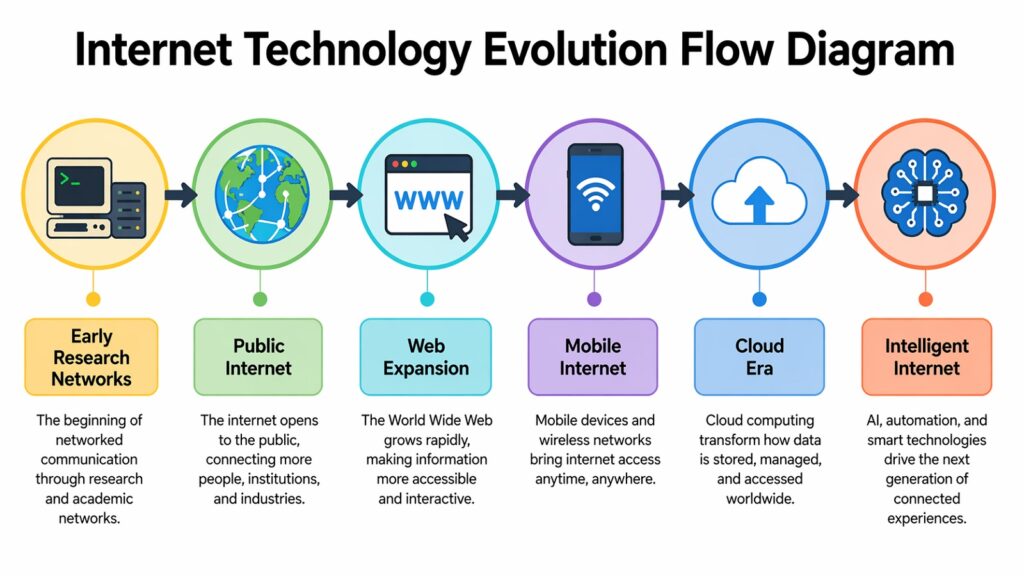
Internet Technology did not arrive fully formed. It grew slowly, in stages, shaped by researchers, engineers, and eventually billions of ordinary users who simply wanted to communicate more easily.
The story begins in the late 1960s with ARPANET, a project funded by the United States Department of Defense. ARPANET connected a handful of university computers and allowed them to share data. It was modest in scale but significant in idea — a network that could survive disruption by routing information along multiple paths.
Through the 1970s and 1980s, Internet Evolution happened quietly. New protocols were developed, more institutions joined the network, and the concept of a shared global system began to take shape. The introduction of TCP/IP as a standard communication protocol in 1983 was a turning point, giving the growing network a common language.
The 1990s changed everything. Tim Berners-Lee introduced the World Wide Web in 1991, making the internet accessible to people who were not engineers. Browsers, email services, and search engines followed. By the late 1990s, millions of households in richer countries had internet access. Internet Technology had become a public utility rather than a research tool.
The 2000s brought broadband connections and social media. The 2010s brought smartphones and mobile internet, which extended connectivity to billions more people, particularly in Asia and in Africa. Today, Internet Technology supports everything from e-commerce and telemedicine to remote work and online education, and it continues to grow.
Table 3: Key Milestones in the Evolution of Internet Technology
| Year / Period | Development |
| 1969 | ARPANET established — first network linking computers at four US universities |
| 1983 | TCP/IP adopted as the standard protocol, giving the internet a universal language |
| 1991 | World Wide Web introduced by Tim Berners-Lee, enabling public web browsing |
| 1993 | Mosaic browser released, making the internet visually accessible to general users |
| Late 1990s | Dial-up internet reaches millions of homes; e-commerce and email become mainstream |
| Early 2000s | Broadband connections replace dial-up; social media platforms begin to emerge |
| 2007–2010 | Smartphones and mobile internet extend connectivity to billions more users globally |
| 2020s | 5G networks, satellite internet, and AI-driven services reshape global connectivity |
3. Global Data Flow in Internet Technology: How Information Moves Worldwide
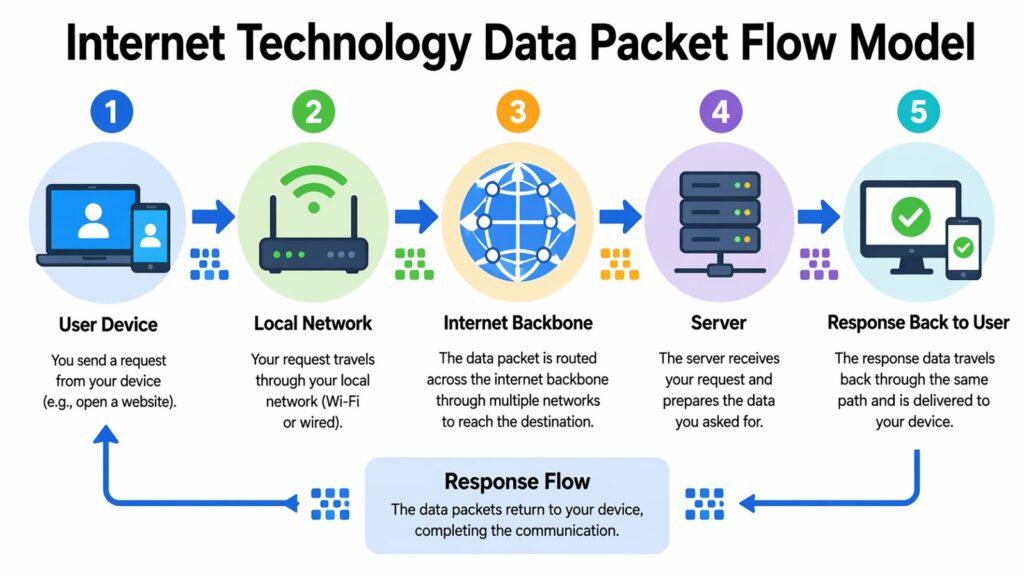
When you load a webpage, something remarkable happens in a fraction of a second. Your device sends a request, that request travels across a network, a server receives it, prepares a response, and sends it back. Internet Technology is the reason all of this happens faster than a blink.
Data does not travel across the internet as a single large file. It is broken into small pieces called packets, each one carrying part of the information along with instructions about where it came from and where it is going. These packets can travel different routes and arrive out of order, but the receiving device reassembles them correctly.
The routes that data packets take are determined by devices called routers. Routers read the destination address on each packet and direct it toward the right path. If one route is congested or broken, routers find alternatives. This flexibility is one of the reasons the internet is so resilient.
Data can travel through copper wires, fibre optic cables, wireless radio signals, or even satellite links, depending on where the devices are and what infrastructure is available. Fibre optic cables carry the majority of long-distance internet traffic because light moves faster through glass than electrical signals move through copper.
The sheer volume of data flowing through the internet every day is difficult to grasp. As of recent estimates, global internet traffic exceeds 400 exabytes per month. Internet Technology manages this flow through a combination of smart routing, compression, and the layered protocol systems that keep everything organised.
Table 4: How Data Flows in Internet Technology — Key Facts
| Aspect | Detail |
| Data unit | Information is broken into packets, typically 1,500 bytes each, for transmission |
| Routing | Routers direct packets toward their destination using constantly updated routing tables |
| Transmission medium | Data travels via fibre optic cables, copper wires, radio waves, or satellite signals |
| Fibre optic speed | Fibre optic cables transmit data at speeds approaching 70% of the speed of light |
| Global traffic volume | Global internet traffic exceeded 400 exabytes per month as of recent estimates |
| Packet reassembly | TCP protocol ensures packets are reassembled in correct order at the destination |
| Latency | Typical latency for a transatlantic data request ranges from 70 to 100 milliseconds |
| Redundancy | Multiple parallel routes exist to reroute data if one path fails or becomes congested |
4. Internet Infrastructure in Internet Technology: Cables, Data Centers, and Satellites
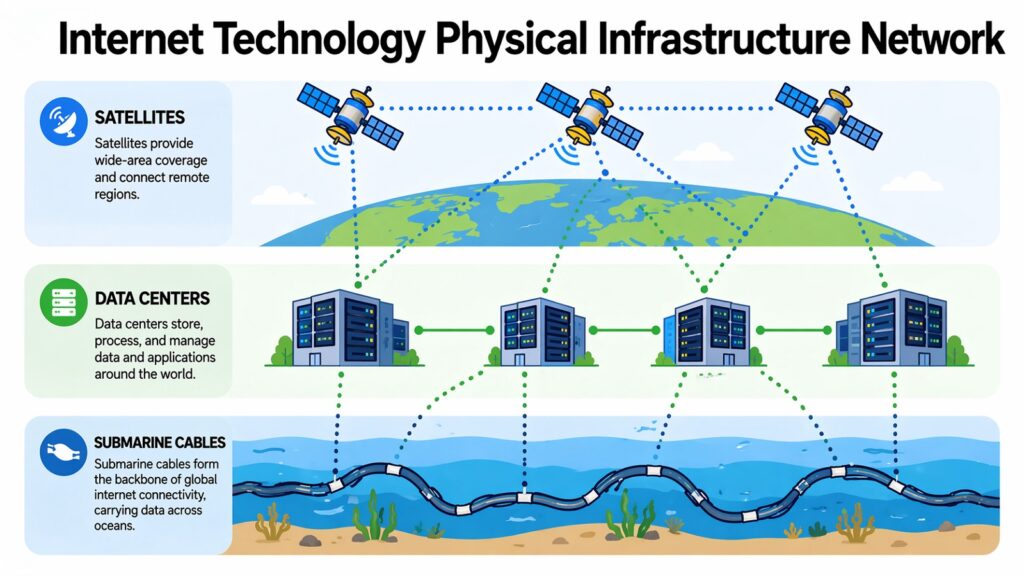
There is a common feeling that the internet exists somewhere in the air, invisible and weightless. But Internet Technology depends on an enormous amount of physical infrastructure — actual machines, cables, and buildings spread across every continent and deep under every ocean.
The backbone of global Internet Technology is a network of undersea fibre optic cables that stretch across the ocean floors. There are over 500 of these cables in service today, carrying more than 95 percent of all international data traffic. They are thin, sometimes no wider than a garden hose, yet they carry vast amounts of information between continents every second.
Data centers are another pillar of Internet Technology infrastructure. These are large facilities, often warehouse-sized, filled with servers that store and process data. When you access a website, stream a video, or use a cloud service, your request is likely being handled by servers inside a data center somewhere. Major technology companies operate data centers on every continent, and the total number of data centers worldwide runs into the hundreds of thousands.
Satellites also play a role in Internet Technology, particularly for areas that are difficult to reach with cables or ground-based infrastructure. Traditional geostationary satellites have long provided internet to remote regions, though with higher latency due to the distance involved. Newer low-Earth orbit satellite networks, such as Starlink, are reducing that latency and expanding coverage to underserved regions.
Together, cables, data centers, and satellites form the physical layer of Internet Technology — the foundation that everything else rests upon. Without this infrastructure, no protocol or software could function.
Table 5: Physical Infrastructure Supporting Internet Technology
| Infrastructure Type | Key Facts |
| Undersea fibre optic cables | Over 500 cables carry more than 95% of international internet data traffic |
| Cable diameter | Submarine cables are typically 25mm in diameter in deep water sections |
| Data centers | Hundreds of thousands of data centers operate globally, housing billions of servers |
| Electricity use | Data centers consume approximately 1 to 1.5% of total global electricity output |
| Geostationary satellites | Orbit at 35,786 km altitude; provide wide coverage but with higher latency |
| Low-Earth orbit satellites | Orbit at 500–1,200 km; offer lower latency than geostationary systems |
| Starlink network | SpaceX Starlink had over 6,000 active satellites in orbit as of early 2024 |
| IXPs | Internet Exchange Points allow networks to connect and exchange traffic directly |
5. Internet Protocol in Internet Technology: The Language of Global Communication
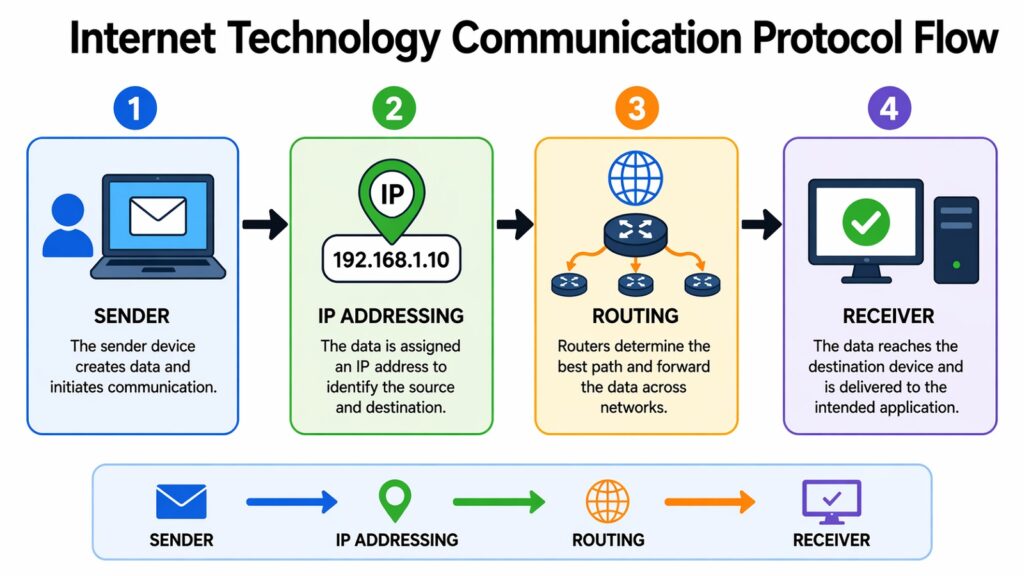
If Internet Technology is a city, then Internet Protocol is the addressing system that makes sure every letter, package, and message reaches the right building. Without it, data would have nowhere to go.
Internet Protocol, or IP, is a set of rules that governs how data is sent from one device to another across a network. Every device connected to the internet is assigned an IP address — a unique numerical label that identifies it. When your device sends data, it stamps that data with both its own address and the destination address, much like writing a return address and a recipient address on an envelope.
There are two versions of IP in common use today. IPv4, introduced in 1983, uses 32-bit addresses and can support about 4.3 billion unique addresses. As the number of internet-connected devices grew into the tens of billions, IPv4 began to run short. IPv6, introduced in the 1990s and increasingly deployed since the 2010s, uses 128-bit addresses and can support an almost unimaginably large number of devices.
IP works alongside other protocols, most notably TCP, the Transmission Control Protocol. TCP handles the reliable delivery of data, making sure packets arrive in the right order and requesting resent copies of any that are lost. Together, TCP and IP form the foundation of Internet Technology communication, so much so that they are often referred to together as TCP/IP.
Understanding Internet Protocol helps clarify why Internet Technology is so dependable. The rules are clear, devices follow them consistently, and the system can adapt to enormous scale — billions of devices exchanging trillions of messages every day.
Table 6: Internet Protocol in Internet Technology — Key Points
| Aspect | Detail |
| IP address (IPv4) | A 32-bit numerical address; supports approximately 4.3 billion unique addresses |
| IP address (IPv6) | A 128-bit address; supports 340 undecillion unique addresses for future devices |
| IPv4 adoption year | IPv4 was standardised in 1981 and became the backbone of early internet communication |
| IPv6 deployment | IPv6 adoption reached over 40% of global internet traffic by 2023 |
| TCP role | TCP ensures data packets are delivered in correct order and retransmits lost ones |
| TCP/IP combination | TCP/IP is the core protocol suite governing internet communication since 1983 |
| Routing tables | Routers maintain tables updated in real time to direct packets along the best paths |
| NAT | Network Address Translation allows multiple devices to share a single public IP address |
6. Domain Name System in Internet Technology: Making the Web Accessible
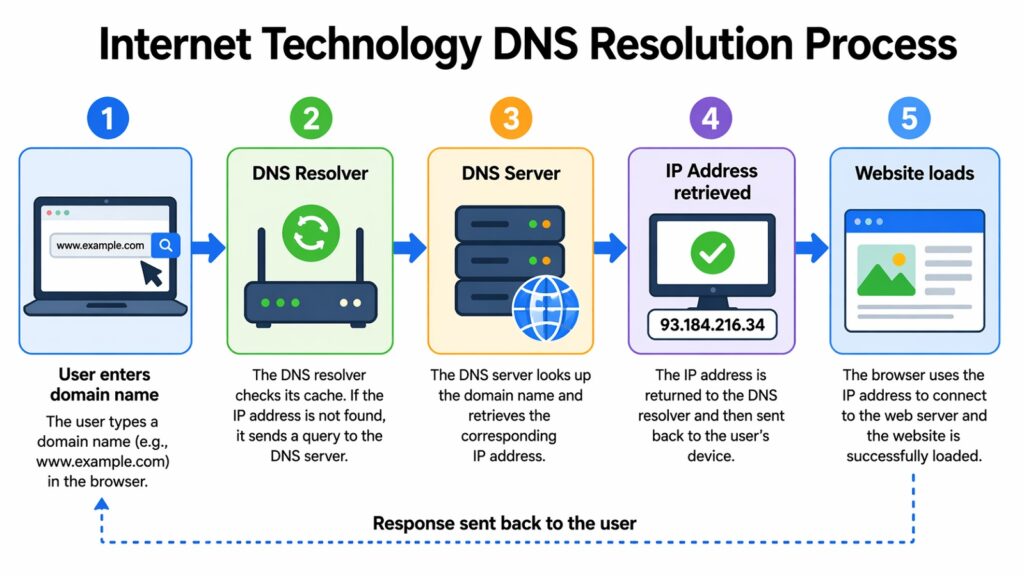
Imagine if every time you wanted to visit a website, you had to remember a string of numbers like 142.250.190.78 instead of simply typing a name. Internet Technology would still work, technically — but it would feel deeply unfriendly. The Domain Name System, or DNS, exists to solve exactly this problem.
The Domain Name System (DNS) is frequently referred to as the internet’s phonebook. It converts human-friendly domain names, such as those for news websites or online stores, into the IP addresses that computers utilize to locate one another. When a web address is entered into a browser, a DNS query is initiated to retrieve the corresponding IP address before the request can commence its journey.
The DNS infrastructure functions as a distributed database, indicating that no single server possesses all the addresses. Instead, the responsibilities are shared among a hierarchy of servers. At the pinnacle of this hierarchy are the root name servers. Beneath them are the servers for top-level domains, including .com, .org, and various country codes. Further down are the authoritative name servers that manage individual websites.
A typical DNS lookup takes only milliseconds, but it involves a quiet chain of queries moving through this hierarchy. Once found, the IP address is often cached locally for a time, so future visits to the same site skip the lookup entirely.
DNS is one of those parts of Internet Technology that users rarely notice unless it breaks. When DNS servers go down, websites become unreachable even though the websites themselves are still functioning. It is, in this sense, one of the most quietly critical pieces of the entire system.
Table 7: Domain Name System in Internet Technology — Key Facts
| Aspect | Detail |
| DNS role | Translates domain names into IP addresses so browsers can locate web servers |
| Root name servers | There are 13 sets of root DNS servers distributed across the world |
| DNS query time | A typical DNS lookup completes in under 100 milliseconds under normal conditions |
| DNS caching | Results are cached locally for hours or days to reduce repeated lookup traffic |
| Top-level domains | There are over 1,500 top-level domains including .com, .org, .net, and country codes |
| ICANN | The Internet Corporation for Assigned Names and Numbers coordinates global DNS management |
| DNSSEC | DNS Security Extensions add cryptographic verification to prevent DNS spoofing attacks |
| DNS over HTTPS | DoH encrypts DNS queries to improve privacy and reduce interception risk |
7. Internet-Based Services in Internet Technology: Cloud, Streaming, and AI
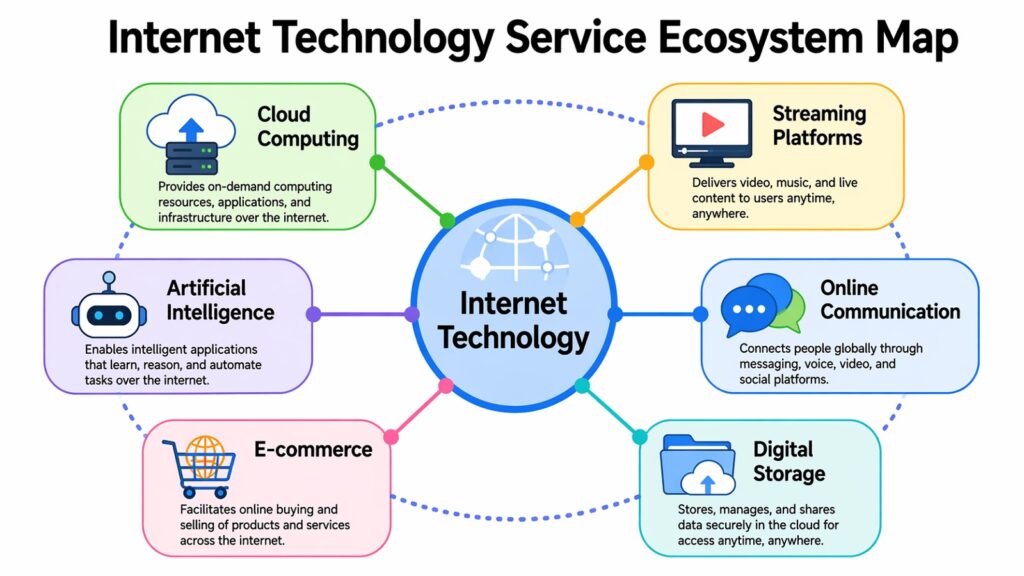
Internet Technology does not just move data — it enables entirely new categories of service that would have been impossible a generation ago. Cloud computing, video streaming, and artificial intelligence are among the most significant of these, and all of them depend on the underlying foundations of Internet Technology.
Cloud computing allows businesses and individuals to store data and run software on remote servers rather than on their own machines. This means a small company can access the same powerful computing resources as a large corporation, paying only for what it uses. Major cloud platforms such as Amazon Web Services, Microsoft Azure, and Google Cloud collectively support hundreds of thousands of businesses worldwide.
Video streaming is perhaps the most visible product of Internet Technology for everyday users. Services like YouTube, Netflix, and others deliver hours of high-definition video to millions of people simultaneously. Streaming relies on fast, reliable internet connections and on a global network of content delivery servers positioned close to users to reduce load times.
Artificial intelligence is now deeply intertwined with Internet Technology. AI models are trained on data centers connected to the internet, and they are accessed through internet-based interfaces. When someone uses a voice assistant, a recommendation algorithm, or an AI writing tool, they are interacting with a system that exists largely in the cloud and depends entirely on Internet Technology to function.
These services represent a shift from the internet as a communication channel to the internet as a computing environment. The line between what lives on your device and what lives online has blurred significantly, and that blurring is one of the defining characteristics of Internet Technology in this era.
Table 8: Internet-Based Services Powered by Internet Technology
| Service Type | Key Facts |
| Cloud computing | Global cloud market revenue exceeded $590 billion in 2023 and continues to grow |
| Amazon Web Services | AWS held approximately 31% of the global cloud infrastructure market in 2023 |
| Video streaming | Netflix alone reported over 260 million subscribers globally as of early 2024 |
| Content delivery networks | CDNs cache content near users to reduce latency; Cloudflare serves over 20% of web traffic |
| AI cloud services | AI model training and inference are increasingly handled by cloud-based data centers |
| SaaS applications | Software as a Service delivers apps via browser; examples include email, CRM, and collaboration tools |
| Edge computing | Processing data closer to users rather than in centralised data centers reduces latency |
| Internet of Things | Over 15 billion IoT devices were connected to the internet globally as of 2023 |
8. Future of Internet Technology: Trends Shaping the Next Digital Era
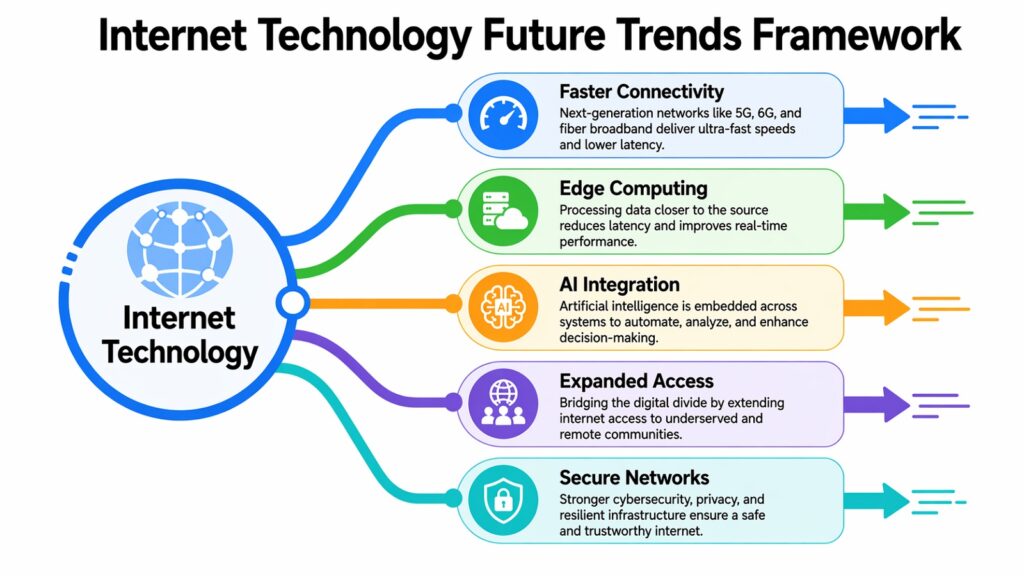
Internet Technology has never stood still, and there is little reason to think it will start now. The next decade is likely to bring changes that are gradual rather than sudden, building on what already exists rather than replacing it entirely.
The rollout of 5G mobile networks is one of the more immediate changes underway. 5G promises significantly faster speeds and lower latency than current mobile networks, which will support new applications in areas like remote surgery, autonomous vehicles, and industrial automation. As of 2024, 5G networks were live in over 80 countries, though coverage remains uneven.
Satellite internet is extending connectivity to parts of the world that have historically been difficult to serve with ground-based infrastructure. Low-Earth orbit networks are making broadband access available in rural areas of developing countries, which could have meaningful effects on education, health services, and economic participation.
The growth of artificial intelligence is also reshaping how Internet Technology works internally. AI is being used to manage network traffic more efficiently, detect security threats in real time, and automate the operation of data centers. These uses tend to happen below the surface, invisible to most users but significant in how smoothly the internet operates.
There is also a growing interest in making Internet Technology more resilient and secure. Concerns about cyberattacks, data privacy, and the concentration of control among a few large technology companies are prompting researchers and policymakers to explore more distributed and decentralised approaches to internet architecture.
The future of Internet Technology will likely be defined less by any single breakthrough than by the steady accumulation of improvements in speed, access, security, and intelligence. The underlying foundations will remain largely recognisable, but the experience they enable will continue to expand.
Table 9: Future Trends in Internet Technology
| Trend | What It Means |
| 5G networks | 5G was live in over 80 countries as of 2024, offering faster speeds and lower latency |
| Satellite broadband | Low-Earth orbit networks are extending internet access to remote and rural regions |
| Wi-Fi 7 | Wi-Fi 7 standard offers speeds up to 46 Gbps, significantly faster than Wi-Fi 6 |
| AI-managed networks | AI systems are being used to optimise routing, detect faults, and manage traffic flow |
| Edge computing growth | Processing data closer to users reduces load on central servers and cuts response times |
| Quantum networking | Research into quantum communication promises theoretically unbreakable encryption |
| Decentralised web | Web3 concepts aim to reduce reliance on centralised servers and platforms |
| Digital inclusion | Efforts to connect the estimated 2.6 billion people still offline as of 2023 are ongoing |
Conclusion: Internet Technology as a Silent Force Shaping Everyday Life
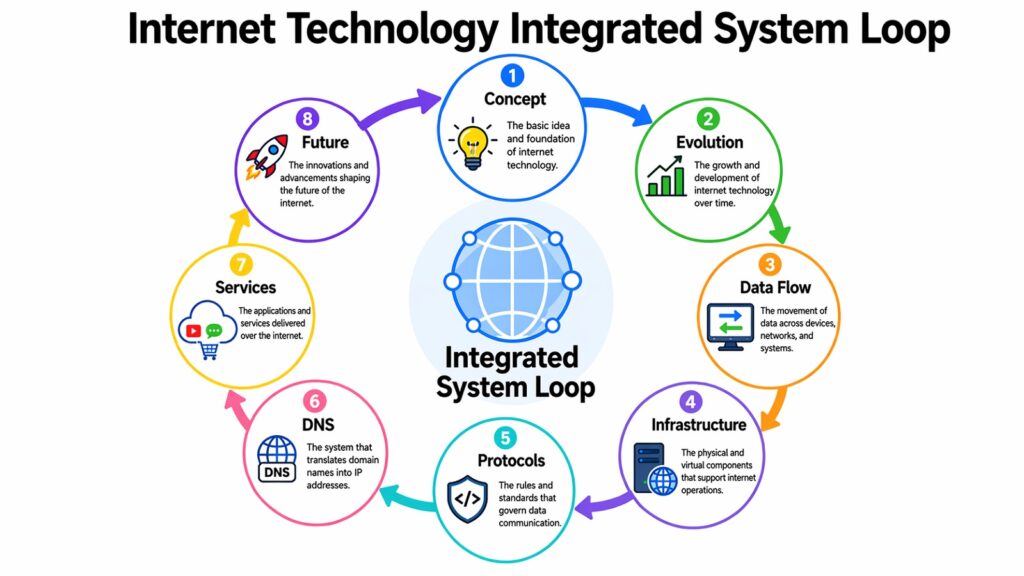
When you step back and look at all eight foundations together, something becomes clear. Internet Technology is not a product or a platform. It is an infrastructure — layered, distributed, and quietly holding up a large portion of modern life.
It began as a research tool and became, within a few decades, the nervous system of the global economy. It connects a student in rural India with a lecture recorded in London. It lets a small business in Nigeria accept payments from a customer in Japan. It carries the health records of a patient from a clinic to a hospital at the same moment they are needed.
The eight foundations of internet technology explored in this article — from the basic concept and its history, through the physical cables and protocols, to the services and the future — are all parts of a single, continuous system. None of them works in isolation. The protocol needs the infrastructure. The infrastructure needs the protocol. The services need both. The future builds on all of them.
Most people will never need to think about any of this directly. Internet Technology is designed to be invisible in use, and that invisibility is part of its success. But understanding even a little of what lies beneath the surface makes the experience richer. It turns something taken for granted into something worth appreciating.
The internet is not finished. It is still growing, still improving, still reaching into corners of the world where it has never been. Internet Technology, in all its layered complexity, is one of the more ambitious things humanity has built together — and it keeps building itself, quietly, every day.
Table 10: Internet Technology — Eight Foundations Summarised
| Foundation | Key Takeaway |
| What Is Internet Technology | A global system of interconnected networks enabling data sharing between billions of devices |
| Evolution of the Internet | Grew from a 1969 research project into a global infrastructure used by over 5 billion people |
| Global Data Flow | Data travels as packets via routers and cables; global traffic exceeds 400 exabytes monthly |
| Internet Infrastructure | More than 500 undersea cables and hundreds of thousands of data centers form the physical backbone |
| Internet Protocol | TCP/IP provides the addressing and delivery rules that make reliable communication possible |
| Domain Name System | DNS translates website names into IP addresses, handled by 13 root server sets worldwide |
| Internet Based Services | Cloud, streaming, and AI services collectively serve billions of users via internet connectivity |
| Future of Internet Technology | 5G, satellite internet, AI-managed networks, and digital inclusion are shaping the next era |