Table of Contents
Introduction: Edge Computing and the Future of Computing
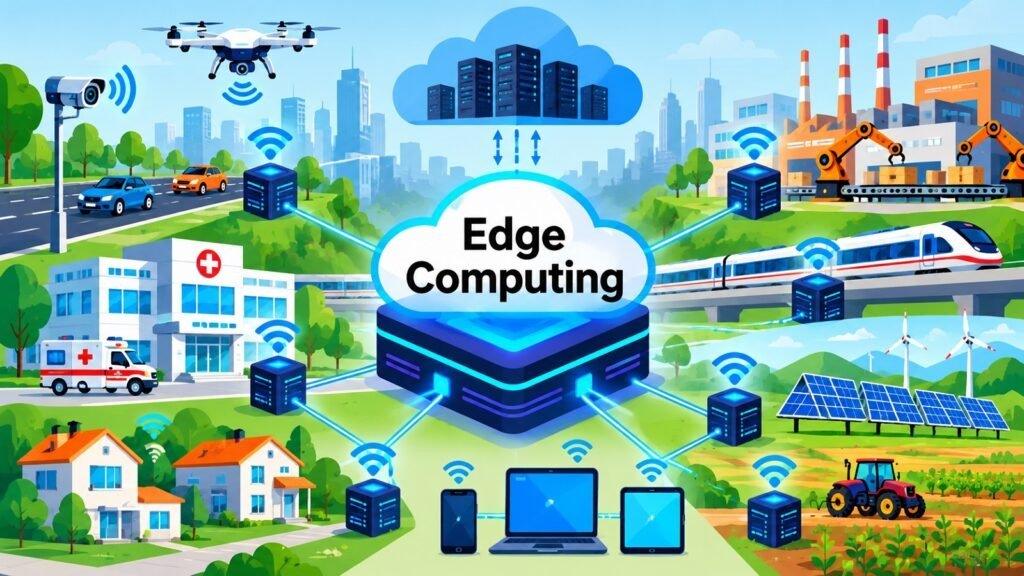
Computing is undergoing a structural shift. For decades, the dominant model moved data toward wherever processing power was concentrated — large centralized systems in data centers or cloud environments. That model continues to serve countless workloads. But the nature of digital systems is changing in ways that challenge the assumption that centralized processing is always the right answer.
Modern digital environments generate data at the edges of networks: inside factories, along highways, within hospitals, across agricultural fields, and embedded in everyday devices. When every workload depends entirely on centralized computing, practical limitations emerge. Sending data to a distant system introduces latency that some applications cannot tolerate. Transmitting large raw-data volumes consumes bandwidth and creates congestion. Systems that depend on continuous connectivity become vulnerable when networks are interrupted. Moving data across long distances also raises questions about privacy and jurisdiction.
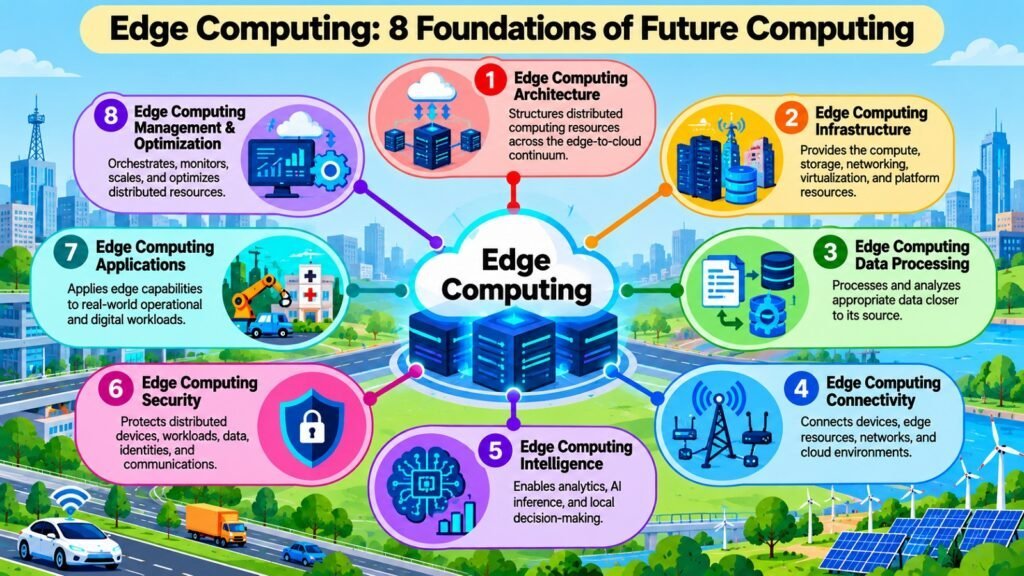
Edge Computing addresses these limitations by enabling processing, data management, and decision-making to occur closer to where data is generated. It is an important Future Computing Technology because the architectural problems it solves are durable, not temporary. Critically, Edge Computing is not a replacement for cloud computing — it is a complementary layer within a broader continuum spanning data-generating devices, edge nodes, regional resources, and cloud platforms. The central question it raises is not where all computing should happen, but where each workload is best placed given its requirements for latency, bandwidth, privacy, and operational context. This article examines eight interconnected foundations that define how Edge Computing works and why it matters.
Edge Computing at a Glance: The 8 Foundations
| Edge Computing Foundations | Role in Edge Computing |
| Architecture | Defines how computing, storage, and intelligence are distributed across the edge-to-cloud continuum |
| Infrastructure | Provides the physical and virtual resources that enable distributed computing outside centralized data centers |
| Data Processing | Moves appropriate processing closer to data sources to support responsiveness and reduce unnecessary data movement |
| Connectivity | Links devices, edge nodes, and cloud platforms through communication technologies suited to distributed environments |
| Intelligence | Brings analytics and AI inference closer to data sources to enable faster interpretation and autonomous responses |
| Security | Protects distributed computing environments through device security, identity management, encryption, and access controls |
| Applications | Translates Edge Computing capabilities into practical value across industries and real-world digital environments |
| Management & Optimization | Ensures distributed infrastructure remains observable, scalable, efficient, and operationally sustainable over time |
1. Edge Computing Architecture: The Foundation of Distributed Computing
Architecture is the structural layer that determines how an Edge Computing environment is organized. It defines how computing capability, data management, storage, networking, and intelligence are distributed across physical and logical locations, and it establishes relationships among all components. A well-designed Edge Computing architecture does not simply replicate a data center at a smaller scale; it reflects deliberate decisions about where workloads should run, how data should flow, and how distributed components should cooperate.
Several key principles underpin distributed Edge Computing architecture. Computational locality holds that processing should occur as close to the data source as workload requirements allow. Decentralization distributes both processing and decision-making so that no operation depends exclusively on a central system. Hierarchical design organizes the environment into layers, each handling workloads suited to its capabilities and proximity. Interoperability enables components from different vendors and environments to work together reliably.
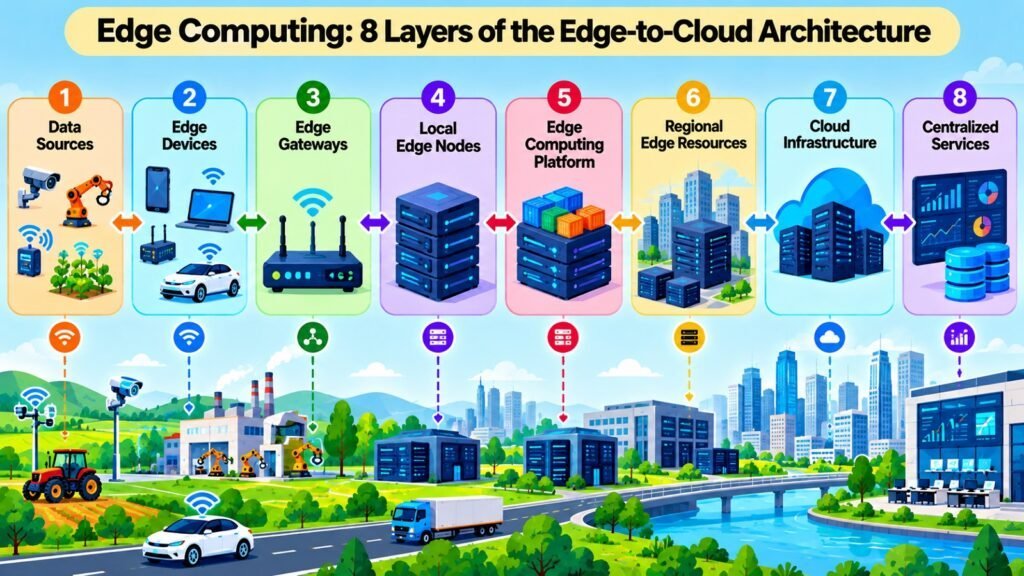
A typical Edge Computing environment spans multiple layers. Data-generating devices — sensors, cameras, actuators — produce raw inputs. Adjacent gateways and edge devices perform initial filtering, aggregation, and local decisions. Edge nodes and regional resources provide greater capacity for workloads requiring more compute power. Cloud platforms serve workloads needing large-scale storage, global visibility, or model training. Consider a manufacturing plant where vibration data is analyzed locally at an edge node within milliseconds, aggregated trend data travels to a regional system, and daily summaries reach the cloud. Architectural patterns range from hierarchical tiers to distributed peer models to hybrid approaches. The governing principle is that choices should reflect workload requirements, not assumptions about where computing conventionally belongs.
Edge Computing Architecture: 8 Key Concepts
| Architectural Concept | Role in Edge Computing |
| Computational Locality | Places processing near data sources to reduce latency and unnecessary data movement |
| Hierarchical Layering | Organizes resources into device, edge, regional, and cloud tiers based on workload needs |
| Decentralization | Distributes processing and decision-making to reduce dependence on a single central system |
| Interoperability | Enables components across vendors and environments to communicate and cooperate reliably |
| Workload Placement | Determines which processing tasks run locally, regionally, or in the cloud based on requirements |
| Resilience by Design | Allows edge nodes to function independently when connectivity to central systems is interrupted |
| Scalability | Supports expansion of distributed resources without redesigning the foundational architecture |
| Edge-to-Cloud Continuum | Treats the environment as a connected spectrum from devices to cloud rather than separate silos |
2. Edge Computing Infrastructure: Building the Distributed Computing Environment
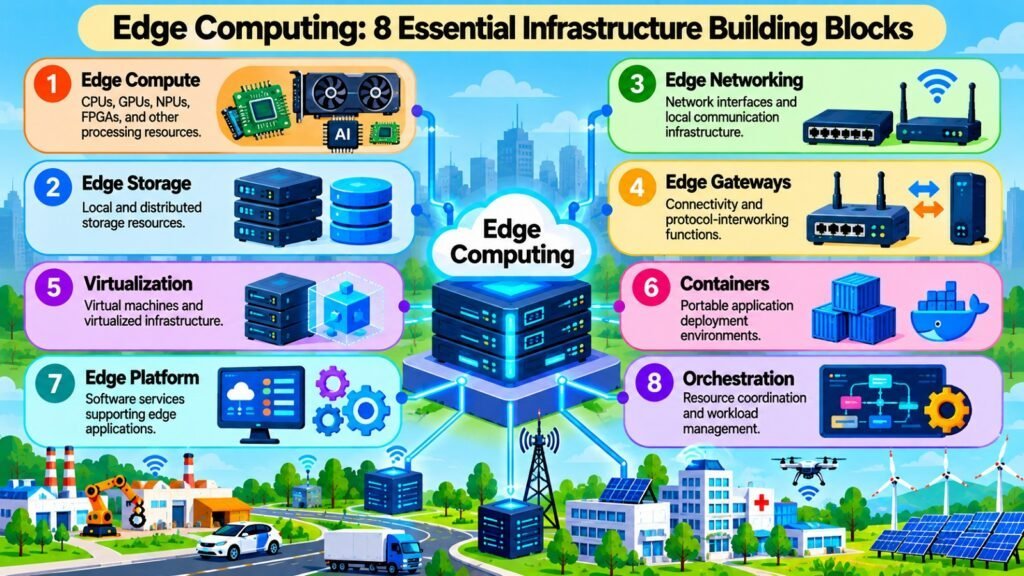
Infrastructure is what makes Edge Computing architecturally possible. While architecture defines structure, infrastructure refers to the physical, virtual, networking, storage, and software resources that enable distributed computing outside traditional data centers. Understanding edge infrastructure means understanding not just what resources are involved, but how their characteristics differ from those deployed in controlled, centralized environments.
Edge servers and computing nodes provide the processing capacity needed to run workloads locally. Unlike data center servers, edge hardware often operates in constrained environments — factory floors, vehicles, remote sites, retail locations — where space, power, and cooling are limited. Hardware is frequently selected for ruggedization, compact form factors, and energy efficiency. Gateways bridge data-generating devices to the broader infrastructure, handling protocol translation, filtering, and aggregation. Accelerators such as GPUs and purpose-built inference chips enable compute-intensive workloads like machine learning inference to run efficiently where general-purpose processors may not suffice. Containerization allows multiple workloads to share physical edge resources while maintaining isolation and portability.
The diversity of edge environments creates challenges that do not arise in centralized settings. A retail store deployment has different constraints than an offshore platform or a moving freight vehicle, and organizations must evaluate infrastructure choices against specific operational conditions rather than applying a standardized model. An important trade-off runs through every edge infrastructure decision: deploying more capable hardware closer to data sources improves local processing and reduces connectivity dependence, but increases the assets requiring maintenance, security, and eventual replacement. The right balance depends on workload requirements, the physical environment, and the organization’s operational capacity.
Edge Computing Infrastructure: 8 Key Components and Considerations
| Component / Consideration | Role in Edge Computing Infrastructure |
| Edge Servers | Provide local processing capacity outside centralized data centers |
| Gateways | Connect data-generating devices to edge infrastructure and handle protocol translation |
| Hardware Accelerators | Enable efficient execution of compute-intensive workloads such as AI inference at the edge |
| Containerization | Allows workloads to run portably and in isolation across distributed edge hardware |
| Storage Resources | Provide local data retention for buffering, caching, and processing without cloud dependency |
| Energy Efficiency | Critical for edge deployments with limited power availability or high energy costs |
| Physical Durability | Hardware must withstand the environmental conditions of each specific edge location |
| Remote Accessibility | Infrastructure must support remote monitoring, management, and software updates |
3. Edge Computing Data Processing: Turning Local Data Into Timely Insights
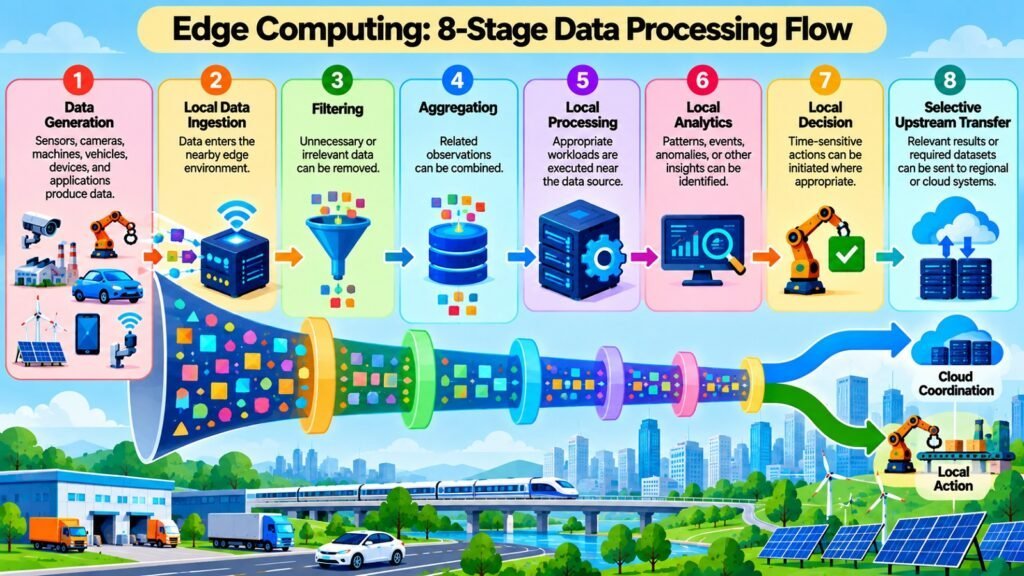
Data is the reason Edge Computing exists. Modern systems generate data at rates and in locations that make routing everything to a central system before acting on it impractical, expensive, or simply too slow. Edge Computing changes data processing by moving appropriate activities closer to data sources, so that insights and responses can be generated where and when they are most needed.
The importance of data locality is straightforward: when processing happens near the source, the time and resources required to move data across a network before processing begins are reduced or eliminated. This matters most when applications require rapid responses, bandwidth is limited, connectivity is intermittent, or raw-data volumes are too large to transmit in full. Filtering and aggregation at the edge mean that only the most relevant information needs to travel further through the network.
Consider an autonomous guided vehicle in a warehouse. It must process sensor readings continuously to navigate safely, and routing every reading to a distant cloud platform would introduce latency incompatible with safe operation. Local edge processing enables millisecond decisions, while only summary data — completed routes, energy logs, exceptions — travels to a central system.
Edge data processing encompasses stream processing for continuous flows, event processing to detect and respond to specific conditions, local analytics that produce immediate insights, selective transmission to determine what data to forward, and synchronization to reconcile locally processed data with broader environments when connectivity is restored. Importantly, Edge Computing does not mean keeping all data permanently at the edge — workload placement should reflect latency requirements, data volume, privacy constraints, and analytical depth.
Edge Computing Data Processing: 8 Key Concepts and Techniques
| Processing Concept / Technique | Role in Edge Computing |
| Data Filtering | Removes irrelevant or redundant data at the edge to reduce transmission volume |
| Stream Processing | Handles continuous data flows in near real time without batch delays |
| Event Processing | Detects and responds to specific conditions in data as they occur locally |
| Data Aggregation | Combines multiple data points into summaries before forwarding to regional or cloud systems |
| Local Analytics | Generates insights from data at or near the source without requiring cloud connectivity |
| Selective Transmission | Sends only relevant processed data to upstream systems rather than all raw data |
| Edge Storage and Buffering | Retains data locally to support processing during connectivity gaps or high-volume periods |
| Data Synchronization | Reconciles locally processed data with central or cloud systems when connectivity is restored |
4. Edge Computing Connectivity: Connecting Devices, Networks, and Computing Resources
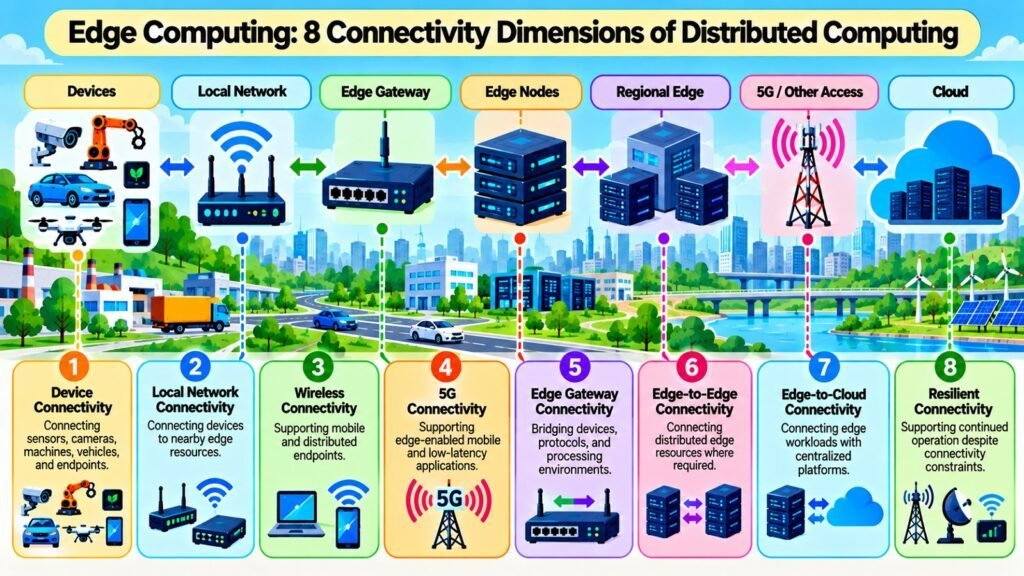
Connectivity is the circulatory system of Edge Computing. Without reliable communication among devices, edge nodes, regional resources, and cloud platforms, distributed workloads cannot coordinate, data cannot reach the systems that process it, and management commands cannot reach the infrastructure that executes them. Understanding connectivity in Edge Computing means understanding not just which technologies are available, but how connectivity conditions shape what workloads can do and where they can run.
Different edge environments call for different approaches. Industrial facilities often use wired Ethernet for reliability where fixed cabling is practical. Wi-Fi provides flexible wireless coverage within buildings and campuses. Cellular networks, including 5G, enable connectivity for mobile and remote deployments. Low-power wide-area network technologies such as LoRaWAN serve devices that transmit small amounts of data infrequently over wide areas.
Private 5G networks are increasingly evaluated for industrial environments requiring low latency and greater performance control than public cellular provides. The key connectivity parameters that influence Edge Computing design are latency, bandwidth, reliability, and availability. Latency determines how quickly data moves between a device and its processing destination. Bandwidth limits how much data can be transmitted, influencing how much processing must occur locally. Reliability and availability affect whether workloads can depend on continuous network access or must operate autonomously during outages.
A remote environmental monitoring station illustrates these trade-offs: it uses cellular to transmit readings but must buffer results locally and transmit when connectivity allows. Edge Computing does not reduce the importance of networking; it changes how computing and networking interact. By allowing appropriate processing near data sources, Edge Computing can shift demand from continuous raw-data transmission to periodic transfer of processed results and summaries.
Edge Computing Connectivity: 8 Key Technologies and Considerations
| Technology / Consideration | Role in Edge Computing Connectivity |
| 5G Cellular | Provides high throughput and low latency for mobile and dense edge deployments |
| Wi-Fi | Delivers flexible wireless coverage within buildings, campuses, and enclosed environments |
| Wired Ethernet | Offers reliable, deterministic connectivity for fixed industrial and enterprise edge nodes |
| LPWAN (e.g., LoRaWAN) | Connects low-power devices across wide areas with infrequent small-data transmissions |
| Private 5G Networks | Enables controlled, low-latency wireless connectivity within industrial or campus environments |
| Latency | Determines how quickly data moves between devices and processing systems, affecting responsiveness |
| Bandwidth | Limits data transmission volume, influencing how much processing must occur locally |
| Intermittent Connectivity | Requires edge workloads to operate autonomously and buffer data when network access is unavailable |
5. Edge Computing Intelligence: Bringing AI and Analytics Closer to Data
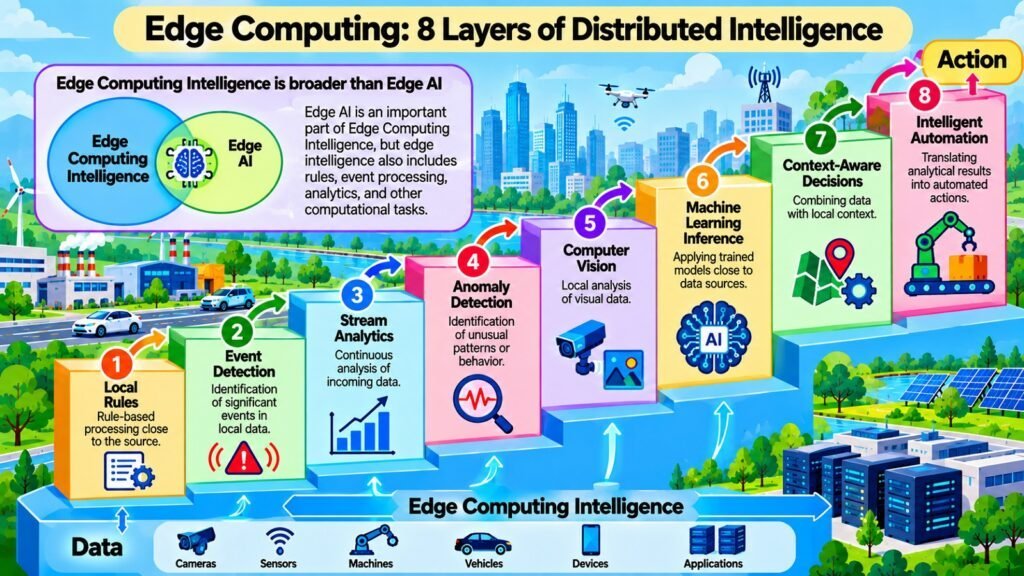
One of the most significant developments within Edge Computing is the ability to bring analytical and intelligent processing closer to where data is generated. When processing happens near the source, systems can interpret data and respond more quickly, more autonomously, and in some cases more privately than when every analysis must pass through a distant central system.
It is useful to distinguish Edge Computing Intelligence from the narrower concept of Edge AI. Edge AI refers specifically to running machine learning models — particularly inference — on edge hardware. Edge Computing Intelligence is broader: it includes AI-based workloads but also encompasses rule-based decision engines, statistical analytics, anomaly detection, complex event processing, and contextual reasoning. A smart building management system illustrates the range. Rather than sending all sensor data to a cloud platform, a local edge node can apply rule-based logic to adjust HVAC settings in real time, use a trained model to predict maintenance needs from equipment behavior, and flag anomalies for review. Each function deploys a form of intelligence appropriate to the task.
Trade-offs are real. Running sophisticated machine learning models at the edge requires adequate compute capacity and potentially specialized hardware. Model accuracy depends on the quality and volume of local data available for inference, and keeping models synchronized across many nodes as they are updated centrally requires careful version management. The most practical approach is typically distributed: certain workloads execute locally, others at regional systems with greater capacity, and model training remains in cloud platforms. Intelligence belongs where workload requirements, data conditions, and available resources make it most effective.
Edge Computing Intelligence: 8 Key Concepts and Workload Types
| Intelligence Concept / Workload | Role in Edge Computing |
| AI Inference | Runs trained machine learning models locally to generate predictions without cloud round-trips |
| Edge Analytics | Analyzes data streams locally to produce insights and support real-time decisions |
| Anomaly Detection | Identifies unusual patterns in data at the edge to enable prompt local responses |
| Computer Vision | Processes image and video data locally for detection, classification, and tracking tasks |
| Rule-Based Decision Logic | Applies predefined conditions to local data to trigger automated responses quickly |
| Predictive Maintenance | Uses local sensor data and models to anticipate equipment failures before they occur |
| Contextual Processing | Interprets data in the context of local environmental conditions for more relevant insights |
| Federated Learning Support | Enables model improvement using local data while keeping raw data on-premises |
6. Edge Computing Security: Protecting Distributed Computing Environments
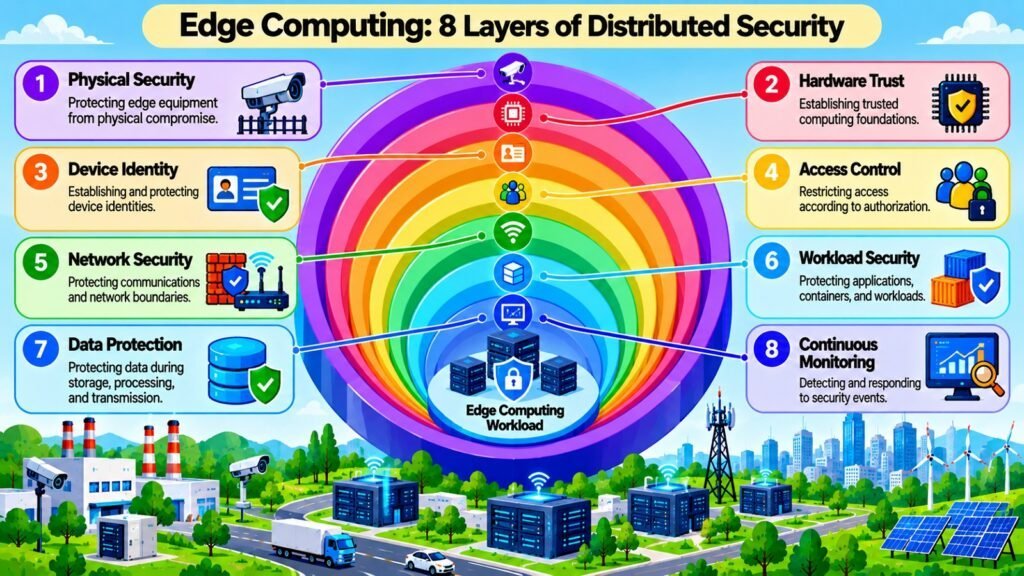
Security in Edge Computing is not a scaled-down version of data center security. Distributing computing across many physical locations fundamentally changes the challenge. Each edge node, gateway, and device represents a potential entry point, and hardware deployed in remote or exposed locations may be difficult to monitor and maintain by personnel who are not security specialists. Effective edge security requires designing for these conditions specifically.
Device security forms the first protection layer. Edge nodes should use secure boot processes that verify software integrity before execution, ensuring only authorized code runs on the hardware. Firmware and software update mechanisms must be designed so they cannot serve as vectors for injecting malicious code. Identity and access management is particularly important in distributed environments where many components require authentication. Zero-trust principles — requiring continuous verification of identity and authorization rather than relying on perimeter-based trust — are increasingly applied to edge deployments. Least-privilege access controls ensure each device or component can access only the resources it specifically requires.
Encryption protects data in transit between devices, edge nodes, and cloud platforms, and data at rest on edge hardware. The practical challenge is that edge devices vary considerably in available processing capacity, so encryption must suit both the sensitivity of the data and the capabilities of the hardware.
Physical security adds a dimension that data center environments largely avoid. An edge node in a retail store, parking structure, or remote utility site is exposed to physical access risks that do not apply to equipment in a controlled facility. Tamper detection, appropriate enclosures, and clear response procedures for unauthorized access are necessary parts of a complete edge security program. Security in Edge Computing is an ongoing operational discipline, not a one-time configuration.
Edge Computing Security: 8 Key Controls and Principles
| Security Control / Principle | Role in Edge Computing Security |
| Secure Boot | Verifies software integrity before execution to prevent unauthorized code from running on edge hardware |
| Zero-Trust Architecture | Requires continuous identity and authorization verification rather than perimeter-based trust |
| Least Privilege Access | Restricts each component to only the resources it specifically requires to function |
| Encryption in Transit | Protects data moving between devices, edge nodes, and cloud platforms from interception |
| Encryption at Rest | Secures stored data on edge hardware against unauthorized access if physical security is compromised |
| Identity and Access Management | Controls which devices, users, and services can access edge infrastructure and data |
| Firmware and Patch Management | Maintains software integrity and addresses vulnerabilities across distributed edge hardware |
| Physical Security | Protects edge hardware from unauthorized physical access, tampering, or removal |
7. Edge Computing Applications: Transforming Real-Time Digital Experiences
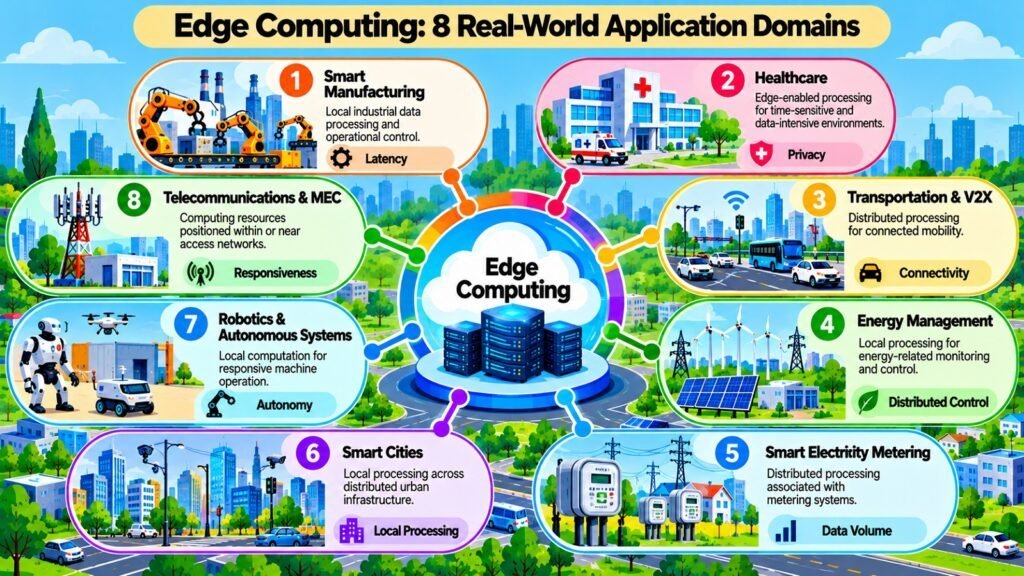
The value of Edge Computing becomes most visible through the practical problems it solves. Architecture, infrastructure, data processing, connectivity, intelligence, and security are the foundations — but applications are where those foundations translate into real outcomes. Understanding why certain workloads suit Edge Computing helps clarify not just what the technology does, but when and where it genuinely creates value.
Manufacturing is one of the environments where Edge Computing has established its strongest foothold. Industrial production generates sensor data at high rates from equipment that requires real-time monitoring to maintain quality and prevent unplanned downtime. Local processing reduces the time between a sensor reading and a corrective action, which matters when equipment operates at high speed or a defect detected late results in wasted material.
Connectivity to central systems may also be intermittent in some facilities, making local processing operationally essential. Autonomous vehicles represent an area where Edge Computing is architecturally necessary: a vehicle processing sensor inputs for navigation in real time cannot route decisions through a distant server without introducing latency incompatible with safety. Healthcare offers another clear fit — patient monitoring devices can generate immediate alerts without continuous cloud connectivity, and local processing reduces privacy exposure from network transmission.
Similar logic extends to smart cities, retail, energy distribution, agriculture, and telecommunications, where workload characteristics — data volume, latency requirements, connectivity conditions, or privacy — make edge processing more appropriate than centralized alternatives. Not every workload in these domains belongs at the edge, however. Applications requiring centralized historical analysis, global data aggregation, or significant compute resources for model training remain better served by cloud or regional platforms. The key is matching workload requirements to the appropriate computing layer.
Edge Computing Applications: 8 Key Application Areas
| Application Area | Why Edge Computing Is Relevant |
| Industrial Manufacturing | Local processing supports real-time quality monitoring and equipment anomaly detection |
| Autonomous Vehicles | Onboard edge processing enables low-latency navigation and safety-critical decisions |
| Healthcare Monitoring | Local analysis of patient data supports real-time alerts and reduces privacy exposure |
| Smart Grid and Energy | Distributed monitoring at substations improves grid responsiveness and fault detection |
| Retail Operations | Local processing supports real-time inventory, analytics, and point-of-sale reliability |
| Smart City Infrastructure | Edge nodes enable responsive traffic management, public safety, and environmental monitoring |
| Telecommunications | Multi-access edge computing hosts low-latency services within mobile network infrastructure |
| Agriculture | Edge processing in the field supports precision irrigation, crop monitoring, and machinery automation |
8. Edge Computing Management & Optimization: Scaling Distributed Computing
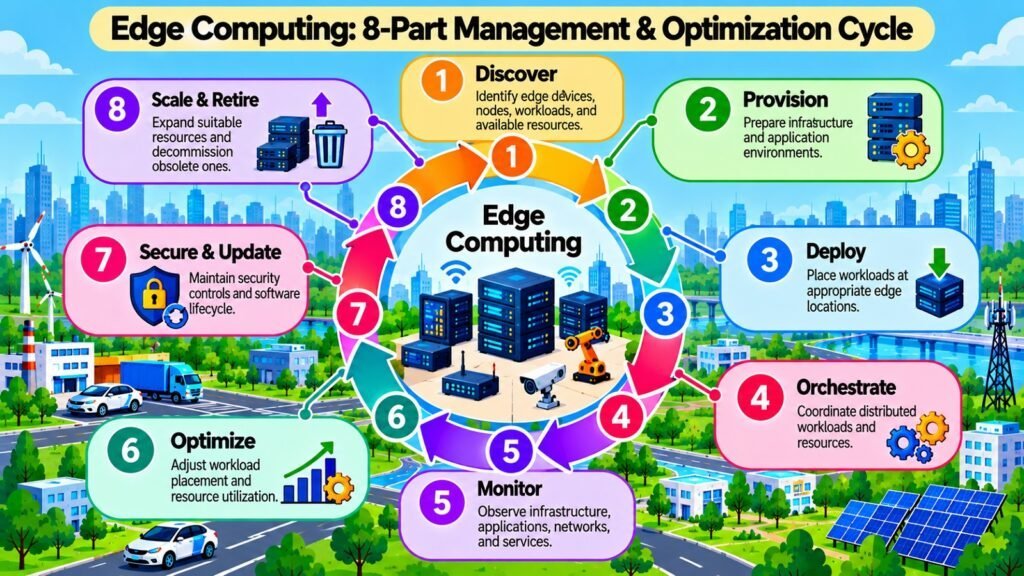
Deploying Edge Computing infrastructure is the beginning of an operational challenge, not the end of one. Managing a distributed environment spanning dozens, hundreds, or thousands of edge nodes across many physical locations requires systematic approaches that differ substantially from managing a centralized data center. In a data center, physical access is controlled and specialized staff are on-site. At the edge, computing resources may be geographically dispersed, resource-constrained, intermittently connected, and maintained by personnel whose primary responsibility is not IT operations.
Workload orchestration is one of the most important management concerns. It involves deciding which workloads run where, allocating resources, and adjusting placement as conditions change. Container orchestration platforms have become a common approach because they provide a standardized abstraction across different hardware and environments. However, applying orchestration at the edge introduces constraints not present in centralized settings — variable connectivity, limited local resources, and the need to handle offline operation gracefully.
Remote monitoring and observability are equally essential: without centralized visibility into performance metrics and health indicators across distributed nodes, problems can remain undetected and performance can degrade silently. Software lifecycle management adds another layer of complexity — keeping firmware, operating systems, and security patches current across a large fleet requires automated update mechanisms that handle intermittent connectivity and manage rollback on failed updates.
A practical test for whether an Edge Computing environment is manageable over time is whether it can be observed, updated, scaled, and troubleshot without depending on physical access to every node. Energy efficiency matters too: the cumulative operational cost of many distributed nodes can exceed expectations if power consumption is not managed deliberately. Automation, standardized practices, and strong operational visibility are the foundations of sustainable edge environments at scale.
Edge Computing Management & Optimization: 8 Key Practices and Considerations
| Management / Optimization Practice | Role in Edge Computing Operations |
| Workload Orchestration | Allocates and places workloads across distributed edge nodes based on resource availability and requirements |
| Remote Monitoring and Observability | Provides centralized visibility into the health and performance of distributed edge infrastructure |
| Automated Software Updates | Manages firmware, OS, and workload updates across large fleets of distributed edge devices |
| Fault Tolerance and Resilience | Ensures edge nodes continue functioning during failures of other nodes or connectivity interruptions |
| Resource Allocation | Optimizes the distribution of compute, memory, and storage across available edge resources |
| Scalability Management | Supports addition of new edge nodes and workloads without destabilizing the existing environment |
| Energy Efficiency | Minimizes power consumption across distributed hardware to control operational costs |
| Security Patch Management | Prioritizes and deploys security updates across distributed edge infrastructure to address vulnerabilities |
Conclusion: Edge Computing and the Next Era of Computing
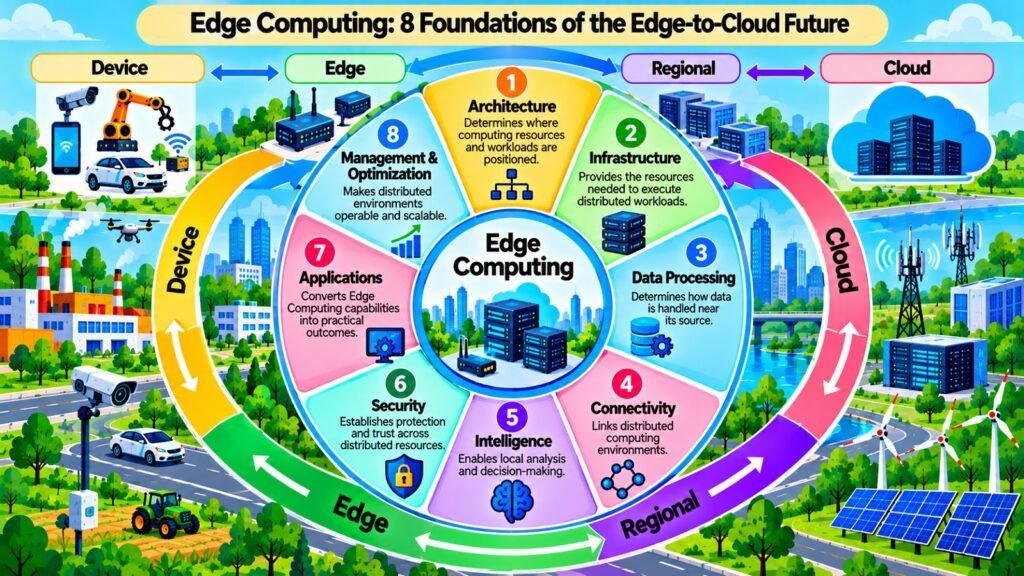
The eight foundations examined in this article are not independent technologies. They are interconnected dimensions of a single distributed computing paradigm. Architecture provides the structural framework for distributing computing, data, and intelligence across the edge-to-cloud continuum. Infrastructure provides the resources that architecture requires.
Data processing determines how information is handled at the appropriate point in the continuum. Connectivity links distributed components into a functional system. Intelligence brings analytical capability closer to data sources for faster, more autonomous responses. Security establishes the protection mechanisms necessary to operate in exposed, distributed environments. Applications translate these capabilities into concrete value across industries. Management and optimization make the entire environment sustainable, observable, and scalable over time.
Edge Computing is an important Future Computing Technology because the forces driving its adoption are durable. The volume of data generated outside centralized environments will not decrease. Expectations for responsiveness in digital applications will not diminish. The geographic diversity of environments where computing must operate will not shrink. These structural conditions make distributed computing an increasingly critical capability for organizations managing complex digital systems.
Edge Computing is not a universal replacement for cloud computing. Workloads that benefit from large-scale resources, global data aggregation, or deep historical analysis are often better served by cloud platforms. The edge-to-cloud continuum exists because different workloads have genuinely different requirements, and the most effective computing environments are those where workload placement reflects those requirements rather than defaulting to any single layer. Organizations that develop a clear understanding of their workloads, data, connectivity environments, and operational constraints will be best positioned to make those decisions well. The eight foundations described here provide a framework for thinking through them systematically as distributed computing continues to mature.
Edge Computing Foundations: Final Reference Summary
| Foundation | Core Contribution to Edge Computing |
| Architecture | Structures the distributed environment and defines how workloads, data, and resources are organized |
| Infrastructure | Provides the physical and virtual resources that enable edge computing outside data centers |
| Data Processing | Enables timely insights by handling data closer to its source rather than centralizing all processing |
| Connectivity | Links distributed components and determines how data and management signals move across the environment |
| Intelligence | Brings analytics and AI inference closer to data to support faster and more autonomous decisions |
| Security | Protects distributed infrastructure, data, and identities across physically exposed edge environments |
| Applications | Demonstrates the practical value of Edge Computing across industries and real-world workloads |
| Management & Optimization | Ensures the distributed environment remains observable, reliable, efficient, and scalable over time |