Table of Contents
Introduction: LAN – An Important Foundation of Computer Networking
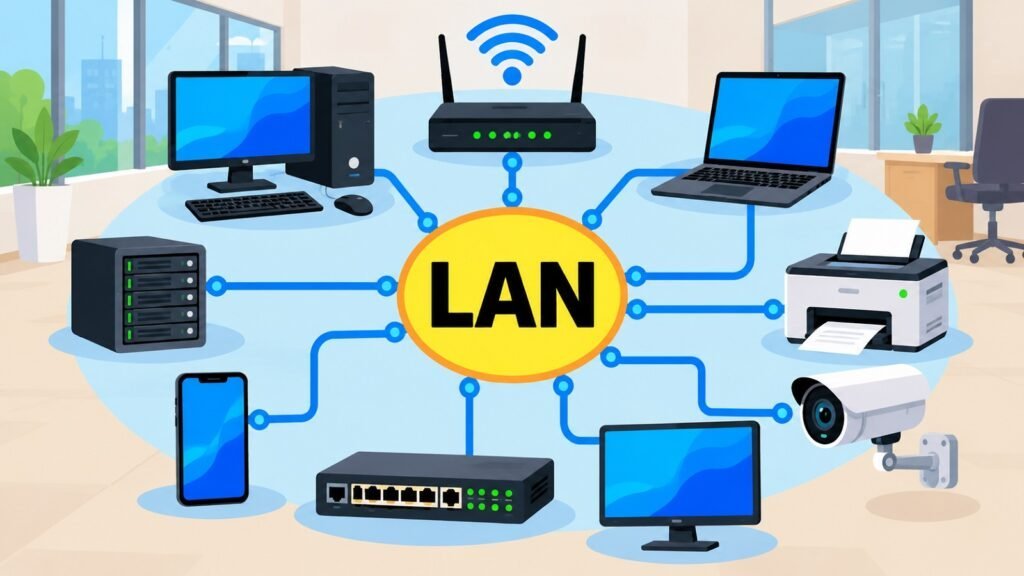
LAN (Local Area Network) is one of the most important computer networks because nearly every other form of digital connectivity eventually passes through one. A local area network connects devices within a limited geographical area, such as a home, a laboratory, or a single office floor, and it lets those devices communicate, share resources, and obtain coordinated access to digital systems. Even when a user reaches a cloud platform on another continent, the first and last hops of that journey cross a LAN, and that ubiquity explains why a working grasp of local networking underpins nearly every later topic in the field.
The scope of a LAN has widened greatly. Early deployments linked a handful of computers so that people could share files and printers, whereas modern settings join servers, printers, smartphones, wireless access points, cameras, sensors, and other IoT equipment. Shared coaxial Ethernet has given way to switched links and high-capacity wireless standards, so wired and wireless access now coexist in most deployments.
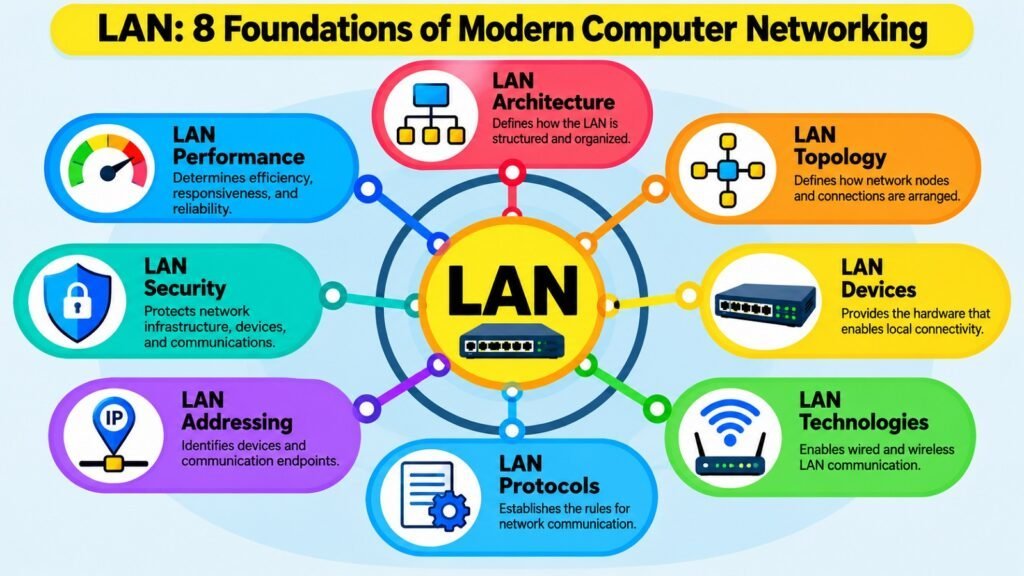
This article examines eight foundations: LAN Architecture, LAN Topology, LAN Devices, LAN Technologies, LAN Protocols, LAN Addressing, LAN Security, and LAN Performance. They are best understood as interlocking parts of one system rather than separate topics. A modification in any single element produces corresponding changes throughout the system, rendering isolated examination inherently deceptive. Taken together, they also explain why two networks built from similar hardware can behave very differently.
The sections that follow show how these foundations jointly determine how a LAN is designed, connected, operated, protected, and optimized. The following table provides a convenient reference point prior to commencing the comprehensive examination.
Table 1: LAN Foundations Summary
| Foundation | Role |
| LAN Architecture | Design model governing organization, management, and growth |
| LAN Topology | Arrangement of devices and links, physical or logical |
| LAN Devices | Hardware that connects endpoints and forwards traffic |
| LAN Technologies | Wired and wireless transmission methods, such as Ethernet and Wi-Fi |
| LAN Protocols | Rules governing how devices exchange data |
| LAN Addressing | Identifiers that locate devices, including MAC and IP addresses |
| LAN Security | Controls protecting infrastructure, data, and access |
| LAN Performance | Measures of speed, delay, reliability, and efficiency |
1. LAN Architecture: Building the Network Foundation
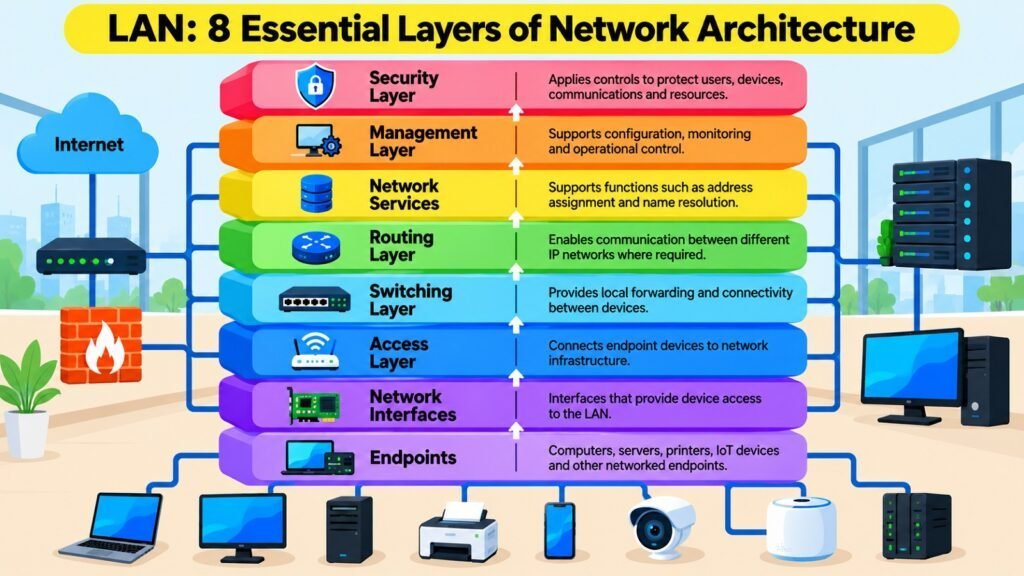
LAN Architecture is the organizing model that determines how a LAN is structured, connected, managed, and expanded over time. Where topology describes how links are arranged, architecture addresses the wider design questions: which functions are centralized, how traffic is segmented, where routing and network services reside, and how communication layers are separated. The IEEE 802 reference model captures one such separation by dividing the data link layer into logical link control and media access control. Architectural choices made early are expensive to reverse, so they deserve careful attention.
In practice, endpoints attach to access switches or access points, which aggregate into distribution and core layers, while routing functions connect the LAN to other networks and services such as DHCP and DNS support daily operation. The three-tier hierarchical model, and its collapsed-core variant for smaller sites, remains a widely taught reference. A home may rely on one consumer router combining switching, wireless access, and routing, whereas a university may spread these functions across many managed devices under centralized controllers. Network services deserve explicit placement in this picture, because their location determines both reliance and failure modes.
Centralized and distributed approaches embody different assumptions. Centralized control simplifies policy enforcement and visibility but concentrates failure risk, whereas distributed designs survive local faults at the expense of consistency and management effort. Every such decision trades something away: simplicity against scalability, centralized management against dependence on central infrastructure, and performance against complexity. The right balance depends on context rather than doctrine.
When evaluating a design, a reader should ask how many endpoints must be supported now and later, which services are mission-critical, how failures will be contained, who will administer the network, and what budget constrains redundancy. Security is far cheaper to embed at this stage than to retrofit. Recognized sources, including IEEE 802 standards and the structured cabling provisions of ISO/IEC 11801, can anchor these questions without dictating a single answer.
Table 2: Core LAN Architecture Concepts
| Concept | Practical Meaning |
| Hierarchical design | Access, distribution, and core layers separate functions |
| Segmentation | Dividing the network into smaller domains for control |
| Redundancy | Alternate paths and devices reduce single points of failure |
| Scalability | Capacity to add users and devices without redesign |
| Centralized management | Unified configuration, monitoring, and policy enforcement |
| Network services | DHCP, DNS, and authentication supporting daily operation |
| Layered communication | Functions separated across protocol layers |
| Manageability | Ease of administering, troubleshooting, and documenting |
2. LAN Topology: Structuring Network Connections
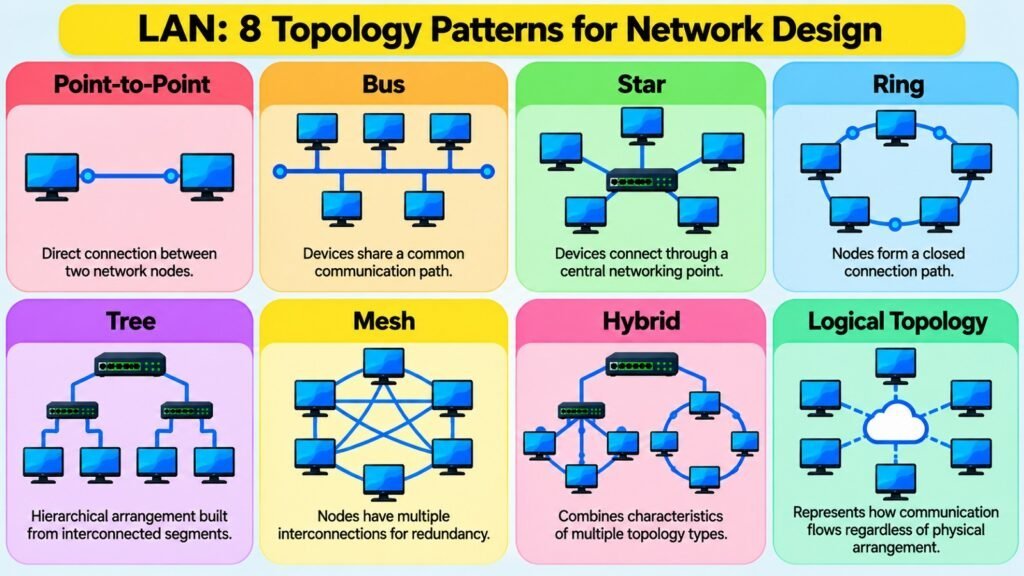
LAN Topology describes how devices and links are arranged, and the discipline distinguishes two senses of that arrangement. Physical topology concerns the layout of cables, ports, and equipment, whereas logical topology describes the path data actually follows between nodes. The significance of this distinction lies in the potential divergence between these two concepts: traditional Token Ring networks exemplified this phenomenon by employing a physical star topology while maintaining logical ring operations, whereas contemporary switched Ethernet networks demonstrate a similar dichotomy by utilizing a physical star configuration while directing frames based on dynamically learned address tables.
Bus topologies, once exemplified by 10BASE5 and 10BASE2 coaxial Ethernet, shared a single medium and relied on CSMA/CD to arbitrate access. They were economical but fragile, since a cable fault could disrupt every station, while ring designs offered orderly access at the cost of dependence on each node. Star topologies, built around a central switch, isolate faults to individual links and simplify management, which explains their dominance since twisted-pair Ethernet matured. Early shared-medium designs also made every added station a participant in collision handling, a limitation that switching later removed.
Tree topologies extend stars hierarchically and suit multi-floor buildings, while mesh arrangements provide redundant paths that improve resilience but raise cabling cost and require loop-prevention mechanisms such as the Spanning Tree Protocol standardized in IEEE 802.1D. Hybrid designs combine these patterns and describe most real deployments. Wireless LANs add an infrastructure model, in which clients associate with access points, and an ad hoc model with direct peer connections.
Choosing a topology is therefore a question of proportion, in which network size, tolerance for downtime, expected expansion, and staff capacity should all be weighed against one another. A modest office environment typically does not warrant the implementation of a mesh network topology, whereas a healthcare facility’s network infrastructure may necessitate redundant uplink connections notwithstanding the associated expenses. Topology should also remain distinct from architecture, which governs design logic, and from devices, which implement the links. Cabling cost and physical pathways frequently decide the question more than theory does.
Table 3: Common LAN Topology Characteristics
| Topology Concept | Key Characteristic |
| Star | Central switch; isolates link faults but depends on the center |
| Bus | Shared medium; low cost, but one fault can disrupt all |
| Ring | Nodes form a loop; orderly access, sensitive to node failure |
| Mesh | Multiple redundant paths; resilient but costly to cable |
| Tree | Hierarchical stars; suits multi-floor buildings |
| Hybrid | Combined patterns; typical of real deployments |
| Physical topology | Actual layout of cables and equipment |
| Logical topology | Path data follows between nodes |
3. LAN Devices: The Hardware Behind Connectivity
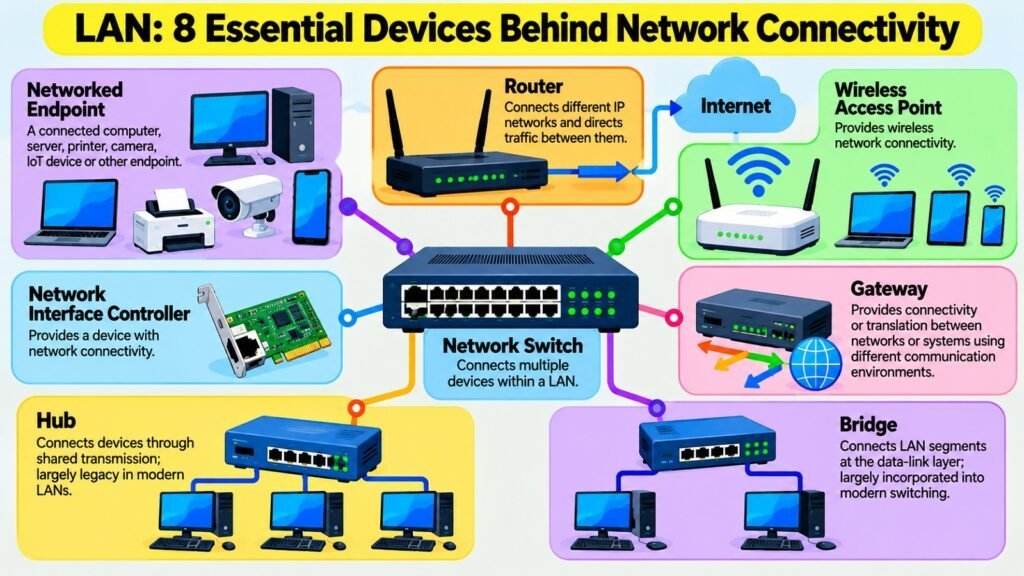
LAN Devices are the physical infrastructure through which endpoints connect, communicate, and reach network resources. Network interface controllers give each endpoint its attachment to the medium and its hardware address. Switches forward Ethernet frames between ports by consulting a table of learned MAC addresses, delivering traffic only where it is needed. Wireless access points function as intermediaries that connect radio-based clients to wired network infrastructure, performing protocol translation between IEEE 802.11 wireless framing standards and IEEE 802.3 wired framing standards. Each device exists because a particular networking function needs a physical home.
Routers and gateways play a different role, because they connect separate networks rather than endpoints within one. A router forwards packets according to network-layer addresses, which is why the default gateway serves as the LAN’s route to everything beyond it. Bridges, the conceptual ancestors of switches, join segments at the data link layer, while hubs repeat electrical signals to every port and are now obsolete because they create a single collision domain. Gateways, in the strict sense, may also translate between protocol families, though everyday usage often equates the term with the default router.
Wired and wireless LANs combine these devices differently. A wired office needs interface controllers, cabling, and switches, often with Power over Ethernet, standardized in IEEE 802.3af, 802.3at, and 802.3bt, to supply access points and cameras. A wireless deployment adds access points, frequently coordinated by a controller or cloud management platform, and depends on careful placement to manage coverage and interference.
Two misconceptions recur, and the first confuses a switch with a router; the switch operates principally within a network and the router between networks, although multilayer switches blur the boundary by also routing. The second assumes every LAN needs the same equipment, whereas a home network often consolidates all functions in a single unit. Evaluation should weigh port capacity, manageability, scalability, redundancy, security features such as port authentication, and deployment constraints including power and cooling.
Table 4: Essential LAN Devices and Their Roles
| Device | Primary Role |
| Network interface controller | Connects an endpoint to the medium; carries its MAC address |
| Switch | Forwards frames between ports using MAC address tables |
| Router | Forwards packets between different networks |
| Wireless access point | Connects Wi-Fi clients to the wired LAN |
| Bridge | Joins segments at the data link layer |
| Hub | Repeats signals to all ports; obsolete |
| Gateway | Relays traffic between dissimilar networks |
| Power over Ethernet injector | Supplies power over twisted-pair cabling |
4. LAN Technologies: Enabling Modern Local Networks
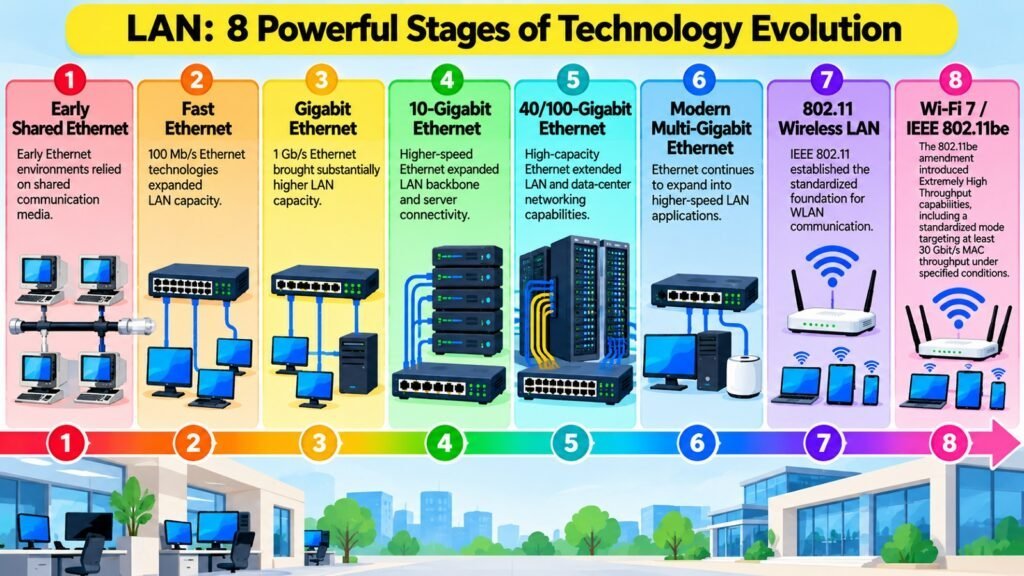
LAN Technologies are the transmission methods and standards used to implement a LAN, and their distinction from the LAN concept itself deserves emphasis. A LAN is defined by scope and administration, whereas the technologies are interchangeable means of realizing it. Ethernet, specified in the IEEE 802.3 family, and Wi-Fi, specified in IEEE 802.11, dominate modern deployments, and both have evolved greatly while preserving backward compatibility. That separation is useful because a network can migrate its transmission technology without rewriting its logical design.
Ethernet has progressed from 10 Mb/s over coaxial cable to 10 Gb/s and well beyond over twisted pair and fiber. Copper remains attractive for short runs because it is inexpensive and can carry power, and suitable cabling categories support 1000BASE-T and 10GBASE-T within the 100-meter channel limit. Optical fiber, whether multimode or single-mode, offers greater distance, immunity to electromagnetic interference, and higher capacity, at a higher installation cost. Standards such as IEEE 802.3ae and 802.3an defined the early 10 Gb/s variants for fiber and twisted pair, respectively.
Wi-Fi trades the predictability of a cable for mobility, and successive amendments, including 802.11n, 802.11ac, and 802.11ax, raised throughput through wider channels, multiple-antenna techniques, and more efficient spectrum use, while the 6 GHz band, first used by Wi-Fi 6E, extended capacity further. Shared spectrum nonetheless exposes wireless links to interference and contention, while switching technologies such as full-duplex operation, VLANs, and link aggregation add flexibility to both media.
The determination of selection fundamentally depends upon evaluating trade-offs: the balance between wired dependability and wireless portability, the consideration of infrastructure expenditure relative to operational adaptability, and the assessment of system capacity in relation to implementation intricacy. Many organizations resolve these by combining fiber backbones, copper access runs, and dense wireless coverage. Because standards change more slowly than products, principles and standards offer a sturdier basis for evaluation than vendor specifications. These choices interact with devices, which must support the chosen media, and with architecture, which determines where each technology is applied.
Table 5: Key LAN Technologies
| Technology | Role in LAN |
| Ethernet (IEEE 802.3) | Dominant wired LAN standard |
| Wi-Fi (IEEE 802.11) | Standard for wireless LAN connectivity |
| Twisted-pair copper | Low-cost wired medium for short runs |
| Optical fiber | High-capacity, long-distance, interference-immune medium |
| Full-duplex switching | Simultaneous sending and receiving, eliminating collisions |
| VLANs (IEEE 802.1Q) | Logical segmentation on shared infrastructure |
| Link aggregation (IEEE 802.1AX) | Combines links for capacity and resilience |
| Power over Ethernet | Delivers power and data over one cable |
5. LAN Protocols: Rules That Enable Communication
LAN Protocols are the standardized rules that let networked devices exchange information in an organized and interoperable way. Without shared conventions for formatting, addressing, and sequencing, equipment from different manufacturers could not communicate, and the open interoperability that marks modern networking would not exist. Standards bodies, notably the IEEE for link-layer behavior and the IETF for the TCP/IP suite, supply these conventions through the IEEE 802 standards and the Request for Comments series. Standardization also supports innovation, because new applications can rely on stable lower-layer behavior.
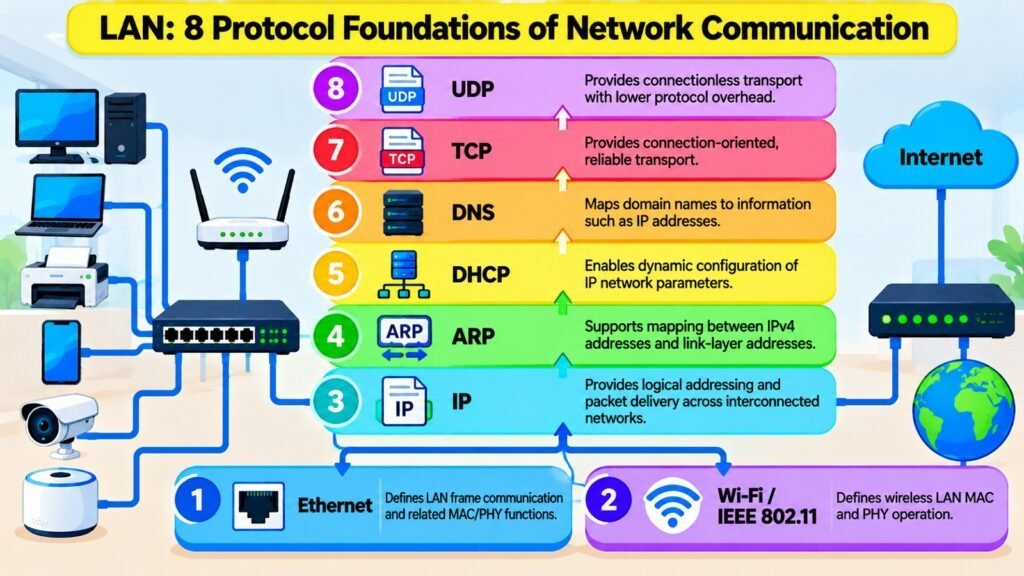
Ethernet defines frame format and media access at the link layer. Above it, IP provides logical packet delivery, ARP maps IPv4 addresses to MAC addresses, DHCP supplies configuration, DNS resolves names, and TCP and UDP carry data between applications, the former reliably and with congestion control, the latter with minimal overhead. Most of these are not exclusive to LANs, yet each plays a distinctive part in local communication. UDP suits name resolution queries, streaming, and real-time voice, where timeliness matters more than retransmission.
Consider a laptop opening a web page on a newly joined network. DHCP assigns an address and gateway, DNS translates the site name into an address, ARP discovers the gateway’s hardware address, and TCP establishes a session over IP packets carried in Ethernet or Wi-Fi frames. Each protocol solves one narrow problem, and the whole operation succeeds only because they compose reliably. Failure at any stage produces a distinct symptom, which is why protocol knowledge directly accelerates troubleshooting.
Protocols should be separated conceptually from addressing: addressing identifies communication endpoints, whereas protocols define the processes by which those endpoints interact. Standardization carries practical weight because compatibility reduces vendor lock-in, simplifies troubleshooting, and allows upgrades without wholesale replacement, though legacy protocols and misconfigured implementations remain a persistent source of inefficiency and vulnerability. Interoperability, however, depends on correct implementation of standards as much as on their existence.
Table 6: Essential LAN Protocols
| Protocol | LAN Relevance |
| Ethernet | Defines link-layer framing and media access control (IEEE 802.3) |
| IP | Provides logical addressing and best-effort packet delivery |
| ARP | Resolves IPv4 addresses to MAC addresses |
| DHCP | Assigns addresses and configuration automatically to clients |
| DNS | Translates names into IP addresses |
| TCP | Reliable, ordered, congestion-controlled transport |
| UDP | Lightweight, connectionless transport for time-sensitive traffic |
| ICMP | Reports errors and supports diagnostics such as ping |
6. LAN Addressing: Identifying Networked Devices
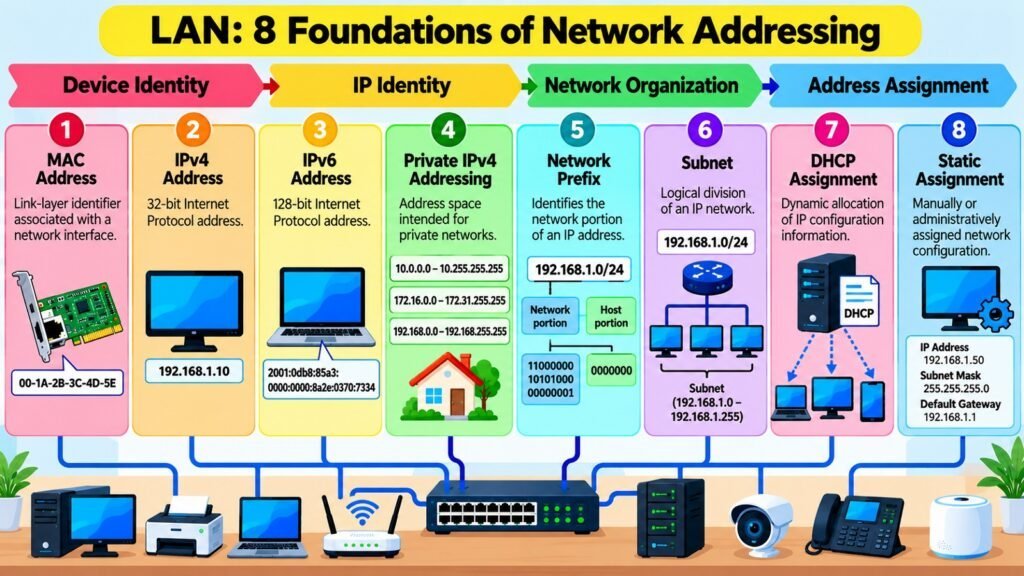
LAN Addressing is the system by which devices and communication endpoints are identified and located. Two address types cooperate, and a MAC address is a 48-bit identifier assigned at the data link layer, whose first 24 bits normally denote the manufacturer’s organizationally unique identifier, and it matters chiefly within a local segment. An IP address operates at the network layer, is hierarchical, and can be reassigned as devices move or networks are reorganized. Because the two layers are independent, replacing a network card changes the MAC address without altering the IP configuration.
IPv4 uses 32-bit addresses, while IPv6, specified in RFC 8200, uses 128 bits and removes the scarcity that drove widespread use of private ranges. RFC 1918 reserves 10.0.0.0/8, 172.16.0.0/12, and 192.168.0.0/16 for private networks, usually paired with network address translation at the boundary. IPv6 local communication relies on link-local addresses and, optionally, unique local addresses defined in RFC 4193. IPv6 deployment is gradual, so many LANs operate dual-stack, running both versions in parallel.
A network prefix separates the portion of an address identifying the network from the portion identifying the host, and subnetting divides a larger block into smaller networks. Addresses may be configured statically, which suits servers and infrastructure that must remain predictable, or assigned dynamically through DHCP, which reduces administrative burden and misconfiguration. In IPv4 local area networks, the Address Resolution Protocol serves as the mechanism connecting logical and physical addressing schemes, while IPv6 employs the Neighbor Discovery Protocol to fulfill this identical function. Address management also covers reservations, lease durations, and documentation of which devices hold which addresses.
Careful address planning pays dividends, since consistent ranges per department or function simplify troubleshooting, make segmentation and firewall rules easier to express, and leave room for growth without renumbering. Inadequate planning strategies result in subnet overlap, depleted DHCP address pools, and confusion when addressing operational incidents. Addressing identifies endpoints, but the rules governing their exchange belong to protocols. Address plans should also anticipate guest, IoT, and server networks that require different treatment.
Table 7: Core LAN Addressing Concepts
| Concept | Role |
| MAC address | 48-bit link-layer identifier for a network interface |
| IPv4 address | 32-bit network-layer address |
| IPv6 address | 128-bit address with a vastly larger space |
| Private address range | RFC 1918 blocks for internal use |
| Subnet | Smaller network created by dividing an address block |
| Network prefix | Portion of an address identifying the network |
| DHCP assignment | Dynamic distribution of addresses and settings |
| Static address | Fixed manual assignment for stable infrastructure |
7. LAN Security: Protecting Local Network Environments
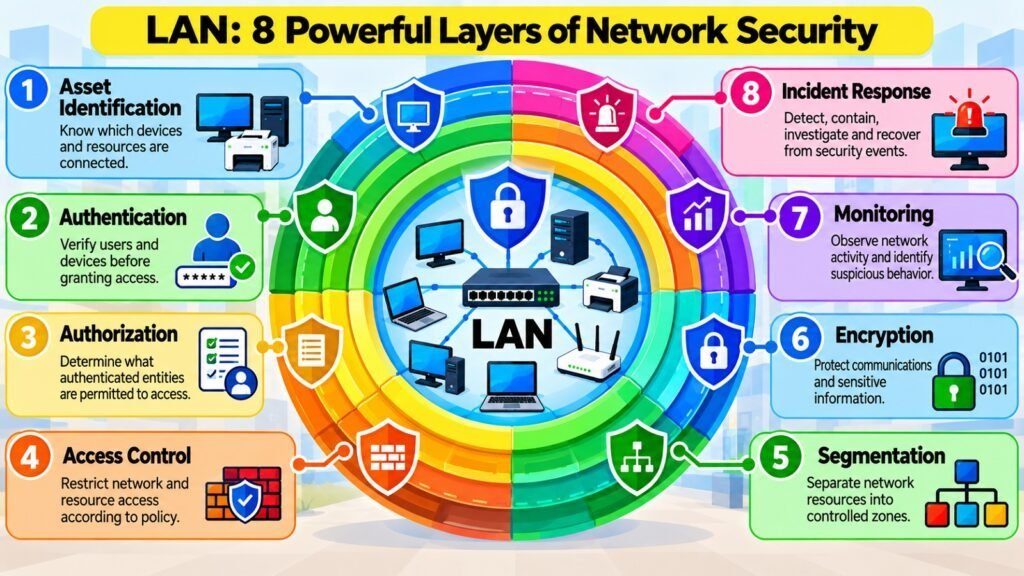
LAN Security comprises the principles, controls, and practices that protect infrastructure, connected devices, communications, and the resources reachable through them. Its importance has grown as local networks carry diverse endpoints, many with weak patching, and provide a path to company systems and sensitive data. Local networks are also where an intruder who bypasses the perimeter does most of the damage. The old assumption that internal traffic can be trusted by default has been challenged, notably by the zero trust model described in NIST Special Publication 800-207.
The foundational concepts include authentication, which verifies identity; authorization, which determines permitted actions; and access control, often enforced at the port through IEEE 802.1X. Segmentation limits how far a compromise can spread, encryption protects confidentiality, and firewalls, monitoring, patching, and endpoint protection address prevention and detection. Wireless network infrastructure demands careful oversight, particularly regarding WPA3’s enhancements over preceding protocols in cryptographic key negotiation and protection against offline dictionary attacks. Device and firmware updates constitute essential components of security hardening, as manufacturers typically establish default configurations with permissive access controls.
Typical risks include unauthorized access, compromised endpoints, insecure wireless configurations, misconfiguration, credential compromise, and lateral movement, in which an intruder who has gained a foothold traverses the network toward higher-value targets. Defense in depth answers these risks by layering independent controls, so that the failure of one does not expose everything. It works only when security is built into architecture, because retrofitted controls tend to be uneven and costly.
Security is never free, because stricter authentication and segmentation inconvenience users and enlarge management workload, while permissive designs accelerate access at the price of exposure. Guidance from NIST, including SP 800-153 on wireless LAN security and SP 800-53 on controls, helps structure these decisions. Security also interacts with the other foundations: architecture supplies enforcement points, addressing enables segmentation, and performance limits how much inspection is affordable. None of these controls is sufficient alone.
Table 8: Principal Local Area Network Security Controls and Risks
| Control or Risk | Description |
| Authentication | Verifies the identity of users and devices |
| Authorization | Grants permissions according to role or policy |
| Segmentation | Restricts spread through VLANs or separate subnets |
| Port-based access control | IEEE 802.1X admits only authenticated devices |
| Wireless encryption | WPA3 protects the confidentiality of wireless traffic |
| Firewall | Filters traffic between zones according to policy |
| Patch management | Fixes known vulnerabilities in devices and software |
| Lateral movement | Attacker progress between internal systems after compromise |
8. LAN Performance: Optimizing Network Efficiency
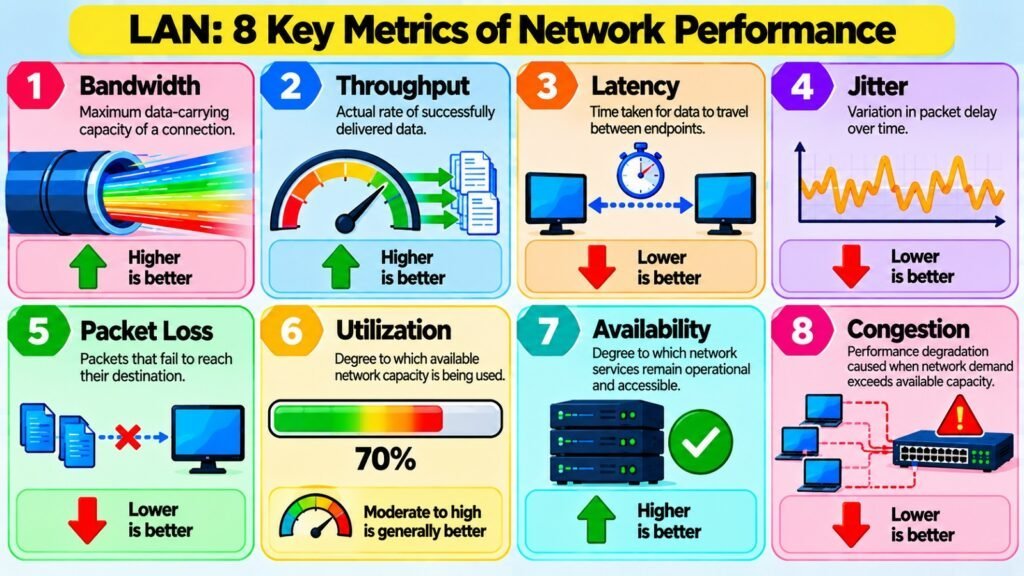
LAN Performance is the capacity of a LAN to deliver reliable, responsive, and efficient communication between connected devices. Bandwidth denotes the maximum data rate of a link, whereas throughput measures what is actually delivered, usually less because of protocol overhead, contention, and retransmission. Latency is the delay a packet experiences, jitter is its variation, and packet loss is the fraction of packets that never arrive. Use and congestion describe how heavily capacity is consumed and what happens when demand exceeds it. These measures are interdependent, as rising use typically precedes growing latency and eventual loss.
The gap between nominal and real performance deserves emphasis. A Wi-Fi link advertised at a high physical rate seldom achieves it, since the rate is a theoretical peak, airtime is shared, and interference, distance, and client capability reduce it. Even a gigabit Ethernet link yields somewhat less application throughput than line rate because headers consume part of every frame. Availability adds a different dimension, expressing the proportion of time the network remains usable. Full-duplex switched links avoid collisions, yet oversubscribed uplinks can still create bottlenecks.
Performance is derived from multiple foundational elements: architectural oversubscription, topology and loop behavior, device forwarding capacity, transmission technology, traffic patterns, configuration decisions including quality of service, and wireless interference. Improvement therefore starts with measurement, and monitoring through SNMP, flow records, and active tests such as ping and iperf establishes baselines, diagnostics isolate bottlenecks, and capacity planning anticipates growth before users notice degradation. Baselines matter because a figure has meaning only relative to normal behavior.
The consequences are tangible, since voice and video tolerate little jitter or loss, interactive applications depend on low latency, and file transfers depend on sustained throughput, so poor performance becomes lost productivity and, in commercial settings, business disruption. Solutions involve trade-offs between cost, complexity, redundancy, and scalability. Overprovisioning offers simplicity at considerable expense, while traffic engineering provides efficiency but requires specialized knowledge.
Table 9: Key LAN Performance Metrics and Factors
| Metric or Factor | Meaning |
| Bandwidth | Maximum data rate of a link |
| Throughput | Actual rate of successful data delivery |
| Latency | Time a packet takes to travel between endpoints |
| Jitter | Variation in packet delay |
| Packet loss | Share of packets that fail to arrive |
| Availability | Proportion of time the network is operational |
| Congestion | Demand exceeding capacity, causing delay or loss |
| Use of capacity | Share of capacity currently in use |
Conclusion: LAN – The Powerful Foundation of Modern Networking
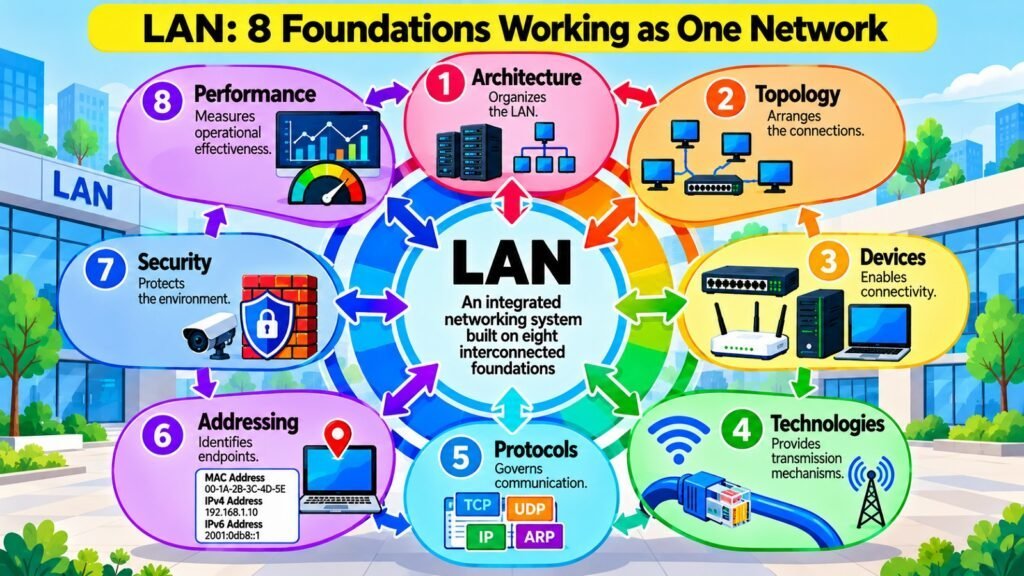
LAN remains one of the most important computer networks because it is where devices first meet the digital world. Its eight foundations are best read as a single system in which architecture establishes the design logic, topology arranges the connections, devices and technologies carry traffic, protocols and addressing make communication possible, and security and performance test whether the whole arrangement deserves trust. Their strength lies in interdependence rather than in any single component.
Understanding a Local Area Network therefore requires more than memorizing definitions, because a topology choice changes fault isolation, which affects security and availability; an addressing plan shapes segmentation, which affects both defense and troubleshooting; a wireless technology decision alters throughput and the devices needed to support it. The practical value of this knowledge lies in recognizing such reliance when designing, evaluating, securing, managing, or improving a network. Knowledge of one foundation without the others yields brittle judgments, whereas an integrated view supports durable ones.
The trajectory is toward greater density and distribution, as wireless access continues to expand, IoT endpoints multiply, hybrid settings blur the boundary between local and remote resources, and cybersecurity expectations rise. Yet the underlying principles of structured design, standardized communication, clear identification, layered protection, and measured performance are unlikely to lose relevance, whatever form future equipment takes.
Seen this way, LAN is not merely a topic within networking but the groundwork on which broader computer networking is understood. Mastery of LAN thus equips readers to approach wide area networks, cloud connectivity, and the internet itself with clearer reasoning.
Table 10: Local Area Network Foundations: Final Takeaways
| Foundation | Central Contribution |
| LAN Architecture | Supplies design logic for organization and growth |
| LAN Topology | Determines how connections are arranged and fail |
| LAN Devices | Provide the hardware that connects and forwards |
| LAN Technologies | Provide the wired and wireless means of transmission |
| LAN Protocols | Define the rules for orderly communication |
| LAN Addressing | Identifies and locates endpoints |
| LAN Security | Protects infrastructure, data, and access |
| LAN Performance | Measures how effectively the network operates |