Table of Contents
Introduction: Augmented Reality – The Rise of an Emerging Computing Technology
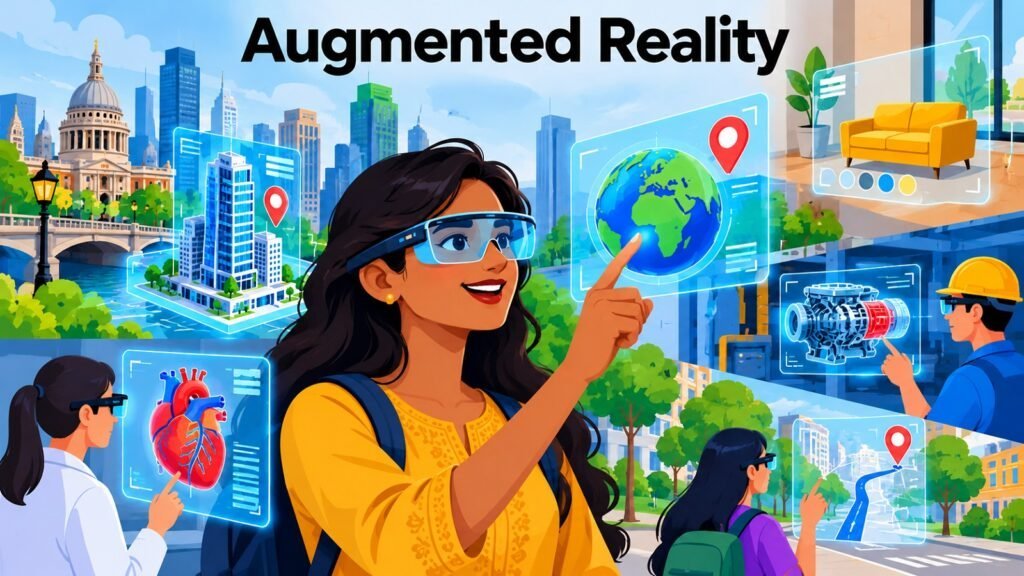
Among the most significant emerging computing technologies of this era, Augmented Reality stands apart for what it fundamentally changes about the relationship between people and computers. Unlike conventional computing, which confines digital interaction to screens and abstract interfaces, Augmented Reality brings computational capabilities into the physical world. It overlays digital information, visual elements, and interactive functions onto a person’s environment, creating a more contextually connected way of experiencing that world.
The core premise is simple: take the physical environment as it exists and add meaningful digital information to it in real time. In practice, this requires solving genuinely complex challenges. The system must perceive and understand the physical space around a user, anchor digital content accurately within that space, present information in a contextually relevant way, and respond to user interaction across both physical and digital layers simultaneously.
Research from institutions such as MIT Media Lab and findings published in journals like IEEE Transactions on Visualization and Computer Graphics establish that Augmented Reality is not simply a visual technology but a computing paradigm that reshapes how information is accessed, processed, and acted upon. For consumers, it creates new modes of information access tied to real-world objects. For businesses, it provides tools for training, remote assistance, and process guidance. For industries such as healthcare, manufacturing, and logistics, it opens possibilities for reducing errors in ways that screen-based computing cannot match.
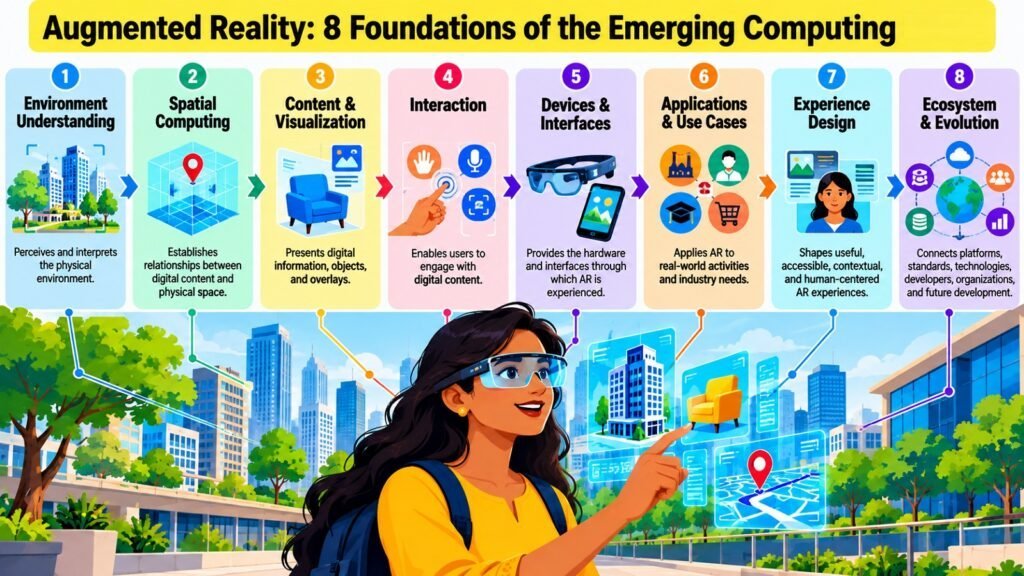
Understanding Augmented Reality properly requires examining eight dimensions: environmental perception, spatial positioning, digital content design, interaction mechanisms, enabling devices, practical applications, experience design, and the broader technological ecosystem shaping its evolution.
Augmented Reality — Eight Foundations Roadmap
| Augmented Reality Foundation | Core Focus |
| AR Environment Understanding | Perceiving, mapping, and interpreting the physical world |
| AR Spatial Computing | Positioning digital content accurately within physical space |
| AR Content & Visualization | Presenting relevant digital information in the user’s environment |
| AR Interaction | Enabling natural and effective human engagement with digital elements |
| AR Devices & Interfaces | Hardware platforms that enable AR experiences |
| AR Applications & Use Cases | Practical activities and industries where AR creates value |
| AR Experience Design | Human-centered principles for coherent and useful AR experiences |
| AR Ecosystem & Evolution | Technologies, standards, and forces shaping AR’s development |
1. Augmented Reality Environment Understanding: Building Digital Awareness
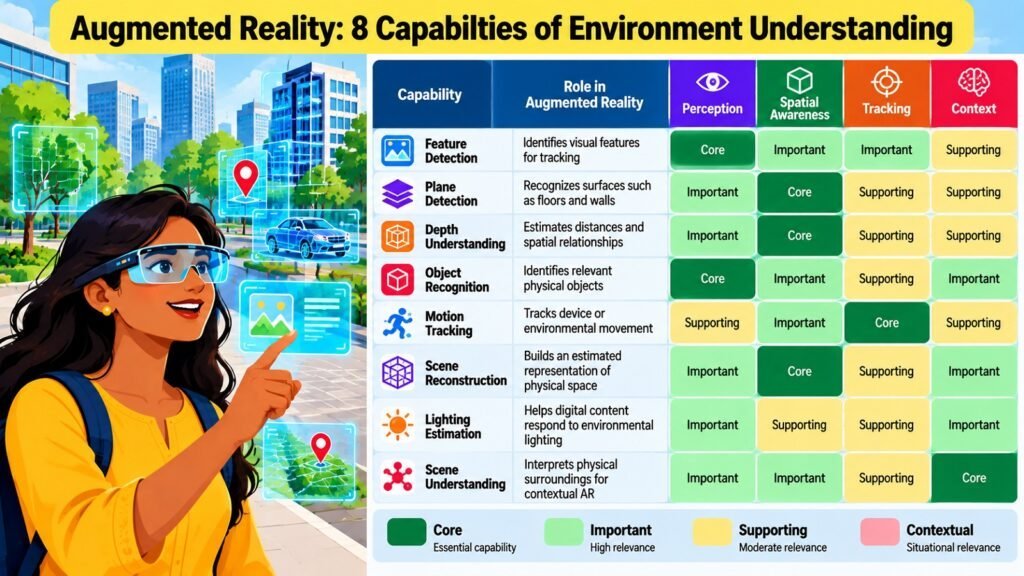
Before an Augmented Reality system can add anything meaningful to the physical world, it must first understand that world. Environment understanding is the foundational capability that allows an AR system to perceive, interpret, and model the physical space around a user. Without it, the augmentation process breaks down: a digital object placed without knowledge of the physical environment will drift, clip through surfaces, or fail to relate meaningfully to anything the user can see.
At its core, environment understanding draws on computer vision. Cameras capture the environment continuously while algorithms detect surfaces, identify objects, estimate spatial geometry, and track how the scene changes as the device or user moves. Depth sensors improve precision by providing geometric distance data that complements the visual signal. The result is a spatial model that the AR system uses as a reference for placing and maintaining digital content.
Simultaneous localization and mapping, widely known as SLAM, has been foundational to making this work in real time on mobile hardware. A SLAM algorithm builds a map of an unknown environment while simultaneously tracking the device’s own position within that map, which is precisely what AR environment understanding requires. Modern AR platforms build on decades of computer vision research.
Practical limitations are significant. Environments with poor lighting, reflective surfaces, rapid movement, and dense clutter all challenge the accuracy of environment understanding. Occlusion, where physical objects in the foreground block the system’s view, creates gaps in the spatial model. As conditions change, the system must update its understanding dynamically, placing continuous demands on processing resources.
Consider a furniture AR application showing how a sofa would look in a living room. The system must detect the floor, understand room boundaries, recognize existing furniture, and estimate scale, all while the user moves. Any failure in environment understanding produces an unconvincing result. That environmental model becomes the foundation from which spatial computing can construct meaningful digital-physical relationships.
Augmented Reality Environment Understanding — Key Capabilities
| Environmental Capability | Role in Augmented Reality |
| Surface detection | Identifies floors, walls, and planes to anchor digital objects stably |
| Depth sensing | Provides geometric distance data to improve spatial accuracy |
| Object recognition | Identifies real-world objects so AR content can relate to them contextually |
| SLAM | Enables real-time environment mapping and device position tracking simultaneously |
| Motion tracking | Maintains stable AR registration as the user or device moves |
| Scene understanding | Interprets spatial context to support relevant content placement |
| Lighting estimation | Adjusts digital rendering to match real-world illumination conditions |
| Occlusion handling | Allows physical objects to correctly appear in front of digital elements |
2. Augmented Reality Spatial Computing: Connecting Digital Content With Physical Space
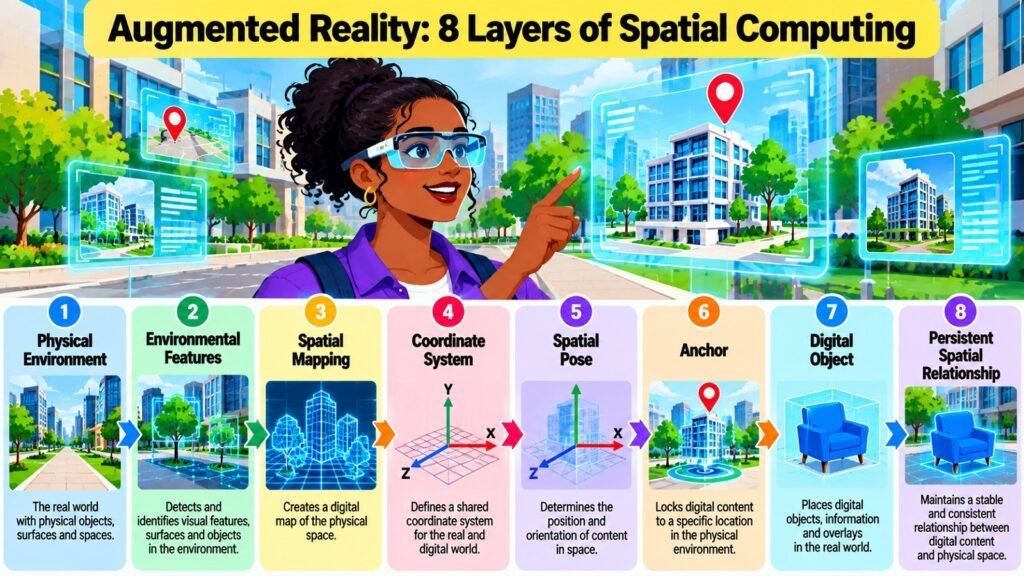
Once an AR system understands the physical environment, the next challenge is placing digital content within it in a way that feels genuinely connected to physical space. Spatial computing in Augmented Reality refers to the processes that establish, maintain, and manage meaningful positional relationships between digital content and the physical world.
The conceptual foundation involves coordinate systems. Every position in the physical space around a user can be represented as coordinates within a spatial reference frame, and the AR system must translate between the device’s own reference frame and the broader spatial frame of the environment. When it works correctly, a digital object placed on a table remains on that table whether the user steps back, moves to the side, or changes viewing angle.
Spatial anchors are a key mechanism for achieving this consistency. An anchor is a reference point in the physical environment to which digital content is attached. Anchored content remains stable relative to that point as the device moves. When anchors persist across sessions, this creates persistent digital layers on specific real-world locations, a capability with significant implications for professional and consumer applications alike.
The practical value is well documented. In industrial maintenance, a technician using AR glasses can view repair instructions appearing directly beside the component being serviced, eliminating the need to consult a separate manual. Research published in journals such as Human Factors has documented measurable reductions in task completion time and error rates when spatial AR guidance is used in assembly tasks.
Alignment errors remain a genuine challenge. Even small inaccuracies in spatial positioning can undermine trust and usability, particularly when digital content must correspond precisely to physical structures. Movement, changing environments, and sensor limitations all introduce uncertainty into spatial calculations. Understanding spatial computing means understanding not only what it enables but the conditions under which it performs reliably.
Augmented Reality Spatial Computing — Key Concepts
| Spatial Concept or Capability | Contribution to Augmented Reality |
| Coordinate systems | Provide the mathematical framework for positioning digital content in physical space |
| Spatial anchoring | Attaches digital objects to physical reference points for stable placement |
| Registration accuracy | Ensures digital content aligns correctly with corresponding physical elements |
| Spatial mapping | Builds a geometric model of the environment for content placement reference |
| Persistent content | Allows digital information to remain attached to physical locations across sessions |
| Scale consistency | Ensures digital objects appear at physically plausible sizes in the environment |
| Spatial relationships | Enables digital content to respond to its position relative to physical objects |
| Positional tracking | Continuously updates content position as the user and device move through space |
3. Augmented Reality Content & Visualization: Bringing Digital Information Into View
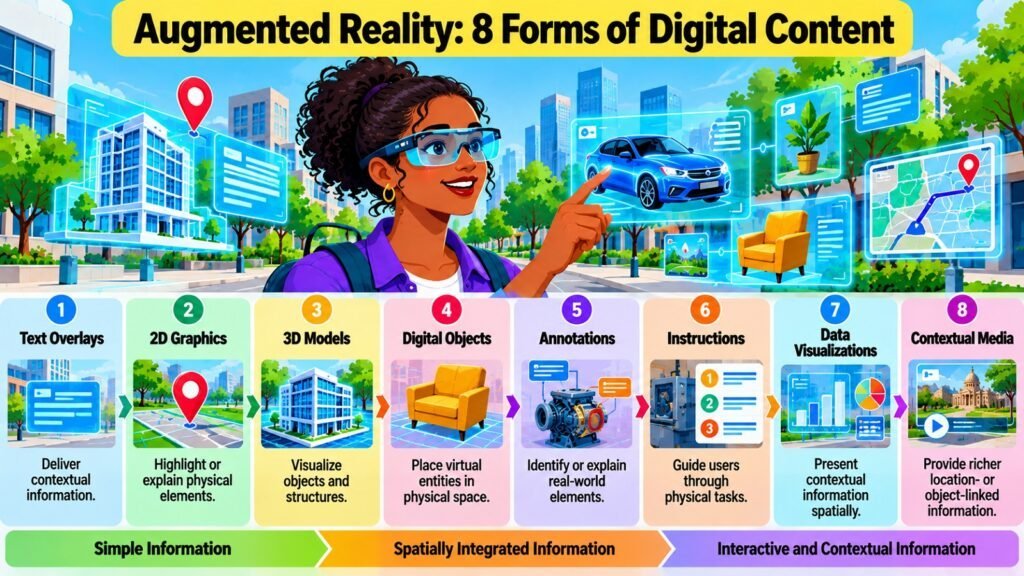
The digital layer that Augmented Reality introduces into the physical environment can take many forms. Text annotations, numerical data, 3D models, instructional graphics, navigational overlays, contextual warnings, product information, and dynamic data feeds are all forms of AR content. What distinguishes AR content from content on a conventional screen is that, when well designed, it is spatially and contextually connected to what the user is actually looking at or doing.
That distinction matters enormously for usefulness. A label identifying a machine component that appears directly beside it reduces cognitive effort because the relationship between information and its subject is immediate. The same information on a separate screen requires the user to establish that connection themselves, introducing additional work and potential for error. Research in information visualization has consistently shown that reducing the distance between information and its referent improves comprehension and decision-making speed.
AR content faces specific visualization challenges. The physical environment is not a controlled visual space. Backgrounds change, lighting varies, and the user’s attention is divided between the physical scene and the digital overlay. Visual hierarchy, meaning the use of contrast, scale, and positioning to signal relative importance, is central to effective AR content design. A low-contrast annotation placed over a visually busy surface is a design failure regardless of how accurate the spatial tracking may be.
Three-dimensional content introduces additional considerations. A 3D model of a product, building, or anatomical structure communicates spatial relationships that 2D graphics cannot, but it must be rendered at a consistent scale from a perspective matching the user’s viewpoint. An AR model of a molecular structure allows learners to examine it from multiple angles, deepening conceptual understanding beyond what static images or text typically achieves.
Information overload is a real risk. Irrelevant or poorly timed content increases cognitive load and impairs performance. The practical criterion for AR content is whether it genuinely contributes to what the user is trying to accomplish.
Augmented Reality Content & Visualization — Key Elements
| Content Element | Primary Purpose or Contribution |
| Text annotations | Deliver concise contextual information directly adjacent to physical objects |
| 3D models | Represent objects or structures with spatial depth and dimensional accuracy |
| Instructional graphics | Guide users through physical tasks with step-by-step visual direction |
| Navigational overlays | Provide wayfinding information referenced to the user’s physical environment |
| Data visualizations | Present numerical or relational data in spatially relevant formats |
| Contextual warnings | Alert users to conditions or hazards identified through environmental awareness |
| Product overlays | Display specifications or configuration options tied to physical products |
| Dynamic data feeds | Connect AR displays to live information streams relevant to the physical context |
4. Augmented Reality Interaction: Enabling Natural Human–Digital Engagement
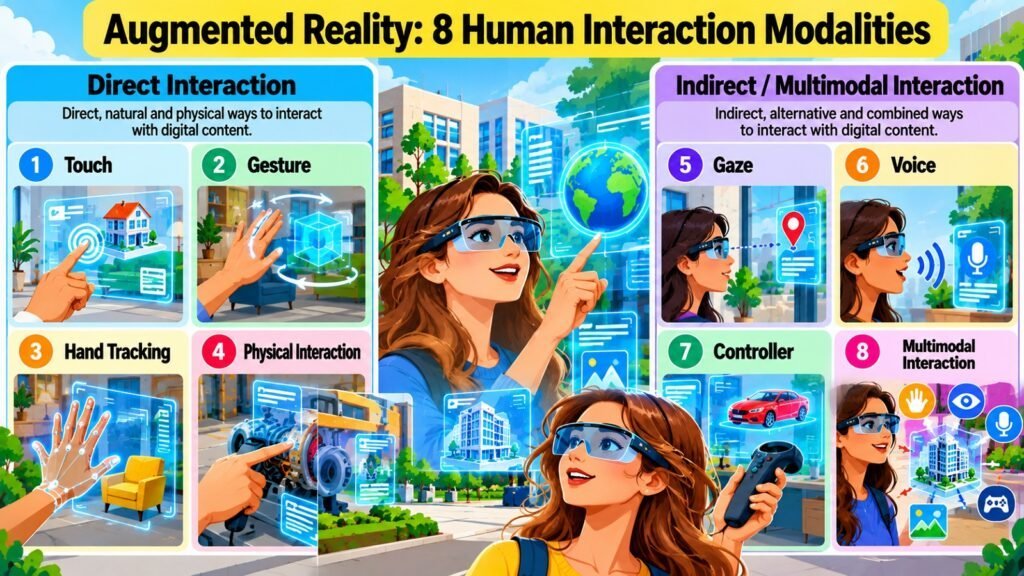
Augmented Reality becomes a genuinely interactive computing interface when users can engage with digital content rather than merely observe it. AR Interaction covers the mechanisms through which people act on, respond to, and manipulate digital elements within their physical environment, and the range of approaches available is considerably broader than the touch and click interactions that define screen-based computing.
Touch interaction remains relevant wherever a screen acts as the AR display, as on smartphones and tablets. When the display is a head-worn device, other modalities take precedence. Hand tracking allows systems to recognize gestures and finger positions without requiring physical contact with any device. Gaze-based interaction uses eye-tracking to identify where a user is looking as a form of implicit selection. Voice commands allow instructions without hand movement, which is particularly valuable in hands-on work environments. Physical-world interaction, where the AR system recognizes how a user handles real objects and responds accordingly, represents an increasingly sophisticated mode of engagement.
Human-computer interaction research provides a useful theoretical frame. Interaction naturalness concerns how closely a method maps to familiar physical or communicative behaviors, with more natural interactions generally requiring less learning and producing fewer errors. Discoverability, the extent to which users can understand available interactions without prior instruction, is a significant challenge in AR because there are no visible buttons or menus to communicate what actions are possible. Feedback must be immediate and clear enough to confirm that an interaction has been recognized.
Context dependency is fundamental. A surgeon cannot use gesture controls requiring large arm movements. A warehouse worker with gloved hands cannot use touch easily. Research in human factors has established that mismatches between interaction design and real-world usage conditions are among the most common sources of AR usability failure. Effective interaction design considers which methods are appropriate for the specific task, environment, and user characteristics, not simply which methods are technically available.
Augmented Reality Interaction — Key Approaches
| Interaction Approach | Practical Role or Characteristic |
| Touch input | Enables direct screen-based AR interaction on smartphones and tablets |
| Hand tracking | Recognizes gestures and finger positions for hands-free AR manipulation |
| Gaze control | Uses eye direction as a selection and attention signal in head-worn AR |
| Voice commands | Allows spoken instructions, useful in hands-occupied work contexts |
| Controller input | Provides precise physical input for AR headsets in controlled environments |
| Spatial gestures | Interprets large arm movements as intentional AR commands |
| Physical-world interaction | Detects how users handle real objects to trigger relevant AR responses |
| Multimodal input | Combines two or more interaction methods to match diverse tasks and contexts |
5. Augmented Reality Devices & Interfaces: Enabling the Augmented Experience
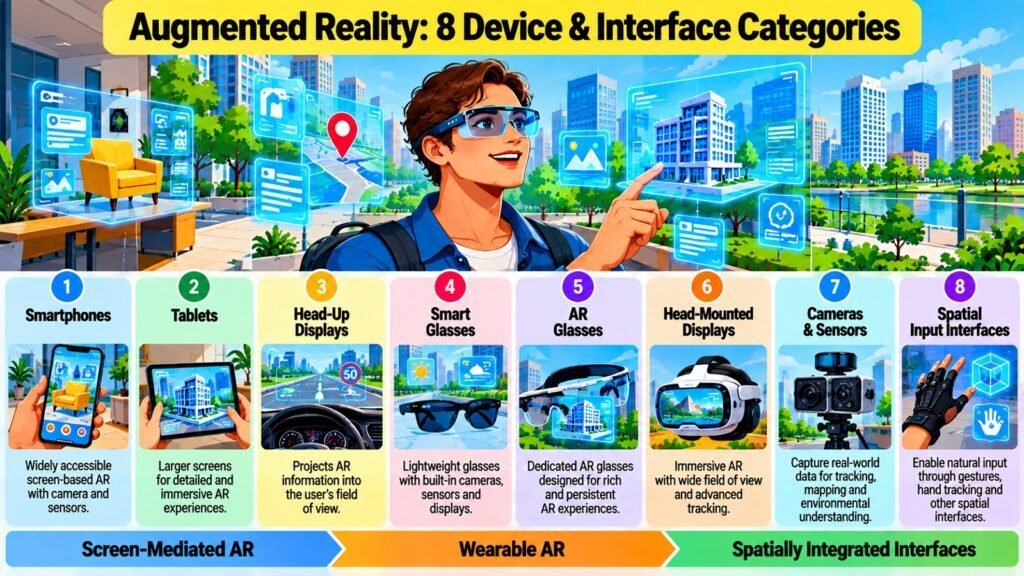
No Augmented Reality experience exists without hardware. The devices through which people access AR determine not only the quality of the experience but also where, when, and how it can practically be used. Device capabilities shape every other foundation: environment understanding accuracy depends on sensor quality, spatial computing depends on processing power, visualization depends on display characteristics, and interaction modalities depend on available input mechanisms.
Smartphones and tablets represent the most widely accessible AR hardware today. The cameras, processors, and motion sensors in modern mobile devices support meaningful AR experiences, and the existing global install base means applications on these platforms can reach large audiences without additional hardware investment. The fundamental limitation is ergonomic: holding a device at arm’s length is cumbersome for extended use, particularly when both hands are needed for a task.
Smart glasses and dedicated AR glasses shift the interface toward a wearable display that keeps the user’s hands free and places digital content closer to the natural line of sight. This form factor is more practical for professional applications requiring sustained use and physical task performance. The optical systems within AR glasses project digital content onto a transparent lens through a waveguide. The field of view available through current optical systems remains a known limitation, covering a narrower portion of the visual environment than natural peripheral vision.
Accelerometers, gyroscopes, depth cameras, and ambient light sensors constitute the foundational data sources upon which environment understanding and spatial computing algorithms rely. Computational processing represents a pervasive constraint affecting environment understanding, spatial tracking, content rendering, and interaction recognition, each of which requires substantial processing capacity. In instances where on-device processing capabilities prove inadequate, AR systems delegate computational tasks to cloud or edge infrastructure; however, this approach introduces latency that may compromise the spatial stability essential for delivering a compelling AR experience.
Augmented Reality Devices & Interfaces — Key Categories
| Device or Interface Category | Defining Capability or Primary Role |
| Smartphones | Wide accessibility; support camera-based AR through existing mobile hardware |
| Tablets | Larger display for AR visualization; useful in education and retail contexts |
| AR glasses (optical see-through) | Transparent display over real-world view; keeps hands free for physical tasks |
| Head-up displays (HUD) | Fixed or vehicle-mounted AR overlay; established in aviation and automotive sectors |
| Depth cameras | Provide geometric distance data for accurate environment understanding |
| Motion sensors (IMU) | Track device orientation and movement to maintain spatial registration |
| Waveguide optics | Thin optical system in AR glasses projecting digital content into the field of view |
| Edge computing hardware | Handles processing-intensive AR tasks with low latency near the point of use |
6. Augmented Reality Applications & Use Cases: Transforming Real-World Activities
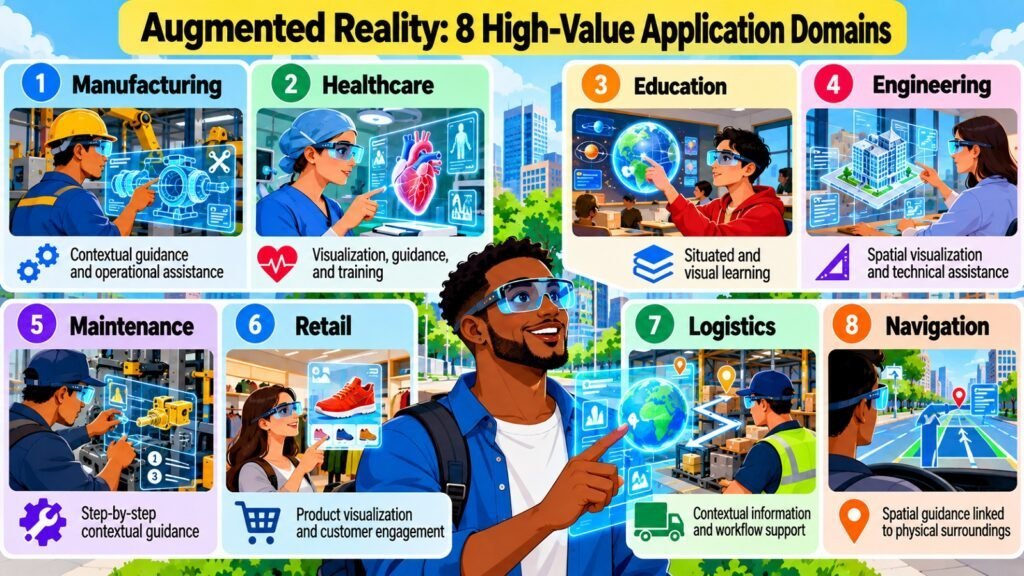
The practical value of Augmented Reality is demonstrated not in laboratories but in real activities where it changes how tasks are performed, how information is accessed, or how decisions are made. Examining several application areas reveals how AR creates value across contexts.
In manufacturing and industrial maintenance, AR has demonstrated measurable benefits. Research examining aircraft assembly procedures, including studies in Boeing manufacturing environments, has shown that workers using AR guidance make fewer errors and complete tasks more quickly than those consulting paper manuals. The mechanism is clear: AR places the instruction exactly where the task is being performed, eliminating the need to translate between an abstract diagram and a physical component.
Healthcare offers another well-documented area. Surgical AR systems overlay preoperative imaging data, including CT and MRI scans, onto the patient’s anatomy during a procedure, giving surgeons a combined view of the operative field and digital information from prior imaging. Navigation guidance in neurosurgery and orthopedic procedures is one of the more mature clinical AR applications, with peer-reviewed literature documenting outcomes.
Educational outcomes are enhanced through augmented reality’s capacity to render abstract concepts as spatially comprehensible entities. When molecular configurations, technical schematics, and biological systems are presented as three-dimensional augmented reality visualizations, learners can observe them from various perspectives—a methodology supported by embodied cognition research, which demonstrates that such multidirectional examination produces more profound comprehension than conventional static representations or written descriptions can provide.
In retail, AR applications allow consumers to visualize products in their own environments before purchasing. Remote assistance platforms enable an expert to guide a field technician by overlaying annotations onto what the technician is seeing. A practical framework for AR suitability asks whether the task involves consulting information during a physical activity, whether spatial context matters, and whether placing information in the user’s field of view would reduce cognitive effort or error.
Augmented Reality Applications & Use Cases — Key Areas
| Application Area | Principal Practical Value or Purpose |
| Manufacturing & assembly | Reduces errors and improves speed through spatially located task guidance |
| Healthcare & surgery | Overlays imaging data on the physical field to support precision procedures |
| Education & training | Makes abstract or complex concepts spatially tangible through 3D AR models |
| Retail & visualization | Lets consumers evaluate products in their own environments before purchase |
| Remote assistance | Enables experts to guide field workers through spatial annotation of live views |
| Navigation & wayfinding | Provides directional information anchored to the physical environment |
| Engineering & architecture | Visualizes designs and structural data in situ before physical construction |
| Logistics & warehousing | Speeds picking, sorting, and verification tasks through AR guidance and data overlay |
7. Augmented Reality Experience Design: Creating Human-Centered Experiences
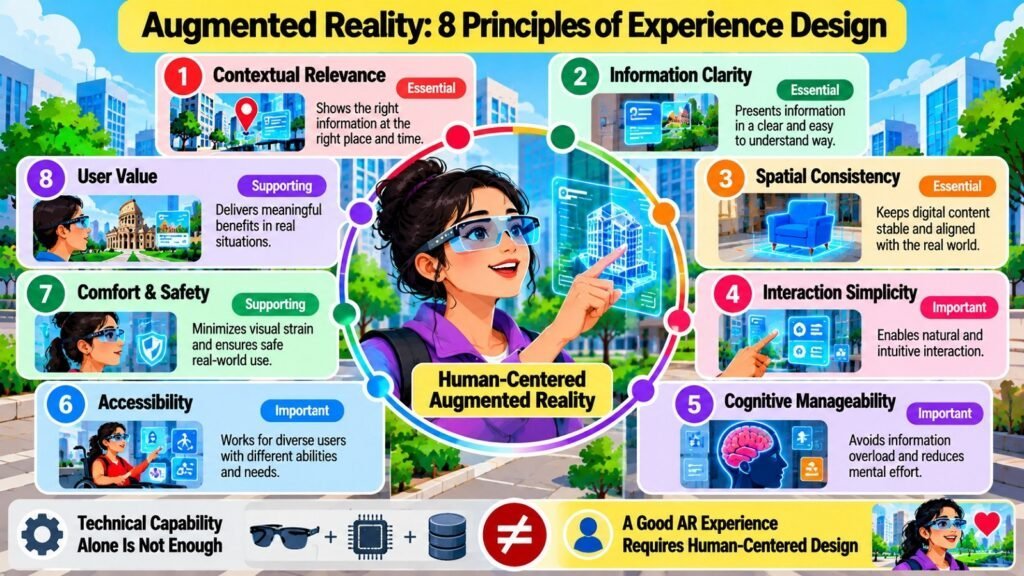
Technical capability does not automatically produce a good Augmented Reality experience. Environment understanding can be accurate, spatial anchoring reliable, content relevant, and interaction responsive, yet the resulting experience can still feel confusing, uncomfortable, or counterproductive. AR Experience Design addresses that gap by asking not what the technology can do but what the experience should feel like for the person using it.
The field draws on human-centered design, user experience design, cognitive science, and spatial UX research. Its starting point is always the user’s task, environment, and characteristics rather than the technology’s features. A well-designed AR experience makes it immediately apparent what information is available and what the user can do with it, responds predictably to actions, and presents information at a level of detail appropriate to the task.
Cognitive load is a central concern. Augmented Reality inherently divides the user’s attention between the physical environment and the digital overlay. Poor design amplifies this division by presenting too much information or placing content in visually demanding locations. John Sweller’s foundational work on cognitive load theory provides a useful frame: applying those principles to AR means designing experiences that reduce the cognitive cost of accessing digital information rather than adding to the visual field indiscriminately.
Contextual relevance is equally essential. Digital content that is not relevant to what the user is currently doing is not neutral; it is actively distracting. Effective AR experience design requires knowing when to present information as much as what to present. Comfort, safety, and accessibility also matter. Head-worn AR devices can cause visual fatigue if the optical system creates mismatches in the visual system’s demands. Accessibility, including support for users with visual, motor, or cognitive differences, is an increasingly recognized design obligation rather than an optional consideration.
Augmented Reality Experience Design — Key Principles
| Design Principle | Practical Implication |
| Cognitive load management | Limit information density to what the task genuinely requires |
| Contextual relevance | Present content only when it is directly useful to the current activity |
| Visual hierarchy | Use scale, contrast, and placement to signal the relative importance of elements |
| Discoverability | Ensure available interactions are apparent without requiring prior instruction |
| Feedback responsiveness | Confirm user actions immediately and clearly through visual or auditory signals |
| Comfort and ergonomics | Design for sustained use without causing visual fatigue or physical strain |
| Accessibility | Support diverse users including those with visual, motor, or cognitive differences |
| Environmental awareness | Adapt content presentation to the visual and spatial conditions of the environment |
8. Augmented Reality Ecosystem & Evolution: Shaping the Future of Computing
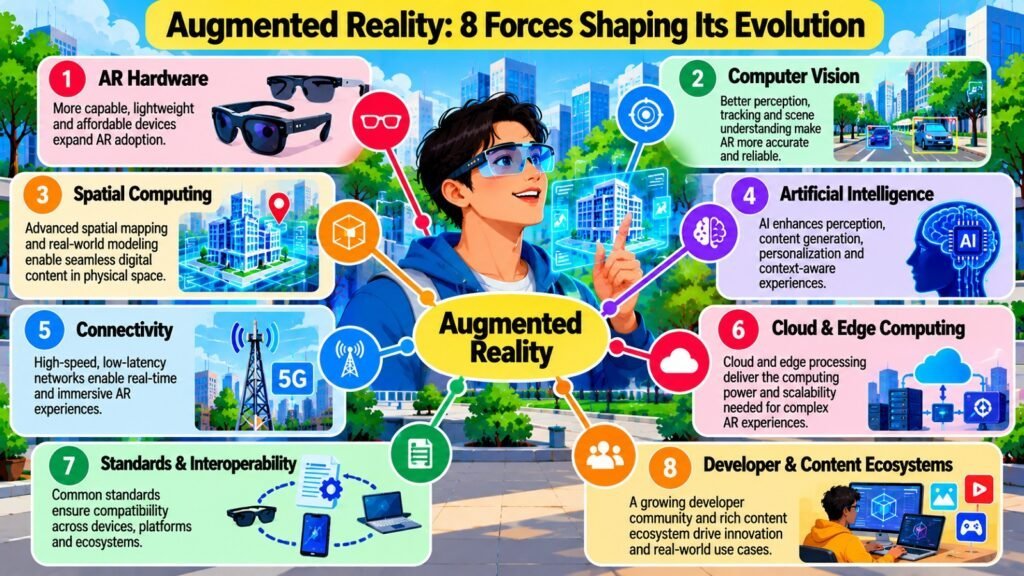
Augmented Reality does not advance independently. Its development pathway is influenced by an extensive network comprising software frameworks, hardware distribution systems, creation utilities, technical specifications, communication networks, and foundational innovations. Comprehending this interconnected system is fundamental to discerning the future direction of Augmented Reality and identifying the factors that will govern the velocity and trajectory of its technological progression.
Software platforms and development frameworks provide the foundation on which AR applications are built. Platforms such as ARKit and ARCore, developed by Apple and Google respectively, standardize access to AR capabilities on mobile devices and have significantly lowered the barrier to building mobile AR applications. Similar platform-level support for AR glasses remains less mature, which partly explains why the wearable AR ecosystem is less developed than mobile AR.
Artificial intelligence is increasingly embedded throughout the AR stack. Machine learning models drive environment understanding, object recognition, and hand tracking. AI-powered content generation is beginning to reduce the cost and time required to create 3D AR content, which has historically been a significant barrier. The relationship between AI and AR is not simply additive; AI improves AR capabilities in ways that conventional programming approaches cannot easily replicate.
Connectivity infrastructure, particularly high-bandwidth low-latency mobile networks, enables computation to be offloaded from AR devices to cloud or edge servers. Technical standards and interoperability frameworks matter considerably: without common standards for spatial anchors, content formats, and cross-platform sharing, the AR ecosystem risks fragmentation. Organizations including the Khronos Group and the Open AR Cloud are working on standards that would allow AR content and spatial data to be shared across platforms. Privacy remains an important constraint, with the continuous capture and processing of physical-environment visual data raising genuine questions about consent and responsible use.
Augmented Reality Ecosystem — Key Components
| Ecosystem Component | Role in Augmented Reality’s Evolution |
| AR software platforms | Standardize access to AR capabilities and lower the barrier to application development |
| AI and machine learning | Improve environment understanding, interaction, and content creation throughout the AR stack |
| Cloud and edge computing | Enable computationally intensive AR tasks on lightweight or mobile hardware |
| Connectivity infrastructure | Provides the bandwidth and latency conditions that enable cloud-assisted AR processing |
| Development tools and SDKs | Allow developers to build AR applications without implementing core functions from scratch |
| Technical standards | Enable content sharing and interoperability across different AR platforms and devices |
| Developer and research communities | Drive innovation in AR capabilities, applications, and design approaches |
| Privacy and regulatory frameworks | Shape responsible data practices and establish boundaries for acceptable AR data collection |
Conclusion: Augmented Reality – A Powerful Foundation for Future Computing
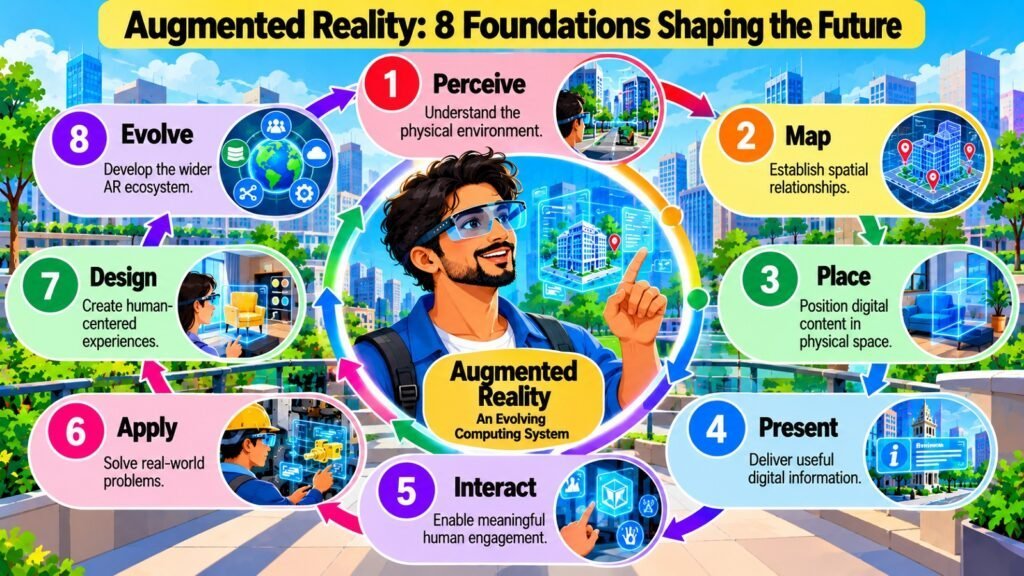
Augmented Reality is best understood as a layered computing system in which each foundation depends on and amplifies the others. Environmental understanding feeds spatial computing, which positions digital content that users interact with through their chosen input method. Applications demonstrate where this creates practical value, experience design ensures it serves human needs, and the broader ecosystem provides the infrastructure that allows AR to mature beyond isolated use cases.
The significance of Augmented Reality lies in what it changes about information and physical context. Unlike conventional computing, which presents information separately from the activity it relates to, Augmented Reality places information where and when it is needed, in direct connection with the physical reality it describes. This represents a qualitative shift in how computing can support human activity.
The limitations are real: environment understanding in complex settings remains challenging, wearable hardware has not yet reached wide accessibility, and privacy frameworks are still developing. The eight foundations examined in this article provide a durable framework for evaluating any AR system and understanding the conditions under which it creates genuine, lasting value.
Augmented Reality — Eight Foundations Final Reference
| Augmented Reality Foundation | Key Takeaway |
| AR Environment Understanding | AR must perceive and model the physical world before meaningful augmentation is possible |
| AR Spatial Computing | Reliable spatial positioning makes digital content feel genuinely connected to physical space |
| AR Content & Visualization | Effective AR content reduces cognitive effort and is contextually tied to the physical environment |
| AR Interaction | The best AR interaction method suits the user’s task, environment, and physical context |
| AR Devices & Interfaces | Device capabilities determine the quality, practicality, and accessibility of any AR experience |
| AR Applications & Use Cases | AR creates the most value when information placement reduces cognitive effort in active physical tasks |
| AR Experience Design | Technical capability must be guided by human-centered principles to produce genuinely useful experiences |
| AR Ecosystem & Evolution | Standards, AI, connectivity, and responsible design will shape AR’s long-term trajectory |