
Table of Contents
Introduction: Why Leadership Decision Making Matters
Every organization moves in the direction its leaders choose. That reality makes leadership decision making one of the most consequential capabilities in both leadership and management. The quality of decisions leaders make shapes where an organization invests, what it prioritizes, how people work, and whether it grows or struggles over time.
Leadership decision making is not simply the act of choosing between alternatives. It is a leadership capability involving judgment, responsibility, choice, action, and accountability. Leaders decide not only what to do but what to stop, what to sacrifice, and what consequences they are prepared to own — consistently under imperfect information, competing priorities, limited resources, and differing stakeholder perspectives.
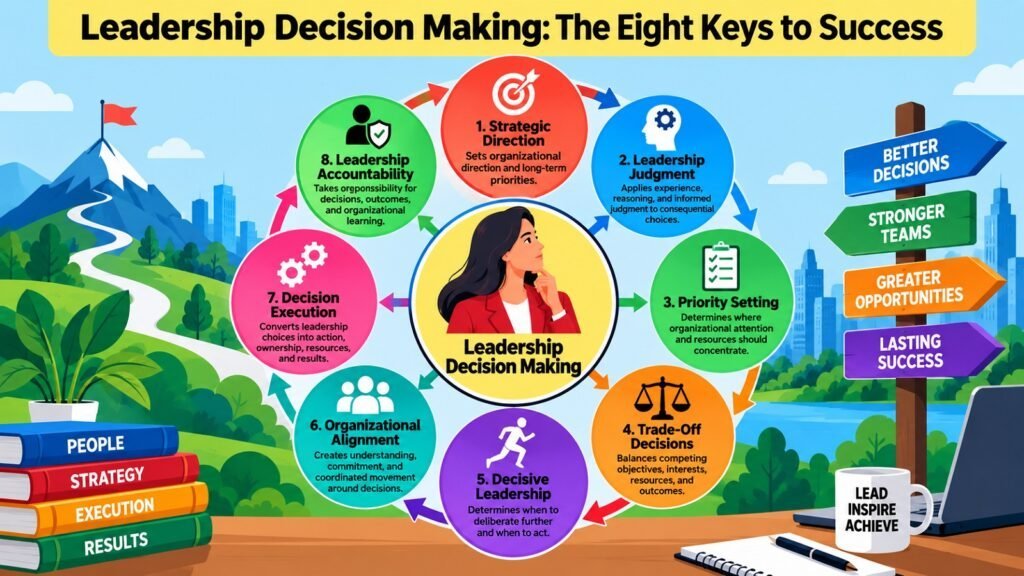
This article examines eight interconnected dimensions of leadership decision making: strategic direction, leadership judgment, priority setting, trade-off decisions, decisive leadership, organizational alignment, decision execution, and leadership accountability. Each represents a distinct responsibility — from determining where the organization should go, to exercising sound judgment, to ensuring that consequential choices are carried through and their results honestly owned.
Together, these dimensions reveal that effective leadership decision making involves far more than selecting a course of action. Each section that follows examines one dimension in depth, offering analysis, evidence-based examples, and practical tools that leaders can apply directly.
Table 1: Leadership Decision Making — Eight Aspects and Their Roles
| Aspect of Leadership Decision Making | Role in Leadership Decision Making |
| Strategic Direction | Determines the long-term path an organization pursues and aligns major decisions with purpose and vision. |
| Leadership Judgment | Enables leaders to reach sound conclusions amid uncertainty, incomplete information, and competing interpretations. |
| Priority Setting | Establishes what receives organizational attention, resources, and focus when competing demands exceed available capacity. |
| Trade-Off Decisions | Requires leaders to choose explicitly between competing objectives, knowing that improving one may reduce another. |
| Decisive Leadership | Ensures leaders act at the right time rather than prematurely or with excessive delay. |
| Organizational Alignment | Creates understanding, commitment, and coordinated action across teams and stakeholders after a consequential decision. |
| Decision Execution | Converts chosen directions into organized action through clear ownership, resources, communication, and follow-through. |
| Leadership Accountability | Connects leadership choices with responsibility for consequences and supports organizational learning from outcomes. |
1. Leadership Decision Making and Strategic Direction
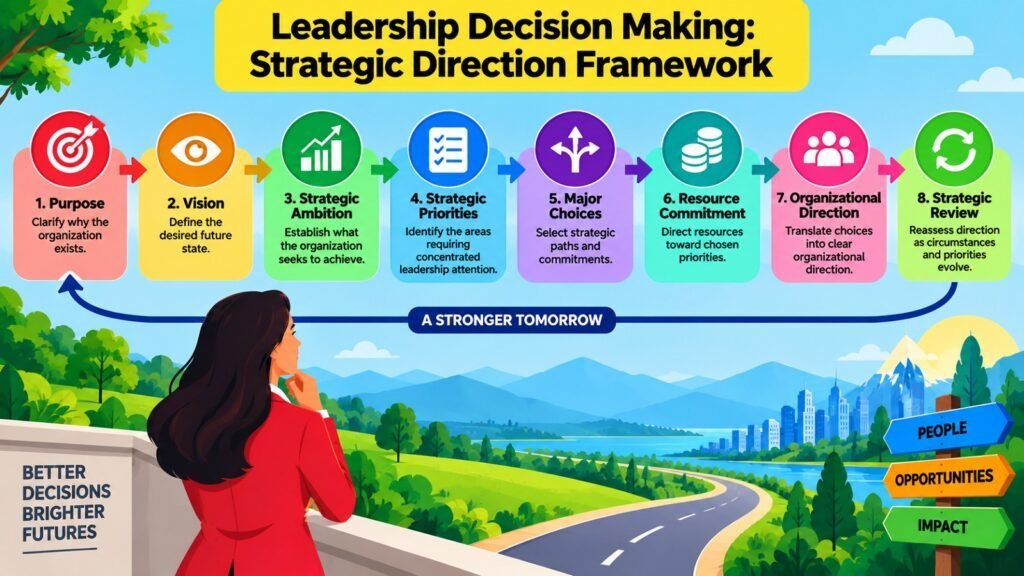
Strategic direction is where leadership decision making carries its most lasting consequences. When leaders decide where an organization should go — what markets to enter, what capabilities to build, what business model to sustain — they commit organizational resources and establish the context within which thousands of subsequent decisions will be made.
Strategic management research consistently shows that senior leadership choices are among the most powerful determinants of organizational performance. The upper echelons framework, developed by Hambrick and Mason in 1984, established that the values, experiences, and cognitive frames of top leaders directly shape the strategic choices an organization makes. Leaders do not simply implement strategy; they constitute it through their decisions.
Amazon’s decision in the mid-2000s to build cloud infrastructure for external customers — what became Amazon Web Services — illustrates how a strategic leadership decision can redefine competitive position entirely. The choice committed significant capital to a business with little precedent. It succeeded because the strategic reasoning was clear and leadership commitment was sustained over time, even when short-term pressures argued for retrenchment.
A persistent tension is the pull of short-term performance demands against the requirements of long-term direction. This pressure can produce what researchers call strategic drift. Leaders can guard against it by asking one disciplined question before any major commitment: does this decision advance the strategic intent we have established, or does it merely solve the problem in front of us? Decisions that fail that test deserve serious scrutiny before proceeding.
Table 2: Leadership Decision Making and Strategic Direction — Eight Strategic Considerations
| Strategic Consideration | Leadership Decision Making Implication |
| Vision-decision alignment | Major decisions should visibly advance the organization’s stated long-term direction, not simply resolve short-term pressures. |
| Resource commitment signals intent | Allocating significant resources to a strategic area communicates organizational priorities more credibly than mission statements alone. |
| Strategic focus requires exclusion | Porter’s competitive strategy research shows that choosing a direction means consciously deciding what not to pursue. |
| Short-termism erodes direction | Excessive focus on near-term results causes strategic drift, a pattern documented across mature industries by Sull (2003). |
| Consistency compounds advantage | Repeated decisions aligned with a clear direction accumulate into durable competitive capability over time. |
| Too many priorities signals none | Research on organizational attention shows that more than three to five strategic priorities effectively means none receives sufficient focus. |
| Strategic reversals have costs | Frequently changing direction destroys organizational momentum and erodes employee trust in leadership judgment. |
| Direction must be communicated clearly | Leaders who cannot articulate the reasoning behind strategic decisions create confusion, misalignment, and poor downstream choices. |
2. Leadership Decision Making and Leadership Judgment
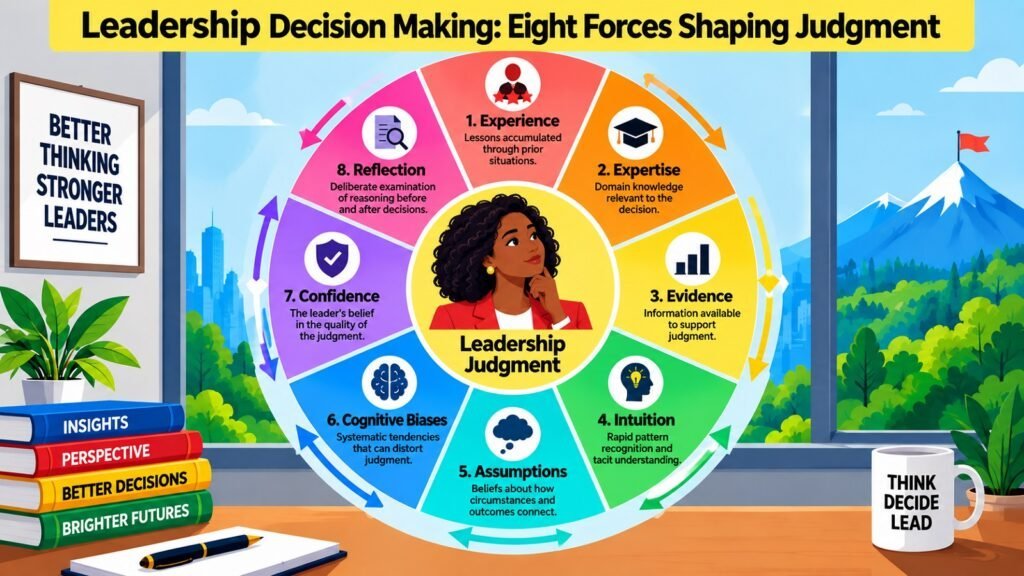
Judgment is the human element at the core of leadership decision making. It is the capacity to reach a well-reasoned conclusion when evidence is incomplete, expert opinion is divided, or the situation is genuinely novel. Every leader will face decisions where data can inform but cannot determine the right course of action. In those moments, judgment is what separates effective leadership from competent administration.
Gary Klein’s research on naturalistic decision making showed that experts rarely evaluate options systematically under pressure; instead, they recognize patterns from experience and simulate outcomes. This works well when experience is directly relevant but can mislead when past patterns no longer apply. Cognitive bias research by Kahneman and Tversky showed that even experienced decision makers are systematically prone to overconfidence, causing them to underweight disconfirming evidence and dismiss perspectives that challenge their own.
Kodak’s decisions regarding digital photography illustrate the risk. Kodak engineers had developed an early digital camera prototype in 1975, but leadership judgment — shaped by deep experience in the film business — delayed serious commitment to digital technology. Experienced judgment formed in one context had become a liability when the environment shifted fundamentally.
Leaders can improve judgment quality by identifying the two or three assumptions a decision depends on most heavily, then actively asking what evidence would suggest those assumptions are wrong. Bringing in perspectives from people not involved in forming the initial view provides further protection against confirmation bias. The goal is not endless deliberation but ensuring that confident conclusions have been genuinely tested before commitment is made.
Table 3: Leadership Decision Making and Leadership Judgment — Eight Judgment Considerations
| Judgment Consideration | Leadership Decision Making Relevance |
| Overconfidence bias | Leaders with strong track records are especially susceptible to overestimating the accuracy of their own judgments (Kahneman, 2011). |
| Confirmation bias | Decision makers tend to seek information confirming existing views and discount evidence that challenges them. |
| Availability heuristic | Recent or vivid events are weighted more heavily than statistical evidence, skewing leadership assessments of risk. |
| Intuition versus analysis | Klein’s research shows expert intuition is reliable when experience is directly relevant but unreliable in genuinely novel situations. |
| Sunk cost fallacy | Leaders may persist with failing directions because of prior investment rather than evaluating the future prospects objectively. |
| Framing effects | The same decision presented differently produces different choices, even when the underlying options are identical. |
| Red team thinking | Assigning someone to argue against a preferred option surfaces weaknesses that internal agreement often conceals. |
| Pre-mortem analysis | Imagining that a decision has already failed and identifying probable causes improves risk assessment before commitment. |
3. Leadership Decision Making and Priority Setting
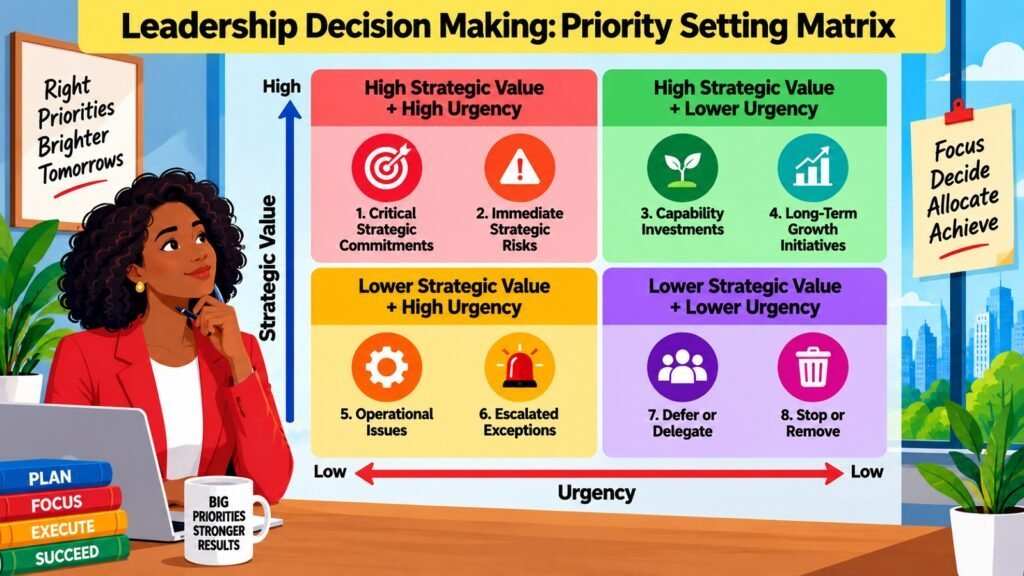
Every organization faces more demands than it can meaningfully serve. Leadership decision making determines which demands receive genuine focus, which receive minimal attention, and which are deferred or discontinued. Priority setting is not a productivity technique; it is a fundamental leadership act that shapes what the organization actually becomes, regardless of what its strategy documents claim.
Attention-based theory, developed by Ocasio, argues that organizational outcomes depend heavily on where leadership attention is directed. Leaders who concentrate on a small number of meaningful priorities consistently outperform those who distribute attention broadly because focused attention produces mastery and coordinated effort, while dispersed attention produces activity without progress. McKinsey research has repeatedly found that senior leadership alignment on a few strategic priorities is one of the most reliable predictors of successful execution.
Nokia’s situation in the late 2000s illustrates the consequences of unclear prioritization. Facing disruption from Apple and Google, Nokia’s leadership struggled to establish a consistent priority among its hardware platforms, its software strategy, and its geographical commitments. The resulting dispersion of organizational attention contributed materially to the company’s loss of competitive position in a market it had previously dominated.
A practical prioritization test asks three questions about each major objective: does it advance stated strategic direction, does it have a clear accountable owner, and is it backed by sufficient resources? Objectives failing those tests should be delayed, removed, or restructured. Leadership responsibility also includes the discipline of stopping lower-value activities — the courage to discontinue commitments that no longer serve strategic purpose.
Table 4: Leadership Decision Making and Priority Setting — Eight Priority Challenges and Responses
| Leadership Priority Challenge | Appropriate Leadership Response |
| Too many stated priorities | Reduce to three to five organizationally meaningful priorities with clear ownership and resource backing. |
| Urgent tasks crowding important work | Distinguish operational urgency from strategic importance; protect time and resources for high-value priorities. |
| Frequently shifting priorities | Establish a minimum commitment period for each priority and communicate changes with clear rationale. |
| Initiatives without clear ownership | Assign a named accountable leader to each priority before approving resource allocation. |
| Low-value activities persisting | Build a regular review to discontinue or deprioritize work that no longer advances strategic direction. |
| Misalignment across leadership team | Require explicit agreement on priority ranking before communicating to the wider organization. |
| Growth versus operational stability tension | Make the trade-off explicit and communicate it clearly rather than allowing both to compete for the same resources. |
| Inadequate resources behind stated priorities | If a priority does not receive funding and capacity, it is not actually a priority — treat resource allocation as a priority decision. |
4. Leadership Decision Making and Trade-Off Decisions
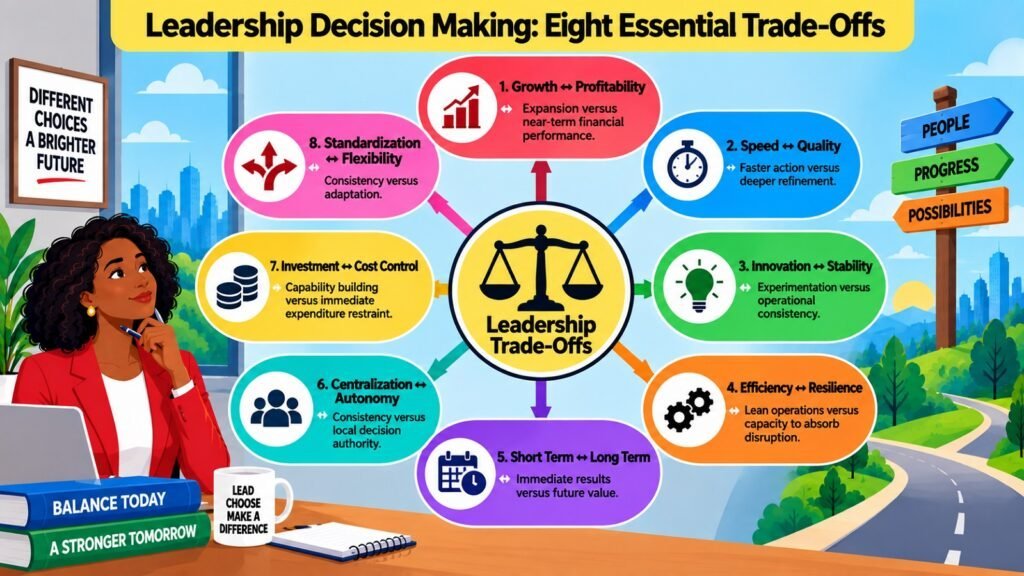
Trade-offs are unavoidable in leadership. Any decision that genuinely commits resources or establishes direction necessarily reduces what is available for other purposes. Leaders who pretend otherwise are not avoiding trade-offs; they are simply allowing them to emerge implicitly, driven by competing organizational pressures rather than deliberate leadership choice. Making trade-offs explicit is a mark of clear thinking and honest leadership decision making.
Michael Porter’s foundational work on competitive strategy established that sustainable competitive positions depend on deliberate trade-offs. Organizations that try to optimize for everything simultaneously — growth, profitability, efficiency, and innovation — typically produce mediocrity across all of them, because the resource and management requirements of each genuinely conflict. The same logic applies to internal leadership decisions: choosing a direction means accepting what that direction does not include.
Amazon’s early strategic decisions are instructive. For more than a decade, leadership deliberately prioritized growth and customer experience over short-term profitability. The trade-off was not accidental; it was an explicit leadership choice grounded in a clear theory of long-term value creation, and leadership was willing to explain and defend it consistently. That clarity distinguished Amazon from organizations where competing objectives were simply left unresolved, generating internal confusion.
Common leadership trade-offs include speed versus quality, innovation versus stability, and near-term financial performance versus long-term capability building. In each case, the leadership challenge is not eliminating the tension but making an honest judgment about which side better serves the organization’s strategic direction, then communicating the rationale clearly. A practical trade-off assessment involves stating what is gained, what is reduced or deferred, and why the chosen direction reflects strategic priorities.
Table 5: Leadership Decision Making and Trade-Off Decisions — Eight Common Leadership Trade-Offs
| Trade-Off in Leadership Decision Making | Illustrative Example or Established Principle |
| Growth versus profitability | Amazon sustained low margins for years to prioritize market share and infrastructure investment over near-term earnings. |
| Speed versus quality | Toyota’s lean system demonstrates that reducing defects can improve speed, but only within a disciplined operational system. |
| Innovation versus stability | Organizations pursuing breakthrough innovation must accept higher operational risk and short-term disruption. |
| Efficiency versus resilience | Just-in-time supply chains are highly efficient but, as COVID-19 revealed, highly vulnerable to supply disruptions. |
| Short-term cost control versus long-term capability | Cutting training budgets reduces immediate costs but erodes organizational capability over time. |
| Specialization versus flexibility | Deep specialization improves efficiency but reduces an organization’s ability to adapt to changing conditions. |
| Decentralization versus consistency | Delegating decisions to local teams accelerates responsiveness but can reduce quality and brand consistency. |
| Risk-taking versus risk management | Organizations that avoid all risk also avoid the opportunities necessary for competitive renewal and long-term growth. |
5. Leadership Decision Making and Decisive Leadership
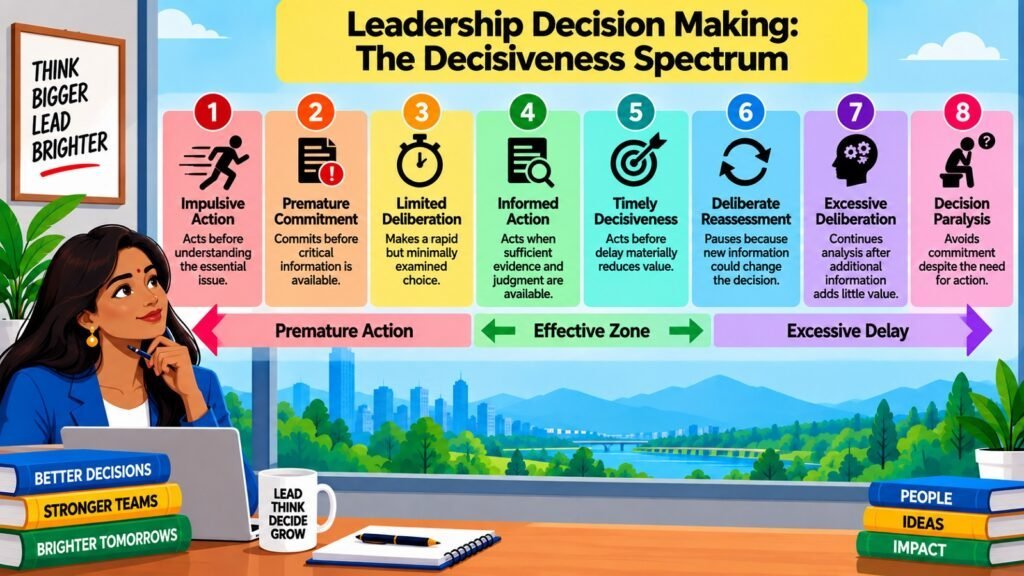
Decisiveness is frequently misunderstood as synonymous with speed or forcefulness. In reality, decisive leadership means acting at the right time with a well-formed judgment, not simply acting quickly. A leader who decides impulsively and one who delays indefinitely are both failing at decisiveness, though in opposite directions. The discipline lies in matching the timing of a decision to its consequences, reversibility, and the genuine value of additional information.
Research on decision delay documents the costs of both failure modes. When leaders delay decisions requiring early commitment, the delay itself becomes a decision with consequences: competitive windows close, teams lose direction, and the eventual commitment often costs more. Conversely, acting before sufficient information is available frequently produces avoidable errors. The question is never simply whether to decide but whether the information available now justifies the commitment the decision requires.
The response of many traditional retailers to e-commerce disruption in the late 1990s illustrates the cost of the delay. Several well-established chains recognized the threat early but delayed major online investment, fearing channel conflict with existing stores. That delay allowed Amazon and others to establish operational advantages that proved insurmountable. The cost of waiting exceeded the cost of the uncertainty leaders had been trying to resolve before acting.
A practical decisiveness test asks: would another thirty days of analysis materially change this decision? When the answer is no, further deliberation is procrastination. Effective decisiveness also requires the willingness to revise — a leader who commits in good faith can and should adjust a decision when material circumstances change, without treating revision as a sign of weakness.
Table 6: Leadership Decision Making and Decisive Leadership — Eight Decision Conditions and Leadership Approaches
| Decision Condition | Appropriate Leadership Approach |
| High urgency, sufficient information | Act promptly; delay transfers cost and risk to the organization without improving decision quality. |
| High urgency, insufficient information | Act on best available judgment with a clear plan to monitor and revise as information emerges. |
| Low urgency, high reversibility | Allow deliberation; the cost of delay is manageable and revision remains feasible if needed. |
| Low urgency, high irreversibility | Invest in thorough analysis; the stakes of an early wrong decision are asymmetrically high. |
| Analysis paralysis risk | Set a decision deadline and commit; further deliberation is procrastination when more information adds no clarity. |
| Competitive window closing | Recognize that not deciding is itself a decision; inaction cedes opportunity to competitors who act faster. |
| Evidence contradicting prior decision | Revise based on new evidence; intellectual honesty outweighs the discomfort of appearing inconsistent. |
| Consensus is unachievable | Seek alignment, not agreement; the leader must decide when further consultation is no longer improving the outcome. |
6. Leadership Decision Making and Organizational Alignment
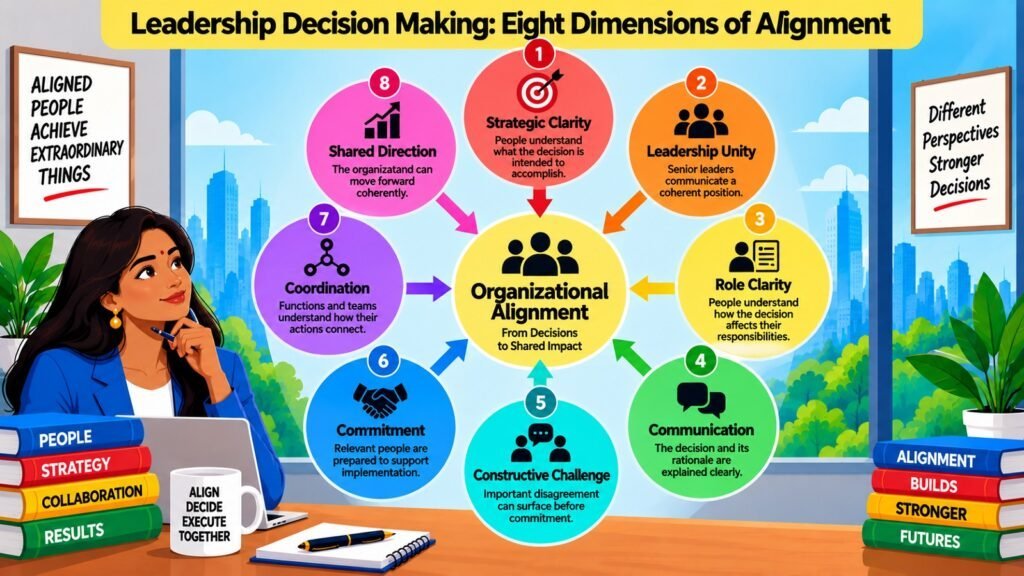
A leadership decision that cannot be executed because people do not understand it, accept it, or are unwilling to act on it has limited practical value. Organizational alignment is the challenge of creating sufficient understanding and commitment across teams, functions, and stakeholders so that a decision can move from intent to action. It is demanding because it requires working with human complexity: conflicting interests, competing incentives, different interpretations, and the emotional reality of change.
Amy Edmondson’s research on psychological safety shows that environments where people feel safe raising concerns produce higher-quality decisions and smoother implementation. However, participation does not mean consensus. The decisions most worth making are often precisely those least likely to produce universal agreement. The leadership skill is knowing when to involve people in deliberation and when to communicate with enough clarity and rationale that people can commit even if they would have decided differently.
The distinction between genuine alignment and superficial agreement is critical. Superficial agreement occurs when people signal acceptance in a meeting but then pursue their own priorities afterward. Many enterprise resource planning implementations during the 1990s and 2000s failed not because of technical problems but because functional leaders had not genuinely aligned on the process changes the system required, and leadership had mistaken surface compliance for operational commitment.
Effective alignment requires leaders to address three questions after any consequential decision: who needs to understand it fully, who needs to be involved in implementing it, and where is the meaningful disagreement that must be surfaced and addressed rather than ignored? Leaders who communicate a decision without answering those questions typically find implementation slower, more contested, and more costly than necessary.
Table 7: Leadership Decision Making and Organizational Alignment — Eight Alignment Challenges and Leadership Responses
| Alignment Challenge | Leadership Response |
| Superficial agreement in meetings | Create structured opportunities for honest dissent before a decision is finalized, not after. |
| Rationale not communicated | Explain why a decision was made, not just what was decided; understanding rationale increases genuine commitment. |
| Key stakeholders excluded | Identify who is materially affected by implementation and involve them appropriately before or immediately after deciding. |
| Legitimate resistance ignored | Distinguish political resistance from substantive concern; address substantive concerns before they undermine execution. |
| Psychological safety absent | Edmondson’s research shows teams without psychological safety suppress concerns, creating entirely superficial alignment. |
| Inconsistent leadership messaging | Ensure all senior leaders communicate the same decision with consistent rationale and commitment. |
| Functional incentives misaligned | Identify where existing metrics or incentives conflict with the decision’s requirements and address them explicitly. |
| Implementation implications unclear | Translate the decision into specific action implications for each team; ambiguity generates conflicting interpretations. |
7. Leadership Decision Making and Decision Execution
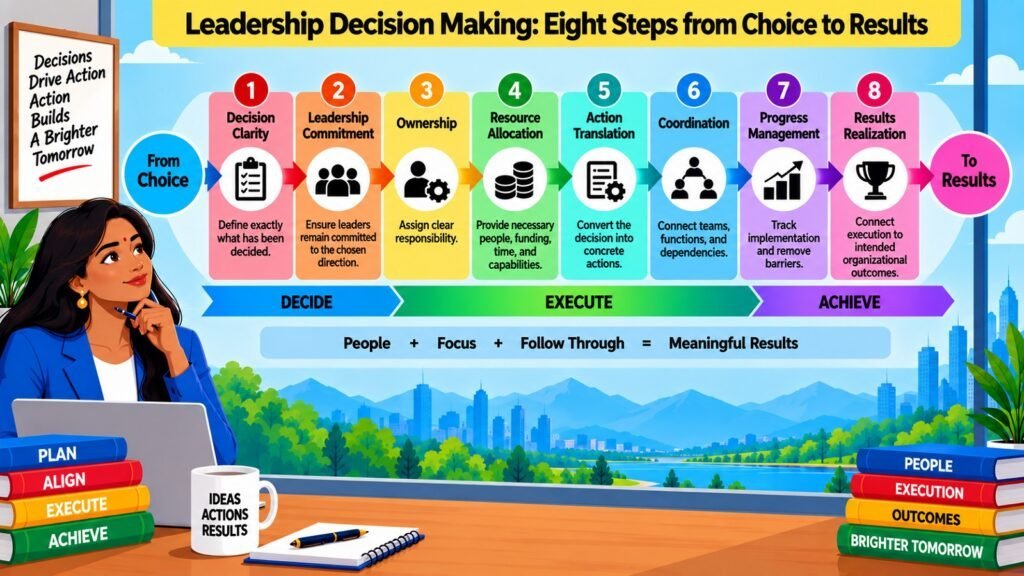
The moment a leader announces a decision, the real work of leadership decision making begins. Execution is where the intended value of a choice is either realized or lost. Lawrence Hrebiniak, in his work on strategy execution, identified that execution failures are more common and more costly than strategy failures, yet leaders invest far more time in making decisions than in ensuring those decisions are successfully carried out.
Execution failure has several well-documented causes. Unclear ownership is among the most common: when multiple people are nominally responsible, no single person is genuinely accountable. Insufficient resources are equally damaging — leaders who make ambitious decisions without allocating the budget, staffing, and management time required are making aspirational announcements rather than operational commitments. Communication gaps then compound both problems across organizational levels.
Public-sector digital transformation programs illustrate this pattern clearly. Governments in multiple countries have announced major decisions to digitize public services, then encountered severe execution failures arising from unclear ownership across departments, insufficient technical capability, competing political priorities, and inadequate budget sequencing. The decisions were often well-reasoned; the execution framework was not.
Effective execution requires leaders to address five questions immediately after a major commitment: who is accountable for implementation, what resources have been committed, what are the first concrete actions required, what is the review cadence, and what barriers are already visible? Leaders who cannot answer those questions at the moment of decision have made a commitment they are not yet prepared to honor.
Table 8: Leadership Decision Making and Decision Execution — Eight Execution Requirements and Leadership Responses
| Execution Requirement or Barrier | Leadership Response |
| Unclear ownership | Assign a single named accountable leader for each major decision; shared accountability typically means no accountability. |
| Insufficient resources | Approve resource allocation before announcing implementation; decisions without resources are intentions, not commitments. |
| Communication gaps | Translate the decision into specific action implications at each organizational level; do not assume understanding cascades automatically. |
| Competing priorities | Confirm that the new decision is ranked above existing commitments it conflicts with; unresolved priority conflicts guarantee execution failure. |
| Implementation barriers not addressed | Identify visible obstacles before launch and assign ownership for resolving each one before implementation begins. |
| Weak follow-through | Establish a regular review cadence from day one; execution without monitoring reverts to prior behaviors. |
| Organizational resistance | Distinguish passive resistance from substantive objection; address the latter openly and manage the former through consistent leadership signals. |
| Intent lost through translation | Verify that what is being executed at working levels matches the decision’s purpose, not just its surface requirements. |
8. Leadership Decision Making and Leadership Accountability
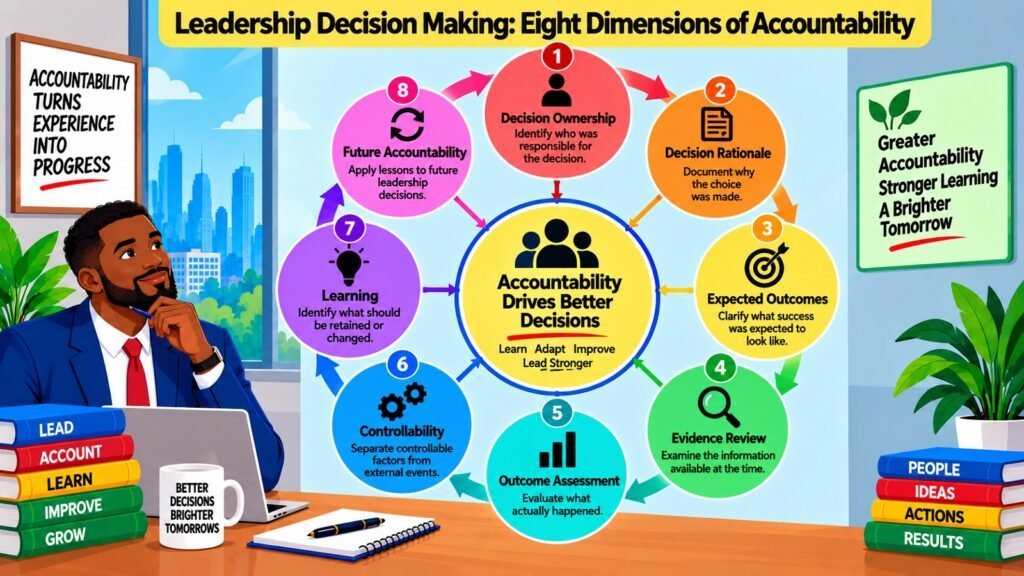
Accountability is the dimension of leadership decision making that closes the loop between a leader’s choices and their consequences. Genuine accountability is not self-punishment or public performance. It is an honest examination of what was decided, why it was decided, what happened as a result, and what should change in future decision making. When leaders practice it well, accountability becomes a source of organizational learning rather than a mechanism for assigning fault.
One of the most important distinctions in this domain is the difference between decision quality and outcome quality. A well-reasoned decision can still produce an unfavorable outcome because many decisions are made under genuine uncertainty, while a poor decision can occasionally produce a favorable result by chance. Annie Duke, drawing on decision science research, argues that conflating outcomes with decision quality leads leaders to draw the wrong lessons from both successes and failures.
The organizational consequences of this confusion are significant. Leaders rewarded for good outcomes regardless of process quality have no incentive to improve judgment. Leaders blamed for bad outcomes even when their process was sound become risk-averse in ways that harm organizational adaptability. Building a culture where decision quality is evaluated alongside results addresses both distortions.
Leaders who accept accountability credibly — acknowledging errors honestly and changing their approach as a result — build trust with the people who work for them. That trust has direct operational value: teams that trust their leaders’ judgment raise concerns early, execute with genuine commitment, and contribute honestly to future deliberations, all of which improve the quality of subsequent leadership decision making.
Table 9: Leadership Decision Making and Leadership Accountability — Eight Accountability Principles
| Accountability Principle | Leadership Decision Making Application |
| Separate decision quality from outcome quality | Evaluate the reasoning and process behind a decision independently from the result it produced (Duke, 2018). |
| Conduct a structured post-decision review | Examine what was decided, what happened, what was controllable, and what the process revealed. |
| Avoid hindsight bias | Kahneman’s research shows leaders tend to believe, after the fact, that outcomes were more predictable than they actually were. |
| Distinguish blame from accountability | Blame focuses on fault; accountability focuses on learning and improvement in future leadership decision making. |
| Create psychological safety for honest review | Teams that feel unsafe raising concerns suppress information that would improve future decision quality. |
| Acknowledge errors clearly and quickly | Early acknowledgment of a failing decision preserves more organizational options than delayed recognition. |
| Identify controllable and uncontrollable factors | Honest accountability requires distinguishing what leadership choices caused from what external conditions produced. |
| Use failure to improve future judgment | Organizations that examine failures rigorously build institutional knowledge that improves subsequent leadership decision making. |
Conclusion: Leadership Decision Making for Lasting Success
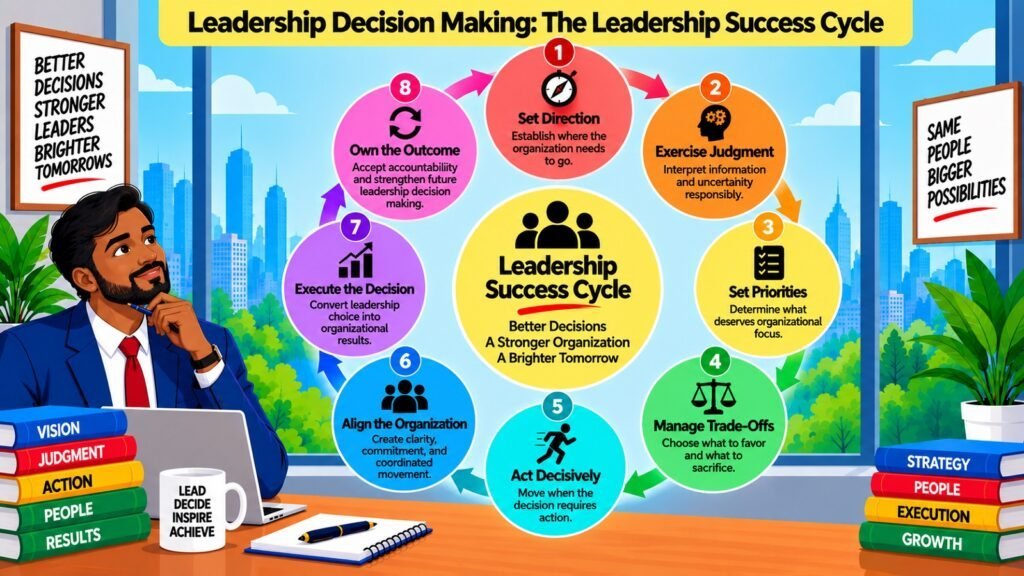
Leadership decision making is not a skill leaders apply occasionally when a large choice presents itself. It is the ongoing expression of leadership — present in every direction set, every priority established, every trade-off navigated, and every consequence owned. The eight dimensions examined here are not independent techniques; they form an integrated capability that develops through experience, reflection, and honest examination of judgment.
The progression from strategic direction through judgment, priority setting, trade-off decisions, decisive action, organizational alignment, execution, and accountability represents a complete arc of responsible leadership decision making. Strategic direction provides context. Judgment determines decision quality under uncertainty. Priority setting concentrates organizational attention. Trade-off decisions require honest acknowledgment of competing objectives. Decisive leadership ensures commitment at the right time. Alignment converts decisions into collective action; execution determines whether they become reality. Accountability connects choices with consequences, generating learning.
The frameworks, diagnostics, and principles presented throughout this article are tools for ongoing use. They do not eliminate uncertainty or guarantee favorable outcomes; nothing in leadership decision making can. What they do is improve process quality, which improves decisions over time and ultimately improves organizational results.
Leadership is ultimately expressed through the choices leaders make and the consequences they are willing to own.
Table 10: Leadership Decision Making — Eight Aspects and Leadership Outcomes
| Aspect of Leadership Decision Making | Leadership Outcome It Contributes To |
| Strategic Direction | Establishes where the organization focuses its long-term energy, resources, and competitive effort. |
| Leadership Judgment | Improves the quality of decisions made under uncertainty and reduces the impact of cognitive bias. |
| Priority Setting | Concentrates organizational attention and resources on the work that matters most, reducing dispersion. |
| Trade-Off Decisions | Creates honest, explicit choices between competing objectives rather than allowing implicit conflicts to persist. |
| Decisive Leadership | Ensures decisions are made at the right time, preserving opportunity and providing teams with clear direction. |
| Organizational Alignment | Converts leadership choices into committed, coordinated action across teams and stakeholder groups. |
| Decision Execution | Realizes the intended value of a decision through clear ownership, resources, communication, and follow-through. |
| Leadership Accountability | Builds trust, supports organizational learning, and strengthens the quality of future leadership decision making. |