Table of Contents
Introduction: Process Automation – The Business Technology Foundation for Better Processes
Process Automation is one of the most consequential aspects of modern Business Technology. Organizations across industries are using it to reduce manual effort, accelerate execution, and free people from repetitive work. Yet many automation initiatives underdeliver — not because the technology fails, but because the business process was poorly understood before automation was applied.
That distinction matters. Process Automation is not simply about replacing human effort with software. At its core, it is about using technology to improve how processes are understood, standardized, optimized, managed, integrated, measured, governed, and scaled. The technology is the enabler. The process is the subject. Two questions cut to the heart of the challenge: should a business automate a process before improving it, or should improvement come first? And is every repetitive, high-volume process automatically a good automation candidate? Getting the answers wrong is a common and costly mistake.
Process Automation, as discussed here, is distinct from the broader concept of Automation covered in general technology literature, which tends to focus on automation platforms and architectural patterns. This article focuses on the business capabilities and management principles that determine whether automation delivers lasting value.
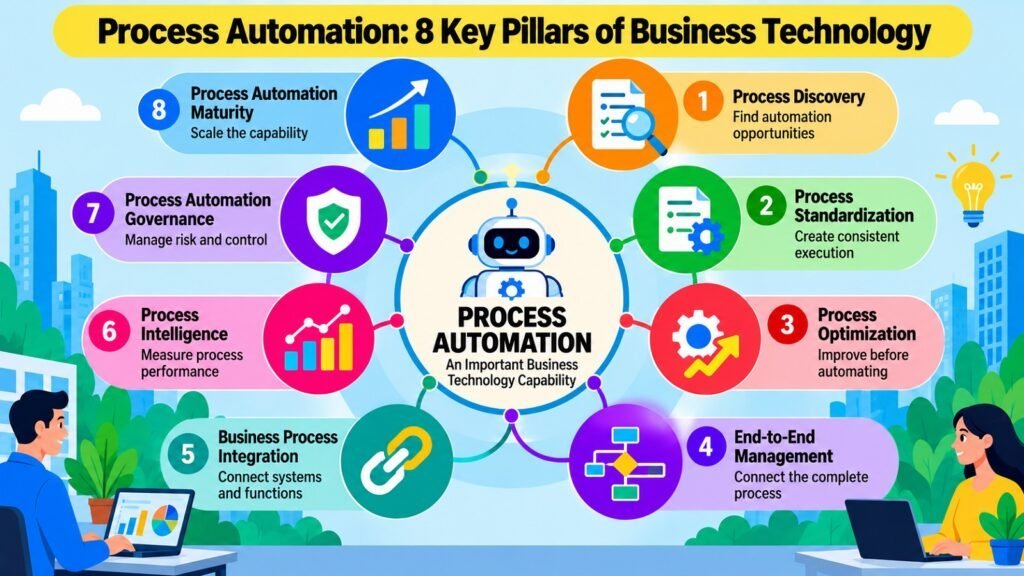
The eight foundations covered here form a progression from identifying automation opportunities to building organizational maturity: Process Discovery, Process Standardization, Process Optimization, End-to-End Process Management, Business Process Integration, Process Intelligence, Process Automation Governance, and Process Automation Maturity. Each foundation connects to the next, and together they provide a framework readers can return to when evaluating or planning any automation initiative.
Table 1: Process Automation Foundations — A Quick-Reference Framework
| Process Automation Foundation | Primary Business Focus |
| Process Discovery | Identifying which processes are genuine automation candidates |
| Process Standardization | Creating the consistency that reliable automation requires |
| Process Optimization | Improving processes before automation locks in inefficiencies |
| End-to-End Process Management | Automating complete process flows, not isolated tasks |
| Business Process Integration | Connecting systems and functions that automated processes span |
| Process Intelligence | Measuring how automated processes perform and where gaps remain |
| Process Automation Governance | Maintaining accountability, control, and risk management |
| Process Automation Maturity | Scaling automation from isolated projects to an organizational capability |
1. Process Automation and Process Discovery: Finding What to Automate
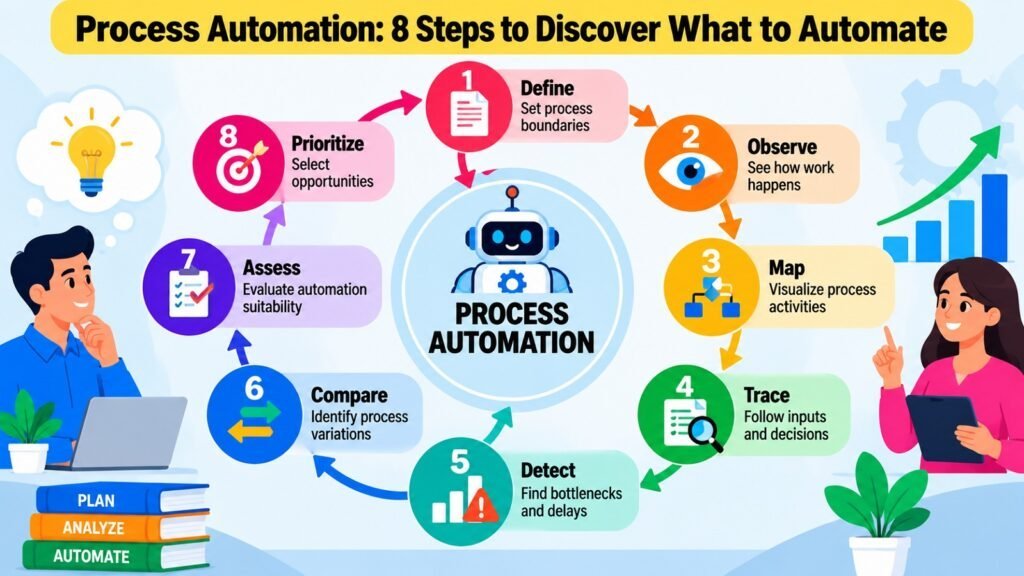
Effective Process Automation begins with understanding how a business process actually works before deciding what to automate. Process Discovery is the discipline of examining process activities, participants, inputs, outputs, dependencies, variations, and exceptions to reveal what the process really does — not just what it was designed to do.
Research in business process management consistently shows that organizations discover significant differences between their documented processes and actual process behavior. Process mapping, structured analysis, and process mining — a technique that uses event log data from information systems to reconstruct real process flows — are all tools that surface these differences. Automation applied to the intended design, rather than the actual process, often fails to account for how work genuinely happens.
Not every frequent or manual process is a good automation candidate. A practical approach evaluates frequency and volume, rule clarity, process stability, exception rate, and business impact. Processes that are highly variable, judgment-intensive, or exception-heavy may require human involvement that automation cannot reliably replicate.
Consider a regional insurance company that treats its claims intake process as an obvious automation candidate because volume is high. Process Discovery reveals that nearly a third of claims require human judgment to determine the applicable policy category, and three teams have developed different informal intake procedures. Automating based on surface simplicity would produce inconsistent outcomes. Discovery prevents that mistake.
Common errors include selecting processes based solely on task frequency and failing to involve the people who actually perform the work. Useful questions at this stage: Do we understand every step as it is actually performed? Do we know where variation occurs and why? Could this process be simplified before we automate it?
Table 2: Process Automation Discovery — Key Factors and What to Examine
| Discovery Factor | What to Examine |
| Frequency and Volume | Whether transaction volume justifies automation investment |
| Rule Clarity | Whether process decisions follow defined, documentable rules |
| Process Stability | How often the process changes due to business or regulatory shifts |
| Exception Rate | Proportion of instances that deviate from the standard path |
| End-to-End Visibility | Whether the complete flow, from trigger to outcome, is understood |
| Manual Effort Distribution | Where human effort concentrates and whether tasks are repetitive or judgment-based |
| Business Impact | The operational and financial significance of the process |
| As-Is vs. Designed Gap | Degree of difference between documented process and actual behavior |
2. Process Automation and Process Standardization: Creating Consistency
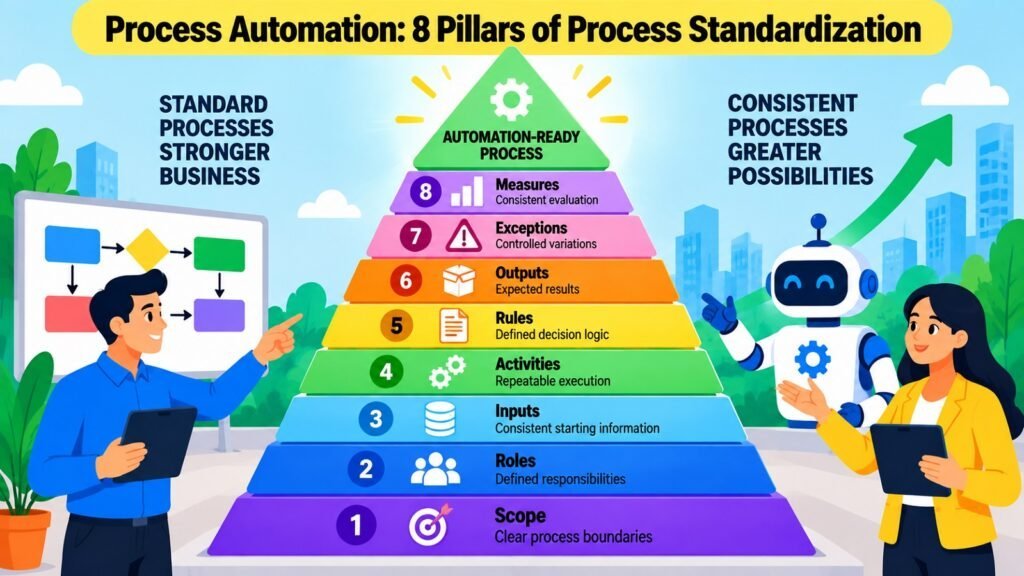
Process Automation works best when a process follows consistent rules, produces predictable outputs, and can be executed in a repeatable way. When variation is uncontrolled, automation either fails to handle it correctly or requires extensive exception logic that erodes the efficiency it was supposed to create.
Standardization does not mean making every process identical regardless of legitimate business differences. Some variation is justified — a process serving enterprise customers may differ from one serving small businesses, and those differences should be preserved. The goal is to identify and remove arbitrary or unmanaged variation: inconsistencies that arise from the absence of clear guidance, agreed-upon roles, or shared understanding, not from genuine business requirements.
Operations management research and lean management literature identify variation reduction as a central lever for process reliability. When organizations apply that discipline before automation, they typically find that standardization improves the automation itself by reducing the number of edge cases the automated process must handle.
A useful illustration comes from procurement. Two departments follow the same nominal purchase order approval process, but one requires justification above five thousand dollars while the other uses ten thousand. Neither threshold has a documented rationale. When the organization attempts to automate approval routing, the inconsistency forces a choice between enforcing one threshold, building costly dual logic, or resolving the ambiguity. Standardization before automation would have resolved it at the right time.
The risk of standardizing purely for automation’s sake deserves mention. Uniformity that serves the technology rather than the business can reduce the organization’s ability to accommodate legitimate variation. Useful questions: Is this variation business-justified, or has it accumulated without deliberate design? Does the proposed standard reflect best practice or merely the most common current practice?
Table 3: Process Automation Readiness — Standardization Areas and What Good Standardization Provides
| Standardization Area | What Good Standardization Provides |
| Process Rules | Consistent decision logic automation can apply without ambiguity |
| Roles and Responsibilities | Clarity about who performs each step and who owns the outcome |
| Input Requirements | Defined formats and quality standards for process inputs |
| Output Definitions | Clear specifications for what each completed step produces |
| Exception Handling | Agreed criteria for when an instance deviates and how it is managed |
| Approval Paths | Documented thresholds and routing logic for authorizations |
| Process Terminology | Shared language used consistently across teams and systems |
| Execution Methods | Agreed procedures for how activities are performed across teams |
3. Process Automation and Process Optimization: Improving Before Automating
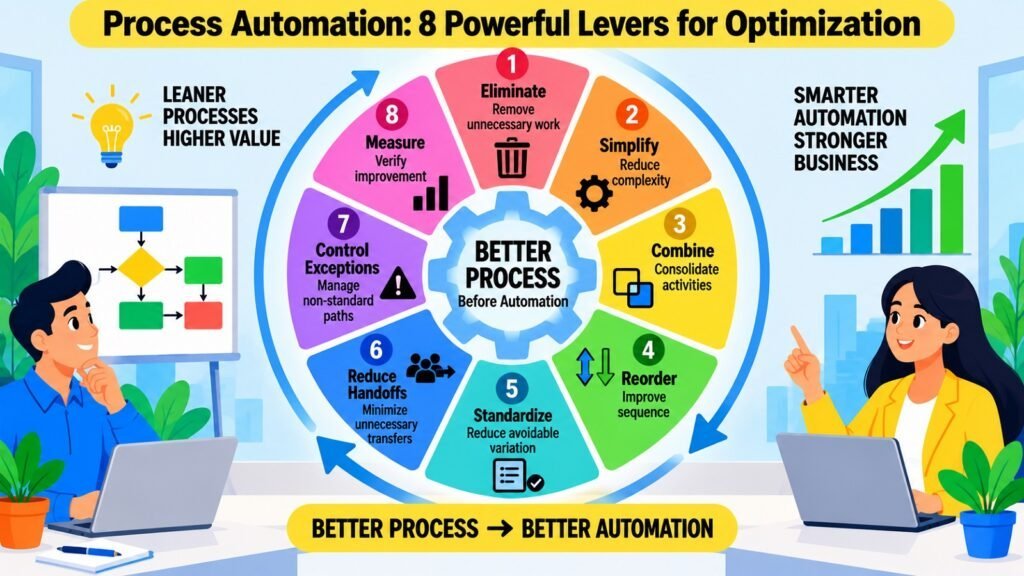
One of the most cited principles in business process management is that automating a broken process produces a faster broken process. Organizations that implement automation without examining the process first frequently discover they have accelerated flawed outcomes, preserved unnecessary costs, or embedded inefficiencies that become expensive to remove later.
Process Optimization involves examining a process for unnecessary steps, duplicated effort, excessive approvals, inefficient handoffs, and complexity that adds cost without adding value. Lean process improvement, Six Sigma, and Business Process Management share a common starting point: understand the current state clearly before determining what to change and why.
The distinction between optimization, standardization, and automation is worth drawing precisely. Standardization creates consistency; optimization removes waste and improves how the process achieves its purpose; automation then executes the improved, consistent process. Treating these as a sequence prevents premature automation.
Consider a financial services organization automating client onboarding. The process contains twelve approval steps, several introduced in response to past incidents. A pre-automation review reveals that five approvals duplicate reviews already performed at an earlier stage. Removing them reduces the process to seven approvals, shortens cycle time, and simplifies the automation design considerably. The same investment produces a better outcome simply because optimization came first.
The assumption that repetition alone qualifies a process for automation deserves scrutiny. A highly repetitive process can still be poorly suited for automation if its rules change frequently or if it requires contextual judgment. Useful questions: Are there steps with no clear purpose? Are handoffs creating delays that redesign could eliminate? Is this complexity a genuine business requirement, or has it accumulated over time?
Table 4: Process Automation Pre-Optimization Checklist
| Optimization Question | Business Implication |
| Are there steps with no clear value output? | Non-value steps add complexity and reduce automation ROI |
| Does the process contain duplicated approvals or reviews? | Redundant controls add cost without improving quality or risk management |
| Are handoffs causing delays or errors? | Poor handoffs signal design problems that automation will replicate |
| Has the process grown without deliberate redesign? | Organically grown processes often contain accumulated inefficiencies |
| Are exceptions too frequent to be genuinely exceptional? | High exception rates suggest the standard path does not match reality |
| Is process complexity justified by business need? | Unjustified complexity should be simplified before automation is designed |
| Is the process stable enough for automation investment? | Processes undergoing significant change are poor near-term candidates |
| Can the process be simplified without losing its purpose? | Simplification before automation typically produces better outcomes |
4. Process Automation and End-to-End Process Management: Connecting Business Work
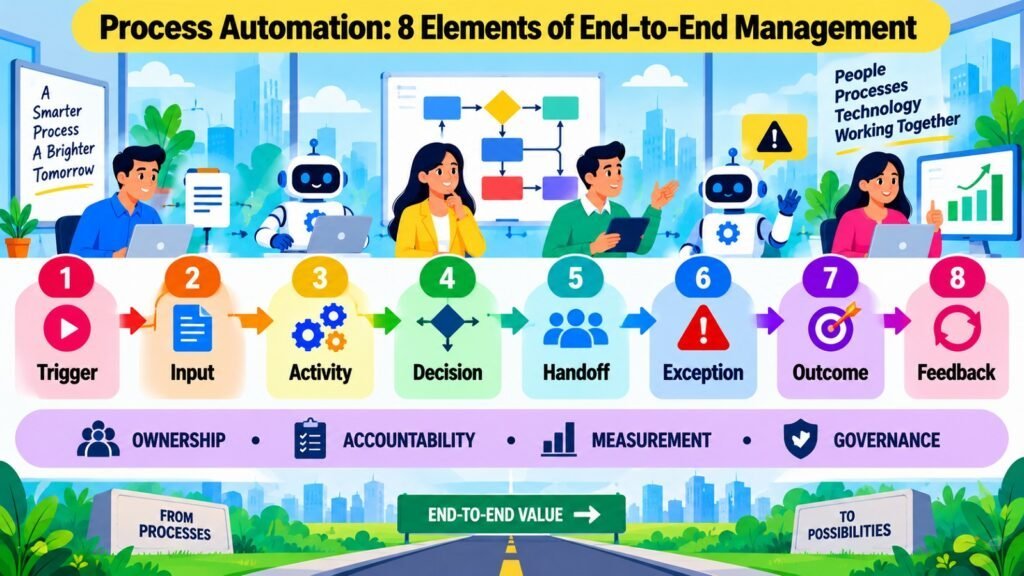
Process Automation creates the most value when organizations consider complete business processes rather than isolated tasks. Many automation initiatives target a specific activity — approving a document, generating a report, sending a notification — without considering how it connects to the broader process. The result is often a local efficiency gain accompanied by a new bottleneck elsewhere.
End-to-end process management requires understanding where a process starts, what triggers it, what it produces, who is accountable for its outcome, and how it flows across departments and systems. Business processes rarely stay within a single function. An order fulfillment process may involve sales, inventory, logistics, finance, and customer service. Automating only one segment without addressing handoffs at the boundaries leaves significant opportunity unrealized.
Business process management literature emphasizes process ownership as a governance concept. A process owner is accountable for end-to-end performance regardless of which functions contribute. Without that accountability, automation tends to be captured by individual departments and optimized for local efficiency. The result is segments that each perform well in isolation but produce delays or errors where departmental responsibilities meet.
Effective Process Automation does not necessarily eliminate people from a process. Many end-to-end processes benefit from automated execution combined with human judgment at the right points — particularly where contextual reasoning, stakeholder relationships, or ethical judgment are required. In a logistics company automating supplier payments, for instance, failing to connect payment automation to the supplier performance review process led to favorable payments continuing toward suppliers whose performance had been flagged. End-to-end thinking at design stage would have caught this.
Useful diagnostic questions: Do we understand this process from trigger to final outcome, not just our department’s segment? Have we identified who is accountable for the overall outcome? Have we examined the handoffs where delays or errors most frequently occur?
Table 5: Process Automation — End-to-End Process Management Elements and Evaluation
| End-to-End Element | What to Evaluate |
| Process Ownership | Whether a single accountable owner exists for the complete process outcome |
| Process Boundaries | Where the process begins and ends, including trigger and final output |
| Departmental Handoffs | How work moves between functions and where delays or quality issues concentrate |
| Decision Points | Which decisions require human judgment and which can follow defined rules |
| Exception Escalation | How the process handles cases outside the standard path |
| Human Involvement | Where people add value automation cannot replicate and how their role is designed |
| Cross-Functional Dependencies | Which external processes or teams must perform reliably for this process to succeed |
| Outcome Accountability | How end-to-end performance is measured and who is responsible for improvement |
5. Process Automation and Business Process Integration: Connecting Systems and Functions
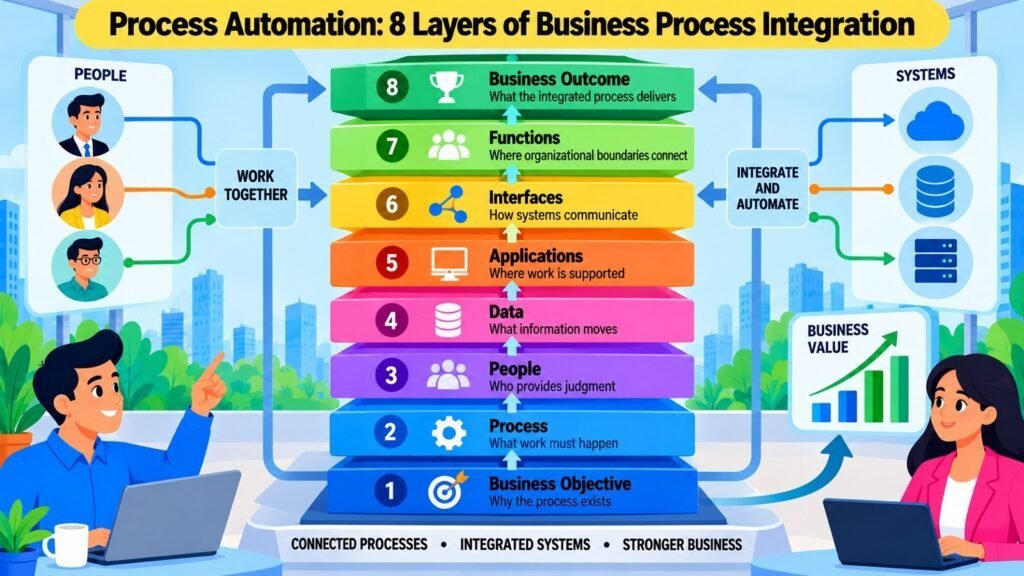
Modern business processes rarely operate within a single system. Customer data may reside in a CRM, financial records in an ERP, operational data in a workflow tool, and compliance records in yet another platform. When Process Automation is implemented without addressing how these systems connect, the result is a partially automated process that still depends on manual data transfer, duplicate entry, or informal coordination between teams.
Business Process Integration is the discipline of connecting the systems and functions a process depends on so information flows reliably across the entire process without manual intervention. Research on enterprise system integration consistently identifies disconnected systems as a significant source of process errors, delays, and data inconsistency. A 2019 MuleSoft study found that the average enterprise uses hundreds of distinct applications with limited automated data exchange. The business consequence of that fragmentation is not primarily a technology problem; it is a process performance problem.
APIs, integration platforms, and middleware allow different systems to exchange data reliably without manual transfer. The business decision is not which technology to use but which integration points are necessary to make the process work end-to-end. Integration should be designed around the business process, not for technical convenience alone.
In a healthcare organization automating its patient referral process, the referring physician uses a clinical system, the specialist uses a scheduling system, and billing uses a separate financial platform. Without integration, staff at each boundary must manually re-enter information, introducing delay and transcription errors. With integration designed around the complete referral process, information flows automatically and the automation is genuinely end-to-end.
Relevant questions: Which systems must exchange data for this process to function end-to-end? Where does manual data transfer currently introduce errors or delays? Is data consistent and timely across all systems the automated process depends on?
Table 6: Process Automation Business Integration — Areas and Business Considerations
| Integration Area | Business Consideration |
| System Connectivity | Whether applications supporting each process step can exchange data reliably |
| Data Consistency | Whether the same information holds the same meaning across all connected systems |
| Handoff Automation | Whether work and data move between systems without manual transfer or re-entry |
| Data Timeliness | Whether information is available when the process needs it, not only when systems sync |
| Cross-Functional Visibility | Whether process status is visible to all relevant teams regardless of system |
| Integration Ownership | Who is responsible for maintaining each integration point |
| Dependency Management | How the organization manages risk when an integrated system is unavailable |
| Data Governance | Whether data quality and access are governed at the process level across systems |
6. Process Automation and Process Intelligence: Measuring What Automation Improves
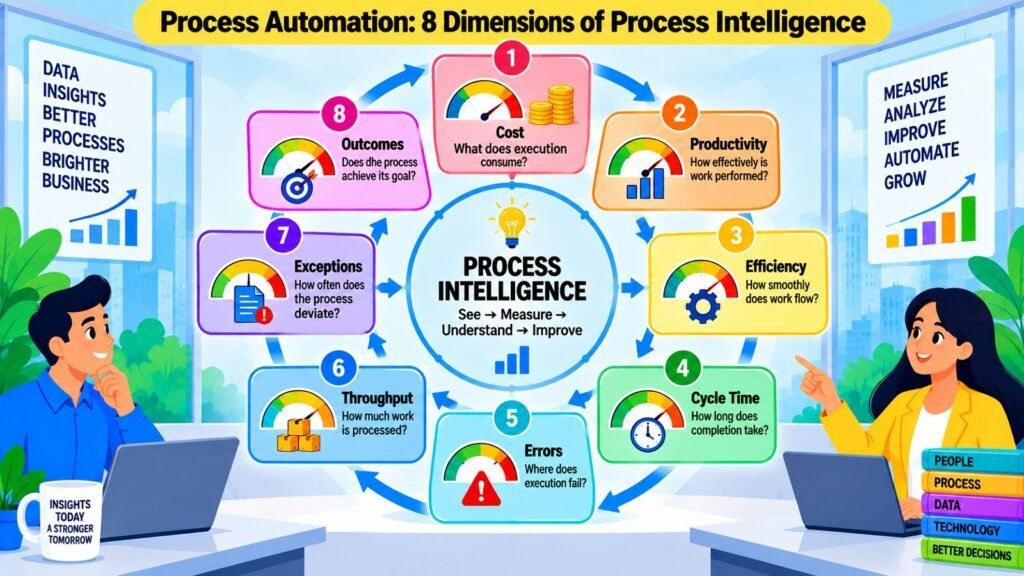
Implementing Process Automation without measuring what it actually changes is a common mistake. Organizations often treat implementation as the end of the work. In practice, it is the beginning of an ongoing management responsibility: understanding whether the automated process performs as intended, where new problems have emerged, and how the process can continue to improve.
Process Intelligence is the capability to use process data, analytics, and monitoring to understand actual process behavior and identify opportunities for improvement. The principle attributed to Peter Drucker — that you cannot manage what you cannot measure — applies with particular force to automated processes. Because automation executes at high speed and volume, unmeasured problems can scale rapidly. A near-real-time measurement framework is therefore more valuable for automated processes than periodic reporting is for manually managed ones.
The most useful measures reveal something actionable. Cycle time connects directly to customer experience and operational efficiency. Throughput indicates capacity. Exception and rework rates reveal how often the process fails to produce the intended outcome without intervention. Compliance rates show whether the automated process follows the rules it was designed to enforce.
A utilities company automates its meter reading exception review, expecting a sixty percent reduction in cycle time. After three months, the actual improvement is thirty-five percent. Process Intelligence reveals that many exceptions require a manual data lookup not anticipated in the automation design. The organization uses this insight to redesign the lookup step and achieve performance closer to the original target.
The feedback loop this enables — Discover, Improve, Automate, Measure, Improve Again — distinguishes organizations that treat automation as a learning capability from those that treat it as a one-time implementation. Key questions: Is the automated process delivering the outcomes we expected? Where do exceptions concentrate? What does the data tell us about further improvement?
Table 7: Process Intelligence Measurement Framework for Process Automation
| Process Measure | What It Reveals |
| Cycle Time | Total elapsed time from initiation to completion, indicating speed and consistency |
| Throughput | Volume of completed instances per period, indicating capacity and operational scale |
| Exception Rate | Proportion of instances deviating from the standard path and requiring intervention |
| Rework Rate | Frequency with which outputs must be corrected, indicating quality problems |
| Compliance Rate | Degree to which the process adheres to rules, policies, or regulatory requirements |
| Bottleneck Location | Steps or handoffs where instances accumulate, indicating capacity or design constraints |
| Outcome Achievement | Whether the process consistently produces the intended business result |
| Automation Success Rate | Proportion of instances completed without unplanned human intervention |
7. Process Automation Governance: Managing Risk and Control
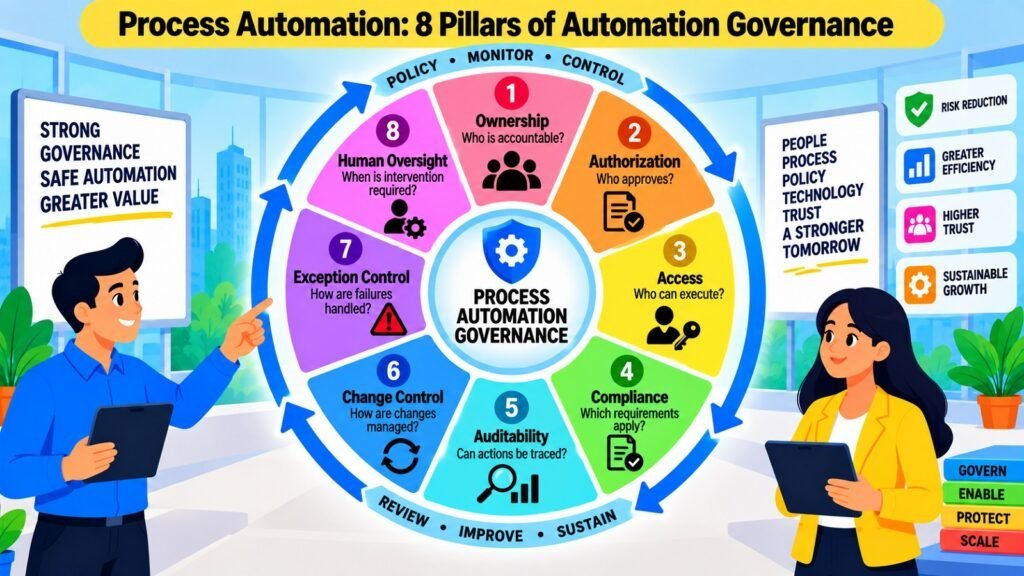
As Process Automation becomes embedded in core business operations, the need for governance grows proportionally. Automated processes execute at high speed and scale, which means errors, unauthorized changes, or design failures can propagate rapidly before they are detected. Governance provides the accountability structures, control mechanisms, and oversight practices that keep automated processes operating within appropriate boundaries.
Process Automation governance addresses accountability — who owns the process, who is responsible for its performance, who approves changes; compliance — whether it operates within regulations and internal policies; risk — what can go wrong and what controls exist; and auditability — whether a reliable record exists of what the process did, when, and why.
Recognized governance frameworks, including COBIT and ISO process management standards, emphasize documented ownership, defined change management procedures, regular performance reviews, and human oversight mechanisms. The Institute of Internal Auditors identifies auditability as a core requirement for any automated process affecting financial records or regulatory compliance.
Weak governance creates risk even when automation performs as designed. A retailer automates pricing adjustments based on inventory levels and competitor data. The automation follows its rules correctly, but those rules were not reviewed when the organization entered a new market segment. Margins in the new segment erode for months before a business review identifies the problem. Periodic governance review of automation rules would have caught it far earlier.
Access control is particularly important when automated processes handle sensitive data or financial transactions, because misconfigured access creates exposures that are larger and more persistent than the equivalent risk in a manual process. Key questions: Who is accountable for this process and its outcomes? How are changes approved and tested? Who has authority to intervene when an unexpected result occurs?
Table 8: Process Automation Governance Checklist
| Governance Area | Control Focus |
| Process Ownership | Documented accountability for the automated process and its change management |
| Access Control | Restrictions on who can view, modify, or override the process and its logic |
| Compliance Monitoring | Ongoing verification that the process follows regulations and internal policies |
| Auditability | Reliable, complete record of what the automated process did and when |
| Change Management | Formal approval, testing, and documentation for changes to process logic |
| Exception Handling | Defined procedures for identifying, escalating, and resolving unexpected behavior |
| Human Oversight | Designated roles and mechanisms for monitoring and intervening in automated processes |
| Risk Review | Periodic assessment of automation-related risks and the adequacy of existing controls |
8. Process Automation Maturity: Scaling a Business Technology Capability
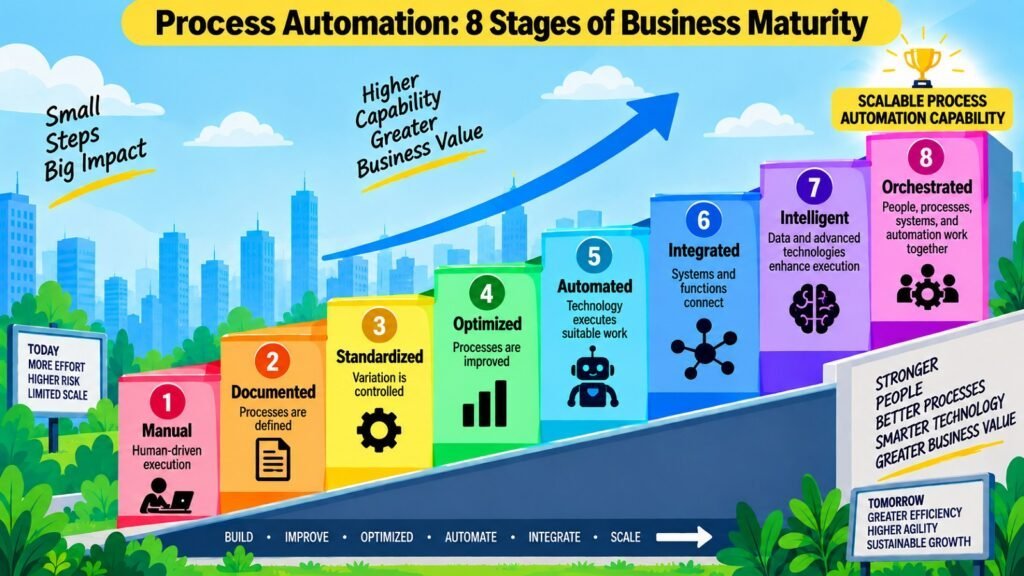
Most organizations begin Process Automation with isolated projects targeting obvious, high-volume, low-complexity processes. This is a sensible starting point. But sustained business value requires moving beyond the project mindset toward building automation as a repeatable, scalable organizational capability.
Maturity in Process Automation is best understood as a progression in organizational capability, not simply an increase in the number of automated processes. An organization running hundreds of automated processes without governance, measurement, or consistent improvement approaches has not necessarily achieved maturity. One managing fewer processes with clear ownership, deliberate standards, and continuous improvement may represent a far more capable operation.
Research on digital transformation consistently finds that technology alone does not produce sustained value. Organizations that derive lasting benefit from automation tend to have developed supporting capabilities: process ownership, systematic opportunity identification, governance structures that scale, measurement frameworks tied to business outcomes, and change management capability to help people adapt as automation expands.
A business services organization begins by automating data entry tasks in finance. Over two years, it develops a center of excellence responsible for automation standards, process assessment, and portfolio management. By the third year, every initiative is evaluated against a consistent framework, governed by documented ownership and change management processes, and measured against defined business outcome targets. The organization is not simply running more automated processes; it is managing automation as a business capability.
Maturity assessment should focus on business outcomes, process discipline, governance quality, and organizational capability — not automation volume. Useful questions: Do we have a consistent approach to identifying and prioritizing automation opportunities? Do our governance structures scale as automation grows? Are our automated processes delivering the outcomes we planned for?
Table 9: Process Automation Maturity Model — Stages and Defining Characteristics
| Maturity Stage | Defining Characteristics |
| Reactive | Ad hoc automation driven by individual team needs; no strategy or organizational standards |
| Aware | Automation recognized as a strategic capability; basic standards and ownership begin to form |
| Developing | Consistent discovery, assessment, and design approaches applied across initiatives |
| Governed | Formal change management, access controls, compliance monitoring, and audit practices in place |
| Measured | Process Intelligence connects automated process performance to defined business outcome metrics |
| Integrated | Automation spans end-to-end processes across systems and functions with deliberate integration |
| Optimizing | Measurement insights drive continuous improvement cycles across the automation portfolio |
| Scaling | Automation managed as an enterprise capability with portfolio thinking, governance, and sustained investment |
Conclusion — Process Automation: Building Smarter and More Scalable Business Processes
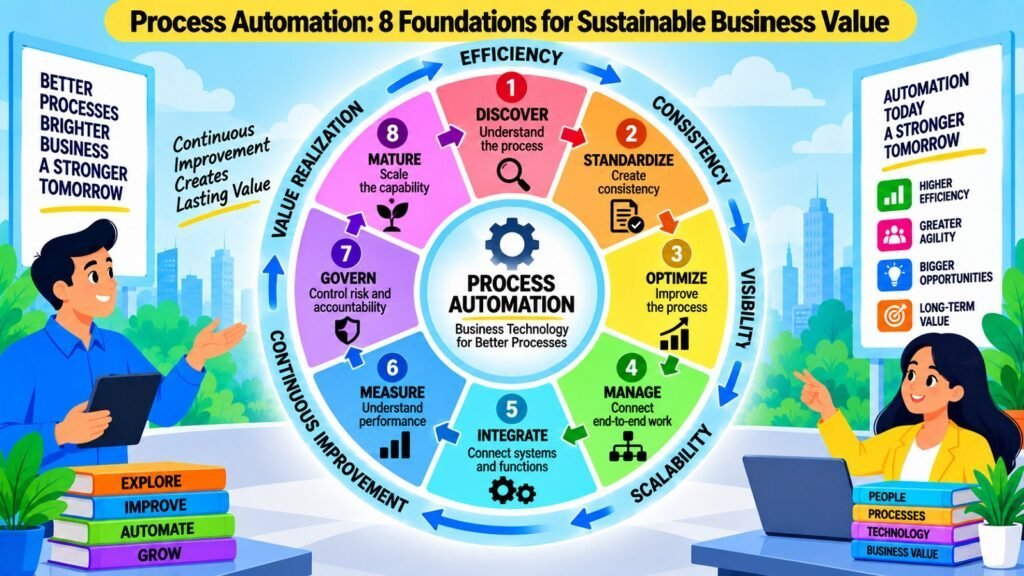
The central argument of this article is consistent from beginning to end: successful Process Automation starts with understanding and improving the business process, not with selecting a technology. That principle reflects the difference in outcomes between organizations that pursue automation strategically and those that pursue it reactively.
The eight foundations form an interconnected framework, not a simple checklist. Process Discovery identifies genuine candidates by examining how processes actually work. Standardization creates the consistency automation depends on. Optimization ensures automation accelerates improved processes rather than embedding inefficiencies at digital speed. End-to-End Process Management prevents fragmented automation that solves a local problem while creating a new one downstream. Business Process Integration connects the systems and functions automated processes span. Process Intelligence provides the measurement capability to know whether automation is delivering real business value. Governance maintains accountability and control as automation scales. And Maturity thinking transforms isolated projects into a sustainable organizational capability.
The most important practical lessons are these: automate processes that are understood, standardized, and optimized — not merely frequent or manual. Design automation around complete process flows. Build integration around business process outcomes. Measure what automation actually changes. Govern automated processes with appropriate seriousness. Evaluate maturity through business outcomes and organizational capability, not through the count of automated processes.
Individual automation technologies will continue to change. What will remain constant is the need for business clarity about which processes are worth automating, how they should be designed, and how their value should be measured and sustained. The framework in this article is designed to be returned to at each stage of an automation initiative. The right question to begin with is always the same: do we understand this process well enough to be confident that automating it will produce a better business outcome?
Table 10: Process Automation Foundations — Final Synthesis
| Foundation | Key Business Question |
| Process Discovery | Do we understand how this process actually works, and is it a genuine candidate? |
| Process Standardization | Is this process consistent and clear enough for automation to execute reliably? |
| Process Optimization | Have we improved this process, or are we locking in existing inefficiencies? |
| End-to-End Process Management | Are we automating the complete process, or creating local efficiency with new downstream problems? |
| Business Process Integration | Do the systems this process depends on connect reliably to support end-to-end automation? |
| Process Intelligence | Do we know whether this automated process is delivering the outcomes we planned for? |
| Process Automation Governance | Do we have the accountability, control, and oversight to manage this automation safely? |
| Process Automation Maturity | Are we building automation as a sustainable capability, or managing isolated projects? |