Table of Contents
Introduction: Sales – Understanding a Strategic Business Function
Sales is one of the most important strategic business functions in any organization, yet it is frequently misunderstood. Popular assumptions cast it as the final stage of a marketing funnel or a set of persuasion techniques applied to reluctant buyers. Neither view is adequate. It is the organizational capability through which a business identifies commercial opportunities, engages prospective customers, and converts those engagements into sustainable revenue.
Commercially, Sales bridges the gap between what an organization offers and what the market will pay for. From the customer’s perspective, it represents the primary point of direct commercial interaction, and the quality of that interaction shapes both immediate decisions and longer-term relationship value. It also has a precise relationship with Marketing. Marketing creates awareness, generates demand, and positions offerings in the market. It converts that demand into actual commercial outcomes through direct buyer engagement, needs understanding, and value communication.
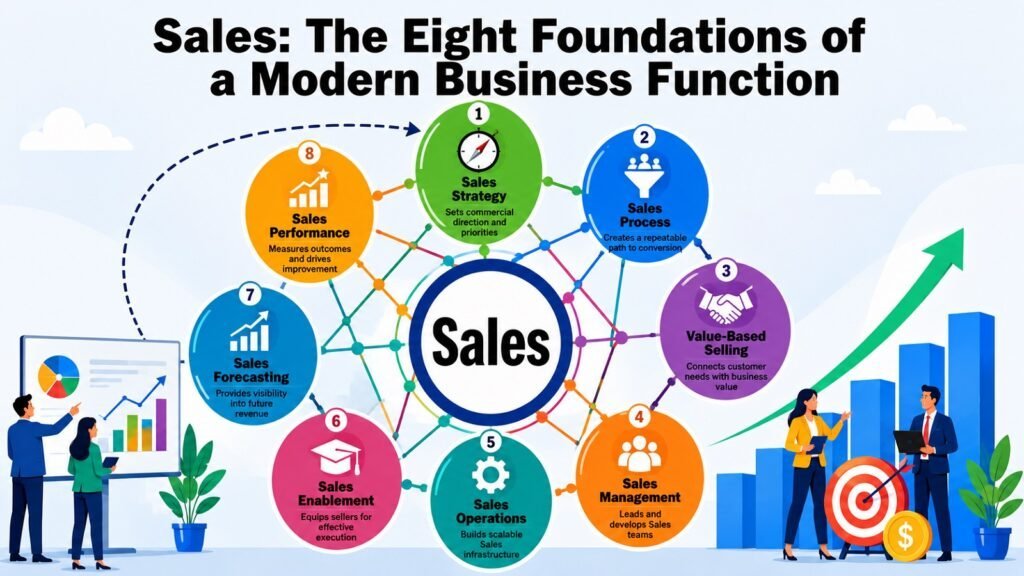
Modern Sales has shifted substantially from transactional approaches. Today, effective Sales depends on eight interconnected foundations: strategy, process, value-based selling, management, operations, enablement, forecasting, and performance. These are not independent activities. They form a connected system, and the strength of each foundation influences the others. Understanding Sales as a complete organizational capability rather than a collection of techniques is what distinguishes high-performing commercial functions from those that produce inconsistent results. The sections that follow examine each foundation individually while showing how together they support sustainable business growth.
Table 1: Sales Foundations — Overview of the Eight Strategic Pillars
| Foundations | Strategic Contribution |
| Strategy | Establishes commercial direction, resource priorities, and market coverage choices |
| Process | Provides a repeatable, measurable pathway for converting opportunities into customers |
| Value-Based Selling | Connects customer-specific needs and outcomes with the business value of solutions |
| Management | Leads, develops, and coordinates people to execute the Sales function effectively |
| Operations | Builds the data, process, and technology infrastructure that enables Sales at scale |
| Enablement | Equips sellers with knowledge, skills, content, and tools for effective execution |
| Forecasting | Estimates future revenue outcomes to support planning and resource decisions |
| Performance | Evaluates effectiveness, productivity, and business contribution across the Sales system |
1. Sales Strategy: Building a Strategic Path to Growth
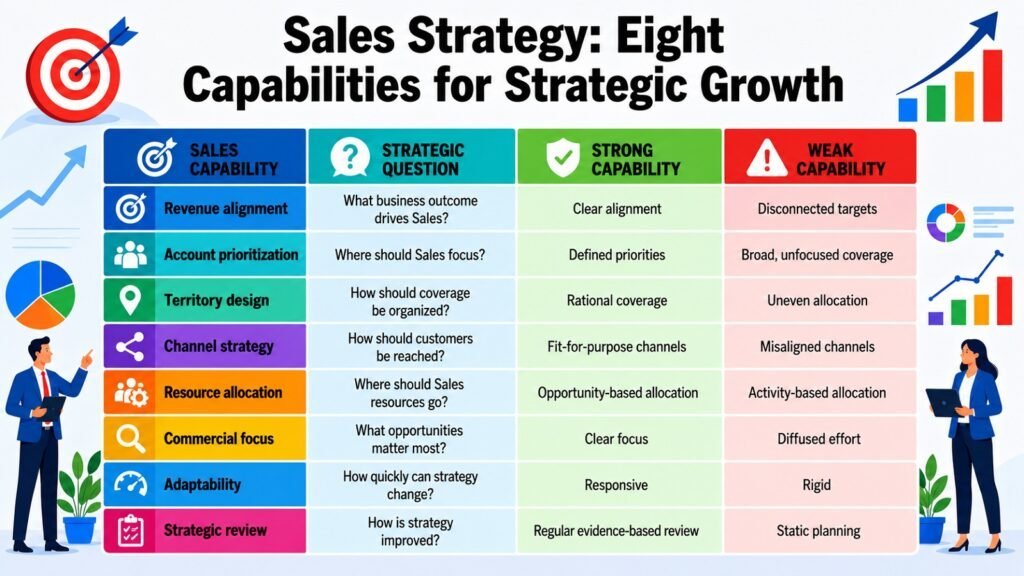
Sales Strategy is the set of deliberate choices through which an organization determines how its Sales function will pursue commercial opportunities, allocate resources, and contribute to broader business growth. It focuses on commercial execution rather than market positioning or brand communication, which belong to Marketing. A well-constructed Selling Strategy answers critical questions: which customers and segments deserve priority, through which channels, with what resource allocation, and in what competitive context.
The theoretical basis draws on competitive strategy and organizational resource theory. Porter’s work on competitive positioning established that organizations must make clear choices about where and how they compete rather than attempting to serve all opportunities equally. In Sales, this translates to disciplined segmentation of commercial opportunities, explicit account prioritization, channel selection, territory design, and resource deployment decisions that reflect genuine strategic logic rather than historical habit. Organizations with clearly articulated selling strategies and strong internal alignment consistently outperform those where commercial effort is distributed without strategic discipline.
Strategic alignment is essential. A Sales Strategy operating in tension with the broader organizational strategy creates friction that consumes resources without proportionate results. Alignment means ensuring that the customers it pursues, the channels it uses, and the resources it deploys are consistent with what the organization can actually deliver competitively. Adaptability matters equally. A strategy that cannot respond to shifts in buyer behavior or competitive conditions becomes a constraint rather than an asset.
A useful diagnostic question for any leader is whether their current strategy is genuinely guiding daily commercial decisions or merely existing as a document without operational influence. Selling Strategy connects forward to the Selling Process that executes it and to the revenue outcomes measured through Performance.
Table 2: Sales Strategy — Eight Dimensions and Their Strategic Role
| Strategy Dimension | Strategic Role |
| Market Segmentation | Identifies which customer groups offer the strongest commercial opportunity for the organization |
| Account Prioritization | Concentrates resources on prospects and customers with the highest potential value |
| Channel Selection | Determines how the organization reaches and serves buyers most effectively and efficiently |
| Territory Design | Allocates geographic or account coverage to balance workload and commercial opportunity |
| Resource Allocation | Deploys people, budget, and capability where commercial return justifies the investment |
| Competitive Positioning | Defines how Sales will differentiate the organization’s offering in competitive situations |
| Strategic Alignment | Ensures priorities reflect broader organizational objectives and delivery capabilities |
| Strategic Adaptability | Enables the selling strategy to revise priorities and coverage when market conditions change significantly |
2. Sales Process: Converting Opportunities Into Customers
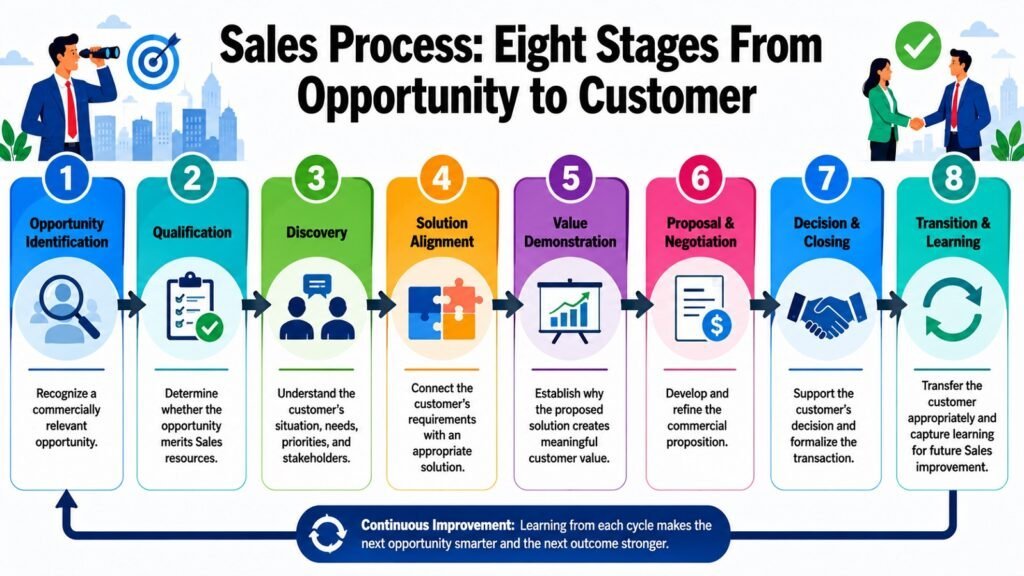
A Sales Process is the structured mechanism through which qualified commercial opportunities progress toward customer decisions and commercial conversion. Its purpose extends beyond providing sellers with an activity checklist. A well-designed process creates organizational repeatability, supports consistent measurement, enables accurate forecasting, and helps leaders identify where and why opportunities are being lost. Critically, the strongest processes reflect the customer’s decision journey as much as the organization’s commercial requirements.
Research on buying behavior confirms that customers progress through recognizable stages: need recognition, information gathering, option evaluation, risk assessment, and commitment. Neil Rackham’s SPIN Selling research, drawing on analysis of thousands of interactions, demonstrated that effective salespeople in complex environments focus on understanding the customer’s situation before presenting solutions. This finding challenged the assumption that persuasion and product knowledge are the primary success drivers, and the evidence continues to support the consultative approach in most business-to-business contexts.
Standardization and flexibility represent a genuine tension in process design. An overly rigid process prevents sellers from responding to individual buyers. An undefined one makes diagnosing execution problems or delivering reliable forecasts impossible. Effective organizations standardize the logic and governance of each stage while giving sellers discretion in how they execute within those boundaries.
Common process failures include weak initial qualification, insufficient discovery, premature proposals, and poor multi-stakeholder management. Each failure produces distinct and identifiable symptoms: high late-stage loss rates, extended sales cycles, poor forecast accuracy, and low conversion rates. A useful evaluative question is whether your selling Process reflects how customers actually buy or merely how your organization prefers to sell. Selling Process connects directly to Value-Based Selling, Operations, Enablement, and Performance.
Table 3: Sales Process — Eight Stages or Principles of an Effective Approach
| Process Stage or Principle | Purpose and Contribution |
| Prospecting and Qualification | Identifies opportunities meeting minimum viability criteria before significant resources are committed |
| Discovery and Needs Assessment | Uncovers the customer’s specific situation, problems, priorities, and decision criteria |
| Solution Alignment | Connects the organization’s capability directly with the customer’s confirmed needs and outcomes |
| Proposal Development | Presents a clear, relevant, commercially structured offer based on genuine understanding |
| Stakeholder Engagement | Manages the decision-making unit across multiple roles, concerns, and authority levels |
| Negotiation and Decision | Addresses commercial, risk, and contractual concerns to move toward mutual agreement |
| Closing and Commitment | Confirms the customer’s decision and establishes clear next steps for onboarding |
| Handover and Transition | Transfers the customer relationship to delivery or account management with full context |
3. Sales: Value-Based Selling – Connecting Customer Needs With Business Value
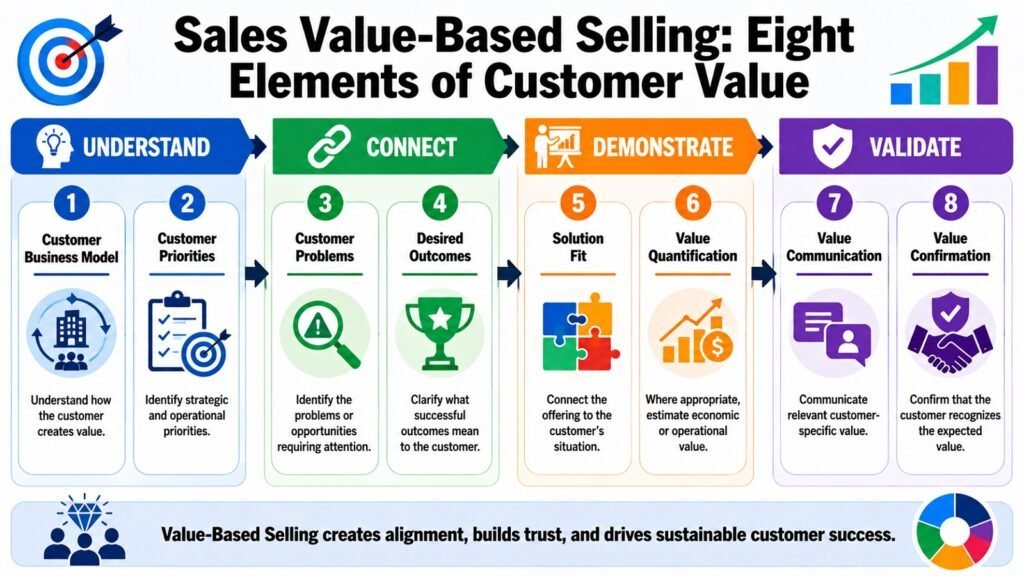
Value-Based Selling connects a customer’s specific problems, priorities, and desired outcomes with the business value that a well-matched solution can deliver. It operates at the level of the individual commercial interaction, requiring sellers to understand each buyer’s unique circumstances and articulate value in terms meaningful to that specific situation. This distinguishes it clearly from product-centered selling, which leads with features, and from marketing-led value propositions, which communicate positioning broadly across market segments.
The theoretical foundations are substantial. Anderson, Narus, and van Rossum’s influential Harvard Business Review research established that customers assess value by comparing the economic benefits of a solution against its full cost, including switching costs, implementation effort, and risk. This framework argues that sellers must move beyond price comparisons and help customers understand the real consequences of choosing one solution over another. Effective Value-Based Selling operationalizes that reasoning in direct customer conversations, replacing feature presentation with outcome-focused discussion grounded in the customer’s actual situation.
Demonstrating value without unsupported claims requires discipline. Tangible value forms include revenue improvement, cost reduction, efficiency gain, risk mitigation, and capability improvement. Intangible forms encompass strategic alignment, competitive advantage, simplicity, and trust. Not every sale calls for financial quantification, and forcing an economic calculation into every conversation can undermine credibility rather than support it.
A useful diagnostic framework is assessing whether your selling approach is product-centered, solution-centered, or genuinely value-centered. Value-Based Selling strengthens the selling Process by improving customer engagement quality and contributes directly to Performance through higher conversion rates and more favorable deal economics.
Table 4: Value-Based Selling — Eight Core Elements of an Effective Approach
| Selling Element | Role in Value-Based Conversations |
| Situation Understanding | Establishes the customer’s current context, constraints, and commercial environment |
| Problem and Priority Identification | Clarifies which problems matter most and why they represent a genuine priority now |
| Outcome Definition | Specifies what a successful resolution looks like from the customer’s perspective |
| Solution Relevance | Demonstrates why the proposed solution addresses confirmed needs and priorities |
| Value Articulation | Communicates specific economic, operational, or strategic benefits in credible terms |
| Stakeholder Alignment | Addresses the distinct priorities and concerns of each relevant decision-maker |
| Risk and Objection Management | Identifies and resolves concerns that could prevent the customer from committing |
| Evidence and Reference | Supports value claims with verifiable outcomes from comparable customer situations |
4. Sales Management: Leading High-Performance Sales Teams
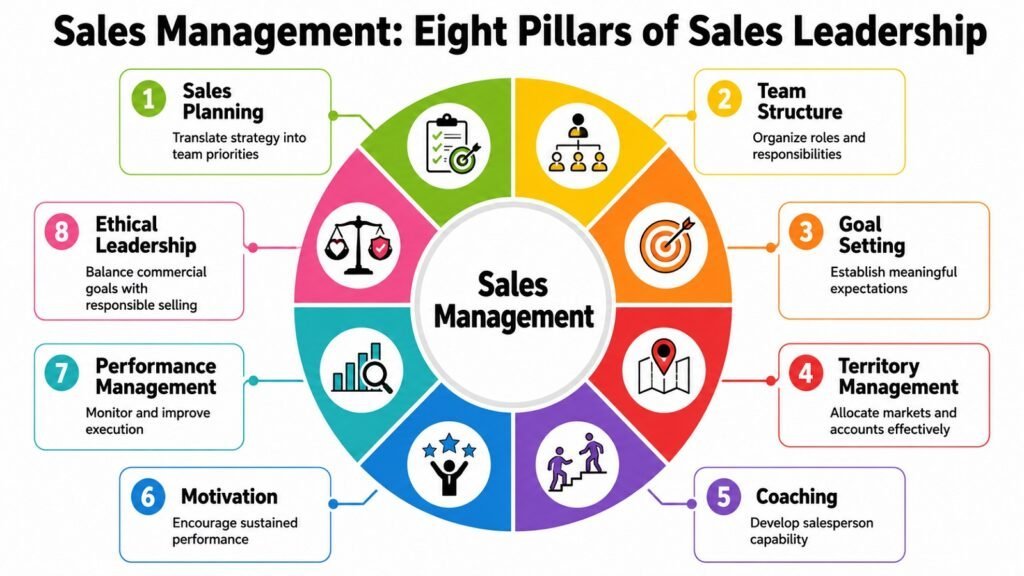
Sales Management is the discipline through which the people executing the selling function are directed, developed, coordinated, and held accountable. Research in organizational behavior consistently shows that management quality, team structure, coaching practices, incentive design, and accountability systems exert substantial influence on selling outcomes. Exceptional individual sellers in poorly managed environments routinely underperform their potential, while strong management can elevate average performers to deliver consistently above expectations.
The theoretical foundations draw on goal-setting theory and expectancy theory. Locke and Latham’s research established that specific, challenging, and measurable goals produce significantly better performance than vague or easy targets, provided the individual has the capability and confidence to achieve them. In selling, this directly informs meaningful quota design, territory objectives, and activity expectations. Expectancy theory further explains that seller motivation depends on believing that effort leads to performance, that performance leads to outcomes, and that those outcomes are genuinely valued by the organization.
Managers translate Sales Strategy into daily execution by setting individual and team expectations, allocating accounts or territories, coaching sellers through complex opportunities, monitoring performance, and addressing execution gaps before they become structural problems. The balance between short-term revenue pressure and long-term capability development is a persistent leadership challenge. Managers who focus exclusively on current-quarter results at the expense of coaching tend to create organizations that oscillate between periods of acceptable performance and deeper underperformance.
Sales Management is deliberately distinct from Enablement, which equips sellers with knowledge and tools, and from Operations, which provides process infrastructure and data systems. A practical self-assessment question is whether coaching in your organization genuinely improves capability or merely reviews pipeline status.
Table 5: Management — Eight Dimensions of Effective Leadership
| Management Dimension | Contributions |
| Goal Setting and Quota Design | Establishes specific, measurable, and motivating commercial expectations for individuals and teams |
| Territory and Account Allocation | Assigns coverage fairly and strategically to balance opportunity and seller capacity |
| Performance Coaching | Develops seller capability through observation, feedback, and targeted skill improvement |
| Pipeline Review and Management | Maintains visibility into opportunity quality, stage accuracy, and commercial risk |
| Incentive and Reward Design | Aligns seller motivation with organizational commercial priorities and customer outcomes |
| Accountability and Follow-through | Ensures commitments are kept and performance gaps are addressed promptly and constructively |
| Talent Development and Retention | Builds long-term selling capability by investing systematically in high-potential sellers |
| Ethical Standards and Culture | Establishes customer-centered, honest, and compliant seling behaviors across the team |
5. Sales Operations: Building the Infrastructure for Sales Excellence
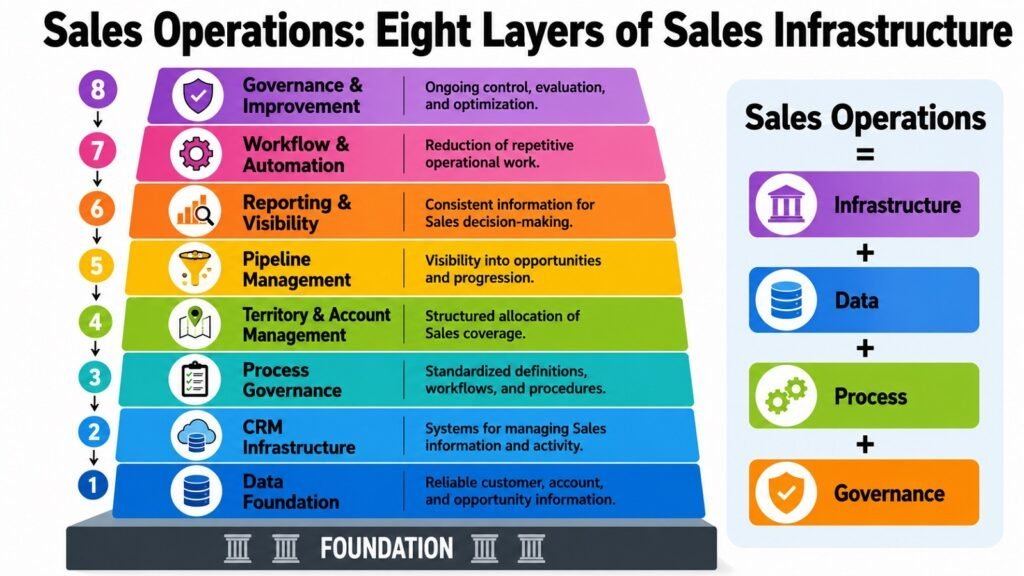
Sales Operations is the function responsible for building and maintaining the infrastructure that allows an organization to function consistently, at scale, and with the visibility needed for effective management. It is frequently underestimated because its contributions are most visible when missing. Weak Sales Operations causes sellers to spend excessive time on administrative tasks, leaves managers without reliable data, produces inconsistent process execution, generates unreliable forecasts, and triggers compensation disputes. Strong Operations eliminates these frictions and allows the Selling function to concentrate its energy on customer engagement.
Researchers in organization design, including Andris Zoltners, Prabhakant Sinha, and Sally Lorimer, have documented how operational excellence enables substantially higher commercial productivity than organizations achieve through individual seller talent alone. CRM systems, territory and account administration, pipeline reporting, compensation calculation, workflow standardization, and technology coordination all fall within its scope. The governing principle is that each component should reduce friction for sellers, improve visibility for managers, and make the Selling process more scalable, rather than primarily generating internal compliance reporting.
The distinction between Operations and Enablement is important. Operations creates and governs the commercial system — data, processes, and governance structures. Enablement develops the sellers who work within it. Assessing operational health means examining whether sellers have reliable, accessible pipeline data; whether management can view accurate conversion and velocity information without manual effort; whether compensation is calculated accurately and transparently; and whether process governance prevents common execution failures. Sales Operations connects selling Strategy with day-to-day execution and provides the data foundation on which effective Forecasting and Performance measurement depend.
Table 6: Sales Operations — Eight Components and Their Contribution
| Operations Component | Contribution to System Effectiveness |
| CRM System Management | Provides a single source of truth for customer, opportunity, and pipeline data |
| Territory and Account Administration | Ensures equitable and commercially rational coverage across all accounts and geographies |
| Pipeline Reporting | Gives managers and leaders visibility into opportunity volume, quality, and velocity |
| Compensation Administration | Calculates and communicates incentive payments accurately, transparently, and on time |
| Process Governance | Standardizes how Sales stages, definitions, and workflows are applied across the team |
| Sales Data and Analytics | Converts raw commercial data into actionable insights for management and strategy decisions |
| Technology Coordination | Manages the selection, implementation, and integration of Sales tools and platforms |
| Operational Reporting | Delivers regular performance summaries that support strategic and management decisions |
6. Sales Enablement: Empowering Sales Teams for Better Execution
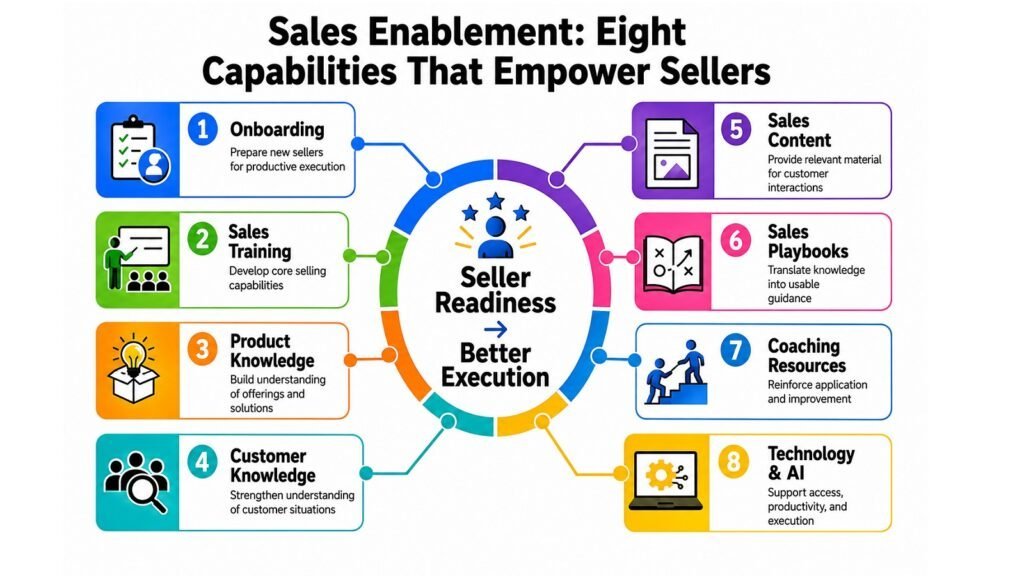
Sales Enablement is the organizational capability of equipping selling professionals with the knowledge, skills, content, tools, and learning support they need to engage customers effectively at every stage of the Selling process. Defining it simply as training understates its scope significantly. Effective Sales Enablement is a continuous system connected to Strategy, the Selling Process, customer needs, and measurable seller behavior, rather than a periodic event delivered in isolation from the commercial realities sellers face every day.
Research by the Sales Management Association and related bodies consistently shows that formal onboarding programs, continuous learning systems, and well-designed coaching resources improve seller ramp time, quota attainment rates, and customer retention compared with organizations relying primarily on informal peer learning and occasional product updates. Enablement works not because it transfers more information but because it changes seller behavior in ways that improve customer engagement and commercial outcomes. This behavioral orientation, grounded in adult learning theory and performance support research, distinguishes effective Enablement programs from content repositories that sellers rarely access.
The most prevalent failure in Enablement is the creation of content in large volumes without ensuring its relevance. Organizations that develop extensive libraries of content and comprehensive training programs often discover that adoption rates remain low, as sellers struggle to quickly locate what is pertinent to their specific circumstances. Effective Enablement is defined by its accessibility, relevance, timing, reinforcement, and alignment with actual sales processes.
Sales Enablement is distinct from Management, which focuses on directing and assessing personnel, and from Operations, which oversees data systems and process frameworks. A valuable diagnostic question to consider is whether your sellers consistently utilize the provided content and tools, or if these resources primarily exist to meet internal governance obligations. Enablement is directly linked to the Process, Value-Based Selling, and ultimately, Performance.
Table 7: Sales Enablement — Eight Dimensions of Effective Capability Building
| Enablement Dimension | Contribution to Seller Readiness and Performance |
| Onboarding Programs | Accelerates new seller productivity by building foundational knowledge and process fluency quickly |
| Continuous Learning | Develops seller skills and knowledge progressively through structured ongoing development |
| Sales Playbooks | Provides practical, workflow-aligned guidance for common selling situations and objections |
| Product and Solution Knowledge | Ensures sellers can explain offerings accurately and connect them to specific customer needs |
| Competitive Intelligence | Equips sellers to position effectively and respond credibly when buyers raise alternatives |
| Sales Content Management | Organizes and delivers relevant customer-facing materials that sellers can access quickly |
| Coaching Resources | Supports managers in delivering effective, behavior-changing coaching conversations with sellers |
| Technology and Tool Adoption | Ensures sellers use Selling tools effectively to improve productivity and customer engagement quality |
7. Sales Forecasting: Predicting Future Revenue With Confidence
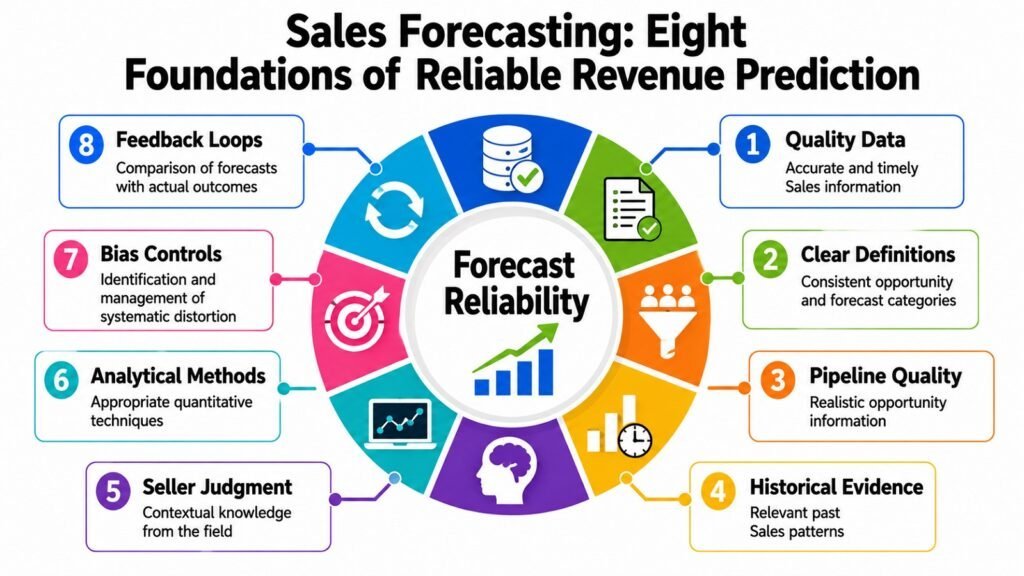
Sales Forecasting is the disciplined process of estimating future revenue outcomes using available evidence about pipeline conditions, opportunity quality, historical performance patterns, and appropriate analytical methods. Its importance extends well beyond the Sales function. Accurate forecasts inform financial planning, capacity decisions, hiring plans, inventory management, and investment allocation across the organization. A function unable to provide reasonably reliable forward estimates imposes high costs elsewhere, from excess inventory to missed staffing targets to inaccurate financial guidance for leadership and investors.
Research in behavioral economics, most prominently by Kahneman and Tversky, documents systematic human forecasting biases including optimism bias, anchoring, and overconfidence. These are especially pronounced in Sales, where sellers and managers face strong incentives to project positive outcomes and where the consequences of under-forecasting often feel more immediate than those of over-forecasting.
Forecasting approaches range from pipeline-weighted methods, which apply probability estimates to opportunities at each stage, through historical pattern analysis and increasingly technology-assisted prediction models. Each has distinct strengths. Pipeline-weighted methods are transparent but depend heavily on accurate stage definitions. Historical methods identify patterns but can miss structural shifts in the business environment.
Human and organizational factors significantly shape forecast quality. Cultures that punish sellers for missing forecasts rather than for providing inaccurate inputs tend to produce systematically optimistic projections that inflate expectations and impair planning. Weak stage definitions create inconsistent pipeline assessments. Infrequent reviews prevent early correction of emerging problems. Effective Forecasting communicates calibrated estimates with appropriate acknowledgment of uncertainty rather than creating false confidence. Forecasting is distinct from Performance: Forecasting estimates what Sales is likely to deliver in the future, while Performance evaluates what Sales has actually delivered and what that reveals about organizational effectiveness.
Table 8: Sales Forecasting — Eight Principles for Greater Forecast Reliability
| Forecasting Principle | Contribution to Forecast Accuracy and Reliability |
| Pipeline Quality Over Quantity | Accurate forecasts depend on well-qualified opportunities, not merely high pipeline volume |
| Consistent Stage Definitions | Clear, shared criteria for each stage prevent optimistic or inconsistent opportunity assessment |
| Historical Baseline Analysis | Conversion rates and cycle times from past performance ground estimates in observed reality |
| Bias Recognition and Correction | Identifying systematic optimism in individual or team forecasts and adjusting for it improves accuracy |
| Scenario-Based Thinking | Expressing outcomes as ranges communicates uncertainty more honestly than single-point predictions |
| Regular Forecast Reviews | Frequent review cycles allow early identification and correction of pipeline and forecast problems |
| Feedback and Calibration | Comparing forecast to actual outcomes and investigating gaps improves future accuracy over time |
| Data Quality Standards | Reliable CRM data and disciplined opportunity management are prerequisites for forecast credibility |
8. Sales Performance: Optimizing Productivity and Results
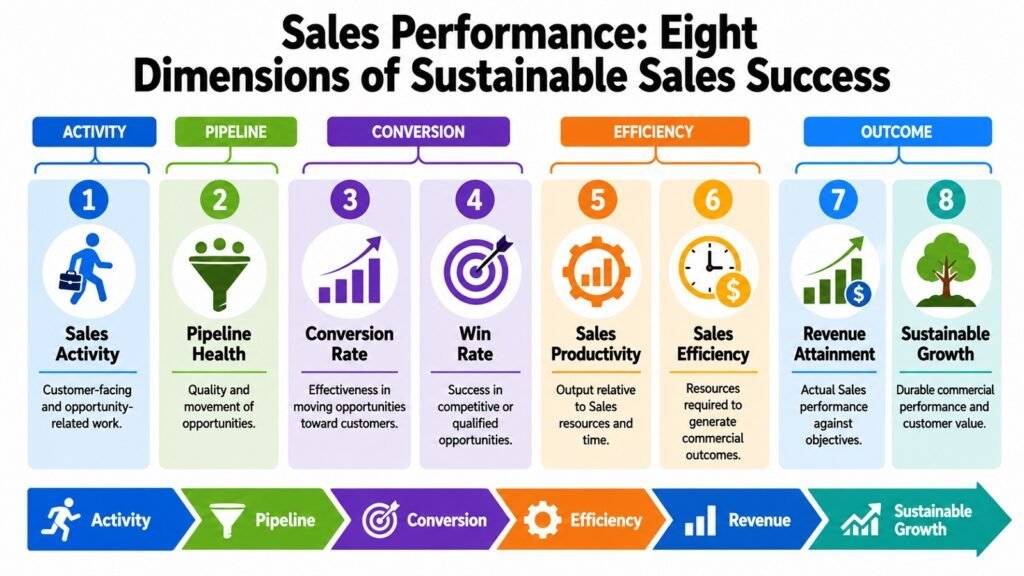
Sales Performance is the outcome-oriented dimension through which organizations evaluate, understand, and improve the effectiveness, productivity, and business contribution of their Sales function. Moving beyond a simple scorecard requires distinguishing between activity, efficiency, effectiveness, and outcomes. Activity measures count what sellers do. Efficiency measures assess resource consumption relative to output. Effectiveness measures evaluate the quality of commercial results relative to opportunity. Outcome measures examine the business consequences: revenue, margin, customer acquisition, and retention.
Research in management practice consistently warns against excessive measurement. Organizations tracking too many performance indicators often create reporting overhead without improving decision quality. The most useful approach maintains a compact set of leading and lagging indicators that together reveal the health of the Sales system. Leading indicators signal future performance: pipeline volume, opportunity quality, conversion velocity, and early-stage activity levels. Lagging indicators confirm past performance: revenue attainment, quota attainment, win rates, and average deal size. Organizations that track only lagging metrics tend to discover problems only after they are already entrenched.
Every preceding foundation shapes Sales Performance. Strategy determines which opportunities are pursued. Process determines conversion efficiency. Value-Based Selling determines engagement quality. Management determines whether people execute consistently. Operations determines whether infrastructure supports or obstructs execution. Enablement determines whether sellers have the knowledge and tools to perform. Forecasting determines whether management has the visibility to act in time. When performance falls short, the diagnosis should examine each foundation rather than defaulting to individual seller accountability. Treating Performance as an organizational learning mechanism rather than a final verdict is what distinguishes companies that build sustainable commercial capability from those that cycle indefinitely between short-term pressure and structural underperformance.
Table 9: Sales Performance — Eight Dimensions and What They Reveal
| Performance Dimension | What It Reveals About Sales Effectiveness |
| Revenue Attainment | Measures whether Sales delivers the total commercial income required by the business |
| Quota Attainment Rate | Shows what proportion of sellers are achieving individual targets in a given period |
| Win Rate | Indicates how effectively Sales converts qualified opportunities into customer commitments |
| Sales Cycle Duration | Reveals process efficiency and alignment between Sales approach and buyer decision timelines |
| Pipeline Velocity | Combines volume, win rate, deal size, and cycle time to indicate overall commercial momentum |
| Average Deal Size | Reflects opportunity mix quality and the effectiveness of Value-Based Selling in practice |
| Customer Acquisition Cost | Assesses efficiency of Sales resources deployed relative to the revenue value of new customers |
| Conversion Rate by Stage | Identifies specific process stages where opportunities are frequently lost or stalled |
Conclusion: Sales – Building a Sustainable Engine for Business Growth
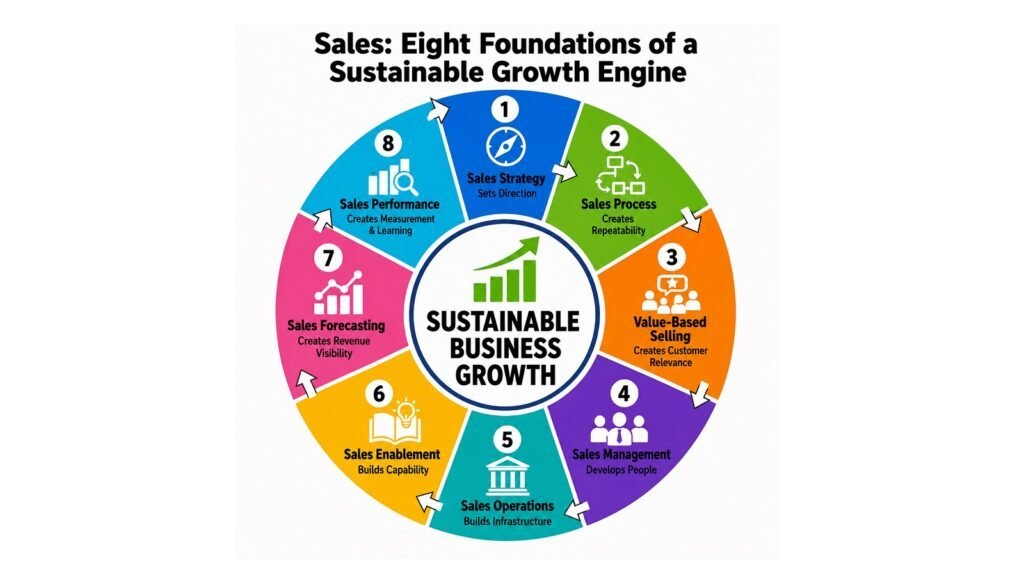
Sales at its most capable is not the final step in a marketing process or a function defined by its ability to close transactions. It is a strategic organizational system that converts genuine customer value into sustainable commercial outcomes. The eight foundations examined in this article are interdependent: weakness in any one constrains the effectiveness of the others.
Sales Strategy establishes commercial direction and resource priorities. Sales Process creates the repeatable pathway through which opportunities become customers. Value-Based Selling ensures commercial engagement centers on genuine customer needs rather than product features alone. Sales Management leads, develops, and holds accountable the people responsible for execution. Sales Operations provides the data, process, and technology infrastructure for consistent execution at scale. Sales Enablement ensures sellers have the knowledge and tools to perform effectively. Sales Forecasting translates pipeline conditions into forward revenue estimates that inform decisions across the entire organization. Sales Performance closes the loop by measuring and diagnosing whether the system is working and where it needs to improve.
Sales improvement is best understood as a continuous cycle. Performance data reveals capability and process gaps. Those gaps inform Enablement and management priorities. Improved capability strengthens execution and customer engagement. Better execution improves outcomes and forecast reliability. Organizations that sustain this cycle build capability that compounds over time. The tools used by Sales will continue to evolve, but the fundamental challenge remains unchanged: connecting genuine customer value with sustainable commercial outcomes.
Table 10: Sales Foundations — Final Synthesis of the Eight Pillars
| Foundations | Contribution to Strong and Sustainable Sales System |
| Strategy | Defines commercial direction, market coverage, and resource priorities that focus the entire effort |
| Process | Creates a repeatable, customer-aligned pathway for consistent opportunity conversion |
| Value-Based Selling | Centers commercial engagement on customer outcomes rather than product features or price alone |
| Management | Develops, leads, and holds accountable the people who execute the Sales function daily |
| Operations | Provides the data, process, and technology infrastructure for scalable Sales execution |
| Enablement | Equips sellers with the knowledge, skills, and tools required to engage customers effectively |
| Forecasting | Translates pipeline conditions into reliable revenue estimates that support organizational planning |
| Sales Performance | Measures and diagnoses Sales effectiveness to drive continuous improvement across the system |