
Table of Contents
Introduction: Leadership Vision as a Cornerstone of Leadership and Management
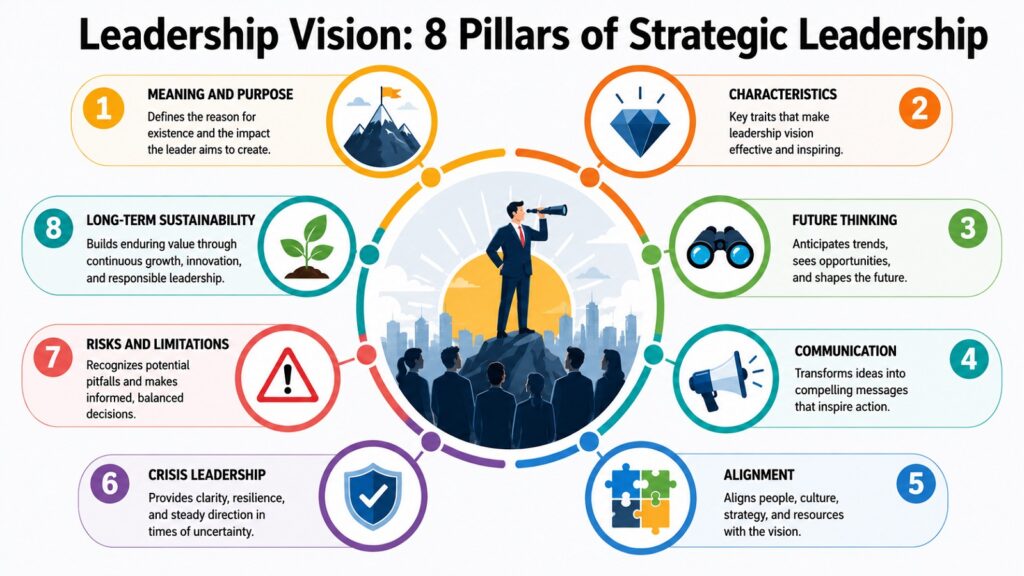
Leadership Vision sits at the heart of effective leadership and management. It gives leaders a clear sense of direction, a way to align people around shared goals, and a foundation for making strategic decisions under pressure. Without Leadership Vision, even talented teams drift, working hard but without a destination. With it, ordinary effort starts to compound into something larger than the sum of its parts.
This is not a new idea. Across business, government, and civic life, the leaders who left the deepest mark were rarely the ones with the most resources. They were the ones who could see further than everyone else in the room, then convince others to walk toward that horizon with them. Abraham Lincoln held a fractured nation together with a vision of unity that most people around him could not yet imagine.
Steve Jobs rebuilt Apple around a vision of simplicity when the easier path would have been to chase every trend. Indra Nooyi reshaped PepsiCo’s portfolio years before the rest of the industry caught up to changing consumer habits. In each case, Leadership Vision was a working tool that shaped decisions, budgets, and culture, not a slogan painted on a wall.
Leadership Vision matters because it does four specific jobs that nothing else in management quite replicates. It defines direction when the path forward is unclear. It aligns people who might otherwise pull in different directions, even with good intentions. It guides strategic decisions when leaders must choose between competing priorities with limited information. And it creates long-term value by giving an organization a reason to exist beyond this quarter’s numbers. These functions explain why Leadership Vision keeps appearing as a defining trait in studies of successful leadership, from Jim Collins’s research on enduring companies to Warren Bennis’s decades of work on what separates leaders from managers.
It would be convenient if Leadership Vision were simply a personality trait, something a leader either has or lacks. The research tells a more useful story. Leadership Vision is a strategic capability that can be built, refined, and sharpened over time. It draws on foresight, communication skill, cultural awareness, and a tolerance for risk that most people practice rather than inherit. This article explores eight proven strategies that great leaders use to develop, communicate, execute, and sustain Leadership Vision inside real organizations.
Each section that follows examines a different dimension of this capability, drawing on leadership theory, documented business history, and practical lessons that translate directly into daily decisions. Some sections look at success. Others, honestly, look at failure, because Leadership Vision without disciplined execution has sunk companies that once looked unstoppable. The goal is a balanced, case-study-driven exploration that treats Leadership Vision as serious strategic work rather than an inspirational footnote.
By the end, you should have a clearer picture of how Leadership Vision actually functions inside organizations, what separates the leaders who get it right from those who don’t, and how you might apply these lessons regardless of your title or industry.
Leadership Vision: Eight Aspects Covered in This Article
| Aspect of Leadership Vision | Focus of the Discussion |
| Meaning and strategic role | Why vision shapes resource allocation |
| Characteristics of effective vision | Traits that make a vision work |
| Future-oriented thinking | Tools leaders use to anticipate change |
| Communication and inspiration | How vision becomes shared purpose |
| Culture and strategy alignment | Embedding vision into daily operations |
| Crisis and uncertainty | Using vision to navigate disruption |
| Failures and limitations | Lessons from visions that collapsed |
| Long-term sustainability | Building vision that outlasts one leader |
1. Leadership Vision: Understanding Its Meaning, Purpose, and Strategic Role
Leadership Vision, at its simplest, is a clear picture of where an organization is headed and why that destination matters. It answers a question that mission statements and quarterly goals cannot answer on their own: what kind of future are we trying to build? A mission describes purpose in the present tense. Goals describe specific, measurable targets. Strategy describes the path. Leadership Vision describes the destination itself, the future state that gives the mission, goals, and strategy their reason for existing.
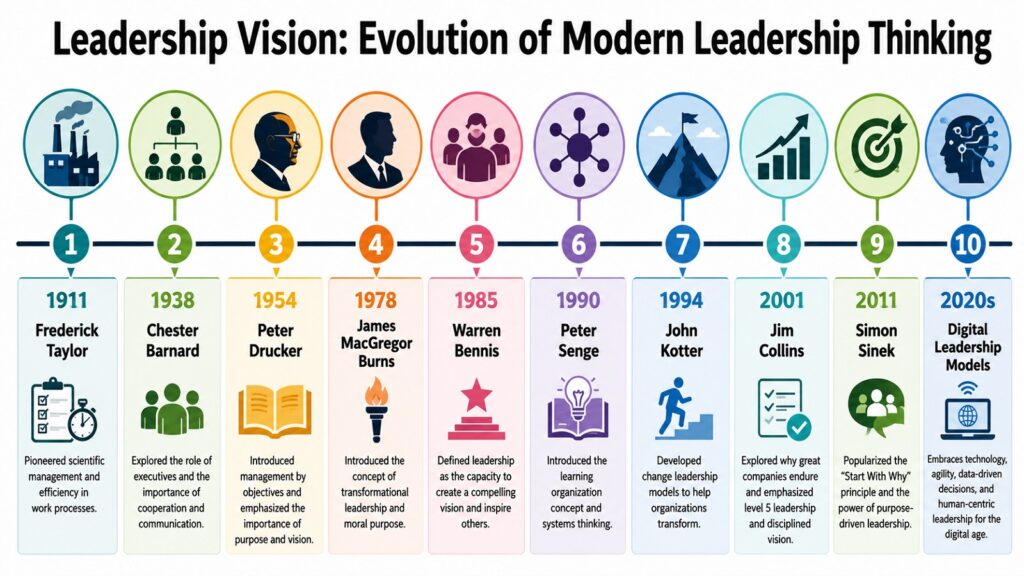
Peter Drucker argued for decades that effective executives spend less time managing tasks and more time deciding what the organization should become. Warren Bennis drew a sharper line, distinguishing managers who do things right from leaders who decide what the right things are in the first place. Jim Collins, after studying companies that sustained greatness, found that enduring organizations paired ambitious long-term vision with disciplined short-term execution. None of these thinkers treated Leadership Vision as decoration. They treated it as the mechanism that determines what an organization says yes to and what it walks away from.
This is where Leadership Vision earns its strategic weight. Every organization has finite resources, finite attention, and finite time, and Leadership Vision acts as a filter for all three. It influences where money gets invested, which projects survive a budget review, and which markets a company decides are worth entering. Amazon’s early vision of becoming the most customer-centric company on earth shaped a willingness to operate at thin margins for years while it built logistics infrastructure that competitors found hard to copy.
Microsoft’s vision under Satya Nadella shifted the company’s center of gravity toward cloud computing, reordering engineering priorities and acquisition strategy across the entire company. Tesla’s vision of accelerating the world’s transition to sustainable energy justified years of capital-intensive bets that a narrower, profit-first vision would likely have rejected.
What ties these examples together is cause and effect. Leadership Vision is not simply present at the start of a strategy document. It actively shapes what leaders choose to fund, staff, and protect when trade-offs become unavoidable. A company without a clear vision still makes these choices, but reactively, based on whatever pressure is loudest that quarter. A company with a clear Leadership Vision makes these choices with a consistent internal logic, even when the external environment changes.
This is the strategic role Leadership Vision plays, and it is worth holding onto as we move through the rest of this article. Leadership Vision is not a slogan. It is a working asset that shapes competitive positioning, resource allocation, and the long-term identity of an organization.
Leadership Vision: Key Thinkers and Organizational Examples
| Thinker or Organization | Vision-Related Contribution |
| Peter Drucker | Defined vision as deciding what to become |
| Warren Bennis | Separated leadership from management |
| Jim Collins | Linked enduring vision with disciplined execution |
| Amazon | Vision built around customer obsession |
| Microsoft | Vision shifted toward cloud computing |
| Tesla | Vision centered on sustainable energy transition |
| Satya Nadella | Reoriented Microsoft’s strategic priorities |
| Jeff Bezos | Prioritized long-term customer trust over margin |
2. Leadership Vision: Characteristics of Effective and Inspiring Leaders
Not every vision statement produces the same results. Some visions energize entire organizations for decades. Others sit quietly in an employee handbook, unread and unused. The difference usually comes down to a specific set of characteristics that researchers and practitioners have identified again and again across very different industries and eras.
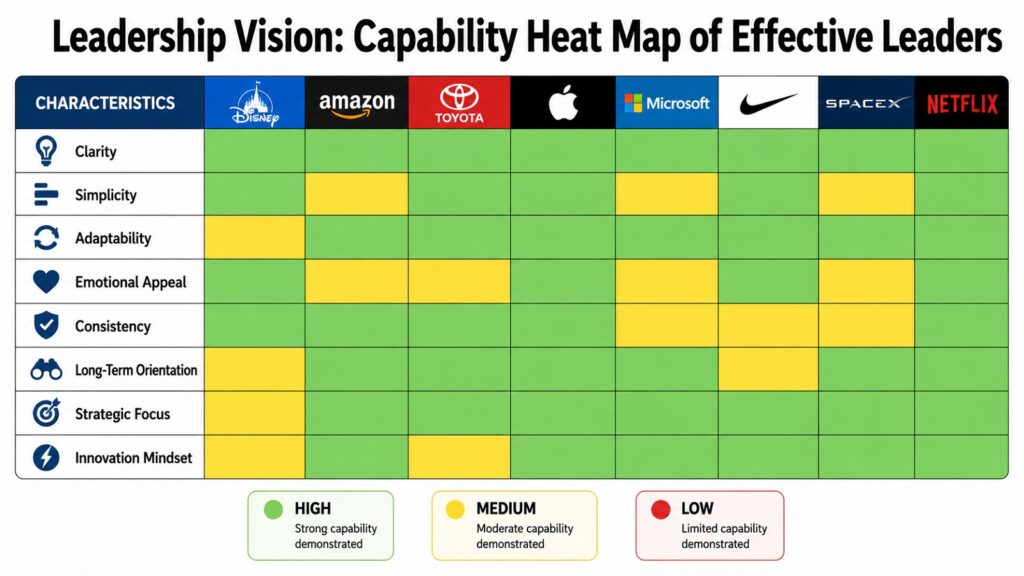
Clarity is the first of these. A vision that requires a paragraph of explanation rarely survives contact with a busy organization. Ambition matters just as much, since a vision that simply restates the present offers nothing to strive for. Realism keeps ambition from collapsing into fantasy, since people quickly stop believing in goals that feel disconnected from what is achievable. Consistency over time builds trust, while simplicity makes the vision easy to repeat and apply in daily decisions. Emotional appeal gives the vision staying power beyond rational argument, and adaptability allows it to survive a changing world without losing its core meaning. Long-term orientation, finally, separates Leadership Vision from a quarterly target dressed up in inspirational language.
These traits show up clearly when you look at specific organizations. Disney’s vision of creating happiness through storytelling has remained remarkably consistent since Walt Disney’s era, even as the company expanded into theme parks, streaming, and franchises that did not exist when the vision was first articulated. That consistency is precisely what allowed the vision to stretch without breaking.
SpaceX offers a different lesson in ambition paired with realism. Elon Musk’s stated goal of making life multiplanetary sounds audacious, yet the company paired it with brutally realistic engineering milestones, like reusable rockets, that made the larger goal feel achievable one step at a time. Nike’s vision around bringing inspiration and innovation to every athlete carries genuine emotional appeal, part of why its marketing has connected with audiences who have no direct relationship with the company’s products.
What these examples demonstrate is that Leadership Vision functions as a dynamic capability rather than a fixed statement. It has to balance inspiration with execution, ambition with believability, and consistency with the flexibility to grow. Leaders who manage that balance well tend to build cultures where people understand not just what they are doing, but why it matters, and that understanding shows up in retention, innovation, and performance over time.
Leadership Vision: Characteristics and Their Real-World Examples
| Characteristic | Associated Company or Leader |
| Clarity | Disney’s storytelling-focused vision |
| Ambition | SpaceX’s multiplanetary goal |
| Realism | SpaceX’s reusable rocket milestones |
| Consistency | Disney’s decades-long thematic continuity |
| Emotional appeal | Nike’s athlete-centered messaging |
| Simplicity | Apple’s design-led product philosophy |
| Adaptability | Amazon’s expansion beyond retail |
| Long-term orientation | Tesla’s sustained energy transition focus |
3. Leadership Vision: How Great Leaders Create Future-Oriented Thinking
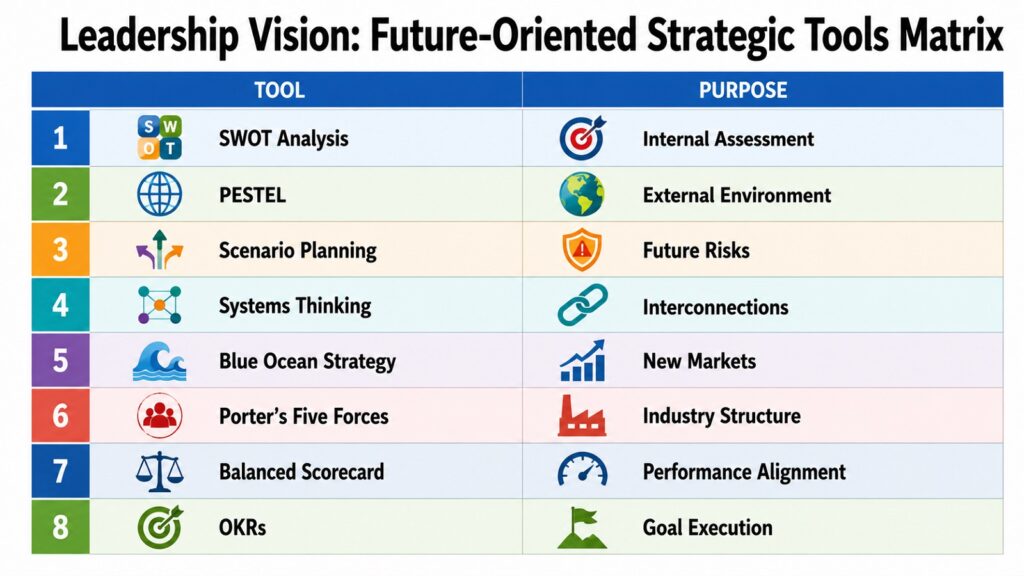
Leadership Vision does not appear fully formed. It develops through a disciplined habit of future-oriented thinking, and leaders who do this well rely on a recognizable set of tools rather than pure intuition. Scenario planning lets leaders test how their organization would respond to several different futures, rather than betting everything on a single forecast. Systems thinking helps leaders see how different parts of a market or industry interact, often revealing opportunities invisible from a narrower view. Environmental scanning keeps leaders aware of shifts in technology, regulation, and customer behavior before those shifts become obvious to everyone else. Blue Ocean Strategy pushes leaders to look for uncontested market space instead of fighting over the same customers as every competitor.
Steve Jobs’s return to Apple in 1997 is a useful case study in how this kind of thinking translates into vision. Rather than competing directly with Microsoft on its own terms, Jobs steered Apple toward a vision built around design simplicity and tightly integrated hardware and software, a category Apple later expanded with the iPod, iPhone, and iPad. That vision emerged from years of watching where personal computing was heading and identifying a gap competitors had stopped paying attention to.
Jeff Bezos offers a similar lesson from a different angle. His early decision to build Amazon around long-term customer obsession, even when it meant sacrificing short-term profit, reflected environmental scanning that recognized how internet retail would eventually reward scale and trust over immediate margin.
What separates these leaders from those who simply guess about the future is the discipline behind the thinking. They treated vision creation as an ongoing analytical process, not a single moment of inspiration. They revisited their assumptions as new information arrived, adjusting specific elements of their vision while protecting its core direction. Leadership Vision informs which strategic bets a leader is willing to make, and strategic outcomes, in turn, tell the leader whether the vision needs refinement.
This is why the most effective leaders treat Leadership Vision as something to revisit constantly rather than a statement carved in stone. A vision that does not evolve risks becoming irrelevant the moment the environment around it shifts.
Leadership Vision: Strategic Tools for Future-Oriented Thinking
| Strategic Tool | Primary Purpose |
| Scenario planning | Testing responses to multiple futures |
| Systems thinking | Seeing interactions across a market |
| Environmental scanning | Tracking shifts before they become obvious |
| Blue Ocean Strategy | Finding uncontested market space |
| Competitive analysis | Understanding rivals’ strategic gaps |
| Trend forecasting | Anticipating technology and consumer shifts |
| Strategic foresight | Linking long-term vision to near-term bets |
| Assumption testing | Refining vision against new evidence |
4. Leadership Vision: Communicating Ideas and Inspiring People
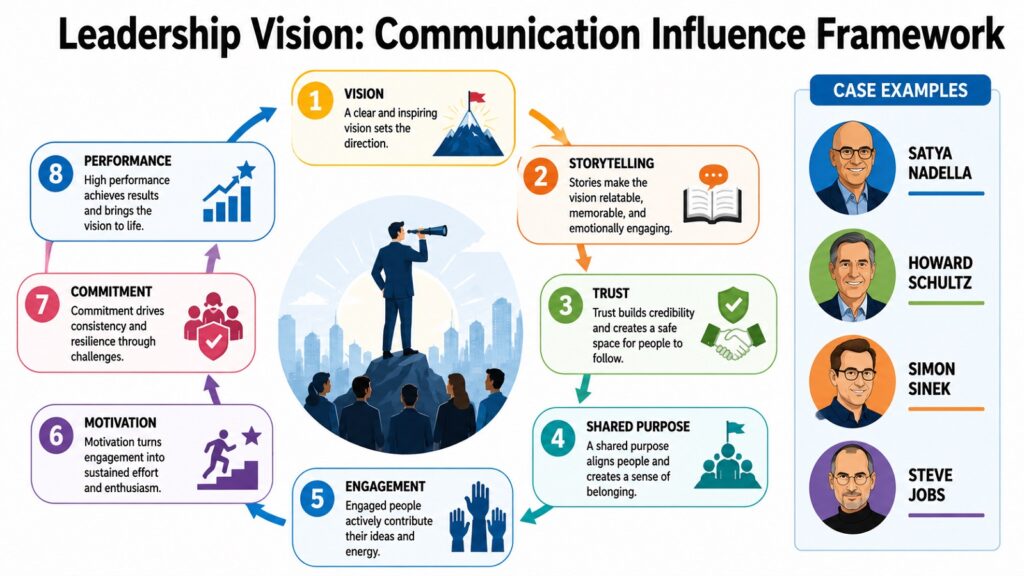
A vision that lives only in a leader’s head accomplishes very little. Leadership Vision becomes useful only when it transforms into a shared sense of purpose across an organization, and that transformation depends almost entirely on communication. What matters most is whether the communication builds trust, tells a coherent story, and connects to something employees genuinely care about.
This is where transformational leadership theory becomes relevant. Transformational leaders do not simply announce a vision and expect compliance. They build relationships with employees that make the vision feel personally meaningful, often by connecting organizational goals to individual growth and purpose. Storytelling plays an outsized role here, because abstract goals rarely move people the way a concrete narrative does. A vision framed as a story, with stakes, challenges, and a clear sense of progress, tends to stick in a way that a bullet-pointed strategy memo never will.
Satya Nadella’s communication style after becoming Microsoft’s CEO offers a clear example. Rather than simply declaring a shift toward cloud computing and growth mindset, Nadella repeatedly told a consistent story about empowerment and learning that reached employees at every level, not just senior leadership. That consistency helped a notoriously large, bureaucratic organization absorb a significant strategic shift without the kind of internal resistance that often derails major pivots. Howard Schultz, during his years leading Starbucks, built communication around the idea of Starbucks as a third place between home and work, a vision he repeated so consistently across meetings, interviews, and store-level training that employees across thousands of locations could repeat it almost verbatim.
The reason certain visions motivate individuals while others struggle to resonate typically relates to authenticity and repetition rather than mere cleverness. Individuals do not dedicate themselves to a vision solely because the language is refined. They invest in it because they encounter it frequently, articulated by leaders who consistently embody the message, making the vision feel tangible rather than merely aspirational. This explains why Leadership Vision cannot be merely communicated once and subsequently set aside. It must be reiterated in town halls, performance evaluations, hiring discussions, and daily decision-making until it becomes ingrained in the organization’s self-identity.
Leadership Vision: Leaders and Their Communication Approaches
| Leader | Communication Approach |
| Satya Nadella | Consistent empowerment and growth narrative |
| Howard Schultz | Repeated third place positioning |
| Steve Jobs | Product launches as storytelling events |
| Indra Nooyi | Performance with purpose messaging |
| Jacinda Ardern | Direct, empathetic crisis communication |
| Mary Barra | Transparent communication during recalls |
| Reed Hastings | Memo-driven culture explanation |
| Tim Cook | Values-led public communication |
5. Leadership Vision: Aligning Culture, Strategy, and Organizational Goals
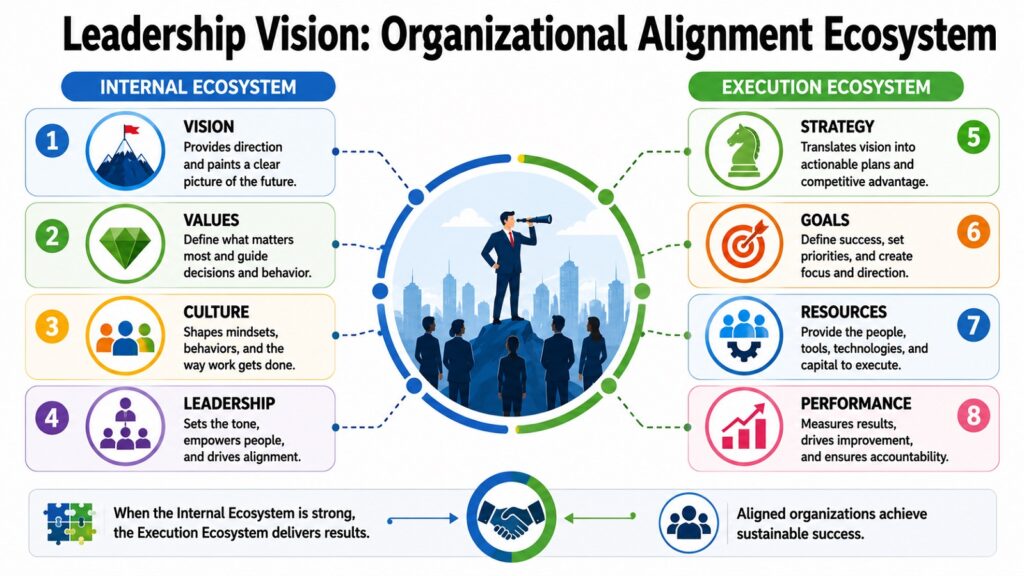
Leadership Vision only becomes meaningful when it gets built into the actual fabric of an organization, not just its messaging. This means connecting vision to values, values to strategic priorities, and strategic priorities to the way resources get allocated day to day. When this alignment works, employees experience the vision as something that shapes real decisions. When it does not work, the vision becomes background noise that nobody trusts.
Toyota’s vision around continuous improvement, expressed through its well known kaizen philosophy, illustrates this alignment well. The vision is not treated as an abstract value sitting apart from operations. It is embedded directly into how factory floors function, how employees are trained to identify inefficiencies, and how managers respond when problems surface. That alignment between vision and daily practice is a major reason Toyota’s production system has been studied and imitated across industries far beyond automotive manufacturing.
Netflix offers a different but equally instructive example. Its vision around entertaining the world has been paired with an unconventional culture built on freedom and responsibility, where employees receive significant autonomy in exchange for high performance expectations. That cultural choice was a direct extension of a vision that prioritized creative risk-taking over rigid process control.
What both cases reveal is that Leadership Vision functions as an organizational system rather than an isolated leadership behavior. It influences hiring criteria, performance metrics, internal promotion decisions, and even the physical design of workspaces. When these elements reinforce the same underlying vision, employees experience consistency, and that consistency builds trust over time.
The opposite is also instructive. Organizations frequently articulate an inspiring vision while continuing to reward behavior that contradicts it, promoting short-term thinking while claiming to value long-term innovation, for example. This disconnect between stated vision and actual incentive structures is one of the most common sources of strategic failure, because employees tend to believe what gets rewarded far more than what gets printed in a values statement. Leadership Vision, in other words, only holds up when culture and strategy are built to support it rather than simply describe it.
Leadership Vision: Companies and Their Cultural Alignment Principles
| Company | Cultural or Strategic Principle |
| Toyota | Kaizen embedded into daily operations |
| Netflix | Freedom and responsibility culture |
| Innovation time built into roles | |
| Patagonia | Environmental values shaping strategy |
| Southwest Airlines | Culture-first hiring and training |
| Zappos | Customer service as core identity |
| 3M | Structured time for experimentation |
| IKEA | Affordability built into design process |
6. Leadership Vision: Navigating Crisis, Change, and Uncertainty
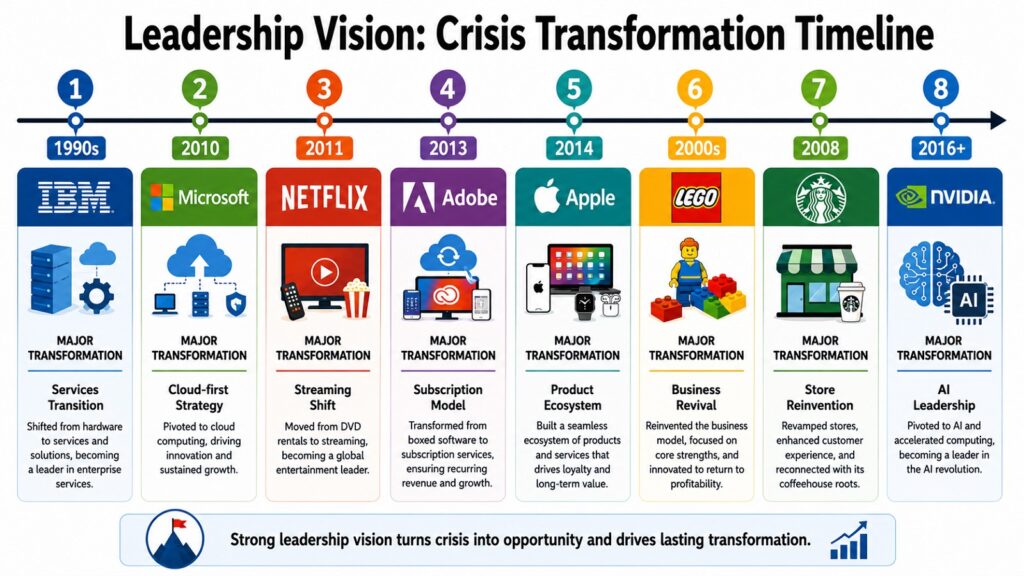
Leadership Vision matters most precisely when things are going badly. In stable conditions, a reasonably competent strategy can carry an organization forward without much need for a compelling vision. During genuine disruption, vision becomes the thing that keeps people moving in a coherent direction when fear and confusion would otherwise pull them apart.
IBM’s transformation during the early 1990s is a well documented case. Facing a near existential crisis as personal computing reshaped the technology industry, IBM under Lou Gerstner shifted its vision from hardware manufacturing toward integrated technology services and solutions. That shift required dismantling parts of the company’s identity that had defined it for decades, but it gave IBM a coherent direction during a period when the alternative was continued decline.
Microsoft’s pivot toward cloud computing under Satya Nadella followed a similar pattern during a period when its traditional software licensing model faced serious competitive pressure. Netflix’s own history includes a notable crisis moment in 2011, when a poorly communicated pricing and service split nearly derailed the company. Its recovery depended on returning to a clear vision focused on streaming and original content, communicated honestly to a frustrated customer base.
What these cases share is a Harvard case-study structure worth noting directly: context, decisions, actions, and outcomes. Each organization faced a specific competitive context that made its existing vision increasingly unworkable. Each leadership team made a deliberate decision to revise the vision rather than simply defend the old one. Each followed through with actions, structural changes, reallocated resources, and new communication, that matched the revised vision. The outcome depended less on the elegance of the new vision and more on the willingness to act on it under pressure.
The lesson generalizes well beyond these specific companies. Leadership Vision during a crisis cannot remain static, but it also cannot be abandoned entirely, since organizations need some continuity to avoid feeling unmoored. The leaders who navigate this well tend to preserve the core purpose behind their vision while being genuinely willing to change the specific strategy used to pursue it.
Leadership Vision: Organizations That Navigated Major Change
| Organization | Crisis or Change Addressed |
| IBM | Shift from hardware to services |
| Microsoft | Transition to cloud computing |
| Netflix | Recovery from 2011 pricing crisis |
| Ford | Restructuring without a bailout |
| Starbucks | Store closures and brand reset |
| LEGO | Recovery from near bankruptcy |
| American Express | Adapting to digital payments |
| Adobe | Shift to subscription-based software |
7. Leadership Vision: Failures, Risks, and Strategic Limitations
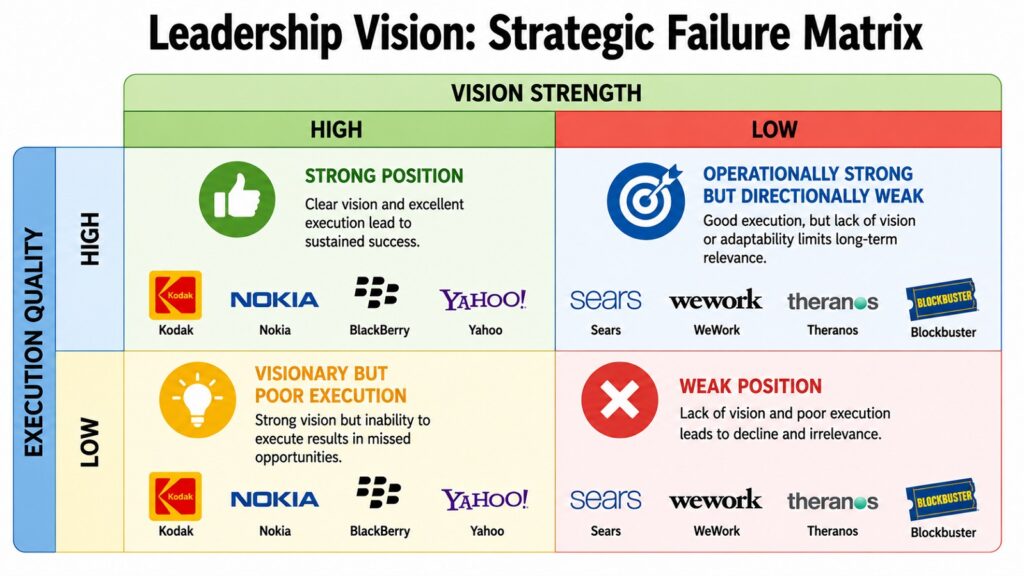
Leadership Vision deserves a more balanced treatment than it usually receives, because an ambitious vision is not automatically a good one. Plenty of failed organizations were led by people with genuinely compelling visions that simply did not survive contact with reality. Understanding why is just as important as studying success.
Kodak’s leadership maintained a vision deeply tied to film photography even as digital imaging became technically and commercially viable, a vision the company itself had the engineering capability to pursue earlier than it did. The failure here was not a lack of vision. It was a vision anchored too firmly to a previous version of the world, defended past the point where evidence justified that confidence. Nokia’s leadership held a vision centered on hardware excellence and manufacturing scale right as the smartphone market shifted decisively toward software ecosystems and app platforms.
WeWork’s leadership pursued a vision of reshaping the future of work at a pace and valuation that assumed continuous, frictionless growth, an assumption that collapsed once investors began scrutinizing the underlying business model. Theranos represents perhaps the starkest example, where a vision of revolutionizing blood testing was pursued well past the point where the underlying technology could actually support it.
These cases share recognizable patterns. Overconfidence led leadership teams to treat early belief in their vision as proof rather than hypothesis. Execution gaps appeared when the operational reality of delivering on the vision proved far harder than the vision suggested. Unrealistic assumptions about market readiness, technological feasibility, or customer behavior went unexamined for too long. And changing environments, especially shifts that competitors recognized faster, turned what had been a reasonable vision into an outdated one.
The broader lesson is not that ambition is dangerous. It is that Leadership Vision requires constant contact with evidence, a willingness to question core assumptions, and organizational structures that reward honest feedback rather than blind confidence. Visionary thinking without disciplined execution and organizational learning is, on its own, a liability rather than an asset.
Leadership Vision: Organizations and Their Strategic Limitations
| Organization | Limitation or Strategic Error |
| Kodak | Vision anchored to film photography |
| Nokia | Underestimated smartphone software shift |
| WeWork | Growth assumptions outpaced reality |
| Theranos | Vision exceeded actual technology |
| Blockbuster | Resisted streaming until too late |
| Yahoo | Lacked a consistent strategic identity |
| Enron | Vision masked unsustainable practices |
| MySpace | Failed to adapt to changing user needs |
8. Leadership Vision: Building Long-Term Success and Sustainable Growth
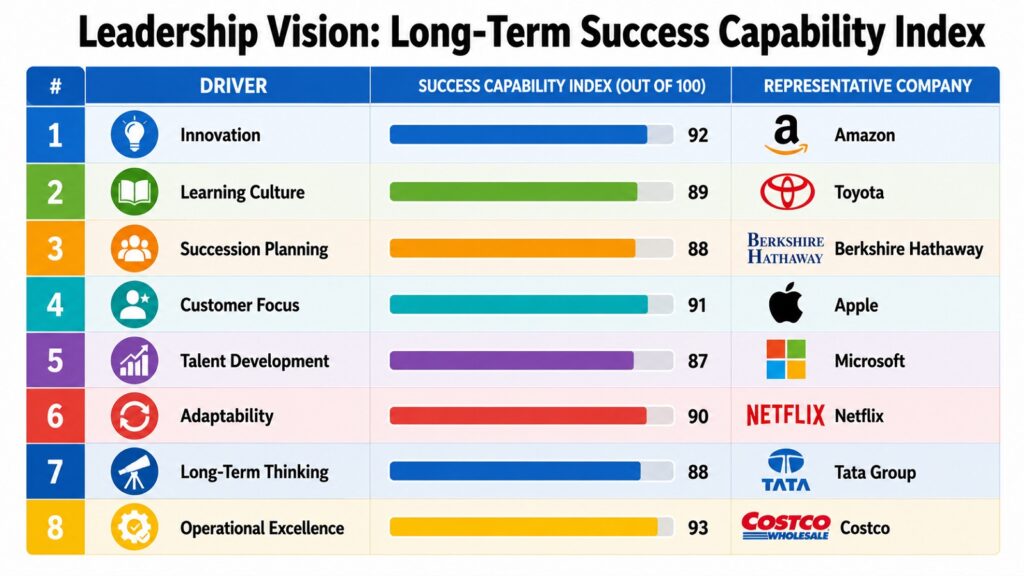
Leadership Vision earns its real value over long stretches of time, not single quarters. Organizations that sustain success across decades tend to share specific practices that keep their vision relevant as conditions change around them, even as the people leading the organization eventually change too.
Continuous improvement is one such practice, where vision is treated as something to refine constantly rather than protect rigidly. Succession planning is another, since a vision that depends entirely on one individual rarely survives that individual’s departure. Learning organizations build mechanisms for absorbing new information and adjusting course without losing their underlying direction, and talent development ensures that future leaders understand the vision deeply enough to carry it forward rather than simply administer it.
Amazon’s vision around customer obsession has persisted well beyond Jeff Bezos’s transition out of the CEO role, partly because the company built systems and leadership principles designed to outlast any single executive. Berkshire Hathaway under Warren Buffett built its vision around long-term value investing and operating businesses with integrity, reinforced through decades of consistent communication in shareholder letters.
Toyota’s commitment to continuous improvement, already discussed earlier, has remained intact across multiple generations of leadership because it was embedded into processes rather than tied to any one executive’s personality. Tata Group offers a particularly long-running example, having sustained a vision centered on nation-building and stakeholder responsibility across more than a century of leadership transitions, including periods of significant political and economic upheaval in India.
What unites these organizations is a willingness to treat Leadership Vision as something requiring active maintenance rather than a one-time exercise completed during a strategy retreat. They protected the core values behind their vision while remaining genuinely open to changing the methods used to pursue it. That distinction, between protecting purpose and clinging to specific tactics, is what separates organizations that adapt successfully from those that eventually become case studies in decline.
Leadership Vision, treated this way, becomes a capability the organization itself holds, rather than a trait that disappears the moment a particular leader moves on.
Leadership Vision: Practices Behind Long-Term Organizational Success
| Organization | Practice Supporting Long-Term Success |
| Amazon | Leadership principles outlasting any executive |
| Berkshire Hathaway | Consistent shareholder communication |
| Toyota | Continuous improvement embedded in process |
| Tata Group | Vision sustained across generations |
| Johnson & Johnson | Long-standing credo guiding decisions |
| Procter & Gamble | Structured leadership development pipeline |
| Unilever | Sustainability built into long-term strategy |
| GE (historical) | Rigorous internal leadership training |
Conclusion: Leadership Vision as the Foundation of Enduring Leadership Success
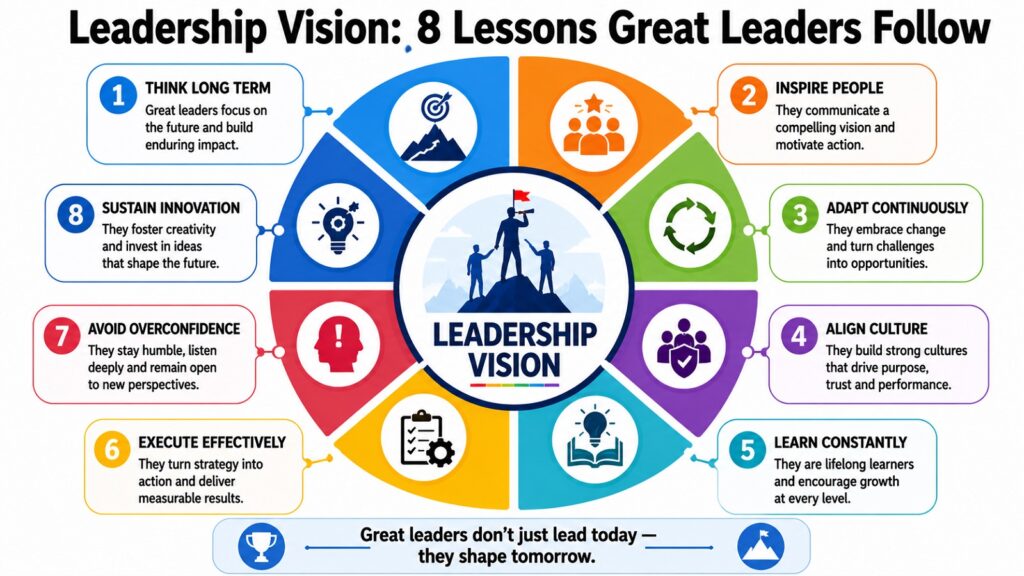
Leadership Vision is an important aspect of leadership and management precisely because it does the foundational work that nothing else quite replicates. It gives organizations direction when the path forward is genuinely unclear. It aligns people around a shared sense of purpose, even across large and complex organizations. It guides strategic decisions when leaders face real trade-offs with imperfect information. And it builds long-term value that survives well beyond any single product cycle or leadership tenure.
The eight strategies explored in this article, understanding the strategic role of vision, recognizing the characteristics that make it effective, developing future-oriented thinking, communicating with consistency, aligning culture and strategy, navigating crisis with purpose intact, learning honestly from failure, and building systems for long-term renewal, are not independent techniques. They reinforce one another inside organizations that take Leadership Vision seriously. A vision communicated brilliantly but never aligned with actual incentives will eventually ring hollow. A vision grounded in disciplined foresight but never tested against honest feedback risks the same fate as Kodak or Theranos.
What this article has tried to demonstrate, through real organizations rather than abstract theory, is that Leadership Vision combines several things that rarely get discussed together: theoretical depth from researchers like Drucker, Bennis, and Collins, historical evidence from companies that succeeded and failed, and practical execution that depends on culture, communication, and constant willingness to learn. Leadership Vision is not a slogan, and it is not a personality trait reserved for a handful of historically famous figures. It is a practical capability that can be developed deliberately, regardless of industry or title.
As markets grow more uncertain and competitive pressure intensifies, leaders who invest seriously in developing Leadership Vision will hold a meaningful advantage over those who treat it as an afterthought. Leadership Vision is not finished once and filed away. It is a continuous journey, one that shapes organizations, industries, and, in some cases, entire societies.
Leadership Vision: Eight Key Lessons from This Article
| Key Lesson | Takeaway |
| Vision drives strategy | Shapes resource allocation and priorities |
| Clarity beats complexity | Simple visions are easier to follow |
| Foresight requires discipline | Built through structured analysis, not guesswork |
| Communication needs repetition | Trust builds through consistent messaging |
| Culture must match vision | Incentives should reinforce stated direction |
| Crisis tests vision | Purpose should stay while strategy adapts |
| Overconfidence is a risk | Evidence must inform belief, not the reverse |
| Sustainability needs systems | Vision should outlast any single leader |