
Table of Contents
Introduction: Why Vision and Mission Matter in Business Strategy
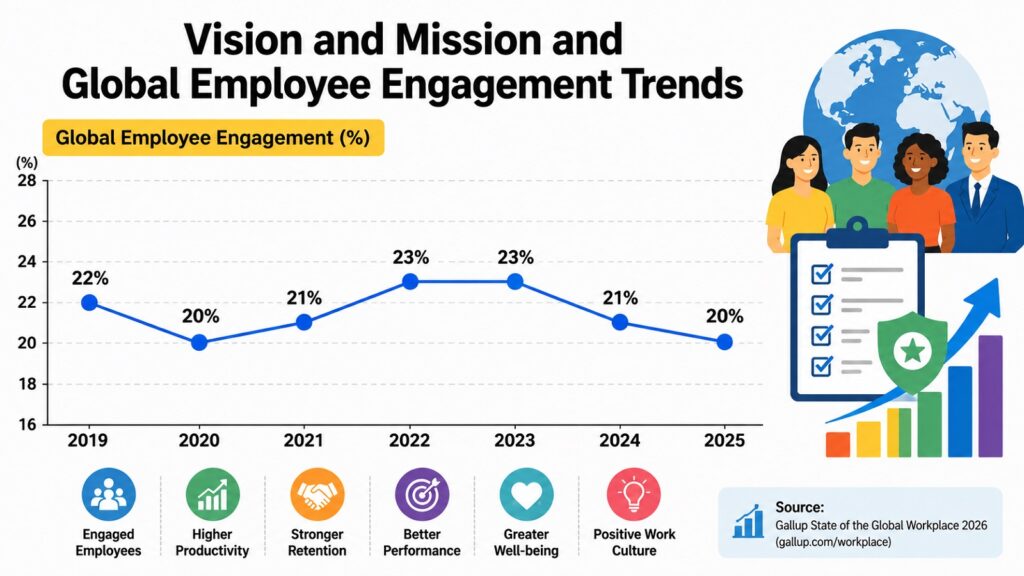
A well-known finding from Bain & Company suggests that fewer than ten percent of companies fully execute the strategies described in their planning documents. The gap rarely comes from a lack of effort or talent within the organization. It comes from a lack of clarity at the very top of the strategy, where Vision and Mission are supposed to live. When Vision and Mission are vague, every decision below them inherits that confusion. When Vision and Mission are sharp and lived out daily, they quietly shape hiring choices, product decisions, and even how a company responds to a crisis.
This is why Vision and Mission deserve more attention than they usually get in business strategy conversations. They are not just opening slides in a corporate deck. They are the reference point that leaders return to when markets shift, when competitors copy their playbook, or when employees ask why their work matters. Companies that treat Vision and Mission as living tools, rather than static statements, tend to make faster decisions because fewer options need debating. The direction has already been set.
Research on organizational behavior consistently links strategic clarity with stronger performance. Employees who understand where a company is headed report higher engagement, and customers who sense a clear purpose behind a brand often show more loyalty during downturns. Vision and Mission also influence stakeholder trust. Investors look for consistency between what a company says and what it does, and a well-defined Vision and Mission makes that consistency easier to demonstrate.
This article explores eight pillars that turn Vision and Mission from simple statements into practical strategic tools. Each pillar examines a different angle, including organizational purpose, statement design, core values, strategic direction, alignment, leadership, stakeholder communication, and execution. Real examples from recognizable companies are used throughout to show how these ideas work outside the classroom. The goal is not to repeat textbook definitions but to show how Vision and Mission function as working parts of a strategy, not as framed posters in a conference room.
By the end of this article, the connection between Vision and Mission and long-term business success should feel less abstract and more like a practical checklist. Readers will see how each pillar reinforces the others, creating a strategic foundation that supports growth even when the business environment becomes unpredictable.
8 Pillars of Vision and Mission in Business Strategy
| Pillars of Vision and Mission | How It Strengthens Vision and Mission |
| Business Purpose | Gives a reason beyond profit |
| Vision and Mission Statements | Define clear strategic direction |
| Core Values | Guide daily employee behavior |
| Strategic Direction | Filters which opportunities to pursue |
| Organizational Alignment | Connects departments to shared goals |
| Leadership and Culture | Keeps mission alive through action |
| Stakeholder Communication | Builds consistent trust and credibility |
| Goal Setting and Execution | Converts mission into results |
1. Vision and Mission as the Foundation of Business Purpose
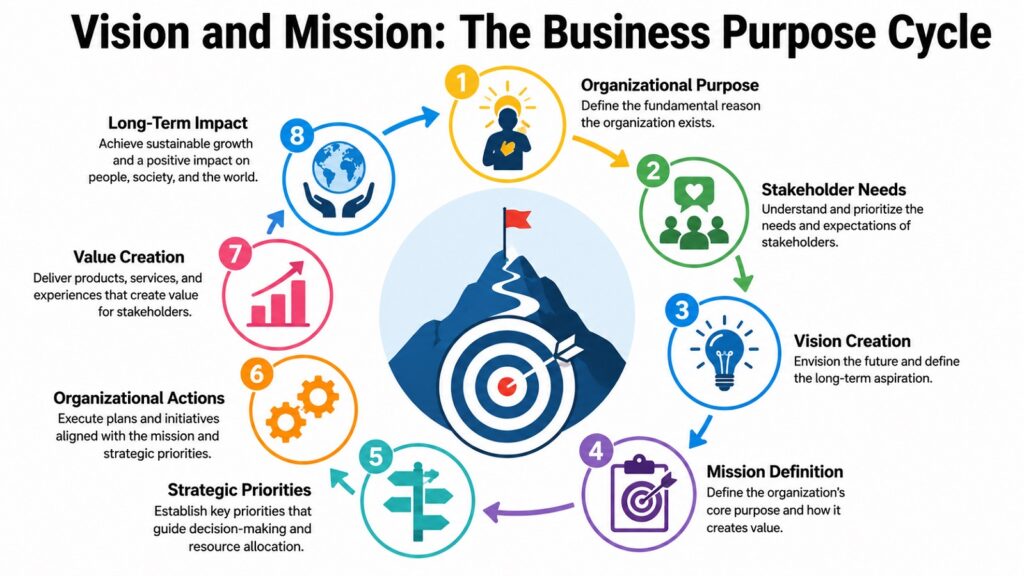
Business purpose answers a question that profit alone cannot answer, which is why an organization deserves to exist in the first place. Vision and Mission give that answer a permanent home. A company without a clear sense of purpose can still make money for a while, but it struggles to explain itself when customers, employees, or investors start asking harder questions. Purpose is what turns a business from a transaction machine into something people can believe in.
For decades, management researchers have explored this concept. Peter Drucker, frequently regarded as the pioneer of contemporary management thought, contended that a business’s primary objective is to create a customer, rather than merely to produce profit. This perspective reinterprets Vision and Mission as instruments for comprehending the customer’s environment instead of mere marketing phrases. Recent studies in organizational behavior have revealed that employees who perceive a distinct purpose in their work demonstrate greater commitment and reduced turnover, which in turn influences productivity and recruitment expenses.
Patagonia offers one of the clearest examples of purpose shaping a Vision and Mission. The company states that it is in business to save the planet, and this mission has shaped decisions that go far beyond marketing. Patagonia uses recycled materials, funds environmental activism, and in 2022 transferred its ownership structure so that profits would permanently support environmental causes. This is not a purpose statement sitting in an annual report. It is a purpose statement that changed who owns the company.
Purpose also strengthens competitive positioning. When two companies sell similar products, the one with a clearer sense of purpose often wins customer preference, especially among younger buyers who research a brand’s values before purchasing. Purpose builds stakeholder trust because it gives investors and partners a consistent lens through which to judge decisions. A company that says it values sustainability but pollutes aggressively will eventually lose credibility, while a company that backs its stated purpose with real action builds a reputation that competitors cannot easily copy.
Long-term sustainability depends on this kind of consistency. Purpose-driven organizations tend to weather downturns better because employees and customers extend more goodwill during difficult periods. Research from organizations like Deloitte has found that companies with a strong sense of purpose report higher employee retention than industry peers, and lower retention costs translate into stronger margins over time.
This sets the stage for the next pillar, which looks at how Vision and Mission statements themselves are written and structured to carry this purpose forward into daily decision-making.
Vision and Mission Purpose Across Leading Organizations
| Organization | Purpose Alignment with Vision and Mission |
| Patagonia | Mission centers on environmental protection |
| Tesla | Vision drives sustainable transportation |
| Costco | Mission ties pricing to employee welfare |
| IKEA | Purpose focuses on affordable living |
| Johnson & Johnson | Credo prioritizes patients first |
| TOMS | Purpose built on one-for-one giving |
| Ben & Jerry’s | Mission links products with activism |
| Warby Parker | Purpose combines eyewear with giving |
2. Vision and Mission Statements That Define Organizational Direction
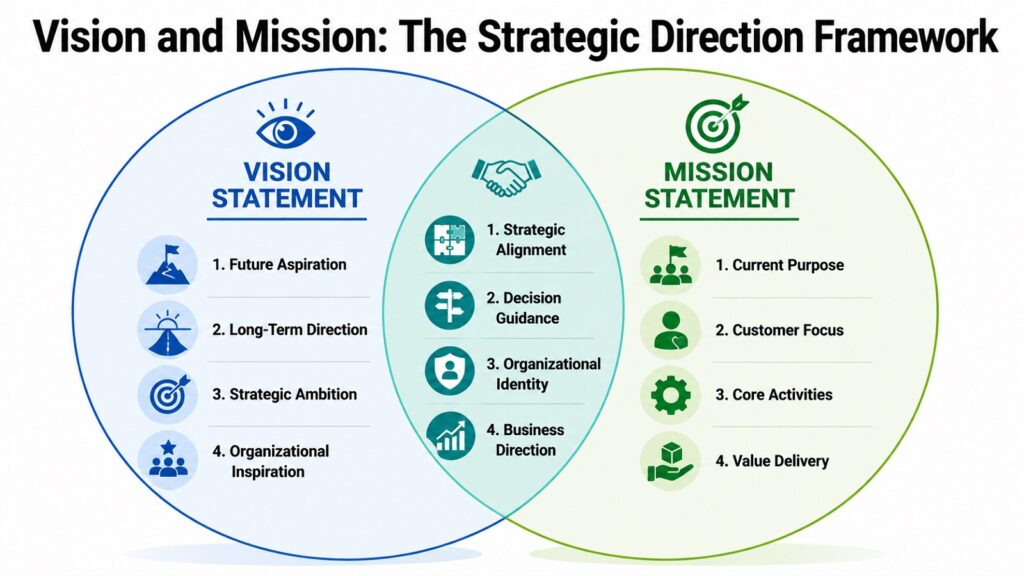
A Vision Statement describes where an organization wants to go, while a Mission Statement describes what it does today to get there. The two work together but answer different questions. Vision looks forward and often describes an aspirational future state, while Mission stays grounded in present activity and identity. Confusing the two is a common mistake, and it often leads to statements that sound impressive but provide little practical guidance for decision-making.
Management scholars such as Fred David, known for his work on strategic management frameworks, have argued that effective Mission Statements should address the company’s customers, products, markets, and values in a way that is specific enough to guide strategy. A Vision Statement, by contrast, should be ambitious but still believable. Microsoft’s early vision, a computer on every desk and in every home, illustrates this balance well. It was bold for its time, yet specific enough that employees understood exactly what they were building toward.
Weak Vision and Mission statements create strategic drift, a condition where different parts of an organization slowly move in different directions because no shared direction exists to anchor them. This often shows up as departments pursuing conflicting priorities, marketing promising something operations cannot deliver, or new product lines with little connection to the company’s stated identity.
Amazon offers a useful case study here. Its mission, to be the most customer-centric company on Earth, has shaped decisions ranging from its return policy to its long-term investment in same-day delivery infrastructure. Even when short-term profits suffered, as they did during years of heavy logistics investment, leadership pointed back to the mission to justify the spending. This is what an effective Mission Statement does. It gives leaders a defensible reason for unpopular short-term decisions because those decisions serve a long-term direction that stakeholders already understand and accept.
The practical lesson for any organization is that Vision and Mission statements should be tested against real decisions rather than judged on how well they read. A useful exercise is to take a recent strategic choice and ask whether the current Vision and Mission would have predicted it. If the statement could justify almost any decision, it is too vague to be useful. Google’s original mission, to organize the world’s information and make it universally accessible and useful, passes this test because it explains why the company moved into maps, video, and cloud storage while staying away from unrelated industries.
Vision and Mission Statement Traits of Known Companies
| Company | Statement Characteristic |
| Microsoft | Vision ties technology to empowerment |
| Amazon | Mission centers on customer obsession |
| Mission organizes world information | |
| Nike | Vision inspires athletes everywhere |
| Starbucks | Mission emphasizes human connection |
| Disney | Mission centers on storytelling |
| IBM | Mission shifted toward enterprise solutions |
| Mission connects professionals to opportunity |
3. Vision and Mission Through Strong Core Strategic Values
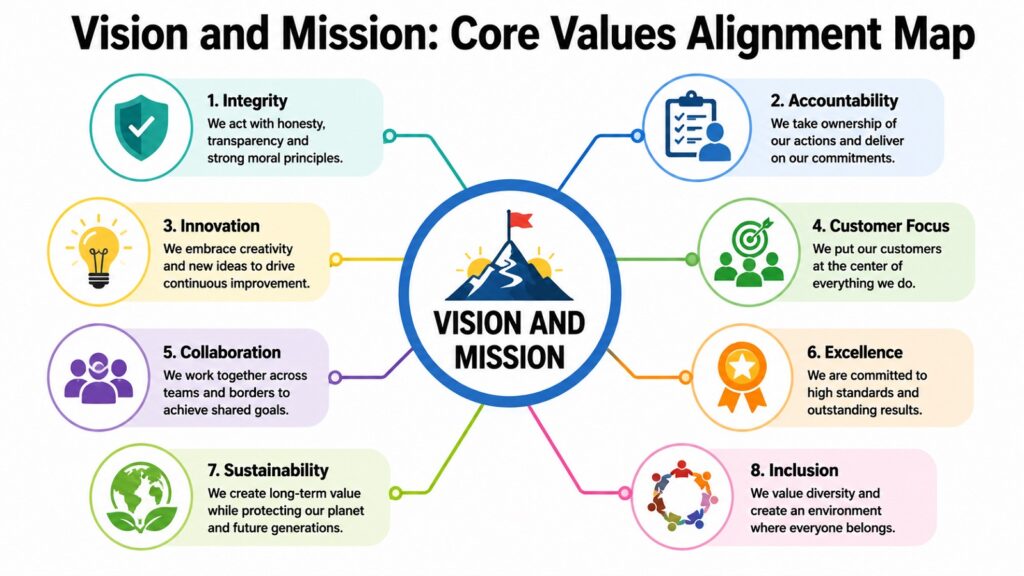
Core Strategic values act as the bridge between a Vision and Mission written on paper and the actual behavior of employees on any given day. A Mission Statement can describe the destination, but values describe how people are expected to act while getting there. Without clear values, even a well-written Mission Statement becomes difficult to apply consistently, because employees lack guidance on how to handle situations the statement does not explicitly cover.
Research on organizational culture, including work associated with Edgar Schein, a prominent scholar in this field, suggests that values only matter when they are reinforced through visible behavior, not just stated in handbooks. A company can claim to value innovation, but if managers punish failed experiments, employees quickly learn that the real value is caution, not innovation. This gap between stated values and lived values is one of the most common reasons Vision and Mission statements fail to influence daily operations.
Costco provides a useful example of values reinforcing mission. The company’s mission centers on providing quality goods at low prices while taking care of employees and members. Costco backs this with unusually high employee wages and benefits compared to competitors in the retail sector, along with a long-standing policy of capping markup on products. These choices are not separate from the mission. They are the mission expressed through compensation policy and pricing strategy, which is why Costco has maintained strong employee retention rates that outperform much of the retail industry.
Strong values also support ethical decision-making during ambiguous situations. When a new scenario arises that company policy does not directly address, employees with a clear sense of organizational values can reason through the situation using those values as a guide. This reduces the burden on senior leadership to micromanage every decision and allows faster responses at lower levels of the organization. Values also support innovation by giving employees confidence that reasonable risks aligned with company values will be supported rather than punished, which encourages the kind of experimentation that strategic growth often depends on.
Southwest Airlines built much of its early competitive advantage around a culture of treating employees well, on the belief that satisfied employees create satisfied customers. This value shaped hiring practices that prioritized attitude over rigid qualifications, along with scheduling flexibility that reduced burnout. The airline’s mission to provide affordable travel only worked because the underlying values made employees willing to deliver friendly service even during the operational stress that comes with rapid, low-cost turnarounds at the gate.
Core Values Behind Vision and Mission Success
| Organization | Prominent Core Value |
| Costco | Employee welfare and fair pricing |
| Southwest Airlines | Employee happiness drives service |
| Zappos | Customer service as identity |
| 3M | Innovation through experimentation |
| Toyota | Continuous improvement and respect |
| Patagonia | Environmental responsibility first |
| Ritz-Carlton | Empowered staff for guests |
| Intellectual freedom and collaboration |
4. Vision and Mission as Drivers of Strategic Direction
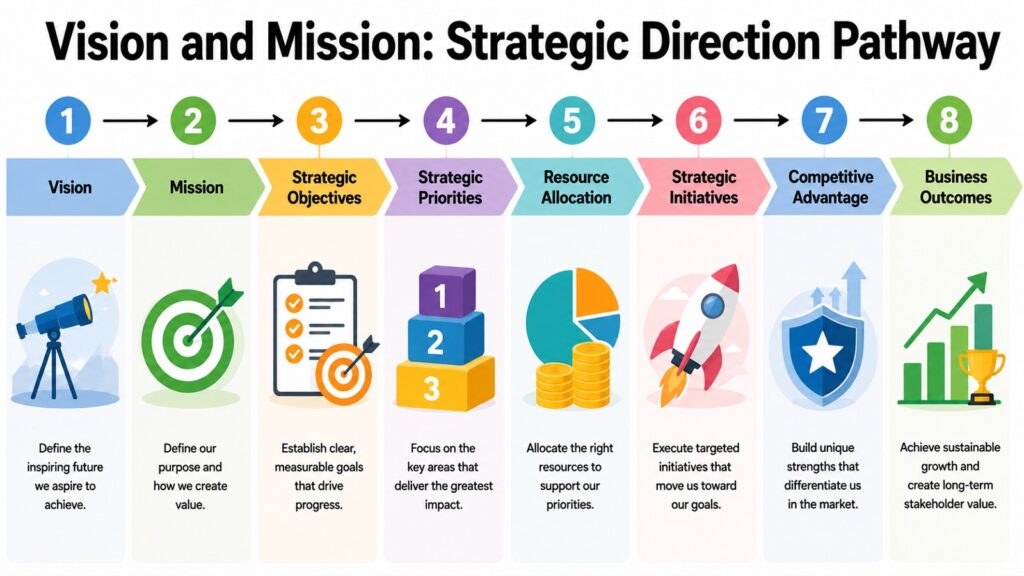
Strategic direction is about choosing which opportunities to pursue and which to decline, and Vision and Mission provide the criteria for making those choices. Without this filter, organizations risk chasing every available opportunity, which spreads resources too thin and weakens the core business that originally made the company successful. Executives who use Vision and Mission as a screening tool can evaluate new markets, partnerships, or product lines against a consistent standard rather than reacting purely to short-term market pressure.
Strategic management theory, particularly the resource-based view associated with researchers like Jay Barney, emphasizes that competitive advantage comes from focusing resources on capabilities that are valuable, rare, and difficult to imitate. Vision and Mission help organizations identify which capabilities matter most by clarifying what the company is actually trying to achieve. A clear mission prevents leadership from spreading investment across capabilities that do not support the long-term direction, even when those capabilities might look attractive in isolation. This becomes especially important during annual budget planning, when departments naturally compete for limited resources and a clear strategic direction gives leadership an objective basis for resolving those competing claims rather than defaulting to whichever department argues loudest.
Apple’s long-standing focus on design and user experience offers a strong example. Despite operating in industries as varied as phones, computers, and wearables, the company has consistently avoided becoming a low-cost commodity manufacturer, choosing instead to protect premium positioning that aligns with its stated focus on building the best products. This discipline meant turning down opportunities for short-term revenue, such as licensing its operating system widely to other hardware makers, because doing so would have diluted the tightly controlled experience central to its strategic identity.
Vision and Mission also help organizations stay focused during periods of uncertainty, such as economic downturns or rapid technological change. When the future is unclear, having a stable long-term direction allows leadership to make faster decisions because fewer variables need to be reconsidered from scratch. Companies without this anchor often experience decision paralysis during uncertain periods, since every choice requires debating fundamental questions about identity and direction that a clear Vision and Mission would have already settled. Netflix demonstrated this kind of stability when streaming technology disrupted its original DVD rental business, since its mission around entertainment convenience for customers remained constant even as the underlying delivery method changed entirely.
Strategic Decisions Shaped by Vision and Mission
| Organization | Strategic Decision |
| Apple | Avoided licensing to protect experience |
| Netflix | Shifted from rental to streaming |
| Amazon | Invested in delivery infrastructure |
| IBM | Exited computers for enterprise services |
| Starbucks | Closed stores nationwide for retraining |
| Adobe | Moved from sales to subscriptions |
| Lego | Refocused on core brick identity |
| Intel | Shifted from chips to processors |
5. Vision and Mission for Organizational Alignment
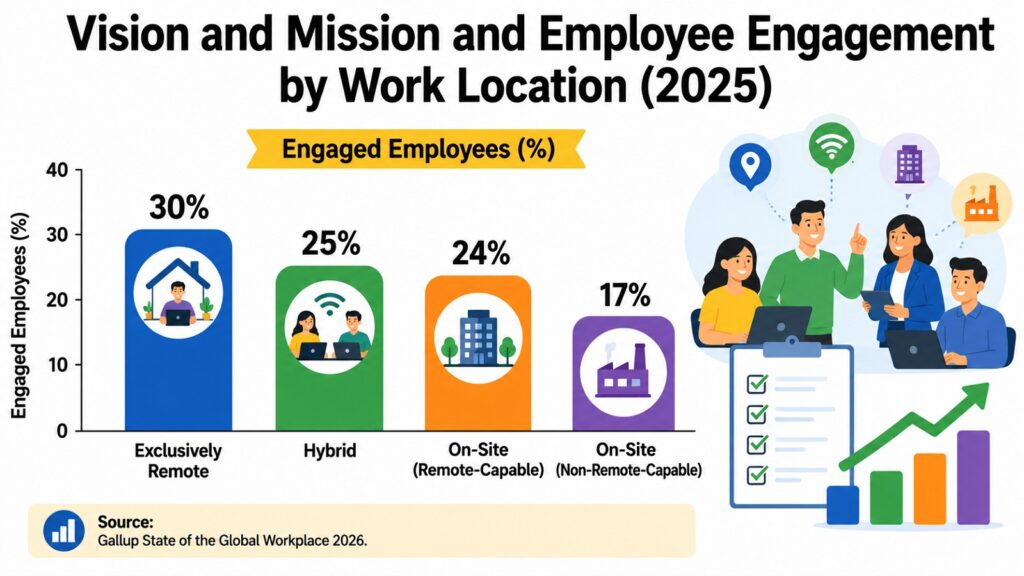
Alignment means that employees, departments, and processes are all working toward the same goals, rather than pulling in separate directions because of conflicting incentives or unclear priorities. Vision and Mission provide the shared reference point that makes this kind of alignment possible at scale. Without it, even talented teams can work hard while producing results that do not add up to coherent progress for the organization as a whole.
Organizational theory has long recognized that alignment problems often come from structural issues rather than individual performance. Different departments may be evaluated on metrics that conflict with each other, such as a sales team rewarded for volume while a finance team is evaluated on margin protection. A clear Vision and Mission does not eliminate this tension entirely, but it gives leadership a shared language for resolving it, since both departments can refer back to the same overarching direction when negotiating priorities.
Toyota’s well-documented production philosophy shows alignment in action. The company’s mission around continuous improvement and respect for people shaped not just manufacturing processes but also how suppliers, engineers, and frontline workers were expected to collaborate. Employees at every level were encouraged to flag problems immediately rather than waiting for management review, a practice that only works when the entire organization shares the same underlying mission about quality and improvement. This kind of alignment turned what could have been a simple manufacturing process into a globally studied management system known as the Toyota Production System.
Alignment also reduces friction during cross-departmental projects, since teams that share an understanding of the broader mission can make faster trade-off decisions without escalating every disagreement to senior leadership. This becomes especially important as companies grow, since informal alignment based on personal relationships among founders tends to break down once an organization expands beyond a few dozen employees, making a documented and well-communicated Vision and Mission increasingly necessary as the company scales.
Performance management systems also play a role in sustaining alignment over time. When individual goals and bonus structures are tied directly back to the company’s stated mission, employees receive a constant reminder of how their daily work connects to the larger direction. Without this connection, mission statements risk becoming background noise that employees can recite but cannot translate into their own job responsibilities.
Departmental Alignment Through Vision and Mission
| Department | Alignment Contribution |
| Sales | Pursues mission-aligned customers |
| Marketing | Communicates consistent brand purpose |
| Human Resources | Hires for culture fit |
| Finance | Funds mission-aligned priorities |
| Operations | Maintains values-driven quality |
| Product Development | Builds mission-supporting features |
| Customer Service | Reinforces brand promise |
| Legal and Compliance | Protects mission-aligned reputation |
6. Vision and Mission in Leadership and Organizational Culture
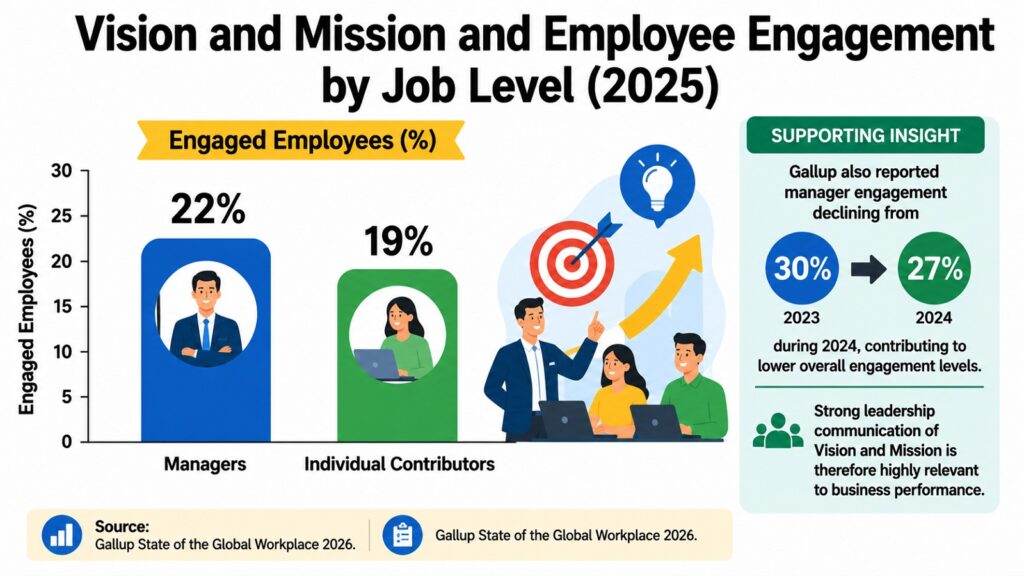
Leaders are the primary carriers of Vision and Mission inside any organization. A mission statement written by a founding team only stays relevant if current leadership continues to model it through visible decisions and everyday behavior. When leaders say one thing and do another, employees quickly notice the gap, and the Vision and Mission lose credibility faster than almost any other strategic asset.
Leadership theory has long emphasized the connection between leader behavior and organizational culture. Transformational leadership research, associated with scholars like Bernard Bass, suggests that leaders who clearly communicate a compelling vision can inspire performance beyond what transactional incentives alone would produce. Culture, in this sense, becomes the accumulated pattern of decisions leaders make when applying Vision and Mission to real situations, repeated often enough that it becomes the organization’s default way of operating.
Microsoft’s cultural transformation under Satya Nadella offers a clear example of leadership reshaping mission into culture. When Nadella became chief executive in 2014, he refocused the company’s mission around empowering every person and organization to achieve more, paired with a cultural shift toward a growth mindset that encouraged learning from failure rather than punishing it. This cultural shift was credited with revitalizing collaboration across previously siloed divisions and supporting Microsoft’s later success in cloud computing, since teams became more willing to experiment and share knowledge across departmental lines that had previously been closely guarded.
Culture also acts as a stabilizing force when individual leaders eventually leave the organization. A mission that has been deeply embedded into daily behavior through consistent leadership tends to survive leadership transitions better than one that exists mainly in a single founder’s personal vision. This is why succession planning at well-run organizations often includes deliberate efforts to ensure incoming leaders understand and can authentically communicate the existing mission.
Middle managers play an underappreciated role in this process as well, since most employees experience the mission through their direct supervisor’s daily decisions rather than through statements from senior executives. A mission that senior leadership communicates clearly can still fail to reach the front line if middle management does not reinforce it consistently.
Leadership Practices That Reinforce Vision and Mission
| Leadership Practice | How It Supports Mission |
| Visible Modeling | Leaders demonstrate values daily |
| Transparent Communication | Explains decisions using mission |
| Consistent Messaging | Keeps mission top of mind |
| Recognition Programs | Rewards mission-aligned actions |
| Open Feedback | Leaders listen to concerns |
| Succession Planning | Prepares leaders to preserve mission |
| Storytelling | Shares examples reinforcing purpose |
| Accountability | Addresses behavior contradicting values |
7. Vision and Mission for Effective Stakeholder Communication
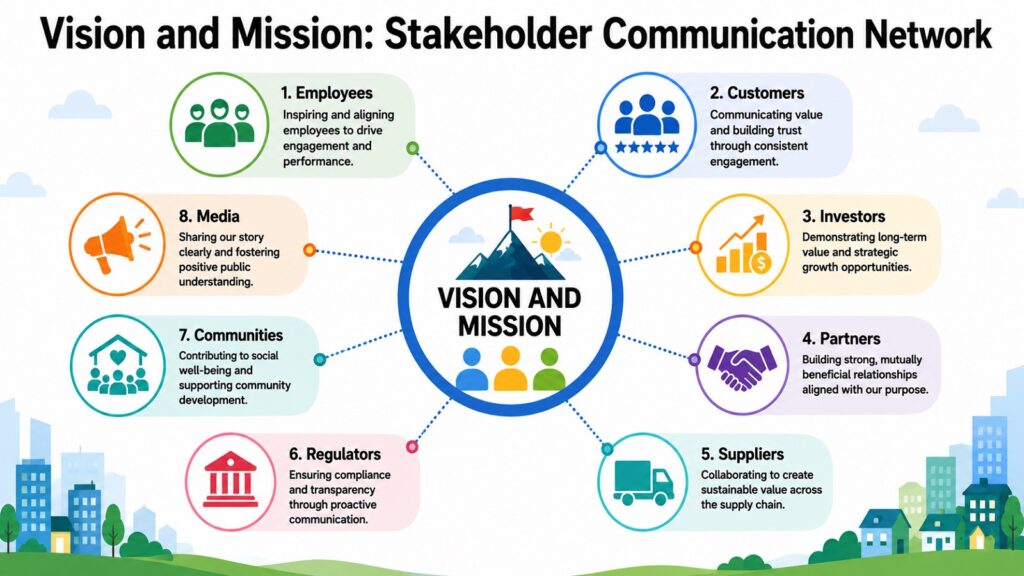
Every organization communicates with multiple audiences at once, including employees, customers, investors, suppliers, regulators, and the communities where it operates. Each of these groups asks a slightly different version of the same question, which is why this company matters to me. Vision and Mission give leaders a consistent answer that can be adapted in tone for different audiences without changing the underlying message.
Stakeholder theory, developed largely through the work of management scholar R. Edward Freeman, argues that businesses succeed over the long term by managing relationships with all of these groups, not just shareholders. A clearly communicated Vision and Mission supports this approach because it gives each stakeholder group a way to evaluate whether the organization is acting consistently with what it claims to value. Investors look for this consistency when assessing long-term risk, since companies that drift from their stated mission often face reputational problems that eventually affect financial performance as well.
Unilever’s Sustainable Living Plan, introduced in 2010, illustrates how Vision and Mission can structure stakeholder communication across very different audiences. The company used the same underlying commitment to sustainable growth when talking to investors about long-term value creation, to customers about product responsibility, and to regulators about environmental compliance. This consistency built credibility precisely because stakeholders could see the same mission applied across multiple contexts rather than hearing a different story depending on who was asking. The plan also gave Unilever a structured way to report progress publicly over time.
Transparency becomes especially important when an organization faces a crisis or makes a controversial decision. Companies with a well-established Vision and Mission have an easier time explaining difficult choices because stakeholders already understand the underlying priorities. This reduces the perception that a decision is purely self-serving, since it can be framed as consistent with values the company has communicated for years.
Communities surrounding company operations represent another stakeholder group that benefits from clear Vision and Mission communication. Local communities often judge a company by its actions on employment, environmental impact, and civic involvement, and a mission that explicitly addresses these areas gives community leaders a basis for holding the company accountable.
Stakeholder Communication Through Vision and Mission
| Stakeholder Group | Communication Influence |
| Employees | Mission clarifies daily purpose |
| Customers | Vision builds loyalty and trust |
| Investors | Mission signals long-term consistency |
| Suppliers | Shared values strengthen partnerships |
| Regulators | Mission demonstrates compliance commitment |
| Communities | Vision shows civic responsibility |
| Media | Mission shapes public narrative |
| Competitors | Mission clarifies market positioning |
8. Vision and Mission in Goal Setting and Execution
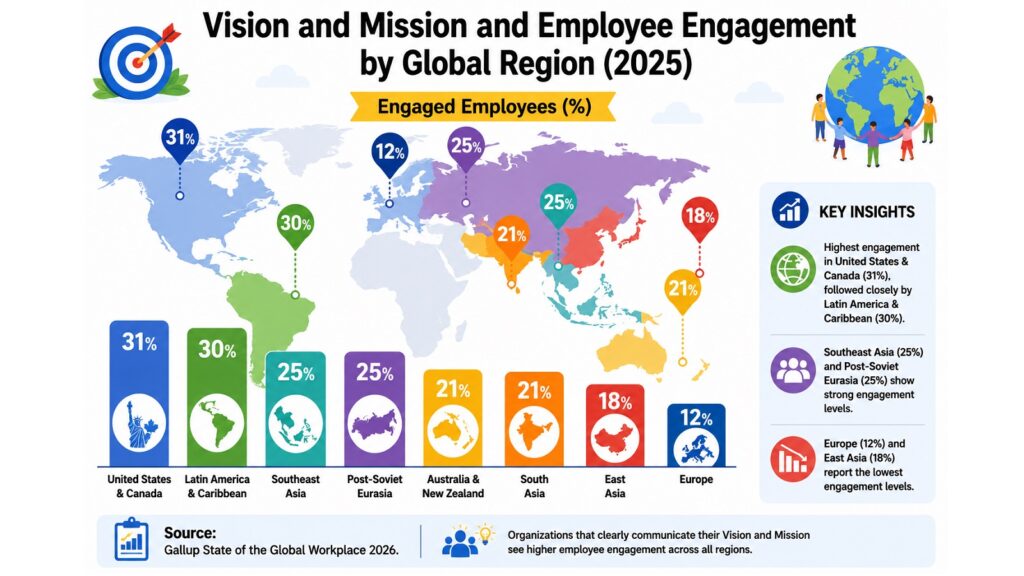
A Vision and Mission only creates real business value when it gets translated into objectives that people can actually act on. This translation process moves from broad, inspiring language down to specific targets, deadlines, and measurable outcomes. Without this step, even the most well-crafted mission statement remains an idea rather than a driver of business results, since employees need concrete direction to know what success looks like in their specific role.
Management frameworks such as Objectives and Key Results, popularized by companies including Google and Intel, provide a structured way to make this translation. Under this approach, broad mission-level priorities get broken into specific objectives, and each objective is paired with measurable key results that indicate whether progress is actually happening. This framework works because it forces abstract mission language into a format that can be tracked, reported, and adjusted quarter by quarter, which keeps the mission connected to daily operational reality rather than letting it drift into background noise.
Intel’s early adoption of Objectives and Key Results under former chief executive Andy Grove illustrates this connection well. Grove pushed the company to define clear, measurable objectives at every level of the organization, which helped Intel execute its strategic shift from memory chips to microprocessors during a period of intense competitive pressure from Japanese manufacturers in the 1980s. The mission of building the company’s future around processors only became actionable once it was broken into specific product development targets that engineering teams could plan around and measure progress against. Grove’s broader philosophy held that strategic intent without disciplined measurement was simply wishful thinking dressed up as planning.
Execution gaps often appear when organizations focus heavily on writing inspiring Vision and Mission statements but invest far less effort in building the systems needed to track whether those statements are being acted upon. Regular performance reviews, transparent reporting structures, and consistent accountability for missed targets all support execution. Without these systems, even a well-designed Vision and Mission statement risks becoming a document referenced occasionally in meetings but rarely shaping daily prioritization.
The connection between mission and execution also depends on realistic goal setting. Objectives that are too easy fail to test whether the organization is genuinely pursuing its stated mission, while objectives that are wildly unrealistic can demoralize teams and create incentives to manipulate reporting rather than improve actual performance.
Execution Practices Supporting Vision and Mission
| Execution Practice | How It Supports Vision and Mission |
| Objectives and Key Results | Breaks mission into targets |
| Performance Reviews | Tracks progress against goals |
| Quarterly Planning | Aligns execution with direction |
| Transparent Reporting | Builds team accountability |
| Resource Allocation | Funds mission priorities |
| Cross-Functional Reviews | Identifies execution gaps early |
| Customer Feedback Loops | Validates mission relevance |
| Milestone Tracking | Confirms intent becomes action |
Conclusion: Building Business Strategy Through Vision and Mission
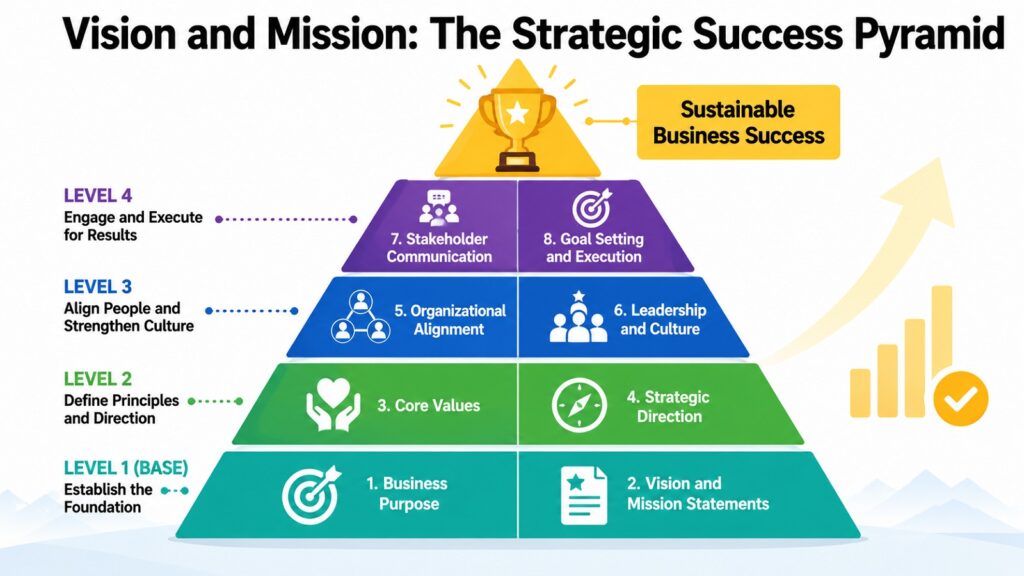
Vision and Mission work best when understood as a connected system rather than eight separate ideas competing for attention. Purpose gives an organization its reason for existing, and well-crafted statements turn that purpose into language that can guide decisions. Core values translate that language into daily behavior, while strategic direction uses it to decide which opportunities deserve resources and which do not. Alignment keeps departments moving together, leadership keeps the mission alive through visible action, stakeholder communication extends that consistency outward, and execution finally converts all of it into measurable results.
The strongest lesson across these eight pillars is that Vision and Mission only create value when they shape real decisions rather than sit quietly in a strategy document gathering dust. A company can write an inspiring mission statement in an afternoon, but building the systems, culture, and leadership behavior needed to make that statement function strategically takes years of consistent effort. The organizations referenced throughout this article, from Patagonia to Microsoft to Intel, succeeded not because their statements were unusually clever but because they backed those statements with structural commitments that were difficult to reverse.
Looking forward, organizations face an environment of faster technological change and shifting stakeholder expectations, which makes strategic clarity more valuable rather than less. Vision and Mission give leaders a stable reference point precisely when external conditions feel unstable. Companies that revisit and reinforce their Vision and Mission regularly, rather than treating them as a one-time exercise from the founding years, position themselves to adapt their tactics while preserving the underlying direction that stakeholders have come to trust. This is ultimately what separates a Vision and Mission that merely sounds good from one that genuinely drives sustainable growth, and it is why business strategy at its core remains a discipline of staying clear about purpose while staying flexible about method.
Strategic Takeaways from the Vision and Mission Pillars
| Pillars of Vision and Mission | Strategic Takeaway |
| Business Purpose | Anchors strategy beyond profit |
| Statements | Provide clear strategic direction |
| Core Values | Translate mission into behavior |
| Strategic Direction | Filters worthwhile opportunities |
| Alignment | Unites departments around goals |
| Leadership and Culture | Sustains mission through action |
| Stakeholder Communication | Builds long-term credibility |
| Execution | Converts mission into growth |