Table of Contents
Introduction: Platform Integration as the Foundation of the Digital Ecosystem
A mid-size insurance company once needed eleven business days just to issue a single corporate policy. The sales team worked in one system, underwriting worked in another, and finance tracked payments in a third tool nobody else could see. Customers waited, employees grew frustrated, and faster competitors took the business. This story repeats across industries, which is why organizations now treat connectivity as a survival skill rather than a technical luxury.
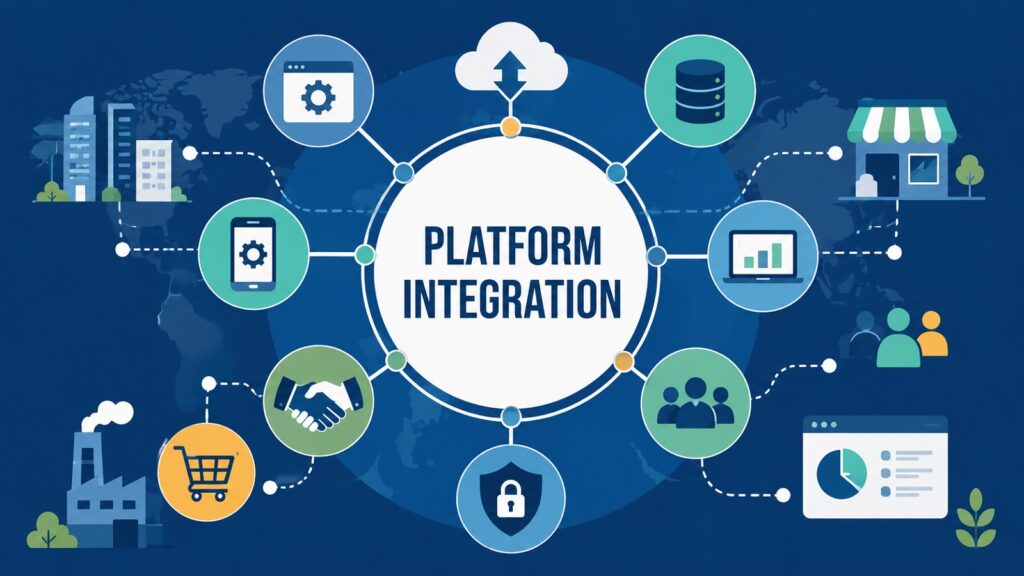
Platform Integration is the strategic response to this fragmentation. It connects technologies, data, applications, business processes, partners, and customers into one operating environment instead of leaving them scattered across disconnected tools. When systems share information freely, work moves faster, decisions improve, and customers feel the difference in every interaction. Platform Integration is an important component of the Digital Ecosystem because it allows every element of that ecosystem to communicate, collaborate, and create business value as an interconnected whole rather than as isolated systems.
A decade ago, integration sat firmly inside the IT department, viewed as plumbing that engineers handled quietly in the background. That view has changed. McKinsey research shows organizations with strong integration capabilities achieve far higher returns on technology investment than peers with weak integration. Executives increasingly see Platform Integration as a long-term capability supporting agility, innovation, and resilience, not a one-time project with a fixed end date.
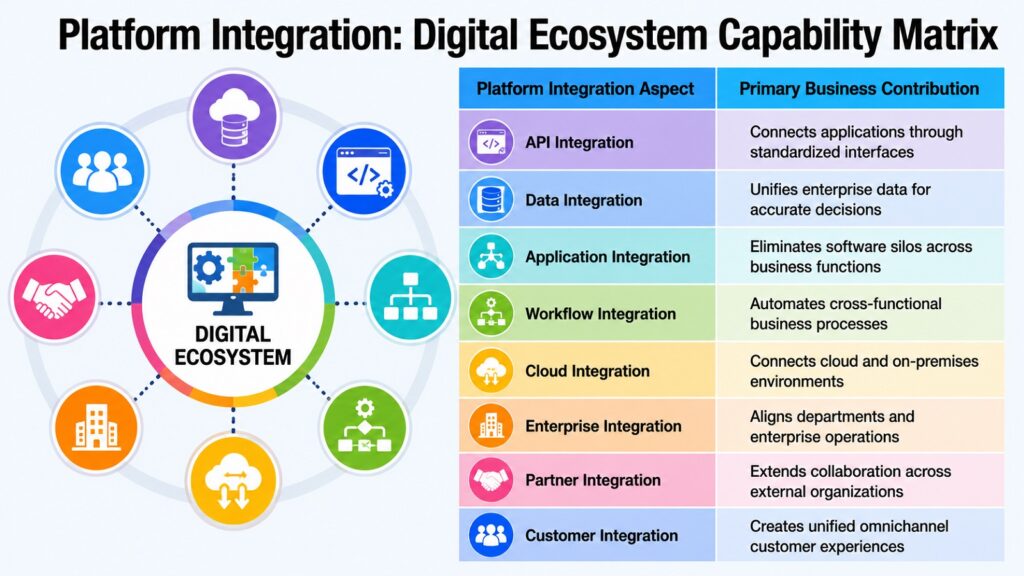
This article examines eight ways organizations build effective Platform Integration: through APIs, data, applications, workflows, cloud environments, enterprise-wide systems, external partners, and customers themselves. Each pillar strengthens a different part of the Digital Ecosystem, and together they form the connective tissue that lets a business operate as one coordinated whole.
Platform Integration: Eight Pillars at a Glance
| Platform Integration Pillar | Contribution to Successful Platform Integration |
| API Integration | Enables secure, standardized communication between applications |
| Data Integration | Unifies fragmented information into one reliable source of truth |
| Application Integration | Connects enterprise software for coordinated business operations |
| Workflow Integration | Automates cross-department processes to reduce delay and error |
| Cloud Integration | Links cloud, SaaS, and on-premises systems into one environment |
| Enterprise Integration | Aligns technology with organization-wide governance and strategy |
| Partner Integration | Extends connectivity beyond company walls to suppliers and allies |
| Customer Integration | Unifies every customer touchpoint into one consistent experience |
1. Platform Integration Through API Integration
Picture a retail company running separate systems for inventory, payments, and loyalty. None of them talks to each other automatically. Staff re-enter data by hand, mistakes pile up, and customers notice when loyalty points do not match purchase history. This disconnection is exactly the problem APIs were built to solve.
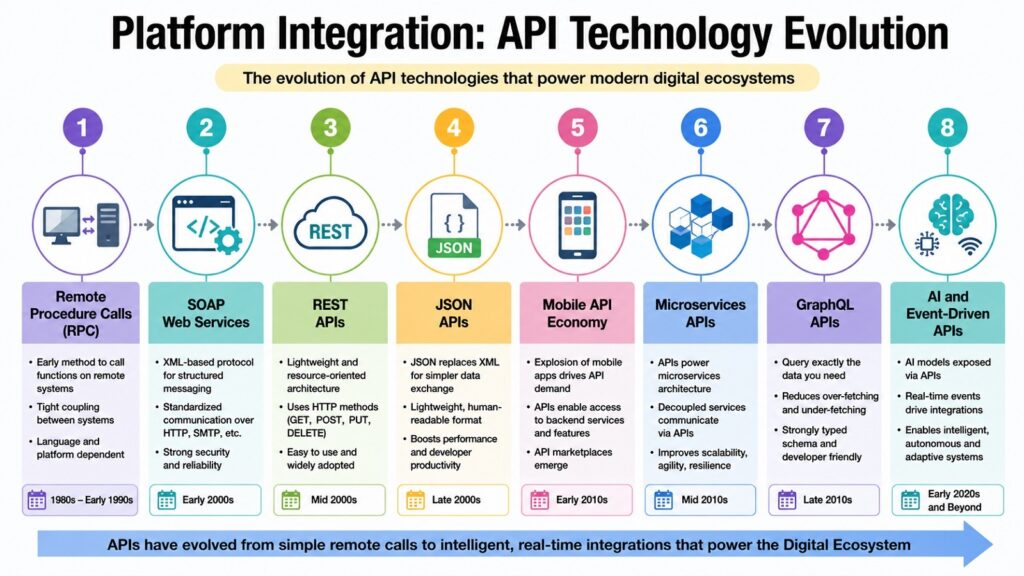
An API acts like a translator between two pieces of software, letting them exchange information securely and consistently. Gartner has noted that the large majority of new enterprise applications now treat APIs as a core architectural component rather than an optional add-on. This shift matters because APIs do more than move data from one place to another. They let businesses build new digital products faster, connect with outside partners more easily, and avoid the cost of building every capability from scratch. The World Economic Forum has estimated that API-driven digital platforms contributed more than twelve trillion dollars in global economic value in a single recent year, a figure that shows how central APIs have become to commerce itself.
AT&T offers a useful real-world example. The telecommunications company needed its service teams to access customer information scattered across more than fifty legacy systems. Using an API-led approach, AT&T built connective layers linking these older systems to a unified Salesforce platform, so representatives no longer had to log into dozens of separate tools to answer a single customer question. The company also cut the time needed to launch new products from about a year down to roughly six weeks, largely because reusable APIs meant new offerings did not require starting from zero.
APIs are not without challenges. Security has become a pressing concern, since exposing more systems through APIs also creates more potential entry points for attackers. Industry research has linked a sizable share of breaches to weaknesses in access permissions, and governance teams must monitor API usage as carefully as any other piece of critical infrastructure.
API Integration forms the technical foundation upon which the rest of Platform Integration is built. Without dependable APIs, data cannot move cleanly between systems, applications cannot cooperate, and partners cannot plug into a business efficiently. The next section turns to a closely related pillar: order in the data flowing across these connections.
Platform Integration Through API Integration: Core Concepts
| Platform Integration Concept | Brief Explanation |
| API Gateway | Central point that manages traffic, security, and routing for APIs |
| API-First Design | Building products around reusable APIs from the earliest planning stage |
| Authentication and Authorization | Verifying identity and permissions before granting API access |
| Rate Limiting | Controlling how often an API can be called to prevent overload |
| Reusable Connectors | Pre-built API components that speed up future integration work |
| API Versioning | Managing changes to APIs without breaking existing connections |
| API Monitoring | Tracking performance and usage to catch problems early |
| API Monetization | Generating direct revenue by offering APIs to outside partners |
2. Platform Integration Through Data Integration
A logistics manager once explained that her biggest obstacle was not a lack of data but too much of it scattered everywhere. Shipment records lived in one system, customer details in another, and financial figures somewhere else entirely. By the time she pulled together a single report, the numbers were already outdated, which is the gap Data Integration closes.
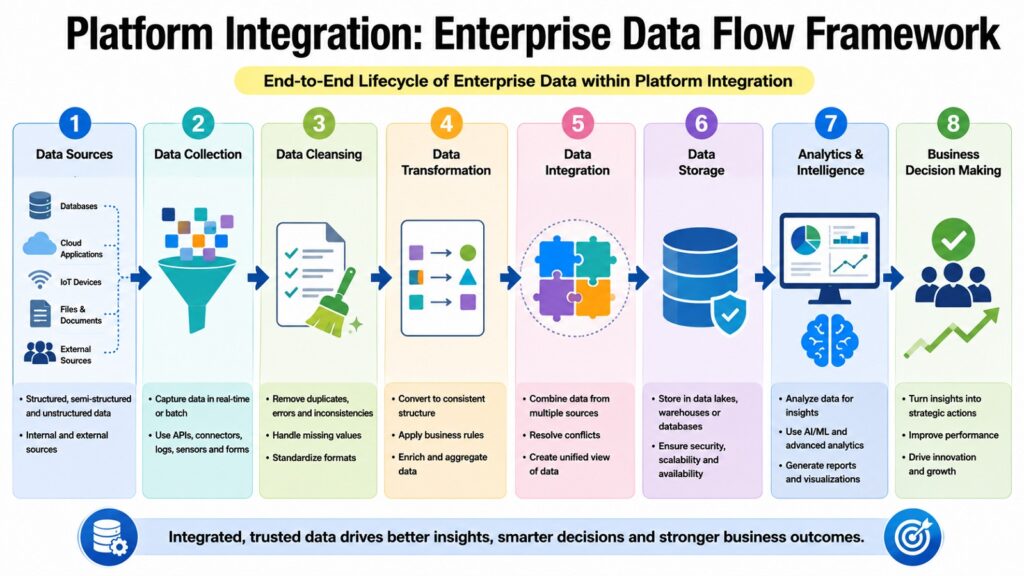
Data Integration brings information from multiple platforms into one consistent, trustworthy view. Without it, even advanced analytics tools or artificial intelligence systems struggle to deliver value, since they are only as good as the data feeding them. Industry surveys have found that a large share of IT leaders consider integration hurdles a major obstacle to scaling artificial intelligence inside their organizations, with the average enterprise now juggling several hundred separate applications. Data governance, synchronization, and quality control are no longer back-office tasks; they are prerequisites for digital maturity.
A useful illustration comes from healthcare. Hospitals using MuleSoft’s integration platform have connected dozens of separate systems, including electronic health records, lab results, and billing platforms, into a single patient view inside their customer relationship management software. This consolidated picture has been linked to a meaningful drop in patient readmission rates, since care teams can finally see a complete record rather than fragments scattered across departments.
Implementing Data Integration is rarely simple. Data silos form naturally as departments adopt their own tools over time, and merging those sources requires careful attention to formatting and conflicting definitions of the same term. Governance failures remain common, and organizations that skip this groundwork often find their projects stall or disappoint.
High-quality Platform Integration depends directly on high-quality Data Integration. APIs may move information between systems, but if the underlying data is inconsistent or incomplete, every downstream process inherits that weakness. Organizations that prioritize clean, well-governed data position themselves to extract real value from analytics and automation.
Platform Integration Through Data Integration: Core Concepts
| Platform Integration Concept | Brief Explanation |
| Single Source of Truth | One trusted, unified version of business-critical information |
| Data Governance | Policies that define ownership, quality, and access to data |
| ETL Processes | Extracting, transforming, and loading data between systems |
| Master Data Management | Maintaining consistent core records across all platforms |
| Real-Time Synchronization | Keeping data current across systems without manual updates |
| Data Quality Monitoring | Checking for accuracy, duplicates, and completeness continuously |
| Data Privacy Compliance | Meeting legal requirements for handling personal information |
| Data Accessibility | Making trusted data available to the teams who need it |
3. Platform Integration Through Application Integration
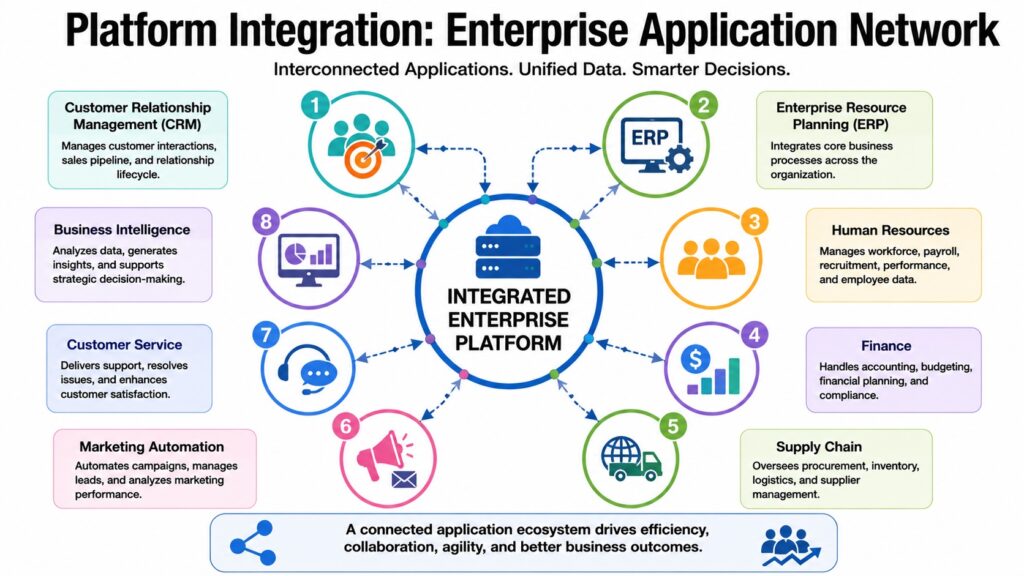
Many organizations run separate applications for finance, human resources, supply chain, and customer service, each chosen at a different point in the company’s history. These tools were rarely designed with each other in mind, and duplicated effort often results, where the same customer record gets entered three times in three different systems. Application Integration closes this gap, letting enterprise software work as one coordinated environment.
The theory behind Application Integration rests on interoperability, the idea that systems built by different vendors at different times can still exchange information reliably. In practice, this plays out across nearly every business function. A sales order placed in a customer relationship management tool can automatically trigger inventory checks, billing entries, and shipping requests without anyone retyping the same details across separate screens. This coordination saves time, but more importantly, it reduces the errors that creep in whenever humans manually transfer information between systems.
A telling example comes from Cox Automotive, which had grown through more than twenty acquisitions, each bringing its own technology stack. Rather than ripping out every legacy system, the company used API-led integration to connect these varied platforms, allowing it to bring new products to market faster despite the underlying complexity. This shows that Application Integration does not always mean replacing old software; often it means building connective layers that let old and new systems cooperate productively.
Application Integration carries real implementation challenges. Architectural decisions made early in a project can be difficult to reverse later, and organizations must weigh trade-offs between point-to-point connections, which are quick to build but hard to maintain, and more structured approaches that scale better. Governance matters here too, since poorly managed integrations can create new dependencies just as brittle as the silos they replaced.
Despite these challenges, Application Integration remains a foundational capability within any mature Digital Ecosystem. It is the layer that turns a collection of separately purchased software tools into something resembling a single coordinated system, so new applications can be added with far less friction going forward.
Platform Integration Through Application Integration: Core Concepts
| Platform Integration Concept | Brief Explanation |
| Point-to-Point Integration | Direct connections between two specific applications |
| Middleware | Software layer that connects and manages multiple applications |
| Enterprise Service Bus | Centralized communication layer for distributed applications |
| Microservices Architecture | Breaking applications into small, independently connected services |
| Legacy System Wrapping | Adding modern connectivity to older systems without full replacement |
| System of Record | The authoritative application for a specific category of data |
| Cross-Functional Workflows | Processes that span multiple connected business applications |
| Application Lifecycle Management | Overseeing integration needs as software is updated or retired |
4. Platform Integration Through Workflow Integration
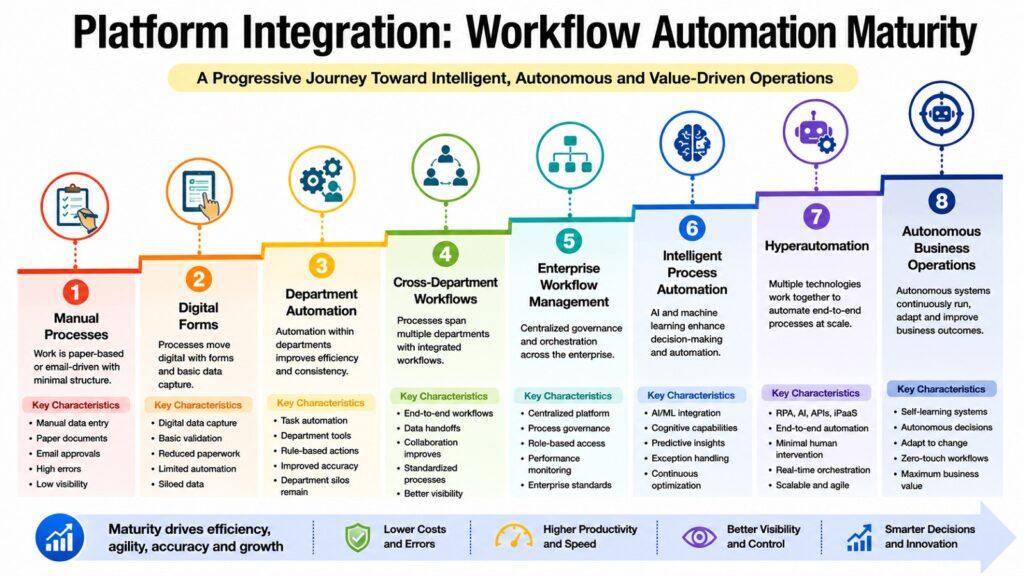
Consider an employee onboarding process that requires approvals from human resources, IT, facilities, and a department manager, each working from separate checklists and email threads. A single missing signature can delay a new hire’s laptop, building access, or payroll setup for days. Disconnected workflows like this quietly drain time, increase errors, and frustrate both employees and customers waiting on the other side of the process.
Workflow Integration connects the individual steps of a business process so work moves automatically from one stage to the next, regardless of which department or platform is involved. Rather than relying on someone to manually notice that a task is finished and pass it along, the system itself triggers the next action. Forrester Research has found that organizations adopting workflow automation see average productivity gains in the range of twenty to thirty percent, largely because work no longer waits in someone’s inbox for attention. McKinsey survey data shows that roughly two-thirds of organizations that implemented automation reported improvements in quality control, customer satisfaction, and employee experience at the same time.
A strong example comes from finance and accounting departments, where Forrester has documented an average three-year return on investment exceeding two hundred percent for automated workflows handling tasks like invoice processing and approval routing. The initial challenge in these departments is almost always the same: approvals stuck in email and finance teams spending hours on manual entry instead of analysis. By connecting the relevant systems and automating handoffs, finance teams free up time for higher-value work, while error rates drop.
Workflow Integration is not free of risk. Poorly mapped processes can automate the wrong steps just as easily as the right ones, and change management matters enormously, since employees accustomed to manual control sometimes resist new systems. Forrester has noted that a meaningful share of automation projects fail because organizations lack a clear strategy before they begin.
Workflow Integration is what transforms Platform Integration from simple system connectivity into measurable business value. When workflows move smoothly across departments and platforms, the broader Digital Ecosystem starts to feel less like a collection of tools and more like a single, coordinated organization.
Platform Integration Through Workflow Integration: Core Concepts
| Platform Integration Concept | Brief Explanation |
| Process Orchestration | Coordinating multiple automated steps into one smooth sequence |
| Approval Routing | Automatically directing tasks to the correct approver |
| Trigger-Based Automation | Actions that start automatically when a condition is met |
| Low-Code Workflow Tools | Platforms that let non-technical staff build automated processes |
| Exception Handling | Defined steps for managing unusual or incomplete cases |
| Audit Trail | Recorded history of every step a workflow has completed |
| Cross-Department Handoffs | Smooth transitions of work between different business teams |
| Continuous Process Improvement | Ongoing refinement of workflows based on performance data |
5. Platform Integration Through Cloud Integration
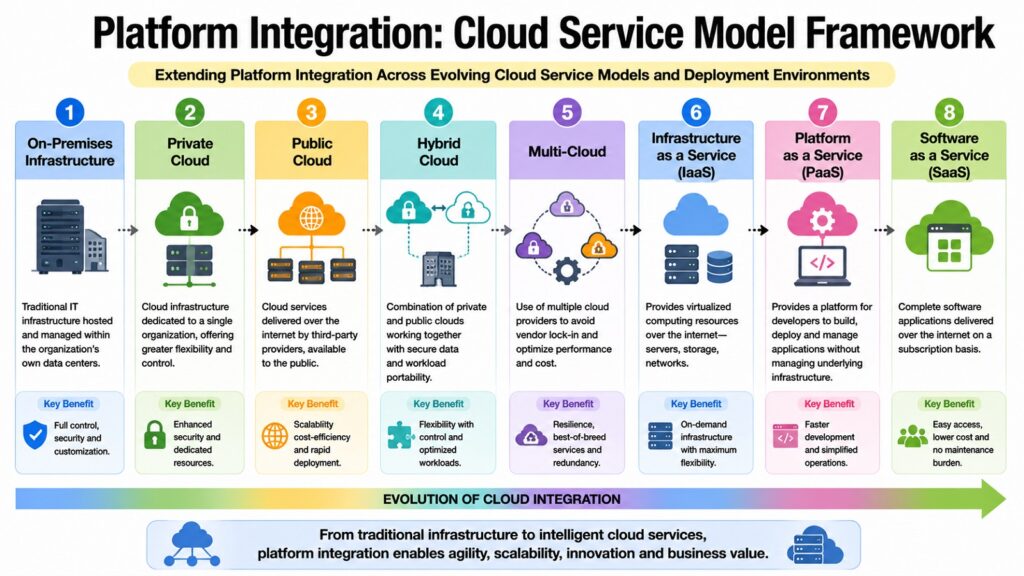
The shift toward cloud computing has been one of the defining technology changes of the past decade. Yet rapid cloud adoption has created a new kind of fragmentation. A company might run its customer database on one cloud provider, its email and collaboration tools on another, and still keep certain sensitive systems on its own physical servers. When these environments do not communicate well, employees end up juggling logins and exporting files manually just to get one coherent picture of the business.
Cloud Integration solves this by building reliable connections between cloud platforms, software-as-a-service applications, and any remaining on-premises systems. Flexera’s State of the Cloud research has found that the large majority of enterprises now use multiple public cloud providers at once, and a substantial share say their existing setup needs modernization to properly support integration. Cloud connectivity has become an essential requirement for building a Digital Ecosystem that can scale, adapt, and survive disruption rather than simply supporting day-to-day computing needs.
A good illustration comes from the broader retail sector, where companies managing inventory and customer data across multiple cloud environments have been able to give store associates and online shoppers consistent product information in real time. When a cloud integration strategy connects point-of-sale systems, e-commerce platforms, and warehouse management tools, a customer checking stock online sees the same numbers an associate sees on the shop floor. Gartner has projected that integration platform as a service offerings, often called iPaaS, would grow from roughly nine billion dollars in revenue to well over seventeen billion dollars within a few years.
Cloud Integration brings its own complications. Vendor lock-in is a genuine concern, since deep dependence on one provider’s tools can make switching expensive later. Security and compliance also grow more complicated as data moves across multiple providers. Hybrid cloud management, where some systems remain on company-owned servers while others move to the cloud, requires careful governance to avoid creating another set of disconnected silos under a new name.
Successful Platform Integration increasingly depends on effective Cloud Integration as organizations continue to modernize. Few businesses today operate entirely on-premises or entirely in a single cloud, which means connecting smoothly across these environments has become a basic requirement rather than an advanced capability.
Platform Integration Through Cloud Integration: Core Concepts
| Platform Integration Concept | Brief Explanation |
| Multi-Cloud Strategy | Using more than one cloud provider for different needs |
| Hybrid Cloud | Combining on-premises infrastructure with cloud environments |
| iPaaS | Integration Platform as a Service connecting cloud applications |
| Cloud-Native Architecture | Building applications specifically designed for cloud environments |
| Containerization | Packaging applications for consistent performance across clouds |
| Cloud Security Posture | Ongoing management of security settings across cloud platforms |
| Vendor Interoperability | Ability of different cloud providers’ tools to work together |
| Disaster Recovery in the Cloud | Backup and recovery strategies spanning cloud environments |
6. Platform Integration Through Enterprise Integration
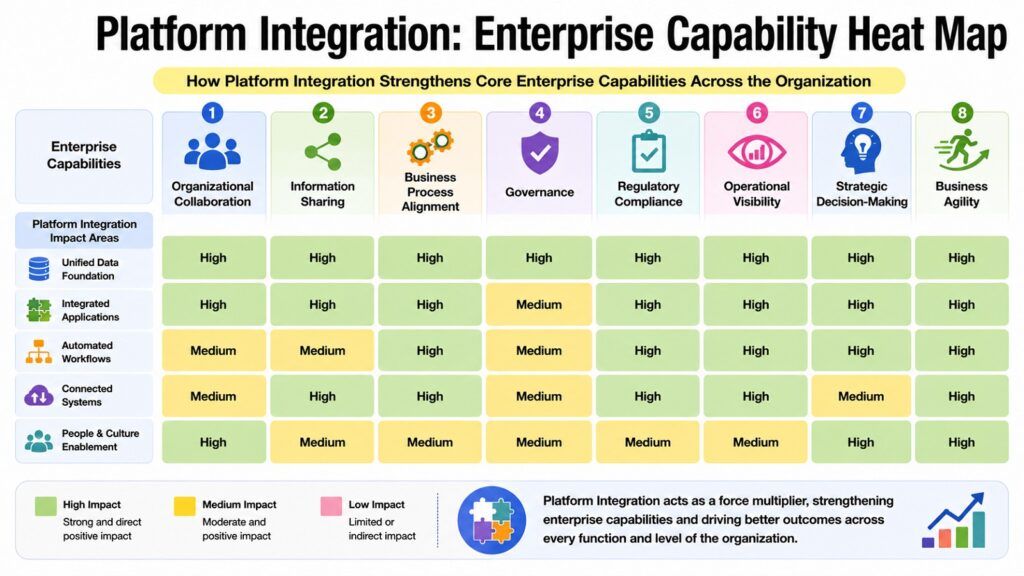
Large organizations often discover that their biggest obstacle is not any single broken system but the simple fact that different regions and business units have each built their own way of doing things. A finance team in one country might use entirely different reporting standards than the same company’s team three time zones away. Without a unifying layer, even straightforward questions, like total revenue across all markets, can take weeks to answer accurately.
Enterprise Integration addresses this by creating one connected environment across the entire organization, where information, processes, governance, and decision-making operate from shared standards rather than regional improvisation. This pillar sits at one of the highest levels of Platform Integration because it requires more than connecting software; it requires aligning people, policy, and technology around common goals across an entire company, sometimes spanning dozens of countries and business lines.
McKinsey’s research on ecosystem strategy offers a relevant data point here: organizations that successfully modernize their technology foundations consistently outperform competitors on speed, agility, and operational efficiency. This advantage compounds at an enterprise scale, where a single architectural decision can affect thousands of employees. One McKinsey study of incumbent companies pursuing ecosystem strategies found that many obstacles to success were organizational rather than technical, including siloed data, mismatched incentives, and leadership that failed to model the behavior change true enterprise-wide integration requires.
A useful real-world pattern appears among large industrial and financial firms that have centralized previously fragmented integration efforts onto a single platform, letting them expand into new markets without rebuilding connectivity from scratch each time. Cencora, a major healthcare distribution company, centralized its electronic data interchange services onto one platform specifically to give itself room for continued growth.
Enterprise Integration carries substantial organizational complexity. Governance frameworks must satisfy regulatory requirements that vary by region, change management must account for cultural differences across business units, and long-term planning becomes essential since enterprise-wide systems are difficult to unwind once implemented.
Enterprise Integration is ultimately what allows a large organization to function as one connected enterprise rather than a loose federation of independent departments.
Platform Integration Through Enterprise Integration: Core Concepts
| Platform Integration Concept | Brief Explanation |
| Enterprise Architecture | Overall blueprint connecting technology to business strategy |
| Centralized Governance | Unified rules and standards applied across business units |
| Cross-Regional Standardization | Common processes and definitions across global operations |
| Change Management | Structured approach to organizational adoption of new systems |
| Shared Services Model | Centralized support functions serving the whole enterprise |
| Master Data Consistency | One agreed definition of key business terms enterprise-wide |
| Scalable Integration Platform | Infrastructure capable of supporting enterprise-wide growth |
| Executive Sponsorship | Leadership backing required for enterprise-scale initiatives |
7. Platform Integration Through Partner Integration
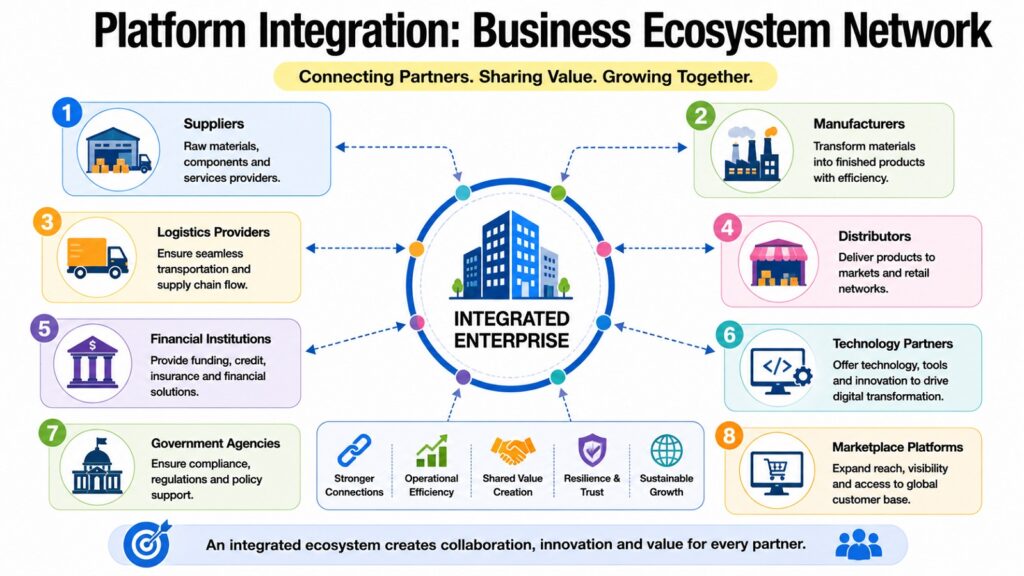
Few businesses today operate entirely on their own. A typical company depends on suppliers for materials, distributors for reach, logistics providers for delivery, financial institutions for payments, and technology vendors for the tools that run daily operations. When these external relationships are managed through phone calls, spreadsheets, and manual paperwork, the entire chain moves slowly, and small disruptions ripple outward in ways that are hard to detect until customers start noticing late deliveries.
Partner Integration extends Platform Integration beyond a single organization’s walls, connecting external suppliers, distributors, and other collaborators into a shared digital environment. This pillar turns isolated companies into genuine business ecosystems, where information about orders, inventory, and shipments flows automatically between trading partners instead of waiting for someone to send an email or place a phone call. The result is faster transactions, fewer errors, and far greater visibility into what is happening across a supply chain at any given moment.
Grillo’s Pickles offers a striking example of this pillar in action. By automating both its buying and selling operations through an integrated B2B platform, the company eliminated roughly sixty hours of manual work every week, freeing staff to focus on growth rather than paperwork, and the business reportedly grew fourfold during the period it relied on this connected approach. A different example comes from global trading company Li & Fung, which worked with IBM to ensure its supply chain systems could handle extreme transaction spikes during major shopping events, ultimately scaling to process roughly one million transactions per hour.
Partner Integration depends heavily on standardized communication. Electronic data interchange, often called EDI, has served this purpose for decades by giving trading partners a common format for purchase orders, invoices, and shipping notices, and it remains essential for high-volume transactions even as newer API-based methods emerge alongside it.
This pillar comes with genuine challenges around trust, security, and compliance. Sharing data with outside organizations always introduces some risk, and onboarding new partners can be slow if every connection must be custom-built rather than following a repeatable pattern.
Platform Integration reaches its full strategic potential only when organizations successfully integrate with their broader business ecosystem. A company can perfect every internal system and still fall short if its connections to outside partners remain slow and manual.
Platform Integration Through Partner Integration: Core Concepts
| Platform Integration Concept | Brief Explanation |
| Electronic Data Interchange | Standardized format for exchanging business documents |
| Self-Service Partner Onboarding | Letting partners connect to systems with minimal manual setup |
| Supply Chain Visibility | Real-time tracking of orders and inventory across partners |
| B2B Integration Platform | Centralized hub connecting a company to its trading partners |
| Trading Partner Network | The collective group of suppliers and distributors a company connects with |
| Compliance Standardization | Meeting shared data and process requirements across partners |
| Collaborative Forecasting | Sharing demand data with partners to improve planning accuracy |
| API and EDI Convergence | Combining modern APIs with traditional EDI for flexibility |
8. Platform Integration Through Customer Integration
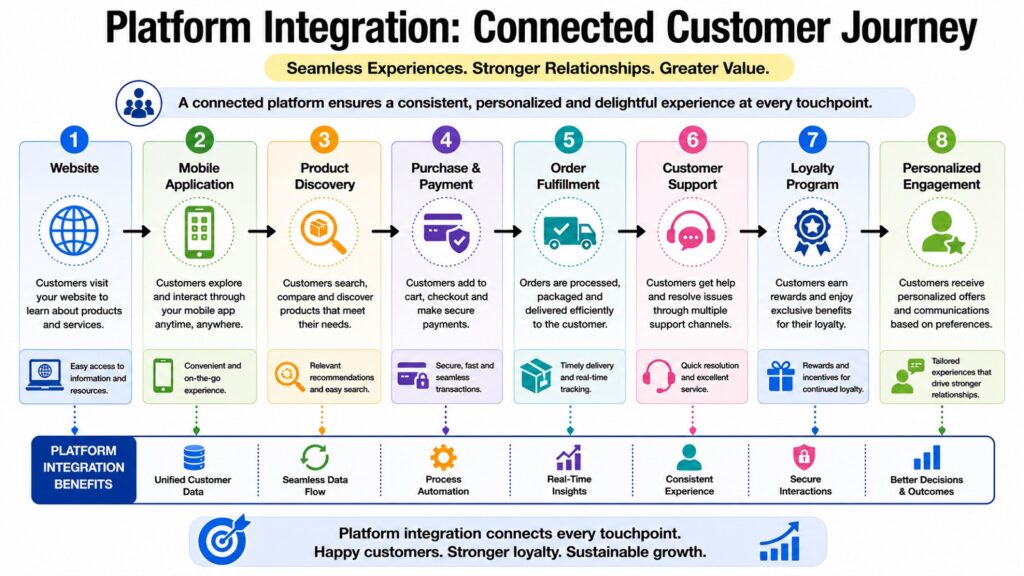
A customer browses a product on their phone during lunch, researches reviews on a laptop that evening, and walks into a physical store the next day expecting staff to already understand their interest. When the website, app, loyalty program, and in-store systems do not share information, this customer has to repeat themselves at every step, and that friction quietly erodes loyalty.
Customer Integration connects websites, mobile applications, customer relationship management (CRM) platforms, support systems, payment tools, and loyalty programs into one unified experience. This pillar matters because customers do not experience a company’s internal architecture directly. They experience whatever that architecture produces, and a disjointed back end almost always shows up as a frustrating front-end experience. Customer Integration represents one of the most visible outcomes of successful Platform Integration, since this is the pillar where customers feel an organization’s digital maturity.
Retail research consistently shows the size of the opportunity here. Studies covering tens of thousands of shoppers have found that a large majority engage with multiple channels before completing a purchase, often using around six different touchpoints along the way. Companies that successfully unify these touchpoints have reported notably faster revenue growth compared to competitors still operating with disconnected channels, along with measurably stronger customer retention. Organizations using integrated omnichannel platforms have reported meaningfully lower wait times and faster first-contact resolution compared to those still running support through siloed tools.
A useful case comes from the insurance sector, where research from Capgemini has shown that connecting previously siloed systems into a centralized customer data hub cut average call handling times roughly in half. Agents no longer needed to ask customers to repeat account details already stored elsewhere in the company.
This pillar requires careful attention to privacy and trust. Unifying customer data across so many touchpoints raises legitimate concerns about how that information is stored and who can access it. Organizations that handle this well treat transparency as a feature rather than a legal obligation.
Customer Integration transforms Platform Integration from an internal operational capability into a strategic competitive advantage. It is the pillar most directly connected to customer satisfaction and sustainable business growth, since it determines whether years of behind-the-scenes integration work translate into an experience customers actually notice.
Platform Integration Through Customer Integration: Core Concepts
| Platform Integration Concept | Brief Explanation |
| Omnichannel Consistency | Uniform experience and data across every customer touchpoint |
| Unified Customer Profile | Single combined record of a customer’s history and preferences |
| Customer Data Platform | Technology that consolidates customer data from multiple sources |
| Personalization Engine | Tools that tailor experiences based on unified customer data |
| Loyalty Program Integration | Connecting rewards across online, mobile, and in-store channels |
| First-Contact Resolution | Solving customer issues without requiring repeated handoffs |
| Privacy-by-Design | Building data protection into customer integration from the start |
| Customer Lifetime Value Tracking | Measuring long-term value enabled by unified customer insight |
Conclusion: Platform Integration as the Engine of Digital Growth
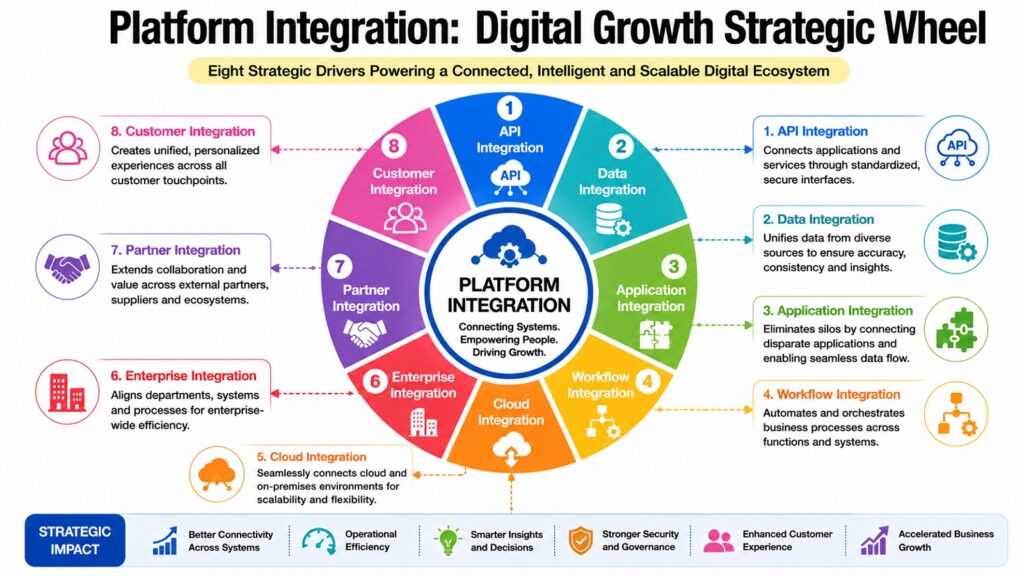
Platform Integration has moved well beyond its origins as a narrow technical task handled quietly inside the IT department. Across the eight pillars examined here, a consistent pattern emerges. API Integration provides the technical connective tissue. Data Integration ensures that tissue carries trustworthy information. Application Integration coordinates enterprise software so that work does not need to be repeated across separate tools. Workflow Integration turns those connections into automated, end-to-end processes. Cloud Integration extends connectivity across increasingly distributed computing environments. Enterprise Integration aligns this structure with organization-wide governance and strategy. Partner Integration carries connectivity beyond company walls into the broader business ecosystem. Customer Integration delivers the visible result that customers actually experience.
Together, these pillars improve operational efficiency, organizational agility, innovation, resilience, and long-term competitiveness. None succeeds in isolation. A business with excellent APIs but poor data governance will struggle just as much as one with a strong cloud strategy but no plan for connecting external partners.
Looking ahead, Platform Integration will keep evolving alongside artificial intelligence, intelligent automation, and increasingly sophisticated cloud infrastructure. Gartner has projected substantial growth in the share of enterprise applications integrated with task-specific AI agents over just the next few years, which suggests the connective work described throughout this article will only grow more important, not less, as these technologies mature. Organizations that treat Platform Integration as a long-term strategic investment, rather than a finished project to check off a list, will be better positioned to adapt as new tools and customer expectations continue to emerge.
Readers interested in any single pillar covered here, from APIs to customer experience, can explore the dedicated articles on each topic for deeper implementation guidance, research-based insight, and detailed business case studies that go further into the strategies briefly introduced in this overview.
Platform Integration: Key Takeaways by Pillar
| Platform Integration Pillar | Key Takeaway |
| API Integration | Builds the secure technical foundation for all other connectivity |
| Data Integration | Ensures every connected system shares trustworthy information |
| Application Integration | Coordinates enterprise software to eliminate duplicated work |
| Workflow Integration | Converts connections into automated, measurable business value |
| Cloud Integration | Extends connectivity across distributed computing environments |
| Enterprise Integration | Aligns technology with organization-wide strategy and governance |
| Partner Integration | Carries connectivity beyond the organization into the ecosystem |
| Customer Integration | Delivers the visible experience customers ultimately judge a brand by |