Table of Contents
Introduction: Software Development Foundations and Why They Matter
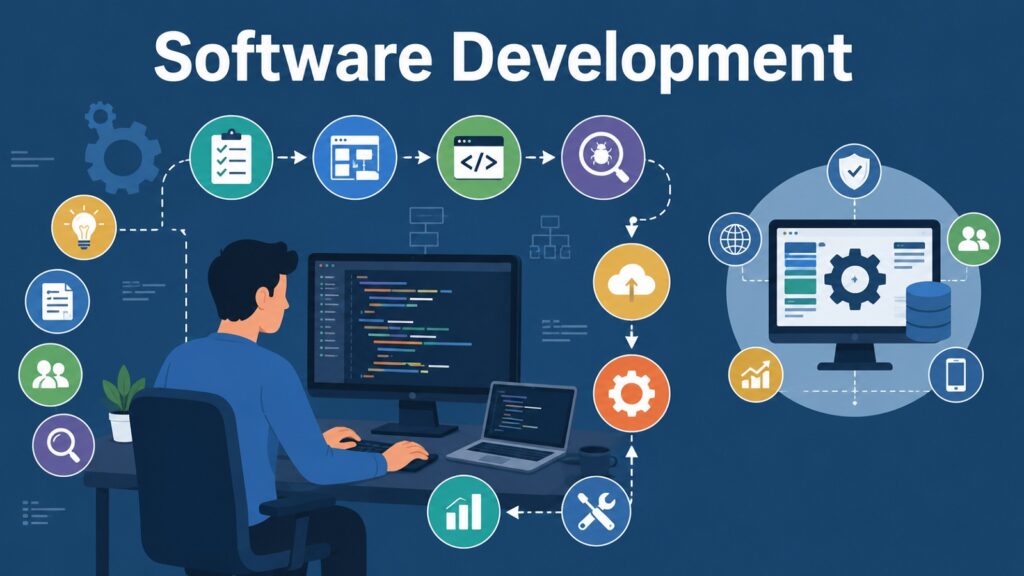
Software Development is the practice of planning, designing, building, testing, deploying, and keeping software alive over its full life. It is one of the most important aspects of Software Systems. It turns raw ideas, user needs, and business goals into real software that runs banks, clinics, schools, and supply chains. Without it, the digital world simply does not exist.
The landscape of computing has evolved significantly since its inception. In the past, individual programmers would create machine code for specific tasks. In contrast, contemporary Software Development resembles a collaborative endeavor involving extensive, distributed teams that utilize cloud-based tools, shared coding platforms, and automated workflows. It now permeates nearly every industry: business, healthcare, law, science, finance, education, and government all rely heavily on it.
What makes Software Development captivating is its interdisciplinary nature. It encompasses elements of engineering, business acumen, creative problem-solving, and effective communication. For instance, a team tasked with developing a hospital records system must be well-versed in clinical workflows as well as database architecture. Similarly, a developer working in a fintech company needs to have knowledge of both tax regulations and encryption methods. This integration of various disciplines is what extends the field’s influence.
The scale of Software Development reflects its growing role. The global software market was valued at close to $699 billion in 2024. The number of software developers worldwide crossed 28 million by that year, growing nearly five percent year over year. These are not small figures. They show that software is now core infrastructure for the modern world, and Software Development is how it gets built.
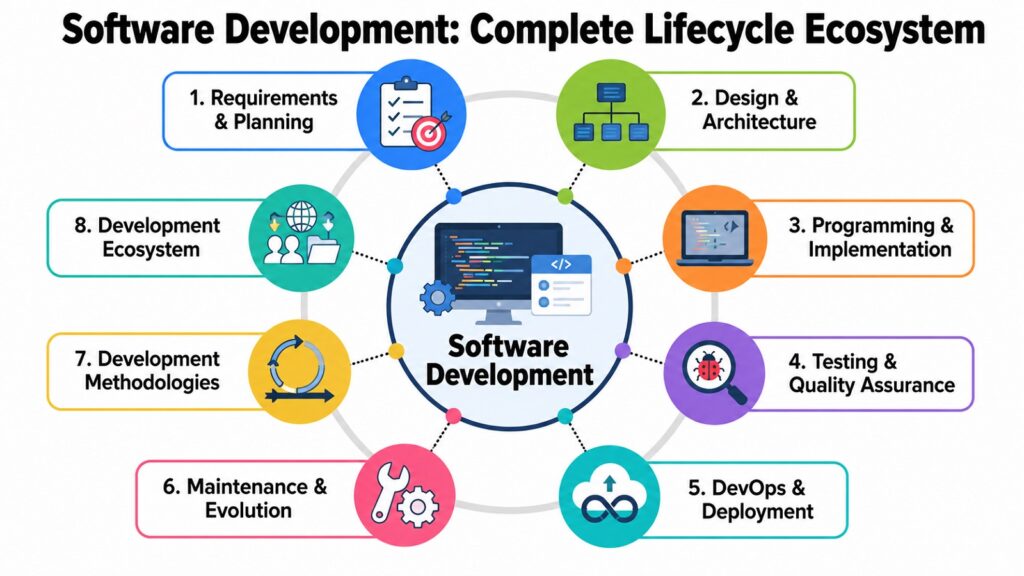
This article explores eight key concepts that shape Software Development. Each concept addresses a specific layer: from identifying requirements and planning tasks, through design, coding, testing, and deployment, to ongoing maintenance, team dynamics, and the broader tool ecosystem. Collectively, they provide a comprehensive understanding of what Software Development entails and the significance of each component in achieving the final outcome.
Table 1: Eight Core Aspects of Software Development
| Aspect | Role in Software Development |
| Requirements and Planning | Defines what the software must do before any code is written |
| Design and Architecture | Sets the structural plan for scalable, maintainable software |
| Programming and Implementation | Turns designs into working, functional software |
| Testing and Quality Assurance | Checks that software meets quality and reliability standards |
| DevOps and Deployment | Automates delivery and links development with operations |
| Maintenance and Evolution | Keeps software secure, updated, and useful after release |
| Methodologies | Organizes team workflows and delivery process |
| Development Ecosystem | Provides the tools, platforms, and communities that speed up development |
1. Software Development Requirements and Planning
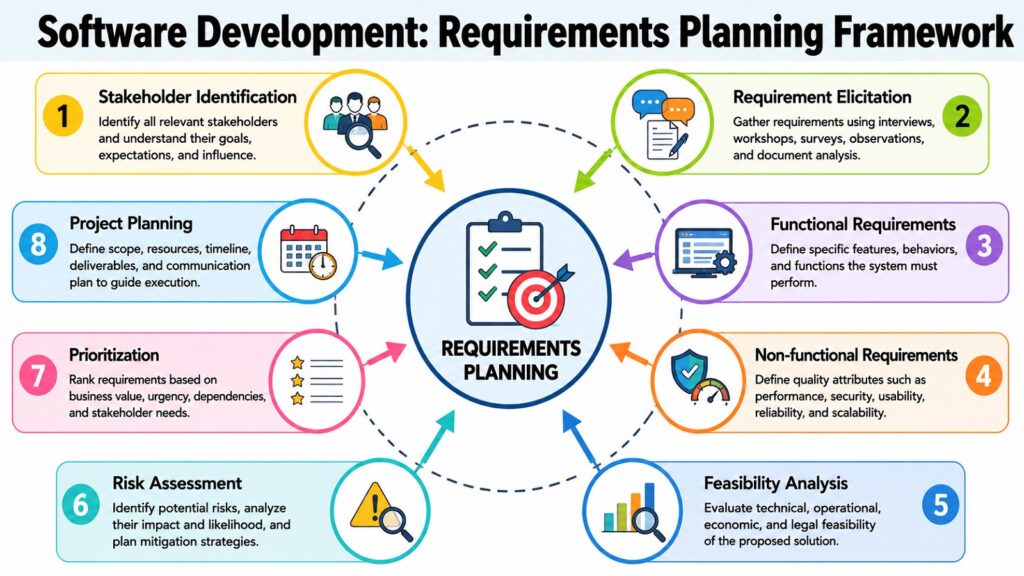
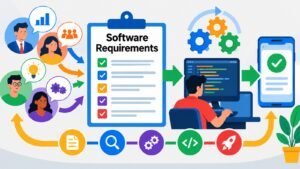
Good Software Development starts long before a line of code is written. The first step is understanding what the software needs to do, why it needs to do it, and for whom. This stage is called requirements work, and it involves learning about business goals, user needs, stakeholder views, technical limits, and project scope.
Software Requirements split into two broad types. Functional ones describe what the software must do, such as letting users submit forms, send alerts, or run reports. Non-functional ones describe how the system must behave, covering speed, security, uptime, and scale. Both types matter equally. Leaving out either leads to software that either fails users or breaks under load.
Gathering requirements is rarely easy. Teams use interviews, workshops, user story sessions, and early prototypes to draw out what stakeholders actually need. People often struggle to put their needs into words. Showing an early mockup tends to reveal gaps and misreads that no amount of document review would catch. Written requirements, whether formal specs or lightweight user stories, give the whole team a shared reference point all the way through the project.
Planning converts those requirements into a work roadmap. This means setting timelines, allocating staff, flagging risks, and deciding what to build first. Risk planning means spotting likely problems early, such as unclear scope, staff limits, or shifting regulations, and making a plan before they blow up the schedule.
The data on skipped planning is stark. Poor requirements work is the top cause of project failure, cited in about 39 percent of cases. Around 31% of software projects are cancelled before they ship, and more than half go over budget by nearly 190 percent. The pattern holds across 30 years of research: most projects fail not because of bad code but because of bad planning and vague scope.
When requirements and planning are handled well, the benefits reach far beyond simply staying on track. Clear scope cuts rework during coding, improves communication between business and technical staff, and creates a baseline for measuring whether the final product met the original goal. Strong planning also helps teams budget for testing, schedule releases, and prepare for the maintenance work that follows launch.
Table 2: Requirements and Planning Activities in Software Development
| Activity | Primary Purpose or Benefit |
| Stakeholder interviews | Surfaces hidden needs and business context |
| User story mapping | Links features to real user workflows |
| Functional requirements | Specifies what the software must do |
| Non-functional requirements | Sets quality, speed, and security targets |
| Feasibility analysis | Checks whether the project is viable within constraints |
| Risk identification | Flags likely problems before they block progress |
| Effort estimation | Guides resource use and schedule setting |
| Requirements documentation | Creates a shared reference for the whole team |
2. Software Development Design and Architecture
Once requirements are clear, Software Development moves into design and architecture. This is where abstract needs become concrete technical structures. Architecture decides how a system is organized: which parts exist, how they talk to each other, where data lives, and how the system will grow and change over time.
Good architectural thinking looks ahead. An architect does not just solve today’s problem. They build a structure that can handle tomorrow’s demands without needing a full rebuild. This requires thinking carefully about modularity, which means splitting the system into separate parts that can be built, tested, and swapped out on their own. Modularity means a change in one area does not break everything else, and it makes large systems far easier to maintain over time.
Abstraction works alongside modularity. By hiding inner complexity behind clean surfaces, parts of the system can change inside without forcing other parts to change with them. APIs, whether used inside the system or exposed to outside users, are the most visible form of this. A well-designed API lets a web app, a mobile client, and a third-party tool all use the same backend service without caring how it works internally.
Data storage choices also shape the architecture. Relational databases suit structured, transactional data. Document stores, graph databases, and time-series options each serve different use cases. Picking the wrong model early causes performance and scale problems that are costly to fix later.
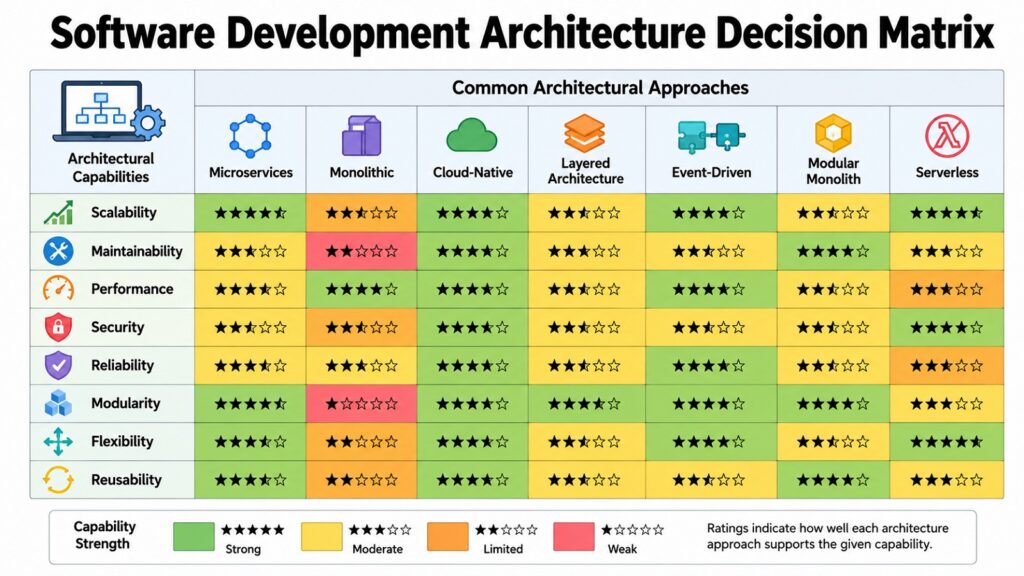
Different systems call for different structural patterns. Monolithic designs pack everything into one deployable unit. This keeps things simple early on but can grow hard to scale. Microservices split the system into many small, independent pieces, each deployed on its own. This adds flexibility but also distributed systems complexity. Event-driven patterns use async messaging to decouple parts further, improving resilience at high throughput. Layered designs separate user interface, business logic, and data concerns, which improves both maintainability and testability.
No pattern is universally right. The best choice depends on team size, expected load, delivery speed, and how mature the operations team is. A two-person startup and a global bank rarely benefit from the same approach. Early design decisions carry long-term weight. Experts consistently observe that poor architecture is among the most costly problems to correct in software, because it touches every other part of the system.
Table 3: Architectural Concepts in Software Development
| Concept | Practical Significance |
| Modularity | Allows parts to be built, tested, and replaced on their own |
| Abstraction | Hides inner complexity behind clean interfaces |
| APIs | Enable communication between parts and with external systems |
| Relational databases | Handle structured, transactional data reliably |
| Microservices | Allow independent deployment and scaling of system parts |
| Monolithic architecture | Simplifies early-stage development and deployment |
| Event-driven design | Improves decoupling and resilience in complex systems |
| Layered architecture | Separates concerns to improve maintainability and testing |
3. Software Development: Programming and Implementation
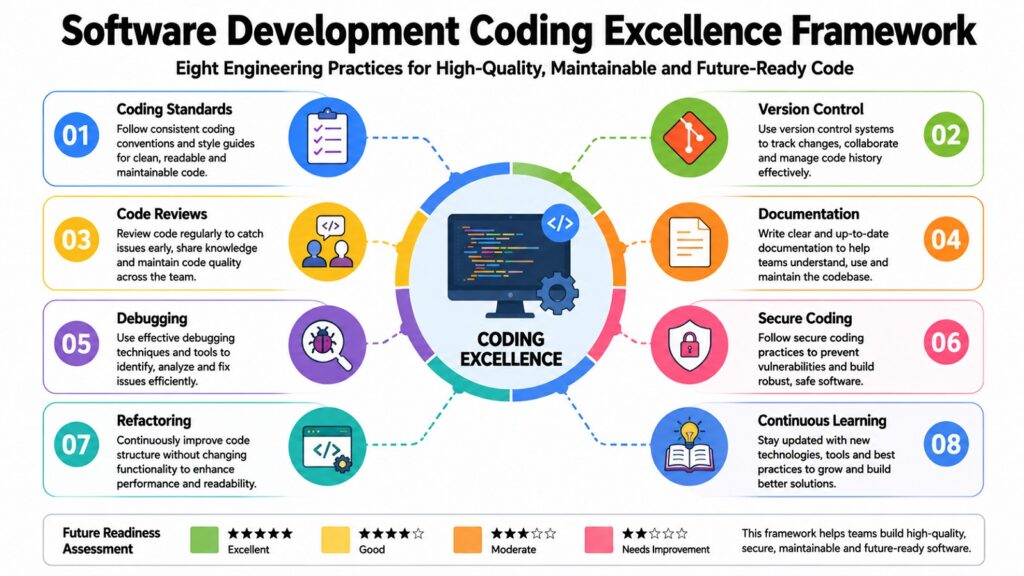
Programming and implementation is where Software Development becomes visible. Designs turn into running software through the craft of writing, reviewing, and refining code. But professional implementation is about far more than typing into an editor.
Language choice matters, though it is rarely as decisive as online debate suggests. Python leads in data science and scripting. JavaScript dominates the web, with frameworks extending it across both client and server environments. Java and C# serve large enterprise systems. Go and Rust have found strong roles in systems programming and cloud-native work. The key is choosing a language whose ecosystem, speed, and community support match the project’s real needs.
Frameworks and libraries facilitate implementation by offering pre-built solutions to frequently encountered issues. Instead of creating a web server, an authentication system, or a data layer from the ground up, developers utilize frameworks that effectively manage these aspects. This approach reduces development time and, when established frameworks are selected, also minimizes security risks.
Version control is non-negotiable in professional Software Development. Git is now the universal standard. Platforms like GitHub and GitLab provide team workflows built on top of it. Pull requests and code review processes ensure that changes are checked before reaching shared codebases. Research shows that peer code review catches a large share of defects before testing even starts.
Secure coding protects software from weaknesses that attackers target. Common flaws such as SQL injection, cross-site scripting, and insecure data handling arise from decisions made during implementation. Teams that treat security as part of the coding phase, rather than something bolted on later, produce measurably safer software.
Documentation is often undervalued but has lasting impact. Code that is not explained becomes a liability. New team members cannot contribute efficiently. Even the original developers lose context after months away. Comments, README files, API docs, and decision records all reduce the long-term cost of keeping software alive.
Table 4: Programming Practices in Software Development
| Practice | Contribution to Software Development |
| Language selection | Aligns tools with project needs and team skills |
| Framework use | Cuts development time using proven, ready-made parts |
| Version control with Git | Enables safe, collaborative code management |
| Code review | Catches defects early and spreads knowledge across the team |
| Secure coding | Stops common vulnerabilities from entering production |
| Integrated development environments | Improve developer output through tooling |
| Debugging practices | Isolate and fix defects during development |
| Code documentation | Reduces long-term maintenance cost and supports handover |
4. Software Development Testing and Quality Assurance
Testing is how Software Development earns trust. A system may have sound architecture and clean code, but without structured testing, no one can be confident it will behave correctly under real conditions. Quality assurance is the practice of checking that software meets its requirements and holds up across a wide range of real-world scenarios.
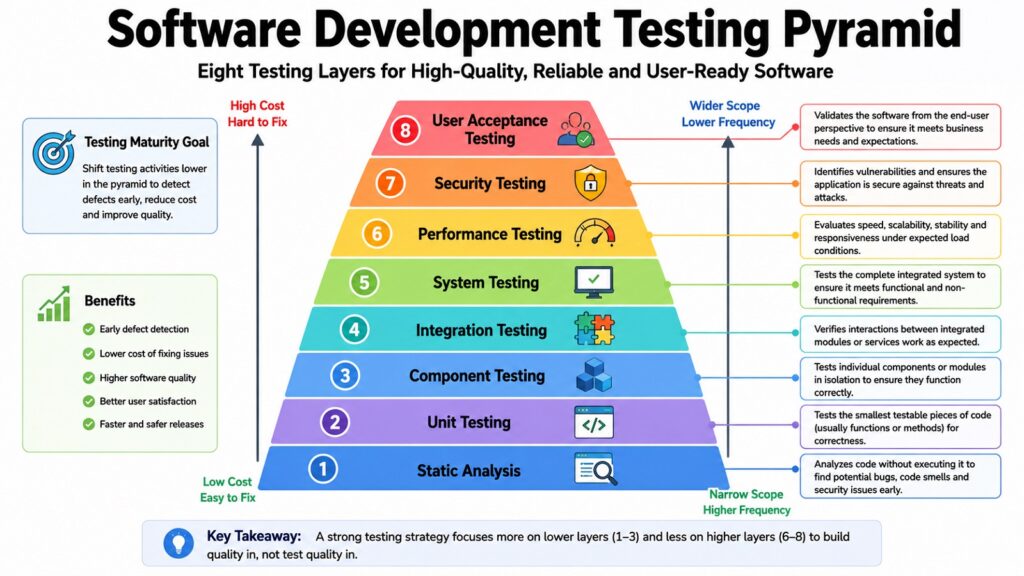
Unit testing assesses individual components in isolation, ensuring that each function or module generates the correct output for specified inputs. Integration testing advances to a higher level, verifying that components function correctly when integrated. System testing reviews the entire assembled application against its specified requirements. Acceptance testing, typically conducted with business users or actual customers, validates that the software fulfills the objectives that initiated the project.
Regression testing protects software from a common trap: fixing one defect and quietly breaking something that worked before. As software grows, the interactions between parts multiply fast. Manual checking of the entire system before each release quickly becomes impractical. This is why automated testing is now central to modern Software Development. Automated suites run in minutes, catch regressions immediately, and give teams the confidence to change code without fear of unknown side effects.
Performance testing examines how the system behaves under load. A system that runs smoothly with ten users may collapse with ten thousand. Load tests, stress tests, and endurance runs probe different sides of this concern. Security testing searches for weaknesses that could expose user data, allow unauthorized access, or disrupt service.
Research makes a strong case for early testing. Fixing a defect after release typically costs many times more than fixing the same defect during development. Yet testing is often treated as a final activity to be squeezed into whatever time remains before a launch date. The consequences appear reliably: production incidents, security failures, and emergency patches that erode user trust and damage reputations.
Defect management tracks bugs from discovery through root cause analysis to verified fix. Quality programs that analyze defect patterns over time can identify systemic weaknesses in the development process itself, rather than treating each bug as a one-off event.
Table 5: Testing Approaches in Software Development
| Testing Type | Primary Objective |
| Unit testing | Verifies individual parts work correctly in isolation |
| Integration testing | Checks that combined parts interact as intended |
| System testing | Evaluates the complete application against requirements |
| Acceptance testing | Confirms software meets business and user expectations |
| Regression testing | Prevents previously fixed defects from reappearing |
| Performance testing | Assesses system behavior under load and stress |
| Security testing | Identifies weaknesses before deployment |
| Automated testing | Enables fast, repeatable quality checks at scale |
5. Software Development: DevOps and Deployment
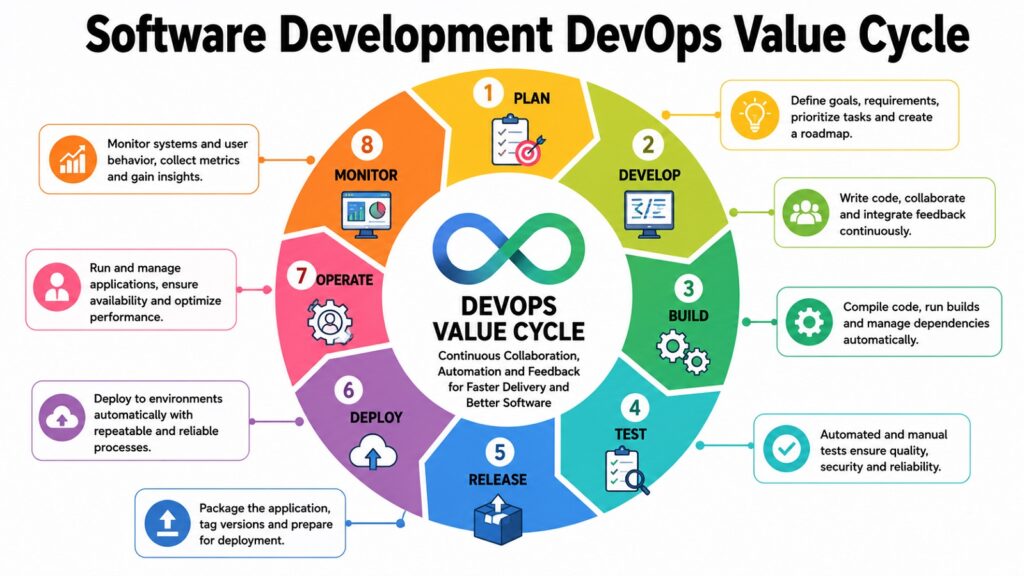
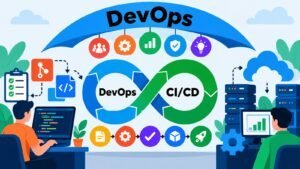
For much of computing history, development and operations were separate worlds with separate goals. Developers wanted to ship new features. Operations teams wanted system stability. The friction between these goals slowed delivery and created tension between groups that needed to work closely. DevOps emerged to address this problem, combining cultural, organizational, and technical practices that unify the two groups around a shared goal of delivering reliable software quickly.
Continuous integration is the practice of merging code changes into a shared base frequently, often many times per day, and automatically checking those changes through build and test automation. This reduces the risk of integration conflicts that pile up when branches diverge over weeks. Continuous delivery builds on this by keeping the codebase in a state where it can be deployed at any time. Continuous deployment goes further, automatically releasing every passing change directly to production without manual approval.
Infrastructure as code treats server setup, network configuration, and deployment environments as files that can be version-controlled, reviewed, and applied automatically. This removes the subtle differences between development, testing, and production environments that cause production-only failures. Containerization packages applications and their dependencies into portable units that run the same way in any environment. Container orchestration platforms manage deployment, scaling, and health monitoring of containerized workloads at scale.
Cloud deployment has changed how organizations run software. Cloud platforms lower upfront infrastructure costs, let capacity grow with demand, and offer managed services that teams no longer need to build themselves. The 2024 DORA State of DevOps Report, drawing on over 39,000 surveyed professionals, found that using flexible cloud infrastructure directly raises organizational performance.
Monitoring and observability provide visibility into how software behaves in production through metrics, logs, and traces. Rollback strategies let teams return to a stable state quickly when a deployment causes problems, reducing the impact on users. The ability to recover fast from a failed deployment is now considered as important as preventing failures in the first place.
Table 6: DevOps Practices in Software Development
| Practice | Contribution to Software Development |
| Continuous integration | Reduces risk through frequent, automated code merging |
| Continuous delivery | Keeps software always ready for production release |
| Continuous deployment | Automates release of every passing change to production |
| Infrastructure as code | Ensures consistent, version-controlled environments |
| Containerization | Packages software for reliable execution anywhere |
| Container orchestration | Manages deployment, scaling, and health of containers |
| Cloud deployment | Reduces infrastructure cost and enables dynamic scaling |
| Monitoring and observability | Provides visibility into production system behavior |
6. Software Development: Maintenance and Evolution
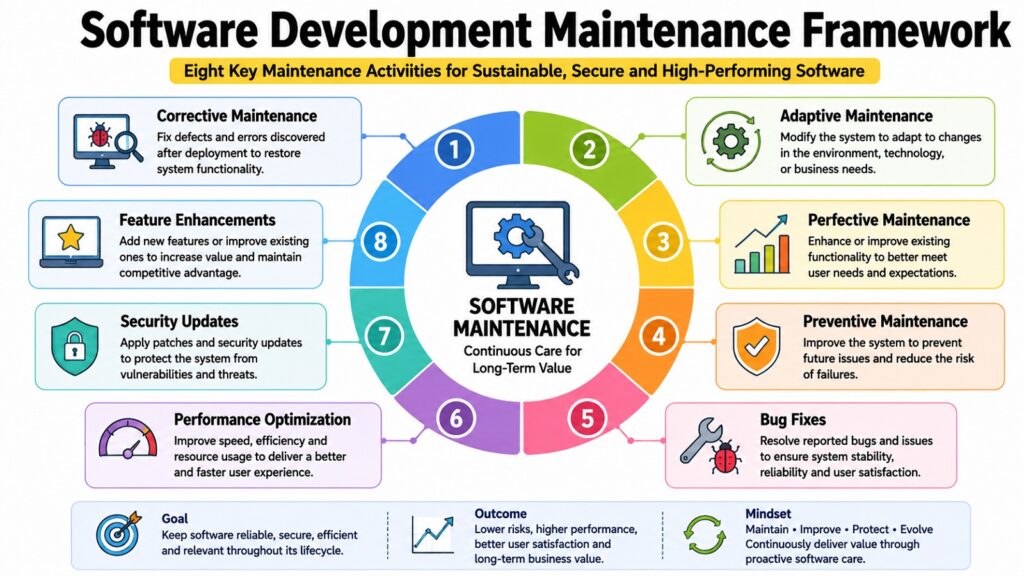
Software Development does not end at launch. What happens after a product ships often determines whether it delivers lasting value or slowly becomes a burden. Maintenance accounts for a large share of total Software Development effort over a system’s lifetime. Some estimates suggest it can consume 60 to 80 percent of lifetime software cost, though this varies by system type and organization.
Corrective maintenance fixes defects found after release. Even with thorough testing, real use surfaces edge cases and failure modes that test environments did not anticipate. A clear and fast defect resolution process limits the time users spend dealing with broken features and reduces the damage caused by public failures.
Adaptive maintenance keeps software compatible with a changing world. Operating system upgrades, database version changes, new regulations, and shifts in third-party APIs all require software to be updated even when no new features are being added. Organizations that skip adaptive maintenance build up incompatibilities that eventually make the software unable to run in its current environment.
Perfective maintenance improves software based on user feedback and real-world operational data. Features that seemed fine at launch often reveal friction in actual use. Performance that was acceptable at one scale becomes a problem as usage grows. Perfective maintenance responds to these discovered needs, turning launch-day software into something that fits the way people actually work.
Preventive maintenance mitigates future risks by addressing vulnerabilities before they lead to failures. Refactoring involves reorganizing code without altering its external functionality, thereby enhancing clarity, reducing complexity, and alleviating technical debt. Technical debt refers to the cumulative cost incurred from shortcuts taken during the development process. Each unaddressed shortcut ultimately requires repayment, manifesting as slower feature development, more challenging debugging, and less stable releases.
Particular emphasis should be placed on security patching. Vulnerabilities identified in third-party libraries, operating systems, and runtime environments necessitate prompt action. Delayed security patching creates opportunities for attackers to exploit. Ensuring the security of software is not merely optional; it is a fundamental obligation for any system that manages user data or operates critical services.
Table 7: Maintenance Activities in Software Development
| Activity | Primary Purpose |
| Corrective maintenance | Fixes defects found after deployment |
| Adaptive maintenance | Updates software for environment and platform changes |
| Perfective maintenance | Improves software based on operational feedback |
| Preventive maintenance | Reduces future failure risk through early improvements |
| Refactoring | Improves code structure without changing its behavior |
| Technical debt management | Addresses shortcuts before they slow progress |
| Security patching | Closes vulnerabilities in software and its dependencies |
| Performance optimization | Improves system speed and efficiency as usage grows |
7. Software Development Methodologies
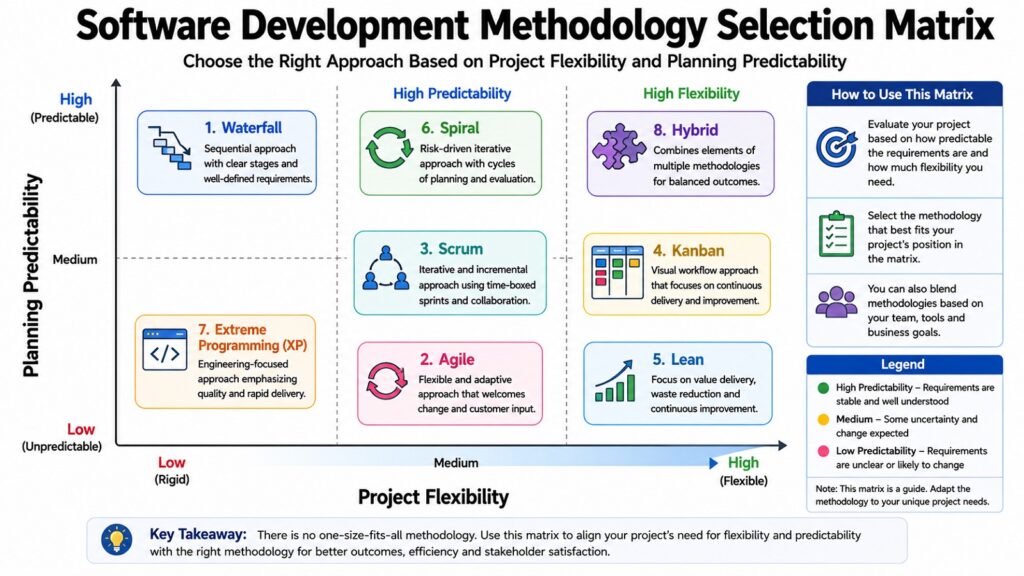
A methodology gives Software Development its rhythm. It defines how work is organized, how teams communicate, how progress is measured, and how the project responds to change. Choosing the right methodology matters as much as choosing the right technology, because even skilled teams can fail when their process does not fit their environment.
Waterfall is the oldest widely used approach. It moves through distinct phases in a strict sequence: requirements, design, coding, testing, and deployment. Each phase must finish before the next starts, and going back to fix an earlier phase is difficult and costly. Waterfall suits projects where requirements are stable, fully known, and unlikely to shift, such as certain government systems or regulated technical deliverables. Its main weakness is rigidity: finding a major requirement error during testing is extremely expensive when design and coding are already complete.
Agile emerged as a direct answer to Waterfall’s limits in fast-moving environments. The Agile Manifesto, written in 2001, set out values and principles that favor working software, customer input, and response to change over rigid process. Agile is a philosophy, not a single workflow. It is realized through specific frameworks.
Scrum is the most widely adopted Agile framework. It organizes work into short, fixed cycles called sprints, typically two weeks long. Each sprint includes planning, daily coordination, delivery, review, and reflection. Scrum assigns clear roles: a product owner sets priorities, a development team does the work, and a scrum master supports the process. Research shows that roughly 71 percent of software teams worldwide use Agile methods, with Scrum being the most common choice.
Kanban focuses on making work visible and limiting how much is in progress at once, which improves how work flows without fixed time boxes. It works well in support and maintenance teams where incoming work is hard to predict. Lean applies production efficiency thinking to Software Development, focusing on cutting waste, getting fast feedback, and building only what adds real value.
The Spiral model combines iterative development with formal risk review. Each cycle covers planning, risk evaluation, engineering, and customer review, making it well suited for large projects where managing risk is central. Extreme Programming emphasizes technical habits like paired coding, test-first development, and continuous integration to achieve high quality in fast-paced settings. Hybrid approaches combine elements from several methods. Many organizations use Agile for daily feature work while applying structured governance for procurement and compliance steps.
Table 8: Software Development Methodologies and Their Applications
| Methodology | Ideal Application |
| Waterfall | Projects with stable, fully defined requirements and fixed scope |
| Agile | Environments requiring frequent feedback and quick adaptation |
| Scrum | Teams delivering software in regular, short sprint cycles |
| Kanban | Support and maintenance teams managing continuous, varied work |
| Lean | Teams focused on cutting waste and maximizing delivery speed |
| Spiral | Large projects where risk analysis drives each development cycle |
| Extreme Programming | High-quality delivery under fast-changing technical conditions |
| Hybrid | Organizations balancing agile delivery with formal governance |
8. Software Development Ecosystem
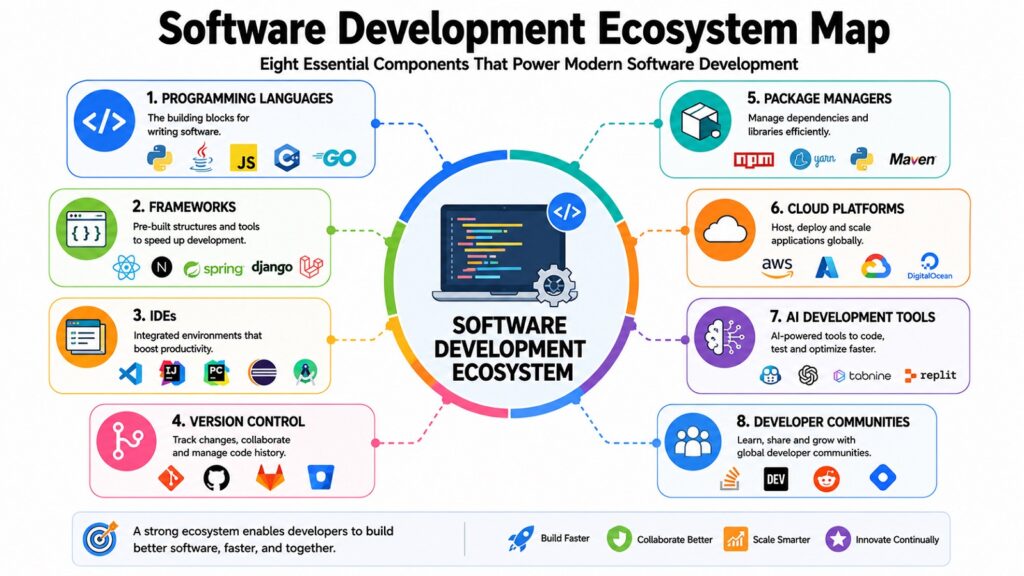
No Software Development effort happens in isolation. Every project draws from a broad ecosystem of languages, frameworks, tools, platforms, communities, and shared practices. The ecosystem is what makes modern Software Development productive at scale. Without it, teams would spend most of their time solving problems that others have already solved, rather than building software that creates new value.
Programming languages form the base. Beyond dominant ones like Python, JavaScript, Java, and Go, the ecosystem includes languages suited to specific needs: R for statistics, SQL for data queries, Swift for iOS apps, and Kotlin for Android. Each language has a community that produces libraries, guides, tutorials, and tooling that multiply what any one developer can do.
Frameworks and libraries extend what a language can do with ready-built solutions to common problems. React and Angular handle front-end interfaces. Django and Spring provide web application structure on the server side. TensorFlow and PyTorch support machine learning work. These frameworks represent years of accumulated engineering effort, freely available to any project that uses them.
Development environments minimize the challenges associated with writing and debugging code. Modern tools provide features such as syntax highlighting, intelligent code completion, integrated debugging, and direct connections to version control systems. Version control platforms play a crucial role in team collaboration. GitHub, with over 100 million developers, has emerged as the primary coordination layer for software development globally.
Package managers like npm for JavaScript, pip for Python, and Maven for Java let teams declare and install dependencies in a reproducible way. Cloud platforms, including AWS, Google Cloud, and Azure, provide compute, storage, database, messaging, and machine learning services that teams can consume without building or managing infrastructure themselves.
AI-assisted development tools have grown rapidly. The 2024 DORA report found that over 75 percent of surveyed professionals were using AI tools daily for tasks including code generation, explanation, and documentation. These tools speed up certain tasks, though the same research noted that teams must maintain discipline around testing and delivery basics to keep overall performance stable. Developer communities, whether organized around open-source projects, forums, conferences, or user groups, provide the knowledge sharing that keeps the ecosystem alive and growing.
Table 9: Components of the Software Development Ecosystem
| Component | Primary Role |
| Programming languages | Provide the syntax and logic for expressing software behavior |
| Frameworks and libraries | Supply ready-made solutions to common development problems |
| Integrated development environments | Improve developer output through tooling and automation |
| Version control platforms | Enable collaborative, tracked code management across teams |
| Package managers | Handle dependency installation and reproducible environments |
| Cloud platforms | Provide scalable infrastructure and managed services |
| AI-assisted tools | Speed up code generation, review, and documentation tasks |
| Developer communities | Drive knowledge sharing, open-source work, and ecosystem growth |
Conclusion: The Future of Software Development
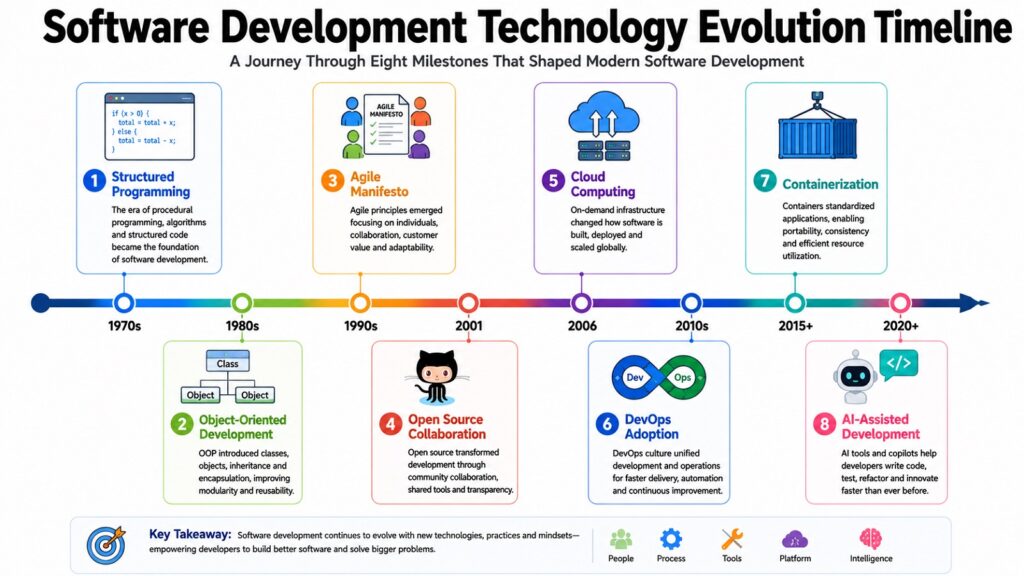
Software Development is not a single skill or a single phase. It is a continuous, integrated process that spans planning, architecture, coding, testing, deployment, maintenance, methodologies, and the broader ecosystem. Each of the eight concepts explored in this article contributes a distinct dimension, and none of them works well alone. Requirements without architecture produce plans that cannot be built. Architecture without testing produces elegant systems that fail in production. Testing without DevOps produces quality software that still takes months to reach users.
What ties all of these dimensions together is a shared commitment to delivering software that works reliably, scales under pressure, adapts to change, and continues to serve people over time. Organizations that invest across all eight areas consistently produce better outcomes than those who optimize one area while neglecting others.
Looking ahead, several trends are reshaping how Software Development will evolve. AI-assisted development has moved from experiment to standard practice. With over 75 percent of developers using AI tools for daily tasks, questions have shifted from whether AI belongs in the workflow to how teams should govern its use and manage the tradeoffs it introduces. Platform engineering, where dedicated teams build internal developer platforms to reduce friction and cognitive load, is rising in response to growing system complexity.
Cloud-native engineering continues to mature. Serverless computing, managed databases, and edge platforms extend what teams can build without managing infrastructure directly. Low-code and no-code platforms are broadening who can take part in Software Development, enabling domain experts and business users to build functional applications without deep coding knowledge.
The concept of secure-by-design thinking is increasingly regarded as a fundamental expectation. Regulatory demands, notable security breaches, and heightened public scrutiny are compelling organizations to integrate security measures earlier in the development process, a shift that few can afford to overlook any longer. The future will favor teams that regard Software Development as a discipline deserving of ongoing investment rather than merely a cost to be reduced. The industry has reached unprecedented levels of capability, connectivity, and significance. Those who grasp its comprehensive nature will be the architects of the software systems that will define the future.
Table 10: Emerging Trends in Software Development
| Trend | Expected Impact |
| AI-assisted development | Speeds up coding and review while requiring careful governance |
| Platform engineering | Reduces cognitive load through standardized internal tooling |
| Cloud-native engineering | Enables scalable software without managing infrastructure |
| Low-code and no-code platforms | Expands participation beyond traditional programmers |
| Secure-by-design practices | Integrates security from the earliest stages of development |
| Intelligent automation | Reduces manual effort in testing, monitoring, and deployment |
| Edge computing | Brings execution closer to users for lower latency |
| Developer experience focus | Improves productivity by reducing friction in daily workflows |