Table of Contents
Introduction: Resource Efficiency – A Foundation of Sustainable Business
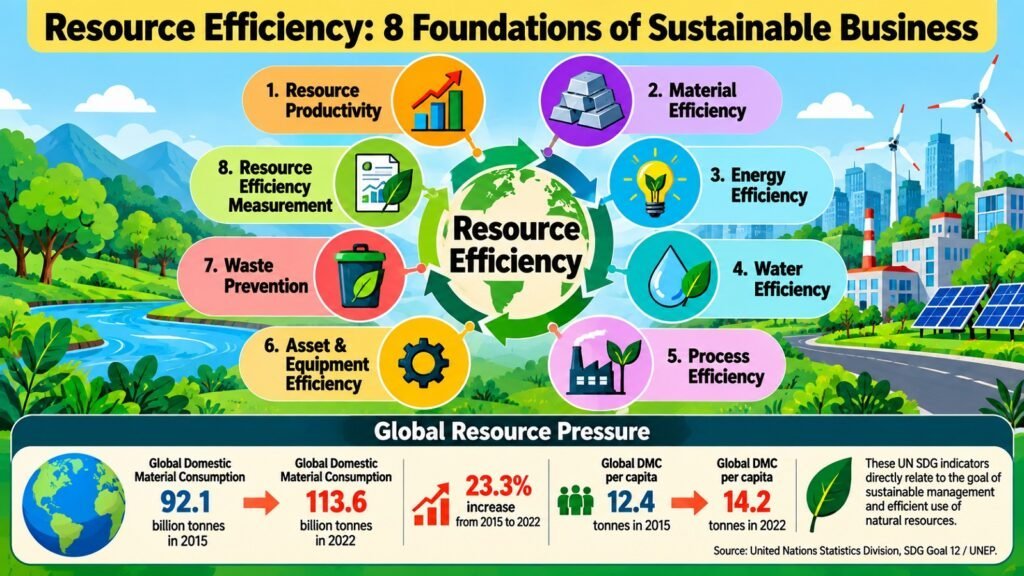
Resource Efficiency is an important aspect of Sustainable Business. In precise terms, it is the ability to generate greater economic and operational value while using resources more effectively and reducing avoidable losses. This definition moves beyond familiar environmental concepts: Resource Efficiency is not simply about conserving energy, recycling materials, or treating waste. It is about improving the relationship between resource inputs and the value those inputs produce across all business operations, connecting them directly with productivity, cost management, and long-term business value.
Resource Efficiency connects to broader Sustainable Business frameworks without overlapping with them. The Circular Economy addresses how resources remain in productive use longer and how materials circulate rather than flowing to disposal. Carbon Management addresses how greenhouse gas emissions are measured, reported, and reduced. Resource Efficiency occupies a distinct but related space, focusing on how efficiently resources are used within operational boundaries and how avoidable losses are prevented. These three frameworks are complementary.
This article examines eight foundations that together constitute a practical Resource Efficiency framework. The sections that follow move from individual resource dimensions through operational mechanisms to measurement and continuous improvement, providing a complete picture of the subject before entering the dedicated topics of Circular Economy and Carbon Management.
Resource Efficiency Framework: Eight Foundations at a Glance
| Foundation | Central Focus |
| Resource Productivity | Generating more economic or operational value per unit of resource consumed |
| Material Efficiency | Using physical materials more effectively and reducing unnecessary material losses |
| Energy Efficiency | Delivering the same or greater output while using energy more effectively |
| Water Efficiency | Obtaining greater operational value from water while reducing unnecessary consumption |
| Process Efficiency | Improving how processes transform resource inputs into useful outputs |
| Asset & Equipment Efficiency | Obtaining useful output from physical assets and reducing losses from underperformance |
| Waste Prevention | Preventing valuable resources from becoming waste before losses occur |
| Resource Efficiency Measurement | Establishing the analytical foundation to verify whether resource use is genuinely improving |
1. Resource Efficiency and Resource Productivity
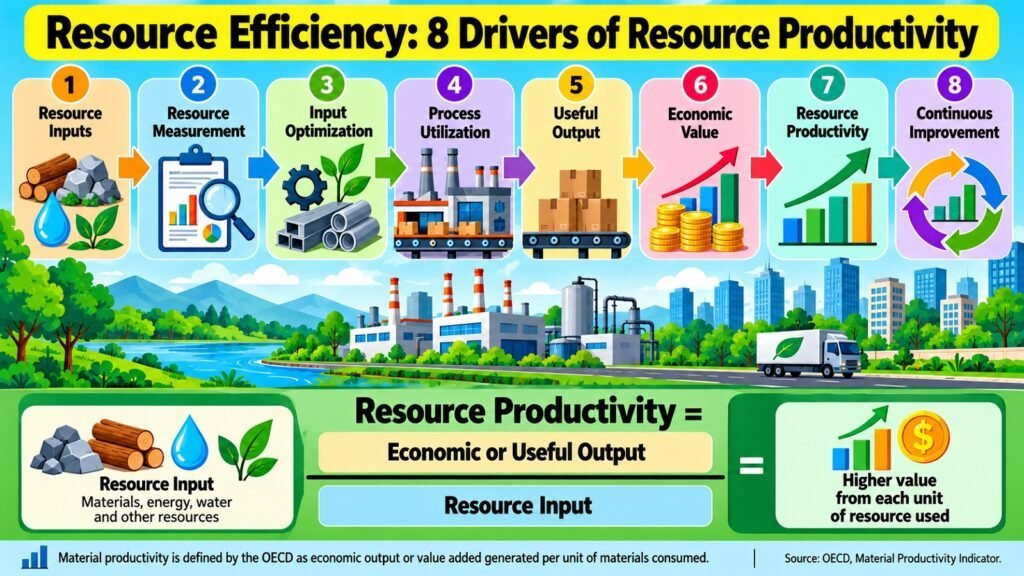
Resource Productivity is a fundamental dimension of Resource Efficiency that examines the relationship between resource inputs and the value those inputs generate. When a business improves Resource Productivity, it produces more useful output from each unit of resource consumed, improving the quality of the relationship between what goes in and what comes out rather than simply reducing absolute consumption.
The distinction between resource intensity and Resource Productivity is important. Resource intensity expresses the quantity of a resource required per unit of output, such as energy per tonne of product. Resource Productivity is conceptually its inverse: the value generated per unit of resource used. An organization may reduce resource intensity while still increasing total consumption if production volume grows faster than efficiency gains. This rebound effect is essential to acknowledge for credible analysis.
Improving Resource Productivity involves identifying resource-intensive activities and finding ways to increase useful output or reduce unnecessary input. Toyota’s production system demonstrates how systematic elimination of non-value-adding steps can improve both productivity and resource use simultaneously, reducing resources required per vehicle without compromising output or quality.
A practical diagnostic approach asks four questions: what resources are being consumed, what value do they produce, where do losses occur between input and output, and where can productivity improve? This framework requires reliable data on consumption and a clear definition of useful output for each process, moving organizations from general awareness to specific improvement.
Tracking both intensity ratios and absolute consumption avoids interpretive distortions. A business can improve its productivity ratio while still using resources inefficiently when demand growth increases total consumption faster than efficiency gains reduce it.
Resource Efficiency and Resource Productivity: Key Concepts
| Concept | Explanation |
| Resource Productivity | Value generated per unit of resource consumed; the inverse of resource intensity |
| Resource Intensity | Resources required per unit of output; a widely used operational efficiency metric |
| Input Utilization | The proportion of resource inputs converted into useful output rather than lost |
| Rebound Effect | Efficiency gains offset by higher total consumption when overall activity expands |
| Value Creation | Economic or operational benefit generated from resource consumption |
| Diagnostic Approach | Identifying where losses occur between resource input and useful business output |
| Measurement Denominator | The output unit used to calculate productivity, such as revenue or units produced |
| Productivity Improvement | Increasing useful output or reducing unnecessary input per unit of production |
2. Resource Efficiency and Material Efficiency
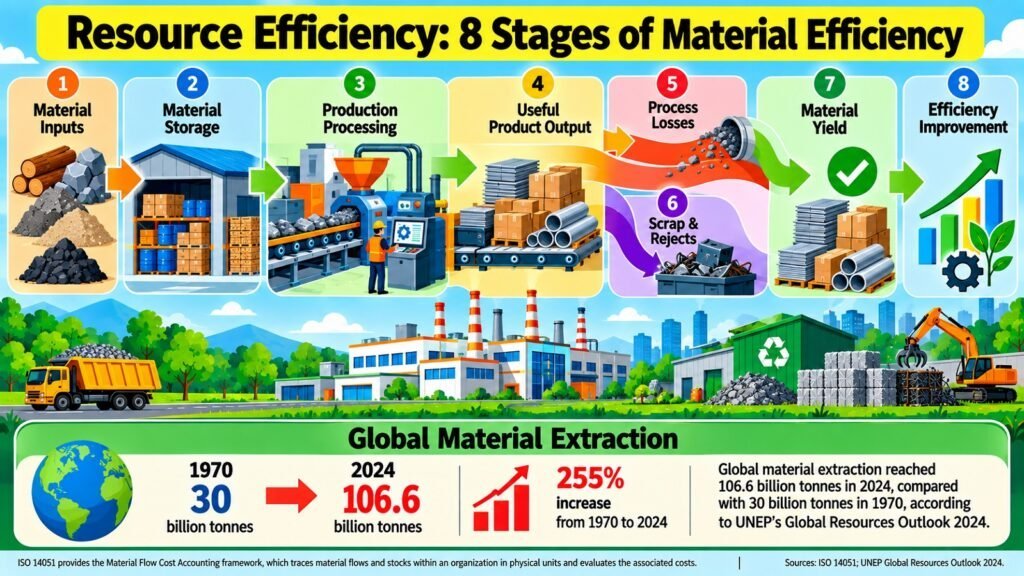
Material Efficiency is the Resource Efficiency dimension concerned with using physical materials more effectively, reducing unnecessary material inputs, and minimizing losses that occur when materials are processed, converted, or handled.
The logic of Material Efficiency is direct. Every kilogram of material purchased but not converted into saleable product represents a cost without a return. That lost material also carried embedded resource costs, since energy, water, and labor were consumed in producing and transporting it before it reached the facility. Reducing material losses simultaneously lowers direct material costs, reduces embedded resource burden, and decreases waste generation.
Lightweighting illustrates the principle in practice. The automotive industry has systematically reduced the material content of vehicle components through the use of high-strength steel, aluminum alloys, and composite materials. When a component delivers the same structural performance with less material, both material cost and embedded resource consumption per unit decline without any reduction in functional quality, demonstrating Material Efficiency applied at the design and production stage.
Process-related material losses deserve particular attention because they tend to be invisible in standard financial reporting. Cutting waste in metalworking, trim loss in textiles, and yield losses in food processing all represent points where material enters an operation but exits as waste rather than product. These losses are typically absorbed into overhead or standard costs, making them a deliberate analytical task to identify and address.
Material Efficiency focuses on preventing unnecessary consumption at source, which is clearly distinct from Circular Economy strategies that address recovery, remanufacturing, and recycling at end of use. These approaches are complementary but operate at different points in the resource lifecycle.
Resource Efficiency and Material Efficiency: Key Concepts
| Concept | Explanation |
| Material Yield | Proportion of input materials successfully converted into saleable product |
| Production Scrap | Material removed or discarded during manufacturing that does not enter the product |
| Lightweighting | Reducing material content while maintaining product performance requirements |
| Input Optimization | Matching material specifications and quantities precisely to production needs |
| Embedded Resource Cost | Energy, water, and labor consumed in producing materials before they reach an operation |
| Process Loss | Material lost during conversion, handling, or processing steps within the facility |
| Material Selection | Choosing materials that deliver required performance with lower resource requirements |
| Boundary with Circular Economy | Material Efficiency prevents unnecessary consumption; circularity recovers used materials |
3. Resource Efficiency and Energy Efficiency
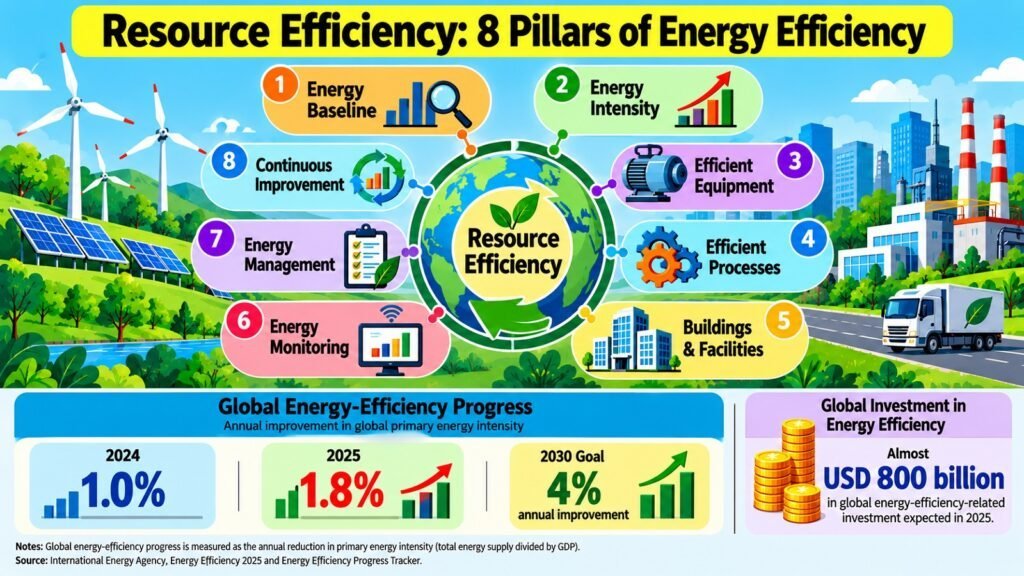
Energy Efficiency is one of the most recognized and operationally significant dimensions of Resource Efficiency. It refers to the ability of a business to deliver the same or greater useful output while using energy more effectively, reducing unnecessary consumption across equipment, processes, buildings, and operational practices.
Energy drives machinery, maintains process conditions, and enables virtually every aspect of physical business operations. Where energy is used inefficiently, it generates cost without proportional output. For energy-intensive industries such as cement, steel, and glass manufacturing, even modest improvements in energy intensity translate into substantial cost reductions. Inefficient energy use also signals inefficiency in the process it powers, making it a useful diagnostic indicator.
Improving energy efficiency begins with understanding where energy is consumed. For most manufacturing businesses, the major consumers are production machinery, process heat, compressed air systems, and building heating and cooling. Establishing a baseline across these categories and identifying the most energy-intensive areas provides a practical starting point. Monitoring systems that deliver interval data by equipment or process area allow businesses to detect anomalies and evaluate the measurable effect of changes.
A strict conceptual boundary must be maintained between Energy Efficiency and Carbon Management. This section focuses on energy use efficiency and intensity reduction. Carbon Management addresses greenhouse gas measurement, reporting, and net-zero pathways. The two are analytically distinct, and conflating them leads to measurement confusion. The rebound effect also applies here: equipment upgrades can incentivize expanded production, increasing total demand even as intensity falls, reinforcing the need to track both intensity ratios and total consumption.
Resource Efficiency and Energy Efficiency: Key Concepts
| Area or Concept | Explanation |
| Energy Intensity | Energy consumed per unit of output; the primary operational efficiency metric |
| Equipment Efficiency | Proportion of consumed energy converted into useful mechanical or process work |
| Compressed Air Systems | A common source of significant energy loss through leakage and pressure inefficiency |
| Building Energy Performance | Heating, cooling, and lighting efficiency across facilities and offices |
| Monitoring and Metering | Interval energy data by equipment or area enables diagnosis and improvement tracking |
| Maintenance and Condition | Equipment in poor condition consumes more energy for the same output |
| Rebound Effect | Efficiency gains can be offset if expanded output increases total energy demand |
| Boundary with Carbon Management | Energy Efficiency concerns use intensity; Carbon Management concerns emission accounting |
4. Resource Efficiency and Water Efficiency
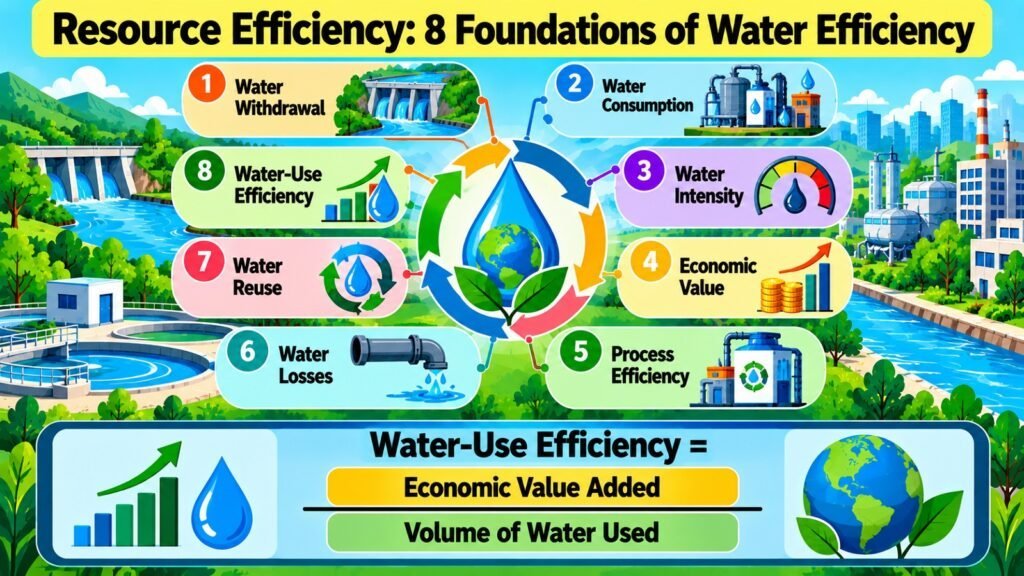
Water Efficiency is the Resource Efficiency dimension concerned with obtaining greater business value from water while reducing unnecessary consumption and avoidable losses. It applies across a wide range of industries, from food and beverage production and textiles to semiconductor manufacturing and commercial building operations.
Water is frequently undervalued as a business input because in many locations it has historically been available at low cost. This tends to produce inefficient use. Leaking pipework, inefficient cleaning cycles, poorly calibrated equipment, and unmonitored cooling systems all consume water beyond operational necessity. When the full cost of water is considered, including treatment, pumping, heating, and wastewater management, the economic case for Water Efficiency strengthens considerably even in water-abundant locations.
The World Resources Institute has documented that water stress exposes industrial and commercial operations to supply availability risk, regulatory restriction, and reputational pressure. For businesses in water-stressed regions or subject to tightening regulatory requirements, efficient water management is therefore an operational resilience issue, not solely a cost concern, and it directly affects the ability to maintain continuous operations as supply conditions change.
Improving Water Efficiency involves identifying where water enters operations, tracking how it is consumed, locating losses through leakage or inefficient processes, and evaluating where internal reuse is feasible within quality and safety requirements. Process water in manufacturing is a frequent improvement target because volumes can be substantial and process conditions can often be modified to reduce consumption without compromising output quality. This section remains scoped to the efficiency of business water use rather than broader water stewardship or environmental discharge management.
Resource Efficiency and Water Efficiency: Key Concepts
| Concept or Application | Explanation |
| Water Intensity | Water consumed per unit of output; the primary Water Efficiency performance metric |
| Leakage Detection | Identifying and repairing uncontrolled losses in distribution and process systems |
| Process Water Optimization | Reducing water volumes in manufacturing processes without compromising product quality |
| Cooling Water Efficiency | Improving heat exchange performance to reduce cooling water volumes |
| Internal Water Reuse | Recirculating process water within an operation where quality conditions allow |
| Full Cost of Water | Including treatment, pumping, heating, and wastewater costs beyond simple supply tariffs |
| Water Stress Relevance | Water Efficiency gains operational importance in water-scarce or tightly regulated locations |
| Monitoring and Metering | Interval data on water use by area enables diagnosis and improvement tracking |
5. Resource Efficiency and Process Efficiency
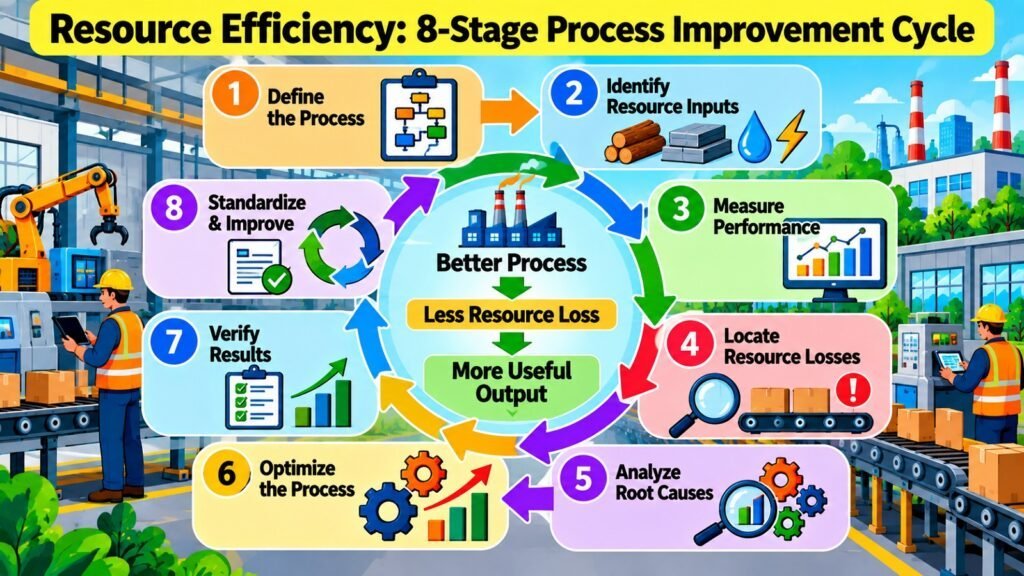
Process Efficiency is the Resource Efficiency dimension concerned with improving the way business processes transform resource inputs into useful outputs. A process is any structured sequence of activities that consumes resources to produce a defined result, and improving Process Efficiency means reducing the resources consumed per unit of useful output by examining and redesigning the process itself rather than simply managing the resources that flow through it.
Processes lose efficiency through several distinct mechanisms. Unnecessary steps consume energy, labor, and time without contributing to output. Bottlenecks cause upstream stages to idle, wasting productive capacity. Process variation produces defects and rework, consuming materials and energy without saleable output. Each mechanism is diagnostically distinct and points to a different improvement intervention.
The relationship between Process Efficiency and other resource dimensions is particularly important. A process improved to eliminate unnecessary steps will typically consume less energy, use fewer materials, generate less waste, and require less asset time per unit of output simultaneously. This cross-resource leverage makes process improvement one of the highest-value interventions in any Resource Efficiency program and distinguishes it from single-resource efficiency initiatives.
Toyota’s production system provides a well-studied reference for this diagnostic approach. Its central question — does each step transform the product in a way that creates value? — applies equally to resource consumption: does each step use resources in a way that contributes to useful output, or does it represent avoidable loss? Automation can support Process Efficiency by increasing consistency, but an automated process retaining unnecessary steps may consume more resources per unit than a simpler, well-designed manual process.
Resource Efficiency and Process Efficiency: Key Concepts
| Concept | Resource Implication or Application |
| Unnecessary Process Steps | Consume energy, labor, and time without contributing to useful output |
| Process Variation | Generates defects and rework, consuming materials and energy without value |
| Bottleneck Identification | Idle upstream processes waste energy and productive capacity |
| Value-Adding Analysis | Distinguishes steps that transform output from those consuming resources without effect |
| Standardization | Reduces variation and creates a stable baseline for efficiency measurement |
| Continuous Improvement | Systematic cycle of diagnosing process losses and implementing targeted changes |
| Cross-Resource Effect | Process improvement typically reduces energy, material, and water use simultaneously |
| Automation and Design | Technology supports efficiency only when the underlying process design is sound |
6. Resource Efficiency and Asset & Equipment Efficiency
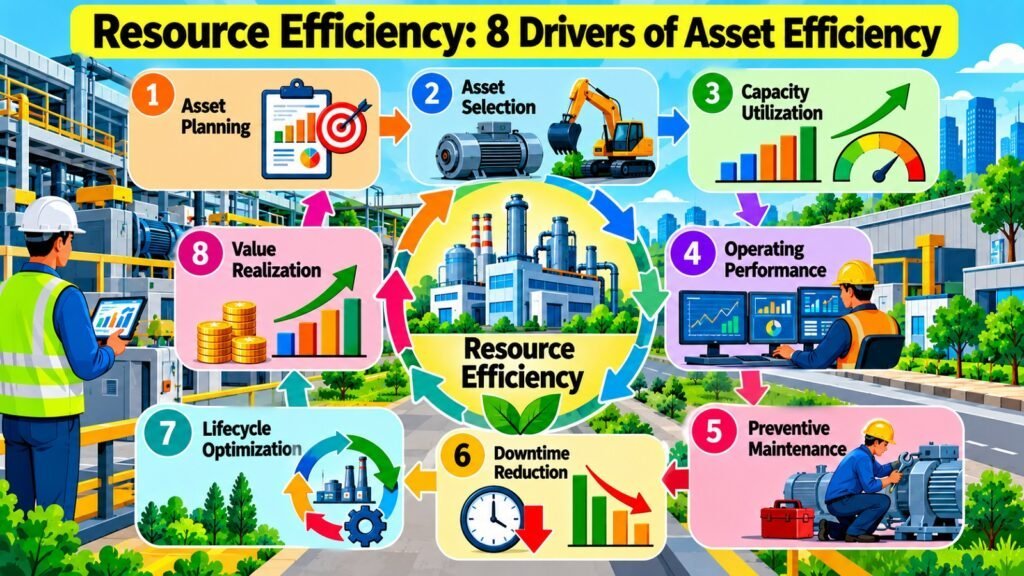
Asset and Equipment Efficiency is the Resource Efficiency dimension concerned with obtaining useful output from machinery, equipment, facilities, and other physical operating assets. It examines how well existing assets are utilized and how their performance and condition influence resource consumption, which connects physical asset management directly to Resource Efficiency outcomes.
Physical assets are acquired to produce output. When they operate below capacity, consume more resources than a given output justifies, sit idle, or perform inconsistently due to poor maintenance, the business incurs resource costs without generating proportional value. This form of resource loss is equally concrete in its operational and financial effect as material waste or process inefficiency.
Overall Equipment Effectiveness, or OEE, evaluates the combined effect of availability, performance rate, and quality yield on productive output. World-class manufacturing typically targets OEE levels around 85%, and the gap between actual and theoretical performance represents capacity not generating corresponding output along with the resources consumed to sustain it.
Maintenance practice is one of the most direct levers for Asset and Equipment Efficiency. Equipment in poor condition consumes more energy for the same output, generates more variation, produces more scrap, and experiences more unplanned downtime. Preventive and condition-based maintenance programs reduce these losses and improve both asset performance and resource use simultaneously, a connection frequently underappreciated in efficiency programs. Chronically underutilized assets present a related challenge: a facility operating equipment at 40% of its designed capacity absorbs fixed resource costs without extracting proportional productivity.
Resource Efficiency and Asset & Equipment Efficiency: Key Concepts
| Factor or Concept | Explanation |
| Overall Equipment Effectiveness (OEE) | Combines availability, performance rate, and quality yield into a single utilization measure |
| Equipment Availability | Proportion of planned operating time the equipment is actually available to run |
| Performance Rate | How close actual throughput is to the designed operating rate of the equipment |
| Condition-Based Maintenance | Maintenance triggered by actual equipment condition data rather than fixed time intervals |
| Capacity Utilization | Proportion of asset capacity productively used relative to total available capacity |
| Idle Energy Consumption | Resources consumed by equipment while not producing useful output |
| Maintenance and Resource Use | Equipment in poor condition consumes more resources per unit of output |
| Asset Rationalization | Identifying underutilized assets and addressing the organizational causes of underuse |
7. Resource Efficiency and Waste Prevention
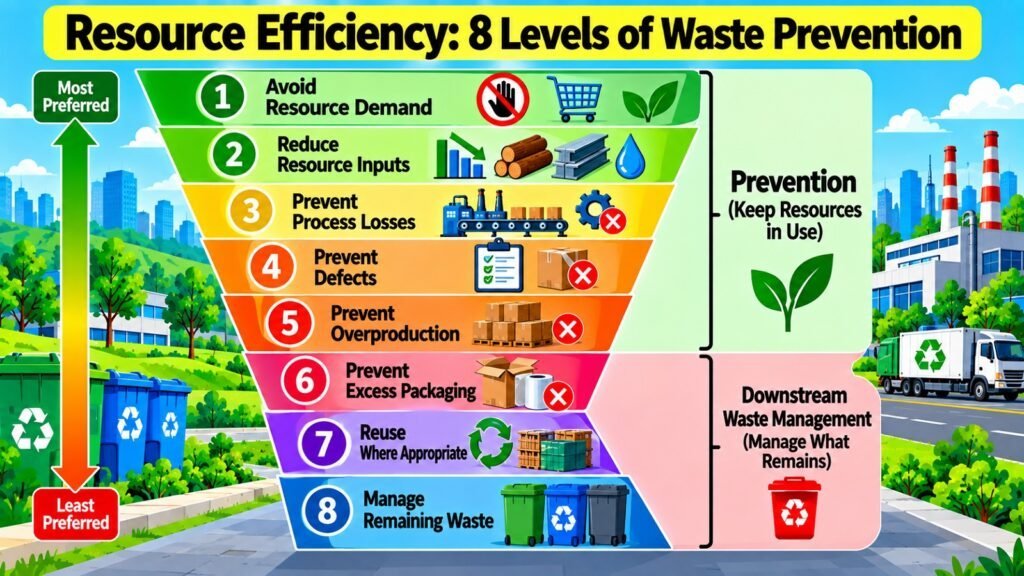
Waste Prevention is a core Resource Efficiency principle focused on stopping valuable resources from becoming waste before that loss occurs, which is fundamentally different from managing waste after the fact.
When a material becomes waste, its embedded value is lost entirely. The cost of acquiring it has already been incurred, the energy and water used to produce and transport it have already been consumed, and the labor involved has been expended. Downstream waste management can recover some fraction of embedded value, but it cannot recover the full cost of the input. Prevention avoids the loss before it occurs, which is why it occupies the highest position in the resource efficiency hierarchy.
Sources of avoidable resource loss are diverse. Overproduction consumes materials, energy, and capacity without corresponding demand. Defects and rework consume full process inputs while producing output that requires additional resources to correct or must be discarded. Spoilage results from planning, storage, or handling failures. Excess packaging consumes material beyond functional requirements. Each is preventable by addressing root causes rather than managing consequences.
A rigorous waste prevention analysis asks four questions: what resource is being lost, where does the loss occur, why does it occur, and what intervention would prevent it? This moves investigation from symptoms to causes. Overproduction, for example, is typically a consequence of demand forecasting or scheduling problems, and the intervention must address those organizational causes. The boundary with Circular Economy is clear: Waste Prevention stops avoidable losses from occurring, while recycling, remanufacturing, and resource recovery address what happens at end of use.
Resource Efficiency and Waste Prevention: Key Concepts
| Resource Loss Type | Prevention Approach |
| Overproduction | Align production scheduling and procurement to actual demand rather than forecast excess |
| Defects and Rework | Address root causes through process standardization and variation reduction |
| Spoilage | Improve storage, handling, and planning to match consumption to material shelf life |
| Process Losses | Redesign steps that generate material or energy losses without contributing to output |
| Excess Packaging | Match packaging specifications to functional requirements rather than convention |
| Idle Resource Consumption | Reduce energy and material use during planned and unplanned downtime periods |
| Inefficient Handling | Minimize material damage and degradation through improved handling and storage practices |
| Planning-Driven Waste | Coordinate procurement, production, and demand management to reduce excess inventory |
8. Resource Efficiency and Resource Efficiency Measurement
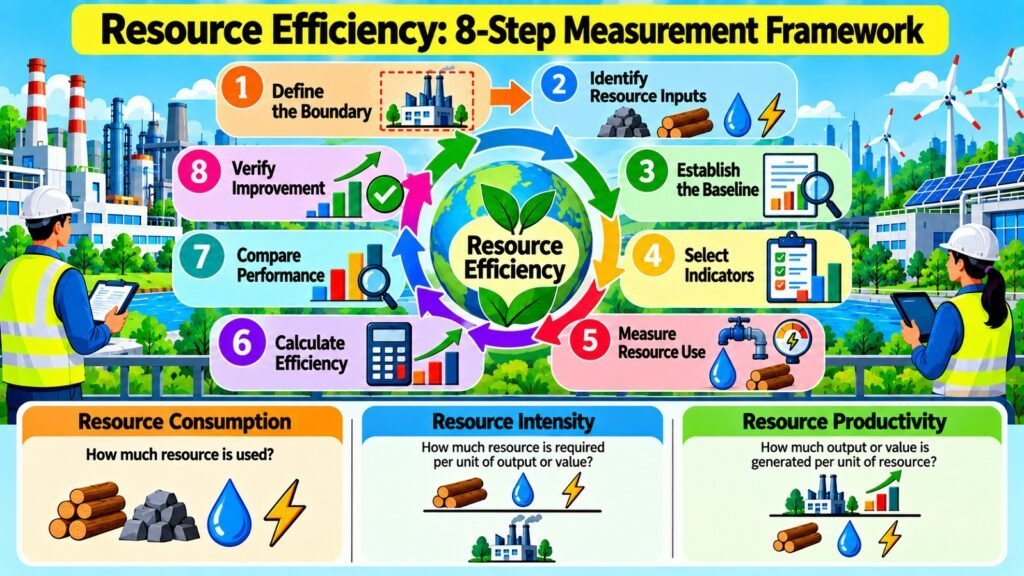
Resource Efficiency Measurement is the analytical foundation that allows businesses to determine whether resource use is actually becoming more efficient. Without reliable measurement, improvement programs rest on assumptions rather than evidence. Measurement transforms resource efficiency from a general aspiration into a managed, verifiable, and improvable process.
The building blocks of Resource Efficiency Measurement are resource consumption data, output data, defined operational boundaries, and a baseline for comparison. Consumption must be measured in consistent units over defined periods within clearly specified boundaries. Output must be expressed in meaningful denominators: revenue, production volumes, or service quantities. Without consistent, clearly defined parameters, the resulting ratios are unreliable and potentially misleading.
Resource intensity ratios are among the most widely used efficiency metrics. Energy per unit of output, water per tonne of product, and material per unit of revenue all express efficiency as a relationship between input and output. These ratios normalize for production volume changes, allowing a business to assess whether it is using resources more or less efficiently as output varies.
Improved resource intensity does not necessarily mean that total resource consumption has declined. When overall activity expands, absolute resource use may increase even as efficiency per unit improves. Organizations with absolute reduction commitments must therefore track both intensity ratios and total consumption. Resource Efficiency Measurement is explicitly distinct from Carbon Reporting, which involves greenhouse gas accounting, and from Circularity Measurement, which tracks the circular performance of material flows.
Resource Efficiency Measurement: Concepts, Metrics, and Interpretation
| Concept or Metric | Explanation |
| Resource Intensity Ratio | Resources consumed per unit of output; normalizes for production volume changes |
| Baseline | The initial measured level of resource use from which improvement is tracked |
| Measurement Boundary | The defined operational scope within which consumption and output are measured |
| Absolute Consumption | Total resource use measured independently of output; relevant for absolute reduction targets |
| Benchmarking | Comparing performance against historical internal data or available industry references |
| Rebound Effect in Measurement | Intensity can improve while absolute consumption rises if output grows faster than savings |
| Data Consistency | Consistent units, time periods, and definitions are required for reliable comparison |
| Boundary with Carbon Reporting | Resource Efficiency Measurement tracks input-output efficiency, not emission accounting |
Conclusion: Resource Efficiency – Building a More Sustainable Business
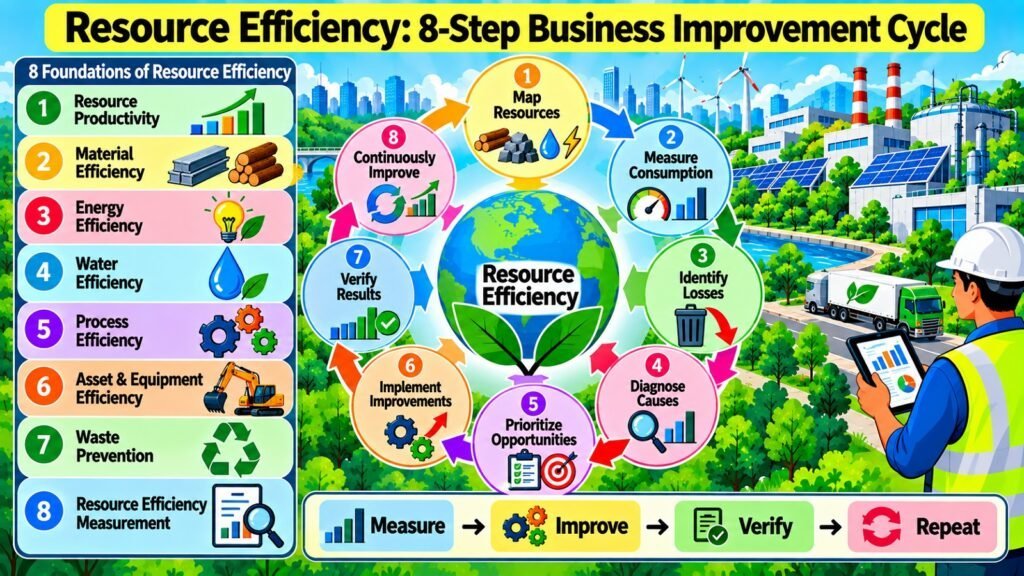
Resource Efficiency, as an important aspect of Sustainable Business, operates most effectively as an integrated framework. The eight foundations are interconnected dimensions of a single system, and improvement in one regularly creates conditions for improvement in others.
Resource Productivity establishes the core relationship between resources consumed and value generated. Material, Energy, and Water Efficiency address the three primary resource categories. Process Efficiency provides the mechanism through which multiple dimensions improve simultaneously. Asset and Equipment Efficiency ensures physical assets generate output without consuming resources unproductively. Waste Prevention addresses loss at source. Resource Efficiency Measurement provides the verified evidence that all seven dimensions are genuinely improving.
The goal is not simply to use less but to close the gap between resources consumed and value generated. The Circular Economy addresses resource recovery at end of use; Carbon Management addresses greenhouse gas emissions; Resource Efficiency addresses how efficiently resources are used within operations. A complete Sustainable Business strategy draws on all three.
A practical evaluation follows a clear sequence: identify resource inputs and establish a baseline; diagnose where losses occur and why; prioritize improvements; implement changes; measure and verify outcomes; and repeat the cycle. Resource Efficiency is a durable capability that builds compound returns, delivering lower resource costs, stronger process performance, and the discipline to adapt as resource availability, cost, and regulatory conditions evolve.
Resource Efficiency: The Eight Foundations and Their Contribution to Sustainable Business
| Foundation | Contribution to Resource Efficiency |
| Resource Productivity | Establishes the core value-per-input relationship that frames all efficiency improvement |
| Material Efficiency | Reduces unnecessary material consumption and minimizes production losses |
| Energy Efficiency | Lowers energy intensity and reduces unnecessary energy use across operations |
| Water Efficiency | Improves operational value from water and reduces losses from inefficient use |
| Process Efficiency | Addresses the operational mechanism through which multiple resource dimensions improve |
| Asset & Equipment Efficiency | Ensures physical assets generate productive output without excess resource consumption |
| Waste Prevention | Stops avoidable resource losses at source before they generate cost and waste burden |
| Resource Efficiency Measurement | Provides verified evidence that resource use is genuinely improving over time |